Wretched, Miserable, Poor, Blind, and Naked

1 “Hear this word, you cows of Bashan,
    who are on the mountain of Samaria,
who oppress the poor, who crush the needy,
    who say to your husbands, ‘Bring, that we may drink!’
2 The Lord God has sworn by his holiness
    that, behold, the days are coming upon you,
when they shall take you away with hooks,
    even the last of you with fishhooks.
3 And you shall go out through the breaches,
    each one straight ahead;
    and you shall be cast out into Harmon,”
declares the Lord.

4 “Come to Bethel, and transgress;
    to Gilgal, and multiply transgression;
bring your sacrifices every morning,
    your tithes every three days;
5 offer a sacrifice of thanksgiving of that which is leavened,
    and proclaim freewill offerings, publish them;
    for so you love to do, O people of Israel!”
declares the Lord God. – Amos 4:1-5 ESV

As Amos continues to convey to the people of Israel God’s righteous indignation with them, he focuses his attention like a laser on the wealthy women of Samaria. Addressing them as “you cows of Bashan,” Amos is unapologetically brutal in his description of their selfish and luxuriant lifestyle. These well-to-do women were guilty of flaunting their wealth and social status by treating others with contempt and condescension. Amos accuses them of “oppressing” the poor and “crushing” the needy.  In the Hebrew language, those two words paint a stark and highly unflattering picture of these women from the upper strata of Israelites society. The word translated as “oppressed” is ʿāšaq, and it means “to violate, defraud, do violence.” Amos is accusing these women of taking advantage of the poor for personal gain. They were defrauding and deceiving the less fortunate in order to increase their own wealth and further enhance their luxurious lifestyles.

In Hebrew, the word “crush” is rāṣaṣ, and it too carries a much more sinister and sinful connotation. It means “to crack in pieces” and can be used either literally or figuratively. In the figurative sense, to crush someone is to treat them with such disdain and disrespect that they are left broken or crushed in spirit. It conveys a lack of empathy or compassion, a total disregard for the worth or well-being of the other.

It seems that Amos is targeting these particular women because they represent that segment of Israelite society that had enjoyed a certain amount of personal success during Jeroboam II’s reign. Under his leadership, the nation had expanded its borders and many of these wealthy families had probably profited from the boom environment this growth created. In the very next chapter, Amos points out the injust nature of their treatment of the poor.

You trample the poor,
    stealing their grain through taxes and unfair rent.
Therefore, though you build beautiful stone houses,
    you will never live in them. – Amos 5:11 NLT

Amos is not suggesting that these women were responsible for all these injustices. But they were enjoying the fruit of someone else’s unjust “labor.” Most likely their husbands were the ones who were “trampling the poor” by levying excessive taxes and charging exorbitant rental fees for their properties. And all the while, they were using their ill-gotten profits to build luxury homes for themselves and their wives.

And Amos portrays the wives of these men as demanding taskmasters who treat their husbands like slaves. Amos purposefully uses hyperbolic, over-the-top language to illustrate the decadent and immoral lifestyle of the upper-class members of Israelite society. His portrayal of these women as lounging on their couches and demanding their husbands to bring them another drink is meant to expose the narcissistic nature of their lives. They are self-consumed and more interested in personal pleasure than in keeping God’s laws.

But by all appearances, these very same women were faithful members of the religious community of Israel. They made regular trips to the altars and shrines set up in Bethel and Gilgal. They worshiped the false gods that Jeroboam II and his predecessors had set up all throughout Israel. In other words, these wealthy women were outstanding members of the faith community. And they most likely believed that their wealth and prosperity had been a gift from the gods.

But Yahweh sees through their sanctimonious and self-righteous displays of mock-godliness. He sees behind the walls of their ostentatious homes and witnesses their “Lives of the Rich and Famous” lifestyles. But He also sees into the recesses of their sin-hardened hearts and knows that they are uncaring and unrepentant of their many transgressions. That’s why He sarcastically challenges them to keep doing what they’ve always done. He encourages them to continue offering their sacrifices and tithes to their false gods.

“Go ahead and offer sacrifices to the idols at Bethel.
    Keep on disobeying at Gilgal.
Offer sacrifices each morning,
    and bring your tithes every three days.
Present your bread made with yeast
    as an offering of thanksgiving.
Then give your extra voluntary offerings
    so you can brag about it everywhere!
This is the kind of thing you Israelites love to do…” – Amos 4:4-5 NLT

They’re worshiping the wrong gods and for all the wrong reasons. They want to be recognized for their religious zeal and applauded for their sacrificial displays of self-righteous sacrifice.

In His sermon on the mount, Jesus exposed this kind of hypocritical religious play-acting. He viewed it as nothing more than an attempt to gain the praise of men.

“Watch out! Don’t do your good deeds publicly, to be admired by others, for you will lose the reward from your Father in heaven.” – Matthew 6:1 NLT

These very same women who were oppressing the poor and crushing the needy were regularly offering their sacrifices and tithes at the temple. They even offered “extra voluntary offerings” but only so they could brag about it to others. Everything they did was all about inflating their own sense of value and worth. It wasn’t enough to be rich. They wanted to be esteemed. But to God, their acts of religious pietism were nothing more than evidence of their sin-hardened hearts. And Jesus would go on to point out the hypocritical nature of giving to get noticed.

“When you give to someone in need, don’t do as the hypocrites do—blowing trumpets in the synagogues and streets to call attention to their acts of charity!” – Matthew 6:2 NLT

But God makes it clear that these kinds of people will pay dearly for their actions. He cannot and will not tolerate this kind of behavior among His chosen people. God has sworn by His own holiness that the guilty will be punished. This statement is intended to stress the otherness of God. He is set apart and holy. He is fully righteous and without sin. He cannot simply turn a blind eye to the unrighteous behavior of His people. His holy nature requires that He deal justly with the blatant disobedience of those who bear His name and have been called to be His light to the nations.

And God announces that these self-absorbed, pampered, and pretentiously pious women will suffer a devastating and humiliating fate.

“The time will come when you will be led away
    with hooks in your noses.
Every last one of you will be dragged away
    like a fish on a hook!
You will be led out through the ruins of the wall;
    you will be thrown from your fortresses.” – Amon 4:2-3 NLT

God predicts a less-than-flattering outcome for these women. They will one day find themselves on the receiving end of the oppression and crushing. When the Assyrians invade Israel, lay siege to the capital city of Samaria, and eventually breach the walls, they capture these women, leading them out of the city with hooks in their noses – just like cows being led to the slaughter. Their wealth and luxurious homes will provide no comfort or protection. Their tithes and extra volunteer offerings will do nothing to garner aid or assistance from their false gods. They will be unceremoniously marched out of town and led to a life marked by poverty and oppression.

But it didn’t have to be this way. As Amos will reveal in the following verses, God had given them ample opportunity to repent and return to Him. He had warned them. He had even afflicted them with plagues, diseases, famines, and troubles of all kinds. But they had repeatedly refused to heed His warnings or be humbled by His judgments. And God will repeatedly remind them, “you did not return to me” (Amos 4:8 ESV).

In the book of Revelation, the apostle John records the words of Jesus regarding the spiritual state of the church in Laodicea, and it is not a flattering picture.

“You say, ‘I am rich. I have everything I want. I don’t need a thing!’ And you don’t realize that you are wretched and miserable and poor and blind and naked.” – Revelation 3:17 NLT

This indictment from the lips of Jesus seems to apply to the wealthy women of Samaria who were living during the days of Amos. They were convinced that their wealth was evidence of their spiritual superiority. They were blessed. And they somehow believed that they deserved even more, which is what led them to oppress and crush the poor and needy. But like the Laodiceans, they were actually wretched, miserable, poor, blind, and naked. And the day was coming when their true spiritual condition would be exposed for all to see.

English Standard Version (ESV) The Holy Bible, English Standard Version. ESV® Permanent Text Edition® (2016). Copyright © 2001 by Crossway Bibles, a publishing ministry of Good News Publishers.

New Living Translation (NLT) Holy Bible, New Living Translation, copyright © 1996, 2004, 2015 by Tyndale House Foundation. Used by permission of Tyndale House Publishers Inc., Carol Stream, Illinois 60188. All rights reserved.

The Message (MSG)Copyright © 1993, 1994, 1995, 1996, 2000, 2001, 2002 by Eugene H. Peterson

Going Through the Motions

21 And the king commanded all the people, “Keep the Passover to the Lord your God, as it is written in this Book of the Covenant.” 22 For no such Passover had been kept since the days of the judges who judged Israel, or during all the days of the kings of Israel or of the kings of Judah. 23 But in the eighteenth year of King Josiah this Passover was kept to the Lord in Jerusalem.

24 Moreover, Josiah put away the mediums and the necromancers and the household gods and the idols and all the abominations that were seen in the land of Judah and in Jerusalem, that he might establish the words of the law that were written in the book that Hilkiah the priest found in the house of the Lord. 25 Before him there was no king like him, who turned to the Lord with all his heart and with all his soul and with all his might, according to all the Law of Moses, nor did any like him arise after him.

26 Still the Lord did not turn from the burning of his great wrath, by which his anger was kindled against Judah, because of all the provocations with which Manasseh had provoked him. 27 And the Lord said, “I will remove Judah also out of my sight, as I have removed Israel, and I will cast off this city that I have chosen, Jerusalem, and the house of which I said, My name shall be there.” – 2 Kings 23:21-27 ESV

Josiah’s efforts to restore the worship of Yahweh in Judah were unprecedented. He did more than any of the other kings of Judah to reestablish and reaffirm the nation’s commitment to the covenant they had made with God. But he faced a formidable and seemingly endless task. His own father had bequeathed to him a kingdom that was in a state of spiritual disarray and moral decline. It seems that everywhere Josiah looked, he found more idols, altars, and shrines to the many false gods his predecessors had erected in Judah. Their pervasive presence provided tangible evidence of the nation’s steep spiritual decline. Like cancer cells in the human body, idolatry had invaded the nation of Judah, spreading its deadly influence to the far corners of the kingdom. And Josiah spent a lifetime attempting to seek and destroy every last vestige of idolatry from the land.

But Josiah knew that even if he was successful in removing every idol, shrine, and altar,  there would still be a problem. The eradication of idolatry would not necessarily result in faithfulness to Yahweh. To restore the peoples’ faith in God, Josiah knew they would need to be reminded of the greatness of God. That is why he spent so much time and money restoring the temple, the symbol of God’s presence and power. It also explains his determination to reinstitute the celebration of Passover.

This annual feast had been divinely ordained by God and was intended to serve as a perpetual reminder of God’s miraculous and gracious deliverance of the nation of Israel from their captivity in Egypt. On the night that God had sent the death angel to enact the tenth and final plague against the Egyptians, He had given the Israelites instructions that would guarantee their safety. Each family was to sacrifice a lamb and sprinkle its blood on the doorposts and lentil of their home. Then they were to gather inside their homes and “eat the meat the same night; they will eat it roasted over the fire with bread made without yeast and with bitter herbs” (Exodus 12:8 NLT).

The people of Israel were expected to faithfully observe this rather strange ritual in order to escape the judgment that was about to fall on the land of Egypt. And God assured them that if they would obey His instructions, they would be spared.

“I will pass through the land of Egypt in the same night, and I will attack all the firstborn in the land of Egypt, both of humans and of animals, and on all the gods of Egypt I will execute judgment. I am the Lord. The blood will be a sign for you on the houses where you are, so that when I see the blood I will pass over you, and this plague will not fall on you to destroy you when I attack the land of Egypt.” – Exodus 12:12-13 NLT

And even before the lambs were slaughtered and the death angel appeared, God commanded His people to make this an annual celebration.

This day will become a memorial for you, and you will celebrate it as a festival to the Lord—you will celebrate it perpetually as a lasting ordinance. – Exodus 12:14 NLT

They were to observe it every year as a reminder of God’s power and provision. And Moses even told them what to say when the future generations of Israelites asked about the nature of this strange celebration.

“It is the sacrifice of the Lord’s Passover, when he passed over the houses of the Israelites in Egypt, when he struck Egypt and delivered our households.” – Exodus 12:27 NLT

But by the time Josiah became king, the celebration of Passover had become a distant and fading memory. Generations of Israelites had grown up having never celebrated this annual feast or having heard the story of God’s deliverance. As a result, they were ignorant of His goodness and greatness. In their minds, Yahweh was just one more God in the pantheon of gods worshiped in Judah. And when Josiah systematically removed all the other options, they found themselves left with a God they didn’t know and could not fully appreciate. And because they had not been taught the Book of the Covenant, they failed to understand the danger of their ignorance of and indifference to God. Centuries earlier, before the Israelites entered the land of promise, Moses had warned them:

“Then when the Lord your God brings you to the land he promised your ancestors Abraham, Isaac, and Jacob to give you—a land with large, fine cities you did not build, houses filled with choice things you did not accumulate, hewn-out cisterns you did not dig, and vineyards and olive groves you did not plant—and you eat your fill, be careful not to forget the Lord who brought you out of Egypt, that place of slavery. You must revere the Lord your God, serve him, and take oaths using only his name. You must not go after other gods, those of the surrounding peoples, for the Lord your God, who is present among you, is a jealous God—his anger will erupt against you and remove you from the land.” – Deuteronomy 6:10-15 NLT

Everything Moses had warned them about had happened. They had forgotten God. They had failed to revere and serve Him. And Josiah was desperately trying to remedy the situation by calling the people to recommit themselves to Yahweh. He used all his authority and power as king to reestablish the primacy of the one true God. He poured every ounce of his passion into the process and spared no expense to see that Yahweh was honored in a manner worthy of His greatness and goodness. Josiah went out of his way to ensure that this Passover was a spectacular occasion that would reaffirm God’s incomparable value and reignite the peoples’ faithfulness to Him.

Never since the time of the prophet Samuel had there been such a Passover. None of the kings of Israel had ever kept a Passover as Josiah did, involving all the priests and Levites, all the people of Jerusalem, and people from all over Judah and Israel. – 2 Chronicles 35:18 NLT

Josiah’s tireless efforts to restore the worship of Yahweh in Judah would not go unnoticed. He would go down in history as one of the greatest kings of Judah.

Before him there was no king like him, who turned to the Lord with all his heart and with all his soul and with all his might, according to all the Law of Moses, nor did any like him arise after him. – 2 Kings 23:25 ESV

He was a man of great faith who used his divinely ordained role as king to lead the people back to God. Like his ancestor David, Josiah was a man after God’s own heart who shepherded the flock of God “with a true heart and led them with skillful hands” (Psalm 78:72 NLT). He did all he could do to reestablish the holiness of God’s name and reinvigorate the hearts of the people to serve Him alone. But his efforts, while sincere, would prove unsuccessful. God was not going to relent concerning His judgment of Judah.

Even so, the Lord was very angry with Judah because of all the wicked things Manasseh had done to provoke him. For the Lord said, “I will also banish Judah from my presence just as I have banished Israel. And I will reject my chosen city of Jerusalem and the Temple where my name was to be honored.” – 2 Kings 23:26-27 NLT

God knew their hearts, and He was fully aware that their outward displays of repentance were insincere and insufficient. The idols had been removed, but their hardened hearts remained. And this sad state of affairs would lead God to declare through the prophet Isaiah:

“These people say they are loyal to me;
they say wonderful things about me,
but they are not really loyal to me.
Their worship consists of
nothing but man-made ritual.” – Isaiah 29:13 NLT

Josiah had torn down all the idols, shrines, and altars, but he could do nothing to heal the hearts of the people. Despite all his efforts, the people remained just as unfaithful and unresponsive to God. The prophet Isaiah would accuse them of having a diminished view of God.

Those who try to hide their plans from the Lord are as good as dead,
who do their work in secret and boast,
“Who sees us? Who knows what we’re doing?”
Your thinking is perverse!
Should the potter be regarded as clay?
Should the thing made say about its maker, “He didn’t make me”?
Or should the pottery say about the potter, “He doesn’t understand”? – Isaiah 29:15-16 NLT

Josiah had purged the land of idols, restored the temple, reinstituted the Passover, and refamiliarized the people with the Book of the Covenant. But he could do nothing to legislate heart change. While he had successfully transformed the environment in which they lived, the people of Judah remained just as unfaithful as ever. God would later warn the prophet Ezekiel to be wary of the hypocritical hearts of the people of Judah.

“So my people come pretending to be sincere and sit before you. They listen to your words, but they have no intention of doing what you say. Their mouths are full of lustful words, and their hearts seek only after money.” – Ezekiel 33:31 NLT

Judah would experience the same fate as their neighbor to the north. Their disobedience and unfaithfulness to God would result in their destruction. Josiah had done his best, but the fall of Judah was inevitable and unavoidable because the hearts of the people remained unresponsive and unrepentant.

English Standard Version (ESV) The Holy Bible, English Standard Version. ESV® Permanent Text Edition® (2016). Copyright © 2001 by Crossway Bibles, a publishing ministry of Good News Publishers.

New Living Translation (NLT) Holy Bible, New Living Translation, copyright © 1996, 2004, 2015 by Tyndale House Foundation. Used by permission of Tyndale House Publishers Inc., Carol Stream, Illinois 60188. All rights reserved.

The Message (MSG)Copyright © 1993, 1994, 1995, 1996, 2000, 2001, 2002 by Eugene H. Peterson

A Serious Heart Condition

14 And he called the people to him again and said to them, “Hear me, all of you, and understand: 15 There is nothing outside a person that by going into him can defile him, but the things that come out of a person are what defile him.” 17 And when he had entered the house and left the people, his disciples asked him about the parable. 18 And he said to them, “Then are you also without understanding? Do you not see that whatever goes into a person from outside cannot defile him, 19 since it enters not his heart but his stomach, and is expelled?” (Thus he declared all foods clean.) 20 And he said, “What comes out of a person is what defiles him. 21 For from within, out of the heart of man, come evil thoughts, sexual immorality, theft, murder, adultery, 22 coveting, wickedness, deceit, sensuality, envy, slander, pride, foolishness. 23 All these evil things come from within, and they defile a person.” – Mark 7:14-23 ESV

A small contingent of scribes and Pharisees had confronted Jesus with an accusation presented in the form of a question. They were demanding that Jesus explain the “shocking” behavior of His disciples.

“Why do your disciples not walk according to the tradition of the elders, but eat with defiled hands?” – Mark 7:5 ESV

What shocked these pious religious leaders was the sight of Jesus’ disciples consuming food without having first cleansed their hands properly.  The word “defiled” is a translation of the Greek word, aniptos which means “unwashed.”  Mark provides a clue as to what was motivating the religious leaders.

For the Pharisees and all the Jews do not eat unless they wash their hands properly, holding to the tradition of the elders… – Mark 7:3 ESV

According to these men, the disciples had violated established protocol. The “tradition of the elders” or oral law, required that all Jews go through a ceremonial cleansing of the hands before eating. Jews were required to wash their hands and say a blessing before eating any meal that included bread. The ritual was known as netilat yadayim, and involved the use of a cup that was used to pour water onto the hands and allowing it to flow down to the elbows. The ritual had nothing to do with personal hygiene but was done for ritualistic purposes.

According to the Cambridge Bible for Schools and Colleges, this was nothing more than a ceremony that had little pragmatic value.

When, therefore, some of the Pharisees remarked that our Lord’s disciples ate with “unwashen hands,” it is not to be understood literally that they did not at all wash their hands, but that they did not wash them ceremonially according to their own practice. And this was expected of them only as the disciples of a religious teacher; for these refinements were not practised by the class of people from which the disciples were chiefly drawn. – Cambridge Bible for Schools and Colleges

And Jesus was well aware of the intentions of His accusers. These men were trying to label He and His disciples as law-breakers. But Jesus took the opportunity to teach His followers a valuable lesson on hygiene and holiness.

While the Pharisees had focused all their attention on the outward practice of hand-washing, Jesus took the conversation deeper. To put it another way, He went to the “heart” of the matter. Gathering the people around Him, Jesus said, “All of you listen…and try to understand. It’s not what goes into your body that defiles you; you are defiled by what comes from your heart” (Mark 7:14-15 NLT).

And that was all He said. As usual, Jesus’ reply was short and succinct, but not exactly clear. And Mark indicates that even the 12 disciples had a difficult time understanding the meaning behind Jesus’ abbreviated lesson. When they were able to be alone with Jesus, they asked Him to explain the meaning behind what they understood to be another one of His parables. But this was less a parable than it was a moral object lesson. What had precipitated Jesus’ comment was the emphasis of the scribes and Pharisees on ritualistic cleansing. These men were all about appearances and used their lengthy list of man-made rules as a way to promote and prove their own righteousness. Their behavior became their badge of honor. Rule-keeping became their primary means for measuring righteousness. But Jesus was much more interested in the inside than the outside. On another occasion, He would level a stinging accusation against the Pharisees, exposing the farcical nature of all their religious rule-keeping.

“you are so careful to clean the outside of the cup and the dish, but inside you are filthy—full of greed and self-indulgence!” – Matthew 23:25 NLT

These attacks on the well-respected religious leaders always left the disciples scratching their heads in confusion. Weren’t the scribes and Pharisees to be revered for their obvious displays of righteousness? How could Jesus get away with calling them hypocrites and blind guides? Why did He feel the constant need to anger them?

But Jesus was attempting to teach His disciples that the problem mankind faced was not of a physical nature but of a spiritual one. It all had to do with the condition of the heart. And no amount of outward cleansing or ritual purification could result in a holy heart. So, He reiterated His original statement one more time, but with further clarification.

“Can’t you see that the food you put into your body cannot defile you? Food doesn’t go into your heart, but only passes through the stomach and then goes into the sewer.” – Mark 7:18 NLT

Food was little more than fuel, taken into the body as a source of energy, then passed out as human waste. The washing of hands, pots, pans, and the food itself, while beneficial from a personal hygiene perspective, had no value when it came to a person’s spiritual condition. Food may help power the human heart, but it can do nothing to influence the moral state of the human soul, either positively or negatively. Drinking from a ritualistically cleansed cup may make one feel purer, but it was nothing more than a  facade, an exercise in self-deception.

Mark adds another important parenthetical statement intended to provide further clarification for the readers of his gospel.

By saying this, he declared that every kind of food is acceptable in God’s eyes. – Mark 7:19 NLT

This expanded explanation most likely escaped the disciples. But it would become clearer to them when Jesus had ascended back into heaven after His resurrection. In the days after Jesus departed and the Holy Spirit ascended, the disciples would obey His commission and take the gospel to Jerusalem, Judea, and the ends of the earth (Acts 1:8). And, before long, there would be Gentiles accepting the free gift of God’s grace made possible through faith in Jesus Christ and receiving the indwelling presence of the Spirit of God. The addition of Gentile converts to the early church would produce an important debate among the disciples about the role of the Mosaic law in the lives of these former pagans. There were those, like Peter, who believed that any Gentiles who came to faith should be required to keep the Jewish religious laws, just as they did. But Paul, the apostle to the Gentiles, would push back strongly against this unnecessary requirement. In doing so, he was not denigrating God’s law, but simply denying that salvation was by faith alone in Christ alone, with no other requirements necessary. Paul would argue vehemently that the law had no place in the lives of these Gentile converts. The Jewish dietary laws no longer applied. And even the Jewish rite of circumcision was to be set aside.

For no one is a Jew who is merely one outwardly, nor is circumcision outward and physical. But a Jew is one inwardly, and circumcision is a matter of the heart, by the Spirit, not by the letter. His praise is not from man but from God. – Romans 2:28-29 NLT

It was all about the heart. And that was the very point Jesus was trying to make with His disciples. And knowing that their hearts were hardened (Mark 6:52), making it difficult for them to grasp the meaning behind His teaching, Jesus made it plain and simple.

“It is what comes from inside that defiles you. For from within, out of a person’s heart, come evil thoughts, sexual immorality, theft, murder, adultery, greed, wickedness, deceit, lustful desires, envy, slander, pride, and foolishness. All these vile things come from within; they are what defile you.” – Mark 7:20-23 NLT

This less-than-flattering list is similar to one found in Paul’s letter to the believers in Galatia.

When you follow the desires of your sinful nature, the results are very clear: sexual immorality, impurity, lustful pleasures, idolatry, sorcery, hostility, quarreling, jealousy, outbursts of anger, selfish ambition, dissension, division, envy, drunkenness, wild parties, and other sins like these. Let me tell you again, as I have before, that anyone living that sort of life will not inherit the Kingdom of God. – Galatians 5:19-21 NLT

These ungodly, unholy, and unrighteous actions are not the result of unwashed hands but an unregenerate heart. Man’s heart is wicked and controlled by his sinful nature. It is not the byproduct of poor living conditions, improper hygiene, insufficient education, or the failure to keep a set of religious rules.

James reminds us that “Temptation comes from our own desires, which entice us and drag us away. These desires give birth to sinful actions. And when sin is allowed to grow, it gives birth to death” (James 1:14-16 NLT). The prophet Jeremiah adds, “The human heart is the most deceitful of all things, and desperately wicked. Who really knows how bad it is?” (Jeremiah 17:9 NLT).

So, Jesus was trying to communicate a deep and abiding truth regarding the nature of man’s sinful state. No amount of ritual cleansing was going to solve the problem. The Pharisees could cleanse the outside of “the cup,” but they would be missing the real problem. Like all men, they were suffering from a serious heart condition that was untreatable by human means. Even their strict adherence to the laws of Moses and their faithful keeping of the traditions of the fathers could do nothing to render their hearts holy and acceptable to God.

And as Paul would later tell the Galatian believers, “it is clear that no one can be made right with God by trying to keep the law. For the Scriptures say, ‘It is through faith that a righteous person has life’” (Galatians 3:11 NLT).

This was news to the disciples and it went against everything they had been taught as young boys receiving training in the local synagogue. Jesus was letting them know that the problem of sin was far greater and more pervasive than they realized. Man’s defilement and condemnation before God was an internal problem, not an external one, and there would be only one solution. And He was standing right in front of them.

English Standard Version (ESV) The Holy Bible, English Standard Version. ESV® Permanent Text Edition® (2016). Copyright © 2001 by Crossway Bibles, a publishing ministry of Good News Publishers.

New Living Translation (NLT) Holy Bible, New Living Translation, copyright © 1996, 2004, 2015 by Tyndale House Foundation. Used by permission of Tyndale House Publishers Inc., Carol Stream, Illinois 60188. All rights reserved.

The Message (MSG)Copyright © 1993, 1994, 1995, 1996, 2000, 2001, 2002 by Eugene H. Peterson
Fakers and Frauds

53 When they had crossed over, they came to land at Gennesaret and moored to the shore. 54 And when they got out of the boat, the people immediately recognized him 55 and ran about the whole region and began to bring the sick people on their beds to wherever they heard he was. 56 And wherever he came, in villages, cities, or countryside, they laid the sick in the marketplaces and implored him that they might touch even the fringe of his garment. And as many as touched it were made well. 

2 Now when the Pharisees gathered to him, with some of the scribes who had come from Jerusalem, 2 they saw that some of his disciples ate with hands that were defiled, that is, unwashed. 3 (For the Pharisees and all the Jews do not eat unless they wash their hands properly, holding to the tradition of the elders, 4 and when they come from the marketplace, they do not eat unless they wash. And there are many other traditions that they observe, such as the washing of cups and pots and copper vessels and dining couches.) 5 And the Pharisees and the scribes asked him, “Why do your disciples not walk according to the tradition of the elders, but eat with defiled hands?” 6 And he said to them, “Well did Isaiah prophesy of you hypocrites, as it is written,

“‘This people honors me with their lips,
    but their heart is far from me;
7 in vain do they worship me,
    teaching as doctrines the commandments of men.’

8 You leave the commandment of God and hold to the tradition of men.”

9 And he said to them, “You have a fine way of rejecting the commandment of God in order to establish your tradition! 10 For Moses said, ‘Honor your father and your mother’; and, ‘Whoever reviles father or mother must surely die.’ 11 But you say, ‘If a man tells his father or his mother, “Whatever you would have gained from me is Corban”’ (that is, given to God)— 12 then you no longer permit him to do anything for his father or mother, 13 thus making void the word of God by your tradition that you have handed down. And many such things you do.” – Mark 6:53-7:13 ESV

One can only imagine the conversations that took place in the boat as the disciples made their way to the northwestern shore of the Sea of Galilee. Just minutes before, they had been fighting the winds and waves of a ferocious storm when suddenly, Jesus had appeared to them, walking on the water. Not recognizing their friend and teacher, they had thought Him to be some kind of ghostly apparition. But Jesus spoke to them, entered the boat with them, and calmed the storm that surrounded them. And the rest of their trip to the region of Gennesaret must have been filled with whispered discussions about what they had just witnessed. These men, desperately trying to take in all that had happened over the last few days, were struggling to reconcile their experiences and expectations. They wanted to believe that Jesus was the Messiah and He had given ample evidence to convince them, but they were still doubtful. Mark indicates that “they still didn’t understand the significance of the miracle of the loaves. Their hearts were too hard to take it in” (Mark 6:52 NLT).

As they arrived in Gennesaret, they disembarked from their boat and were immediately engulfed by the crowds of people attempting to get to Jesus. News of their arrival spread fast and, before long, they found themselves immersed in the circus-like atmosphere that followed Jesus wherever He went.

Wherever he went—in villages, cities, or the countryside—they brought the sick out to the marketplaces. They begged him to let the sick touch at least the fringe of his robe, and all who touched him were healed. – Mark 6:56 NLT

It would appear that the people of Gennesaret had heard the rumors about the woman who was healed simply by touching the edge of Jesus’ robe. This news emboldened people to take matters into their own hands, likely resulting in Jesus being swarmed by those attempting to touch Him so they could be healed. And Jesus graciously allowed them to invade His personal space so that “all who touched him were healed.”

But there were others who wanted to lay their hands on Jesus, not to be healed but so that they might arrest Him. A contingent of Pharisees and scribes had arrived from Jerusalem and they had one purpose for their mission: Find evidence that would convict Jesus of breaking the law and justify His arrest.

The scribes and Pharisees, as experts in the Mosaic Law, were well-equipped for the task they had been given by the high priest. Their extensive knowledge of both the written and oral laws of Israel provided them with a virtual treasure trove of potential rule violations with which to convict Jesus. Surely there was some obscure law He was breaking that they could use as evidence against Him. If nothing else, they hoped to discredit Jesus by portraying Him as ignorant of God’s laws or guilty of willfully ignoring them.

So, it is no surprise that they approached Jesus and demanded that He explain the questionable behavior of His disciples.

“Why do your disciples not walk according to the tradition of the elders, but eat with defiled hands?” – Mark 7:6 ESV

To help his readers understand what is going on, Mark provides a parenthetical explanation of Jewish purification rites.

The Jews, especially the Pharisees, do not eat until they have poured water over their cupped hands, as required by their ancient traditions. Similarly, they don’t eat anything from the market until they immerse their hands in water. This is but one of many traditions they have clung to—such as their ceremonial washing of cups, pitchers, and kettles. – Mark 7:3-4 NLT

These “ancient traditions” were not part of the Mosaic Law but had been created and passed down by men. Essentially, they were add-ons or man-made additions to God’s law. And they had nothing to do with physical cleanliness or hygiene. These rules or rituals were followed in order to demonstrate and declare one’s righteousness. It was all about appearances. Jesus would later say of them:

“They crush people with unbearable religious demands and never lift a finger to ease the burden. Everything they do is for show.” – Matthew 23:4-5 NLT

And He would go on to level some serious accusations against these self-ascribed icons of righteousness.

“What sorrow awaits you teachers of religious law and you Pharisees. Hypocrites! For you are so careful to clean the outside of the cup and the dish, but inside you are filthy—full of greed and self-indulgence! You blind Pharisee! First wash the inside of the cup and the dish, and then the outside will become clean, too.

“What sorrow awaits you teachers of religious law and you Pharisees. Hypocrites! For you are like whitewashed tombs—beautiful on the outside but filled on the inside with dead people’s bones and all sorts of impurity. Outwardly you look like righteous people, but inwardly your hearts are filled with hypocrisy and lawlessness.” – Matthew 23:25-28 NLT

Their righteousness was nothing more than a facade, a carefully crafted image meant to obscure the true condition of their hearts. And when these men confronted Jesus about the unacceptable habits of His disciples, He responded by quoting Scripture.

“You hypocrites! Isaiah was right when he prophesied about you, for he wrote,

‘These people honor me with their lips,
    but their hearts are far from me.
Their worship is a farce,
    for they teach man-made ideas as commands from God.’

For you ignore God’s law and substitute your own tradition.” – Mark 7:6-8 NLT

Jesus used the Old Testament Scriptures against them. Using the writings of one of their revered prophets, Jesus exposed their self-righteous indignation for what it was – nothing more than prideful pretense. They were nothing more than hypocrites and pretenders. In fact, the Greek word, hypokritēs was used to refer to an actor in a play, someone who assumed the character of another.

These men had fooled everyone into believing that they were holy and righteous. But they had made their own man-made rules more important than the commands of God. They were guilty of giving precedence to their “traditions,” even creating loopholes that allowed them to violate God’s laws.

“You skillfully sidestep God’s law in order to hold on to your own tradition.” – Mark 7:9 NLT

And Jesus provides them with specific examples.

“For instance, Moses gave you this law from God: ‘Honor your father and mother,’ and ‘Anyone who speaks disrespectfully of father or mother must be put to death.’ But you say it is all right for people to say to their parents, ‘Sorry, I can’t help you. For I have vowed to give to God what I would have given to you.’” – Mark 7:10-11 NLT

Jesus was referring to their law of corban. This man-made law allowed someone to dedicate something as an offering to God but did not require them to relinquish possession of it. As Jesus reveals, it was nothing more than a convenient way for someone to tie up their assets so that they wouldn’t have to share them with others. This was in direct violation of God’s law. The Ten Commandments had made it clear that the Jews were to honor their parents, and in a society that lacked any kind of welfare system, this would have included the provision of financial support. But corban provided a convenient loophole. By dedicating their resources to God, a Jew could excuse themselves from assisting their needy parents. And because they were not required to immediately turn over their assets to God, they were free to use them for their own personal benefit. And Jesus exposed corban for what it was: Lawlessness.

“In this way, you let them disregard their needy parents. And so you cancel the word of God in order to hand down your own tradition.” – Mark 7:12-13 NLT

These men had no right to question Jesus about the behavior of His disciples. They were nothing more than whitewashed tombs. Their sanctimonious self-righteousness was little more than a show, a poorly veiled display of moral pretense and hypocrisy.

In attempting to judge Jesus, the scribes and Pharisees left themselves open to judgment. And Jesus pulled no punches. He wanted His disciples to understand that the laws of God always took precedence over any rules or regulations made by men. And Jesus came to fulfill each and every one of the laws given by His Heavenly Father. In His sermon on the mount, Jesus declared His God-ordained mission to fulfill the law of God – down to the very last detail.

“Don’t misunderstand why I have come. I did not come to abolish the law of Moses or the writings of the prophets. No, I came to accomplish their purpose. I tell you the truth, until heaven and earth disappear, not even the smallest detail of God’s law will disappear until its purpose is achieved. So if you ignore the least commandment and teach others to do the same, you will be called the least in the Kingdom of Heaven. But anyone who obeys God’s laws and teaches them will be called great in the Kingdom of Heaven.” – Matthew 5:17-19 NLT

And because the scribes and Pharisees were guilty of ignoring God’s law by replacing it with their own, they would be least in the Kingdom of Heaven.

English Standard Version (ESV) The Holy Bible, English Standard Version. ESV® Permanent Text Edition® (2016). Copyright © 2001 by Crossway Bibles, a publishing ministry of Good News Publishers.

New Living Translation (NLT) Holy Bible, New Living Translation, copyright © 1996, 2004, 2015 by Tyndale House Foundation. Used by permission of Tyndale House Publishers Inc., Carol Stream, Illinois 60188. All rights reserved.

The Message (MSG)Copyright © 1993, 1994, 1995, 1996, 2000, 2001, 2002 by Eugene H. Peterson

The Danger of Self-Righteousness

13 He went out again beside the sea, and all the crowd was coming to him, and he was teaching them. 14 And as he passed by, he saw Levi the son of Alphaeus sitting at the tax booth, and he said to him, “Follow me.” And he rose and followed him.

15 And as he reclined at table in his house, many tax collectors and sinners were reclining with Jesus and his disciples, for there were many who followed him. 16 And the scribes of the Pharisees, when they saw that he was eating with sinners and tax collectors, said to his disciples, “Why does he eat with tax collectors and sinners?” 17 And when Jesus heard it, he said to them, “Those who are well have no need of a physician, but those who are sick. I came not to call the righteous, but sinners.” – Mark 2:13-17 ESV

Jesus has just displayed His power and authority over the physical realm by healing the paralyzed man. But, more importantly, His astonishing ability to restore the man’s health was a demonstration of His God-given authority to forgive sin. As the Son of God, Jesus had come to earth in order to set men free from their slavery to sin and their condemnation of death. The formerly paralyzed man, while physically whole and forgiven, would still end up committing sins and face the ultimate penalty for doing so: physical death and eternal separation from God.

But Jesus had become a man so that He might serve as the substitutionary atonement, the ultimate sacrifice for the sins of mankind. His death on behalf of sinful humanity would satisfy the just and righteous wrath of God, and provide all those who placed their faith in His atoning work with a way to be restored to a right relationship with His Father. And, as a result of Jesus’ selfless sacrifice, they would enjoy forgiveness of all their sins – past, present, and future. The author of Hebrews describes it this way:

…he has appeared once for all at the end of the ages to put away sin by the sacrifice of himself. – Hebrews 9:26 ESV

And the psalmist provides us with a powerful reminder of the sin-forgiving power of the Son of God.

As far as the east is from the west, so far has He removed our transgressions from us.
 – Psalm 103:12 BSB

Mark transitions his narrative from the crowded confines of Simon and Andrew’s home to the shoreline of the Sea of Galilee. But will maintain his emphasis on Jesus’ power and authority to forgive sin, and continue to reveal the growing divide between Jesus and the religious authorities.

While walking along the seashore, Jesus continued to teach the crowds that continued to follow Him wherever He went. And as they made their way along the roadway that ran from Capernaum to Damascus and along the shore of the Sea of Galilee, they came across the tax booth of a man named Levi. This was not some chance encounter but a divinely-scheduled appointment. When Levi woke up that morning, he had no idea that his day would include a one-on-one meeting with the Messiah of Israel.

Luke describes Levi as a “tax collector” (Luke5:27). His chosen profession would have made Levi highly unpopular with his fellow Jews. He was an employee of Herod Antipas, the Roman-appointed puppet king of Israel. And his job was to collect all taxes having to do with trade and customs. Because Capernaum was located on a major trade route from Damascus, Levi would have been responsible for collecting export and import fees, sales and customs taxes, as well as tolls. But what made men like Levi particularly unpopular was their tendency to extort additional fees and surcharges from the fellow Jews. Tax collectors were seen as social pariahs who worked for the enemy and took advantage of their own people to line their pockets.

So, when Jesus issued Levi an invitation to follow Him, the Jews would have been shocked and appalled. In their minds, Levi was a traitor to his people and the epitome of a godless sinner. And to make matters even worse, Mark reveals that Jesus decided to share a meal with this social outcast. Luke records that Levi threw a party in Jesus’ honor and invited a large number of guests.

Levi made him a great feast in his house, and there was a large company of tax collectors and others reclining at table with them. – Luke 5:29 ESV

And Mark provides the added detail that “many tax collectors and sinners were reclining with Jesus and his disciples” (Mark 2:15 ESV). It seems that Levi was forced to invite his friends, who like him, were considered to be the dregs of the community.

Yet, Jesus accepted Levi’s invitation to dine at his house and willingly chose to associate with those whom the Jews considered as unclean and unacceptable. And Jesus’ actions did not go unnoticed.

But when the teachers of religious law who were Pharisees saw him eating with tax collectors and other sinners, they asked his disciples, “Why does he eat with such scum?” – Mark 2:16 NLT

They were shocked and disgusted by this shameless display of poor judgment on Jesus’ part. He should have known better. By entering Levi’s home and sharing a meal with this motley collection of sinners, Jesus had made He and His disciples ceremonially unclean. They had contaminated themselves.

There is a clear us-versus-them vibe going on. The Pharisees viewed themselves as righteous because of their meticulous adherence to both the written and oral laws of the Jews. They were the law-keepers and the law-enforcers. And, as far as they were concerned, Jesus had chosen to associate with the scum of the earth. By entering Levi’s home, Jesus had done the unthinkable and unforgivable.

The Pharisees had no compassion for people like Levi. They had no desire to reach out to those whom they considered sinners. They bore no sense of responsibility for the spiritual well-being less fortunate, whom they considered to be unworthy of mercy. In the minds of the Pharisees, it was the sin-prone common people who held back the nation of Israel and kept it from enjoying the full favor of God. To the self-righteous Pharisees, it was the sorry likes of Levi and his friends that kept Israel from being all that it could be. They were a blight on the nation and now, Jesus had clearly revealed His love for the unloveable and His heart for the irredeemable.

But Jesus knew exactly what was going on. He was fully aware of the disgust and distaste His actions had caused, and He chose to address the issue head-on.

“Those who are well have no need of a physician, but those who are sick. I came not to call the righteous, but sinners.” – Mark 2:17 ESV

With this simple statement, Jesus exposed the glaring difference between Himself and His accusers. They considered themselves to be spiritually healthy and whole. They were well and had no need of a Savior. But what they failed to understand was that their good deeds were of no value to God. As the prophet Isaiah had written hundreds of years earlier: “We are all infected and impure with sin. When we display our righteous deeds, they are nothing but filthy rags” (Isaiah 64:6 NLT).

Jesus was not impressed by the Pharisees and their outward displays of righteousness. He would later call them out for their hypocrisy and lack of compassion.

“…they don’t practice what they teach. They crush people with unbearable religious demands and never lift a finger to ease the burden.” – Matthew 23:3-4 NLT

“What sorrow awaits you teachers of religious law and you Pharisees. Hypocrites! For you shut the door of the Kingdom of Heaven in people’s faces. You won’t go in yourselves, and you don’t let others enter either.” – Matthew 23:13 NLT

These men considered themselves to be the cream of the crop, the religious elite of Israel whose unblemished behavior guaranteed them a place in God’s kingdom. But Jesus let them know that their self-confidence was misplaced and mistaken. He had come to minister to the sick – those who recognized their spiritual malady and sought help. Like the paralyzed man, the tax collectors and sinners gathered in Levi’s home were in need of assistance. They knew they were sinners and were fully aware that they lacked what was necessary to “heal” themselves.

It was the apostle John who wrote, “If we confess our sins, he is faithful and just to forgive us our sins and to cleanse us from all unrighteousness” (1 John 1:9 ESV). The sinners reclining around the table with Jesus were just the kind of people Jesus came to save. They were sinners in need of a Savior. And if they would only confess their sin, they would know the joy of having their sins forgiven and their spiritual sickness healed.

But the Pharisees, riddled with pride and a misplaced sense of self-righteousness, were unable to see their need and unwilling to confess their sins. But their self-confidence would ultimately result in their own self-destruction. Their stubborn insistence that they were well would be their downfall. And the apostle Paul describes the dangerous path they had decided to take and the deadly destination to which it would lead.

Yes, they knew God, but they wouldn’t worship him as God or even give him thanks. And they began to think up foolish ideas of what God was like. As a result, their minds became dark and confused. Claiming to be wise, they instead became utter fools. – Romans 1:21-22 NLT

English Standard Version (ESV) The Holy Bible, English Standard Version. ESV® Permanent Text Edition® (2016). Copyright © 2001 by Crossway Bibles, a publishing ministry of Good News Publishers.

New Living Translation (NLT) Holy Bible, New Living Translation, copyright © 1996, 2004, 2015 by Tyndale House Foundation. Used by permission of Tyndale House Publishers Inc., Carol Stream, Illinois 60188. All rights reserved.

The Message (MSG)Copyright © 1993, 1994, 1995, 1996, 2000, 2001, 2002 by Eugene H. Peterson

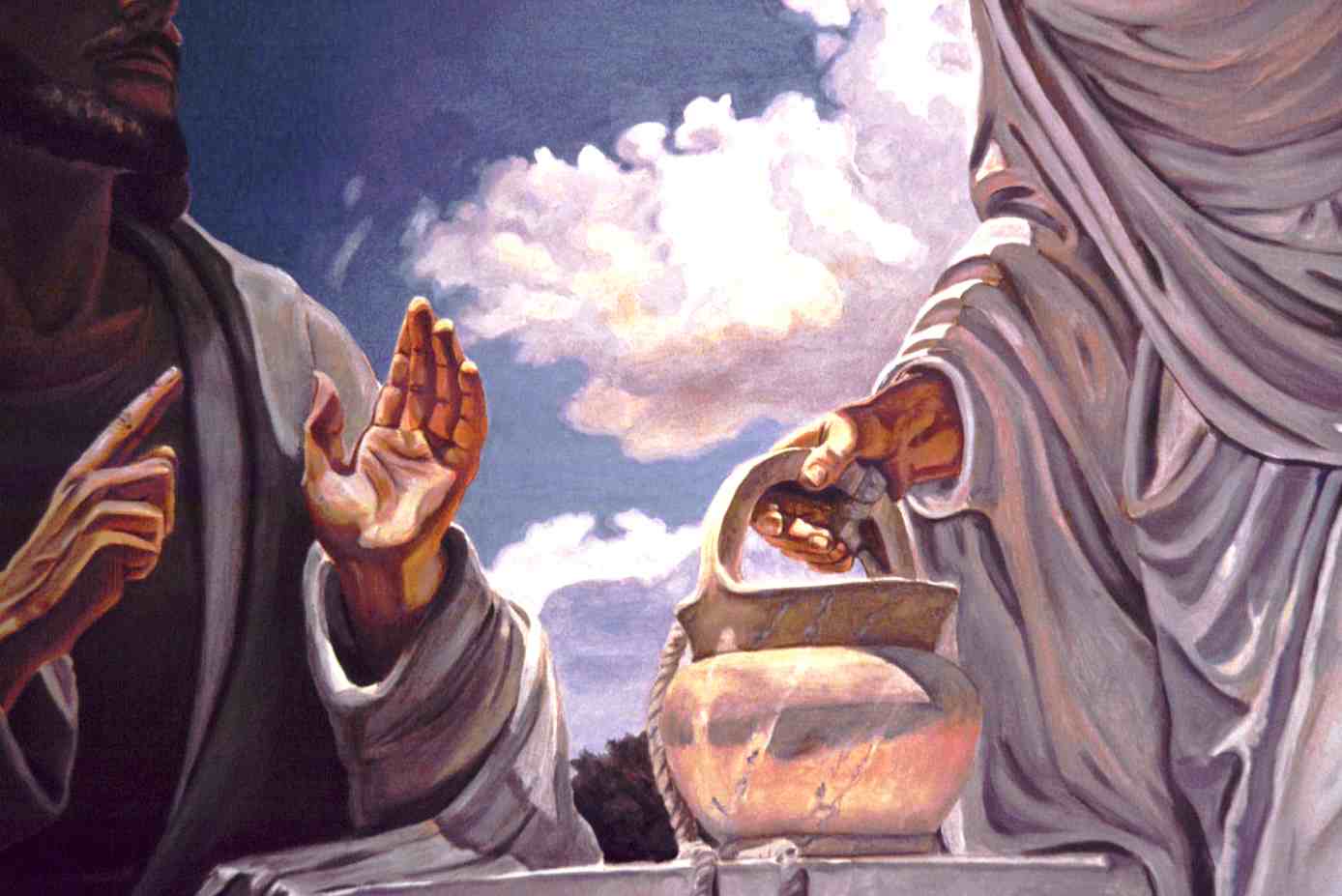
In Spirit and Truth

16 Jesus said to her, “Go, call your husband, and come here.” 17 The woman answered him, “I have no husband.” Jesus said to her, “You are right in saying, ‘I have no husband’; 18 for you have had five husbands, and the one you now have is not your husband. What you have said is true.” 19 The woman said to him, “Sir, I perceive that you are a prophet. 20 Our fathers worshiped on this mountain, but you say that in Jerusalem is the place where people ought to worship.” 21 Jesus said to her, “Woman, believe me, the hour is coming when neither on this mountain nor in Jerusalem will you worship the Father. 22 You worship what you do not know; we worship what we know, for salvation is from the Jews. 23 But the hour is coming, and is now here, when the true worshipers will worship the Father in spirit and truth, for the Father is seeking such people to worship him. 24 God is spirit, and those who worship him must worship in spirit and truth.” 25 The woman said to him, “I know that Messiah is coming (he who is called Christ). When he comes, he will tell us all things.” 26 Jesus said to her, “I who speak to you am he.” – John 4:16-26 ESV

The woman wanted what Jesus had to offer. The thought of a source of freely flowing water that would eliminate her constant need to draw water from the well of Jacob was more than appealing to her. But, like Nicodemus, she was missing the point of Jesus’ words. She had come to the well to meet a physical need. Her mission had been to draw water from the well for use in drinking, bathing, and cleaning. Water was a daily necessity that made living in that arid region possible. Without it, life would be impossible.

But even water has its limitations. It can be consumed to quench thirst, but in time, the thirst will return. Water can be used to wash away the dirt and grime of life, but it can’t prevent one from becoming filthy again. That’s why the woman was forced to return to the well on a daily basis. Her need for water was insatiable.

Yet Jesus had piqued the woman’s interest with His mention of  “living water.” But don’t miss how He had opened His conversation with her.

“If you knew the gift of God, and who it is that is saying to you, ‘Give me a drink,’ you would have asked him, and he would have given you living water.” – John 4:10 ESV

The woman was clueless as to Jesus’ identity. When she had arrived at the well, she was surprised to find an unknown Jewish man waiting there. And her surprise turned to shock when this stranger dared to speak to her – “For Jews have no dealings with Samaritans” (John 4:9 ESV). Yet Jesus assured her that, had she known who He was and the nature of the gift He had to offer, she would have been the first to speak that day.

Jesus, in need of water to satisfy His thirst, had stopped at the well. But as the woman pointed out, He had “nothing to draw water with” (John 4:11 ESV). So He had asked her for help because she was the only one who had the means by which to satisfy His need. Yet, the inference behind the story is that the woman had a need for something far greater than water. And if she had only known the true identity of the stranger at the well and what He was capable of offering her, she would have been begging Him for the gift of God. 

It is easy to overlook the fact that both Nicodemus and this woman were worshipers of Yahweh. He was an orthodox member of the sect of the Pharisees. She was a Samaritan. He worshiped the God of Abraham at the temple in Jerusalem. Her people chose to worship Him at Mount Gerizim. Nicodemus prided Himself on his identity as a purebred Jew and a strict adherent to the Mosaic Law. The Samaritan woman, though viewed as a half-breed by the Jews, believed that her people were worshiping Yahweh in the manner prescribed by Moses. But what both failed to take into account was their need for a Savior. While the Jews and the Samaritans believed in the prophecies concerning the coming Messiah, they were clueless as to His real mission. 

The primary message found in chapters 3 and 4 is that of need, and Nicodemus and the Samaritan woman had the same need in common. The need for eternal life. But in order to have eternal life, they would have to experience cleansing from their sin. Jesus had described it to Nicodemus as birth from above. He described it to the woman at the well as living water. Both of these individuals, despite their obvious differences, would be denied access into God’s kingdom for the very same reason: Sin.

Nicodemus, while outwardly righteous in appearance, was guilty of hypocrisy, just like the rest of his fellow members of the Pharisees. Jesus would have some harsh words of indictment against these well-respected members of Israel’s religious elite.

“What sorrow awaits you teachers of religious law and you Pharisees. Hypocrites! For you are so careful to clean the outside of the cup and the dish, but inside you are filthy—full of greed and self-indulgence!” – Matthew 23:25 NLT

“What sorrow awaits you teachers of religious law and you Pharisees. Hypocrites! For you are like whitewashed tombs—beautiful on the outside but filled on the inside with dead people’s bones and all sorts of impurity.” – Matthew 23:27 NLT

But the woman at the well had her own set of issues. Not only was she a Samaritan and, therefore, guilty of practicing idolatry, but she was also guilty of violating the law of God. As Jesus was about to point out, she was an adulteress. When he asked her to go get her husband, she confessed that she was unmarried. But Jesus knew more about her than she could have ever imagined, and He revealed to her the true nature of her need.

“You are right in saying, ‘I have no husband’; for you have had five husbands, and the one you now have is not your husband. What you have said is true.” – John 4:17-18 ESV

Suddenly, Jesus shifted the topic of conversation away from water to sin. He made it painfully personal. And while the woman’s statement had been anything but a confession, Jesus declared that what she had said was more true than she realized. She had no husband because she was in an adulterous relationship. She was guilty of sin.

But in a somewhat awkward attempt to change the subject, the woman declared, “Sir, I perceive that you are a prophet” (John 4:19 ESV). She desperately wanted to talk about something other than her five failed marriages and her current live-in relationship. So, sensing that Jesus had some kind of prophetic powers, she decided to ask Him about an important point of controversy between the Jews and the Samaritans.

“Our fathers worshiped on this mountain, but you say that in Jerusalem is the place where people ought to worship.” – John 4:20 ESV

By refocusing the topic of conversation, she was hoping to divert attention away from her own personal problems. But Jesus was not going to allow that to happen. He addressed her question, but in a way that brought the focus right back on her. In essence, Jesus let her know that the issue had less to do about where God should be worshiped, but the motive behind the worship. The Jews and Samaritans were busy debating about location, but Jesus was far more interested in motivation. Why were they worshiping God?

And Jesus dropped a bombshell on her that must have left her reeling.

“Woman, believe me, the hour is coming when neither on this mountain nor in Jerusalem will you worship the Father.” – John 4:21 ESV

The worship of God wasn’t about a temple in Jerusalem or a shrine on Mount Gerizim. It was a matter of the heart. While the Jews had a more accurate understanding of God, they were guilty of worshiping Him falsely. Jesus would later declare of the Jews, “These people honor me with their lips, but their hearts are far from me. Their worship is a farce, for they teach man-made ideas as commands from God” (Matthew 15:8-9 NLT).

And He told the Samaritan woman, “You worship what you do not know” (John 4:22 ESV). The Samaritans practiced a form of syncretism that blended the worship of Yahweh with that of false gods. Their doctrine was polluted and filled with pagan ideas that rendered Yahweh virtually unrecognizable.

Jesus fast-forwarded the conversation to the future, revealing that a day would come when “when the true worshipers will worship the Father in spirit and truth, for the Father is seeking such people to worship him” (John 4:23 ESV). Worship will no longer be about location and the ritual observation of rules and regulations. It will be about a relationship with God based on spirit and truth. And Jesus informed the woman that the future hour to which He referred was actually “now here.” It had arrived. And He had been the one to usher it in.

But what did He mean by “spirit and truth?” And how had His arrival changed the nature of man’s worship of God? The two terms “spirit and truth” are actually meant to convey one idea. Jesus is attempting to define worship that which is “truly spiritual.” In other words, it is not some physical activity practiced in a particular place and according to some man-made set of governing rules. It is a matter of the heart, not the head. It is spiritual in nature and not physical. Going through the religious motions either in Jerusalem or on Mount Gerizim was not going to cut it. Both the Jews and the Samaritans had been guilty of worshiping the one true God falsely and unfaithfully.

But Jesus had come to make the true worship of God possible, by restoring sinful men and women to a right relationship with Him. To do so, they would have to be born of the Spirit, just as He had told Nicodemus. They would have to have their spiritual thirst quenched by the living water Jesus would provide. And just a few chapters later, John will describe Jesus standing in the temple courtyard, shouting:

“Anyone who is thirsty may come to me! Anyone who believes in me may come and drink! For the Scriptures declare, ‘Rivers of living water will flow from his heart.’”(When he said “living water,” he was speaking of the Spirit, who would be given to everyone believing in him. But the Spirit had not yet been given because Jesus had not yet entered into his glory.).” – John 7:38-39 NLT

The true worship of God would be made possible by the presence of the indwelling Spirit of God. And to receive the Spirit, one would have to accept the gracious gift of salvation made possible through the sacrifice of God’s own Son.

These words left the woman in a state of confusion. She was having a difficult time following what Jesus had to say. But she proclaimed her belief in the coming of the Messiah and her hope that He would clear up all the confusion regarding where to worship God. And that’s when Jesus boldly proclaimed to her, “I who speak to you am he” (John 4:26 ESV). The not-yet had become the now. The long-awaited Messiah had shown up and He was talking to her. The answer to her question regarding the true worship of God was standing right in front of her.

English Standard Version (ESV) The Holy Bible, English Standard Version. ESV® Permanent Text Edition® (2016). Copyright © 2001 by Crossway Bibles, a publishing ministry of Good News Publishers.

New Living Translation (NLT)
Holy Bible, New Living Translation, copyright © 1996, 2004, 2015 by Tyndale House Foundation. Used by permission of Tyndale House Publishers Inc., Carol Stream, Illinois 60188. All rights reserved.

The Message (MSG)Copyright © 1993, 1994, 1995, 1996, 2000, 2001, 2002 by Eugene H. Peterson

Harsh Words for His Harshest Critics

13 “But woe to you, scribes and Pharisees, hypocrites! For you shut the kingdom of heaven in people’s faces. For you neither enter yourselves nor allow those who would enter to go in. 15 Woe to you, scribes and Pharisees, hypocrites! For you travel across sea and land to make a single proselyte, and when he becomes a proselyte, you make him twice as much a child of hell as yourselves.

16 “Woe to you, blind guides, who say, ‘If anyone swears by the temple, it is nothing, but if anyone swears by the gold of the temple, he is bound by his oath.’ 17 You blind fools! For which is greater, the gold or the temple that has made the gold sacred? 18 And you say, ‘If anyone swears by the altar, it is nothing, but if anyone swears by the gift that is on the altar, he is bound by his oath.’ 19 You blind men! For which is greater, the gift or the altar that makes the gift sacred? 20 So whoever swears by the altar swears by it and by everything on it. 21 And whoever swears by the temple swears by it and by him who dwells in it. 22 And whoever swears by heaven swears by the throne of God and by him who sits upon it.

23 “Woe to you, scribes and Pharisees, hypocrites! For you tithe mint and dill and cumin, and have neglected the weightier matters of the law: justice and mercy and faithfulness. These you ought to have done, without neglecting the others. 24 You blind guides, straining out a gnat and swallowing a camel!

25 “Woe to you, scribes and Pharisees, hypocrites! For you clean the outside of the cup and the plate, but inside they are full of greed and self-indulgence. 26 You blind Pharisee! First clean the inside of the cup and the plate, that the outside also may be clean.

27 “Woe to you, scribes and Pharisees, hypocrites! For you are like whitewashed tombs, which outwardly appear beautiful, but within are full of dead people’s bones and all uncleanness. 28 So you also outwardly appear righteous to others, but within you are full of hypocrisy and lawlessness.

29 “Woe to you, scribes and Pharisees, hypocrites! For you build the tombs of the prophets and decorate the monuments of the righteous, 30 saying, ‘If we had lived in the days of our fathers, we would not have taken part with them in shedding the blood of the prophets.’ 31 Thus you witness against yourselves that you are sons of those who murdered the prophets. 32 Fill up, then, the measure of your fathers. 33 You serpents, you brood of vipers, how are you to escape being sentenced to hell? 34 Therefore I send you prophets and wise men and scribes, some of whom you will kill and crucify, and some you will flog in your synagogues and persecute from town to town, 35 so that on you may come all the righteous blood shed on earth, from the blood of righteous Abel to the blood of Zechariah the son of Barachiah, whom you murdered between the sanctuary and the altar. 36 Truly, I say to you, all these things will come upon this generation. – Matthew 23:13-36 ESV

Brooklyn_Museum_-_Woe_unto_You,_Scribes_and_Pharisees_(Malheur_à_vous,_scribes_et_pharisiens)_-_James_Tissot

The Pharisees and teachers of religious law were not fans of Jesus. In fact, they despised Him and had been searching for ample cause to have Him eliminated. So, at this point in Matthew’s account, he portrays Jesus amping up His rhetoric in an unabashed attack on these so-called religious leaders. As He prepares to follow His Father’s will and head to the cross, Jesus goes out of His way to expose the truth about His enemies. But Jesus’ words are not intended to be a vindictive attack on those who disagree with Him. He is pulling aside the veil and revealing the long-hidden truth regarding these men. They are not what they seem. And, before He leaves this earth, Jesus wants to ensure that His disciples understood what true religion should look like.

Religion that is pure and undefiled before God the Father is this: to visit orphans and widows in their affliction, and to keep oneself unstained from the world. – James 1:27 ESV

At this point, Jesus makes His message much more direct by turning His attention directly to the Pharisees and teachers of religious law. This is the part where He pronounces His seven woes or warnings against them. It is important to recognize that this is all about two distinctly different ways to approach God. What Jesus has to say is less about their behavior than the focus of their ministry.

Woe #1: They had a false view of the Kingdom of Heaven and how to enter it. Not only was their errant view making entry into God’s Kingdom impossible for them, but it was also slamming the door in the face of every person under their influence. They had made the attainment of righteousness all about human effort. In their minds, entry into the Kingdom of Heaven was reserved for law-keepers, and they viewed themselves as the quintessential keepers of the law.

Woe #2: Their false view of the Kingdom of Heaven had deadly consequences. Their refusal to accept Jesus as the Messiah was condemning themselves and others to hell. They were eager to convert others to their way of thinking and to their view of the Kingdom, but the result was that these individuals ended up as lost as they were. By following the teaching of these men, the people of Israel were being deceived into believing a lie. They were placing their faith in the faulty confidence professed by these false teachers.

Woe #3: In spite of all their knowledge of the Mosaic Law, they were blind to the one to whom the law and the prophets pointed. Jesus had already told these men that He was the primary focal point of the Hebrew Scriptures.

“You search the Scriptures because you think they give you eternal life. But the Scriptures point to me!” – John 5:39 NLT

But in their arrogance and prideful knowledge, they had missed the whole point. They had misunderstood what was of real value in the Kingdom of Heaven. Jesus points out that the temple, which God had set apart as His own, was holy, not the gold used to adorn it. The altar, the place God had set aside for sacrifice, was holy and anything that touched it became holy as well. Ultimately, it is God who makes heaven holy and gives it its value.

The religious leaders were focusing their attention on the wrong things. They were materially-minded, rather than spiritually-focused. Their whole practice of making and keeping oaths was little more than a series of man-made loopholes and escape clauses designed to give them an easy out from having to do what they swore to do. They could appear to be holy and righteous without having to accept any of the cost or consequences. And Jesus pointed out that they were really minimizing and trivializing the holiness of God.

Woe #4:They misunderstood the true nature of the Kingdom because they tended to major on the minors. Since they believed that entrance into the Kingdom was based on the keeping of the law, they ended up nitpicking the law to death. Jesus accused them of being meticulously observant of laws concerning the tithing of fruit, grain, and other produce – to the point of absurdity. But in doing so, they conveniently overlooked the more important commandments concerning justice, mercy, and faith.

Jesus borrowed from their own Scriptures to remind them of God’s own words concerning this matter.

No, O people, the Lord has told you what is good,
    and this is what he requires of you:
to do what is right, to love mercy,
    and to walk humbly with your God. – Micah 6:8 NLT

In all their zeal to tithe unscrupulously, they were failing to keep the two greatest commandments: To love God and to love others.

Woe #5: They had a false understanding of what constitutes righteousness in God’s Kingdom. God was interested in the INSIDE, not the OUTSIDE. Yet their focus was solely on the externals. They made behavior modification their goal, rather than heart transformation. Yet Jesus had taught just the opposite.

“But the things that come out of the mouth come from the heart, and these things defile a person. For out of the heart come evil ideas, murder, adultery, sexual immorality, theft, false testimony, slander. These are the things that defile a person; it is not eating with unwashed hands that defiles a person.” – Matthew 15:18-20 NLT

These men were all about appearances. They lived to impress and were addicted to the praise of men. As long as they looked good, they believed they were good. External appearances and outward behavior were the criteria by which they judged a man’s righteousness, but God looks at the condition of the heart.

Woe #6: This one supports the previous one. It reveals their false concept of what it took to become clean or righteous. Again, they had replaced heart transformation with behavior modification. They spent all their time obsessing about outward appearances while ignoring the internal state of their souls. Rather than heartfelt repentance, they focused on outward reformation. Rather than acknowledge their sin, they simply attempted to cover it up with good deeds and religious effort.

Jesus described them as painted tombs. Not exactly a compliment. Their outward display of righteous behavior was like putting makeup on a pig. It didn’t change reality. A well-manicured grave, covered with flowers and its tombstone meticulously clean, can’t change the fact that beneath the surface lies death and decay.

Woe #7: In failing to recognize their own sinful condition, they had become just like their ancestors – rebellious, stubborn, and resistant to God. The Israelites had built tombs and monuments to honor the prophets of God but had failed to listen to their words of warning. In fact, they had killed many of them. And Jesus made it clear that the religious leaders of Israel had done the same thing in His day, rejecting the most recent prophet of God: John the Baptist. And in just a matter of days, they would arrange to have the very Son of God put to death. After Jesus was out of the way, they would end up persecuting and killing the disciples as well.

“Therefore, I am sending you prophets and wise men and teachers of religious law. But you will kill some by crucifixion, and you will flog others with whips in your synagogues, chasing them from city to city.” – Matthew 23:34 NLT

Misplaced passion

Why was Jesus so upset with these men? What drove Him to treat them so harshly? They were passionate. They were zealous. They were religious. BUT THEY WERE DANGEROUS! They had become obstacles to the Kingdom of Heaven. Their misplaced zeal had led them to become stumbling blocks.

Jesus said to his disciples, “Stumbling blocks are sure to come, but woe to the one through whom they come! It would be better for him to have a millstone tied around his neck and be thrown into the sea than for him to cause one of these little ones to sin.” – Luke 17:1-2 NET

These men DID NOT represent the way into the Kingdom of Heaven. They didn’t even know the directions. But where do we see this today? In the myriad of false and pseudo-Christian religions. We see it in anyone who denies that salvation is through faith alone in Christ alone. We need to learn to look for these characteristics.

  1. Posing as spokesmen for God, but denying people access to the Kingdom of God
  2. Giving people false hope by offering them a false gospel
  3. Providing easy workarounds to true holiness and commitment to God
  4. Judging righteousness based on their own standards, rather than God’s
  5. Refusing to acknowledge sin, while emphasizing self-righteousness
  6. Putting undue emphasis on the praise of men, rather than that of God
  7. Failing to see their status as enemies of God

The spirit of the Pharisees is alive and well today. It’s evident in every religion that refuses to acknowledge Jesus Christ as the only way. It’s prevalent in many main-stream denominations that preach a gospel of works, not grace. It can be found anytime legalism and rule-keeping replaces a love for God and others. It shows up whenever our religion becomes more important than our relationship with Christ. It takes the form of hypocrisy, when what we say we believe fails to impact the way we behave. When we love the praise of man more than pleasing God.

English Standard Version (ESV)
The Holy Bible, English Standard Version. ESV® Permanent Text Edition® (2016). Copyright © 2001 by Crossway Bibles, a publishing ministry of Good News Publishers.

New Living Translation (NLT)
Holy Bible, New Living Translation, copyright © 1996, 2004, 2015 by Tyndale House Foundation. Used by permission of Tyndale House Publishers Inc., Carol Stream, Illinois 60188. All rights reserved.

(MSG)Copyright © 1993, 1994, 1995, 1996, 2000, 2001, 2002 by Eugene H. Peterson

Faith and Fruitfulness

18 In the morning, as he was returning to the city, he became hungry. 19 And seeing a fig tree by the wayside, he went to it and found nothing on it but only leaves. And he said to it, “May no fruit ever come from you again!” And the fig tree withered at once.

20 When the disciples saw it, they marveled, saying, “How did the fig tree wither at once?” 21 And Jesus answered them, “Truly, I say to you, if you have faith and do not doubt, you will not only do what has been done to the fig tree, but even if you say to this mountain, ‘Be taken up and thrown into the sea,’ it will happen. 22 And whatever you ask in prayer, you will receive, if you have faith.” 

23 And when he entered the temple, the chief priests and the elders of the people came up to him as he was teaching, and said, “By what authority are you doing these things, and who gave you this authority?” 24 Jesus answered them, “I also will ask you one question, and if you tell me the answer, then I also will tell you by what authority I do these things. 25 The baptism of John, from where did it come? From heaven or from man?” And they discussed it among themselves, saying, “If we say, ‘From heaven,’ he will say to us, ‘Why then did you not believe him?’ 26 But if we say, ‘From man,’ we are afraid of the crowd, for they all hold that John was a prophet.” 27 So they answered Jesus, “We do not know.” And he said to them, “Neither will I tell you by what authority I do these things.” –  Matthew 21:18-27 ESV

FigOne of the reasons it is important to read the four gospels simultaneously, in what is called a “harmony,” is that it provides you with a much more accurate timeline of the events. You will also discover that each of the authors has provided his own unique retelling of the events surrounding the life of Jesus. When read together, they provide a 3D-rendering of the circumstances, with each gospel providing different details that help fill out the story.

This is especially true with today’s passage. The story of Jesus cursing the fig tree is difficult to understand, and it requires a reading of each of the three synoptic gospels (Matthew, Mark, and Luke) to get a well-rounded understanding of the circumstances involved.

Mark tells us that, after entering Jerusalem on Monday to joyous shouts of the people, Jesus went to the Temple and, “after looking around carefully at everything, he left because it was late in the afternoon. Then he returned to Bethany with the twelve disciples” (Mark 11:11 NLT). Bethany would be their home base during what is called the Passion Week. They would return there each evening and spend the night. Then each morning, they would make their way back to the eastern gate of the city of Jerusalem, passing through the Mount of Olives along the way, roughly a two-mile walk.

On Tuesday morning, Jesus and the disciples returned to Jerusalem, and along the way, they passed a fig tree. Jesus “noticed a fig tree in full leaf and little way off, so he went over to see if he could find any figs. But there were only leaves because it was too early in the season for fruit. Then Jesus said to the tree, ‘May no one eat your fruit again!’ And the disciples heard him say it” (Mark 11:12-14 NLT).

This sequence of events is critical to understanding what Jesus does next. He curses the fig tree, then He and the disciples made their way into Jerusalem, where He “entered the Temple and began to drive out the people buying and selling animals for sacrifice. He knocked over the tables of the money changers and the chairs of those selling doves, and he stopped everyone from using the Temple as a marketplace” (Mark 11:15-16 NLT).

Taking these two events out of order or attempting to deal with them independently will render them virtually incomprehensible. The cursing of the fig tree makes sense only if you keep in mind what Jesus did next.

When He arrived in Jerusalem that Monday and took a look around the Temple grounds, He saw what had become of His Father’s house. He assessed the situation and then left for the day. On the way back into the city the next morning, He saw the barren fig tree and cursed it. Matthew tells us that Jesus was hungry, and when He went to find fruit on the tree, there was none. But His cursing of the tree is not done out of anger or vindictiveness. This was not some petty power display or a form of divine judgment upon a fruitless tree. It was intended to be visual lesson for the disciples.

One of the important details found in the story is that the tree was in full bloom. It was a healthy, visibly vibrant tree that had all the appearances of fruitfulness. But the fruit was missing. Think back on what John the Baptist had to say to the Jewish religious leaders, “But when he saw many of the Pharisees and Sadducees coming to his baptism, he said to them, ‘You brood of vipers! Who warned you to flee from the wrath to come? Bear fruit in keeping with repentance’” (Matthew 3:7-8 ESV).

We could do a lengthy study on the fruit-bearing properties of the Middle Eastern fig tree, but that is not the point of the story. There are commentators who try to explain that the fig tree in that part of the world has fruit on it year-round. Others say that if the tree was in full leaf it should have had fruit. But all we know from the gospel accounts is that IT HAD NO FRUIT.

Mark tells us it was not the season for fruit, and yet, Jesus hungered for fruit. He came to the tree expecting to see and enjoy fruit. BUT THE TREE WAS EMPTY OF FRUIT. It was appealing to the eye but failed to live up to Jesus’ expectations.

As usual, this event had much to do with Jesus’ perception of the religious leaders of His day. Jesus had accused the Pharisees of doing everything they did to be noticed by men. It was all about the show.

“They do all their deeds to be seen by others.” – Matthew 23:5 ESV

But this problem had become a national epidemic. To all appearances, the nation of Israel had all the trappings of religious fervor and faith. They had a place of worship – the Temple. They practiced the religious requirements as handed down by God – Passover, Pentecost, Feast of Tabernacles, the Law, etc. They had a priesthood. They made regular sacrifices to atone for their sins.

In his book, The Words and Works of Jesus, J. Dwight Pentecost writes, “Like the leafy tree, they had given external evidence of being fruitful but on examination, they were seen to be barren and fruitless. Therefore judgment had to come on that generation.”

Mark indicates that it was the next morning, as they passed by the fig tree again, that the disciples noticed it was withered from the roots up. “Peter remembered what Jesus had said to the tree on the previous day and exclaimed, ‘Look, Rabbi! The fig tree you cursed has withered and died!’” (Mark 11:20-21 NLT).

So what’s the point? The cursing of the fig tree was a statement against the spiritual hypocrisy and religious formalism of the Pharisees. The fig tree had all that was required for fruitfulness, but no fruit. And Jesus used the moment to teach the disciples an important lesson on faith, and He makes the main point right at the outset: “Have faith in God” (Mark 11:22 NLT).

No faith. No Fruit.

It was the lack of faith in God that resulted in Israel’s barrenness. They were not experiencing the power of God in their lives (Mark 11:23). They were not enjoying answered prayers from God (Mark 11:24). Their prayers were hindered by hatred and unforgiveness (Mark 11:25). Over in the book of John, we read the words of Jesus:

“Yes, I am the vine; you are the branches. Those who remain in my, and I in them, will produce much fruit. For apart from me you can nothing. Anyone who does not remain in me is thrown away like a useless branch and withers. Such branches are gathered into a pile to be burned. But if you remain in me and my words remain in you, you may ask for anything you want, and it will be granted! When you produce much fruit, you are my true disciples. This brings great glory to my Father.” – John 15:5-8 NLT

Fruitfulness and faith go hand in hand.

When Jesus cleansed the Temple, He had shouted, “The Scriptures declare, ‘My Temple will be called a house of prayer for all nations,’ but you have turned it into a den of thieves’” (Mark 11:17 NLT). He accused the religious leaders of stealing glory from God. They were abusing the people of God. They were more obsessed with financial gain than holiness. They were more interested in fleecing the flock than in faithfulness. But God’s house was for all people. Jesus had come for all men. Salvation was for all who would believe.

Yet, the Jewish religious leaders had taken the court of the Gentiles, the only place non-Jews could worship, and had turned it into a three-ring circus. It was there that they had set up their system of graft and greed, disguised as religion. But at the end of the day, Jesus’ cleansing of the Temple was all about obedience and faithfulness. It was about wholehearted commitment to the Lord and not about religiosity and ritual. Jesus compared them to their rebellious ancestors and concludes that NOTHING HAD CHANGED!

And He warned them that the temple would not save them. It was the God of the Temple who was to be their only hope. And it was the people who God had called to His Temple who were important.

Over in his letter to the Corinthian believers, Paul reminds us, “Don’t you realize that all of you together are the temple of God and that the Spirit of God lives in you? God will destroy anyone who destroys this temple. For God’s temple is holy, and you are that temple” (1 Corinthians 3:16-17 NLT).

Jesus is still looking for fruitfulness from His people. That fruitfulness is only possible through faith in God. And those who have faith in God and believe in His Son will experience the fruit of the Spirit and the power of God in their lives. That is why Jesus told the disciples, “Truly, I say to you, if you have faith and do not doubt, you will not only do what has been done to the fig tree, but even if you say to this mountain, ‘Be taken up and thrown into the sea,’ it will happen” (Matthew 21:21 ESV).

Israel was going to be judged by God for its lack of fruitfulness, caused by its lack of faith in Him. Like the barren fig tree, they would be judged for their failure to bear fruit in keeping with repentance. They had all the appearances of religiosity but lacked the one thing that could make them truly religious: Faith in God. Which is why they rejected His Son and their Savior. And Jesus wanted His disciples to know that they would need to have faith without doubt, so that they could experience the kind of fruitfulness God had planned for them.

English Standard Version (ESV)
The Holy Bible, English Standard Version. ESV® Permanent Text Edition® (2016). Copyright © 2001 by Crossway Bibles, a publishing ministry of Good News Publishers.

New Living Translation (NLT)
Holy Bible, New Living Translation, copyright © 1996, 2004, 2015 by Tyndale House Foundation. Used by permission of Tyndale House Publishers Inc., Carol Stream, Illinois 60188. All rights reserved.

The Message (MSG)Copyright © 1993, 1994, 1995, 1996, 2000, 2001, 2002 by Eugene H. Peterson

The Art of Self-Denial

“And when you fast, do not look gloomy like the hypocrites, for they disfigure their faces that their fasting may be seen by others. Truly, I say to you, they have received their reward. But when you fast, anoint your head and wash your face, that your fasting may not be seen by others but by your Father who is in secret. And your Father who sees in secret will reward you.” – Matthew 6:16-18 ESV

After having provided His listeners with a model for how to pray, Jesus turns His attention to the topic of fasting. In order for us to understand what Jesus is trying to say about fasting, it’s essential that we discern its role within the Hebrew cultural context. Otherwise, we will try to apply our modern perception of fasting and miss Jesus’ intended application.

For many of us, fasting is a rather foreign concept. The kind of fasting of which we are familiar seems to be tied to dieting or weight loss. And fasting has also become a popular form of cleansing or purging for health reasons. But that is not what Jesus is talking about. In Jesus’ day, fasting was a religious rite, practiced in conjunction with a particular feast day or religious festival. For instance, fasting was a regular part of the yearly celebration of the Day of Atonement.

Now on the tenth day of this seventh month is the Day of Atonement. It shall be for you a time of holy convocation, and you shall afflict yourselves and present a food offering to the Lord. And you shall not do any work on that very day, for it is a Day of Atonement, to make atonement for you before the Lord your God. For whoever is not afflicted on that very day shall be cut off from his people. – Leviticus 23:26-29 ESV

The phrase “afflict yourselves” is a reference to fasting. The people were to fast or deny themselves their normal intake of food, while at the same time presenting a food offering to the Lord. Fasting, in this case, was intended to be an expression of one’s complete dependence upon God. But it was also a way of focusing your attention solely upon God. Rather than seeking your sustenance from food, you were turning to God to meet your needs. It was a spiritual exercise that was usually accompanied by prayer and confession of sins (1 Samuel 7:5-6). Fasting was not done for its potential health benefits or cleansing properties. While it may have had beneficial side effects, fasting was meant to focus one’s attention on God, not on self. In fact, fasting was, at its core, a denial of self.

But once again, the Jews had managed to turn fasting into an external show of self-righteous piety and religious one-upmanship. And this had been going on for some time. God had confronted the Israelites regarding their false view of fasting before. He had spoken harsh words to them through the prophet Isaiah.

“Shout with the voice of a trumpet blast.
    Shout aloud! Don’t be timid.
Tell my people Israel of their sins!
Yet they act so pious!
They come to the Temple every day
    and seem delighted to learn all about me.
They act like a righteous nation
    that would never abandon the laws of its God.
They ask me to take action on their behalf,
    pretending they want to be near me.
‘We have fasted before you!’ they say.
    ‘Why aren’t you impressed?
We have been very hard on ourselves,
    and you don’t even notice it!’

“I will tell you why!” I respond.
    “It’s because you are fasting to please yourselves.
Even while you fast,
    you keep oppressing your workers.
What good is fasting
    when you keep on fighting and quarreling?
This kind of fasting
    will never get you anywhere with me.
You humble yourselves
    by going through the motions of penance,
bowing your heads
    like reeds bending in the wind.
You dress in burlap
    and cover yourselves with ashes.
Is this what you call fasting?

Do you really think this will please the Lord?

“No, this is the kind of fasting I want:
Free those who are wrongly imprisoned;
    lighten the burden of those who work for you.
Let the oppressed go free,
    and remove the chains that bind people.
Share your food with the hungry,
    and give shelter to the homeless.
Give clothes to those who need them,
    and do not hide from relatives who need your help.” – Isaiah 58:1-7 NLT

So, when Jesus confronts the Jews in His audience with their false concept of fasting, He is simply reiterating the concerns of His Father. Once again, He refers to “the hypocrites,” a clear reference to the Pharisees and other religious leaders. They had taken fasting, a form of self-denial and self-humiliation, and turned it into a means of self-promotion. They fasted to get noticed. They fasted to garner the praises of men, but not to confess their sins before God. This was not the kind of fasting God desired. He desired fasting that came from the heart. He wanted them to deny themselves the sins they so deeply enjoyed committing. In the case of the Isaiah passage, God expected the Jews to free the wrongly imprisoned, to lighten the burdens of their workers, to let the oppressed go free, and remove the chains that held people bound. While they were busy wearing sackcloth and denying themselves food in an attempt to get God’s attention, they were also busy practicing all kinds of moral and ethical injustices. And God was not impressed.

For the Jews in Jesus’ audience, the problem was even worse. The kind of fasting they were exposed to was not even intended to get God’s attention. It was aimed at men. Jesus accuses them of trying “to look miserable and disheveled so people will admire them for their fasting” (Matthew 6:16 NLT). Fasting had become all about the outward impression it left on those around you. But throughout His message, Jesus has been talking about those who are approved by God. And just as we have seen in the Isaiah passage, God does not approve of fasting that is done with wrong motives or in a hypocritical manner.

Like any spiritual discipline, fasting can be abused. It can also be misunderstood and practiced for all the wrong reasons. Reading the Bible is a good thing. It is proper for God’s children to spend time in His Word. But we can make Bible reading a badge of honor and a means by which we show others just how spiritual we really are. The same thing can be said of prayer, Scripture memory, Bible study, and giving. These spiritual disciplines can be twisted and misused, becoming nothing more than outward signs of piety that do not reflect the true condition of the heart. It was King David who wrote these powerful words after having been confronted and convicted by the prophet Samuel regarding his affair with Bathsheba.

For you will not delight in sacrifice, or I would give it;
you will not be pleased with a burnt offering.
The sacrifices of God are a broken spirit;
a broken and contrite heart, O God, you will not despise. – Psalm 51:16-17 ESV

The external practice of offering sacrifices meant nothing if the heart remained unchanged and unrepentant. Fasting that was merely an outward show done to convince others of our spirituality will never impress God. He sees our hearts. He knows our motives. And Jesus says that if you fast to garner the praise of men, you will get all the reward you are seeking, but you won’t have the approval of God. You won’t know what it means to be blessed by God. Like the Jews in Isaiah’s day, you will find yourself saying, “I have fasted before you! Why aren’t you impressed?”

Seeking the praise of men is a dangerous game to play. It means we value their opinions over that of God. We care more about their perceptions of us than we do about how God sees us. And Jesus warns us that if the reward we seek through our acts of spiritual discipline is the praise of men, we will get exactly what we want, but no more.

Let’s bring it into a modern context. If I tell others I am fasting in order to impress them with my spirituality, but my real intent is to lose weight, I may impress my friends and drop a few pounds, but I will not gain favor with God.

If I truly want to deny myself something as a means of humbling myself before God, Jesus would recommend that I do it in secret. He would tell me to hide what I am doing from others because they don’t need to know. I don’t need to advertise my fast because God sees my heart. I don’t need to tell others how much I read my Bible or how many Scripture verses I have memorized. God knows, and that is all that matters. But it is important to remember that God also knows my motives. He knows why I read my Bible and memorize Scripture. If I do these things while ignoring sin in my life, I am nothing more than a hypocrite, a play-actor. I am attempting to cover up my sin by doing righteous things. But God wants a broken and contrite heart. Listen to the words of God spoken through the prophet Isaiah:

“Remove the heavy yoke of oppression.
    Stop pointing your finger and spreading vicious rumors!
Feed the hungry,
    and help those in trouble.
Then your light will shine out from the darkness,
    and the darkness around you will be as bright as noon.
The Lord will guide you continually,
    giving you water when you are dry
    and restoring your strength.
You will be like a well-watered garden,
    like an ever-flowing spring.
Some of you will rebuild the deserted ruins of your cities.
    Then you will be known as a rebuilder of walls
    and a restorer of homes.” – Isaiah 58:9-12 NLT

Fasting should be an outward expression of the inward condition of the heart. If our hearts are prideful and self-focused, our fasting will end up being done for our own glory, and not for God’s. If our hearts are broken, humble, and dependent upon God and His mercy, our fasting will be done for His glory and His approval, not for the praise of men. God knows our heart, and He will reward us according to the intention of our heart. Our Father, who sees in secret, will reward us.

English Standard Version (ESV)
The Holy Bible, English Standard Version. ESV® Permanent Text Edition® (2016). Copyright © 2001 by Crossway Bibles, a publishing ministry of Good News Publishers.

New Living Translation (NLT)
Holy Bible, New Living Translation, copyright © 1996, 2004, 2015 by Tyndale House Foundation. Used by permission of Tyndale House Publishers Inc., Carol Stream, Illinois 60188. All rights reserved.

The Message (MSG)Copyright © 1993, 1994, 1995, 1996, 2000, 2001, 2002 by Eugene H. Peterson

Proper Prayer

“And when you pray, you must not be like the hypocrites. For they love to stand and pray in the synagogues and at the street corners, that they may be seen by others. Truly, I say to you, they have received their reward. But when you pray, go into your room and shut the door and pray to your Father who is in secret. And your Father who sees in secret will reward you.

“And when you pray, do not heap up empty phrases as the Gentiles do, for they think that they will be heard for their many words. Do not be like them, for your Father knows what you need before you ask him.” – Matthew 6:5-8 ESV

The Jews were a prayerful people. Prayer was an important part of their religious practice. They had prayers, like the Shema, that were to be recited both morning and evening. Services were held throughout the day at the synagogue where the people of Israel would gather for prayer. So, prayer was not uncommon or unfamiliar among those who heard Jesus speak that day on the hillside. But Jesus was not promoting the necessity of prayer, He was trying to expose the false motivation behind their prayers.

As He has done throughout His sermon, Jesus begins with a warning against hypocrisy – a form of play-acting, where outward appearances were meant to deceive or delude. The Greek word is hypokritēs and was used to describe an actor in a play. An actor’s job was to portray a particular character, altering his voice and appearance to give the illusion that he was someone else. A good actor was able to distort reality and suspend belief, if only for a short period of time.

The problem Jesus is attempting to address is the presence of hypocrisy in matters of faith. Posing and pretending was not to be part of the life of a child of God. Prayer was important to God. He considered the communication between Himself and His chosen people as vital and worthy of reverence. He had provided prayer as a means by which men could express their needs to Him, but also declare His goodness and glory. They could ask things of Him, but they were also expected to offer praises to Him for all He had done for them already.

And yet, prayer had become just another means of promoting personal piety. Praying in public, where others could see and hear you, was done to get noticed and to seek the admiration of others for your superior spirituality. Public praying was a way to put your righteousness on display, for all to see. But Jesus says, “When you pray, don’t be like the hypocrites who love to pray publicly on street corners and in the synagogues where everyone can see them” (Matthew 6:5 NLT).

He redefines the purpose of prayer. It was not to get noticed by men, but heard by God. Prayer was not meant to be a public display of your piety or personal righteousness. Remember what He said just a few verses earlier? “Beware of practicing your righteousness before other people in order to be seen by them” (Matthew 6:1 ESV). Like alms-giving, prayer had become nothing more than a means to an end, and the end was the praise of men. When Jesus warns them not to practice “your righteousness” before other people, He is not offering them a compliment for their apparent righteousness. He is not telling them that their giving of alms and public prayers were righteous acts. He is describing their actions as self-righteousness. They were guilty of displaying a self-produced brand of righteousness. And just so we’re clear, Jesus is not saying that alms-giving and public prayer are wrong. He is simply using these two things as examples of good and godly things that had become misunderstood and misused by those who were desperately wanting others to see them as something they were not. In a desperate desire to be viewed by their peers as righteous and holy, they did everything to get noticed.

But Jesus tells them that they are focused on the wrong audience. They are busy trying to convince others of their righteousness when it should have been God they were worried about. He should have been the focus of their prayers. Rather than wasting their time trying to convince others of their own righteousness, they would have been better off confessing their unrighteousness to God. It was Os Guinness who wrote, “I live before the audience of One – before others I have nothing to gain, nothing to lose, nothing to prove.”

It is important that we recognize that Jesus is not condemning public prayer. But prayer is intended, first and foremost, to be a spiritual activity. It is meant to be a conversation between man and God. Prayer is intended for adoration, confession, thanksgiving, and supplication. It is a way for man to give to God (glory, honor, adoration). But it also a means by which men can get from God (forgiveness, healing, guidance). Jesus is rejecting the idea of righteousness being inextricably linked to public prayerfulness. He is saying that, if you pray to impress men, you will fail to gain approval from God. Acts of righteousness done with nothing more than recognition in mind are not acts of righteousness at all. In a sense, they become nothing more than right actions done for the wrong reasons.

Jesus is exposing the kind of prayer that is self-focused and meant to get you seen and heard. It’s prayer meant to impress, not confess. It’s prayer meant to gain the praise of men, but that fails to offer praise to God. It’s prayer designed to boost our reputation before men and that lacks confession of our transgressions toward God.

So, what are we to do? Not pray? No, Jesus challenges His audience to rethink their perspective on prayer. He tells them to go into their room, shut the door and pray to God – in private – where no one else can see. And God, who sees all, will not only see them but hear and reward them. He will bless them, approve of them, and express His pleasure with them by answering their prayers. The apostle John would later expand on the message of Jesus,

And we are confident that he hears us whenever we ask for anything that pleases him. And since we know he hears us when we make our requests, we also know that he will give us what we ask for. – 1 John 5:14-15 NLT

In essence, Jesus is telling us that if we pray to impress others, we will get exactly what we seek: Their praise. But we won’t get the approval of God. If getting noticed for our prayers is more important to us than getting our prayers answered by God, we will become well-known and revered for our prayer life, but God won’t receive glory for answering our prayers. Prayers prayed to get noticed by men, will always fail to get men to notice God. But our responsibility as God’s children is to bring glory to Him, not us. We are here to point men and women to God, not to us. We are meant to lift Him up, not ourselves.

Jesus goes on to describe an aspect of prayer with which we all struggle. How do you get God to hear and answer you? Even if you pray in private, where no one can hear you but God, how do you make sure He really does hear you? Once again, Jesus exposes a misconception. He states, “When you pray, don’t babble on and on as the Gentiles do. They think their prayers are answered merely by repeating their words again and again” (Matthew 6:7 NLT).

When you talk to God, don’t try to impress Him with the length of your prayer or by the careful choice of your words. Don’t drone on and on, somehow thinking that God will be more prone to hear you if your prayers display a proper amount of fervor. It is neither the intensity or longevity of our prayers that cause God to answer. It is the motivation of the heart. James tells us, “when you ask, you don’t get it because your motives are all wrong – you want only what will give you pleasure” (James 4:3 NLT). Wrong methods. Wrong motives. That’s the problem. Later on, in this same message, Jesus will say:

“Keep on asking, and you will receive what you ask for. Keep on seeking, and you will find. Keep on knocking, and the door will be opened to you. For everyone who asks, receives. Everyone who seeks, finds. And to everyone who knocks, the door will be opened.

“You parents—if your children ask for a loaf of bread, do you give them a stone instead? Or if they ask for a fish, do you give them a snake? Of course not! So if you sinful people know how to give good gifts to your children, how much more will your heavenly Father give good gifts to those who ask him.” – Matthew 7:7-11 NLT

We are to ask. And we are to trust God for the answer. He isn’t going to give us something we don’t need or can’t use. But it’s important to remember that God is not going to give us everything we ask for because too often our motives are wrong. Also, we don’t always know what it is we actually need. We may think we need healing, but God knows that what we really need is increased faith. We may ask God for a solution to a financial need, but He knows that the real issue is spiritual in nature. We have a greed problem. So, rather than give us money, He teaches us to live within our means, learning to trust Him for our needs.

Sometimes, we spend far too much time asking God for things. But Jesus reminds us, “your Father knows exactly what you need even before you ask him!” (Matthew 6:8 NLT). This doesn’t mean we don’t have a responsibility to ask God for things, but that the purpose behind our prayer is not to share information with God, but to communicate our dependence upon Him. We don’t pray to keep God up to speed with all that is going on in our life. He already knows. We pray in order to convey to Him our complete reliance upon Him for everything in our life. Prayer is an act of submission to God. It is the adoration of God. It is a means by which we offer up our thankfulness for all that He has done and is doing in and around our life.

Prayer isn’t meant to get you noticed by men. But, on the other hand, it isn’t intended to get you noticed by God. He already knows everything there is to know about you. Prayer is an expression of humility to God, showing Him that we are completely dependent upon Him for all things. But how easy it is to make prayer an expression of pride and self-promotion. So, Jesus warns us not to pray that way. And then He provides us with an example of how to pray. But that’s for tomorrow.

English Standard Version (ESV)
The Holy Bible, English Standard Version. ESV® Permanent Text Edition® (2016). Copyright © 2001 by Crossway Bibles, a publishing ministry of Good News Publishers.

New Living Translation (NLT)
Holy Bible, New Living Translation, copyright © 1996, 2004, 2015 by Tyndale House Foundation. Used by permission of Tyndale House Publishers Inc., Carol Stream, Illinois 60188. All rights reserved.

The Message (MSG)Copyright © 1993, 1994, 1995, 1996, 2000, 2001, 2002 by Eugene H. Peterson