No Other Gods

Do not be idolaters as some of them were; as it is written, “The people sat down to eat and drink and rose up to play.” We must not indulge in sexual immorality as some of them did, and twenty-three thousand fell in a single day. We must not put Christ to the test, as some of them did and were destroyed by serpents, 10 nor grumble, as some of them did and were destroyed by the Destroyer. 11 Now these things happened to them as an example, but they were written down for our instruction, on whom the end of the ages has come. 12 Therefore let anyone who thinks that he stands take heed lest he fall. 13 No temptation has overtaken you that is not common to man. God is faithful, and he will not let you be tempted beyond your ability, but with the temptation he will also provide the way of escape, that you may be able to endure it.

14 Therefore, my beloved, flee from idolatry. 1 Corinthians 10:7-14 ESV

As far as Paul was concerned, the Corinthians had a far too casual approach to sin. He has already chastised them for their laissez-faire approach to the sexual sin that was taking place in their midst.

It is actually reported that there is sexual immorality among you, and of a kind that is not tolerated even among pagans. – 1 Corinthians 5:1 ESV

It appears that they were overly tolerant and dangerously permissive when it came to sin, even among members of their own fellowship. Not only that, but they had developed an unhealthy arrogance regarding their own spirituality and standing before God. Which is what led Paul to warn them, “If you think you are standing strong, be careful not to fall” (1 Corinthians 10:12 NLT). In an attempt to get their attention, Paul resorted to using the Israelites as an object lesson. Their status as God’s chosen people had not prevented them from sinning or protected them from God’s punishment. They had enjoyed all the privileges and blessings of God’s favor, but had proven to be unfaithful in the end. So, Paul warns the Corinthians, “Do not be idolaters as some of them were” (1 Corinthians 10:7a ESV).

Like the Corinthians, the Israelites had been redeemed from a culture in which idol worship was commonplace. In Egypt, the Israelites had been surrounded by a plethora of false gods, and the ten plagues were directed against many of them. In His outpouring of the plagues, God had proven Himself superior to the false gods of Egypt, providing convincing evidence to the Israelites that He was the one true God. But in the end, even after their miraculous deliverance from captivity in Egypt, they resorted to idol worship. They went back to what they found familiar and comfortable. 

The Corinthians found themselves in similar circumstances. Most, if not all of them, had pagan backgrounds. They had been idol worshipers when Paul and others had brought the good news of Jesus Christ to their city. As a result of God’s grace, they had been redeemed from slavery to sin and delivered from their hopeless worship of false gods. However, some in the congregation continued to dabble in idolatry. They were eating meat that had been sacrificed to idols, and some were attending the feasts where this high-quality fare was served. This is what led Paul to say, “flee from idolatry” (1 Corinthians 10:14b ESV). When it came to idolatry, they were not to dabble with it, cozy up to it, or have anything to do with it. That included attending any feasts associated with the worship of false gods.

Paul knew the Corinthians had a problem with compromise. They had already compromised their moral convictions, and it was not impossible to think that they might compromise their worship of Yahweh through their continued association with idols and justifying their actions as harmless.

Again, Paul uses the Israelites as an example.

The people celebrated with feasting and drinking, and they indulged in pagan revelry. – 1 Corinthians 10:7 NLT).

This refers to the time when Moses was on the mountain receiving the Ten Commandments from God and, in his absence, the Israelites forced Aaron to make a golden calf for them to worship. Moses recorded the events surrounding that infamous day.

So all the people took off the rings of gold that were in their ears and brought them to Aaron. And he received the gold from their hand and fashioned it with a graving tool and made a golden calf. And they said, “These are your gods, O Israel, who brought you up out of the land of Egypt!” When Aaron saw this, he built an altar before it. And Aaron made a proclamation and said, “Tomorrow shall be a feast to the Lord.” And they rose up early the next day and offered burnt offerings and brought peace offerings. And the people sat down to eat and drink and rose up to play. – Exodus 32:3-6 ESV

God was angered by their actions and told Moses, “I have seen this people, and behold, it is a stiff-necked people. Now therefore let me alone, that my wrath may burn hot against them and I may consume them, in order that I may make a great nation of you” (Exodus 32:9-10 ESV).

They were arrogant, prideful, and lacked any fear of God. They failed to honor and revere Him despite all He had done for them. They demanded that Aaron fashion a new version of Yahweh in a form that was more approachable and controllable. In doing so, they turned their backs on the one and only God of the universe. At the end of the day, that is what idolatry really is; it is turning to something other than God as our source of provision, power, significance, and security. It doesn’t have to be a golden calf.; we can end up worshiping our career, family, finances, talents, or even our status as God’s chosen people. In other words, we can easily resort to worshiping our salvation instead of our Savior. We can put our hope in our eternal security rather than in the one who made eternal life possible. 

Paul warns us against developing a casual attitude toward idolatry because idol worship is nothing less than unfaithfulness to God. It is a form of spiritual adultery, making more of something or someone else other than God. Tim Kellerprovide a succinct definition of idolatry in his book, Counterfeit Gods.

“What is an idol? It is anything more important to you than God, anything that absorbs your heart and imagination more than God, anything you seek to give you what only God can give…

“An idol is whatever you look at and say, in your heart of hearts, “If I have that, then I’ll feel my life has meaning, then I’ll know I have value, then I’ll feel significant and secure.” There are many ways to describe that kind of relationship to something, but perhaps the best one is worship.” – Tim Keller, Countefeit Gods

The Israelites were disciplined by God for their unfaithfulness. They put God to the test, “and twenty-three thousand fell in a single day” (1 Corinthians 10:8 ESV). And Paul warns us, “We must not put Christ to the test, as some of them did and were destroyed by serpents, nor grumble, as some of them did and were destroyed by the Destroyer” (1 Corinthians 10:9-10 ESV).

Just because we are in Christ, doesn’t mean we have the right to insult Christ by giving our affections and attentions to something or someone other than Him. We are to flee from idolatry in all its forms. The Corinthians were worshiping their right to eat meat sacrificed to idols. It wasn’t that they were worshiping the idols to whom the meat was sacrificed. They were elevating their freedom to enjoy the pleasures of this life over their submission to the will of God for their life. We cannot afford to get cocky or comfortable. Which is why Paul warns us, “Therefore let anyone who thinks that he stands take heed lest he fall” (1 Corinthians 10:12 ESV).

We each face the constant temptation to worship something other than God. But, “God is faithful, and he will not let you be tempted beyond your ability, but with the temptation he will also provide the way of escape, that you may be able to endure it” (1 Corinthians 10:13 ESV). Fleeing idolatry is a form of faithfulness. It shows God that we refuse to worship anything or anyone other than him. We would rather run from idolatry, in all its forms, than run the risk of offending a holy and righteous God.

Father, sometimes we think idolatry is not a problem for us because we don’t have figurines of false deities sitting on our fireplace mantle. But as Tim Keller pointed out, idolatry is “anything that absorbs your heart and imagination more than God, anything you seek to give you what only God can give.” According to that definition, we all have god replacements or stand-ins that we turn to for hope, help, happiness, contentment, or significance. Our careers, families, finances, and health can all becomes gods we turn to other than You. We worship them by giving them far more attention and time than we dedicate to You. They are where we turn in times of trouble. They are the source of our assurance when times are tough and our faith is wavering. But Paul tells us to run, not walk, from these subtle forms of idolatry because they are deceptive and deadly. You made it clear when You said, ““You must not have any other god but me” (Exodus 20:3 NLT). But we still have the tendency to replace the one true God with false gods that will never deliver what they promise. Help us keep our eyes and our hopes set on You alone. Amen

English Standard Version (ESV) The Holy Bible, English Standard Version. ESV® Permanent Text Edition® (2016). Copyright © 2001 by Crossway Bibles, a publishing ministry of Good News Publishers.

New Living Translation (NLT) Holy Bible, New Living Translation, copyright © 1996, 2004, 2015 by Tyndale House Foundation. Used by permission of Tyndale House Publishers Inc., Carol Stream, Illinois 60188. All rights reserved.

When Rights Become Wrong

1 Now concerning food offered to idols: we know that “all of us possess knowledge.” This “knowledge” puffs up, but love builds up. If anyone imagines that he knows something, he does not yet know as he ought to know. But if anyone loves God, he is known by God.

Therefore, as to the eating of food offered to idols, we know that “an idol has no real existence,” and that “there is no God but one.” For although there may be so-called gods in heaven or on earth—as indeed there are many “gods” and many “lords”— yet for us there is one God, the Father, from whom are all things and for whom we exist, and one Lord, Jesus Christ, through whom are all things and through whom we exist.

However, not all possess this knowledge. But some, through former association with idols, eat food as really offered to an idol, and their conscience, being weak, is defiled. Food will not commend us to God. We are no worse off if we do not eat, and no better off if we do. But take care that this right of yours does not somehow become a stumbling block to the weak. 10 For if anyone sees you who have knowledge eating in an idol’s temple, will he not be encouraged, if his conscience is weak, to eat food offered to idols? 11 And so by your knowledge this weak person is destroyed, the brother for whom Christ died. 12 Thus, sinning against your brothers and wounding their conscience when it is weak, you sin against Christ. 13 Therefore, if food makes my brother stumble, I will never eat meat, lest I make my brother stumble. 1 Corinthians 8:1-13 ESV

With the opening words of this chapter, Paul reveals that he is answering yet another one of the questions sent to him by the church in Corinth. This one had to do with eating food that had been offered to idols. To modern, 21st-century Christians, this will sound like a strange discussion that has little in the way of practical application for us. But Paul’s primary point has to do with knowledge and what we do with it, especially in our interactions with “weaker,” less spiritually mature Christians and with the lost.

There are two major views as to what was going on in the Corinthian fellowship that caused them to raise this question with Paul. The more traditional view is that there were former pagans in the church who had come to faith in Christ and who were still buying meat in the marketplace that had been offered as sacrifices to false gods. It was a common practice for pagan priests to offer for sale in the market some of the meat offered as a sacrifice to their god. Its use as an offering would have ensured that it was the highest quality meat and, therefore, in high demand.  The converted pagans in the church would have known that the meat was of excellent quality. This fact, coupled with their new understanding that their former gods were actually non-existent, would have made the meat highly attractive and perfectly acceptable for purchase.

Paul confirms their conclusion when he writes, “we know that ‘an idol has no real existence,’ and that ‘there is no God but one’’ (1 Corinthians 8:4b ESV). In his estimation, their “knowledge” or understanding of the matter was correct, but that same knowledge had become a source of pride. It was causing them to look past the negative influence they were having on their fellow church members. There were younger, less mature believers in the church who did not yet understand the truth regarding idols. Paul writes, “not all possess this knowledge” (1 Corinthians 8:7a ESV).

These less-informed individuals were confused by the actions of their fellow church members. If a more mature believer were to serve this meat to a new Christian, the less mature believer might view the meat as unclean and, therefore, unacceptable for consumption. To eat meat sacrificed to an idol would cause them to sin against their consciences because they were being unfaithful to God. The spiritual arrogance of their brothers and sisters in Christ would cause them to stumble regarding their faith.

But there is a second view regarding what was going on in Corinth that carries an even more shocking indictment on those who were eating meat that had been sacrificed to idols. It seems that this was more than just a case of buying meat at the market and serving it for dinner in your home. The problem involved a continuing practice of eating meat sacrificed to idols in the very temple dedicated to that idol. In verse 10, Paul writes, “For if anyone sees you who have knowledge eating in an idol’s temple, will he not be encouraged, if his conscience is weak, to eat food offered to idols?”

It seems that there were believers in the church in Corinth who were still celebrating at the feasts held within the temples of their former false gods. These were common affairs in Greek culture and were well-attended. They were social gatherings where the community came to worship their god and share a celebratory meal together. Evidently, there were believers in the church in Corinth who were attending these meals and justifying their behavior based on their “knowledge” regarding the non-existence of idols. Their reasoning was that if idols do not exist and God is the one true god, then what difference does it make whether or not we eat meat in the temple of an idol? While their logic made perfect sense, they were leaving out the Savior’s admonition to put the needs of others ahead of our own. They were disregarding the spiritual well-being of those within their fellowship who might be confused by their actions and caused to follow their lead.

For Paul, the issue had little to do with meat sacrificed to idols, eating in temples, or spiritual knowledge. In fact, he simply states, “this ‘knowledge’ puffs up, but love builds up” (1 Corinthians 8:1b ESV). Their knowledge had led to pride and arrogance, rather than love. They cared more about their so-called rights than they did about the spiritual well-being of their fellow believers. They enjoyed eating meals in the temple because the food was good and the fellowship was great. Attending these feasts allowed them to enjoy the company of their pagan friends and act as if nothing had changed in their lives. They may have even used the excuse that being in the temple with their lost friends and neighbors allowed them to share the gospel. But Paul knew that their actions were motivated by selfishness, not selflessness; they were doing what they did for themselves, not for the sake of others.

Paul makes it clear that the issue has nothing to do with meat. He writes, “Food will not commend us to God. We are no worse off if we do not eat, and no better off if we do” (1 Corinthians 8:8 ESV). The issue was about rights.

But take care that this right of yours does not somehow become a stumbling block to the weak. – 1 Corinthians 8:9 ESV

For Paul, it was simple; he would rather give up meat altogether if it was going to cause a brother to stumble. It wasn’t worth it. If our freedoms in Christ cause a brother or sister in Christ to become enslaved to their own sin, we have missed the whole point of the gospel. Not only that, Paul says that we have actually sinned against them and against Christ. We have become a stumbling block in their spiritual path.

As Christians, we have certain rights based on our newfound freedom in Christ. But when we let those rights tempt our brothers and sisters in Christ to do wrong, we stand as guilty before God. My rights should never deter another believer in their pursuit of righteousness. It would be better to die to my rights than to die for them.

Father, when we demand our rights, we lose sight of Your call that we be righteous. You are far more concerned with our holiness than our happiness. It’s not that You are some kind of cosmic killjoy who is out to make our lives miserable; it is that You are in the business of transforming us from self-obsessed, what’s-in-it-for-me individuals into loving members of the body of Christ. I am reminded of Paul’s words to the believers in Philippi, who he encouraged to follow the example of Christ.

Do nothing from selfish ambition or conceit, but in humility count others more significant than yourselves. Let each of you look not only to his own interests, but also to the interests of others. Have this mind among yourselves, which is yours in Christ Jesus, who, though he was in the form of God, did not count equality with God a thing to be grasped,  but emptied himself, by taking the form of a servant, being born in the likeness of men.  And being found in human form, he humbled himself by becoming obedient to the point of death, even death on a cross” (Philippians 2:3-8 NLT).

Show us how to model our lives after Jesus, so that we might die to self and live for others, just as He did. Amen

English Standard Version (ESV) The Holy Bible, English Standard Version. ESV® Permanent Text Edition® (2016). Copyright © 2001 by Crossway Bibles, a publishing ministry of Good News Publishers.

New Living Translation (NLT) Holy Bible, New Living Translation, copyright © 1996, 2004, 2015 by Tyndale House Foundation. Used by permission of Tyndale House Publishers Inc., Carol Stream, Illinois 60188. All rights reserved.

Too Little, Too Late

21 And the king commanded all the people, “Keep the Passover to the LORD your God, as it is written in this Book of the Covenant.” 22 For no such Passover had been kept since the days of the judges who judged Israel, or during all the days of the kings of Israel or of the kings of Judah. 23 But in the eighteenth year of King Josiah this Passover was kept to the LORD in Jerusalem.

24 Moreover, Josiah put away the mediums and the necromancers and the household gods and the idols and all the abominations that were seen in the land of Judah and in Jerusalem, that he might establish the words of the law that were written in the book that Hilkiah the priest found in the house of the LORD. 25 Before him there was no king like him, who turned to the LORD with all his heart and with all his soul and with all his might, according to all the Law of Moses, nor did any like him arise after him.

26 Still the LORD did not turn from the burning of his great wrath, by which his anger was kindled against Judah, because of all the provocations with which Manasseh had provoked him. 27 And the LORD said, “I will remove Judah also out of my sight, as I have removed Israel, and I will cast off this city that I have chosen, Jerusalem, and the house of which I said, My name shall be there.” – 2 Kings 23:21-27 ESV

Josiah’s efforts to restore the worship of Yahweh in Judah were unprecedented. He did more than any of the other kings of Judah to reestablish and reaffirm the nation’s commitment to the covenant they had made with God. But he faced a formidable and seemingly endless task. His own father had bequeathed to him a kingdom that was in a state of spiritual disarray and moral decline. It seems that everywhere Josiah looked, he found more idols, altars, and shrines to the many false gods his predecessors had erected in Judah. Their pervasive presence provided tangible evidence of the nation’s steep spiritual decline. Like cancer cells in the human body, idolatry had invaded the nation of Judah, spreading its deadly influence to the far corners of the kingdom. And Josiah spent a lifetime attempting to seek and destroy every last vestige of idolatry from the land.

But Josiah knew that even if he was successful in removing every idol, shrine, and altar,  there would still be a problem. The eradication of idolatry would not necessarily result in faithfulness to Yahweh. To restore the people’s faith in God, Josiah knew they would need to be reminded of the greatness of God. That is why he spent so much time and money restoring the Temple, the symbol of God’s presence and power. It also explains his determination to re institute the celebration of Passover.

This annual feast had been divinely ordained by God and was intended to serve as a perpetual reminder of God’s miraculous and gracious deliverance of the nation of Israel from their captivity in Egypt. On the night that God had sent the death angel to enact the tenth and final plague against the Egyptians, He had given the Israelites instructions that would guarantee their safety. Each family was to sacrifice a lamb and sprinkle its blood on the doorposts and lentil of their home. Then they were to gather inside their homes and “eat the meat the same night; they will eat it roasted over the fire with bread made without yeast and with bitter herbs” (Exodus 12:8 NLT).

The people of Israel were expected to faithfully observe this rather strange ritual in order to escape the judgment that was about to fall on the land of Egypt. And God assured them that if they would obey His instructions, they would be spared.

“I will pass through the land of Egypt in the same night, and I will attack all the firstborn in the land of Egypt, both of humans and of animals, and on all the gods of Egypt I will execute judgment. I am the LORD. The blood will be a sign for you on the houses where you are, so that when I see the blood I will pass over you, and this plague will not fall on you to destroy you when I attack the land of Egypt.” – Exodus 12:12-13 NLT

Even before the lambs were slaughtered and the death angel appeared, God commanded His people to make this an annual celebration.

This day will become a memorial for you, and you will celebrate it as a festival to the Lord—you will celebrate it perpetually as a lasting ordinance. – Exodus 12:14 NLT

They were to observe it every year as a reminder of God’s power and provision. Moses even told them what to say when the future generations of Israelites asked about the nature of this strange celebration.

“It is the sacrifice of the LORD’s Passover, when he passed over the houses of the Israelites in Egypt, when he struck Egypt and delivered our households.” – Exodus 12:27 NLT

However, by the time Josiah became king, the celebration of Passover had become a distant and fading memory. Many Israelite children had grown up having never celebrated this annual feast or hearing the story of God’s deliverance. As a result, they were ignorant of His goodness and greatness. In their minds, Yahweh was just one more god in the pantheon of deities worshiped in Judah. And when Josiah systematically removed all the other options, they found themselves left with a God they didn’t know and could not fully appreciate. And because they had not been taught the Book of the Covenant, they failed to understand the danger of their ignorance of and indifference to God. Centuries earlier, before the Israelites entered the land of promise, Moses had warned them:

“Then when the LORD your God brings you to the land he promised your ancestors Abraham, Isaac, and Jacob to give you—a land with large, fine cities you did not build, houses filled with choice things you did not accumulate, hewn-out cisterns you did not dig, and vineyards and olive groves you did not plant—and you eat your fill, be careful not to forget the LORD who brought you out of Egypt, that place of slavery. You must revere the LORD your God, serve him, and take oaths using only his name. You must not go after other gods, those of the surrounding peoples, for the LORD your God, who is present among you, is a jealous God—his anger will erupt against you and remove you from the land.” – Deuteronomy 6:10-15 NLT

Everything Moses had warned them about happened. They had forgotten God and had failed to revere and serve Him. That is why Josiah desperately tried to remedy the situation by calling the people to recommit themselves to Yahweh. He used all his authority and power as king to re-establish the primacy of the one true God. He poured every ounce of his passion into the process and spared no expense to see that Yahweh was honored in a manner worthy of His greatness and goodness. Josiah went out of his way to ensure that this Passover was a spectacular occasion that would reaffirm Yahweh’s incomparable value and reignite the people’s faithfulness to Him.

Never since the time of the prophet Samuel had there been such a Passover. None of the kings of Israel had ever kept a Passover as Josiah did, involving all the priests and Levites, all the people of Jerusalem, and people from all over Judah and Israel. – 2 Chronicles 35:18 NLT

Josiah’s tireless efforts to restore the worship of Yahweh in Judah would not go unnoticed. He would go down in history as one of the greatest kings of Judah.

Before him there was no king like him, who turned to the LORD with all his heart and with all his soul and with all his might, according to all the Law of Moses, nor did any like him arise after him. – 2 Kings 23:25 ESV

He was a man of great faith who used his divinely ordained authority as king to lead the people back to God. Like his ancestor David, Josiah was a man after God’s own heart who shepherded the flock of God “with a true heart and led them with skillful hands” (Psalm 78:72 NLT). He did all he could do to restore the holiness of God’s name among the people of Judah and reinvigorate their hearts to serve Him alone. But while his efforts were sincere, they proved unsuccessful. Yahweh knew the hearts of His covenant people remained unchanged, and He would not relent concerning their judgment.

Even so, the LORD was very angry with Judah because of all the wicked things Manasseh had done to provoke him. For the LORD said, “I will also banish Judah from my presence just as I have banished Israel. And I will reject my chosen city of Jerusalem and the Temple where my name was to be honored.” – 2 Kings 23:26-27 NLT

God knew their outward displays of repentance were insincere and insufficient. The idols had been removed, but their idolatrous hearts remained. Yahweh would use the prophet Isaiah to declare His sad assessment of their moral condition.

“These people say they are loyal to me;
they say wonderful things about me,
but they are not really loyal to me.
Their worship consists of
nothing but man-made ritual.” – Isaiah 29:13 NLT

Josiah had torn down all the idols, shrines, and altars, but he could do nothing to heal the hearts of the people. Despite all his efforts, the people remained just as unfaithful and unresponsive to God. The prophet Isaiah would accuse them of having a diminished view of God.

What sorrow awaits those who try to hide their plans from the LORD,
    who do their evil deeds in the dark!
“The LORD can’t see us,” they say.
    “He doesn’t know what’s going on!”
How foolish can you be?
    He is the Potter, and he is certainly greater than you, the clay!
Should the created thing say of the one who made it,
    “He didn’t make me”?
Does a jar ever say,
    “The potter who made me is stupid”? – Isaiah 29:15-16 NLT

Josiah had purged the land of idols, restored the Temple, re-instituted the Passover, and re-familiarized the people with the Book of the Covenant. But he could do nothing to legislate heart change. While he had successfully transformed the environment in which they lived, the people of Judah remained just as unfaithful as ever. God would later warn the prophet Ezekiel to be wary of the hypocritical hearts of the people of Judah.

“So my people come pretending to be sincere and sit before you. They listen to your words, but they have no intention of doing what you say. Their mouths are full of lustful words, and their hearts seek only after money.” – Ezekiel 33:31 NLT

Judah would experience the same fate as their neighbor to the north. Their disobedience and unfaithfulness to God would result in their destruction. Josiah had done his best, but the fall of Judah was inevitable and unavoidable because the hearts of the people remained unresponsive and unrepentant.

English Standard Version (ESV) The Holy Bible, English Standard Version. ESV® Permanent Text Edition® (2016). Copyright © 2001 by Crossway Bibles, a publishing ministry of Good News Publishers.

New Living Translation (NLT) Holy Bible, New Living Translation, copyright © 1996, 2004, 2015 by Tyndale House Foundation. Used by permission of Tyndale House Publishers Inc., Carol Stream, Illinois 60188. All rights reserved.
Reformation 1.0

Then the king sent, and all the elders of Judah and Jerusalem were gathered to him. And the king went up to the house of the LORD, and with him all the men of Judah and all the inhabitants of Jerusalem and the priests and the prophets, all the people, both small and great. And he read in their hearing all the words of the Book of the Covenant that had been found in the house of the LORD. And the king stood by the pillar and made a covenant before the LORD, to walk after the LORD and to keep his commandments and his testimonies and his statutes with all his heart and all his soul, to perform the words of this covenant that were written in this book. And all the people joined in the covenant.

And the king commanded Hilkiah the high priest and the priests of the second order and the keepers of the threshold to bring out of the temple of the LORD all the vessels made for Baal, for Asherah, and for all the host of heaven. He burned them outside Jerusalem in the fields of the Kidron and carried their ashes to Bethel. And he deposed the priests whom the kings of Judah had ordained to make offerings in the high places at the cities of Judah and around Jerusalem; those also who burned incense to Baal, to the sun and the moon and the constellations and all the host of the heavens. And he brought out the Asherah from the house of the LORD, outside Jerusalem, to the brook Kidron, and burned it at the brook Kidron and beat it to dust and cast the dust of it upon the graves of the common people. And he broke down the houses of the male cult prostitutes who were in the house of the LORD, where the women wove hangings for the Asherah. And he brought all the priests out of the cities of Judah, and defiled the high places where the priests had made offerings, from Geba to Beersheba. And he broke down the high places of the gates that were at the entrance of the gate of Joshua the governor of the city, which were on one’s left at the gate of the city. However, the priests of the high places did not come up to the altar of the LORD in Jerusalem, but they ate unleavened bread among their brothers. 10 And he defiled Topheth, which is in the Valley of the Son of Hinnom, that no one might burn his son or his daughter as an offering to Molech. 11 And he removed the horses that the kings of Judah had dedicated to the sun, at the entrance to the house of the LORD, by the chamber of Nathan-melech the chamberlain, which was in the precincts. And he burned the chariots of the sun with fire. 12 And the altars on the roof of the upper chamber of Ahaz, which the kings of Judah had made, and the altars that Manasseh had made in the two courts of the house of the LORD, he pulled down and broke in pieces and cast the dust of them into the brook Kidron. 13 And the king defiled the high places that were east of Jerusalem, to the south of the mount of corruption, which Solomon the king of Israel had built for Ashtoreth the abomination of the Sidonians, and for Chemosh the abomination of Moab, and for Milcom the abomination of the Ammonites. 14 And he broke in pieces the pillars and cut down the Asherim and filled their places with the bones of men.

15 Moreover, the altar at Bethel, the high place erected by Jeroboam the son of Nebat, who made Israel to sin, that altar with the high place he pulled down and burned, reducing it to dust. He also burned the Asherah. 16 And as Josiah turned, he saw the tombs there on the mount. And he sent and took the bones out of the tombs and burned them on the altar and defiled it, according to the word of the LORD that the man of God proclaimed, who had predicted these things. 17 Then he said, “What is that monument that I see?” And the men of the city told him, “It is the tomb of the man of God who came from Judah and predicted these things that you have done against the altar at Bethel.” 18 And he said, “Let him be; let no man move his bones.” So they let his bones alone, with the bones of the prophet who came out of Samaria. 19 And Josiah removed all the shrines also of the high places that were in the cities of Samaria, which kings of Israel had made, provoking the LORD to anger. He did to them according to all that he had done at Bethel. 20 And he sacrificed all the priests of the high places who were there, on the altars, and burned human bones on them. Then he returned to Jerusalem. – 2 Kings 23:1-20 ESV

When it came to reforming and healing the deadly spiritual malaise in Judah, Josiah had his work cut out for him. And when reading the list of his reforms, it’s easy to focus on all the positive steps he took to course-correct Judah’s spiritual trajectory. But why was all of this necessary? How had things gotten so bad in Judah that the king was forced to commit all his time and resources to this spiritual reclamation project? The reader should be shocked and appalled by the abysmal condition of the nation’s faith community; the moral state of the people of Judah had reached an all-time low. And Josiah revealed the extent of their moral decline by reading to them portions of the rediscovered Book of the Covenant – the Pentateuch. It’s likely that his reading included this foundational and oft-repeated admonition from the original Ten Commandments.

“Do not make idols or set up carved images, or sacred pillars, or sculptured stones in your land so you may worship them. I am the LORD your God. You must keep my Sabbath days of rest and show reverence for my sanctuary. I am the LORD. – Leviticus 26:1-2 NLT

Josiah had already begun an aggressive temple renovation project designed to repair the long-neglected house of God. But these restoration efforts were more than cosmetic in nature. Josiah was having to purge and purify the sanctuary of God from the desecrating presence of altars to a litany of pagan idols. His predecessors had repeatedly displayed their disregard for God by defiling the temple that bore His name. They had turned God’s house into a veritable showroom for displaying all their false gods, and the sheer volume of these abominations is staggering.

Then the king instructed Hilkiah the high priest and the priests of the second rank and the Temple gatekeepers to remove from the LORD’s Temple all the articles that were used to worship Baal, Asherah, and all the powers of the heavens. – 2 Kings 23:4 NLT

The king removed the Asherah pole from the LORD’s Temple… – 2 Kings 23:6 NLT

He also tore down the living quarters of the male and female shrine prostitutes that were inside the Temple of the LORD – 2 Kings 23:7 NLT

He removed from the entrance of the LORD’s Temple the horse statues that the former kings of Judah had dedicated to the sun – 2 Kings 23:11 NLT

The king destroyed the altars that Manasseh had built in the two courtyards of the LORD’s Temple. – 2 Kings 23:12 NLT

Josiah was a busy man, and his reforms didn’t stop at the Temple. He was determined to do whatever was necessary to remove every last vestige of idolatry from the land of Judah. He ordered the destruction of all shrines or altars dedicated to false gods, and there were a lot of them. Pagan shrines and high places could be found throughout Judah, from the capital city of Jerusalem to Geba in the north and Beersheba in the south. Their ubiquitous presence required Josiah to launch an extensive seek-and-destroy mission that began in the Temple, extended to the valleys just out Jerusalem, and reached all the way to the northern territory of Israel.

While the northern kingdom of Israel had fallen to the Assyrians and the people had been taken captive, the shrines and altars to their false gods remained. So, Josiah sent special mobile demolition teams as far as Bethel to destroy the altar that Jeroboam had erected decades earlier.

The king also tore down the altar at Bethel—the pagan shrine that Jeroboam son of Nebat had made when he caused Israel to sin. He burned down the shrine and ground it to dust, and he burned the Asherah pole. – 2 Kings 23:15 NLT

This was in direct fulfillment of a centuries-old prophecy God declared against rebellious Jeroboam. After God had split the kingdom of Solomon in half, He had awarded the kingship of the ten northern tribes to Jeroboam, who displayed his loyalty and gratitude by erecting a golden calf in the city of Bethel. This newly appointed king of Israel repaid God by abandoning Him. So, God sent a young, unnamed prophet with a message.

“O altar, altar! This is what the LORD says: A child named Josiah will be born into the dynasty of David. On you he will sacrifice the priests from the pagan shrines who come here to burn incense, and human bones will be burned on you.” – 1 Kings 13:2 NLT

Now, hundreds of years later, the prophecy of God became a reality. Josiah tore down the altar dedicated to the golden calf and then had the ground desecrated by burning human bones on it.

Then Josiah turned around and noticed several tombs in the side of the hill. He ordered that the bones be brought out, and he burned them on the altar at Bethel to desecrate it. (This happened just as the LORD had promised through the man of God when Jeroboam stood beside the altar at the festival.) – 2 Kings 23:16 NLT

The scope of Josiah’s reformation initiative is truly staggering, and it reveals just how bad things had gotten in Judah. The sheer volume of false gods being worshiped by the people of Yahweh should leave us dumbfounded. There were shrines to Baal, Topheth, Ashtoreth, Chemosh, and Molech – just to name a few. But there also altars dedicated “to the sun, the moon, the constellations, and to all the powers of the heavens” (2 Kings 23:5 NLT), as well as horse and chariot statues dedicated to the sun (2 Kings 23:11).

Josiah was faced with a truly formidable task but he took it on with dedicated determination. He tore down, burned down, cut down, smashed, and desecrated the thousands of altars to the myriad of false gods that permeated the landscape and the hearts of the people of Judah. Josiah took his role seriously because he feared God greatly.

His reading of the Book the Covenant reminded him of the dire consequences facing the people of God if they failed to remain faithful to their covenant commitment. He was well aware of what had happened to the northern kingdom, and he knew that Judah was just as deserving of God’s judgment. They had been equally unfaithful and the evidence was everywhere. So, Josiah took it upon himself to cleanse the land of its idolatrous stain. But the greatest challenge he faced was turning the hearts of the people back to Yahweh. He could remove the idols from the land, but could he remove the spirit of idolatry from their hearts? Time would tell.

English Standard Version (ESV) The Holy Bible, English Standard Version. ESV® Permanent Text Edition® (2016). Copyright © 2001 by Crossway Bibles, a publishing ministry of Good News Publishers.

New Living Translation (NLT) Holy Bible, New Living Translation, copyright © 1996, 2004, 2015 by Tyndale House Foundation. Used by permission of Tyndale House Publishers Inc., Carol Stream, Illinois 60188. All rights reserved.

A Just Fate For Fleecing the Flock of God

17 Then the word of the LORD came to Elijah the Tishbite, saying, 18 “Arise, go down to meet Ahab king of Israel, who is in Samaria; behold, he is in the vineyard of Naboth, where he has gone to take possession. 19 And you shall say to him, ‘Thus says the LORD, “Have you killed and also taken possession?”’ And you shall say to him, ‘Thus says the LORD: “In the place where dogs licked up the blood of Naboth shall dogs lick your own blood.”’”

20 Ahab said to Elijah, “Have you found me, O my enemy?” He answered, “I have found you, because you have sold yourself to do what is evil in the sight of the LORD. 21 Behold, I will bring disaster upon you. I will utterly burn you up, and will cut off from Ahab every male, bond or free, in Israel. 22 And I will make your house like the house of Jeroboam the son of Nebat, and like the house of Baasha the son of Ahijah, for the anger to which you have provoked me, and because you have made Israel to sin. 23 And of Jezebel the LORD also said, ‘The dogs shall eat Jezebel within the walls of Jezreel.’ 24 Anyone belonging to Ahab who dies in the city the dogs shall eat, and anyone of his who dies in the open country the birds of the heavens shall eat.”

25 (There was none who sold himself to do what was evil in the sight of the LORD like Ahab, whom Jezebel his wife incited. 26 He acted very abominably in going after idols, as the Amorites had done, whom the LORD cast out before the people of Israel.)

27 And when Ahab heard those words, he tore his clothes and put sackcloth on his flesh and fasted and lay in sackcloth and went about dejectedly. 28 And the word of the LORD came to Elijah the Tishbite, saying, 29 “Have you seen how Ahab has humbled himself before me? Because he has humbled himself before me, I will not bring the disaster in his days; but in his son’s days I will bring the disaster upon his house.” 1 Kings 21:17-29 ESV

Ahab was busy surveying his newly acquired vineyard when he received a surprise visit from his old arch-nemesis, Elijah the prophet. The king had been making plans to transform Naboth’s vineyard into his own personal garden; however, Elijah was about to transform Ahab’s dream of a personal retreat into a living nightmare.

Speaking on behalf of God, Elijah leveled the charge against Ahab in the form of a condemning question: “Haven’t you committed murder and taken possession of the property of the deceased?” (1 Kings 21:19 NET). Elijah wasn’t looking for a confession from Ahab because his guilt was well-established. Jezebel’s little ploy to falsely accuse Naboth of cursing God and the king had fooled no one, most especially Yahweh. And before Ahab could respond, Elijah delivered the next part of his message.

“This is what the LORD has said: ‘In the spot where dogs licked up Naboth’s blood they will also lick up your blood—yes, yours!’” – 1 Kings 21:19 NET

It’s important to recall that Ahab was already under a curse from God for his refusal to execute Ben-hadad, the king of Syria. After Ahab had decided to spare Ben-hadad so he could sign a trade agreement with him, God sent a prophet with a dire pronouncement:

Because you have spared the man I said must be destroyed, now you must die in his place, and your people will die instead of his people.” – 1 Kings 20:42 NLT

Ahab had spared the life of a man whom God had condemned to death, and then he murdered a man who was undeserving of death. As a result, Ahab found himself under a double-curse from God. The first prophet had told Ahab that he would die for his first act of rebellion against God. Now, Elijah informed Ahab that his murder of Naboth had determined the nature of his death. It would be violent and humiliating, with the king’s blood poured out on the very same spot where Naboth had been unjustly stoned to death. And the only ones present at his death would be the wild dogs that would feast on his blood.

But Elijah’s words appear to have made no impact on Ahab. He simply responded, So, my enemy, you have found me! (1 Kings 21:20 NLT). He expresses no fear. He acknowledges no guilt. So, Elijah provided the stubborn and unrepentant king with further details concerning his fate. The prophet had traveled all the way to Jezreel for this confrontation because Ahab was totally committed to doing evil in the sight of the LORD. He had no morals or scruples and displayed no fear of or respect for Yahweh. He did whatever he wanted without ever considering whether his actions were in line with God’s will. Now he would learn the price he would have to pay for his rebellion. Ahab would face the same fate as two of his predecessors: Jeroboam and Baasha.

“I will bring disaster on you and consume you. I will destroy every one of your male descendants, slave and free alike, anywhere in Israel! I am going to destroy your family as I did the family of Jeroboam son of Nebat and the family of Baasha son of Ahijah, for you have made me very angry and have led Israel into sin.” – 1 Kings 21:21-22 NLT

Ahab’s dream of building a kingdom and a legacy that would last for generations had been forfeited. There would be no dynasty because God was going to eliminate all his male heirs. Ahab would have no sons to sit on his throne after him. And it should be noted that Elijah delivered this message on the very plot of land on which Ahab had hoped to build a garden. His dreams of fruitfulness were being dashed by God. He and his wicked wife, Jezebel, would be the last of their line because God was going to wipe out their heirs and destroy all hope of them propagating their legacy of sin and rebellion. Elijah let the king know that Jezebel would also pay dearly for her role in leading Israel into idolatry and apostasy. In fact, Ahab’s entire household would end up suffering degrading deaths as judgment for his sin.

“Dogs will eat Jezebel’s body at the plot of land in Jezreel. The members of Ahab’s family who die in the city will be eaten by dogs, and those who die in the field will be eaten by vultures.” – 1 Kings 21:23-24 NLT

At this point, the author provides a parenthetical commentary, intended to explain the harshness of God’s judgment. When it came to committing acts of wickedness and evil among the rulers of Israel, Ahab and Jezebel were the poster couple. Despite the abysmally poor track records of Jeroboam and Baasha, Ahab and Jezebel managed to establish a new low in terms of doing evil in the sight of the Lord.

Even for the callous and hard-hearted Ahab, this news was far more than he could bear. When the full scope of God’s judgment had finally registered in hiss brain, he was devastated.

…he tore his clothes and put sackcloth on his flesh and fasted and lay in sackcloth and went about dejectedly. – 1 Kings 21:27 ESV

Evidently, his display of sorrow and repentance was real because God acknowledged it as such.

“Do you see how Ahab has humbled himself before me? Because he has done this, I will not do what I promised during his lifetime. It will happen to his sons; I will destroy his dynasty.” – 1 Kings 21:29 NLT

Because Ahab had finally managed to display a semblance of humility and remorse for his actions, God would show him mercy. He would allow Ahab to live out his life, but Ahab’s son, Joram, would suffer in his place. Joram would have his blood spilled on the ground where Naboth was stoned to death (2 Kings 9:25-26). And there is no indication that Jezebel ever repented, so she would still have to endure the judgment God prescribed for her many sins. Her humiliating and gruesome death is recorded in the book of 2 Kings.

When Jezebel, the queen mother, heard that Jehu had come to Jezreel, she painted her eyelids and fixed her hair and sat at a window. When Jehu entered the gate of the palace, she shouted at him, “Have you come in peace, you murderer? You’re just like Zimri, who murdered his master!”

Jehu looked up and saw her at the window and shouted, “Who is on my side?” And two or three eunuchs looked out at him. “Throw her down!” Jehu yelled. So they threw her out the window, and her blood spattered against the wall and on the horses. And Jehu trampled her body under his horses’ hooves.

Then Jehu went into the palace and ate and drank. Afterward he said, “Someone go and bury this cursed woman, for she is the daughter of a king.” But when they went out to bury her, they found only her skull, her feet, and her hands.

When they returned and told Jehu, he stated, “This fulfills the message from the LORD, which he spoke through his servant Elijah from Tishbe: ‘At the plot of land in Jezreel, dogs will eat Jezebel’s body. Her remains will be scattered like dung on the plot of land in Jezreel, so that no one will be able to recognize her.’” – 2 Kings 9:32-37 NLT

Ahab and Jezebel had lived their lives according to their own standards. They had attempted to replace Yahweh with their own gods, repeatedly violated His commands, and ruled the people of Israel according to their own selfish agenda. But they would pay dearly for their rebellion. Their wickedness would result in Yahweh delivering His righteous and just judgment against them. These two icons of evil had ruled for years with impunity, but Yahweh had seen enough. For her apostasy and apathy toward the people of Israel, Jezebel would suffer a violent and degrading death. For his uncharacteristic display of remorse, Ahab would be spared, but only to realize that the judgment of Yahweh would fall on his son and heir to the throne. Yet, the text provides no response from Ahab. The news that his son would have to bear the brunt of Yahweh’s wrath does not seem to have fazed him. This self-absorbed “shepherd” of Israel showed no sympathy for his son’s fate and no regard for the impact his actions had on the flock of God.

Years later, the prophet Ezekiel would record Yahweh’s indictment against the kings of the northern tribe of Israel, including Ahab and his wicked wife.

Then this message came to me from the LORD: “Son of man, prophesy against the shepherds, the leaders of Israel. Give them this message from the Sovereign LORD: What sorrow awaits you shepherds who feed yourselves instead of your flocks. Shouldn’t shepherds feed their sheep? You drink the milk, wear the wool, and butcher the best animals, but you let your flocks starve. You have not taken care of the weak. You have not tended the sick or bound up the injured. You have not gone looking for those who have wandered away and are lost. Instead, you have ruled them with harshness and cruelty…you abandoned my flock and left them to be attacked by every wild animal. And though you were my shepherds, you didn’t search for my sheep when they were lost. You took care of yourselves and left the sheep to starve. Therefore, you shepherds, hear the word of the LORD. This is what the Sovereign LORD says: I now consider these shepherds my enemies, and I will hold them responsible for what has happened to my flock. I will take away their right to feed the flock, and I will stop them from feeding themselves. I will rescue my flock from their mouths; the sheep will no longer be their prey. – Ezekiel 32:1-4, 8-10 NLT

Yahweh held Ahab and Jezebel to account and delivered the judgment they both deserved. They had abused their authority and fleeced the flock of God. Now, the Great Shepherd was paying them back for their years of selfish and destructive leadership over His people.

English Standard Version (ESV) The Holy Bible, English Standard Version. ESV® Permanent Text Edition® (2016). Copyright © 2001 by Crossway Bibles, a publishing ministry of Good News Publishers.

New Living Translation (NLT) Holy Bible, New Living Translation, copyright © 1996, 2004, 2015 by Tyndale House Foundation. Used by permission of Tyndale House Publishers Inc., Carol Stream, Illinois 60188. All rights reserved.

The Fateful Journey From Faith to Fear

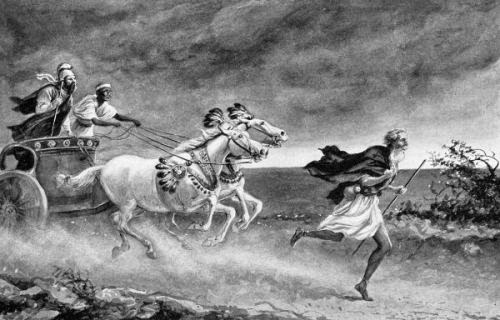
41 And Elijah said to Ahab, “Go up, eat and drink, for there is a sound of the rushing of rain.” 42 So Ahab went up to eat and to drink. And Elijah went up to the top of Mount Carmel. And he bowed himself down on the earth and put his face between his knees. 43 And he said to his servant, “Go up now, look toward the sea.” And he went up and looked and said, “There is nothing.” And he said, “Go again,” seven times. 44 And at the seventh time he said, “Behold, a little cloud like a man’s hand is rising from the sea.” And he said, “Go up, say to Ahab, ‘Prepare your chariot and go down, lest the rain stop you.’” 45 And in a little while the heavens grew black with clouds and wind, and there was a great rain. And Ahab rode and went to Jezreel. 46 And the hand of the LORD was on Elijah, and he gathered up his garment and ran before Ahab to the entrance of Jezreel. 

1 Ahab told Jezebel all that Elijah had done, and how he had killed all the prophets with the sword. Then Jezebel sent a messenger to Elijah, saying, “So may the gods do to me and more also, if I do not make your life as the life of one of them by this time tomorrow.” Then he was afraid, and he arose and ran for his life and came to Beersheba, which belongs to Judah, and left his servant there. 1 Kings 18:41-19:3 ESV

Chapter 18 opened up with the words God spoke to Elijah: “Go, show yourself to Ahab, and I will send rain upon the earth” (1 Kings 18:1 ESV). This statement contains a command as well as a promise from God. After his three-and-a-half-year absence, Elijah was to return to Israel from Sidon and confront King Ahab one more time. But while this command would likely involve significant risk to the prophet, his obedience would result in a tremendous blessing on the people. God would end the prolonged drought and restore rain to the land.

It is impossible to know if Elijah was aware of all that would have to happen before the rain returned. There is no indication as to when God divulged the rest of His plan and Elijah’s role in it. But before the physical drought could end, the spiritual drought afflicting the people would have to come to a decisive conclusion that involved a dramatic confrontation between Elijah and the 450 prophets of Baal. However, the real battle would be between Yahweh, the God of Israel, and Baal, the god of Ahab and Jezebel.

Yahweh had won the day, displaying His power by sending fire from heaven that “consumed the burnt offering and the wood and the stones and the dust, and licked up the water that was in the trench” (1 Kings 18:38 ESV). This demonstrative exhibition of God’s omnipotence brought the people to their knees in fear and worship. What they had just witnessed left them thoroughly convinced that Yahweh was the one true God, and that newly revived awareness left them crying out, “The LORD, he is God; the LORD, he is God” (1 Kings 18:39 ESV). And as if to put an exclamation point on the whole scene, Elijah ordered the capture and execution of all 450 of Baal’s so-called prophets. Their god had remained silent when they cried to him for help. Now the prophet of Yahweh silenced them for good. They would no longer deceive and mislead the people of Israel with fallacious promises concerning their false god.

But there was still one thing missing: The rain that Yahweh had promised. Baal had been discredited, his prophets had been eliminated, and the peoples’ reverence for Yahweh had been rejuvenated. But the land remained under the God-ordained drought that had turned Israel into a dust bowl where water and food were scarce and daily survival was a challenge. The land that God had once described as “flowing with milk and honey” (Exodus 33:3 ESV) had become fruitless and lifeless, reflecting the spiritual state of the people who occupied it.

Hundreds of years earlier, long before the people of Israel took possession of the land of Canaan, Moses warned what would happen if they proved unfaithful.

“And if you will indeed obey my commandments that I command you today, to love the LORD your God, and to serve him with all your heart and with all your soul, he will give the rain for your land in its season, the early rain and the later rain, that you may gather in your grain and your wine and your oil. And he will give grass in your fields for your livestock, and you shall eat and be full. Take care lest your heart be deceived, and you turn aside and serve other gods and worship them; then the anger of the LORD will be kindled against you, and he will shut up the heavens, so that there will be no rain, and the land will yield no fruit, and you will perish quickly off the good land that the LORD is giving you.” – Deuteronomy 11:13-17 ESV

Years later, when God’s people continued to display their propensity for unfaithfulness, His prophet, Joel, would offer this promise of divine restoration even in the face of their disobedience.

Surely the LORD has done great things!
    Don’t be afraid, O land.
Be glad now and rejoice,
    for the LORD has done great things.
Don’t be afraid, you animals of the field,
    for the wilderness pastures will soon be green.
The trees will again be filled with fruit;
    fig trees and grapevines will be loaded down once more.
Rejoice, you people of Jerusalem!
    Rejoice in the LORD your God!
For the rain he sends demonstrates his faithfulness.
    Once more the autumn rains will come,
    as well as the rains of spring.
The threshing floors will again be piled high with grain,
    and the presses will overflow with new wine and olive oil.

The LORD says, “I will give you back what you lost…” – Joel 2:20-25 ESV

That day on Mount Carmel, the people had seen the fire of God fall from heaven, completely consuming the altar, sacrifice, and water. But they had not yet seen or felt His blessing. As Joel stated, “the rain he sends demonstrates his faithfulness.” Their land was in desperate need of restoration and rejuvenation, and so were they. After three-and-a-half years of spiritual drought, their hearts were parched and hardened. They had lost the capacity for fruitfulness and faithfulness and needed an outpouring of God’s grace and mercy.

Elijah knew what God had in store. So, he informed the shell-shocked king to “Go get something to eat and drink, for I hear a mighty rainstorm coming!” (1 Kings 18:41 NLT). There was a blessing on the horizon. Despite Ahab and Jezebel’s wickedness, God was about to pour out His goodness on the land.

The fact that Ahab had food to eat is symbolic of his self-centered approach to leadership. His sins had brought God’s curse upon the nation, but while the people suffered severely from the lack of rain, Ahab and Jezebel lived in royal comfort and ease. God would later issue an indictment against the leaders of Israel, warning them of their blatant disregard for the care of His people.

“What sorrow awaits you shepherds who feed yourselves instead of your flocks. Shouldn’t shepherds feed their sheep?” – Ezekiel 34:2 NLT

As Ahab was busy satisfying his own needs, Elijah interceded on behalf of the people of Israel. He “climbed to the top of Mount Carmel and bowed low to the ground and prayed with his face between his knees” (1 Kings 18:42 NLT). At one point during his prayer, he stopped and sent his servant to look toward the Mediterranean Sea in the east. But the servant saw nothing. This pattern repeated itself five more times with the same disappointing result. But the seventh time, the servant returned with a different report.

“I saw a little cloud about the size of a man’s hand rising from the sea.” – 1 Kings 18:44 NLT

Out on the distant horizon, the servant saw what appeared to be a glimmer of hope. It was a small and seemingly insignificant cloud, but Elijah knew what it meant. The blessing of God was about to fall and, when it did, it would come in torrents. So, he instructed his servant to warn Ahab to leave immediately, or he may not make it back to his winter palace in Jezreel. When Elijah’s servant looked to the east, he saw only a faint possibility. But through his eyes of faith,  Elijah saw something altogether different. He perceived the imminent arrival of the outpouring of God’s blessing, and before long, that small cloud developed into a massive storm that brought strong winds and torrential rains. As Ahab tried to outrun the storm in his chariot, “the LORD gave special strength to Elijah. He tucked his cloak into his belt and ran ahead of Ahab’s chariot all the way to the entrance of Jezreel” (1 Kings 18:46 NLT).

Because Jezreel was anywhere from 10 to 20 miles east of Mount Carmel, some commentators attempt to explain this last verse by saying that Ahab’s chariot got caught in the mud and delayed his arrival. Others speculate that Elijah simply took a shortcut over the ridge of Mount Carmel. But everything about this story has been focused on the matchless power of God, and it should not seem out of the question that God might endow his prophet with a supernatural capacity to outrun the chariot of his arch-nemesis. God had defeated Baal. Now, the prophet of God had defeated the benefactor of Baal.

But while Elijah had won the victory at Mount Carmel and the race to Jezreel, he would have little time to celebrate. Upon hearing the unexpected news of all that had transpired on Mount Carmel, Jezebel was outraged and directed all her anger at Elijah.

“May the gods strike me and even kill me if by this time tomorrow I have not killed you just as you killed them.” – 1 Kings 19:2 NLT

Despite all that Ahab told her about the day’s events, she remained unconvinced of Yahweh’s power. She even called on Baal and his queen mother, Asherah, to come to her aid so that she might avenge the deaths of the prophets by killing Elijah. She was still putting her hope and trust in her false gods. Even the sudden arrival of long-awaited rain did nothing to diminish her misplaced trust in her lifeless and powerless gods. Baal, Jezebel’s beloved fertility god, had done nothing to eliminate the drought that had plagued the land.

But even more surprising than Jezebel’s stubborn belief in Baal and her resistance to God was Elijah’s sudden display of fear and doubt. This man, who had called down fire from heaven and had singlehandedly executed 450 prophets of Baal, found himself intimidated by the idle threats of this self-absorbed, idol-worshiping queen. Her vow to avenge her false god should have made Elijah laugh with scorn. Her god had proven himself to be speechless, powerless, and utterly helpless in the face of Yahweh. Yet, the formerly faithful Elijah was suddenly fearful, and this time, rather than running to the problem in the strength of God, he took flight and tried to escape it. He fled for his life, covering the 25 miles from Jezreel to Beersheba, motivated by fear and in the strength of his own flesh. Faced with the threats of Jezebel, Elijah took his eyes off God and took his fate into his own hands. 

This faithful man of God allowed the words of an idol-obsessed queen to dishearten and defeat him. He had bravely faced off against the 450 prophets of Baal, but now, with Jezebel’s words ringing in his ear, Elijah ran all the way to Beersheba, located on the southern border of Judah. From there, he would enter the Judean wilderness, the very same place where the disobedient and doubtful Israelites had wandered for 40 years when they refused to enter the promised land. And, in no time at all, the once faith-filled Elijah would find himself racked by fear and desiring death rather than face the vengeful anger of Jezebel.

English Standard Version (ESV) The Holy Bible, English Standard Version. ESV® Permanent Text Edition® (2016). Copyright © 2001 by Crossway Bibles, a publishing ministry of Good News Publishers.

New Living Translation (NLT) Holy Bible, New Living Translation, copyright © 1996, 2004, 2015 by Tyndale House Foundation. Used by permission of Tyndale House Publishers Inc., Carol Stream, Illinois 60188. All rights reserved.

Limping Between Two Spiritual Opinions

1 After many days the word of the LORD came to Elijah, in the third year, saying, “Go, show yourself to Ahab, and I will send rain upon the earth.” So Elijah went to show himself to Ahab. Now the famine was severe in Samaria. And Ahab called Obadiah, who was over the household. (Now Obadiah feared the LORD greatly, and when Jezebel cut off the prophets of the LORD, Obadiah took a hundred prophets and hid them by fifties in a cave and fed them with bread and water.) And Ahab said to Obadiah, “Go through the land to all the springs of water and to all the valleys. Perhaps we may find grass and save the horses and mules alive, and not lose some of the animals.” So they divided the land between them to pass through it. Ahab went in one direction by himself, and Obadiah went in another direction by himself.

And as Obadiah was on the way, behold, Elijah met him. And Obadiah recognized him and fell on his face and said, “Is it you, my lord Elijah?” And he answered him, “It is I. Go, tell your lord, ‘Behold, Elijah is here.’” And he said, “How have I sinned, that you would give your servant into the hand of Ahab, to kill me? 10 As the LORD your God lives, there is no nation or kingdom where my lord has not sent to seek you. And when they would say, ‘He is not here,’ he would take an oath of the kingdom or nation, that they had not found you. 11 And now you say, ‘Go, tell your lord, “Behold, Elijah is here.”’ 12 And as soon as I have gone from you, the Spirit of the LORD will carry you I know not where. And so, when I come and tell Ahab and he cannot find you, he will kill me, although I your servant have feared the LORD from my youth. 13 Has it not been told my lord what I did when Jezebel killed the prophets of the Lord, how I hid a hundred men of the Lord’s prophets by fifties in a cave and fed them with bread and water? 14 And now you say, ‘Go, tell your lord, “Behold, Elijah is here”’; and he will kill me.” 15 And Elijah said, “As the LORD of hosts lives, before whom I stand, I will surely show myself to him today.” 16 So Obadiah went to meet Ahab, and told him. And Ahab went to meet Elijah.

17 When Ahab saw Elijah, Ahab said to him, “Is it you, you troubler of Israel?” 18 And he answered, “I have not troubled Israel, but you have, and your father’s house, because you have abandoned the commandments of the LORD and followed the Baals. 19 Now therefore send and gather all Israel to me at Mount Carmel, and the 450 prophets of Baal and the 400 prophets of Asherah, who eat at Jezebel’s table.”

20 So Ahab sent to all the people of Israel and gathered the prophets together at Mount Carmel. 21 And Elijah came near to all the people and said, “How long will you go limping between two different opinions? If the LORD is God, follow him; but if Baal, then follow him.” And the people did not answer him a word. 1 Kings 18:1-22 ESV

For nearly three years, Elijah has been living in exile among the Sidonians. God had sent him there to protect and preserve him for the next phase of his mission. Three years earlier, Elijah had delivered God’s message of judgment to King Ahab and his pagan queen, Jezebel. Their joint decision to use their royal power to legislate the worship of Baal had brought down the anger of Yahweh in the form of a devastating famine. Knowing this godless couple would seek to kill His messenger, God sent Elijah away so that he could live to fight another day, and that day had finally come.

In his original encounter with Ahab, Elijah had boldly declared that the famine would last until God ordered him to bring it to an end.

“As surely as the LORD, the God of Israel, lives—the God I serve—there will be no dew or rain during the next few years until I give the word!” – 1 Kings 17:1 NLT

Now, three years later, Elijah had received his marching orders from God.

“Go, show yourself to Ahab, and I will send rain upon the earth.” – 1 Kings 18:1 ESV

God had allowed the drought to take its toll. Three years without rain had resulted in a widespread famine that had even impacted the capital city of Samaria. It was there that Ahab had ordered the construction of a temple to Baal, the Phoenician fertility god.

He erected an altar for Baal in the house of Baal, which he built in Samaria. And Ahab made an Asherah. Ahab did more to provoke the LORD, the God of Israel, to anger than all the kings of Israel who were before him. – 1 Kings 16:32-33 ESV

But Baal’s presence had not spared the royal city. Whatever power the people believed their beloved fertility god possessed had failed to stem the ravaging effects of the drought and the life-threatening nature of the resulting famine. Things had gotten so bad that Ahab ordered a search for any land where there might be grass to feed his horses and mules. As king, he was more concerned about the fate of his livestock than he was about the well-being of the people under his care. So, he sent his household manager on a desperate, but futile search for green grass in the midst of a famine. But what Obadiah ended up finding was something neither he nor the king ever expected.

As Obadiah was walking along, he suddenly saw Elijah coming toward him. Obadiah recognized him at once and bowed low to the ground before him. “Is it really you, my lord Elijah?” he asked. – 1 Kings 18:7 NLT

Obadiah was shocked to run into Elijah. After three years, he had probably assumed that the prophet had met an untimely end. But out of reverence and honor, he bowed before Elijah. This man, who served as a royal official in the court of King Ahab, was still a faithful follower of Yahweh, and the author provides an essential parenthetical description that lets the reader know that Obadiah can be trusted.

Obadiah was a devoted follower of the LORD. Once when Jezebel had tried to kill all the LORD’s prophets, Obadiah had hidden 100 of them in two caves. He put fifty prophets in each cave and supplied them with food and water. – 1 Kings 18:3-4 NLT

This little detail concerning Obadiah will prove to be important as the narrative unfolds. First, it lets the reader know that after Elijah had delivered God’s message concerning the drought, Jezebel had launched a campaign to liquidate any and all of God’s prophets from the land of Israel. It seems reasonable to believe that her goal had been to catch and eliminate Elijah. Still, she was willing to execute any prophet of Yahweh who might stand in opposition to her will and the worship of her false god.

But the author’s little aside provides a second detail that will prove crucial. Jezebel’s death squads had failed to find and kill 100 prophets of Yahweh because they had been protected by Obadiah. At significant risk to his own life, this royal official had willfully violated the queen’s command by aiding and abetting those whose executions she had ordered. God had chosen to use ravens to deliver food for Elijah. But in the case of the 100 prophets, He had selected a member of Ahab’s royal court. Once again, God had used an unlikely and unexpected source to preserve His messengers. The fact that these 100 prophets exist will become more important as the story unfolds.

Recognizing Obadiah as a member of the royal court, Elijah instructed him to return to the palace with a message for the king.

“Go, tell your lord, ‘Behold, Elijah is here.’” – 1 Kings 18:8 ESV

Obadiah, while a faithful follower of Yahweh, was not thrilled at the prospect of sharing this news with King Ahab. He knew that Elijah was a wanted man with a bounty on his head, and Ahab had gone to great lengths to locate and eliminate this proverbial thorn in his side.

“I swear by the Lord your God that the king has searched every nation and kingdom on earth from end to end to find you” – 1 Kings 18:10 NLT

After three years, Ahab’s quest to find Elijah had proven unsuccessful, and his frustration would have been at an all-time high. Obadiah was afraid that if he delivered Elijah’s message and then the prophet disappeared again, the king would take out his anger on him. In an attempt to let Elijah know that he had already risked his life in the cause of Yahweh, Obadiah shared the story of his rescue of the 100 prophets. Hadn’t that been enough? Was God now requiring him to put his life on the line again just so he could deliver Elijah’s message to the king?

But Elijah promised his reluctant friend that he would not put his life in jeopardy; he would not be going anywhere because he had a job to do. In fact, he assured Obadiah that he would appear before the king that very day. So, Obadiah did as the prophet commanded and rode to find the king, who was also conducting a futile search for green grass.

When Ahab heard the news, he dropped everything and rode to meet Elijah. Upon seeing the man he loathed and despised, the king sarcastically asked, “Is it you, you troubler of Israel?” (1 Kings 18:17 ESV). This arrogant and apostate king tried to blame Elijah for the nation’s woes. He knew that Elijah had spoken the drought into existence, and he held him personally responsible for all the pain and suffering it had caused. His stubborn and unrepentant heart would not allow him to admit his own culpability for what had happened. It was the sin of Ahab and his wife that had brought down the judgment of God. Elijah had just been the messenger, and he immediately placed the blame for Israel’s woes right where it belonged.

“I have made no trouble for Israel,” Elijah replied. “You and your family are the troublemakers, for you have refused to obey the commands of the LORD and have worshiped the images of Baal instead. – 1 Kings 18:18 NLT

Ahab and his father Omri had led the people of Israel into apostasy by promoting the worship of false gods. They had turned their backs on Yahweh, causing God’s chosen people to commit spiritual adultery by giving their allegiance and affections to the gods of the Canaanites. They were to blame for the drought and the famine it caused.

But it’s important to recall that God had told Elijah to deliver a message to Ahab that would have sounded like good news: “Tell him that I will soon send rain!” (1 Kings 18:1 NLT). Yet, while the drought was about to end, the judgment was far from over. God was about to deliver a devastating blow to the royal couple that would reveal the impotence of their false god and the futility of abandoning the one true God.

Elijah threw down the gauntlet, challenging the king to a public showdown that would pit Baal against Yahweh.

“Now summon all Israel to join me at Mount Carmel, along with the 450 prophets of Baal and the 400 prophets of Asherah who are supported by Jezebel.” – 1 Kings 18:19 NLT

Driven by pride, the king took the challenge and called for an assembly of all the people of Israel. He ordered all the prophets of his false gods to gather together to do battle with Elijah and his God. Just consider the arrogance required to do what Ahab did. He was willingly and deliberately going to war with God Almighty, and he legitimately thought he could win, but his ego was in for a rude awakening. His gods were about to be exposed for what they were: Figments of man’s fertile and futile imagination that would be proven lifeless and powerless before the God of the universe.

In an epic showdown, Elijah was going to take on the god of Ahab and Jezebel, and challenge the people of Israel to end their vacillating indecision about which God they would serve. In a sense, Elijah was following the lead of Joshua, who, centuries earlier, had issued a similar challenge to the indecisive and unfaithful Israelites of his day.

“…choose today whom you will serve. Would you prefer the gods your ancestors served beyond the Euphrates? Or will it be the gods of the Amorites in whose land you now live? But as for me and my family, we will serve the LORD.” – Joshua 24:15 NLT

English Standard Version (ESV) The Holy Bible, English Standard Version. ESV® Permanent Text Edition® (2016). Copyright © 2001 by Crossway Bibles, a publishing ministry of Good News Publishers.

New Living Translation (NLT) Holy Bible, New Living Translation, copyright © 1996, 2004, 2015 by Tyndale House Foundation. Used by permission of Tyndale House Publishers Inc., Carol Stream, Illinois 60188. All rights reserved.

Drought, Doubt, and Deliverance

1 Now Elijah the Tishbite, of Tishbe in Gilead, said to Ahab, “As the LORD, the God of Israel, lives, before whom I stand, there shall be neither dew nor rain these years, except by my word.” And the word of the LORD came to him: “Depart from here and turn eastward and hide yourself by the brook Cherith, which is east of the Jordan. You shall drink from the brook, and I have commanded the ravens to feed you there.” So he went and did according to the word of the LORD. He went and lived by the brook Cherith that is east of the Jordan. And the ravens brought him bread and meat in the morning, and bread and meat in the evening, and he drank from the brook. And after a while the brook dried up, because there was no rain in the land.

Then the word of the LORD came to him, “Arise, go to Zarephath, which belongs to Sidon, and dwell there. Behold, I have commanded a widow there to feed you.” 10 So he arose and went to Zarephath. And when he came to the gate of the city, behold, a widow was there gathering sticks. And he called to her and said, “Bring me a little water in a vessel, that I may drink.” 11 And as she was going to bring it, he called to her and said, “Bring me a morsel of bread in your hand.” 12 And she said, “As the LORD your God lives, I have nothing baked, only a handful of flour in a jar and a little oil in a jug. And now I am gathering a couple of sticks that I may go in and prepare it for myself and my son, that we may eat it and die.” 13 And Elijah said to her, “Do not fear; go and do as you have said. But first make me a little cake of it and bring it to me, and afterward make something for yourself and your son. 14 For thus says the LORD, the God of Israel, ‘The jar of flour shall not be spent, and the jug of oil shall not be empty, until the day that the LORD sends rain upon the earth.’” 15 And she went and did as Elijah said. And she and he and her household ate for many days. 16 The jar of flour was not spent, neither did the jug of oil become empty, according to the word of the LORD that he spoke by Elijah. 1 Kings 17:1-16 ESV

Almost as if out of nowhere, a new character appears on the scene. His sudden and unexpected arrival seems intended to accentuate the divine nature of his mission. No background story or biographical information is provided, other than his name and the identity of his hometown.

His introduction into the narrative is timed to coincide with the rise to power of King Ahab and his Sidonian queen, Jezebel. With this new power couple ruling over the northern kingdom of Israel, the spiritual state of the ten northern tribes has reached an all-time low. The author ended chapter 16 with an unflattering description of their influence over the nation.

…he [Ahab] took for his wife Jezebel the daughter of Ethbaal king of the Sidonians, and went and served Baal and worshiped him. He erected an altar for Baal in the house of Baal, which he built in Samaria. And Ahab made an Asherah. Ahab did more to provoke the LORD, the God of Israel, to anger than all the kings of Israel who were before him. – 1 Kings 16:31-33 ESV

To claim that Ahab had managed to anger God more than any of his predecessors is a significant statement. He was following in the footsteps of some world-class, all-star-quality apostates. But when it came to wickedness and unfaithfulness, Ahab set the new gold standard. He became the proverbial poster boy for all that is wicked and ungodly, while his wife managed to earn herself a permanent spot in the spiritual hall of infamy.

In the middle of their sin-fueled and self-absorbed reign, God decides to deliver a message to them, utilizing an obscure and unknown man named Elijah. This will not be the first time God has sent a prophet to deliver a message to a wayward and rebellious king. When Jeroboam had made the fateful decision to replace Yahweh with his own false gods, an unnamed prophet appeared on the scene with a dire message for the king, and he demonstrated God’s anger by destroying one of the altars Jeroboam had dedicated to his false god. Later on, Jeroboam sent his wife to consult with another prophet of God, in hopes of getting a prognosis regarding his young son’s illness. But what he got was bad news. He was told that his son would die and that every one of his male heirs would face the same fate before they could inherit the throne. In other words, any hopes of establishing a dynasty would be destroyed.

As the seventh king to reign over the northern kingdom of Israel, Ahab would not be the first to receive a message from God. But, in his case, the prophet would play a more pronounced and prolonged role in his life. The sins of Ahab and his wife were so egregious that God made his prophet a permanent fixture in their kingdom.

Elijah’s very first encounter with the king and queen was far from favorable. He stood before this powerful couple and boldly proclaimed, “As the LORD, the God of Israel, lives, before whom I stand, there shall be neither dew nor rain these years, except by my word” (1 Kings 17:1 ESV). That took guts and a fair amount of faith. He was claiming to have the God-given authority to withhold rain from the kingdom of Israel. Any way you look at it, this had to come across as a less-than-veiled threat to Ahab and Jezebel. But before they had time to cut this arrogant upstart down to size, God gave him instructions to get out of town.

“Depart from here and turn eastward and hide yourself by the brook Cherith, which is east of the Jordan. – 1 Kings 17:3 ES

Elijah had done his job, but now it was time for God to prepare him for the next phase of his assignment. Before sending his prophet back into the mouth of the lion’s den, God planned to equip him for what was to come. He was determined to make Elijah a faithful and obedient messenger, strong enough to handle all the vitriol and violence that was about to come his way. Standing up to Ahab and Jezebel was not going to be easy, so God graciously eased Elijah into his new role with a hands-on experience that would teach him to trust and obey.

While in God’s preparatory school for prophets, Elijah was miraculously fed and cared for; he received a twice-daily ration of bread and meat, delivered to his cave by ravens. And outside the cave was a ready source of clean, pure water. But in time, “the brook dried up, because there was no rain in the land” (1 Kings 17:7 ESV). In other words, Elijah’s prediction of drought had come true, and he suffered just like everyone else. Without rain, there was no harvest, so that meant there was no more bread or meat for the ravens to deliver. Elijah’s little oasis in the wilderness had become a death trap. So, God gave him new instructions.

“Go and live in the village of Zarephath, near the city of Sidon. I have instructed a widow there to feed you.” – 1 Kings 17:8 NLT

This would have been a long and arduous journey under normal conditions, but the presence of drought made it even more so. Interestingly, God sent Elijah to a city in the region of Sidon, the very kingdom over which Jezebel’s father was king. Elijah was being sent to the same place Ahab had acquired a queen and her false god, Baal. Zarephath lay between Tyre and Sidon, two of the most prominent Phoenician cities. But as the story makes clear, the drought had made its way all the way to the coast of the Mediterranean Sea.

God provided Elijah with scant details about what to do when he arrived in Zarephath. The prophet had no food and received no word from God regarding when and how it would come, if it did at all. So, when Elijah encountered a widow gathering sticks, he decided to throw himself on her mercy. He asked for a drink of water and a morsel of bread. But then he discovered that this woman’s state was worse than his own.

“I swear by the LORD your God that I don’t have a single piece of bread in the house. And I have only a handful of flour left in the jar and a little cooking oil in the bottom of the jug. I was just gathering a few sticks to cook this last meal, and then my son and I will die.” – 1 Kings 17:12 NLT

The drought had taken its toll, leaving the woman with no food with which to feed herself or her young son.  It shouldn’t be overlooked that Baal, the god of the Phoenicians, was considered a fertility god. He was the provider of bountiful blessings, whether in the form of crops or children. Yet, this woman was living in a drought and watching her young son starve to death. There was nothing bountiful taking place in Zarephath, and Jezebel’s god was nowhere to be found.

Then, God gave Elijah a message to deliver to the woman.

“Don’t be afraid! Go ahead and do just what you’ve said, but make a little bread for me first. Then use what’s left to prepare a meal for yourself and your son. For this is what the LORD, the God of Israel, says: There will always be flour and olive oil left in your containers until the time when the LORD sends rain and the crops grow again!” – 1 Kings 17:13-14 NLT

While the god of the Phoenicians had failed to provide, the God of Israel would meet her needs and preserve the lives of both her and her son. Even in a time of drought, God would miraculously provide flour and oil in abundance until He decided to open up the skies and end the drought.

The woman faithfully obeyed the word of the prophet, and There was always enough flour and olive oil left in the containers, just as the LORD had promised through Elijah” (1 Kings 17:16 NLT). God graciously provided for this Sidonian widow and her son, and He continued to meet the needs of His prophet. But more importantly, God was teaching Elijah that He could be trusted. He was greater than the fertility god of the Phoenicians. He was more powerful than the false deity of Ahab and Jezebel. The brook may have dried up, but the resources of God remained unending and plentiful. The ravens may have stopped showing up, but the miracle-working power of God remained undiminished. Elijah was learning the vital truth that no circumstance is too difficult for Yahweh, and the days ahead would provide further confirmation of that fact.

English Standard Version (ESV) The Holy Bible, English Standard Version. ESV® Permanent Text Edition® (2016). Copyright © 2001 by Crossway Bibles, a publishing ministry of Good News Publishers.

New Living Translation (NLT) Holy Bible, New Living Translation, copyright © 1996, 2004, 2015 by Tyndale House Foundation. Used by permission of Tyndale House Publishers Inc., Carol Stream, Illinois 60188. All rights reserved.

Just When You Thought It Couldn’t Get Any Worse

29 In the thirty-eighth year of Asa king of Judah, Ahab the son of Omri began to reign over Israel, and Ahab the son of Omri reigned over Israel in Samaria twenty-two years. 30 And Ahab the son of Omri did evil in the sight of the LORD, more than all who were before him. 31 And as if it had been a light thing for him to walk in the sins of Jeroboam the son of Nebat, he took for his wife Jezebel the daughter of Ethbaal king of the Sidonians, and went and served Baal and worshiped him. 32 He erected an altar for Baal in the house of Baal, which he built in Samaria. 33 And Ahab made an Asherah. Ahab did more to provoke the LORD, the God of Israel, to anger than all the kings of Israel who were before him. 34 In his days Hiel of Bethel built Jericho. He laid its foundation at the cost of Abiram his firstborn, and set up its gates at the cost of his youngest son Segub, according to the word of the LORD, which he spoke by Joshua the son of Nun. 1 Kings 16:29-34 ESV

Things have not been going well in the northern kingdom of Judah. The downward spiritual spiral that began with the reign of Jeroboam has continued unabated. His decision to re-image the God of Israel as a golden calf had been in direct violation of the command given to Moses by God hundreds of years earlier.

“I am the LORD your God, who rescued you from the land of Egypt, the place of your slavery. You must not have any other god but me. You must not make for yourself an idol of any kind or an image of anything in the heavens or on the earth or in the sea. You must not bow down to them or worship them, for I, the LORD your God, am a jealous God who will not tolerate your affection for any other gods. I lay the sins of the parents upon their children; the entire family is affected—even children in the third and fourth generations of those who reject me.” – Exodus 20:1-5 NLT

And yet, despite God’s clear instructions, Jeroboam made his own gods and then attempted to claim that they, not Yahweh, had delivered the nation from their captivity in Egypt.

So on the advice of his counselors, the king made two gold calves. He said to the people, “It is too much trouble for you to worship in Jerusalem. Look, Israel, these are the gods who brought you out of Egypt!”

He placed these calf idols in Bethel and in Dan—at either end of his kingdom. But this became a great sin, for the people worshiped the idols, traveling as far north as Dan to worship the one there. – 1 Kings 12:28-30 NLT

Jeroboam’s decision brought a curse from God upon his dynasty. As a result, his son, Abijah, died in infancy. Another son, Nadab, inherited the throne upon Jeroboam’s death, but in the second year of his reign, he was assassinated by a man named Baasha, who declared himself king. Baasha fulfilled the curse God had placed over the house of Jeroboam by putting to death every one of his descendants. But because Baasha proved to be a wicked king who led the people into further idolatry, God placed a curse on his house as well. Baasha was assassinated by Zimri, the commander of his chariots, who then proceeded to wipe out the entire royal household. But Zimri’s reign would last only seven days. When faced with a coup led by Omri, his former superior officer, Zimri chose to commit suicide. Omri then declared himself to be the legitimate king of Israel. But his reign would prove to be no better than that of his predecessor. In fact, the author flatly states, “Omri did what was evil in the sight of the LORD, and did more evil than all who were before him. For he walked in all the way of Jeroboam the son of Nebat, and in the sins that he made Israel to sin, provoking the LORD, the God of Israel, to anger by their idols” (1 Kings 16:25-26 ESV).

There has been no break in Israel’s downward trajectory. Like water in a sink when the plug is pulled, the spiritual state of the nation continued to spiral down the drain. And just when it appears that Israel has reached an all-time low, another character is introduced who manages to establish himself as the official record holder for apostasy and wickedness.

Omri was succeeded by his son, Ahab, and in more ways than one. Not only did this young man ascend to his father’s throne, but he managed to eclipse his father’s record of sin and rebellion. The author introduces Ahab’s reign with the stinging indictment: “Ahab the son of Omri did evil in the sight of the LORD, more than all who were before him” (1 Kings 16:30 ESV). Then he follows up that far-from-flattering assessment with tangible proof.

He compares the wickedness of Ahab with that of Jeroboam, the first king of the northern tribes of Israel. Jeroboam had been guilty of making his own false gods and attributing to them the credit for something Yahweh had done. In a sense, Jeroboam had tried to create his own version of the one true God. But Ahab decided to abandon Yahweh altogether, replacing Him with Baal, the god of the Canaanites, and his choice of this particular god was influenced by his wife, Jezebel. His marriage to Jezebel had been orchestrated by his father as part of a treaty he had made with Ethbaal, the king of Tyre and Sidon. To form an alliance with this pagan nation, Omri arranged a marriage between his son and Ethbaal’s daughter. This unholy alliance was in direct violation of God’s command.

When the LORD your God hands these nations over to you and you conquer them, you must completely destroy them. Make no treaties with them and show them no mercy. You must not intermarry with them. Do not let your daughters and sons marry their sons and daughters, for they will lead your children away from me to worship other gods. – Deuteronomy 7:2-3 NLT

While the marriage had been Omri’s idea, the author refuses to absolve Ahab of any guilt for his role in the affair. He had been fully compliant and complicit.

…he took for his wife Jezebel the daughter of Ethbaal king of the Sidonians, and went and served Baal and worshiped him. – 1 Kings 16:31 ESV

Just as God had warned, Ahab’s pagan wife ended up having a powerful and detrimental influence over him. This marriage, arranged purely for political purposes, was destined to have dire spiritual implications. What Omri had done to secure the state of his kingdom would end up sealing its fate. Jezebel would do more to degrade the spiritual health of the nation than any king, including her own husband.

This pagan princess introduced her new husband to the gods of her people. The Phoenicians and Canaanites considered Baal to be the most powerful of all the gods. According to their mythology, he was the offspring of El, the chief god, and Asherah, the moon goddess. Baal was sometimes referred to as the sun god or the god of thunder. He was considered a fertility god who rewarded those who worshiped him with fruitfulness, in the form of children and abundant crops.

Ahab willingly and eagerly adopted the false gods of Jezebel, ordering the construction of a temple dedicated to Baal and the erection of an Asherah pole for the worship of Baal’s mother, the moon goddess. These actions stand in stark contrast to those of Solomon, who constructed a Temple for Yahweh in the capital city of Jerusalem. Now, here was Ahab, the king of the northern tribes of Judah, building a temple in the capital city of Samaria dedicated to the worship of the false god of the Canaanites. The people of Israel had sunk to an all-time low, and it was going to get even worse.

The author provided a foreshadowing of things to come when he stated that Ahab “did more to provoke the anger of the LORD, the God of Israel, than any of the other kings of Israel before him” (1 Kings 16:33 NLT). This foreboding statement is followed by another tangible expression of Ahab’s ill-fated actions. It seems that Ahab had given orders to rebuild the destroyed city of Jericho. This task was assigned to a man named Hiel, but the endeavor proved costly. While overseeing the construction of the city, Hiel ended up losing two of his own sons. 

This somewhat strange and seemingly out-of-place narrative is meant to illustrate Ahab’s blatant disregard for the will of God. His determination to rebuild the city of Jericho was in direct violation of God’s command. Hundreds of years earlier, when the Israelites had first entered the land of Canaan, Jericho had been the first city they had defeated and destroyed. God had given them a supernatural victory over the city and its inhabitants, and then He commanded its destruction, placing a curse on anyone who tried to rebuild the ruins.

“Cursed before the Lord be the man who rises up and rebuilds this city, Jericho.

“At the cost of his firstborn shall he
    lay its foundation,
and at the cost of his youngest son
    shall he set up its gates.” – Joshua 6:26 ESV

Hiel, under direct orders from Ahab, ended up violating the command of God, and, as a result, he inadvertently found himself suffering the curse of God. The author sadly states that this poor man “laid its foundation at the cost of Abiram his firstborn, and set up its gates at the cost of his youngest son Segub, according to the word of the LORD” (1 Kings 16:34 ESV).

The marriage of Ahab and Jezebel would prove to be one of the worst things that ever happened to the people of God. This unholy alliance ended up bringing great sorrow upon the nation, leading the people into further rebellion against God. Eventually, Jezebel became the poster girl for wickedness and evil. Her very name would become a byword for all that stands opposed to God. In fact, her name appears in the very last book of the Bible, as a less-than-flattering description of a woman who would end up leading the church at Thyatira into immorality and the worship of false gods.

“But I have this complaint against you. You are permitting that woman—that Jezebel who calls herself a prophet—to lead my servants astray. She teaches them to commit sexual sin and to eat food offered to idols. I gave her time to repent, but she does not want to turn away from her immorality.” – Revelation 2:20-21 NLT

But the devastating exploits of this power couple were just beginning. As will become painfully evident, their evil actions would not go unnoticed or unpunished by God. He is omniscient and omnipotent, possessing the divine capacity to see and know all things, and the power to deal with the wickedness of man justly and sovereignly. Ahab and Jezebel would wield tremendous authority and display an unbridled arrogance toward Yahweh. Their failure to honor and revere Him as God would come back to haunt them. The actions of this royal couple would bring down God’s wrath, not just because they refused to honor Him, but because they influenced others to follow their lead. The apostle Paul describes the fate of all those who follow the path of Ahab and Jezebel.

Since they thought it foolish to acknowledge God, he abandoned them to their foolish thinking and let them do things that should never be done. Their lives became full of every kind of wickedness, sin, greed, hate, envy, murder, quarreling, deception, malicious behavior, and gossip. They are backstabbers, haters of God, insolent, proud, and boastful. They invent new ways of sinning, and they disobey their parents. They refuse to understand, break their promises, are heartless, and have no mercy. They know God’s justice requires that those who do these things deserve to die, yet they do them anyway. Worse yet, they encourage others to do them, too. – Romans 1:28-32 NLT

English Standard Version (ESV) The Holy Bible, English Standard Version. ESV® Permanent Text Edition® (2016). Copyright © 2001 by Crossway Bibles, a publishing ministry of Good News Publishers.

New Living Translation (NLT) Holy Bible, New Living Translation, copyright © 1996, 2004, 2015 by Tyndale House Foundation. Used by permission of Tyndale House Publishers Inc., Carol Stream, Illinois 60188. All rights reserved.

The Almighty and Accountability

In the twenty-sixth year of Asa king of Judah, Elah the son of Baasha began to reign over Israel in Tirzah, and he reigned two years. But his servant Zimri, commander of half his chariots, conspired against him. When he was at Tirzah, drinking himself drunk in the house of Arza, who was over the household in Tirzah, 10 Zimri came in and struck him down and killed him, in the twenty-seventh year of Asa king of Judah, and reigned in his place.

11 When he began to reign, as soon as he had seated himself on his throne, he struck down all the house of Baasha. He did not leave him a single male of his relatives or his friends. 12 Thus Zimri destroyed all the house of Baasha, according to the word of the LORD, which he spoke against Baasha by Jehu the prophet, 13 for all the sins of Baasha and the sins of Elah his son, which they sinned and which they made Israel to sin, provoking the LORD God of Israel to anger with their idols. 14 Now the rest of the acts of Elah and all that he did, are they not written in the Book of the Chronicles of the Kings of Israel? 1 Kings 16:8-14 ESV

Being the heir to a king in Israel could be a dangerous occupation, particularly if your father was under God’s judgment. There was Nadab, the son of Jeroboam, who was assassinated in the second year of his reign. Baasha, his murderer, took his place on the throne of Israel, and Baasha secured his kingdom by having the entire extended family of Jeroboam executed. That way, there would be no heirs to try to reclaim the throne.

Twenty-four years later, Baasha’s son, Elah, ascended to the throne after his father’s death. But he, too, would enjoy a reign of only two years before being assassinated by Zimri, one of his own military officers. And Zimri also took drastic measures to protect his newfound power and position.

Zimri immediately killed the entire royal family of Baasha, leaving him not even a single male child. – 1 Kings 16:11 NLT

Both Jeroboam and Baasha were under the judgment of God. In Jeroboam’s case, God had placed his entire lineage under a curse because he had led the northern tribes of Israel to worship false gods.

“You have done more evil than all who lived before you. You have made other gods for yourself and have made me furious with your gold calves. And since you have turned your back on me, I will bring disaster on your dynasty and will destroy every one of your male descendants, slave and free alike, anywhere in Israel. I will burn up your royal dynasty as one burns up trash until it is all gone.” – 1 Kings 14:9-10 NLT

And though Baasha was not a descendant of Jeroboam, he would find himself under a similar curse because he had chosen to follow Jeroboam’s example.

“I lifted you out of the dust to make you ruler of my people Israel, but you have followed the evil example of Jeroboam. You have provoked my anger by causing my people Israel to sin. So now I will destroy you and your family, just as I destroyed the descendants of Jeroboam son of Nebat. The members of Baasha’s family who die in the city will be eaten by dogs, and those who die in the field will be eaten by vultures.” – 1 Kings 16:2-4 NLT

Yahweh had elevated these two men from obscurity to places of power and great influence. But rather than respond in gratitude and reverence, they let their success go to their heads. They lost sight of the fact that they had been placed on the throne by God and that it was He who deserved their honor, worship, and faithfulness. It was the prophet, Daniel, who told King Nebuchadnezzar of Babylon, “Praise the name of God forever and ever, for he has all wisdom and power. He controls the course of world events; he removes kings and sets up other kings” (Daniel 2:20-21 NLT). The psalmist, Asaph,  wrote, “it is God who executes judgment, putting down one and lifting up another” (Psalm 75:7 ESV).

Power is intoxicating, and it has a highly attractive quality to it that, once tasted, can become addictive and habit-forming. As has been made abundantly clear, the position of king was highly coveted in Israel. Since Jeroboam, who was a relative nobody, had been able to enjoy his 15 minutes of fame and fortune, everyone believed the position was open to anyone with enough drive and ambition to take it. Baash deemed himself a far better candidate than Nadab, so he took matters into his hands, eliminated the competition, and crowned himself king. But in doing so, he failed to realize that he was nothing more than an instrument in the hands of God. The Almighty had used him to bring judgment against the house of Jeroboam. Baasha would have enjoyed a long and fruitful reign if he had only recognized the hand of God in his life and given Him the glory and honor He so richly deserved. But Baasha became blinded by his own glory.

The history of the kings of Judah and Israel has come a long way since the day when Solomon asked God for “an understanding mind” (1 Kings 3:9 ESV). As the newly crowned king of the still united nation of Israel, Solomon was aware of his shortcomings. He knew he was young and ill-prepared to rule over the vast kingdom his father had built. And, faced with the formidable task of following in his father’s footsteps, Solomon had sought the assistance of God.

“I am like a little child who doesn’t know his way around. And here I am in the midst of your own chosen people, a nation so great and numerous they cannot be counted! Give me an understanding heart so that I can govern your people well and know the difference between right and wrong. For who by himself is able to govern this great people of yours?” – 1 Kings 3:7-9 NLT

Notice that Solomon understood that the people of Israel were God’s chosen people, not his. He was simply a figurehead, serving on behalf of God and according to His sovereign will. At the early stages of his reign, Solomon seemed quite aware of his place on the depth chart. He had no delusions of grandeur and showed no signs of an overinflated sense of self-worth. He was humble, submissive, and fully aware of his need for God’s help. But over his four-decades-long reign, Solomon grew increasingly more self-reliant and obsessed with the trappings of power and success. He began to seek fulfillment and satisfaction in all the wrong places and, ultimately, he was forced to confess that his quest had left him unfulfilled and dissatisfied.

I became greater than all who had lived in Jerusalem before me, and my wisdom never failed me. Anything I wanted, I would take. I denied myself no pleasure. I even found great pleasure in hard work, a reward for all my labors. But as I looked at everything I had worked so hard to accomplish, it was all so meaningless—like chasing the wind. There was nothing really worthwhile anywhere. – Ecclesiastes 2:9-11 NLT

In essence, Solomon had become an idol factory. He manufactured all kinds of substitutes for God, hoping to discover meaning and purpose for his life. In the early days of his reign, he turned to God. But as the years progressed, he began to seek help and hope in all the wrong places.

I also tried to find meaning by building huge homes for myself and by planting beautiful vineyards. I made gardens and parks, filling them with all kinds of fruit trees. I built reservoirs to collect the water to irrigate my many flourishing groves. I bought slaves, both men and women, and others were born into my household. I also owned large herds and flocks, more than any of the kings who had lived in Jerusalem before me. I collected great sums of silver and gold, the treasure of many kings and provinces. I hired wonderful singers, both men and women, and had many beautiful concubines. I had everything a man could desire! – Ecclesiastes 2:4-8 NLT

He had it all, but he had nothing. Surrounded by all the trappings of success, Solomon discovered that his life was empty and he was trapped in an existential maze with no hope of finding the exit. He was lost. Yet the answer to his problem was all around him. It was God who had given him wisdom and wealth. His fame and fortune were the handiwork of Yahweh. But Solomon had begun to read his own press clippings and assumed that his greatness was his own doing. He lost sight of God, and that ultimately led him to seek help from his menagerie of false gods. That decision would have long-lasting ramifications, resulting in the division of his kingdom and the rise of men like Rehoboam, Jeroboam, Nadab, Abijah, Baasha, and Zimri.

The pattern established by Solomon continued for generations. Each successive king seemed to lose sight of his calling and, in time, lost touch with God. They each became guilty of making substitutes for God, a fact that the author of 1 Kings makes painfully clear.

So Zimri destroyed the dynasty of Baasha as the LORD had promised through the prophet Jehu. This happened because of all the sins Baasha and his son Elah had committed, and because of the sins they led Israel to commit. They provoked the anger of the LORD, the God of Israel, with their worthless idols. – 1 Kings 16:12-13 NLT

Late in his life, long after his meaningless quest for significance had left him empty-handed, Solomon came to a painful yet necessary epiphany.

Then I realized that these pleasures are from the hand of God. For who can eat or enjoy anything apart from him? God gives wisdom, knowledge, and joy to those who please him. But if a sinner becomes wealthy, God takes the wealth away and gives it to those who please him. This, too, is meaningless—like chasing the wind. – Ecclesiastes 2:24-26 NLT

He allowed God to become obscured by the pleasures and trappings of success. He spent his entire life pursuing wealth, treasures, fame, and influence. But in doing so, he turned His back on the very one who had made it all possible. It was God who had placed Solomon on the throne. It was God who had blessed Solomon with wisdom and wealth. And it was God who took it all away and gave it to someone else. Now, years later, the pattern continued to repeat itself, providing further proof of the validity of Asaph’s words: “It is God who executes judgment, putting down one and lifting up another.”

English Standard Version (ESV) The Holy Bible, English Standard Version. ESV® Permanent Text Edition® (2016). Copyright © 2001 by Crossway Bibles, a publishing ministry of Good News Publishers.

New Living Translation (NLT) Holy Bible, New Living Translation, copyright © 1996, 2004, 2015 by Tyndale House Foundation. Used by permission of Tyndale House Publishers Inc., Carol Stream, Illinois 60188. All rights reserved.