Doing Battle With Sin

1 After this David defeated the Philistines and subdued them, and David took Metheg-ammah out of the hand of the Philistines.

And he defeated Moab and he measured them with a line, making them lie down on the ground. Two lines he measured to be put to death, and one full line to be spared. And the Moabites became servants to David and brought tribute.

David also defeated Hadadezer the son of Rehob, king of Zobah, as he went to restore his power at the river Euphrates. And David took from him 1,700 horsemen, and 20,000 foot soldiers. And David hamstrung all the chariot horses but left enough for 100 chariots. And when the Syrians of Damascus came to help Hadadezer king of Zobah, David struck down 22,000 men of the Syrians. Then David put garrisons in Aram of Damascus, and the Syrians became servants to David and brought tribute. And the Lord gave victory to David wherever he went. And David took the shields of gold that were carried by the servants of Hadadezer and brought them to Jerusalem. And from Betah and from Berothai, cities of Hadadezer, King David took very much bronze.

When Toi king of Hamath heard that David had defeated the whole army of Hadadezer, 10 Toi sent his son Joram to King David, to ask about his health and to bless him because he had fought against Hadadezer and defeated him, for Hadadezer had often been at war with Toi. And Joram brought with him articles of silver, of gold, and of bronze. 11 These also King David dedicated to the Lord, together with the silver and gold that he dedicated from all the nations he subdued, 12 from Edom, Moab, the Ammonites, the Philistines, Amalek, and from the spoil of Hadadezer the son of Rehob, king of Zobah.

13 And David made a name for himself when he returned from striking down 18,000 Edomites in the Valley of Salt. 14 Then he put garrisons in Edom; throughout all Edom he put garrisons, and all the Edomites became David’s servants. And the Lord gave victory to David wherever he went. – 2 Samuel 8:1-14 ESV

Chapter five ended with the words: “And David did as the Lord commanded him, and struck down the Philistines from Geba to Gezer” (2 Samuel 5:25 ESV). Chapter eight begins with the words: “After this David defeated the Philistines and subdued them, and David took Metheg-ammah out of the hand of the Philistines” (2 Samuel 8:1 ESV). Many commentators believe that chapters six and seven are parenthetical and not chronological in nature. They deal with more religious-oriented aspects of David’s reign, while chapters five and eight deal with his military conquests.

Chapter six describes David’s efforts to bring the Ark of the Covenant into the city of Jerusalem. Chapter seven covers God’s giving of His covenant to David. Chapter seven opens with the words: “Now when the king lived in his house and the Lord had given him rest from all his surrounding enemies…” (2 Samuel 7:1 ESV). It is that second half of the sentence that leads most Old Testament scholars to believe the covenant was given to David later in his reign after he had ceased from war with the enemies of Israel. Therefore, like chapter six, chapter seven is out of chronological order. These two chapters were placed where they are in the story because they provide a spiritual context to David’s reign. They reveal his zeal for and dedication to the Lord, a key motivating force in his military efforts. They also shed light on the real source behind David’s military success: God. That point is made clear in chapter eight.

And the Lord gave victory to David wherever he went. – 2 Samuel 8:15 ESV

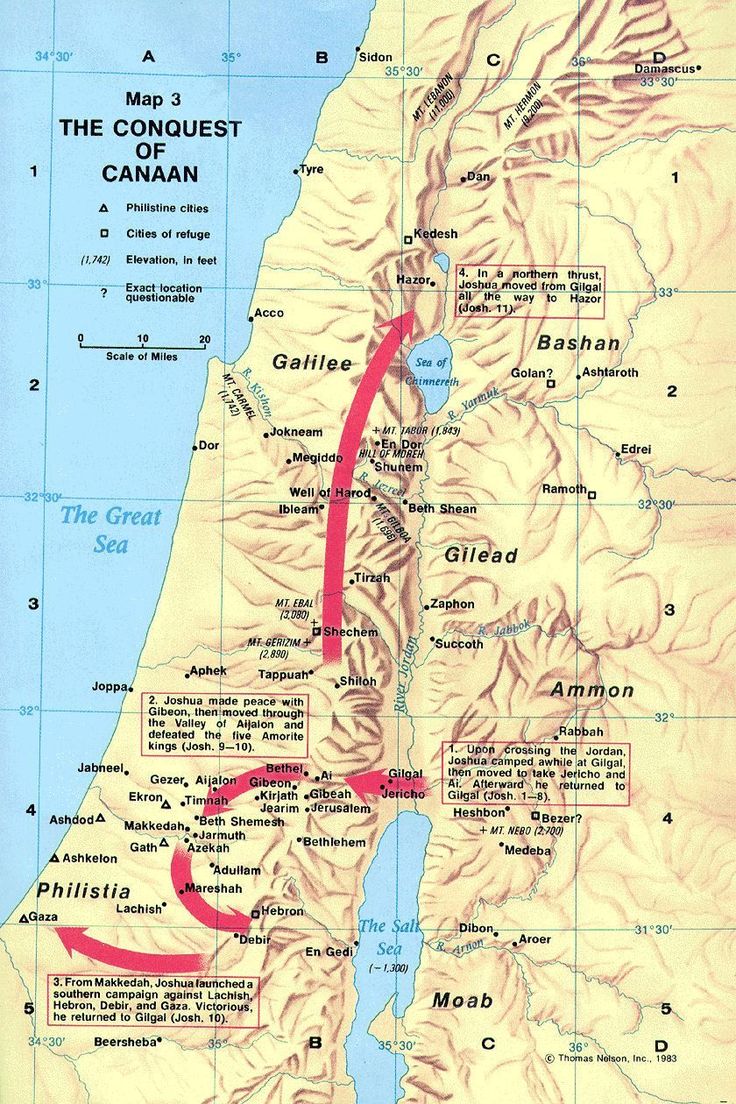
Chapter eight picks up where chapter five left off. David, as God’s hand-picked king, was finishing what Joshua and the people of Israel should have done when they entered the Promised Land years earlier. God had given them very specific commands regarding their conquest and occupation of the land of Canaan.

Moses my servant is dead. Therefore, the time has come for you to lead these people, the Israelites, across the Jordan River into the land I am giving them. I promise you what I promised Moses: ‘Wherever you set foot, you will be on land I have given you—from the Negev wilderness in the south to the Lebanon mountains in the north, from the Euphrates River in the east to the Mediterranean Sea in the west, including all the land of the Hittites.’ No one will be able to stand against you as long as you live. For I will be with you as I was with Moses. I will not fail you or abandon you. – Joshua 1:2-5 NLT

God had told Moses what the people were to do when they entered the land He had promised to Abraham and his descendants, and Moses had passed the words of God on to the people.

“In those towns that the Lord your God is giving you as a special possession, destroy every living thing. You must completely destroy the Hittites, Amorites, Canaanites, Perizzites, Hivites, and Jebusites, just as the Lord your God has commanded you. This will prevent the people of the land from teaching you to imitate their detestable customs in the worship of their gods, which would cause you to sin deeply against the Lord your God.” – Deuteronomy 20:16-18 NLT

But the people of God had disobeyed and failed to purge the land of its inhabitants. They had been half-hearted in their efforts and allowed the majority of the nations that occupied the land of Canaan to remain. And, just as God had predicted, the people of the land ended up infecting the people of God with their idolatry, immorality, and “detestable customs.” This is what led to the period of the judges. In fact, the opening chapters of the book of Judges reveal exactly what had happened.

 The Lord was with the people of Judah, and they took possession of the hill country. But they failed to drive out the people living in the plains, who had iron chariots. – Judges 1:19 ESV

The tribe of Benjamin, however, failed to drive out the Jebusites, who were living in Jerusalem. So to this day the Jebusites live in Jerusalem among the people of Benjamin. – Judges 1:21 ESV

The tribe of Manasseh failed to drive out the people living in Beth-shan, Taanach, Dor, Ibleam, Megiddo, and all their surrounding settlements  – Judges 1:27 ESV

The tribe of Ephraim failed to drive out the Canaanites living in Gezer, so the Canaanites continued to live there among them. – Judges 1:29 ESV

The tribe of Zebulun failed to drive out the residents of Kitron and Nahalol, so the Canaanites continued to live among them. – Judges 1:30 ESV

This pattern of repeated nonfeasance got so bad that God ended up sending an angel to deliver some extremely bad news:

“I brought you out of Egypt into this land that I swore to give your ancestors, and I said I would never break my covenant with you. For your part, you were not to make any covenants with the people living in this land; instead, you were to destroy their altars. But you disobeyed my command. Why did you do this? So now I declare that I will no longer drive out the people living in your land. They will be thorns in your sides, and their gods will be a constant temptation to you.” – Judges 2:1-3 NLT

Because they refused to do as He commanded, God removed His divine protection. By the time David became king, the situation had grown far worse. Without God’s divine assistance, the Israelites found themselves unable to “weed out” the thorns that surrounded them. These remnant nations proved to be a real threat to Israel’s future as a nation, not just physically but spiritually. Their armies constantly harassed the people of Israel but it was their false gods that did the greatest damage. Idolatry ended up being Israel’s Achilles heal.

So, as the king and commander-in-chief of Israel’s armies, David determined to finish what Joshua had begun. He was going to carry out God’s command and purge the land of these nations and their false gods.

David defeated the Philistines, Moabites, Syrians, Edomites, Amalekites, Ammonites, and the armies of Zobah. However, the author makes it clear that David’s military successes were not his own doing. God was giving David victories over his enemies. The very fact that David was forced to fight so many battles reflects just how unsuccessful the Israelites had been in their efforts to rid the land of its inhabitants. Their disobedience had allowed these nations to not only survive but to thrive. They had grown in numbers and strength and were no longer merely an irritant to the people of Israel, but a real threat to their existence. But David was doing everything in his power and with God’s help to subdue and destroy them.

To our modern, more enlightened sensibilities, the content of this chapter can be shocking, even appalling. God’s order for the complete annihilation of the inhabitants of the land of Canaan seems to portray Him as callous and blood-thirsty, with a seemingly capricious outlook on human life. How can the loving, creator-God call for the destruction of entire people groups, including men, women, and innocent children? This question has caused many to doubt the veracity of the Old Testament. It has led others to reject the very idea of God Himself. Richard Dawkins, a proudly professing atheist and staunch opponent of Christianity has described the God of the Bible as, “a vindictive, bloodthirsty ethnic cleanser; a misogynistic, homophobic, racist, infanticidal, genocidal, filicidal, pestilential, megalomaniacal, sadomasochistic, capriciously malevolent bully” (Richard Dawkins, The God Delusion).  He goes on to state, “The tragi-farce of God’s maniacal jealousy against alternative gods recurs continually through the Old Testament.”

For someone like Dawkins, the issue has less to do with the destruction of the people of Canaan, than it does with his desire for proof that the God of the Bible is the fanciful creation of man’s imagination. He simply uses the Old Testament record of God’s call for the destruction of the inhabitants of Canaan as proof that this so-called “God” of the Israelites, even if He did exist, would not be worth following. But he misses the whole point of the story and the true nature of mankind’s tragic situation.

The Bible makes it painfully clear that all men (women and children included) are sinners and stand before God as guilty and worthy of death. Their sins are not viewed as innocent mistakes or simply character flaws but as acts of open rebellion against a holy God. Humanity rejected the rule and reign of God, choosing the path of autonomy and self-rule. This anarchy had to be dealt with and, because God’s holiness consists of justice, He was obligated by His own nature to deal righteously with the sins of men. He could not simply overlook mankind’s rebellion because He recognized that sin, like an infectious disease, is contagious and capable of spreading from one person to another. Like cancer cells in the human body, sin metastasizes and spreads, destroying everything in its path. Sin is non-discriminatory and merciless.

God’s call for the destruction of the inhabitants of the land was based on His understanding of the true danger of indwelling sin. Left unchecked, the sinful dispositions of the unbelieving Canaanites would gradually infect and influence the people of God. According to the Old Testament record, that is exactly what happened. Over time, the people of Israel found themselves abandoning their set-apart status as God’s chosen people and blending in with the surrounding culture. They became just like the nations around them as the cancer of sin spread among them and destroyed their once-healthy relationship with God.

The same thing happens to believers today as we allow the sins of the world to contaminate our lives. Rather than doing radical surgery and removing the sin that so easily entangles us (Hebrews 12:1), we embrace it, welcoming it with open arms. We end up loving the world and the things of the world (1 John 12:15). We become friends with the world, failing to recognize that the world hates us and is out to destroy us (John 15:18-19).

The removal of the sinful influences in our lives is difficult and oftentimes painful. It may require us to abandon those longstanding relationships that are a negative influence on our lives and a threat to our spiritual health. As God’s chosen people, we are expected to live set-apart lives that clearly differentiate our status as His children. This demands that we pull away from those individuals whose influence in our lives is unhealthy and potentially destructive. This may sound radical and even unloving, but it is for our own good.

God doesn’t forbid our association with the world. He doesn’t expect us to live in seclusion, isolating ourselves from the surrounding culture. We are called to be salt and light, agents of influence and change in a sin-darkened world. But we must take sin seriously. We must never compromise our convictions or grow complacent about our calling. David knew just how dangerous sin could be, both externally and internally, and he was willing to do whatever it took to remove both. In Psalm 139, he offers a compelling and heartfelt prayer to God.

O God, if only you would destroy the wicked!
    Get out of my life, you murderers!
They blaspheme you;
    your enemies misuse your name.
O Lord, shouldn’t I hate those who hate you?
    Shouldn’t I despise those who oppose you?
Yes, I hate them with total hatred,
    for your enemies are my enemies.

Search me, O God, and know my heart;
    test me and know my anxious thoughts.
Point out anything in me that offends you,
    and lead me along the path of everlasting life. – Psalm 139:19-24 NLT

But as those living on this side of the cross, we must balance the words of David with those of Jesus. He came to offer a better way. He provided a new weapon in the war against sin: The gospel. That is why He could tell His followers that the key to conquering sin is love.

“But to you who are willing to listen, I say, love your enemies! Do good to those who hate you. Bless those who curse you. Pray for those who hurt you…Love your enemies! Do good to them. Lend to them without expecting to be repaid. Then your reward from heaven will be very great, and you will truly be acting as children of the Most High, for he is kind to those who are unthankful and wicked. You must be compassionate, just as your Father is compassionate.” – Luke 6:27-28, 35-36 NLT

English Standard Version (ESV) The Holy Bible, English Standard Version. ESV® Permanent Text Edition® (2016). Copyright © 2001 by Crossway Bibles, a publishing ministry of Good News Publishers.

New Living Translation (NLT) Holy Bible, New Living Translation, copyright © 1996, 2004, 2015 by Tyndale House Foundation. Used by permission of Tyndale House Publishers Inc., Carol Stream, Illinois 60188. All rights reserved.
A Pass or Fail Test

47 When Saul had taken the kingship over Israel, he fought against all his enemies on every side, against Moab, against the Ammonites, against Edom, against the kings of Zobah, and against the Philistines. Wherever he turned he routed them. 48 And he did valiantly and struck the Amalekites and delivered Israel out of the hands of those who plundered them.

49 Now the sons of Saul were Jonathan, Ishvi, and Malchi-shua. And the names of his two daughters were these: the name of the firstborn was Merab, and the name of the younger Michal. 50 And the name of Saul’s wife was Ahinoam the daughter of Ahimaaz. And the name of the commander of his army was Abner the son of Ner, Saul’s uncle. 51 Kish was the father of Saul, and Ner the father of Abner was the son of Abiel.

52 There was hard fighting against the Philistines all the days of Saul. And when Saul saw any strong man, or any valiant man, he attached him to himself. 

1 And Samuel said to Saul, “The Lord sent me to anoint you king over his people Israel; now therefore listen to the words of the Lord. Thus says the Lord of hosts, ‘I have noted what Amalek did to Israel in opposing them on the way when they came up out of Egypt. Now go and strike Amalek and devote to destruction all that they have. Do not spare them, but kill both man and woman, child and infant, ox and sheep, camel and donkey.’” – 1 Samuel 14:47-15:3 ESV

Saul failed to completely annihilate the Philistines, choosing instead to leave the field of battle at Michmash and return to his home base of Gibeah. With the Lord’s help, Saul’s son Jonathan had turned the once invincible Philistine army into a confused and panic-stricken rabble.

panic broke out in the Philistine army, both in the camp and in the field, including even the outposts and raiding parties. And just then an earthquake struck, and everyone was terrified. – 1 Samuel 14:15 NLT

Saul could have easily put an end to the Philistine problem but he became distracted by a much less pressing issue. In the heat of the battle, Saul discovered that his own son had consumed honey and thus violated his earlier order commanding his soldiers to fast until the last Philistine was dead. The news of Jonathan’s disobedience caused Saul to lose interest in the battle and he “called back the army from chasing the Philistines, and the Philistines returned home” (1 Samuel 14:46 NLT).

But Saul went on to fight another day. He was still the official king of Israel and news of the Israelite’s victory over the Philistines soon spread throughout the region. To the rest of Israel’s enemies, it must have appeared that this formerly weak and defenseless band of rag-tag tribes had suddenly become a force to be reckoned with. Now that they had a king, they might lose their reputation as Canaan’s perennial pushover. Saul’s ascension to Israel’s throne got the attention of the neighboring nations, leading to a series of battles against “Moab, Ammon, Edom, the kings of Zobah, and the Philistines” (1 Samuel 14:47 NLT). The text doesn’t say who instigated these conflicts, but it does reveal that Saul enjoyed great success.

wherever he turned, he was victorious. He performed great deeds and conquered the Amalekites, saving Israel from all those who had plundered them. – 1 Samuel 14:47-48 NLT

God had abandoned Saul and chosen to replace him but that doesn’t mean God was done with him. Saul remained God’s chosen instrument and would be used to protect and preserve God’s chosen people, the Israelites. God would keep the covenant promise He made to Abraham, Isaac, and Jacob. He would continue to prosper them despite their rejection of Him. He would give them victories over their enemies even though they repeatedly repaid His faithfulness with unfaithfulness.

Saul knew that his days were numbered because Samuel the prophet had delivered God’s stinging rebuke: “…your kingdom must end, for the Lord has sought out a man after his own heart. The Lord has already appointed him to be the leader of his people, because you have not kept the Lord’s command” (1 Samuel 13:14 NLT). But Samuel provided no timeline, leaving Saul in a constant state of angst-ridden anticipation, waiting for the second shoe to drop.

In some ways, Saul tried to move on, perhaps in an attempt to win back God’s favor. He performed his kingly duties well, leading the Israelites in victories over their ever-present enemies. But chapter 14 ends with a simple statement that speaks volumes about Saul’s flawed character and past mistakes.

The Israelites fought constantly with the Philistines throughout Saul’s lifetime. – 1 Samuel 14:52 NLT

Saul had been given a chance to destroy the Philistines but had failed to take advantage of it. As a result, the Philistines would become a proverbial and quite literal thorn in his side. This one nation would become Saul’s personal nemesis and a painful reminder of his less-than-flattering past and God’s chilling promise regarding his future. Saul must have realized that the Philistines would somehow play an important role in his God-ordained fate.

Chapter 14 also ends by setting the stage for all that is to come. It provides a short but insightful record of Saul’s family. This incomplete genealogical list contains the names of key individuals who will each play significant parts in the unfolding story of Saul’s life. Jonathan, Ishbosheth, Michal, and Abner will become all-too-familiar names to the reader and their presence in the closing paragraph of chapter 14 serves to presage the end of Saul’s reign and God’s plans for Israel’s future.

When chapter 15 opens, a nearly 25-year timelapse has occurred. Saul has been serving for 23 years as Israel’s king and during that time he has had little or no contact with Samuel the prophet. But one day Samuel suddenly shows up with an important word from God.

“It was the Lord who told me to anoint you as king of his people, Israel. Now listen to this message from the Lord! This is what the Lord of Heaven’s Armies has declared: I have decided to settle accounts with the nation of Amalek for opposing Israel when they came from Egypt. Now go and completely destroy the entire Amalekite nation—men, women, children, babies, cattle, sheep, goats, camels, and donkeys.” – 1 Samuel 15:1-3 NLT

Up until this point, Saul has been operating according to his own will. There is no indication that any of his battles with Israel’s enemies over the last two decades have been the result of God’s direct orders. His ongoing skirmishes with the Moabites, Ammonites, Edomites, and Philistines were reactionary in nature; he was simply responding to the ever-present threat of hostile forces.

But on this occasion, Samuel provides Saul with specific instructions regarding the Amalekites, a nomadic tribe inhabiting the area south of Canaan between Mount Seir and the Egyptian border. The Amalekites were descendants of Amalek, the son of Eliphaz and grandson of Esau (Genesis 36). When the Israelites were making their way to the land of Canaan under the direction of Moses, they were repeatedly attacked by bands of Amalekite raiders.

“Never forget what the Amalekites did to you as you came from Egypt. They attacked you when you were exhausted and weary, and they struck down those who were straggling behind. They had no fear of God. Therefore, when the Lord your God has given you rest from all your enemies in the land he is giving you as a special possession, you must destroy the Amalekites and erase their memory from under heaven. Never forget this! – Deuteronomy 25:17-19 NLT

In a decisive battle against Amalek and his forces, Moses stood on a mountaintop overlooking the conflict taking place below. As long as he held the staff of God over his head, the Israelites had the advantage over their enemies. When he grew tired and the staff was lowered, the course of the battle shifted. But with the help of Aaron and Hur, Moses was able to keep the staff aloft and Joshua led Israel to victory over their enemy. As the Israelites celebrated their God-ordained victory, Moses received the following promise from the Lord: “I will erase the memory of Amalek from under heaven”’ (Exodus 17:14 NLT).

Now, centuries later, God was commanding Saul to fulfill that promise. It was time to erase the memory of the Amalekites and Saul was to be God’s instrument of judgment. For the first time in nearly a quarter of a century, Saul has received direct instructions from Jehovah and the details are very specific. He has been commanded to “devote to destruction all that they have” (1 Samuel 15:3 ESV). No man, woman, child, or domesticated animal is to be left alive. God was serious about erasing every memory of the Amalekites from under heaven. There was to be no bounty of captives taken. Anything related to the Amalekites was to be destroyed.

Saul had his marching orders. For years he had longed to hear from God and now the Almighty had spoken. The question will be whether he is willing to do what God has commanded him to do. Will he be obedient? Will God’s will take precedence over his own? What happens next will reveal the true condition of Saul’s heart and justify God’s earlier decision to reject him as king. A divine test is about to be administered that will expose Saul for who he really is.

English Standard Version (ESV) The Holy Bible, English Standard Version. ESV® Permanent Text Edition® (2016). Copyright © 2001 by Crossway Bibles, a publishing ministry of Good News Publishers.

New Living Translation (NLT) Holy Bible, New Living Translation, copyright © 1996, 2004, 2015 by Tyndale House Foundation. Used by permission of Tyndale House Publishers Inc., Carol Stream, Illinois 60188. All rights reserved.

The Lord Saved Israel

16 And the watchmen of Saul in Gibeah of Benjamin looked, and behold, the multitude was dispersing here and there. 17 Then Saul said to the people who were with him, “Count and see who has gone from us.” And when they had counted, behold, Jonathan and his armor-bearer were not there. 18 So Saul said to Ahijah, “Bring the ark of God here.” For the ark of God went at that time with the people of Israel. 19 Now while Saul was talking to the priest, the tumult in the camp of the Philistines increased more and more. So Saul said to the priest, “Withdraw your hand.” 20 Then Saul and all the people who were with him rallied and went into the battle. And behold, every Philistine’s sword was against his fellow, and there was very great confusion. 21 Now the Hebrews who had been with the Philistines before that time and who had gone up with them into the camp, even they also turned to be with the Israelites who were with Saul and Jonathan. 22 Likewise, when all the men of Israel who had hidden themselves in the hill country of Ephraim heard that the Philistines were fleeing, they too followed hard after them in the battle. 23 So the Lord saved Israel that day. And the battle passed beyond Beth-aven.

24 And the men of Israel had been hard pressed that day, so Saul had laid an oath on the people, saying, “Cursed be the man who eats food until it is evening and I am avenged on my enemies.” So none of the people had tasted food. 25 Now when all the people came to the forest, behold, there was honey on the ground. 26 And when the people entered the forest, behold, the honey was dropping, but no one put his hand to his mouth, for the people feared the oath. 27 But Jonathan had not heard his father charge the people with the oath, so he put out the tip of the staff that was in his hand and dipped it in the honeycomb and put his hand to his mouth, and his eyes became bright. 28 Then one of the people said, “Your father strictly charged the people with an oath, saying, ‘Cursed be the man who eats food this day.’” And the people were faint. 29 Then Jonathan said, “My father has troubled the land. See how my eyes have become bright because I tasted a little of this honey. 30 How much better if the people had eaten freely today of the spoil of their enemies that they found. For now the defeat among the Philistines has not been great.” – 1 Samuel 14:16-30 ESV

From their safe and secure vantage point in Gibeah, Saul’s watchman could tell that something was happening at the Philistine base camp. They could see thousands of Philistine soldiers fleeing the scene but they had no idea what was causing this max exodus. In an attempt to discern what was going on, Saul demanded an immediate roll call of his army at Geba, located near the Philistine encampment. It seems that he wanted to determine if any of his troops had engaged in battle with the enemy without his authorization. When the report came back, Saul learned that only two individuals were missing: Jonathan and his armor-bearer. But Saul remained completely unaware of what was happening in the enemy camp. News of his son’s absence must have confused and concerned Saul. Was Jonathan AWOL or was he somehow involved in the situation taking place near Michmash?

Little did he know that Jonathan and his servant were involved in a miraculous rout of the Philistine forces, aided by the hand of God. Having snuck into the enemy camp, these two men killed 20 Philistine soldiers, a surprising and highly successful feat that caused panic to spread among the remaining Philistine forces.

…panic broke out in the Philistine army, both in the camp and in the field, including even the outposts and raiding parties. And just then an earthquake struck, and everyone was terrified. – 1 Samuel 14:15 NLT

Jonathan believed that God would come to their aid and that is just what happened. The son of the king had stepped out in faith, trusting that his God would give them victory over the enemy, despite the odds and his own father’s reticence to take the battle to the Philistines. It’s interesting to note that Jonathan never sought a word from God. He never uttered a prayer asking for direction. He simply did what good soldiers were supposed to do; he confronted the enemy of God and waited for God to direct his hand. His whole strategy had been based on receiving a simple sign from God.

“We will cross over and let them see us. If they say to us, ‘Stay where you are or we’ll kill you,’ then we will stop and not go up to them. But if they say, ‘Come on up and fight,’ then we will go up. That will be the Lord’s sign that he will help us defeat them.” – 1 Samuel 14:8-10 NLT

God never spoke, but the enemy did, tauntingly teasing Jonathan and his armor-bearer by calling out, “Come on up here, and we’ll teach you a lesson!” (1 Samuel 14:12 NLT). That was all Jonathan needed to hear. Firm in his belief that Jehovah “can win a battle whether he has many warriors or only a few” (1 Samuel 14:6 NLT), Jonathan accepted the Philistine’s invitation and proved that “nothing can hinder the Lord” (1 Samuel 14:6 NLT).

Meanwhile, back in Gibeah, Saul was still waiting on a word from God. He had summoned Ahijah the high priest and ordered him to seek divine guidance. The text states that Saul ordered the Ark of God to be retrieved from its location in Kiriath-jearim (1 Samuel 7:2). But many of the oldest manuscripts of the Old Testament texts state that Saul ordered Ahijah to use his ephod as a means of divination. The New English Translation reflects this alternate reading of the text.

So Saul said to Ahijah, “Bring near the ephod,” for he was at that time wearing the ephod in front of the Israelites. – 1 Samuel 14:18 NET

This makes more sense because it seems unlikely that Saul would have repeated the earlier mistake of the Israelites when they brought the Ark of God into the camp only to see it captured by the Philistines. In verse 3, the author reveals that Ahijah had entered Saul’s camp wearing an ephod or priestly robe. The details for the design of this garment are found in Exodus 28:6-14. But while this one-of-a-kind robe was truly spectacular in appearance, what set it apart was the “breastpiece of judgment” that came with it.

“Then, with great skill and care, make a chestpiece to be worn for seeking a decision from God. Make it to match the ephod, using finely woven linen embroidered with gold and with blue, purple, and scarlet thread.” – Exodus 28:15 NLT

What made this elaborate pouch so special was what was contained within it.

“Insert the Urim and Thummim into the sacred chestpiece so they will be carried over Aaron’s heart when he goes into the Lord’s presence. In this way, Aaron will always carry over his heart the objects used to determine the Lord’s will for his people whenever he goes in before the Lord.” – Exodus 28:30 NLT

Saul was hoping that Ahijah could use the sacred lots to discern the will of God. Rather than take action, he waited for some kind of sign to show him what to do. But, evidently, Ahijah’s attempt to seek divine guidance had produced no results. Finally, Saul ran out of patience.

But while Saul was talking to the priest, the confusion in the Philistine camp grew louder and louder. So Saul said to the priest, “Never mind; let’s get going!” – 1 Samuel 14:19 NLT

After a lengthy and unnecessary delay, Saul and his forces entered the battle. What happened next was an act of God. The greatly reduced Israelite army easily routed the far superior Philistine force. Even Hebrews who had joined the Philistine army as mercenaries decided to switch their allegiance mid-battle and fight with their kinsmen. Seeing what was happening at Michmach, AWOL Israelite soldiers came out of hiding and joined in the slaughter of the Philistines. The result was a great victory.

But Samuel, recording these events at a later date, makes it clear that the victory could not be attributed to Jonathan or Saul.

So the Lord saved Israel that day, and the battle continued to rage even beyond Beth-aven. – 1 Samuel 14:23 NLT

Jonathan was right when he said, “Nothing can hinder the Lord. He can win a battle whether he has many warriors or only a few!” (1 Samuel 14:6 NLT). He believed His God was all-powerful and fully capable of delivering His people with “the least of these.” It is almost as if Jonathan had the words of Joshua ringing in his ears as he and his armor-bearer took the battle to the enemy.

“For the Lord has driven out great and powerful nations for you, and no one has yet been able to defeat you. Each one of you will put to flight a thousand of the enemy, for the Lord your God fights for you, just as he has promised. So be very careful to love the Lord your God. – Joshua 23:9-11 NLT

God fought with Jonathan. One faithful man who believed in the faithfulness of his God was able to defeat a far superior enemy. Jonathan placed his hope in the Almighty and he wasn’t disappointed. He stepped out in faith and God showed up in a big way.

English Standard Version (ESV) The Holy Bible, English Standard Version. ESV® Permanent Text Edition® (2016). Copyright © 2001 by Crossway Bibles, a publishing ministry of Good News Publishers.

New Living Translation (NLT) Holy Bible, New Living Translation, copyright © 1996, 2004, 2015 by Tyndale House Foundation. Used by permission of Tyndale House Publishers Inc., Carol Stream, Illinois 60188. All rights reserved.

You and Your King

14 ”If you will fear the Lord and serve him and obey his voice and not rebel against the commandment of the Lord, and if both you and the king who reigns over you will follow the Lord your God, it will be well. 15 But if you will not obey the voice of the Lord, but rebel against the commandment of the Lord, then the hand of the Lord will be against you and your king. 16 Now therefore stand still and see this great thing that the Lord will do before your eyes. 17 Is it not wheat harvest today? I will call upon the Lord, that he may send thunder and rain. And you shall know and see that your wickedness is great, which you have done in the sight of the Lord, in asking for yourselves a king.” 18 So Samuel called upon the Lord, and the Lord sent thunder and rain that day, and all the people greatly feared the Lord and Samuel.

19 And all the people said to Samuel, “Pray for your servants to the Lord your God, that we may not die, for we have added to all our sins this evil, to ask for ourselves a king.” 20 And Samuel said to the people, “Do not be afraid; you have done all this evil. Yet do not turn aside from following the Lord, but serve the Lord with all your heart. 21 And do not turn aside after empty things that cannot profit or deliver, for they are empty. 22 For the Lord will not forsake his people, for his great name’s sake, because it has pleased the Lord to make you a people for himself. 23 Moreover, as for me, far be it from me that I should sin against the Lord by ceasing to pray for you, and I will instruct you in the good and the right way. 24 Only fear the Lord and serve him faithfully with all your heart. For consider what great things he has done for you. 25 But if you still do wickedly, you shall be swept away, both you and your king.” – 1 Samuel 12:14-25 ESV

While the people of Israel played no part in the selection of Saul as their king, Samuel seems intent on blaming them for the whole affair. When introducing Saul to the people for the first time, Samuel added the disclaimer, “…behold the king whom you have chosen” (1 Samuel 12:13 ESV). Throughout the remainder of his speech, Samuel never mentions Saul as God’s choice for king. Samuel obviously recognized God’s sovereign hand in the whole affair, but he refuses to describe Saul as the king of God’s choosing. Instead, he portrays Saul as the people’s choice.

“…here is the king you have chosen.” – 1 Samuel 12:13 NLT

“…you and your king” – 1 Samuel 12:14 NLT

“…if you continue to sin, you and your king will be swept away. – 1 Samuel 12:25 NLT

God had orchestrated every aspect of Saul’s selection process, but Samuel is disclosing that the man God chose was in keeping with the people’s original demand.

“…Give us a king to judge us like all the other nations have.” – 1 Samuel 8:5 NLT

They didn’t ask for a godly king; they specifically requested a king who would resemble the powerful potentates that ruled over their adversaries. It wasn’t that the Israelites were opposed to having a wise and righteous king, it’s that they were more interested in his military capabilities than his character character. Surrounded by countless nations equipped with powerful armies and led by ruthlessly aggressive kings, the Israelites were looking for a leader who could help them compete on the world stage. During the period of the judges, the Israelites endured a repetitive cycle of raids, wars, and demoralizing defeats at the hands of their enemies. While God used His hand-picked judges to deliver Israel from these very same enemies, there never seemed to be an end to the suffering and degradation. The bullies ruled the playground and the Israelites were sick of always being on the losing end. So, they decided a king was the solution to their problem.

But what they failed to realize was that their suffering was their own fault. God had warned them that their disobedience would bring His discipline and the book of Judges explains the divine purpose behind it all.

Now these are the nations that the Lord left, to test Israel by them, that is, all in Israel who had not experienced all the wars in Canaan. It was only in order that the generations of the people of Israel might know war, to teach war to those who had not known it before. These are the nations: the five lords of the Philistines and all the Canaanites and the Sidonians and the Hivites who lived on Mount Lebanon, from Mount Baal-hermon as far as Lebo-hamath. They were for the testing of Israel, to know whether Israel would obey the commandments of the Lord. – Judges 3:1-4 ESV

God had used those nations to test the faithfulness of His people. The original test was to see if the Israelites would remain set apart from the surrounding nations. Would they stay faithful to their covenant commitment and refrain from intermarrying with the pagan nations and worshiping their false gods? But sadly, Israel couldn’t keep from compromising their convictions and turning their backs on God.

They abandoned the Lord and served the Baals and the Ashtaroth. So the anger of the Lord was kindled against Israel, and he gave them over to plunderers, who plundered them. And he sold them into the hand of their surrounding enemies, so that they could no longer withstand their enemies. Whenever they marched out, the hand of the Lord was against them for harm, as the Lord had warned, and as the Lord had sworn to them. And they were in terrible distress. – Judges 2:13-15 ESV

Their problem wasn’t that they lacked a king, it was that they were devoid of faithfulness. They just couldn’t bring themselves to remain solely dedicated to the God of Abraham, Isaac, and Jacob. Their spiritual fidelity had proven to be suspect and they suffered as a result. The whole reason God allowed the Israelites to be plundered and persecuted was so that they might recognize their sin, repent, and return to Him. But any change of heart the Israelites displayed was always short-lived and followed by another round of unfaithfulness and idolatry.

That’s why Samuel warns the Israelites that their new king will do them no good if they fail to remain faithful to God.

“Now if you fear and worship the Lord and listen to his voice, and if you do not rebel against the Lord’s commands, then both you and your king will show that you recognize the Lord as your God. But if you rebel against the Lord’s commands and refuse to listen to him, then his hand will be as heavy upon you as it was upon your ancestors.” – 1 Samuel 12:14-15 NLT

They had their human king, but unless they began to treat God with the dignity and honor He deserved, they would find themselves suffering the same fate as their ancestors. Having an earthly king was not going to solve their problem. He could lead them into battle, but unless he led them to worship God alone, victory would be fleeting and the future would be bleak.

To back up Samuel’s words of warning, God provided a sign. The annual wheat harvest in Israel took place at a time when rain was scarce, allowing the farmers to gather their crops uninterrupted by seasonal storms. But on this occasion, God flipped the script and orchestrated an unexpected deluge of rain that halted the harvest and highlighted the weight of their sin.

You know that it does not rain at this time of the year during the wheat harvest. I will ask the Lord to send thunder and rain today. Then you will realize how wicked you have been in asking the Lord for a king!” – 1 Samuel 12:17 NLT

The sign had its intended effect, leaving the people in an abject state of fear and causing them to cry out, “Pray to the Lord your God for us, or we will die…For now we have added to our sins by asking for a king!” (1 Samuel 12:19 NLT).

Having got their attention, Samuel affirms their guilt but assuages their fears, telling them, “You have certainly done wrong, but make sure now that you worship the Lord with all your heart, and don’t turn your back on him. Don’t go back to worshiping worthless idols that cannot help or rescue you—they are totally useless!” (1 Samuel 12:20-21 NLT).

They thought a king was the solution to their problem but they were wrong. God had always been their King, but they refused to submit to His reign over their lives. Their problem was spiritual, not political. It had always been about idolatry and infidelity, not aristocracy and royalty.

With Saul’s inauguration, a new era had begun, but the Israelites faced the same old fate if they refused to acknowledge God as their King. The people of Israel feared their enemies more than they feared God. They had yet to understand that they had been the cause of their own suffering. The Ammonites and Philistines had never been the problem; they were nothing more than a test to see if the Israelites would remain faithful to God. The real danger these nations posed was not of a military nature but of a spiritual one. The primary weapons of mass destruction they wielded were their false gods and the Israelites had been devastated by their influence.

So, in a state of compassion and with the heart of a true shepherd, Samuel promises to keep the people of Israel in his prayers and to continue to serve as their spiritual advisor in the days ahead.

“As for me, I will certainly not sin against the Lord by ending my prayers for you. And I will continue to teach you what is good and right. But be sure to fear the Lord and faithfully serve him. Think of all the wonderful things he has done for you. But if you continue to sin, you and your king will be swept away.” – 1 Samuel 12:23-25 NLT

The success of Saul’s reign was directly tied to their faithfulness. As long as he and the people remained committed to obeying the will of God, they would find success. Their future would be secure as long as they remembered who was really in charge. Samuel’s charge to the people echoes the words that Joshua spoke the the nation of Israel right before his death.

And if it is evil in your eyes to serve the Lord, choose this day whom you will serve, whether the gods your fathers served in the region beyond the River, or the gods of the Amorites in whose land you dwell. But as for me and my house, we will serve the Lord.” – Joshua 24:15 ESV

English Standard Version (ESV) The Holy Bible, English Standard Version. ESV® Permanent Text Edition® (2016). Copyright © 2001 by Crossway Bibles, a publishing ministry of Good News Publishers.

New Living Translation (NLT) Holy Bible, New Living Translation, copyright © 1996, 2004, 2015 by Tyndale House Foundation. Used by permission of Tyndale House Publishers Inc., Carol Stream, Illinois 60188. All rights reserved.

Our All-Knowing God Always Knows What Is Best

16 The Lord spoke to Moses, saying, 17 “These are the names of the men who shall divide the land to you for inheritance: Eleazar the priest and Joshua the son of Nun. 18 You shall take one chief from every tribe to divide the land for inheritance. 19 These are the names of the men: Of the tribe of Judah, Caleb the son of Jephunneh. 20 Of the tribe of the people of Simeon, Shemuel the son of Ammihud. 21 Of the tribe of Benjamin, Elidad the son of Chislon. 22 Of the tribe of the people of Dan a chief, Bukki the son of Jogli. 23 Of the people of Joseph: of the tribe of the people of Manasseh a chief, Hanniel the son of Ephod. 24 And of the tribe of the people of Ephraim a chief, Kemuel the son of Shiphtan. 25 Of the tribe of the people of Zebulun a chief, Elizaphan the son of Parnach. 26 Of the tribe of the people of Issachar a chief, Paltiel the son of Azzan. 27 And of the tribe of the people of Asher a chief, Ahihud the son of Shelomi. 28 Of the tribe of the people of Naphtali a chief, Pedahel the son of Ammihud.” 29 These are the men whom the Lord commanded to divide the inheritance for the people of Israel in the land of Canaan. 

1 The Lord spoke to Moses in the plains of Moab by the Jordan at Jericho, saying, “Command the people of Israel to give to the Levites some of the inheritance of their possession as cities for them to dwell in. And you shall give to the Levites pasturelands around the cities. The cities shall be theirs to dwell in, and their pasturelands shall be for their cattle and for their livestock and for all their beasts. The pasturelands of the cities, which you shall give to the Levites, shall reach from the wall of the city outward a thousand cubits all around. And you shall measure, outside the city, on the east side two thousand cubits, and on the south side two thousand cubits, and on the west side two thousand cubits, and on the north side two thousand cubits, the city being in the middle. This shall belong to them as pastureland for their cities.

“The cities that you give to the Levites shall be the six cities of refuge, where you shall permit the manslayer to flee, and in addition to them you shall give forty-two cities. All the cities that you give to the Levites shall be forty-eight, with their pasturelands. And as for the cities that you shall give from the possession of the people of Israel, from the larger tribes you shall take many, and from the smaller tribes you shall take few; each, in proportion to the inheritance that it inherits, shall give of its cities to the Levites.” Numbers 34:16-35:8 ESV

God provided Moses with the name of one man from each of the ten tribes of Israel. These men, hand-picked by God, would assist Eleazar, the high priest, and Joshua in the distribution of the land. The tribes of Gad and Reuben were not included because they had chosen to settle outside the boundaries of Canaan. These men were well-respected leaders among their respective tribes and would help to guarantee that the land was fairly apportioned and that each tribe, regardless of its size, was treated equitably and fairly. There was to be no favoritism or any form of nepotism. The larger tribes, whose numbers would be based on the recent census taken by Moses, would be allotted more extensive land allotments. But was not a guarantee that they would receive the best land. God was giving these ten men the weighty responsibility of dividing up the Israelites’ inheritance in a way that would satisfy all the parties involved, and that would not be an easy task.

The next thing on God’s agenda was to arrange for the needs of the tribe of Levi, his own tribe. He had already informed Moses that the Levites would inherit no land in Canaan. God had set apart the tribe of Levi as His special possession and had dedicated them to the care and maintenance of the Tabernacle. As a result, God promised to be their inheritance.

“Remember that the Levitical priests—that is, the whole of the tribe of Levi—will receive no allotment of land among the other tribes in Israel. Instead, the priests and Levites will eat from the special gifts given to the Lord, for that is their share. They will have no land of their own among the Israelites. The Lord himself is their special possession, just as he promised them.” – Deuteronomy 18:1-2 NLT

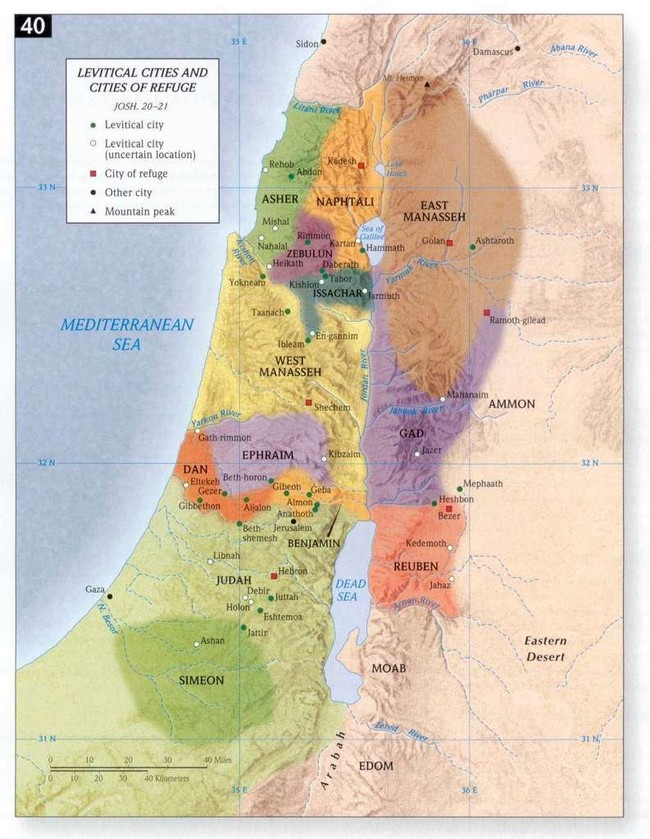
But while the Levites would be allotted no land in Canaan, they would be awarded the deeds to 48 cities located within the territories of each of the other 11 tribes (Joshua 21). Even the tribes of Gad, Reuben, and the half-tribe of Manasseh were required to provide the Levites with towns and pastureland for their flocks on the other side of the Jordan River. God had made ample accommodations for the Levites.

These Levitical cities were to be strategically located throughout the nation of Israel so that every Israelite was no more than ten miles from one of them. This helped to ensure that the people of God were never far away from a member of the Levitical priesthood, whose job was to provide instruction in the ways of God. The Levitical priests served as judges (Deuteronomy 17:8-13) and teachers of God’s law (Deuteronomy 33:10). So, it was essential that every Israelite had ready access to a Levitical town and a priest of God.

Of the 48 towns awarded to the Levites, six were to be designated as cities of refuge. These were specially sanctioned zones within the boundaries of Israel where anyone guilty of committing a non-premediated murder could seek asylum. God had already declared His ruling concerning murder (Exodus 20:13), but He had Moses present a special provision for cases involving accidental homicide.

“If someone kills another person unintentionally, without previous hostility, the slayer may flee to any of these cities to live in safety. – Deuteronomy 19:4 NLT

He even had Moses provide a potential scenario in which a city of refuge would become necessary.

“For example, suppose someone goes into the forest with a neighbor to cut wood. And suppose one of them swings an ax to chop down a tree, and the ax head flies off the handle, killing the other person. In such cases, the slayer may flee to one of the cities of refuge to live in safety.” – Deuteronomy 19:5 NLT

God knew that life would happen and that deadly accidents would be a part of the Israelites’ existence in the land. Men would be killed and justice would need to be pursued. But what He didn’t want was some form of vigilante justice running rampant through the nation. Yet God knew that the relatives of a murder victim would tend to seek revenge against the guilty party and ask questions later. The cities of refuge were intended to protect the innocent while justice was being served.

Since Israel had no professional police force, these kinds of accidents could easily turn into bloodbaths where the relatives of the victim sought to avenge their loved one’s death. So, these cities, occupied by the Levites, would provide a place where the guilty party could find solace and seek a fair judgment concerning his guilt or innocence. In His plans for the land of promise, God was leaving nothing to chance. He was creating a well-designed system for dealing with the inevitable problem of sin among His chosen people. He was going to distribute the Levitical priesthood among them to provide spiritual enlightenment and He was going to create safe havens for those who unwittingly committed even the gravest of sins. God was providing for and protecting His people.

English Standard Version (ESV) The Holy Bible, English Standard Version. ESV® Permanent Text Edition® (2016). Copyright © 2001

New Living Translation (NLT) Holy Bible, New Living Translation, copyright © 1996, 2004, 2015 by Tyndale House Foundation. Used by permission of Tyndale House Publishers Inc., Carol Stream, Illinois 60188. All rights reserved.

A New Leader But the Same Old People

12 The Lord said to Moses, “Go up into this mountain of Abarim and see the land that I have given to the people of Israel. 13 When you have seen it, you also shall be gathered to your people, as your brother Aaron was, 14 because you rebelled against my word in the wilderness of Zin when the congregation quarreled, failing to uphold me as holy at the waters before their eyes.” (These are the waters of Meribah of Kadesh in the wilderness of Zin.) 15 Moses spoke to the Lord, saying, 16 “Let the Lord, the God of the spirits of all flesh, appoint a man over the congregation 17 who shall go out before them and come in before them, who shall lead them out and bring them in, that the congregation of the Lord may not be as sheep that have no shepherd.” 18 So the Lord said to Moses, “Take Joshua the son of Nun, a man in whom is the Spirit, and lay your hand on him. 19 Make him stand before Eleazar the priest and all the congregation, and you shall commission him in their sight. 20 You shall invest him with some of your authority, that all the congregation of the people of Israel may obey. 21 And he shall stand before Eleazar the priest, who shall inquire for him by the judgment of the Urim before the Lord. At his word they shall go out, and at his word they shall come in, both he and all the people of Israel with him, the whole congregation.” 22 And Moses did as the Lord commanded him. He took Joshua and made him stand before Eleazar the priest and the whole congregation, 23 and he laid his hands on him and commissioned him as the Lord directed through Moses.  Numbers 27:12-23 ESV

The day Moses had been dreading had finally arrived. He had known for some time that he would not be leading the people of Israel into the land of Canaan. Due to Moses’ uncharacteristic actions in the wilderness of Zin, God had determined to ban his servant from entering the promised land.

“Because you did not trust me enough to demonstrate my holiness to the people of Israel, you will not lead them into the land I am giving them!” – Numbers 20:12 NLT

In a moment of extreme frustration with the constantly whining Israelites, Moses had snapped and disobeyed the command of God.

“You and Aaron must take the staff and assemble the entire community. As the people watch, speak to the rock over there, and it will pour out its water. You will provide enough water from the rock to satisfy the whole community and their livestock.” – Numbers 20:8 NLT

Rather than speaking to the rock as God had ordered him to do, Moses lashed out in anger and repeatedly struck the rock with his staff. His anger and frustration with the people had caused him to disobey and dishonor God in the eyes of the people. It appears that Moses’ real crime was that he attempted to rob God of glory by claiming responsibility for producing the miracle.

“Listen, you rebels!” he shouted. “Must we bring you water from this rock?”– Numbers 20:10 NLT

His attempt to inflate his own identity in the eyes of the people cost him dearly. While his impromptu actions successfully produced water from the rock and probably earned him a bit of respect from the people, his little stunt resulted in his permanent ban from the land of promise; he would never have the pleasure of entering God’s rest. Instead, he would die in the wilderness, just as Miriam and Aaron had.

So, with the Israelites on the verge of entering Canaan, God informed Moses that his days on this earth had come to an end. His debt had come due. But before taking Moses’ life, God gave His servant one more chance to see the land of promise from a distance. God led Moses up a mountain and allowed him to take in the view.

“Climb one of the mountains east of the river, and look out over the land I have given the people of Israel. After you have seen it, you will die like your brother, Aaron, for you both rebelled against my instructions in the wilderness of Zin. When the people of Israel rebelled, you failed to demonstrate my holiness to them at the waters.” – Numbers 27:12-14 NLT

For nearly four decades, this land had been the focus of Moses’ life. Ever since he had led the people out of Egypt, his life’s mission had been to guide them to this very spot. But now, as he looked out over the fertile valley below, he was doing so for the very last time. He would not be going in and it was time to turn over his leadership responsibilities to someone else.

Ever the consummate leader, Moses begged God to appoint the right man for the task. He knew from firsthand experience just how stubborn and headstrong the people could be and they would never make it without strong leadership.

“O Lord, you are the God who gives breath to all creatures. Please appoint a new man as leader for the community. Give them someone who will guide them wherever they go and will lead them into battle, so the community of the Lord will not be like sheep without a shepherd.”– Nmbers 27:16-17 NLT

This request from Moses reveals a great deal about his heart. Despite all the difficulties the people of Israel had caused him over the last forty years, Moses cared deeply for them. He knew that, without strong leadership, they would never make it. As difficult as the last four decades had been, their conquering of the land of Canaan would pose a far greater test of their resolve and faithfulness. The next leader would need to be able to do battle with the rebellion-prone Israelites as well as the occupants of the land.

While Moses had been required to lead the people across the wilderness, his replacement would be tasked with leading them into battle. Their conquest of Canaan would be difficult and fraught with danger, and these people who had made a habit of whining about the lack of water and food would certainly find the thought of military service distasteful. So, they were going to need a man who was equal parts warrior and shepherd. He would have to be both a fighting man and a kind-hearted guide who could lead the people with patience and care.

But Moses’ concerns were unnecessary because God already had a man in mind. He suggested Joshua, one of the two men who had been part of the 12-man contingent of spies who had reconnoitered the land 40 years earlier. Joshua and Caleb had been the voices of reason among the fearful and disheartened men who recommended that the people not enter the land of promise. While the majority of the spies had deemed the land unconquerable and to be avoided at all costs, Joshua and Caleb had provided a dissenting opinion:

Two of the men who had explored the land, Joshua son of Nun and Caleb son of Jephunneh, tore their clothing. They said to all the people of Israel, “The land we traveled through and explored is a wonderful land! And if the Lord is pleased with us, he will bring us safely into that land and give it to us. It is a rich land flowing with milk and honey. Do not rebel against the Lord, and don’t be afraid of the people of the land. They are only helpless prey to us! They have no protection, but the Lord is with us! Don’t be afraid of them!” – Numbers 14:6-9 NLT

While the people eventually rejected the counsel of Joshua and Caleb, these two men had powerfully declared their faith in God and demonstrated their belief in His power and goodness. Despite the odds, they had called the people to trust and obey their sovereign God. Four decades later, God chose Joshua to be Moses’ successor.

“Take Joshua son of Nun, who has the Spirit in him, and lay your hands on him. Present him to Eleazar the priest before the whole community, and publicly commission him to lead the people. – Numbers 27:18-19 NLT

“This spirit was not something that now came upon Joshua, or was temporary (such as the coming of the spirit on the elders in 11:17, 25-26); it already existed in Joshua and was the basis of God’s choice of him. Deut. 34:9 applies the phrase ‘full of the spirit of Wisdom’ to Joshua, confirming the thought here.” – Timothy R. Ashley, The Book of Numbers.

Joshua was God’s man for the moment. He had been chosen by God long before this day arrived, and the Spirit of God had been preparing him for the next phase of Israel’s journey.

But God’s relationship with Joshua would be different than the one He had with Moses. While God had interacted with Moses face-to-face, Joshua received his instructions through the high priest and the use of “the Urim—one of the sacred lots cast before the Lord” (Numbers 27:21 NLT). This new method of communication would feature built-in safeguards, allowing Eleazar, the high priest, to act as a source of confirmation for all decisions. This would prevent Joshua from acting on his own and risking the wrath of God.

Having received God’s plan for his replacement and knowing that he would soon be breathing his last breath on Earth, Moses descended from the mountain and went about preparing Joshua for his new role.

So Moses did as the Lord commanded. He presented Joshua to Eleazar the priest and the whole community. Moses laid his hands on him and commissioned him to lead the people, just as the Lord had commanded through Moses. – Numbers 27:22-23 NLT

With new leadership called and commissioned, it was time to begin the final phase of the mission. This generation of Israelites was about to do what their mothers and fathers had failed to do: Enter the land of promise. This had been the goal all along. It had always been God’s intention for the wilderness to be a means to this end. From the moment they left Egypt and began their long trek to the Jordan River, the Israelites had been on a journey to the land of promise. Now, their inheritance lay across the river and all they had to do was step out in faith and take it as their own. But as Joshua would soon discover, that would be easier said than done. As Moses’ God-appointed replacement, he had his work cut out for him and his reliance upon God was about to be sorely tested.

English Standard Version (ESV) The Holy Bible, English Standard Version. ESV® Permanent Text Edition® (2016). Copyright © 2001

New Living Translation (NLT) Holy Bible, New Living Translation, copyright © 1996, 2004, 2015 by Tyndale House Foundation. Used by permission of Tyndale House Publishers Inc., Carol Stream, Illinois 60188. All rights reserved.

A New Generation and a New Opportunity

52 The Lord spoke to Moses, saying, 53 “Among these the land shall be divided for inheritance according to the number of names. 54 To a large tribe you shall give a large inheritance, and to a small tribe you shall give a small inheritance; every tribe shall be given its inheritance in proportion to its list. 55 But the land shall be divided by lot. According to the names of the tribes of their fathers they shall inherit. 56 Their inheritance shall be divided according to lot between the larger and the smaller.”

57 This was the list of the Levites according to their clans: of Gershon, the clan of the Gershonites; of Kohath, the clan of the Kohathites; of Merari, the clan of the Merarites. 58 These are the clans of Levi: the clan of the Libnites, the clan of the Hebronites, the clan of the Mahlites, the clan of the Mushites, the clan of the Korahites. And Kohath was the father of Amram. 59 The name of Amram’s wife was Jochebed the daughter of Levi, who was born to Levi in Egypt. And she bore to Amram Aaron and Moses and Miriam their sister. 60 And to Aaron were born Nadab, Abihu, Eleazar, and Ithamar. 61 But Nadab and Abihu died when they offered unauthorized fire before the Lord. 62 And those listed were 23,000, every male from a month old and upward. For they were not listed among the people of Israel, because there was no inheritance given to them among the people of Israel.

63 These were those listed by Moses and Eleazar the priest, who listed the people of Israel in the plains of Moab by the Jordan at Jericho. 64 But among these there was not one of those listed by Moses and Aaron the priest, who had listed the people of Israel in the wilderness of Sinai. 65 For the Lord had said of them, “They shall die in the wilderness.” Not one of them was left, except Caleb the son of Jephunneh and Joshua the son of Nun.  Numbers 26:52-65 ESV

The census ordered by Jehovah had more than one purpose. Not only would it determine the number of men eligible for military service, but it would also provide the basis for each tribe’s land allotment once they entered Canaan. Since Moses was ordered to conduct the census tribe by tribe, the final number of each tribe’s combatants would reflect their overall population size and their appropriate share of the inheritance. Knowing that the apportionment of the land could be a potential landmine, God gave Moses strict instructions regarding its division and allotment.

“Divide the land among the tribes, and distribute the grants of land in proportion to the tribes’ populations, as indicated by the number of names on the list. Give the larger tribes more land and the smaller tribes less land, each group receiving a grant in proportion to the size of its population.” – Numbers 26:53-54 NLT

It only made sense that the larger tribes would receive a larger portion of the land. But to prevent the larger tribes from using their influence to grab the best land for themselves, God ordered Moses to use a lottery system to determine how the land was divided and assigned.

“But you must assign the land by lot, and give land to each ancestral tribe according to the number of names on the list. Each grant of land must be assigned by lot among the larger and smaller tribal groups.” – Numbers 26:55-56 NLT

Because of his role as the leader of the nation of Israel, Moses found himself in a delicate and somewhat difficult position. Not only was he responsible for convincing the people to enter the land and begin its conquest, but he would also have to determine the boundaries of each tribe’s land allotment. Even while God had ordered this task to be accomplished through the casting of lots, there was still a good chance that one or more of the tribes might be dissatisfied with the location or physical characteristics of the land they received. It didn’t help that virtually every square inch of Canaan was already occupied by other nations that were not going to give up their land without a fight. So, Moses had his work cut out for him.

But God had sovereignly ordained a strategy that would protect Moses from accusations of self-aggrandizement or using his power to promote his particular tribe. Moses was a member of the tribe of Levi and God had already determined that this tribe would receive no allotment of land in Canaan. They were to serve as priests and the caretakers of the Tabernacle, and God had already made it clear that He would provide for all their needs once they arrived in the land of promise.

“Remember that the Levitical priests—that is, the whole of the tribe of Levi—will receive no allotment of land among the other tribes in Israel. Instead, the priests and Levites will eat from the special gifts given to the Lord, for that is their share. They will have no land of their own among the Israelites. The Lord himself is their special possession, just as he promised them. – Deuteronomy 18:1-2 NLT

The tribe of Levi would not own any land in Canaan, so no one could accuse Moses of showing favoritism to his own clan. But without land, how would the Levites feed their families, flocks, and herds? God had made provision for that as well.

“You priests will receive no allotment of land or share of property among the people of Israel. I am your share and your allotment. As for the tribe of Levi, your relatives, I will compensate them for their service in the Tabernacle. Instead of an allotment of land, I will give them the tithes from the entire land of Israel.” – Numbers 18:20-21 NLT

God had arranged a way for them to have ample food to eat. Not only that, He had ordained a plan to provide for their living arrangements. While they would receive no allotment of land, they would be given cities located within the other tribes’ territories.

“Command the people of Israel to give to the Levites from their property certain towns to live in, along with the surrounding pasturelands. These towns will be for the Levites to live in, and the surrounding lands will provide pasture for their cattle, flocks, and other livestock. The pastureland assigned to the Levites around these towns will extend 1,500 feet from the town walls in every direction. Measure off 3,000 feet outside the town walls in every direction—east, south, west, north—with the town at the center. This area will serve as the larger pastureland for the towns. – Numbers 35:2-5 NLT

God had made ample preparations and provisions for the Levites. In doing so, He had ensured that there would be no way for Moses to use his power to reward his own tribe. God had protected him. But while the Levites were exempt from military service, they were still included in the census.

The men from the Levite clans who were one month old or older numbered 23,000. But the Levites were not included in the registration of the rest of the people of Israel because they were not given an allotment of land when it was divided among the Israelites. – Numbers 26:62 NLT

The Levites were numbered but not required to register for military service. They would continue to serve as priests and perform the duties assigned to them as caretakers of the Tabernacle.

But this chapter ends with a rather somber reminder of the previous generation. Nearly 40 years earlier, God had ordered that a census be taken when the people were camped at the base of Mount Sinai. It had been a year since they escaped their enslavement in Egypt and they were well on their way to their final destination – the land of promise. So, God ordered Moses to conduct a census to ascertain their exact number.

A year after Israel’s departure from Egypt, the Lord spoke to Moses in the Tabernacle in the wilderness of Sinai. On the first day of the second month of that year he said, “From the whole community of Israel, record the names of all the warriors by their clans and families. List all the men twenty years old or older who are able to go to war. You and Aaron must register the troops, and you will be assisted by one family leader from each tribe.” – Numbers 1:1-4 NLT

The number came to 603,550, not including the Levites. Nearly 38 years later, the number had not changed dramatically; they could still field 601,730 eligible men for combat duty. God had sustained their numbers all throughout the four decades they had wandered in the wilderness. But Moses points out that while the numbers were relatively the same, the names and faces had changed.

Not one person on this list had been among those listed in the previous registration taken by Moses and Aaron in the wilderness of Sinai. For the Lord had said of them, “They will all die in the wilderness.” Not one of them survived except Caleb son of Jephunneh and Joshua son of Nun. – Numbers 26:64-64 NLT

The previous generation had blown their chance to enter the land of Canaan. Thirty-eight years earlier, they had the opportunity to cross the Jordan River and begin the conquest of the land, but they refused. When the spies reported that there were powerful nations occupying the land, the people made the fateful decision to reject God’s offer of an inheritance and decided to return to Egypt instead. But God would not allow them to return to their former enslavement. As punishment for their disobedience, they were doomed to wander through the wilderness until every last one of them died. The only two members of that generation who would enter the land of Canaan were Caleb and Joshua, the two spies who had tried to convince the people to trust God and obey His command to enter the land. But their words had fallen on deaf ears.

Now, 38 years later, those two men would be the sole survivors of the previous generation who would have the privilege and honor of crossing the Jordan River and occupying the land that had been promised to them by God. They had waited four decades, but now their hopes and dreams would finally be fulfilled. Their faithfulness and resilience would be rewarded by God and both men would play significant roles in Israel’s conquering and occupation of the land of Canaan. The Lord had cleaned house and was ready to fulfill His promise to provide His people with their inheritance, using these two faithful men to lead the way.

English Standard Version (ESV) The Holy Bible, English Standard Version. ESV® Permanent Text Edition® (2016). Copyright © 2001

New Living Translation (NLT) Holy Bible, New Living Translation, copyright © 1996, 2004, 2015 by Tyndale House Foundation. Used by permission of Tyndale House Publishers Inc., Carol Stream, Illinois 60188. All rights reserved.

Too Little, Too Late

26 And the Lord spoke to Moses and to Aaron, saying, 27 “How long shall this wicked congregation grumble against me? I have heard the grumblings of the people of Israel, which they grumble against me. 28 Say to them, ‘As I live, declares the Lord, what you have said in my hearing I will do to you: 29 your dead bodies shall fall in this wilderness, and of all your number, listed in the census from twenty years old and upward, who have grumbled against me, 30 not one shall come into the land where I swore that I would make you dwell, except Caleb the son of Jephunneh and Joshua the son of Nun. 31 But your little ones, who you said would become a prey, I will bring in, and they shall know the land that you have rejected. 32 But as for you, your dead bodies shall fall in this wilderness. 33 And your children shall be shepherds in the wilderness forty years and shall suffer for your faithlessness, until the last of your dead bodies lies in the wilderness. 34 According to the number of the days in which you spied out the land, forty days, a year for each day, you shall bear your iniquity forty years, and you shall know my displeasure.’ 35 I, the Lord, have spoken. Surely this will I do to all this wicked congregation who are gathered together against me: in this wilderness they shall come to a full end, and there they shall die.”

36 And the men whom Moses sent to spy out the land, who returned and made all the congregation grumble against him by bringing up a bad report about the land— 37 the men who brought up a bad report of the land—died by plague before the Lord. 38 Of those men who went to spy out the land, only Joshua the son of Nun and Caleb the son of Jephunneh remained alive.

39 When Moses told these words to all the people of Israel, the people mourned greatly. 40 And they rose early in the morning and went up to the heights of the hill country, saying, “Here we are. We will go up to the place that the Lord has promised, for we have sinned.” 41 But Moses said, “Why now are you transgressing the command of the Lord, when that will not succeed? 42 Do not go up, for the Lord is not among you, lest you be struck down before your enemies. 43 For there the Amalekites and the Canaanites are facing you, and you shall fall by the sword. Because you have turned back from following the Lord, the Lord will not be with you.” 44 But they presumed to go up to the heights of the hill country, although neither the ark of the covenant of the Lord nor Moses departed out of the camp. 45 Then the Amalekites and the Canaanites who lived in that hill country came down and defeated them and pursued them, even to Hormah.  Numbers 14:26-45 ESV

God essentially told the Israelites that the worst-case scenario they had conjured up in their minds was going to take place. Their greatest fears were going to become reality. In an attempt to rationalize their rebellion against Moses’ leadership, they had predicted a foreboding future if they stayed where they were.

“Would that we had died in the land of Egypt! Or would that we had died in this wilderness! Why is the Lord bringing us into this land, to fall by the sword? Our wives and our little ones will become a prey. – Numbers 14:2-3 ESV

And God let them know that their projections of doom and gloom would come true.

“As surely as I live, declares the Lord, I will do to you the very things I heard you say. You will all drop dead in this wilderness! Because you complained against me, every one of you who is twenty years old or older and was included in the registration will die. You will not enter and occupy the land I swore to give you. – Numbers 14:28-30 NLT

As punishment for their rebellion, God revealed their fate. They would not be returning to Egypt and they would never enter the land of promise. Instead, they would spend the next four decades wandering in the wilderness. During that time, the entire first generation of Israelites would die of natural causes as they wandered just outside the border of Canaan. They wouldn’t have to worry about dying in battle because they would never make it to the promised land. No, their deaths would be from old age as they spent the next 40 years living a nomadic and pointless lifestyle; a year for every day the 12 spies had spent in Canaan.

There would be no supernatural cosmological display of fire and brimstone to consume the wicked. The ground wouldn’t open up and swallow all those who were guilty. In fact, for the next 40 years, God would continue to provide for their physical needs; providing them with manna, quail, and fresh drinking water. Despite their rebellious actions, God was not going to abandon or annihilate them. His presence would remain with them. The Tabernacle would be available to them for worship and sacrifice. They would continue to tend their flocks and herds, raise their children, and live out their days in relative peace and security. But they would never enter the land that God had promised as their inheritance.

“Not one of you from this wicked generation will live to see the good land I swore to give your ancestors.” – Deuteronomy 1:25 NLT

Canaan was to have been their final destination. It was a rich and fertile land, just as the spies had reported, and even before God had brought a single plague against Egypt, He had promised to lead the descendants of Jacob to their new homeland.

“I have promised to rescue you from your oppression in Egypt. I will lead you to a land flowing with milk and honey—the land where the Canaanites, Hittites, Amorites, Perizzites, Hivites, and Jebusites now live.” – Exodus 3:17 NLT

But as a result of their stubborn refusal to trust God, they would spend 40 long years living on the wrong side of the border of Canaan. In time, one by one, they would succumb to old age and die, and their bodies would be buried in the barren wastelands of the wilderness. The stiff punishment for their rebellion led the author of Hebrews to use it as a warning to a new generation of Jews who had been offered another promise of future inheritance by God.

“Today when you hear his voice,
    don’t harden your hearts
as Israel did when they rebelled,
    when they tested me in the wilderness.
There your ancestors tested and tried my patience,
    even though they saw my miracles for forty years.
So I was angry with them, and I said,
‘Their hearts always turn away from me.
    They refuse to do what I tell them.’
So in my anger I took an oath:
    ‘They will never enter my place of rest.’” – Hebrews 3:7-11 NLT

Canaan was to have been their place of rest. That doesn’t mean Canaan was going to be a stress-free environment, devoid of difficulties. The spies had been right; there were enemies in the land and the Israelites would have to do battle with each of them if they wanted to make the land their own. But God had promised them victory. He was going to use the Israelites to purge the land of all the wickedness, immorality, and godlessness that had filled it since their departure more than 430 years earlier.

Yet, rather than obeying God and trusting Him to give them victory over the inhabitants of Canaan, the Israelites ended up making an enemy of God.

“Because your men explored the land for forty days, you must wander in the wilderness for forty years—a year for each day, suffering the consequences of your sins. Then you will discover what it is like to have me for an enemy.” – Numbers 14:34 NLT

What makes this story so painful and impactful is that it involves the people of God. These were His chosen ones whom He had redeemed out of slavery in Egypt. He had graciously offered them freedom and a permanent homeland of their own where they could enjoy His presence, power, and provision. Yet, because the conquest of the land appeared to be a more difficult undertaking than they had imagined, they turned their back on God’s gracious offer. Once again, the author of Hebrews emphasizes the disbelieving nature of God’s chosen people.

And who was it who rebelled against God, even though they heard his voice? Wasn’t it the people Moses led out of Egypt? And who made God angry for forty years? Wasn’t it the people who sinned, whose corpses lay in the wilderness? And to whom was God speaking when he took an oath that they would never enter his rest? Wasn’t it the people who disobeyed him? So we see that because of their unbelief they were not able to enter his rest. – Hebrews 3:16-19 NLT

And he warns his fellow Jews to learn from their ancestors’ mistakes.

Be careful then, dear brothers and sisters. Make sure that your own hearts are not evil and unbelieving, turning you away from the living God. For if we are faithful to the end, trusting God just as firmly as when we first believed, we will share in all that belongs to Christ. – Hebrews 3:12, 14 NLT

God’s promise of rest required obedience. The land was theirs, but they would have to do battle to take full possession of it. A non-negotiable prerequisite for occupying the land was the cleansing of all its impurities, and that would require hard work and faith. Any effort they put forth would have to be based on their belief that God would go before them and provide them with victory. But for the Israelites, a long march back to Egypt and the promise of certain enslavement were more appealing than the risk of obeying the will of God. As a result, they would never enter His rest.

And, as for the ten spies who convinced the people to rebel against God, they faced a more immediate and unpleasant outcome for their role.

The ten men Moses had sent to explore the land—the ones who incited rebellion against the Lord with their bad report—were struck dead with a plague before the Lord. – Numbers 14:36-37 NLT

God had not changed His mind. His promise to provide an inheritance for the descendants of Abraham, Isaac, and Jacob remained just as firm as ever. But there would be some who would never get to enjoy it; they had forfeited that right.

But when the people heard the news of God’s judgment against them, they were grieved and attempted to change God’s mind by feigning repentance and declaring their rejuvenated willingness to march into Canaan.

“We realize that we have sinned, but now we are ready to enter the land the Lord has promised us.” – Numbers 14:40 NLT

But it was too little, too late. Moses even warned them that they were only making matters worse by attempting to escape God’s judgment through their faux display of faithfulness. After watching the ten spies die from a plague, the people were suddenly motivated to obey God’s command and march into Canaan. They were suggesting immediate entrance into the land, even though that was not what God had ordered. They thought a show of enthusiasm might temper God’s anger. But Moses warned them against making such an ill-fated decision.

“Why are you now disobeying the Lord’s orders to return to the wilderness? It won’t work. Do not go up into the land now. You will only be crushed by your enemies because the Lord is not with you. When you face the Amalekites and Canaanites in battle, you will be slaughtered. The Lord will abandon you because you have abandoned the Lord.” – Numbers 14:41-43 NLT

But stubborn as always, the people rejected Moses’ counsel and attempted to enter Canaan – without God’s approval or help – and they failed miserably. They had forfeited their right to the inheritance. The land would never be theirs and they would never enjoy the rest that God had promised. The apostle Paul provides a powerful application of this story for those who long to enter the eternal rest that comes through faith in Christ.

I don’t want you to forget, dear brothers and sisters, about our ancestors in the wilderness long ago. All of them were guided by a cloud that moved ahead of them, and all of them walked through the sea on dry ground. In the cloud and in the sea, all of them were baptized as followers of Moses. All of them ate the same spiritual food, and all of them drank the same spiritual water. For they drank from the spiritual rock that traveled with them, and that rock was Christ. Yet God was not pleased with most of them, and their bodies were scattered in the wilderness.

These things happened as a warning to us, so that we would not crave evil things as they did, or worship idols as some of them did. – 1 Corinthians 10:1-7 NLT

The Israelites had experienced the power and presence of God. He had defeated their Egyptian overlords and delivered them from captivity. He had led them, fed them, protected them, and provided for them. But when it came time to enter the land, they had rebelled against Him. And when Moses warned them against taking matters into their own hands by entering the land without God’s blessing or presence, they rebelled yet again.

But the people defiantly pushed ahead toward the hill country, even though neither Moses nor the Ark of the Lord’s Covenant left the camp. Then the Amalekites and the Canaanites who lived in those hills came down and attacked them and chased them back as far as Hormah. – Numbers 14:44-45 NLT

They attempted to do God’s will without God’s permission and power, and they failed miserably. They thought they could correct their former act of disobedience with an enthusiastic but unsanctioned assault on the enemies of God. But without His permission and presence, their efforts proved powerless.

English Standard Version (ESV) The Holy Bible, English Standard Version. ESV® Permanent Text Edition® (2016). Copyright © 2001

New Living Translation (NLT) Holy Bible, New Living Translation, copyright © 1996, 2004, 2015 by Tyndale House Foundation. Used by permission of Tyndale House Publishers Inc., Carol Stream, Illinois 60188. All rights reserved.

From Restfulness to the Wilderness

13 But Moses said to the Lord, “Then the Egyptians will hear of it, for you brought up this people in your might from among them, 14 and they will tell the inhabitants of this land. They have heard that you, O Lord, are in the midst of this people. For you, O Lord, are seen face to face, and your cloud stands over them and you go before them, in a pillar of cloud by day and in a pillar of fire by night. 15 Now if you kill this people as one man, then the nations who have heard your fame will say, 16 ‘It is because the Lord was not able to bring this people into the land that he swore to give to them that he has killed them in the wilderness.’ 17 And now, please let the power of the Lord be great as you have promised, saying, 18 ‘The Lord is slow to anger and abounding in steadfast love, forgiving iniquity and transgression, but he will by no means clear the guilty, visiting the iniquity of the fathers on the children, to the third and the fourth generation.’ 19 Please pardon the iniquity of this people, according to the greatness of your steadfast love, just as you have forgiven this people, from Egypt until now.”

20 Then the Lord said, “I have pardoned, according to your word. 21 But truly, as I live, and as all the earth shall be filled with the glory of the Lord, 22 none of the men who have seen my glory and my signs that I did in Egypt and in the wilderness, and yet have put me to the test these ten times and have not obeyed my voice, 23 shall see the land that I swore to give to their fathers. And none of those who despised me shall see it. 24 But my servant Caleb, because he has a different spirit and has followed me fully, I will bring into the land into which he went, and his descendants shall possess it. 25 Now, since the Amalekites and the Canaanites dwell in the valleys, turn tomorrow and set out for the wilderness by the way to the Red Sea.” Numbers 14:13-25 ESV

God was angry. He had deemed the ungrateful and disobedient response of the people to His leadership as unacceptable and worthy of judgment.

“How long will this people despise me? And how long will they not believe in me, in spite of all the signs that I have done among them? I will strike them with the pestilence and disinherit them, and I will make of you a nation greater and mightier than they.” – Numbers 14:11-12 ESV

But this was not the first time that God had grown impatient with His chosen people. When they had been camped at the base of Mount Sinai, He had reached a similar conclusion because of their blatant display of rebellion. While Moses had been on the mountaintop receiving the Ten Commandments from God, the people had decided to fashion and worship a golden calf. To make matters worse, the Israelites credited their new idol with their recent deliverance from Egypt. So, God told Moses:

“I have seen this people, and behold, it is a stiff-necked people. Now therefore let me alone, that my wrath may burn hot against them and I may consume them, in order that I may make a great nation of you.” – Exodus 32:9-10 ESV

In both cases, God declared His intent to destroy the people of Israel and start from scratch. But notice that in neither scenario would His destruction have included Moses and his family. God was willing to spare His chosen leader and start the process of building a great nation all over again. He had started the original plan with Abraham, and there was nothing to prevent Him from doing so with Moses – except for Moses.

On both occasions, one person stood in the way of God carrying out His plan to completely destroy His rebellious people: Moses. He interceded on behalf of his fellow Israelites. Even though these very same people had repeatedly questioned his leadership and had even attempted to replace him, he boldly defended them.  In Exodus, we read that “Moses implored the Lord his God…” (Exodus 32:11 ESV), and in Numbers, it states that “Moses said to the Lord…” (Numbers 14:13 ESV).

This beleaguered and often discredited man stood by his fellow Israelites and begged God to consider the impact their destruction would have on His reputation. At Sinai, Moses raised the prospect of the Egyptians gloating over the annihilation of the Jewish people by their own God.

“Why should the Egyptians say, ‘With evil intent did he bring them out, to kill them in the mountains and to consume them from the face of the earth’?” – Exodus 32:12 ESV

Moses appealed to God’s sense of honor and reminded Him of the covenant commitment He had made to Abraham, Isaac, and Jacob.

“Remember Abraham, Isaac, and Israel, your servants, to whom you swore by your own self, and said to them, ‘I will multiply your offspring as the stars of heaven, and all this land that I have promised I will give to your offspring, and they shall inherit it forever.’” – Exodus 32:13 ESV

As a result, “the Lord relented from the disaster that he had spoken of bringing on his people” (Exodus 32:14 ESV).

In the wilderness of Paran, Moses employed a similar tactic with God, arguing that news of His destruction of the people would get back to the Egyptians and they would spread rumors among the Canaanites about His unfaithfulness.

“Then the Egyptians will hear of it, for you brought up this people in your might from among them, and they will tell the inhabitants of this land…” – Numbers 14:13-14 ESV

Moses reminded God that the nations occupying Canaan were already familiar with the stories of the Israelites and the powerful deity who lived among them.

“They have heard that you, O Lord, are in the midst of this people. For you, O Lord, are seen face to face, and your cloud stands over them and you go before them, in a pillar of cloud by day and in a pillar of fire by night.” – Numbers 14:14 ESV

News of Israel’s deliverance from Egypt had reached Canaan long before the Israelites did. Their year-long stay at Mount Sinai had provided more than enough time for the stories of God’s power and the devastating plagues He had poured out on the Egyptians to reach the promised land. Rumors concerning this massive host of people traveling through the wilderness had made their way to the Amalekites, Hittites, Jebusites, and Amorites. Reports of Israel’s God going before them in the form of a pillar of cloud by day and a pillar of fire by night had reached their ears and left them shaking in terror.

But Moses warns God that if He follows through with His plan to wipe out the Israelites, it will do irreparable damage to His reputation among the Canaanites. They will go from fearing Him to ridiculing Him.

“Now if you kill this people as one man, then the nations who have heard your fame will say, ‘It is because the Lord was not able to bring this people into the land that he swore to give to them that he has killed them in the wilderness.’” – Numbers 14:15-16 ESV

So, Moses appeals to God’s love, patience, and faithfulness.

“The Lord is slow to anger and abounding in steadfast love, forgiving iniquity and transgression, but he will by no means clear the guilty, visiting the iniquity of the fathers on the children, to the third and the fourth generation.” – Numbers 14:18 ESV

To drive home his point, Moses quotes God’s own words back to Him. Back when Moses ascended Mount Sinai after having destroyed the first stone tablets God had given him, he was met with a manifestation of God’s glory. As Moses stood with two newly carved tablets of stone in his hand, “The Lord descended in the cloud and stood with him there, and proclaimed the name of the Lord. The Lord passed before him” (Exodus 34:5-6 ESV). Then Moses heard God say, “The Lord, the Lord, a God merciful and gracious, slow to anger, and abounding in steadfast love and faithfulness, keeping steadfast love for thousands, forgiving iniquity and transgression and sin, but who will by no means clear the guilty, visiting the iniquity of the fathers on the children and the children’s children, to the third and the fourth generation” (Exodus 34:6-7 ESV).

Now, as Moses stood before the Lord once again, he reminded the Lord of His earlier statement. In doing so, Moses wasn’t denying the guilt of the people; he was simply calling on God to punish only those who were responsible for the rebellion. He pleaded with God to “pardon the iniquity of this people, according to the greatness of your steadfast love” (Numbers 14:19 ESV). From Moses’ perspective, the people had been misled and negatively influenced by the report of the ten spies. These men had coerced the people into rejecting God’s command to enter the land of Canaan. Moses believed the spies were deserving of God’s judgment but the people deserved God’s forgiveness, and God agreed. He pardoned the people but declared His intent to punish the ten spies.

“…none of the men who have seen my glory and my signs that I did in Egypt and in the wilderness, and yet have put me to the test these ten times and have not obeyed my voice, shall see the land that I swore to give to their fathers. And none of those who despised me shall see it.” – Numbers 14:22-23 ESV

But what Moses failed to understand was the deep-rooted rebellion among that generation of Israelites; the problem was greater than he realized. And while God was willing to pardon the nation as a whole, He would not forgive those who had questioned His integrity and rejected His command to enter the land. The ten spies would suffer immediate death as a result of a God-ordained plague (Numbers 14:36-38). But the rest of that generation would be spared. Yet, as the following verses reveal, they would ultimately die of natural causes in the wilderness (Numbers 14:32-33).

They had listened to the report of the spies and refused to obey God’s command to enter the land of promise. In doing so, they denied God’s power to give them victory over their enemies. They discredited God’s promises, inferring that He was incapable of doing what He had said He would do. And their refusal to enter the land displayed their ingratitude for all that He had done on their behalf.

Yet God would remain faithful. He would continue to display His steadfast love and extend His grace and mercy but that generation would pay dearly for their refusal to do His will. He had wanted to bless them but they had forfeited that right through their stubborn disobedience.

God would not destroy them, but they would never set foot in Canaan. They had been delivered by God but would never experience the joy of entering into His rest.

“…when your fathers put me to the test
    and put me to the proof, though they had seen my work.
For forty years I loathed that generation
    and said, “They are a people who go astray in their heart,
    and they have not known my ways.”
Therefore I swore in my wrath,
    “They shall not enter my rest.” – Psalm 90:9-11 ESV

The generation that had experienced God’s deliverance, received His law, enjoyed His presence, funded the building of His Tabernacle, and repeatedly benefited from His abundant mercy, grace, and love, were denied the joy of entering the land He had prepared for them. Their rebellion resulted in their rejection. For the next 40 years, they would continue to enjoy God’s presence and provision, but they would never set foot in the promised land.

English Standard Version (ESV) The Holy Bible, English Standard Version. ESV® Permanent Text Edition® (2016). Copyright © 2001

New Living Translation (NLT) Holy Bible, New Living Translation, copyright © 1996, 2004, 2015 by Tyndale House Foundation. Used by permission of Tyndale House Publishers Inc., Carol Stream, Illinois 60188. All rights reserved.

Their God Is Their Appetite

16 Then the Lord said to Moses, “Gather for me seventy men of the elders of Israel, whom you know to be the elders of the people and officers over them, and bring them to the tent of meeting, and let them take their stand there with you. 17 And I will come down and talk with you there. And I will take some of the Spirit that is on you and put it on them, and they shall bear the burden of the people with you, so that you may not bear it yourself alone. 18 And say to the people, ‘Consecrate yourselves for tomorrow, and you shall eat meat, for you have wept in the hearing of the Lord, saying, “Who will give us meat to eat? For it was better for us in Egypt.” Therefore the Lord will give you meat, and you shall eat. 19 You shall not eat just one day, or two days, or five days, or ten days, or twenty days, 20 but a whole month, until it comes out at your nostrils and becomes loathsome to you, because you have rejected the Lord who is among you and have wept before him, saying, “Why did we come out of Egypt?”’” 21 But Moses said, “The people among whom I am number six hundred thousand on foot, and you have said, ‘I will give them meat, that they may eat a whole month!’ 22 Shall flocks and herds be slaughtered for them, and be enough for them? Or shall all the fish of the sea be gathered together for them, and be enough for them?” 23 And the Lord said to Moses, “Is the Lord’s hand shortened? Now you shall see whether my word will come true for you or not.”

24 So Moses went out and told the people the words of the Lord. And he gathered seventy men of the elders of the people and placed them around the tent. 25 Then the Lord came down in the cloud and spoke to him, and took some of the Spirit that was on him and put it on the seventy elders. And as soon as the Spirit rested on them, they prophesied. But they did not continue doing it.

26 Now two men remained in the camp, one named Eldad, and the other named Medad, and the Spirit rested on them. They were among those registered, but they had not gone out to the tent, and so they prophesied in the camp. 27 And a young man ran and told Moses, “Eldad and Medad are prophesying in the camp.” 28 And Joshua the son of Nun, the assistant of Moses from his youth, said, “My lord Moses, stop them.” 29 But Moses said to him, “Are you jealous for my sake? Would that all the Lord’s people were prophets, that the Lord would put his Spirit on them!” 30 And Moses and the elders of Israel returned to the camp. Numbers 11:16-30 ESV

Moses was feeling a bit overwhelmed by his responsibilities as the leader of Israel. From the very first moment he had introduced himself to them as their God-appointed deliverer, he had run into opposition. Even when he had successfully led them out of Egypt and across the Red Sea, they proved to be far from compliant and quick to complain. He had been forced to deal with their rebellion at Mount Sinai, when they had begun to worship the golden calves while he was on the mountaintop receiving the Ten Commandments from God.

They were incessantly complaining about everything, from the quality of the food to the scarcity of water. Some questioned Moses’ leadership skills and tried to displace him. Others tried to mount an insurrection and orchestrate an immediate return to Egypt. Hardly a day went by when Moses didn’t have to deal with a disgruntled Israelite or face another round of searing criticism. Having reached the limits of his patience andin a state of frustration and self-pity, he decided to turn in his resignation to God.

I can’t carry all these people by myself! The load is far too heavy! If this is how you intend to treat me, just go ahead and kill me. Do me a favor and spare me this misery!” – Numbers 11:14-15 NLT

But God wasn’t going to let Moses off the hook quite so easily; He had more for His servant to do. God was aware that the Israelites were stubborn people who could be disobedient, disrespectful, and ungrateful. Even on a good day, they were difficult to manage. But when things didn’t go the way they expected or desired, they could be virtually ungovernable and intolerable to deal with.

So, God instructed Moses to choose 70 men from among the elders and leaders of Israel. These hand-picked individuals would serve as Moses’ assistants and provide him with much-needed help in managing the day-to-day affairs of the nation. To ensure their capacity for godly leadership, God promised to anoint them with His Spirit. And to prove to the people that these men had been appointed by God, they would receive the gift of prophecy.

“Prophesying here does not refer to prediction or even to proclamation but to giving (in song or speech) praise and similar expressions without prior training (see the comparable experience of Saul in 1 Sam. 10:9-11)” – Eugene H. Merrill, “Numbers.” In The Bible Knowledge Commentary: Old Testament, pp. 215-58.

Their ability to prophesy would testify to their status as God’s chosen messengers. These men were already recognized as leaders among their people, but now they would be seen as God’s messengers and Moses’ co-administrators.

“They will bear the burden of the people along with you, so you will not have to carry it alone.” – Numbers 11:17 NLT

Having dealt with Moses’ complaint about feeling overworked and overwhelmed, God turned His attention to the people’s criticism of the cuisine. They had expressed great displeasure with God’s culinary skills, citing their distaste and disgust for the manna He had provided. They were sick of it and demanded a change in diet.

“Oh, for some meat!” they exclaimed. “We remember the fish we used to eat for free in Egypt. And we had all the cucumbers, melons, leeks, onions, and garlic we wanted. But now our appetites are gone. All we ever see is this manna!” – Numbers 11:4-6 NLT

Despite their complaining and their rather obvious case of selective memory, God had Moses inform the Israelites that He was going to give in to their demand.

“Purify yourselves, for tomorrow you will have meat to eat. You were whining, and the Lord heard you when you cried, ‘Oh, for some meat! We were better off in Egypt!’ Now the Lord will give you meat, and you will have to eat it. And it won’t be for just a day or two, or for five or ten or even twenty. You will eat it for a whole month until you gag and are sick of it. – Numbers 11:18-20 NLT

The old adage, “Be careful what you wish for” applies here. In demanding that God give them meat to eat, the people were rejecting His providence and provision. He is the one who had graciously and miraculously given them the manna to eat, but they had grown tired of His bland and monotonous diet plan. Driven by their physical appetites and controlled by their fleshly desires, they dared to question God’s goodness and demanded that He meet their needs according to their own criteria. In essence, they were telling God that knew what was best for them. The apostle Paul provides an apt description of these kinds of people.

Their end is destruction, their god is their belly, and they glory in their shame, with minds set on earthly things. – Philippians 3:19 ESV

Yet God promised to fulfill their wish – in abundance. For a solid month, they would consume nothing but meat, and their chosen diet would soon become repugnant to them. Eventually, they would long for the manna of God but meat would remain their only choice on the menu. This novel 30-day diet plan was God’s way of punishing them for their rejection of Him. This wasn’t about food choices but about their unwillingness to submit to God’s will for them. At the heart of their demand for meat was their rejection of God’s entire redemptive plan for them.

“For you have rejected the Lord, who is here among you, and you have whined to him, saying, ‘Why did we ever leave Egypt?’” – Numbers 11:20 NLT

God was attempting to move them forward – toward Canaan – but they were constantly looking backward to Egypt. They were living in the past and refusing to trust God’s future plan for them. They disliked His chosen path for their lives and wanted to return to the “good old days” of Egypt. But their memories were clouded and their faith had been contaminated by a fear of the unknown and a resistance to anything they considered unpleasant. Their journey to the promised land had not turned out to be a walk in the park.

It had been a year since they left Egypt and the promised land was nowhere in sight. Each morning they woke up in the wilderness and waited to see what God would do. Would they stay encamped where they were or would the cloud of God’s presence move from above the Tabernacle and lead them to their next destination? There was no clear end in sight. But the blessings of God required obedience. If they wanted to enjoy His presence, power, and provision, they would have to trust Him and submit to His will. But for the next 30 days, they would be forced to eat their own words and endure a one-dimensional diet of nothing but meat.

When Moses heard what God planned to do, he immediately questioned the logic and logistics of it all. He couldn’t fathom how God intended to provide enough meat to feed so many people. Even if they slaughtered all their livestock and emptied the rivers and streams of every fish, they wouldn’t have enough meat to feed the people of Israel for a month, and they would end up depleting their herds and flocks. So, Moses informed God that His plan was impossible. But God reminded His doubting deliverer that He was fully capable of carrying out His plan.

“Has my arm lost its power? Now you will see whether or not my word comes true!” – Numbers 11:23 NLT

God didn’t tell Moses how He was going to accomplish His meat miracle. He simply instructed Moses to select 70 men and bring them to the Tabernacle for their anointing by the Spirit. Moses obeyed and God fulfilled His promise by pouring out His Spirit and empowering these men to prophesy. For some reason, two of the men never made it to the Tabernacle. Yet, even though they had remained in the camp, the Spirit of God descended upon them, and they too received the gift of prophecy. When Joshua heard about these two outliers, he demanded that Moses put a stop to what he believed to be an unauthorized display of divine power. Yet, Moses refused to do so, instead expressing his desire that every single Israelite would receive the same anointing of God.

“Are you jealous for my sake? I wish that all the Lord’s people were prophets and that the Lord would put his Spirit upon them all!” – Numbers 11:29 NLT

For whatever reason, Eldad and Medad had remained behind in the camp. Yet they had been chosen by Moses and were therefore anointed by God. Their proximity to the Tabernacle was not essential to their calling and their distance from the other 68 men had no impact on their anointing by God. Much to their surprise, the Spirit came upon them and they prophesied in the camp. This display of divine power caught Joshua by surprise and he viewed their prophesying as an attempt to displace Moses as God’s appointed leader.

But rather than seeing Eldad and Medad as competition, Moses expressed his desire that all the people of Israel could experience that same degree of divine endorsement and empowerment. Little did he know that his wish would one day be fulfilled. The prophet Ezekiel speaks of a day when God will pour out His Spirit on all His people.

“Therefore say to the house of Israel, Thus says the Lord God: …I will give you a new heart, and a new spirit I will put within you. And I will remove the heart of stone from your flesh and give you a heart of flesh. And I will put my Spirit within you, and cause you to walk in my statutes and be careful to obey my rules.” – Ezekiel 36:22, 26-27 ESV

While the people would not receive the anointing of the Spirit, they would have a different kind of blessing poured out upon them. God was going to fulfill His promise of meat on a grand scale, and Moses and the rest of the Israelites would learn that God’s arm had not lost its power to provide. But they would also learn the sad lesson that God’s arm had not lost its power to punish.

English Standard Version (ESV) The Holy Bible, English Standard Version. ESV® Permanent Text Edition® (2016). Copyright © 2001

New Living Translation (NLT) Holy Bible, New Living Translation, copyright © 1996, 2004, 2015 by Tyndale House Foundation. Used by permission of Tyndale House Publishers Inc., Carol Stream, Illinois 60188. All rights reserved.