The LORD Has Spoken

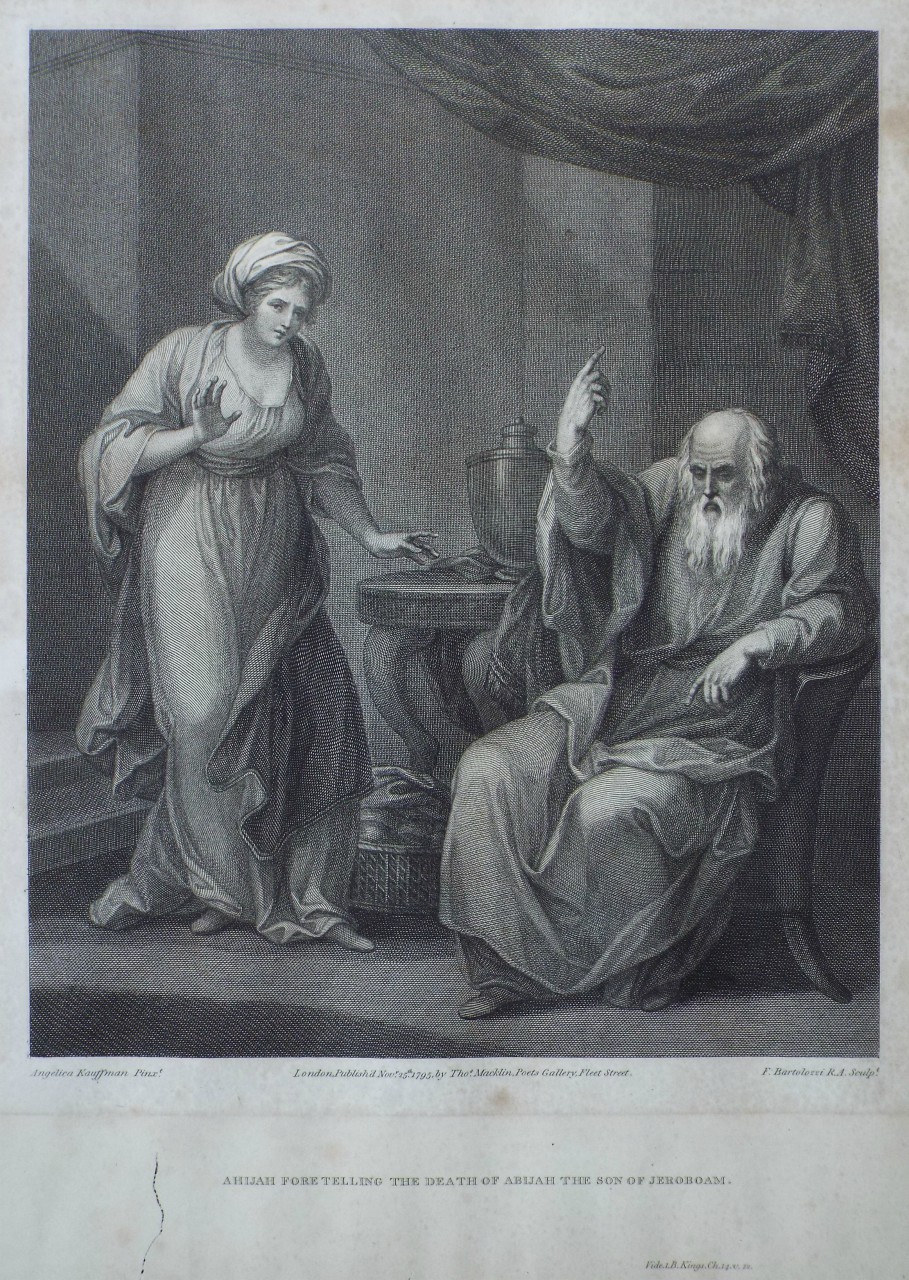
1 At that time Abijah the son of Jeroboam fell sick. 2 And Jeroboam said to his wife, “Arise, and disguise yourself, that it not be known that you are the wife of Jeroboam, and go to Shiloh. Behold, Ahijah the prophet is there, who said of me that I should be king over this people. 3 Take with you ten loaves, some cakes, and a jar of honey, and go to him. He will tell you what shall happen to the child.”

4 Jeroboam’s wife did so. She arose and went to Shiloh and came to the house of Ahijah. Now Ahijah could not see, for his eyes were dim because of his age. 5 And the LORD said to Ahijah, “Behold, the wife of Jeroboam is coming to inquire of you concerning her son, for he is sick. Thus and thus shall you say to her.”

When she came, she pretended to be another woman. 6 But when Ahijah heard the sound of her feet, as she came in at the door, he said, “Come in, wife of Jeroboam. Why do you pretend to be another? For I am charged with unbearable news for you. 7 Go, tell Jeroboam, ‘Thus says the LORD, the God of Israel: “Because I exalted you from among the people and made you leader over my people Israel 8 and tore the kingdom away from the house of David and gave it to you, and yet you have not been like my servant David, who kept my commandments and followed me with all his heart, doing only that which was right in my eyes, 9 but you have done evil above all who were before you and have gone and made for yourself other gods and metal images, provoking me to anger, and have cast me behind your back, 10 therefore behold, I will bring harm upon the house of Jeroboam and will cut off from Jeroboam every male, both bond and free in Israel, and will burn up the house of Jeroboam, as a man burns up dung until it is all gone. 11 Anyone belonging to Jeroboam who dies in the city the dogs shall eat, and anyone who dies in the open country the birds of the heavens shall eat, for the LORD has spoken it.”’ 12 Arise therefore, go to your house. When your feet enter the city, the child shall die. 13 And all Israel shall mourn for him and bury him, for he only of Jeroboam shall come to the grave, because in him there is found something pleasing to the LORD, the God of Israel, in the house of Jeroboam. 14 Moreover, the LORD will raise up for himself a king over Israel who shall cut off the house of Jeroboam today. And henceforth, 15 the LORD will strike Israel as a reed is shaken in the water, and root up Israel out of this good land that he gave to their fathers and scatter them beyond the Euphrates, because they have made their Asherim, provoking the LORD to anger. 16 And he will give Israel up because of the sins of Jeroboam, which he sinned and made Israel to sin.”

17 Then Jeroboam’s wife arose and departed and came to Tirzah. And as she came to the threshold of the house, the child died. 18 And all Israel buried him and mourned for him, according to the word of the LORD, which he spoke by his servant Ahijah the prophet. – 1 Kings 14:1-18 ESV
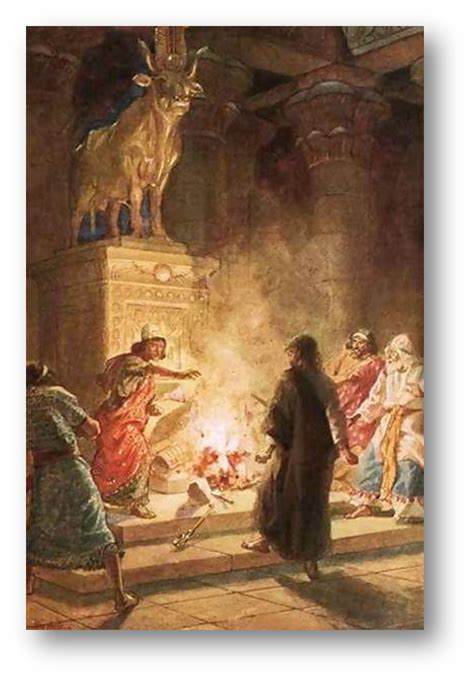
God had spoken His word of judgment against the false gods of Israel, and used a young, unnamed prophet to deliver it. This unidentified servant of God spoke his divine message directly to the altar itself. In the presence of King Jeroboam and the people of Israel, he addressed the sacred site itself, the place they had set up to worship and seek the favor of their man-made god. This shrine was located in the city of Bethel, in the southern region of the land belonging to the ten tribes. Jeroboam had constructed a second altar just like it in the northern city of Dan. In an attempt to prevent his people from returning to Judah to offer sacrifices to Yahweh at the temple in Jerusalem, he provided them with two new and more convenient worship sites. But these alternate sites and the altars they contained were adorned with golden calves, the man-made symbols of Jeroboam’s false gods. So, Yahweh had His prophet deliver a stinging indictment against one of these pseudo-sacred sites.

“O altar, altar! This is what the LORD says: A child named Josiah will be born into the dynasty of David. On you he will sacrifice the priests from the pagan shrines who come here to burn incense, and human bones will be burned on you.” – 1 Kings 13:2 NLT

Even these inanimate places of worship would be judged by God for the role they played in Israel’s apostasy. These carefully constructed sites made of handcrafted stones would end up desecrated and dishonored. The golden idols to which they were dedicated would be exposed for what they were: lifeless and powerless lumps of metal. The psalmist sardonically described the utter futility of these false gods.

Their idols are merely things of silver and gold,
    shaped by human hands.
They have mouths but cannot speak,
    and eyes but cannot see.
They have ears but cannot hear,
    and noses but cannot smell.
They have hands but cannot feel,
    and feet but cannot walk,
    and throats but cannot make a sound.
And those who make idols are just like them,
as are all who trust in them. – Psalm 115:4-8 NLT

Since Jeroboam had been responsible for the creation of these altars and the gods they contained, he too would experience the judgment of God. While he had been forced to stand and watch as the prophet destroyed one of his sacred shrines, he walked away unscathed. He was still the king, and his life went on just as it had before. After ordering the reconstruction of the altar, Jeroboam went about his business and soon forgot all that had happened at Bethel. But God had not forgotten the sins of Jeroboam.

Somewhere along the way, Jeroboam’s wife gave birth to a son, ensuring that he would have an heir to his throne to perpetuate his dynasty. But this joy was soon overshadowed by the news that Jeroboam’s son had become seriously ill. Concerned for his son’s health and his dynasty’s future, Jeroboam sent his wife to ask the prophet Ahijah for a divine prognosis. He wanted to know if his son would live or die.

Jeroboam likely chose to send his wife to Ahijah because the prophet had been the one to pronounce his kingship. Years earlier, Ahijah had been sent by Yahweh to inform Jeroboam that he had been selected to be the first king of the northern kingdom of Israel.

One day as Jeroboam was leaving Jerusalem, the prophet Ahijah from Shiloh met him along the way. Ahijah was wearing a new cloak. The two of them were alone in a field, and Ahijah took hold of the new cloak he was wearing and tore it into twelve pieces. Then he said to Jeroboam, “Take ten of these pieces, for this is what the LORD, the God of Israel, says: ‘I am about to tear the kingdom from the hand of Solomon, and I will give ten of the tribes to you!” – 1 Kings 11:29-31 NLT

The prophet made it clear that Jeroboam’s reign was the result of Solomon’s sin. The son of David had refused to remain faithful to Yahweh, having erected shrines and altars to the false gods of his many wives. As a result, God would divide his kingdom and establish ten of the 12 tribes as a separate nation-state. Jeroboam had done nothing to deserve his rise to power and prominence; it was the sovereign will of God.

The prophet also informed Jeroboam that Jerusalem would remain the place where Yahweh was to be worshiped. The two nations were to remain devoted to the worship of Yahweh and use the Temple in Jerusalem as their sole sacred site. As the newly installed king of Israel, Jeroboam would need to follow David’s example and encourage the ten northern tribes to remain faithful to Yahweh.

“I will place you on the throne of Israel, and you will rule over all that your heart desires. If you listen to what I tell you and follow my ways and do whatever I consider to be right, and if you obey my decrees and commands, as my servant David did, then I will always be with you. I will establish an enduring dynasty for you as I did for David, and I will give Israel to you.” – 1 Kings 11:37-38 NLT

But Jeroboam had failed to heed the prophet’s warning, and now he was suffering the consequences. Yet, when his son became ill, he chose to send his wife to the only man he believed could help him.

Even though Jeroboam’s wife had disguised herself to hide her identity as the queen, the old, blind prophet knew who she was as soon as she walked in the door. Ahijah had been given a divine “heads-up,” informing him of her visit and its purpose.

“Jeroboam’s wife will come here, pretending to be someone else. She will ask you about her son, for he is very sick. Give her the answer I give you.” – 1 Kings 14:5 NLT

As soon as this worried and grieving mother walked in the door, she was met with devastating news. Before she could speak a word, the prophet delivered a message of divine judgment against the house of Jeroboam. The woman who had delivered to Jeroboam an heir to his throne would now be charged with delivering a grim message of his dynasty’s destruction.

“Give your husband, Jeroboam, this message from the LORD, the God of Israel:…I will bring disaster on your dynasty and will destroy every one of your male descendants, slave and free alike, anywhere in Israel. I will burn up your royal dynasty as one burns up trash until it is all gone.” – 1 Kings 14:7, 10 NLT

The prophet made sure she understood that her husband’s reign had been a gift from God. Yahweh had “ripped the kingdom away from the family of David” and given it to Jeroboam (1 Kings 14:8 NLT), and Jeroboam had returned the favor by turning his back on God and causing the ten northern tribes to worship false gods. Just as God had predicted the future destruction of Jeroboam’s altars, He now decreed the destruction of Jeroboam’s heirs.

“The members of Jeroboam’s family who die in the city will be eaten by dogs, and those who die in the field will be eaten by vultures. I, the LORD, have spoken.” – 1 Kings 14:11 NLT

And much to his wife’s dismay, it would all begin with the death of his son.

“Go on home, and when you enter the city, the child will die.” – 1 Kings 14:12 NLT

It’s impossible to fathom the level of grief this woman felt upon hearing this devastating news. In just a matter of minutes, she had been informed that her entire world was about to collapse. Her husband’s kingdom was going to be destroyed, and her young son would die. The prophet made it painfully clear that it was all her husband’s fault. The message she had been given to deliver to Jeroboam left no doubts as to his culpability and sole responsibility for all that was about to happen.

“…you have not been like my servant David, who obeyed my commands and followed me with all his heart and always did whatever I wanted. You have done more evil than all who lived before you. You have made other gods for yourself and have made me furious with your gold calves.” – 1 Kings 14:8-9 NLT

But while this poor woman was still trying to process all that she had heard, Ahijah continued to deliver more bad news.

“In addition, the LORD will raise up a king over Israel who will destroy the family of Jeroboam. This will happen today, even now!” – 1 Kings 14:14 NLT

Jeroboam’s sin was going to have long-lasting consequences. His decision to lead the people of Israel into apostasy would be replicated by his successors, creating a lengthy lineage of spiritual adulterers among God’s chosen people. He had set the tone for their future rebellion, ensuring their eventual removal from the land of promise and their exile “beyond the Euphrates River” (1 Kings 14:15 NLT). Centuries later, God would use the nation of Assyria as His agents of judgment against the northern kingdom of Israel.

In 722 BC, this pagan nation conquered Israel and turned the chosen people of God into slaves. More than 200 years would pass before this devastating event took place. In the meantime, the kings of Israel would follow the pattern established by Jeroboam, leading the people of God into increasing rebellion and wickedness.

But at this point in the story, Jeroboam remains on the throne of Israel. For the moment, God allowed him to maintain his kingdom, but the die had been cast. The damage had been done, and the judgment of God had been decreed.

When Jeroboam’s poor wife returned home, the message of the prophet was confirmed.

“…as she came to the threshold of the house, the child died.” – 1 Kings 14:17 ESV

The judgment of God had begun.

English Standard Version (ESV) The Holy Bible, English Standard Version. ESV® Permanent Text Edition® (2016). Copyright © 2001 by Crossway Bibles, a publishing ministry of Good News Publishers.

New Living Translation (NLT) Holy Bible, New Living Translation, copyright © 1996, 2004, 2015 by Tyndale House Foundation. Used by permission of Tyndale House Publishers Inc., Carol Stream, Illinois 60188. All rights reserved.

The High Cost of Compromised Convictions

11 Now an old prophet lived in Bethel. And his sons came and told him all that the man of God had done that day in Bethel. They also told to their father the words that he had spoken to the king. 12 And their father said to them, “Which way did he go?” And his sons showed him the way that the man of God who came from Judah had gone. 13 And he said to his sons, “Saddle the donkey for me.” So they saddled the donkey for him and he mounted it. 14 And he went after the man of God and found him sitting under an oak. And he said to him, “Are you the man of God who came from Judah?” And he said, “I am.” 15 Then he said to him, “Come home with me and eat bread.” 16 And he said, “I may not return with you, or go in with you, neither will I eat bread nor drink water with you in this place, 17 for it was said to me by the word of the LORD, ‘You shall neither eat bread nor drink water there, nor return by the way that you came.’” 18 And he said to him, “I also am a prophet as you are, and an angel spoke to me by the word of the LORD, saying, ‘Bring him back with you into your house that he may eat bread and drink water.’” But he lied to him. 19 So he went back with him and ate bread in his house and drank water.

20 And as they sat at the table, the word of the LORD came to the prophet who had brought him back. 21 And he cried to the man of God who came from Judah, “Thus says the LORD, ‘Because you have disobeyed the word of the LORD and have not kept the command that the LORD your God commanded you, 22 but have come back and have eaten bread and drunk water in the place of which he said to you, “Eat no bread and drink no water,” your body shall not come to the tomb of your fathers.’” 23 And after he had eaten bread and drunk, he saddled the donkey for the prophet whom he had brought back. 24 And as he went away a lion met him on the road and killed him. And his body was thrown in the road, and the donkey stood beside it; the lion also stood beside the body. 25 And behold, men passed by and saw the body thrown in the road and the lion standing by the body. And they came and told it in the city where the old prophet lived.

26 And when the prophet who had brought him back from the way heard of it, he said, “It is the man of God who disobeyed the word of the LORD; therefore the LORD has given him to the lion, which has torn him and killed him, according to the word that the LORD spoke to him.” 27 And he said to his sons, “Saddle the donkey for me.” And they saddled it. 28 And he went and found his body thrown in the road, and the donkey and the lion standing beside the body. The lion had not eaten the body or torn the donkey. 29 And the prophet took up the body of the man of God and laid it on the donkey and brought it back to the city to mourn and to bury him. 30 And he laid the body in his own grave. And they mourned over him, saying, “Alas, my brother!” 31 And after he had buried him, he said to his sons, “When I die, bury me in the grave in which the man of God is buried; lay my bones beside his bones. 32 For the saying that he called out by the word of the LORD against the altar in Bethel and against all the houses of the high places that are in the cities of Samaria shall surely come to pass.”

33 After this thing Jeroboam did not turn from his evil way, but made priests for the high places again from among all the people. Any who would, he ordained to be priests of the high places. 34 And this thing became sin to the house of Jeroboam, so as to cut it off and to destroy it from the face of the earth. – 1 Kings 13:11-34 ESV

After delivering God’s message of judgment to Jeroboam and having destroyed the altar dedicated to one of Jeroboam’s false gods, the young prophet began his return journey to Judah. He had successfully fulfilled his God-ordained mission and was following Yahweh’s strict instructions to spend no additional time among the northern tribes. He was to accept no forms of hospitality or allow anything to delay his return home. He was even warned to take a different route back to Judah to prevent anyone from interfering with his mission. This young prophet had proved to be obedient to the will of God, even rejecting Jeroboam’s tempting offer of a meal and a reward. Instead, he declared his intentions to remain faithful to every detail of God’s instructions.

“Even if you gave me half of everything you own, I would not go with you. I would not eat or drink anything in this place. For the LORD gave me this command: ‘You must not eat or drink anything while you are there, and do not return to Judah by the same way you came.’” So he left Bethel and went home another way. – 1 Kings 13:8-10 NLT

But as the story continues to unfold and the young prophet makes his way home, he decides to take what appears to be an unsanctioned break under a large tree. Having not yet crossed the border into Judah, he decided to take a much-needed rest. While the text does not tell where the young man began his journey to Judah that day, he had likely spent many hours making the trip to Bethel. If he started his trip from Jerusalem, it would have been a 90-mile trek to Bethel. And now, after having destroyed Jeroboam’s altar to his false god, the prophet had to walk all the way back. So, it makes perfect sense that he was weary from all the activity and excitement of the day. He was tired, hungry, and alone. But he had not yet completed his mission. He had been instructed by God to return to Judah without delay and to avoid all distractions.

Yet, as the young man rested under the tree, he was approached by a stranger — an old prophet who happened to live in Bethel. The author provides few details about this man, except that he was a prophet and a father. His sons, who had witnessed the events at the altar that day, returned home and told him all that the young prophet had said and done. Intrigued by what he heard, the elder prophet commanded his sons to saddle a donkey so that he could seek out his younger peer. It seems likely that he simply wanted to verify the message the younger prophet had delivered. As a prophet himself, this older man would have been interested in whether the message delivered by the young man was actually from Yahweh. If it were, there were dark days ahead for the northern kingdom. What the young prophet declared at the altar earlier that day did not bode well for the ten northern tribes.

“A child named Josiah will be born into the dynasty of David. On you he will sacrifice the priests from the pagan shrines who come here to burn incense, and human bones will be burned on you.” – 1 Kings 13:2 NLT

Those were serious words that implied future judgment against the northern kingdom, and this senior prophet was anxious to verify their veracity. So, he mounted his donkey and began his search for the one who had delivered this foreboding message. Since the young prophet had decided to take his unscheduled rest stop under the tree, the older prophet caught up with him before he had crossed over into Judah. This is where the story gets interesting.

Based on what happens next, it is difficult to understand the motives of the older man. He clearly used deception to convince the younger prophet to return to his home for a meal. His offer was rejected by the young man because it violated the command of God.

“I am not allowed to eat or drink anything here in this place. For the Lord gave me this command: ‘You must not eat or drink anything while you are there, and do not return to Judah by the same way you came.’” – 1 Kings 13:16-17 NLT

They were still within the borders of Israel because the young prophet had not yet made it to the safety of Judah. But, anxious to hear more about the young man’s message from God, the older prophet lied to him. He falsely claimed to have been given a message from an angel commanding him to bring the young man to his home for a meal. Driven by hunger, the young prophet lowered his defenses and accepted the offer. But in doing so, he disobeyed the command of God. He allowed his physical appetites to cloud his thinking and compromise his convictions.

The text indicates that the young prophet violated the divine decree by sharing a meal in the older prophet’s home. As soon as he had eaten the food he had been commanded to avoid, the young man received a stinging rebuke from God delivered by the very man who had just deceived him.

“This is what the LORD says: You have defied the word of the LORD and have disobeyed the command the LORD your God gave you. You came back to this place and ate and drank where he told you not to eat or drink. Because of this, your body will not be buried in the grave of your ancestors.” – 1 Kings 13:21-22 NLT

This time, the older prophet had spoken the truth. His lie had caused the younger prophet to disobey God. Now, he had the unpleasant responsibility of delivering God’s message of judgment against the very man he had deceived and caused to disobey. The rest of the story reads like something out of Grimms’ Fairy Tales. The young man, with a full stomach and a heavy heart, began his journey home. But before he could make it into Judah, he was attacked by a lion. The beast killed the prophet but left the body and the donkey unmolested. Uncharacteristically, the lion stood sentry over the fallen body, protecting it from other predators. Passing travelers saw the strange scene and reported it back in Bethel. Upon hearing the news, the older prophet retrieved the body of the young man and placed it in his own tomb, located in the city of Bethel.

The old man was now fully convinced that what the young prophet had said had been the word of God.

“For the message the LORD told him to proclaim against the altar in Bethel and against the pagan shrines in the towns of Samaria will certainly come true.” – 1 Kings 13:32 NLT

Yahweh had used this young, unnamed prophet to declare His judgment against the ten northern tribes. Their continued apostasy would eventually lead to their destruction. When it came to His chosen people, God was deadly serious about their obedience to Him. Whether they were a fully united confederation of 12 tribes or divided into two rival kingdoms, they remained His prized possession and were obligated to live according to His commands. Obedience would bring the blessings of God, but disobedience would bring His curses.

The young prophet had learned the costly lesson that partial obedience was insufficient and unacceptable to God. He had almost completed his mission but had ultimately failed. He had been sent by God, but he ultimately ended up being punished by God for allowing worldly distractions to divert him from his ultimate goal. Had he crossed the border into Judah, he could have eaten his fill of food. But he compromised and allowed his physical appetites to cloud his thinking and distract him from his God-given assignment, and he paid dearly for his mistake. This young man’s life is a perfect illustration of what the apostle John warned about in his first epistle.

Do not love this world nor the things it offers you, for when you love the world, you do not have the love of the Father in you. For the world offers only a craving for physical pleasure, a craving for everything we see, and pride in our achievements and possessions. These are not from the Father, but are from this world. And this world is fading away, along with everything that people crave. But anyone who does what pleases God will live forever. – 1 John 2:15-17 NLT

The young prophet’s desire for physical pleasure ended up superseding his love for God, and it proved not only disappointing but deadly. The older and supposedly wiser prophet had long ago compromised his convictions by remaining in Israel long after Jeroboam had erected his false gods and created his own religion. He had done nothing to address the apostasy in Israel, and he seemed unbothered by the fact that Jeroboam restricted the people from returning to Jerusalem to celebrate the annual feasts. The fact that Yahweh chose to use a younger and much less experienced prophet to deliver His message of judgment to Jeroboam speaks volumes. Yet, in the end, the older prophet was convicted by his compromise and complacency and did the right thing.

So the prophet laid the body of the man of God on the donkey and took it back to the town to mourn over him and bury him. He laid the body in his own grave, crying out in grief, “Oh, my brother!” – 1 Kings 13:29-30 NLT

English Standard Version (ESV) The Holy Bible, English Standard Version. ESV® Permanent Text Edition® (2016). Copyright © 2001 by Crossway Bibles, a publishing ministry of Good News Publishers.

New Living Translation (NLT) Holy Bible, New Living Translation, copyright © 1996, 2004, 2015 by Tyndale House Foundation. Used by permission of Tyndale House Publishers Inc., Carol Stream, Illinois 60188. All rights reserved.

Sovereign Over All

1 And behold, a man of God came out of Judah by the word of the LORD to Bethel. Jeroboam was standing by the altar to make offerings. 2 And the man cried against the altar by the word of the LORD and said, “O altar, altar, thus says the LORD: ‘Behold, a son shall be born to the house of David, Josiah by name, and he shall sacrifice on you the priests of the high places who make offerings on you, and human bones shall be burned on you.’” 3 And he gave a sign the same day, saying, “This is the sign that the LORD spoken: ‘Behold, the altar shall be torn down, and the ashes that are on it shall be poured out.’” 4 And when the king heard the saying of the man of God, which he cried against the altar at Bethel, Jeroboam stretched out his hand from the altar, saying, “Seize him.” And his hand, which he stretched out against him, dried up, so that he could not draw it back to himself. 5 The altar also was torn down, and the ashes poured out from the altar, according to the sign that the man of God had given by the word of the LORD. 6 And the king said to the man of God, “Entreat now the favor of the LORD your God, and pray for me, that my hand may be restored to me.” And the man of God entreated the LORD, and the king’s hand was restored to him and became as it was before. 7 And the king said to the man of God, “Come home with me, and refresh yourself, and I will give you a reward.” 8 And the man of God said to the king, “If you give me half your house, I will not go in with you. And I will not eat bread or drink water in this place, 9 for so was it commanded me by the word of the LORD, saying, ‘You shall neither eat bread nor drink water nor return by the way that you came.’” 10 So he went another way and did not return by the way that he came to Bethel. – 1 Kings 13:1-10 ESV

In an effort to preserve the kingdom given to him by God, Jeroboam made a boneheaded decision that ended up offending God. He knew that the members of the ten northern tribes were religious people and feared that they would continue to travel to Judah to offer sacrifices at the Temple Solomon had built in Jerusalem. This continued spiritual connection to the holy city might influence them to restore their relationship with Rehoboam and the people of Judah. So, to prevent this from happening, Jeroboam made the fateful decision to create an alternate religion for the ten tribes of Israel, complete with priests and golden idols made to look like calves, which he had placed in the cities of Dan and Bethel. Then he convinced the people to turn their backs on Yahweh by offering their sacrifices to the two golden calves.

“It is too much trouble for you to worship in Jerusalem. Look, Israel, these are the gods who brought you out of Egypt!”

He placed these calf idols in Bethel and in Dan—at either end of his kingdom. But this became a great sin, for the people worshiped the idols, traveling as far north as Dan to worship the one there. – 1 Kings 12:28-30 NLT

In following Jeroboam’s lead, the people no longer sought forgiveness, cleansing, and blessing from God Almighty, but placed their hopes in lifeless statues made by human hands. Years later, the prophet Isaiah would describe the futility of worshiping false gods.

How foolish are those who manufacture idols.
    These prized objects are really worthless.
The people who worship idols don’t know this,
    so they are all put to shame.
Who but a fool would make his own god—
    an idol that cannot help him one bit?
All who worship idols will be disgraced
    along with all these craftsmen—mere humans—
    who claim they can make a god.
They may all stand together,
    but they will stand in terror and shame. – Isaiah 44:9-11 NLT

But to Jeroboam, his decision made all the sense in the world. He was a pragmatist who was more interested in preserving his newfound status as king than in promoting the ongoing worship of the one who had made him king. And his decision, while initially successful, was about to prove seriously flawed.

Jeroboam had traveled to Bethel to offer sacrifices to one of his false gods. But while there, he received a visit from a prophet of the one true God. This unnamed man had come from Judah with a message from Yahweh. So, as Jeroboam was about to offer sacrifices to his visible, but lifeless god, he was given a word from the invisible, yet all-powerful God of Israel. And the prophet, seemingly ignoring Jeroboam, directed his message at the altar the king had constructed. In a sense, this was one deity speaking to another. Yahweh was challenging the false god of Jeroboam by delivering a prophecy concerning its coming destruction.

“O altar, altar! This is what the LORD says: A child named Josiah will be born into the dynasty of David. On you he will sacrifice the priests from the pagan shrines who come here to burn incense, and human bones will be burned on you.” – 1 Kings 13:2 NLT

Jeroboam’s god was going to meet an untimely end. When faced with the power of God Almighty, Jeroboam’s false god proved incapable of defending itself. It remained speechless because it was lifeless. And the warning delivered by the prophet of God carried long-term ramifications. It would be 290 years later before God fulfilled His word, and all during that time, the nation of Israel would continue to worship their false gods. But eventually, God would raise up a king over the southern kingdom of Judah named Josiah, and he would institute a series of religious reforms in both Judah and Israel. In doing so, he would fulfill God’s prophecy against the altar of Jeroboam’s false god.

The king also tore down the altar at Bethel—the pagan shrine that Jeroboam son of Nebat had made when he caused Israel to sin. He burned down the shrine and ground it to dust, and he burned the Asherah pole. Then Josiah turned around and noticed several tombs in the side of the hill. He ordered that the bones be brought out, and he burned them on the altar at Bethel to desecrate it. (This happened just as the LORD had promised through the man of God when Jeroboam stood beside the altar at the festival.) – 2 Kings 23:15-16 NLT

The very fact that this altar was still in existence and in use nearly 300 years later reveals the level of apostasy in Israel. Jeroboam’s decision to replace Yahweh with false gods was going to have long-lasting consequences. In an effort to preserve his kingdom, Jeroboam had been willing to sacrifice the spiritual well-being of his own people.

And to demonstrate that the words he had spoken were true, “the man of God gave a sign to prove his message” (1 Kings 13:3 NLT).

He said, “The LORD has promised to give this sign: This altar will split apart, and its ashes will be poured out on the ground.” – 1 Kings 13:3 NLT

God was going to validate His word with a powerful sign. There would be an immediate judgment on Jeroboam’s apostasy. His shrine and the golden calf it contained would be destroyed. But, once again, Jeroboam attempted to preserve his kingdom by rejecting the will of God. After the prophet had spoken his word of warning, Jeroboam commanded that he be arrested. He wrongly assumed that he could thwart the will of God by binding the messenger of God. In doing so, Jeroboam would establish a precedent that would carry over for generations. His successors to the throne of Israel would continue to reject the will of God by resisting and refusing the messengers of God. Rather than repent and return in humble submission to Yahweh, they would each cling stubbornly to their false gods, dooming their people to the judgment of God.

But Jeroboam’s attempt to stop God’s prophet proved ineffective and injurious. He still ended up with a shattered altar and a paralyzed hand. Suddenly convinced of the prophet’s position as God’s spokesman, Jeroboam begged him to intercede with Yahweh on his behalf.

“Entreat now the favor of the LORD your God, and pray for me, that my hand may be restored to me.” – 1 Kings 13:6 ESV

The prophet prayed and God responded, restoring full mobility to Jeroboam’s paralyzed hand. But Jeroboam’s response to this miracle is revealing. Having just witnessed the miraculous destruction of the altar to his false god and having had his hand paralyzed by God, you would think that Jeroboam would have begged for forgiveness. But instead, he tries to win over the favor of the prophet by inviting him to dinner and offering him a reward. Perhaps Jeroboam feared that the prophet might turn his attention to Dan and destroy the altar there. So, in another attempt to preserve his kingdom, he tried to bribe the prophet of God.

But God, knowing the true nature of Jeroboam’s heart, had warned the prophet not to accept any invitation from this conniving and calculating king.

“Even if you gave me half of everything you own, I would not go with you. I would not eat or drink anything in this place. For the Lord gave me this command: ‘You must not eat or drink anything while you are there, and do not return to Judah by the same way you came.’” – 1 Kings 13:8-9 NLT

Jeroboam was a man who, for the sake of his kingdom, had been willing to compromise his faith in God. And he assumed that this unnamed prophet would be just as willing to make concessions in exchange for monetary gain. But he was wrong. This unnamed prophet of Yahweh refused to compromise his convictions for personal gain. Even when faced with Jeroboam’s offer of a reward, this faithful servant remained uncompromising in his commitment to the will of God. He recognized Yahweh as the one true God and refused to be tempted by Jeroboam’s thinly veiled offer of monetary gain in exchange for spiritual infidelity. His actions reflect his firm and unwavering belief in his God, and echo the words Yahweh spoke through the prophet Isaiah.

This is what the LORD says—
    your Redeemer and Creator:
“I am the LORD, who made all things.
    I alone stretched out the heavens.
Who was with me
    when I made the earth?
I expose the false prophets as liars
    and make fools of fortune-tellers.
I cause the wise to give bad advice,
    thus proving them to be fools.
But I carry out the predictions of my prophets!” – Isaiah 44:24-26 NLT

Jeroboam’s reign over the ten northern tribes had been the work of God, not the result of his own ambition and ingenuity. Yahweh had ordained his rise to power as part of a judgment against Solomon for his spiritual infidelity that resulted in the proliferation of false gods in Israel. But rather than honor Yahweh for His providential role in his rise to power, Jeroboam had created his own religion, complete with its own gods, priestly caste, and sacrificial system. In a vain attempt to solidify his kingdom, Jeroboam led the ten northern tribes to abandon Yahweh and place their hope in the golden calves he had made.

Despite Jeroboam’s actions, the young prophet’s appearance serves as a sign that Yahweh was still in control. Jeroboam could create his own gods and erect shrines in their honor, but he could not escape the sovereign will of Yahweh. According to the word of the prophet, Jeroboam’s altar was destroyed and the ashes poured out. His god proved to be powerless before the one true God, and Jeroboam’s attempt to have the prophet arrested proved futile. As he pointed his finger at the prophet and ordered his arrest, Yahweh intervened, paralyzing Jeroboam’s arm and forcing him to watch as his precious altar was destroyed. Ironically, the rebellious Jeroboam was forced to beg the prophet to call on Yahweh for healing. Rather than appeal to his own self-manufactured god, Jeroboam knew that Yahweh was his only hope.

The prophet prayed, and the LORD answered. Despite his track record of unfaithfulness, Jeroboam received grace and mercy from Yahweh. The recalcitrant king’s hand was restored, and his kingdom was preserved because Yahweh had a much larger plan in place that Jeroboam or any other king could not oppose.

English Standard Version (ESV) The Holy Bible, English Standard Version. ESV® Permanent Text Edition® (2016). Copyright © 2001 by Crossway Bibles, a publishing ministry of Good News Publishers.

New Living Translation (NLT) Holy Bible, New Living Translation, copyright © 1996, 2004, 2015 by Tyndale House Foundation. Used by permission of Tyndale House Publishers Inc., Carol Stream, Illinois 60188. All rights reserved.

Divided Allegiance

25 Then Jeroboam built Shechem in the hill country of Ephraim and lived there. And he went out from there and built Penuel. 26 And Jeroboam said in his heart, “Now the kingdom will turn back to the house of David. 27 If this people go up to offer sacrifices in the temple of the LORD at Jerusalem, then the heart of this people will turn again to their lord, to Rehoboam king of Judah, and they will kill me and return to Rehoboam king of Judah.” 28 So the king took counsel and made two calves of gold. And he said to the people, “You have gone up to Jerusalem long enough. Behold your gods, O Israel, who brought you up out of the land of Egypt.” 29 And he set one in Bethel, and the other he put in Dan. 30 Then this thing became a sin, for the people went as far as Dan to be before one. 31 He also made temples on high places and appointed priests from among all the people, who were not of the Levites. 32 And Jeroboam appointed a feast on the fifteenth day of the eighth month like the feast that was in Judah, and he offered sacrifices on the altar. So he did in Bethel, sacrificing to the calves that he made. And he placed in Bethel the priests of the high places that he had made. 33 He went up to the altar that he had made in Bethel on the fifteenth day in the eighth month, in the month that he had devised from his own heart. And he instituted a feast for the people of Israel and went up to the altar to make offerings. – 1 Kings 12:25-33 ESV

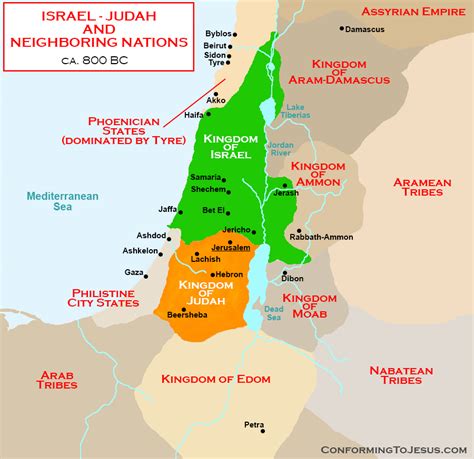
Because of Solomon’s unfaithfulness, God divided his vast kingdom in half, placing ten of the 12 tribes under the rule of Jeroboam. This left Rehoboam, the son of Solomon, with only the tribe over which to reign, that of Judah. The sprawling domain he had inherited from his father had been greatly diminished, virtually overnight. This judgment against Solomon resulted in the division of one kingdom into two. In the north, the ten tribes would become the nation of Israel. In the south, the tribe of Judah, which was later joined by the tribe of Benjamin, would become known as the nation of Judah.

The 12 tribes of Israel were the descendants of the 12 sons of Jacob, whose name God later changed to Israel. These 12 tribes had been set apart by God and bestowed with a great privilege; they were to be His chosen people.

“For you are a people holy to the LORD your God. The LORD your God has chosen you to be a people for his treasured possession, out of all the peoples who are on the face of the earth.” – Deuteronomy 7:6 ESV

“And the LORD has declared today that you are a people for his treasured possession, as he has promised you, and that you are to keep all his commandments, and that he will set you in praise and in fame and in honor high above all nations that he has made, and that you shall be a people holy to the LORD your God, as he promised.” – Deuteronomy 26:18-19 ESV

God had miraculously rescued them out of their slavery in Egypt and had led them to the land of Canaan, which He had promised to give them as their inheritance. On their way to this promised land, God graciously provided them with His law, which provided them with detailed instructions regarding their behavior as His chosen people. They were His treasured possession and, as such, they were to reflect their unique status by conducting their lives according to His commands. This would ensure that they remained holy or set apart, living distinctively different lives from all the other nations of the world. And because God knew they would fail to keep all His laws, He provided them with the sacrificial system so they could receive cleansing from and forgiveness for their sins. But the one thing God required from them was faithfulness. The very first law He had given them to obey concerned their unwavering allegiance to Him.

“You shall have no other gods before me.” – Exodus 20:3 ESV

And because He knew the natural proclivity of man’s heart, God elaborated on His command by adding the following restrictions:

“You shall not make for yourself a carved image, or any likeness of anything that is in heaven above, or that is in the earth beneath, or that is in the water under the earth. You shall not bow down to them or serve them, for I the LORD your God am a jealous God, visiting the iniquity of the fathers on the children to the third and the fourth generation of those who hate me…” – Exodus 20:4-5 ESV

The book of Exodus goes on to record that the very day Moses came down from the top of Mount Sinai with the commandments of God in hand, he discovered the people of Israel had already violated the first command. While he had been on the mountaintop, the people had begun to have second thoughts about his leadership and the God he claimed to represent.

When the people saw that Moses delayed to come down from the mountain, the people gathered themselves together to Aaron and said to him, “Up, make us gods who shall go before us. As for this Moses, the man who brought us up out of the land of Egypt, we do not know what has become of him.” – Exodus 32:1 ESV

Aaron, the brother of Moses, obliged the people and ordered the construction of a golden calf, which the people promptly began to worship. When Moses later descended from Mount Sinai, he found the people dancing and singing before their newly crafted god.

And as soon as he came near the camp and saw the calf and the dancing, Moses’ anger burned hot, and he threw the tablets out of his hands and broke them at the foot of the mountain. He took the calf that they had made and burned it with fire… – Exodus 32:19-20 ESV

However, this wasn’t a new god; it was a reimagining of the one true God. When the golden calf was finished, the people said, “These are your gods, O Israel, who brought you up out of the land of Egypt!” (Exodus 32:4 ESV). But this declaration by the people concerned Aaron.

When Aaron saw this, he built an altar before it. And Aaron made a proclamation and said, “Tomorrow shall be a feast to the LORD.” – Exodus 32:5 ESV

Aaron clarified that this idol was to be seen as a representation of Yahweh, the LORD. He had helped the people create a more approachable and personable Yahweh. Rather than the God of smoke, fire, thunder, and lightning that had appeared on Mount Sinai, they now had a version of Yahweh that reminded them of the false gods they worshiped back in Egypt. 

This proclivity for unfaithfulness did not stop in the wilderness of Sinai. Even after God graciously led them to the land of Canaan and assisted them in conquering and occupying the land He had promised to give them, the people continued their pattern of disobedience, which led to further spiritual adultery. Idolatry became a habit for the people of God. And it was Solomon’s own penchant for false gods that led to the division of his kingdom.

…when Solomon was old his wives turned away his heart after other gods, and his heart was not wholly true to the LORD his God, as was the heart of David his father. For Solomon went after Ashtoreth the goddess of the Sidonians, and after Milcom the abomination of the Ammonites. So Solomon did what was evil in the sight of the LORD… – 1 Kings 11:4-6 ESV

But the infidelity of the people of Israel didn’t end with God’s judgment. As this chapter reveals, they seemed to have an endless capacity for unfaithfulness. As soon as Jeroboam was crowned king over the ten northern tribes, he made an executive decision that he hoped would guarantee his reign for years to come. Fearing that the people would feel obligated to worship Yahweh in Jerusalem, where Solomon’s temple was located, Jeroboam came up with a plan to erect his own holy cities with his own gods. This would eliminate the need for any Israelite to journey to Jerusalem to offer sacrifices. So, buoyed by the advice of his counselors, Jeroboam built these shrines in the cities of Dan and Bethel. Just like Aaron and Solomon, Jeroboam became personally responsible for leading the people into rebellion against God.

This caused Israel to sin; the people went to Bethel and Dan to worship the calves. – 1 Kings 12:20 ESV

And Jeroboam didn’t stop with the construction of these shrines to his man-made gods. He created his own religious system, complete with priests and a sacrificial system. He attempted to replicate all the details of the system established by Yahweh and, in doing so, provided the people with an alternative means of cleansing and forgiveness. But everything he did was in direct violation of Yahweh’s law.

It’s important to remember that God had given Jeroboam his kingdom and his kingship. He had done nothing to earn his new position or to establish his domain. It had all been handed to him by the sovereign will of God. And yet, fearing that he might lose what he had been given, Jeroboam chose to violate the will of God to protect and preserve his newfound power and prestige. Relying on faulty human reasoning, he determined that the best way to maintain the people’s allegiance was to provide them with their own gods to worship. And like docile sheep, the people willingly followed the lead of their new shepherd.

On the fifteenth day of the eighth month (a date he had arbitrarily chosen) Jeroboam offered sacrifices on the altar he had made in Bethel. He inaugurated a festival for the Israelites and went up to the altar to offer sacrifices. – 1 Kings 12: 33 NLT

The many shrines that Solomon had built to honor Ashtoreth, the goddess of the Sidonians; Milcom, the god of the Ammonites; and Chemosh, the god of Moab, were still in the land of Judah. The spirit of idolatry had not ended with the split of the kingdom. Now, Jeroboam had ensured that the ten northern tribes had their own false gods to worship in place of the one true God.

Centuries later, the apostle Paul described mankind’s tendency to try to replace the one true God with their own versions of Him.

But God shows his anger from heaven against all sinful, wicked people who suppress the truth by their wickedness.  They know the truth about God because he has made it obvious to them. For ever since the world was created, people have seen the earth and sky. Through everything God made, they can clearly see his invisible qualities—his eternal power and divine nature. So they have no excuse for not knowing God.

Yes, they knew God, but they wouldn’t worship him as God or even give him thanks. And they began to think up foolish ideas of what God was like. As a result, their minds became dark and confused. Claiming to be wise, they instead became utter fools. And instead of worshiping the glorious, ever-living God, they worshiped idols made to look like mere people and birds and animals and reptiles. – Romans 1:18-23 NLT

The Israelites, whom Yahweh had chosen to be His treasured possession, had every reason to know and understand the truth about God. He had redeemed them out of slavery in Egypt. He had led them across the wilderness to Mount Sinai, where He appeared to them in the form of a dark cloud complete with thunder and lightning. From Sinai’s peak, He had given them His law and the plans for the Tabernacle, which would serve as His heavenly dwelling place during their journey to Canaan.

Yahweh assisted them in their conquest of the land of Canaan and fulfilled His promise to give them the land as their inheritance. But the people of Israel have proved to be far from faithful and prone to spiritual infidelity. Solomon had set the tone, and his successors would follow his lead. The rest of the Book of Kings chronicles the sad story of how the divided nation of Israel failed to give Yahweh their undivided allegiance. Led by their kings, the people of Israel would consistently turn their backs on Yahweh. They would never entirely abandon Him, but they would consistently break their covenant commitment to Him.

English Standard Version (ESV) The Holy Bible, English Standard Version. ESV® Permanent Text Edition® (2016). Copyright © 2001 by Crossway Bibles, a publishing ministry of Good News Publishers.

New Living Translation (NLT) Holy Bible, New Living Translation, copyright © 1996, 2004, 2015 by Tyndale House Foundation. Used by permission of Tyndale House Publishers Inc., Carol Stream, Illinois 60188. All rights reserved.

A Sad, But Sovereign State of Affairs

16 And when all Israel saw that the king did not listen to them, the people answered the king, “What portion do we have in David? We have no inheritance in the son of Jesse. To your tents, O Israel! Look now to your own house, David.” So Israel went to their tents. 17 But Rehoboam reigned over the people of Israel who lived in the cities of Judah. 18 Then King Rehoboam sent Adoram, who was taskmaster over the forced labor, and all Israel stoned him to death with stones. And King Rehoboam hurried to mount his chariot to flee to Jerusalem. 19 So Israel has been in rebellion against the house of David to this day. 20 And when all Israel heard that Jeroboam had returned, they sent and called him to the assembly and made him king over all Israel. There was none that followed the house of David but the tribe of Judah only.

21 When Rehoboam came to Jerusalem, he assembled all the house of Judah and the tribe of Benjamin, 180,000 chosen warriors, to fight against the house of Israel, to restore the kingdom to Rehoboam the son of Solomon. 22 But the word of God came to Shemaiah the man of God: 23 “Say to Rehoboam the son of Solomon, king of Judah, and to all the house of Judah and Benjamin, and to the rest of the people, 24 ‘Thus says the LORD, You shall not go up or fight against your relatives the people of Israel. Every man return to his home, for this thing is from me.’” So they listened to the word of the LORD and went home again, according to the word of the LORD. – 1 Kings 12:16-24 ESV

Reigning over the 12 tribes of Israel had never been an easy task. Even the great King David found it difficult to win over the allegiance of all the tribes when he first ascended to the throne. After the death of King Saul, David’s own tribe of Judah immediately crowned him as their king, but the rest of the tribes anointed Saul’s son, Ish-bosheth, as their king. This included Gilead, the Ashurites, Jezreel, Ephraim, Benjamin, and all Israel (2 Samuel 2:9). For seven and a half years, David reigned over the tribe of Judah, while the rest of the tribes gave their allegiance to Ish-bosheth. However, eventually, these two factions ended up fighting against one another.

There was a long war between the house of Saul and the house of David. And David grew stronger and stronger, while the house of Saul became weaker and weaker. – 2 Samuel 3:1 ESV

After a long and protracted struggle, Ish-bosheth was assassinated by two of his own soldiers, leaving the 11 tribes of Israel in a state of disarray. Eventually, they settled their dispute with Judah and agreed to accept David as their king.

So all the elders of Israel came to the king at Hebron, and King David made a covenant with them at Hebron before the LORD, and they anointed David king over Israel. David was thirty years old when he began to reign, and he reigned forty years. At Hebron he reigned over Judah seven years and six months, and at Jerusalem he reigned over all Israel and Judah thirty-three years. – 2 Samuel 5:3-5 ESV

Each of these tribes was characterized by a strong, independent streak and a natural desire for autonomy. While they had all demanded that Samuel the prophet appoint a king over them, they would have each preferred that he choose a man from their own particular tribe. This strong tribal allegiance made it difficult for any of Israel’s kings to rule without experiencing some form of unrest or dissatisfaction from the various clans. Ruling over this confederation of 12 tribes required diplomacy and humility. No king could expect to manage this diverse conglomeration of autonomous people groups through intimidation or brute force.

Yet, here was Rehoboam, the new king of Israel, attempting to do just that. Having heard the request of his people that he rescind some of his father’s more abusive policies, Rehoboam ignored their plea and threatened them with even worse conditions.

“My father laid heavy burdens on you, but I’m going to make them even heavier! My father beat you with whips, but I will beat you with scorpions!” – 1 Kings 12:14 NLT

Emboldened by the foolish counsel of his inexperienced peers, Rehoboam had decided that intimidation was better than negotiation. He stubbornly refused to make any concessions and, in doing so, he ended up alienating ten of the 12 tribes of Israel. In just a matter of minutes, Rehoboam managed to destroy the kingdom his father and grandfather had spent 80 years building.

When all Israel realized that the king had refused to listen to them, they responded,

“Down with the dynasty of David!
    We have no interest in the son of Jesse.
Back to your homes, O Israel!
    Look out for your own house, O David!”

So the people of Israel returned home. – 1 Kings 12:16 NLT

Centuries later, Jesus would make a statement that powerfully illustrates the folly of Rehoboam’s decision: “Every kingdom divided against itself is laid waste, and no city or house divided against itself will stand” (Matthew 12:25 ESV). In a single act, fueled by youthful pride and arrogance, Rehoboam managed to destroy one of the greatest nations on the face of the earth.

The people of Judah and Israel were as innumerable as the sand on the seashore; they had plenty to eat and drink and were happy. Solomon ruled all the kingdoms from the Euphrates River to the land of the Philistines, as far as the border of Egypt. These kingdoms paid tribute as Solomon’s subjects throughout his lifetime. – 1 Kings 4:20-21 NLT

Rehoboam had inherited his father’s wealth, crown, and vast domain, but it seems that his father’s wisdom had been non-transferable. He was operating in ignorance and determined to do things his own way, and he would learn the painful lesson from one of the many proverbs his father had collected.

There is a way that seems right to a man, but its end is the way to death. – Proverbs 14:12 ESV

This stubborn young man refused to believe that his kingdom was lost. In a futile effort to quell what he saw as an insurrection, “Rehoboam sent Adoniram, who was in charge of forced labor, to restore order, but the people of Israel stoned him to death” (1 Kings 12:18 NLT). Rehoboam quickly discovered that he was a king with a much-diminished kingdom. He had lost control over the entire northern region of the nation and was left with nothing but the land belonging to the tribe of Judah as his domain. The author of 1 Kings ensures that his audience understands the gravity of the situation.

And to this day the northern tribes of Israel have refused to be ruled by a descendant of David. – 1 Kings 12:19 NLT

This was not a temporary setback, but a permanent realignment of the nation of Israel’s political, civil, and religious fortunes. What happened that day would have long-term implications for all 12 tribes. And, as the author points out, this entire scenario played out according to the sovereign will of God; it had all been His doing. Yes, Rehoboam had played his part, alienating his fellow Israelites by refusing to listen to their calls for justice. But God had already warned that this was going to happen. It was His judgment against Solomon for his sin and rebellion.

The LORD was very angry with Solomon, for his heart had turned away from the LORD, the God of Israel, who had appeared to him twice. He had warned Solomon specifically about worshiping other gods, but Solomon did not listen to the LORD’s command. So now the LORD said to him, “Since you have not kept my covenant and have disobeyed my decrees, I will surely tear the kingdom away from you and give it to one of your servants.” – 1 Kings 11:9-11 NLT

This had all been God’s will. Yet, Rehoboam continued to stubbornly refuse to accept his fate. In a last-ditch effort to restore his kingdom, he assembled an army of 180,000 men from the tribes of Judah and Benjamin with the intent to fight a civil war against his own people. But God graciously intervened.

“Say to Rehoboam the son of Solomon, king of Judah, and to all the house of Judah and Benjamin, and to the rest of the people, ‘Thus says the LORD, You shall not go up or fight against your relatives the people of Israel. Every man return to his home, for this thing is from me.’” – 1 Kings 12:23-24 NLT

Rehoboam would not be able to thwart God’s will. The die had been cast, and the outcome was set in stone. The nation was divided, and no one could restore it to its former glory. The rest of the book of 1 Kings chronicles the somewhat sordid history of the divided nation of Israel. Virtually overnight, what had once been a rich and powerful kingdom was reduced to a shadow of its former glory. The ten tribes in the north became the nation of Israel, while Judah eventually joined forces with the tribe of Benjamin to form the nation of Judah.

These two nations would not only find themselves constantly at odds with one another, but also with God. The unfaithfulness displayed by Solomon would continue on both sides of the border that separated these two nations. For generations to come, the people whom God had chosen would choose to disobey and dishonor Him. Yet, throughout it all, He would continue to display His love and grace, sending His prophets to call His people to repent and return. Despite their unfaithfulness, He would remain faithful.

To his credit, Rehoboam listened to the words of Shemaiah, the man of God. This prophet delivered a message from Yahweh forbidding Rehoboam from using his 180,000 chosen warriors to attack the newly formed house of Israel. This prideful young king had demonstrated a propensity for acting impulsively and unwisely, but, in this case, he heeded the prophet’s warning and obeyed the command of Yahweh. Peace reigned because God intervened. But, as the text reveals, “to this day the northern tribes of Israel have refused to be ruled by a descendant of David” (1 Kings 12:19 NLT). 

English Standard Version (ESV) The Holy Bible, English Standard Version. ESV® Permanent Text Edition® (2016). Copyright © 2001 by Crossway Bibles, a publishing ministry of Good News Publishers.

New Living Translation (NLT) Holy Bible, New Living Translation, copyright © 1996, 2004, 2015 by Tyndale House Foundation. Used by permission of Tyndale House Publishers Inc., Carol Stream, Illinois 60188. All rights reserved.
God’s Will Would Be Done

26 Jeroboam the son of Nebat, an Ephraimite of Zeredah, a servant of Solomon, whose mother’s name was Zeruah, a widow, also lifted up his hand against the king. 27 And this was the reason why he lifted up his hand against the king. Solomon built the Millo, and closed up the breach of the city of David his father. 28 The man Jeroboam was very able, and when Solomon saw that the young man was industrious he gave him charge over all the forced labor of the house of Joseph. 29 And at that time, when Jeroboam went out of Jerusalem, the prophet Ahijah the Shilonite found him on the road. Now Ahijah had dressed himself in a new garment, and the two of them were alone in the open country. 30 Then Ahijah laid hold of the new garment that was on him, and tore it into twelve pieces. 31 And he said to Jeroboam, “Take for yourself ten pieces, for thus says the LORD, the God of Israel, ‘Behold, I am about to tear the kingdom from the hand of Solomon and will give you ten tribes 32 (but he shall have one tribe, for the sake of my servant David and for the sake of Jerusalem, the city that I have chosen out of all the tribes of Israel), 33 because they have forsaken me and worshiped Ashtoreth the goddess of the Sidonians, Chemosh the god of Moab, and Milcom the god of the Ammonites, and they have not walked in my ways, doing what is right in my sight and keeping my statutes and my rules, as David his father did. 34 Nevertheless, I will not take the whole kingdom out of his hand, but I will make him ruler all the days of his life, for the sake of David my servant whom I chose, who kept my commandments and my statutes. 35 But I will take the kingdom out of his son’s hand and will give it to you, ten tribes. 36 Yet to his son I will give one tribe, that David my servant may always have a lamp before me in Jerusalem, the city where I have chosen to put my name. 37 And I will take you, and you shall reign over all that your soul desires, and you shall be king over Israel. 38 And if you will listen to all that I command you, and will walk in my ways, and do what is right in my eyes by keeping my statutes and my commandments, as David my servant did, I will be with you and will build you a sure house, as I built for David, and I will give Israel to you. 39 And I will afflict the offspring of David because of this, but not forever.’” 40 Solomon sought therefore to kill Jeroboam. But Jeroboam arose and fled into Egypt, to Shishak king of Egypt, and was in Egypt until the death of Solomon. – 1 Kings 11:26-40 ESV

Despite all his wisdom, Solomon had made some serious errors in judgment, not the least of which was his decision to violate many of God’s commands. He had chosen to disobey God by amassing for himself stables full of thousands of horses and a harem filled with a thousand wives and concubines. On top of that, he had filled his treasury with vast quantities of gold and silver — all in direct violation of God’s commands (Deuteronomy 17:16-17).

Solomon had also managed to fulfill all the dire predictions the prophet Samuel had conveyed to the people of Israel when they demanded “a king to judge us like all the other nations have” (1 Samuel 8:5 NLT). Long before David or Solomon reigned over Israel, God had been their sovereign King. But the day came when the people grew tired of being governed by the judges and prophets whom God had placed over them. They preferred to have a leader who looked and acted like the kings of their enemies. In demanding a human king, they actually rejected the righteous rule of God over their lives. So, God gave them their wish but warned them of the consequences.

“These will be the ways of the king who will reign over you: he will take your sons and appoint them to his chariots and to be his horsemen and to run before his chariots. And he will appoint for himself commanders of thousands and commanders of fifties, and some to plow his ground and to reap his harvest, and to make his implements of war and the equipment of his chariots. He will take your daughters to be perfumers and cooks and bakers…He will take your male servants and female servants and the best of your young men and your donkeys, and put them to his work.” – 1 Samuel 8:11-13, 16 ESV

Solomon was guilty of all of the above. He had conscripted large numbers of his own people to serve as laborers on his many building projects. Solomon had used his power as king to force the people of Israel to do his bidding. There’s little doubt that the citizens of Solomon’s realm grew resentful of the involuntary nature of their role in building his kingdom and fame. Verse 26 introduces a man named Jeroboam, from the tribe of Ephraim, one of the largest of the northern tribes. It just so happened that Jeroboam was the son of one of Solomon’s former officials. At some point, Solomon took note of this young man, whose father had recently died. Recognizing a certain degree of leadership ability in Jeroboam, Solomon decided to put him on his payroll.

Jeroboam was a very capable young man, and when Solomon saw how industrious he was, he put him in charge of the labor force from the tribes of Ephraim and Manasseh, the descendants of Joseph. – 1 Kings 11:28 NLT

But notice that Solomon expected Jeroboam to supervise the laborers who had been conscripted from his own tribe. This unique responsibility exposed Jeroboam to the less-than-ideal conditions under which his fellow tribesmen were forced to serve King Solomon. It should come as no surprise that Jeroboam began to build up resentment over what he observed day after day. This scenario bears a striking resemblance to one involving the famous Hebrew patriarch, Moses. The great deliverer of Israel had been born in Egypt during a time when the people of Israel were suffering great persecution at the hands of Pharaoh, the king of Egypt.

…the Egyptians made the Israelites their slaves. They appointed brutal slave drivers over them, hoping to wear them down with crushing labor. They forced them to build the cities of Pithom and Rameses as supply centers for the king.…the Egyptians worked the people of Israel without mercy. They made their lives bitter, forcing them to mix mortar and make bricks and do all the work in the fields. They were ruthless in all their demands. – Exodus 1:11, 13-14 NLT

However, even under these harsh conditions, the people of Israel continued to increase in number, prompting Pharaoh to devise a plan to significantly reduce their numbers.

Then Pharaoh, the king of Egypt, gave this order to the Hebrew midwives, Shiphrah and Puah: “When you help the Hebrew women as they give birth, watch as they deliver. If the baby is a boy, kill him; if it is a girl, let her live.” – Exodus 1:15-16 NLT

He instituted a policy of ethnic cleansing meant to diminish any future possibility of the Israelites staging a revolt. But in the midst of this horrible circumstance, God raised up Israel’s future deliverer. Moses, who was an infant at the time and a target of Pharaoh’s edict, was miraculously spared and ended up being adopted into Pharaoh’s household. He would be raised as an Egyptian, living in the royal palace and enjoying all the benefits of his position as the adopted grandson of Pharaoh. But one day, as an adult, Moses would be given an up-close and personal exposure to the plight of his own people.

Many years later, when Moses had grown up, he went out to visit his own people, the Hebrews, and he saw how hard they were forced to work. During his visit, he saw an Egyptian beating one of his fellow Hebrews. After looking in all directions to make sure no one was watching, Moses killed the Egyptian and hid the body in the sand. – Exodus 2: 11-12 NLT

Despite his high standing in Pharaoh’s household, Moses’ rash action brought down the full wrath of his grandfather. He became a wanted man and was forced to flee for his life, eventually settling as an exile in the land of Midian. It was while living in the wilderness of Midian that Moses had a personal encounter with God and received his commission as Israel’s future deliverer.

Moses had seen the mistreatment of his people and taken matters into his own hands. But God was going to use Moses’ misapplied empathy and compassion in a far more effective way – all so that His divine will might be fulfilled.

In the case of Jeroboam, he was given a similar commission from God. But rather than a visit from God in the form of a burning bush, Jeroboam was confronted by a prophet of God.

One day as Jeroboam was leaving Jerusalem, the prophet Ahijah from Shiloh met him along the way. Ahijah was wearing a new cloak. The two of them were alone in a field, and Ahijah took hold of the new cloak he was wearing and tore it into twelve pieces. Then he said to Jeroboam, “Take ten of these pieces, for this is what the LORD, the God of Israel, says: ‘I am about to tear the kingdom from the hand of Solomon, and I will give ten of the tribes to you!’” – 1 Kings 11:29-31 NLT

Like Moses, Jeroboam received a direct commission from Yahweh. In a sense, he, too, would become a deliverer of his people. God was going to use Jeroboam to deliver the tribe of Ephraim, along with nine other northern tribes, from their subjugation under Solomon’s rule. As Moses was used by God to punish the wicked Egyptians, Jeroboam would become God’s chosen instrument for delivering judgment upon Solomon for his many acts of unfaithfulness and disobedience.

Much to his shock and surprise, Jeroboam was informed that God was going to divide Solomon’s vast kingdom in half and install him as the new king over ten of the tribes. God was painfully specific when delineating His reasons for this dramatic shift in the nation’s fortunes.

“For Solomon has abandoned me and worshiped Ashtoreth, the goddess of the Sidonians; Chemosh, the god of Moab; and Molech, the god of the Ammonites. He has not followed my ways and done what is pleasing in my sight. He has not obeyed my decrees and regulations as David his father did.” – 1 Kings 11:33 NLT

Yet, God also revealed His intentions to allow Solomon to complete his reign over an undivided kingdom. But at Solomon’s death, his son would inherit a kingdom that consisted of a single tribe, that of Judah.

“His son will have one tribe so that the descendants of David my servant will continue to reign, shining like a lamp in Jerusalem, the city I have chosen to be the place for my name.” – 1 Kings 11:36 NLT

Despite Solomon’s unfaithfulness, God remained faithful, vowing to keep the covenant He had made with David. He would preserve a remnant of Solomon’s kingdom so that one day He might fulfill the promise concerning the future king who would reign on David’s throne for perpetuity.

“And your house and your kingdom shall be made sure forever before me. Your throne shall be established forever.” – 2 Samuel 7:16 ESV

God had future plans in store for the rebellious nation of Israel. But for now, He was determined to punish Solomon for his repeated acts of unfaithfulness. He provided Jeroboam with the same arrangements He had made with Solomon. If Jeroboam remained committed to the word and the will of God, he would enjoy God’s blessings.

“I will place you on the throne of Israel, and you will rule over all that your heart desires. If you listen to what I tell you and follow my ways and do whatever I consider to be right, and if you obey my decrees and commands, as my servant David did, then I will always be with you. I will establish an enduring dynasty for you as I did for David, and I will give Israel to you.” – 1 Kings 11:37-38 NLT

Because 1 Kings is a book of history, it will just be a matter of time before we know whether Jeroboam lived up to God’s expectations. Yet, regardless of what Solomon had done or whatever Jeroboam would end up doing, God’s will would be done. All His promises would be kept and His plan would be fulfilled in its entirety.

But when Solomon heard about the message spoken by the prophet, he tried to thwart Yahweh’s will. He set out to eliminate any threat by having Jeroboam murdered. But Jeroboam escaped to Egypt, where he remained in exile until the death of Solomon. It’s interesting to note that Moses had fled from Egypt to escape the wrath of Pharaoh. Now, Jeroboam was fleeing to Egypt in an attempt to escape the wrath of Solomon. But, like Moses, Jeroboam would one day return and complete the assignment Yahweh had given him.

English Standard Version (ESV) The Holy Bible, English Standard Version. ESV® Permanent Text Edition® (2016). Copyright © 2001 by Crossway Bibles, a publishing ministry of Good News Publishers.

New Living Translation (NLT) Holy Bible, New Living Translation, copyright © 1996, 2004, 2015 by Tyndale House Foundation. Used by permission of Tyndale House Publishers Inc., Carol Stream, Illinois 60188. All rights reserved.

Blessing and Obedience

1 Not to us, O LORD, not to us, but to your name give glory,
    for the sake of your steadfast love and your faithfulness!

2 Why should the nations say,
    “Where is their God?”
3 Our God is in the heavens;
    he does all that he pleases.

4 Their idols are silver and gold,
    the work of human hands.
5 They have mouths, but do not speak;
    eyes, but do not see.
6 They have ears, but do not hear;
    noses, but do not smell.
7 They have hands, but do not feel;
    feet, but do not walk;
    and they do not make a sound in their throat.
8 Those who make them become like them;
    so do all who trust in them.

9 O Israel, trust in the LORD!
    He is their help and their shield.
10 O house of Aaron, trust in the LORD!
    He is their help and their shield.
11 You who fear the LORD, trust in the LORD!
    He is their help and their shield.

12 The LORD has remembered us; he will bless us;
    he will bless the house of Israel;
    he will bless the house of Aaron;
13 he will bless those who fear the LORD,
    both the small and the great.

14 May the LORD give you increase,
    you and your children!
15 May you be blessed by the LORD,
    who made heaven and earth!

16 The heavens are the LORD‘s heavens,
    but the earth he has given to the children of man.
17 The dead do not praise the LORD,
    nor do any who go down into silence.
18 But we will bless the LORD
    from this time forth and forevermore.
Praise the LORD! – Psalm 115:1-18 ESV

The anonymous author of this psalm opens with a prayer requesting Yahweh to glorify His own name for His own sake. While this petition sounds selfless and focused on God’s glory alone, the request has an ulterior motive. The psalmist is asking Yahweh to reveal His unfailing love and faithfulness for His chosen people by performing an act of divine intervention. Some unforeseen situation has taken place that requires a literal act of God, and the psalmist unashamedly begs Yahweh to do the impossible.

Whatever their dilemma, the psalmist was willing to let Yahweh get all the glory for delivering His people. They needed help, not credit. In a blatant attempt to appeal to Yahweh’s pride, the psalmist poses a hypothetical scenario in the form of a question.

Why should the nations say,
    “Where is their God?” – Psalm 115:2 ESV

He suggests that any inaction on God’s part will come across as impotence to their pagan neighbors. These idol worshipers will view Israel’s God as powerless in the face of their superior deity. If Yahweh doesn’t do something spectacular and sooner rather than later, their enemies will end up mocking Him and glorifying their own gods.

The psalmist knew that Yahweh was a jealous God who refused to share His glory with anyone or anything else. The prophet Isaiah had recorded Yahweh’s unequivocal perspective on the matter.

“I am the LORD; that is my name! I will not give my glory to anyone else, nor share my praise with carved idols.” – Isaiah 42:8 NLT

When He gave Moses the Ten Commandments on Mount Sinai, Yahweh clarified His views on idol worship.

“You must not have any other god but me.

“You must not make for yourself an idol of any kind, or an image of anything in the heavens or on the earth or in the sea. You must not bow down to them or worship them, for I, the Lord your God, am a jealous God who will not tolerate your affection for any other gods.” – Deuteronomy 5:7-9 NLT

Almost as if he is trying to prove his allegiance to Yahweh, the psalmist provides his personal opinion on the idiocy of idolatry.

Their idols are merely things of silver and gold,
    shaped by human hands.
They have mouths but cannot speak,
    and eyes but cannot see.
They have ears but cannot hear,
    and noses but cannot smell.
They have hands but cannot feel,
    and feet but cannot walk,
    and throats but cannot make a sound.
And those who make idols are just like them,
    as are all who trust in them. – Psalm 115:4-8 NLT

Unlike Yahweh, who is all-powerful and not of this earth, these lifeless manmade statues are mute, blind, and completely impotent. They are the figment of a man’s imagination and the work of his hands, and Yahweh ridiculed the pagan nations that placed their hope in these harmless and helpless symbols of hope.

“Their ways are futile and foolish.
    They cut down a tree, and a craftsman carves an idol.
They decorate it with gold and silver
    and then fasten it securely with hammer and nails
    so it won’t fall over.
Their gods are like
    helpless scarecrows in a cucumber field!
They cannot speak,
    and they need to be carried because they cannot walk.
Do not be afraid of such gods,
    for they can neither harm you nor do you any good.” – Jeremiah 10:3-5 NLT

Yet, the psalmist knew that his own people were guilty of trusting in the false gods of their enemies. Apostasy and idolatry had been an ongoing problem within the nation of Israel from the very beginning. That is why he addresses the Israelites directly and challenges them to place their hope in the one true God: Yahweh.

O Israel, trust the LORD!
    He is your helper and your shield.
O priests, descendants of Aaron, trust the LORD!
    He is your helper and your shield.
All you who fear the LORD, trust the LORD!
    He is your helper and your shield. – Psalm 115:9-11 NLT

He knew Yahweh would not act if His covenant people remained stubbornly disobedient and unfaithful. So, he calls on the people and the priests to repent and return to Yahweh. If they wanted to see the LORD’s salvation, they would need to treat Him with the dignity and honor He deserved.

Long before the people of Israel set foot in the land of Canaan, Yahweh had warned them to remain faithful to the covenant commitment they had made with Him. Moses left nothing to the imagination when he declared the non-negotiable conditions of the covenant.

“The Lord has declared today that you are his people, his own special treasure, just as he promised, and that you must obey all his commands. And if you do, he will set you high above all the other nations he has made. Then you will receive praise, honor, and renown. You will be a nation that is holy to the Lord your God, just as he promised.” – Deuteronomy 26:18-19 NLT

That is the point the psalmist had in mind when he wrote: “The LORD remembers us and will bless us. He will bless the people of Israel and bless the priests, the descendants of Aaron. He will bless those who fear the LORD, both great and lowly” (Psalm 115:12-13 NLT). Obedience brings blessing. If the Israelites wanted to see God act, they would need to obey. If they wanted to experience the blessings of God, they would need to treat Him with honor and respect. 

While this psalm opens up by addressing Yahweh directly, its message is aimed at the disobedient and disengenuous people of God. The entire discussion about idols was for their benefit and intended to remind them of the futility of placing their hope in anything or anyone other than Yahweh, “the LORD, who made heaven and earth” (Psalm 115:15 NLT). 

It seems likely that the psalmist had Deuteronomy 28 in mind when he penned the words of his song.

“If you fully obey the Lord your God and carefully keep all his commands that I am giving you today, the Lord your God will set you high above all the nations of the world. You will experience all these blessings if you obey the Lord your God:

Your towns and your fields
    will be blessed.
Your children and your crops
    will be blessed.
The offspring of your herds and flocks
    will be blessed.
Your fruit baskets and breadboards
    will be blessed.
Wherever you go and whatever you do,
    you will be blessed.” – Deuteronomy 28:1-6 NLT

They had experienced Yahweh’s blessings over the years. But now they faced an uncertain future because they had been unfaithful to their covenant commitments. But it was not too late. They could change their ways. They could reverse course. All that was required was repentance, a rejection of their false gods, and a return to their commitment to worship Yahweh alone. And to drive home his point, the psalmist gives them the choice between death and sold-out devotion to their God.

The dead cannot sing praises to the LORD,
    for they have gone into the silence of the grave.
But we can praise the LORD
    both now and forever!

Praise the Lord! – Psalm 115:17-18 NLT

Continued disobedience would bring God’s judgment and, ultimately, death. But repentance would result in redemption and a restoration of God’s covenant blessings. The choice was theirs.

Father, we love to see You perform powerful acts of deliverance. We like reading the stories that record Your miraculous interventions on behalf of Your people. But we tend to forget that You desire faithfulness from those who bear Your name and benefit from Your goodness. We love the idea of unmerited favor and undeserved grace, but tend to take your favor for granted and cheapen your grace by treating it with contempt. Like the psalmist, we want to see You intervene on our behalf, but we fail to recognize that You still require obedience and sold-out worship from Your people. You remain a jealous God who will not tolerate unfaithfulness or spiritual infidelity. Show me how to live with expectation of Your power while maintaining a passion for Your glory. It seems odd to expect deliverance from the God we so often treat with disinterest. Amen

English Standard Version (ESV) The Holy Bible, English Standard Version. ESV® Permanent Text Edition® (2016). Copyright © 2001 by Crossway Bibles, a publishing ministry of Good News Publishers.

New Living Translation (NLT) Holy Bible, New Living Translation, copyright © 1996, 2004, 2015 by Tyndale House Foundation. Used by permission of Tyndale House Publishers Inc., Carol Stream, Illinois 60188. All rights reserved.

A Primer on Praise

1 Praise the LORD!
Oh give thanks to the LORD, for he is good,
    for his steadfast love endures forever!
2 Who can utter the mighty deeds of the LORD,
    or declare all his praise?
3 Blessed are they who observe justice,
    who do righteousness at all times!

4 Remember me, O LORD, when you show favor to your people;
    help me when you save them,
5 that I may look upon the prosperity of your chosen ones,
    that I may rejoice in the gladness of your nation,
    that I may glory with your inheritance.

6 Both we and our fathers have sinned;
    we have committed iniquity; we have done wickedness.
7 Our fathers, when they were in Egypt,
    did not consider your wondrous works;
they did not remember the abundance of your steadfast love,
    but rebelled by the sea, at the Red Sea.
8 Yet he saved them for his name’s sake,
    that he might make known his mighty power.
9 He rebuked the Red Sea, and it became dry,
    and he led them through the deep as through a desert.
10 So he saved them from the hand of the foe
    and redeemed them from the power of the enemy.
11 And the waters covered their adversaries;
    not one of them was left.
12 Then they believed his words;
    they sang his praise.

13 But they soon forgot his works;
    they did not wait for his counsel.
14 But they had a wanton craving in the wilderness,
    and put God to the test in the desert;
15 he gave them what they asked,
    but sent a wasting disease among them.

16 When men in the camp were jealous of Moses
    and Aaron, the holy one of the LORD,
17 the earth opened and swallowed up Dathan,
    and covered the company of Abiram.
18 Fire also broke out in their company;
    the flame burned up the wicked.

19 They made a calf in Horeb
    and worshiped a metal image.
20 They exchanged the glory of God
    for the image of an ox that eats grass.
21 They forgot God, their Savior,
    who had done great things in Egypt,
22 wondrous works in the land of Ham,
    and awesome deeds by the Red Sea.
23 Therefore he said he would destroy them—
    had not Moses, his chosen one,
stood in the breach before him,
    to turn away his wrath from destroying them.

24 Then they despised the pleasant land,
    having no faith in his promise.
25 They murmured in their tents,
    and did not obey the voice of the Lord.
26 Therefore he raised his hand and swore to them
    that he would make them fall in the wilderness,
27 and would make their offspring fall among the nations,
    scattering them among the lands.

28 Then they yoked themselves to the Baal of Peor,
    and ate sacrifices offered to the dead;
29 they provoked the LORD to anger with their deeds,
    and a plague broke out among them.
30 Then Phinehas stood up and intervened,
    and the plague was stayed.
31 And that was counted to him as righteousness
    from generation to generation forever.

32 They angered him at the waters of Meribah,
    and it went ill with Moses on their account,
33 for they made his spirit bitter,
    and he spoke rashly with his lips.

34 They did not destroy the peoples,
    as the LORD commanded them,
35 but they mixed with the nations
    and learned to do as they did.
36 They served their idols,
    which became a snare to them.
37 They sacrificed their sons
    and their daughters to the demons;
38 they poured out innocent blood,
    the blood of their sons and daughters,
whom they sacrificed to the idols of Canaan,
    and the land was polluted with blood.
39 Thus they became unclean by their acts,
    and played the whore in their deeds.

40 Then the anger of the LORD was kindled against his people,
    and he abhorred his heritage;
41 he gave them into the hand of the nations,
    so that those who hated them ruled over them.
42 Their enemies oppressed them,
    and they were brought into subjection under their power.
43 Many times he delivered them,
    but they were rebellious in their purposes
    and were brought low through their iniquity.

44 Nevertheless, he looked upon their distress,
    when he heard their cry.
45 For their sake he remembered his covenant,
    and relented according to the abundance of his steadfast love.
46 He caused them to be pitied
    by all those who held them captive.

47 Save us, O LORD our God,
    and gather us from among the nations,
that we may give thanks to your holy name
    and glory in your praise.

48 Blessed be the LORD, the God of Israel,
    from everlasting to everlasting!
And let all the people say, “Amen!”
    Praise the LORD!  – Psalm 106:1-48 ESV

They say hindsight is 20/20. This euphemistic idiom expresses the insight one receives after coming out on the other side of a difficult circumstance. Looking back at a situation, it seems obvious what should have been done, but it was not apparent in the moment. The author of the 106th Psalm appears to have hindsight bias as he chronicles events from the history of the nation of Israel. 

This psalm provides a sweeping overview of Israel’s less-than-flattering relationship with Yahweh. It painstakingly outlines their track record of apostasy and disobedience while reminding them of God’s patient display of love, grace, and mercy.

The psalmist declares his own culpability and responsibility for their strained relationship with Yahweh.

Like our ancestors, we have sinned.
    We have done wrong! We have acted wickedly!
Our ancestors in Egypt
    were not impressed by the LORD’s miraculous deeds. – Psalm 106:6-7 NLT

This psalm appears to have been written late in Israel’s history, long after the fall of the northern kingdom of Israel to the Assyrians and Judah’s subsequent fall to the Babylonians. So, the author is writing retrospectively, looking back on centuries of disobedience and rebellion against God that culminated in the defeat and captivity of His chosen people.

The books of 1st and 2nd Chronicles recap the history of Israel and are aimed at an audience that had just returned from 70 years in captivity in Babylon. This remant of former captives might have had reason to question the goodness of God and His faithfulness to them. After all, He had allowed Nebuchadnezzar and his Babylonian troops to destroy Jerusalem, desecrate the Temple, and deport them into a seven-decade-long period of slavery and oppression. Why had Yahwen allowed that to happen? How could a good and loving God allow His children to suffer for so long?

Considering the context, this Psalm takes on a whole new light. In it, the psalmist is calling on the people of Israel to praise Yahweh.

Praise the LORD!

Give thanks to the LORD, for he is good!
    His faithful love endures forever.
Who can list the glorious miracles of the LORD?
    Who can ever praise him enough? – Psalm 106:1-2 NLT

He encourages them to give Yahwen thanks for His goodness and lovingkindness. He challenges them to remember all that God has done for them. Just in case their memory is spotty and they have difficulty recalling what God has done on their behalf, he tells them. In not-so-subtle fashion, he outlines the not-so-pretty history of the people of Israel and their interactions with God.

He begins his epic recounting of their sin-filled saga all the way back to Egypt. From the very beginning, they had questioned God and rebelled against His plans for them. Even after He miraculously released them from captivity in Egypt, they rebelled against His leadership when they found themselves at the Red Sea with no way across and the enemy bearing down on them. They questioned His lovingkindness and doubted His power. Yet, He still provided a way of escape. During their days in the wilderness, they repeatedly complained against His leadership, ability to provide, and the integrity of His plan for their lives. The Psalmist reminds his readers, “In the wilderness, their desires ran wild, testing God’s patience in that dry land” (Psalms 106:14 NLT).

Driven by their physical desires, and not just for food, the people continually rebelled against God. The list goes on and on, and their track record was not a good one. They forgot God, worshiped idols, and complained continually. They even rejected the idea of the promised land, demanding that Moses allow them to return to Egypt. They seemingly forgot the fact of their 400 years of captivity and suffering, or decided that they would rather be slaves in Egypt than servants of the one true God in the land of promise.

The psalmist reminds them how God repeatedly punished them for their rebellion. He sent nations against them, using these foreign invaders to subjugate and oppress them. Then, God would miraculously deliver them, only to see them fall back into the same sin and rebellion. This cycle of sin, suffering, and salvation is the story of the period of the Judges.

Again and again he rescued them,
    but they chose to rebel against him,
    and they were finally destroyed by their sin.

Even so, he pitied them in their distress
    and listened to their cries. – Psalm 106:43-44 NLT

Even so. Nevertheless. Yet. Still.

Various translations render verse 44 differently, yet it provides the key to understanding this entire psalm. Despite all they had done to alienate God and rebel against Him, He responded in love, kindness, mercy, and grace. He looked down. He heard their cry. He remembered His covenant with them. He relented. Even when they found themselves in captivity in Babylon, God caused their captors to show them mercy, to the point that they allowed the people of God to return to their own land.

God cared for His rebellious people even though they had rejected Him. That is why He is worthy of their praise. He had saved them and gathered them from among the nations. So, their response should be to glorify His name and bless Him for who He is and all that He has done. The psalmist strongly encourages them to thank God for His undeserved grace and mercy. This message should have resonated with the people of Israel because He had been good to them. He had graciously orchestrated their return to the land and allowed them to rebuild their destroyed capital and desecrated Temple. Yahweh had kept His promise and restored their broken relationship with Him.

But what about us? Do we fully understand all that God has done for us through the death, burial, and resurrection of His Son? Do we comprehend the magnitude of our own sin and rebellion, our alienation from God due to our inherited and inherent sin natures? We, too, were separated from God by a gulf that was too wide for us to cross. We were condemned by sin and were worthy of God’s righteous and just punishment. We were dead in our sinfulness and yet, nevertheless, even so, still – God sent His Son.

For while we were still helpless, at the right time Christ died for the ungodly. For one will hardly die for a righteous man; though perhaps for the good man someone would dare even to die. But God demonstrates His own love toward us, in that while we were yet sinners, Christ died for us. – Romans 5:6-8 NASB

We couldn’t save ourselves, so God did it for us by sending His Son to die in our place. He showed us mercy when we deserved wrath. He extended grace that was unwarranted and undeserved. Now we stand before Him as forgiven, righteous, redeemed, restored, and with full access to His throne as His children. So why wouldn’t we praise Him? Why wouldn’t we constantly thank Him for all that He has done? Why would we waste a single second complaining about our lot in life? Why would we even think about whining when He has saved us from captivity to sin and the penalty of eternal death?

And all the people shall say, “Amen.”
Praise the Lord! – Psalms 106:48 NASB

Father, I have so much to praise You for, but I need nothing more than the fact that You have saved me in spite of me. You took me when I was at my worst and provided a way of salvation I couldn’t have come up with on my own. I was dead and You made me alive. I was captive to a life of sin and You set me free. I was condemned to death and You pardoned me. You paid the price for my sin that I could never have afforded to pay. I stand before You restored, redeemed, and fully forgiven by You. So You are more than worthy of my praise! Amen

English Standard Version (ESV) The Holy Bible, English Standard Version. ESV® Permanent Text Edition® (2016). Copyright © 2001 by Crossway Bibles, a publishing ministry of Good News Publishers.

New Living Translation (NLT) Holy Bible, New Living Translation, copyright © 1996, 2004, 2015 by Tyndale House Foundation. Used by permission of Tyndale House Publishers Inc., Carol Stream, Illinois 60188. All rights reserved.

Salvation is Near to Those Who Fear Him

To the choirmaster. A Psalm of the Sons of Korah.

1 LORD, you were favorable to your land;
    you restored the fortunes of Jacob.
2 You forgave the iniquity of your people;
    you covered all their sin. Selah
3 You withdrew all your wrath;
    you turned from your hot anger.

4 Restore us again, O God of our salvation,
    and put away your indignation toward us!
5 Will you be angry with us forever?
    Will you prolong your anger to all generations?
6 Will you not revive us again,
    that your people may rejoice in you?
7 Show us your steadfast love, O LORD,
    and grant us your salvation.

8 Let me hear what God the LORD will speak,
    for he will speak peace to his people, to his saints;
    but let them not turn back to folly.
9 Surely his salvation is near to those who fear him,
    that glory may dwell in our land.

10 Steadfast love and faithfulness meet;
    righteousness and peace kiss each other.
11 Faithfulness springs up from the ground,
    and righteousness looks down from the sky.
12 Yes, the LORD will give what is good,
    and our land will yield its increase.
13 Righteousness will go before him
    and make his footsteps a way. – Psalm 85:1-13 ESV

The opening lines of this psalm appear to be speaking of God’s deliverance of a remnant of Israelites from their captivity in Babylon. After 70 years in exile, God sovereignly orchestrated their return under Ezra and Nehemiah.

This plan for their restoration had been in place from the very beginning and was announced to the exiled Israelites in a letter written by the prophet Jeremiah.

This is what the Lord says: “You will be in Babylon for seventy years. But then I will come and do for you all the good things I have promised, and I will bring you home again. For I know the plans I have for you,” says the Lord. “They are plans for good and not for disaster, to give you a future and a hope. In those days when you pray, I will listen. If you look for me wholeheartedly, you will find me. I will be found by you,” says the Lord. “I will end your captivity and restore your fortunes. I will gather you out of the nations where I sent you and will bring you home again to your own land.” – Jeremiah 29:10-14 NLT

God kept His word and brought His chosen people home to the land of promise. But their homecoming was anything but joyful. They returned to find Jerusalem in ruins, the Temple completely demolished, and their former homes destroyed. In their absence, other people groups had taken over the land and did everything in their power to stop any plans for resettlement.

When the first wave of Israelites returned to Canaan, word was sent back to Nehemiah in Babylon describing the sorry state of affairs.

“Things are not going well for those who returned to the province of Judah. They are in great trouble and disgrace. The wall of Jerusalem has been torn down, and the gates have been destroyed by fire.” – Nehemiah 1:3 NLT

Under the leadership of Zerubbabel, the remnant of Israelites who returned to the land of promise attempted to rebuild the Temple but were met with fierce opposition.

…the local residents tried to discourage and frighten the people of Judah to keep them from their work. They bribed agents to work against them and to frustrate their plans. – Ezra 4:4-5 NLT

This organized resistance was relentless and long-term. Years later, a contingent of Israel’s enemies wrote a letter to King Artaxerxes, attempting to portray the Israelites as insurrectionists and a threat to his kingdom.

“The king should know that the Jews who came here to Jerusalem from Babylon are rebuilding this rebellious and evil city. They have already laid the foundation and will soon finish its walls. And the king should know that if this city is rebuilt and its walls are completed, it will be much to your disadvantage, for the Jews will then refuse to pay their tribute, customs, and tolls to you.”

“Since we are your loyal subjects and do not want to see the king dishonored in this way, we have sent the king this information. We suggest that a search be made in your ancestors’ records, where you will discover what a rebellious city this has been in the past. In fact, it was destroyed because of its long and troublesome history of revolt against the kings and countries who controlled it. We declare to the king that if this city is rebuilt and its walls are completed, the province west of the Euphrates River will be lost to you.” – Ezra 4:12-16 NLT

The psalmist sees this persistent opposition as a sign of God’s displeasure and calls on Yahweh to relent from His anger and restore His people to favor once again. 

Now restore us again, O God of our salvation.
    Put aside your anger against us once more.
Will you be angry with us always?
    Will you prolong your wrath to all generations? – Psalm 85:4-5 NLT

His assumption was that God remained angry over Israel’s past disobedience and was using their enemies to punish them. So, he pleads with Yahweh to pour out His ḥeseḏ, His unfailing love. This Hebrew word is most often translated as “mercy” and reflects a need for God’s undeserved favor. The psalmist knew the Israelites had done nothing to deserve God’s love and forgiveness. Their days in exile were not marked by repentance or faithful worship of God. Yahweh had returned them to the land in keeping with His promise and as proof of His faithfulness.

But the psalmist understood that their return to the land would be incomplete and unproductive if their relationship with Yahweh remained unrestored. A rebuilt city, restored Temple, and a revitalized local economy would mean nothing without a revived relationship with God. The psalmist knew that spiritual revival would be an important part of Israel’s renewal.

I listen carefully to what God the Lord is saying,
    for he speaks peace to his faithful people.
    But let them not return to their foolish ways.
Surely his salvation is near to those who fear him,
    so our land will be filled with his glory. – Psalm 85:8-9 NLT

Their return to the land could not be marked by the same spiritual apathy and apostasy that led to their fall. Things would need to be different this time around. They had experienced a location change, but God expected heart change. Yahweh desired His people to serve Him willingly and faithfully, not out of coercion or compulsion, but out of love.

Long before the Israelites entered the land of Canaan, God had given them His expectations concerning their behavior. If they obeyed Him, they would experience His blessings.

“If you fully obey the Lord your God and carefully keep all his commands that I am giving you today, the Lord your God will set you high above all the nations of the world. You will experience all these blessings if you obey the Lord your God:

Your towns and your fields
    will be blessed.
Your children and your crops
    will be blessed.
The offspring of your herds and flocks
    will be blessed.
Your fruit baskets and breadboards
    will be blessed.
Wherever you go and whatever you do,
    you will be blessed.

“The Lord will conquer your enemies when they attack you. They will attack you from one direction, but they will scatter from you in seven!

“The Lord will guarantee a blessing on everything you do and will fill your storehouses with grain. The Lord your God will bless you in the land he is giving you.” – Deuteronomy 28:1-8 NLT

And the psalmist reveals that he understood that this relationship between God and His covenant people remained unchanged. If the people wanted to experience God’s unfailing love and enjoy the fruits of a relationship with Him, they would need to be faithful. Love, peace, truth, and righteousness were theirs if only they would keep their covenant commitments to Yahweh.

Unfailing love and truth have met together.
    Righteousness and peace have kissed!
Truth springs up from the earth,
    and righteousness smiles down from heaven.
Yes, the LORD pours down his blessings.
    Our land will yield its bountiful harvest.
Righteousness goes as a herald before him,
    preparing the way for his steps. – Psalm 85:10-13 NLT

But God’s blessings would accompany obedience. Rebuilding the city and the Temple would not be enough. The Israelites would need to rebuild their relationship with Yahweh and make Him a non-negotiable priority for their lives.

Father, it’s always been about a relationship with You. Our behavior is important and our actions do matter, but You have always focused on the heart. The things we do for You mean nothing if we do them for the wrong reasons or with a hardened heart. Show me how to make You the top priority in my life, not the things You do for me. I want to be faithful whether things are going well or not. I want to remain committed even when my circumstances don’t make sense and my hope begins to waver. Show me how to fear You so that I might remain faithful to You. Amen

English Standard Version (ESV) The Holy Bible, English Standard Version. ESV® Permanent Text Edition® (2016). Copyright © 2001 by Crossway Bibles, a publishing ministry of Good News Publishers.

New Living Translation (NLT) Holy Bible, New Living Translation, copyright © 1996, 2004, 2015 by Tyndale House Foundation. Used by permission of Tyndale House Publishers Inc., Carol Stream, Illinois 60188. All rights reserved.

Our Gracious God

To the choirmaster: according to Lilies. A Testimony. Of Asaph, a Psalm.

1 Give ear, O Shepherd of Israel,
    you who lead Joseph like a flock.
You who are enthroned upon the cherubim, shine forth.
2     Before Ephraim and Benjamin and Manasseh,
stir up your might
    and come to save us!

3 Restore us, O God;
    let your face shine, that we may be saved!

4 O LORD God of hosts,
    how long will you be angry with your people’s prayers?
5 You have fed them with the bread of tears
    and given them tears to drink in full measure.
6 You make us an object of contention for our neighbors,
    and our enemies laugh among themselves.

7 Restore us, O God of hosts;
    let your face shine, that we may be saved!

8 You brought a vine out of Egypt;
    you drove out the nations and planted it.
9 You cleared the ground for it;
    it took deep root and filled the land.
10 The mountains were covered with its shade,
    the mighty cedars with its branches.
11 It sent out its branches to the sea
    and its shoots to the River.
12 Why then have you broken down its walls,
    so that all who pass along the way pluck its fruit?
13 The boar from the forest ravages it,
    and all that move in the field feed on it.

14 Turn again, O God of hosts!
    Look down from heaven, and see;
have regard for this vine,
15     the stock that your right hand planted,
    and for the son whom you made strong for yourself.
16 They have burned it with fire; they have cut it down;
    may they perish at the rebuke of your face!
17 But let your hand be on the man of your right hand,
    the son of man whom you have made strong for yourself!
18 Then we shall not turn back from you;
    give us life, and we will call upon your name!

19 Restore us, O LORD God of hosts!
    Let your face shine, that we may be saved! – Psalm 80:1-19 ESV

Like the psalm that precedes it, this is a national psalm of lament, but it is difficult to determine the exact context surrounding its message. Some scholars believe Asaph is addressing the fall of the northern kingdom of Israel in 722 BC. But if Asaph was a resident of the southern kingdom of Judah, his prayer in verse 3 would appear to place the timing of this psalm after the fall of Jerusalem in 586 BC.

Before Ephraim and Benjamin and Manasseh,
stir up your might
    and come to save us! – Psalm 80:3 ESV

Asaph seems to indicate that something has happened to the people of Judah, the residents of the southern kingdom. In verses 5 and 6, he describes the extent of their suffering, which he attributes to God’s divine punishment.

You have fed us with sorrow
    and made us drink tears by the bucketful.
You have made us the scorn of neighboring nations.
    Our enemies treat us as a joke. – Psalm 80:5-6 NLT

Asaph’s reference to Ephraim, Benjamin, and Manasseh is intended as a not-so-subtle reminder that the nation of Israel used to be a unified whole. There had been a time under the reigns of David and Solomon when the 12 tribes of Israel were unified and dominated the political landscape of Canaan. Ephraim was the primary tribe in the north, the Benjamites lived in the south, and the tribe of Manasseh was located east of the Jordan River in the Transjordan. So it makes more sense to see this psalm lamenting Israel’s abysmal condition after the northern and southern kingdoms had fallen to the Assyrians and Babylonians.

It is interesting to note that Asaph opens his psalm with a reference to Joseph, the son of Jacob, who had been sold into slavery by his brothers. Under God’s sovereign hand, this young man ended up in Egypt and rose to the second-highest position in the land. His miraculous and meteoric rise to prominence was God-ordained and for the sole purpose of providing a place of refuge for his family when a famine struck the land of Canaan.

Asaph opens his psalm by addressing Yahweh as the “Shepherd of Israel” (Psalm 80:1 ESV), who leads Joseph like a flock. Joseph’s two sons, born to him in Egypt, were adopted by his father Jacob, and their descendants became heirs of the land of promise. Ephraim and Manasseh, two of the tribes mentioned in verse 2, were the descendants of Joseph’s two sons and, at one time, enjoyed a place within the unified nation of Israel alongside the tribe of Benjamin.

But sin had disrupted Israel’s peace and prosperity. King Solomon, the wisest man who ever lived, behaved like a fool by fostering idolatry and apostasy in the kingdom. His actions resulted in God splitting the kingdom in half. From that point, the downward spiritual spiral continued in the north, south, and east, as all the tribes exhibited a penchant for unfaithfulness and a stubborn refusal to repent and return to Yahweh.

So, Asaph calls on God to step in and fix the problem.

Show us your mighty power.
    Come to rescue us! – Psalm 80:3 NLT

Asaph attributes their fate to God’s displeasure with them, but he never acknowledges their complicity and guilt. At no point does Asaph attempt to confess the sins of his fellow Israelites. Instead, he questions why God remains so angry and unwilling to answer their prayers for deliverance.

Asaph attempts to remind God of His past acts of kindness by chronicling how He had delivered the Israelites from their slavery in Egypt and established them in the land of Canaan.

You brought us from Egypt like a grapevine;
    you drove away the pagan nations and transplanted us into your land.
You cleared the ground for us,
    and we took root and filled the land.
Our shade covered the mountains;
    our branches covered the mighty cedars.
We spread our branches west to the Mediterranean Sea;
    our shoots spread east to the Euphrates River. – Psalm 80:8-11 NLT

Those were the good old days, when the Israelites enjoyed the blessings of God. They had been fruitful and filled the land of Canaan. Under the leadership of David and Solomon, their numbers grew and their kingdom spread, making them a force to be reckoned with in the region. But all that had changed. The conditions in Israel were markedly different when Asaph penned this psalm because sin had brought the judgment of God.

Yet, Asaph never mentions their sin. He fails to acknowledge their complicity in their own demise, choosing instead to blame God.

But now, why have you broken down our walls
    so that all who pass by may steal our fruit?
The wild boar from the forest devours it,
    and the wild animals feed on it. – Psalm 80:12-13 NLT

While God had brought judgment upon the people of Israel, it had been as a result of their rebellion against Him. Asaph obsesses over the consequences they suffered and demands remediation, but he refuses to confess their guilt. He begs God to intervene and appears to try to shame God into action.

Take care of this grapevine
    that you yourself have planted,
    this son you have raised for yourself. – Psalm 80:14-15 NLT

Asaph freely admits that God had chosen Israel to be His treasured possession, but he couldn’t understand why they were suffering so greatly. It made no sense. As the nation that bore His name, the Israelites should have been prospering and enjoying all the benefits of their privileged position. But, according to Asaph, they were like a vineyard that had been “chopped up and burned by” (Psalm 80:16 NLT) by their enemies.

So, Asaph asks God to reverse the trend and restore His people to greatness.

May you give support to the one you have chosen,
to the one whom you raised up for yourself. –
Psalm 80:17 NET

In response to God’s miraculous deliverance, Asaph promises the renewed allegiance of the people of Israel.

Then we will never abandon you again.
    Revive us so we can call on your name once more. – Psalm  80:17 NLT

By referring to God’s name, Asaph appeals to God’s reputation. He knows that Yahweh holds His name in high regard and will not allow it to be tarnished by those privileged to bear it. He had warned the Israelites that their behavior reflected on His character.

“You must worship no other gods, for the Lord, whose very name is Jealous, is a God who is jealous about his relationship with you.” – Exodus 34:14 NLT

He would not allow them to drag His name through the mud by their repeated acts of apostasy and idolatry, and that is the reason for their current state of deprivation and despair. All 12 tribes were guilty of worshiping other gods and had angered Yahweh with their refusal to heed His warnings and repent of their sins. But Asaph longs to see God redeem and restore them.

Turn us again to yourself, O Lord God of Heaven’s Armies.
    Make your face shine down upon us.
    Only then will we be saved. – Psalm 80:19 NLT

He was right. God was the only solution to their problem. Their cities lay in ruins, and their economy was devastated. They had no king or army and no hope of improving their fortunes unless God stepped in. Asaph’s reliance upon God was commendable, but he failed to recognize the corporate need for repentance. The prophets made it clear that redemption and restoration were available but required repentance.

Seek the Lord while you can find him.
    Call on him now while he is near.
Let the wicked change their ways
    and banish the very thought of doing wrong.
Let them turn to the Lord that he may have mercy on them.
    Yes, turn to our God, for he will forgive generously. – Isaiah 55:6-7 NLT

God would later inspire Jeremiah to deliver the following message to the Israelites living in exile in Babylon. He wanted them to know that their captivity had an expiration date, but to enjoy His deliverance, they must exhibit repentant hearts.

“For I know the plans I have for you,” says the Lord. “They are plans for good and not for disaster, to give you a future and a hope. In those days when you pray, I will listen. If you look for me wholeheartedly, you will find me. I will be found by you,” says the Lord. “I will end your captivity and restore your fortunes. I will gather you out of the nations where I sent you and will bring you home again to your own land.” – Jeremiah 29:11-14 NLT

Asaph was right to call on God, but neglected to call the people to repentance. God had promised to hear their prayers and restore their fortunes, but He required that they look for him “wholeheartedly.” God demanded their sold-out devotion to Him alone, instead of their usual brand of half-hearted, going-through-the-motions, on-again-off-again worship.

Yet, despite their failure to repent and return to Him in wholehearted devotion, God eventually released them from their exile in Babylon and restored them to the land of Canaan. Their covenant-keeping God graciously ended their captivity and arranged for a remnant to return to Jerusalem under the leadership of Ezra and Nehemiah. Yahweh proved to be faithful even when His people refused to keep their end of the covenant agreement. And, according to the Book of Ezekiel, God is far from done with His chosen people. The day is coming when He will perform a miracle of transformation that will ensure their unwavering devotion to Him.

“For I will gather you up from all the nations and bring you home again to your land.

“Then I will sprinkle clean water on you, and you will be clean. Your filth will be washed away, and you will no longer worship idols. And I will give you a new heart, and I will put a new spirit in you. I will take out your stony, stubborn heart and give you a tender, responsive heart. And I will put my Spirit in you so that you will follow my decrees and be careful to obey my regulations.

“And you will live in Israel, the land I gave your ancestors long ago. You will be my people, and I will be your God. I will cleanse you of your filthy behavior.” – Ezekiel 36:24-29 NLT

Father, You truly are amazing. Your love never fails. You always keep Your word. Your grace is always undeserved. Your mercy never runs out. Your patience is inexhaustible. And Your plan for Your people is unstoppable. Despite us, You continually pour out Your blessings through Jesus Christ. You have made a way where there was no way. You do the impossible and accomplish the improbable. And we don’t deserve it. Amen

English Standard Version (ESV) The Holy Bible, English Standard Version. ESV® Permanent Text Edition® (2016). Copyright © 2001 by Crossway Bibles, a publishing ministry of Good News Publishers.

New Living Translation (NLT) Holy Bible, New Living Translation, copyright © 1996, 2004, 2015 by Tyndale House Foundation. Used by permission of Tyndale House Publishers Inc., Carol Stream, Illinois 60188. All rights reserved.