Discontentment in the Camp

1 Now Korah the son of Izhar, son of Kohath, son of Levi, and Dathan and Abiram the sons of Eliab, and On the son of Peleth, sons of Reuben, took men. 2 And they rose up before Moses, with a number of the people of Israel, 250 chiefs of the congregation, chosen from the assembly, well-known men. 3 They assembled themselves together against Moses and against Aaron and said to them, “You have gone too far! For all in the congregation are holy, every one of them, and the Lord is among them. Why then do you exalt yourselves above the assembly of the Lord?” 4 When Moses heard it, he fell on his face, 5 and he said to Korah and all his company, “In the morning the Lord will show who is his, and who is holy, and will bring him near to him. The one whom he chooses he will bring near to him. 6 Do this: take censers, Korah and all his company; 7 put fire in them and put incense on them before the Lord tomorrow, and the man whom the Lord chooses shall be the holy one. You have gone too far, sons of Levi!” 8 And Moses said to Korah, “Hear now, you sons of Levi: 9 is it too small a thing for you that the God of Israel has separated you from the congregation of Israel, to bring you near to himself, to do service in the tabernacle of the Lord and to stand before the congregation to minister to them, 10 and that he has brought you near him, and all your brothers the sons of Levi with you? And would you seek the priesthood also? 11 Therefore it is against the Lord that you and all your company have gathered together. What is Aaron that you grumble against him?”

12 And Moses sent to call Dathan and Abiram the sons of Eliab, and they said, “We will not come up. 13 Is it a small thing that you have brought us up out of a land flowing with milk and honey, to kill us in the wilderness, that you must also make yourself a prince over us? 14 Moreover, you have not brought us into a land flowing with milk and honey, nor given us inheritance of fields and vineyards. Will you put out the eyes of these men? We will not come up.” – Numbers 16:1-14 ESV

The story of the Israelites’ journey through the wilderness is a fascinating one, filled with plenty of twists and turns, plot changes, and storylines. It’s easy to read this chronicle of the lives of the people of God and wonder how they could be so slow to learn. How could they refuse to obey God after all He had done for them? Why would they continue to whine, complain, and moan about their lot in life when the God of the universe was leading them, providing for them, and revealing Himself to them day after day? But the truth is, as believers, we have the Spirit of God living within us and the Word of God made available to us and yet we still struggle with obedience and belief. So, we probably shouldn’t be too quick to judge the Israelites harshly.

Yet in today’s story from chapter 16, we have another occurrence of jealousy and rebellion. It seems that Korah, a grandson of Kohath, and a member of the tribe of Levi, decided that he had every right to take part in the priestly responsibilities. As a Kohathite, he was part of the clan responsible for the transportation and care of all the vessels and utensils of the Tabernacle. They had been assigned that role by God.

“The duties of the Kohathites at the Tabernacle will relate to the most sacred objects.” – Numbers 4:4 NLT

According to God’s instructions, the Kohathites had a very specific role to play. For them to do that job, Aaron, the high priest, and his sons had to prepare all the sacred objects for transport.

“When the camp moves, Aaron and his sons must enter the Tabernacle first to take down the inner curtain and cover the Ark of the Covenant with it. Then they must cover the inner curtain with fine goatskin leather and spread over that a single piece of blue cloth. Finally, they must put the carrying poles of the Ark in place.” – Numbers 4:5-6 NLT

Every item had to be carefully prepared according to God’s painstaking instructions. If Aaron and his sons failed to do everything just as God had commanded, it would have devastating consequences for Korah and the rest of his clan.

“The camp will be ready to move when Aaron and his sons have finished covering the sanctuary and all the sacred articles. The Kohathites will come and carry these things to the next destination. But they must not touch the sacred objects, or they will die.” – Numbers 4:15 NLT

“Do not let the Kohathite clans be destroyed from among the Levites! This is what you must do so they will live and not die when they approach the most sacred objects. Aaron and his sons must always go in with them and assign a specific duty or load to each person. The Kohathites must never enter the sanctuary to look at the sacred objects for even a moment, or they will die.” – Numbers 4:18-20 NLT

All the holy objects were to be covered with cloths to prevent the Kohathites from inadvertently touching them. The larger items featured poles that were inserted into specially crafted rings that allowed the Kohathites to carry the sacred objects safely and securely without risk of death. It should have been considered an honor to carry these holy furnishings that were essential for the worship of Yahweh. Yet, we learn that Korah was not content with the God-ordained role he and his clan had been assigned. He wanted more.

Driven by jealousy and a desire for greater prominence, he enlisted the support of others, and, together, they incited a rebellion against Moses, along with 250 other leaders of the community; all “prominent members of the assembly” (Numbers 4:2 NLT). It was a coup.

Korah appealed to other men in the camp to join him in his rebellion. He stirred up members of the tribe of Reuben by getting them to see that Moses had taken away the right of the firstborn of every tribe to serve God by replacing them with the sons of Levi. His argument was that every single Israelite was holy; not just Moses, Aaron, and his sons.

He accused Moses of exalting himself above everyone else. He and his compatriots went to Moses and said, “You have gone too far! Everyone in Israel has been set apart by the LORD, and he is with all of us. What right do you have to act as though you are greater than anyone else among all these people of the LORD?” (Numbers 16:3 NLT).

Although Korah was from the tribe of Levi, he and his clan were not allowed to serve as priests, and he found this slight to be unacceptable. He viewed their God-assigned role as “moving men” to be less-than-acceptable and more than a bit demeaning.

In his defense, Korah was basing his argument on a statement given by God when the people of Israel were still in Egypt.

“Now therefore, if you will indeed obey my voice and keep my covenant, you shall be my treasured possession among all peoples, for all the earth is mine; and you shall be to me a kingdom of priests and a holy nation.” – Exodus 19:5-6 NLT

But what Korah failed to remember was that the entire nation had done irreparable damage to their holy status when they had been encamped at Mount Sinai. While Moses had been up on the mountaintop receiving the Ten Commandments from God, the people had decided to turn their back on God and worship a newly constructed golden calf (Exodus 32). And as punishment for their sin, God had given Moses orders to execute all those who had taken part in the idolatrous festivities.

So he stood at the entrance to the camp and shouted, “All of you who are on the Lord’s side, come here and join me.” And all the Levites gathered around him.

Moses told them, “This is what the Lord, the God of Israel, says: Each of you, take your swords and go back and forth from one end of the camp to the other. Kill everyone—even your brothers, friends, and neighbors.” The Levites obeyed Moses’ command, and about 3,000 people died that day. – Exodus 32:26-28 NLT

It had been the Levites who stood by Moses’ side and carried out God’s orders. As a result, Moses rewarded them for their show of faithfulness and obedience.

“Today you have ordained yourselves for the service of the Lord, for you obeyed him even though it meant killing your own sons and brothers. Today you have earned a blessing.” – Exodus 32:29 NLT

But Korah wasn’t satisfied with God’s will. He demanded that a new plan be put in place. Yet, Moses attempted to reason with his disgruntled kinsman.

“Does it seem insignificant to you that the God of Israel has chosen you from among all the community of Israel to be near him so you can serve in the Lord’s Tabernacle and stand before the people to minister to them? Korah, he has already given this special ministry to you and your fellow Levites. Are you now demanding the priesthood as well?” – Numbers 16:9-10 NLT

Moses couldn’t understand why Korah considered himself and his clansmen as second-class citizens. Why was he unable to view their God-ordained role as vital and worthy of their best efforts? And Moses tried to warn them that their complaint was really with God, not himself or Aaron.

“The Lord is the one you and your followers are really revolting against! For who is Aaron that you are complaining about him?” – Numbers 16:11 NLT

Korah was walking on thin ice. He was venturing into uncharted waters that would bring him to a far-from-pleasant destination. Moses attempted to reason with Korah’s compatriots, but they refused to listen to what he had to say.

“We refuse to come before you! Isn’t it enough that you brought us out of Egypt, a land flowing with milk and honey, to kill us here in this wilderness, and that you now treat us like your subjects? What’s more, you haven’t brought us into another land flowing with milk and honey. You haven’t given us a new homeland with fields and vineyards. Are you trying to fool these men? We will not come.” – Numbers 16:12-14 NLT

The stage was set. The lines were drawn. Korah and his disenchanted companions stood their ground and refused to heed the warnings of Moses. They were done taking orders from Moses and Aaron. As far as they were concerned, it was their time to shine and they would not be satisfied until they were the ones calling the shots.

But they failed to recognize that their complaints had reached the ears of God. He had been listening to their arrogant demands and knew that their discontentment was ultimately directed at Him. It’s interesting to note that the very people who were responsible for transporting the holy objects from the Tabernacle were carrying resentment for the very one for whom the Tabernacle had been made. They might as well have discarded the holy object on the side of the path somewhere in the wilderness. Their disrespectful and divisive treatment of God’s chosen leader was no less egregious than if they had desecrated the holy objects under their care. Korah despised his God-ordained role and coveted a spot in the limelight. But he would soon discover that his discontentment would be met with God’s disapproval.

English Standard Version (ESV) The Holy Bible, English Standard Version. ESV® Permanent Text Edition® (2016). Copyright © 2001

New Living Translation (NLT) Holy Bible, New Living Translation, copyright © 1996, 2004, 2015 by Tyndale House Foundation. Used by permission of Tyndale House Publishers Inc., Carol Stream, Illinois 60188. All rights reserved.
The Need for Light and Leadership

1 Now the Lord spoke to Moses, saying, 2 “Speak to Aaron and say to him, When you set up the lamps, the seven lamps shall give light in front of the lampstand.” 3 And Aaron did so: he set up its lamps in front of the lampstand, as the Lord commanded Moses. 4 And this was the workmanship of the lampstand, hammered work of gold. From its base to its flowers, it was hammered work; according to the pattern that the Lord had shown Moses, so he made the lampstand.

5 And the Lord spoke to Moses, saying, 6 “Take the Levites from among the people of Israel and cleanse them. 7 Thus you shall do to them to cleanse them: sprinkle the water of purification upon them, and let them go with a razor over all their body, and wash their clothes and cleanse themselves. 8 Then let them take a bull from the herd and its grain offering of fine flour mixed with oil, and you shall take another bull from the herd for a sin offering. 9 And you shall bring the Levites before the tent of meeting and assemble the whole congregation of the people of Israel. 10 When you bring the Levites before the Lord, the people of Israel shall lay their hands on the Levites, 11 and Aaron shall offer the Levites before the Lord as a wave offering from the people of Israel, that they may do the service of the Lord. 12 Then the Levites shall lay their hands on the heads of the bulls, and you shall offer the one for a sin offering and the other for a burnt offering to the Lord to make atonement for the Levites. 13 And you shall set the Levites before Aaron and his sons, and shall offer them as a wave offering to the Lord.

14 “Thus you shall separate the Levites from among the people of Israel, and the Levites shall be mine. 15 And after that the Levites shall go in to serve at the tent of meeting, when you have cleansed them and offered them as a wave offering. 16 For they are wholly given to me from among the people of Israel. Instead of all who open the womb, the firstborn of all the people of Israel, I have taken them for myself. 17 For all the firstborn among the people of Israel are mine, both of man and of beast. On the day that I struck down all the firstborn in the land of Egypt I consecrated them for myself, 18 and I have taken the Levites instead of all the firstborn among the people of Israel. 19 And I have given the Levites as a gift to Aaron and his sons from among the people of Israel, to do the service for the people of Israel at the tent of meeting and to make atonement for the people of Israel, that there may be no plague among the people of Israel when the people of Israel come near the sanctuary.”

20 Thus did Moses and Aaron and all the congregation of the people of Israel to the Levites. According to all that the Lord commanded Moses concerning the Levites, the people of Israel did to them. 21 And the Levites purified themselves from sin and washed their clothes, and Aaron offered them as a wave offering before the Lord, and Aaron made atonement for them to cleanse them. 22 And after that the Levites went in to do their service in the tent of meeting before Aaron and his sons; as the Lord had commanded Moses concerning the Levites, so they did to them.

23 And the Lord spoke to Moses, saying, 24 “This applies to the Levites: from twenty-five years old and upward they shall come to do duty in the service of the tent of meeting. 25 And from the age of fifty years they shall withdraw from the duty of the service and serve no more. 26 They minister to their brothers in the tent of meeting by keeping guard, but they shall do no service. Thus shall you do to the Levites in assigning their duties.” – Numbers 8:1-26 ESV

Chapter seven recorded the joy and generosity of the people of Israel at the dedication of the Tabernacle. The entire chapter is a list of all the gifts the various tribes brought to the dedication, and Moses painstakingly records the exact nature of each tribe’s contribution, revealing that they all gave equally. This occasion was spread out over 12 days, with the various sacrifices for each tribe taking up the better part of the day on which they made their presentation. So, for almost two solid weeks, there was the giving of gifts, the burning of sacrifices, and the atonement for the sins of the people. This would have been a remarkable celebration and it ended with Moses going into the Tabernacle to meet with God, where “he heard the voice speaking to him from above the mercy seat that was on the ark of the testimony, from between the two cherubim” (Numbers 7:59 ESV).

This was a joyful celebration because God had accepted their gifts and had come to dwell among them, just as He had promised.  This momentous occasion was followed by the dedication of the Levites. These men were the literal “stand-ins” for the people. God had chosen them to serve Him in place of the firstborn males of the people. At one point, God had commanded that all the firstborn males were to be dedicated to His service. This was because He had spared all the firstborn Hebrew sons on the night the Death Angel passed through the land of Egypt.

But later, God chose to use the Levites as substitutes for the firstborns of Israel. The male descendants of Levi would serve in their place. So on this day, the people were commanded by God to lay their hands on the heads of the Levites, transferring the sole responsibility of serving God onto the members of this one tribe. In essence, the Levites became living sacrifices, dedicated to God’s service.

But this chapter opens with a brief, yet important command from God concerning the golden lampstand. At first glance, these verses appear out of place. They don’t seem to fit the context. But upon closer examination, they begin to make sense.

God commands Moses to have Aaron light the golden lampstand within the Tabernacle. The design for this vital tabernacle fixture was given much earlier and provides important details that will help explain the inclusion of verses 1-4. God had been very specific about the lampstand’s construction.

“Make a lampstand of pure, hammered gold. Make the entire lampstand and its decorations of one piece—the base, center stem, lamp cups, buds, and petals. Make it with six branches going out from the center stem, three on each side. Each of the six branches will have three lamp cups shaped like almond blossoms, complete with buds and petals.  Craft the center stem of the lampstand with four lamp cups shaped like almond blossoms, complete with buds and petals. There will also be an almond bud beneath each pair of branches where the six branches extend from the center stem. 36 The almond buds and branches must all be of one piece with the center stem, and they must be hammered from pure gold. Then make the seven lamps for the lampstand, and set them so they reflect their light forward.” – Exodus 25:31-37 NLT

Notice the emphasis on the almond buds, blossoms, and petals. There are four separate references to this particular flower. The lampstand was to resemble a budding almond tree, which was the first tree to blossom and bear fruit in the spring. So, the lampstand was to be a visual symbol of life and fruitfulness, but it was also intended to bring light.

With the seven lamps of the Golden Lampstand having been lit, God then instructed Moses to set apart the Levites. An elaborate ceremony was conducted to consecrate the Levites and to remind the Israelites that this one tribe had been chosen by God to serve as their substitutes.

“Of all the people of Israel, the Levites are reserved for me. I have claimed them for myself in place of all the firstborn sons of the Israelites; I have taken the Levites as their substitutes.” – Numbers 8:16 NLT

God wanted to make it perfectly clear that the Levites had been given the sole responsibility of mediating before Him on behalf of the people of Israel.

“I have claimed the Levites in place of all the firstborn sons of Israel. And of all the Israelites, I have assigned the Levites to Aaron and his sons. They will serve in the Tabernacle on behalf of the Israelites and make sacrifices to purify the people so no plague will strike them when they approach the sanctuary.” – Numbers 8:18-19 NLT

As part of the ceremony of consecration, the Levites “purified themselves from sin and washed their clothes” (Numbers 8:21 NLT).

After that the Levites went into the Tabernacle to perform their duties, assisting Aaron and his sons. So they carried out all the commands that the Lord gave Moses concerning the Levites. – Numbers 8:22 NLT

The lampstand was lit, the Levites were cleansed, and their ministry in the Tabernacle on behalf of the people officially began. But fast-forward to chapter 16 and there you will find recorded a rather dark moment in Israel’s history. It took place as they continued their journey from Egypt to Canaan and it involved a significant rebellion against the leadership of Moses and Aaron. A small group of individuals, jealous of the power wielded by Moses and his brother, decided to stage a coup. Korah, Dathan, Abiram, and On “incited a rebellion against Moses, along with 250 other leaders of the community, all prominent members of the assembly” (Numbers 16:3 NLT).

Their argument was that Moses and Aaron were nothing special because the whole nation had been set apart by God.

“You have gone too far! The whole community of Israel has been set apart by the Lord, and he is with all of us. What right do you have to act as though you are greater than the rest of the Lord’s people?” – Numbers 16:3 NLT

Moses responded to their demand for equality and equity with a challenge.

“Tomorrow morning the Lord will show us who belongs to him and who is holy. The Lord will allow only those whom he selects to enter his own presence.” – Numbers 16:5 NLT

Korah and his companions were declaring themselves to be on equal standing with Moses and Aaron. They felt like they were being slighted and treated like second-class citizens but their complaints were ill-founded and unwise. They were actually questioning the will of God, and what makes this scene so fascinating is that Korah was a Levite. In fact, Moses points out this very fact when he states, “Korah, you and all your followers must prepare your incense burners. Light fires in them tomorrow, and burn incense before the Lord. Then we will see whom the Lord chooses as his holy one. You Levites are the ones who have gone too far!” (Numbers 16:6-7 NLT).

It seems that Korah and his cohorts were dissatisfied with their God-ordained role as servants in the Tabernacle; they wanted power. They were looking for a more prestigious role that was worthy of greater honor. In fact, they wanted to be priests, just like Aaron and his sons. So, Moses confronted them about the insubordination that had led them to stage an attempted insurrection.

“Now listen, you Levites! Does it seem insignificant to you that the God of Israel has chosen you from among all the community of Israel to be near him so you can serve in the Lord’s Tabernacle and stand before the people to minister to them? Korah, he has already given this special ministry to you and your fellow Levites. Are you now demanding the priesthood as well? The Lord is the one you and your followers are really revolting against! For who is Aaron that you are complaining about him?” – Numbers 16:8-11 NLT

But despite Moses’ words, Korah and his companions remained unrepentant. They “stirred up the entire community against Moses and Aaron, and they all gathered at the Tabernacle entrance” (Numbers 16:19 NLT).

At this point in the story, the glory of God appeared before the people and the Almighty declared His intent to destroy the entire nation for its rebellion.

“Get away from all these people so that I may instantly destroy them!” – Numbers 16:21 NLT

But Moses and Aaron interceded on behalf of the people and begged God to spare them.

“O God,” they pleaded, “you are the God who gives breath to all creatures. Must you be angry with all the people when only one man sins?” – Numbers 16:22 NLT

As a result, God determined to wipe out the families of Korah, Dathan, and Abiram.

The earth opened its mouth and swallowed the men, along with their households and all their followers who were standing with them, and everything they owned. So they went down alive into the grave, along with all their belongings. The earth closed over them, and they all vanished from among the people of Israel. – Numbers 16:32-33 NLT

But the story doesn’t end there. Even after this tragic event, the people continued to rebel against the leadership of Moses and Aaron.

…the very next morning the whole community of Israel began muttering again against Moses and Aaron, saying, “You have killed the Lord’s people!” – Numbers 16:41 NLT

In response to their continued insolence and rebellion, God sent a plague that left 14,700 people dead. Had not Aaron interceded, purifying the people with incense, even more people would have died.

The next thing God commanded Moses to do was to have each tribe bring a staff with the name of their tribe inscribed on it. They were to place these staffs inside the tabernacle in front of the Ark of the Covenant. God ordained this to be a final affirmation of leadership.

“Buds will sprout on the staff belonging to the man I choose. Then I will finally put an end to the people’s murmuring and complaining against you.” – Numbers 17:5 NLT

The next day, when Moses entered the Tabernacle, “he found that Aaron’s staff, representing the tribe of Levi, had sprouted, budded, blossomed, and produced ripe almonds!” (Numbers 17:8 NLT).

God had settled the debate once and for all. He had reconfirmed the priestly role of Aaron and his sons. He had dramatically reminded the Levites of their status as His servants. And He had warned all the people of their need to submit to His divine will. Everyone had a part to play. No one was to covet the role of another. There was to be no disunity or jealousy. Every priest, Levite, Nazirite, and citizen of the nation of Israel was expected to live in submission to the will of God – no questions asked, no complaints registered.

Chapter eight ends with a divine decree that limited each Levite’s length of service to 25 years. Theirs was not a lifelong commitment, but a temporary one that ended at the age of 50. Once the tenure of their service was complete, they were to relinquish their duties to another. Each man was to serve during the prime years of his life, ensuring that the service of the Tabernacle was of the highest quality.

This chapter began with the lighting of the seven lamps that sat upon the Golden Lampstand and lit the way into the Holy of Holies where God’s presence dwelt. It then detailed the cleansing and the consecration of the Levites who were to be the designated caretakers of God’s house, ensuring that it remained holy so that God’s presence would remain constant. In essence, this entire chapter is about light and leadership. God had ordained both as necessary for the well-being of His people, and it should not escape our notice that Jesus used both light and leadership to describe His God-ordained role as the Messiah.

“I am the light of the world. Whoever follows me will not walk in darkness, but will have the light of life.” – John 8:12 ESV

“I am the good shepherd. The good shepherd lays down his life for the sheep.” – John 10:11 ESV

Light and leadership are near and dear to the heart of God. Without light, darkness prevails, and “Without wise leadership, a nation falls” (Proverbs 11:14 NLT). Both light and leadership have to do with vision; the ability to see as well as the capacity to foresee what God has planned. The Levites were expected to protect the people of God by providing godly leadership and preserving the light of God’s presence.

English Standard Version (ESV) The Holy Bible, English Standard Version. ESV® Permanent Text Edition® (2016). Copyright © 2001

New Living Translation (NLT) Holy Bible, New Living Translation, copyright © 1996, 2004, 2015 by Tyndale House Foundation. Used by permission of Tyndale House Publishers Inc., Carol Stream, Illinois 60188. All rights reserved.

Giving For God’s Glory

12 He who offered his offering the first day was Nahshon the son of Amminadab, of the tribe of Judah. 13 And his offering was one silver plate whose weight was 130 shekels, one silver basin of 70 shekels, according to the shekel of the sanctuary, both of them full of fine flour mixed with oil for a grain offering; 14 one golden dish of 10 shekels, full of incense; 15 one bull from the herd, one ram, one male lamb a year old, for a burnt offering; 16 one male goat for a sin offering; 17 and for the sacrifice of peace offerings, two oxen, five rams, five male goats, and five male lambs a year old. This was the offering of Nahshon the son of Amminadab.

18 On the second day Nethanel the son of Zuar, the chief of Issachar, made an offering. 19 He offered for his offering one silver plate whose weight was 130 shekels, one silver basin of 70 shekels, according to the shekel of the sanctuary, both of them full of fine flour mixed with oil for a grain offering; 20 one golden dish of 10 shekels, full of incense; 21 one bull from the herd, one ram, one male lamb a year old, for a burnt offering; 22 one male goat for a sin offering; 23 and for the sacrifice of peace offerings, two oxen, five rams, five male goats, and five male lambs a year old. This was the offering of Nethanel the son of Zuar.

24 On the third day Eliab the son of Helon, the chief of the people of Zebulun: 25 his offering was one silver plate whose weight was 130 shekels, one silver basin of 70 shekels, according to the shekel of the sanctuary, both of them full of fine flour mixed with oil for a grain offering; 26 one golden dish of 10 shekels, full of incense; 27 one bull from the herd, one ram, one male lamb a year old, for a burnt offering; 28 one male goat for a sin offering; 29 and for the sacrifice of peace offerings, two oxen, five rams, five male goats, and five male lambs a year old. This was the offering of Eliab the son of Helon.

30 On the fourth day Elizur the son of Shedeur, the chief of the people of Reuben: 31 his offering was one silver plate whose weight was 130 shekels, one silver basin of 70 shekels, according to the shekel of the sanctuary, both of them full of fine flour mixed with oil for a grain offering; 32 one golden dish of 10 shekels, full of incense; 33 one bull from the herd, one ram, one male lamb a year old, for a burnt offering; 34 one male goat for a sin offering; 35 and for the sacrifice of peace offerings, two oxen, five rams, five male goats, and five male lambs a year old. This was the offering of Elizur the son of Shedeur.

36 On the fifth day Shelumiel the son of Zurishaddai, the chief of the people of Simeon: 37 his offering was one silver plate whose weight was 130 shekels, one silver basin of 70 shekels, according to the shekel of the sanctuary, both of them full of fine flour mixed with oil for a grain offering; 38 one golden dish of 10 shekels, full of incense; 39 one bull from the herd, one ram, one male lamb a year old, for a burnt offering; 40 one male goat for a sin offering; 41 and for the sacrifice of peace offerings, two oxen, five rams, five male goats, and five male lambs a year old. This was the offering of Shelumiel the son of Zurishaddai.

42 On the sixth day Eliasaph the son of Deuel, the chief of the people of Gad: 43 his offering was one silver plate whose weight was 130 shekels, one silver basin of 70 shekels, according to the shekel of the sanctuary, both of them full of fine flour mixed with oil for a grain offering; 44 one golden dish of 10 shekels, full of incense; 45 one bull from the herd, one ram, one male lamb a year old, for a burnt offering; 46 one male goat for a sin offering; 47 and for the sacrifice of peace offerings, two oxen, five rams, five male goats, and five male lambs a year old. This was the offering of Eliasaph the son of Deuel.

48 On the seventh day Elishama the son of Ammihud, the chief of the people of Ephraim: 49 his offering was one silver plate whose weight was 130 shekels, one silver basin of 70 shekels, according to the shekel of the sanctuary, both of them full of fine flour mixed with oil for a grain offering; 50 one golden dish of 10 shekels, full of incense; 51 one bull from the herd, one ram, one male lamb a year old, for a burnt offering; 52 one male goat for a sin offering; 53 and for the sacrifice of peace offerings, two oxen, five rams, five male goats, and five male lambs a year old. This was the offering of Elishama the son of Ammihud.

54 On the eighth day Gamaliel the son of Pedahzur, the chief of the people of Manasseh: 55 his offering was one silver plate whose weight was 130 shekels, one silver basin of 70 shekels, according to the shekel of the sanctuary, both of them full of fine flour mixed with oil for a grain offering; 56 one golden dish of 10 shekels, full of incense; 57 one bull from the herd, one ram, one male lamb a year old, for a burnt offering; 58 one male goat for a sin offering; 59 and for the sacrifice of peace offerings, two oxen, five rams, five male goats, and five male lambs a year old. This was the offering of Gamaliel the son of Pedahzur.

60 On the ninth day Abidan the son of Gideoni, the chief of the people of Benjamin: 61 his offering was one silver plate whose weight was 130 shekels, one silver basin of 70 shekels, according to the shekel of the sanctuary, both of them full of fine flour mixed with oil for a grain offering; 62 one golden dish of 10 shekels, full of incense; 63 one bull from the herd, one ram, one male lamb a year old, for a burnt offering; 64 one male goat for a sin offering; 65 and for the sacrifice of peace offerings, two oxen, five rams, five male goats, and five male lambs a year old. This was the offering of Abidan the son of Gideoni.

66 On the tenth day Ahiezer the son of Ammishaddai, the chief of the people of Dan: 67 his offering was one silver plate whose weight was 130 shekels, one silver basin of 70 shekels, according to the shekel of the sanctuary, both of them full of fine flour mixed with oil for a grain offering; 68 one golden dish of 10 shekels, full of incense; 69 one bull from the herd, one ram, one male lamb a year old, for a burnt offering; 70 one male goat for a sin offering; 71 and for the sacrifice of peace offerings, two oxen, five rams, five male goats, and five male lambs a year old. This was the offering of Ahiezer the son of Ammishaddai.

72 On the eleventh day Pagiel the son of Ochran, the chief of the people of Asher: 73 his offering was one silver plate whose weight was 130 shekels, one silver basin of 70 shekels, according to the shekel of the sanctuary, both of them full of fine flour mixed with oil for a grain offering; 74 one golden dish of 10 shekels, full of incense; 75 one bull from the herd, one ram, one male lamb a year old, for a burnt offering; 76 one male goat for a sin offering; 77 and for the sacrifice of peace offerings, two oxen, five rams, five male goats, and five male lambs a year old. This was the offering of Pagiel the son of Ochran.

78 On the twelfth day Ahira the son of Enan, the chief of the people of Naphtali: 79 his offering was one silver plate whose weight was 130 shekels, one silver basin of 70 shekels, according to the shekel of the sanctuary, both of them full of fine flour mixed with oil for a grain offering; 80 one golden dish of 10 shekels, full of incense; 81 one bull from the herd, one ram, one male lamb a year old, for a burnt offering; 82 one male goat for a sin offering; 83 and for the sacrifice of peace offerings, two oxen, five rams, five male goats, and five male lambs a year old. This was the offering of Ahira the son of Enan.

84 This was the dedication offering for the altar on the day when it was anointed, from the chiefs of Israel: twelve silver plates, twelve silver basins, twelve golden dishes, 85 each silver plate weighing 130 shekels and each basin 70, all the silver of the vessels 2,400 shekels according to the shekel of the sanctuary, 86 the twelve golden dishes, full of incense, weighing 10 shekels apiece according to the shekel of the sanctuary, all the gold of the dishes being 120 shekels; 87 all the cattle for the burnt offering twelve bulls, twelve rams, twelve male lambs a year old, with their grain offering; and twelve male goats for a sin offering; 88 and all the cattle for the sacrifice of peace offerings twenty-four bulls, the rams sixty, the male goats sixty, the male lambs a year old sixty. This was the dedication offering for the altar after it was anointed.

89 And when Moses went into the tent of meeting to speak with the Lord, he heard the voice speaking to him from above the mercy seat that was on the ark of the testimony, from between the two cherubim; and it spoke to him. – Numbers 7:12-89 ESV

This chapter looks back at a month earlier in the lives of the Israelites when they had just finished the construction of the Tabernacle. At that point, the various tribal leaders brought to Moses what appears to have been an unsolicited, spontaneous gift of six wagons and 12 oxen. The twelve tribes gave these gifts to assist the Levites with the transport of the Tabernacle and all its contents from the wilderness to the Promised Land.

The six wagons and 12 oxen would prove highly beneficial when transporting the large quantities of material associated with the Tabernacle.  The gifts were distributed by Moses to the Levites, but none were given to the Kohathites because they were commanded by God to carry the sacred objects on their shoulders.

In addition to the oxen and carts, each of the tribes presented a variety of offerings that included silver dishes, rams, goats, lambs, and grain. Each tribe offered their gifts in sequential order over a 12-day period of time. The extent of the offerings seems to suggest that they were a collective gift given by the people of each tribe. In a sense, the entire community was joining together to offer their gifts to help in the dedication of God’s new dwelling place. Each tribe gave the same gifts, signifying that no one tribe was greater than any other. But the most significant gift was the very practical one of the oxen and carts that would prove essential in the transport of the Tabernacle from one location to another.

While care of the Tabernacle was to be the sole responsibility of the Levites, the other tribes showed their desire to honor God and His house through their contributions. Their gifts showed forethought and a commitment to solidarity; they were all in this together. As a community, they were all dependent upon the care of the Tabernacle because it served as a guarantee of God’s abiding presence.

In much the same way, we can help support those who have been called by God to serve as ministers or missionaries, by giving them the practical support that will make their task more tolerable. In the book of Ephesians, Paul reminds us that God, “is the one who gave these gifts to the church: the apostles, the prophets, the evangelists, and the pastors and teachers. Their responsibility is to equip God’s people to do his work and build up the church, the body of Christ” (Ephesians 4:11-12 NLT).

There are those whom God has called to serve the body of Christ in specific roles that come with heavy responsibilities. It is up to the rest of the faith community to support them and stand beside them as they carry out their duties. Paul wrote to Timothy and gave him the following instructions regarding those men who were appointed as elders of the local church.

Elders who do their work well should be paid well, especially those who work hard at both preaching and teaching. For the Scripture says, “Do not keep an ox from eating as it treads out the grain.’ And in another place, ‘Those who work deserve their pay!” – 1 Timothy 5:17-18 NLT

The unique nature of the gifts given by the 12 tribes provides a powerful lesson in the collective nature of the ministry. It reminds us that God’s people need to see to it that God’s work is always fully funded and supported – for the good of the ministry and the glory of God. The Israelites’ gift of the oxen and wagon was practical and highly utilitarian, but it was an offering to God as much as any other sacrifice associated with the Tabernacle. Sometimes our practical gifts get overlooked and overshadowed by the more impressive “spiritual” gifts of teaching and preaching. But just imagine how difficult it would have been for the Levites to transport all the contents of the Tabernacle had the tribes not been sensitive to God’s leading and given those six carts and 12 oxen.

The family of God is designed to work together in a unified effort to accomplish His divine will. The priests, Levites, Nazirites, and the individual members of each tribe were each to do their part in ensuring that God’s work was accomplished. God’s people should give and serve for the collective good and for God’s glory, and our giving should be practical, powerful, and life-transformational.

English Standard Version (ESV) The Holy Bible, English Standard Version. ESV® Permanent Text Edition® (2016). Copyright © 2001

New Living Translation (NLT) Holy Bible, New Living Translation, copyright © 1996, 2004, 2015 by Tyndale House Foundation. Used by permission of Tyndale House Publishers Inc., Carol Stream, Illinois 60188. All rights reserved.

Blessed to Be a Blessing

22 The Lord spoke to Moses, saying, 23 “Speak to Aaron and his sons, saying, Thus you shall bless the people of Israel: you shall say to them,

24 The Lord bless you and keep you;
25 the Lord make his face to shine upon you and be gracious to you;
26 the Lord lift up his countenance upon you and give you peace.

27 “So shall they put my name upon the people of Israel, and I will bless them.” – Numbers 6:22-27 ESV

At this point, God switches His focus back to Aaron and his sons, whom He had appointed to serve as priests. Aaron was the older brother of Moses (Exodus 7:7) who had served at his sibling’s side ever since the days when God commissioned them to deliver the people of Israel from their captivity in Egypt. Moses was the God-appointed deliverer but Aaron was to serve as his brother’s mouthpiece.

“Is there not Aaron, your brother, the Levite? I know that he can speak well. Behold, he is coming out to meet you, and when he sees you, he will be glad in his heart. You shall speak to him and put the words in his mouth, and I will be with your mouth and with his mouth and will teach you both what to do. He shall speak for you to the people, and he shall be your mouth, and you shall be as God to him.” – Exodus 4:14-16 ESV

In those days, Moses had been living in the land of Midian, having left Egypt out of fear for his life. In an attempt to protect a Jewish slave from mistreatment by an Egyptian, Moses killed the oppressor and was forced to run for his life when news reached the ears of Pharaoh. It was during his stay in Midian that Moses received God’s call to deliver the people of Israel, and, at the same time, Aaron, who was still living in Egypt, received his own divine commission to come to his brother’s aid.

The Lord said to Aaron, “Go into the wilderness to meet Moses.” So he went and met him at the mountain of God and kissed him. And Moses told Aaron all the words of the Lord with which he had sent him to speak, and all the signs that he had commanded him to do. Then Moses and Aaron went and gathered together all the elders of the people of Israel. Aaron spoke all the words that the Lord had spoken to Moses and did the signs in the sight of the people. And the people believed; and when they heard that the Lord had visited the people of Israel and that he had seen their affliction, they bowed their heads and worshiped. – Exodus 4:27-31 ESV

Later in the book of Genesis, Moses records the point at which God set apart Aaron and his sons to serve as priests. This was long after the people of Israel had made their miraculous escape from slavery in Egypt.

“Call for your brother, Aaron, and his sons, Nadab, Abihu, Eleazar, and Ithamar. Set them apart from the rest of the people of Israel so they may minister to me and be my priests.” – Exodus 28:1 NLT

These men were given the privilege and responsibility of serving as God’s mediators and ministers. Their role was defined by God and could not be performed by anyone else in the Israelite community. As members of the tribe of Levi, Aaron, Nadab, Abihu, Eleazar, and Ithamar were doubly set apart. They were part of the Levitical caste whom God had chosen to serve in the place of all the firstborn males of Israel, but they were also the clan that would serve as priests within the Tabernacle of God. God ordered Moses to perform an elaborate ceremony that would consecrate them for their new role as His servants.

“Present Aaron and his sons at the entrance of the Tabernacle, and wash them with water. Dress Aaron in his priestly garments—the tunic, the robe worn with the ephod, the ephod itself, and the chestpiece. Then wrap the decorative sash of the ephod around him. Place the turban on his head, and fasten the sacred medallion to the turban. Then anoint him by pouring the anointing oil over his head. Next present his sons, and dress them in their tunics. Wrap the sashes around the waists of Aaron and his sons, and put their special head coverings on them. Then the right to the priesthood will be theirs by law forever. In this way, you will ordain Aaron and his sons.” – Exodus 29:4-9 NLT

God went on to tell Moses that Aaron and his sons would serve as priests for perpetuity. Unlike a Nazirite, whose service to God was voluntary and temporary, the Aaronic priesthood came with a lifelong commitment.

“Yes, I will consecrate the Tabernacle and the altar, and I will consecrate Aaron and his sons to serve me as priests. Then I will live among the people of Israel and be their God, and they will know that I am the Lord their God. I am the one who brought them out of the land of Egypt so that I could live among them. I am the Lord their God.” – Exodus 29:44-46 NLT

As priests, their role was essential in maintaining the holiness of God’s people. One of their primary responsibilities was to offer sacrifices to God in the Tabernacle, ensuring that the sins of the people were atoned for so that God’s presence would remain within their midst.

After providing the requirements concerning the Nazirite vow of service, God ordered Aaron and his sons to pronounce a blessing on the people of Israel. This three-fold blessing was not intended to be a one-and-done event.

“Whereas Nazirites generally undertook their vows for a short period, the priests were always there pronouncing this blessing at the close of the daily morning service in the temple and later in the synagogues.” – Gordon J. Wenham, “Aaron’s Rod (Numbers 17:16-28).” Zeitschrift für die Alttestamentliche Wissenschaft 93:2 (1981):280-81.

In prescribing the exact wording of the blessing, God gave Aaron and his sons an outline for determining all future blessings. God was revealing His heart for the people of Israel and delegating to His priests the authority to speak on His behalf.

“Whenever Aaron and his sons bless the people of Israel in my name, I myself will bless them.” – Numbers 6:27 NLT

These men were to love the people under their care in the same way that God did. They were to be servant-shepherds, calling down the blessings of God upon the flock over which He had given them responsibility. They were to view their commission as a gift from God and a high and holy calling.

“But only you and your sons shall attend to your priesthood for everything concerning the altar and what is inside the veil, and you are to perform that service. I am giving you the work of the priesthood as a gift…” – Numbers 18:7 BSB

The apostle Peter shared similar words with the elders who served the congregation to whom he wrote.

Care for the flock that God has entrusted to you. Watch over it willingly, not grudgingly—not for what you will get out of it, but because you are eager to serve God. Don’t lord it over the people assigned to your care, but lead them by your own good example. And when the Great Shepherd appears, you will receive a crown of never-ending glory and honor.– 1 Peter 5:2-4 NLT

God gave His priests the authority to “bless” His sheep. They were ordered to pronounce a divinely inspired promise of future blessing upon the people of God who were preparing to enter the land of Canaan.

“May the Lord bless you
    and protect you.
May the Lord smile on you
    and be gracious to you.
May the Lord show you his favor
    and give you his peace.” – Numbers 6:24-26 NLT

“This blessing, like the preceding Nazirite legislation, deals with the purification of Israel. As the nation prepared to move out toward the Promised Land, God gave this benediction to the priests to offer for the sanctification of the people. God’s will was to bless all His people, not just the Nazirites. The priests were the mediators of this blessing from God to the Israelites.” – Thomas L. Constable, Notes on Numbers

For the people of Israel to enjoy God’s protection, grace, favor, and peace, they would need to remain holy and pure. That could only happen if the priests carried out their God-ordained assignment to shepherd the people well. By dictating the content of the blessing, God provided His undershepherds with a glimpse into His own heart. The prophet Isaiah painted a vivid picture of the Great Shepherd’s gentle and caring demeanor.

He tends His flock like a shepherd; He gathers the lambs in His arms and carries them close to His heart. He gently leads the nursing ewes. – Isaiah 40:11 BSB

Aaron and his sons were to “bless” the people in the same way; words alone would not be enough. The blessing, without commensurate actions, would be insufficient. In a way, God was demanding that His priests be the conduits through which His protection, grace, favor, and peace flowed. If they did their job faithfully and effectively, the presence of God would remain within the camp of Israel and the people of God would be blessed. But if they failed, the people would suffer.

Years later, long after the people of Israel had conquered and populated the land of Canaan, the priests of Israel would fail to do their jobs and bring down God’s wrath rather than His blessing. Their dereliction of duty would end up indicting them.

“The shepherds of my people have lost their senses. They no longer seek wisdom from the LORD. Therefore, they fail completely, and their flocks are scattered.” – Jeremiah 10:21 NLT

“What sorrow awaits the leaders of my people—the shepherds of my sheep—for they have destroyed and scattered the very ones they were expected to care for…” – Jeremiah 23:1 NLT

The prophet Ezekiel provides a stinging rebuke from God against the neglectful shepherds of Israel.

“Ah, shepherds of Israel who have been feeding yourselves! Should not shepherds feed the sheep? You eat the fat, you clothe yourselves with the wool, you slaughter the fat ones, but you do not feed the sheep. The weak you have not strengthened, the sick you have not healed, the injured you have not bound up, the strayed you have not brought back, the lost you have not sought, and with force and harshness you have ruled them. So they were scattered, because there was no shepherd, and they became food for all the wild beasts. My sheep were scattered; they wandered over all the mountains and on every high hill. My sheep were scattered over all the face of the earth, with none to search or seek for them.” – Ezekiel 34:2-6 ESV

Rather than providing protection, grace, favor, and peace, God’s shepherds had fleeced the flock of God. They had abused, used, and abandoned God’s people, bringing down curses rather than blessings, and God held them responsible.

So, when God ordered Aaron and his sons to bless the people, He was expecting far more than just lip service; He was demanding actions in keeping with their words. Talk is cheap and words of blessing are meaningless if they aren’t accompanied by tangible expressions of love and care. God would not bless a disobedient people. He would not protect and pour out His favor on those who refused to keep His commands. So, it was up to the priests to teach the law to the people and to see that it was obeyed. But, more importantly, it was their own obedience that was to serve as a model for those under their care.

English Standard Version (ESV) The Holy Bible, English Standard Version. ESV® Permanent Text Edition® (2016). Copyright © 2001

New Living Translation (NLT) Holy Bible, New Living Translation, copyright © 1996, 2004, 2015 by Tyndale House Foundation. Used by permission of Tyndale House Publishers Inc., Carol Stream, Illinois 60188. All rights reserved.

Preserving God’s Presence

1 The Lord spoke to Moses and Aaron, saying, 2 “Take a census of the sons of Kohath from among the sons of Levi, by their clans and their fathers’ houses, 3 from thirty years old up to fifty years old, all who can come on duty, to do the work in the tent of meeting. 4 This is the service of the sons of Kohath in the tent of meeting: the most holy things. 5 When the camp is to set out, Aaron and his sons shall go in and take down the veil of the screen and cover the ark of the testimony with it. 6 Then they shall put on it a covering of goatskin and spread on top of that a cloth all of blue, and shall put in its poles. 7 And over the table of the bread of the Presence they shall spread a cloth of blue and put on it the plates, the dishes for incense, the bowls, and the flagons for the drink offering; the regular showbread also shall be on it. 8 Then they shall spread over them a cloth of scarlet and cover the same with a covering of goatskin, and shall put in its poles. 9 And they shall take a cloth of blue and cover the lampstand for the light, with its lamps, its tongs, its trays, and all the vessels for oil with which it is supplied. 10 And they shall put it with all its utensils in a covering of goatskin and put it on the carrying frame. 11 And over the golden altar they shall spread a cloth of blue and cover it with a covering of goatskin, and shall put in its poles. 12 And they shall take all the vessels of the service that are used in the sanctuary and put them in a cloth of blue and cover them with a covering of goatskin and put them on the carrying frame. 13 And they shall take away the ashes from the altar and spread a purple cloth over it. 14 And they shall put on it all the utensils of the altar, which are used for the service there, the fire pans, the forks, the shovels, and the basins, all the utensils of the altar; and they shall spread on it a covering of goatskin, and shall put in its poles. 15 And when Aaron and his sons have finished covering the sanctuary and all the furnishings of the sanctuary, as the camp sets out, after that the sons of Kohath shall come to carry these, but they must not touch the holy things, lest they die. These are the things of the tent of meeting that the sons of Kohath are to carry.

16 “And Eleazar the son of Aaron the priest shall have charge of the oil for the light, the fragrant incense, the regular grain offering, and the anointing oil, with the oversight of the whole tabernacle and all that is in it, of the sanctuary and its vessels.”

17 The Lord spoke to Moses and Aaron, saying, 18 “Let not the tribe of the clans of the Kohathites be destroyed from among the Levites, 19 but deal thus with them, that they may live and not die when they come near to the most holy things: Aaron and his sons shall go in and appoint them each to his task and to his burden, 20 but they shall not go in to look on the holy things even for a moment, lest they die.” – Numbers 4:1-20 ESV

Now God provides Moses with additional and more detailed instructions outlining each Levitical clan’s responsibilities concerning the Tabernacle. This entails Moses taking yet another census of families and clans of Kohath, Gershon, and Merari, the three sons of Levi. This time, the census was to include only those men who were 30 to 50 years old. God provides Moses with an age range that qualifies the Levites for service in the Tabernacle.

“Take a census of the sons of Kohath from among the sons of Levi, by their clans and their fathers’ houses, from thirty years old up to fifty years old, all who can come on duty, to do the work in the tent of meeting.” – Numbers 4:2-3 ESV

But later in chapter 8, God provides what appears to be contradictory standards for Levitical age qualifications.

“This is the rule the Levites must follow: They must begin serving in the Tabernacle at the age of twenty-five, and they must retire at the age of fifty. After retirement they may assist their fellow Levites by serving as guards at the Tabernacle, but they may not officiate in the service. This is how you must assign duties to the Levites.” – Numbers 8:24-26 NLT

Upon closer examination, it appears that there are two kinds of service being discussed in these two passages. In Numbers 4, God refers to “the work” to be conducted in the tent of meeting or Tabernacle. The Hebrew word is מְלָאכָה (mᵊlā’ḵâ), and it refers to the “business” or “occupation” of these men concerning the Tabernacle. God goes on to describe the actual duties they were instructed to carry out that would require them to enter the inner recesses of the Tabernacle and interface with the holy objects contained within. Their responsibilities would require them to touch “the most holy things” (Numbers 4:4 ESV) to prepare them for transport from one place to another when the Israelites were commanded by God to break camp.

To qualify for this important task, a male Levite had to be at least 30 years of age, and no more than 50. But in the Numbers 8 passage, it appears that God lowers the entry level for service to 25 years of age. Yet, the context is this passage is slightly different. In this case, the men who are 25-29 years old are qualified “to do duty in the service of the tent of meeting” (Numbers 8:24 NLT). The phrase, “to do duty” could be translated “to go forth.” It is a military term that speaks of one’s responsibility to assemble for service. At age 25, young Levite males could begin to serve in a limited capacity. It might be best to view this as a kind of internship or period of apprenticeship. The kind of “service” they could perform appears to be different than that described in Numbers 4. The Hebrew word is עֲבֹדָה (ăḇōḏâ), and it refers to “labor” or “work.” The Numbers 8 passage provides four years of training for young men so that they might be properly prepared for future service within the Tabernacle. Up until the time when they turned 30, these young men would be relegated to performing manual labor and would not have been allowed to enter the Tabernacle itself.

All of the Kohathites from 30 to 50 years old were required to care for “the most holy things” within the Tabernacle. While Kohath was not the eldest son of Levi, he is mentioned first because the role assigned to his family and clan was the most important of all. They were responsible for all of the items located within the Holy Place and the Holy of Holies of the Tabernacle, and these sacred objects required special attention and handling.

Any time that the Israelites were ordered by God to break camp, the first order of business was to disassemble the Tabernacle, but this required careful planning and laser-focused attention to detail. Any failure to follow God’s instructions could be devastating, even deadly. It all began with the removal of the inner curtain that separated the Holy Place from the Holy of Holies. This task was assigned to Aaron, the high priest, and his sons. Only the priests were allowed to enter the sacred spaces and prepare the holy furniture for transport.

The first order of business was to properly cover the ark of the covenant to prevent the Kohathites or any other Israelites from looking upon it. The very veil that served as an entrance into the Holy of Holies was used to cover the ark. Then they were to cover the veil with a goatskin tarp that would protect the ark from the elements. The final layer was a piece of blue-colored fabric. Once the ark was properly covered, Aaron and his sons were to insert the poles that would allow the Kohathites to transport the ark without having to touch it. All of the sacred objects were designed to be carried with poles so that no one would inadvertently touch them and die.

“…when Aaron and his sons have finished covering the sanctuary and all the furnishings of the sanctuary, as the camp sets out, after that the sons of Kohath shall come to carry these, but they must not touch the holy things, lest they die.” – Numbers 4:15 ESV

The Kohathites were also forbidden to look at the holy objects upon pain of death.

“…they shall not go in to look on the holy things even for a moment, lest they die.” – Numbers 4:20 ESV

These men had the privilege of entering the inner sanctuary of the Tabernacle and carrying the sacred furniture, but they were under strict orders to treat these objects with proper awe and reverence.

Every one of the sacred objects was to be treated in the same manner, including the Table of Shewbread, the Golden Lampstand, and the Altar of Incense. God’s instructions were very clear and He expected them to be followed down to the last detail.

“…they shall take all the vessels of the service that are used in the sanctuary and put them in a cloth of blue and cover them with a covering of goatskin and put them on the carrying frame.” – Numbers 4:12 ESV

Once Aaron and his sons had finished the preparatory phase of the operation, the Kohathites could enter the Tabernacle and begin the removal of the sacred objects. The only things they did not transport were the oil for the light, the fragrant incense, the grain offering, and the anointing oil; these items were placed under the care of Eleazar, one of the sons of Aaron. This same young man was responsible for overseeing the entire process of preparing the Tabernacle for transport and ensuring that it made its way to the next destination without incident.

God had designed the Tabernacle to be portable because He knew that it would have to accompany the Israelites all the way from Mount Sinai to Canaan. Because of His omnipotence, He also knew that there would be a 40-year period in which the Israelites wandered through the wilderness because they refused to enter the land the first time they arrived at its borders. For four decades they would be required to transport God’s house from one location to another. His presence was directly tied to the Tabernacle and the maintenance of the Tabernacle’s holiness was essential if He was to remain among His people. So, God provided Moses and the Israelites with strict instructions for protecting the sacredness of His house and preserving the promise of His abiding presence, and the Kohathites would play an integral and irreplaceable role in the entire process.

English Standard Version (ESV) The Holy Bible, English Standard Version. ESV® Permanent Text Edition® (2016). Copyright © 2001

New Living Translation (NLT) Holy Bible, New Living Translation, copyright © 1996, 2004, 2015 by Tyndale House Foundation. Used by permission of Tyndale House Publishers Inc., Carol Stream, Illinois 60188. All rights reserved.

Responsible for the Holiness of a Nation

40 And the Lord said to Moses, “List all the firstborn males of the people of Israel, from a month old and upward, taking the number of their names. 41 And you shall take the Levites for me—I am the Lord—instead of all the firstborn among the people of Israel, and the cattle of the Levites instead of all the firstborn among the cattle of the people of Israel.” 42 So Moses listed all the firstborn among the people of Israel, as the Lord commanded him. 43 And all the firstborn males, according to the number of names, from a month old and upward as listed were 22,273.

44 And the Lord spoke to Moses, saying, 45 “Take the Levites instead of all the firstborn among the people of Israel, and the cattle of the Levites instead of their cattle. The Levites shall be mine: I am the Lord. 46 And as the redemption price for the 273 of the firstborn of the people of Israel, over and above the number of the male Levites, 47 you shall take five shekels per head; you shall take them according to the shekel of the sanctuary (the shekel of twenty gerahs), 48 and give the money to Aaron and his sons as the redemption price for those who are over.” 49 So Moses took the redemption money from those who were over and above those redeemed by the Levites. 50 From the firstborn of the people of Israel he took the money, 1,365 shekels, by the shekel of the sanctuary. 51 And Moses gave the redemption money to Aaron and his sons, according to the word of the Lord, as the Lord commanded Moses. – Numbers 3:40-51 ESV

The next thing God commanded Moses to do was to determine the exact number of firstborn males among the people of Israel. Moses was to include all one-month-old baby boys to adult males. He had already taken a census of the people, numbering all the adult males “twenty years old and upward, all in Israel who are able to go to war” (Numbers 1:3 ESV). When that list had been compiled, it revealed that there were 603,550 adult males among the Israelites who were of fighting age.

But this new list was to serve a different purpose. God wanted Moses to come up with the exact number of firstborn males among the Israelites, and it was to include even one-month-old infants, toddlers, adolescents, and boys as old as 19. This list was not to include the Levites because God had separated them to serve as the caretakers of His earthly house, the Tabernacle.

According to verse 39, Moses had already determined the exact number of Levites who were one month old and older.

All those listed among the Levites, whom Moses and Aaron listed at the commandment of the Lord, by clans, all the males from a month old and upward, were 22,000. – Numbers 3:39 ESV

When he had completed his list of firstborn Israelite males, the number was 22,273. According to the Book of Exodus, all the firstborn males of Israel were to be dedicated to God. They rightfully belonged to Him.

The firstborn of your sons you shall give to me. You shall do the same with your oxen and with your sheep: seven days it shall be with its mother; on the eighth day you shall give it to me. – Exodus 22:29-30 ESV

The Israelites had been ordered to dedicate all their firstborn males to God’s service because He had spared them from death on the night that the “destroyer” had passed through the land of Egypt. On that fateful night, God had ordered His people to sacrifice an unblemished lamb and sprinkle its blood on the doorpost and lintel of their homes. As the death angel passed through the land of Egypt, he passed over any home on which the blood was visible. As a result of their act of faith, their firstborn were spared. But the Egyptians were not so fortunate.

At midnight the Lord struck down all the firstborn in the land of Egypt, from the firstborn of Pharaoh who sat on his throne to the firstborn of the captive who was in the dungeon, and all the firstborn of the livestock. – Exodus 12:29 NLT

The next morning, Pharaoh, still mourning the loss of his own firstborn son, released the Israelites from their captivity, and “the people of Israel journeyed from Rameses to Succoth, about six hundred thousand men on foot, besides women and children” (Exodus 12:37 NLT). As a result of His gracious sparing of the firstborn among their sons, flocks, and herds, God placed a non-negotiable and permanent requirement upon the people of Israel.

“Dedicate to me every firstborn among the Israelites. The first offspring to be born, of both humans and animals, belongs to me.” – Exodus 13:1 NLT

God went on to explain the significance of this command.

“This is what you must do when the Lord fulfills the promise he swore to you and to your ancestors. When he gives you the land where the Canaanites now live, you must present all firstborn sons and firstborn male animals to the Lord, for they belong to him. A firstborn donkey may be bought back from the Lord by presenting a lamb or young goat in its place. But if you do not buy it back, you must break its neck. However, you must buy back every firstborn son.

“And in the future, your children will ask you, ‘What does all this mean?’ Then you will tell them, ‘With the power of his mighty hand, the Lord brought us out of Egypt, the place of our slavery. Pharaoh stubbornly refused to let us go, so the Lord killed all the firstborn males throughout the land of Egypt, both people and animals. That is why I now sacrifice all the firstborn males to the Lord—except that the firstborn sons are always bought back.’ This ceremony will be like a mark branded on your hand or your forehead. It is a reminder that the power of the Lord’s mighty hand brought us out of Egypt.” – Exodus 13:11-16 NLT

When the Israelites arrived in the land of Canaan, they would be required to redeem their firstborn sons. This ceremony would entail each Israelite family paying a price to ransom their son from service to the Lord. But this ceremony was never enacted because, long before the Israelites arrived in Canaan, God ordered the Levites to serve as the payment for the firstborn sons of Israel.

Moses’ census revealed that there were 22,273 firstborn Israelites males. However, there were only 22,000 male Levites who were above the age of 20. So, what was Moses to do about the discrepancy of the 273 unredeemed Israelites? God had a plan.

“…for the redemption of the 273 firstborn males of the Israelites who exceed the number of the Levites,  collect five shekels for each one individually; you are to collect this amount in the currency of the sanctuary shekel (this shekel is twenty gerahs).  And give the money for the redemption of the excess number of them to Aaron and his sons.” – Numbers 3:46-48 NLT

Those 273 firstborn sons would need to be ransomed by the payment of a five-shekel fee that would be paid to the Levites. This entire process was designed to free the firstborn sons of Israel from their obligation to dedicate their lives to the service of God. Because God had spared the lives of all the firstborn sons of Israel on the night of Passover, all future firstborn sons were to be His personal possession. They were to serve at God’s behest and were no longer free to meet the needs of the families. But in Numbers 3, God alters this plan by allowing the Levites to serve as substitutes for the firstborn sons of Israel.

Up to this point, God had expected all Israelites to serve as His priests.

“…you shall be my treasured possession among all peoples, for all the earth is mine; and you shall be to me a kingdom of priests and a holy nation.” – Exodus 19:5-6 ESV

But with His designation of the Levites as the priestly caste, God allowed them to serve on behalf of all the people. The Levites took on the responsibility of the firstborn, dedicating their lives to the service of God, the care of the Tabernacle, and the spiritual oversight of the people of Israel.

From this point forward, the Levites would be required to serve as substitutes for the rest of the Israelites. Unlike all the other tribes, they would receive no land allotment in Canaan. God would care for their needs by giving them cities located within the various tribal land grants. But their primary source of sustenance would be God Almighty.

“Remember that the Levitical priests—that is, the whole of the tribe of Levi—will receive no allotment of land among the other tribes in Israel. Instead, the priests and Levites will eat from the special gifts given to the Lord, for that is their share. They will have no land of their own among the Israelites. The Lord himself is their special possession, just as he promised them.” – Deuteronomy 19:1-2 NLT

This special relationship with God came with a price. Not only would they receive no land allotment in Canaan, but they would be required to protect the integrity of God’s name and preserve the holiness of His earthly sanctuary, the Tabernacle.

And the Lord said to Aaron, “You priests will receive no allotment of land or share of property among the people of Israel. I am your share and your allotment. As for the tribe of Levi, your relatives, I will compensate them for their service in the Tabernacle. Instead of an allotment of land, I will give them the tithes from the entire land of Israel.

“From now on, no Israelites except priests or Levites may approach the Tabernacle. If they come too near, they will be judged guilty and will die. Only the Levites may serve at the Tabernacle, and they will be held responsible for any offenses against it.” Numbers 18:20-23 NLT

This one tribe was set apart to serve as God’s priests, ministering in His house and offering their lives on behalf of the people of Israel. Their unique role as God’s servants would prove crucial to the spiritual well-being of the nation of Israel, for many years to come. During the 40 years Israel spent wandering in the wilderness, the Levites would care for and transport God’s dwelling place, ensuring that His presence remained among the people of Israel and that the means of atonement from sin was always available. Without them, the Tabernacle would have fallen into disarray. Without the Tabernacle, the sacrificial system would have been of no benefit. It was God’s presence above the mercy seat that made atonement possible. But it was the Levites who were responsible for maintaining the sanctity of the sanctuary so that God’s presence would remain.

Of all the tribes of Israel, the Levites would be held to a higher standard and required to live up to God’s righteous expectations.

“I am the LORD your God. You must consecrate yourselves and be holy, because I am holy.” – Leviticus 11:44 NLT

English Standard Version (ESV) The Holy Bible, English Standard Version. ESV® Permanent Text Edition® (2016). Copyright © 2001

New Living Translation (NLT) Holy Bible, New Living Translation, copyright © 1996, 2004, 2015 by Tyndale House Foundation. Used by permission of Tyndale House Publishers Inc., Carol Stream, Illinois 60188. All rights reserved.

A Weighty Responsibility

14 And the Lord spoke to Moses in the wilderness of Sinai, saying, 15 “List the sons of Levi, by fathers’ houses and by clans; every male from a month old and upward you shall list.” 16 So Moses listed them according to the word of the Lord, as he was commanded. 17 And these were the sons of Levi by their names: Gershon and Kohath and Merari. 18 And these are the names of the sons of Gershon by their clans: Libni and Shimei. 19 And the sons of Kohath by their clans: Amram, Izhar, Hebron, and Uzziel. 20 And the sons of Merari by their clans: Mahli and Mushi. These are the clans of the Levites, by their fathers’ houses.

21 To Gershon belonged the clan of the Libnites and the clan of the Shimeites; these were the clans of the Gershonites. 22 Their listing according to the number of all the males from a month old and upward was 7,500. 23 The clans of the Gershonites were to camp behind the tabernacle on the west, 24 with Eliasaph, the son of Lael as chief of the fathers’ house of the Gershonites. 25 And the guard duty of the sons of Gershon in the tent of meeting involved the tabernacle, the tent with its covering, the screen for the entrance of the tent of meeting, 26 the hangings of the court, the screen for the door of the court that is around the tabernacle and the altar, and its cords—all the service connected with these.

27 To Kohath belonged the clan of the Amramites and the clan of the Izharites and the clan of the Hebronites and the clan of the Uzzielites; these are the clans of the Kohathites. 28 According to the number of all the males, from a month old and upward, there were 8,600, keeping guard over the sanctuary. 29 The clans of the sons of Kohath were to camp on the south side of the tabernacle, 30 with Elizaphan the son of Uzziel as chief of the fathers’ house of the clans of the Kohathites. 31 And their guard duty involved the ark, the table, the lampstand, the altars, the vessels of the sanctuary with which the priests minister, and the screen; all the service connected with these. 32 And Eleazar the son of Aaron the priest was to be chief over the chiefs of the Levites, and to have oversight of those who kept guard over the sanctuary.

33 To Merari belonged the clan of the Mahlites and the clan of the Mushites: these are the clans of Merari. 34 Their listing according to the number of all the males from a month old and upward was 6,200. 35 And the chief of the fathers’ house of the clans of Merari was Zuriel the son of Abihail. They were to camp on the north side of the tabernacle. 36 And the appointed guard duty of the sons of Merari involved the frames of the tabernacle, the bars, the pillars, the bases, and all their accessories; all the service connected with these; 37 also the pillars around the court, with their bases and pegs and cords.

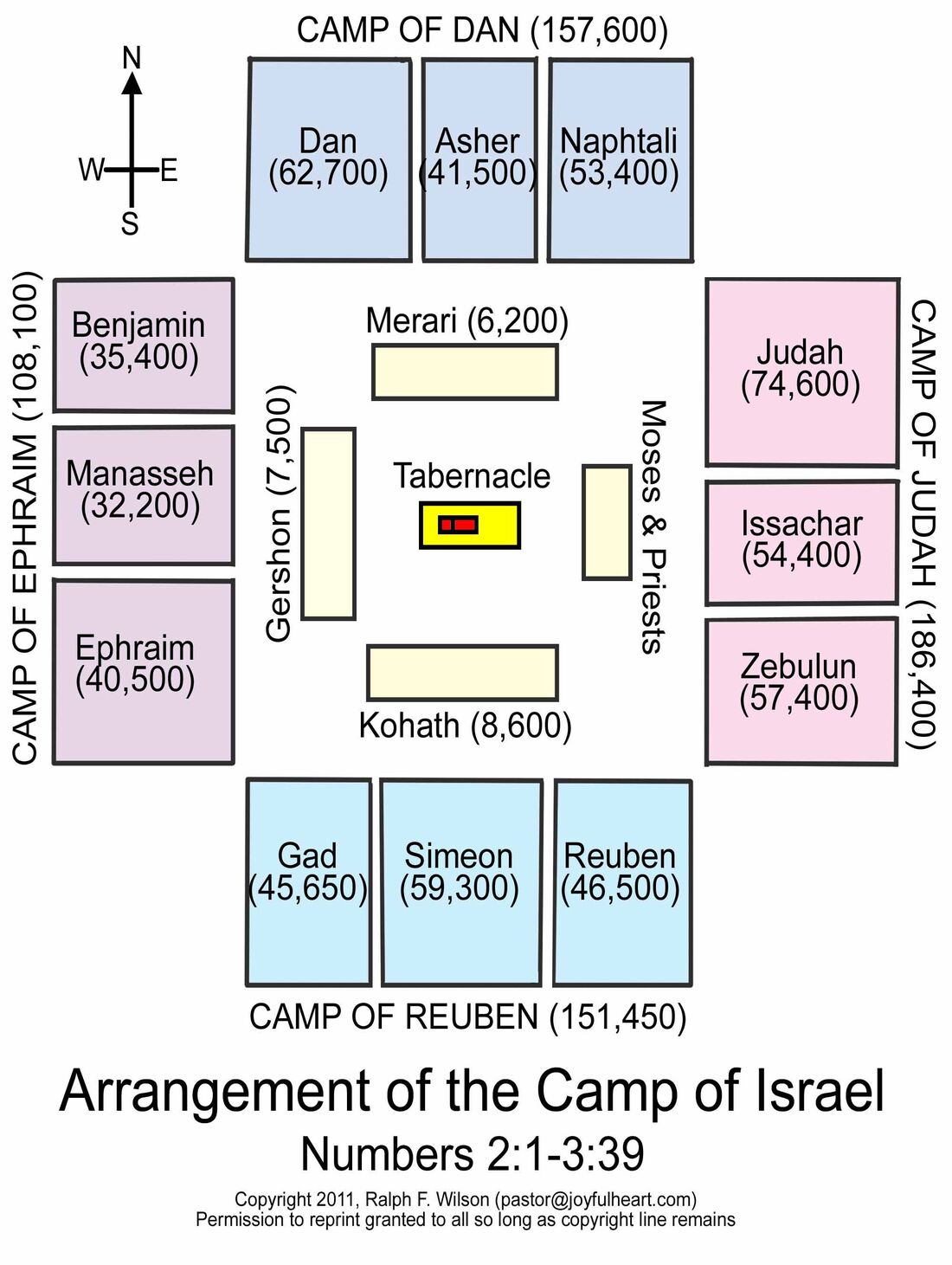
38 Those who were to camp before the tabernacle on the east, before the tent of meeting toward the sunrise, were Moses and Aaron and his sons, guarding the sanctuary itself, to protect the people of Israel. And any outsider who came near was to be put to death. 39 All those listed among the Levites, whom Moses and Aaron listed at the commandment of the Lord, by clans, all the males from a month old and upward, were 22,000. – Numbers 3:14-39 ESV

God ordered Moses to take a census of the tribe of Levi, instructing him to number “every male from a month old and upward” (Numbers 3:15 ESV). Levi had three sons and eight grandsons who represented eight different clans which contained 22,000 descendants of Levi. The two Gershonite clans were represented by 7,500 males one-month-old or older. The four Kohathite clans were comprised of 8,600 males one-month-old or older. The two Merarite clans numbered just 6,200 males one-month-old or older.

This numerical assessment of each of the Levite clans was for the purpose of assigning their God-ordained responsibilities. Each of the clans was to carry out tasks related to the maintenance of the Tabernacle. They were also assigned a particular region within the Israelite camp to occupy and oversee. The Gershonites were to camp on the west side of the Tabernacle, while the Kohathites occupied the south side and the Merarites were assigned to the north side. The east side of the Tabernacle, located nearest the entrance to the holy compound, “was reserved for the tents of Moses and of Aaron and his sons, who had the final responsibility for the sanctuary on behalf of the people of Israel” (Numbers 3:38 NLT).

With the Levites strategically placed around the perimeter of the Tabernacle, the Israelites would enjoy the constant presence and influence of God’s ministers and servants. These various Levitical clans were assigned a specific set of responsibilities related to the Tabernacle. The Gershonites “were responsible to care for the Tabernacle, including the sacred tent with its layers of coverings, the curtain at its entrance, the curtains of the courtyard that surrounded the Tabernacle and altar, the curtain at the courtyard entrance, the ropes, and all the equipment related to their use” (Numbers 3:25-26 NLT).

The Kohathites “were responsible for the care of the Ark, the table, the lampstand, the altars, the various articles used in the sanctuary, the inner curtain, and all the equipment related to their use” (Numbers 3:31 NLT).

Finally, the Merarites “were responsible for the care of the frames supporting the Tabernacle, the crossbars, the pillars, the bases, and all the equipment related to their use. They were also responsible for the posts of the courtyard and all their bases, pegs, and ropes” (Numbers 3:36-37 NLT).

The Tabernacle was the house of God and was to be treated with reverence and respect. The various elements that comprised this one-of-a-kind structure had been designed by God and were painstakingly crafted by men who had been supernaturally endowed with the skills necessary to carry out God’s plan. This was no ordinary tent, and it was to be treated with great care because every part of it had been set apart by God for His use. Even the disassembly and transport of its various elements required careful attention to God’s instructions. The holy objects associated with the Holy Place and the Holy of Holies could not be touched by human hands. That is why God designed them with poles to assist in their transport from one place to another.

God had given Moses very specific orders concerning the care and maintenance of the Tabernacle. Only the priestly class of the Levites were allowed to interact with the Tabernacle when it was in its completed state. The rest of the clans were restricted from entering the Tabernacle until it was time to relocate it for transport to another location. And, on those occasions, the Gershonites, Kohathites, and Merarites had to wait until the holy furniture was properly prepared and covered before they could fulfill their duties. God had given Aaron strict instructions regarding this matter.

“You, your sons, and your relatives from the tribe of Levi will be held responsible for any offenses related to the sanctuary. But you and your sons alone will be held responsible for violations connected with the priesthood.

“Bring your relatives of the tribe of Levi—your ancestral tribe—to assist you and your sons as you perform the sacred duties in front of the Tabernacle of the Covenant. But as the Levites go about all their assigned duties at the Tabernacle, they must be careful not to go near any of the sacred objects or the altar. If they do, both you and they will die. The Levites must join you in fulfilling their responsibilities for the care and maintenance of the Tabernacle, but no unauthorized person may assist you.” – Numbers 18:1-4 NLT

The tribe of Levi had been set apart by God and given the responsibility of caring for His sacred house. “Anyone other than a priest or Levite who went too near the sanctuary was to be put to death” (Numbers 3:38 NLT). By placing the various clans of Levi around the perimeter of the Tabernacle, God created a buffer zone that was designed to protect the people of Israel from possible death for violating His ban on coming too close to the holy place. While God had moved His presence from the top of Mount Sinai to the Holy of Holies in the Tabernacle, He was still to be treated with proper reverence and respect. He had come to dwell among them and was closer than ever before, but they were not to treat His divine presence with contempt or complacency. His nearness did not make Him any less holy. His immanence did not diminish His transcendence. Just because God had taken up residence among them and had placed His glory in the midst of their camp did not give them the right to treat Him with a disrespectful kind of over-familiarity.

The Levites were to act as mediators between God and the rest of the Israelites. The members of the priestly caste were to serve as God’s intercessors, offering sacrifices on behalf of the people and assisting them in maintaining a right standing with Him. The rest of the Levites were to care for the dwelling place of God, ensuring that it was properly maintained and its holiness was protected at all costs. If the house of God became defiled, it would no longer be an appropriate place for God’s presence, and without God’s presence, the Israelites would lose the one thing that set them apart from all the other nations on earth. Moses revealed his understanding of this vital relationship between God’s presence and the Israelites’ unique status among the nations when he said to God, “If you don’t personally go with us, don’t make us leave this place. How will anyone know that you look favorably on me—on me and on your people—if you don’t go with us? For your presence among us sets your people and me apart from all other people on the earth” (Exodus 33:15-16 NLT).

Moses knew that the only thing that set the Israelites apart was the presence of God, and God made it clear that His presence was directly tied to the sanctity of the Tabernacle. That’s why He placed so much emphasis on the Levites and their role as the caretakers of His earthly house. The Tabernacle was the key to their survival and success as they made their way to the Promised Land. God had left Mount Sinai and taken up residence among them in the portable sanctuary He had designed and they had built. As long as they maintained the holiness of God’s house, He would remain among them, and He assigned the Levites with the weighty responsibility of protecting the sanctity of His sanctuary.

English Standard Version (ESV) The Holy Bible, English Standard Version. ESV® Permanent Text Edition® (2016). Copyright © 2001

New Living Translation (NLT) Holy Bible, New Living Translation, copyright © 1996, 2004, 2015 by Tyndale House Foundation. Used by permission of Tyndale House Publishers Inc., Carol Stream, Illinois 60188. All rights reserved.

Servants and Substitutes

1 These are the generations of Aaron and Moses at the time when the Lord spoke with Moses on Mount Sinai. 2 These are the names of the sons of Aaron: Nadab the firstborn, and Abihu, Eleazar, and Ithamar. 3 These are the names of the sons of Aaron, the anointed priests, whom he ordained to serve as priests. 4 But Nadab and Abihu died before the Lord when they offered unauthorized fire before the Lord in the wilderness of Sinai, and they had no children. So Eleazar and Ithamar served as priests in the lifetime of Aaron their father.

5 And the Lord spoke to Moses, saying, 6 “Bring the tribe of Levi near, and set them before Aaron the priest, that they may minister to him. 7 They shall keep guard over him and over the whole congregation before the tent of meeting, as they minister at the tabernacle. 8 They shall guard all the furnishings of the tent of meeting, and keep guard over the people of Israel as they minister at the tabernacle. 9 And you shall give the Levites to Aaron and his sons; they are wholly given to him from among the people of Israel. 10 And you shall appoint Aaron and his sons, and they shall guard their priesthood. But if any outsider comes near, he shall be put to death.”

11 And the Lord spoke to Moses, saying, 12 “Behold, I have taken the Levites from among the people of Israel instead of every firstborn who opens the womb among the people of Israel. The Levites shall be mine, 13 for all the firstborn are mine. On the day that I struck down all the firstborn in the land of Egypt, I consecrated for my own all the firstborn in Israel, both of man and of beast. They shall be mine: I am the Lord.” – Numbers 3:1-13 ESV

Having provided Moses with the logistical arrangements of the various tribes around the Tabernacle, God now deals with the one tribe that He seems to have overlooked. The tribe of Levi was not mentioned in chapter two but they would play a significant role in the life of the Israelites and would be distributed equally among the other tribes within the encampment. This one tribe had been chosen by God to serve as caretakers of the Tabernacle but also as instructors of the law, teaching the people to obey the commands of God. They had received this special designation because of the role they played during the golden calf incident at Mount Sinai.

Not long after they arrived at the mountain, Moses left them in the valley while he ascended the mountain to confer with God. He left his brother Aaron in charge, but when Moses failed to return, the people began to pressure Aaron to take over the leadership responsibilities. The first thing they demanded their new leader to do was to make a new version of the God of Mount Sinai. They were unhappy with the thunder-and-lightning-fear-inducing God who occupied the summit of Mount Sinai.

To the Israelites at the foot of the mountain, the glory of the Lord appeared at the summit like a consuming fire. – Exodus 24:17 NLT

The powerful manifestation of God’s presence on Mount Sinai left the people petrified and fearful to draw near. So, when Moses failed to return after 40 days, they demanded that Aaron make them gods that were more like the gods they had worshiped in Egypt.

“Up, make us gods who shall go before us. As for this Moses, the man who brought us up out of the land of Egypt, we do not know what has become of him.” – Exodus 32:1 ESV

Aaron gave in to their demands by gathering their gold jewelry and fashioning it into the image of a calf. Then he announced, “Tomorrow shall be a feast to the Lord” (Exodus 32:5 ESV). The Hebrew word for “Lord” is Yahweh. Aaron was proclaiming that this calf he had made with his own hands was actually the God who had rescued them from Egypt. He had made a new and improved version of the God of Abraham, Isaac, and Jacob. But Aaron’s actions did not go unnoticed by God.

“Go down, for your people, whom you brought up out of the land of Egypt, have corrupted themselves. They have turned aside quickly out of the way that I commanded them. They have made for themselves a golden calf and have worshiped it and sacrificed to it and said, ‘These are your gods, O Israel, who brought you up out of the land of Egypt!’” – Exodus 32:7-8 ESV

When Moses descended the mountain with the Ten Commandments in his hands, he witnessed with his own eyes the extent of the people’s wickedness.

Moses saw that Aaron had let the people get completely out of control, much to the amusement of their enemies. So he stood at the entrance to the camp and shouted, “All of you who are on the Lord’s side, come here and join me.” And all the Levites gathered around him. – Exodus 32:25-26 NLT

Moses knew he had to deal with the rebellion in the camp so he called for volunteers to assist him in meting out judgment. His own tribe, the Levites, were the only ones who stepped up to the challenge. Surrounded by his fellow tribesmen, Moses gave them their grim marching orders.

“Thus says the Lord God of Israel, ‘Put your sword on your side each of you, and go to and fro from gate to gate throughout the camp, and each of you kill his brother and his companion and his neighbor.’” – Exodus 32:27 ESV

When the Levites had finished their work, more than 3,000 Israelites lay lifeless on the valley floor. Then Moses made the following announcement to his fellow Levites.

“Today you have been ordained for the service of the Lord, each one at the cost of his son and of his brother, so that he might bestow a blessing upon you this day.” – Exodus 32:29 ESV

It’s interesting to note that God had already planned to have the Levites serve as priests. He had given Moses the following instructions during his 40-day absence.

“Then bring near to you Aaron your brother, and his sons with him, from among the people of Israel, to serve me as priests—Aaron and Aaron’s sons, Nadab and Abihu, Eleazar and Ithamar.” – Exodus 28:1 ESV

Little did the Levites know that their actions during the Golden Calf incident simply confirmed the role to which God had already assigned them. As God’s chosen priesthood, the Levites would also serve as the designated substitutes for the firstborn.

Before the Israelites left Egypt, God ordained the final plague that would ensure their release. He warned the Israelites that on one fateful night, all the firstborn of both animals and men would die unless His instructions were closely followed. He ordered each Israelite to sacrifice a lamb and sprinkle its blood on the doorpost and lintel of their home. This act of faith would ensure that the firstborn living within the walls of that home would be spared. And, as a result of God’s gracious acts of salvation, He claimed all the firstborn males of the Israelites as His own.

“Dedicate to me all the firstborn sons of Israel and every firstborn male animal. They are mine.” – Exodus 13:2 NLT

God had spared the firstborn of the Israelites and, in return, the people were to set apart those individuals to His service. They belonged to God. But things were about to change. God had another plan. He appointed the tribe of Levi to serve as ministers and as priests within the Tabernacle. They were the smallest of the tribes and seemed to hold special favor with God because of their role in the aftermath of the Golden Calf debacle.

The Levites became God’s servants and they served as the peoples’ substitute. God still claimed the firstborn as His own. They belonged to Him because He had spared their lives the night the death angel had passed over their homes in the land of Egypt. When Moses numbered all the firstborn males of the tribes of Israel they totaled 22,273. These were probably the number of firstborn males who had been born since they had left Egypt. The total number of Levite males from one month and older were 22,000. God was going to allow the Levites to become substitutes for the firstborn of all the Israelites.

“The Levites will be reserved for me as substitutes for the firstborn sons of Israel; I am the LORD. And the Levites’ livestock are mine as substitutes for the firstborn livestock of the whole nation of Israel.” – Number 3:41 NLT

God could have required all the firstborn males of Israel to maintain and move His Tabernacle. He could have demanded that they serve as His ministers and priests, but instead, He set aside the tribe of Levi for this important duty. And in doing so, He allowed the Levites to serve as surrogates and stand-ins for all the firstborn of Israel.

The Levites were not to be included in the census of fighting men but were to care for the Tabernacle. They were responsible for taking it down when they broke camp and for erecting it when they set up camp again. In doing so, they would be protecting the sons of Israel from death. No one but member of the tribe of Levi was allowed to come near the Tabernacle or touch any of its furnishings (Numbers 1:47-54).

The Levites had been given a heavy responsibility. They were to care for all the things related to the Tabernacle, maintaining them and moving them whenever the Israelites broke camp and relocated. It was a huge task and, because the Tabernacle was God’s holy dwelling place, it was to be taken seriously. God seemed to know that if this responsibility had been left up to the people, they would have dropped the ball. The Tabernacle would have fallen into disrepair as they became distracted with their own cares and concerns. So He appointed this task to the Levites. They served as substitutes. They satisfied God’s requirement that the firstborn were to belong to Him. They served in the place of those who were rightfully obligated to serve God. The firstborn had been graciously replaced by someone else.

This is a picture of Christ’s substitutionary death for each of us. He became our sin substitute. He paid the debt we owed. He took our place. He served in our stead. He satisfied the demands of a holy God and did what none of us were able to do. He made the ultimate sacrifice, which is exactly what the Levites did. They became a sacrifice for the people of Israel. They served and satisfied the demands of God by maintaining and caring for His Tabernacle. They kept the people of Israel from experiencing death by keeping the Tabernacle holy and set apart for God. Their role was vital to the spiritual life of the people of God. They gave so that others might live. Just as Jesus has done for us.

English Standard Version (ESV) The Holy Bible, English Standard Version. ESV® Permanent Text Edition® (2016). Copyright © 2001

New Living Translation (NLT) Holy Bible, New Living Translation, copyright © 1996, 2004, 2015 by Tyndale House Foundation. Used by permission of Tyndale House Publishers Inc., Carol Stream, Illinois 60188. All rights reserved.

Our Great High Priest

1 For every high priest chosen from among men is appointed to act on behalf of men in relation to God, to offer gifts and sacrifices for sins. 2 He can deal gently with the ignorant and wayward, since he himself is beset with weakness. 3 Because of this he is obligated to offer sacrifice for his own sins just as he does for those of the people. 4 And no one takes this honor for himself, but only when called by God, just as Aaron was.

5 So also Christ did not exalt himself to be made a high priest, but was appointed by him who said to him,

“You are my Son,
    today I have begotten you”;

6 as he says also in another place,

“You are a priest forever,
    after the order of Melchizedek.”

7 In the days of his flesh, Jesus offered up prayers and supplications, with loud cries and tears, to him who was able to save him from death, and he was heard because of his reverence. 8 Although he was a son, he learned obedience through what he suffered. 9 And being made perfect, he became the source of eternal salvation to all who obey him, 10 being designated by God a high priest after the order of Melchizedek. – Hebrews 5:1-10 ESV

In the early days of Israel, the high priest was an appointed position. Aaron was the original high priest, designated so by God Himself. His command to Moses to set aside  Aaron and his sons as priests is recorded in the book of Exodus.

“Then bring near to you Aaron your brother, and his sons with him, from among the people of Israel, to serve me as priests—Aaron and Aaron’s sons, Nadab and Abihu, Eleazar and Ithamar.” – Exodus 28:1 ESV

God would later qualify the vital nature of their calling.

“I will consecrate the tent of meeting and the altar. Aaron also and his sons I will consecrate to serve me as priests. I will dwell among the people of Israel and will be their God. And they shall know that I am the Lord their God, who brought them out of the land of Egypt that I might dwell among them. I am the Lord their God.” – Exodus 29:44-46 ESV

Aaron and his sons were set apart by God to serve as priests, offering sacrifices on behalf of the people. No one else could serve in this capacity. King Saul attempted to do so and lost his kingship because of it (1 Samuel 13:5-14). During the days of Israel’s wilderness wandering, Korah, a Levite, incited a rebellion against Moses and Aaron, demanding that he and his brothers be made priests. But Moses asked him, “would you seek the priesthood also? Therefore it is against the Lord that you and all your company have gathered. What is Aaron that you grumble against him?” (Numbers 16:10-11 ESV). As a result of their attempt to self-appoint themselves as priests, Korah, Dothan, Abiram, and all their families were literally swallowed alive by the earth.

The priesthood was a serious matter to God. The men whom God appointed for this role were responsible for the care and maintenance of the Tabernacle but also for administering the sacrificial system of Israel. But God also gave Aaron, the high priest, another directive that made their role pedagogic in nature. They were responsible for teaching the people the ways of God.

And the Lord spoke to Aaron, saying, “Drink no wine or strong drink, you or your sons with you, when you go into the tent of meeting, lest you die. It shall be a statute forever throughout your generations. You are to distinguish between the holy and the common, and between the unclean and the clean, and you are to teach the people of Israel all the statutes that the Lord has spoken to them by Moses.” – Leviticus 10:8-11 ESV

And so when we read of Jesus being appointed high priest “to act on behalf of men in relation to God” it should get our attention. Jesus was not a descendant of Aaron. He was a descendant of David, from the tribe of Judah. Technically, He was not qualified to be a priest, let alone the high priest. And the writer of Hebrews makes it perfectly clear that Jesus “did not exalt himself to be made high priest, but was appointed by him [God]” (Hebrews 5:5 ESV). So unlike Korah and his companions, Jesus was not guilty of trying to anoint Himself as high priest. He, like Aaron, was chosen by God to serve in this capacity.

Even in His humanity, Jesus served in His role as a priest, offering up “prayers and supplications, with loud cries and tears, to him who was able to save him from death” (Hebrews 5:7 ESV). Jesus prayed regularly during His time on earth, and He taught His disciples the importance of prayer in their own lives. And just hours before His death, He prayed what has become known as His High Priestly Prayer from the Garden of Olives. In that prayer, Jesus interceded on behalf of His disciples, declaring His love for them and expressing His desire that His Heavenly Father protect and preserve them so that they might one day enjoy the gift of eternal life.

“I have given them the glory you gave me, so they may be one as we are one. I am in them and you are in me. May they experience such perfect unity that the world will know that you sent me and that you love them as much as you love me. Father, I want these whom you have given me to be with me where I am. Then they can see all the glory you gave me because you loved me even before the world began!” – John 17:22-24 NLT

Jesus was of a different priesthood than that of Aaron. He was “designated by God a high priest after the order of Melchizedek” (Hebrews 5:10 ESV). Melchizedek was an obscure figure mentioned in Genesis 14. In this story, Abraham has just rescued his nephew Lot and his family, who had been taken captive when the cities of Sodom and Gomorrah had been overrun by an alliance of kings. After having defeated the kings and rescued Lot, his family, and all their possessions, Abraham was met by Melchizedek, king of Salem. The text tells us that Melchizedek was also a priest of God Most High. This priest-king blessed Abraham and, in return, Abraham gave Melchizedek a tenth of all the plunder he had taken. That is the extent of the information we have about Melchizedek. But the author of Hebrews tells us that Jesus was appointed by God after the order of Melchizedek. In other words, He was of a different priesthood than that of Aaron and his sons.

In chapter seven of this letter, we are given more insight into who this man was and why Jesus was appointed high priest after his order and not that of Aaron:

He [Melchizedek] is first, by translation of his name, king of righteousness, and then he is also king of Salem, that is, king of peace. He is without father or mother or genealogy, having neither beginning of days nor end of life, but resembling the Son of God he continues a priest forever. – Hebrews 7:2-3 ESV

This does not mean that Melchizedek was a divine being who was never born or died, but that there is no known record of his ancestry. He appears on the scene in the book of Genesis, then disappears. He serves as a foreshadowing of the future priest-king whom God would reveal. Melchizedek was the king of righteousness and the king of peace. Interestingly enough, his royal city, Salem, is the city that David would later make his capital and rename Jerusalem. And one day, Jesus will return and reign from the throne of David in Jerusalem when He establishes His millennial kingdom.

Unlike Aaron and his sons who served only as priests, Jesus was appointed both king and priest by God, and He received both titles when he ascended back to earth after His death and resurrection.

I also pray that you will understand the incredible greatness of God’s power for us who believe him. This is the same mighty power that raised Christ from the dead and seated him in the place of honor at God’s right hand in the heavenly realms. Now he is far above any ruler or authority or power or leader or anything else—not only in this world but also in the world to come. God has put all things under the authority of Christ and has made him head over all things for the benefit of the church. – Ephesians 1:19-22 NLT

For there is one God, and there is one mediator between God and men, the man Christ Jesus, who gave himself as a ransom for all, which is the testimony given at the proper time. – 1 Timothy 2:5-6 ESV

Jesus now sits by His Father’s side in heaven, where He reigns over all that He has made. But at the present time, not all humanity recognizes Him as King and Lord. So, Jesus maintains His priestly role, offering all mankind the opportunity to be reconciled with God through faith in His substitutionary death on the cross. Jesus is both King and High Priest, and He received these two divine appointments because He was obedient, faithfully completing the assignment given to Him by God the Father. Jesus did not simply offer sacrifices on behalf of the people as Aaron and his sons had done. Jesus offered Himself. He made the ultimate sacrifice of His own life. And even though He was the divine Son of God, in His human state Jesus, “learned obedience through what he suffered” (Hebrews 5:8 ESV). And while His obedience ultimately ended in death, it also resulted in His “perfection” or glorification. He was raised from the dead and restored to His rightful place at the side of God the Father. And “he became the source of eternal salvation to all who obey him” (Hebrews 5:9 ESV).

Jesus wasn’t just a different high priest than that of Aaron. He was a better high priest who offered a better sacrifice. He offered a permanent, once-for-all sacrifice that never has to be repeated. He was the sinless high priest who offered Himself as the unblemished Lamb of God that paid for the sins of humanity. And as a result, those who place their faith in His sacrifice can share in His righteousness and have peace with God. We can be justified or made right with God. That is why He is the great high priest.

English Standard Version (ESV) The Holy Bible, English Standard Version. ESV® Permanent Text Edition® (2016). Copyright © 2001

New Living Translation (NLT) Holy Bible, New Living Translation, copyright © 1996, 2004, 2015 by Tyndale House Foundation. Used by permission of Tyndale House Publishers Inc., Carol Stream, Illinois 60188. All rights reserved.

Food For Thought

1 And the Lord spoke to Moses, saying, 2 “Speak to Aaron and his sons so that they abstain from the holy things of the people of Israel, which they dedicate to me, so that they do not profane my holy name: I am the Lord. 3 Say to them, ‘If any one of all your offspring throughout your generations approaches the holy things that the people of Israel dedicate to the Lord, while he has an uncleanness, that person shall be cut off from my presence: I am the Lord. 4 None of the offspring of Aaron who has a leprous disease or a discharge may eat of the holy things until he is clean. Whoever touches anything that is unclean through contact with the dead or a man who has had an emission of semen, 5 and whoever touches a swarming thing by which he may be made unclean or a person from whom he may take uncleanness, whatever his uncleanness may be— 6 the person who touches such a thing shall be unclean until the evening and shall not eat of the holy things unless he has bathed his body in water. 7 When the sun goes down he shall be clean, and afterward he may eat of the holy things, because they are his food. 8 He shall not eat what dies of itself or is torn by beasts, and so make himself unclean by it: I am the Lord.’ 9 They shall therefore keep my charge, lest they bear sin for it and die thereby when they profane it: I am the Lord who sanctifies them.

10 “A lay person shall not eat of a holy thing; no foreign guest of the priest or hired worker shall eat of a holy thing, 11 but if a priest buys a slave as his property for money, the slave may eat of it, and anyone born in his house may eat of his food. 12 If a priest’s daughter marries a layman, she shall not eat of the contribution of the holy things. 13 But if a priest’s daughter is widowed or divorced and has no child and returns to her father’s house, as in her youth, she may eat of her father’s food; yet no lay person shall eat of it. 14 And if anyone eats of a holy thing unintentionally, he shall add the fifth of its value to it and give the holy thing to the priest. 15 They shall not profane the holy things of the people of Israel, which they contribute to the Lord, 16 and so cause them to bear iniquity and guilt, by eating their holy things: for I am the Lord who sanctifies them.” – Leviticus 22:1-16 ESV

In this section, God addresses the priests’ relationship with “the holy things of the people of Israel” (Leviticus 22:2 ESV). This is a reference to those offerings given by the people of Israel, of which a portion was set apart as payment to the priests for their service in the Tabernacle. In point of fact, since every sacrifice was dedicated to God, the portion which was given to the priests was actually a gracious gift from God. Yahweh was allowing Aaron and his sons to join Him in a meal of fellowship.

There were a number of different sacrifices or offerings that, once given to God, included a payment to the priests for their service. This included the grain offering.

“These are the instructions regarding the grain offering. Aaron’s sons must present this offering to the Lord in front of the altar. The priest on duty will take from the grain offering a handful of the choice flour moistened with olive oil, together with all the frankincense. He will burn this representative portion on the altar as a pleasing aroma to the Lord. Aaron and his sons may eat the rest of the flour, but it must be baked without yeast and eaten in a sacred place within the courtyard of the Tabernacle.” – Leviticus 6:14-16 NLT

But the priests also received a portion of every sin offering.

Then the Lord said to Moses, “Give Aaron and his sons the following instructions regarding the sin offering. The animal given as an offering for sin is a most holy offering, and it must be slaughtered in the Lord’s presence at the place where the burnt offerings are slaughtered. The priest who offers the sacrifice as a sin offering must eat his portion in a sacred place within the courtyard of the Tabernacle.” – Leviticus 6:24-26 NLT

God also allotted a portion of every guilt offering as a gift to the priest who participated in the sacrifice.

“This is the law of the guilt offering. It is most holy. In the place where they kill the burnt offering they shall kill the guilt offering, and its blood shall be thrown against the sides of the altar. And all its fat shall be offered, the fat tail, the fat that covers the entrails, the two kidneys with the fat that is on them at the loins, and the long lobe of the liver that he shall remove with the kidneys. The priest shall burn them on the altar as a food offering to the Lord; it is a guilt offering. Every male among the priests may eat of it. It shall be eaten in a holy place. It is most holy.” – Leviticus 7:1-6 NLT

Finally, every peace offering presented to Yahweh included a sizeable gift of food for the priest to eat.

“Speak to the people of Israel, saying, Whoever offers the sacrifice of his peace offerings to the Lord shall bring his offering to the Lord from the sacrifice of his peace offerings. His own hands shall bring the Lord‘s food offerings. He shall bring the fat with the breast, that the breast may be waved as a wave offering before the Lord. The priest shall burn the fat on the altar, but the breast shall be for Aaron and his sons. And the right thigh you shall give to the priest as a contribution from the sacrifice of your peace offerings.” – Leviticus 7:29-32 NLT

But since these gifts had been given to God and He had then shared a portion of them with His priests, they were to be considered holy and treated as such. The consumption of these food gifts came with conditions. They were not to be treated flippantly or irreverently. All the purity laws detailed in Leviticus 11-15 come into play here. The priests were to avoid anything that might render them ceremonially unclean. To partake of these holy food offerings in a state of impurity would be to defile that which belonged to God, and that would be a serious breach of priestly protocol.

These men had been set apart by God to serve in His house, therefore, their holiness was mandatory. That’s why God instituted a rigid purification process for every priest before he could serve as a mediator for the people. Aaron and his sons had to be cleansed and their sins atoned for before they could enter God’s house and offer sacrifices on behalf of the people. And once they had completed their sacrifices for the day, they were free to enjoy the gracious food offerings God had provided for them. But even then, they were not to let down their guard.

The priests were free to share these meals with their family members, but only under the strictest conditions. The purity of the priest’s family came into play as well. Since no priest could eat in an unholy state, neither could any member of his family. This ruled out anyone who was unclean for any reason whatsoever. All the purity laws found in chapters 11-15 came into play here.

“These included skin diseases (chapters 13, 14), bodily emissions (chapter 15), and contact with unclean animals and the dead (chapter 11).” – Kenneth A. Matthew, Leviticus: Holy God, Holy People

No priest or any member of his family could enter into the fellowship meal with Yahweh in an unclean state. The presence of an unclean person at one of these meals would have run the risk of defiling every other participant as well as the food that had been dedicated to God. This was unacceptable and to be avoided at all costs.

There is a sense in which the priest could view the eating of this meal as a post-work celebration. His job was done and now it was time to enjoy the fruits of his labor. But God wanted Aaron and his sons to understand that their holy status did not change when they took off their priestly roles or exited the Tabernacle. And, when it came to these meals, they were to be eaten within the Tabernacle compound – in the very presence of God Almighty. So, the priests were not to let their guard down. They were not free to invite anyone to join them in these meals. No layperson outside of the priest’s immediate family was allowed to participate.

“No one outside a priest’s family may eat the sacred offerings. Even guests and hired workers in a priest’s home are not allowed to eat them.” – Leviticus 22:10 NLT

But even the priest’s own children could be banned from the table for a variety of reasons. If they were unclean, they were prohibited from taking part. And if one of the priest’s daughters married outside the tribe of Levi, she forfeited her right to eat the Lord’s offering.

“If a priest’s daughter marries someone outside the priestly family, she may no longer eat the sacred offerings.” – Leviticus 22:12 NLT

God was quite specific and unwavering in His conditions concerning this matter. He even reiterated His ban by stating, “No one outside a priest’s family may eat the sacred offerings” (Leviticus 22:13 NLT). There were to be no workarounds, exemptions, or exceptions. While technically, these food offerings belonged to the priest, they had been dedicated to God. The right for the priest to consume these holy items had been given to him by God. Therefore, these gifts were not to be treated as common or ordinary. God gladly shared what rightfully belonged to Him, but He expected His gift to be treated with dignity, honor, and reverence. That’s why He warned the priests to protect the integrity of His name by preserving the holiness of the food offerings.

“The priests must not let the Israelites defile the sacred offerings brought to the Lord by allowing unauthorized people to eat them.” – Leviticus 22:15-16 NLT

These food offerings had no special properties and conveyed no supernatural attributes to those who ate them. But they did reflect the character of God. Since they had been dedicated to Him, they were an extension of His very nature. Just as the items in the Tabernacle were to be viewed as holy and treated with reverence, so too were the food gifts that God shared with His priests. And God had Moses warn Aaron and his sons to tread carefully and reverently when feasting on the goodness and graciousness of God.

“Tell Aaron and his sons to be very careful with the sacred gifts that the Israelites set apart for me, so they do not bring shame on my holy name. I am the Lord.” – Leviticus 22:2 NLT

The food itself was never the point. It was always about the holiness of God. Anything associated with the name of God was intended to reflect the holy character of God. And, as such, it was to be treated with care and handled with appropriate respect and reverence.

The apostle Paul encouraged the believers in Corinth to live their lives with the goal to please God at all costs.

So, whether you eat or drink, or whatever you do, do all to the glory of God. – 1 Corinthians 10:31 ESV

That same idea was to motivate the lives of God’s priests. There was no point at which they could take off their robes and let down their guard. Just as the food of the sacrifice belonged to God and deserved to be treated with reverence, so too did the priests belong to God and they were to live every moment of their lives to bring Him glory and honor His name.

English Standard Version (ESV) The Holy Bible, English Standard Version. ESV® Permanent Text Edition® (2016). Copyright © 2001

New Living Translation (NLT) Holy Bible, New Living Translation, copyright © 1996, 2004, 2015 by Tyndale House Foundation. Used by permission of Tyndale House Publishers Inc., Carol Stream, Illinois 60188. All rights reserved.