Personal Holiness at All Costs and at All Times

1 And the Lord said to Moses, “Speak to the priests, the sons of Aaron, and say to them, No one shall make himself unclean for the dead among his people, 2 except for his closest relatives, his mother, his father, his son, his daughter, his brother, 3 or his virgin sister (who is near to him because she has had no husband; for her he may make himself unclean). 4 He shall not make himself unclean as a husband among his people and so profane himself. 5 They shall not make bald patches on their heads, nor shave off the edges of their beards, nor make any cuts on their body. 6 They shall be holy to their God and not profane the name of their God. For they offer the Lord‘s food offerings, the bread of their God; therefore they shall be holy. 7 They shall not marry a prostitute or a woman who has been defiled, neither shall they marry a woman divorced from her husband, for the priest is holy to his God. 8 You shall sanctify him, for he offers the bread of your God. He shall be holy to you, for I, the Lord, who sanctify you, am holy. 9 And the daughter of any priest, if she profanes herself by whoring, profanes her father; she shall be burned with fire.

10 “The priest who is chief among his brothers, on whose head the anointing oil is poured and who has been consecrated to wear the garments, shall not let the hair of his head hang loose nor tear his clothes. 11 He shall not go in to any dead bodies nor make himself unclean, even for his father or for his mother. 12 He shall not go out of the sanctuary, lest he profane the sanctuary of his God, for the consecration of the anointing oil of his God is on him: I am the Lord. 13 And he shall take a wife in her virginity. 14 A widow, or a divorced woman, or a woman who has been defiled, or a prostitute, these he shall not marry. But he shall take as his wife a virgin of his own people, 15 that he may not profane his offspring among his people, for I am the Lord who sanctifies him.” – Leviticus 21:1-15 ESV

A life of holiness was a non-negotiable requirement for all of God’s people but it was especially important for those men who served as priests and intermediaries between Yahweh and His chosen people. So beginning in chapter 21 and running all the way through Leviticus 22:16, God turns His attention to the priesthood. Aaron and his sons had been given the responsibility of ministering within God’s house, the Tabernacle, where He had promised that His holy presence would reside. Their vital role within the sacrificial system established by God required them to live up to a more stringent set of standards. God had given them the responsibility of serving as spiritual instructors for His people.

“You must distinguish between what is sacred and what is common, between what is ceremonially unclean and what is clean. And you must teach the Israelites all the decrees that the Lord has given them through Moses.” – Leviticus 10:10-11 NLT

And they were to teach by example as well as by word. And it’s interesting to note that when Jesus was describing the religious teachers of His day, He basically recommended that His disciples do as they say, but not as they do.

“The teachers of religious law and the Pharisees are the official interpreters of the law of Moses. So practice and obey whatever they tell you, but don’t follow their example. For they don’t practice what they teach.” – Matthew 23:2-3 NLT

There was no room for hypocrisy and duplicity in the life of God’s priestly leaders. Their lives belonged to God and they served on His behalf and at His behest. Their role as priests was not a job, but a calling. Yawheh had set apart Aaron, his sons, and the rest of the men of the tribe of Levi, and given them the mission of serving as His ministers and as emissaries to the rest of the nation of Israel.

God wanted His priests to understand and embrace the importance of their calling, so He provided them with a diverse range of regulations and rulings that concerned matters that might disqualify them for service. Anything that could result in their ceremonial defilement was to be avoided at all costs. These men were to take special precautions to maintain their purity and preserve their holiness. Their intimate connection with the Tabernacle required that they pay special attention to every area of their daily lives. Most of these commands have to do with their “off-duty” hours when they were not serving in their official capacity as priests. But even when they weren’t “on the clock,” they were to remain vigilant about their spiritual purity.

Death was a daily reality among the Israelites. The elderly passed away from natural causes. Others died from injuries or accidents. Disease and illness took their toll on some. But in all of this, the priests were never to allow themselves to become defiled by coming into contact with a dead body. Should this happen, they would become ceremonially unclean and unfit for service. But God gave a special exemption in terms of family members.

“The only exceptions are his closest relatives—his mother or father, son or daughter, brother, or his virgin sister who depends on him because she has no husband.” – Leviticus 21:2-3 NLT

In all other cases, the priests were to avoid any and all contact with the dead. And not only that, the priests were prohibited from imitating the mourning rituals of the pagan religions of the Canaanites. God strictly forbade His priests from shaving their heads, trimming their beards, or cutting their bodies. God had already addressed these issues back in chapter 19.

“Do not trim off the hair on your temples or trim your beards. Do not cut your bodies for the dead, and do not mark your skin with tattoos. I am the Lord.” – Leviticus 19:27-28 NLT

None of the Israelites were to practice the occult-like rituals of the Canaanites. But these kinds of practices were especially off-limits for the priests of Yahweh, and rightfully so.

“Not only did such rituals show the priest mourning the dad, but they involved mutilation of the body and possibly suggested pagan veneration of the dead.” – Allen P. Ross, Holiness to the Lord: A Guide to the Exposition of the Book of Leviticus

God demanded that Moses and the people of Israel treat the priests as holy “because they offer up food to your God. You must consider them holy because I, the Lord, am holy, and I make you holy” (Leviticus 21:8 NLT). In a sense, it behooved the people of Israel to help protect the purity of the priesthood because of their vital role in the sacrificial system. Unholy priests would be of no help when it came to seeking atonement from God. So, it was incumbent upon all the people to assist the priests in their pursuit of holiness.

That’s why God addressed the subject of priests and marriage. They were strictly prohibited from marrying women who were prostitutes or divorced. To do so would result in their defilement and disqualification for priestly service. And God considered prostitution so dangerous to priestly purity that He actually addressed what to do if a daughter of a priest was found to be a prostitute.

“…the daughter of any priest, if she profanes herself by whoring, profanes her father; she shall be burned with fire.” – Leviticus 21:9 ESV

This was serious business to God. The daughter’s willful actions negatively impacted her father’s holiness thereby invalidating him from priestly service to the Lord, and the only way to remedy the problem was to remove the impurity – permanently. Most likely, the woman was to be executed, then her body was to be burned. This would serve to purify the father from defilement and restore his ability to perform his role as a priest.

Verses 10-15 address the high priest in particular. As the highest-ranking member of the priesthood, Aaron was placed under even stricter requirements. When it came to mourning the death of a loved one, he was not allowed to “leave his hair uncombed or tear his clothing” (Leviticus 21:10 NLT). As the spiritual leader of God’s people, he was not permitted the luxury of mourning like everyone else. He represented God at all times. So, God denied him the right to mourn like everyone else. He was not allowed to go anywhere near a dead body, even if it belonged to his own father or mother. And God gave the reason for this harsh-sounding restriction.

“He must not defile the sanctuary of his God by leaving it to attend to a dead person, for he has been made holy by the anointing oil of his God. I am the Lord.” – Leviticus 21:12 NLT

Even the death of a parent was not to distract the high priest from his calling as the mediator between God and His people. God had set Him apart for His service alone. Others would have to mourn the dead because the high priest had been set apart to worship the living God. And this principle is echoed by the words of Jesus found in the gospel of Matthew. One day, Jesus was approached by a young man who expressed the desire to be His disciple but he gave the excuse, “Lord, let me first go and bury my father” (Matthew 8:21 NLT). But Jesus gave what sounded like a harsh and compassionless response. 

And Jesus said to him, “Follow me, and leave the dead to bury their own dead.” – Matthew 8:22 NLT

Some commentators believe the issue was that the young man was postponing his commitment and using the future death of his father as an excuse. They speculate that the death of the young man’s father was not imminent but only inevitable. There was no funeral about to take place. The young man was simply hoping to delay his commitment to a later date. But it makes more sense to see this passage through the lens of Leviticus 21. Jesus was calling on this man to make serving God his highest priority, placing greater value on following the Lord of life than in mourning the dead.

Even when it came to marriage, the high priest had to answer to his higher calling. God prohibited Aaron and his successors from marrying a woman who was a widow, divorced, or a known prostitute. And whoever the high priest ended up marrying was required to be “a virgin from his own clan” (Leviticus 21:14 NLT). The wife of the high priest was expected to help maintain his holiness and provide him with future offspring who might serve in his place upon his death. Purity was essential. Holiness was critical. Because the high priest and his associates represented God at all times. Of all people within the camp of Israel, they were expected to pursue and maintain personal holiness at all costs and at all times.

English Standard Version (ESV) The Holy Bible, English Standard Version. ESV® Permanent Text Edition® (2016). Copyright © 2001

New Living Translation (NLT) Holy Bible, New Living Translation, copyright © 1996, 2004, 2015 by Tyndale House Foundation. Used by permission of Tyndale House Publishers Inc., Carol Stream, Illinois 60188. All rights reserved.
Set Apart for God’s Service

1 The Lord spoke to Moses, saying, 2 “Take Aaron and his sons with him, and the garments and the anointing oil and the bull of the sin offering and the two rams and the basket of unleavened bread. 3 And assemble all the congregation at the entrance of the tent of meeting.” 4 And Moses did as the Lord commanded him, and the congregation was assembled at the entrance of the tent of meeting.

5 And Moses said to the congregation, “This is the thing that the Lord has commanded to be done.” 6 And Moses brought Aaron and his sons and washed them with water. 7 And he put the coat on him and tied the sash around his waist and clothed him with the robe and put the ephod on him and tied the skillfully woven band of the ephod around him, binding it to him with the band. 8 And he placed the breastpiece on him, and in the breastpiece he put the Urim and the Thummim. 9 And he set the turban on his head, and on the turban, in front, he set the golden plate, the holy crown, as the Lord commanded Moses.

10 Then Moses took the anointing oil and anointed the tabernacle and all that was in it, and consecrated them. 11 And he sprinkled some of it on the altar seven times, and anointed the altar and all its utensils and the basin and its stand, to consecrate them. 12 And he poured some of the anointing oil on Aaron’s head and anointed him to consecrate him. 13 And Moses brought Aaron’s sons and clothed them with coats and tied sashes around their waists and bound caps on them, as the Lord commanded Moses. – Leviticus 8:1-13 ESV

At this juncture in the narrative, an important change is about to take place within the Israelite community. Up to this point, Moses has functioned as their de facto priest, leading and serving them as God’s emissary and acting as the divinely appointed mediator between Yahweh and His chosen people. Each time Moses ascended Mount Sinai to meet with the Lord, he did so as the representative of his people. On all the occasions when he had entered Pharaoh’s palace to demand the release of the people of Israel, he had done so as the designated spokesman for God and the divinely appointed leader of the Israelite community.

Along the way, Moses repeatedly interceded before God on behalf of his people. At Mount Sinai, he pleaded with God to forgive and spare the people from His wrath for their worship of the golden calf (Exodus 32:11-14). It was to Moses that God gave the Ten Commandments and His plans for the sacrificial system. Moses was the one to whom God laid out His designs for the construction of the Tabernacle as His earthly dwelling place. But God also gave Moses instructions regarding the priesthood with his brother, Aaron, designated to serve as the first high priest.

More than four decades later, when Moses was nearing death and preparing to turn over the leadership of the nation to Joshua, he offered up this blessing concerning Aaron and the rest of the priestly tribe of Levi.

“The Levites obeyed your word
    and guarded your covenant.
They were more loyal to you
    than to their own parents.
They ignored their relatives
    and did not acknowledge their own children.
They teach your regulations to Jacob;
    they give your instructions to Israel.
They present incense before you
    and offer whole burnt offerings on the altar.” – Deuteronomy 33:9-10 NLT

God had designated the Levites as the sole tribe to serve as priests and caretakers of the Tabernacle. And in chapter 8 of Leviticus, Moses is preparing to officially turn over the priestly duties that he had performed for so long. From this moment forward, Aaron and his sons would serve as the spiritual leaders of Israel, with responsibility for teaching God’s law, maintaining the purity of the Tabernacle, and offering sacrifices before God to atone for the sins of themselves and the people.

In the book of Malachi, God refers to the covenant He made with the tribe of Levi.

“The purpose of my covenant with the Levites was to bring life and peace, and that is what I gave them. This required reverence from them, and they greatly revered me and stood in awe of my name. They passed on to the people the truth of the instructions they received from me. They did not lie or cheat; they walked with me, living good and righteous lives, and they turned many from lives of sin.

“The words of a priest’s lips should preserve knowledge of God, and people should go to him for instruction, for the priest is the messenger of the Lord of Heaven’s Armies.” – Malachi 2:5-7 NLT

This divine statement of the Levite’s covenantal relationship with God was included to accentuate their fall from grace. At the time Malachi penned these words from God, the Levitical priesthood was in disarray and morally compromised. The opening verses of Malachi chapter 2 paint a rather bleak picture of their degraded spiritual status.

“Listen, you priests—this command is for you! Listen to me and make up your minds to honor my name,” says the Lord of Heaven’s Armies, “or I will bring a terrible curse against you. I will curse even the blessings you receive. Indeed, I have already cursed them, because you have not taken my warning to heart. I will punish your descendants and splatter your faces with the manure from your festival sacrifices, and I will throw you on the manure pile. Then at last you will know it was I who sent you this warning so that my covenant with the Levites can continue,” says the Lord of Heaven’s Armies. – Malachi 2:1-4 NLT

They had broken their covenant bond with God, having failed to maintain their faithfulness to Him. The priests were complicit in the moral and spiritual fall of the people of Israel and God was holding them accountable.

This account from the book of Malachi is important to consider when looking at the watershed moment recorded in the book of Leviticus. Here, Moses records the inaugural moment when the priesthood was established and the Levites assumed their roles as the spiritual leaders of the nation of Israel.

But before Aaron and his sons could serve in their new capacity as priests, they had to be consecrated and purified. So, God commanded Moses to “Bring Aaron and his sons, along with their sacred garments, the anointing oil, the bull for the sin offering, the two rams, and the basket of bread made without yeast, and call the entire community of Israel together at the entrance of the Tabernacle” (Leviticus 8:2-3 NLT).

A special ceremony was arranged for the dedication and consecration of the Levitical priesthood. A new phase in Israel’s spiritual journey was about to begin, and it would be marked by sacrifice, purification, and the dedication of Aaron and his sons to God’s service. From this point forward the Levites would become servants of the Most High God. And to mark the occasion, God ordered a special ceremony that was meant to prepare them for their unique and indispensable role.

This ordination service was to take place under the watchful eyes of the people of Israel. God commanded Moses to “assemble all the congregation” (Leviticus 8:3 ESV). No one was to be left out. The entire community was to serve as a witness to this auspicious event, and Moses told them that what they were about to see was “the thing that the Lord has commanded to be done” (Leviticus 8:5 ESV). In other words, this was going to be a God-ordained ceremony that would forever alter the nature of their interactions with God. Up to this point, they had always seen Moses as their primary intercessor and spiritual leader. When Moses had lingered longer on Mount Sinai than they thought necessary, they had panicked and decided to appoint Aaron as his successor, even demanding that their new leader fabricate a new god for them to worship. But now, God was officially turning over the responsibility for the spiritual well-being of His people to someone other than Moses. 

The entire ceremony began with a purification process in which Aaron and his sons were physically and ceremonially cleansed for their new role. The next phase of the process involved their “robing,” a special ceremony that involved Moses placing upon each of the men the sacred garments that God had designed for them. In a sense, these garments symbolized their holiness by distinguishing them from the rest of the Israelite community. God had given detailed instructions for the manufacturing of these special robes, ordering Moses, “you shall make holy garments for Aaron your brother, for glory and for beauty. You shall speak to all the skillful, whom I have filled with a spirit of skill, that they make Aaron’s garments to consecrate him for my priesthood” (Exodus 28:2-3 ESV). These were to be “holy garments” (beḡeḏ qōḏeš), that served to set apart Aaron and his sons and illustrated that they belonged to God alone. The purification process cleansed them from defilement and sin. Dressing them in the sacred robes that symbolized that God was clothing them in His righteousness.

This elaborate ritual was designed to remind everyone involved that these men were being consecrated for a special role that required cleansing and holiness. In their capacity as priests, there was no place for sin, impurity, or defilement of any kind. Their job would be to maintain their own purity and that of the people so that the presence of God might continue to dwell among them.

“Wearing the brilliant garments of the priestly office indicated to the people that the high priest was God’s representative and was ready to function in any of the priestly capacities. The message of this ritual is that those who minister must be prepared and equipped to do what God called them to do.” – Alan P. Ross, Holiness to the Lord: A Guide to the Exposition of the Book of Leviticus

Having dressed Aaron and his sons in their robes of righteousness, Moses preceded to anoint them for their new roles. This part of the ceremony was to serve as their official consecration to God’s service. The oil represented the pouring out of God’s Spirit upon these men, sanctifying them to serve as His ministers and mediators. They had been cleansed of all sin, dressed in robes of righteousness, and were now being empowered by God to perform the formidable task to which He had called them. The anointing with oil of the Tabernacle, its content, and the priests who would serve within it, also symbolized God’s divine seal of approval on the entire enterprise. He was pleased and was providing His Spirit’s power and enablement so that this tent made with human hands might become all that He had intended it to be. Without the Spirit of God, the Tabernacle would remain just another earthly dwelling place made by human hands. Without the Spirit of God, Aaron and his sons would be nothing more than well-dressed men masquerading as servants of God. Without the indwelling presence of the Spirit of God and His divine enablement, buildings and people remain nothing more than empty shells that lack the power to reflect God’s glory and any hope of accomplishing His will.

God had a job for Aaron and his sons to do, and He not only provided them with proper attire for their new role, but He also provided them with the power to do all that He had called them to do. They had everything they needed to do what He had set them apart to do.

English Standard Version (ESV) The Holy Bible, English Standard Version. ESV® Permanent Text Edition® (2016). Copyright © 2001

New Living Translation (NLT) Holy Bible, New Living Translation, copyright © 1996, 2004, 2015 by Tyndale House Foundation. Used by permission of Tyndale House Publishers Inc., Carol Stream, Illinois 60188. All rights reserved.
The Painful Process of Purging

21 And Moses said to Aaron, “What did this people do to you that you have brought such a great sin upon them?” 22 And Aaron said, “Let not the anger of my lord burn hot. You know the people, that they are set on evil. 23 For they said to me, ‘Make us gods who shall go before us. As for this Moses, the man who brought us up out of the land of Egypt, we do not know what has become of him.’ 24 So I said to them, ‘Let any who have gold take it off.’ So they gave it to me, and I threw it into the fire, and out came this calf.”

25 And when Moses saw that the people had broken loose (for Aaron had let them break loose, to the derision of their enemies), 26 then Moses stood in the gate of the camp and said, “Who is on the Lord’s side? Come to me.” And all the sons of Levi gathered around him. 27 And he said to them, “Thus says the Lord God of Israel, ‘Put your sword on your side each of you, and go to and fro from gate to gate throughout the camp, and each of you kill his brother and his companion and his neighbor.’” 28 And the sons of Levi did according to the word of Moses. And that day about three thousand men of the people fell. 29 And Moses said, “Today you have been ordained for the service of the Lord, each one at the cost of his son and of his brother, so that he might bestow a blessing upon you this day.” – Exodus 32:21-29 ESV

As soon as Moses and Joshua arrived back in the Israelite camp, Moses made a beeline for Aaron. He must have been beside himself with confusion and consternation as he considered how his brother had let this happen. While Moses had been up on the mountain, he had left Aaron in charge, and had told the elders of Israel, “Wait here for us until we return to you. And behold, Aaron and Hur are with you. Whoever has a dispute, let him go to them” (Exodus 24:14 ESV). Now, Moses had practically run back down the mountain after hearing God’s report of all that had happened in his absence.

“Go down, for your people, whom you brought up out of the land of Egypt, have corrupted themselves. They have turned aside quickly out of the way that I commanded them. They have made for themselves a golden calf and have worshiped it and sacrificed to it…” – Exodus 32:7-8 ESV

God never implicated Aaron, but Moses needed to know how any of this could have happened without his brother’s knowledge or consent. So, as soon as he saw Aaron, Moses demanded an explanation.

“What did this people do to you that you have brought such a great sin upon them?” – Exodus 32:21 ESV

Moses didn’t pull any punches or give his brother the benefit of the doubt. He seemed to know that Aaron was responsible for what had happened, and Aaron’s response speaks volumes.

“Don’t get so upset, my lord,” Aaron replied. “You yourself know how evil these people are. They said to me, ‘Make us gods who will lead us. We don’t know what happened to this fellow Moses, who brought us here from the land of Egypt.’ So I told them, ‘Whoever has gold jewelry, take it off.’ When they brought it to me, I simply threw it into the fire—and out came this calf!” – Exodus 32:23-24 NLT

Aaron didn’t deny complicity but he did try to absolve himself of any responsibility. He admitted that he played a role in the debacle, but painted himself as an unwilling and unwitting participant. He claimed to be an innocent victim of mob rule. These “evil people” pressured him into taking part in their wicked scheme. He had no other choice.

Aaron appealed to his brother’s own history of dealing with the Israelites. If anyone could understand what it was like to deal with these stubborn people, it would be Moses. After all, they had given him a run for his money on more than one occasion. Aaron somehow believed that Moses would excuse his actions by placing all the burden of guilt on the people. Surely Moses would absolve his own brother of any responsibility once he recognized that Aaron had been forcefully coerced by the unruly Israelites.

But Aaron’s excuse lacked any hint of transparency or believability. It was filled with half-truths and cleverly worded alibis designed to mitigate responsibility and avoid judgment. Aaron was fairly accurate when detailing the people’s demand that he make them an idol, and he made sure to place part of the blame on Moses for having been AWOL for 40 days. In a sense, he was saying that none of this would have happened if Moses had simply stayed in the camp.

This whole exchange between Aaron and his brother is a classic example of passing the buck. Aaron knew he was guilty, but he was desperate to transfer as much of the blame as possible onto the people. And since there were far too many witnesses who could corroborate his role in fashioning the golden calf, Aaron decided to fabricate a far-fetched tale to explain its sudden appearance. He admitted to taking up the collection of gold from the people but made it sound like he did so as some kind of tax or penalty for their unjust demand. When Aaron tossed their gold into the fire to destroy it, the golden calf miraculously came out of the flames. In other words, it just appeared – like magic.

This wild claim stood in direct contradiction to the facts. When the people demanded that Aaron make them a god to replace Yahweh, he responded, “Take off the rings of gold that are in the ears of your wives, your sons, and your daughters, and bring them to me” (Exodus 32:2 ESV). And when they had done so, “he received the gold from their hand and fashioned it with a graving tool and made a golden calf” (Exodus 32:4 ESV).

In an effort to protect himself, Aaron lied to his brother and to God. He blatantly misrepresented the facts in an effort to paint himself in the best possible light. But Moses saw through his brother’s subterfuge.

Moses saw that Aaron had let the people get completely out of control, much to the amusement of their enemies. – Exodus 32:25 NLT

This statement stresses the fact that, even with the idol destroyed, the people were still running around in a state of wild abandon. Their “revelry” had not abated, even after Moses melted down their idol, pulverized the gold, mixed it with water, and forced them to drink it. The moral mayhem continued and Moses held his brother completely responsible for it. To make matters worse, news of Israel’s debauchery spread to the other nations in the area. Reports of this party in the wilderness of Sinai circulated far and wide, leaving Israel a veritable laughing stock among their enemies. The so-called people of Yahweh had abandoned their great deity for a golden calf, and now there were dancing around in the wilderness like a bunch of drunk adolescents who gained access to their parent’s liquor cabinet. Even their pagan neighbors saw their actions as reprehensible and unacceptable.

But Moses had seen enough. He knew something had to be done, so he called for reinforcements. At this point in the narrative, Moses displays a holy vengeance for the Lord’s reputation. Having seen the extent of the wickedness that had taken place in his absence, Moses knew that he had to intervene. God had been justly angry about the situation in the camp and now Moses shared that anger.

Moses called on all those who remained faithful to the Lord to join him, and the tribe of Levi stepped forward. Then Moses commissioned them for the purging and purifying work that God had in store for them.

“Thus says the Lord God of Israel, ‘Put your sword on your side each of you, and go to and fro from gate to gate throughout the camp, and each of you kill his brother and his companion and his neighbor.’” – Exodus 32:27 ESV

While Aaron had tried to make light of what had happened, Moses knew that this situation was going to require drastic measures. God had given him a plan for mitigating the damage done by the people’s actions and it was going to be painful and permanent in nature. The guilty were going to pay for their sins with their lives.

When men of the tribe of Levi stepped forward when Moses issued his call, they had no idea what was going to be required of them. They had demonstrated their zeal for the Lord by answering Moses’ call, but now they were going to have to prove their faithfulness by striking down all those within the camp who had played a role in the rebellion. And, as a result of their efforts, more than 3,000 men of Israel paid for their apostasy with their lives.

It would seem that God called for the deaths of all those who had played a leadership role in the uprising. Many more were guilty of participating in the idolatry and immorality that accompanied it. But God was interested in dealing with those who had instigated the whole affair. And for their role in the purging, the tribe of Levi was given a special commendation.

“Today you have been ordained for the service of the Lord, each one at the cost of his son and of his brother, so that he might bestow a blessing upon you this day.” – Exodus 32:29 ESV

Because they had declared their allegiance to God and were willing to do the dirty work of protecting the integrity of His name, God rewarded them with the honor of serving as priests and servants. The Levites had stood by their kinsman, Moses, and had taken up arms against all those who dared to abandon their God. They were honored for their commitment to God by being given the privilege of serving Him as shepherds over the people. By executing the 3,000 ringleaders, they had actually spared God’s people from further apostasy. They had purged the evil from their midst. But God was not yet done. The instigators had paid for their crime with their lives, but all those who had gladly followed their lead would also face God’s judgment.

English Standard Version (ESV) The Holy Bible, English Standard Version. ESV® Permanent Text Edition® (2016). Copyright © 2001

New Living Translation (NLT) Holy Bible, New Living Translation, copyright © 1996, 2004, 2015 by Tyndale House Foundation. Used by permission of Tyndale House Publishers Inc., Carol Stream, Illinois 60188. All rights reserved.

Redemption Comes With a Price

1 The Lord said to Moses, 2 “Consecrate to me all the firstborn. Whatever is the first to open the womb among the people of Israel, both of man and of beast, is mine.”

3 Then Moses said to the people, “Remember this day in which you came out from Egypt, out of the house of slavery, for by a strong hand the Lord brought you out from this place. No leavened bread shall be eaten. 4 Today, in the month of Abib, you are going out. 5 And when the Lord brings you into the land of the Canaanites, the Hittites, the Amorites, the Hivites, and the Jebusites, which he swore to your fathers to give you, a land flowing with milk and honey, you shall keep this service in this month. 6 Seven days you shall eat unleavened bread, and on the seventh day there shall be a feast to the Lord. 7 Unleavened bread shall be eaten for seven days; no leavened bread shall be seen with you, and no leaven shall be seen with you in all your territory. 8 You shall tell your son on that day, ‘It is because of what the Lord did for me when I came out of Egypt.’ 9 And it shall be to you as a sign on your hand and as a memorial between your eyes, that the law of the Lord may be in your mouth. For with a strong hand the Lord has brought you out of Egypt. 10 You shall therefore keep this statute at its appointed time from year to year.

11 “When the Lord brings you into the land of the Canaanites, as he swore to you and your fathers, and shall give it to you, 12 you shall set apart to the Lord all that first opens the womb. All the firstborn of your animals that are males shall be the Lord’s. 13 Every firstborn of a donkey you shall redeem with a lamb, or if you will not redeem it you shall break its neck. Every firstborn of man among your sons you shall redeem. 14 And when in time to come your son asks you, ‘What does this mean?’ you shall say to him, ‘By a strong hand the Lord brought us out of Egypt, from the house of slavery. 15 For when Pharaoh stubbornly refused to let us go, the Lord killed all the firstborn in the land of Egypt, both the firstborn of man and the firstborn of animals. Therefore I sacrifice to the Lord all the males that first open the womb, but all the firstborn of my sons I redeem.’ 16 It shall be as a mark on your hand or frontlets between your eyes, for by a strong hand the Lord brought us out of Egypt.” – Exodus 13:1-16 ESV

As the people of Israel prepared to make their long-awaited exit from Egypt, God reminded them that their escape from death during the tenth plague was going to come with a cost. When the death angel had passed over their homes on that fateful night, their firstborn sons had been spared. They had obeyed His command and sprinkled the blood of the unblemished lambs on the doorpost and lintels of their homes and, as a result, God redeemed the firstborn males “both of man and of beast” (Exodus 13:1 ESV). But the Egyptians experienced no such deliverance from the hand of God.

…that night at midnight, the Lord struck down all the firstborn sons in the land of Egypt, from the firstborn son of Pharaoh, who sat on his throne, to the firstborn son of the prisoner in the dungeon. Even the firstborn of their livestock were killed. – Exodus 12:29 NLT

Now, God reminded the Israelites that His sparing of their firstborns would have long-term implications.

“Dedicate to me every firstborn among the Israelites. The first offspring to be born, of both humans and animals, belongs to me.” – Exodus 13:1 NLT

Like the newly inaugurated Passover meal and the Feast of Unleavened Bread, the dedication of the firstborn was to be a perpetual rite among the Israelites. Every spring, when God’s people found themselves surrounded by the signs of new life, they were to remember His deliverance of the firstborn and dedicate all those born into their homes over the last year.

Evidently, this dedication ceremony would not go into effect until the people of Israel reached the promised land and took possession of it. It was to be implemented once God fulfilled His end of the covenant commitment and had them safely ensconced in their new homeland.

“This is what you must do when the Lord fulfills the promise he swore to you and to your ancestors. When he gives you the land where the Canaanites now live, you must present all firstborn sons and firstborn male animals to the Lord, for they belong to him.” – Exodus 13:11-12 NLT

God had redeemed them. The Hebrew word for redeem is פָּדָה (pāḏâ) and it carries the idea of paying a ransom for something or someone. This redemption came with a cost – a life for a life. God had spared the lives of the firstborn, so they now belonged to Him. But the Israelites could redeem them back – for a price.

“A firstborn donkey may be bought back from the Lord by presenting a lamb or young goat in its place. But if you do not buy it back, you must break its neck. However, you must buy back every firstborn son.” – Exodus 13:13 NLT

The firstborn among their flocks and herds were no longer theirs to use at their discretion. They belonged to God. But He provided a way for the Israelites to redeem back their firstborn animals by allowing them to offer a substitute. To redeem back a donkey, the price was a lamb or young goat. An offering was required to buy back a firstborn male animal. Until this sacrifice was made, the animal was off-limits to the Israelites and unavailable for their use. And God would later reiterate His command regarding the dedication of the firstborn.

“You shall not delay to offer from the fullness of your harvest and from the outflow of your presses. The firstborn of your sons you shall give to me. You shall do the same with your oxen and with your sheep: seven days it shall be with its mother; on the eighth day you shall give it to me.” – Exodus 22:29-30 ESV

But the terms of this agreement would later change. When the people of Israel reached Mount Sinai, Moses went to the top of the mountain where he received the Ten Commandments from God. But meanwhile, down in the valley, the people had coerced Aaron to make for them an idol in the form of a golden calf. They had grown impatient waiting on Moses to return and decided to return to their worship of the false gods of Egypt.

…they gathered around Aaron. “Come on,” they said, “make us some gods who can lead us. We don’t know what happened to this fellow Moses, who brought us here from the land of Egypt.” – Exodus 32:1 NLT

Aaron caved into their demands and crafted a calf out of the gold that the Egyptians had given them before they left Egypt.

When the people saw it, they exclaimed, “O Israel, these are the gods who brought you out of the land of Egypt!” – Exodus 32:4 NLT

But this blatant abandonment of Yahweh would cost them dearly. When Moses returned from the mountaintop, he “saw the calf and the dancing, and he burned with anger. He threw the stone tablets to the ground, smashing them at the foot of the mountain. He took the calf they had made and burned it. Then he ground it into powder, threw it into the water, and forced the people to drink it” (Exodus 32:19-20 NLT). Then Moses stood at the entrance of the camp and called for any who remained committed to Yahweh and “all the Levites gathered around him” (Exodus 32:26 NLT).

Moses ordered the men of the tribe of Levi to take their swords and join him in cleansing the camp of all those who had joined in the decadent display of debauchery and apostasy.

“Each of you, take your swords and go back and forth from one end of the camp to the other. Kill everyone—even your brothers, friends, and neighbors.” The Levites obeyed Moses’ command, and about 3,000 people died that day. – Exodus 32:27-28 NLT

As a result of their efforts, the Levites were rewarded for their service and faithfulness.

“Today you have ordained yourselves for the service of the Lord, for you obeyed him even though it meant killing your own sons and brothers. Today you have earned a blessing.” – Exodus 32:29 NLT

God would eventually reward the Levites with the honor of serving Him as priests and caretakers of the tabernacle. Their role at Sinai earned them the right to become substitutes for all the firstborn males born to the rest of the tribes.

“Look, I have chosen the Levites from among the Israelites to serve as substitutes for all the firstborn sons of the people of Israel. The Levites belong to me, for all the firstborn males are mine. On the day I struck down all the firstborn sons of the Egyptians, I set apart for myself all the firstborn in Israel, both of people and of animals. They are mine; I am the Lord.” – Numbers 3:12-13 NLT

But because there were not enough Levites to serve as substitutes for every male son among the rest of the tribes, God came up with another form of redemption.

“Take the Levites as substitutes for the firstborn sons of the people of Israel. And take the livestock of the Levites as substitutes for the firstborn livestock of the people of Israel. The Levites belong to me; I am the Lord. There are 273 more firstborn sons of Israel than there are Levites. To redeem these extra firstborn sons, collect five pieces of silver for each of them (each piece weighing the same as the sanctuary shekel, which equals twenty gerahs). Give the silver to Aaron and his sons as the redemption price for the extra firstborn sons.” – Numbers 3:45-48 NLT

The Israelites would be required to pay five pieces of silver as a redemption price for their sons. So, even when the firstborns were no longer required to serve out their dedication to God, they were expected to pay the redemption price. Their lives belonged to God.

This dedication of the firstborn was to be an annual rite among the Hebrews. Performed alongside Passover and the Feast of Unleavened Bread, it was intended to serve as a perpetual reminder of God’s gracious deliverance. He had provided a way of salvation so that the firstborn among the Israelites might be spared from death. And the apostle Peter would remind Christ-followers that God sent His Son as the ultimate form of redemption for rebellious mankind.

For you know that God paid a ransom to save you from the empty life you inherited from your ancestors. And it was not paid with mere gold or silver, which lose their value. It was the precious blood of Christ, the sinless, spotless Lamb of God. God chose him as your ransom long before the world began, but now in these last days he has been revealed for your sake. – 1 Peter 1:18-20 NLT

God had redeemed the Israelites from their captivity in Egypt. The sacrifice of the innocent lambs was a foreshadowing of the consummate sacrifice of the spotless Lamb of God. He would be the ultimate ransom paid so that men might be set free from slavery to sin and death. Like the Levites who remained unstained by the sins of their brothers and were able to appease the wrath of God, so Christ became the sinless one who defeated sin and death by offering Himself as the sacrificial substitute.

English Standard Version (ESV) The Holy Bible, English Standard Version. ESV® Permanent Text Edition® (2016). Copyright © 2001

New Living Translation (NLT) Holy Bible, New Living Translation, copyright © 1996, 2004, 2015 by Tyndale House Foundation. Used by permission of Tyndale House Publishers Inc., Carol Stream, Illinois 60188. All rights reserved.

Enough is Enough

1 Then he brought me back to the outer gate of the sanctuary, which faces east. And it was shut. 2 And the Lord said to me, “This gate shall remain shut; it shall not be opened, and no one shall enter by it, for the Lord, the God of Israel, has entered by it. Therefore it shall remain shut. 3 Only the prince may sit in it to eat bread before the Lord. He shall enter by way of the vestibule of the gate, and shall go out by the same way.”

4 Then he brought me by way of the north gate to the front of the temple, and I looked, and behold, the glory of the Lord filled the temple of the Lord. And I fell on my face. 5 And the Lord said to me, “Son of man, mark well, see with your eyes, and hear with your ears all that I shall tell you concerning all the statutes of the temple of the Lord and all its laws. And mark well the entrance to the temple and all the exits from the sanctuary. 6 And say to the rebellious house,to the house of Israel, Thus says the Lord God: O house of Israel, enough of all your abominations, 7 in admitting foreigners, uncircumcised in heart and flesh, to be in my sanctuary, profaning my temple, when you offer to me my food, the fat and the blood. You have broken my covenant, in addition to all your abominations. 8 And you have not kept charge of my holy things, but you have set others to keep my charge for you in my sanctuary.

9 “Thus says the Lord God: No foreigner, uncircumcised in heart and flesh, of all the foreigners who are among the people of Israel, shall enter my sanctuary. 10 But the Levites who went far from me, going astray from me after their idols when Israel went astray, shall bear their punishment. 11 They shall be ministers in my sanctuary, having oversight at the gates of the temple and ministering in the temple. They shall slaughter the burnt offering and the sacrifice for the people, and they shall stand before the people, to minister to them. 12 Because they ministered to them before their idols and became a stumbling block of iniquity to the house of Israel, therefore I have sworn concerning them, declares the Lord God, and they shall bear their punishment. 13 They shall not come near to me, to serve me as priest, nor come near any of my holy things and the things that are most holy, but they shall bear their shame and the abominations that they have committed. 14 Yet I will appoint them to keep charge of the temple, to do all its service and all that is to be done in it. – Ezekiel 44:1-14 ESV

Ezekiel had been given the privilege of witnessing the glory of the Lord enter the temple and fill the Holy of Holies. The return of God’s divine presence to the temple was a sign that He will one day return His people to the land of promise and restore their relationship with Him. Ezekiel had seen the glory of the Lord depart and now he had seen it return. But as Ezekiel’s divine guide led him back to the eastern gate of the Millennial Temple, he notices that the gate has been closed. This was the very gate through which the glory of the Lord had entered the Holy of Holies (Ezekiel 43:1-5). The sight of a closed and locked gate must have left Ezekiel a bit confused. It conveyed the idea of inaccessibility to God’s presence. Perhaps noticing the perplexity on Ezekiel’s face, his guide provided an explanation.

“This gate must remain closed; it will never again be opened. No one will ever open it and pass through, for the Lord, the God of Israel, has entered here. Therefore, it must always remain shut.” – Ezekiel 44:2 NLT

This closure will be meant to commemorate the eastern gate as the place where God’s presence reentered the temple. It will set apart (make holy) this particular gate because of its unique role in God’s return to His house and His people. Only one individual will be allowed access to this gate and the guide describes him as “the prince.”

“Only the prince himself may sit inside this gateway to feast in the Lord’s presence. But he may come and go only through the entry room of the gateway.”– Ezekiel 44:3 NLT

Many have assumed this to be a reference to Jesus, the Messiah because He is repeatedly referred to throughout the book of Ezekiel as “the prince.”

“And I will set over them one shepherd, my servant David. He will feed them and be a shepherd to them.And I, the Lord, will be their God, and my servant David will be a prince among my people. I, the Lord, have spoken!” – Ezekiel 34:24 NLT

As the Son of David, Jesus is the rightful heir to the throne of Israel, and during the Millennial Kingdom, He will rule over the world from His throne in Jerusalem.

“My servant David will be their king, and they will have only one shepherd. They will obey my regulations and be careful to keep my decrees. They will live in the land I gave my servant Jacob, the land where their ancestors lived. They and their children and their grandchildren after them will live there forever, generation after generation. And my servant David will be their prince forever.” – Ezekiel 37:24-25 NLT

The Hebrew word that is translated as “prince” is nāśî’ (נָשִׂיא). Like most Hebrew words, it can have a variety of meanings, including “chief, prince, captain, leader.” Ezekiel uses it repeatedly and not always in reference to the Messiah. And while it would be easy to assume that the “prince” who is given access to the closed eastern gate is a reference to Jesus, the rest of Ezekiel’s book would refute that notion.

In the very next chapter, Ezekiel describes this same prince making a blood sacrifice as atonement for his sins.

“On the day of Passover the prince will provide a young bull as a sin offering for himself and the people of Israel.”– Ezekiel 45:22 NLT

This could not be a reference to Jesus. Secondly, in chapter 46, Ezekiel reveals that this very same prince will father children, which would seem to make it an unlikely reference to the Messiah.

“…the prince may never take anyone’s property by force. If he gives property to his sons, it must be from his own land, for I do not want any of my people unjustly evicted from their property.” – Ezekiel 46:18 NLT

Finally, this prince will serve as an intermediary for the people but will not be a priest.

“The east gateway of the inner courtyard will be closed during the six workdays each week, but it will be open on Sabbath days and the days of new moon celebrations.The prince will enter the entry room of the gateway from the outside. Then he will stand by the gatepost while the priest offers his burnt offering and peace offering. He will bow down in worship inside the gateway passage and then go back out the way he came.” – Ezekiel 46:1-2 NLT

Yet, the book of Hebrews describes Jesus as our high priest forever (Hebrews 6:20), and, as the greater high priest, He is not required to offer sacrifices for Himself or for the people because He offered Himself as the perfect, sinless sacrifice.

He is the kind of high priest we need because he is holy and blameless, unstained by sin. He has been set apart from sinners and has been given the highest place of honor in heaven.Unlike those other high priests, he does not need to offer sacrifices every day. They did this for their own sins first and then for the sins of the people. But Jesus did this once for all when he offered himself as the sacrifice for the people’s sins.– Hebrews 7:26-27 NLT

So, who is this prince? It is likely an individual who is given authority over the temple itself. He will be appointed by God to serve as chief or governor of the temple complex. And in his role, he will be given access to the eastern gate each Sabbath day so that he might oversee the presentation of offerings to God. But only he will be able to enter and exit the eastern gate. The rest of the people will enter through the northern gate and exit through the southern gate (Ezekiel 46:8-10).

Having seen the closed eastern gate, Ezekiel is taken to the northern gate where he enters and is able to see the glory of the Lord hovering over the temple yet again. And as before, Ezekiel falls on his face in awe and reverent fear.

As Ezekiel lies prostrate on the ground, the voice of the Lord provides him with a solemn warning to deliver to the people of Israel.

“…give these rebels, the people of Israel, this message from the Sovereign Lord: O people of Israel, enough of your detestable sins! You have brought uncircumcised foreigners into my sanctuary—people who have no heart for God. In this way, you defiled my Temple even as you offered me my food, the fat and blood of sacrifices. In addition to all your other detestable sins, you have broken my covenant. Instead of safeguarding my sacred rituals, you have hired foreigners to take charge of my sanctuary.” – Ezekiel 44:6-8 NLT

Throughout his vision, Ezekiel has seen no other human beings. His only companion has been his guide. So, this message must be intended for his fellow exiles in Babylon. God has given Ezekiel a glimpse of a future day when He will return His people to the land and restore the nation of Israel to its former glory. In fact, its glory will far exceed anything the people of Israel ever experienced under David or Solomon because Jesus Christ, the Son of God, will be their King. And they will worship God in a magnificent Temple that will put Solomon’s grand structure to shame.

But God makes it clear that He expects His people to repent of their sins – even now. The people of Judah were guilty of desecrating His former temple and that is why it had been reduced to a pile of rubble by the Babylonians. They had ignored God’s commands, broken His covenant, and abused the very house where His presence dwelt. So, God commanded Ezekiel to give his fellow exiles this sobering message of warning.

In God’s Millennial Temple, holiness will rule supreme. There will be no place for the uncircumcised and impure. Even the Levites, whom God had consecrated as priests and caretakers of the temple, would lose their divine privileges because of their role in Israel’s denigration of His house. They had forfeited their right to serve in His Millennial Temple because they had failed to maintain the holiness of Solomon’s temple.

“But they encouraged my people to worship idols, causing Israel to fall into deep sin. So I have taken a solemn oath that they must bear the consequences for their sins, says the Sovereign Lord.” – Ezekiel 44:12 NLT

Many of their descendants will be disqualified from service because of the sins of their fathers. They will still be able to serve as caretakers of the temple grounds and gates, but they will be restricted from any involvement in the sacrificial system.

“They may not approach me to minister as priests. They may not touch any of my holy things or the holy offerings, for they must bear the shame of all the detestable sins they have committed. They are to serve as the Temple caretakers, taking charge of the maintenance work and performing general duties.” – Ezekiel 44:13-14 NLT

But as the remainder of chapter 44 will show, there will be a remnant among the Levites who are able to serve as priests. God will allow the descendants of Zadok to fulfill their priestly duties in the Millennial Temple because they had remained faithful when everyone else had turned their backs on God.

God wanted His rebellious people to know that things were going to be drastically different in the future Kingdom of His Son. Holiness will be non-optional and required of all who serve in His house. His presence will be permanent and His requirement of righteousness will be non-negotiable. From the priest to the prince, everyone will be required to be holy as He is holy.

English Standard Version (ESV) The Holy Bible, English Standard Version. ESV® Permanent Text Edition® (2016). Copyright © 2001

New Living Translation (NLT) Holy Bible, New Living Translation, copyright © 1996, 2004, 2015 by Tyndale House Foundation. Used by permission of Tyndale House Publishers Inc., Carol Stream, Illinois 60188. All rights reserved.

A Place of Refuge and Atonement

9 And the Lord spoke to Moses, saying, 10 “Speak to the people of Israel and say to them, When you cross the Jordan into the land of Canaan, 11 then you shall select cities to be cities of refuge for you, that the manslayer who kills any person without intent may flee there. 12 The cities shall be for you a refuge from the avenger, that the manslayer may not die until he stands before the congregation for judgment. 13 And the cities that you give shall be your six cities of refuge. 14 You shall give three cities beyond the Jordan, and three cities in the land of Canaan, to be cities of refuge. 15 These six cities shall be for refuge for the people of Israel, and for the stranger and for the sojourner among them, that anyone who kills any person without intent may flee there.

16 “But if he struck him down with an iron object, so that he died, he is a murderer. The murderer shall be put to death. 17 And if he struck him down with a stone tool that could cause death, and he died, he is a murderer. The murderer shall be put to death. 18 Or if he struck him down with a wooden tool that could cause death, and he died, he is a murderer. The murderer shall be put to death. 19 The avenger of blood shall himself put the murderer to death; when he meets him, he shall put him to death. 20 And if he pushed him out of hatred or hurled something at him, lying in wait, so that he died, 21 or in enmity struck him down with his hand, so that he died, then he who struck the blow shall be put to death. He is a murderer. The avenger of blood shall put the murderer to death when he meets him.

22 “But if he pushed him suddenly without enmity, or hurled anything on him without lying in wait 23 or used a stone that could cause death, and without seeing him dropped it on him, so that he died, though he was not his enemy and did not seek his harm, 24 then the congregation shall judge between the manslayer and the avenger of blood, in accordance with these rules. 25 And the congregation shall rescue the manslayer from the hand of the avenger of blood, and the congregation shall restore him to his city of refuge to which he had fled, and he shall live in it until the death of the high priest who was anointed with the holy oil. 26 But if the manslayer shall at any time go beyond the boundaries of his city of refuge to which he fled, 27 and the avenger of blood finds him outside the boundaries of his city of refuge, and the avenger of blood kills the manslayer, he shall not be guilty of blood. 28 For he must remain in his city of refuge until the death of the high priest, but after the death of the high priest the manslayer may return to the land of his possession. 29 And these things shall be for a statute and rule for you throughout your generations in all your dwelling places.

30 “If anyone kills a person, the murderer shall be put to death on the evidence of witnesses. But no person shall be put to death on the testimony of one witness. 31 Moreover, you shall accept no ransom for the life of a murderer, who is guilty of death, but he shall be put to death. 32 And you shall accept no ransom for him who has fled to his city of refuge, that he may return to dwell in the land before the death of the high priest. 33 You shall not pollute the land in which you live, for blood pollutes the land, and no atonement can be made for the land for the blood that is shed in it, except by the blood of the one who shed it. 34 You shall not defile the land in which you live, in the midst of which I dwell, for I the Lord dwell in the midst of the people of Israel.” – Numbers 35:9-34 ESV

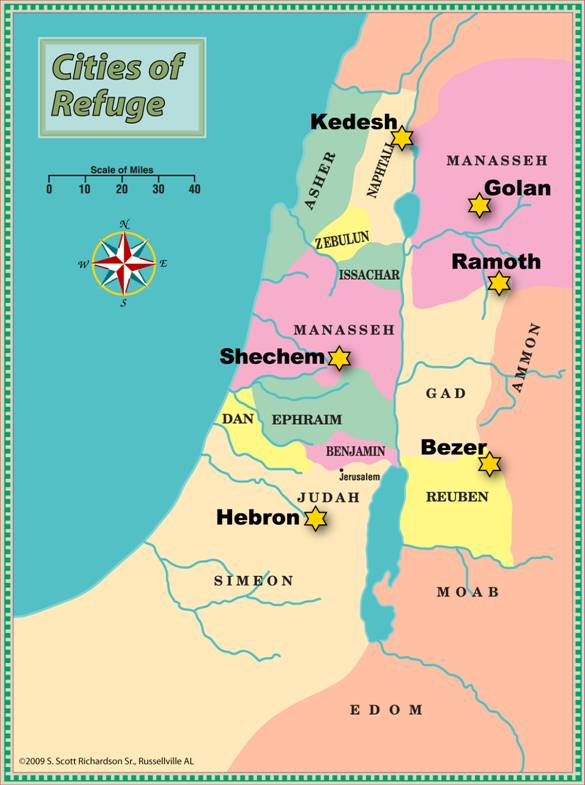
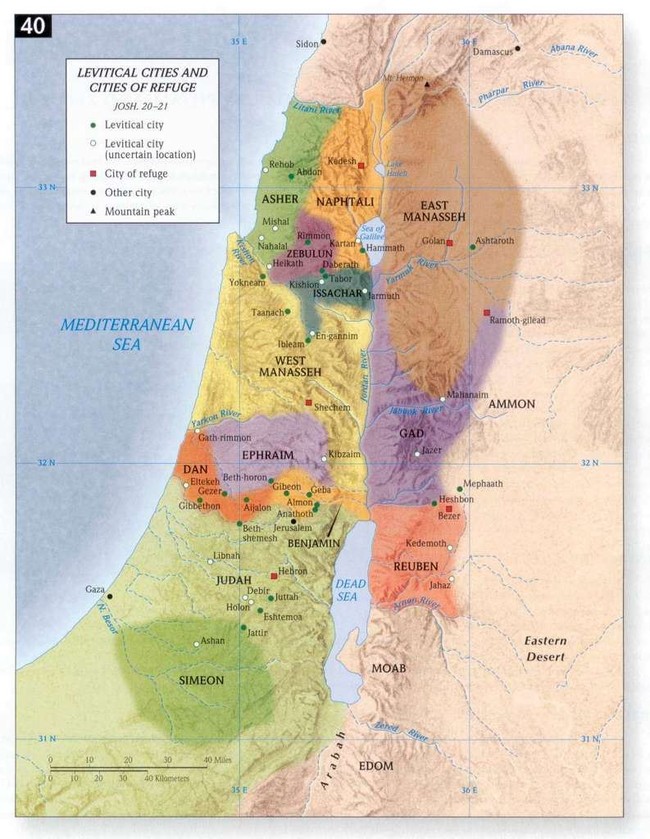
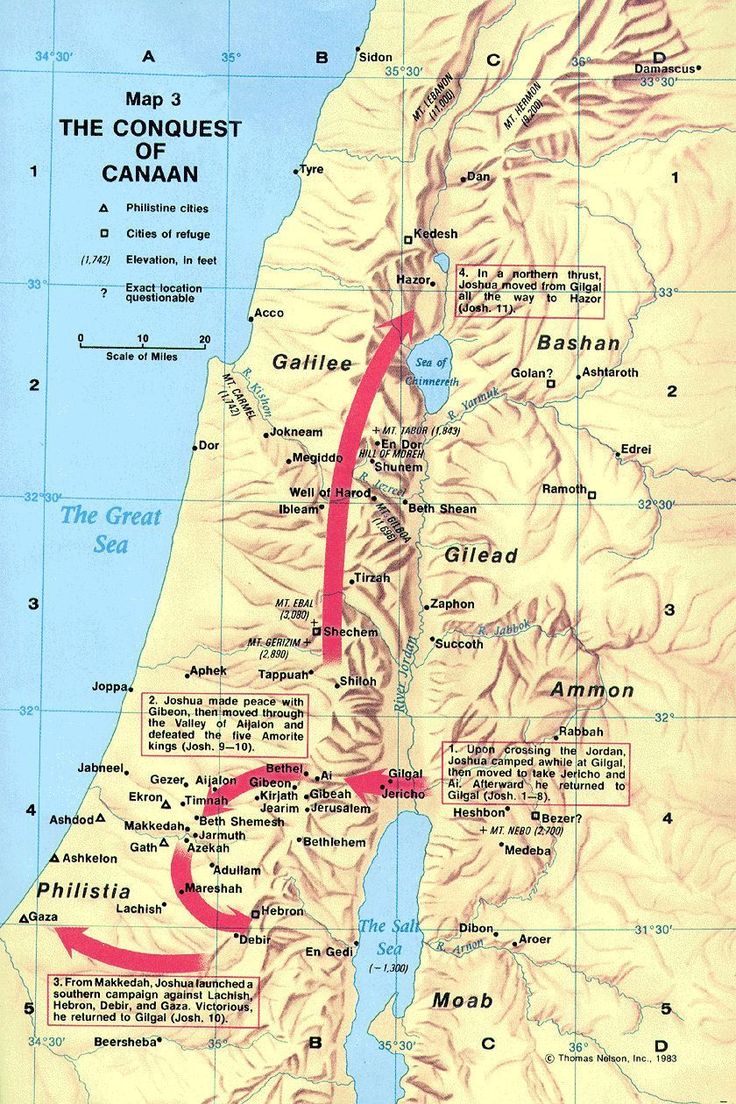
The cities of refuge. God instructed Moses to set aside six different cities, located throughout the land of Canaan, and designate them as cities of refuge. Occupied by Levites, these cities were strategically placed and easily accessible from all parts of the land. Their purpose was to provide a safe haven to anyone who had committed unpremeditated murder.  If an Israelite inadvertently and unintentionally caused the death of a fellow Israelite, he could flee to one of these cities and seek refuge from the avenger.

In that cultural context, It was up to the relatives of a murder victim to seek vengeance. This “blood avenger” (Numbers 35:19) was not just free to kill the murdered, he was obligated to do so (Numbers 35:19, 21). It was his duty. He was called the “avenger of blood.”

But in order to prevent the blood avenger from taking the life of an innocent individual, the cities of refuge were established. If an Israelite accidentally killed someone else, he could run to one of these cities and seek refuge. As long as he remained there, he would be protected from the blood avenger. It was up to the residents of the city (Levites) to help determine the guilt of innocence of the accused. If it was determined that his actions were premeditated and intentional, he was to be handed over to the blood avenger for retribution. But if he was deemed innocent of having committed voluntary manslaughter, he would be allowed to remain in the city of refuge until the high priest died. In essence, the city became his prison. If he ever left, he would be guilty of violating his sentence and the blood avenger could seek his death.

All of this sounds very barbaric to us, but you have to remember that Israel had no police force for enforcing laws or dispensing justice. According to the Mosaic Law, murder was a crime worthy of death. The guilty must be punished. But involuntary manslaughter was to be dealt with in a different manner. That is why the cities were established. God was protecting the innocent.

God dwelt among His people, and His very presence demanded that they live set-apart lives. His holiness and righteousness required that they live differently and distinctively, abiding by a stringent set of rules and regulations that governed their behavior and interactions with one another. And yet God knew their weaknesses and fully understood their incapacity to live up to His exacting standards. The entire sacrificial system was designed to deal with their ongoing struggle with sin.

To unjustly execute the innocent would have been as evil in God’s sight as to excuse the guilty. So He provided those who had committed involuntary manslaughter a means for finding justice. They could live in the city of refuge and enjoy permanent protection from the “blood avenger.” They were still guilty of murder, but their lives were spared. The city of refuge became their prison until the day that the high priest died. Then his death would serve as an atonement for their sin, providing them with release from their guilt and the right to live among their kinsmen again – innocent and free.

The ongoing presence of God was constantly in jeopardy due to the sinfulness of men. Yet He provided them with countless means by which they could receive restoration and assure His continued existence among them. It was God who set them apart. Without them, they would have been nothing. His presence provided them their distinctiveness. And it was their sin that threatened their uniqueness as His chosen people.

From the day that Adam and Eve sinned in the garden, God has been actively and aggressively seeking to restore order to the chaos created by their actions. Their sin brought disorder, disobedience, and, ultimately, death into the world. It wasn’t long after Eve listened to the lies of the enemy and convinced her husband to join her in rejecting God’s word, that murder showed up on the scene. One of Eve’s own sons killed his brother. Death entered the scene. And disease would not be far behind it. Their bodies would undergo the inevitable effects of aging. Sin would increase. Rebellion against God would run rampant. And yet God continued to reach out to mankind, offering a form of refuge from the consequences of sin.

In a real sense, God’s choosing of Abraham made him and his descendants a “city of refuge” for mankind. The people of Israel would become a single source of God’s abiding presence and divine protection from the guilt and condemnation of sin. It was among the children of God that men could find access to their Creator. It was through the law of God that men could learn of the divine requirements and expectations of a holy God. It was through the sacrificial system instituted by God that men could find atonement for their sins and freedom from the penalty of death they so justly deserved. God had provided a city of refuge among the sons of men. And eventually, God would send His own Son as the ultimate and final means of refuge and escape from sin’s destructive power and God’s righteous judgment.

The Scriptures make it painfully clear that all men are guilty of sin.

For all have sinned and fall short of the glory of God.– Romans 3:23 ESV

Surely there is not a righteous man on earth who does good and never sins. – Ecclesiastes 7:20 ESV

Who can say, “I have made my heart pure; I am clean from my sin?” – Proverbs 20:9 ESV

We are all infected and impure with sin. When we display our righteous deeds, they are nothing but filthy rags. – Isaiah 64:6 NLT

The law of God was given to reveal to men the reality and gravity of their sins. Like a speed limit sign on the side of the freeway, the law provided a constant reminder of man’s proclivity for disobedience and rebellion. Our guilt is unquestionable and undeniable. Sinful humanity stands condemned before a holy and righteous God due to the sinful nature passed down to them from Adam and Eve. All are guilty and all stand condemned. And the very presence of disease and death in our world is an outward reminder of the reality of sin’s devastating consequences.

In the case of someone seeking refuge in one of these cities, if they remained there until the high priest died, their sin was forgiven. They walked away free and clear. The death of the high priest had atoning value just as Jesus’ death for us atones for our sins. No one could accuse this person once the high priest had died. And we stand as unaccused and uncondemned because of what Christ has done for us.

Who dares accuse us whom God has chosen for his own? Will God? No! He is the one who has given us right standing with himself. Who then will condemn us? Will Christ Jesus? No, for he is the one who died for us and was raised to life for us and is sitting at the place of highest honor next to God, pleading for us. – Romans 8:33-34 NLT

We can take refuge in Christ. He is our high priest and He has died for us. His death has set us free once and for all.

God also bound himself with an oath, so that those who received the promise could be perfectly sure that he would never change his mind. So God has given us both his promise and his oath. These two things are unchangeable because it is impossible for God to lie. Therefore, we who have fled to him for refuge can take new courage, for we can hold on to his promise with confidence. This confidence is like a strong and trustworthy anchor for our souls. It leads us through the curtain of heaven into God’s inner sanctuary. Jesus has already gone in there for us. He has become our eternal High Priest in the line of Melchizedek. – Hebrews 6:17-20 NLT

English Standard Version (ESV) The Holy Bible, English Standard Version. ESV® Permanent Text Edition® (2016). Copyright © 2001

New Living Translation (NLT) Holy Bible, New Living Translation, copyright © 1996, 2004, 2015 by Tyndale House Foundation. Used by permission of Tyndale House Publishers Inc., Carol Stream, Illinois 60188. All rights reserved.

Our Proactive and Protective God

16 The Lord spoke to Moses, saying, 17 “These are the names of the men who shall divide the land to you for inheritance: Eleazar the priest and Joshua the son of Nun. 18 You shall take one chief from every tribe to divide the land for inheritance. 19 These are the names of the men: Of the tribe of Judah, Caleb the son of Jephunneh. 20 Of the tribe of the people of Simeon, Shemuel the son of Ammihud. 21 Of the tribe of Benjamin, Elidad the son of Chislon. 22 Of the tribe of the people of Dan a chief, Bukki the son of Jogli. 23 Of the people of Joseph: of the tribe of the people of Manasseh a chief, Hanniel the son of Ephod. 24 And of the tribe of the people of Ephraim a chief, Kemuel the son of Shiphtan. 25 Of the tribe of the people of Zebulun a chief, Elizaphan the son of Parnach. 26 Of the tribe of the people of Issachar a chief, Paltiel the son of Azzan. 27 And of the tribe of the people of Asher a chief, Ahihud the son of Shelomi. 28 Of the tribe of the people of Naphtali a chief, Pedahel the son of Ammihud.” 29 These are the men whom the Lord commanded to divide the inheritance for the people of Israel in the land of Canaan. 

1 The Lord spoke to Moses in the plains of Moab by the Jordan at Jericho, saying, 2 “Command the people of Israel to give to the Levites some of the inheritance of their possession as cities for them to dwell in. And you shall give to the Levites pasturelands around the cities. 3 The cities shall be theirs to dwell in, and their pasturelands shall be for their cattle and for their livestock and for all their beasts. 4 The pasturelands of the cities, which you shall give to the Levites, shall reach from the wall of the city outward a thousand cubits all around. 5 And you shall measure, outside the city, on the east side two thousand cubits, and on the south side two thousand cubits, and on the west side two thousand cubits, and on the north side two thousand cubits, the city being in the middle. This shall belong to them as pastureland for their cities.

6 “The cities that you give to the Levites shall be the six cities of refuge, where you shall permit the manslayer to flee, and in addition to them you shall give forty-two cities. 7 All the cities that you give to the Levites shall be forty-eight, with their pasturelands. 8 And as for the cities that you shall give from the possession of the people of Israel, from the larger tribes you shall take many, and from the smaller tribes you shall take few; each, in proportion to the inheritance that it inherits, shall give of its cities to the Levites.” – Numbers 34:16-35:8 ESV

God provided Moses with the name of one man from each of the ten tribes of Israel. These men, hand-picked by God, would assist Eleazar, the high priest, and Joshua in the distribution of the land. The tribes of Gad and Reuben were not included because they had chosen to settle outside the boundaries of Canaan. These men were well-respected leaders among their respective tribes and would help to guarantee that the land was fairly apportioned and that each tribe, regardless of its size, was treated equitably and fairly. There was to be no favoritism or any form of nepotism. The larger tribes, whose numbers would be based on the recent census taken by Moses, would be allotted more extensive land allotments. But that did not mean they would get the best land. God was giving these ten men the weighty responsibility of dividing up the Israelites’ inheritance in a way that would satisfy all the parties involved, and that would not be an easy task.

The next thing on God’s agenda was to arrange for the needs of the tribe of Levi. He had already informed Moses that the Levites would inherit no land in Canaan. He had set apart the tribe of Levi as His special possession and had dedicated them to the care and maintenance of the tabernacle. As a result, God promised to be their inheritance.

“Remember that the Levitical priests—that is, the whole of the tribe of Levi—will receive no allotment of land among the other tribes in Israel. Instead, the priests and Levites will eat from the special gifts given to the Lord, for that is their share. 2 They will have no land of their own among the Israelites. The Lord himself is their special possession, just as he promised them.” – Deuteronomy 18:1-2 NLT

But while the Levites would be allotted no land in Canaan, they would be awarded the deeds to 48 cities located within the territories of each of the other 11 tribes (Joshua 21). Even the tribes of Gad, Reuben, and the half-tribe of Manasseh were required to provide the Levites with towns and pastureland for their flocks. God had made accommodations for the Levites.

These Levitical cities were to be strategically located throughout the nation of Israel so that every Israelite was no more than ten miles from one of them. This helped to ensure that the people of God were never far away from a member of the Levitical priesthood, whose job was to provide instruction in the ways of God. The Levitical priests served as judges (Deuteronomy 17:8-13) and teachers of God’s law (Deuteronomy 33:10). So, it was essential that every Israelite had ready access to a Levitical town and a priest of God.

Of the 48 towns awarded to the Levites, six were to be designated as cities of refuge. These were specially sanctioned zones within the boundaries of Israel where anyone guilty of committing a non-premediated murder could seek asylum. God had already declared His ruling concerning murder (Exodus 20:13), but He had Moses present a special provision for cases involving accidental homicide.

“If someone kills another person unintentionally, without previous hostility, the slayer may flee to any of these cities to live in safety.” – Deuteronomy 19:4 NLT

He even had Moses provide a potential scenario in which a city of refuge would become necessary.

“For example, suppose someone goes into the forest with a neighbor to cut wood. And suppose one of them swings an ax to chop down a tree, and the ax head flies off the handle, killing the other person. In such cases, the slayer may flee to one of the cities of refuge to live in safety.” – Deuteronomy 19:5 NLT

God knew that life would happen and that deadly accidents would be a part of the Israelites’ existence in the land. Men would be killed and justice would need to be pursued. But what He didn’t want was some form of vigilante justice running rampant through the nation. Yet God knew that the relatives of a murder victim would tend to seek revenge against the guilty party and ask questions later. The cities of refuge were intended to protect the innocent while justice was being served.

Since Israel had no professional police force, these kinds of accidents could easily turn into bloodbaths where the relatives of the victim sought to avenge their loved one’s death. So, these cities, occupied by the Levites, would provide a place where the guilty party could find solace and seek a fair judgment concerning his guilt or innocence. In His plans for the land of promise, God was leaving nothing to chance. He was creating a well-designed system for dealing with the inevitable problem of sin among His chosen people. He was going to distribute the Levitical priesthood among them to provide spiritual enlightenment and He was going to create safe havens for those who unwittingly committed even the gravest of sins. God was providing for and protecting His people.

English Standard Version (ESV) The Holy Bible, English Standard Version. ESV® Permanent Text Edition® (2016). Copyright © 2001

New Living Translation (NLT) Holy Bible, New Living Translation, copyright © 1996, 2004, 2015 by Tyndale House Foundation. Used by permission of Tyndale House Publishers Inc., Carol Stream, Illinois 60188. All rights reserved.

A Second Chance to Accomplish a First

52 The Lord spoke to Moses, saying, 53 “Among these the land shall be divided for inheritance according to the number of names. 54 To a large tribe you shall give a large inheritance, and to a small tribe you shall give a small inheritance; every tribe shall be given its inheritance in proportion to its list. 55 But the land shall be divided by lot. According to the names of the tribes of their fathers they shall inherit. 56 Their inheritance shall be divided according to lot between the larger and the smaller.”

57 This was the list of the Levites according to their clans: of Gershon, the clan of the Gershonites; of Kohath, the clan of the Kohathites; of Merari, the clan of the Merarites. 58 These are the clans of Levi: the clan of the Libnites, the clan of the Hebronites, the clan of the Mahlites, the clan of the Mushites, the clan of the Korahites. And Kohath was the father of Amram. 59 The name of Amram’s wife was Jochebed the daughter of Levi, who was born to Levi in Egypt. And she bore to Amram Aaron and Moses and Miriam their sister. 60 And to Aaron were born Nadab, Abihu, Eleazar, and Ithamar. 61 But Nadab and Abihu died when they offered unauthorized fire before the Lord. 62 And those listed were 23,000, every male from a month old and upward. For they were not listed among the people of Israel, because there was no inheritance given to them among the people of Israel.

63 These were those listed by Moses and Eleazar the priest, who listed the people of Israel in the plains of Moab by the Jordan at Jericho. 64 But among these there was not one of those listed by Moses and Aaron the priest, who had listed the people of Israel in the wilderness of Sinai. 65 For the Lord had said of them, “They shall die in the wilderness.” Not one of them was left, except Caleb the son of Jephunneh and Joshua the son of Nun. – Numbers 26:52-65 ESV

The census ordered by Jehovah had more than one purpose. Not only would it determine the number of men eligible for military service, but it would also provide the basis for each tribe’s land allotment once they entered Canaan. Because Moses was ordered to conduct the census tribe by tribe, the final number of each tribe’s combatants would reflect their overall population size and their appropriate share of the inheritance. Knowing that the apportionment of the land could be a potential landmine, God gave Moses strict instructions regarding its division and allotment.

“Divide the land among the tribes, and distribute the grants of land in proportion to the tribes’ populations, as indicated by the number of names on the list. Give the larger tribes more land and the smaller tribes less land, each group receiving a grant in proportion to the size of its population.” – Numbers 26:53-54 NLT

It only made sense that the larger tribes would receive a larger portion of the land. But to prevent the larger tribes from using their influence to grab the best land for themselves, God ordered that Moses use a lottery system to determine how the land was divided and assigned.

“But you must assign the land by lot, and give land to each ancestral tribe according to the number of names on the list. Each grant of land must be assigned by lot among the larger and smaller tribal groups.” – Numbers 26:55-56 NLT

Because of his role as the leader of the nation of Israel, Moses found himself in a delicate and somewhat difficult position. Not only was he responsible for convincing the people to enter the land and begin its conquest, but he would also have to determine the boundaries of each tribe’s land allotment. And even while God had ordered this task to be accomplished through the casting of lots, there was still a good chance that one or more of the tribes might be dissatisfied with the location or physical characteristics of the land they received. And it didn’t help that virtually every square inch of Canaan was already occupied by other nations that were not going to give up their land without a fight. So, Moses had his work cut out for him.

But God had sovereignly ordained a strategy that would protect Moses from accusations of self-aggrandizement or using his power to promote his particular tribe. Moses was a member of the tribe of Levi and God had already determined that this tribe would receive no allotment of land in Canaan. They were to serve as priests and the caretakers of the tabernacle. And God had already made it clear that He would be their portion in the land of promise.

“Remember that the Levitical priests—that is, the whole of the tribe of Levi—will receive no allotment of land among the other tribes in Israel. Instead, the priests and Levites will eat from the special gifts given to the Lord, for that is their share. They will have no land of their own among the Israelites. The Lord himself is their special possession, just as he promised them.” – Deuteronomy 18:1-2 NLT

The tribe of Moses would not own any land, so no one could accuse him of showing favoritism to his own clan. But without land, how would the Levites feed their families, flock, and herds? God had made provision for that as well.

“You priests will receive no allotment of land or share of property among the people of Israel. I am your share and your allotment. As for the tribe of Levi, your relatives, I will compensate them for their service in the Tabernacle. Instead of an allotment of land, I will give them the tithes from the entire land of Israel.” – Numbers 18:20-21 NLT

God had arranged a way for them to have ample food to eat. And not only that, He had ordained a plan for them to have cities of their own, located throughout the tribes of Israel.

“Command the people of Israel to give to the Levites from their property certain towns to live in, along with the surrounding pasturelands. These towns will be for the Levites to live in, and the surrounding lands will provide pasture for their cattle, flocks, and other livestock. The pastureland assigned to the Levites around these towns will extend 1,500 feet from the town walls in every direction. Measure off 3,000 feet outside the town walls in every direction—east, south, west, north—with the town at the center. This area will serve as the larger pastureland for the towns.” – Numbers 35:2-5 NLT

God had made ample preparations and provisions for the Levites. And in doing so, He had assured that there would be no way for Moses to use his power to reward his own tribe. God had protected him. But while the Levites were exempt from military service, they were still included in the census.

The men from the Levite clans who were one month old or older numbered 23,000. But the Levites were not included in the registration of the rest of the people of Israel because they were not given an allotment of land when it was divided among the Israelites. – Numbers 26:62 NLT

The Levites were numbered but not required to register for military service. They would continue to serve as priests and perform the duties assigned to them as caretakers of the tabernacle.

But this chapter ends with a rather somber reminder of the previous generation. Nearly 40 years earlier, God had ordered that a census be taken when the people were camped at the base of Mount Sinai. They had just recently escaped their enslavement in Egypt and were on their way to the land of promise. And God ordered Moses to conduct a census in order to ascertain their exact number.

A year after Israel’s departure from Egypt, the Lord spoke to Moses in the Tabernacle in the wilderness of Sinai. On the first day of the second month of that year he said, “From the whole community of Israel, record the names of all the warriors by their clans and families. List all the men twenty years old or older who are able to go to war. You and Aaron must register the troops, and you will be assisted by one family leader from each tribe.” – Numbers 1:1-4 NLT

And the number came to 603,550, not including the Levites. Now, nearly 38 years later, the number had not changed dramatically. They could still field 601,730 eligible men for combat duty. God had sustained their numbers all throughout the four decades they had wandered in the wilderness. But Moses points out that while the numbers were relatively the same, the names had changed.

Not one person on this list had been among those listed in the previous registration taken by Moses and Aaron in the wilderness of Sinai. For the Lord had said of them, “They will all die in the wilderness.” Not one of them survived except Caleb son of Jephunneh and Joshua son of Nun. – Numbers 26:64-64 NLT

The previous generation had blown their chance to enter the land of Canaan. Thirty-eight years earlier, they had been given the opportunity to cross the Jordan River and begin the conquest of the land, but they refused. When the spies reported that there were powerful nations occupying the land, the people made the fateful decision to reject God’s offer of an inheritance and decided to return to Egypt instead. But God would not allow them to return to their former enslavement. As punishment for their disobedience, they were doomed to wander through the wilderness until every last one of them had died. The only two members of that generation who would enter the land of Canaan were Caleb and Joshua, the two spies who had tried to convince the people to trust God and obey. But their words had fallen on deaf ears.

Now, 38 years later, those two men would be the sole survivors of the previous generation who would have the privilege and honor of crossing the Jordan River and occupying the land that had been promised to them by God. They had waited four decades, but their hopes and dreams would finally be fulfilled.

English Standard Version (ESV) The Holy Bible, English Standard Version. ESV® Permanent Text Edition® (2016). Copyright © 2001

New Living Translation (NLT) Holy Bible, New Living Translation, copyright © 1996, 2004, 2015 by Tyndale House Foundation. Used by permission of Tyndale House Publishers Inc., Carol Stream, Illinois 60188. All rights reserved.

I Am Your Portion

20 And the Lord said to Aaron, “You shall have no inheritance in their land, neither shall you have any portion among them. I am your portion and your inheritance among the people of Israel.

21 “To the Levites I have given every tithe in Israel for an inheritance, in return for their service that they do, their service in the tent of meeting, 22 so that the people of Israel do not come near the tent of meeting, lest they bear sin and die. 23 But the Levites shall do the service of the tent of meeting, and they shall bear their iniquity. It shall be a perpetual statute throughout your generations, and among the people of Israel they shall have no inheritance. 24 For the tithe of the people of Israel, which they present as a contribution to the Lord, I have given to the Levites for an inheritance. Therefore I have said of them that they shall have no inheritance among the people of Israel.”

25 And the Lord spoke to Moses, saying, 26 “Moreover, you shall speak and say to the Levites, ‘When you take from the people of Israel the tithe that I have given you from them for your inheritance, then you shall present a contribution from it to the Lord, a tithe of the tithe. 27 And your contribution shall be counted to you as though it were the grain of the threshing floor, and as the fullness of the winepress. 28 So you shall also present a contribution to the Lord from all your tithes, which you receive from the people of Israel. And from it you shall give the Lord‘s contribution to Aaron the priest. 29 Out of all the gifts to you, you shall present every contribution due to the Lord; from each its best part is to be dedicated.’ 30 Therefore you shall say to them, ‘When you have offered from it the best of it, then the rest shall be counted to the Levites as produce of the threshing floor, and as produce of the winepress. 31 And you may eat it in any place, you and your households, for it is your reward in return for your service in the tent of meeting. 32 And you shall bear no sin by reason of it, when you have contributed the best of it. But you shall not profane the holy things of the people of Israel, lest you die.’” – Numbers 18:20-32 ESV

The tribe of Levi had been set apart by God and assigned responsibility for caring for the tabernacle and overseeing the elaborate sacrificial system He had ordained for the nation of Israel. Of the 12 tribes of Israel, they were the only one that would not be given an allotment of land in Canaan. Rather than inheriting a designated area within the land of promise, they would be given 48 cities located within the territorial boundaries of the other tribes.

“Six of the towns you give the Levites will be cities of refuge, where a person who has accidentally killed someone can flee for safety. In addition, give them forty-two other towns. In all, forty-eight towns with the surrounding pastureland will be given to the Levites. These towns will come from the property of the people of Israel. The larger tribes will give more towns to the Levites, while the smaller tribes will give fewer. Each tribe will give property in proportion to the size of its land.” – Numbers 35:6-8 NLT

This meant that members of the tribe of Levi would be distributed among the other tribes of Israel. In a sense, as God’s “holy ”ones, they were to permeate the rest of God’s people and provide a positive spiritual influence on the nation as a whole. In return for their faithful service as priests and caretakers of the tabernacle, the Levites would enjoy the provision of God.

“You shall have no inheritance in their land, neither shall you have any portion among them. I am your portion and your inheritance among the people of Israel.

“To the Levites I have given every tithe in Israel for an inheritance, in return for their service that they do, their service in the tent of meeting…” – Numbers 18:20-21 ESV

God promised to meet all their needs. But their compensation would not come in the form of agricultural commodities or livestock. They would grow no crops of their own. They would own no flocks or herds. Yet, God would provide for them through means of the sacrificial system. God would graciously share with the Levitical priests the gifts given to Him by the people.

“These are the parts the priests may claim as their share from the cattle, sheep, and goats that the people bring as offerings: the shoulder, the cheeks, and the stomach. You must also give to the priests the first share of the grain, the new wine, the olive oil, and the wool at shearing time. For the Lord your God chose the tribe of Levi out of all your tribes to minister in the Lord’s name forever.” – Deuteronomy 18:3-5 NLT

“God was the unique inheritance to the Levites. He was the focus of their service, the source of their sustenance, and the significance of their calling. Their inheritance included cities, daily food, and a constant vocation, but it did not include the same type of land inheritance given to the other tribes of Israel.” – http://www.gotquestions.org

In their position as God’s mediators, the Levites played a vital role in protecting the spiritual and physcial well-being of the people. They served as guardians of the tabernacle with the responsibility of preventing any unauthorized individual from attempting to enter the holy place or come in contact with the consecrated items contained within it.

“From now on, no Israelites except priests or Levites may approach the Tabernacle. If they come too near, they will be judged guilty and will die. Only the Levites may serve at the Tabernacle, and they will be held responsible for any offenses against it.” – Numbers 18:22-23 NLT

Failure to do their job would have dire consequences for all involved. So, God stressed to Aaron the serious nature of their role. Holiness was a high priority for God and the Levites were to help the nation of Israel maintain their set-apart status by requiring obedience to His commands

In return, God would provide for all their needs. Yet, the Levites were still expected to contribute a tithe on the basis of His gracious gifts to them. In other words, they were to offer a tithe on the tithe. When the people gave their tithes to God, the Levites would receive a portion as a gracious gift from God. But God expected them to a tithe in return, as a token of their gratitude toward and complete reliance upon Him.

“You must present one-tenth of the tithe received from the Israelites as a sacred offering to the Lord. This is the Lord’s sacred portion, and you must present it to Aaron the priest. Be sure to give to the Lord the best portions of the gifts given to you.” – Numbers 18:28-29 NLT

They were instructed to treat the tithes of the people as if they were the produce they had grown, the flocks they had raised, and the fruits they had cultivated.

“When you present the best part as your offering, it will be considered as though it came from your own threshing floor or winepress.” – Numbers 18:30 NLT

This was intended to create a sense of total dependence upon God. He was to be their sole source of provision and by giving a tenth of what they received back to Him, they would be demonstrating their complete reliance upon His grace and mercy. But God warned them to take this command seriously and obey it religiously. There was no room for debate or differences of opinion.

“You Levites and your families may eat this food anywhere you wish, for it is your compensation for serving in the Tabernacle. You will not be considered guilty for accepting the Lord’s tithes if you give the best portion to the priests. But be careful not to treat the holy gifts of the people of Israel as though they were common. If you do, you will die.” – Numbers 18:31-32 NLT

Disobedience would result in God’s disapproval and, ultimately, the death of the guilty party. If they treated the tithes of the people with disrespect, they would pay with their lives. Those gifts and offerings had been dedicated to God and were to be revered as His possessions. He was graciously sharing with them what was rightfully His. And what He really wanted them to understand was that He was to be their portion. The Hebrew word is חֵלֶק (ḥēleq), and it can be translated as “portion,” “part,” or “territory.”

While they would receive no land as their inheritance, God would serve as their territory. The benefits they would normally expect to receive from land ownership would be provided by God Himself, and He would prove to be a more than sufficient source of sustenance. Yet, His goodness would be directly tied to their obedience.

English Standard Version (ESV) The Holy Bible, English Standard Version. ESV® Permanent Text Edition® (2016). Copyright © 2001

New Living Translation (NLT) Holy Bible, New Living Translation, copyright © 1996, 2004, 2015 by Tyndale House Foundation. Used by permission of Tyndale House Publishers Inc., Carol Stream, Illinois 60188. All rights reserved.

A Shadow of Things to Come

1 So the Lord said to Aaron, “You and your sons and your father’s house with you shall bear iniquity connected with the sanctuary, and you and your sons with you shall bear iniquity connected with your priesthood. 2 And with you bring your brothers also, the tribe of Levi, the tribe of your father, that they may join you and minister to you while you and your sons with you are before the tent of the testimony. 3 They shall keep guard over you and over the whole tent, but shall not come near to the vessels of the sanctuary or to the altar lest they, and you, die. 4 They shall join you and keep guard over the tent of meeting for all the service of the tent, and no outsider shall come near you. 5 And you shall keep guard over the sanctuary and over the altar, that there may never again be wrath on the people of Israel. 6 And behold, I have taken your brothers the Levites from among the people of Israel. They are a gift to you, given to the Lord, to do the service of the tent of meeting. 7 And you and your sons with you shall guard your priesthood for all that concerns the altar and that is within the veil; and you shall serve. I give your priesthood as a gift, and any outsider who comes near shall be put to death.” – Numbers 18:1-7 ESV

As a result of the rebellion of Korah, God brought a plague among the people of Israel. It was only Aaron’s quick action, as he atoned for their sins, that prevented the complete destruction of the people of Israel at the hands of God. He intervened and interceded on their behalf, and God spared them. As a result, God reconfirmed His selection of Aaron and his sons to serve as His priests.

The budding of the rod of Aaron was a divine sign of God’s choosing of Aaron and the tribe of Levi as His servants. They would belong to Him. Only the Levites could serve as caretakers of the tabernacle and only Aaron and his sons could serve as intercessors with God on behalf of the people. With their jobs came great responsibilities and great blessings. They were to remain holy and set apart to God. They received no inheritance in the land, but God provided for them from the gifts that were given to Him as a part of the sacrifices of the people. The Levites received from God that which was holy. They ate well but they had to be very careful not to profane or desecrate the things of God through unholy conduct. God warned Aaron, “You, your sons, and your relatives from the tribe of Levi will be held responsible for any offenses related to the sanctuary. But you and your sons alone will be held responsible for violations connected with the priesthood” (Numbers 18:1 NLT).

These were ordinary men who had been given an extraordinary responsibility. They were the literal keepers of the spiritual flame of Israel. They were to maintain God’s house and everything in it. They protected it and transported it. Aaron and his sons, as the priests, were responsible for offering sacrifices on behalf of the people, atoning for their sins, and providing a means for them to remain in right standing with God. But their work could never fully remove guilt or provide full atonement for the sins of the people. But the priesthood and the sacrificial system as outlined in the Old Testament was a foreshadowing of something greater to come.

They serve in a system of worship that is only a copy, a shadow of the real one in heaven. For when Moses was getting ready to build the Tabernacle, God gave him this warning: “Be sure that you make everything according to the pattern I have shown you here on the mountain.” But now Jesus, our High Priest, has been given a ministry that is far superior to the old priesthood, for he is the one who mediates for us a far better covenant with God, based on better promises. – Hebrews 8:5-6 NLT

God’s plan for the tabernacle, the sacrificial system, and the priesthood was a temporary system that represented a far greater future reality. It was imperfect because it involved sinful men. Aaron and his sons were flawed and far from perfect, just like every other Israelite. For them to perform their duties as priests, they had to undergo rigorous purification rites for the atonement of their own sins. And, according to the book of Hebrews, their humanity made them susceptible to death just like everyone else and required that there be constant replacements available.

The former priests were many in number, because they were prevented by death from continuing in office. – Hebrews 7:23 ESV

But God’s plan was far greater than that of the tabernacle and the earthly priesthood. He had already determined a better means of atoning for the sins of man. And it would involve His own Son. This had been God’s plan all along. After His resurrection from the dead, Jesus gave His disciples two separate Bible lessons where He “opened their minds to understand the Scriptures” (Luke 24:45 ESV). For the two disciples on the road to Emmaus, “he interpreted to them in all the Scriptures the things concerning himself” (Luke 24:27 ESV). Jesus unpacked all the writings of Moses and the prophets, showing how He had been foreshadowed and predicted. Everything had been pointing to Him. The entire sacrificial system was but a shadow of things to come. The priesthood as practiced in Moses’ day, served as a glimpse of something greater to come.

He is the kind of high priest we need because he is holy and blameless, unstained by sin. He has been set apart from sinners and has been given the highest place of honor in heaven.  Unlike those other high priests, he does not need to offer sacrifices every day. They did this for their own sins first and then for the sins of the people. But Jesus did this once for all when he offered himself as the sacrifice for the people’s sins.  The law appointed high priests who were limited by human weakness. But after the law was given, God appointed his Son with an oath, and his Son has been made the perfect High Priest forever. – Hebrews 7:26-28 NLT

Man would need a greater High Priest. We would require a greater means of atonement. The sacrificial system, as practiced by the Jews in the days of Moses and even into the days of Jesus, could never fully eradicate the sins of men. Because man’s capacity for sin was endless, so was the need for constant sacrifice. There was never a point at which they were totally forgiven and completely free from the guilt of their sin. If nothing else, the law and the sacrificial system were a daily reminder of the ever-present reality of sin and guilt. No one could keep the law perfectly so, therefore, no one was truly sinless. And the constant capacity to sin required the constant need to sacrifice in order to atone for those sins.

But Jesus came to put an end to the madness. He was the High Priest who came to deal with sin once and for all.

He did not enter heaven to offer himself again and again, like the high priest here on earth who enters the Most Holy Place year after year with the blood of an animal. If that had been necessary, Christ would have had to die again and again, ever since the world began. But now, once for all time, he has appeared at the end of the age to remove sin by his own death as a sacrifice. And just as each person is destined to die once and after that comes judgment, so also Christ died once for all time as a sacrifice to take away the sins of many people. He will come again, not to deal with our sins, but to bring salvation to all who are eagerly waiting for him. – Hebrews 9:25-28 NLT

Because of Jesus’ sacrifice, our sins have been paid for. Our atonement has been accomplished once and for all. We can now stand before God as righteous in His eyes. All because of what Jesus accomplished on the cross on our behalf. We have been set free and are no longer slaves to sin. We have the capacity to live differently and distinctively, empowered by the indwelling Holy Spirit. And our righteousness is not of our own making but has been provided for us by Christ Himself. He bore our sins and transferred His righteousness to us. He died so that we might live.

When reading the Old Testament, we must look for Christ and understand that it all foreshadows His ultimate arrival on the scene. The Old Testament is as much about Christ as the four Gospels. Prior to His ascension, Jesus took time to teach His disciples and point out all that the Old Testament Scriptures revealed about Himself. The story of the Bible is the story of God’s ultimate redemption of mankind through the saving work of Jesus. Like any story, it has a beginning and an end. In the story recorded in Luke, we see Jesus departing from His disciples, ascending up into heaven. But we know that’s not the end of the story.

This Jesus, who was taken up from you into heaven, will come in the same way you saw him go into heaven. – Acts 1:11 ESV

He has gone, but He will someday return. His work as High Priest is complete but His job as King is not yet finished. And we look forward to the day when God closes the final chapter in His great book of redemption.

English Standard Version (ESV) The Holy Bible, English Standard Version. ESV® Permanent Text Edition® (2016). Copyright © 2001

New Living Translation (NLT) Holy Bible, New Living Translation, copyright © 1996, 2004, 2015 by Tyndale House Foundation. Used by permission of Tyndale House Publishers Inc., Carol Stream, Illinois 60188. All rights reserved.