A Life of Law-Keeping is Enslaving

13 For you were called to freedom, brothers. Only do not use your freedom as an opportunity for the flesh, but through love serve one another. 14 For the whole law is fulfilled in one word: “You shall love your neighbor as yourself.” 15 But if you bite and devour one another, watch out that you are not consumed by one another.

16 But I say, walk by the Spirit, and you will not gratify the desires of the flesh. 17 For the desires of the flesh are against the Spirit, and the desires of the Spirit are against the flesh, for these are opposed to each other, to keep you from doing the things you want to do. 18 But if you are led by the Spirit, you are not under the law. 19 Now the works of the flesh are evident: sexual immorality, impurity, sensuality, 20 idolatry, sorcery, enmity, strife, jealousy, fits of anger, rivalries, dissensions, divisions, 21 envy, drunkenness, orgies, and things like these. I warn you, as I warned you before, that those who do such things will not inherit the kingdom of God. – Galatians 5:13-21 ESV

Freedom from the law results in license. That was one of the accusations the party of the circumcision leveled against Paul and his message of grace and freedom from the law. They most likely used Paul’s own teaching as evidence against him.

In his letter to the Romans, Paul wrote, “…where sin increased, grace abounded all the more” (Romans 5:20 ESV). And yet, Paul went on to say, “What shall we say then? Are we to continue in sin that grace may abound? By no means! How can we who died to sin still live in it?” (Romans 6:1-2 ESV). Grace was not a license to sin. The freedom it provided from the Mosaic Law was not a ticket to live as one pleased. Grace freed people from having to keep the law in an attempt to earn favor with God. The law held men captive to their sin, in bondage to their own weakness, and incapable of doing anything about it. But the salvation offered in Christ set men free. It was William Barclay who wrote, “…the Christian is not the man who has become free to sin, but the man, who, by the grace of God, has become free not to sin.”

That is why Paul warned his readers to not use their new-found freedom in Christ as an opportunity for the flesh. They were free from having to keep the law, but not free from having to live in keeping with God’s expectation of holiness. At one point in His ministry, Jesus was asked what the greatest commandment of God was, and He responded:

“You shall love the Lord your God with all your heart and with all your soul and with all your mind. This is the great and first commandment. And a second is like it: You shall love your neighbor as yourself. On these two commandments depend all the Law and the Prophets.” Matthew 22:37-40 ESV

Paul used these very words of Jesus to admonish his readers. Loving God meant living according to His holy will. Loving others required loving them selflessly and sacrificially, which is why Paul said, “…through love serve one another” (Galatians 5:13 ESV).

In his letter to the believers in Corinth, Paul provided an entire chapter on the subject of love. In it, he wrote:

If I speak with human eloquence and angelic ecstasy but don’t love, I’m nothing but the creaking of a rusty gate. If I speak God’s Word with power, revealing all his mysteries and making everything plain as day, and if I have faith that says to a mountain, ‘Jump,’ and it jumps, but I don’t love, I’m nothing. If I give everything I own to the poor and even go to the stake to be burned as a martyr, but I don’t love, I’ve gotten nowhere. So, no matter what I say, what I believe, and what I do, I’m bankrupt without love. – 1 Corinthians 13:1-7 MSG

But this kind of love is only possible through the power of the indwelling Holy Spirit. Without His help and our complete reliance upon His power, we will tend to live in the weakness of our own sinful flesh; we will become selfish and self-centered. We will tend to gratify the desires of our old nature, which Paul describes with painful accuracy. These fleshly desires are the exact opposite of what the Spirit wants to produce in us. They are counter to the will of God and reflect a love of self more than a love for Him. They most certainly don’t model a love for others.

Look at Paul’s list: sexual immorality, impurity, lustful pleasures, idolatry, sorcery, hostility, quarreling, jealousy, outbursts of anger, selfish ambition, dissension, division, envy, drunkenness, and wild parties. Each of these “works of the flesh” reveals a disdain for God and a complete disregard for others.

The moral, ceremonial, and civil sections of the Mosaic Law were designed to regulate the lives of the people of Israel regarding their relationship with God and with one another. But as Jesus said, all of the commandments could be summed up by two simple commands: Love God and love others.

Loving God required a sold-out allegiance to Him as the one true God. The Israelites were forbidden from giving their affections to any other god. Jesus’ admonition to love others required concrete and observable actions. To love another person meant that you could not become jealous of them, get angry with them, lust after them, or take advantage of them. These kinds of actions were antithetical to love.

Notice that Paul’s list has more to do with our relationships with one another than our relationship with God. There is a reason for this. The apostle John wrote, “If anyone says, ‘I love God,’ and hates his brother, he is a liar; for he who does not love his brother whom he has seen cannot love God whom he has not seen” (1 John 4:20 ESV). The greatest expression of our love for God is to be found in our love for those whom He has made. When we love others, we are actually displaying our love for God. Living selflessly and sacrificially exemplifies the very character of God. When our lives are marked by self-control and a focus on the needs of others, we reflect His divine nature and its influence over our lives. But Paul makes it clear that these divinely influenced behaviors are only possible when we live according to the power of God’s indwelling Spirit.

So I say, let the Holy Spirit guide your lives. Then you won’t be doing what your sinful nature craves. – Galatians 5:16 NLT

Paul points out that a Spirit-led life stands diametrically opposed to a flesh-filled life.

…the Spirit gives us desires that are the opposite of what the sinful nature desires. – Galatians 5:17 NLT

In the life of a believer, a battle is always raging between the flesh and the Spirit.

These two forces are constantly fighting each other, so you are not free to carry out your good intentions. – Galatians 5:17 NLT

Salvation does not eliminate a believer’s sin nature; it provides him with a way to reject its influence over his life. Paul reminded the members of the Colossian church that they had been “raised to new life with Christ” so they were to set their sights “on the realities of heaven” (Colossians 3:1 NLT). At the same time, they were to allow the Holy Spirit to remove all those behaviors that were associated with their old sinful natures.

…put to death the sinful, earthly things lurking within you. Have nothing to do with sexual immorality, impurity, lust, and evil desires. Don’t be greedy, for a greedy person is an idolater, worshiping the things of this world. Because of these sins, the anger of God is coming. You used to do these things when your life was still part of this world. But now is the time to get rid of anger, rage, malicious behavior, slander, and dirty language. Don’t lie to each other, for you have stripped off your old sinful nature and all its wicked deeds. Put on your new nature, and be renewed as you learn to know your Creator and become like him. – Colossians 3:5-10 NLT

Paul wanted the Colossians and the Galatians to understand that a life continually characterized by the works of the flesh was a life devoid of the Spirit of God. Those who have placed their faith in Jesus Christ have received God’s indwelling and empowering Spirit and, as a result, they are no longer slaves to sin and incapable of living righteous lives. They have been filled with the Holy Spirit and have the power to love God and love others. That’s why Paul told the Romans, “But you are not controlled by your sinful nature. You are controlled by the Spirit if you have the Spirit of God living in you. (And remember that those who do not have the Spirit of Christ living in them do not belong to him at all)” (Romans 8:9 NLT).

The presence of the Spirit within us does not guarantee that we will live sin-free lives, but it does mean that we don’t have to live sin-dominated lives. Living according to our own sinful flesh will always produce bad fruit. But living according to the Spirit of God produces good fruit that pleases God and blesses others. We have been freed from the penalty and power of sin. Because of Christ’s death on the cross and His Spirit’s presence within us, we are free to say no to sin.

The grace of God has made a sin-less life possible. We are not completely free from sin but we are no longer slaves to its wishes and whims. According to Paul, salvation has broken the chains by which sin once held us captive.

We know that our old sinful selves were crucified with Christ so that sin might lose its power in our lives. We are no longer slaves to sin. For when we died with Christ we were set free from the power of sin. – Romans 6:6-7 NLT

Sin is no longer your master, for you no longer live under the requirements of the law. Instead, you live under the freedom of God’s grace. – Romans 6:14 NLT

Paul’s whole point is that a return to law-keeping is a return to enslavement. The law could not empower anyone to say no to sin; it could only reveal the presence of sin in their lives. The law could only expose and condemn sin but it couldn’t provide a way to resist its influence. That’s why Paul pointed out how his pre-conversion life was marked by a love-hate relationship with the law.

…it was the law that showed me my sin. I would never have known that coveting is wrong if the law had not said, “You must not covet.” But sin used this command to arouse all kinds of covetous desires within me! If there were no law, sin would not have that power. – Romans 7:7-8 NLT

Paul didn’t want the Galatians to exchange the grace of God for a life of enslavement to the law and a losing battle with sin. He had long ago discovered that “the law’s commands, which were supposed to bring life, brought spiritual death instead” (Romans 7:10 NLT), and he wanted to keep the Galatians from experiencing the futility of a life ruled by law-keeping instead of grace.

English Standard Version (ESV) The Holy Bible, English Standard Version. ESV® Permanent Text Edition® (2016). Copyright © 2001

New Living Translation (NLT) Holy Bible, New Living Translation, copyright © 1996, 2004, 2015 by Tyndale House Foundation. Used by permission of Tyndale House Publishers Inc., Carol Stream, Illinois 60188. All rights reserved.
Preserving and Protecting the Gospel

You were running well. Who hindered you from obeying the truth? This persuasion is not from him who calls you. A little leaven leavens the whole lump. 10 I have confidence in the Lord that you will take no other view, and the one who is troubling you will bear the penalty, whoever he is. 11 But if I, brothers, still preach circumcision, why am I still being persecuted? In that case the offense of the cross has been removed. 12 I wish those who unsettle you would emasculate themselves! – Galatians 5:7-12 ESV

Paul took this issue very seriously. As far as he was concerned, it had little to do with the rite of circumcision itself, but it had everything to do with the integrity of the gospel. God had sent His Son as the one and only means for mankind’s salvation. His sacrificial death on the cross was God’s sole solution to man’s sin problem. God had never intended for the law to save men; it was meant to reveal the extent of God’s righteous expectations and expose mankind’s sinfulness.

The law revealed in a concrete, non-negotiable form the holiness and righteousness that God demanded of His chosen people, the Israelites. It left no grey areas or anything up to man’s imagination. But the Israelites, like all humanity, were sinful and totally incapable of keeping the law, and this proved to be no surprise to God. It had all been part of His divine plan for humanity’s salvation. He had intended all along for His Son to take on human form and live as a man so that He might keep the law and become the sinless substitute and unblemished sacrifice for the sins of mankind.

Through His incarnation, Jesus, the sinless Son of God, was able to do what no man had ever done before; live in perfect obedience to God’s law. This allowed Him to become the sinless sacrifice, the unblemished Lamb who willingly gave up His life as the atoning offering for all those who stood condemned before a holy and just God. Jesus died on behalf of sinful men and women, and His death provided the only means by which they might be restored to a right relationship with God.

Paul wrote to the believers in Rome and reminded them that sin was a universal problem that held all humanity captive and under the condemnation of death.

…for all have sinned and fall short of the glory of God, and are justified by his grace as a gift, through the redemption that is in Christ Jesus, whom God put forward as a propitiation by his blood, to be received by faith. – Romans 3:23-25 ESV

Jesus paid the debt that humanity owed. He satisfied the just demands of His Heavenly Father by paying in full the penalty that demanded the death of the entire human race. His death made justification with God possible. For the first time in human history, sinful men and women could be restored to a right relationship with God – for all time. As the author of Hebrews makes clear, “God’s will was for us to be made holy by the sacrifice of the body of Jesus Christ, once for all time” (Hebrews 10:10 NLT).

Under the old covenant of law, the sacrifices for sins were never-ending because they were incapable of irradicating the root problem.

Under the old covenant, the priest stands and ministers before the altar day after day, offering the same sacrifices again and again, which can never take away sins. – Hebrews 10:11 NLT

Sin was inevitable and unavoidable. The sacrifices were ongoing and perpetual because each new sin required a new sacrifice.

The sacrifices under that system were repeated again and again, year after year, but they were never able to provide perfect cleansing for those who came to worship. If they could have provided perfect cleansing, the sacrifices would have stopped, for the worshipers would have been purified once for all time, and their feelings of guilt would have disappeared. – Hebrews 10:1-2 NLT

The author of Hebrews fully supports Paul’s claims concerning the all-sufficient death of Jesus. He points out that the sacrificial system that accompanied the Mosaic Law was incapable of solving man’s ongoing sin problem.

…those sacrifices actually reminded them of their sins year after year. For it is not possible for the blood of bulls and goats to take away sins. That is why, when Christ came into the world… – Hebrews 10:3-5 NLT

Paul clarifies the difference between Jesus’ atoning sacrifice and those of the countless animals that were offered under the old covenant. He boldly states that when Jesus offered up His life as the payment for the sins of mankind, “by that one offering he forever made perfect those who are being made holy” (Hebrews 10:14 NLT).

That message was sacrosanct to Paul and he considered anything or anyone that interfered with the simplicity of its content to be an enemy and a threat to the cause of Christ. He didn’t suffer false teachers lightly and he refused to tolerate those who preached a different version of God’s gospel. That is why he started out this letter to the Galatians with very strong words concerning those who attempted to amend the gospel message.

You are following a different way that pretends to be the Good News but is not the Good News at all. You are being fooled by those who deliberately twist the truth concerning Christ.

Let God’s curse fall on anyone, including us or even an angel from heaven, who preaches a different kind of Good News than the one we preached to you. I say again what we have said before: If anyone preaches any other Good News than the one you welcomed, let that person be cursed. – Galatians 1:6-9 NLT

In today’s passage, Paul commends his readers for running the race well but then accuses them of allowing others to knock them off course. They had accepted Christ by faith and had been living the Christian life in faith, but then had allowed themselves to be steered off course. The Greek word Paul used was ἀνακόπτω (anakoptō) and it refers to something having its progress hindered, held back, or checked in some way.

The Judaizers, who were demanding that the Gentile converts in Galatia be circumcised, were actually hindering them from obeying the truth as found in the gospel. They were adding unnecessary requirements, and Paul made it clear that these new rules were not from God.

This persuasion is not from him who calls you. – Galatians 5:8 ESV

The real danger this kind of teaching posed was that it would soon permeate every aspect of their faith, causing them to walk away from the grace offered by God and back into the legalism of the law. This is what Paul seems to be saying when he writes, “A little leaven leavens the whole lump.” This kind of false teaching would become like cancer spreading through the church in Galatia and robbing them of the freedom they had found in Christ.

But Paul expressed his confidence that the Galatian believers would reject this false teaching and remain faithful to the life of faith. He assured them that, regardless of what others might have said, he was not a proponent of circumcision. Yes, he had encouraged Timothy to be circumcised, but that was a different case altogether. Timothy, a young disciple of Paul’s, had a Jewish mother who had become a believer, but his father was Greek. In the book of Acts we read, “Paul wanted Timothy to accompany him, and he took him and circumcised him because of the Jews who were in those places, for they all knew that his father was a Greek” (Acts 16:3 ESV).

This decision had nothing to do with Timothy’s salvation; Paul was trying to safeguard Timothy’s ministry among the Jews. Paul knew that they would never listen to an uncircumcised Gentile, so he encouraged Timothy to undergo circumcision to make him acceptable to the Jews and provide him a platform to share the gospel with them. Paul had an interesting ministry philosophy that he sums up in his first letter to the believers in Corinth.

Even though I am a free man with no master, I have become a slave to all people to bring many to Christ. When I was with the Jews, I lived like a Jew to bring the Jews to Christ. When I was with those who follow the Jewish law, I too lived under that law. Even though I am not subject to the law, I did this so I could bring to Christ those who are under the law. When I am with the Gentiles who do not follow the Jewish law, I too live apart from that law so I can bring them to Christ. – 1 Corinthians 9:19-21 NLT

It was this mindset that influenced Paul’s decision to have Timothy circumcised. But it seems that the false teachers in Galatia were using this situation with Timothy to portray Paul as a proponent of circumcision. But Paul denies that charge and asks why he is still being persecuted by the Judaizers if they are all on the same page.

if I were still preaching that you must be circumcised—as some say I do—why am I still being persecuted? – Galatians 5:8 NLT

No, Paul was adamantly opposed to these men and he made his position clear. For him, the very nature of the cross was an offense to the legalists. Jesus’ death had removed any vestige of self-righteousness or the possibility of justification by works. The cross symbolized Jesus’ once-for-all-time payment for the sins of mankind. Nothing more was necessary. But for the legalists who comprised the party of the circumcision, the cross was not enough.

Paul had some particularly harsh words for these deceivers, comparing them to the pagan priests who practiced ritual castration as part of their worship, and he wished that they would do the same to themselves.

I just wish that those troublemakers who want to mutilate you by circumcision would mutilate themselves. – Galatians 5:12 NLT

Paul was not necessarily wishing physical harm on these individuals but was really expressing his desire that they be cut off from the local fellowship of believers. He saw them as a real danger to the spiritual well-being of the church. In his letter to the church in Philippi, Paul had similarly harsh words regarding these men.

Look out for the dogs, look out for the evildoers, look out for those who mutilate the flesh. For we are the circumcision, who worship by the Spirit of God and glory in Christ Jesus and put no confidence in the flesh. – Philippians 3:2-3 ESV

In our desire to be tolerant, we sometimes run the risk of allowing dangerously false doctrines to infiltrate the church. But when it came to the doctrine of salvation, Paul was anything but tolerant. He refused to accept alternative views or opposing opinions. He would not put up with those who offered a different gospel. For Paul, there was only one means of salvation and it was by faith alone in Christ alone, and if anyone preached a different version of that truth, Paul called them out.

Tolerance is not love. Allowing false gospels to confuse and confound the lost is unacceptable and undefendable. Paul’s primary concern was for the well-being of the body of Christ. He knew there would always be false religions promoting novel ways to gain favor with their particular deities, but he refused to let these messages gain a foothold in the local church. Paul knew that there was only one gospel message and that salvation was available only through faith in Christ. He firmly believed the claims of Jesus and was willing to do everything in his power to preserve them.

“I am the way, and the truth, and the life. No one comes to the Father except through me.” – John 14:6 ESV

English Standard Version (ESV) The Holy Bible, English Standard Version. ESV® Permanent Text Edition® (2016). Copyright © 2001

New Living Translation (NLT) Holy Bible, New Living Translation, copyright © 1996, 2004, 2015 by Tyndale House Foundation. Used by permission of Tyndale House Publishers Inc., Carol Stream, Illinois 60188. All rights reserved.

True Freedom

1 For freedom Christ has set us free; stand firm therefore, and do not submit again to a yoke of slavery.

Look: I, Paul, say to you that if you accept circumcision, Christ will be of no advantage to you. I testify again to every man who accepts circumcision that he is obligated to keep the whole law. You are severed from Christ, you who would be justified by the law; you have fallen away from grace. For through the Spirit, by faith, we ourselves eagerly wait for the hope of righteousness. For in Christ Jesus neither circumcision nor uncircumcision counts for anything, but only faith working through love. – Galatians 5:1-6 ESV

In these verses, Paul makes it clear that the rite of circumcision was one of the big issues facing the Gentile believers to whom he wrote. They were being pressured by the Judaizers into believing that their salvation was incomplete unless they agreed to be circumcised. In essence, they were being told that they needed to become Jews before they could become card-carrying Christ followers. But Paul warns them that there is no end to this slippery slope down which they are about to slide.

If they give in to the demand of circumcision, then they will be required to keep the whole law. By accepting the idea that obedience to the law is necessary for their salvation, they are placing themselves back under the full weight of the law. The apostle James warned of the danger of falling under the spell of the law.

For whoever keeps the whole law but fails in one point has become accountable for all of it. – James 2:10 ESV

There is no such thing as partial obedience to the law. One who chooses to live under the commands of the law must adhere to all of them, without fail and with no opportunity to decide for self-determination. God’s law wasn’t up for debate or customizable. It was all or nothing.

But the real issue for Paul is that of freedom in Christ. He states that it is “for freedom Christ has set us free” (Galatians 5:1 ESV). Most of us, when we think of our freedom in Christ, focus on our emancipation from sin and death. And yet, Paul speaks of another freedom we enjoy because of our relationship with Christ.

When we were controlled by our old nature, sinful desires were at work within us, and the law aroused these evil desires that produced a harvest of sinful deeds, resulting in death. But now we have been released from the law, for we died to it and are no longer captive to its power. Now we can serve God, not in the old way of obeying the letter of the law, but in the new way of living in the Spirit. – Romans 7:5-6 NLT

Does our release from the law mean that the law was somehow evil? Paul answers that question rather emphatically. “Of course not!the law itself is holy, and its commands are holy and right and good” (Romans 7:7, 12 NLT). Paul is emphasizing that the law is no longer to be viewed as a mandatory code of conduct or as a set of rules that must be obeyed to gain a right standing with God. We have been freed from that pointless pursuit, which is why Paul spent his lifetime preaching the believer’s newfound freedom in Christ. That freedom includes our release from having to pursue justification through adherence to the law.

Yet we know that a person is made right with God by faith in Jesus Christ, not by obeying the law. And we have believed in Christ Jesus, so that we might be made right with God because of our faith in Christ, not because we have obeyed the law. For no one will ever be made right with God by obeying the law. – Galatians 2:16 NLT

Obviously, the law applies to those to whom it was given, for its purpose is to keep people from having excuses, and to show that the entire world is guilty before God. For no one can ever be made right with God by doing what the law commands. The law simply shows us how sinful we are. – Romans 3:19-20 NLT

So it is clear that no one can be made right with God by trying to keep the law. For the Scriptures say, “It is through faith that a righteous person has life.” This way of faith is very different from the way of law, which says, “It is through obeying the law that a person has life.” – Galatians 3:11-12 NLT

Paul didn’t want the Galatians to fall back into a life of slavery. Before coming to faith in Christ, they were slaves to sin and under the control of Satan himself. They had no other choice. But when they had accepted Christ as their Savior, they had been released from their captivity. Now, by listening to the teachings of the Judaizers, they were risking a return to slavery – placing themselves under the demands of the law.

Paul warns that if they turned their backs on the grace offered through Christ and the justification that He alone could provide, they would be willingly allowing themselves to live according to their own self-reliance and their ability to keep God happy through rule-keeping. To do so would be to fall away from grace, and Paul was not willing to sit back and watch them do that. It isn’t that Paul feared that they ran the risk of losing their salvation. That is not what falling away from grace means. He is simply saying that by returning to the law, they would be walking away from God’s sole method of salvation and justification: His undeserved and unearned grace as offered through His Son through faith.

In Paul’s theology, faith in God’s grace made available through the gift of His Son would result in good works and a willing adherence to His commands. In the minds of the legalists, it was the exact opposite. Man’s adherence to God’s law would earn him a right standing before God and was, if anything, as important as faith in Christ.

Paul gives us the key difference between a life that is grace-focused and one that is law-based.

For through the Spirit, by faith, we ourselves eagerly wait for the hope of righteousness. – Galatians 5:5 ESV

The believer is to live according to the Spirit’s power and not his own own. And it is the Holy Spirit who provides the believers with the faith necessary to wait for the hope of righteousness. We don’t manufacture faith; it is a gift provided to us by God. It is with the Spirit’s help that we enjoy “the assurance of things hoped for, the conviction of things not seen” (Hebrews 11:1 ESV).

That is how the author of the book of Hebrews describes faith. God’s indwelling Spirit provides us with the supernatural ability to believe in things that have not yet happened and to trust in those things we can’t even see. It is by faith that we believe we will be fully sanctified by God. We can’t see the end result and we can’t even see our sanctification taking place in real-time. But we believe that God is doing what He has promised to do. Paul wanted believers to have certainty and an abiding assurance that God had not only saved them by faith but was busy perfecting them by faith. And one day He was going to finish what He began by glorifying them by faith.

And I am certain that God, who began the good work within you, will continue his work until it is finally finished on the day when Christ Jesus returns. – Philippians 1:6 NLT

God doesn’t need our help to make us holy. He simply asks for our complete reliance upon Him and our willing obedience to what He calls us to do, even when it doesn’t make sense. For Paul, it always came back to faith. Faith was the key to salvation, sanctification, and our ultimate glorification. To place oneself under the demands of the law, in the hopes of earning a right standing with God, was to reject the grace of God. It would make all that Christ accomplished on the cross ineffective and unnecessary. His death would have been needless and pointless; a fact that Paul raised in chapter two.

I do not treat the grace of God as meaningless. For if keeping the law could make us right with God, then there was no need for Christ to die. – Galatians 2:21 NLT

For Paul, there was no going back. He was a Hebrew of Hebrews and a former Pharisee, but he was not willing to place himself back under the strict and unwavering demands of the law. He knew he was incapable of living up to God’s exacting standards. In fact, in his letter to the believers in Rome, he described his ongoing battle with sin and the flesh. He knew the real issue was not the law but man’s inability to live up to its holy demands.

…the trouble is not with the law, for it is spiritual and good. The trouble is with me, for I am all too human, a slave to sin. I don’t really understand myself, for I want to do what is right, but I don’t do it. Instead, I do what I hate. But if I know that what I am doing is wrong, this shows that I agree that the law is good. So I am not the one doing wrong; it is sin living in me that does it.

And I know that nothing good lives in me, that is, in my sinful nature. I want to do what is right, but I can’t. I want to do what is good, but I don’t. I don’t want to do what is wrong, but I do it anyway. But if I do what I don’t want to do, I am not really the one doing wrong; it is sin living in me that does it. – Romans 7:14-20 NLT

Paul goes on to lament his battle with sin and his inability to live up to God’s holy standard.

Oh, what a miserable person I am! Who will free me from this life that is dominated by sin and death? – Romans 7:24 NLT

But he provides an answer to his own question, by stating his immense gratitude for God’s gracious gift of His Son.

Thank God! The answer is in Jesus Christ our Lord. So you see how it is: In my mind I really want to obey God’s law, but because of my sinful nature I am a slave to sin. – Romans 7:25 NLT

Righteousness is not something we produce; it is a gift we receive. Freedom from sin is not something we achieve through law-keeping; it is a by-product of our faith in Christ and the outworking of the Holy Spirit in our lives. The grace of God makes it possible and the death of Christ makes it available – to all who will receive it by faith.

English Standard Version (ESV) The Holy Bible, English Standard Version. ESV® Permanent Text Edition® (2016). Copyright © 2001

New Living Translation (NLT) Holy Bible, New Living Translation, copyright © 1996, 2004, 2015 by Tyndale House Foundation. Used by permission of Tyndale House Publishers Inc., Carol Stream, Illinois 60188. All rights reserved.

Faith, Not Self-Effort

Know then that it is those of faith who are the sons of Abraham. And the Scripture, foreseeing that God would justify the Gentiles by faith, preached the gospel beforehand to Abraham, saying, “In you shall all the nations be blessed.” So then, those who are of faith are blessed along with Abraham, the man of faith. – Galatians 3:7-9 ESV

In his defense of justification by faith alone in Christ alone, Paul makes a somewhat surprising argument. Having rejected the idea that adherence to the Mosaic Law was a necessary requirement for salvation, Paul brings up Abraham, the patriarch of the Hebrew nation. What makes this tactic so interesting is that Paul is using the one man that all Israelites revere, including the Judaizers, to support his argument against the need for Gentile conversion to Judaism.

Paul refers to Abraham as “the man of faith” (Galatians 3:9) and this will become the basis of his entire argument. The question becomes: Why was Abraham considered a man of faith? Was it because of something he did? In his letter to the believers in Rome, Paul argued that Abraham was deemed righteous before God because of his faith.

What then shall we say was gained by Abraham, our forefather according to the flesh? For if Abraham was justified by works, he has something to boast about, but not before God. For what does the Scripture say? “Abraham believed God, and it was counted to him as righteousness.” – Romans 4:1-3 ESV

Paul contends that it was Abraham’s belief in the promises of God that led to God’s declaration of his righteous standing. It had nothing to do with Abraham’s behavior or his adherence to a set of laws. Even back in the days of Abraham, God had operated on the singular criteria of faith. His relationship with Abraham was based on a simple promise that stated, “All nations will be blessed through you” (Galatians 3:

the Scriptures looked forward to this time when God would make the Gentiles right in his sight because of their faith. God proclaimed this good news to Abraham long ago when he said, “In you shall all the nations be blessed” (Galatians 3:8 ESV). This is a direct quote from the promise God made when He called Abraham out of Ur.

“Go from your country and your kindred and your father’s house to the land that I will show you. And I will make of you a great nation, and I will bless you and make your name great, so that you will be a blessing. I will bless those who bless you, and him who dishonors you I will curse, and in you all the families of the earth shall be blessed.” – Genesis 12:1-3 ESV

Abraham believed this promise and left Ur for the land of Canaan. There was no law involved because the law did not yet exist. Circumcision was not required because God had not yet instituted that religious rite. All that was required of Abraham was faith. He simply needed to believe God’s promise and obey God’s command. And he did.

So Abram went, as the Lord had told him… – Genesis 12:4 ESV

At this point in the story, Abraham’s “family” consisted of himself and his barren wife, Sarah. He had no children and, therefore, no heir. Yet, when God had promised to produce a great nation from him and his infertile wife, Abraham believed and set out in faith.

Paul uses Abraham’s faith-motivated actions as encouragement for the struggling Christians in Galatia.

So all who put their faith in Christ share the same blessing Abraham received because of his faith. – Galatians 3:9 NLT

He is using the Hebrew patriarch as an example of what it means to live by faith. The Galatian believers were being told that faith was an insufficient means to receive salvation. The Judaizers were telling them that circumcision was required because it was a sign of the covenant commitment to Yahweh, the God of the Jews. It was the first step in a lengthy and legalistic process toward true faith. But Paul vehemently disagreed, using their own patriarch as the proof.

A few verses later, Paul points out that Abraham was deemed righteous by God long before the Mosaic Law was given. It would be 430 years before the law was given to Moses on Mount Sinai, so there is no way that Abraham’s righteousness was tied to the law. When Moses received the promise that God would bless all the nations through him, he was 75 years old. It would be 25 years later before God instituted the rite of circumcision.

Then God said to Abraham, “Your responsibility is to obey the terms of the covenant. You and all your descendants have this continual responsibility. This is the covenant that you and your descendants must keep: Each male among you must be circumcised. You must cut off the flesh of your foreskin as a sign of the covenant between me and you. – Genesis 17:9-11 NLT

So, there is no way that circumcision can be tied to Abraham’s faith. God declared Abraham to be righteous long before He commanded the rite of circumcision. Paul clarified this point as well in his letter to the Romans.

For we say that faith was counted to Abraham as righteousness. How then was it counted to him? Was it before or after he had been circumcised? It was not after, but before he was circumcised. He received the sign of circumcision as a seal of the righteousness that he had by faith while he was still uncircumcised. – Romans 4:9-11 ESV

You can see why Paul was so upset with those who had shown up in Galatia representing the party of the circumcision. They were demanding that all the Gentile converts be circumcised as a non-negotiable requirement for their acceptance into the fellowship. And yet, in his letter to the Romans, Paul clearly revealed the fallacy behind this belief. He made it perfectly clear that God declared Abraham righteous long before the requirement of circumcision had been given.

The purpose was to make him the father of all who believe without being circumcised, so that righteousness would be counted to them as well, and to make him the father of the circumcised who are not merely circumcised but who also walk in the footsteps of the faith that our father Abraham had before he was circumcised. – Romans 4:11-12 ESV

Abraham was to be the father of many nations, not just the Hebrews. It’s important to note that God’s original promise to Abraham was made before the Hebrew nation even existed. Isaac had not yet been born.

Later on in this same chapter, Paul divulges how God intended to make Abraham “the father of a multitude of nations” (Genesis 17:5 ESV). It would be through offspring that God would bless all the nations of the earth. But Paul’s Spirit-inspired interpretation of God’s promise is the most important part of his entire argument.

Now the promises were made to Abraham and to his offspring. It does not say, “And to offsprings,” referring to many, but referring to one, “And to your offspring,” who is Christ. – Galatians 3:16 ESV

Paul, through the inspiration of the Holy Spirit, unpacks this familiar Old Testament passage and reveals that. all along, God’s plan had been to bless the nations through Abraham by making the Messiah one of his descendants. It would be through Jesus that the nations would be blessed by being restored to a right relationship with God the Father through faith in Christ the Son.

It would be through faith in Christ’s substitutionary death on the cross that the nations would be blessed. The Jews (circumcised) and the Gentiles (uncircumcised) would discover the blessings of God through faith in His Son. Paul was adamant in his belief that righteousness was available through faith alone in Christ alone.

For the promise to Abraham and his offspring that he would be heir of the world did not come through the law but through the righteousness of faith. For if it is the adherents of the law who are to be the heirs, faith is null and the promise is void. – Romans 4:13-14 ESV

No one could ever save themselves, including the Jews. Yes, they had the law of God, but they were incapable of living up to its exacting standards. All the law could do was expose their sinfulness and condemn them as unrighteous and unworthy of God’s goodness. The law revealed God’s righteous expectations and man’s incapacity to keep them. The law made the holiness of God tangible, but also unattainable.

Now before faith came, we were held captive under the law, imprisoned until the coming faith would be revealed. So then, the law was our guardian until Christ came, in order that we might be justified by faith. – Galatians 3:23-24 ESV

Paul wanted the Galatians to realize that their salvation was solely based on faith in Jesus Christ. Nothing was missing and there wasn’t anything more they needed to do. It was the finished work of Christ and their complete dependence upon it that had resulted in their salvation. And Paul reminded them that “those who are of faith are blessed along with Abraham, the man of faith” (Galatians 3:9 ESV).

Faith is foundational to all that we are as believers. Without faith, we have nothing. Without faith, we are nothing.

“In walking with God, a man will go just as far as he believes, and no further. His life will always be proportional to his faith. His peace, his patience, his courage, his zeal, his works – will all be according to his faith” .– J. C. Ryle, Holiness

We are saved as a result of faith. We grow spiritually in proportion to our faith. We live our lives according to faith. The author of Hebrews reminds us, “…without faith it is impossible to please him, for whoever would draw near to God must believe that he exists and that he rewards those who seek him” (Hebrews 11:6 ESV).

Our works, devoid of faith, are worthless. And our faith, if not placed in the finished work of Christ and kept there, can easily transform into self-reliance – a kind of faith that seeks to earn favor with God through self-effort. At the heart of biblical faith is a God-dependence that recognizes self as insufficient and Jesus as the only solution to our sin problem.

English Standard Version (ESV) The Holy Bible, English Standard Version. ESV® Permanent Text Edition® (2016). Copyright © 2001

New Living Translation (NLT) Holy Bible, New Living Translation, copyright © 1996, 2004, 2015 by Tyndale House Foundation. Used by permission of Tyndale House Publishers Inc., Carol Stream, Illinois 60188. All rights reserved.

God’s Love Can’t Be Earned

17 But if, in our endeavor to be justified in Christ, we too were found to be sinners, is Christ then a servant of sin? Certainly not! 18 For if I rebuild what I tore down, I prove myself to be a transgressor. 19 For through the law I died to the law, so that I might live to God. 20 I have been crucified with Christ. It is no longer I who live, but Christ who lives in me. And the life I now live in the flesh I live by faith in the Son of God, who loved me and gave himself for me. 21 I do not nullify the grace of God, for if righteousness were through the law, then Christ died for no purpose. – Galatians 2:17-21 ESV

Paul’s take on the universal problem of sin is best summed up in his oft-quoted statement: “…for all have sinned and fall short of the glory of God” (Romans 3:23 ESV). He went on to say, “and [all] are justified by his grace as a gift, through the redemption that is in Christ Jesus, whom God put forward as a propitiation by his blood, to be received by faith” (Romans 3:24-26 ESV).

When Paul used the word “all”, he included the Jews. Even the Israelites, who were the descendants of Abraham and God’s chosen people found themselves in the same condition as the unrighteous Gentiles. They were all guilty and stood condemned before God because of their sins. Because while the Jews had received the law of God through Moses, they had been unable to keep God’s righteous decrees perfectly and completely. In their attempt to be justified or made right with God by keeping the law, they only found themselves condemned by the law.

Paul recalls exactly what he said to Peter when the party of the circumcision had come to town.

“You and I are Jews by birth, not ‘sinners’ like the Gentiles. Yet we know that a person is made right with God by faith in Jesus Christ, not by obeying the law.” – Galatians 2:15-16 NLT

He acknowledged that the Jews had been set apart by God and extended very unique privileges as His people. His statement, “not ‘sinners’ like the Gentiles” does not claim that Israelites are without sin but that their sinfulness is judged differently. They are held accountable to keep the law because the law was only given to them. Paul makes this point clear in his letter to the Romans.

When the Gentiles sin, they will be destroyed, even though they never had God’s written law. And the Jews, who do have God’s law, will be judged by that law when they fail to obey it. – Romans 2:12 NLT

The Judaizers were claiming that without the requirement to keep the Mosaic Law, the Gentiles would end up living lives of lawlessness and license. But Paul disagreed. He knew that the law was given to expose the sinfulness of the people of Israel. It was meant to display the true nature of their hearts. For centuries they had lived under the laws that Moses had given them but had repeatedly violated or simply ignored them. Their hearts were not in it. In fact, God had declared of them, “These people say they are mine. They honor me with their lips, but their hearts are far from me. And their worship of me is nothing but man-made rules learned by rote” (Isaiah 29:13 NLT).

For Paul, the issue was always about obedience, and from what he could see, there were Gentiles who were better at keeping God’s law than the people of God themselves.

For merely listening to the law doesn’t make us right with God. It is obeying the law that makes us right in his sight. Even Gentiles, who do not have God’s written law, show that they know his law when they instinctively obey it, even without having heard it. They demonstrate that God’s law is written in their hearts, for their own conscience and thoughts either accuse them or tell them they are doing right. – Romans 2:13-15 NLT

God had given His law to the Israelites to demonstrate their distinctiveness. No other nation was blessed with direct access to Yahweh and the privilege of living under His righteous laws. Moses put it this way:

“For what great nation is there that has a god so near to it as the Lord our God is to us, whenever we call upon him? And what great nation is there, that has statutes and rules so righteous as all this law that I set before you today?” – Deuteronomy 4:7-8 ESV

But as great as the law was, it could never justify anyone. The law’s sole purpose was to expose the Israelites’ incapacity to live set-apart lives. The law was clear but their hearts were unclean. This led Paul to paint an unlikely scenario.

But if, in our endeavor to be justified in Christ, we too were found to be sinners, is Christ then a servant of sin? – Galatians 2:17 ESV

He’s posing the question of whether Jesus’ claim of justification in Him alone was intended to lead Jews into sin. And for Paul, the answer is an emphatic, “Certainly not!” It would be ridiculous to suggest that Jesus’ statement, “I am the way, and the truth, and the life. No one comes to the Father except through me” (John 14:6 ESV) was encouraging people to ignore the law altogether, causing them to sin. He is the one who also said, “Don’t misunderstand why I have come. I did not come to abolish the law of Moses or the writings of the prophets. No, I came to accomplish their purpose” (Matthew 5:17 NLT).

Jesus came to fulfill or keep the law. As the sinless Son of God, He was the only one capable of living up to God’s righteous standards. Jesus’ perfect obedience is what made Him the perfect sacrifice for the sins of mankind.

So, all this talk about the law and the proposal of a circumcision requirement for all Gentile believers was more than Paul could handle. Jesus had accomplished it all on the cross and there was nothing more necessary. The proponents of circumcision were attempting to add circumcision as a necessary requirement for all Gentiles to “complete” their salvation experience. They were teaching that it was disobedience, and therefore sin, for the Gentiles to refuse circumcision. But Paul argued that justification through Christ reveals that all are sinners, regardless of whether they have been circumcised or not. Jews and Gentiles all stand before God as guilty of sin and worthy of death, because the wages of sin is death (Romans 6:23).

When men finally come to the realization that they are completely incapable of justifying themselves before God through human effort, they are forced to recognize their own sinfulness and guilt. That is what Paul means when he says they are “found to be sinners.” The process of being made right with God through faith in Christ necessarily exposes our sinfulness and our need for a Savior. But that does not make Christ a servant of sin. In other words, it is not that Christ is leading us into or encouraging us to sin, but He is simply exposing our sin to us. We discover that, as Isaiah says, even our most righteous acts are like filthy rags before God – stained, contaminated, and unacceptable (Isaiah 64:6).

So, Paul contends, why would anyone want to rebuild what has been torn down? Why would we want to return to trying to earn favor with God through rule-keeping? The law could never save anyone. All it could do was condemn and accuse. This did not make the law an accomplice in man’s sin, but the law was God’s holy and righteous means of revealing the full extent of man’s rebelliousness against God. Paul put it this way:

Well then, am I suggesting that the law of God is sinful? Of course not! In fact, it was the law that showed me my sin. I would never have known that coveting is wrong if the law had not said, “You must not covet.” But sin used this command to arouse all kinds of covetous desires within me! If there were no law, sin would not have that power. – Romans 7:7-8 NLT

As a result, Paul says, “I died to the law — I stopped trying to meet all its requirements — so that I might live for God” (Galatians 2:19 NLT). He learned to stop trying to earn favor with God through religious rule-keeping. His life was no longer based upon human effort. He had died alongside Christ and had been given a new life with a new nature.

My old self has been crucified with Christ. It is no longer I who live, but Christ lives in me. So I live in this earthly body by trusting in the Son of God, who loved me and gave himself for me. – Galatians 2:20 NLT

Paul wanted his readers to know that they had a new power within them, provided by God and made possible by Jesus’ death on the cross. They no longer had to trust in themselves and their own self-effort. They were to trust in the Son of God and rely on the Spirit of God who lived within them.

Paul had no desire to rebuild what had been torn down. He didn’t want to go back to his old way of life, attempting to please God through law-keeping. He remembered all too well what that life had been like. The more he had tried to keep the law, the more his sinful nature seemed to resist and rebel against the law. If it said, “Don’t covet”, he wanted to covet all the more. Like a child who is told not to do something, he felt compelled to do it more than ever. Now that he was free in Christ, he had no desire to go back to the enslavement that came with trying to keep the law. And he didn’t want his readers to fall back under the law either.

The bottom line for Paul is that if righteousness could have ever been achieved through the law, then Jesus’ death would have been meaningless and unnecessary. But as Peter wrote, “Christ also suffered once for sins, the righteous for the unrighteous, that he might bring us to God, being put to death in the flesh but made alive in the spirit” (1 Peter 3:18 ESV).

Jesus died so that we might live. He fulfilled the law we were incapable of keeping. He did what we could never have done for ourselves; He made us right with God. So now our obedience to God’s righteous standards is motivated by a sense of love and gratitude, not duty. We are no longer trying to earn God’s love, but simply returning it. We are not trying to make Him accept us, but we are only trying to express our appreciation for having already done so. We love because He first loved us (1 John 4:19).

English Standard Version (ESV) The Holy Bible, English Standard Version. ESV® Permanent Text Edition® (2016). Copyright © 2001

New Living Translation (NLT) Holy Bible, New Living Translation, copyright © 1996, 2004, 2015 by Tyndale House Foundation. Used by permission of Tyndale House Publishers Inc., Carol Stream, Illinois 60188. All rights reserved.

When the Godly Become Godless

1 And the word of the Lord came to me, saying, “And you, son of man, will you judge, will you judge the bloody city? Then declare to her all her abominations. You shall say, Thus says the Lord God: A city that sheds blood in her midst, so that her time may come, and that makes idols to defile herself! You have become guilty by the blood that you have shed, and defiled by the idols that you have made, and you have brought your days near, the appointed time of your years has come. Therefore I have made you a reproach to the nations, and a mockery to all the countries. Those who are near and those who are far from you will mock you; your name is defiled; you are full of tumult.

“Behold, the princes of Israel in you, every one according to his power, have been bent on shedding blood. Father and mother are treated with contempt in you; the sojourner suffers extortion in your midst; the fatherless and the widow are wronged in you. You have despised my holy things and profaned my Sabbaths. There are men in you who slander to shed blood, and people in you who eat on the mountains; they commit lewdness in your midst. 10 In you men uncover their fathers’ nakedness; in you they violate women who are unclean in their menstrual impurity. 11 One commits abomination with his neighbor’s wife; another lewdly defiles his daughter-in-law; another in you violates his sister, his father’s daughter. 12 In you they take bribes to shed blood; you take interest and profit and make gain of your neighbors by extortion; but me you have forgotten, declares the Lord God.

13 “Behold, I strike my hand at the dishonest gain that you have made, and at the blood that has been in your midst. 14 Can your courage endure, or can your hands be strong, in the days that I shall deal with you? I the Lord have spoken, and I will do it. 15 I will scatter you among the nations and disperse you through the countries, and I will consume your uncleanness out of you. 16 And you shall be profaned by your own doing in the sight of the nations, and you shall know that I am the Lord.” – Ezekiel 22:1-16 ESV

The people of Judah were lawbreakers – plain and simple. They were guilty of violating the commands of God as outlined in the Mosaic Law, and they couldn’t pass the buck and blame their ancestors for their predicament. No, this was a present-day problem that persisted in Judah and all the way to the Kebar River in Babylon. Wherever the people of God could be found, spiritual unfaithfulness and moral laxity were in close proximity. The exiles eeking out a living as refugees in Babylon couldn’t claim exemption from God’s wrath because they were just as guilty of apostasy and idolatry as their friends and family members back home. In the short time they had been in Babylon, they had acclimated to their new surroundings and even adopted the gods of their captors. They no longer bothered to keep the Sabbath day holy. Their observance of God’s commands had become optional rather than mandatory.

But God’s greatest condemnation was reserved for the citizens of “the bloody city” (Ezekiel 22:2 ESV). This was His less-than-flattering description of Jerusalem, the capital city of Judah, and the location of the majestic temple that Solomon had built in His honor.

God’s description of Jerusalem as a bloody city was not just hyperbole. He wasn’t exaggerating or attempting to use over-the-top rhetoric to paint the city in as negative a light as He possibly could. In six verses, God lays out the evidence for His accusation of blood-guilt against Jerusalem’s inhabitants. In verses two and three, He refers to Jerusalem as a “city of murderers,” and each of these “murderers” was guilty of committing an actual crime.

“…you are guilty because of the blood you have shed.” – Ezekiel 22:4 NLT

Every leader in Israel who lives within your walls is bent on murder. – Ezekiel 22:6 NLT

People accuse others falsely and send them to their death. – Ezekiel 22:9 NLT

There are hired murderers, loan racketeers, and extortioners everywhere.” – Ezekiel 22:12 NLT

But now I clap my hands in indignation over your dishonest gain and bloodshed. – Ezekiel 22:13 NLT

The Mosaic Law had been intended to regulate human behavior, dictating how God’s people were to interact and engage with Him and with one another. The law had a vertical and horizontal aspect to it. It outlined how the Israelites were to conduct their lives and display their set-apart status as His chosen people. There were laws that determined how they were to treat God, and there were laws that determined their relationships with one another. And adherence to the law was to produce a community that was regulated and motivated by love.

There was an occasion when Jesus was approached by some Jewish religious leaders, and they asked Him to name “the most important commandment in the law of Moses,” (Matthew 22:36 NLT), to which Jesus replied, “You must love the Lord your God with all your heart, all your soul, and all your mind” (Matthew 22:37 NLT). Jesus described this as “the first and greatest commandment” (Matthew 22:38 NLT), but then quickly added the following addendum to His answer:

A second is equally important: ‘Love your neighbor as yourself.’ The entire law and all the demands of the prophets are based on these two commandments.” – Matthew 22:39 NLT

Love God. Love others. The entire corpus of the Mosaic Law rested on those two timeless truths. Obedience to God’s law should reflect a love for Him and demonstrate a love for others. It was never intended to be a list of rules and regulations to adhere to out of some sense of duty or in hopes of a reward for a job well done.

God had graciously given His laws to the descendants of Abraham. They were unique to the people of Israel and were designed to set them apart from the rest of the world‘s population. By living in loving obedience to God’s commands, the Israelites would showcase God’s love, mercy, power, and grace to the nations. But rather than love and listen to God, they had chosen to adopt the ways of the world. They wanted to blend in, not stand out.

We want to be like the nations all around us, who serve idols of wood and stone.” – Ezekiel 20:32 NLT

They chose idolatry over fidelity and faithfulness. And in choosing to love false gods, they rejected the one true God. They fell out of love with God and abandoned His law and, in doing so, lost the capacity to love one another. The apostle Paul describes the sequence of events that leads to this kind of drastic behavioral change.

…they knew God, but they wouldn’t worship him as God or even give him thanks. And they began to think up foolish ideas of what God was like. As a result, their minds became dark and confused. Claiming to be wise, they instead became utter fools. And instead of worshiping the glorious, ever-living God, they worshiped idols made to look like mere people and birds and animals and reptiles.

So God abandoned them to do whatever shameful things their hearts desired. As a result, they did vile and degrading things with each other’s bodies. They traded the truth about God for a lie. So they worshiped and served the things God created instead of the Creator himself… – Romans 1:21-25 NLT

This pattern is on full display in Ezekiel 22, as God describes the downward trajectory of Judah’s apostasy. Their idolatry or love affair with false gods had resulted in abject hatred for one another. Selfishness ruled the day. The entire community was marked by injustice and abuse. By choosing to reject God and embrace idols, the people of Israel had jettisoned their set-apart status and took on the characteristics of the fallen world around them.

They no longer honored their fathers and mothers as God had commanded them to do. They extorted the foreigners living among them, profiting off of them by demanding payment for protection. Rather than treat orphans and widows with dignity and respect as God had commanded, they wronged and oppressed them. They were guilty of perjury and liable, falsely accusing one another just to line their own pockets. And they were even willing to see the innocent put to death if it meant they could somehow benefit from their demise. Adultery was rampant. Sexual sin was widely practiced and accepted. Rape and incest had become so commonplace that there was no longer any shame associated with these heinous acts. Hired murderers, loan racketeers, and extortioners were everywhere. And God sums up the sorry state of affairs by declaring, “They never even think of me and my commands, says the Sovereign Lord” ( Ezekiel 22:12 NLT).

In a sense, God was out of sight and out of mind. They lived as if He didn’t even exist, or if He did, He was too powerless or indifferent to do anything about their behavior. They truly thought they could continue to live in violation of His law and get away with it. But they were in for a rude awakening. God was about to bring their sinful free-for-all to an abrupt and ignominious end.

“But now I clap my hands in indignation over your dishonest gain and bloodshed. How strong and courageous will you be in my day of reckoning? I, the Lord, have spoken, and I will do what I said. I will scatter you among the nations and purge you of your wickedness.” – Ezekiel 22:13-15 NLT

The people of God had become godless. They had abandoned their set-apart status in order to blend in with the rest of the world. But their idols would not save them. Their substitute gods would prove to be impotent and incapable of delivering them from the wrath of Yahweh. Their sinful behavior had polluted the land of promise, so God was going to purge the land of their presence, sending them into exile just like Ezekiel and his fellow refugees. But when all was said and done, they would know beyond a shadow of a doubt that Yahweh alone is God.

English Standard Version (ESV) The Holy Bible, English Standard Version. ESV® Permanent Text Edition® (2016). Copyright © 2001

New Living Translation (NLT) Holy Bible, New Living Translation, copyright © 1996, 2004, 2015 by Tyndale House Foundation. Used by permission of Tyndale House Publishers Inc., Carol Stream, Illinois 60188. All rights reserved.

A Life-Changing Look at the Law

Now we know that the law is good, if one uses it lawfully, understanding this, that the law is not laid down for the just but for the lawless and disobedient, for the ungodly and sinners, for the unholy and profane, for those who strike their fathers and mothers, for murderers, 10 the sexually immoral, men who practice homosexuality, enslavers, liars, perjurers, and whatever else is contrary to sound doctrine, 11 in accordance with the gospel of the glory of the blessed God with which I have been entrusted. – 1 Timothy 2:8-11 ESV

Paul has warned Timothy about a certain group of individuals who had infiltrated the church in Ephesus and were declaring themselves to be experts on the Mosaic Law. These self-proclaimed teachers of the law were creating confusion among the converts to Christianity, propagating a range of dangerous doctrines based on their misguided interpretation and application of the Jewish legal code. Yet Paul flatly debunks their expertise.

…they do not understand what they are saying or the things they insist on so confidently. – 1 Timothy 1:7 NET

On Paul’s third missionary journey, he made a stop in the city of Ephesus where he found a small contingent of newly converted believers. Paul took these 12 men under his wing, baptizing them and laying hands on them so that they might receive the Holy Spirit. And Paul also spent time in the local synagogue, witnessing to his fellow Jews.

Paul went to the synagogue and preached boldly for the next three months, arguing persuasively about the Kingdom of God. Acts 19:8 NLT

But the reception Paul received from the Jews living in Ephesus was far from warm.

…some became stubborn, rejecting his message and publicly speaking against the Way. So Paul left the synagogue and took the believers with him. Then he held daily discussions at the lecture hall of Tyrannus. This went on for the next two years, so that people throughout the province of Asia—both Jews and Greeks—heard the word of the Lord. – Acts 19:9-10 NLT

Paul had been undeterred by the stubbornness of the Jews and continued to preach the gospel of Jesus Christ to any who would listen. It is likely that some of the Jewish converts were among those who were trying to use their knowledge of the Mosaic Law to promote a form of legalism among the Gentile members of the congregation. But Paul insisted that these people, while well-intentioned, failed to understand the purpose of the law.

As a former Pharisee, Paul was an expert in the law of Moses. He had studied it extensively and could probably recite much of it from memory. Unlike the wanna-be teachers of the law in Ephesus, Paul had the credentials and curricula vitae to back up his opinions concerning the law.

I was circumcised when I was eight days old. I am a pure-blooded citizen of Israel and a member of the tribe of Benjamin—a real Hebrew if there ever was one! I was a member of the Pharisees, who demand the strictest obedience to the Jewish law. I was so zealous that I harshly persecuted the church. And as for righteousness, I obeyed the law without fault. – Philippians 3:5-6 NLT

But Paul’s understanding of the law had been radically transformed by his encounter with the resurrected Christ on the road to Damascus. Since becoming a follower of Christ, Paul had developed a whole new perspective on the law. No longer was the law to be seen as a set of rules to keep in order to have a right relationship with God. That is exactly what he told the believers in Rome.

Obviously, the law applies to those to whom it was given, for its purpose is to keep people from having excuses, and to show that the entire world is guilty before God. For no one can ever be made right with God by doing what the law commands. The law simply shows us how sinful we are. – Romans 3:19-20 NLT

What these so-called experts in the law were teaching was a form of legalism. There were promoting a need to keep the law in order to be truly saved. In their minds, the idea of faith alone in Christ alone was not enough. As far as they were concerned, the Gentile converts to Christianity were required to keep the laws given to Moses and practice all the rites and rituals associated with Judaism. But Paul knew this to be a dangerous lie that destroyed the whole idea of salvation by faith.

Can we boast, then, that we have done anything to be accepted by God? No, because our acquittal is not based on obeying the law. It is based on faith. So we are made right with God through faith and not by obeying the law. – Romans 3:27-28 NLT

In the letter he wrote to the church in Ephesus, Paul reminded them of the incredible nature of God’s grace.

God saved you by his grace when you believed. And you can’t take credit for this; it is a gift from God. Salvation is not a reward for the good things we have done, so none of us can boast about it. – Ephesians 2:8-9 NLT

This problem of legalism creeping into the church was pervasive. It seems that Paul encountered it in every city where the gospel gained a foothold. As soon as people began to place their faith in Christ, the legalists would appear on the scene, promoting their false doctrine of faith plus works. These Judaizers, as they came to be known, were adamant in their belief that obedience to the Mosaic Law was a non-negotiable requirement for salvation. Yet, Paul vehemently disagreed with their assertion.

…those who depend on the law to make them right with God are under his curse, for the Scriptures say, “Cursed is everyone who does not observe and obey all the commands that are written in God’s Book of the Law.” So it is clear that no one can be made right with God by trying to keep the law. For the Scriptures say, “It is through faith that a righteous person has life.” This way of faith is very different from the way of law, which says, “It is through obeying the law that a person has life.” – Galatians 3:10-12 NLT

Paul went on to explain to the Galatian believers the true purpose of the law.

Why, then, was the law given? It was given alongside the promise to show people their sins. But the law was designed to last only until the coming of the child who was promised. – Galatians 3:19 NLT

The law was never meant to save anyone. In the law, God revealed the righteous requirements He ordained for His people, but He knew that they would fail to live up to His exacting standards. That’s why He gave them the sacrificial system. Their inability to live up to the stringent moral and ethical code He established would leave them in a constant state of sin. So, the sacrificial system provided a means of receiving atonement and forgiveness.

The author of the book of Hebrews reminds us that the sacrificial system was never intended to permanently irradicate sin and eliminate guilt. In a sense, it was a bandaid approach to a much more serious problem.

The sacrifices under that system were repeated again and again, year after year, but they were never able to provide perfect cleansing for those who came to worship. If they could have provided perfect cleansing, the sacrifices would have stopped, for the worshipers would have been purified once for all time, and their feelings of guilt would have disappeared.

But instead, those sacrifices actually reminded them of their sins year after year. For it is not possible for the blood of bulls and goats to take away sins. – Hebrews 10:1-4 NLT

And Paul emphasizes that this understanding of the law’s role does not in any way diminish its value.

Is there a conflict, then, between God’s law and God’s promises? Absolutely not! If the law could give us new life, we could be made right with God by obeying it. But the Scriptures declare that we are all prisoners of sin, so we receive God’s promise of freedom only by believing in Jesus Christ. – Galatians 3:21-22 NLT

The law was always intended to be a temporary solution to the problem of sin and it was only provided to the people of Israel. God had given His law to His chosen people and it had been meant to be a way of setting them apart from all the other nations on earth. God had given them His code of conduct and demanded that they obey it to the letter. But He had known they would fail. Even as the set-apart people of God and equipped with the law of God, they were unable to live up to His righteous standard. And Paul told the Galatians that the law had always been intended to function as a short-term fix to the eternal problem of sin.

Before the way of faith in Christ was available to us, we were placed under guard by the law. We were kept in protective custody, so to speak, until the way of faith was revealed.

Let me put it another way. The law was our guardian until Christ came; it protected us until we could be made right with God through faith. And now that the way of faith has come, we no longer need the law as our guardian. – Galatians 3:23-25 NLT

And Paul wanted Timothy to combat the lies of the legalists who were infiltrating the church in Ephesus. It was essential that Timothy shut down any talk of law-keeping as a requirement for salvation. According to Paul, faith in Christ provides freedom from the requirements of the law.

Christ has truly set us free. Now make sure that you stay free, and don’t get tied up again in slavery to the law. – Galatians 5:1 NLT

For Paul, the law was for the unbelieving and unrepentant. It was for all those who had not yet been set free from sin by placing their faith in Christ. And he makes that point perfectly clear to Timothy.

The law is for people who are sexually immoral, or who practice homosexuality, or are slave traders, liars, promise breakers, or who do anything else that contradicts the wholesome teaching that comes from the glorious Good News entrusted to me by our blessed God. – 1 Timothy 1:10-11 NLT

It was Jesus who predicted the sin-defeating and life-liberating nature of His death, burial, and resurrection. Faith in Christ provides freedom from sin and liberation from a life of legalism and law-keeping.

“I tell you the truth, everyone who sins is a slave of sin. A slave is not a permanent member of the family, but a son is part of the family forever. So if the Son sets you free, you are truly free. – John 8:34-36 NLT

English Standard Version (ESV) The Holy Bible, English Standard Version. ESV® Permanent Text Edition® (2016). Copyright © 2001

New Living Translation (NLT) Holy Bible, New Living Translation, copyright © 1996, 2004, 2015 by Tyndale House Foundation. Used by permission of Tyndale House Publishers Inc., Carol Stream, Illinois 60188. All rights reserved.

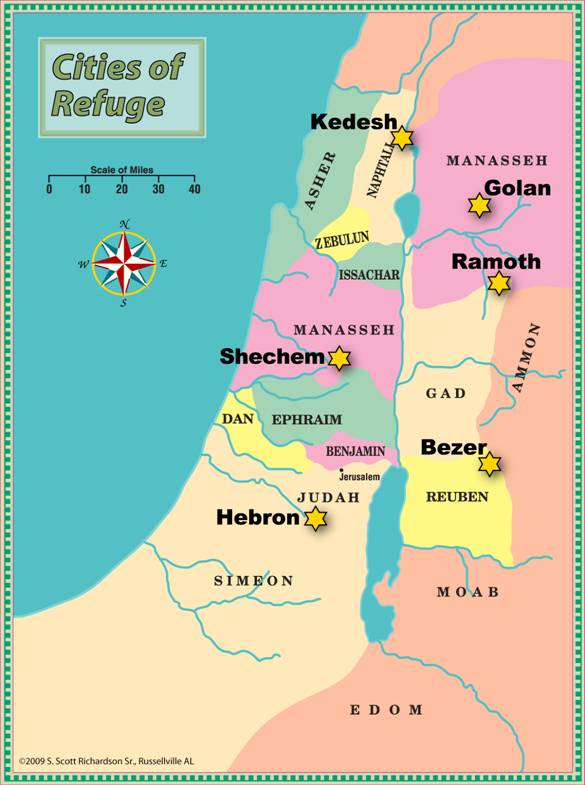
A Place of Refuge and Atonement

And the Lord spoke to Moses, saying, 10 “Speak to the people of Israel and say to them, When you cross the Jordan into the land of Canaan, 11 then you shall select cities to be cities of refuge for you, that the manslayer who kills any person without intent may flee there. 12 The cities shall be for you a refuge from the avenger, that the manslayer may not die until he stands before the congregation for judgment. 13 And the cities that you give shall be your six cities of refuge. 14 You shall give three cities beyond the Jordan, and three cities in the land of Canaan, to be cities of refuge. 15 These six cities shall be for refuge for the people of Israel, and for the stranger and for the sojourner among them, that anyone who kills any person without intent may flee there.

16 “But if he struck him down with an iron object, so that he died, he is a murderer. The murderer shall be put to death. 17 And if he struck him down with a stone tool that could cause death, and he died, he is a murderer. The murderer shall be put to death. 18 Or if he struck him down with a wooden tool that could cause death, and he died, he is a murderer. The murderer shall be put to death. 19 The avenger of blood shall himself put the murderer to death; when he meets him, he shall put him to death. 20 And if he pushed him out of hatred or hurled something at him, lying in wait, so that he died, 21 or in enmity struck him down with his hand, so that he died, then he who struck the blow shall be put to death. He is a murderer. The avenger of blood shall put the murderer to death when he meets him.

22 “But if he pushed him suddenly without enmity, or hurled anything on him without lying in wait 23 or used a stone that could cause death, and without seeing him dropped it on him, so that he died, though he was not his enemy and did not seek his harm, 24 then the congregation shall judge between the manslayer and the avenger of blood, in accordance with these rules. 25 And the congregation shall rescue the manslayer from the hand of the avenger of blood, and the congregation shall restore him to his city of refuge to which he had fled, and he shall live in it until the death of the high priest who was anointed with the holy oil. 26 But if the manslayer shall at any time go beyond the boundaries of his city of refuge to which he fled, 27 and the avenger of blood finds him outside the boundaries of his city of refuge, and the avenger of blood kills the manslayer, he shall not be guilty of blood. 28 For he must remain in his city of refuge until the death of the high priest, but after the death of the high priest the manslayer may return to the land of his possession. 29 And these things shall be for a statute and rule for you throughout your generations in all your dwelling places.

30 “If anyone kills a person, the murderer shall be put to death on the evidence of witnesses. But no person shall be put to death on the testimony of one witness. 31 Moreover, you shall accept no ransom for the life of a murderer, who is guilty of death, but he shall be put to death. 32 And you shall accept no ransom for him who has fled to his city of refuge, that he may return to dwell in the land before the death of the high priest. 33 You shall not pollute the land in which you live, for blood pollutes the land, and no atonement can be made for the land for the blood that is shed in it, except by the blood of the one who shed it. 34 You shall not defile the land in which you live, in the midst of which I dwell, for I the Lord dwell in the midst of the people of Israel.”  Numbers 35:9-34 ESV

The cities of refuge. God instructed Moses to set aside six different cities, located throughout the land of Canaan, and designate them as cities of refuge. Occupied by Levites, these cities were strategically placed and easily accessible from all parts of the land. Their purpose was to provide a safe haven to anyone who had committed unpremeditated murder.  If an Israelite inadvertently and unintentionally caused the death of a fellow Israelite, he could flee to one of these cities and seek refuge from the avenger.

In that cultural context, It was up to the relatives of a murder victim to seek vengeance. This “blood avenger” (Numbers 35:19) was not just free to kill the murdered, he was obligated to do so (Numbers 35:19, 21). It was his duty. He was called the “avenger of blood.”

But in order to prevent the blood avenger from taking the life of an innocent individual, the cities of refuge were established. If an Israelite accidentally killed someone else, he could run to one of these cities and seek refuge. As long as he remained there, he would be protected from the blood avenger. It was up to the residents of the city (Levites) to help determine the guilt of innocence of the accused. If it was determined that his actions were premeditated and intentional, he was to be handed over to the blood avenger for retribution. But if he was deemed innocent of having committed voluntary manslaughter, he would be allowed to remain in the city of refuge until the high priest died. In essence, the city became his prison. If he ever left, he would be guilty of violating his sentence and the blood avenger could seek his death.

All of this sounds very barbaric to us, but you have to remember that Israel had no police force for enforcing laws or dispensing justice. According to the Mosaic Law, murder was a crime worthy of death. The guilty must be punished. But involuntary manslaughter was to be dealt with in a different manner. That is why the cities were established. God was protecting the innocent.

God dwelt among His people, and His very presence demanded that they live set-apart lives. His holiness and righteousness required that they live differently and distinctively, abiding by a stringent set of rules and regulations that governed their behavior and interactions with one another. And yet God knew their weaknesses and fully understood their incapacity to live up to His exacting standards. The entire sacrificial system was designed to deal with their ongoing struggle with sin.

To unjustly execute the innocent would have been as evil in God’s sight as to excuse the guilty. So He provided those who had committed involuntary manslaughter a means for finding justice. They could live in the city of refuge and enjoy permanent protection from the “blood avenger.” They were still guilty of murder, but their lives were spared. The city of refuge became their prison until the day that the high priest died. Then his death would serve as an atonement for their sin, providing them with release from their guilt and the right to live among their kinsmen again – innocent and free.

The ongoing presence of God was constantly in jeopardy due to the sinfulness of men. Yet He provided them with countless means by which they could receive restoration and assure His continued existence among them. It was God who set them apart. Without them, they would have been nothing. His presence provided them their distinctiveness. And it was their sin that threatened their uniqueness as His chosen people.

From the day that Adam and Eve sinned in the garden, God has been actively and aggressively seeking to restore order to the chaos created by their actions. Their sin brought disorder, disobedience, and, ultimately, death into the world. It wasn’t long after Eve listened to the lies of the enemy and convinced her husband to join her in rejecting God’s word, that murder showed up on the scene. One of Eve’s own sons killed his brother. Death entered the scene. And disease would not be far behind it. Their bodies would undergo the inevitable effects of aging. Sin would increase. Rebellion against God would run rampant. And yet God continued to reach out to mankind, offering a form of refuge from the consequences of sin.

In a real sense, God’s choosing of Abraham made him and his descendants a “city of refuge” for mankind. The people of Israel would become a single source of God’s abiding presence and divine protection from the guilt and condemnation of sin. It was among the children of God that men could find access to their Creator. It was through the law of God that men could learn of the divine requirements and expectations of a holy God. It was through the sacrificial system instituted by God that men could find atonement for their sins and freedom from the penalty of death they so justly deserved. God had provided a city of refuge among the sons of men. And eventually, God would send His own Son as the ultimate and final means of refuge and escape from sin’s destructive power and God’s righteous judgment.

The Scriptures make it painfully clear that all men are guilty of sin.

For all have sinned and fall short of the glory of God.– Romans 3:23 ESV

Surely there is not a righteous man on earth who does good and never sins. – Ecclesiastes 7:20 ESV

Who can say, “I have made my heart pure; I am clean from my sin?” – Proverbs 20:9 ESV

We are all infected and impure with sin. When we display our righteous deeds, they are nothing but filthy rags. – Isaiah 64:6 NLT

The law of God was given to reveal to men the reality and gravity of their sins. Like a speed limit sign on the side of the freeway, the law provided a constant reminder of man’s proclivity for disobedience and rebellion. Our guilt is unquestionable and undeniable. Sinful humanity stands condemned before a holy and righteous God due to the sinful nature passed down to them from Adam and Eve. All are guilty and all stand condemned. And the very presence of disease and death in our world is an outward reminder of the reality of sin’s devastating consequences.

In the case of someone seeking refuge in one of these cities, if they remained there until the high priest died, their sin was forgiven. They walked away free and clear. The death of the high priest had atoning value just as Jesus’ death for us atones for our sins. No one could accuse this person once the high priest had died. And we stand as unaccused and uncondemned because of what Christ has done for us.

Who dares accuse us whom God has chosen for his own? Will God? No! He is the one who has given us right standing with himself. Who then will condemn us? Will Christ Jesus? No, for he is the one who died for us and was raised to life for us and is sitting at the place of highest honor next to God, pleading for us. – Romans 8:33-34 NLT

We can take refuge in Christ. He is our high priest and He has died for us. His death has set us free once and for all.

God also bound himself with an oath, so that those who received the promise could be perfectly sure that he would never change his mind. So God has given us both his promise and his oath. These two things are unchangeable because it is impossible for God to lie. Therefore, we who have fled to him for refuge can take new courage, for we can hold on to his promise with confidence. This confidence is like a strong and trustworthy anchor for our souls. It leads us through the curtain of heaven into God’s inner sanctuary. Jesus has already gone in there for us. He has become our eternal High Priest in the line of Melchizedek. – Hebrews 6:17-20 NLT

English Standard Version (ESV) The Holy Bible, English Standard Version. ESV® Permanent Text Edition® (2016). Copyright © 2001

New Living Translation (NLT) Holy Bible, New Living Translation, copyright © 1996, 2004, 2015 by Tyndale House Foundation. Used by permission of Tyndale House Publishers Inc., Carol Stream, Illinois 60188. All rights reserved.

The Law, Love, and Justice

1 The wicked flee when no one pursues,
    but the righteous are bold as a lion.
When a land transgresses, it has many rulers,
    but with a man of understanding and knowledge,
    its stability will long continue.
A poor man who oppresses the poor
    is a beating rain that leaves no food.
Those who forsake the law praise the wicked,
    but those who keep the law strive against them.
Evil men do not understand justice,
    but those who seek the Lord understand it completely.
Better is a poor man who walks in his integrity
    than a rich man who is crooked in his ways.
The one who keeps the law is a son with understanding,
    but a companion of gluttons shames his father.
Whoever multiplies his wealth by interest and profit
    gathers it for him who is generous to the poor.
If one turns away his ear from hearing the law,
    even his prayer is an abomination.
10 Whoever misleads the upright into an evil way
    will fall into his own pit,
    but the blameless will have a goodly inheritance.
11 A rich man is wise in his own eyes,
    but a poor man who has understanding will find him out.
12 When the righteous triumph, there is great glory,
    but when the wicked rise, people hide themselves.
13 Whoever conceals his transgressions will not prosper,
    but he who confesses and forsakes them will obtain mercy.
14 Blessed is the one who fears the Lord always,
    but whoever hardens his heart will fall into calamity.
– Proverbs 28:1-14 ESV

This Proverb, while a collection of independent wise sayings, does have somewhat of a theme. Most of the verses can be tied right back to the Ten Commandments, the original Law of God given on Mount Sinai to Moses during the days of the Exodus. Here they are:

  1. You must not have any other god but me.
  2. You must not make for yourself an idol of any kind or an image of anything in the heavens of on the earth or in the sea.
  3. You must not misuse the name of the Lord your God.
  4. Remember to observe the Sabbath day by keeping it holy.
  5. Honor your father and mother.
  6. You must not murder.
  7. You must not commit adultery.
  8. You must not steal.
  9. You must not testify falsely against your neighbor.
  10. You must not covet.

If you notice, the first four regulate our relationship with God, while the last six deal with our human relationships. Now if you go back to Proverbs 28, you will see that most, if not all, of these verses have to do with our outlook on the law of God and its impact on our relationships with others.

Throughout this Proverb, virtually every verse contrasts the wicked and the righteous. One group rejects the law of God while the other embraces and obeys it. But verse nine contains a sobering warning.

God detests the prayers of a person who ignores the law. – Proverbs 28:9 NLT

This wisdom saying should grab our attention and make us question what it means to ignore the law. But what law is he talking about, and what does it mean to ignore it? You and I certainly don’t want to find ourselves in the position where God detests our prayers. We don’t want to find ourselves crying out to God only to have Him refuse to hear or answer our prayers because of the fact that we have ignored His law.

To reject the law is to praise the wicked;
    to obey the law is to fight them. – Proverbs 28:4 NLT

God’s law is the standard for all life on this planet. The rules that govern how we are relate to Him and how we should treat one another are contained in the law. It gives us the basis for all our interactions. Without a standard, everyone does what is in their own best interests and according to their own set of self-centered rules. It leads to corruption, graft, greed, abuse, neglect of the poor, and justification of all kinds of harmful actions.

We are warned, “Those who trust their own insight are foolish, but anyone who walks in wisdom is safe” (Proverbs 28:26 NLT). To walk in wisdom is to live your life according to God’s terms, in obedience to His law or standards for life. God cares deeply about our human relationships. He wants us to treat one another with care, concern, respect, dignity, love, and honor – because all mankind is made in His image. But when we reject God’s law and disrespect our parents, murder out of hatred or for personal gain, take another man’s wife, steal what belongs to someone else, discredit another human being, or desire what they have more than we desire a relationship with them, we are fools. We lack wisdom because we are rejecting the conditions for life given to us by God Himself. It results in “moral rot” as described in verse 2. It leads to abuse and oppression. It becomes contagious, leading even good people to do bad things. It causes men to justify their actions and reject accountability for the wrongs they commit.

The Ten Commandments begin with four statements about honoring God. We are to treat Him with respect, dignity, and honor at all times. As Proverbs 1:7 says, “Start with God – the first step in learning is bowing down to God; only fools thumb their noses at such wisdom and learning” (Proverbs 1:7 MSG).

Our relationships with men are all based on and dependent upon our relationship with God. Wise rulers are those who know God and honor Him with their lives. They live according to His law and don’t rule based on their own set of subjective standards. Wise parents are those whose households are God-honoring, where He is lifted up and held as the standard for life. Wise young people obey the law because they love God. Wise vendors don’t try to take advantage of their customers in order to make a buck, because they love God and know that dishonesty is dishonoring to Him.

The wise commit sins, but immediately confess them to God because they know He sees all and they value their relationship with Him more than any pleasure their sin may provide.

Loving the law is simply loving God. It is obeying His Word because you trust Him. It is doing what He says because You recognize that He knows best. And when you love God and keep His law, you end up doing what is just and right.

Evil people don’t understand justice,
    but those who follow the Lord understand completely.
Proverbs 28:5 NLT

The opening line of the United State’s pledge of allegiance contains the four simple words: “And justice for all.” Many of us remember reciting them each day in the classroom. But what do they mean? What would justice for all look like and does it ever really happen? Verse give tells us that justice is understood only by those who follow the Lord. Those who are wicked or simply choose to reject the way of the Lord have no concept of godly justice. They tend to see it from their own perspective and define it for their own good. But according to the NET Study Bible, the Hebrew word for justice used in this verse (mishpat) refers to the legal rights of people, to decisions that are equitable in the community. It has a communal aspect to it.

Justice is not just about MY rights, but the rights of all. And those who follow the Lord will understand justice from that perspective because God is concerned about justice for all. He is concerned for the rights and welfare of the poor, needy, disenfranchised, neglected, abused, and all those who lack representation and protection. God cares about the alien and foreigner, the widow and the orphan, the slave and the servant, the falsely accused, and the unfairly treated.

When asked what the greatest commandment was, Jesus simply said, “‘You must love the Lord your God with all your heart, all your soul, and all your mind,’ This is the first and greatest commandment. The second is equally important: ‘Love your neighbor as yourself.’ The entire law and all the demands of the prophets are based on these two commandments” (Matthew 22:37-40 NLT).

Love God. Love others. There it is. We are just as obligated to love others as we are to love God because to fail to express love to those made in the likeness and image of God is a slap to the face of their creator.

One of the most effective ways of expressing love to others is by assuring that they receive justice. It is making sure that their rights are protected and their status as one of God’s creatures is maintained. Justice is not just an arbitrary requirement placed on man by God. It is part of His very nature, His character. God is just and righteous and always does what is right – every time, all the time. So, God expects His people to love justice just as much as He does. He requires them, as His representatives, to make sure that all men receive justice. One way we do this is by ensuring that just and righteous men and women are elected to high offices in our nation. Otherwise, we will experience exactly what Proverbs 28 warns us about.

A wicked ruler is as dangerous to the poor
    as a roaring lion or an attacking bear. – Proverbs 28:15 NLT

A ruler with no understanding will oppress his people,
    but one who hates corruption will have a long life. – Proverbs 28:16 NLT

When the wicked take charge, people go into hiding. – Proverbs 28:12 NLT

Justice is an expression of God’s character, while injustice is anti-God. Ignoring the needs, rights, and concerns of others is selfish and, ultimately, sinful. It is ungodly, unrighteous, unloving, un-Christlike, and unacceptable in the life of a believer. To love others as we love ourselves is to do whatever we can to protect them, provide for them, and speak up for them when necessary.

Injustice is all around us because sin and Satan thrive on it. The enemy preys on the weak, pitting the strong against them. His objective is to divide and conquer. He strives to create disunity rather than community. He breeds selfishness and self-centeredness. He thrives in an atmosphere filled with narcissism and self-gratification. He lulls mankind into a self-centered stupor that becomes insensitive and, eventually, oblivious to the injustice taking place all around us.

But God calls for justice. He demands love expressed in actions. He calls us to love others as much as we love Him, as an expression of our love for Him. That’s quite a calling. And it’s one we have ignored for far too long.

English Standard Version (ESV) The Holy Bible, English Standard Version. ESV® Permanent Text Edition® (2016). Copyright © 2001 by Crossway Bibles, a publishing ministry of Good News Publishers.

New Living Translation (NLT) Holy Bible, New Living Translation, copyright © 1996, 2004, 2015 by Tyndale House Foundation. Used by permission of Tyndale House Publishers Inc., Carol Stream, Illinois 60188. All rights reserved.

New English Translation (NET)NET Bible® copyright ©1996-2017 by Biblical Studies Press, L.L.C. http://netbible.com All rights reserved.

The High Cost of Getting Your Own Way

1 Now Naboth the Jezreelite had a vineyard in Jezreel, beside the palace of Ahab king of Samaria. And after this Ahab said to Naboth, “Give me your vineyard, that I may have it for a vegetable garden, because it is near my house, and I will give you a better vineyard for it; or, if it seems good to you, I will give you its value in money.” But Naboth said to Ahab, “The Lord forbid that I should give you the inheritance of my fathers.” And Ahab went into his house vexed and sullen because of what Naboth the Jezreelite had said to him, for he had said, “I will not give you the inheritance of my fathers.” And he lay down on his bed and turned away his face and would eat no food.

But Jezebel his wife came to him and said to him, “Why is your spirit so vexed that you eat no food?” And he said to her, “Because I spoke to Naboth the Jezreelite and said to him, ‘Give me your vineyard for money, or else, if it please you, I will give you another vineyard for it.’ And he answered, ‘I will not give you my vineyard.’” And Jezebel his wife said to him, “Do you now govern Israel? Arise and eat bread and let your heart be cheerful; I will give you the vineyard of Naboth the Jezreelite.”

So she wrote letters in Ahab’s name and sealed them with his seal, and she sent the letters to the elders and the leaders who lived with Naboth in his city. And she wrote in the letters, “Proclaim a fast, and set Naboth at the head of the people. 10 And set two worthless men opposite him, and let them bring a charge against him, saying, ‘You have cursed God and the king.’ Then take him out and stone him to death.” 11 And the men of his city, the elders and the leaders who lived in his city, did as Jezebel had sent word to them. As it was written in the letters that she had sent to them, 12 they proclaimed a fast and set Naboth at the head of the people. 13 And the two worthless men came in and sat opposite him. And the worthless men brought a charge against Naboth in the presence of the people, saying, “Naboth cursed God and the king.” So they took him outside the city and stoned him to death with stones. 14 Then they sent to Jezebel, saying, “Naboth has been stoned; he is dead.”

15 As soon as Jezebel heard that Naboth had been stoned and was dead, Jezebel said to Ahab, “Arise, take possession of the vineyard of Naboth the Jezreelite, which he refused to give you for money, for Naboth is not alive, but dead.” 16 And as soon as Ahab heard that Naboth was dead, Ahab arose to go down to the vineyard of Naboth the Jezreelite, to take possession of it. 1 Kings 21:1-16 ESV

Chapter 20 ended with the statement: And the king of Israel went to his house vexed and sullen and came to Samaria” (1 Kings 20:43 ESV). The author used two Hebrew words, sar and zāʿēp̄, to describe Ahab’s state of mind. And like most words in the Hebrew language, these two words carry a range of meanings. When we read that Ahab was “vexed and sullen,” it conjures up images of an unhappy child who is pouting because he didn’t get his way. But Ahab wasn’t just throwing himself a pity party; he was angry and resentful. And it’s easy to understand the intensity of his emotions when we consider the severity of God’s judgment. Ahab had chosen to spare the life of Ben-hadad so that he could sign a potentially lucrative treaty with him. But this decision was had not been God’s will, and Ahab would suffer greatly for it.

“Because you have let go out of your hand the man whom I had devoted to destruction, therefore your life shall be for his life, and your people for his people.” – 1 Kings 20:42 ESV

With that bit of bad news still ringing in his ears, Ahab had left the Valley of Aphek and returned to his palace in Samaria. When he arrived, he was in a dark mental state. The New English Translation describes him as “bitter and angry.” He deeply resented the punishment meted out to him by God. The Hebrew word sar conveys the idea of a stubborn, almost rebellious resistance to this God-ordained fate. And the word zāʿēp̄ lets the reader know that Ahab was wearing his emotions on his sleeve. His anger was visible. Since he couldn’t take out his anger on God, it spilled over onto all those around him. Even his neighbor, Naboth.

At some point after the victory over the Syrians, Ahab visited his summer palace in Jezreel. One day, while surveying the grounds of his palace, he noticed Naboth’s vineyard, which was located nearby. Seeing that this was fertile land, Ahab determined that it would make a fine spot to plant a garden for his palace. So, he approached Naboth with an offer.

“Since your vineyard is so convenient to my palace, I would like to buy it to use as a vegetable garden. I will give you a better vineyard in exchange, or if you prefer, I will pay you for it.” – 1 Kings 21:2 NLT

But Naboth politely turned down the king’s generous offer, explaining that the land on which the vineyard was located was part of his inheritance. According to Mosaic Law, the Israelites were forbidden to sell the land that God had given to them as their inheritance. The book of Leviticus outlined this divine prohibition against property transactions involving land dedicated to the various tribes of Israel.

“The land must never be sold on a permanent basis, for the land belongs to me. You are only foreigners and tenant farmers working for me.” – Leviticus 25:23 NLT

The book of Numbers provides further clarification concerning God’s ban on the transfer or sale of any of the land He had allotted to the 12 tribes.

The inheritance of the people of Israel shall not be transferred from one tribe to another, for every one of the people of Israel shall hold on to the inheritance of the tribe of his fathers. – Numbers 36:7 NLT

Naboth was simply obeying the law as given by God to Moses. He was legally prohibited from accepting Ahab’s offer. But none of this mattered to Ahab. And Naboth’s firm but polite response produced in Ahab the same effect as God’s earlier warning of judgment.

And Ahab went into his house vexed and sullen because of what Naboth the Jezreelite had said to him – 1 Kings 21:4 ESV

Ahab responded with bitterness and anger. But notice that his anger was not directed at Naboth but at what Naboth had said. When Naboth informed the king that he could not sell him the land, his justification had been based on the law of God. Once again, God had interfered with Ahab’s plans, and it left him a strong sense of resentment and frustration. His anger was with God and His constant intervention into his affairs. Ahab couldn’t even buy a vineyard without running into this ever-present God who seemed to stick His nose into everything. Denied his desire for a garden, Ahab allowed his anger to turn to depression and deep despondency, even refusing to eat.

Concerned about the deteriorating condition of her husband’s mental health, Jezebel asked Ahab for an explanation. But notice the brevity of his reply. Rather than give Jezebel the full context of his conversation with Naboth, he simply states that he made a fair offer that was summarily rebuffed. His recollection of what Naboth said is anything but accurate. He mentions nothing about God’s ban on the sale of tribal land. He simply states that Naboth refused his offer.

Frustrated by her husband’s sullen state and obvious lack of initiative, she accuses him of forgetting who he is and the kind of power he possesses. “Are you the king of Israel or not?” she asks him. From Jezebel’s perspective, Ahab had abdicated his divine rights as the king. He was the sovereign over all of Israel, and he had the power to do whatever he wanted to do. No one, including Naboth, had the right to stand in his way. And to prove it, she implemented a plan to put Naboth in his place and the vineyard in her husband’s possession.

This pagan queen, who had introduced the worship of Baal to the nation of Israel, hired false witnesses to accuse Naboth of cursing the God of Israel. These men were to show up at a fast, held in honor of Yahweh, and declare that Naboth had cursed both God and the king. And Jezebel had pre-arranged with the elders of Jezreel that they would immediately stone Naboth to death for this fictitious crime.

And everything went just as Jezebel had planned. Naboth was falsely accused and executed. When the elders of Jezreel informed Jezebel that Naboth was dead, she immediately shared the good news with Ahab.

“Arise, take possession of the vineyard of Naboth the Jezreelite, which he refused to give you for money, for Naboth is not alive, but dead.” – 1 Kings 21:15 ESV

Notice that Ahab asks for no explanations. He doesn’t ask his wife a single question concerning Naboth’s well-timed death. He simply got out of bed, put on his royal robes, and took possession of the land that would soon be his new garden. He got what he wanted and didn’t seem to care how it had happened. But Jezebel’s actions had only made things worse. She had falsely accused an innocent man and had orchestrated his unlawful execution. And she had still violated God’s law concerning the land inheritance. According to Mosaic Law, Naboth’s land would have passed on to his descendants. God had made it clear that the land He had given to the tribes as their inheritance was to remain within their possession.

“…give the following instructions to the people of Israel: If a man dies and has no son, then give his inheritance to his daughters. And if he has no daughter either, transfer his inheritance to his brothers. If he has no brothers, give his inheritance to his father’s brothers. But if his father has no brothers, give his inheritance to the nearest relative in his clan. This is a legal requirement for the people of Israel, just as the Lord commanded Moses.”  – Numbers 27:8-11 NLT

Jezebel’s murder of Naboth was wrong on every level. She had violated a range of divine decrees to get her husband what he wanted. Her blind ambition resulted in unconscionable behavior that would only exacerbate God’s judgment against her husband. Ahab had his vineyard. Jezebel had her husband back. But their joy would soon turn to sorrow. They had both gotten what they wanted, but their personal achievements would come with a high price. Ahab’s new garden, while free, would cost him dearly. And Jezebel’s plot to murder Naboth, while successful, would come with a hefty price tag for which she would pay dearly.

English Standard Version (ESV) The Holy Bible, English Standard Version. ESV® Permanent Text Edition® (2016). Copyright © 2001 by Crossway Bibles, a publishing ministry of Good News Publishers.

New Living Translation (NLT) Holy Bible, New Living Translation, copyright © 1996, 2004, 2015 by Tyndale House Foundation. Used by permission of Tyndale House Publishers Inc., Carol Stream, Illinois 60188. All rights reserved.

The Message (MSG)Copyright © 1993, 1994, 1995, 1996, 2000, 2001, 2002 by Eugene H. Peterson