Why Are You Here?

4 But he himself went a day’s journey into the wilderness and came and sat down under a broom tree. And he asked that he might die, saying, “It is enough; now, O LORD, take away my life, for I am no better than my fathers.” 5 And he lay down and slept under a broom tree. And behold, an angel touched him and said to him, “Arise and eat.” 6 And he looked, and behold, there was at his head a cake baked on hot stones and a jar of water. And he ate and drank and lay down again. 7 And the angel of the LORD came again a second time and touched him and said, “Arise and eat, for the journey is too great for you.” 8 And he arose and ate and drank, and went in the strength of that food forty days and forty nights to Horeb, the mount of God.

9 There he came to a cave and lodged in it. And behold, the word of the LORD came to him, and he said to him, “What are you doing here, Elijah?” 10 He said, “I have been very jealous for the LORD, the God of hosts. For the people of Israel have forsaken your covenant, thrown down your altars, and killed your prophets with the sword, and I, even I only, am left, and they seek my life, to take it away.” 11 And he said, “Go out and stand on the mount before the LORD.” And behold, the LORD passed by, and a great and strong wind tore the mountains and broke in pieces the rocks before the LORD, but the LORD was not in the wind. And after the wind an earthquake, but the LORD was not in the earthquake. 12 And after the earthquake a fire, but the LORD was not in the fire. And after the fire the sound of a low whisper. 13 And when Elijah heard it, he wrapped his face in his cloak and went out and stood at the entrance of the cave. And behold, there came a voice to him and said, “What are you doing here, Elijah?” 14 He said, “I have been very jealous for the LORD, the God of hosts. For the people of Israel have forsaken your covenant, thrown down your altars, and killed your prophets with the sword, and I, even I only, am left, and they seek my life, to take it away.” – 1 Kings 19:4-14 ESV

While everything had gone exceptionally well for Elijah on Mount Carmel, he soon found himself disappointed in how things turned out. His challenge of the false prophets of Baal had proven to be successful, and, from the immediate reaction of the people, it appeared that revival had come to the land. This spiritual renewal of the people seemed to be symbolized by the torrential rain that had brought an end to the three-and-a-half years of drought. It appeared as if the nation was headed in the right direction. As a prophet of God, Elijah longed to see the repentance and restoration of the people of God.

But upon his triumphant return to Jezreel, he was met with intense opposition from the very woman who had begun all this trouble in Israel. Queen Jezebel was incensed when she heard what Elijah had done to the 450 prophets of her god. So, she sent Elijah a life-threatening message.

“So may the gods do to me and more also, if I do not make your life as the life of one of them by this time tomorrow.” – 1 Kings 19:2 ESV

She swore an oath to her gods that she would avenge the deaths of the prophets of Baal by killing Elijah. She gave the prophet less than 24 hours to live and vowed to sacrifice her own life if she failed to take his life. Despite the abject failure of her god to defeat Yahweh on Mount Carmel, she was still very much a believer. She exhibited no remorse or repentance but instead warned Elijah that while he had won the battle on Mount Carmel, the war was far from over. She was willing to fight to the death – either his or her own.  And Elijah did not take this news well.

…he was afraid, and he arose and ran for his life and came to Beersheba, which belongs to Judah, and left his servant there. – 1 Kings 19:3 ESV

The man who had run from Mount Carmel to Jezreel after his victory over the prophets of Baal was now running for his life. But this time, he was powered by fear, not faith. And Elijah didn’t stop running until he had reached Beersheba, the last town of any size in the southernmost region of Judah. Then, leaving his servant behind in the city, Elijah traveled another day’s journey into the wilderness, where he finally stopped to rest.

In a state of deep depression and disillusionment, Elijah asked God to take his life. Since Ahab and Jezebel remained fully committed to their false gods, Elijah had concluded that his prophetic mission had been an abysmal failure. There would be no revival in Israel as long as those two wielded all the power and influence over the people. They were calling the shots and determining the nation’s religious affiliation.

Elijah had run out of faith and energy. He was physically, emotionally, and spiritually spent. In his despondent state, he cried out to God, saying, “I have had enough, LORD.…Take my life, for I am no better than my ancestors who have already died” (1 Kings 19:4 NLT). Exhausted, he fell asleep. But he was soon awakened by an angel who commanded him to eat. There beside him was a loaf of bread and a jar of water. Rather than taking Elijah’s life, Yahweh provided his faith-famished prophet with sustenance, miraculously delivered by the hand of an angel. Elijah may have decided that he was done, but God was not done with Elijah. The prophet ate and fell back asleep. 

However, his rest was disturbed yet again by a second visit from the angel, who had brought more food and a message.

“Get up and eat some more, or the journey ahead will be too much for you.” – 1 Kings 19:7 NLT

Elijah’s plan had been to die alone in the wilderness, but Yahweh informed His disillusioned prophet that he had not yet reached his final destination. He had run, but not far enough. When Elijah abruptly fled Jezreel, he did so because he thought his life was over. Since Jezebel had vowed to kill him, Elijah determined to have Yahweh take his life. But the LORD had other plans. He sent Elijah on a 40-day journey further south, all the way to Mount Sinai. The food the angel provided miraculously sustained Elijah for this long and arduous journey.

…the food gave him enough strength to travel forty days and forty nights to Mount Sinai, the mountain of God. – 1 Kings 19:8 ESV

This trip should have taken no more than 15-20 days on foot, but Elijah found himself wandering in the wilderness for 40 days and nights. This number is significant because it corresponds to the 40 years that the disobedient Israelites had spent wandering in the wilderness. When they failed to obey God and enter the land of Canaan (Numbers 13-14), He doomed them to spend the next 40 years in the wilderness of Sinai, until that disobedient generation died off.

So the Lord’s anger burned against Israel, and He made them wander in the wilderness for forty years, until the entire generation of those who had done evil in the sight of the Lord came to an end. – Numbers 32:13 NLT

When they had heard the report of the spies that the land of Canaan was full of giants and well-fortified cities, the people of Israel refused to trust God and made plans to return to Egypt.

“If only we had died in Egypt, or even here in the wilderness!” they complained. “Why is the LORD taking us to this country only to have us die in battle? Our wives and our little ones will be carried off as plunder! Wouldn’t it be better for us to return to Egypt?” – Numbers 14:2-3 NLT

Now, centuries later, Elijah, the prophet of God, had chosen death in the wilderness rather than face the “giants” in his day. He had determined that Jezebel was too big for God. But Yahweh ordered Elijah to go to the very place where He had revealed Himself to the people of Israel. It had been at Mount Sinai that God gave His law to Moses. It had been on Mount Sinai that God displayed His glory and demonstrated His unparalleled power.

So it came about on the third day, when it was morning, that there were thunder and lightning flashes and a thick cloud over the mountain and a very loud trumpet sound, so that all the people who were in the camp trembled. And Moses brought the people out of the camp to meet God, and they stood at the foot of the mountain. – Exodus 19:16-17 NLT

When Yahweh had safely sequestered Elijah in the recesses of a cave, He asked His doubting prophet a question: “What are you doing here, Elijah?” (1 Kings 19:9 ESV). He wanted Elijah to explain the motivation behind his most recent actions, and the prophet responded with a pitiful portrait of his Don-Quixote-like quest to defeat the enemies of God. He deemed himself the last man standing, the sole survivor of an ill-fated battle against the forces of evil.

“I have zealously served the LORD God Almighty. But the people of Israel have broken their covenant with you, torn down your altars, and killed every one of your prophets. I am the only one left, and now they are trying to kill me, too.” – 1 Kings 19:10 NLT

Elijah threw himself a pity party and invited Yahweh to attend, but the LORD was not interested in celebrating Elijah’s accomplishments or validating his woe-is-me mentality. Instead, God instructed His despondent prophet to step out of the cave and into the shadow of Mount Sinai. As Elijah stood at the base of the mountain, God revealed Himself. At first, He displayed His glory in the form of a fierce windstorm so mighty that it blew boulders off the face of the mountain. This dramatic display was followed by a massive earthquake that shook the ground under Elijah’s feet. Finally, Elijah watched as the peak of the mountain was consumed by fire. The pitiful prophet was witnessing the same jaw-dropping spectacle the Israelites had seen.

Now Mount Sinai was all in smoke because the LORD descended upon it in fire; and its smoke ascended like the smoke of a furnace, and the entire mountain quaked violently. – Exodus 19:18 NLT

But Elijah was to discover that, while these dramatic revelations of God were impressive, they were not meant to represent His presence. The text clearly states that the LORD was not in the wind, the earthquake, or the fire. Yes, they were manifestations of His greatness, but they were not how God was going to speak to His prophet. After the ear-piercing blast of the wind, the earth-shaking rumble of the earthquake, and the roar of the fire, Elijah heard “the sound of a low whisper” ( 1 Kings 19:12 ESV). Evidently, the three previous displays of God’s power had driven Elijah back into the recesses of the cave. But upon hearing the gentle sound of the whisper, he timidly made his way back outside. There, in the quiet of the moment, he heard Yahweh repeat His previous question: “What are you doing here, Elijah?” (1 Kings 19:13 NLT). 

Once again, Elijah gave the same well-rehearsed reply. He reiterated his claim to have zealously served Yahweh and re-emphasized his status as the last faithful Israelite. It was all about him. He alone had zealously served Yahweh. While everyone else in Israel had turned their backs on God, Elijah had remained faithful and fully committed. He was the last line of defense against the forces of evil, and now he was as good as dead.

But where was God? Even after the dramatic displays of divine power on Mount Sinai, Elijah had been unable to get his mind off himself. For some reason, he believed that the future of Israel had been dependent upon him, and he had failed and let God down. Despite his victory over the prophets of Baal, Ahab and Jezebel were firmly entrenched and in charge of the affairs of the nation, or so Elijah thought. From his perspective, all was lost. But God had news for Elijah, and He had plans for Ahab and Jezebel that the defeated prophet knew nothing about.

In a still, small voice, Yahweh was about to whisper His sovereign secret for Israel’s future in the ear of his self-consumed prophet. When God had asked Elijah, “What are you doing here?”, the prophet had given his answer. Now it was God’s turn. He would explain the real purpose behind Elijah’s seeming failure and his fear and flight. Elijah thought it was all over, but Yahweh was just getting started. 

English Standard Version (ESV) The Holy Bible, English Standard Version. ESV® Permanent Text Edition® (2016). Copyright © 2001 by Crossway Bibles, a publishing ministry of Good News Publishers.

New Living Translation (NLT) Holy Bible, New Living Translation, copyright © 1996, 2004, 2015 by Tyndale House Foundation. Used by permission of Tyndale House Publishers Inc., Carol Stream, Illinois 60188. All rights reserved.

One Last Thing

12 Then Solomon said, “The LORD has said that he would dwell in thick darkness. 13 I have indeed built you an exalted house, a place for you to dwell in forever.” 14 Then the king turned around and blessed all the assembly of Israel, while all the assembly of Israel stood. 15 And he said, “Blessed be the LORD, the God of Israel, who with his hand has fulfilled what he promised with his mouth to David my father, saying, 16 ‘Since the day that I brought my people Israel out of Egypt, I chose no city out of all the tribes of Israel in which to build a house, that my name might be there. But I chose David to be over my people Israel.’ 17 Now it was in the heart of David my father to build a house for the name of the LORD, the God of Israel. 18 But the LORD said to David my father, ‘Whereas it was in your heart to build a house for my name, you did well that it was in your heart. 19 Nevertheless, you shall not build the house, but your son who shall be born to you shall build the house for my name.’ 20 Now the LORD has fulfilled his promise that he made. For I have risen in the place of David my father, and sit on the throne of Israel, as the LORD promised, and I have built the house for the name of the LORD, the God of Israel. 21 And there I have provided a place for the ark, in which is the covenant of the LORD that he made with our fathers, when he brought them out of the land of Egypt.” – 1 Kings 8:12-21 ESV

Having completed construction of the Temple and safely secured the Ark of the Covenant within the Holy of Holies, Solomon was ready to formally dedicate the new structure. This was a momentous occasion for the entire nation of Israel, and a large number of them had assembled to witness the official arrival of the Ark, the symbol of God’s presence, power, and mercy. The people of Israel had a vested interest in the new Temple, having witnessed and participated in its construction for more than seven years. By the order of Solomon, tens of thousands of Israelites had been conscripted to serve as laborers, carpenters, masons, cooks, and foremen on this massive project. David had come up with the idea of building a house for God, and Solomon had made it a reality, but the people had supplied the blood, sweat, and tears. It had become a community project for which they took great pride.

Standing before the temple, with the citizens of Israel spread out behind him, Solomon summarized the fruit of their labor.

“O LORD, you have said that you would live in a thick cloud of darkness. Now I have built a glorious Temple for you, a place where you can live forever!” – 1 Kings 8:12-13 NLT

Speaking directly to Yahweh, Solomon affirmed the LORD’s holy and transcendent nature. He paraphrased the words that God had spoken to Moses on Mount Sinai after He had delivered the people of Israel from their captivity in Egypt.

And the LORD said to Moses, “Behold, I am coming to you in a thick cloud, that the people may hear when I speak with you, and may also believe you forever.” – Exodus 19:9 NLT

Moses was told to assemble the people of Israel and prepare them for an encounter with God. Three days later, they gathered at the base of Mount Sinai.

On the morning of the third day there were thunders and lightnings and a thick cloud on the mountain and a very loud trumpet blast, so that all the people in the camp trembled. Then Moses brought the people out of the camp to meet God, and they took their stand at the foot of the mountain. Now Mount Sinai was wrapped in smoke because the LORD had descended on it in fire. The smoke of it went up like the smoke of a kiln, and the whole mountain trembled greatly. – Exodus 19:16-18 ESV

God made Himself visible to the people of Israel, manifesting His presence in the form of a thick, dark cloud that resembled smoke belching from a kiln. This tangible representation of the Almighty was accompanied by a frightening pyrotechnic show that further enhanced His greatness and instilled fear in the people.

Now when all the people saw the thunder and the flashes of lightning and the sound of the trumpet and the mountain smoking, the people were afraid and trembled, and they stood far off and said to Moses, “You speak to us, and we will listen; but do not let God speak to us, lest we die.” Moses said to the people, “Do not fear, for God has come to test you, that the fear of him may be before you, that you may not sin.” The people stood far off, while Moses drew near to the thick darkness where God was. – Exodus 20:18-21 ESV

Forty years later, on the banks of the Jordan River, Moses addressed a new generation of Israelites who were preparing to enter the land of Canaan. He reminded them of that fateful day when God appeared to their fathers and mothers at Mount Sinai.

“You came near and stood at the foot of the mountain, while flames from the mountain shot into the sky. The mountain was shrouded in black clouds and deep darkness. And the LORD spoke to you from the heart of the fire. You heard the sound of his words but didn’t see his form; there was only a voice.” – Deuteronomy 4:11-12 NLT

God had chosen to reveal Himself to His people. Ever since the day they left Egypt, He had traveled before them in the form of a pillar of fire by night and a pillar of cloud by day (Exodus 40:34-38). When God gave Moses instructions to build the Tabernacle, He had also promised to make His presence known by appearing in the form of a cloud over the mercy seat, which sat on top of the Ark, located within the Holy of Holies.

“Tell Aaron your brother not to come at any time into the Holy Place inside the veil, before the mercy seat that is on the ark, so that he may not die. For I will appear in the cloud over the mercy seat.” – Leviticus 16:2 ESV

With the transfer of the Ark of the Covenant into the newly constructed Temple, Solomon was welcoming God into His new home. It was “a glorious Temple” (1 Kings 8:13 NLT), where God would dwell permanently. This was no tent, designed to be erected, taken down, and then transported from one place to another. It was a massive stone structure built to last forever, providing Yahweh with an everlasting dwelling place on earth. And Solomon rejoiced over having been able to play a part in this great endeavor.

“I have indeed built you an exalted house, a place for you to dwell in forever.” – 1 Kings 8:13 ESV

This was not an expression of pride or arrogance on Solomon’s part. He was simply expressing his amazement at having been used by God to make his father’s dream a reality. Turning and addressing the people, Solomon gave them a brief history lesson, outlining the events that had led up to this great day.

While David had conceived the idea of building a permanent house for God, he was not given the privilege of making it a reality. Instead, God would build David’s kingdom, using David’s military prowess to ensure that the nation of Israel had secured all the land that God had promised as their inheritance. David proved successful at his God-given task. He fought many battles, conquered the enemies of Israel, and established the nation as a formidable force in the region. But it was because of David’s bloody conquests that he would be denied the privilege of building a house for God.

“You have killed many men in the battles you have fought. And since you have shed so much blood in my sight, you will not be the one to build a Temple to honor my name. But you will have a son who will be a man of peace. I will give him peace with his enemies in all the surrounding lands. His name will be Solomon, and I will give peace and quiet to Israel during his reign.” – 1 Chronicles 22:8-9 NLT

Solomon reminds the people that, while David’s intentions had been admirable, God had declared that the honor of building the temple would fall to his son. Solomon had been divinely ordained to carry out the wishes of his father.

“You wanted to build the Temple to honor my name. Your intention is good, but you are not the one to do it. One of your own sons will build the Temple to honor me.” – 1 Kings 8:18-19 NLT

Solomon wanted the people to understand that the Temple was not to be a monument to his own greatness. It had been built to honor the name of God and existed for His glory alone. Solomon realized that he sat on the throne of Israel solely at God’s discretion.

“…now the LORD has fulfilled the promise he made, for I have become king in my father’s place, and now I sit on the throne of Israel, just as the LORD promised.” – 1 Kings 8:20 NLT

Solomon makes it clear that his ascendancy to the throne had been ordained and orchestrated by God so that he might build a house for God.

“I have built this Temple to honor the name of the LORD, the God of Israel.” – 1 Kings 8:20 NLT

He had successfully completed the task assigned to him by God. His nearly eight-year-long commitment to this project had come to an end, and now he could rest in the knowledge that the LORD had taken up residence in His new home, assuring Israel of His permanent presence in their midst.

Yet, as will be revealed in Solomon’s prayer of dedication, he knew that God would not actually dwell in the Temple. Yahweh was too great to be confined to a building built by human hands. But Solomon understood that the Temple, in all its glory, would be a constant reminder to the people of Israel of both God’s greatness and nearness. He would go on to ask the God who dwells in heaven to honor His Temple on earth by hearing and answering the prayers offered up in its courts.

“May you watch over this Temple night and day, this place where you have said, ‘My name will be there.’ May you always hear the prayers I make toward this place. May you hear the humble and earnest requests from me and your people Israel when we pray toward this place. Yes, hear us from heaven where you live, and when you hear, forgive.” – 1 Kings 8:29-30 NLT

As Solomon stood gazing at the massive structure he had helped to create, his heart must have swelled with pride. He had spent seven decades and a good portion of the royal treasury to make his father’s dream a reality. But despite the Temple’s impressive facade and its no-expenses-spared interior, he knew the Temple was nothing more than a building built by human hands. Without Yahweh’s presence, it would be a hollow shell, devoid of significance and powerless to provide and protect those who worshiped within its walls. The Temple was always meant to be a means to an end. It was to a meeting place, where the God of heaven would make Himself visible and accessible to those who honored and revered His name.

Years later, Solomon would pen the following words in the only Psalm attributed to him.

Unless the LORD builds a house,
    the work of the builders is wasted.
Unless the LORD protects a city,
    guarding it with sentries will do no good.
It is useless for you to work so hard
    from early morning until late at night,
anxiously working for food to eat;
    for God gives rest to his loved ones. – Psalm 127:1-2 NLT

As proud as he was of his awe-inspiring Temple, Solomon knew his hope was in the LORD. Unless Yahweh showed up, the Holy of Holies would remain empty, and the fate of his kingdom would be in question. Solomon must have recalled the words that Moses spoke to Yahweh in the wilderness of Sinai. While the people of Israel had encamped at the base of Mount Sinai, Moses had grown accustomed to having regular encounters with Yahweh in the tent of meeting. But God had informed Moses it was time to leave Sinai and lead the people to the land of promise. To which Moses responded:

“If you don’t personally go with us, don’t make us leave this place. How will anyone know that you look favorably on me—on me and on your people—if you don’t go with us? For your presence among us sets your people and me apart from all other people on the earth.” – Exodus 33:15-16 NLT

Moses knew that it was Yahweh’s presence that set the people of Israel apart. Without it, they were no different from any other nation. Solomon understood that reality as well. He knew that without Yahweh’s presence, the Temple would mean nothing and his kingdom would amount to nothing. His hope for the future was dependent upon Yahweh showing up and setting His people apart with His presence, power, and provision.

English Standard Version (ESV) The Holy Bible, English Standard Version. ESV® Permanent Text Edition® (2016). Copyright © 2001 by Crossway Bibles, a publishing ministry of Good News Publishers.

New Living Translation (NLT) Holy Bible, New Living Translation, copyright © 1996, 2004, 2015 by Tyndale House Foundation. Used by permission of Tyndale House Publishers Inc., Carol Stream, Illinois 60188. All rights reserved.

Blessing and Obedience

1 Not to us, O LORD, not to us, but to your name give glory,
    for the sake of your steadfast love and your faithfulness!

2 Why should the nations say,
    “Where is their God?”
3 Our God is in the heavens;
    he does all that he pleases.

4 Their idols are silver and gold,
    the work of human hands.
5 They have mouths, but do not speak;
    eyes, but do not see.
6 They have ears, but do not hear;
    noses, but do not smell.
7 They have hands, but do not feel;
    feet, but do not walk;
    and they do not make a sound in their throat.
8 Those who make them become like them;
    so do all who trust in them.

9 O Israel, trust in the LORD!
    He is their help and their shield.
10 O house of Aaron, trust in the LORD!
    He is their help and their shield.
11 You who fear the LORD, trust in the LORD!
    He is their help and their shield.

12 The LORD has remembered us; he will bless us;
    he will bless the house of Israel;
    he will bless the house of Aaron;
13 he will bless those who fear the LORD,
    both the small and the great.

14 May the LORD give you increase,
    you and your children!
15 May you be blessed by the LORD,
    who made heaven and earth!

16 The heavens are the LORD‘s heavens,
    but the earth he has given to the children of man.
17 The dead do not praise the LORD,
    nor do any who go down into silence.
18 But we will bless the LORD
    from this time forth and forevermore.
Praise the LORD! – Psalm 115:1-18 ESV

The anonymous author of this psalm opens with a prayer requesting Yahweh to glorify His own name for His own sake. While this petition sounds selfless and focused on God’s glory alone, the request has an ulterior motive. The psalmist is asking Yahweh to reveal His unfailing love and faithfulness for His chosen people by performing an act of divine intervention. Some unforeseen situation has taken place that requires a literal act of God, and the psalmist unashamedly begs Yahweh to do the impossible.

Whatever their dilemma, the psalmist was willing to let Yahweh get all the glory for delivering His people. They needed help, not credit. In a blatant attempt to appeal to Yahweh’s pride, the psalmist poses a hypothetical scenario in the form of a question.

Why should the nations say,
    “Where is their God?” – Psalm 115:2 ESV

He suggests that any inaction on God’s part will come across as impotence to their pagan neighbors. These idol worshipers will view Israel’s God as powerless in the face of their superior deity. If Yahweh doesn’t do something spectacular and sooner rather than later, their enemies will end up mocking Him and glorifying their own gods.

The psalmist knew that Yahweh was a jealous God who refused to share His glory with anyone or anything else. The prophet Isaiah had recorded Yahweh’s unequivocal perspective on the matter.

“I am the LORD; that is my name! I will not give my glory to anyone else, nor share my praise with carved idols.” – Isaiah 42:8 NLT

When He gave Moses the Ten Commandments on Mount Sinai, Yahweh clarified His views on idol worship.

“You must not have any other god but me.

“You must not make for yourself an idol of any kind, or an image of anything in the heavens or on the earth or in the sea. You must not bow down to them or worship them, for I, the Lord your God, am a jealous God who will not tolerate your affection for any other gods.” – Deuteronomy 5:7-9 NLT

Almost as if he is trying to prove his allegiance to Yahweh, the psalmist provides his personal opinion on the idiocy of idolatry.

Their idols are merely things of silver and gold,
    shaped by human hands.
They have mouths but cannot speak,
    and eyes but cannot see.
They have ears but cannot hear,
    and noses but cannot smell.
They have hands but cannot feel,
    and feet but cannot walk,
    and throats but cannot make a sound.
And those who make idols are just like them,
    as are all who trust in them. – Psalm 115:4-8 NLT

Unlike Yahweh, who is all-powerful and not of this earth, these lifeless manmade statues are mute, blind, and completely impotent. They are the figment of a man’s imagination and the work of his hands, and Yahweh ridiculed the pagan nations that placed their hope in these harmless and helpless symbols of hope.

“Their ways are futile and foolish.
    They cut down a tree, and a craftsman carves an idol.
They decorate it with gold and silver
    and then fasten it securely with hammer and nails
    so it won’t fall over.
Their gods are like
    helpless scarecrows in a cucumber field!
They cannot speak,
    and they need to be carried because they cannot walk.
Do not be afraid of such gods,
    for they can neither harm you nor do you any good.” – Jeremiah 10:3-5 NLT

Yet, the psalmist knew that his own people were guilty of trusting in the false gods of their enemies. Apostasy and idolatry had been an ongoing problem within the nation of Israel from the very beginning. That is why he addresses the Israelites directly and challenges them to place their hope in the one true God: Yahweh.

O Israel, trust the LORD!
    He is your helper and your shield.
O priests, descendants of Aaron, trust the LORD!
    He is your helper and your shield.
All you who fear the LORD, trust the LORD!
    He is your helper and your shield. – Psalm 115:9-11 NLT

He knew Yahweh would not act if His covenant people remained stubbornly disobedient and unfaithful. So, he calls on the people and the priests to repent and return to Yahweh. If they wanted to see the LORD’s salvation, they would need to treat Him with the dignity and honor He deserved.

Long before the people of Israel set foot in the land of Canaan, Yahweh had warned them to remain faithful to the covenant commitment they had made with Him. Moses left nothing to the imagination when he declared the non-negotiable conditions of the covenant.

“The Lord has declared today that you are his people, his own special treasure, just as he promised, and that you must obey all his commands. And if you do, he will set you high above all the other nations he has made. Then you will receive praise, honor, and renown. You will be a nation that is holy to the Lord your God, just as he promised.” – Deuteronomy 26:18-19 NLT

That is the point the psalmist had in mind when he wrote: “The LORD remembers us and will bless us. He will bless the people of Israel and bless the priests, the descendants of Aaron. He will bless those who fear the LORD, both great and lowly” (Psalm 115:12-13 NLT). Obedience brings blessing. If the Israelites wanted to see God act, they would need to obey. If they wanted to experience the blessings of God, they would need to treat Him with honor and respect. 

While this psalm opens up by addressing Yahweh directly, its message is aimed at the disobedient and disengenuous people of God. The entire discussion about idols was for their benefit and intended to remind them of the futility of placing their hope in anything or anyone other than Yahweh, “the LORD, who made heaven and earth” (Psalm 115:15 NLT). 

It seems likely that the psalmist had Deuteronomy 28 in mind when he penned the words of his song.

“If you fully obey the Lord your God and carefully keep all his commands that I am giving you today, the Lord your God will set you high above all the nations of the world. You will experience all these blessings if you obey the Lord your God:

Your towns and your fields
    will be blessed.
Your children and your crops
    will be blessed.
The offspring of your herds and flocks
    will be blessed.
Your fruit baskets and breadboards
    will be blessed.
Wherever you go and whatever you do,
    you will be blessed.” – Deuteronomy 28:1-6 NLT

They had experienced Yahweh’s blessings over the years. But now they faced an uncertain future because they had been unfaithful to their covenant commitments. But it was not too late. They could change their ways. They could reverse course. All that was required was repentance, a rejection of their false gods, and a return to their commitment to worship Yahweh alone. And to drive home his point, the psalmist gives them the choice between death and sold-out devotion to their God.

The dead cannot sing praises to the LORD,
    for they have gone into the silence of the grave.
But we can praise the LORD
    both now and forever!

Praise the Lord! – Psalm 115:17-18 NLT

Continued disobedience would bring God’s judgment and, ultimately, death. But repentance would result in redemption and a restoration of God’s covenant blessings. The choice was theirs.

Father, we love to see You perform powerful acts of deliverance. We like reading the stories that record Your miraculous interventions on behalf of Your people. But we tend to forget that You desire faithfulness from those who bear Your name and benefit from Your goodness. We love the idea of unmerited favor and undeserved grace, but tend to take your favor for granted and cheapen your grace by treating it with contempt. Like the psalmist, we want to see You intervene on our behalf, but we fail to recognize that You still require obedience and sold-out worship from Your people. You remain a jealous God who will not tolerate unfaithfulness or spiritual infidelity. Show me how to live with expectation of Your power while maintaining a passion for Your glory. It seems odd to expect deliverance from the God we so often treat with disinterest. Amen

English Standard Version (ESV) The Holy Bible, English Standard Version. ESV® Permanent Text Edition® (2016). Copyright © 2001 by Crossway Bibles, a publishing ministry of Good News Publishers.

New Living Translation (NLT) Holy Bible, New Living Translation, copyright © 1996, 2004, 2015 by Tyndale House Foundation. Used by permission of Tyndale House Publishers Inc., Carol Stream, Illinois 60188. All rights reserved.

Worthy of Praise

A Psalm of David.

1 Ascribe to the LORD, O heavenly beings,
    ascribe to the LORD glory and strength.
2 Ascribe to the LORD the glory due his name;
    worship the LORD in the splendor of holiness.

3 The voice of the LORD is over the waters;
    the God of glory thunders,
    the LORD, over many waters.
4 The voice of the LORD is powerful;
    the voice of the LORD is full of majesty.

5 The voice of the LORD breaks the cedars;
    the LORD breaks the cedars of Lebanon.
6 He makes Lebanon to skip like a calf,
    and Sirion like a young wild ox.

7 The voice of the LORD flashes forth flames of fire.
8 The voice of the LORD shakes the wilderness;
    the LORD shakes the wilderness of Kadesh.

9 The voice of the LORD makes the deer give birth
    and strips the forests bare,
    and in his temple all cry, “Glory!”

10 The LORD sits enthroned over the flood;
    the LORD sits enthroned as king forever.
11 May the LORD give strength to his people!
    May the LORD bless his people with peace! – Psalm 29:1-11 ESV

How do you honor someone you can’t see? How do you recognize and rejoice in the greatness of an invisible God? That has always been a problem for the people of God. Abraham and Moses had private conversations with God. Abraham even caught glimpses of God’s glory in the burning bush, and Moses was allowed to see God’s back as he passed by him on the mountain. A handful of God’s people have had supernatural glimpses of God’s glory. For the rest of us, we are left with the task of trying to honor and adequately ascribe to God the glory He so richly deserves.

For David, it was pretty simple; he saw God all around him. When he looked into the night sky and saw all the stars and planets, he saw God’s hand.

When I look at the night sky and see the work of your fingers—
    the moon and the stars you set in place—
what are mere mortals that you should think about them,
    human beings that you should care for them? – Psalm 8:3-4 NLT

The heavens reflected God’s glory. After Samuel anointed him to be the next king of Israel, David spent years running from King Saul and hiding in the wilderness. While sitting in the mouth of a cave in the middle of the rugged mountain landscape, he saw more than his fair share of storms. As he witnessed the lightning flash across the night sky and occasionally strike a tree, shattering it in two, and as he listened to the thunder echo off the canyon walls, shaking the ground beneath his feet, David couldn’t help but think of God. To him, the thunder was the very voice of God.

The voice of the Lord splits the mighty cedars;
    the Lord shatters the cedars of Lebanon. – Psalm 29:5 NLT

The voice of the Lord strikes
    with bolts of lightning.
The voice of the Lord makes the barren wilderness quake;
    the Lord shakes the wilderness of Kadesh. – Psalm 29:7-8 NLT

The voice of the Lord twists mighty oaks
    and strips the forests bare. – Psalm 29:9 NLT

His use of anthropomorphic language was an attempt to describe God’s incomparable power. The thought of God speaking was enough to cause David to stand in awe. Seven times in this passage, David refers to God’s voice. He knew that God had spoken the world into existence. He recognized that God’s words carried weight and the sound of His voice was more powerful than the most potent lightning, capable of bringing great destruction or incredible blessing.

David was a king, and he understood the concept of power. He knew that the king’s word was law, but he also knew that, as a man, his power was limited, and his voice only carried so much weight. However, God’s voice was limitless in power, and He alone deserved glory and recognition on the part of both angels and men that He alone was worthy of worship.

Honor the Lord, you heavenly beings;
    honor the Lord for his glory and strength.
Honor the Lord for the glory of his name. – Psalm 29:1-2 NLT

David begins this Psalm by encouraging men and angels to give to God honor for His glory and strength. As far as David was concerned, all beings were to recognize God’s unparalleled majesty and worship Him accordingly. God alone is King. His voice is powerful, and He is worthy of our worship and praise.

This dramatic imagery of God’s thunder-like voice shattering trees and shaking mountains almost portrays Him as unapproachable and inaccessible. It is reminiscent of the language Moses used to describe God’s appearance on Mount Sinai in the wilderness.

On the morning of the third day, thunder roared and lightning flashed, and a dense cloud came down on the mountain. There was a long, loud blast from a ram’s horn, and all the people trembled. Moses led them out from the camp to meet with God, and they stood at the foot of the mountain. All of Mount Sinai was covered with smoke because the Lord had descended on it in the form of fire. The smoke billowed into the sky like smoke from a brick kiln, and the whole mountain shook violently. – Exodus 19:16-18 NLT

The people of Israel stood at the base of Mount Sinai and gazed up at this spectacular demonstration of Yahweh’s divine glory.

“You came near and stood at the foot of the mountain, while flames from the mountain shot into the sky. The mountain was shrouded in black clouds and deep darkness. And the Lord spoke to you from the heart of the fire. You heard the sound of his words but didn’t see his form; there was only a voice.” – Deuteronomy 4:11-12 NLT

And this unforgettable pyrotechnic display made an impression on them.

When the people heard the thunder and the loud blast of the ram’s horn, and when they saw the flashes of lightning and the smoke billowing from the mountain, they stood at a distance, trembling with fear. – Exodus 20:18 NLT

They feared Yahweh’s power and presence. His awe-inspiring demonstration left them shell-shocked and begging Moses to protect them from God’s wrath.

“You speak to us, and we will listen. But don’t let God speak directly to us, or we will die!” – Exodus 20:19 NLT

But Moses assured them that they had nothing to fear.

“…for God has come in this way to test you, and so that your fear of him will keep you from sinning!” – Psaelm 20:20 NLT

God wanted His people to know that He was to be feared but for the right reasons. He was glorious and great and worthy of praise. He was powerful and capable of dispensing judgment on the disobedient and unrighteous. But He wanted to bless His children, not destroy them.

That is why David ends His Psalm with a comforting thought.

The Lord rules over the floodwaters.
    The Lord reigns as king forever.
The Lord gives his people strength.
    The Lord blesses them with peace. – Psalm 29:10-11 NLT

This same glorious, powerful, majestic God gives His people strength and blesses them with security. David knew that it wasn’t he and his mighty men who protected the people of Israel – it was God. God gave them the strength to face their enemies and withstand adversity. It was God who blessed them with peace (shalom). For David, peace was not just an absence of conflict but a sense of completeness and an awareness of well-being and security in adversity.

When a thunderstorm strikes, it’s an opportunity to think about God. As the lightning flashes across the sky, it provides a visible demonstration of God’s glory and greatness. These meteorological displays are God-ordained reminders of His power and worthiness of our awe and wonder. They should remind us of His greatness and cause us to give Him the glory He so richly deserves.

Honor the Lord for the glory of his name.
    Worship the Lord in the splendor of his holiness. – Psalm 29:2 NLT

Father, Your power is all around us, but we fail to recognize it. We just see nature, but we don’t see the God behind it. Give me the eyes of David. Help me to see You all around me. Let me recognize Your presence in all of life. I want to worship You and honor You for who You are. I want to grow in my awareness of Your power and glory. Open my eyes so that I might see You more clearly each day. Amen

English Standard Version (ESV) The Holy Bible, English Standard Version. ESV® Permanent Text Edition® (2016). Copyright © 2001 by Crossway Bibles, a publishing ministry of Good News Publishers.

New Living Translation (NLT) Holy Bible, New Living Translation, copyright © 1996, 2004, 2015 by Tyndale House Foundation. Used by permission of Tyndale House Publishers Inc., Carol Stream, Illinois 60188. All rights reserved.

The King of Glory

A Psalm of David.

1 The earth is the Lord‘s and the fullness thereof,
    the world and those who dwell therein,
2 for he has founded it upon the seas
    and established it upon the rivers.

3 Who shall ascend the hill of the Lord?
    And who shall stand in his holy place?
4 He who has clean hands and a pure heart,
    who does not lift up his soul to what is false
    and does not swear deceitfully.
5 He will receive blessing from the Lord
    and righteousness from the God of his salvation.
6 Such is the generation of those who seek him,
    who seek the face of the God of Jacob. Selah

7 Lift up your heads, O gates!
    And be lifted up, O ancient doors,
    that the King of glory may come in.
8 Who is this King of glory?
    The Lord, strong and mighty,
    the Lord, mighty in battle!
9 Lift up your heads, O gates!
    And lift them up, O ancient doors,
    that the King of glory may come in.
10 Who is this King of glory?
    The Lord of hosts,
    he is the King of glory! Selah – Psalm 24:1-10 ESV

Ultimately, this Psalm is about God. It speaks of His holiness, power, glory, and transcendence. God is not like us. He is transcendent and wholly righteous in all that He does. He is the creator of everything and operates outside the limits of time and space. God is eternal and omnipresent. He sees all, knows all, and is obligated by His holiness to mete out justice to all those who fail to live up to His rigorous and unbending moral standards. Sinful men can’t just come into His presence any time they want – flippantly or arrogantly. They must recognize His holiness and acknowledge their unrighteousness.

David understood and revered the otherness of God. He begins his Psalm with a declaration of God’s status as the maker of the heavens and the earth. He is the uncreated, ever-existent one who exists outside His creation and rules over it from “his holy place” (Psalm 24:3 ESV). From his limited, earth-bound perspective, David envisions God’s abode as a mountain. He is inaccessible and unapproachable. David may be referring to Mount Sinai in the wilderness, where Moses met with God and received the Ten Commandments. Moses described God’s glorious presence on Mount Sinai in startling and intimidating terms.

On the morning of the third day, thunder roared and lightning flashed, and a dense cloud came down on the mountain. There was a long, loud blast from a ram’s horn, and all the people trembled. Moses led them out from the camp to meet with God, and they stood at the foot of the mountain. All of Mount Sinai was covered with smoke because the Lord had descended on it in the form of fire. The smoke billowed into the sky like smoke from a brick kiln, and the whole mountain shook violently. As the blast of the ram’s horn grew louder and louder, Moses spoke, and God thundered his reply. The Lord came down on the top of Mount Sinai and called Moses to the top of the mountain. So Moses climbed the mountain. – Exodus 19:16-20 NLT

Not only was this manifestation of God’s glory frightening to the people of Israel, but they had been warned about the danger of coming anywhere near His presence. In preparation for Yahweh’s appearance on the mountaintop, the people were commanded to purify themselves.

“Go down and prepare the people for my arrival. Consecrate them today and tomorrow, and have them wash their clothing. Be sure they are ready on the third day, for on that day the Lord will come down on Mount Sinai as all the people watch. Mark off a boundary all around the mountain. Warn the people, ‘Be careful! Do not go up on the mountain or even touch its boundaries. Anyone who touches the mountain will certainly be put to death. No hand may touch the person or animal that crosses the boundary; instead, stone them or shoot them with arrows. They must be put to death.’” – Exodus 19:10-13 NLT

God was holy and they were not. They could not just barge into His presence unprepared and with an attitude of entitlement. David seems to have this incident in mind when he asks, “Who may climb the mountain of the Lord? Who may stand in his holy place?” (Psalm 24:3 NLT). And he answers his own questions. 

Only those whose hands and hearts are pure,
    who do not worship idols
    and never tell lies. – Psalm 24:4 NLT

God’s holiness demands that His people be righteous and faithfully keep His commands. David seems to truncate God’s law into two simple imperatives. The first is God-directed, demanding that men worship Yahweh alone, which is in keeping with the first of the Ten Commandments. David’s second injunction is man-oriented, prohibiting the speaking of falsehoods. His simplification of God’s moral code is in keeping with what Jesus said when He was asked what the greatest commandment was.

“‘You must love the Lord your God with all your heart, all your soul, and all your mind.’ This is the first and greatest commandment. A second is equally important: ‘Love your neighbor as yourself.’ The entire law and all the demands of the prophets are based on these two commandments.” – Matthew 22:37-40 NLT

Love God and love others. That was the core issue behind the Mosaic Law, and David seems to have understood that long before Jesus explained it to the Pharisees. Only those who love God and others well “will receive the Lord’s blessing and have a right relationship with God their savior” (Psalm 24:5 NLT). According to David, only those kinds of people can seek God and worship in His presence.

This high view of God runs counter to the current trend of seeing God as our friend or the kindly old grandfather in the sky. Far too many treat God like He’s their personal valet, life coach, or personal trainer. David reminds us that God is not someone who is to be treated lightly or with disdain. Those who seek God and enjoy the benefits of a relationship with Him are those whose deeds are blameless, whose hearts are pure and innocent, and whose lives are not marked by worthless, vain conduct. They recognize that their behavior plays a big part in their ability to enjoy God’s blessings.

God is the King of Glory. He deserves our praise, adoration, worship, wonder, awe, reverence, fear, and respect. He is strong and mighty. He is holy and righteous. He is set apart. He is above all and deserving of all glory and honor. It is God’s separateness and our own sinfulness that makes the cross of Jesus Christ so amazing and life-changing. It is Christ’s sacrificial death on the cross that allows sinful men and women to have access to the very throne room of God. It is what He has done that enables us to share in His righteousness and be viewed by God as holy. We have access to His presence not because WE are blameless and pure in and of ourselves but because Jesus Christ was blameless and pure. Because He took all our sinfulness on Himself at the cross, we were imputed His righteousness. We are seen by God as blameless, innocent, clean, pure, holy, and righteous.

And as if that was not enough, God gave us His Holy Spirit to indwell us and empower us to live holy lives. We can live righteously and rightly – despite the presence of our sinful natures. We can live by the Spirit, or we can live according to the flesh (our sinful nature). We can live in obedience or disobedience. The choice is up to us. Each day we must recognize God’s holiness and our own sinfulness. We must remember what Christ has done for us on the cross. We must rest in the fact that we have the same power that raised Christ from the dead living within us in the form of the Holy Spirit. We can live holy lives. We can say no to sin and yes to God’s transformative power in our lives.

Our daily desire should be to come into God’s presence – recognizing His holiness and our responsibility to treat Him with dignity, honor, and respect. Paul put it this way,

And so, dear brothers and sisters, I plead with you to give your bodies to God because of all he has done for you. Let them be a living and holy sacrifice—the kind he will find acceptable. This is truly the way to worship him. – Romans 12:1 NLT

We belong to Him. He paid for us with His own Son’s life. We are to give our lives to Him and allow Him to transform us into the likeness of His Son – and in so doing, honor Him for who He is – the King of Glory.

The final three verses of this Psalm provide a prophetic vision of the second coming of Jesus Christ when He appears as the King of kings and Lord of lords. He will be Jehovah-Sabaoth, the LORD of Hosts, who returns to earth to complete God’s grand plan of redemption that includes the restoration of all things. David describes the gates of Jerusalem being opened wide so that the LORD of Hosts can enter and rule in righteousness from the throne of David.

These closing verses present a stark contrast to David’s opening questions: “Who may climb the mountain of the Lord? Who may stand in his holy place?” Rather than a man attempting to enter God’s presence based on his own righteousness, this closing scene pictures the King of Glory coming to dwell with men on earth. The righteous one will make His home with us. 

Father, never let me treat You with anything but respect, glory, and honor. Never let me get so casual with You that I lose sight of your holiness. Never let me take for granted that I have access into Your presence because of what Jesus did for me on the cross. You are the King of glory and You deserve my respect, honor, and awe. Amen

English Standard Version (ESV) The Holy Bible, English Standard Version. ESV® Permanent Text Edition® (2016). Copyright © 2001 by Crossway Bibles, a publishing ministry of Good News Publishers.

New Living Translation (NLT) Holy Bible, New Living Translation, copyright © 1996, 2004, 2015 by Tyndale House Foundation. Used by permission of Tyndale House Publishers Inc., Carol Stream, Illinois 60188. All rights reserved.

A Loss of Appetite for God’s Ways

1 And the people complained in the hearing of the Lord about their misfortunes, and when the Lord heard it, his anger was kindled, and the fire of the Lord burned among them and consumed some outlying parts of the camp. 2 Then the people cried out to Moses, and Moses prayed to the Lord, and the fire died down. 3 So the name of that place was called Taberah, because the fire of the Lord burned among them.

4 Now the rabble that was among them had a strong craving. And the people of Israel also wept again and said, “Oh that we had meat to eat! 5 We remember the fish we ate in Egypt that cost nothing, the cucumbers, the melons, the leeks, the onions, and the garlic. 6 But now our strength is dried up, and there is nothing at all but this manna to look at.”

7 Now the manna was like coriander seed, and its appearance like that of bdellium. 8 The people went about and gathered it and ground it in handmills or beat it in mortars and boiled it in pots and made cakes of it. And the taste of it was like the taste of cakes baked with oil. 9 When the dew fell upon the camp in the night, the manna fell with it.

10 Moses heard the people weeping throughout their clans, everyone at the door of his tent. And the anger of the Lord blazed hotly, and Moses was displeased. 11 Moses said to the Lord, “Why have you dealt ill with your servant? And why have I not found favor in your sight, that you lay the burden of all this people on me? 12 Did I conceive all this people? Did I give them birth, that you should say to me, ‘Carry them in your bosom, as a nurse carries a nursing child,’ to the land that you swore to give their fathers? 13 Where am I to get meat to give to all this people? For they weep before me and say, ‘Give us meat, that we may eat.’ 14 I am not able to carry all this people alone; the burden is too heavy for me. 15 If you will treat me like this, kill me at once, if I find favor in your sight, that I may not see my wretchedness.” – Numbers 11:1-15 ESV

The people of Israel were on the move. After nearly a year encamped at the base of Mount Sinai, they had watched as the cloud of God’s presence departed from above the Tabernacle, indicating His desire for them to break camp and continue their journey to the land of Canaan. They followed His instructions and methodically made their way to the wilderness of Paran where the cloud had come to rest.

But it wasn’t long before the obedient children of God became disgruntled and obstinate. Their willingness to follow God’s leading came to an abrupt end as soon as they encountered any kind of discomfort or dissatisfaction, and this was not the first time they had expressed their displeasure with God. A year earlier, when they were leaving Egypt after their release from captivity, they found themselves in an unexpected and highly uncomfortable predicament. After Pharaoh had finally agreed to release them, they followed Moses into the wilderness and arrived on the shore of the Red Sea.

When Pharaoh finally let the people go, God did not lead them along the main road that runs through Philistine territory, even though that was the shortest route to the Promised Land. God said, “If the people are faced with a battle, they might change their minds and return to Egypt.” So God led them in a roundabout way through the wilderness toward the Red Sea. Thus the Israelites left Egypt like an army ready for battle. – Exodus 13:17-18 NLT

God had led them to that very spot. It had been His will that they arrive on the banks of the sea just as Pharaoh and his army were bearing down on them. It seems that Pharaoh had experienced a change of heart and decided to force the Israelites back into slavery. So, when the people found themselves with their backs to the sea and the army of Egypt bearing down on them, they responded to Moses in anger.

“Why did you bring us out here to die in the wilderness? Weren’t there enough graves for us in Egypt? What have you done to us? Why did you make us leave Egypt? Didn’t we tell you this would happen while we were still in Egypt? We said, ‘Leave us alone! Let us be slaves to the Egyptians. It’s better to be a slave in Egypt than a corpse in the wilderness!’” – Exodus 14:11-12 NLT

Yet, despite their complaining, God miraculously delivered them. He had Moses part the waters of the Red Sea and they crossed over on dry ground, and the cloud of God’s presence kept the Egyptians at bay until the very last Israelite had made it to the eastern shore of the sea. Then, as Pharaoh’s army attempted to pursue them, “the waters returned and covered all the chariots and charioteers—the entire army of Pharaoh. Of all the Egyptians who had chased the Israelites into the sea, not a single one survived” (Exodus 14:28 NLT).

Their miraculous crossing and the destruction of the Egyptians made an impact on the Israelites.

When the people of Israel saw the mighty power that the Lord had unleashed against the Egyptians, they were filled with awe before him. They put their faith in the Lord and in his servant Moses. – Exodus 14:31 NLT

Now, more than a year later, it appears that their faith had run out. Once again, they struggled with discontentment concerning God’s will for them. They were not happy with their circumstances and so they began to complain to Moses once again.

Soon the people began to complain about their hardship, and the Lord heard everything they said. – Numbers 11:1 NLT

Their year-long hiatus at Mount Sinai had made them lazy and unprepared for the difficulties of traveling through the wilderness. So, the journey to Paran left them disgruntled and dissatisfied with God’s plan for them. They were unhappy and more than willing to voice their displeasure. But again, this was not the first time the Israelites had become disenchanted with God’s will for them.

Three days after their miraculous crossing of the Red Sea, they found themselves in the desert of Shur, a barren place where water was scarce. When they finally discovered an oasis, its water was contaminated and undrinkable. This disappointing outcome led the people to direct their anger at Moses.

Then the people complained and turned against Moses. “What are we going to drink?” they demanded. – Exodus 15:24 NLT

But God directed Moses to a particular piece of wood that, when thrown in the spring, “made the water good to drink” (Exodus 15:25 NLT). Having temporarily satiated the thirst of His dissatisfied people, God then led them to another oasis “where they found twelve springs and seventy palm trees” (Exodus 15:27 NLT). He provided for all their needs. He even “set before them the following decree as a standard to test their faithfulness to him” (Exodus 15:25 NLT).

“If you will listen carefully to the voice of the Lord your God and do what is right in his sight, obeying his commands and keeping all his decrees, then I will not make you suffer any of the diseases I sent on the Egyptians; for I am the Lord who heals you.” – Exodus 15:26 NLT

All God required of His people was that they remain faithful and obedient. In return, He promised to provide for and protect them; they would never go without. That doesn’t mean they would never experience difficulties along the way. But by trusting God, they would get to see His providential hand providing for their every need.

Yet, a year later, they exhibited the same stubborn tendency to grouse and complain at the slightest inconvenience, and God heard everything they said. As a result, “his anger was kindled, and the fire of the Lord burned among them and consumed some outlying parts of the camp” (Numbers 11:1 ESV). It’s unclear whether anyone actually died in this conflagration or whether it was only meant to get their attention. Whatever this “fire” was, it had its intended effect, producing fear in the hearts of the Israelites.

…the people screamed to Moses for help, and when he prayed to the Lord, the fire stopped. – Numbers 11:2 NLT

But while the fire died down, their complaining continued, and it wasn’t long before another round of grievances made their way to the ears of God. It seems that the foreigners who had chosen to accompany the Israelites when they left Egypt had grown disenchanted with the manna that God had provided for them. One month after the Israelites departed Egypt, the people expressed their displeasure to Moses and Aaron over the lack of food.

“If only the Lord had killed us back in Egypt,” they moaned. “There we sat around pots filled with meat and ate all the bread we wanted. But now you have brought us into this wilderness to starve us all to death.” – Exodus 16:3 NLT

But God heard their complaints and responded with grace and mercy. Rather than sending fire as a punishment for their ungratefulness, He determined to shower them with manna.

“I have heard the Israelites’ complaints. Now tell them, ‘In the evening you will have meat to eat, and in the morning you will have all the bread you want. Then you will know that I am the Lord your God.’” – Exodus 16:12 NLT

God fed them. He miraculously met their physical needs with spiritual food. No one knew exactly what manna was but it provided them with the strength and stamina to continue their journey to the land of Canaan. And God would provide it every day for over 40 years.

So the people of Israel ate manna for forty years until they arrived at the land where they would settle. They ate manna until they came to the border of the land of Canaan. – Exodus 16:35 NLT

Yet, just a year after having left Egypt, the people were complaining about the monotonous menu of manna.

“Oh, for some meat!” they exclaimed. “We remember the fish we used to eat for free in Egypt. And we had all the cucumbers, melons, leeks, onions, and garlic we wanted. But now our appetites are gone. All we ever see is this manna!” – Numbers 11:4-6 NLT

They returned God’s grace and mercy with ungratefulness and dissatisfaction. They didn’t like God’s culinary skills. They wanted a more varied and appetizing selection of menu options. In their faulty imaginations, they recalled enjoying a much more diverse and appealing range of food choices back in Egypt. They conveniently forgot the part about slavery and making bricks without straw. They left out the persecution and pain they had experienced during their years of captivity. Driven by their physical appetites, they conjured up memories of their halcyon days in Egypt – which were nothing more than figments of their imaginations.

And, once again, their complaints reached the ears of Moses and God.

Moses heard all the families standing in the doorways of their tents whining, and the Lord became extremely angry. – Numbers 11:10 NLT

But this time, it’s Moses who displays his anger with the people and expresses his frustration with God.

“Why are you treating me, your servant, so harshly? Have mercy on me! What did I do to deserve the burden of all these people? Did I give birth to them? Did I bring them into the world? Why did you tell me to carry them in my arms like a mother carries a nursing baby? How can I carry them to the land you swore to give their ancestors? Where am I supposed to get meat for all these people? They keep whining to me, saying, ‘Give us meat to eat!’ I can’t carry all these people by myself! The load is far too heavy! If this is how you intend to treat me, just go ahead and kill me. Do me a favor and spare me this misery!” – Numbers 11:11-15 NLT

Moses was not a happy camper. For more than a year he had been attempting to lead a people who were inflexible and incorrigible. Nothing seemed to make them happy, and he was at his wit’s end. He had grown tired of their constant complaining and expressed his frustration to God. The burden of caring for these people had taken its toll and he boldly conveyed his displeasure to God. In fact, Moses seems to blame God for the whole state of affairs. He shakes his fist in Yahweh’s face and, essentially, accuses Him of abandonment. According to Moses, God had placed all the burden of leading the nation of Israel on his back, and he was overwhelmed by it all. He was tapped out and ready to throw in the towel.

Moses was suffering the same condition as the people he claimed to be leading. He had taken his eyes off of the Lord. He no longer recognized the sovereign hand of God over his life and conveniently forgot how the Almighty had provided for all his needs. As a result, he wrongly assumed responsibility for the well-being of God’s people. Moses had forgotten that he was nothing more than a conduit of God’s blessing and not its source. He was responsible for leading them but God was their sole provider and protector.

When God had given the people the manna to eat, He had told them it would be a sign of His power and provision.

“Then you will know that I am the Lord your God.” – Exodus 16:12 NLT

Yet, Moses and the people had lost sight of that fact. Comfort and convenience had taken precedence over their faith in God’s sovereignty and providence. Now that the people had the Tabernacle and the guarantee of God’s presence, it was as if they assumed following God would be a trouble-free experience. But at the first sign of discomfort, they complained. And Moses was brazen enough to demand that God fix the problem or kill him on the spot.

“If this is how you intend to treat me, just go ahead and kill me. Do me a favor and spare me this misery!” – Numbers 11:15 NLT

They all had a lot to learn about God’s providential care and, despite their ongoing displays of ingratitude and unbelief, God would continue to show them mercy and grace. He would even respond to Moses’ bold ultimatum with love and not anger, providing His servant with a plan for lightening the burden of leadership.

English Standard Version (ESV) The Holy Bible, English Standard Version. ESV® Permanent Text Edition® (2016). Copyright © 2001

New Living Translation (NLT) Holy Bible, New Living Translation, copyright © 1996, 2004, 2015 by Tyndale House Foundation. Used by permission of Tyndale House Publishers Inc., Carol Stream, Illinois 60188. All rights reserved.

Follow the Leader

11 In the second year, in the second month, on the twentieth day of the month, the cloud lifted from over the tabernacle of the testimony, 12 and the people of Israel set out by stages from the wilderness of Sinai. And the cloud settled down in the wilderness of Paran. 13 They set out for the first time at the command of the Lord by Moses. 14 The standard of the camp of the people of Judah set out first by their companies, and over their company was Nahshon the son of Amminadab. 15 And over the company of the tribe of the people of Issachar was Nethanel the son of Zuar. 16 And over the company of the tribe of the people of Zebulun was Eliab the son of Helon.

17 And when the tabernacle was taken down, the sons of Gershon and the sons of Merari, who carried the tabernacle, set out. 18 And the standard of the camp of Reuben set out by their companies, and over their company was Elizur the son of Shedeur. 19 And over the company of the tribe of the people of Simeon was Shelumiel the son of Zurishaddai. 20 And over the company of the tribe of the people of Gad was Eliasaph the son of Deuel.

21 Then the Kohathites set out, carrying the holy things, and the tabernacle was set up before their arrival. 22 And the standard of the camp of the people of Ephraim set out by their companies, and over their company was Elishama the son of Ammihud. 23 And over the company of the tribe of the people of Manasseh was Gamaliel the son of Pedahzur. 24 And over the company of the tribe of the people of Benjamin was Abidan the son of Gideoni.

25 Then the standard of the camp of the people of Dan, acting as the rear guard of all the camps, set out by their companies, and over their company was Ahiezer the son of Ammishaddai. 26 And over the company of the tribe of the people of Asher was Pagiel the son of Ochran. 27 And over the company of the tribe of the people of Naphtali was Ahira the son of Enan. 28 This was the order of march of the people of Israel by their companies, when they set out.

29 And Moses said to Hobab the son of Reuel the Midianite, Moses’ father-in-law, “We are setting out for the place of which the Lord said, ‘I will give it to you.’ Come with us, and we will do good to you, for the Lord has promised good to Israel.” 30 But he said to him, “I will not go. I will depart to my own land and to my kindred.” 31 And he said, “Please do not leave us, for you know where we should camp in the wilderness, and you will serve as eyes for us. 32 And if you do go with us, whatever good the Lord will do to us, the same will we do to you.”

33 So they set out from the mount of the Lord three days’ journey. And the ark of the covenant of the Lord went before them three days’ journey, to seek out a resting place for them. 34 And the cloud of the Lord was over them by day, whenever they set out from the camp.

35 And whenever the ark set out, Moses said, “Arise, O Lord, and let your enemies be scattered, and let those who hate you flee before you.” 36 And when it rested, he said, “Return, O Lord, to the ten thousand thousands of Israel.” – Numbers 10:11-36 ESV

The orders had been given. Detailed instructions had been carefully communicated to the people of Israel. They knew exactly what they would need to do when God decided it was time for them to leave Mount Sinai and, now, that time had come. Their encampment at the base of the mountain had been their home for almost a year, but God had never intended this spot in the wilderness to be their final destination. According to Exodus 19:1, they had arrived there two months after leaving Egypt.

Exactly two months after the Israelites left Egypt, they arrived in the wilderness of Sinai. After breaking camp at Rephidim, they came to the wilderness of Sinai and set up camp there at the base of Mount Sinai. – Exodus 19:1-2 NLT

Now, just ten days short of the first anniversary of their arrival in Sinai, they were instructed to pack up and leave.

In the second year after Israel’s departure from Egypt—on the twentieth day of the second month—the cloud lifted from the Tabernacle of the Covenant. So the Israelites set out from the wilderness of Sinai and traveled on from place to place until the cloud stopped in the wilderness of Paran. – Numbers 10:11-12 NLT

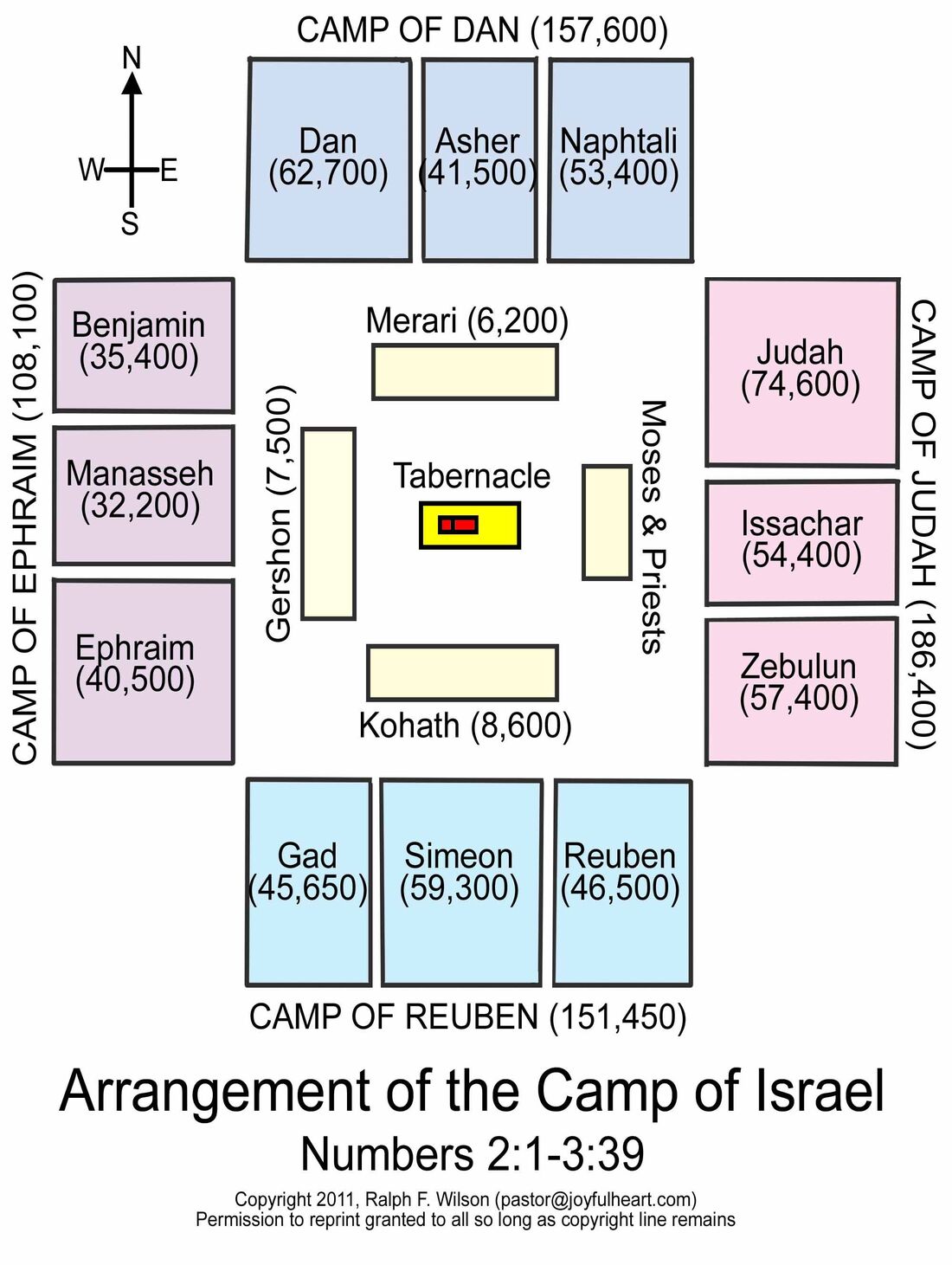
In Numbers 10, Moses indicates that the day came when the cloud of God’s presence departed from its place above the Tabernacle and made its way into the wilderness. Following the instructions given to them by God, the Levites began the careful disassembly and packing of the Tabernacle while the people of broke camp. When all was ready, they moved out in an orderly, prearranged manner.

…the people of Israel set out by stages from the wilderness of Sinai. – Numbers 10:12 ESV

Due to the large number of Israelites involved in this mass migration, God provided them with strict instructions regarding their movements. It was not to be a free-for-all, with everyone departing at once and according to their own timeline and agenda. With 12 tribes involved consisting of what has been estimated as more than two million people, this was a major undertaking that required precision and careful planning. Tents must be taken down, herds and flocks must be rounded up, and the Tabernacle must be dismantled and prepared for transport to the next destination. According to Numbers 10, the people went about their duties obediently. Everyone did their part and carefully followed the instructions of the Lord.

When the cloud made its way into the wilderness, the people knew it was time to move. At the sound of the two silver trumpets (Numbers 10:1), they gathered together and saw the sight of the cloud making its way into the wilderness. God had made the decision to relocate their camp and move them closer to their final destination: The land of Canaan.
Under normal circumstances, the trip to Kadesh-Barnea should have taken 11 days (Deuteronomy 1:2), but with the large number of Israelites and livestock involved and the need for an orderly and well-regimented evacuation process, it took them three days to arrive at the wilderness of Paran. The cloud had come to rest in that region, signifying that this was the spot where they were to set up camp. God chose this particular location for a reason.

“The Desert of Paran is a large plateau in the northeastern Sinai, south of what later would be called the Negev of Judah, and west of the Arabah. This forms the southernmost portion of the Promised Land, the presumed staging area for the assault on the land itself. The principal lines of assault on the land of Canaan are from the southwest, following the Way of the Sea from Egypt, and from the northwest, following the Way of the Sea from Phoenicia. Israel’s staging for attack in the Desert of Paran was a brilliant strategy. In this way they would avoid the fortified routes to the west, presumably under the control of Egypt. This unusual line of attack from the south would stun the inhabitants of the land. They would come like a sirocco blast from the desert, and the land would be theirs, under the hand of God.” – Ronald B. Allen, “Numbers.” In Genesis—Numbers. Vol. 2 of The Expositor’s Bible Commentary

Verses 13-28 provide the details concerning the departure of Israel from Mount Sinai. The tribe of Judah led the way, with each of the other tribes moving out according to a prearranged plan. Some of the tribes would have started the process long before the Tabernacle was completely dismantled and ready for transport. The lengthy procession would have stretched out for miles as the Israelites made their way into the wilderness, following the cloud of the Lord.

They marched for three days after leaving the mountain of the Lord, with the Ark of the Lord’s Covenant moving ahead of them to show them where to stop and rest. As they moved on each day, the cloud of the Lord hovered over them. – Numbers 10:33-34 NLT

God was guiding them, just as He had promised to do. He was leading them further away from Egypt and ever closer to their new home in Canaan. The land He had promised to Abraham as an inheritance would soon be theirs. But they would have to continue to follow His leading and trust Him for their provisions along the way. The journey would not be easy but Moses knew that as long as they followed God’s will, they would be blessed. He even tried to convince his wife’s brother to join them.

“We are on our way to the place the Lord promised us, for he said, ‘I will give it to you.’ Come with us and we will treat you well, for the Lord has promised wonderful blessings for Israel!” – Numbers 10:29 NLT

It’s interesting to note that Moses asked his brother-in-law to serve as a scout or guide for the people of Israel.

“You know the places in the wilderness where we should camp. Come, be our guide. If you do, we’ll share with you all the blessings the Lord gives us.” – Numbers 10:31-32 NLT

Perhaps Moses knew that Hobab was familiar with the wilderness terrain and could help them choose the best places to camp. But this seems to contradict the idea that the cloud of God was to serve as their guide. It is unclear whether Moses’ request was out of step with the will of God. But he evidently convinced Hobab to join them. Judges 1:16 indicates that the descendants of Moses’ father-in-law were still traveling with the Israelites long after they made it into the land of Canaan.

When the tribe of Judah left Jericho—the city of palms—the Kenites, who were descendants of Moses’ father-in-law, traveled with them into the wilderness of Judah. They settled among the people there, near the town of Arad in the Negev. – Judges 1:16 NLT

Hobab and his family may have ended up traveling with the Israelites, but his services were not required. God was going to lead His people and He did so through the cloud that rested over the Ark of the Covenant.

They marched for three days after leaving the mountain of the Lord, with the Ark of the Lord’s Covenant moving ahead of them to show them where to stop and rest. As they moved on each day, the cloud of the Lord hovered over them. – Numbers 10:33-34 NLT

The Kohathites set out, carrying the articles for the sanctuary carrying the Ark of the Covenant at the head of the procession and the cloud of the Lord hovered above it as they walked. All the Israelites could see the cloud rising up into the sky and know that they were headed in the right direction, and when the Ark came to rest, the people knew it was time to stop for the night. Each time the Ark and the cloud set out, Moses would utter a prayer or blessing.

“Arise, O Lord, and let your enemies be scattered! Let them flee before you!” – Numbers 10:35 NLT

And when the cloud ceased to move and the priests set down the Ark of the Covenant, Moses would pronounce another blessing.

“Return, O Lord, to the countless thousands of Israel!” – Numbers 10:36 NLT

Moses knew that the people of Israel were completely dependent upon God. Without Him, this entire journey would be a disaster and any hope of conquering the land of Canaan would be lost. Little did he know what awaited them in the wilderness. In his mind, they were on their way to the land of promise and preparing to occupy the inheritance promised to them by God. But this chapter, marked by its description of the peoples’ orderly procession from Mount Sinai, is setting up an unexpected disaster awaiting them in the days ahead.

They left Mount Sinai with confidence and in eager anticipation of the future God had in store for them. After a year’s delay, they were on their way to Canaan, their future home and the rich inheritance God had promised to them, But their enthusiasm would soon be dampened by a series of unfortunate events that would keep them from entering the promised land. God would successfully lead them to the border of their new home but their entrance would be denied. Chapters 11-25 chronicles the almost 40-year hiatus that would come as a result of their disobedience to God’s commands. He would get them to the land but they would fail to do their part and, as a result, they would suffer the consequences.

English Standard Version (ESV) The Holy Bible, English Standard Version. ESV® Permanent Text Edition® (2016). Copyright © 2001

New Living Translation (NLT) Holy Bible, New Living Translation, copyright © 1996, 2004, 2015 by Tyndale House Foundation. Used by permission of Tyndale House Publishers Inc., Carol Stream, Illinois 60188. All rights reserved.

Preserving God’s Presence

1 The Lord spoke to Moses and Aaron, saying, 2 “Take a census of the sons of Kohath from among the sons of Levi, by their clans and their fathers’ houses, 3 from thirty years old up to fifty years old, all who can come on duty, to do the work in the tent of meeting. 4 This is the service of the sons of Kohath in the tent of meeting: the most holy things. 5 When the camp is to set out, Aaron and his sons shall go in and take down the veil of the screen and cover the ark of the testimony with it. 6 Then they shall put on it a covering of goatskin and spread on top of that a cloth all of blue, and shall put in its poles. 7 And over the table of the bread of the Presence they shall spread a cloth of blue and put on it the plates, the dishes for incense, the bowls, and the flagons for the drink offering; the regular showbread also shall be on it. 8 Then they shall spread over them a cloth of scarlet and cover the same with a covering of goatskin, and shall put in its poles. 9 And they shall take a cloth of blue and cover the lampstand for the light, with its lamps, its tongs, its trays, and all the vessels for oil with which it is supplied. 10 And they shall put it with all its utensils in a covering of goatskin and put it on the carrying frame. 11 And over the golden altar they shall spread a cloth of blue and cover it with a covering of goatskin, and shall put in its poles. 12 And they shall take all the vessels of the service that are used in the sanctuary and put them in a cloth of blue and cover them with a covering of goatskin and put them on the carrying frame. 13 And they shall take away the ashes from the altar and spread a purple cloth over it. 14 And they shall put on it all the utensils of the altar, which are used for the service there, the fire pans, the forks, the shovels, and the basins, all the utensils of the altar; and they shall spread on it a covering of goatskin, and shall put in its poles. 15 And when Aaron and his sons have finished covering the sanctuary and all the furnishings of the sanctuary, as the camp sets out, after that the sons of Kohath shall come to carry these, but they must not touch the holy things, lest they die. These are the things of the tent of meeting that the sons of Kohath are to carry.

16 “And Eleazar the son of Aaron the priest shall have charge of the oil for the light, the fragrant incense, the regular grain offering, and the anointing oil, with the oversight of the whole tabernacle and all that is in it, of the sanctuary and its vessels.”

17 The Lord spoke to Moses and Aaron, saying, 18 “Let not the tribe of the clans of the Kohathites be destroyed from among the Levites, 19 but deal thus with them, that they may live and not die when they come near to the most holy things: Aaron and his sons shall go in and appoint them each to his task and to his burden, 20 but they shall not go in to look on the holy things even for a moment, lest they die.” – Numbers 4:1-20 ESV

Now God provides Moses with additional and more detailed instructions outlining each Levitical clan’s responsibilities concerning the Tabernacle. This entails Moses taking yet another census of families and clans of Kohath, Gershon, and Merari, the three sons of Levi. This time, the census was to include only those men who were 30 to 50 years old. God provides Moses with an age range that qualifies the Levites for service in the Tabernacle.

“Take a census of the sons of Kohath from among the sons of Levi, by their clans and their fathers’ houses, from thirty years old up to fifty years old, all who can come on duty, to do the work in the tent of meeting.” – Numbers 4:2-3 ESV

But later in chapter 8, God provides what appears to be contradictory standards for Levitical age qualifications.

“This is the rule the Levites must follow: They must begin serving in the Tabernacle at the age of twenty-five, and they must retire at the age of fifty. After retirement they may assist their fellow Levites by serving as guards at the Tabernacle, but they may not officiate in the service. This is how you must assign duties to the Levites.” – Numbers 8:24-26 NLT

Upon closer examination, it appears that there are two kinds of service being discussed in these two passages. In Numbers 4, God refers to “the work” to be conducted in the tent of meeting or Tabernacle. The Hebrew word is מְלָאכָה (mᵊlā’ḵâ), and it refers to the “business” or “occupation” of these men concerning the Tabernacle. God goes on to describe the actual duties they were instructed to carry out that would require them to enter the inner recesses of the Tabernacle and interface with the holy objects contained within. Their responsibilities would require them to touch “the most holy things” (Numbers 4:4 ESV) to prepare them for transport from one place to another when the Israelites were commanded by God to break camp.

To qualify for this important task, a male Levite had to be at least 30 years of age, and no more than 50. But in the Numbers 8 passage, it appears that God lowers the entry level for service to 25 years of age. Yet, the context is this passage is slightly different. In this case, the men who are 25-29 years old are qualified “to do duty in the service of the tent of meeting” (Numbers 8:24 NLT). The phrase, “to do duty” could be translated “to go forth.” It is a military term that speaks of one’s responsibility to assemble for service. At age 25, young Levite males could begin to serve in a limited capacity. It might be best to view this as a kind of internship or period of apprenticeship. The kind of “service” they could perform appears to be different than that described in Numbers 4. The Hebrew word is עֲבֹדָה (ăḇōḏâ), and it refers to “labor” or “work.” The Numbers 8 passage provides four years of training for young men so that they might be properly prepared for future service within the Tabernacle. Up until the time when they turned 30, these young men would be relegated to performing manual labor and would not have been allowed to enter the Tabernacle itself.

All of the Kohathites from 30 to 50 years old were required to care for “the most holy things” within the Tabernacle. While Kohath was not the eldest son of Levi, he is mentioned first because the role assigned to his family and clan was the most important of all. They were responsible for all of the items located within the Holy Place and the Holy of Holies of the Tabernacle, and these sacred objects required special attention and handling.

Any time that the Israelites were ordered by God to break camp, the first order of business was to disassemble the Tabernacle, but this required careful planning and laser-focused attention to detail. Any failure to follow God’s instructions could be devastating, even deadly. It all began with the removal of the inner curtain that separated the Holy Place from the Holy of Holies. This task was assigned to Aaron, the high priest, and his sons. Only the priests were allowed to enter the sacred spaces and prepare the holy furniture for transport.

The first order of business was to properly cover the ark of the covenant to prevent the Kohathites or any other Israelites from looking upon it. The very veil that served as an entrance into the Holy of Holies was used to cover the ark. Then they were to cover the veil with a goatskin tarp that would protect the ark from the elements. The final layer was a piece of blue-colored fabric. Once the ark was properly covered, Aaron and his sons were to insert the poles that would allow the Kohathites to transport the ark without having to touch it. All of the sacred objects were designed to be carried with poles so that no one would inadvertently touch them and die.

“…when Aaron and his sons have finished covering the sanctuary and all the furnishings of the sanctuary, as the camp sets out, after that the sons of Kohath shall come to carry these, but they must not touch the holy things, lest they die.” – Numbers 4:15 ESV

The Kohathites were also forbidden to look at the holy objects upon pain of death.

“…they shall not go in to look on the holy things even for a moment, lest they die.” – Numbers 4:20 ESV

These men had the privilege of entering the inner sanctuary of the Tabernacle and carrying the sacred furniture, but they were under strict orders to treat these objects with proper awe and reverence.

Every one of the sacred objects was to be treated in the same manner, including the Table of Shewbread, the Golden Lampstand, and the Altar of Incense. God’s instructions were very clear and He expected them to be followed down to the last detail.

“…they shall take all the vessels of the service that are used in the sanctuary and put them in a cloth of blue and cover them with a covering of goatskin and put them on the carrying frame.” – Numbers 4:12 ESV

Once Aaron and his sons had finished the preparatory phase of the operation, the Kohathites could enter the Tabernacle and begin the removal of the sacred objects. The only things they did not transport were the oil for the light, the fragrant incense, the grain offering, and the anointing oil; these items were placed under the care of Eleazar, one of the sons of Aaron. This same young man was responsible for overseeing the entire process of preparing the Tabernacle for transport and ensuring that it made its way to the next destination without incident.

God had designed the Tabernacle to be portable because He knew that it would have to accompany the Israelites all the way from Mount Sinai to Canaan. Because of His omnipotence, He also knew that there would be a 40-year period in which the Israelites wandered through the wilderness because they refused to enter the land the first time they arrived at its borders. For four decades they would be required to transport God’s house from one location to another. His presence was directly tied to the Tabernacle and the maintenance of the Tabernacle’s holiness was essential if He was to remain among His people. So, God provided Moses and the Israelites with strict instructions for protecting the sacredness of His house and preserving the promise of His abiding presence, and the Kohathites would play an integral and irreplaceable role in the entire process.

English Standard Version (ESV) The Holy Bible, English Standard Version. ESV® Permanent Text Edition® (2016). Copyright © 2001

New Living Translation (NLT) Holy Bible, New Living Translation, copyright © 1996, 2004, 2015 by Tyndale House Foundation. Used by permission of Tyndale House Publishers Inc., Carol Stream, Illinois 60188. All rights reserved.

A Weighty Responsibility

14 And the Lord spoke to Moses in the wilderness of Sinai, saying, 15 “List the sons of Levi, by fathers’ houses and by clans; every male from a month old and upward you shall list.” 16 So Moses listed them according to the word of the Lord, as he was commanded. 17 And these were the sons of Levi by their names: Gershon and Kohath and Merari. 18 And these are the names of the sons of Gershon by their clans: Libni and Shimei. 19 And the sons of Kohath by their clans: Amram, Izhar, Hebron, and Uzziel. 20 And the sons of Merari by their clans: Mahli and Mushi. These are the clans of the Levites, by their fathers’ houses.

21 To Gershon belonged the clan of the Libnites and the clan of the Shimeites; these were the clans of the Gershonites. 22 Their listing according to the number of all the males from a month old and upward was 7,500. 23 The clans of the Gershonites were to camp behind the tabernacle on the west, 24 with Eliasaph, the son of Lael as chief of the fathers’ house of the Gershonites. 25 And the guard duty of the sons of Gershon in the tent of meeting involved the tabernacle, the tent with its covering, the screen for the entrance of the tent of meeting, 26 the hangings of the court, the screen for the door of the court that is around the tabernacle and the altar, and its cords—all the service connected with these.

27 To Kohath belonged the clan of the Amramites and the clan of the Izharites and the clan of the Hebronites and the clan of the Uzzielites; these are the clans of the Kohathites. 28 According to the number of all the males, from a month old and upward, there were 8,600, keeping guard over the sanctuary. 29 The clans of the sons of Kohath were to camp on the south side of the tabernacle, 30 with Elizaphan the son of Uzziel as chief of the fathers’ house of the clans of the Kohathites. 31 And their guard duty involved the ark, the table, the lampstand, the altars, the vessels of the sanctuary with which the priests minister, and the screen; all the service connected with these. 32 And Eleazar the son of Aaron the priest was to be chief over the chiefs of the Levites, and to have oversight of those who kept guard over the sanctuary.

33 To Merari belonged the clan of the Mahlites and the clan of the Mushites: these are the clans of Merari. 34 Their listing according to the number of all the males from a month old and upward was 6,200. 35 And the chief of the fathers’ house of the clans of Merari was Zuriel the son of Abihail. They were to camp on the north side of the tabernacle. 36 And the appointed guard duty of the sons of Merari involved the frames of the tabernacle, the bars, the pillars, the bases, and all their accessories; all the service connected with these; 37 also the pillars around the court, with their bases and pegs and cords.

38 Those who were to camp before the tabernacle on the east, before the tent of meeting toward the sunrise, were Moses and Aaron and his sons, guarding the sanctuary itself, to protect the people of Israel. And any outsider who came near was to be put to death. 39 All those listed among the Levites, whom Moses and Aaron listed at the commandment of the Lord, by clans, all the males from a month old and upward, were 22,000. – Numbers 3:14-39 ESV

God ordered Moses to take a census of the tribe of Levi, instructing him to number “every male from a month old and upward” (Numbers 3:15 ESV). Levi had three sons and eight grandsons who represented eight different clans which contained 22,000 descendants of Levi. The two Gershonite clans were represented by 7,500 males one-month-old or older. The four Kohathite clans were comprised of 8,600 males one-month-old or older. The two Merarite clans numbered just 6,200 males one-month-old or older.

This numerical assessment of each of the Levite clans was for the purpose of assigning their God-ordained responsibilities. Each of the clans was to carry out tasks related to the maintenance of the Tabernacle. They were also assigned a particular region within the Israelite camp to occupy and oversee. The Gershonites were to camp on the west side of the Tabernacle, while the Kohathites occupied the south side and the Merarites were assigned to the north side. The east side of the Tabernacle, located nearest the entrance to the holy compound, “was reserved for the tents of Moses and of Aaron and his sons, who had the final responsibility for the sanctuary on behalf of the people of Israel” (Numbers 3:38 NLT).

With the Levites strategically placed around the perimeter of the Tabernacle, the Israelites would enjoy the constant presence and influence of God’s ministers and servants. These various Levitical clans were assigned a specific set of responsibilities related to the Tabernacle. The Gershonites “were responsible to care for the Tabernacle, including the sacred tent with its layers of coverings, the curtain at its entrance, the curtains of the courtyard that surrounded the Tabernacle and altar, the curtain at the courtyard entrance, the ropes, and all the equipment related to their use” (Numbers 3:25-26 NLT).

The Kohathites “were responsible for the care of the Ark, the table, the lampstand, the altars, the various articles used in the sanctuary, the inner curtain, and all the equipment related to their use” (Numbers 3:31 NLT).

Finally, the Merarites “were responsible for the care of the frames supporting the Tabernacle, the crossbars, the pillars, the bases, and all the equipment related to their use. They were also responsible for the posts of the courtyard and all their bases, pegs, and ropes” (Numbers 3:36-37 NLT).

The Tabernacle was the house of God and was to be treated with reverence and respect. The various elements that comprised this one-of-a-kind structure had been designed by God and were painstakingly crafted by men who had been supernaturally endowed with the skills necessary to carry out God’s plan. This was no ordinary tent, and it was to be treated with great care because every part of it had been set apart by God for His use. Even the disassembly and transport of its various elements required careful attention to God’s instructions. The holy objects associated with the Holy Place and the Holy of Holies could not be touched by human hands. That is why God designed them with poles to assist in their transport from one place to another.

God had given Moses very specific orders concerning the care and maintenance of the Tabernacle. Only the priestly class of the Levites were allowed to interact with the Tabernacle when it was in its completed state. The rest of the clans were restricted from entering the Tabernacle until it was time to relocate it for transport to another location. And, on those occasions, the Gershonites, Kohathites, and Merarites had to wait until the holy furniture was properly prepared and covered before they could fulfill their duties. God had given Aaron strict instructions regarding this matter.

“You, your sons, and your relatives from the tribe of Levi will be held responsible for any offenses related to the sanctuary. But you and your sons alone will be held responsible for violations connected with the priesthood.

“Bring your relatives of the tribe of Levi—your ancestral tribe—to assist you and your sons as you perform the sacred duties in front of the Tabernacle of the Covenant. But as the Levites go about all their assigned duties at the Tabernacle, they must be careful not to go near any of the sacred objects or the altar. If they do, both you and they will die. The Levites must join you in fulfilling their responsibilities for the care and maintenance of the Tabernacle, but no unauthorized person may assist you.” – Numbers 18:1-4 NLT

The tribe of Levi had been set apart by God and given the responsibility of caring for His sacred house. “Anyone other than a priest or Levite who went too near the sanctuary was to be put to death” (Numbers 3:38 NLT). By placing the various clans of Levi around the perimeter of the Tabernacle, God created a buffer zone that was designed to protect the people of Israel from possible death for violating His ban on coming too close to the holy place. While God had moved His presence from the top of Mount Sinai to the Holy of Holies in the Tabernacle, He was still to be treated with proper reverence and respect. He had come to dwell among them and was closer than ever before, but they were not to treat His divine presence with contempt or complacency. His nearness did not make Him any less holy. His immanence did not diminish His transcendence. Just because God had taken up residence among them and had placed His glory in the midst of their camp did not give them the right to treat Him with a disrespectful kind of over-familiarity.

The Levites were to act as mediators between God and the rest of the Israelites. The members of the priestly caste were to serve as God’s intercessors, offering sacrifices on behalf of the people and assisting them in maintaining a right standing with Him. The rest of the Levites were to care for the dwelling place of God, ensuring that it was properly maintained and its holiness was protected at all costs. If the house of God became defiled, it would no longer be an appropriate place for God’s presence, and without God’s presence, the Israelites would lose the one thing that set them apart from all the other nations on earth. Moses revealed his understanding of this vital relationship between God’s presence and the Israelites’ unique status among the nations when he said to God, “If you don’t personally go with us, don’t make us leave this place. How will anyone know that you look favorably on me—on me and on your people—if you don’t go with us? For your presence among us sets your people and me apart from all other people on the earth” (Exodus 33:15-16 NLT).

Moses knew that the only thing that set the Israelites apart was the presence of God, and God made it clear that His presence was directly tied to the sanctity of the Tabernacle. That’s why He placed so much emphasis on the Levites and their role as the caretakers of His earthly house. The Tabernacle was the key to their survival and success as they made their way to the Promised Land. God had left Mount Sinai and taken up residence among them in the portable sanctuary He had designed and they had built. As long as they maintained the holiness of God’s house, He would remain among them, and He assigned the Levites with the weighty responsibility of protecting the sanctity of His sanctuary.

English Standard Version (ESV) The Holy Bible, English Standard Version. ESV® Permanent Text Edition® (2016). Copyright © 2001

New Living Translation (NLT) Holy Bible, New Living Translation, copyright © 1996, 2004, 2015 by Tyndale House Foundation. Used by permission of Tyndale House Publishers Inc., Carol Stream, Illinois 60188. All rights reserved.

Servants and Substitutes

1 These are the generations of Aaron and Moses at the time when the Lord spoke with Moses on Mount Sinai. 2 These are the names of the sons of Aaron: Nadab the firstborn, and Abihu, Eleazar, and Ithamar. 3 These are the names of the sons of Aaron, the anointed priests, whom he ordained to serve as priests. 4 But Nadab and Abihu died before the Lord when they offered unauthorized fire before the Lord in the wilderness of Sinai, and they had no children. So Eleazar and Ithamar served as priests in the lifetime of Aaron their father.

5 And the Lord spoke to Moses, saying, 6 “Bring the tribe of Levi near, and set them before Aaron the priest, that they may minister to him. 7 They shall keep guard over him and over the whole congregation before the tent of meeting, as they minister at the tabernacle. 8 They shall guard all the furnishings of the tent of meeting, and keep guard over the people of Israel as they minister at the tabernacle. 9 And you shall give the Levites to Aaron and his sons; they are wholly given to him from among the people of Israel. 10 And you shall appoint Aaron and his sons, and they shall guard their priesthood. But if any outsider comes near, he shall be put to death.”

11 And the Lord spoke to Moses, saying, 12 “Behold, I have taken the Levites from among the people of Israel instead of every firstborn who opens the womb among the people of Israel. The Levites shall be mine, 13 for all the firstborn are mine. On the day that I struck down all the firstborn in the land of Egypt, I consecrated for my own all the firstborn in Israel, both of man and of beast. They shall be mine: I am the Lord.” – Numbers 3:1-13 ESV

Having provided Moses with the logistical arrangements of the various tribes around the Tabernacle, God now deals with the one tribe that He seems to have overlooked. The tribe of Levi was not mentioned in chapter two but they would play a significant role in the life of the Israelites and would be distributed equally among the other tribes within the encampment. This one tribe had been chosen by God to serve as caretakers of the Tabernacle but also as instructors of the law, teaching the people to obey the commands of God. They had received this special designation because of the role they played during the golden calf incident at Mount Sinai.

Not long after they arrived at the mountain, Moses left them in the valley while he ascended the mountain to confer with God. He left his brother Aaron in charge, but when Moses failed to return, the people began to pressure Aaron to take over the leadership responsibilities. The first thing they demanded their new leader to do was to make a new version of the God of Mount Sinai. They were unhappy with the thunder-and-lightning-fear-inducing God who occupied the summit of Mount Sinai.

To the Israelites at the foot of the mountain, the glory of the Lord appeared at the summit like a consuming fire. – Exodus 24:17 NLT

The powerful manifestation of God’s presence on Mount Sinai left the people petrified and fearful to draw near. So, when Moses failed to return after 40 days, they demanded that Aaron make them gods that were more like the gods they had worshiped in Egypt.

“Up, make us gods who shall go before us. As for this Moses, the man who brought us up out of the land of Egypt, we do not know what has become of him.” – Exodus 32:1 ESV

Aaron gave in to their demands by gathering their gold jewelry and fashioning it into the image of a calf. Then he announced, “Tomorrow shall be a feast to the Lord” (Exodus 32:5 ESV). The Hebrew word for “Lord” is Yahweh. Aaron was proclaiming that this calf he had made with his own hands was actually the God who had rescued them from Egypt. He had made a new and improved version of the God of Abraham, Isaac, and Jacob. But Aaron’s actions did not go unnoticed by God.

“Go down, for your people, whom you brought up out of the land of Egypt, have corrupted themselves. They have turned aside quickly out of the way that I commanded them. They have made for themselves a golden calf and have worshiped it and sacrificed to it and said, ‘These are your gods, O Israel, who brought you up out of the land of Egypt!’” – Exodus 32:7-8 ESV

When Moses descended the mountain with the Ten Commandments in his hands, he witnessed with his own eyes the extent of the people’s wickedness.

Moses saw that Aaron had let the people get completely out of control, much to the amusement of their enemies. So he stood at the entrance to the camp and shouted, “All of you who are on the Lord’s side, come here and join me.” And all the Levites gathered around him. – Exodus 32:25-26 NLT

Moses knew he had to deal with the rebellion in the camp so he called for volunteers to assist him in meting out judgment. His own tribe, the Levites, were the only ones who stepped up to the challenge. Surrounded by his fellow tribesmen, Moses gave them their grim marching orders.

“Thus says the Lord God of Israel, ‘Put your sword on your side each of you, and go to and fro from gate to gate throughout the camp, and each of you kill his brother and his companion and his neighbor.’” – Exodus 32:27 ESV

When the Levites had finished their work, more than 3,000 Israelites lay lifeless on the valley floor. Then Moses made the following announcement to his fellow Levites.

“Today you have been ordained for the service of the Lord, each one at the cost of his son and of his brother, so that he might bestow a blessing upon you this day.” – Exodus 32:29 ESV

It’s interesting to note that God had already planned to have the Levites serve as priests. He had given Moses the following instructions during his 40-day absence.

“Then bring near to you Aaron your brother, and his sons with him, from among the people of Israel, to serve me as priests—Aaron and Aaron’s sons, Nadab and Abihu, Eleazar and Ithamar.” – Exodus 28:1 ESV

Little did the Levites know that their actions during the Golden Calf incident simply confirmed the role to which God had already assigned them. As God’s chosen priesthood, the Levites would also serve as the designated substitutes for the firstborn.

Before the Israelites left Egypt, God ordained the final plague that would ensure their release. He warned the Israelites that on one fateful night, all the firstborn of both animals and men would die unless His instructions were closely followed. He ordered each Israelite to sacrifice a lamb and sprinkle its blood on the doorpost and lintel of their home. This act of faith would ensure that the firstborn living within the walls of that home would be spared. And, as a result of God’s gracious acts of salvation, He claimed all the firstborn males of the Israelites as His own.

“Dedicate to me all the firstborn sons of Israel and every firstborn male animal. They are mine.” – Exodus 13:2 NLT

God had spared the firstborn of the Israelites and, in return, the people were to set apart those individuals to His service. They belonged to God. But things were about to change. God had another plan. He appointed the tribe of Levi to serve as ministers and as priests within the Tabernacle. They were the smallest of the tribes and seemed to hold special favor with God because of their role in the aftermath of the Golden Calf debacle.

The Levites became God’s servants and they served as the peoples’ substitute. God still claimed the firstborn as His own. They belonged to Him because He had spared their lives the night the death angel had passed over their homes in the land of Egypt. When Moses numbered all the firstborn males of the tribes of Israel they totaled 22,273. These were probably the number of firstborn males who had been born since they had left Egypt. The total number of Levite males from one month and older were 22,000. God was going to allow the Levites to become substitutes for the firstborn of all the Israelites.

“The Levites will be reserved for me as substitutes for the firstborn sons of Israel; I am the LORD. And the Levites’ livestock are mine as substitutes for the firstborn livestock of the whole nation of Israel.” – Number 3:41 NLT

God could have required all the firstborn males of Israel to maintain and move His Tabernacle. He could have demanded that they serve as His ministers and priests, but instead, He set aside the tribe of Levi for this important duty. And in doing so, He allowed the Levites to serve as surrogates and stand-ins for all the firstborn of Israel.

The Levites were not to be included in the census of fighting men but were to care for the Tabernacle. They were responsible for taking it down when they broke camp and for erecting it when they set up camp again. In doing so, they would be protecting the sons of Israel from death. No one but member of the tribe of Levi was allowed to come near the Tabernacle or touch any of its furnishings (Numbers 1:47-54).

The Levites had been given a heavy responsibility. They were to care for all the things related to the Tabernacle, maintaining them and moving them whenever the Israelites broke camp and relocated. It was a huge task and, because the Tabernacle was God’s holy dwelling place, it was to be taken seriously. God seemed to know that if this responsibility had been left up to the people, they would have dropped the ball. The Tabernacle would have fallen into disrepair as they became distracted with their own cares and concerns. So He appointed this task to the Levites. They served as substitutes. They satisfied God’s requirement that the firstborn were to belong to Him. They served in the place of those who were rightfully obligated to serve God. The firstborn had been graciously replaced by someone else.

This is a picture of Christ’s substitutionary death for each of us. He became our sin substitute. He paid the debt we owed. He took our place. He served in our stead. He satisfied the demands of a holy God and did what none of us were able to do. He made the ultimate sacrifice, which is exactly what the Levites did. They became a sacrifice for the people of Israel. They served and satisfied the demands of God by maintaining and caring for His Tabernacle. They kept the people of Israel from experiencing death by keeping the Tabernacle holy and set apart for God. Their role was vital to the spiritual life of the people of God. They gave so that others might live. Just as Jesus has done for us.

English Standard Version (ESV) The Holy Bible, English Standard Version. ESV® Permanent Text Edition® (2016). Copyright © 2001

New Living Translation (NLT) Holy Bible, New Living Translation, copyright © 1996, 2004, 2015 by Tyndale House Foundation. Used by permission of Tyndale House Publishers Inc., Carol Stream, Illinois 60188. All rights reserved.