God Is Not Yet Done

22 And over the people who remained in the land of Judah, whom Nebuchadnezzar king of Babylon had left, he appointed Gedaliah the son of Ahikam, son of Shaphan, governor. 23 Now when all the captains and their men heard that the king of Babylon had appointed Gedaliah governor, they came with their men to Gedaliah at Mizpah, namely, Ishmael the son of Nethaniah, and Johanan the son of Kareah, and Seraiah the son of Tanhumeth the Netophathite, and Jaazaniah the son of the Maacathite. 24 And Gedaliah swore to them and their men, saying, “Do not be afraid because of the Chaldean officials. Live in the land and serve the king of Babylon, and it shall be well with you.” 25 But in the seventh month, Ishmael the son of Nethaniah, son of Elishama, of the royal family, came with ten men and struck down Gedaliah and put him to death along with the Jews and the Chaldeans who were with him at Mizpah. 26 Then all the people, both small and great, and the captains of the forces arose and went to Egypt, for they were afraid of the Chaldeans.

27 And in the thirty-seventh year of the exile of Jehoiachin king of Judah, in the twelfth month, on the twenty-seventh day of the month, Evil-merodach king of Babylon, in the year that he began to reign, graciously freed Jehoiachin king of Judah from prison. 28 And he spoke kindly to him and gave him a seat above the seats of the kings who were with him in Babylon. 29 So Jehoiachin put off his prison garments. And every day of his life he dined regularly at the king’s table, 30 and for his allowance, a regular allowance was given him by the king, according to his daily needs, as long as he lived. – 2 Kings 25:22-30 ESV

The scene in Jerusalem was one of utter destruction and devastation. The once-formidable city walls had been reduced to rubble. The massive doors that hung at the gates into Jerusalem had been torn from their hinges and burned. The homes of both the rich and the poor had been destroyed, leaving the city virtually uninhabitable. Even the king’s royal palace had been ransacked and turned into a smoldering ruin, and the Babylonians had not spared the house of God either. It had become a place of refuge for many trying to flee from the bloodthirsty Babylonians, but they found no help or hope within the walls of the Temple they had long neglected.

The Babylonians killed Judah’s young men, even chasing after them into the Temple. They had no pity on the people, killing both young men and young women, the old and the infirm. – 2 Chronicles 36:17 NLT

The grand house that Solomon had constructed, the long-standing symbol of God’s presence and power among His people, was desecrated and then destroyed.

The king took home to Babylon all the articles, large and small, used in the Temple of God, and the treasures from both the LORD’s Temple and from the palace of the king and his officials. Then his army burned the Temple of God… – 2 Chronicles 36:18 NLT

And none of this should have come as a surprise to the people of Judah. On the very day that Solomon had consecrated the newly opened Temple, God had warned him:

“I have answered your prayer and your request for help that you made to me. I have consecrated this temple you built by making it my permanent home; I will be constantly present there. You must serve me with integrity and sincerity, just as your father David did. Do everything I commanded and obey my rules and regulations. Then I will allow your dynasty to rule over Israel permanently, just as I promised your father David, ‘You will not fail to have a successor on the throne of Israel.’

“But if you or your sons ever turn away from me, fail to obey the regulations and rules I instructed you to keep, and decide to serve and worship other gods, then I will remove Israel from the land I have given them, I will abandon this temple I have consecrated with my presence, and Israel will be mocked and ridiculed among all the nations. This temple will become a heap of ruins; everyone who passes by it will be shocked and will hiss out their scorn, saying, ‘Why did the LORD do this to this land and this temple?’ Others will then answer, ‘Because they abandoned the LORD their God, who led their ancestors out of Egypt. They embraced other gods whom they worshiped and served. That is why the LORD has brought all this disaster down on them.’” – 2 Kings 9:3-9 NLT
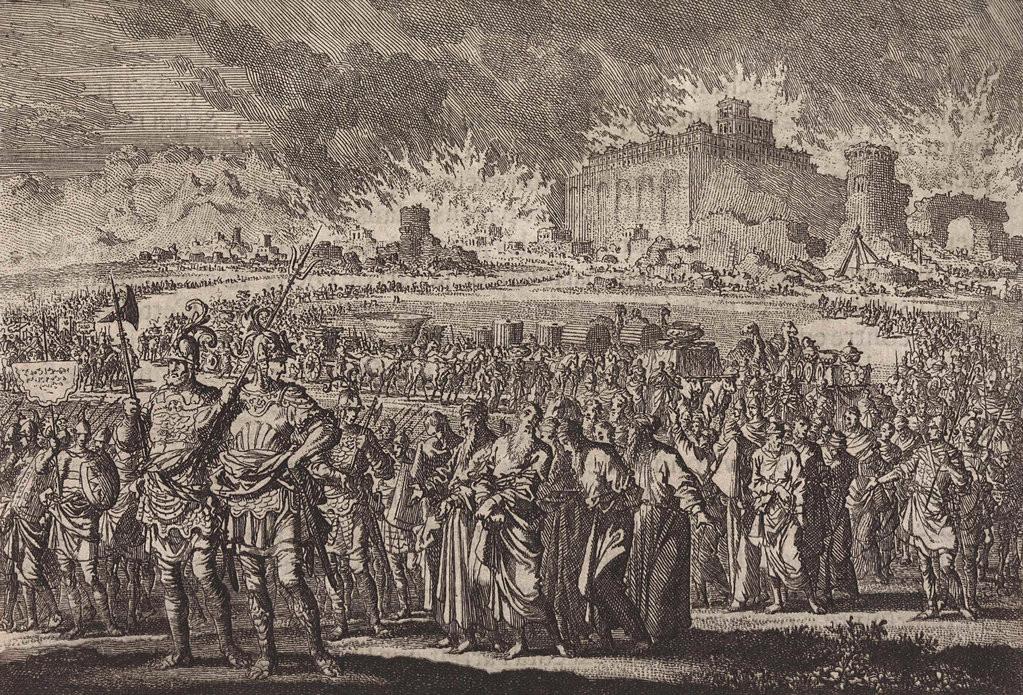
More than three-and-a-half centuries had passed since Yahweh issued that warning to King Solomon. During that time, the majority of the kings of Judah had chosen to abandon Yahweh for the false gods of the nations around them. They led the nation into idolatry and apostasy, and now, as the people of Judah made their way in chains to Babylon, they could look over their shoulders and see the fiery fulfillment of God’s words to Solomon.

As Nebuchadnezzar and his forces departed Judah, they left a destroyed city and a decimated populace behind.

King Nebuchadnezzar took all of Jerusalem captive, including all the commanders and the best of the soldiers, craftsmen, and artisans—10,000 in all. Only the poorest people were left in the land. – 2 Kings 24:14 NLT

Nebuchadnezzar appointed a man named Gedaliah to serve as governor over the greatly diminished and demoralized citizenry of Jerusalem. They would no longer have a king to rule over them. Gedaliah was a Jew, but not a descendant of Solomon. He had no royal blood and would wield no kingly authority. He served at the behest of Nebuchadnezzar and was under the watchful eye of the ever-present Babylonian garrison. His was a thankless job that was more managerial than magisterial. In time, he would come to be seen as nothing more than a puppet of the occupying Babylonian forces.

The commanders of Judah’s army who had fled from the city of Jerusalem when the walls were breached returned when they heard that Gedaliah had been appointed governor. But they didn’t like the pro-Babylonian rhetoric that Gedaliah was spouting.

Gedaliah vowed to them that the Babylonian officials meant them no harm. “Don’t be afraid of them. Live in the land and serve the king of Babylon, and all will go well for you,” he promised. – 2 Kings 25:24 NLT

This compromising stance ultimately cost Gedaliah his life. Ishmael, one of Judah’s former military commanders, orchestrated the assassination of Gedaliah. It’s not clear what Ishmael hoped to accomplish by the murder of the Babylonian-appointed governor, but it seems obvious that this was an act of rebellion against the occupying forces. Ishmael murdered Gedaliah and his Jewish officials, along with members of the Babylonian garrison, and this resulted in a swift reprisal from Nebuchadnezzar. Ishmael’s attempt to drive the Babylonians out of Judah backfired on him. Instead, “all the people of Judah, from the least to the greatest, as well as the army commanders, fled in panic to Egypt, for they were afraid of what the Babylonians would do to them” (2 Kings 25:26 NLT).

This scene is intended to convey a strong sense of irony. The disobedient people of God were returning to the very place from which He had freed them centuries earlier. While some of their friends and family members had been deported to Babylon as slaves, this remnant of God’s chosen people would seek refuge in the land where their forefathers had been served as slaves for more than 400 years.

Once again, all of this had been predicted by God. Centuries earlier, as the people of Israel stood on the shore of the River Jordan, preparing to enter the Land of Promise, He had told them that if they would faithfully obey Him, they would experience His blessings. But if they chose to disobey Him, they would experience “long-lasting afflictions and severe, enduring illnesses” (Deuteronomy 28:59 NLT). Moses went on to warn them, “He will afflict you with all the diseases of Egypt that you feared so much, and you will have no relief. The LORD will afflict you with every sickness and plague there is, even those not mentioned in this Book of Instruction, until you are destroyed.” (Deuteronomy 28:60-61 NLT).

And Moses had been very specific when outlining the devastating nature of the curses they would encounter should they fail to “fear the glorious and awesome name of the LORD your God” (Deuteronomy 28:58 NLT).

The LORD will scatter you among all nations, from one end of the earth to the other. There you will worship other gods that neither you nor your ancestors have known, gods of wood and stone. Among those nations you will have no rest, nor will there be a place of peaceful rest for the soles of your feet, for there the Lord will give you an anxious heart, failing eyesight, and a spirit of despair. Your life will hang in doubt before you; you will be terrified by night and day and will have no certainty of surviving from one day to the next. In the morning you will say, ‘If only it were evening!’ And in the evening you will say, ‘I wish it were morning!’ because of the things you will fear and the things you will see. Then the LORD will make you return to Egypt by ship, over a route I said to you that you would never see again. There you will sell yourselves to your enemies as male and female slaves, but no one will buy you.” – Deuteronomy 28:64-68 NLT

Some 850 years after God had redeemed the people of Israel from their captivity in Egypt, a remnant of their still rebellious descendants would return. But it’s interesting to note that these poor, disheveled exiles would find no hope in Egypt. They won’t even be able to sell themselves as slaves. They will become paupers and aliens living outside the Land of Promise and under the curse of the God they chose to reject.

But despite all the dire imagery portrayed in this closing chapter of the book of 2 Kings, there is a silver lining on the dark cloud of Judah’s history. The author ends his book with a new king ascending to the throne of Babylon. These closing verses seem to be a mirror image of the scene found in the book of Genesis that preceded Israel’s 400-year enslavement in Egypt. Exodus 1:8 records, “Now there arose a new king over Egypt, who did not know Joseph.” This new Pharaoh came to power and, having no first-hand knowledge of Joseph and the people of Israel, decided that they were a threat to his administration. So, he launched a campaign to afflict and enslave them. This would lead to four centuries’ worth of unprecedented misery and maltreatment.

But when Evil-merodach replaced Nebuchadnezzar as the ruler over the Babylonian empire, he made a decision to release King Jehoiachin of Judah from his enslavement. He released him from prison and “spoke kindly to Jehoiachin and gave him a higher place than all the other exiled kings in Babylon” (2 Kings 25:28 NLT). For the remainder of his life in Babylon, Jehoiachin lived like a king. He was given royal robes to wear and was allowed to dine at Evil-merodach’s table.

But why is this important? It foreshadows something highly significant. Back in the book that bears his name, the prophet Jeremiah pronounced a curse on Jehoiachin, who was also known as Coniah.

“Why is this man Jehoiachin like a discarded, broken jar?
    Why are he and his children to be exiled to a foreign land?
O earth, earth, earth!
    Listen to this message from the LORD!
This is what the LORD says:
‘Let the record show that this man Jehoiachin was childless.
    He is a failure,
for none of his children will succeed him on the throne of David
    to rule over Judah.’”– Jeremiah 22:28-30 NLT

And yet, if we fast-forward to the gospel of Matthew, we find the following words in his genealogy of Jesus.

Josiah was the father of Jehoiachin and his brothers (born at the time of the exile to Babylon).
After the Babylonian exile:
Jehoiachin was the father of Shealtiel.
Shealtiel was the father of Zerubbabel.
Zerubbabel was the father of Abiud.
Abiud was the father of Eliakim.
Eliakim was the father of Azor.
Azor was the father of Zadok.
Zadok was the father of Akim.
Akim was the father of Eliud.
Eliud was the father of Eleazar.
Eleazar was the father of Matthan.
Matthan was the father of Jacob.
Jacob was the father of Joseph, the husband of Mary.
Mary gave birth to Jesus, who is called the Messiah. – Matthew 1:11-16 NLT

Here, in the genealogy of Jesus, we find Jehoiachin’s name. The very man who was told that none of his children would succeed him as king is listed as a progenitor of the King of kings. Of Jehoiachin’s seven sons, not one of them would ascend to the throne of David, but Jesus would. Yahweh would graciously reverse the curse, producing a royal heir who would reign in righteousness and deliver His people from their enslavement to sin and death.

Notice one more name in the lineage of Jesus: Zerubbabel. This descendant of Jehoiachin would later become the governor of Judea when the exiles returned from their captivity in Babylon. The prophet Haggai would pronounce a blessing from God on Zerubbabel that foreshadowed a great reversal of fortunes for His chosen people.

“Speak to Zerubbabel, governor of Judah, saying, I am about to shake the heavens and the earth, and to overthrow the throne of kingdoms. I am about to destroy the strength of the kingdoms of the nations, and overthrow the chariots and their riders. And the horses and their riders shall go down, every one by the sword of his brother. On that day, declares the LORD of hosts, I will take you, O Zerubbabel my servant, the son of Shealtiel, declares the LORD, and make you like a signet ring, for I have chosen you, declares the LORD of hosts.” – Haggai 2:21-23 NLT

The Book of 2 Kings ends on a positive note because God’s will concerning the people of Israel was far from done. The story of the redemption of His chosen people and the restoration of the world He created was not yet over. The Messiah, the Savior of the world, would one day come, and His arrival would usher in a new day and a new hope for the people of God and the nations of the world.

English Standard Version (ESV) The Holy Bible, English Standard Version. ESV® Permanent Text Edition® (2016). Copyright © 2001 by Crossway Bibles, a publishing ministry of Good News Publishers.

New Living Translation (NLT) Holy Bible, New Living Translation, copyright © 1996, 2004, 2015 by Tyndale House Foundation. Used by permission of Tyndale House Publishers Inc., Carol Stream, Illinois 60188. All rights reserved.

A Divine Eviction Notice

1 And in the ninth year of his reign, in the tenth month, on the tenth day of the month, Nebuchadnezzar king of Babylon came with all his army against Jerusalem and laid siege to it. And they built siegeworks all around it. So the city was besieged till the eleventh year of King Zedekiah. On the ninth day of the fourth month the famine was so severe in the city that there was no food for the people of the land. Then a breach was made in the city, and all the men of war fled by night by the way of the gate between the two walls, by the king’s garden, and the Chaldeans were around the city. And they went in the direction of the Arabah. But the army of the Chaldeans pursued the king and overtook him in the plains of Jericho, and all his army was scattered from him. Then they captured the king and brought him up to the king of Babylon at Riblah, and they passed sentence on him. They slaughtered the sons of Zedekiah before his eyes, and put out the eyes of Zedekiah and bound him in chains and took him to Babylon.

In the fifth month, on the seventh day of the month—that was the nineteenth year of King Nebuchadnezzar, king of Babylon—Nebuzaradan, the captain of the bodyguard, a servant of the king of Babylon, came to Jerusalem. And he burned the house of the LORD and the king’s house and all the houses of Jerusalem; every great house he burned down. 10 And all the army of the Chaldeans, who were with the captain of the guard, broke down the walls around Jerusalem. 11 And the rest of the people who were left in the city and the deserters who had deserted to the king of Babylon, together with the rest of the multitude, Nebuzaradan the captain of the guard carried into exile. 12 But the captain of the guard left some of the poorest of the land to be vinedressers and plowmen.

13 And the pillars of bronze that were in the house of the LORD, and the stands and the bronze sea that were in the house of the LORD, the Chaldeans broke in pieces and carried the bronze to Babylon. 14 And they took away the pots and the shovels and the snuffers and the dishes for incense and all the vessels of bronze used in the temple service, 15 the fire pans also and the bowls. What was of gold the captain of the guard took away as gold, and what was of silver, as silver. 16 As for the two pillars, the one sea, and the stands that Solomon had made for the house of the LORD, the bronze of all these vessels was beyond weight. 17 The height of the one pillar was eighteen cubits, and on it was a capital of bronze. The height of the capital was three cubits. A latticework and pomegranates, all of bronze, were all around the capital. And the second pillar had the same, with the latticework.

18 And the captain of the guard took Seraiah the chief priest and Zephaniah the second priest and the three keepers of the threshold; 19 and from the city he took an officer who had been in command of the men of war, and five men of the king’s council who were found in the city; and the secretary of the commander of the army, who mustered the people of the land; and sixty men of the people of the land, who were found in the city. 20 And Nebuzaradan the captain of the guard took them and brought them to the king of Babylon at Riblah. 21 And the king of Babylon struck them down and put them to death at Riblah in the land of Hamath. So Judah was taken into exile out of its land. – 2 Kings 25:1-21 ESV

Zedekiah, formerly known as Mattaniah, received his new name and his right to rule over Judah from King Nebuchadnezzar of Babylon. He replaced his nephew, Jehoiachin, who had surrendered to the Babylonians to end the siege of Jerusalem. Rather than allowing Jehoiachin’s son, Coniah, to become king, Nebuchadnezzar chose Mattaniah, who became a vassal of the Babylonian state. But Mattaniah’s new role and newly acquired Babylonian name did not make him amenable to Nebuchadnezzar’s plans for Judah. So, he decided to rebel against the Babylonians. But in doing so, Zedekiah was actually rebelling against the will of Yahweh. The prophet Jeremiah had warned Zedekiah to submit to the Babylonians as divinely ordained agents of judgment.

“This is what the LORD of Heaven’s Armies, the God of Israel, says: With my great strength and powerful arm I made the earth and all its people and every animal. I can give these things of mine to anyone I choose. Now I will give your countries to King Nebuchadnezzar of Babylon, who is my servant. I have put everything, even the wild animals, under his control. All the nations will serve him, his son, and his grandson until his time is up. Then many nations and great kings will conquer and rule over Babylon. So you must submit to Babylon’s king and serve him; put your neck under Babylon’s yoke! I will punish any nation that refuses to be his slave, says the LORD. I will send war, famine, and disease upon that nation until Babylon has conquered it.” – Jeremiah 27:4-8 NLT

But King Zedekiah received bad advice from false prophets who told him, “The king of Babylon will not conquer you” ( Jeremiah 27:14 NLT). Yet Jeremiah warned the king not to listen to these men.

“This is what the LORD says: ‘I have not sent these prophets! They are telling you lies in my name, so I will drive you from this land. You will all die—you and all these prophets, too.’” – Jeremiah 27:15 NLT

These charlatans had even prophesied that all the golden articles plundered from the temple would soon be returned. They assured the king that everything was going to be okay. But Jeremiah delivered the painful truth to Zedekiah, informing him that it was actually going to get much worse.

“For the LORD of Heaven’s Armies has spoken about the pillars in front of the Temple, the great bronze basin called the Sea, the water carts, and all the other ceremonial articles. King Nebuchadnezzar of Babylon left them here when he exiled Jehoiachin son of Jehoiakim, king of Judah, to Babylon, along with all the other nobles of Judah and Jerusalem. Yes, this is what the LORD of Heaven’s Armies, the God of Israel, says about the precious things still in the Temple, in the palace of Judah’s king, and in Jerusalem: ‘They will all be carried away to Babylon and will stay there until I send for them,’ says the LORD. ‘Then I will bring them back to Jerusalem again.’” – Jeremiah 27:19-22 NLT

But all these warnings fell on deaf ears; Zedekiah and his royal administrators refused to heed the prophet’s counsel.

“…neither King Zedekiah nor his attendants nor the people who were left in the land listened to what the LORD said through Jeremiah.” – Jeremiah 37:2 NLT

Yet, Zedekiah would have the audacity to beg Jeremiah to pray for God to reverse His plans to destroy the city. The sudden arrival of the Egyptian army had encouraged and emboldened him. It seems that their unexpected appearance caused the Babylonians to call off their siege of Jerusalem, and Zedekiah saw this as a good sign and proof that the false prophets had been right all along. So, he asked Jeremiah to seek confirmation from Yahweh that the city of Jerusalem had been spared. But Jeremiah refused to tell Zedekiah what he was hoping to hear.

“This is what the LORD says: Do not fool yourselves into thinking that the Babylonians are gone for good. They aren’t! Even if you were to destroy the entire Babylonian army, leaving only a handful of wounded survivors, they would still stagger from their tents and burn this city to the ground!” – Jeremiah 37:9-10 NLT

Infuriated by the prophet’s message, Zedekiah eventually had the prophet flogged and imprisoned, falsely accusing him of treason. But undeterred by this treatment, Jeremiah later gave the king another ultimatum.

“This is what the LORD God of Heaven’s Armies, the God of Israel, says: ‘If you surrender to the Babylonian officers, you and your family will live, and the city will not be burned down. But if you refuse to surrender, you will not escape! This city will be handed over to the Babylonians, and they will burn it to the ground.’” – Jeremiah 37:17-18 NLT

In the ninth year of Zedekiah’s reign, his worst fears were realized; the Babylonians returned. For two long years, they laid siege to the capital. In time, conditions inside the walls of Jerusalem became so bad that the people began to starve to death. When the Babylonians eventually breached the walls of the city, King Zedekiah and some of his troops attempted a nighttime escape. But as soon as they got outside the walls of Jerusalem, Zedekiah’s men abandoned him, leaving him completely defenseless and an easy target for the Babylonians.

They captured the king and took him to the king of Babylon at Riblah, where they pronounced judgment upon Zedekiah. They made Zedekiah watch as they slaughtered his sons. Then they gouged out Zedekiah’s eyes, bound him in bronze chains, and led him away to Babylon. – 2 Kings 25:6 NLT

Zedekiah suffered a fate worse than death. He was forced to watch the execution of his own sons, then was blinded and led away in captivity, never to see the city of Jerusalem again. But had he been able to look upon the devastating scene taking place on Mount Zion, he would have been appalled. The great city of David was aflame, and in every quarter of the capital, the Babylonians were enacting a reign of terror. Those who were not killed were taken captive, soon to be transported as slaves to Babylon. And King Nebuchadnezzar ordered the systematic destruction of all the city’s infrastructure. The walls were torn down, and the royal palace and all the administrative buildings were destroyed. There wasn’t a single house left standing, including the house of God. The Babylonians plundered every last item of value from the Temple, just as the prophet Jeremiah had said they would.

The Babylonians broke up the bronze pillars in front of the LORD’s Temple, the bronze water carts, and the great bronze basin called the Sea, and they carried all the bronze away to Babylon. They also took all the ash buckets, shovels, lamp snuffers, ladles, and all the other bronze articles used for making sacrifices at the Temple. The captain of the guard also took the incense burners and basins, and all the other articles made of pure gold or silver. – 2 Kings 25:13-15 NLT

Then they burned the Temple to the ground. For the Jews, this scene would have been incomprehensible. For generations, the Temple had stood as the symbol of Yahweh’s power and presence. To watch it be plundered and then go up in flames would have been inconceivable. But Yahweh had warned them that this would happen.

“‘Don’t be fooled into thinking that you will never suffer because the Temple is here. It’s a lie! Do you really think you can steal, murder, commit adultery, lie, and burn incense to Baal and all those other new gods of yours, and then come here and stand before me in my Temple and chant, ‘We are safe!’—only to go right back to all those evils again? Don’t you yourselves admit that this Temple, which bears my name, has become a den of thieves? Surely I see all the evil going on there. I, the Lord, have spoken!’” – Jeremiah 7:9-11 NLT

They had placed their hope in a building rather than in the one for whom it was built. Yahweh had warned them that He would destroy the Temple because they had turned it into an idol or a replacement for Him.

“I will now destroy this Temple that bears my name, this Temple that you trust in for help, this place that I gave to you and your ancestors. – Jeremiah 7:14 NLT

Not only did God commission Nebuchadnezzar to destroy the Temple, but He also ordained the execution of those men who had been responsible for its care and for the spiritual well-being of the people. Yahweh had cleaned house, purging the land of its idolatry and apostasy, and with the smoke of the city rising up behind them, the disheveled and demoralized citizens of Judah began their long march to Babylon and back into captivity. Their ancestors had originally entered the land of Canaan as freed men, having been delivered from their captivity in Egypt by Yahweh. Now, generations later, the people of Judah found themselves enslaved once again, all because they refused to remain faithful to the one who had set them apart as His treasured possession.

English Standard Version (ESV) The Holy Bible, English Standard Version. ESV® Permanent Text Edition® (2016). Copyright © 2001 by Crossway Bibles, a publishing ministry of Good News Publishers.

New Living Translation (NLT) Holy Bible, New Living Translation, copyright © 1996, 2004, 2015 by Tyndale House Foundation. Used by permission of Tyndale House Publishers Inc., Carol Stream, Illinois 60188. All rights reserved.

Blind Man’s Bluff

Now the rest of the deeds of Jehoiakim and all that he did, are they not written in the Book of the Chronicles of the Kings of Judah? So Jehoiakim slept with his fathers, and Jehoiachin his son reigned in his place. And the king of Egypt did not come again out of his land, for the king of Babylon had taken all that belonged to the king of Egypt from the Brook of Egypt to the river Euphrates.

Jehoiachin was eighteen years old when he became king, and he reigned three months in Jerusalem. His mother’s name was Nehushta the daughter of Elnathan of Jerusalem. And he did what was evil in the sight of the LORD, according to all that his father had done.

10 At that time the servants of Nebuchadnezzar king of Babylon came up to Jerusalem, and the city was besieged. 11 And Nebuchadnezzar king of Babylon came to the city while his servants were besieging it, 12 and Jehoiachin the king of Judah gave himself up to the king of Babylon, himself and his mother and his servants and his officials and his palace officials. The king of Babylon took him prisoner in the eighth year of his reign 13 and carried off all the treasures of the house of the LORD and the treasures of the king’s house, and cut in pieces all the vessels of gold in the Temple of the LORD, which Solomon king of Israel had made, as the LORD had foretold. 14 He carried away all Jerusalem and all the officials and all the mighty men of valor, 10,000 captives, and all the craftsmen and the smiths. None remained, except the poorest people of the land. 15 And he carried away Jehoiachin to Babylon. The king’s mother, the king’s wives, his officials, and the chief men of the land he took into captivity from Jerusalem to Babylon. 16 And the king of Babylon brought captive to Babylon all the men of valor, 7,000, and the craftsmen and the metal workers, 1,000, all of them strong and fit for war. 17 And the king of Babylon made Mattaniah, Jehoiachin’s uncle, king in his place, and changed his name to Zedekiah.

18 Zedekiah was twenty-one years old when he became king, and he reigned eleven years in Jerusalem. His mother’s name was Hamutal the daughter of Jeremiah of Libnah. 19 And he did what was evil in the sight of the LORD, according to all that Jehoiakim had done. 20 For because of the anger of the LORD it came to the point in Jerusalem and Judah that he cast them out from his presence.

And Zedekiah rebelled against the king of Babylon. – 2 Kings 24:5-20 ESV

Eliakim was the second son of Joash to sit on the throne of Judah. The reign of his younger brother, Jehoahaz, had only lasted three months before he was deposed and taken captive by Neco, the king of Egypt. He became the puppet-king of the Egyptians and was forced to pay an exorbitant annual tribute to secure his throne. He even faced the indignity of having his name changed to Jehoiakim. But the time came when his Egyptian overlords were displaced by the new bully on the block, the Babylonians. The army of King Nebuchadnezzar defeated the combined forces of the Assyrians and Egyptians at the Battle of Carchemish in 605 BC. This decisive victory dramatically altered the political landscape of the Middle East and set the stage for Judah’s eventual fall.

The Babylonians’ defeat of the Egyptians provided Jehoiakim with a brief reprieve, but it was not long before he found himself facing yet another Gentile superpower with aspirations of global dominance. Nebuchadnezzar eventually set his sights on Judah, and for three years, he forced Jehoiakim back into his familiar and just as unpleasant role as a vassal. For eight years of his 11-year reign, Jehoiakim had served as Pharaoh’s virtual slave. Now, after three more years of Babylonian oppression and control, he decided enough was enough and rebelled against King Nebuchadnezzar. But Jehoiakim failed to realize that this entire scenario was the handiwork of God Almighty. Yahweh had sovereignly appointed the Babylonians to be His agents of judgment against the rebellious nation of Judah. So, when Jehoiakim rebelled against Nebuchadnezzar, he was really attempting to resist the will of God.

Yahweh had repeatedly warned His rebellious people that their fate would be far from pleasant if they continued to reject His calls for repentance.

“Go back to King Zedekiah and tell him, ‘This is what the Lord, the God of Israel, says: I will make your weapons useless against the king of Babylon and the Babylonians who are outside your walls attacking you. In fact, I will bring your enemies right into the heart of this city. I myself will fight against you with a strong hand and a powerful arm, for I am very angry. You have made me furious! I will send a terrible plague upon this city, and both people and animals will die. And after all that, says the Lord, I will hand over King Zedekiah, his staff, and everyone else in the city who survives the disease, war, and famine. I will hand them over to King Nebuchadnezzar of Babylon and to their other enemies. He will slaughter them and show them no mercy, pity, or compassion.’ – Jeremiah 21:3-7 NLT

But despite Jeremiah’s dire predictions of Judah’s fall, the people of Judah remained unrepentant, and their leaders continued to doubt the reality of Yahweh’s sovereignty, until it was too late.

Then the LORD sent bands of Babylonian, Aramean, Moabite, and Ammonite raiders against Judah to destroy it, just as the LORD had promised through his prophets. These disasters happened to Judah because of the LORD’s command. He had decided to banish Judah from his presence because of the many sins of Manasseh… – 2 Kings 24:2-3 NLT

The fall of Judah was inevitable because God had ordained it, and there was nothing Jehoiakim could do to avoid or escape it. And eventually, God repaid Jehoiakim for his stubborn resistance to His will by allowing the Babylonians to capture the capital city of Jerusalem.

Then King Nebuchadnezzar of Babylon came to Jerusalem and captured it, and he bound Jehoiakim in bronze chains and led him away to Babylon. Nebuchadnezzar also took some of the treasures from the Temple of the Lord, and he placed them in his palace in Babylon. – 2 Chronicles 36:6-7 NLT

Jehoiakim, dethroned and disgraced, was replaced by his 18-year-old son, Jehoiachin. And just like his father and his uncle before him, “Jehoiachin did what was evil in the LORD’s sight” (2 Kings 24:9 NLT). Not only did Jehoiachin offend God by encouraging idolatry and apostasy, but he also attempted to resist God’s will by rebelling against the Babylonians whom God had sent. This forced Nebuchadnezzar to lay siege to the city of Jerusalem, which he eventually captured. With Jerusalem’s fall, Jehoiachin found himself without a capital city or a throne. He and the royal family were taken captive and deported to Babylon.

Then King Jehoiachin, along with the queen mother, his advisers, his commanders, and his officials, surrendered to the Babylonians. – 2 Kings 24:12 NLT

And none of this should have come as a shock to King Jehoiachin because God had warned that it would happen. He had repeatedly sent His prophets to deliver His message of impending destruction, but they would not listen. The prophet Jeremiah had given Jehoiachin’s father, Jehoiakim, a stark description of what God had planned for the nation of Judah.

“You made me furious by worshiping idols you made with your own hands, bringing on yourselves all the disasters you now suffer. And now the LORD of Heaven’s Armies says: Because you have not listened to me, I will gather together all the armies of the north under King Nebuchadnezzar of Babylon, whom I have appointed as my deputy. I will bring them all against this land and its people and against the surrounding nations. I will completely destroy you and make you an object of horror and contempt and a ruin forever. I will take away your happy singing and laughter. The joyful voices of bridegrooms and brides will no longer be heard. Your millstones will fall silent, and the lights in your homes will go out. This entire land will become a desolate wasteland. Israel and her neighboring lands will serve the king of Babylon for seventy years. – Jeremiah 25:7-11 NLT

And in the eighth year of Nebuchadnezzar’s reign, the prophecy of Jeremiah was fulfilled.

King Nebuchadnezzar took all of Jerusalem captive, including all the commanders and the best of the soldiers, craftsmen, and artisans—10,000 in all. Only the poorest people were left in the land. – 2 Kings 24:14 NLT

But this would prove to be just the beginning of the end. Over time, there would be far more people deported from the land of Judah to Babylon. Despite the fall of Jerusalem, the stubbornness of the people of Judah was not yet abated. Those who remained in the land still refused to bow their knees to Yahweh. And when Nebuchadnezzar placed Jehoiachin’s uncle, Mattaniah, on the throne, they seemed to assume that life would go on as usual. But when Nebuchadnezzar changed Mattaniah’s name to Zedekiah, the people should have realized that they were far from an independent nation. They were little more than slaves of a foreign power, and, in time, many of them would find themselves joining their exiled brothers and sisters in Babylon.

The people had a new king, and that king had a new name, but little else changed in the nation of Judah. They continued in their old rebellious ways, and Zedekiah proved to be just as evil as all those kings who had occupied the throne before him. The author of 2 Kings makes it painfully clear that their persistent and pervasive rebellion had finally brought upon them the righteous wrath of God.

These things happened because of the LORD’s anger against the people of Jerusalem and Judah, until he finally banished them from his presence and sent them into exile. – 2 Kings 24:20 NLT

But even Yahweh’s judgment failed to get the attention of the king and his people; they remained stubbornly unrepentant and persistently unfaithful, right to the bitter end.

Zedekiah was a hard and stubborn man, refusing to turn to the LORD, the God of Israel. Likewise, all the leaders of the priests and the people became more and more unfaithful. They followed all the pagan practices of the surrounding nations, desecrating the Temple of the LORD that had been consecrated in Jerusalem. – 2 Chronicles 36:13-14 NLT

Zedekiah had been given ample warning, but he refused to listen. The prophet Jeremiah had delivered to Zedekiah Yahweh’s very clear warnings.

“…you must submit to Babylon’s king and serve him; put your neck under Babylon’s yoke! I will punish any nation that refuses to be his slave, says the LORD. I will send war, famine, and disease upon that nation until Babylon has conquered it.” – Jeremiah 27:9 NLT

Jeremiah had even advised the king to submit to King Nebuchadnezzar as an agent of God Almighty.

“If you want to live, submit to the yoke of the king of Babylon and his people. Why do you insist on dying—you and your people? Why should you choose war, famine, and disease, which the LORD will bring against every nation that refuses to submit to Babylon’s king? Do not listen to the false prophets who keep telling you, ‘The king of Babylon will not conquer you.’ They are liars. This is what the LORD says: ‘I have not sent these prophets! They are telling you lies in my name, so I will drive you from this land. You will all die—you and all these prophets, too.’” – Jeremiah 27:12-15 NLT

But Zedekiah refused to heed the words of Yahweh’s prophet, and in the ninth year of his reign, the stubborn king of Judah would learn the painful lesson that resistance to the will of God never ends well.

English Standard Version (ESV) The Holy Bible, English Standard Version. ESV® Permanent Text Edition® (2016). Copyright © 2001 by Crossway Bibles, a publishing ministry of Good News Publishers.

New Living Translation (NLT) Holy Bible, New Living Translation, copyright © 1996, 2004, 2015 by Tyndale House Foundation. Used by permission of Tyndale House Publishers Inc., Carol Stream, Illinois 60188. All rights reserved.

The Will of God and the Ways of Men

28 Now the rest of the acts of Josiah and all that he did, are they not written in the Book of the Chronicles of the Kings of Judah? 29 In his days Pharaoh Neco king of Egypt went up to the king of Assyria to the river Euphrates. King Josiah went to meet him, and Pharaoh Neco killed him at Megiddo, as soon as he saw him. 30 And his servants carried him dead in a chariot from Megiddo and brought him to Jerusalem and buried him in his own tomb. And the people of the land took Jehoahaz the son of Josiah, and anointed him, and made him king in his father’s place.

31 Jehoahaz was twenty-three years old when he began to reign, and he reigned three months in Jerusalem. His mother’s name was Hamutal the daughter of Jeremiah of Libnah. 32 And he did what was evil in the sight of the LORD, according to all that his fathers had done. 33 And Pharaoh Neco put him in bonds at Riblah in the land of Hamath, that he might not reign in Jerusalem, and laid on the land a tribute of a hundred talents of silver and a talent of gold. 34 And Pharaoh Neco made Eliakim the son of Josiah king in the place of Josiah his father, and changed his name to Jehoiakim. But he took Jehoahaz away, and he came to Egypt and died there. 35 And Jehoiakim gave the silver and the gold to Pharaoh, but he taxed the land to give the money according to the command of Pharaoh. He exacted the silver and the gold of the people of the land, from everyone according to his assessment, to give it to Pharaoh Neco.

36 Jehoiakim was twenty-five years old when he began to reign, and he reigned eleven years in Jerusalem. His mother’s name was Zebidah the daughter of Pedaiah of Rumah. 37 And he did what was evil in the sight of the LORD, according to all that his fathers had done. 

1 In his days, Nebuchadnezzar king of Babylon came up, and Jehoiakim became his servant for three years. Then he turned and rebelled against him. And the LORD sent against him bands of the Chaldeans and bands of the Syrians and bands of the Moabites and bands of the Ammonites, and sent them against Judah to destroy it, according to the word of the LORD that he spoke by his servants the prophets. Surely this came upon Judah at the command of the LORD, to remove them out of his sight, for the sins of Manasseh, according to all that he had done, and also for the innocent blood that he had shed. For he filled Jerusalem with innocent blood, and the LORD would not pardon. – 2 Kings 23:28-24:4 ESV

In his ongoing attempt to redeem the spiritual soul of the nation, King Josiah had bitten off more than he could chew. His many reforms and his ongoing battle against idolatry and apostasy were more than enough to keep him busy. But as the king of a powerful nation, he also had the responsibility to keep abreast of all the military and political machinations taking place in the region. At this point in history, the Assyrians were still the dominant force in the region, but the Babylonians were beginning to exert a formidable influence. They were an up-and-coming superpower that posed a real threat to Assyria’s global empire.

Josiah received word that the Egyptian army was on its way to Carchemish on the Euphrates River, where they were to join Assyrian forces in a battle against the upstart Babylonians. For some reason, Josiah made the fateful decision to oppose this military alliance between Egypt and Assyria.

After Josiah had finished restoring the Temple, King Neco of Egypt led his army up from Egypt to do battle at Carchemish on the Euphrates River, and Josiah and his army marched out to fight him. But King Neco sent messengers to Josiah with this message:

“What do you want with me, king of Judah? I have no quarrel with you today! I am on my way to fight another nation, and God has told me to hurry! Do not interfere with God, who is with me, or he will destroy you.” – 2 Chronicles 23:20-21 NLT

Perhaps Josiah was hoping that the Babylonians would bring an end to Assyria’s longstanding stranglehold on the region. Long after the Assyrians had called off their siege of Jerusalem, they remained a constant threat to Judah. So, Josiah rallied his troops and intercepted the Egyptian army as it made its way to Carchemish. But King Neco, the Pharaoh of Egypt, warned Josiah not to interfere, claiming to have a divine mandate from God.

But Josiah refused to listen to Neco, to whom God had indeed spoken, and he would not turn back. Instead, he disguised himself and led his army into battle on the plain of Megiddo. – 2 Chronicles 23:22 NLT

Josiah refused to believe that Yahweh was behind this unholy alliance between the Egyptians and the Assyrians. He couldn’t see any reason why Yahweh would direct the pagan king of the Egyptians to join forces with the already powerful and deadly kingdom of Assyria. It made no sense. But Josiah failed to understand that Yahweh was orchestrating His sovereign will and raising up the nation of Babylon as His agent of judgment against Assyria for its role in the destruction of the northern kingdom of Israel. Josiah was also unaware that God was preparing to use Babylon to destroy the nation of Judah.

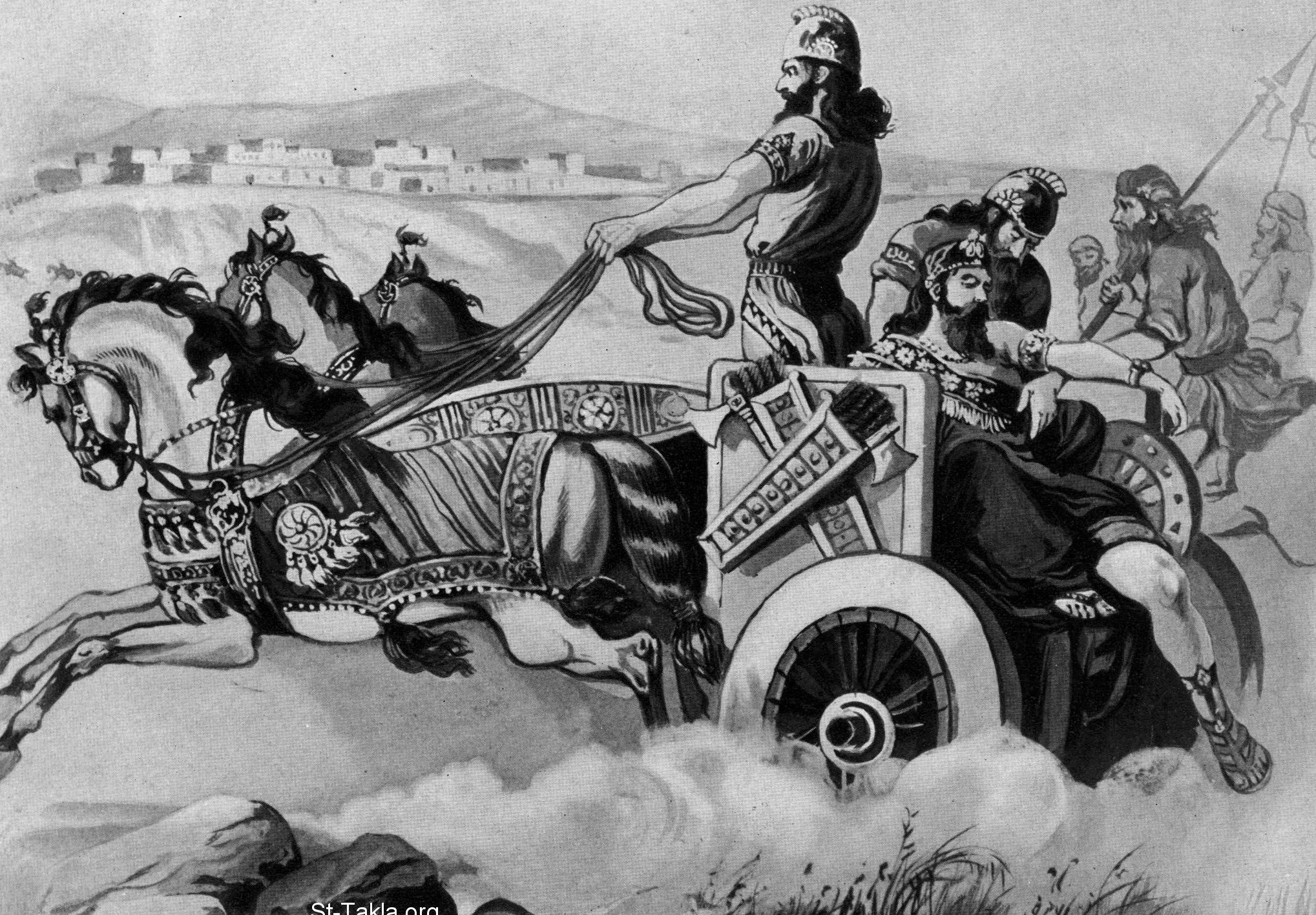
Ignorant of God’s plans, King Josiah decided to take matters into his own hands and led his troops into battle against the Egyptians. They intercepted the Egyptian army at a place called Megiddo, and in the ensuing battle, King Josiah was killed. The author of 2 Kings states that “Pharaoh Neco killed him at Megiddo, as soon as he saw him” (2 Kings 23:29 ESV). But in 2 Chronicles 35, we’re told that Josiah had disguised himself before going into battle. It seems that Josiah’s little ploy to hide his kingly identity failed. King Neco recognized Josiah instantly and ordered his death.

But the enemy archers hit King Josiah with their arrows and wounded him. He cried out to his men, “Take me from the battle, for I am badly wounded!” – 2 Chronicles 35:23 NLT

The wounded king was placed in another chariot and evacuated to the city of Jerusalem, where he died. After giving their fallen king a state funeral, the people chose Jehoahaz as his replacement. This choice seems a bit odd because Jehoahaz was Josiah’s middle son and, therefore, not the next in line to the throne. But it seems that the people were looking for a king who would bring back the old way of life to which they had grown accustomed. They missed the days of Manasseh and regretted all the reforms that Josiah had instituted in Judah. So, they chose the one son of Josiah who represented their best chance at bringing back the good old days. And it appears that they picked just the right man for the job becaise “he did what was evil in the LORD’s sight, just as his ancestors had done” (2 Kings 23:32 NLT).

But Jehoahaz’s reign would be short-lived. The people failed to take into account that King Neco might have something to say about who took Josiah’s place on the throne of Judah. Just three months into his reign, Jehoahaz was deposed by the Pharaoh and taken captive to Egypt, where he died. Neco filled the vacancy with Eliakim, the older brother of Jehoahaz, and changed his name to Jehoiakim. This young man became little more than a puppet king who was forced to make an annual tribute payment to the Egyptians. To do this, he imposed a debilitating tax on the people of Judah. The prophet provides a brief but sobering summary of the sad state of affairs in the southern kingdom of Judah after the death of Josiah.

Do not weep for the dead king or mourn his loss. Instead, weep for the captive king being led away! For he will never return to see his native land again.

For this is what the LORD says about Jehoahaz, who succeeded his father, King Josiah, and was taken away as a captive: “He will never return. He will die in a distant land and will never again see his own country.” – Jeremiah 22:10-12 NLT

With Josiah’s death, the period of reformation in Judah came to an abrupt end. He had been the heart and soul behind all the changes that had taken place, and, without him, the people quickly reverted to their old ways. Virtually overnight, the conditions in Judah took a dramatic turn for the worse. Judah was now a vassal state, ruled by a powerless king who answered to the Pharaoh of Egypt.

Josiah’s attempt to stop the Egyptians from joining forces with the Assyrians had failed. In 605 BC, just four years after Josiah’s death, these two armies were defeated by the Babylonians at the Battle of Carchemish. This unexpected victory by the Babylonians over the Egyptians and Assyrians proved to be a game-changing event in the history of the Middle East. It catapulted King Nebuchadnezzar of Babylon into the role of the most powerful ruler on earth. With his defeat of the Assyrians, Nebuchadnezzar took over all the lands they had conquered, dramatically increasing the size and influence of his empire.

Eventually, the Babylonians would wrest control of Judah from the hands of King Neco of Egypt, and Jehoiakim would find himself answering to yet another, more powerful, king. But Jehoiakim will try to resist his new overlord, refusing to submit to his authority. Like his father, Josiah, Jehoiakim will fail to see the sovereign hand of God behind all that is taking place. His outlook is short-sighted, and he will attempt to make the most of his less-than-ideal circumstances.

The prophet Jeremiah records God’s stinging condemnation of Jehoiakim’s arrogant and self-centered approach to leadership.

And the LORD says, “What sorrow awaits Jehoiakim,
    who builds his palace with forced labor.
He builds injustice into its walls,
    for he makes his neighbors work for nothing.
    He does not pay them for their labor.
He says, ‘I will build a magnificent palace
    with huge rooms and many windows.
I will panel it throughout with fragrant cedar
    and paint it a lovely red.’
But a beautiful cedar palace does not make a great king!
    Your father, Josiah, also had plenty to eat and drink.
But he was just and right in all his dealings.
    That is why God blessed him.
He gave justice and help to the poor and needy,
    and everything went well for him.
Isn’t that what it means to know me?”
    says the LORD.
“But you! You have eyes only for greed and dishonesty!
    You murder the innocent,
    oppress the poor, and reign ruthlessly.” – Jeremiah 22:13-17 NLT

Unlike his reform-minded father, Jehoiakim had no heart for Yahweh. He was a self-obsessed man who used his power and position to improve his own lot in life while allowing the nation of Judah to continue its slide into apostasy. When Neco was forced to abandon his hold on Judah, Jehoiakim saw it as an opportunity to assert his independence, but he failed to understand the gravity of his situation. He had no clue that Yahweh had divinely ordained Nebuchadnezzar and the Babylonians to bring judgment against the nation of Judah. In attempting to resist the Babylonians, Jehoiakim was actually opposing the sovereign will of God, and he would pay dearly for his obstinacy.

For three years, Yahweh sent the Babylonians, Arameans, Moabites, and Ammonites against the rebellious nation of Judah. And the author leaves no doubt as to the purpose behind these raids.

These disasters happened to Judah because of the LORD’s command. He had decided to banish Judah from his presence because of the many sins of Manasseh. – 2 Kings 24:3 NLT

Little did Jehoiakim know that he was facing the beginning of the end. The coming judgment of Judah was imminent and unavoidable.

English Standard Version (ESV) The Holy Bible, English Standard Version. ESV® Permanent Text Edition® (2016). Copyright © 2001 by Crossway Bibles, a publishing ministry of Good News Publishers.

New Living Translation (NLT) Holy Bible, New Living Translation, copyright © 1996, 2004, 2015 by Tyndale House Foundation. Used by permission of Tyndale House Publishers Inc., Carol Stream, Illinois 60188. All rights reserved.
The Self-Delusion of “Self-Made” Men

1 Manasseh was twelve years old when he began to reign, and he reigned fifty-five years in Jerusalem. His mother’s name was Hephzibah. And he did what was evil in the sight of the LORD, according to the despicable practices of the nations whom the LORD drove out before the people of Israel. For he rebuilt the high places that Hezekiah his father had destroyed, and he erected altars for Baal and made an Asherah, as Ahab king of Israel had done, and worshiped all the host of heaven and served them. And he built altars in the house of the LORD, of which the LORD had said, “In Jerusalem will I put my name.” And he built altars for all the host of heaven in the two courts of the house of the LORD. And he burned his son as an offering and used fortune-telling and omens and dealt with mediums and with necromancers. He did much evil in the sight of the LORD, provoking him to anger. And the carved image of Asherah that he had made he set in the house of which the LORD said to David and to Solomon his son, “In this house, and in Jerusalem, which I have chosen out of all the tribes of Israel, I will put my name forever. And I will not cause the feet of Israel to wander anymore out of the land that I gave to their fathers, if only they will be careful to do according to all that I have commanded them, and according to all the Law that my servant Moses commanded them.” But they did not listen, and Manasseh led them astray to do more evil than the nations had done whom the LORD destroyed before the people of Israel.

10 And the LORD said by his servants the prophets, 11 “Because Manasseh king of Judah has committed these abominations and has done things more evil than all that the Amorites did, who were before him, and has made Judah also to sin with his idols, 12 therefore thus says the LORD, the God of Israel: Behold, I am bringing upon Jerusalem and Judah such disaster that the ears of everyone who hears of it will tingle. 13 And I will stretch over Jerusalem the measuring line of Samaria, and the plumb line of the house of Ahab, and I will wipe Jerusalem as one wipes a dish, wiping it and turning it upside down. 14 And I will forsake the remnant of my heritage and give them into the hand of their enemies, and they shall become a prey and a spoil to all their enemies, 15 because they have done what is evil in my sight and have provoked me to anger, since the day their fathers came out of Egypt, even to this day.” 2 Kings 21:1-15 ESV

When reading the opening lines of 2 Kings 21, an old proverb comes to mind that states: “All good things must come to an end.”

With the end of Hezekiah’s life, the fortunes of Israel took a decidedly dark turn for the worse. While Hezekiah was far from a perfect king, he had proved to be faithful to Yahweh, doing “what was right in the eyes of the LORD” (2 Kings 18:3 ESV). As a result, “the LORD was with him; wherever he went out, he prospered” (2 Kings 18:7 ESV). Hezekiah had been an ambitious reformer who attempted to restore and reinvigorate the worship of Yahweh in Judah. But the last 15 years of his reign, which were marked by peace and great prosperity, became fertile ground for Hezekiah’s pride to take root and grow. In time, he developed an unhealthy preoccupation with his own success and self-importance. 

Hezekiah was very wealthy and highly honored. He built special treasury buildings for his silver, gold, precious stones, and spices, and for his shields and other valuable items. He also constructed many storehouses for his grain, new wine, and olive oil; and he made many stalls for his cattle and pens for his flocks of sheep and goats. He built many towns and acquired vast flocks and herds, for God had given him great wealth. He blocked up the upper spring of Gihon and brought the water down through a tunnel to the west side of the City of David. And so he succeeded in everything he did. – 2 Chronicles 32:27-30 NLT

It is important to remember that those years of life and prosperity had been a gracious gift from God, in answer to Hezekiah’s humble prayer as he lay near death. God heard and restored his health, then granted him another 15 years of life. During the last 11 years, up until the day of his death in 686 BC, Hezekiah’s son, Manasseh, had served as his co-regent. But upon Hezekiah’s death, Manasseh assumed the burden and responsibilities of leadership as the king of Judah at the age of 23.

Manasseh had begun his co-regency at the young age of 12. So, for 11 years this young man had been able to serve alongside his father, learning valuable life lessons on everything from leadership and diplomacy to fiduciary responsibility and spiritual fidelity. But unfortunately, Manasseh was exposed to some of Hezekiah’s less flattering years in office. He served alongside his father at a time when Judah was prospering and Hezekiah was more interested in building his kingdom and reputation than in promoting the worship of Yahweh.

It appears quite obvious that Manasseh’s 11-year apprenticeship under his father’s tutelage failed to prepare him to be a godly king. His ascension to the throne ushered in one of the darkest periods in Judah’s long and tumultuous history, and his reign would reverse most, if not all, of the religious reforms his father had implemented. Virtually overnight, he radically transformed the kingdom of Judah into a spiritual wasteland by systematically rescinding all of his father’s earlier reforms.

He did what was evil in the LORD’s sight, following the detestable practices of the pagan nations that the LORD had driven from the land ahead of the Israelites. He rebuilt the pagan shrines his father, Hezekiah, had destroyed. He constructed altars for Baal and set up an Asherah pole, just as King Ahab of Israel had done. He also bowed before all the powers of the heavens and worshiped them. – 2 Kings 21:2-3 NLT

This ambitious young man seemed determined to eradicate all vestiges of Yahweh from the hearts and minds of the people. He erected altars to false gods inside the Temple, rendering it unholy and unfit for Yahweh’s presence. He encouraged the practice of sorcery and divination, and even promoted the use of human sacrifices as an acceptable form of worship, offering up his own son as a payment to his false god.

Everything he did was in direct violation of God’s commands and seemed to be part of a well-calculated plan to destroy all that his father had accomplished. He purposefully dismantled the spiritual legacy his father had left, but the text provides no explanation as to what prompted Manasseh’s actions. His mother is mentioned, but we know nothing about her or the role she may have played in his spiritual formation. However, it is painfully clear that while Manasseh inherited his father’s throne, he did not inherit his father’s love for Yahweh. In fact, he led the nation of Judah to “do even more evil than the pagan nations that the LORD had destroyed when the people of Israel entered the land” (2 Kings 21:9 NLT).

This young king led the nation of Judah in a wave of apostasy and spiritual infidelity that would have shocked the land’s former pagan occupants. During this period of spiritual decline, Yahweh used men like the prophet Jeremiah to communicate His displeasure and warn of His pending discipline for their egregious behavior.

“Go west and look in the land of Cyprus;
    go east and search through the land of Kedar.
Has anyone ever heard of anything
    as strange as this?
Has any nation ever traded its gods for new ones,
    even though they are not gods at all?
Yet my people have exchanged their glorious God
    for worthless idols!
The heavens are shocked at such a thing
    and shrink back in horror and dismay,”
    says the Lord.
“For my people have done two evil things:
They have abandoned me—
    the fountain of living water.
And they have dug for themselves cracked cisterns
    that can hold no water at all!” – Jeremiah 2:10-13 NLT

All that his father had spent years building, Manasseh painstakingly and systematically destroyed. But while Manasseh was busy dismantling the spiritual legacy bequeathed to him by his father, Yahweh was far from silent. The author of 2 Chronicles states that “The LORD spoke to Manasseh and his people, but they ignored all his warnings” (2 Chronicles 33:10 NLT). God didn’t sit idly by, watching in silence as the young king led an insurrection against His sovereign will and authority. He sent His prophets to warn the king and his compliant subjects that their insubordination would have dire consequences. Jeremiah would deliver a particularly stinging indictment against the people of Judah for their willing participation in Manasseh’s apostasy.

“I will send four kinds of destroyers against them,” says the LORD. “I will send the sword to kill, the dogs to drag away, the vultures to devour, and the wild animals to finish up what is left. Because of the wicked things Manasseh son of Hezekiah, king of Judah, did in Jerusalem, I will make my people an object of horror to all the kingdoms of the earth.” – Jeremiah 15:3-4 NLT

Jeremiah would go on to record God’s words concerning the capital city of Jerusalem, where Manasseh instigated his wicked and rebellious anti-reform measures.

“Who will feel sorry for you, Jerusalem?
    Who will weep for you?
    Who will even bother to ask how you are?
You have abandoned me
    and turned your back on me,”
    says the Lord.
“Therefore, I will raise my fist to destroy you.
    I am tired of always giving you another chance.” – Jeremiah 15:5-6 NLT

Yahweh declared Manasseh to be more wicked than the pagan nations who had previously occupied the land of Canaan before the arrival of the Israelites. This leader of God’s chosen people managed to out-sin the godless Amorites. Rather than follow in his father’s footsteps, Manasseh decided to emulate the behavior of Ahab, the infamous king of Israel who, with the help of his wife, Jezebel, led the northern kingdom into such depths of moral and spiritual decay that God eventually destroyed them. Now, under Manasseh’s leadership, Judah was headed down the very same path and facing a similar outcome.

I will judge Jerusalem by the same standard I used for Samaria and the same measure I used for the family of Ahab. I will wipe away the people of Jerusalem as one wipes a dish and turns it upside down.” – 2 Kings 21:13 NLT

Manasseh may have been the sovereign ruler over the kingdom of Judah, but he would soon discover that he was no match for the King of the universe. His ongoing disregard and disrespect for Yahweh would not be tolerated.  God would not be mocked, and those who refused to honor their covenant commitments would not go unpunished. Yahweh’s blunt assessment of Judah leaves no doubt concerning their guilt and well-deserved condemnation.

“…they have done great evil in my sight and have angered me ever since their ancestors came out of Egypt.” – 2 Kings 21:15 NLT

Manasseh believed that he had the freedom and authority to replace Yahweh. After all, he was king. But he was about to learn the same painful lesson that Yahweh taught to Ahab, Sennacherib, and so many other human kings: there is but one King over all the earth, and He alone decides who rules and reigns over its inhabitants. Manasseh served at God’s discretion, and he would soon discover that his ego was no match for God’s divine will. Years later, another pride-filled king would learn the same timeless lesson from the lips of another prophet of God. Years after the fall of Jerusalem at the hands of the Babylonians, the prophet Daniel would inform King Nebuchadnezzar, “the Most High rules over the kingdoms of the world. He gives them to anyone he chooses—even to the lowliest of people” (Daniel 4:17 NLT).

Neither Nebuchadnezzar nor Manasseh was a match for the Almighty. While they both allowed their power to go to their heads, it was Yahweh who ruled, and it was He who would determine the destiny of their dynasties.

English Standard Version (ESV) The Holy Bible, English Standard Version. ESV® Permanent Text Edition® (2016). Copyright © 2001 by Crossway Bibles, a publishing ministry of Good News Publishers.

New Living Translation (NLT) Holy Bible, New Living Translation, copyright © 1996, 2004, 2015 by Tyndale House Foundation. Used by permission of Tyndale House Publishers Inc., Carol Stream, Illinois 60188. All rights reserved.
Repentance Must Precede Restoration

A Maskil of Ethan the Ezrahite.

1 I will sing of the steadfast love of the LORD, forever;
    with my mouth I will make known your faithfulness to all generations.
For I said, “Steadfast love will be built up forever;
    in the heavens you will establish your faithfulness.”
You have said, “I have made a covenant with my chosen one;
    I have sworn to David my servant:
‘I will establish your offspring forever,
    and build your throne for all generations.’” Selah

Let the heavens praise your wonders, O LORD,
    your faithfulness in the assembly of the holy ones!
For who in the skies can be compared to the Lord?
    Who among the heavenly beings is like the Lord,
a God greatly to be feared in the council of the holy ones,
    and awesome above all who are around him?
O LORD God of hosts,
    who is mighty as you are, O LORD,
    with your faithfulness all around you?
You rule the raging of the sea;
    when its waves rise, you still them.
10 You crushed Rahab like a carcass;
    you scattered your enemies with your mighty arm.
11 The heavens are yours; the earth also is yours;
    the world and all that is in it, you have founded them.
12 The north and the south, you have created them;
    Tabor and Hermon joyously praise your name.
13 You have a mighty arm;
    strong is your hand, high your right hand.
14 Righteousness and justice are the foundation of your throne;
    steadfast love and faithfulness go before you.
15 Blessed are the people who know the festal shout,
    who walk, O LORD, in the light of your face,
16 who exult in your name all the day
    and in your righteousness are exalted.
17 For you are the glory of their strength;
    by your favor our horn is exalted.
18 For our shield belongs to the LORD,
    our king to the Holy One of Israel.

19 Of old you spoke in a vision to your godly one, and said:
    “I have granted help to one who is mighty;
    I have exalted one chosen from the people.
20 I have found David, my servant;
    with my holy oil I have anointed him,
21 so that my hand shall be established with him;
    my arm also shall strengthen him.
22 The enemy shall not outwit him;
    the wicked shall not humble him.
23 I will crush his foes before him
    and strike down those who hate him.
24 My faithfulness and my steadfast love shall be with him,
    and in my name shall his horn be exalted.
25 I will set his hand on the sea
    and his right hand on the rivers.
26 He shall cry to me, ‘You are my Father,
    my God, and the Rock of my salvation.’
27 And I will make him the firstborn,
    the highest of the kings of the earth.
28 My steadfast love I will keep for him forever,
    and my covenant will stand firm for him.
29 I will establish his offspring forever
    and his throne as the days of the heavens.
30 If his children forsake my law
    and do not walk according to my rules,
31 if they violate my statutes
    and do not keep my commandments,
32 then I will punish their transgression with the rod
    and their iniquity with stripes,
33 but I will not remove from him my steadfast love
    or be false to my faithfulness.
34 I will not violate my covenant
    or alter the word that went forth from my lips.
35 Once for all I have sworn by my holiness;
    I will not lie to David.
36 His offspring shall endure forever,
    his throne as long as the sun before me.
37 Like the moon it shall be established forever,
    a faithful witness in the skies.” Selah

38 But now you have cast off and rejected;
    you are full of wrath against your anointed.
39 You have renounced the covenant with your servant;
    you have defiled his crown in the dust.
40 You have breached all his walls;
    you have laid his strongholds in ruins.
41 All who pass by plunder him;
    he has become the scorn of his neighbors.
42 You have exalted the right hand of his foes;
    you have made all his enemies rejoice.
43 You have also turned back the edge of his sword,
    and you have not made him stand in battle.
44 You have made his splendor to cease
    and cast his throne to the ground.
45 You have cut short the days of his youth;
    you have covered him with shame. Selah

46 How long, O LORD? Will you hide yourself forever?
    How long will your wrath burn like fire?
47 Remember how short my time is!
    For what vanity you have created all the children of man!
48 What man can live and never see death?
    Who can deliver his soul from the power of Sheol? Selah

49 LORD, where is your steadfast love of old,
    which by your faithfulness you swore to David?
50 Remember, O Lord, how your servants are mocked,
    and how I bear in my heart the insults of all the many nations,
51 with which your enemies mock, O LORD,
    with which they mock the footsteps of your anointed.

52 Blessed be the Lord forever!
Amen and Amen. Psalm 89:1-52 ESV

The author of this psalm was Ethan the Ezrahite, who, according to 1 Kings 4:31, was a wise member of King David’s royal administration. He and his brother Heman, the author of Psalm 88, also served together as Levitical musicians and singers. His song begins by praising Yahweh (the LORD) for His unfailing love and faithfulness.

I will sing of the LORD’s unfailing love forever!
    Young and old will hear of your faithfulness.
Your unfailing love will last forever.
    Your faithfulness is as enduring as the heavens. – Psalm 89:1-2 NLT

His psalm includes a reminder of the covenant promises that Yahweh made to David.

“Now I will make you as famous as the great men of the earth. I will establish a place for my people Israel and settle them there; they will live there and not be disturbed anymore. Violent men will not oppress them again, as they did in the beginning and during the time when I appointed judges to lead my people Israel. Instead, I will give you relief from all your enemies. The LORD declares to you that he himself will build a dynastic house for you. – 2 Samuel 7:9-11 NLT

For 25 verses, Ethan sings Yahweh’s praises, declaring His supremacy and incomparability. Yahweh has no equal, and His power is limitless. The Creator of heaven and earth rules over all with justice and righteousness, displaying His glory for all to see.

But Ethan knew that God had His limits. Despite His unfailing love and faithfulness, Yahweh would not tolerate spiritual infidelity and disobedience in His people. His covenant with David was intended to be ongoing, extending to future generations of David’s descendants.

When the time comes for you to die, I will raise up your descendant, one of your own sons, to succeed you, and I will establish his kingdom. He will build a house for my name, and I will make his dynasty permanent. – 2 Samuel 7:12-13 NLT

But Ethan knew Yahweh would hold each succeeding generation accountable for their actions. He would demand obedience to His law and submission to His will, and if they failed to do so, they would experience His judgment and wrath.

But if his descendants forsake my instructions
    and fail to obey my regulations,
if they do not obey my decrees
    and fail to keep my commands,
then I will punish their sin with the rod,
    and their disobedience with beating. – Psalm 89:30-32 NLT

Yahweh warned David that this would be the consequence of future unfaithfulness. David’s heir to the throne would experience God’s love, but he would also come under God’s loving discipline if he refused to follow his father’s example of faithfulness.

“I will become his father and he will become my son. When he sins, I will correct him with the rod of men and with wounds inflicted by human beings. But my loyal love will not be removed from him…” – 2 Samuel 7:14-15 NLT

Ethan went out of his way to recall the covenant Yahweh made with David, almost as if to remind Him of its binding promises. He repeats Yahweh’s words back to Him in an attempt to hold Him to His word.

“No, I will not break my covenant;
    I will not take back a single word I said.
I have sworn an oath to David,
    and in my holiness I cannot lie:
His dynasty will go on forever;
    his kingdom will endure as the sun.
It will be as eternal as the moon,
    my faithful witness in the sky!” – Psalm 89:34-37 NLT

And Ethan has a purpose behind the rather lengthy opening to his psalm. The first 37 verses have served as the preface to his opening remarks in what appears to be a trial of Yahweh. In verse 38, he accuses God of violating the terms of His covenant agreement.

But now you have rejected him and cast him off.
    You are angry with your anointed king.
You have renounced your covenant with him;
    you have thrown his crown in the dust. – Psalm 89:37-38 NLT

Ethan provides no hints as to which descendant of David he has in mind or what event has caused his concern. Obviously, something tragic has taken place, forcing Ethan to draw the conclusion that Yahweh has broken His covenant promise. Whoever the king is, his reign is at risk and the future of the kingdom is in jeopardy. It seems likely that Ethan is recounting the Babylonian siege of Jerusalem. Over a period of years, King Nebuchadnezzar and his forces had threatened to destroy the southern kingdom of Judah. A series of Davidic kings had attempted to hold off the Babylonian threat and failed. Jehoiachin’s father, Jehoiakim, had reigned for 11 years, but it all came to an end when Nebuchadnezzar took him back to Babylon in chains. Jehoiachin ascended to his father’s throne at the age of 18, but he only lasted three months before he too was taken captive to Babylon.

Ethan describes the scene of Jehoiachin’s fall and places the blame on Yahweh.

You have ended his splendor
    and overturned his throne.
You have made him old before his time
    and publicly disgraced him. – Psalm 89:44-45 NLT

But he conveniently leaves out an important part of the narrative. Both Jehoiakim and Jehoiachin had been guilty of sinning against Yahweh.

Jehoiakim was twenty-five years old when he became king, and he reigned for eleven years in Jerusalem. He did evil in the sight of the LORD his God. – 2 Chronicles 36:5 NLT

Jehoiachin was eighteen years old when he became king, and he reigned three months and ten days in Jerusalem. He did evil in the sight of the LORD. – 2 Chronicles 36:9 NLT

Ethan doesn’t seem to remember that Yahweh had promised to punish David’s descendants for their sin. His judgment was inevitable but it was never to be taken as a sign that God had reneged on His covenant promises. In fact, God’s judgment was in keeping with His covenant commitment.

But speaking on behalf of the fallen king, Ethan writes, “LORD, where is your unfailing love? You promised it to David with a faithful pledge. Consider, LORD, how your servants are disgraced! I carry in my heart the insults of so many people. Your enemies have mocked me, O LORD; they mock your anointed king wherever he goes” (Psalm 89:49-51 NLT). 

There is no evidence of brokenness or repentance. The king displays no remorse and offers no confession of his sins. It must have been demoralizing for Jehoiachin to leave Jerusalem draped in chains and treated like a common slave. The city must have mourned as they watched yet another king led away in defeat and ignominy. The Babylonians had arrested their king and plundered their Temple, and Yahweh seemed to be AWOL.

But Yahweh was there and simply waiting for someone to take ownership for the sins of His covenant people. He wanted someone to have the attitude that David had.

The sacrifice you desire is a broken spirit.
    You will not reject a broken and repentant heart, O God.
Look with favor on Zion and help her;
    rebuild the walls of Jerusalem.
Then you will be pleased with sacrifices offered in the right spirit—
    with burnt offerings and whole burnt offerings.
    Then bulls will again be sacrificed on your altar. – Psalm 51:17019 NLT

But all Ethan could muster up was a weak line of praise at the end of his somber song.

Praise the Lord forever!
    Amen and amen! – Psalm 89:51 NLT

He expects God to do something. In fact, he conveys the idea that God is obligated to fix their problem because He has broken His covenant commitment. But where is the broken spirit? What evidence of repentance does Ethan give? He wanted to experience Yahweh’s deliverance, but is unwilling to admit that their suffering had been self-inflicted. A whole succession of kings had led Judah to disobey Yahweh, and now they were paying the consequences for their actions. But the faithful, always loving Yahweh stood ready to restore His people when they were ready to confess their sins.

“If my people who are called by my name will humble themselves and pray and seek my face and turn from their wicked ways, I will hear from heaven and will forgive their sins and restore their land.” – 2 Chronicles 7:14 NLT

Confession is the key to experiencing God’s deliverance. Repentance must precede restoration. David knew that, and so did his son Solomon. The promise recorded in 2 Chronicles 7:14 was spoken by God at the dedication of the Solomonic Temple. And God had warned His people that disobedience would bring discipline in the form of their nation’s fall and the Temple’s destruction.

“If you or your descendants abandon me and disobey the decrees and commands I have given you, and if you serve and worship other gods, then I will uproot the people from this land that I have given them. I will reject this Temple that I have made holy to honor my name. I will make it an object of mockery and ridicule among the nations” – 2 Chronicles 7:19-20 NLT

But Yahweh was ready and willing to forgive their sins and restore their land — as soon as they were ready to humble themselves and turn from their wicked ways.

Father, we love the idea of forgiveness and count on the reality of Your unfailing love. But we take these gracious gifts for granted and treat them with contempt because we fail to acknowledge our sinfulness. We fully expect You to keep Your covenant promises, but seem to believe we are under no obligation to do our part. Somehow, we have determined that faithfulness is Your responsibility, not ours. But You still expect Your people to display humble hearts and a willingness to take ownership for our sins. Your love for us came at a high price; You sacrificed Your Son on our behalf. So, forgive us for making Your grace cheap and our faith as if its optional. Amen

English Standard Version (ESV) The Holy Bible, English Standard Version. ESV® Permanent Text Edition® (2016). Copyright © 2001 by Crossway Bibles, a publishing ministry of Good News Publishers.

New Living Translation (NLT) Holy Bible, New Living Translation, copyright © 1996, 2004, 2015 by Tyndale House Foundation. Used by permission of Tyndale House Publishers Inc., Carol Stream, Illinois 60188. All rights reserved.

The Handwriting on the Wall

1 King Belshazzar made a great feast for a thousand of his lords and drank wine in front of the thousand.

Belshazzar, when he tasted the wine, commanded that the vessels of gold and of silver that Nebuchadnezzar his father had taken out of the temple in Jerusalem be brought, that the king and his lords, his wives, and his concubines might drink from them. Then they brought in the golden vessels that had been taken out of the temple, the house of God in Jerusalem, and the king and his lords, his wives, and his concubines drank from them. They drank wine and praised the gods of gold and silver, bronze, iron, wood, and stone.

Immediately the fingers of a human hand appeared and wrote on the plaster of the wall of the king’s palace, opposite the lampstand. And the king saw the hand as it wrote. Then the king’s color changed, and his thoughts alarmed him; his limbs gave way, and his knees knocked together. The king called loudly to bring in the enchanters, the Chaldeans, and the astrologers. The king declared to the wise men of Babylon, “Whoever reads this writing, and shows me its interpretation, shall be clothed with purple and have a chain of gold around his neck and shall be the third ruler in the kingdom.” Then all the king’s wise men came in, but they could not read the writing or make known to the king the interpretation. Then King Belshazzar was greatly alarmed, and his color changed, and his lords were perplexed.

10 The queen, because of the words of the king and his lords, came into the banqueting hall, and the queen declared, “O king, live forever! Let not your thoughts alarm you or your color change. 11 There is a man in your kingdom in whom is the spirit of the holy gods. In the days of your father, light and understanding and wisdom like the wisdom of the gods were found in him, and King Nebuchadnezzar, your father—your father the king—made him chief of the magicians, enchanters, Chaldeans, and astrologers, 12 because an excellent spirit, knowledge, and understanding to interpret dreams, explain riddles, and solve problems were found in this Daniel, whom the king named Belteshazzar. Now let Daniel be called, and he will show the interpretation.” – Daniel 5:1-12 ESV

Once again, the narrative jumps ahead, shifting the focus from Nebuchadnezzar to Belshazzar, the last king to reign over the Babylonian empire. Nebuchadnezzar’s daughter, Nitocris, married Nabonidus, to whom she bore Belshazzar. When Nebuchadnezzar died in 562 B.C., he was succeeded by Amel-Marduk. Over a period of nine years, a succession of family members would rule the nation, including Neriglissar, Labashi-Marduk, and Nabonidus. When Nabonidus was exiled in 550 B.C., he appointed his eldest son, Belshazzar, as his co-regent. This places the events of chapter five nearly 66 years after Daniel and his friends arrived in Babylon and some 36 years after the events in chapter four.

Chronologically, the story recorded in chapter five takes place after the events found in chapters seven and eight. The author’s decision to rearrange the order was meant to connect Belshazzar’s vision with Nebuchadnezzar’s dream. Both stories deal with the topic of pride and feature Daniel’s God-given capacity to interpret dreams and visions (Daniel 1:17). Daniel was likely in his 80s when this story takes place and had been in exile and service to the Babylonian crown for decades.

As the story opens, Belshazzar is hosting a sumptuous feast for 1,000 of his lords. Little did he know that his reign and the dominance of the Babylonian kingdom were about to come to an end. His father, Nabonidus, had already been captured in battle with the Medo-Persians and sent into exile. His departure left Belshazzar in charge of the kingdom and tasked with protecting the capital city from the Medo-Persian army that camped outside its walls.

But instead of making battle plans, the king throws a lavish party for his cronies. As the wine flowed and the tongues loosened, Belshazzar commanded that his stewards retrieve the gold and silver cups that had been plundered from the Temple in Jerusalem when his grandfather had captured the city decades earlier. Facing possible defeat at the hands of the Medo-Persians, Belshazzar decided to relive the glory days of his grandfather and impress his guests with looted treasure from a bygone era. During his short reign, he had done little to expand the borders of his kingdom. He had few exploits to celebrate and no stories of global expansion with which to impress his guests. So, he brought out the symbols of his grandfather’s glory days and drank heartily before his friends and family members.

The author provides a not-so-subtle hint of things to come when he writes, “While they drank from them they praised their idols made of gold, silver, bronze, iron, wood, and stone” (Daniel 5:4 NLT). The Hebrew audience for which this book was intended would have recognized the warning sign in this statement. Belshazzar and his fellow partiers were using sacred vessels consecrated for use in the worship of Yahweh to celebrate the false gods of Babylon. This pride-filled decision would not turn out well and the text conveys the immediacy of the outcome.

Suddenly, they saw the fingers of a human hand writing on the plaster wall of the king’s palace, near the lampstand. The king himself saw the hand as it wrote, and his face turned pale with fright. His knees knocked together in fear and his legs gave way beneath him. – Daniel 5:5-6 NLT

Belshazzar’s actions were likely meant to instill a sense of national pride among his key leaders. The nation was on the brink of annihilation and in desperate need of encouragement. But his decision to boast in his own might at the expense of God was a poor one. The vision of a disembodied hand scrawling a message on the wall of his palace left Belshazzar and his guests shaken to the core. The entire entourage sobered up immediately.

In a scene reminiscent of chapters two and four, Belshazzar sent for his enchanters, Chaldeans, and astrologers. These “wise men” were gathered up and brought before the king, who demanded that they use their supernatural powers to ascertain the meaning of the vision.

“Whoever can read this writing and tell me what it means will be dressed in purple robes of royal honor and will have a gold chain placed around his neck. He will become the third highest ruler in the kingdom!” – Daniel 5:7 NLT

Belshazzar was willing to richly reward anyone who could provide an explanation for what he had just witnessed. While the floating hand had disappeared, the message it scrawled was still there for all to see. But the handwriting was in a language no one could decipher. The king’s occult experts were left scratching their heads and unable to interpret what the words said, let alone what they meant. This left the king in an increasing state of unrest and fear. The party was over and the drunken guests could only watch with increasing fear as the king became increasingly more agitated.

At this point, an unlikely and unexpected individual came to the rescue: The king’s own mother, Nitocris. She recalled a scene from the past and informed Belshazzar of a man named Daniel who had come to the aid of her father during a similar situation.

“There is a man in your kingdom who has within him the spirit of the holy gods. During Nebuchadnezzar’s reign, this man was found to have insight, understanding, and wisdom like that of the gods. Your predecessor, the king—your predecessor King Nebuchadnezzar—made him chief over all the magicians, enchanters, astrologers, and fortune-tellers of Babylon. – Daniel 5:11 NLT

Due to his advanced age, it seems likely that Daniel’s work schedule had greatly diminished. Despite his position as chief of all the wise men, Daniel had not been summoned to the palace. But the queen noted Daniel’s reputation for solving difficult mysteries.

“This man Daniel, whom the king named Belteshazzar, has exceptional ability and is filled with divine knowledge and understanding. He can interpret dreams, explain riddles, and solve difficult problems.” – Daniel 5:12 NLT

She purposefully shares Daniel’s Babylonian name, which is remarkably similar to that of her son. Belshazzar means “Baal protect the king” or “Prince of Bel.” Belteshazzar appears to be the feminine version of that same name and could be translated as “Lady protect the king.” But the similarities between their names would not have escaped Belshazzar. Desperate to have someone translate the words on the wall and provide their meaning, Belshazzar sent for Belteshazzar.

Once again, through a series of strange and unexpected events, God worked behind the scenes to communicate His will to a pagan, pride-filled king. Years had passed and a new king sat on the throne of Babylon, but he too would find himself little more than a pawn on the chessboard of God Almighty. This still-wet-behind-the-ears potentate had a lot to learn about sovereignty and power. He could drink from the Lord’s cups and gloat over his vast power and superiority, but his fate rested in the hands of Yahweh. Daniel, who was nearing the end of his life, was still a capable vessel in the hands of the Almighty. He was going to be used one more time to serve his God by proclaiming a divine message of judgment upon the arrogant ruler of a pagan kingdom.

God was not done with Daniel, and He was far from done with the nation of Babylon. Through the prophet Jeremiah, God had already predicted the demise of the once-mighty Babylonian empire.

“I will stir up a destroyer against Babylon
    and the people of Babylonia.
Foreigners will come and winnow her,
    blowing her away as chaff.
They will come from every side
    to rise against her in her day of trouble.
Don’t let the archers put on their armor
    or draw their bows.
Don’t spare even her best soldiers!
    Let her army be completely destroyed.
They will fall dead in the land of the Babylonians,
    slashed to death in her streets.
For the Lord of Heaven’s Armies
    has not abandoned Israel and Judah.
He is still their God,
    even though their land was filled with sin
    against the Holy One of Israel.” – Jeremiah 51:1-5 NLT

Belshazzar had been greatly disturbed by the handwriting on the wall, but he had no idea just how bad his day was about to get. Things were going to go from bad to worse. His little stunt of drinking wine from the vessels of God was going to cost him dearly. In an effort to glorify himself, Belshazzar had mocked God and now he would pay the price.

English Standard Version (ESV) The Holy Bible, English Standard Version. ESV® Permanent Text Edition® (2016). Copyright © 2001 by Crossway Bibles, a publishing ministry of Good News Publishers.

New Living Translation (NLT) Holy Bible, New Living Translation, copyright © 1996, 2004, 2015 by Tyndale House Foundation. Used by permission of Tyndale House Publishers Inc., Carol Stream, Illinois 60188. All rights reserved.

New English Translation (NET)NET Bible® copyright ©1996-2017 by Biblical Studies Press, L.L.C. http://netbible.com All rights reserved.

A Mind of His Own

19 Then Daniel, whose name was Belteshazzar, was dismayed for a while, and his thoughts alarmed him. The king answered and said, “Belteshazzar, let not the dream or the interpretation alarm you.” Belteshazzar answered and said, “My lord, may the dream be for those who hate you and its interpretation for your enemies! 20 The tree you saw, which grew and became strong, so that its top reached to heaven, and it was visible to the end of the whole earth, 21 whose leaves were beautiful and its fruit abundant, and in which was food for all, under which beasts of the field found shade, and in whose branches the birds of the heavens lived— 22 it is you, O king, who have grown and become strong. Your greatness has grown and reaches to heaven, and your dominion to the ends of the earth. 23 And because the king saw a watcher, a holy one, coming down from heaven and saying, ‘Chop down the tree and destroy it, but leave the stump of its roots in the earth, bound with a band of iron and bronze, in the tender grass of the field, and let him be wet with the dew of heaven, and let his portion be with the beasts of the field, till seven periods of time pass over him,’ 24 this is the interpretation, O king: It is a decree of the Most High, which has come upon my lord the king, 25 that you shall be driven from among men, and your dwelling shall be with the beasts of the field. You shall be made to eat grass like an ox, and you shall be wet with the dew of heaven, and seven periods of time shall pass over you, till you know that the Most High rules the kingdom of men and gives it to whom he will. 26 And as it was commanded to leave the stump of the roots of the tree, your kingdom shall be confirmed for you from the time that you know that Heaven rules. 27 Therefore, O king, let my counsel be acceptable to you: break off your sins by practicing righteousness, and your iniquities by showing mercy to the oppressed, that there may perhaps be a lengthening of your prosperity.”

28 All this came upon King Nebuchadnezzar. 29 At the end of twelve months he was walking on the roof of the royal palace of Babylon, 30 and the king answered and said, “Is not this great Babylon, which I have built by my mighty power as a royal residence and for the glory of my majesty?” 31 While the words were still in the king’s mouth, there fell a voice from heaven, “O King Nebuchadnezzar, to you it is spoken: The kingdom has departed from you, 32 and you shall be driven from among men, and your dwelling shall be with the beasts of the field. And you shall be made to eat grass like an ox, and seven periods of time shall pass over you, until you know that the Most High rules the kingdom of men and gives it to whom he will.” 33 Immediately the word was fulfilled against Nebuchadnezzar. He was driven from among men and ate grass like an ox, and his body was wet with the dew of heaven till his hair grew as long as eagles’ feathers, and his nails were like birds’ claws. – Daniel 4:10-33 ESV

In the earlier episode, when forced to reveal and interpret the king’s dream, Daniel took the matter to God. He gathered his three friends together and they prayed, asking God to tell them the content of the dream and its meaning, and God obliged. This time, however, there is no indication that Daniel utilized prayer to discern the interpretation of the king’s second dream. It appears Daniel knew the meaning of the dream as soon as the king described it, but he hesitated and was  “dismayed for a while, and his thoughts alarmed him” (Daniel 4:19 ESV). No explanation is given for Daniel’s disturbed state of mind but when the king sensed his reluctance to speak and encouraged him to reveal what he knew, Daniel replied, “I wish the events foreshadowed in this dream would happen to your enemies, my lord, and not to you!” (Daniel 4:19 NLT).

Daniel may have been well into his 50s by the time this incident occurred. He would have spent decades in Nebuchadnezzar’s employment, serving as the chief of all the king’s wise men. It’s likely that, during that time, Daniel and the king would have developed a close relationship. Despite their ethnic and religious differences, the two men would have shared a mutual respect and affinity for one another. Daniel’s hesitancy to reveal the dream’s meaning was born out of his care and concern for Nebuchadnezzar, not a fear of repercussions.

Buoyed by the king’s kind words of encouragement, Daniel broke his silence and said, “That tree, Your Majesty, is you. For you have grown strong and great; your greatness reaches up to heaven, and your rule to the ends of the earth” (Daniel 4:22 NLT). That part of the dream would have been easy to deliver because it was what Nebuchadnezzar wanted to hear. But it was the second half of the interpretation that had disturbed Daniel and caused him to hesitate. The blissful, happy image of the king’s reign would not end well. The watcher in the dream was a bad omen that signaled an unpleasant and unavoidable end to the king’s fame and fortune.

Your Majesty, and what the Most High has declared will happen to my lord the king. You will be driven from human society, and you will live in the fields with the wild animals. You will eat grass like a cow, and you will be drenched with the dew of heaven. Seven periods of time will pass while you live this way, until you learn that the Most High rules over the kingdoms of the world and gives them to anyone he chooses.” – Daniel 4:24-25 NLT

Daniel had to be the bearer of bad news but he didn’t deliver his message with any sense of joy or vindictiveness. He found no comfort in informing Nebuchadnezzar of his fate. Daniel seems completely aware that Nebuchadnezzar was going to get what he deserved. After all his years in the king’s employment, Daniel knew from personal experience that Nebuchadnezzar had a pride problem. He would have regularly witnessed the king’s growing arrogance and overconfidence in his own self-worth. Nebuchadnezzar was the most powerful man in the world and he had built an empire that was second to none. But Daniel knew that God was about to send a powerful and irrefutable message to his pride-filled boss.

What’s interesting to note is the focus of God’s judgment. He chooses to mess with Nebuchadnezzar’s mind, not his might. God could have dealt a death blow to the kingdom of Babylon but, instead, he threatens the king with temporary insanity. Babylon posed no problem for God. He was not intimidated by Babylonian supremacy and their reputation as an invincible superpower. As Daniel reveals in his interpretation of the dream, “…the Most High rules over the kingdoms of the world and gives them to anyone he chooses” ( Daniel 4:25 NLT). God had chosen to use Babylon as His instrument of judgment against the nation of Judah. He had raised Nebuchadnezzar to power for the sole purpose of fulfilling His promise of divine discipline against His disobedient children.

“Therefore thus says the Lord of hosts: Because you have not obeyed my words, behold, I will send for all the tribes of the north, declares the Lord, and for Nebuchadnezzar the king of Babylon, my servant, and I will bring them against this land and its inhabitants, and against all these surrounding nations. I will devote them to destruction, and make them a horror, a hissing, and an everlasting desolation. – Jeremiah 25:8-9 ESV

But Nebuchadnezzar had grown overconfident and self-assured. In his eyes, he was a self-made man who took full credit for his own success and saw no end to his dream of world dominance. But God had other plans. Little did Nebuchadnezzar know that his 15 minutes of fame would one day come to an end. God had given Jeremiah a second part to the divine plan for Babylon’s future.

Moreover, I will banish from them the voice of mirth and the voice of gladness, the voice of the bridegroom and the voice of the bride, the grinding of the millstones and the light of the lamp. This whole land shall become a ruin and a waste, and these nations shall serve the king of Babylon seventy years. Then after seventy years are completed, I will punish the king of Babylon and that nation, the land of the Chaldeans, for their iniquity, declares the Lord, making the land an everlasting waste. I will bring upon that land all the words that I have uttered against it, everything written in this book, which Jeremiah prophesied against all the nations. For many nations and great kings shall make slaves even of them, and I will recompense them according to their deeds and the work of their hands.” – Jeremiah 25:10-14 NLT

But that prophecy was to be fulfilled at a later date. Nebuchadnezzar faced a much more imminent problem – the loss of his mind, not his kingdom. What God had in store for him was going to be personal and painful. His kingdom would remain intact but his sanity would be removed for “seven periods of time” ( Daniel 4:25 NLT). Most scholars believe this is a reference to years. If so, then the king was going to go through a protracted period of unprecedented insanity. He would live like an animal with no recollection of his former status as king and no interaction with other humans. The once great and greatly feared king of Babylon would become a madman, and there was nothing he could do to prevent it from happening.

There is no indication that Nebuchadnezzar could forestall the inevitable. He had no power to prevent God Most High from fulfilling His edict. Daniel will plead with the king to change his ways, but even he does not seem confident that it will do any good.

“King Nebuchadnezzar, please accept my advice. Stop sinning and do what is right. Break from your wicked past and be merciful to the poor. Perhaps then you will continue to prosper. – Daniel 4:27 NLT

God knew Nebuchadnezzar’s heart better than Daniel did. He knew the king would never bow the knee or renounce his pride and arrogance. Even the threat of losing his most precious possession, his mind, would not be enough to cause Nebuchadnezzar to repent.

But there was good news. While God would destroy Nebuchadnezzar’s mind, it would only be for a season. In time, God would relent and restore the king’s sanity. But it would only happen when the king had learned his lesson. God had Daniel inform Nebuchadnezzar of the meaning behind the stump in his dream.

“…the stump and roots of the tree were left in the ground. This means that you will receive your kingdom back again when you have learned that heaven rules.” – Daniel 4:26 NLT

Nebuchadnezzar’s mind would be bound by God until he was willing to admit the reality of God’s sovereignty. There was only one King and He alone rules and reigns over all the kingdoms of Earth. And despite Daniel’s desperate pleas for Nebuchadnezzar to repent, the king will continue in his stubborn, pride-filled ways.

English Standard Version (ESV) The Holy Bible, English Standard Version. ESV® Permanent Text Edition® (2016). Copyright © 2001 by Crossway Bibles, a publishing ministry of Good News Publishers.

New Living Translation (NLT) Holy Bible, New Living Translation, copyright © 1996, 2004, 2015 by Tyndale House Foundation. Used by permission of Tyndale House Publishers Inc., Carol Stream, Illinois 60188. All rights reserved.

New English Translation (NET)NET Bible® copyright ©1996-2017 by Biblical Studies Press, L.L.C. http://netbible.com All rights reserved.

The Self-Delusions of a Self-Made Man

1 “King Nebuchadnezzar to all peoples, nations, and languages, that dwell in all the earth: Peace be multiplied to you! It has seemed good to me to show the signs and wonders that the Most High God has done for me.

How great are his signs,
    how mighty his wonders!
His kingdom is an everlasting kingdom,
    and his dominion endures from generation to generation.

4 I, Nebuchadnezzar, was at ease in my house and prospering in my palace. I saw a dream that made me afraid. As I lay in bed the fancies and the visions of my head alarmed me. So I made a decree that all the wise men of Babylon should be brought before me, that they might make known to me the interpretation of the dream. Then the magicians, the enchanters, the Chaldeans, and the astrologers came in, and I told them the dream, but they could not make known to me its interpretation. At last Daniel came in before me—he who was named Belteshazzar after the name of my god, and in whom is the spirit of the holy gods—and I told him the dream, saying, “O Belteshazzar, chief of the magicians, because I know that the spirit of the holy gods is in you and that no mystery is too difficult for you, tell me the visions of my dream that I saw and their interpretation.” – Daniel 4:1-9 ESV

The content of this chapter appears to cover events that happened much later in Nebuchadnezzar’s reign, perhaps near its end. Some scholars propose that a significant gap exists between the close of chapter three and the opening of chapter four. If correct, Daniel would be a much older man and Nebuchadnezzar’s kingdom would have had time to reach the height of its glory. Babylon would have become a formidable world power with its opulent capital city reflecting Nebuchadnezzar’s dreams of unbridled success and significance.

The chapter opens with what appears to be a written testimony from the king himself. He begins by praising the greatness of ‘ĕlâʿillay – the God most high. This is clearly a reference to the God of Daniel, Shadrach, Meshach, and Abednego. Nebuchadnezzar was not declaring his allegiance to the Hebrew God but was simply acknowledging Yahweh’s supremacy over all other gods. The king had ample evidence to reach this conclusion, having witnessed the miraculous salvation of Shadrach, Meshach, and Abednego from the fiery furnace. He also experienced Yahweh’s power when Daniel interpreted his dream, something none of his magicians, sorcerers, or astrologers could do. Nebuchadnezzar was impressed with the God of the Hebrews and had promoted Him to a premier position among all the gods of the Babylonians.

Nebuchadnezzar was an equal opportunity idolater, choosing to include the gods of the nations he had conquered. Since Yahweh had proved Himself powerful and useful, Nebuchadnezzar was willing to promote His worship. He had even issued an official decree that made it illegal to denigrate or disparage the God of the Hebrews.

“If any people, whatever their race or nation or language, speak a word against the God of Shadrach, Meshach, and Abednego, they will be torn limb from limb, and their houses will be turned into heaps of rubble. There is no other god who can rescue like this!” – Daniel 3:29 NLT

Even years later, as the king reflected on his power and prominence, he was willing to give Yahweh some of the credit. Verses 1-3 are intended to set up what Nebuchadnezzar is about to relate. In the verses that follow, the king recalls yet another incident involving a dream, Daniel, and Yahweh. Decades have passed and the prophecy contained in the first dream has not yet been fulfilled. His kingdom remains intact and his power has not diminished. He even begins his testimony with the pride-filled statement, “I, Nebuchadnezzar, was living in my palace in comfort and prosperity” (Daniel 4:4 NLT).

He was enjoying all the perks and benefits that accompanied the crown. He was rich, revered, and greatly feared. He ruled over a kingdom that had conquered much of the known world. But Nebuchadnezzar couldn’t control his unconscious thoughts. As he lay on his richly appointed bed, his mind was filled with nightmares that left him agitated and confused. Unable to sleep and anxious to know the meaning of the dream, Nebuchadnezzar sent for his wise men, a distinguished group of trusted advisors that included “magicians, enchanters, astrologers, and fortune-tellers” (Daniel 4:7 NLT). But as before, these self-proclaimed prophets men proved powerless to help the king.

I told them the dream, but they could not tell me what it meant. – Daniel 4:7 NLT

This time, Nebuchadnezzar took it easy on them. He didn’t require them to use their powers to determine what he dreamed, he simply asked them to explain its meaning. But they were clueless.

Then Daniel showed up. The text doesn’t explain Daniel’s late arrival but according to chapter two, he was the highest-ranking wise man in the kingdom.

…the king appointed Daniel to a high position and gave him many valuable gifts. He made Daniel ruler over the whole province of Babylon, as well as chief over all his wise men. – Daniel 2:48 NLT

Perhaps Daniel had been occupied with matters of state. But whatever the case, his timing could not have been better. He arrived just in time to hear the king’s dream and provide its interpretation. Nebuchadnezzar recounts Daniel’s entrance into the royal court by using his Hebrew and Babylonian names. It is unclear what Belteshazzar means but the king states that it has ties to one of his gods. He also adds the note that Daniel was filled with “the spirit of the holy gods” (Daniel 4:8 ESV). It seems unlikely that Nebuchadnezzar, a pagan polytheist, would have been referring to the Holy Spirit. He was simply acknowledging that Daniel possessed supernatural powers of a divine origin.

Desperate to know what his dream meant, Nebuchadnezzar begged Daniel to use his powers to solve the mystery.

“Belteshazzar, chief of the magicians, I know that the spirit of the holy gods is in you and that no mystery is too great for you to solve. Now tell me what my dream means.” – Daniel 4:9 NLT

While Nebuchadnezzar doesn’t mention Yahweh by name, he knows that Daniel is a devout follower of the God of the Hebrews. Throughout this chapter, Yahweh’s superiority will be proclaimed. Even in the opening verses, Nebuchadnezzar declares His greatness.

“How great are his signs,
    how powerful his wonders!
His kingdom will last forever,
    his rule through all generations. – Daniel 4:3 NLT

But as the chapter unfolds, Yahweh’s supremacy will be repeatedly stated.

“…the Most High rules the kingdom of men and gives it to whom he will and sets over it the lowliest of men.” – Daniel 4:17 ESV

“…this is the interpretation, O king: It is a decree of the Most High, which has come upon my lord the king.” – Daniel 4:24 ESV

“…the Most High rules the kingdom of men and gives it to whom he will. – Daniel 4:25 ESV

“…the Most High rules the kingdom of men and gives it to whom he will.” – Daniel 4:32 ESV

I blessed the Most High, and praised and honored him who lives forever,

for his dominion is an everlasting dominion,
    and his kingdom endures from generation to generation…” – Daniel 4:34 ESV

“…he does according to his will among the host of heaven
    and among the inhabitants of the earth…” – Daniel 4:35 ESV

I, Nebuchadnezzar, praise and extol and honor the King of heaven, for all his works are right and his ways are just; and those who walk in pride he is able to humble. – Daniel 4:37 ESV

This entire chapter is intended to provide a stark contrast between the powers of this world and the sovereign majesty and might of God Almighty. Nebuchadnezzar is meant to represent human authority in all its prideful arrogance. He is the consummate self-made man who dares to shake his fist in the face of God and declare his autonomy and independent authority. Surrounded by all the trappings of his own success, he dares to see himself as a deity in his own mind. But his dream mocks and rocks his confidence.

Nebuchadnezzar had conquered the world, but he couldn’t win the battle going on inside his head. Things were happening that he could not control or explain. There was a dimension to the world he could not see and over which he was powerless. Despite his posse of prophetic posers, he could not see the future. Regardless of his power, he had no way of controlling his fate. But the King of Heaven was not only aware of Nebuchadnezzar’s future, but He was in control of it.

Nebuchadnezzar was going to learn a powerful and painful lesson about God’s sovereignty and man’s inadequacy. His might was minimal when compared to that of God. His rule was impermanent when compared to that of God. His autonomy was non-existent when compared with the providential power of God Most High.

…all the nations of the world
    are but a drop in the bucket.
They are nothing more
    than dust on the scales.
He picks up the whole earth
    as though it were a grain of sand. – Isaiah 40:17 NLT

God sits above the circle of the earth.
    The people below seem like grasshoppers to him!
He spreads out the heavens like a curtain
    and makes his tent from them.
He judges the great people of the world
    and brings them all to nothing. – Isaiah 40:22-23 NLT

The king’s heart is like a stream of water directed by the Lord;
    he guides it wherever he pleases. – Proverbs 21:1 NLT

Nebuchadnezzar was surrounded by wealth, power, prestige, and a team of worldly wisemen who offered to provide him with insights into the future. But all the pomp and prophetic promises of this world are no match for God Most High.

English Standard Version (ESV) The Holy Bible, English Standard Version. ESV® Permanent Text Edition® (2016). Copyright © 2001 by Crossway Bibles, a publishing ministry of Good News Publishers.

New Living Translation (NLT) Holy Bible, New Living Translation, copyright © 1996, 2004, 2015 by Tyndale House Foundation. Used by permission of Tyndale House Publishers Inc., Carol Stream, Illinois 60188. All rights reserved.

New English Translation (NET)NET Bible® copyright ©1996-2017 by Biblical Studies Press, L.L.C. http://netbible.com All rights reserved.

God Doesn’t Need Man’s Help

19 Then Nebuchadnezzar was filled with fury, and the expression of his face was changed against Shadrach, Meshach, and Abednego. He ordered the furnace heated seven times more than it was usually heated. 20 And he ordered some of the mighty men of his army to bind Shadrach, Meshach, and Abednego, and to cast them into the burning fiery furnace. 21 Then these men were bound in their cloaks, their tunics, their hats, and their other garments, and they were thrown into the burning fiery furnace. 22 Because the king’s order was urgent and the furnace overheated, the flame of the fire killed those men who took up Shadrach, Meshach, and Abednego. 23 And these three men, Shadrach, Meshach, and Abednego, fell bound into the burning fiery furnace.

24 Then King Nebuchadnezzar was astonished and rose up in haste. He declared to his counselors, “Did we not cast three men bound into the fire?” They answered and said to the king, “True, O king.” 25 He answered and said, “But I see four men unbound, walking in the midst of the fire, and they are not hurt; and the appearance of the fourth is like a son of the gods.”

26 Then Nebuchadnezzar came near to the door of the burning fiery furnace; he declared, “Shadrach, Meshach, and Abednego, servants of the Most High God, come out, and come here!” Then Shadrach, Meshach, and Abednego came out from the fire. 27 And the satraps, the prefects, the governors, and the king’s counselors gathered together and saw that the fire had not had any power over the bodies of those men. The hair of their heads was not singed, their cloaks were not harmed, and no smell of fire had come upon them. 28 Nebuchadnezzar answered and said, “Blessed be the God of Shadrach, Meshach, and Abednego, who has sent his angel and delivered his servants, who trusted in him, and set aside the king’s command, and yielded up their bodies rather than serve and worship any god except their own God. 29 Therefore I make a decree: Any people, nation, or language that speaks anything against the God of Shadrach, Meshach, and Abednego shall be torn limb from limb, and their houses laid in ruins, for there is no other god who is able to rescue in this way.” 30 Then the king promoted Shadrach, Meshach, and Abednego in the province of Babylon. – Daniel 3:19-30 ESV

Nebuchadnezzar became enraged when he realized his death threat had not dissuaded Shadrach, Meshach, and Abednego from refusing to bow down to his idol. He had warned them, “If you do not worship, you shall immediately be cast into a burning fiery furnace” (Daniel 3:15 ESV). Then he arrogantly challenged their God to do anything about it.

“And who is the god who will deliver you out of my hands?” – Daniel 3:15 ESV

But the three young men refused to compromise their convictions. They held their ground and refused to obey the king’s edict, choosing instead to place their faith in God’s power and providential care. They truly believed that Yahweh was fully capable of keeping them from the flames or rescuing them out of them.

“…our God whom we serve is able to deliver us from the burning fiery furnace, and he will deliver us out of your hand, O king. – Daniel 3:17 ESV

They had no way of knowing the outcome of the day’s events. God had given them no verbal guarantee that their lives would be spared. They even displayed a willingness to suffer whatever fate God may have in store for them.

“…even if he doesn’t [rescue us], we want to make it clear to you, Your Majesty, that we will never serve your gods or worship the gold statue you have set up.” – Daniel 3:18 NLT

Nebuchadnezzar couldn’t comprehend their willingness to face death rather than to compromise their convictions. He took their refusal as a personal affront to his power and authority. They weren’t just refusing to bow down to his image, they were rejecting his right to rule their lives. As king of the world’s most powerful nation, Nebuchadnezzar had grown drunk on his own success. He was obsessed with his image and used to getting his way. Nations fell before him. Lesser kings bowed down in front of him. His own citizens feared and revered him. But when these three young Hebrew men dared to question his sovereignty and withhold their allegiance, it was more than he could stand. So, he ordered their immediate executions.

The text makes it clear that Nebuchadnezzar was not simply carrying out his own decree by ordering the deaths of three recalcitrant Hebrews. He was launching a personal attack on the God of Shadrach, Meshach, and Abednego. This had become a personal battle between him and this dream-inducing, future-predicting God of Daniel and his three friends. Nebuchadnezzar was determined to come out the winner in this war of wills, so he ordered his “mighty men” to bind Shadrach, Meshach, and Abednego. He wasn’t leaving their arrest up to some low-level infantry soldiers who might allow them to escape. Next, he ordered the furnace to be super-heated and the three men to be clothed in layer after layer of flammable fabric. He was taking no chances. Nothing would prevent him from proving his power and asserting his authority over the meddling God of the Hebrews.

Nebuchadnezzar must have felt a perverse sense of joy as he watched his guards get consumed by the flames while throwing the three Hebrews into the furnace. There was no way of escape for Shadrach, Meshach, and Abednego, and there was no way their God could come to their aid. But Nebuchadnezzar was in for a shock. As he gazed into the furnace, he saw something that took his breath away.

“Look!” Nebuchadnezzar shouted. “I see four men, unbound, walking around in the fire unharmed! And the fourth looks like a god!” – Daniel 3:25 NLT

This was impossible. There was no way these men could have survived the flames of the furnace. Yet, they were walking about unharmed and accompanied by some kind of celestial being. To Nebuchadnezzar’s polytheistic mind, this fourth individual was “like a son of the gods.” The appearance of this being was not like that of the three men and the king concluded that it must be a divine manifestation.

Shocked and shaken by what he was witnessing, Nebuchadnezzar approached the mouth of the furnace and called out, “Shadrach, Meshach, and Abednego, servants of the Most High God, come out, and come here!” (Daniel 3:26 ESV). The king refers to their God as ‘ĕlâ ʿillay – God most high. As a polytheist, Nebuchadnezzar was simply confessing that the Hebrew God was the greatest of all gods. He was not declaring Yahweh to be the one true God; he was admitting that no other gods could compare or compete with the God of Shadrach, Meshach, and Abednego.

To the surprise of Nebuchadnezzar and his royal officials, the three men exited the furnace unharmed and untouched.

The hair of their heads was not singed, their cloaks were not harmed, and no smell of fire had come upon them. – Daniel 3:27 ESV

There was no logical way to explain their miraculous survival. The king’s magicians, sorcerers, and seers were dumbfounded by what they had witnessed. The Chaldeans who had maliciously accused Shadrach, Meshach, and Abednego must have been stunned by the unexpected outcome of their efforts. Having hoped to eliminate their competition, they had to stand back and watch the three Hebrews receive further praise and adulation from the king.

“Praise to the God of Shadrach, Meshach, and Abednego! He sent his angel to rescue his servants who trusted in him. They defied the king’s command and were willing to die rather than serve or worship any god except their own God. – Daniel 3:28 NLT

This was not the outcome the Chaldeans had expected. Rather than seeing their enemies burned alive, they watched as the three Hebrews were celebrated and elevated to even higher positions within the king’s administration.

But what happened next should not be overlooked or dismissed. It shouldn’t be misunderstood either. As a result of God’s miraculous deliverance of the Shadrach, Meshach, and Abednego, Nebuchadnezzar issued another rash and unnecessary edict.

“Therefore, I make this decree: If any people, whatever their race or nation or language, speak a word against the God of Shadrach, Meshach, and Abednego, they will be torn limb from limb, and their houses will be turned into heaps of rubble. There is no other god who can rescue like this!” – Daniel 3:28 NLT

At first glance, this appears to be a positive outcome. The king of a pagan, idol-worshiping nation is commanding that the God of the Hebrews be treated with honor and reverence. But look closely. This edict commands the worship of Yahweh under the penalty of death. It is devotion motivated by the threat of destruction. It was the same tactic Nebuchadnezzar used to coerce the worship of his statue. Bow down or die.

But God does not need men’s help. He also does not desire worship that is motivated by abject fear or simply as a means of escaping death. During the days that Israel wandered in the wilderness on their way to the promised land, Moses commanded them, “Hear, O Israel: The Lord our God, the Lord is one. You shall love the Lord your God with all your heart and with all your soul and with all your might” (Deuteronomy 6:4 ESV). “Worshiping” that is coerced or done out of a sense of obligation displeases God. It is meaningless, vain, and hypocritical. 

God despises heartless worship that is motivated by fear rather than true faith. The whole reason Daniel and his friends were in Babylon to begin with is because their forefathers had failed to worship God is spirit and in truth.

“I hate all your show and pretense—
    the hypocrisy of your religious festivals and solemn assemblies.
I will not accept your burnt offerings and grain offerings.
    I won’t even notice all your choice peace offerings.
Away with your noisy hymns of praise!
    I will not listen to the music of your harps.
Instead, I want to see a mighty flood of justice,
    an endless river of righteous living.” – Amos 5:21-24 NLT

Nebuchadnezzar was trying to manufacture worship, just as he had done with his statue. He thought he could force his people to have faith in Israel’s God. But that is not the kind of worship God requires or desires. God did not need Nebuchadnezzar’s help, and He did not desire the worship of those whose hearts were not in it. Worship done for the wrong reason and with an improper motivation is an affront to God.

Nebuchadnezzar’s edict was not going to produce true worshipers. It would only create the same kind of shallow, fear-induced worship that God accused the Israelites of displaying.

“…this people draw near with their mouth
    and honor me with their lips,
    while their hearts are far from me,
and their fear of me is a commandment taught by men…” – Isaiah 29:3 NLT

God didn’t want or need Nebuchadnezzar’s help. Manufactured worship is not worship at all. Faithfulness that is the fruit of fear and the byproduct of threats is a sham. It won’t last and it can’t withstand the heat of the furnace. The faith of Shadrach, Meshach, and Abednego wasn’t forced, it was from the heart.

English Standard Version (ESV) The Holy Bible, English Standard Version. ESV® Permanent Text Edition® (2016). Copyright © 2001 by Crossway Bibles, a publishing ministry of Good News Publishers.

New Living Translation (NLT) Holy Bible, New Living Translation, copyright © 1996, 2004, 2015 by Tyndale House Foundation. Used by permission of Tyndale House Publishers Inc., Carol Stream, Illinois 60188. All rights reserved.

New English Translation (NET)NET Bible® copyright ©1996-2017 by Biblical Studies Press, L.L.C. http://netbible.com All rights reserved.