The LORD of Hosts Is With Us

To the choirmaster. Of the Sons of Korah. According to Alamoth. A Song.

1 God is our refuge and strength,
    a very present help in trouble.
Therefore we will not fear though the earth gives way,
    though the mountains be moved into the heart of the sea,
though its waters roar and foam,
    though the mountains tremble at its swelling. Selah

There is a river whose streams make glad the city of God,
    the holy habitation of the Most High.
God is in the midst of her; she shall not be moved;
    God will help her when morning dawns.
The nations rage, the kingdoms totter;
    he utters his voice, the earth melts.
The LORD of hosts is with us;
    the God of Jacob is our fortress. Selah

Come, behold the works of the LORD,
    how he has brought desolations on the earth.
He makes wars cease to the end of the earth;
    he breaks the bow and shatters the spear;
    he burns the chariots with fire.
10 “Be still, and know that I am God.
    I will be exalted among the nations,
    I will be exalted in the earth!”
11 The LORD of hosts is with us;
    the God of Jacob is our fortress. Selah Psalm 46:1-11 ESV

The title of this psalm reveals that it was written by one of the sons of Korah and “according to Alamoth.” The meaning of this description is somewhat obscure, but the Hebrew word ʿălāmôṯ refers to maidens or young women. Some conjecture that this psalm was to be sung by men but in falsetto voices “according to the alamoth style” (NET Bible). This musical notation was intended to dictate the vocal style of the song when performed. 

But while the title’s exact meaning remains undetermined, the psalm’s message is clear. The opening line establishes the theme.

God is our refuge and strength,
    always ready to help in times of trouble. – Psalm 46:1 NLT

Inspired by this psalm, the great reformer Martin Luther penned the opening lines of his hymn, “A Mighty Fortress Is Our God.”

A mighty Fortress is our GodA Bulwark never failingOur Helper He amid the floodOf mortal ills prevailing

Isaac Watts also found inspiration from this psalm when writing “O God Our Help In Ages Past.”

O God, our help in ages past,
Our hope for years to come,
Our shelter from the stormy blast,
And our eternal home.

Both Luther and Watts found the message of Psalm 46 hopeful and inspirational. Its declaration of God’s greatness even in the face of calamity struck a chord with them, and they echoed its message in their own words and for a more contemporary audience.

The psalm contrasts the eternality and power of God with the temporal chaos of the fallen world in which men live. Earthquakes, natural disasters, storms, and man-made wars may rock our world, but God remains firmly established on His heavenly throne and in complete control of all things. Chaos may abound around us, but there is no reason to fear because “The Lord of hosts is with us; the God of Jacob is our fortress” (Psalm 46:7 ESV).

Under the inspiration of the Holy Spirit, the psalmist painted a beautiful picture that portrays the past, present, and future plans of God. Isaac Watts seemed to grasp this point when he penned the opening line of his hymn. He mentioned God’s help in the past ages as the source of our hope for years to come. God is constant and consistent. He is eternal and unchanging.

So we will not fear when earthquakes come
    and the mountains crumble into the sea.
Let the oceans roar and foam.
    Let the mountains tremble as the waters surge! – Psalm 46:3 NLT

The God who created the world can maintain and sustain it, even in the face of earth-shattering disasters. His presence is a source of power that assures His people of protection and peace even amid the storms of life. The psalmist describes the assuring nature of God’s presence.

A river brings joy to the city of our God,
    the sacred home of the Most High.
God dwells in that city; it cannot be destroyed.
    From the very break of day, God will protect it. – Psalm 46:4-5 NLT

The city of God refers to Jerusalem, but there was no river flowing in or out of the capital city. Yet, the apostle John was given a glimpse of the New Jerusalem, the city which will be the home of God’s people where they will dwell with Him for eternity. That city will feature a river flowing from the throne of God.

Then the angel showed me a river with the water of life, clear as crystal, flowing from the throne of God and of the Lamb. It flowed down the center of the main street. On each side of the river grew a tree of life, bearing twelve crops of fruit, with a fresh crop each month. The leaves were used for medicine to heal the nations. – Revelation 22:1-2 NLT

In that city, the permanent presence of God will provide protection from pain, sorrow, suffering, storms, and wars.

“Look, God’s home is now among his people! He will live with them, and they will be his people. God himself will be with them. He will wipe every tear from their eyes, and there will be no more death or sorrow or crying or pain. All these things are gone forever.” – Revelation 21:3-4 NLT

But until that day comes and the holy city descends from heaven to earth, the world will be marked by continuing chaos and confusion.

The nations rage, the kingdoms totter;
he utters his voice, the earth melts. – Psalm 46:6 ESV

But God will be with us. He will not leave us or forsake us.

The LORD of hosts is with us;
    the God of Jacob is our fortress. – Psalm 46:7 ESV

In the present, storms will come, wars will rage, chaos will persist, and fears will assail us. But we can rest in the hope of God’s pervasive presence and power. The psalmist fills his song with words of comfort and encouragement, speaking of God’s sovereignty over the nations of the world.

Come, see the glorious works of the Lord:
    See how he brings destruction upon the world.
He causes wars to end throughout the earth.
    He breaks the bow and snaps the spear;
    he burns the shields with fire. – Psalm 46:8-9 NLT

But this image of God defeating the armies of the world is prophetic, foreshadowing an event that remains unfulfilled but clearly predicted in the Book of Revelation.

Then I saw heaven opened, and a white horse was standing there. Its rider was named Faithful and True, for he judges fairly and wages a righteous war. His eyes were like flames of fire, and on his head were many crowns. A name was written on him that no one understood except himself. He wore a robe dipped in blood, and his title was the Word of God. The armies of heaven, dressed in the finest of pure white linen, followed him on white horses. From his mouth came a sharp sword to strike down the nations. He will rule them with an iron rod. He will release the fierce wrath of God, the Almighty, like juice flowing from a winepress. On his robe at his thigh was written this title: King of all kings and Lord of all lords. – Revelation 19:11-16 NLT

In a vision, John was given a preview of coming attractions. He was allowed to witness the second coming of Christ when, as the King of kings and Lord of lords, Jesus will defeat the armies of this world and set up His Millennial Kingdom on earth.

Then I saw an angel standing in the sun, shouting to the vultures flying high in the sky: “Come! Gather together for the great banquet God has prepared. Come and eat the flesh of kings, generals, and strong warriors; of horses and their riders; and of all humanity, both free and slave, small and great.”

Then I saw the beast and the kings of the world and their armies gathered together to fight against the one sitting on the horse and his army. And the beast was captured, and with him the false prophet who did mighty miracles on behalf of the beast—miracles that deceived all who had accepted the mark of the beast and who worshiped his statue. Both the beast and his false prophet were thrown alive into the fiery lake of burning sulfur. Their entire army was killed by the sharp sword that came from the mouth of the one riding the white horse. And the vultures all gorged themselves on the dead bodies. – Revelation 19:17-21 NLT

We still live in a world marked by wars and marred by natural disasters. But there is a day coming when God will bring an end to all the chaos and confusion. He will send His Son to earth a second time to finish the redemptive plan He began on the cross. It is our hope in God’s promise of these future events that allows us to experience peace in the present world in which we live. God is reminding us that He is in charge and will one day make all things new.

“Be still, and know that I am God!
    I will be honored by every nation.
    I will be honored throughout the world.” – Psalm 46:10 NLT

In his vision of the end times, John was allowed to hear the words of another song entitled “the song of Moses, the servant of God, and the song of the Lamb” (Revelation 15:3 NLT). Sung by a choir of men and women who had been martyred by the Antichrist, this song echoes the words of Psalm 46.

“Great and marvelous are your works,
    O Lord God, the Almighty.
Just and true are your ways,
    O King of the nations.
Who will not fear you, Lord,
    and glorify your name?
    For you alone are holy.
All nations will come and worship before you,
    for your righteous deeds have been revealed.” – Revelation 15:3-4 NLT

The God who will bring about the restoration of all things is near — even as the chaos and confusion seem to reign over us. He is not distant or disinterested in the current condition of this world. He is not powerless or impotent. No, the psalmist would have us remember “The LORD of hosts is with us; the God of Jacob is our fortress” (Psalm 46:11 ESV). But there is a day coming when God will send His Son again, and the New Jerusalem will descend. The end will come just as He promised and the eternal state will begin — never to end. And, once again, John was given a glimpse of that new city that should produce faith and hope in the heart of every believer.

I saw no temple in the city, for the Lord God Almighty and the Lamb are its temple. And the city has no need of sun or moon, for the glory of God illuminates the city, and the Lamb is its light. The nations will walk in its light, and the kings of the world will enter the city in all their glory. Its gates will never be closed at the end of day because there is no night there. And all the nations will bring their glory and honor into the city. Nothing evil will be allowed to enter, nor anyone who practices shameful idolatry and dishonesty—but only those whose names are written in the Lamb’s Book of Life. – Revelation 22:22-27 NLT

Father, the world is a place of chaos and confusion, and it can feel as if You are nowhere to be found. But this psalm reminds me that You are always with us. You never leave us or forsake us. You never forget about us. In fact, You are working a plan that includes the here and now and the hereafter. As You told the people of Israel, “I know the plans I have for you, They are plans for good and not for disaster, to give you a future and a hope” (Jeremiah 29:11 NLT). That promise holds true for us as well. Help me to rest in Your eternal plan. Restore my hope so that I can resist the urge to doubt and fear when the storms of life come and wars rage all around me. You are with me and You have great plans for me. Amen

English Standard Version (ESV) The Holy Bible, English Standard Version. ESV® Permanent Text Edition® (2016). Copyright © 2001 by Crossway Bibles, a publishing ministry of Good News Publishers.

New Living Translation (NLT) Holy Bible, New Living Translation, copyright © 1996, 2004, 2015 by Tyndale House Foundation. Used by permission of Tyndale House Publishers Inc., Carol Stream, Illinois 60188. All rights reserved.
The King is Coming

To the choirmaster: according to Lilies. A Maskil of the Sons of Korah; a love song.

1 My heart overflows with a pleasing theme;
    I address my verses to the king;
    my tongue is like the pen of a ready scribe.

You are the most handsome of the sons of men;
    grace is poured upon your lips;
    therefore God has blessed you forever.
Gird your sword on your thigh, O mighty one,
    in your splendor and majesty!

In your majesty ride out victoriously
    for the cause of truth and meekness and righteousness;
    let your right hand teach you awesome deeds!
Your arrows are sharp
    in the heart of the king’s enemies;
    the peoples fall under you.

Your throne, O God, is forever and ever.
    The scepter of your kingdom is a scepter of uprightness;
    you have loved righteousness and hated wickedness.
Therefore God, your God, has anointed you
    with the oil of gladness beyond your companions;
    your robes are all fragrant with myrrh and aloes and cassia.
From ivory palaces stringed instruments make you glad;
    daughters of kings are among your ladies of honor;
    at your right hand stands the queen in gold of Ophir.

10 Hear, O daughter, and consider, and incline your ear:
    forget your people and your father’s house,
11     and the king will desire your beauty.
Since he is your lord, bow to him.
12     The people of Tyre will seek your favor with gifts,
    the richest of the people.

13 All glorious is the princess in her chamber, with robes interwoven with gold.
14     In many-colored robes she is led to the king,
    with her virgin companions following behind her.
15 With joy and gladness they are led along
    as they enter the palace of the king.

16 In place of your fathers shall be your sons;
    you will make them princes in all the earth.
17 I will cause your name to be remembered in all generations;
    therefore nations will praise you forever and ever. Psalm 45:1-17 ESV

This psalm is a love song to the king, written by one the admiring citizens of his kingdom. It is not romantic in nature but is meant to serve as an impassioned endorsement of the king’s moral character and physical stature. This satisfied subject cannot contain his enthusiasm and must sing the king’s praises to all who will listen.

Beautiful words stir my heart.
    I will recite a lovely poem about the king,
    for my tongue is like the pen of a skillful poet. – Psalm 45:1 NLT

The psalmist describes the king as physically handsome, gracious in speech, and blessed by God. He is a mighty warrior who fights to defend truth, humility, and justice. Unwilling to use his sovereign power unjustly or for selfish gain, the king mirrors the words of the Proverb.

Unfailing love and faithfulness protect the king;
    his throne is made secure through love. – Proverbs 20:28 NLT

The psalmist sees his king as a faithful vice-regent of God who wisely and righteously carries out the one true King’s divine will. The alliance between God and the king is so strong that the psalmist sees them as inseparable. At one point, he even addresses the king as God.

Your throne, O God, endures forever and ever.
    You rule with a scepter of justice.
You love justice and hate evil. – Psalm 45:6-7 NLT

He is not ascribing deity to the king but is simply declaring that the king rules in complete submission to God and in keeping with His will. As a result of his godly behavior, the king enjoys the blessings of God. His reign is marked by success because he has the favor of the Almighty.

Therefore God, your God, has anointed you,
    pouring out the oil of joy on you more than on anyone else.
Myrrh, aloes, and cassia perfume your robes.
    In ivory palaces the music of strings entertains you. – Psalm 45:7-8 NLT

The psalmist sees the king as an icon of virtue who rightfully enjoys all the perks and benefits of his position. He has been blessed with wealth, a large family, military success, and the adoration of his people. Even as the king prepares to wed his queen, he is dressed in lavish robes and surrounded by the women of his royal court. But the psalmist addresses the queen-to-be, counseling her to leave behind her family and embrace the privilege she has to marry a man who will love and care for her as he does his people.

Listen to me, O royal daughter; take to heart what I say.
    Forget your people and your family far away.
For your royal husband delights in your beauty;
    honor him, for he is your lord. – Psalm 45:10-11 NLT

The wedding is described as a beautiful affair, with the king and his new bride becoming one as they are joined together by God. Their union will be blessed by God, producing many sons who “will become kings like their father” (Psalm 45:16 NLT).

This entire psalm has been described as Messianic in nature, foreshadowing the coming of the Son of God, who would be the ultimate King of Israel and the Bridegroom of the church. The apostle John must have had this psalm in mind when he penned his vision of the wedding feast of the Lamb.

Then I heard again what sounded like the shout of a vast crowd or the roar of mighty ocean waves or the crash of loud thunder:

“Praise the Lord!
    For the Lord our God, the Almighty, reigns.
Let us be glad and rejoice,
    and let us give honor to him.
For the time has come for the wedding feast of the Lamb,
    and his bride has prepared herself.
She has been given the finest of pure white linen to wear.”
    For the fine linen represents the good deeds of God’s holy people.

And the angel said to me, “Write this: Blessed are those who are invited to the wedding feast of the Lamb.” And he added, “These are true words that come from God.” – Revelation 19:6-9 NLT

Inspired by the Holy Spirit, the author of this psalm was unknowingly prophesying about the coming Messiah, who will one day rule in Jerusalem from the throne of David. He will be the true King who reigns in righteousness and perfectly fulfills the will of His Heavenly Father, just as the author of Hebrews wrote.

And when he brought his supreme Son into the world, God said,

“Let all of God’s angels worship him.”

Regarding the angels, he says,

“He sends his angels like the winds,
    his servants like flames of fire.”

But to the Son he says,

“Your throne, O God, endures forever and ever.
    You rule with a scepter of justice.
You love justice and hate evil.
    Therefore, O God, your God has anointed you,
    pouring out the oil of joy on you more than on anyone else.” – Hebrews 1:6-9 NLT

The psalmist never mentions the name of the king he had in mind. This was not an oversight, but the will of the Holy Spirit who inspired this beautiful poem. It was always meant to point to Christ and to serve as a reminder that the ultimate King will one day return to earth and reign in righteousness.

The apostle John describes his vision of “the wife of the Lamb.”

Then one of the seven angels who held the seven bowls containing the seven last plagues came and said to me, “Come with me! I will show you the bride, the wife of the Lamb.”

So he took me in the Spirit to a great, high mountain, and he showed me the holy city, Jerusalem, descending out of heaven from God. – Revelation 21:9-10 NLT

As the vision continued, John was given a glimpse of this new place where God and man will dwell together for eternity.

I saw no temple in the city, for the Lord God Almighty and the Lamb are its temple. And the city has no need of sun or moon, for the glory of God illuminates the city, and the Lamb is its light. The nations will walk in its light, and the kings of the world will enter the city in all their glory. Its gates will never be closed at the end of day because there is no night there. And all the nations will bring their glory and honor into the city. Nothing evil will be allowed to enter, nor anyone who practices shameful idolatry and dishonesty—but only those whose names are written in the Lamb’s Book of Life. – Revelation 21:22-27 NLT

Without realizing it, the author of Psalm 45 was describing this future scenario but from an earth-bound, human perspective. He thought he was praising an earthly king, but, in reality, he was picturing an as-yet-to-be-fulfilled scene that God will bring about according to His perfect will.

Your sons will become kings like their father.
    You will make them rulers over many lands.
I will bring honor to your name in every generation.
    Therefore, the nations will praise you forever and ever. – Psalm 45:16-17 NLT

Father, I am always amazed by the obvious inspiration of Your Word. This psalm, written so many centuries ago was inspired by Your Holy Spirit and contains imagery that points to Your Son as the coming King of kings and Lord of lords. You have always had Your plan in place and have pointed to it repeatedly through the writings of the prophets and pens of the psalmists. This poem, which appears to be written for a long-dead human king, was actually a glowing tribute to Your Son. It serves as a reminder that Your plan has yet to be fully fulfilled, but it will be. Help me to keep my focus on the reality and reliability of Your plan. Amen

English Standard Version (ESV) The Holy Bible, English Standard Version. ESV® Permanent Text Edition® (2016). Copyright © 2001 by Crossway Bibles, a publishing ministry of Good News Publishers.

New Living Translation (NLT) Holy Bible, New Living Translation, copyright © 1996, 2004, 2015 by Tyndale House Foundation. Used by permission of Tyndale House Publishers Inc., Carol Stream, Illinois 60188. All rights reserved.

Water for Purification and Revitalization

1 “On that day there shall be a fountain opened for the house of David and the inhabitants of Jerusalem, to cleanse them from sin and uncleanness.

“And on that day, declares the Lord of hosts, I will cut off the names of the idols from the land, so that they shall be remembered no more. And also I will remove from the land the prophets and the spirit of uncleanness. And if anyone again prophesies, his father and mother who bore him will say to him, ‘You shall not live, for you speak lies in the name of the Lord.’ And his father and mother who bore him shall pierce him through when he prophesies.

“On that day every prophet will be ashamed of his vision when he prophesies. He will not put on a hairy cloak in order to deceive, but he will say, ‘I am no prophet, I am a worker of the soil, for a man sold me in my youth.’ And if one asks him, ‘What are these wounds on your back?’ he will say, ‘The wounds I received in the house of my friends.’

“Awake, O sword, against my shepherd,
    against the man who stands next to me,”
declares the Lord of hosts.

“Strike the shepherd, and the sheep will be scattered;
    I will turn my hand against the little ones.
In the whole land, declares the Lord,
    two thirds shall be cut off and perish,
    and one third shall be left alive.
And I will put this third into the fire,
    and refine them as one refines silver,
    and test them as gold is tested.
They will call upon my name,
    and I will answer them.
I will say, ‘They are my people’;
    and they will say, ‘The Lord is my God.’” – Zechariah 13:1-9 ESV

Chapter 13 is a continuation of the previous chapter, expanding further on the events associated with the future state of Israel and the world. With the Messiah’s unexpected return and His victory over their enemies, the people of God respond with penitence and remorse over their previous rejection of Him. But what follows is another unexpected response from the one “whom they have pierced” (Zechariah 12:10 ESV). Rather than judgment, the Messiah offers them cleansing from their sins.

“On that day there shall be a fountain opened for the house of David and the inhabitants of Jerusalem, to cleanse them from sin and uncleanness.” – Zechariah 13:1 ESV

This water of purification will flow from the Temple itself, a scene witnessed by the prophet Ezekiel and recorded in the book that bears his name.

In my vision, the man brought me back to the entrance of the Temple. There I saw a stream flowing east from beneath the door of the Temple and passing to the right of the altar on its south side. The man brought me outside the wall through the north gateway and led me around to the eastern entrance. There I could see the water flowing out through the south side of the east gateway. – Ezekiel 47:1-2 NLT

In his book, the prophet Ezekiel described how the Israelites had rejected God and turned to other sources of self-satisfaction and sustenance. Rather than worship Him alone, they violated His commandment (Exodus 20:3-5) and committed spiritual adultery.

“For my people have done two evil things: They have abandoned me — the fountain of living water. And they have dug for themselves cracked cisterns that can hold no water at all! – Jeremiah 2:13 NLT

God had offered to be the sole source of their spiritual and physical needs. He had promised to bless them greatly if they would only remain faithful to Him. But they had chosen to give their affections to false gods who proved to be incapable of providing life and purification from sin.

What did your ancestors find wrong with me
    that led them to stray so far from me?
They worshiped worthless idols,
    only to become worthless themselves.” – Jeremiah 2:5 NLT

Has any nation ever traded its gods for new ones,
    even though they are not gods at all?
Yet my people have exchanged their glorious God
    for worthless idols! – Jeremiah 2:11 NLT

Their apostasy left them impure and in need of cleansing. Water for purification was a central part of the sacrificial system provided by God. Even the priests had to be cleansed before they could minister in God’s house on behalf of the people.

And the Lord spoke to Moses, saying, “Take the Levites from among the people of Israel and cleanse them. Thus you shall do to them to cleanse them: sprinkle the water of purification upon them.” – Numbers 8:5-7 ESV

The water of purification was a strange concoction ordained by God and detailed in the Book of Numbers. The Israelites were to take a red heifer without defect and burn it on the altar along with cedarwood, hyssop, and scarlet yarn. The ashes were to be gathered and kept in a clean place for later use in a ceremony of purification.

“For the unclean they shall take some ashes of the burnt sin offering, and fresh water shall be added in a vessel. Then a clean person shall take hyssop and dip it in the water and sprinkle it on the tent and on all the furnishings and on the persons who were there and on whoever touched the bone, or the slain or the dead or the grave. And the clean person shall sprinkle it on the unclean on the third day and on the seventh day. Thus on the seventh day he shall cleanse him, and he shall wash his clothes and bathe himself in water, and at evening he shall be clean.” – Numbers 19:17-19 ESV

The uncleanness referred to in these verses had to do with anyone who came into contact with a dead body.

“Whoever touches the dead body of any person shall be unclean seven days. He shall cleanse himself with the water on the third day and on the seventh day, and so be clean. But if he does not cleanse himself on the third day and on the seventh day, he will not become clean. Whoever touches a dead person, the body of anyone who has died, and does not cleanse himself, defiles the tabernacle of the Lord, and that person shall be cut off from Israel; because the water for impurity was not thrown on him, he shall be unclean. His uncleanness is still on him.” – Numbers 19:11-13 ESV

The water of purification was used to cleanse the contaminated and unclean individual, allowing them to be restored to fellowship with God and their faith community.

In the Zechariah passage, Yahweh speaks of a future day when He will not only cleanse His people with living water but He will also purge the land of idolatry and false prophets. He will remove the distractions that led to their rebellion and rejection of His Son. Even those who attempt to present themselves as prophets of God will be exposed as frauds and suffer the consequences. In that future day, there will be no need for prophets because God’s word will have been fulfilled completely. The Messiah will have returned and established His Millennial Kingdom. In this 1000-year-long period in which Christ will rule from the throne of David in Jerusalem, righteousness and justice will be the law of the land. The Son of David, Jesus Himself, will reign over the world and serve in the roles of King, Prophet, and Priest. Anyone else who claims to speak on God’s behalf will be deemed a liar and dealt with appropriately.

In the closing verses of this chapter, Yahweh focuses His attention on someone He refers to as “my shepherd…the man who stands next to me” (Zechariah 13:7 ESV). There are some who believe this to be a reference to Jesus the Messiah, but the context seems to make this conclusion untenable. Yahweh goes on to give the command, “Strike the shepherd, and the sheep will be scattered; I will turn my hand against the little ones” (Zechariah 13:7 ESV). This verse seems to tie back to chapter 11 where Yahweh delivered an unflattering assessment of the worthless shepherd.

Then the Lord said to me, “Go again and play the part of a worthless shepherd. This illustrates how I will give this nation a shepherd who will not care for those who are dying, nor look after the young, nor heal the injured, nor feed the healthy. Instead, this shepherd will eat the meat of the fattest sheep and tear off their hooves.” – Zechariah 11:15-16 NLT

This false and unreliable shepherd would suffer serious repercussions for His failure to feed and care for God’s flock.

“What sorrow awaits this worthless shepherd
    who abandons the flock!
The sword will cut his arm
    and pierce his right eye.
His arm will become useless,
    and his right eye completely blind.” – Zechariah 11:17 NLT

In the Zechariah 13 passage, Yahweh’s description of this individual as “My shepherd” would seem to indicate a partnership between the two of them.  He describes this shepherd as being by His side, inferring a sense of intimacy. But God often referred to His relationship with godless leaders with the same kind of language. God repeatedly referred to Nebuchadnezzar, the king of Babylon, as “my servant” (Jeremiah 27:6; 43:10). He also said of Cyrus, the king of Persia, “He is my shepherd” (Isaiah 44:38 NLT). So, the use of this intimate language does not necessarily suggest that this individual has a close relationship with Yahweh or functions as a willing or obedient servant. Both Nebuchadnezzar and Cyrus were simply unwilling instruments whom God used to accomplish His will.

God even considered the religious and civil leaders of Israel as His shepherds, even though they proved to be rebellious and unfaithful.

“‘Therefore, you shepherds, hear the word of the Lord: As surely as I live, declares the Sovereign Lord, because my flock lacks a shepherd and so has been plundered and has become food for all the wild animals, and because my shepherds did not search for my flock but cared for themselves rather than for my flock, therefore, you shepherds, hear the word of the Lord: This is what the Sovereign Lord says: I am against the shepherds and will hold them accountable for my flock. I will remove them from tending the flock so that the shepherds can no longer feed themselves. I will rescue my flock from their mouths, and it will no longer be food for them.” – Ezekiel 34:7-10 NLT

God allowed these men to serve according to His divine purposes. He placed them in positions of authority and gave them responsibility for caring for His chosen people, but they abused their power. The same thing will happen in the end times when God allows the Antichrist to ascend to power over the entire world. This “shepherd” will rule over all humanity, including the Jewish people living during that day. He will win them over by making a treaty with them and allowing them to rebuild the Temple, but then He will turn against them and mercilessly persecute them, even putting many to death. This seems to be the shepherd Yahweh has in mind in the Zechariah passage.

God describes the immense suffering of His people at the hands of the Antichrist during the Great Tribulation.

“In the whole land, declares the Lord,
    two thirds shall be cut off and perish,
    and one third shall be left alive.
And I will put this third into the fire,
    and refine them as one refines silver,
    and test them as gold is tested.
They will call upon my name,
    and I will answer them.” – Zechariah 13:8-9 ESV

During this future period of intense persecution, many Jews and Christians will be martyred for their faith. In his vision of the end times, the apostle John was allowed to see this host of martyred saints standing before the altar of the Almighty in heaven.

I saw under the altar the souls of those who had been slain because of the word of God and the testimony they had maintained. They called out in a loud voice, “How long, Sovereign Lord, holy and true, until you judge the inhabitants of the earth and avenge our blood?” – Revelation 6:9-10 NLT

The Antichrist will be given “power to wage war against God’s holy people and to conquer them” and authority over every tribe, people, language and nation” (Revelation 13:7 NLT).

But God will have the last word. This “shepherd” who turns on the flock of God will pay dearly for his actions. Jesus Christ will return to earth again and deal a death blow to the Antichrist and Satan, casting them into hell along with all those who refuse to honor God and His chosen Servant.

But there’s a New Testament passage that reveals a hidden aspect to the words of God found in Zechariah 13. In his gospel account, Matthew records the following statement that Jesus addressed to His disciples just prior to His death.

“Tonight all of you will desert me. For the Scriptures say,

‘God will strike the Shepherd,
    and the sheep of the flock will be scattered.’

But after I have been raised from the dead, I will go ahead of you to Galilee and meet you there.” – Matthew 26:31-32 NLT

Here, Jesus uses the very same passage found in Zechariah to describe His own death as God’s Shepherd. But He will die for a completely different reason. His suffering will result in life and redemption. His sacrifice will produce atonement and forgiveness for sins. Jesus, the Good Shepherd will be struck down but only to rise again and make possible eternal life to all those who place their faith in Him. As Jesus told the woman at the well, His death would provide life and access to living water.

“…those who drink the water I give will never be thirsty again. It becomes a fresh, bubbling spring within them, giving them eternal life.” – John 4:14 NLT

When the Good Shepherd returns to rescue God’s sheep and restore them His fold, He will usher in the eternal state where God’s people will live with Him in the New Jerusalem. Featured prominently in this coming Kingdom is the river of the water of life.

Then the angel showed me the river of the water of life, bright as crystal, flowing from the throne of God and of the Lamb through the middle of the street of the city; also, on either side of the river, the tree of life with its twelve kinds of fruit, yielding its fruit each month. The leaves of the tree were for the healing of the nations. No longer will there be anything accursed, but the throne of God and of the Lamb will be in it, and his servants will worship him. – Revelation 22:1-3 NLT

The Zechariah passage ends with the statement, “I will say, ‘They are my people’; and they will say, ‘The Lord is my God’” (Zechariah 13:9 ESV), and Revelation 21:3 states, “Behold, the dwelling place of God is with man. He will dwell with them, and they will be his people, and God himself will be with them as their God.”

God’s grand plan of redemption will be complete and all His promises fulfilled.

English Standard Version (ESV)
The Holy Bible, English Standard Version. ESV® Permanent Text Edition® (2016). Copyright © 2001 by Crossway Bibles, a publishing ministry of Good News Publishers.

New Living Translation (NLT)
Holy Bible, New Living Translation, copyright © 1996, 2004, 2015 by Tyndale House Foundation. Used by permission of Tyndale House Publishers Inc., Carol Stream, Illinois 60188. All rights reserved.

How Great Is His Goodness

14 Then the LORD will appear over them,
    and his arrow will go forth like lightning;
the LORD God will sound the trumpet
    and will march forth in the whirlwinds of the south.
15 The LORD of hosts will protect them,
    and they shall devour, and tread down the sling stones,
and they shall drink and roar as if drunk with wine,
    and be full like a bowl,
    drenched like the corners of the altar.

16 On that day the LORD their God will save them,
    as the flock of his people;
for like the jewels of a crown
    they shall shine on his land.
17 For how great is his goodness, and how great his beauty!
    Grain shall make the young men flourish,
    and new wine the young women. – Zechariah 9:14-17 ESV

In verses 12-13, Yahweh invites all His people who remain dispersed around the world to return to the land of promise. The remnant who had left Babylon and made the long journey to Judah with Zerubbabel were just a fraction of the Israelites still scattered in distant lands. This divine invitation was extended to any and all Jews to come to their ancestral homeland.

“Return to your stronghold, O prisoners of hope;
    today I declare that I will restore to you double.
For I have bent Judah as my bow;
    I have made Ephraim its arrow.
I will stir up your sons, O Zion,
    against your sons, O Greece,
    and wield you like a warrior’s sword. – Zechariah 9:12-132 ESV

When the Assyrians invaded the northern kingdom of Israel in 732 B.C., many Israelites fled to neighboring countries seeking safety. When Israel feel in 720 B.C., many of these refugees chose to remain in their adopted homelands rather than return to Israel. When the capital city of Samaria fell, many Israelites were taken as captives to Assyria, never to return to Israel. The same thing happened to the southern kingdom of Judah nearly 120 years later when the Babylonians invaded their land and destroyed the capital city of Jerusalem. When the first wave of Babylonian soldiers arrived in Judah, many of its citizens fled for their lives. Those who remained were forced to witness the fall of Jerusalem in 586 B.C. Tens of thousands of them were forced to make the long march to Babylon as captives. Almost 70 years after their arrival in the land, a small portion of them returned to Judah to rebuild the Temple and the city and its walls.

While Yahweh’s message is addressed to Zechariah and intended for his fellow Judahites, this section of verses speaks of a future generation of Israelites who will return to the land long after Zechariah and his contemporaries are gone. He describes a future day when Judah and Israel (Ephraim) will be reunited under Yahweh’s sovereign leadership. The LORD will lead them in battle against their enemies.

“The LORD will appear above his people;
    his arrows will fly like lightning!
The Sovereign Lord will sound the ram’s horn
    and attack like a whirlwind from the southern desert. – Zechariah 9:14 NLT

The LORD’s sudden appearance will usher in an epic battle between the reunified Israelite kingdom and their enemies. Verse 13 describes Israel’s future enemy as Greece, but this is more likely a reference to the Gentile nations as a whole. This prophecy was partially fulfilled in the second century B.C.  when the Jews rose up against their Greek/Syrian oppressors. The Greeks had conquered much of the known world under the leadership of Alexander the Great but with his death in 323 B.C., his vast empire was divided between four of his top commanders. Eventually, Judah came under the heavy-handed rule of the Seleucids, founded by Seleucus, one of Alexander’s generals. In 175 B.C., Antiochus IV assumed leadership of the Seleucid Empire and began to persecute the Jews, outlawing many of their religious practices and demanding the worship of the Greek god, Zeus. In an attempt to humiliate the Jews and their God, Antiochus ordered the sacrifice of a pig in the Temple. This desecration of the house of God led to the Maccabean Revolt.

In one of his many visions, the prophet Daniel was given a glimpse into the future where he saw these horrible events unfolding.

“After this period of sixty-two sets of seven, the Anointed One will be killed, appearing to have accomplished nothing, and a ruler will arise whose armies will destroy the city and the Temple. The end will come with a flood, and war and its miseries are decreed from that time to the very end. The ruler will make a treaty with the people for a period of one set of seven, but after half this time, he will put an end to the sacrifices and offerings. And as a climax to all his terrible deeds, he will set up a sacrilegious object that causes desecration, until the fate decreed for this defiler is finally poured out on him.” – Daniel 9:26-27 NLT

But what Daniel saw was only partially fulfilled with the Macabbean Revolt. Jesus alluded to this fact when He delivered His Olivette Discourse near the end of His life.

“The day is coming when you will see what Daniel the prophet spoke about—the sacrilegious object that causes desecration standing in the Holy Place.” (Reader, pay attention!) “Then those in Judea must flee to the hills. A person out on the deck of a roof must not go down into the house to pack. A person out in the field must not return even to get a coat. How terrible it will be for pregnant women and for nursing mothers in those days. And pray that your flight will not be in winter or on the Sabbath. For there will be greater anguish than at any time since the world began. And it will never be so great again. In fact, unless that time of calamity is shortened, not a single person will survive. But it will be shortened for the sake of God’s chosen ones.” – Matthew 24:15-22 NLT

Jesus spoke these words long after the Macabbean Revolt, indicating that Daniel’s message was not yet fulfilled. There would be another desecration of the Temple sometime in the distant future. In Revelation 13, the apostle John describes the vision he received of the end times events associated with Jesus’ second coming. In his vision he saw the false prophet set up an idol of the Antichrist and demand that all people bow down and worship it.

He ordered the people to make a great statue of the first beast, who was fatally wounded and then came back to life. He was then permitted to give life to this statue so that it could speak. Then the statue of the beast commanded that anyone refusing to worship it must die. – Revelation 13:14-15 NLT

These strange-sounding, supernatural events will occur near the end of the Great Tribulation. The Antichrist will rule over all the earth, empowered by Satan himself. The false prophet will serve as Antichrist’s right-hand man, performing great signs and miracles, and ordering the worship of Antichrist instead of the one true God. But at the end of this period, the LORD will appear. John was also provided with a vision of that epic moment.

Then I saw heaven opened, and a white horse was standing there. Its rider was named Faithful and True, for he judges fairly and wages a righteous war. His eyes were like flames of fire, and on his head were many crowns. A name was written on him that no one understood except himself. He wore a robe dipped in blood, and his title was the Word of God. The armies of heaven, dressed in the finest of pure white linen, followed him on white horses. From his mouth came a sharp sword to strike down the nations. He will rule them with an iron rod. He will release the fierce wrath of God, the Almighty, like juice flowing from a winepress. On his robe at his thigh was written this title: King of all kings and Lord of all lords. – Revelation 19:11-16 NLT

John was allowed to see the second coming of Jesus Christ as He returned to earth to deliver judgment upon the Antichrist and all his followers. In his vision, John saw “the beast and the kings of the world and their armies gathered together to fight against the one sitting on the horse and his army” (Revelation 19:19 NLT). In an earlier vision, John saw Satan, the Antichrist, and his false prophet use demonic forces to instigate a glogal insurrection against God.

And I saw three evil spirits that looked like frogs leap from the mouths of the dragon, the beast, and the false prophet. They are demonic spirits who work miracles and go out to all the rulers of the world to gather them for battle against the LORD on that great judgment day of God the Almighty. – Revelation 16:13-14 NLT

Revelation 19 describes how these coalition forces fared against the LORD.

Then I saw the beast and the kings of the world and their armies gathered together to fight against the one sitting on the horse and his army. And the beast was captured, and with him the false prophet who did mighty miracles on behalf of the beast—miracles that deceived all who had accepted the mark of the beast and who worshiped his statue. Both the beast and his false prophet were thrown alive into the fiery lake of burning sulfur. Their entire army was killed by the sharp sword that came from the mouth of the one riding the white horse. And the vultures all gorged themselves on the dead bodies. – Revelation 19:19-21 NLT

This would appear to be the same event Yahweh describes in His message to Zechariah.

“On that day the LORD their God will rescue his people,
    just as a shepherd rescues his sheep.
They will sparkle in his land
    like jewels in a crown.
How wonderful and beautiful they will be!
    The young men will thrive on abundant grain,
    and the young women will flourish on new wine. – Zechariah 9:16-17 NLT

The great battle described in Revelation 19 will be followed by the millennial reign of Christ – a thousand years during which He will rule over all the earth from the throne of David in Jerusalem. His Kingdom will be worldwide and marked by righteousness, peace, and truth. John was given a vision of this marvelous scene as well.

Then I saw thrones, and seated on them were those to whom the authority to judge was committed. Also I saw the souls of those who had been beheaded for the testimony of Jesus and for the word of God, and those who had not worshiped the beast or its image and had not received its mark on their foreheads or their hands. They came to life and reigned with Christ for a thousand years. – Revelation 20:4 NLT

All those martyred during the Great Tribulation will be resurrected and allowed to rule alongside Christ in His earthly Kingdom. Believing Jews and Gentiles will live side-by-side in the city of Jerusalem benefiting from the righteous rule of the King of kings and Lord of lords.

But the ultimate fulfillment of God’s message to Zechariah takes place when God makes all things new. Christ’s reign earthly Kingdom will last a thousand years and then be followed by God’s recreation of the heavens and earth.

Then I saw a new heaven and a new earth, for the old heaven and the old earth had disappeared. And the sea was also gone. And I saw the holy city, the new Jerusalem, coming down from God out of heaven like a bride beautifully dressed for her husband. – Revelation 21:1-2 NLT

God will come to dwell on earth in the New Jerusalem, reigning alongside His Son.

I heard a loud shout from the throne, saying, “Look, God’s home is now among his people! He will live with them, and they will be his people. God himself will be with them. He will wipe every tear from their eyes, and there will be no more death or sorrow or crying or pain. All these things are gone forever.” – Revelation 21:3-4 NLT

In this earthly paradise, the new Eden, God will come to live among His people, including both Jews and Gentiles. It will be a time of great rejoicing because all the walls of separation will have been removed. Evil and sin will have been eradicated and the ungodly will have been removed.

I saw no temple in the city, for the Lord God Almighty and the Lamb are its temple. And the city has no need of sun or moon, for the glory of God illuminates the city, and the Lamb is its light. The nations will walk in its light, and the kings of the world will enter the city in all their glory. Its gates will never be closed at the end of day because there is no night there. And all the nations will bring their glory and honor into the city. Nothing evil will be allowed to enter, nor anyone who practices shameful idolatry and dishonesty—but only those whose names are written in the Lamb’s Book of Life. – Revelation 21:22-27 NLT

It’s no wonder that Yahweh ends His message with the rather bold self-assessment, “how great is his goodness, and how great his beauty!” (Zechariah 9:17 ESV).

English Standard Version (ESV)
The Holy Bible, English Standard Version. ESV® Permanent Text Edition® (2016). Copyright © 2001 by Crossway Bibles, a publishing ministry of Good News Publishers.

New Living Translation (NLT)
Holy Bible, New Living Translation, copyright © 1996, 2004, 2015 by Tyndale House Foundation. Used by permission of Tyndale House Publishers Inc., Carol Stream, Illinois 60188. All rights reserved.

The Kingdom Shall Be the LORD’s

19 Those of the Negeb shall possess Mount Esau,
    and those of the Shephelah shall possess the land of the Philistines;
they shall possess the land of Ephraim and the land of Samaria,
    and Benjamin shall possess Gilead.
20 The exiles of this host of the people of Israel
    shall possess the land of the Canaanites as far as Zarephath,
and the exiles of Jerusalem who are in Sepharad
    shall possess the cities of the Negeb.
21 Saviors shall go up to Mount Zion
    to rule Mount Esau,
    and the kingdom shall be the Lord‘s. Obadiah 1:19-21 ESV

In a final stinging rebuke, God announces that the land He had graciously given to Esau as his inheritance would become the property of the Israelites, the descendants of Esau’s brother, Jacob. The around Mount Seir had been God’s gift to the Edomites, a fact revealed by Joshua when he began to lead the Israelites in their conquest of the land of Canaan.

“This is what the Lord, the God of Israel, says: Long ago your ancestors, including Terah, the father of Abraham and Nahor, lived beyond the Euphrates River, and they worshiped other gods. But I took your ancestor Abraham from the land beyond the Euphrates and led him into the land of Canaan. I gave him many descendants through his son Isaac. To Isaac I gave Jacob and Esau. To Esau I gave the mountains of Seir, while Jacob and his children went down into Egypt. – Joshua 2:1-4 NLT

Joshua, who had replaced Moses as the leader of the Israelites, had heard his predecessor s the same instructions.

“Then at last the Lord said to me, You have been wandering around in this hill country long enough; turn to the north. Give these orders to the people: “You will pass through the country belonging to your relatives the Edomites, the descendants of Esau, who live in Seir. The Edomites will feel threatened, so be careful. Do not bother them, for I have given them all the hill country around Mount Seir as their property, and I will not give you even one square foot of their land. – Deuteronomy 2:4-5 NLT

But because of the way the Edomites had treated their blood relatives, God was going to destroy them and reward their land to the Israelites. God had made it clear that “every man from Mount Esau will be cut off by slaughter” (Obadiah 1:9 ESV). Now, He reveals that the Edomites’ former homeland will become His chosen people’s property. The land that God originally declared to be off-limits for the Israelites would become vacant and available for occupation. The “lofty dwelling” (Obadiah 1:3 ESV) of Edom would become the property of Jacob’s descendants.

Israelites living in the southern region of Israel, known as the Negeb, would move into  “the clefts of the rock” (Obadiah 1:3 ESV) vacated by the Edomites. What had once been the mountain fortress of Esau’s descendants would protect and preserve God’s chosen people. The Edomites had used their impenetrable and seemingly invincible mountain hideout as a base of operations for their ongoing raids against Israelitestowns and villages in the Negeb. Now, the tables would be turned as the victims moved into the abandoned homes of the victimizers.

In this closing section of his prophecy, Obadiah records the fulfillment of the promise God made to Abraham centuries earlier.

I will bless those who bless you and curse those who treat you with contempt. – Genesis 12:3 NLT

Obadiah describes a day when the Israelites will expand their borders far beyond anything David or Solomon accomplished in their day. Along with the former Edomite land holdings, God would add territory once occupied by the Philistines. The land of Ephraim, Gilead, and Samaria would also become the rightful possessions of God’s people. Despite the centuries of suffering they had endured, the Israelites would enjoy unprecedented expansion because of God’s gracious intervention.

This “day of the Lord” would occur sometime in the distant future but God describes it as near.

“The day is near when I, the Lord,
    will judge all godless nations!
As you have done to Israel,
    so it will be done to you.
All your evil deeds
    will fall back on your own heads. – Obadiah 1:15 NLT

Because God is eternal and operates outside the bounds of time and space, He can simultaneously view the past, present, and future. Events that appear distant to men are as close as the next morning to God Almighty. He views them as if they have already taken place because, in His omniscience, He is certain of their outcome.

So, as Obadiah wraps up his brief but vital prophecy, he ends on a high note, describing the day when ”the LORD himself will be king” (Obadiah 1:21 NLT) over the land of Israel. Yahweh, the God of Israel will rule and reign over His chosen people in the land of their inheritance. This prophetic glimpse into the future describes the arrival of God’s Kingdom on earth. The apostle John was given a more detailed preview of coming attractions which he recorded in the Book of Revelation.

Then I saw a new heaven and a new earth, for the old heaven and the old earth had disappeared. And the sea was also gone. And I saw the holy city, the new Jerusalem, coming down from God out of heaven like a bride beautifully dressed for her husband.

I heard a loud shout from the throne, saying, “Look, God’s home is now among his people! He will live with them, and they will be his people. God himself will be with them. He will wipe every tear from their eyes, and there will be no more death or sorrow or crying or pain. All these things are gone forever.” – Revelation 21:1-4 NLT

At the end of the Great Tribulation, Jesus will set up His earthly Kingdom in Jerusalem, where He will reign for a thousand years. But when the Millennial Kingdom comes to a close, Satan will stage one last rebellion against God but will fail miserably and be judged and condemned along with all those who joined his cause. Then God will destroy and recreate the heavens and the Earth and send down the celestial city of New Jerusalem. The apostle Paul describes what will take place at that time.

After that the end will come, when he will turn the Kingdom over to God the Father, having destroyed every ruler and authority and power. For Christ must reign until he humbles all his enemies beneath his feet. And the last enemy to be destroyed is death. For the Scriptures say, “God has put all things under his authority.” (Of course, when it says “all things are under his authority,” that does not include God himself, who gave Christ his authority.) Then, when all things are under his authority, the Son will put himself under God’s authority, so that God, who gave his Son authority over all things, will be utterly supreme over everything everywhere. – 1 Corinthians 15:24-28 NLT

Or, as Obadiah puts it, “the kingdom shall be the LORD’s” (Obadiah 1:21 ESV).

English Standard Version (ESV)
The Holy Bible, English Standard Version. ESV® Permanent Text Edition® (2016). Copyright © 2001 by Crossway Bibles, a publishing ministry of Good News Publishers.

New Living Translation (NLT)
Holy Bible, New Living Translation, copyright © 1996, 2004, 2015 by Tyndale House Foundation. Used by permission of Tyndale House Publishers Inc., Carol Stream, Illinois 60188. All rights reserved.

The Message (MSG)Copyright © 1993, 1994, 1995, 1996, 2000, 2001, 2002 by Eugene H. Peterson

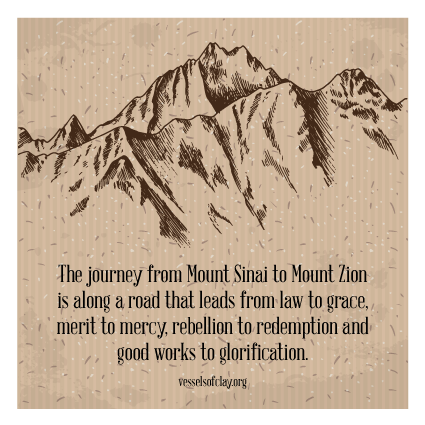
The Journey from Merit to Mercy

18 For you have not come to what may be touched, a blazing fire and darkness and gloom and a tempest 19 and the sound of a trumpet and a voice whose words made the hearers beg that no further messages be spoken to them. 20 For they could not endure the order that was given, “If even a beast touches the mountain, it shall be stoned.” 21 Indeed, so terrifying was the sight that Moses said, “I tremble with fear.” 22 But you have come to Mount Zion and to the city of the living God, the heavenly Jerusalem, and to innumerable angels in festal gathering, 23 and to the assembly of the firstborn who are enrolled in heaven, and to God, the judge of all, and to the spirits of the righteous made perfect, 24 and to Jesus, the mediator of a new covenant, and to the sprinkled blood that speaks a better word than the blood of Abel. – Hebrews 12:18-24 ESV

Two-MountainsThe author of Hebrews compares the Christian life to that of a long and arduous journey. Because of his Hebrew audience, he most likely had in mind the more than 40-year journey the people of Israel took to get to the land promised by God to their forefather, Abraham.

That trek had ended up being an ultra-marathon, covering thousands of miles and four decades, and it required incredible endurance and a constant awareness that there truly was a goal in mind. They were headed somewhere. The seemingly endless journey had an actual destination. Even on those days when it all felt pointless and mind-numbingly repetitious, they had to keep walking and trusting that God knew what He was doing and that Moses knew where he was going. At times, they had their doubts and felt free to make them known.

In these verses, the author contrasts Mount Sinai with Mount Zion. The first mountain was from their past. It was the place, early on in the Exodus story, where God had met with Moses and given him the Ten Commandments and the Book of the Covenant. That fateful day, when Moses prepared to ascend Mount Sinai had been a terrifying and life-changing moment for the people of God.

On the morning of the third day there were thunders and lightnings and a thick cloud on the mountain and a very loud trumpet blast, so that all the people in the camp trembled. Then Moses brought the people out of the camp to meet God, and they took their stand at the foot of the mountain. Now Mount Sinai was wrapped in smoke because the Lord had descended on it in fire. The smoke of it went up like the smoke of a kiln, and the whole mountain trembled greatly. And as the sound of the trumpet grew louder and louder, Moses spoke, and God answered him in thunder. – Exodus 19:16-19 ESV

The physical manifestations that accompanied the presence of God on the pinnacle of the mountain had left the people in a state of fear and anxiety. The Exodus account goes on to say, “when all the people saw the thunder and the flashes of lightning and the sound of the trumpet and the mountain smoking, the people were afraid and trembled, and they stood far off and said to Moses, ‘You speak to us, and we will listen; but do not let God speak to us, lest we die’” (Exodus 20:18-19 ESV).

The dramatic pyrotechnic display they witnessed that day left them terrified. None of them missed the significance or symbolism of it all. Their God was powerful, holy, transcendent, and not to be trifled with. The dramatic display on the top of Mount Sinai was intended to reinforce in their minds the holiness of God. It was also a reminder of their own sinfulness. That fact would be reinforced by God’s giving of the Ten Commandments to Moses.

But as the book of Exodus recounts, the first time Moses returned from the top of the mountain with the tablets in his hands, he found the people worshiping the golden calf. Just days after the dramatic and frightening display of God’s presence on the mountain that had left them trembling in fear, they had determined to make their own god. Moses had been gone for 40 days and the people began to doubt that he would ever return. So, in his absence, they convinced Aaron, Moses’ older brother, to fashion a false god out of their trinkets of gold.

When the people saw how long it was taking Moses to come back down the mountain, they gathered around Aaron. “Come on,” they said, “make us some gods who can lead us. We don’t know what happened to this fellow Moses, who brought us here from the land of Egypt.” – Exodus 32:1 NLT

Angered by the actions of His rebellious people, God informed Moses of His intentions to destroy them.

“I have seen how stubborn and rebellious these people are. Now leave me alone so my fierce anger can blaze against them, and I will destroy them. Then I will make you, Moses, into a great nation.” – Exodus 32:9-10 NLT

But Moses interceded on behalf of the people, pleading with God to remember the covenant He had made with Abraham.

“Change your mind about this terrible disaster you have threatened against your people! Remember your servants Abraham, Isaac, and Jacob. You bound yourself with an oath to them, saying, ‘I will make your descendants as numerous as the stars of heaven. And I will give them all of this land that I have promised to your descendants, and they will possess it forever.’” – Exodus 32:12-13 NLT

But their sinful actions produced painful consequences. That very day, God used the Levites to execute 3,000 individuals who had instigated the rebellion. So, from that day forward, the remaining Israelites would always view Mount Sinai as a symbol of God’s holiness and their own unrighteousness, and the Law God gave them would prove to be a constant reminder of their own sinfulness and incapacity to live obediently.

But for the believer, Mount Zion is a radically different mountain that represents an altogether different encounter with God. Mount Sinai was physical in nature and could be seen and touched, albeit on pain of death. Yet Mount Zion is a spiritual mountain. There is no smoke, fire, thunder, lightning, or ban against drawing near. Mount Zion is not only approachable, it is preferable. It is our final destination. It represents “the city of the living God, the heavenly Jerusalem” (Hebrews 12:22 ESV).

During the reigns of David and Solomon, Jerusalem was a powerful city, the capital of the Jewish empire. It was in Jerusalem that Solomon built the temple. It was there that the people came each year on the Day of Atonement to make sacrifices to God. As the people journeyed from the surrounding areas up to Jerusalem, they would sing the Songs of Ascent found in the Psalms. One of them says, “Those who trust in the Lord are like Mount Zion, which cannot be moved, but abides forever. As the mountains surround Jerusalem, so the Lord surrounds his people, from this time forth and forevermore” (Psalm 125:1-2 ESV).

Jerusalem, the royal city, sat on the top of Mount Zion, where it represented the presence of God. It was there that God dwelt in the Holy of Holies of the temple. It was to Zion that the people walked in order to celebrate the various feasts and festivals. It was to Mount Zion they ascended to receive forgiveness of sin and to have their relationship with God restored.

For those who have placed their faith in Jesus, Mount Zion is the final destination on their spiritual journey. It represents the believer’s heavenly home – “the city of the living God, the heavenly Jerusalem.” Christ-followers are on a journey to a place where they will encounter God, but rather than experiencing fear and trembling, they will enjoy peace, acceptance, joy, and freedom from sin and sorrow. There will be no condemnation. There will be no need for the law to remind us of God’s holy expectations. We will be holy.

There will be no conviction of sin or any need for the law to expose our sin anymore because we will be sinless. In a sense, the Christian life is a journey from one mountain to another. It is a long, sometimes difficult trip away from the mountain where man’s relationship with God was marked by law, rule-keeping, disobedience, fear, and failure. It is a daily walk toward another mountain where we will find complete forgiveness, the redemption of our bodies, and our final glorification.

Paul reminds us, “But our citizenship is in heaven, and from it we await a Savior, the Lord Jesus Christ, who will transform our lowly body to be like his glorious body” (Philippians 3:20-21 ESV).

We are on our way to Mount Zion. That is our final destination. It is our home. And while the journey there may seem long and at times difficult, we must keep our eye on the prize. We must never turn back to Mount Sinai, marked by rules and a constant reminder of our guilt and sin. Mount Zion is our home, where we will be with all those who have gone before us and enjoy unbroken fellowship with God and “Jesus, the mediator of a new covenant” (Hebrews 12:24 ESV).

English Standard Version (ESV) The Holy Bible, English Standard Version. ESV® Permanent Text Edition® (2016). Copyright © 2001

New Living Translation (NLT) Holy Bible, New Living Translation, copyright © 1996, 2004, 2015 by Tyndale House Foundation. Used by permission of Tyndale House Publishers Inc., Carol Stream, Illinois 60188. All rights reserved.

Well Worth the Wait

39 And all these, though commended through their faith, did not receive what was promised, 40 since God had provided something better for us, that apart from us they should not be made perfect. – Hebrews 11:39-40 ESV

Now that we’ve reached the end of the chapter, let’s go back through the list of the faithful again.

Abel died at the hands of his brother. Enoch was taken by God in the prime of life. Noah survived the flood that destroyed the earth, only to watch sin raise its ugly head again and infect his own family. Abraham would never occupy the land God had promised to give him, and he would die long before his offspring would grow to be as numerous as the stars in the sky. Sarah would bear a son in spite of her old age and barrenness but die without ever giving birth again. Isaac would watch his sons, Jacob and Esau, spend years of their lives separated from and loathing one another. Jacob would die in the land of Egypt, the patriarch of a family that numbered no more than 70 – not exactly a mighty nation as God had promised. Moses led the people of Israel to the promised land but never stepped foot into it himself because of his sin against God. The people of Israel made it into the land but failed to obey God’s commands and eventually ended up being removed by God and forced to live in exile in Babylon. For Rahab, other than her mention in the lineage of Jesus, she passed into obscurity, living among the people of Israel.

Their life stories, while marked by faith, are not all pictures of the good life. Their lives were not trouble-free or devoid of difficulty and doubt. They are recognized for their faith, but the author makes it clear that though they lived lives of faith, they also experienced their fair share of trials and troubles. He describes those who were tortured for their faith, “refusing to accept release, so that they might rise again to a better life” (Hebrews 11:35 ESV).

These unnamed but faith-filled individuals refused to recant their faith in God even under the pain of torture. Instead, they trusted that, should they die, God would raise them again to eternal life. The author speaks of women who “received back their dead by resurrection” (Hebrews 11:35 ESV). I don’t think this means that their dead loved ones were raised back to life, but that these women had faith that they would see them again in heaven. They were willing to suffer loss in this life because of their faith in the life to come.

What is amazing is that the author makes it clear that many on his list “did not receive what was promised” (Hebrews 11:39 ESV). Why? Because the promise was future-oriented. The fulfillment of the promise made to Abraham was ultimately fulfilled in Christ. His death and resurrection opened up the gospel to all people. No longer would the Jews be the sole beneficiaries of God’s blessings. Today, people from every tribe, nation, and tongue have placed their faith in Jesus Christ and have become part of the family of Abraham. The book of Revelation tells us of a scene that will take place in the future where all the offspring of Abraham, both Jew and Gentile, will gather before the throne of God.

After this I looked, and behold, a great multitude that no one could number, from every nation, from all tribes and peoples and languages, standing before the throne and before the Lamb, clothed in white robes, with palm branches in their hands, and crying out with a loud voice, “Salvation belongs to our God who sits on the throne, and to the Lamb!” – Revelation 7:9-10 ESV

Abraham longed to see that day and died believing that it would come. He was a living, breathing example of the author’s definition of faith.

Faith is the assurance of things hoped for, the conviction of things not seen. – Hebrews 11:1 ESV

Each of the individuals in the Hebrews 11 list received something better in the end. Because of their faith in the promises of God, they eventually received entrance into His presence. Ultimately, their faith was in the hope of God’s redemption. None of them lived long enough to see the coming of Jesus into the world. Yet, they lived their lives longing for a Messiah, a deliverer from the sin that surrounded them. Paul tells us, “But the Scripture imprisoned everything under sin, so that the promise by faith in Jesus Christ might be given to those who believe” (Galatians 3:22 ESV).

This includes those who lived before the coming of Christ. Their belief in the promises and power of God was considered by God to be faith in the coming Messiah. They were willing to trust God with their present circumstances, knowing that He had a future solution in mind.

Ultimately, their faith was in God. They trusted Him for things they could not see. They had hope for the future because they had an assurance that He could deliver what He had promised. They were able to endure because they believed He would come through. And every promise God made to these individuals was finally realized in the coming of Jesus Christ. He was and is mankind’s hope. And while they may not have fully realized it, every one of the people in the Hebrews “Hall of Faith” was placing their faith in Christ; God’s redeemer, deliverer, savior, sinless sacrifice, and the ultimate key to experiencing all the blessings God has in store.

Abraham lived in tents all of his life, but we’re told “he was looking forward to the city that has foundations, whose designer and builder is God” (Hebrews 11:10 ESV). He knew that God had something better in store for him and he died believing in that reality. But Abraham was not alone. The author of Hebrews tells us that every one of the individuals on his list “died in faith, not having received the things promised, but having seen them and greeted them from afar” (Hebrews 11:13 ESV).

They knew something better was in store for them, so they were willing to live as “strangers and exiles on the earth” (Hebrews 11:13 ESV). They desired “a better country, that is, a heavenly one” (Hebrews 11:16 ESV). They put their faith in God and their hope in something they could not see. “Therefore God is not ashamed to be called their God, for he has prepared for them a city” (Hebrews 11:16 ESV). And the Book of Revelation paints a vivid picture of what that long-awaited city will look like when it comes.

Then I saw a new heaven and a new earth, for the first heaven and the first earth had passed away, and the sea was no more. And I saw the holy city, new Jerusalem, coming down out of heaven from God, prepared as a bride adorned for her husband. And I heard a loud voice from the throne saying, “Behold, the dwelling place of God is with man. He will dwell with them, and they will be his people, and God himself will be with them as their God. He will wipe away every tear from their eyes, and death shall be no more, neither shall there be mourning, nor crying, nor pain anymore, for the former things have passed away.” And he who was seated on the throne said, “Behold, I am making all things new.” Also he said, “Write this down, for these words are trustworthy and true.” And he said to me, “It is done! I am the Alpha and the Omega, the beginning and the end. To the thirsty I will give from the spring of the water of life without payment. The one who conquers will have this heritage, and I will be his God and he will be my son. Revelation 21:1-7 ESV

English Standard Version (ESV) The Holy Bible, English Standard Version. ESV® Permanent Text Edition® (2016). Copyright © 2001

New Living Translation (NLT) Holy Bible, New Living Translation, copyright © 1996, 2004, 2015 by Tyndale House Foundation. Used by permission of Tyndale House Publishers Inc., Carol Stream, Illinois 60188. All rights reserved.

The Golden Lampstand

31 “You shall make a lampstand of pure gold. The lampstand shall be made of hammered work: its base, its stem, its cups, its calyxes, and its flowers shall be of one piece with it. 32 And there shall be six branches going out of its sides, three branches of the lampstand out of one side of it and three branches of the lampstand out of the other side of it; 33 three cups made like almond blossoms, each with calyx and flower, on one branch, and three cups made like almond blossoms, each with calyx and flower, on the other branch—so for the six branches going out of the lampstand. 34 And on the lampstand itself there shall be four cups made like almond blossoms, with their calyxes and flowers, 35 and a calyx of one piece with it under each pair of the six branches going out from the lampstand. 36 Their calyxes and their branches shall be of one piece with it, the whole of it a single piece of hammered work of pure gold. 37 You shall make seven lamps for it. And the lamps shall be set up so as to give light on the space in front of it. 38 Its tongs and their trays shall be of pure gold. 39 It shall be made, with all these utensils, out of a talent of pure gold. 40 And see that you make them after the pattern for them, which is being shown you on the mountain.” – Exodus 25:31-40 ESV

The opening lines of the book of Genesis tell of God’s creation of the universe, and it begins with His dispelling of darkness with light.

In the beginning God created the heavens and the earth. The earth was formless and empty, and darkness covered the deep waters. And the Spirit of God was hovering over the surface of the waters.

Then God said, “Let there be light,” and there was light. And God saw that the light was good. – Genesis 1:1-4 NLT

In God’s grand plan for the universe He created, light would always be preferable to darkness. God deemed the light to be good because it symbolized His own nature.

God is light, and in him is no darkness at all. – 1 John 1:5 ESV

Whatever is good and perfect is a gift coming down to us from God our Father, who created all the lights in the heavens. He never changes or casts a shifting shadow. – James 1:17 NLT

In the same way, God planned for a source of light that would penetrate the darkness of the Tabernacle. This tent-like structure was designed with no windows to let in the light of the sun. And in its innermost recesses, where the Holy Place and the Holy of Holies were located, the darkness would make these small rooms virtually unusable. In the impenetrable blackness of these spaces, the priests would have found it difficult to carry out their God-ordained duties. So, God designed a light source, “a lampstand of pure gold” (Exodus 25:31 ESV).

Within the Holy of Holies, God’s presence was intended to dwell above the Mercy Seat which was located on the top of the Ark of the Covenant. Just outside the veil, in the Holy Place where the Table of Showbread and Altar of Incense were located, the Golden Lampstand would symbolize the light of God’s presence. The flames from its seven lamps would illuminate the room and serve as a constant reminder of God’s glory and holiness.

From God’s description of the lampstand, it appears that it had a central shaft or trunk with six branches. At the top of the central shaft and six branches, oil lamps were to be placed. This meant that the lampstand offered seven sources of light to illuminate the Holy Place. This tree-like object was covered in almond blossoms made of pure gold. These budding “flowers” were intended to communicate the idea of light and life. This symbolic tree was to be a constant reminder of God’s providential care for His people. Perhaps it was meant to serve as a symbol of the Tree of Life that was located in the Garden of Eden (Genesis 2:9). This same tree is mentioned in the final chapter of the book of Revelation. In his vision, the apostle John is given a glimpse of the New Jerusalem, the city of God that will descend from heaven and serve as the dwelling place of God among men. In that city, the Tree of Life reappears.

Then the angel showed me a river with the water of life, clear as crystal, flowing from the throne of God and of the Lamb. It flowed down the center of the main street. On each side of the river grew a tree of life, bearing twelve crops of fruit, with a fresh crop each month. The leaves were used for medicine to heal the nations.

No longer will there be a curse upon anything. For the throne of God and of the Lamb will be there, and his servants will worship him. And they will see his face, and his name will be written on their foreheads. And there will be no night there—no need for lamps or sun—for the Lord God will shine on them. And they will reign forever and ever. – Revelation 22:1-5 NLT

Notice that there will be no need for lamps or even the sun, “for the Lord God will shine on them.” In this eternal city, God’s presence will come to dwell among His people, and John indicates that in this New Jerusalem, there will be no need of a Tabernacle or Temple.

I saw no temple in the city, for the Lord God Almighty and the Lamb are its temple. And the city has no need of sun or moon, for the glory of God illuminates the city, and the Lamb is its light. The nations will walk in its light, and the kings of the world will enter the city in all their glory. Its gates will never be closed at the end of day because there is no night there. And all the nations will bring their glory and honor into the city. Nothing evil will be allowed to enter, nor anyone who practices shameful idolatry and dishonesty—but only those whose names are written in the Lamb’s Book of Life. – Revelation 21:22-27 NLT

But in the Tabernacle God provided for the people of Israel, light would be a necessity. So, God designed a lampstand, a tree of light and life, to dispel the darkness and display His glory. And this lamp would serve as a foreshadowing of a greater and brighter light to come. It was Jesus who would later declare Himself to be the light of the world.

“I am the light of the world. Whoever follows me will not walk in darkness, but will have the light of life.” – John 8:12 ESV

And the apostle John would describe the impact of this divine light.

In him was life, and the life was the light of men. The light shines in the darkness, and the darkness has not overcome it. – John 1:4-5 ESV

But Jesus was more than just a source of light; He was the key to life, and He pointed the way to God. Yet, John reminds us that the light of the world was not well received by all.

“…the light has come into the world, and people loved the darkness rather than the light because their works were evil. For everyone who does wicked things hates the light and does not come to the light, lest his works should be exposed. But whoever does what is true comes to the light, so that it may be clearly seen that his works have been carried out in God.” – John 3:19-21 ESV

To come into God’s presence is to enter the light. His glory and goodness expose our sins. But Jesus made it possible for those sins to be atoned for so that we might walk in the light and enjoy the illuminating presence of God in our lives.

The prophet, Isaiah, predicted the coming of the light of the world. Centuries earlier, under the inspiration of the Holy Spirit, Isaiah wrote these promising words:

The people who walk in darkness
    will see a great light.
For those who live in a land of deep darkness,
    a light will shine. – Isaiah 9:2 NLT

Then he went on to provide the identity of this “great light.”

For a child is born to us,
    a son is given to us.
The government will rest on his shoulders.
    And he will be called:
Wonderful Counselor, Mighty God,
    Everlasting Father, Prince of Peace.
His government and its peace
    will never end.
He will rule with fairness and justice from the throne of his ancestor David
    for all eternity.
The passionate commitment of the Lord of Heaven’s Armies
    will make this happen! – Isaiah 9:6-7 NLT

The Golden Lampstand was to be placed in the Holy Place. It was reserved for the benefit of the priests. But the light of the world came to illuminate the lives of all men. He came to penetrate the darkness of sin and provide light to illuminate the way back to God. This child would grow to be a man, who would die on the cross for the sins of mankind. But He would be miraculously raised back to life as proof that His death had satisfied the just demands of a holy God. His dead body was placed in a cold, dark tomb, but that foreboding place was invaded by the light of God’s glory when Jesus was resurrected.

The light still shines in the darkness. Jesus still illuminates the way to God. He remains the light of the world and the light of life, dispelling the darkness of sin and displaying the glory of God as He transforms the lives of those living in darkness. And the apostle John wrapped up the book of Revelation with this promising statement from the lips of Jesus Himself.

“I, Jesus, have sent my angel to give you this message for the churches. I am both the source of David and the heir to his throne. I am the bright morning star.” Revelation 22:16 NLT

English Standard Version (ESV) The Holy Bible, English Standard Version. ESV® Permanent Text Edition® (2016). Copyright © 2001

New Living Translation (NLT) Holy Bible, New Living Translation, copyright © 1996, 2004, 2015 by Tyndale House Foundation. Used by permission of Tyndale House Publishers Inc., Carol Stream, Illinois 60188. All rights reserved.

The Lord is There

1 “These are the names of the tribes: Beginning at the northern extreme, beside the way of Hethlon to Lebo-hamath, as far as Hazar-enan (which is on the northern border of Damascus over against Hamath), and extending from the east side to the west, Dan, one portion. Adjoining the territory of Dan, from the east side to the west, Asher, one portion. Adjoining the territory of Asher, from the east side to the west, Naphtali, one portion. Adjoining the territory of Naphtali, from the east side to the west, Manasseh, one portion. Adjoining the territory of Manasseh, from the east side to the west, Ephraim, one portion. Adjoining the territory of Ephraim, from the east side to the west, Reuben, one portion. Adjoining the territory of Reuben, from the east side to the west, Judah, one portion.

“Adjoining the territory of Judah, from the east side to the west, shall be the portion which you shall set apart, 25,000 cubits in breadth, and in length equal to one of the tribal portions, from the east side to the west, with the sanctuary in the midst of it. The portion that you shall set apart for the Lord shall be 25,000 cubits in length, and 20,000 in breadth. 10 These shall be the allotments of the holy portion: the priests shall have an allotment measuring 25,000 cubits on the northern side, 10,000 cubits in breadth on the western side, 10,000 in breadth on the eastern side, and 25,000 in length on the southern side, with the sanctuary of the Lord in the midst of it. 11 This shall be for the consecrated priests, the sons of Zadok, who kept my charge, who did not go astray when the people of Israel went astray, as the Levites did. 12 And it shall belong to them as a special portion from the holy portion of the land, a most holy place, adjoining the territory of the Levites. 13 And alongside the territory of the priests, the Levites shall have an allotment 25,000 cubits in length and 10,000 in breadth. The whole length shall be 25,000 cubits and the breadth 20,000. 14 They shall not sell or exchange any of it. They shall not alienate this choice portion of the land, for it is holy to the Lord.

15 “The remainder, 5,000 cubits in breadth and 25,000 in length, shall be for common use for the city, for dwellings and for open country. In the midst of it shall be the city, 16 and these shall be its measurements: the north side 4,500 cubits, the south side 4,500, the east side 4,500, and the west side 4,500. 17 And the city shall have open land: on the north 250 cubits, on the south 250, on the east 250, and on the west 250. 18 The remainder of the length alongside the holy portion shall be 10,000 cubits to the east, and 10,000 to the west, and it shall be alongside the holy portion. Its produce shall be food for the workers of the city. 19 And the workers of the city, from all the tribes of Israel, shall till it. 20 The whole portion that you shall set apart shall be 25,000 cubits square, that is, the holy portion together with the property of the city.

21 “What remains on both sides of the holy portion and of the property of the city shall belong to the prince. Extending from the 25,000 cubits of the holy portion to the east border, and westward from the 25,000 cubits to the west border, parallel to the tribal portions, it shall belong to the prince. The holy portion with the sanctuary of the temple shall be in its midst. 22 It shall be separate from the property of the Levites and the property of the city, which are in the midst of that which belongs to the prince. The portion of the prince shall lie between the territory of Judah and the territory of Benjamin.

23 “As for the rest of the tribes: from the east side to the west, Benjamin, one portion. 24 Adjoining the territory of Benjamin, from the east side to the west, Simeon, one portion. 25 Adjoining the territory of Simeon, from the east side to the west, Issachar, one portion. 26 Adjoining the territory of Issachar, from the east side to the west, Zebulun, one portion. 27 Adjoining the territory of Zebulun, from the east side to the west, Gad, one portion. 28 And adjoining the territory of Gad to the south, the boundary shall run from Tamar to the waters of Meribah-kadesh, from there along the Brook of Egypt to the Great Sea. 29 This is the land that you shall allot as an inheritance among the tribes of Israel, and these are their portions, declares the Lord God.

30 “These shall be the exits of the city: On the north side, which is to be 4,500 cubits by measure, 31 three gates, the gate of Reuben, the gate of Judah, and the gate of Levi, the gates of the city being named after the tribes of Israel. 32 On the east side, which is to be 4,500 cubits, three gates, the gate of Joseph, the gate of Benjamin, and the gate of Dan. 33 On the south side, which is to be 4,500 cubits by measure, three gates, the gate of Simeon, the gate of Issachar, and the gate of Zebulun. 34 On the west side, which is to be 4,500 cubits, three gates, the gate of Gad, the gate of Asher, and the gate of Naphtali. 35 The circumference of the city shall be 18,000 cubits. And the name of the city from that time on shall be, The Lord Is There.” Ezekiel 48:1-35 ESV

In this closing chapter of his book, Ezekiel provides a detailed layout of the tribal allotment within the Millennial Kingdom. Beginning in the north and working his way down, he describes God’s plan for the geographical arrangement of the 12 tribes, beginning with Dan and ending with Gad. Each tribe will occupy a portion of the land of promise that extends from east to west, from the Mediterranean Sea to the Jordan River. The tribes of Issachar, Zebulun, and Gad will have the “Brook of Egypt” as their western border. Unlike the division of the land under Joshua, the Millennial Kingdom will allot equal portions of real estate to each of the tribes. When Moses had set aside the land for the people of Israel, he had done so based on the population size of each tribe. But in the Millennial Kingdom, the distribution of the land will be based on very different criteria. Rather than size, it appears to be based on faithfulness.

Genesis 35 provides the names of the 12 sons of Israel (Jacob).

Now the sons of Jacob were twelve. The sons of Leah: Reuben (Jacob’s firstborn), Simeon, Levi, Judah, Issachar, and Zebulun. The sons of Rachel: Joseph and Benjamin. The sons of Bilhah, Rachel’s servant: Dan and Naphtali. The sons of Zilpah, Leah’s servant: Gad and Asher. These were the sons of Jacob who were born to him in Paddan-aram. – Genesis 35:21-26 ESV

In examining the north-to-south allotment of the land, it becomes clear that there is an intended progression to their order. Dan, one of the most unfaithful tribes, will find itself located in the far north of the land.  The tribe of Gad will bookend the land from its location in the south. It’s interesting to note that the four sons born to Jacob’s concubines (Dan, Asher, Naphtali, and Gad) all occupy land on the extreme edges of the Kingdom. Yet Judah and Benjamin are located on either side of the holy district, the site of the Millennial Temple. These were the two tribes that made up the southern kingdom of Judah after God split Solomon’s kingdom in two. During the days of the divided kingdom, the tribes of Judah and Benjamin displayed the greatest degree of faithfulness to Yahweh and yielded the largest number of godly kings. Their reward for their faithfulness will be in the form of land allotments on either side of the holy district. The rest of the sons born to Jacob’s two wives, Leah and Rachel, will occupy land toward the center of the kingdom.

Proximity to the Millennial Temple seems to be the point in all of this because that is where God’s presence will dwell. Ezekiel saw the vision of God’s glory reentering the new temple and taking up residence in the Most Holy Place (Ezekiel 43:4). The Millennial Temple will sit within the holy city, and Ezekiel describes this future Jerusalem (Zechariah 14:8) as being six miles in circumference. It will have 12 gates, three on each side, dedicated to the 12 tribes of Israel.

His description of the city and its gates mirrors the one given by the apostle John in the book of Revelation. But John was describing the New Jerusalem.

And he carried me away in the Spirit to a great, high mountain, and showed me the holy city Jerusalem coming down out of heaven from God, having the glory of God, its radiance like a most rare jewel, like a jasper, clear as crystal. It had a great, high wall, with twelve gates, and at the gates twelve angels, and on the gates the names of the twelve tribes of the sons of Israel were inscribed— on the east three gates, on the north three gates, on the south three gates, and on the west three gates. – Revelation 21:10-13 ESV

He was not describing the Jerusalem of the Millennial Kingdom, but yet another iteration of the holy city that will appear at the end of the millennial age when God makes all things new (Revelation 21:5). This New Jerusalem will have 12 gates named after the 12 tribes of Israel, but it will also feature 12 foundations, dedicated to the 12 apostles.

And the wall of the city had twelve foundations, and on them were the twelve names of the twelve apostles of the Lamb. – Revelation 21:14 ESV

The greatest difference between these two versions of the city of Jerusalem appears to be the timing of their appearance. The Jerusalem that will exist during the Millennial Kingdom will feature a temple and a reinstated sacrificial system. The city will be occupied by both Jews and Gentiles, but not all will be Christ followers. In the New Jerusalem, the occupants will be from every tribe, nation, and tongue, and share a common faith in Christ. It will be filled with the elect of God from all eras, including both Jews and Gentiles.

The Millennial Kingdom is dedicated to the nation of Israel, the descendants of Abraham, Isaac, and Jacob. Its very existence culminates God’s covenant promises to the patriarchs and fulfills every commitment He had made to them. But that kingdom will come to an end and be replaced by the New Jerusalem and the eternal state, and at that time, “it will be “true” Israel—those who have trusted in Jesus Christ—that will enter the gates of the Kingdom of Heaven. It is through the twelve gates of the New Jerusalem that the true tribal people—believers of Jewish descent as well as Gentiles who have been “grafted in” with God’s people (Romans 11:17–25)—will enter the joy of the Lord (see Matthew 25:21). (https://www.gotquestions.org/twelve-gates-Revelation.html).

But there is one important factor that both Jerusalems have in common: The presence of God. John describes his vision of the New Jerusalem descending out of heaven.

I saw a new heaven and a new earth, for the first heaven and the first earth had passed away, and the sea was no more. And I saw the holy city, new Jerusalem, coming down out of heaven from God, prepared as a bride adorned for her husband. And I heard a loud voice from the throne saying, “Behold, the dwelling place of God is with man. He will dwell with them, and they will be his people, and God himself will be with them as their God. He will wipe away every tear from their eyes, and death shall be no more, neither shall there be mourning, nor crying, nor pain anymore, for the former things have passed away.” – Revelation 21:1-4 ESV

The dwelling place of God will be with man. He will dwell with them. God himself will be with them as their God. There is a promise of permanence in this passage. God will come to live among His people – on earth. Our final destination is not heaven, but earth. All the redeemed will live in perfect unity with God the Father and God the Son – for all eternity. And in this future Jerusalem, there will be no temple.

And I saw no temple in the city, for its temple is the Lord God the Almighty and the Lamb. And the city has no need of sun or moon to shine on it, for the glory of God gives it light, and its lamp is the Lamb. By its light will the nations walk, and the kings of the earth will bring their glory into it – Revelation 21:22-24 ESV

But the Jerusalem of the Millennial Kingdom, with its glorious temple filled with the glory of God, will also enjoy God’s presence. In fact, the very name of the main gate that will lead into this future city is “The Lord Is There” (Ezekiel 48:35 ESV).

The book of Ezekiel has finally come to an end. It has been 22 years since Ezekiel first saw his vision of God and received his commission as God’s prophet to the people of Judah. His ministry began with an unbelievable glimpse of the glory of God. He was given a word to deliver from the very mouth of God, predicting the coming siege of Jerusalem, the destruction of the temple, and the deportation of the people of Judah to Babylon. In chapter ten, Ezekiel was shown the real tragedy of it all – the glory of God departing the temple. The very presence and power of God were removed from the midst of the people due to their sin and rebellion. But two decades later, God gave Ezekiel another vision of a rebuilt temple, a restored Jerusalem, and a revived relationship with the people of God.

The book of Ezekiel ends with the city of Jerusalem referred to by the name, “The Lord Is There,” and if the Lord is there that means His glory has returned once again to the city. This book began with the glory of God and ends with it. God will one day take up residence in the city of Jerusalem. The abiding presence of God is a powerful image with which to sum up this book. While God had to punish His people for their sins, He never abandoned them completely. He remained faithful and committed to His plan for them. Even while they were in exile, He sent His prophets to communicate His message to them. And ultimately, God returned them to the land. But there is a day yet future when God will complete His plan for the people of Israel and fully fulfill His promises to them. He will once again make His place among them, so that the city of Jerusalem can truly be called, “The Lord Is There.”

English Standard Version (ESV) The Holy Bible, English Standard Version. ESV® Permanent Text Edition® (2016). Copyright © 2001

New Living Translation (NLT) Holy Bible, New Living Translation, copyright © 1996, 2004, 2015 by Tyndale House Foundation. Used by permission of Tyndale House Publishers Inc., Carol Stream, Illinois 60188. All rights reserved.

The River of Life

Then he brought me back to the door of the temple, and behold, water was issuing from below the threshold of the temple toward the east (for the temple faced east). The water was flowing down from below the south end of the threshold of the temple, south of the altar. Then he brought me out by way of the north gate and led me around on the outside to the outer gate that faces toward the east; and behold, the water was trickling out on the south side.

Going on eastward with a measuring line in his hand, the man measured a thousand cubits, and then led me through the water, and it was ankle-deep. Again he measured a thousand, and led me through the water, and it was knee-deep. Again he measured a thousand, and led me through the water, and it was waist-deep. Again he measured a thousand, and it was a river that I could not pass through, for the water had risen. It was deep enough to swim in, a river that could not be passed through. And he said to me, “Son of man, have you seen this?”

Then he led me back to the bank of the river. As I went back, I saw on the bank of the river very many trees on the one side and on the other. And he said to me, “This water flows toward the eastern region and goes down into the Arabah, and enters the sea; when the water flows into the sea, the water will become fresh. And wherever the river goes, every living creature that swarms will live, and there will be very many fish. For this water goes there, that the waters of the sea may become fresh; so everything will live where the river goes. 10 Fishermen will stand beside the sea. From Engedi to Eneglaim it will be a place for the spreading of nets. Its fish will be of very many kinds, like the fish of the Great Sea. 11 But its swamps and marshes will not become fresh; they are to be left for salt. 12 And on the banks, on both sides of the river, there will grow all kinds of trees for food. Their leaves will not wither, nor their fruit fail, but they will bear fresh fruit every month, because the water for them flows from the sanctuary. Their fruit will be for food, and their leaves for healing.” Ezekiel 47:1-12 ESV

What an amazing picture of God’s faithfulness. Not only is He going to restore the land and the people to it, but He is also going to rebuild the Temple, reinstate the sacrificial system, and renew their hearts. God is going to make it possible for the Israelites to serve Him faithfully so that they can remain in the land. He will give them new hearts and a new desire to serve Him faithfully.

For I will gather you up from all the nations and bring you home again to your land. Then I will sprinkle clean water on you, and you will be clean. Your filth will be washed away, and you will no longer worship idols. And I will give you a new heart, and I will put a new spirit in you. I will take out your stony, stubborn heart and give you a tender, responsive heart. And I will put my Spirit in you so that you will follow my decrees and be careful to obey my regulations. And you will live in Israel, the land I gave your ancestors long ago. You will be my people, and I will be your God. – Ezekiel 36:24-26 NLT

This entire vision that Ezekiel received was about what God is going to do in the future Millennial Kingdom. God will not only change the hearts of the people, but He will also change the nature of the land of Israel.

In his vision, Ezekiel sees a river flowing from the Holy of Holies, the innermost room of the temple. This river will flow out from the temple grounds and into the Jordan Valley, slowly growing larger and deeper as it makes its way to the Dead Sea. And as its waters flow into the Dead Sea it will transform this lifeless body of water into a fish-filled, tree-bounded paradise. This river of life will dramatically alter the topography of the land.

At the present time, the region around the Dead Sea is a barren wasteland, but in the Millennial Kingdom, it will be transformed into a lush and fruitful paradise. Trees will grow where no trees exist right now. Fish will swim where no fish can exist right now. The aptly named Dead Sea will become a place of life and fruitfulness. Ezekiel is given a glimpse of the transforming power of God. He will make all things new.

The prophet, Zechariah, also alludes to this new water source that will suddenly show up when Christ returns to earth at His Second Coming.

On that day his feet will stand on the Mount of Olives, east of Jerusalem. And the Mount of Olives will split apart, making a wide valley running from east to west. Half the mountain will move toward the north and half toward the south. – Zechariah 14:4 NLT

As a result of Christ’s dramatic and earth-shattering arrival to earth, the topography surrounding the city of Jerusalem will be permanently altered. A spring will open up in the Holy of Holies and flow out of the sanctuary, through the courtyard, and out the gate of the temple complex.

On that day life-giving waters will flow out from Jerusalem, half toward the Dead Sea and half toward the Mediterranean, flowing continuously in both summer and winter.

And the Lord will be king over all the earth. On that day there will be one Lord—his name alone will be worshiped. – Zechariah 14:8-9 NLT

This life-giving spring will turn into two rivers that will transform the landscape, delivering the water of life to the Mediterranean and the Dead Sea. Jesus Christ will reign from the throne of David in Jerusalem, for a period of one thousand years. And during this time, Jesus, the author of life, will be the source of life and sustenance for all who live under his righteous rule.

This future condition of life and fruitfulness stands in stark contrast to the assessment God made of His rebellious people during the days of Jeremiah the prophet.

“For my people have done two evil things: They have abandoned me— the fountain of living water. And they have dug for themselves cracked cisterns that can hold no water at all! – Jeremiah 2:13 NLT

In the Millennial Kingdom of Christ, living water will flow from Mount Zion, transforming the landscape of Israel. It is a picture of the life-cleansing, sin-atoning work of Jesus on the cross.

In His encounter at the well with the Samaritan woman, Jesus informed her: “If you only knew the gift God has for you and who you are speaking to, you would ask me, and I would give you living water” (John 4:10 NLT). The woman, confused by what Jesus had said, asked, “Where would you get this living water?” (John 4:11 NLT). And Jesus, pointing to the nearby well, responded, “Anyone who drinks this water will soon become thirsty again. But those who drink the water I give will never be thirsty again. It becomes a fresh, bubbling spring within them, giving them eternal life” (John 4:12-13 NLT). 

This future Kingdom will be like nothing the world has ever seen before. The righteous administration of Christ will govern like no other government that has ever existed. Zechariah describes an environment where the city of Jerusalem will rise above the newly formed plains that surround it. The city will be filled to the brim with citizens anxious to live under the righteous rule of the King of kings and Lord of lords.

All the land from Geba, north of Judah, to Rimmon, south of Jerusalem, will become one vast plain. But Jerusalem will be raised up in its original place and will be inhabited all the way from the Benjamin Gate over to the site of the old gate, then to the Corner Gate, and from the Tower of Hananel to the king’s winepresses. And Jerusalem will be filled, safe at last, never again to be cursed and destroyed. – Zechariah 14:10-11 NLT

But the river flowing from the inner recesses of the Millennial Temple should remind us of another river that will exist in the eternal state. The apostle John was given a vision of this life-giving river and he describes it in the book of Revelation.

Then he showed me a river of the water of life, clear as crystal, coming from the throne of God and of the Lamb, in the middle of its street. On either side of the river was the tree of life, bearing twelve kinds of fruit, yielding its fruit every month; and the leaves of the tree were for the healing of the nations. – Revelation 22:1-2 NASB

In this future scene, which takes place at the end of the Millennial Kingdom, John sees the river flowing from the throne of God and the Lamb. This vision reveals the New Jerusalem, which will descend out of heaven and come to rest on earth. From this celestial city, God and His Son will reign over all the earth. And from their thrones will flow the river of the water of life.

God is all about restoring life and bringing about healing, and these things flow from His throne. He is the source of life. Only through Him can men be restored to new life. He can take what was once dead and bring it back to life. He can transform dead lives and renew lifeless seas. That’s the God we serve, and He remains the same, now and forever.

English Standard Version (ESV) The Holy Bible, English Standard Version. ESV® Permanent Text Edition® (2016). Copyright © 2001

New Living Translation (NLT) Holy Bible, New Living Translation, copyright © 1996, 2004, 2015 by Tyndale House Foundation. Used by permission of Tyndale House Publishers Inc., Carol Stream, Illinois 60188. All rights reserved.