You Can Run, But You Can’t Hide

1 After the death of Ahab, Moab rebelled against Israel.

Now Ahaziah fell through the lattice in his upper chamber in Samaria, and lay sick; so he sent messengers, telling them, “Go, inquire of Baal-zebub, the god of Ekron, whether I shall recover from this sickness.” But the angel of the LORD said to Elijah the Tishbite, “Arise, go up to meet the messengers of the king of Samaria, and say to them, ‘Is it because there is no God in Israel that you are going to inquire of Baal-zebub, the god of Ekron? Now therefore thus says the LORD, You shall not come down from the bed to which you have gone up, but you shall surely die.’” So Elijah went.

The messengers returned to the king, and he said to them, “Why have you returned?” And they said to him, “There came a man to meet us, and said to us, ‘Go back to the king who sent you, and say to him, Thus says the LORD, Is it because there is no God in Israel that you are sending to inquire of Baal-zebub, the god of Ekron? Therefore you shall not come down from the bed to which you have gone up, but you shall surely die.’” He said to them, “What kind of man was he who came to meet you and told you these things?” They answered him, “He wore a garment of hair, with a belt of leather about his waist.” And he said, “It is Elijah the Tishbite.”

Then the king sent to him a captain of fifty men with his fifty. He went up to Elijah, who was sitting on the top of a hill, and said to him, “O man of God, the king says, ‘Come down.’” 10 But Elijah answered the captain of fifty, “If I am a man of God, let fire come down from heaven and consume you and your fifty.” Then fire came down from heaven and consumed him and his fifty.

11 Again the king sent to him another captain of fifty men with his fifty. And he answered and said to him, “O man of God, this is the king’s order, ‘Come down quickly!’” 12 But Elijah answered them, “If I am a man of God, let fire come down from heaven and consume you and your fifty.” Then the fire of God came down from heaven and consumed him and his fifty.

13 Again the king sent the captain of a third fifty with his fifty. And the third captain of fifty went up and came and fell on his knees before Elijah and entreated him, “O man of God, please let my life, and the life of these fifty servants of yours, be precious in your sight. 14 Behold, fire came down from heaven and consumed the two former captains of fifty men with their fifties, but now let my life be precious in your sight.” 15 Then the angel of the LORD said to Elijah, “Go down with him; do not be afraid of him.” So he arose and went down with him to the king 16 and said to him, “Thus says the LORD, ‘Because you have sent messengers to inquire of Baal-zebub, the god of Ekron—is it because there is no God in Israel to inquire of his word?—therefore you shall not come down from the bed to which you have gone up, but you shall surely die.’”

17 So he died according to the word of the LORD that Elijah had spoken. Jehoram became king in his place in the second year of Jehoram the son of Jehoshaphat, king of Judah, because Ahaziah had no son. 18 Now the rest of the acts of Ahaziah that he did, are they not written in the Book of the Chronicles of the Kings of Israel? 2 Kings 1:1-18 ESV

The Book of 2 Kings continues the chronicle of the kings of Judah and Israel. With Ahab’s death, his son Ahaziah ascended to the throne, and he proved to be cut from the same cloth. “He did what was evil in the sight of the Lord and walked in the way of his father and in the way of his mother…” (1 Kings 22:52 ESV). In other words, he was just as immoral and spiritually bankrupt as every other king who had ruled over the northern kingdom. He not only inherited his father’s kingdom but also his predilection for false gods.  “He served Baal and worshiped him and provoked the LORD, the God of Israel, to anger in every way that his father had done” (1 Kings 22:53 ESV). And, as the opening chapter of 2 Kings reveals, his penchant for idolatry would prove to be his undoing.

But before the author reveals the fate of Ahaziah, he opens the second half of his history of the kings of Israel and Judah with a somewhat parenthetical statement: “After the death of Ahab, Moab rebelled against Israel” (2 Kings 1:1 ESV). It seems that Ahab had been extracting a sizeable annual tribute from the Moabites, literally fleecing his smaller neighbor to the east. But upon Ahab’s death, King Mesha put an end to these debilitating payments. 

Now Mesha king of Moab was a sheep breeder, and he had to deliver to the king of Israel 100,000 lambs and the wool of 100,000 rams. But when Ahab died, the king of Moab rebelled against the king of Israel. – 2 Kings 3:4-5 ESV

Before the very outset of his reign, Ahaziah would find himself having to deal with the sins of his father. Ahab had been a harsh and uncaring king who made a lot of enemies along the way, and Ahaziah would have his hands full trying to manage the royal mess his father had left him.
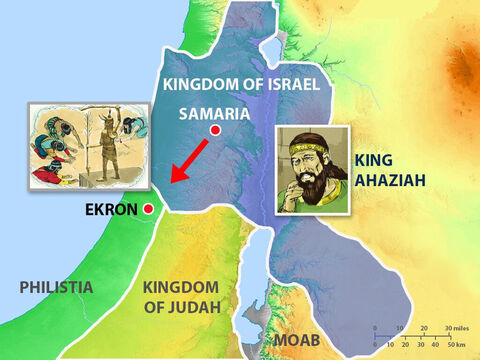
But before Ahaziah had a chance to deal with the rebellious Moabites, he suffered a life-threatening fall that left him confined to his bed in the royal palace in Samaria. His injuries were severe enough that he was concerned about whether he would fully recover. So, he sent messengers to the temple of Baal-zebub, the god of Ekron, seeking a divine prediction concerning his fate. It had been Ahaziah’s parents who had introduced Baal worship to Israel, and he proved to be a faithful adherent to their false religion. In his time of suffering, he sought the counsel of Baal rather than Yahweh, the covenant God of Israel. While Baal worship was rampant throughout the northern kingdom, Ahaziah sent his messengers to Ekron, which was located on Israel’s eastern border with Philistia. Ekron was a renowned occult center, and it was far enough away from Samaria that the news of the king’s injuries might be kept a secret.

However, Ahaziah’s messengers never reached Ekron. They were met along the way by Elijah, the prophet of Yahweh. Ahab’s old nemesis appears on the scene once again, but this time, he has bad news for Ahab’s son. Elijah had received instructions from Yahweh, commanding him to intercept the king’s messengers and inform them of their master’s fate. Ahaziah was hoping to hear a positive word from Baal, but instead, he would receive bad news from the God of Israel.

“Is there no God in Israel? Why are you going to Baal-zebub, the god of Ekron, to ask whether the king will recover? Now, therefore, this is what the LORD says: You will never leave the bed you are lying on; you will surely die.” – 2 Kings 1:3-4 NLT

There is a hint of sarcasm in this message. Yahweh is chiding Ahaziah for sending his messengers all the way to Ekron to seek a word from his false god. Baal worship was rampant within the nation of Israel. There were shrines and high places dedicated to Baal and Asherah all over the northern kingdom. In fact, Ahaziah had access to a Baal temple that his father had built in the capital city of Samaria.

He [Ahab] erected an altar for Baal in the house of Baal, which he built in Samaria. – 1 Kings 15:32 ESV

And there were literally hundreds of priests and prophets who served on behalf of Baal. Yet, Ahaziah had sent his messengers on a field trip all the way to Ekron in hopes of hearing something from his god. Perhaps he had started his search for an answer at the local temple, but had come up empty-handed. This could have led him to his “long-distance-call” to Ekron.

When Ahaziah heard the less-than-positive pronouncement his messengers delivered, he grew suspicious. This was not the news he had been expecting. So, he asked for a description of the man who had predicted his pending death. As soon as he heard what the man looked like, his suspicions were confirmed; it was Elijah the Tishbite. As the son of Ahab and Jezebel, Ahaziah would have grown up hearing the stories of Elijah and his defeat of the prophets of Baal on Mount Carmel. He would have been very familiar with his mother’s intense hatred for this prophet of Yahweh. The ongoing battle of words and will between his father and Elijah would have taken place right in front of him. So, when he discovered that Elijah had once again interjected himself into Israel’s affairs, he sent guards to arrest him. But, just like the messengers he had sent to Ekron, the guards never made it to their destination.

As visible proof of his role as a spokesman for Yahweh, Elijah called down fire from heaven that wiped out all 50 men, including their captain. But this display of power made no impression on the stubborn and unrepentant Ahaziah. He simply sent another 50 guards who suffered the very same fate. The third commander recognized the divine nature of Elijah’s role and wisely chose to beg for mercy.

“O man of God, please spare my life and the lives of these, your fifty servants. See how the fire from heaven came down and destroyed the first two groups. But now please spare my life!” – 2 Kings 1:13-14 NLT

The angel of God intervened, instructing Elijah to spare the lives of these men and accompany them back to Samaria. When he arrived in the capital city, Elijah reiterated his earlier message, but this time, directly to Ahaziah. He confirmed that the king would not recover from his injuries. Ahaziah’s stubborn refusal to seek God even in his time of greatest need would come with a death sentence. His unjustified yet unwavering allegiance to Baal had sealed his fate. As always, the words of Elijah proved to be true.

So Ahaziah died, just as the LORD had promised through Elijah. – 2 Kings 1:17 NLT

Yet another king of Israel met an untimely but well-deserved end. The legacy of unfaithfulness, begun by Jeroboam, had been passed down from generation to generation, infecting each successive king and bringing the just and righteous judgment of God upon them. And because Ahaziah had no male heir to whom he could leave the throne, his brother Jehoram became king of Israel.

Ahaziah, like his predecessors, failed to recognize Yahweh as the one true God. He acted as if Yahweh no longer existed in Israel. But he had been proven wrong. Yahweh was still alive and well, and His power was undiminished. While Ahaziah refused to seek Yahweh’s face, he could not escape Yahweh’s sovereign will. The God of Israel could be ignored, but He would not go away.

Ahaziah had made the fateful mistake of rejecting the one true God. Like his father, Ahaziah had stubbornly refused to acknowledge the supremacy of Yahweh, choosing instead to act as if the God of Israel was non-existent and powerless. But as King David declared in one of his psalms, only a fool would dare deny Yahweh’s existence.

Only fools say in their hearts,
    “There is no God.”
They are corrupt, and their actions are evil;
    not one of them does good!

The LORD looks down from heaven
    on the entire human race;
he looks to see if anyone is truly wise,
    if anyone seeks God.
But no, all have turned away;
    all have become corrupt.
No one does good,
    not a single one!

Will those who do evil never learn?
    They eat up my people like bread
    and wouldn’t think of praying to the Lord.
Terror will grip them,
    for God is with those who obey him.
The wicked frustrate the plans of the oppressed,
    but the LORD will protect his people. – Psalm 14:1-6 NLT

Ahaziah tried to pretend that Yahweh didn’t exist, but he paid for his folly with his life.

English Standard Version (ESV) The Holy Bible, English Standard Version. ESV® Permanent Text Edition® (2016). Copyright © 2001 by Crossway Bibles, a publishing ministry of Good News Publishers.

New Living Translation (NLT) Holy Bible, New Living Translation, copyright © 1996, 2004, 2015 by Tyndale House Foundation. Used by permission of Tyndale House Publishers Inc., Carol Stream, Illinois 60188. All rights reserved.

God Is For Me

To the choirmaster: according to The Dove on Far-off Terebinths. A Miktam of David, when the Philistines seized him in Gath.

1 Be gracious to me, O God, for man tramples on me;
    all day long an attacker oppresses me;
my enemies trample on me all day long,
    for many attack me proudly.
When I am afraid,
    I put my trust in you.
In God, whose word I praise,
    in God I trust; I shall not be afraid.
    What can flesh do to me?

All day long they injure my cause;
    all their thoughts are against me for evil.
They stir up strife, they lurk;
    they watch my steps,
    as they have waited for my life.
For their crime will they escape?
    In wrath cast down the peoples, O God!

You have kept count of my tossings;
    put my tears in your bottle.
    Are they not in your book?
Then my enemies will turn back
    in the day when I call.
    This I know, that God is for me.
10 In God, whose word I praise,
    in the Lord, whose word I praise,
11 in God I trust; I shall not be afraid.
    What can man do to me?

12 I must perform my vows to you, O God;
    I will render thank offerings to you.
13 For you have delivered my soul from death,
    yes, my feet from falling,
that I may walk before God
    in the light of life. Psalm 56:1-13 ESV

It would be safe to say that David was well acquainted with suffering, sorrow, and setbacks. For 13 years, he lived as a fugitive, relentlessly pursued by King Saul. During those difficult days, he was forced to seek refuge in the wilderness and depend upon God for his safety and security. After seeking aid from Ahimelech, the priest at Nob, David and his men sought refuge in the Philistine city of Gath, the hometown of Goliath. This fateful decision and its less-than-flattering outcome are recorded in 1 Samuel chapter 21.

David left Nob carrying the bread of the presence to feed his men and the sword of Goliath that he used to cut off the giant’s head after killing him in battle. Bearing the holy bread dedicated to God and the sword belonging to the deceased Philistine champion, David led his men to Gath, the headquarters of Achish, the Philistine king. Everything about this decision seems poorly thought through. What was David thinking? How could he expect anything good to come from seeking refuge among the enemies of Israel, and why would they offer asylum to the man responsible for their champion’s death?

As soon as David showed up in Gath, the glaring stupidity of his decision became apparent.

So David escaped from Saul and went to King Achish of Gath. But the officers of Achish were unhappy about his being there. “Isn’t this David, the king of the land?” they asked. “Isn’t he the one the people honor with dances, singing,

‘Saul has killed his thousands,
    and David his ten thousands’?” – 1 Samuel 21:10-11 NLT

David immediately regretted his decision and was forced to devise Plan B. As his loyal men looked on in shock, David “pretended to be insane, scratching on doors and drooling down his beard” (1 Samuel 21:13 NLT). Surrounded by hostile forces and desperate to preserve the lives of himself and his men, David feigned insanity. It must have been an Academy Award-winning performance because King Achish was convinced that David had lost his mind.

Finally, King Achish said to his men, “Must you bring me a madman? We already have enough of them around here! Why should I let someone like this be my guest?” – 1 Samuel 15:14-15 NLT

Amazingly, David left Gath alive but with his dignity destroyed. He was a humbled and humiliated man without a home and a bounty on his head. He was persona non grata in Judah and now had a growing reputation as a wild-eyed lunatic. But through it all, David continued to place his trust in God. That is what Psalm 56 is all about. He opens this psalm of lament by seeking God’s assistance in his time of need.

O God, have mercy on me,
    for people are hounding me.
    My foes attack me all day long.
I am constantly hounded by those who slander me,
    and many are boldly attacking me. – Psalm 56:1-2 NLT

Despite all life’s difficulties, David refuses to turn his back on God. Instead, he declares his unwavering trust in the goodness of his ever-present, always faithful God.

But when I am afraid,
    I will put my trust in you.
I praise God for what he has promised.
    I trust in God, so why should I be afraid?
    What can mere mortals do to me? – Psalm 56:3-4 NLT

David’s words remind me of a song made famous by Louis Armstrong.

Sometimes I’m up
And sometimes I’m down
Yes, Lord, you know sometimes I’m almost to the ground
Oh, yes, Lord, still
Nobody knows the trouble I’ve seen
Nobody knows but Jesus
Nobody knows the trouble I’ve seen
Glory, Hallelujah

These familiar lyrics could be the anthem of every believer who has ever lived. We all face troubles in life. Some are physical, others are financial. Some of our problems are self-induced, while others come at us unexpectedly and undeservedly. Some are short-term, while others hang around for years, even a lifetime. But as the lyrics state so well, even when everybody else is oblivious to our troubles, Jesus knows. He is well aware of every circumstance going on in our lives.

David found comfort in his troubles because he knew that God was aware. He boldly declared, “God is on my side” (Psalm 56:9 NLT). Amid trouble, David put his hope and trust in the Lord. But before we place David on a pedestal and elevate him to sainthood, let’s remind ourselves that this psalm was written after he ran away from King Saul and fled to his arch enemies, the Philistines, for protection. That’s not exactly trusting in God, is it? He didn’t run to God; he ran to King Achish.

At every level, this does not appear to be a bright move on David’s part. Early in his career, David had made a name for himself by killing the Philistine champion, Goliath, in a one-on-one battle. The Philistines had never forgotten or forgiven David. On top of that, David had built his reputation on being a mighty warrior. In fact, there was already a song about David with lyrics that said, “Saul has killed his thousands, and David his ten thousands!” (1 Samuel 18:7 NLT). And many of those David had slain were Philistines. So why on earth did David run to the Philistines for protection? We’re not told, but we can guess that David hoped they would see him as some kind of secret weapon, and when they discovered he and King Saul were at odds, they would assume they could use him against the Israelites. But when David arrived in the Philistine territory, the reception he received was less than welcoming. They immediately recognized him and were ready to kill him. So David was forced to feign insanity, and had to act like he had completely lost his mind. Not willing to kill a lunatic, they allow him to leave.

It is after David got out of this sticky situation that he wrote, “You have rescued me from death; you have kept my feet from slipping” (Psalm 56:13 NLT). David realized after the fact that God had protected him even when he had refused to turn to God for protection. It wasn’t his incredible acting ability that saved his life; it was God. David had learned a valuable lesson: “But when I am afraid, I will put my trust in you” (Psalm 56:3 NLT).

Troubles were going to come. Trials were just around the next corner. David was always going to have people like Saul in his life. The Philistines would always be his enemy. But he had learned that he could trust God. God knew his troubles, and God had a solution. David didn’t have to fear Saul, Achish, the Philistines, Doeg the Edomite, the Ziphites,  or any other man. He simply had to trust the promises of God.

His enemies could twist his words, seek to betray him, constantly spy on him, and even plot his demise, but God was on his side. He envisioned God as caring and compassionate, carefully monitoring his suffering and sorrows.

You keep track of all my sorrows.
    You have collected all my tears in your bottle.
    You have recorded each one in your book. – Psalm 56:8 NLT

What makes this psalm so powerful is the timing of its content. David wrote it in the heat of the battle, not after having been delivered from it. He was still a fugitive. The Philistines were still his enemy. He was living in caves and running for his life, but he knew he could rely on God.

This I know: God is on my side!
I praise God for what he has promised;
    yes, I praise the Lord for what he has promised.
I trust in God, so why should I be afraid?
    What can mere mortals do to me? – Psalm 56:9-11 NLT

David’s troubles were far from over, but he continued to rest in God’s goodness, grace, mercy, and deliverance. He found strength in God’s promises. David didn’t fully understand what was happening in his life, but he knew that God had anointed him for a reason, and he was willing to trust God with the outcome. He was confident in God’s deliverance and determined to offer sacrifices of praise and thanksgiving one day.

I will fulfill my vows to you, O God,
    and will offer a sacrifice of thanks for your help.
For you have rescued me from death;
    you have kept my feet from slipping.
So now I can walk in your presence, O God,
    in your life-giving light. – Psalm 56:12-13 NLT

Father, sometimes I’m up and sometimes I’m down, but You are always right there with me, fully aware of my situation and ready to take care of me in the midst of them. You know what is going on. You are aware and I can trust You to help me at all times. Help me to trust in Your faithfulness and rest in Your unwavering goodness. I want to walk in Your life-giving light and find hope in Your powerful promises. Amen

English Standard Version (ESV) The Holy Bible, English Standard Version. ESV® Permanent Text Edition® (2016). Copyright © 2001 by Crossway Bibles, a publishing ministry of Good News Publishers.

New Living Translation (NLT) Holy Bible, New Living Translation, copyright © 1996, 2004, 2015 by Tyndale House Foundation. Used by permission of Tyndale House Publishers Inc., Carol Stream, Illinois 60188. All rights reserved.

Distracted by Earthly Things

1 In the spring of the year, the time when kings go out to battle, Joab led out the army and ravaged the country of the Ammonites and came and besieged Rabbah. But David remained at Jerusalem. And Joab struck down Rabbah and overthrew it. And David took the crown of their king from his head. He found that it weighed a talent of gold, and in it was a precious stone. And it was placed on David’s head. And he brought out the spoil of the city, a very great amount. And he brought out the people who were in it and set them to labor with saws and iron picks and axes. And thus David did to all the cities of the Ammonites. Then David and all the people returned to Jerusalem.

And after this there arose war with the Philistines at Gezer. Then Sibbecai the Hushathite struck down Sippai, who was one of the descendants of the giants, and the Philistines were subdued. And there was again war with the Philistines, and Elhanan the son of Jair struck down Lahmi the brother of Goliath the Gittite, the shaft of whose spear was like a weaver’s beam. And there was again war at Gath, where there was a man of great stature, who had six fingers on each hand and six toes on each foot, twenty-four in number, and he also was descended from the giants. And when he taunted Israel, Jonathan the son of Shimea, David’s brother, struck him down. These were descended from the giants in Gath, and they fell by the hand of David and by the hand of his servants. – 1 Chronicles 20:1-8 ESV

First Chronicles 20 parallels 2 Samuel 11, where the story of David’s sin with Bathsheba is recorded in great detail. Interestingly, both chapters start out the same way, “The following spring, the time of year when kings go to war…,” but then they each take a slightly different path. The 2 Samuel passage goes on to say, “…David sent Joab and the Israelite army to destroy the Ammonites. In the process they laid siege to the city of Rabbah. But David stayed behind in Jerusalem” (2 Samuel 11:1 ESV).

Chapter 20 of 1 Chronicles states that “…Joab led the Israelite army in successful attacks against the towns and villages of the Ammonites.” But in both cases, the authors clarify that David didn’t go into battle, but remained in Jerusalem. At a time of the year when kings would normally be waging war, David chose to send his troops into battle while he stayed safely ensconced in his capital city. He sent Joab to do his dirty business, while he stayed behind in Jerusalem. This decision led to his sin with Bathsheba and, ultimately, his murder of her husband Uriah.

But in 1 Chronicles, the author leaves out what happened while David was back in the capital and concentrates his attention on the victory over the Ammonites. If you just read this chapter alone, and not in association with chapter 11 of Second Samuel, you would be led to believe that this was just business as usual for David. He was sending out his troops and then going to meet them after the battle was over like all good kings do. But when you know what David was up to while Joab and his men were busy fighting for David and the kingdom, this story takes on a whole new light. And when you read that “David and his army returned to Jerusalem,” it should kind of turn your stomach a little bit. Here is David, who has just committed adultery with Bathsheba, attempted to cover it up, and in desperation, had her husband killed by abandoning him in battle, leading his troops triumphantly back into town to the cheers of the people, as if he had been there all along. He is enjoying the accolades and attention that come with victory when his life was actually marred by his moral lapse with Bathsheba. It is the height of hypocrisy.

What stands out in this passage if that there is no mention of David fighting the enemy. Joab, Sibbecai, Elhannon, and Jonathan are all listed as men who led, fought, and gained victory over the Ammonites. But David seems to take all the credit and more. “Then David went to Rabbah and removed the crown from the king’s head, and it was placed on his own head. The crown was made of gold and set with gems, and he found that it weighed seventy-five pounds” (1 Chronicles, 20:2 NLT). When taken in conjunction with 2 Samuel 11, this paints an even grimmer picture of David. Not only has he committed adultery and murder, but he comes across as someone desperate for attention. He wants to stay at home in the safety and luxury of his palace in Jerusalem, but bask in the glory of the victory that others have brought about. He covets the benefits and blessings of victory without the risk.

In the second half of chapter 20, the chronicler goes on to describe the Israelite victory over the Philistines, but David is noticeably absent from the story until the closing verse.

they fell by the hand of David and by the hand of his servants. – 1 Chronicles 20:8 ESV

David gets the glory without doing any of the work. But why does the Chronicler seem to stress David’s victories but leave out the entire story about David and his illicit affair with Bathsheba? It’s unlikely that the chronicler was attempting to cover up David’s infamous sin because it would have been well-known to all of his readers. More than likely, he omitted the details of this less-than-flattering event in David’s life because his purpose for the chapter was to highlight David’s victories over his enemies at the beginning of his reign. But that one phrase, “In the spring of the year, the time when kings go out to battle” stands out. It tells us that Joab, the commander of David’s army, led the troops into battle while “David remained at Jerusalem” (1 Chronicles 20:1 ESV). While David should have been busy defeating the enemies of God, he was falling victim to “sexual immorality, impurity, passion, evil desire, and covetousness” (Colossians 3:5 ESV). David had been God-ordained to be the king of Israel and lead the people of Israel.

“You shall be shepherd of my people Israel, and you shall be prince over Israel.” – 2 Samuel 5:2 ESV

But in the story of his affair with Bathsheba, we have a case of David losing sight of his real objective. He became distracted from God’s intended purpose for his life. While David would experience great victories in the years ahead, he would also suffer tremendous losses within his own household as a consequence of his sin.

The chronicler obviously knew well the sin of David with Bathsheba, but his real objective was to write of God’s activity among His people through the kingship of David. Despite David, God was still at work, providing the nation of Israel with victories over their enemies. He was still giving them His divine assistance in conquering the nations that occupied the land of Canaan. His efforts would be so effective that by the time David’s son Solomon took over the throne, his kingdom would experience a time of unparalleled peace and prosperity. But even with all his wisdom, riches, and obvious blessings from God, Solomon would prove to be unfaithful, allowing his love of women to lead to his worship of false gods. He would lose sight of the fact that God had given him wisdom so that he might lead the nation of Israel wisely. God blessed him with abundant resources that he might provide for the people of God.

Both of these men had been chosen by God to lead His people and they were not to be like all the other kings of the world. They were never to forget that they had the God of the universe on their side and that their actions and attitudes were to reflect their unique relationship with Him. God wanted to bless their reigns and provide them with victories over their enemies and peace and prosperity for their people. God would provide both men with the assurance of His abiding presence and power.

David and Solomon both illustrate man’s unique capacity to focus on that which is earthly and temporal. In Colossians 3, Paul provides a short, but relatively comprehensive list of what constitutes an earthly, rather than a heavenly mindset: “sexual immorality, impurity, passion, evil desire, and covetousness” (Colossians 3:5 ESV).

In his letter to the Galatians, Paul provided an even longer list of what he calls the “works of the flesh”: sexual immorality, impurity, sensuality, idolatry, sorcery, enmity, strife, jealousy, fits of anger, rivalries, dissensions, division, envy, drunkenness, orgies, and things like these (Galatians 5:19-21 ESV).

Together, these two lists serve as a compendium of a life lived with an earthly, rather than a heavenly focus. Paul goes on to tell his readers to put to death what is earthly in them. These are internal issues that emanate from within. Jesus Himself said, “For out of the heart come evil thoughts, murder, adultery, sexual immorality, theft, false witness, slander” (Matthew 15:19 ESV).

David’s sin with Bathsheba was an outflow of an internal problem in David’s heart. Solomon’s idolatry and unfaithfulness were the direct result of his own heart condition. James points out the danger of this internal source of temptation and distraction.

But each person is tempted when he is lured and enticed by his own desire. – James 1:14 ESV

But Paul gives the antidote to the problem. 

…set your sights on the realities of heaven, where Christ sits in the place of honor at God’s right hand. Think about the things of heaven, not the things of earth.Colossians 3:1 NLT

Our focus, interest, and primary concern is to be on eternal, rather than temporal things. We are to desire the things of God instead of the things of this world. Paul reminds us that, because of our relationship with Jesus Christ, we are equipped to live differently and distinctively.

you have stripped off your old sinful nature and all its wicked deeds. Put on your new nature, and be renewed as you learn to know your Creator and become like him. – Colossians 3:9 NLT

The tense he uses in this sentence suggests that this is a past event; it has already taken place. We have been given a new life in Christ. We are new creations.

Therefore, if anyone is in Christ, he is a new creation. The old has passed away; behold, the new has come. – 2 Corinthians 5:17 ESV

Paul’s emphasis seems to be that we are to recognize our new identity as redeemed, renewed creations and live accordingly. In other words, our conduct should begin to reflect our new status as children of God. We are “being renewed” daily – an ongoing process by which we are being transformed into the likeness of Christ. Paul would have us remember that our job is to live in keeping with who we are in Christ.

Put on then, as God’s chosen ones, holy and beloved, compassionate hearts, kindness, humility, meekness, and patience, bearing with one another and, if anyone has a complaint against another, forgiving each other. – Colossians 3:12-13 ESV

My relationship with Christ should transform every area of my life.

In whatever you do, in word or deed, do everything in the name of the Lord Jesus. – Colossians 3:17 ESV

I am to live with a heavenly mindset, not an earthly one. I am to live a life that reflects my new identity in Christ and my new Spirit-empowered capacity to reflect His holiness and righteousness. I don’t have to live according to my old sinful nature. Yes, it is still there and is alive and well but God has given me a new nature that can effectively counteract my old nature. Paul puts it this way:

…walk by the Spirit, and you will not gratify the desires of the flesh. – Galatians 5:16 ESV

I can live by the Spirit and walk by the Spirit. I can bear the fruit of the Spirit. But I must set my mind on the things above. I must seek God’s will and saturate my mind with His Word. I cannot live like Christ if I attempt to exist on a steady diet of earthly things. If I fill my mind with the things of this world, I will bear the fruit of this world. So Paul encourages us to “let the word of Christ dwell in you richly, teaching and admonishing one another in all wisdom, singing psalms and hymns and spiritual songs, with thankfulness in your hearts to God” (Colossians 3:16 ESV).

English Standard Version (ESV)
The Holy Bible, English Standard Version. ESV® Permanent Text Edition® (2016). Copyright © 2001 by Crossway Bibles, a publishing ministry of Good News Publishers.

New Living Translation (NLT)
Holy Bible, New Living Translation, copyright © 1996, 2004, 2015 by Tyndale House Foundation. Used by permission of Tyndale House Publishers Inc., Carol Stream, Illinois 60188. All rights reserved.

A Never-Ending Battle With Sin

1 After this David defeated the Philistines and subdued them, and he took Gath and its villages out of the hand of the Philistines.

And he defeated Moab, and the Moabites became servants to David and brought tribute.

David also defeated Hadadezer king of Zobah-Hamath, as he went to set up his monument at the river Euphrates. And David took from him 1,000 chariots, 7,000 horsemen, and 20,000 foot soldiers. And David hamstrung all the chariot horses, but left enough for 100 chariots. And when the Syrians of Damascus came to help Hadadezer king of Zobah, David struck down 22,000 men of the Syrians. Then David put garrisons in Syria of Damascus, and the Syrians became servants to David and brought tribute. And the Lord gave victory to David wherever he went. And David took the shields of gold that were carried by the servants of Hadadezer and brought them to Jerusalem. And from Tibhath and from Cun, cities of Hadadezer, David took a large amount of bronze. With it Solomon made the bronze sea and the pillars and the vessels of bronze.

When Tou king of Hamath heard that David had defeated the whole army of Hadadezer, king of Zobah, 10 he sent his son Hadoram to King David, to ask about his health and to bless him because he had fought against Hadadezer and defeated him; for Hadadezer had often been at war with Tou. And he sent all sorts of articles of gold, of silver, and of bronze. 11 These also King David dedicated to the Lord, together with the silver and gold that he had carried off from all the nations, from Edom, Moab, the Ammonites, the Philistines, and Amalek.

12 And Abishai, the son of Zeruiah, killed 18,000 Edomites in the Valley of Salt. 13 Then he put garrisons in Edom, and all the Edomites became David’s servants. And the Lord gave victory to David wherever he went.

14 So David reigned over all Israel, and he administered justice and equity to all his people. 15 And Joab the son of Zeruiah was over the army; and Jehoshaphat the son of Ahilud was recorder; 16 and Zadok the son of Ahitub and Ahimelech the son of Abiathar were priests; and Shavsha was secretary; 17 and Benaiah the son of Jehoiada was over the Cherethites and the Pelethites; and David’s sons were the chief officials in the service of the king. – 1 Chronicles 18:1-17 ESV

Chapter 14 ends with the words: “And David did as God commanded him, and they struck down the Philistine army from Gibeon to Gezer.” (1 Chronicles 14:16 ESV). Chapter 18 begins with the words: “After this David defeated the Philistines and subdued them, and he took Gath and its villages out of the hand of the Philistines” (1 Chronicles 18:1 ESV). Many commentators believe that chapters 15 and 16 are parenthetical and not chronological in nature. They deal with more religious-oriented aspects of David’s reign, while chapters 14 and 18 deal with his military conquests.

Chapter 15 describes David’s efforts to bring the Ark of the Covenant into the city of Jerusalem. Chapter 17 covers God’s giving of His covenant to David. This chapter opens with the words: “Now when David lived in his house…” (1 Chronicles 17:1 ESV). The companion passage in 2 Samuel adds an interesting detail.

Now when the king lived in his house and the Lord had given him rest from all his surrounding enemies… – 2 Samuel 7:1 ESV

It is that second half of the sentence that leads most Old Testament scholars to believe the covenant was given to David late in his reign after he had ceased from war with the enemies of Israel. Therefore, like chapters 15 and 16, chapter 17 is out of chronological order. These chapters were placed where they are in the story because they provide a spiritual context to David’s reign. They reveal his zeal for and dedication to the Lord, a key motivating force in his military efforts. They also shed light on the real source behind David’s military success: God. That point is made clear in chapter 18.

And the Lord gave victory to David wherever he went. – 1 Chronicles 18:13 ESV

Chapter 18 picks up where chapter 14 left off. David, as God’s hand-picked king, was finishing what Joshua and the people of Israel should have done when they entered the Promised Land years earlier. God had given them very specific commands regarding their conquest and occupation of the land of Canaan.

Moses my servant is dead. Therefore, the time has come for you to lead these people, the Israelites, across the Jordan River into the land I am giving them. I promise you what I promised Moses: ‘Wherever you set foot, you will be on land I have given you—from the Negev wilderness in the south to the Lebanon mountains in the north, from the Euphrates River in the east to the Mediterranean Sea in the west, including all the land of the Hittites.’ No one will be able to stand against you as long as you live. For I will be with you as I was with Moses. I will not fail you or abandon you. – Joshua 1:2-5 NLT

God had told Moses what the people were to do when they entered the land He had promised to Abraham and his descendants, and Moses had passed the words of God on to the people.

“In those towns that the Lord your God is giving you as a special possession, destroy every living thing. You must completely destroy the Hittites, Amorites, Canaanites, Perizzites, Hivites, and Jebusites, just as the Lord your God has commanded you. This will prevent the people of the land from teaching you to imitate their detestable customs in the worship of their gods, which would cause you to sin deeply against the Lord your God.” – Deuteronomy 20:16-18 NLT

But the people of God had disobeyed and failed to purge the land of its inhabitants. They had been half-hearted in their efforts and allowed the majority of the nations that occupied the land of Canaan to remain. And, just as God had predicted, the people of the land ended up infecting the people of God with their idolatry, immorality, and “detestable customs.” This is what led to the period of the judges. In fact, the opening chapters of the book of Judges reveal exactly what had happened.

 The Lord was with the people of Judah, and they took possession of the hill country. But they failed to drive out the people living in the plains, who had iron chariots. – Judges 1:19 ESV

The tribe of Benjamin, however, failed to drive out the Jebusites, who were living in Jerusalem. So to this day the Jebusites live in Jerusalem among the people of Benjamin. – Judges 1:21 ESV

The tribe of Manasseh failed to drive out the people living in Beth-shan, Taanach, Dor, Ibleam, Megiddo, and all their surrounding settlements  – Judges 1:27 ESV

The tribe of Ephraim failed to drive out the Canaanites living in Gezer, so the Canaanites continued to live there among them. – Judges 1:29 ESV

The tribe of Zebulun failed to drive out the residents of Kitron and Nahalol, so the Canaanites continued to live among them. – Judges 1:30 ESV

This pattern of repeated nonfeasance got so bad that God ended up sending an angel to deliver some extremely bad news:

“I brought you out of Egypt into this land that I swore to give your ancestors, and I said I would never break my covenant with you. For your part, you were not to make any covenants with the people living in this land; instead, you were to destroy their altars. But you disobeyed my command. Why did you do this? So now I declare that I will no longer drive out the people living in your land. They will be thorns in your sides, and their gods will be a constant temptation to you.” – Judges 2:1-3 NLT

Because they refused to do as He commanded, God removed His divine protection. By the time David became king, the situation had grown far worse. Without God’s divine assistance, the Israelites found themselves unable to “weed out” the thorns that surrounded them. These remnant nations proved to be a real threat to Israel’s future as a nation, not just physically but spiritually. Their armies constantly harassed the people of Israel but it was their false gods that did the greatest damage. Idolatry ended up being Israel’s Achilles heal.

So, as the king and commander-in-chief of Israel’s armies, David determined to finish what Joshua had begun. He was going to carry out God’s command and purge the land of these nations and their false gods.

David defeated the Philistines, Moabites, Syrians, Edomites, Amalekites, Ammonites, and the armies of Zobah. However, the author makes it clear that David’s military successes were not his own doing. God was giving David victories over his enemies. The very fact that David was forced to fight so many battles reflects just how unsuccessful the Israelites had been in their efforts to rid the land of its inhabitants. Their disobedience had allowed these nations to not only survive but to thrive. They had grown in numbers and strength and were no longer merely an irritant to the people of Israel, but a real threat to their existence. But David was doing everything in his power and with God’s help to subdue and destroy them.

To our modern, more enlightened sensibilities, the content of this chapter can be shocking, even appalling. God’s order for the complete annihilation of the inhabitants of the land of Canaan seems to portray Him as callous and blood-thirsty, with a seemingly capricious outlook on human life. How can the loving, creator-God call for the destruction of entire people groups, including men, women, and innocent children? This question has caused many to doubt the veracity of the Old Testament. It has led others to reject the very idea of God Himself. Richard Dawkins, a proudly professing atheist and staunch opponent of Christianity has described the God of the Bible as, “a vindictive, bloodthirsty ethnic cleanser; a misogynistic, homophobic, racist, infanticidal, genocidal, filicidal, pestilential, megalomaniacal, sadomasochistic, capriciously malevolent bully” (Richard Dawkins, The God Delusion).  He goes on to state, “The tragi-farce of God’s maniacal jealousy against alternative gods recurs continually through the Old Testament.”

For someone like Dawkins, the issue has less to do with the destruction of the people of Canaan, than it does with his desire for proof that the God of the Bible is the fanciful creation of man’s imagination. He simply uses the Old Testament record of God’s call for the destruction of the inhabitants of Canaan as proof that this so-called “God” of the Israelites, even if He did exist, would not be worth following. But he misses the whole point of the story and the true nature of mankind’s tragic situation.

The Bible makes it painfully clear that all men (women and children included) are sinners and stand before God as guilty and worthy of death. Their sins are not viewed as innocent mistakes or simply character flaws but as acts of open rebellion against a holy God. Humanity rejected the rule and reign of God, choosing the path of autonomy and self-rule. This anarchy had to be dealt with and, because God’s holiness consists of justice, He was obligated by His own nature to deal righteously with the sins of men. He could not simply overlook mankind’s rebellion because He recognized that sin, like an infectious disease, is contagious and capable of spreading from one person to another. Like cancer cells in the human body, sin metastasizes and spreads, destroying everything in its path. Sin is non-discriminatory and merciless.

God’s call for the destruction of the inhabitants of the land was based on His understanding of the true danger of indwelling sin. Left unchecked, the sinful dispositions of the unbelieving Canaanites would gradually infect and influence the people of God. According to the Old Testament record, that is exactly what happened. Over time, the people of Israel found themselves abandoning their set-apart status as God’s chosen people and blending in with the surrounding culture. They became just like the nations around them as the cancer of sin spread among them and destroyed their once-healthy relationship with God.

The same thing happens to believers today as we allow the sins of the world to contaminate our lives. Rather than doing radical surgery and removing the sin that so easily entangles us (Hebrews 12:1), we embrace it, welcoming it with open arms. We end up loving the world and the things of the world (1 John 12:15). We become friends with the world, failing to recognize that the world hates us and is out to destroy us (John 15:18-19).

The removal of the sinful influences in our lives is difficult and oftentimes painful. It may require us to abandon those longstanding relationships that are a negative influence on our lives and a threat to our spiritual health. As God’s chosen people, we are expected to live set-apart lives that clearly differentiate our status as His children. This demands that we pull away from those individuals whose influence in our lives is unhealthy and potentially destructive. This may sound radical and even unloving, but it is for our own good.

God doesn’t forbid our association with the world. He doesn’t expect us to live in seclusion, isolating ourselves from the surrounding culture. We are called to be salt and light, agents of influence and change in a sin-darkened world. But we must take sin seriously. We must never compromise our convictions or grow complacent about our calling. David knew just how dangerous sin could be, both externally and internally, and he was willing to do whatever it took to remove both. In Psalm 139, he offers a compelling and heartfelt prayer to God.

O God, if only you would destroy the wicked!
    Get out of my life, you murderers!
They blaspheme you;
    your enemies misuse your name.
O Lord, shouldn’t I hate those who hate you?
    Shouldn’t I despise those who oppose you?
Yes, I hate them with total hatred,
    for your enemies are my enemies.

Search me, O God, and know my heart;
    test me and know my anxious thoughts.
Point out anything in me that offends you,
    and lead me along the path of everlasting life. – Psalm 139:19-24 NLT

But as those living on this side of the cross, we must balance the words of David with those of Jesus. He came to offer a better way. He provided a new weapon in the war against sin: The gospel. That is why He could tell His followers that the key to conquering sin is love.

“But to you who are willing to listen, I say, love your enemies! Do good to those who hate you. Bless those who curse you. Pray for those who hurt you…Love your enemies! Do good to them. Lend to them without expecting to be repaid. Then your reward from heaven will be very great, and you will truly be acting as children of the Most High, for he is kind to those who are unthankful and wicked. You must be compassionate, just as your Father is compassionate.” – Luke 6:27-28, 35-36 NLT

English Standard Version (ESV)
The Holy Bible, English Standard Version. ESV® Permanent Text Edition® (2016). Copyright © 2001 by Crossway Bibles, a publishing ministry of Good News Publishers.

New Living Translation (NLT)
Holy Bible, New Living Translation, copyright © 1996, 2004, 2015 by Tyndale House Foundation. Used by permission of Tyndale House Publishers Inc., Carol Stream, Illinois 60188. All rights reserved.

The Battle is the Lord’s

When the Philistines heard that David had been anointed king over all Israel, all the Philistines went up to search for David. But David heard of it and went out against them. Now the Philistines had come and made a raid in the Valley of Rephaim. 10 And David inquired of God, “Shall I go up against the Philistines? Will you give them into my hand?” And the Lord said to him, “Go up, and I will give them into your hand.” 11 And he went up to Baal-perazim, and David struck them down there. And David said, “God has broken through my enemies by my hand, like a bursting flood.” Therefore the name of that place is called Baal-perazim. 12 And they left their gods there, and David gave command, and they were burned.

13 And the Philistines yet again made a raid in the valley. 14 And when David again inquired of God, God said to him, “You shall not go up after them; go around and come against them opposite the balsam trees. 15 And when you hear the sound of marching in the tops of the balsam trees, then go out to battle, for God has gone out before you to strike down the army of the Philistines.” 16 And David did as God commanded him, and they struck down the Philistine army from Gibeon to Gezer. 17 And the fame of David went out into all lands, and the Lord brought the fear of him upon all nations. – 1 Chronicles 14:8-17 ESV

Upon hearing word that David had been crowned king of Israel, the Philistines determined to attack him before he could establish his reign and gather strength. During the seven-year span that David ruled over the single tribe of Judah, the Philistines viewed him as no threat. But now that David was king over all 12 tribes of Israel, the Philistines determined to finish what Saul began but failed to finish; they set out to end David’s reign before it could get started.

No timeline is given for this event, but it would appear that the Philistines acted quickly so they could attack David while his new kingdom was in its infancy. At this point in time, Israel was still a loose collective of 12 tribes that operated independently of one another. David had not had time to set up a standing army and had only recently taken possession of Jerusalem from the Jebusites. While David had plans to make Jerusalem his new capital, he had not yet had time to fortify the city.

So, as the Philistine forces gathered in the Valley of Rephaim just west of Jerusalem, David and his men made their way to their stronghold in the land of Judah. We’re not told where this stronghold was but it could have been in the vicinity of the cave of Adullam near Hebron. Some scholars believe David remained in Jerusalem, which is referred to as “the stronghold of Zion” in 1 Chronicles 11:5. While David would eventually make Jerusalem his permanent capital, it is unlikely that it was ready to stand a long and drawn-out siege by the Philistines.

It seems more logical and strategic that David returned to his original stronghold in the wilderness. It would have made sense for him to return to familiar ground and draw the Philistines away from Jerusalem. The Valley of Rephaim was southwest of Jerusalem and closer to Hebron and the border between Israel and the Philistines. But regardless of where David’s stronghold was located, the more pressing matter was his reaction to the Philistine threat. His long-awaited reign over the 12 tribes of Israel had just begun and he was already facing his first test.

The Philistines were a formidable foe and were not to be taken lightly. David was well acquainted with their ways, not only from his previous battles against them but because of the years he and his men had spent living among them. David knew he was in for a fight and was ready to engage the enemy but before a single arrow was shot or a spear was thrown, David sought the counsel of God.

He wanted to know two things: Should he do battle with the Philistines and, if he did, would be successful. David could have easily assumed that war with the Philistines was inevitable and simply marched into battle without seeking any word from God. He could have rationalized that, as the king, doing battle with the enemies of Israel was his duty; it came with the job description. But instead of acting rashly or presumptuously,  David turned to God. He wanted God’s blessing and approval. But more than anything, He wanted God’s help.

David was taking nothing for granted. He knew his ascension to the throne of Israel had been God’s doing, but he had no assurances that a victory over the Philistines was part of the plan. He could have acted presumptuously and assumed that, as king, he had the right to act on God’s behalf without seeking God’s permission. But David was unwilling to take that risk.

This was not a new perspective for David. He had a long-held confidence in the Lord’s ability to provide victory in battle. As a young shepherd boy, David had his very first encounter with the Philistines and declared with confidence that God would give over Goliath, the Philistine champion.

“This day the Lord will deliver you into my hand, and I will strike you down and cut off your head. And I will give the dead bodies of the host of the Philistines this day to the birds of the air and to the wild beasts of the earth, that all the earth may know that there is a God in Israel, and that all this assembly may know that the Lord saves not with sword and spear. For the battle is the Lord‘s, and he will give you into our hand. – 1 Samuel 17:47-47 ESV

It was David who later expressed in one of his psalms his firm confidence in the Lord.

Now I know that the Lord saves his anointed;
    he will answer him from his holy heaven
    with the saving might of his right hand.
Some trust in chariots and some in horses,
    but we trust in the name of the Lord our God. – Psalm 20:6-7 ESV

In the chronicles account, God answers David’s request in the affirmative, providing David with permission to engage the enemy and a guarantee of success. With God’s blessing, David took the battle to the Philistines and won his first major victory as the king of Israel. Having routed the enemy and captured their abandoned idols, David could have reveled in his success but, instead, he gave all the credit to God. He named the place of battle Baal-perazim, which literally means, “the Lord of breaking through.” David explains the meaning of the name when he says, “The Lord has broken through my enemies before me like a breaking flood” (2 Samuel 5:20 ESV).

David could sense God’s role in the victory because it had been so quick and decisive. The God of Israel had not only defeated the Philistine army but had proven His superiority over their false gods. In the aftermath of the battle, David and his men found the discarded idols littering the battlefield. The Philistines’ gods had been worthless because they were lifeless. So, David and his men gathered them up and burned them (1 Chronicles 14:12).

But while the Philistines lost the battle, they refused to give up the war. They regrouped and regathered in the Valley of Rephaim and when David was informed, he sought the counsel of God again. He was unwilling to assume that God’s first directive was still in effect, and his decision to seek God’s will a second time proved to be timely and well worth the effort. This time, God gave David different instructions.

“You shall not go up; go around to their rear, and come against them opposite the balsam trees. And when you hear the sound of marching in the tops of the balsam trees, then rouse yourself, for then the Lord has gone out before you to strike down the army of the Philistines.” – 2 Samuel 5:23-24 ESV

As a well-seasoned commander, David could have viewed this plan with incredulity. He could have questioned God’s wisdom and debated the benefits of such a strategy. After all, God’s plan sounds a bit strange. What did God mean by “the sound of marching of the tops of the balsam tree?” What kind of sign was that? How would David know when to attack? What if the plan failed?

But David never raised those questions. He didn’t balk or bicker with God, instead, he simply obeyed and, once again, he handily defeated the Philistines.

So David did what the Lord commanded, and he struck down the Philistines all the way from Gibeon to Gezer. – 2 Samuel 5:25 NLT

These two victories were God’s doing. Yes, David and his men had to fight, but it was God who gave them success. David’s naming of the first battleground, “the Lord of breaking through” provides us with insight into his perception of the events of that day. It had been God who had broken through his enemies like a flood. David didn’t boast in the actions of his “mighty men of valor” or attempt to take personal credit for the victory. He gave God the glory, and this pattern would continue throughout David’s life. He would experience other victories just like this one, and with each win over his enemies, his faith and confidence in God increased. His dependence upon God for aid in his battles is reflected in his psalms.

God’s way is perfect.
    All the Lord’s promises prove true.
    He is a shield for all who look to him for protection.
For who is God except the Lord?
    Who but our God is a solid rock?
God arms me with strength,
    and he makes my way perfect.
He makes me as surefooted as a deer,
    enabling me to stand on mountain heights.
He trains my hands for battle;
    he strengthens my arm to draw a bronze bow.
You have given me your shield of victory.
    Your right hand supports me;
    your help has made me great. – Psalm 18:30-35 NLT

Praise the Lord, who is my rock.
    He trains my hands for war
    and gives my fingers skill for battle.
He is my loving ally and my fortress,
    my tower of safety, my rescuer.
He is my shield, and I take refuge in him.
    He makes the nations submit to me. – Psalm 144:1-2 NLT

David’s breakthroughs were God’s doing and his victories were the direct results of his reliance upon God. But God didn’t win the battles without David; He won them by using David as His preferred agent, His divinely chosen instrument to accomplish His will.

In the same way, God has chosen us as believers in Jesus Christ to act as His agents of change and His spiritual army to bring about His victories on this earth. As Paul reminds us, we are not fighting against flesh and blood.

Be strong in the Lord and in his mighty power. Put on all of God’s armor so that you will be able to stand firm against all strategies of the devil. For we are not fighting against flesh-and-blood enemies, but against evil rulers and authorities of the unseen world, against mighty powers in this dark world, and against evil spirits in the heavenly places.

Therefore, put on every piece of God’s armor so you will be able to resist the enemy in the time of evil. Then after the battle you will still be standing firm. – Ephesians 6:10-13 NLT

God has provided us with spiritual armor and equipped us with spiritual power in the form of the Holy Spirit. He has assured us of victory over our enemy but we must fight and do so according to His terms while utilizing His strategies. We must seek God’s will in the battles we face.

As Paul reminds us, we must “pray in the Spirit at all times and on every occasion. Stay alert and be persistent in your prayers for all believers everywhere” (Ephesians 6:18 NLT). David was victorious because He sought the will of God. He won because God gave him a breakthrough against his enemy. The same thing can be true for us, as long as we turn to God, rely upon Him, and do what He commands us to do.

Attempting to do battle for God, but without permission from God is doomed to failure, no matter how well-intentioned we might be. Fighting the enemies of God in our own strength and according to our own terms will end in loss and disappointment every time.

Centuries later, another king found himself facing a formidable foe on the battlefield. The odds were against him and the outcome seemed certain. But despite the dire circumstances, King Jehoshaphat received a message that would contradict his worst assumptions and guarantee an unexpected outcome.

“Listen, all you people of Judah and Jerusalem! Listen, King Jehoshaphat! This is what the Lord says: Do not be afraid! Don’t be discouraged by this mighty army, for the battle is not yours, but God’s. Tomorrow, march out against them. You will find them coming up through the ascent of Ziz at the end of the valley that opens into the wilderness of Jeruel. But you will not even need to fight. Take your positions; then stand still and watch the Lord’s victory. He is with you, O people of Judah and Jerusalem. Do not be afraid or discouraged. Go out against them tomorrow, for the Lord is with you!” – 2 Chronicles 20:15-17 NLT

And all these lessons from history were meant to encourage the returned exiles as they faced the formidable task of rebuilding and repopulating Judah.

English Standard Version (ESV)
The Holy Bible, English Standard Version. ESV® Permanent Text Edition® (2016). Copyright © 2001 by Crossway Bibles, a publishing ministry of Good News Publishers.

New Living Translation (NLT)
Holy Bible, New Living Translation, copyright © 1996, 2004, 2015 by Tyndale House Foundation. Used by permission of Tyndale House Publishers Inc., Carol Stream, Illinois 60188. All rights reserved.

The Army of God

1 Now these are the men who came to David at Ziklag, while he could not move about freely because of Saul the son of Kish. And they were among the mighty men who helped him in war. They were bowmen and could shoot arrows and sling stones with either the right or the left hand; they were Benjaminites, Saul’s kinsmen. The chief was Ahiezer, then Joash, both sons of Shemaah of Gibeah; also Jeziel and Pelet, the sons of Azmaveth; Beracah, Jehu of Anathoth, Ishmaiah of Gibeon, a mighty man among the thirty and a leader over the thirty; Jeremiah, Jahaziel, Johanan, Jozabad of Gederah, Eluzai, Jerimoth, Bealiah, Shemariah, Shephatiah the Haruphite; Elkanah, Isshiah, Azarel, Joezer, and Jashobeam, the Korahites; And Joelah and Zebadiah, the sons of Jeroham of Gedor.

From the Gadites there went over to David at the stronghold in the wilderness mighty and experienced warriors, expert with shield and spear, whose faces were like the faces of lions and who were swift as gazelles upon the mountains: Ezer the chief, Obadiah second, Eliab third, 10 Mishmannah fourth, Jeremiah fifth, 11 Attai sixth, Eliel seventh, 12 Johanan eighth, Elzabad ninth, 13 Jeremiah tenth, Machbannai eleventh. 14 These Gadites were officers of the army; the least was a match for a hundred men and the greatest for a thousand. 15 These are the men who crossed the Jordan in the first month, when it was overflowing all its banks, and put to flight all those in the valleys, to the east and to the west.

16 And some of the men of Benjamin and Judah came to the stronghold to David. 17 David went out to meet them and said to them, “If you have come to me in friendship to help me, my heart will be joined to you; but if to betray me to my adversaries, although there is no wrong in my hands, then may the God of our fathers see and rebuke you.” 18 Then the Spirit clothed Amasai, chief of the thirty, and he said,

“We are yours, O David,
    and with you, O son of Jesse!
Peace, peace to you,
    and peace to your helpers!
    For your God helps you.”

Then David received them and made them officers of his troops.

19 Some of the men of Manasseh deserted to David when he came with the Philistines for the battle against Saul. (Yet he did not help them, for the rulers of the Philistines took counsel and sent him away, saying, “At peril to our heads he will desert to his master Saul.”) 20 As he went to Ziklag, these men of Manasseh deserted to him: Adnah, Jozabad, Jediael, Michael, Jozabad, Elihu, and Zillethai, chiefs of thousands in Manasseh. 21 They helped David against the band of raiders, for they were all mighty men of valor and were commanders in the army. 22 For from day to day men came to David to help him, until there was a great army, like an army of God.

23 These are the numbers of the divisions of the armed troops who came to David in Hebron to turn the kingdom of Saul over to him, according to the word of the Lord. 24 The men of Judah bearing shield and spear were 6,800 armed troops. 25 Of the Simeonites, mighty men of valor for war, 7,100. 26 Of the Levites 4,600. 27 The prince Jehoiada, of the house of Aaron, and with him 3,700. 28 Zadok, a young man mighty in valor, and twenty-two commanders from his own father’s house. 29 Of the Benjaminites, the kinsmen of Saul, 3,000, of whom the majority had to that point kept their allegiance to the house of Saul. 30 Of the Ephraimites 20,800, mighty men of valor, famous men in their fathers’ houses. 31 Of the half-tribe of Manasseh 18,000, who were expressly named to come and make David king. 32 Of Issachar, men who had understanding of the times, to know what Israel ought to do, 200 chiefs, and all their kinsmen under their command. 33 Of Zebulun 50,000 seasoned troops, equipped for battle with all the weapons of war, to help David with singleness of purpose. 34 Of Naphtali 1,000 commanders with whom were 37,000 men armed with shield and spear. 35 Of the Danites 28,600 men equipped for battle. 36 Of Asher 40,000 seasoned troops ready for battle. 37 Of the Reubenites and Gadites and the half-tribe of Manasseh from beyond the Jordan, 120,000 men armed with all the weapons of war.

38 All these, men of war, arrayed in battle order, came to Hebron with a whole heart to make David king over all Israel. Likewise, all the rest of Israel were of a single mind to make David king. 39 And they were there with David for three days, eating and drinking, for their brothers had made preparation for them. 40 And also their relatives, from as far as Issachar and Zebulun and Naphtali, came bringing food on donkeys and on camels and on mules and on oxen, abundant provisions of flour, cakes of figs, clusters of raisins, and wine and oil, oxen and sheep, for there was joy in Israel. – 1 Chronicles 12:1-40 ESV

The chronicler used chapter 11 to introduce his readers to the “mighty men” of David. In this chapter, he provides further details concerning their lineage and the role they played during David’s years of personal exile from King Saul. These men proved to be valuable assets to David as he continued his battles with the enemies of Israel even while living with a bounty on his head.

With these two chapters, the chronicler is building a case for the validity of the reign of David. He is attempting to convince the returned exiles that David’s reign as king, even though long-ended, was the work of God. His emphasis on King David is meant to remind his readers of the promise that God made concerning David’s heir. The prophet Samuel recorded this prophetic promise

“Now go and say to my servant David, ‘This is what the LORD of Heaven’s Armies has declared: I took you from tending sheep in the pasture and selected you to be the leader of my people Israel. I have been with you wherever you have gone, and I have destroyed all your enemies before your eyes.’” – 2 Samuel 7:8-9 NLT

God had fulfilled that part of His promise. With the help of his “mighty men,” David had enjoyed great success over the enemies of Israel. Eventually, David ascended the throne of Israel and continued to pile up victories over his adversaries. This too, was in fulfillment of God’s promise.

”’Evil nations won’t oppress them as they’ve done in the past, starting from the time I appointed judges to rule my people Israel. And I will give you rest from all your enemies.’” – 2 Samuel 7:10-11 NLT

But the part of God’s promise multifaceted promise that the chronicler wanted to emphasize had to do with David’s dynasty.

“‘Furthermore, the LORD declares that he will make a house for you—a dynasty of kings! For when you die and are buried with your ancestors, I will raise up one of your descendants, your own offspring, and I will make his kingdom strong.

‘Your house and your kingdom will continue before me for all time, and your throne will be secure forever.’” – 2 Samuel 7:11-12, 16 NLT

The chronicler wanted his readers to understand and believe that God’s promise of a future king to sit on the throne of David would happen. They were currently living without the benefit of a king who could provide guidance and protection from their enemies. But God was not done; He would keep promises.

To prove his point, the chronicler recounts the story of David’s flight to the land of the Philistines to escape the mercenaries Saul had sent to kill him. This story is recorded in 1 Samuel 27.

Then David said in his heart, “Now I shall perish one day by the hand of Saul. There is nothing better for me than that I should escape to the land of the Philistines. Then Saul will despair of seeking me any longer within the borders of Israel, and I shall escape out of his hand.” – 1 Samuel 27:1 ESV

Things had gotten so bad for David that he decided the only thing for him to do was to seek refuge among the Philistines so that Saul would think he had defected. This was not exactly a stellar plan, and it would end up causing David problems in the long run. There is no indication that this plan was authorized by God. Yet, in one of David’s greatest moments of despondency and desperation, God showed up. David was on the run and feeling as if his world was coming to an end. Feeling alone and abandoned by God, “David arose and went over, he and the six hundred men who were with him, to Achish the son of Maoch, king of Gath” (1 Samuel 27:2 ESV). What makes this decision all the more questionable is that Gath was the hometown of Goliath, the Philistine champion whom David defeated in battle (1 Samuel 17:50-53).

It made no sense for David to expect Goliath’s clan members to welcome him with open arms. Yet, as First Samuel makes clear, David and his men were allowed to settle in the land of Gath and lived there for almost a year and a half. During that time, he and his “mighty men of valor” made clandestine raids against the enemies of Israel. During his stay in Gath, David enjoyed a much-needed respite from Saul’s seemingly endless attempts to take his life. Not only that, his army grew in size and strength.

This chapter provides a detailed accounting of the tens of thousands of Israelite warriors from every tribe of Israel who defected to David’s side even while he was living with the Philistines. This speaks volumes about their respect for David and indicates that God was a part of this plan. Here was David, living in enemy territory, as far from the throne of Israel as he could possibly get, and yet God was expanding the size of his army. And this was not just any army. God was surrounding David with the best and the brightest, the strongest and the bravest.

Every day a new batch of battle-hardened soldiers showed up on David’s doorstep. The arrival of these unsolicited recruits must have surprised David. In fact, when the first group showed up, David thought they had come to capture him. He sensed betrayal, and for good reason because it had happened to him before.

“If you have come in peace to help me, we are friends. But if you have come to betray me to my enemies when I am innocent, then may the God of our ancestors see it and punish you.” – 1 Chronicles 12:17 NLT

But these men pledged their allegiance to David and indicated that they knew that God was with him and not Saul.

“We are yours, David!
    We are on your side, son of Jesse.
Peace and prosperity be with you,
    and success to all who help you,
    for your God is the one who helps you.” – 1 Samuel 12:18 NLT

With each passing day, David’s army grew.

Hardly a day went by without men showing up to help – it wasn’t long before his band seemed as large as God’s own army! – 1 Chronicles 12:22 MSG

Even while David lived among the Philistines, God was confirming his future and preparing him for his eventual ascension to the throne. God was working in ways that David could never have imagined. His desperate attempt to hide among the Philistines could not hide him from the will of God. God was going to finish what He had begun and in a spectacular fashion. With this many men having defected to David, it’s no wonder that Saul was so easily defeated in battle against the Philistines and took his own life. God had removed the greatest warriors from Saul and given them to David. God’s hand was on David because he was the divinely ordained successor to Saul and nothing was going to prevent the promise of God from being fulfilled; not even David’s questionable decision to live among the Philistines.

Years later, after Saul’s death, David found himself living in Hebron and receiving a contingent of leaders from the other 11 tribes of Israel. These men had come to pledge their allegiance to David and crown him as their king. On that same fateful day, David was joined by his “mighty men of valor,” those same men who joined his ranks while he was a fugitive in the land of the Philistines.

All these men came in battle array to Hebron with the single purpose of making David the king over all Israel. In fact, everyone in Israel agreed that David should be their king. They feasted and drank with David for three days, for preparations had been made by their relatives for their arrival. – 1 Chronicles 12:38-39 NLT

A celebration was held to commemorate David’s kingship. Food and wine were in abundance, but so were “the mighty men who helped him in war” (1 Chronicles 12:1 ESV). They had come to join their leader as he celebrated his rise to the throne of Israel. The presence of these men at David’s coronation provides a powerful reminder of God’s sovereignty and uncanny ability to turn seeming defeat into victory. God used one of the darkest moments of David’s life to prepare him for his role as king, and He did it by providing him with the army he would need to rule a fractured nation. God provided David with his royal troops long before he held the title or wore the crown.

…they were all brave and able warriors who became commanders in his army. Day after day more men joined David until he had a great army, like the army of God. – 1 Samuel 12:21-22 NLT

In your worst moments do you tend to see the hand of God or do you simply see darkness and despair? God’s people must never forget that He is always working behind the scenes and in ways that we might not be able to comprehend. Whether we realize it or not, He is raising up “mighty men of valor” to come to our aid in our greatest times of need. It could be in the form of an encouraging word from a friend. It might be a surprising answer to prayer. It could take the form of a passage that you have read a thousand times before but that suddenly speaks to you in a fresh and exciting way. He might provide you with insight into an area of your life that He wants to work on. God is always at work in the lives of those He has chosen and loves, even in our darkest days.

If God could provide David with an army long before he needed it, then he could provide a rag-tag band of Israelites living in the land of promise with everything they needed to thrive in their less-than-deal circumstances. His promises had not been voided by their stay in Babylon. His faithfulness had not diminished because they had failed to live in obedience to His commands. He had promised to return them to the land and it had happened just as He had said. Now, He was ready to implement the next phase of His plan for their reoccupation of the land of promise.

English Standard Version (ESV)
The Holy Bible, English Standard Version. ESV® Permanent Text Edition® (2016). Copyright © 2001 by Crossway Bibles, a publishing ministry of Good News Publishers.

New Living Translation (NLT)
Holy Bible, New Living Translation, copyright © 1996, 2004, 2015 by Tyndale House Foundation. Used by permission of Tyndale House Publishers Inc., Carol Stream, Illinois 60188. All rights reserved.

Facing the Giants

15 There was war again between the Philistines and Israel, and David went down together with his servants, and they fought against the Philistines. And David grew weary. 16 And Ishbi-benob, one of the descendants of the giants, whose spear weighed three hundred shekels of bronze, and who was armed with a new sword, thought to kill David. 17 But Abishai the son of Zeruiah came to his aid and attacked the Philistine and killed him. Then David’s men swore to him, “You shall no longer go out with us to battle, lest you quench the lamp of Israel.”

18 After this there was again war with the Philistines at Gob. Then Sibbecai the Hushathite struck down Saph, who was one of the descendants of the giants. 19 And there was again war with the Philistines at Gob, and Elhanan the son of Jaare-oregim, the Bethlehemite, struck down Goliath the Gittite, the shaft of whose spear was like a weaver’s beam. 20 And there was again war at Gath, where there was a man of great stature, who had six fingers on each hand, and six toes on each foot, twenty-four in number, and he also was descended from the giants. 21 And when he taunted Israel, Jonathan the son of Shimei, David’s brother, struck him down. 22 These four were descended from the giants in Gath, and they fell by the hand of David and by the hand of his servants. 2 Samuel 21:15-22 ESV

It is impossible to tell from the text at what point these events occurred in David’s reign. It is assumed that they took place in the early days of his kingship, but there is no definitive proof to support that position. As part of the “appendix” to the book, these stories are intended to provide the reader with an overview of David’s reign. As the author wraps up his chronicle of David’s life, he includes these colorful and captivating “snap shots” that capture key moments along the way.

Throughout his years as Israel’s God-appointed leader, David faced ongoing conflicts with the dreaded Philistines. His first encounter with these perennial foes of the Israelites took place in the valley of Elah. King Saul and the Israelite army were camped in the valley of Elah, preparing to face off with the Philistines. David, fresh off his anointing by the prophet of God, showed up at the Israelite camp with orders from his father to check on the welfare of his brothers. David was a young shepherd boy with no military experience, but he was shocked to find the entire Israelite army paralyzed by the threats of a brash and loud-mouthed Philistine named Goliath. This giant of a man had been taunting Saul and his troops, demanding that they send out a worthy opponent to face him in hand-to-hand combat. It would be a winner-takes-all affair with an extremely costly outcome for the losing side; they would be forced to become their enemy’s slaves.

As the story goes, David stepped up and volunteered to take on the giant. His brothers ridiculed him and King Saul doubted him. But, with no other viable options to which to turn, Saul eventually gave David permission to face Goliath. The rest, as they say, is history. David miraculously won the contest with nothing more than a slingshot and five smooth stones. He killed the giant and saved the day. But it seems that the Philistines never kept their end of the agreement. Rather than surrender to the Israelites, they panicked and ran. The Israelites slaughtered many of the Philistines and pillaged their camp, but the conflict between these two nations was far from over.

The closing verses of chapter 21 provide insight into the ongoing war David waged with the Philistines. His victory over Goliath, while epic in nature, did not eliminate the Philistine threat. Even during the years when he was forced to escape the wrath of King Saul, David continued to fight with the Philistines. On two separate occasions, David sought refuge among his mortal enemies in an attempt to escape the armed mercenaries who had been sent by Saul to take his life. Yet David would discover that there was no hope of forming alliances with these sworn enemies of Israel.

Ever since his days as the young shepherd boy, David had been in constant war with the Philistines. And it seems that the Philistines held a special disdain for David because of his defeat of their beloved champion, Goliath. They never forgot how David’s unexpected victory had rallied the Israelite army and turned the tide of the battle. Over the years, their hatred for David only intensified and their attacks on the Israelites increased. In this chapter, the author introduces us to four of Goliath’s big-boned relatives who made the defeat of the Israelites a personal matter.

There was Ishbi-benob, Saph, Goliath, and another unidentified man who was born with 12 toes and 12 fingers. Each of these men was larger than life, both literally and figuratively, and posed a real threat to David and the nation of Israel. But they fell at the hands of David’s men. Their massive size and formidable weapons were no match for the mighty men of David. But why? It would be tempting to make this all about the four men who accomplished these mighty deeds on behalf of David and the nation of Israel: Abishai, Sibbecai, Elhanan, and Jonathan.

Chapter 23 will even introduce us to the “mighty men of David,” a select group of individuals who displayed almost supernatural military prowess. But rather than put our focus on these men, we should immediately recognize the hand of God. The victories of Israel over the Philistines and their seemingly endless line of champions were due to God, not the efforts of these men. Yes, they had to fight. They were required to go into battle against superior adversaries and risk life and limb, but their victory was due to God, not themselves. Verse 22 states, “These four were descended from the giants in Gath, and they fell by the hand of David and by the hand of his servants.” But once again, their victories were made possible by God. The author’s emphasis on each Philistine’s larger-than-normal size and bigger-than-usual weapons is meant to paint a picture of impossible odds. Yet, David’s men came out victorious.

It’s interesting to note that the author claims that these Philistines “fell by the hand of David and by the hand of his servants.” Yet, it doesn’t appear that David played any part in the deaths of these four Philistine champions. In fact, out of concern for his safety, David’s men forbade him from accompanying them in battle.

“You are not going out to battle with us again! Why risk snuffing out the light of Israel?” – 2 Samuel 21:17 NLT

But because of his role as king, David is given credit for the deaths of these Philistine warriors. His faithful and fearless warriors fought on his behalf and gladly shared with him the glory of their victories.

Once again, it is unclear when all these duels between David’s men and the Philistines took place. It doesn’t appear that they occurred at the same time or in one epic battle. These were ongoing encounters between the disgruntled relatives of Goliath who longed to avenge the legacy of their fallen family member. The text makes it clear that these were not normal foes; they were “descended from the giants” (2 Samuel 21:20 ESV). The Hebrew word translated as “giants” is Rephaim, but its etymology is unclear. “Whatever the origin of the Rephaim, it is certain that a race of ‘giants’ — strong, tall people—did exist at one time, and many cultures had dealings with them” (“Who Were the Rephaim” GotQuestions.org. https://www.gotquestions.org/who-were-the-rephaim.html).

Regardless of the genetic background of these men, the vital point of the story is their defeat at the hands of David’s men. But these victories over seemingly supernatural foes are really the handiwork of God Almighty. Even in his defeat of Goliath, David knew that his success had been God’s doing and not his own. Even as David faced off with Goliath in the valley of Elah, he warned his foe, “You come to me with sword, spear, and javelin, but I come to you in the name of the Lord of Heaven’s Armies—the God of the armies of Israel, whom you have defied. Today the Lord will conquer you, and I will kill you and cut off your head. And then I will give the dead bodies of your men to the birds and wild animals, and the whole world will know that there is a God in Israel!” (2 Samuel 17:45-46 NLT).

David’s reign would be marked by war and his battles against the enemies of Israel would never end. This perpetual state of warfare was the direct result of Israel’s failure to obey God and rid the land of all its inhabitants. Centuries earlier, under the leadership of Joshua, they had been ordered by God to eradicate all the pagan people groups that occupied the land that was to be their inheritance. Their partial obedience to God’s command had allowed nations like the Philistines to remain alive and well in the land. As a result, David was left with the task of finishing what Joshua had begun, and his battles would last the entirety of his reign. It would be his son Solomon who would reign over a kingdom marked by peace. But David’s tenure as king would be one of constant war and bloodshed. Yet God would be with him and that is the message found within these verses.

What should really stand out is God’s unwavering faithfulness in the face of so much unfaithfulness on the part of David and the people of Israel. David’s victories were the result of God’s grace and mercy, and not because David was a faithful and fully obedient servant. David didn’t earn or deserve his success as a military commander. He didn’t merit the expansion of his kingdom. God was blessing him in spite of him. Time and time again, David failed God in sometimes epic fashion. But God remained faithful to His promises to David. It would have been easy for the men of David to make much of their individual successes. They could have, and probably did, brag about their victories over superior enemies. But the message for us is one of dependence upon God. Our victories are His doing. Our successes are His alone. We are only as great as our God. To be victorious we must understand that our God is glorious.

English Standard Version (ESV) The Holy Bible, English Standard Version. ESV® Permanent Text Edition® (2016). Copyright © 2001 by Crossway Bibles, a publishing ministry of Good News Publishers.

New Living Translation (NLT) Holy Bible, New Living Translation, copyright © 1996, 2004, 2015 by Tyndale House Foundation. Used by permission of Tyndale House Publishers Inc., Carol Stream, Illinois 60188. All rights reserved.

Discipline Not Desire Determines Your Destiny

1 David again gathered all the chosen men of Israel, thirty thousand. And David arose and went with all the people who were with him from Baale-judah to bring up from there the ark of God, which is called by the name of the Lord of hosts who sits enthroned on the cherubim. And they carried the ark of God on a new cart and brought it out of the house of Abinadab, which was on the hill. And Uzzah and Ahio, the sons of Abinadab, were driving the new cart, with the ark of God, and Ahio went before the ark.

And David and all the house of Israel were celebrating before the Lord, with songs and lyres and harps and tambourines and castanets and cymbals. And when they came to the threshing floor of Nacon, Uzzah put out his hand to the ark of God and took hold of it, for the oxen stumbled. And the anger of the Lord was kindled against Uzzah, and God struck him down there because of his error, and he died there beside the ark of God. And David was angry because the Lord had broken out against Uzzah. And that place is called Perez-uzzah to this day. And David was afraid of the Lord that day, and he said, “How can the ark of the Lord come to me?” 10 So David was not willing to take the ark of the Lord into the city of David. But David took it aside to the house of Obed-edom the Gittite. 11 And the ark of the Lord remained in the house of Obed-edom the Gittite three months, and the Lord blessed Obed-edom and all his household. – 2 Samuel 6:1-11 ESV

David had a heart for God and was anxious to serve God well and rule according to His will. As revealed in the last chapter, before doing battle with the Philistines David sought God’s counsel and the result was a stunning and decisive victory. As he began to plan and prepare for his future kingdom, including the creation of his new capital in Jerusalem, he was motivated by a strong desire to honor God in all that he did.

One of the first decisions he made as king over all of Israel was to relocate the Ark of the Covenant from its place in Kiriath-jearim to the city of Jerusalem. The ark was an important part of the Israelite’s history and served as a link to the days of Moses and the period of the exodus. The Book of Hebrews provides some important details regarding this holy and revered object.

the ark of the covenant covered on all sides with gold, in which was a golden urn holding the manna, and Aaron’s staff that budded, and the tablets of the covenant. – Hebrews 9:4 ESV

The cover of the ark was called the Mercy Seat and it was there that God’s presence dwelt. Exodus records God’s commands concerning the Mercy Seat.

“You shall make a mercy seat of pure gold. Two cubits and a half shall be its length, and a cubit and a half its breadth. And you shall make two cherubim of gold; of hammered work shall you make them, on the two ends of the mercy seat. Make one cherub on the one end, and one cherub on the other end. Of one piece with the mercy seat shall you make the cherubim on its two ends. The cherubim shall spread out their wings above, overshadowing the mercy seat with their wings, their faces one to another; toward the mercy seat shall the faces of the cherubim be. And you shall put the mercy seat on the top of the ark, and in the ark you shall put the testimony that I shall give you. There I will meet with you, and from above the mercy seat, from between the two cherubim that are on the ark of the testimony…” – Exodus 25:17-22 ESV

The Mercy Seat was especially significant to the Jewish people because it was there, once a year on the Day of Atonement, that the High Priest would sprinkle the blood of a bull and a goat as an offering to God for the sins of the people. This national treasure was more than an icon or symbol of their religion, it was a key to their atonement and the means of their justification before God. This explains why David was anxious to have the Ark relocated into his newly chosen capital. But in his zeal to do the right thing, David ended up making the wrong decision; he got in a hurry and failed to do his homework, and his actions resulted in the unnecessary death of Uzzah.

In his letter to the Romans, Paul discusses the problem of zeal without knowledge.

Brothers, my heart’s desire and prayer to God for them is that they may be saved. For I bear them witness that they have a zeal for God, but not according to knowledge. For, being ignorant of the righteousness of God, and seeking to establish their own, they did not submit to God’s righteousness. – Romans 10:1-3 ESV

Paul was talking about his fellow Jews who had refused to accept Jesus as their Messiah. In their zeal for God, they had failed to recognize the very one sent to them by God. Instead, they continued to seek a right standing with God through adherence to the Mosaic Law. They were zealous for God but refused to do things God’s way, and that was David’s problem. God had given the Israelites very clear instructions regarding the ark, including the means for transporting it from one place to another.

“Have the people make an Ark of acacia wood—a sacred chest 45 inches long, 27 inches wide, and 27 inches high. Overlay it inside and outside with pure gold, and run a molding of gold all around it. Cast four gold rings and attach them to its four feet, two rings on each side. Make poles from acacia wood, and overlay them with gold. Insert the poles into the rings at the sides of the Ark to carry it. These carrying poles must stay inside the rings; never remove them.” – Exodus 25:10-15 NLT

The camp will be ready to move when Aaron and his sons have finished covering the sanctuary and all the sacred articles. The Kohathites will come and carry these things to the next destination. But they must not touch the sacred objects, or they will die. So these are the things from the Tabernacle that the Kohathites must carry. – Numbers 4:15 NLT

God’s design for the Ark included two long poles with which it was to be carried and only by the sons of Kohath. Because of the holiness of the Ark, it was forbidden for anyone to touch it. To do so would result in death. According to 1 Samuel 6:19, if anyone dared to look inside the Ark, they too would suffer the penalty of death. These divine prohibitions were not suggestions that could be arbitrarily obeyed or altered. They were not up for debate or human interpretation. Yet, when David got ready to move the Ark to his new capital, he made a major mistake.

Rather than adhering to God’s commands, David decided to employ a more expeditious and time-saving means for accomplishing his objective. Whether he realized it or not, David took a page out of the Philistine playbook and that decision would come back to haunt him.

Years earlier, before Samuel had become a prophet of God and Israel had a king, the Israelites found themselves in battle with the Philistines. After suffering a devastating loss to their mortal enemies, the Israelites were confused and concerned. In desperation, the elders of Israel ordered to have the Ark of the Covenant brought to the battle site. Their reasoning was simple: “Let’s bring the Ark of the Covenant of the Lord from Shiloh. If we carry it into battle with us, it will save us from our enemies” (1 Samuel 4:3 NLT).

The Israelites were desperate. They had just lost 4,000 men in battle and the war was far from over. So, they determined to bring the Ark to the battle site, treating it as some kind of good luck charm or magic talisman. It’s important to note that the elders made no mention of God in their instructions to retrieve the Ark. They believed this gold-encrusted box would provide them with victory over their enemies. But their plan backfired. Rather than bringing the Israelites victory, the Ark was captured by the Philistines.

The pagan and idolatrous Philistines viewed the Ark as an Israelite idol and put it on display in the temple of their god, Dagon. But their capture of the Ark proved to be deadly and they decided to return it to the Israelites. Unaware of God’s instructions for the proper transporting of the Ark, they did so according to their own methodology.

“Now build a new cart, and find two cows that have just given birth to calves. Make sure the cows have never been yoked to a cart. Hitch the cows to the cart, but shut their calves away from them in a pen. Put the Ark of the Lord on the cart, and beside it place a chest containing the gold rats and gold tumors you are sending as a guilt offering. Then let the cows go wherever they want.” – 1 Samuel 6:7-8 NLT

Sadly, when it came time for David to transport the Ark to Jerusalem, he chose to follow the example of the Philistines. Rather than adhering to God’s detailed instructions concerning the Ark, David took a more worldly and expeditious approach.

They placed the Ark of God on a new cart and brought it from Abinadab’s house, which was on a hill. Uzzah and Ahio, Abinadab’s sons, were guiding the cart that carried the Ark of God. Ahio walked in front of the Ark. – 2 Samuel 6:3-4 NLT

David was in a hurry to have the Ark moved into his new capital. In a sense, he was treating the Ark like a talisman or lucky charm, hoping that its close proximity would assure him of God’s constant presence. But things did not turn out as expected. As the ox-drawn cart made its way to Jerusalem, David and the people celebrated the happy occasion. But their cries of joy soon turned to gasps of shock and surprise.

Somewhere along the way, the oxen stumble, causing the cart to careen precariously and unsettling the precious cargo it carried. In an attempt to protect the Ark, one of the sons of the high priest instinctively reached out and tried to steady it with his hand. It all happened in a split second. One minute the people were singing and dancing and, the next, they were gazing on in horror as the young priest dropped lifeless to the ground. The text leaves nothing to the imagination when it states the cause of death.

Then the Lord’s anger was aroused against Uzzah, and God struck him dead because of this. So Uzzah died right there beside the Ark of God. – 2 Samuel 6:7 NLT

It might be tempting to view this as a gross overreaction on God’s part. How could He kill a man for attempting to protect the Ark? What Uzzah did was not malicious or intended as a show of disrespect for God. He had tried to do the right thing and died for his effort.

But it’s important to remember that God’s anger is always righteous and just. It is never capricious or undeserved. Uzzah had broken the law of God and, as a result, the righteous anger of God was poured out. But Uzzah never should have been put in that position. The Ark was never intended to be transported by an ox-drawn cart. David had employed worldly means to accomplish God’s will and Uzzah ended up paying the price.

Had God not punished Uzzah for his sin, God would have failed to be God. He would have been unjust. Had He not responded in anger over the violation of His just law, He would have been an unjust God. That is why God gave clear conditions and commands regarding his people and their interactions with Him. Had David done things according to God’s plan, Uzzah would not have died. While David’s sin was not motivated by a heart of rebellion, it was rebellion nonetheless, and the outcome was death.

It’s interesting to note that David was not the one who died that day. His fateful decision cost another man his life but, in the end, David was responsible. Yet, rather than own up to his mistake, David became angry with God.

David was angry because the Lord’s anger had burst out against Uzzah. He named that place Perez-uzzah (which means “to burst out against Uzzah”), as it is still called today. – 2 Samuel 6:8 NLT

He knew that Uzzah’s death had been God’s doing and it made him livid. Then his anger turned to fear that paralyzed him into inaction. Rather than taking the time to determine what he had done wrong and how he might be responsible, David had the Ark moved to the house of Obed-edom of Gath. He gave up his quest to relocate the Ark and returned to Jerusalem empty-handed and despondent.

His intentions had been proper and right. Bringing the Ark into Jerusalem had never been the problem; it was how he attempted to do it. When he suffered for doing God’s will in the wrong way, David just gave up. So the Ark sat in the house of Obed-edom the for three months. David returned to Jerusalem angry at God and without the presence of the Ark in his new capital. But while David pouted, God was busy blessing Obed-edom, and, eventually, news of this would reach David, motivating him into action.

The problem was not David’s zeal; it was his methodology. It was also his lack of knowledge regarding the will of God. He attempted to do the right thing in the wrong way. He acted with sincerity but in ignorance. He had celebrated, danced, and sang as he led the procession toward Jerusalem. He had been enthusiastic and excited about having the Ark in his new capital but he had left out one important part: Obedience. As Samuel had told King Saul years earlier, God prefers obedience to enthusiastic sacrifice any day of the week.

Has the Lord as great delight in burnt offerings and sacrifices,
    as in obeying the voice of the Lord?
Behold, to obey is better than sacrifice,
    and to listen than the fat of rams.
For rebellion is as the sin of divination,
    and presumption is as iniquity and idolatry. – 1 Samuel 15:22-23 ESV

This man after God’s own heart was learning just how difficult it can be to live in keeping with God’s will. David’s desire to do the right thing was commendable but his failure to do it according to God’s will had proved costly. Yet, he would learn. His faith would grow and his desire to live in obedience to God would increase over time. David was learning the truth of the Proverb: “Enthusiasm without knowledge is no good; haste makes mistakes.” (Proverbs 19:2 NLT).

English Standard Version (ESV) The Holy Bible, English Standard Version. ESV® Permanent Text Edition® (2016). Copyright © 2001 by Crossway Bibles, a publishing ministry of Good News Publishers.

New Living Translation (NLT) Holy Bible, New Living Translation, copyright © 1996, 2004, 2015 by Tyndale House Foundation. Used by permission of Tyndale House Publishers Inc., Carol Stream, Illinois 60188. All rights reserved.

The Battle Is Not Yours

17 When the Philistines heard that David had been anointed king over Israel, all the Philistines went up to search for David. But David heard of it and went down to the stronghold. 18 Now the Philistines had come and spread out in the Valley of Rephaim. 19 And David inquired of the Lord, “Shall I go up against the Philistines? Will you give them into my hand?” And the Lord said to David, “Go up, for I will certainly give the Philistines into your hand.” 20 And David came to Baal-perazim, and David defeated them there. And he said, “The Lord has broken through my enemies before me like a breaking flood.” Therefore the name of that place is called Baal-perazim. 21 And the Philistines left their idols there, and David and his men carried them away.

22 And the Philistines came up yet again and spread out in the Valley of Rephaim. 23 And when David inquired of the Lord, he said, “You shall not go up; go around to their rear, and come against them opposite the balsam trees. 24 And when you hear the sound of marching in the tops of the balsam trees, then rouse yourself, for then the Lord has gone out before you to strike down the army of the Philistines.” 25 And David did as the Lord commanded him, and struck down the Philistines from Geba to Gezer. – 2 Samuel 5:17-25 ESV

Upon hearing word that David had been crowned king of Israel, the Philistines determined to attack him before he could establish his reign and gather strength. During the seven-year span that David ruled over the single tribe of Judah, the Philistines viewed him as no threat. But now that David was king over all 12 tribes of Israel, the Philistines determined to finish what Saul began but failed to finish; they set out to end David’s reign before it could get started.

No timeline is given for this event, but it would appear that the Philistines acted quickly so they could attack David while his new kingdom was in disarray. At this point in time, Israel was still a loose collective of 12 tribes that operated independently of one another. David had not had time to set up a standing army and, according to 2 Samuel 5:6-10, he had only recently taken possession of Jerusalem from the Jebusites. While it seems that David had plans to make Jerusalem his new capital, there had been no time to fortify the city.

So, as the Philistine forces gathered in the Valley of Rephaim just west of Jerusalem, David and his men made their way to their stronghold in the land of Judah. We’re not told where this stronghold was but it could have been in the vicinity of the cave of Adullam near Hebron. Some scholars believe David remained in Jerusalem, which is referred to as “the stronghold of Zion” in verse 7. While David would eventually make Jerusalem his permanent capital, it is unlikely that it was ready to stand a long and drawn-out siege by the Philistines.

It seems more logical and strategic that David returned to his original stronghold in the wilderness. It would have made sense for him to return to familiar ground and draw the Philistines away from Jerusalem and the other tribes of Israel. The Valley of Rephaim was southwest of Jerusalem and closer to Hebron and the border between Israel and the Philistines. But regardless of where David’s stronghold was located, the more pressing matter was his reaction to the Philistine threat. His long-awaited reign over the 12 tribes of Israel had just begun and he was already facing his first test.

The Philistines were a formidable foe and were not to be taken lightly. David was well acquainted with their ways, not only from his previous battles against them but because of the years he and his men had spent living among them. David knew he was in for a fight and was ready to engage the enemy but before a single arrow was shot or a spear was thrown, David sought the counsel of God.

He wanted to know two things: Should he fight with the Philistines and, if he did, whether or not he would be successful. David could have easily assumed that war with the Philistines was inevitable and simply marched into battle without seeking any word from God. He could have rationalized that, as the king, doing battle with the enemies of Israel was his duty; it came with the job description. But instead of acting rashly or presumptuously,  David turned to God. He wanted God’s blessing and approval. But more than anything, He wanted God’s help.

David wasn’t taking anything for granted. He knew his ascension to the throne of all Israel had been God’s doing, but he had no assurances that a victory over the Philistines was part of the plan. He could have acted presumptuously and assumed that, as king, he had the right to act on God’s behalf without seeking God’s permission. But David was unwilling to take that risk and sought God’s will in the matter.

God answered in the affirmative, providing David with permission to engage the enemy and a guarantee of success. With God’s blessing, David took the battle to the Philistines and won the first major victory as the King of Israel. Having routed the enemy and captured their abandoned idols, David could have reveled in his success but, instead, he gave all the credit to God. He named the place where the battle took place Baal-perazim, which literally means, “the Lord of breaking through.” David explains the meaning of the name when he says, “The Lord has broken through my enemies before me like a breaking flood” (2 Samuel 5:20 ESV).

David could sense God’s role in the victory because it had been so quick and decisive. The God of Israel had not only defeated the Philistine army but had proven His superiority over their false gods. In the aftermath of the battle, David and his men found the discarded idols littering the battlefield. The Philistines’ gods had been worthless because they were lifeless. So, David and his men gathered them up and burned them (1 Chronicles 14:12).

But while the Philistines lost the battle, they were not giving up the war. They regrouped and regathered in the Valley of Rephaim and, again, David sought the counsel of God. He wasn’t taking anything for granted or making any assumptions that a second victory was assured. His decision to seek God’s will a second time proved to be timely and well worth the effort.

This time, God gave David different instructions.

“You shall not go up; go around to their rear, and come against them opposite the balsam trees. And when you hear the sound of marching in the tops of the balsam trees, then rouse yourself, for then the Lord has gone out before you to strike down the army of the Philistines.” – 2 Samuel 5:23-24 ESV

As a well-seasoned commander, David could have viewed this plan with incredulity. He could have questioned God’s wisdom and debated the benefits of such a strategy. After all, God’s plan sounded a bit strange. What did God mean by “the sound of marching of the tops of the balsam tree?” What kind of sign was that? How would David know when to attack? What if the plan failed?

But those questions never came up. David didn’t balk or bicker with God. He simply obeyed and, once again, he handily defeated the Philistines.

So David did what the Lord commanded, and he struck down the Philistines all the way from Gibeon to Gezer. – 2 Samuel 5:25 NLT

These two victories had been God’s doing. Yes, David and his men had to fight, but it was God who gave them success. David’s naming of the first battleground, “the Lord of breaking through” provides us with insight into David’s perception of the events of that day. It had been God who had broken through his enemies like a flood. David would experience other victories like this one, and with each win over his enemies, his faith and confidence in God would increase. This dependence upon God for aid in his battles is reflected in his psalms.

God’s way is perfect.
    All the Lord’s promises prove true.
    He is a shield for all who look to him for protection.
For who is God except the Lord?
    Who but our God is a solid rock?
God arms me with strength,
    and he makes my way perfect.
He makes me as surefooted as a deer,
    enabling me to stand on mountain heights.
He trains my hands for battle;
    he strengthens my arm to draw a bronze bow.
You have given me your shield of victory.
    Your right hand supports me;
    your help has made me great. – Psalm 18:30-35 NLT

Praise the Lord, who is my rock.
    He trains my hands for war
    and gives my fingers skill for battle.
He is my loving ally and my fortress,
    my tower of safety, my rescuer.
He is my shield, and I take refuge in him.
    He makes the nations submit to me. – Psalm 144:1-2 NLT

David’s breakthroughs were God’s doing. His victories were the direct results of his reliance upon God. But God didn’t win the battles without David; He won them by using David as His preferred agent, His divinely chosen instrument to accomplish His will.

In the same way, God has chosen us as believers in Jesus Christ to act as His agents of change and His spiritual army to bring about His victories on this earth. As Paul reminds us, we are not fighting against flesh and blood.

Be strong in the Lord and in his mighty power. Put on all of God’s armor so that you will be able to stand firm against all strategies of the devil. For we are not fighting against flesh-and-blood enemies, but against evil rulers and authorities of the unseen world, against mighty powers in this dark world, and against evil spirits in the heavenly places.

Therefore, put on every piece of God’s armor so you will be able to resist the enemy in the time of evil. Then after the battle you will still be standing firm. – Ephesians 6:10-13 NLT

God has provided us with spiritual armor and equipped us with spiritual power in the form of the Holy Spirit. He has assured us of victory over our enemy but we must fight according to His terms while utilizing His strategies. We must seek God’s will regarding the battles we face.

As Paul reminds us, we must “pray in the Spirit at all times and on every occasion. Stay alert and be persistent in your prayers for all believers everywhere” (Ephesians 6:18 NLT). David was victorious because He sought the will of God. He won because God gave him a breakthrough against his enemy. The same thing can be true for us, as long as we turn to God, rely upon Him, and do what He commands us to do. Attempting to do battle for God, but without permission from God is doomed to failure, no matter how well-intentioned we might be. Fighting the enemies of God in our own strength and according to our own terms will end in loss and disappointment every time.

Centuries later, another king found himself facing a formidable foe on the battlefield. The odds were against him and the outcome seemed certain. But despite the dire circumstances, King Jehoshaphat received a message that would contradict his worst assumptions and guarantee an unexpected outcome.

“Listen, all you people of Judah and Jerusalem! Listen, King Jehoshaphat! This is what the Lord says: Do not be afraid! Don’t be discouraged by this mighty army, for the battle is not yours, but God’s. Tomorrow, march out against them. You will find them coming up through the ascent of Ziz at the end of the valley that opens into the wilderness of Jeruel. But you will not even need to fight. Take your positions; then stand still and watch the Lord’s victory. He is with you, O people of Judah and Jerusalem. Do not be afraid or discouraged. Go out against them tomorrow, for the Lord is with you!” – 2 Chronicles 20:15-17 NLT

English Standard Version (ESV) The Holy Bible, English Standard Version. ESV® Permanent Text Edition® (2016). Copyright © 2001 by Crossway Bibles, a publishing ministry of Good News Publishers.

New Living Translation (NLT) Holy Bible, New Living Translation, copyright © 1996, 2004, 2015 by Tyndale House Foundation. Used by permission of Tyndale House Publishers Inc., Carol Stream, Illinois 60188. All rights reserved.

The Perplexity of God’s Sovereignty

After the death of Saul, when David had returned from striking down the Amalekites, David remained two days in Ziklag. And on the third day, behold, a man came from Saul’s camp, with his clothes torn and dirt on his head. And when he came to David, he fell to the ground and paid homage. David said to him, “Where do you come from?” And he said to him, “I have escaped from the camp of Israel.” And David said to him, “How did it go? Tell me.” And he answered, “The people fled from the battle, and also many of the people have fallen and are dead, and Saul and his son Jonathan are also dead.” Then David said to the young man who told him, “How do you know that Saul and his son Jonathan are dead?” And the young man who told him said, “By chance I happened to be on Mount Gilboa, and there was Saul leaning on his spear, and behold, the chariots and the horsemen were close upon him. And when he looked behind him, he saw me, and called to me. And I answered, ‘Here I am.’ And he said to me, ‘Who are you?’ I answered him, ‘I am an Amalekite.’ And he said to me, ‘Stand beside me and kill me, for anguish has seized me, and yet my life still lingers.’ 10 So I stood beside him and killed him, because I was sure that he could not live after he had fallen. And I took the crown that was on his head and the armlet that was on his arm, and I have brought them here to my lord.”

11 Then David took hold of his clothes and tore them, and so did all the men who were with him. 12 And they mourned and wept and fasted until evening for Saul and for Jonathan his son and for the people of the Lord and for the house of Israel, because they had fallen by the sword. 13 And David said to the young man who told him, “Where do you come from?” And he answered, “I am the son of a sojourner, an Amalekite.” 14 David said to him, “How is it you were not afraid to put out your hand to destroy the Lord’s anointed?” 15 Then David called one of the young men and said, “Go, execute him.” And he struck him down so that he died. 16 And David said to him, “Your blood be on your head, for your own mouth has testified against you, saying, ‘I have killed the Lord’s anointed.’” – 2 Samuel 1:1-16  ESV

The Bible is full of irony and this story is a case in point. Saul, having taken his own life by falling on his own sword, was left on the field of battle, his body exposed and unprotected. Still bearing the king’s armor and royal crown, Saul’s corpse would have been easy to spot on a battlefield covered in dead and wounded soldiers. But according to this story, an Amalekite mercenary got to Saul before the Philistines did. He took Saul’s crown and armlet and made his way to Ziklag, having concocted a false version of the events surrounding Saul’s death. He hoped that David would reward him for having killed Saul. But the irony in all of this is that this man, who falsely took credit for Saul’s death and stole his crown and armlet, was an Amalekite.

Early in Saul’s reign, he received a word from the prophet Samuel, ordering him to destroy the Amalekites.

“The Lord sent me to anoint you king over his people Israel; now therefore listen to the words of the Lord. Thus says the Lord of hosts, ‘I have noted what Amalek did to Israel in opposing them on the way when they came up out of Egypt. Now go and strike Amalek and devote to destruction all that they have. Do not spare them, but kill both man and woman, child and infant, ox and sheep, camel and donkey.’” – 1 Samuel 15:1-3 ESV

Saul complied with God’s command and led the Israelites into battle. But while he successfully defeated the Amalekites, he failed to follow through on all of God’s instructions.

And Saul defeated the Amalekites from Havilah as far as Shur, which is east of Egypt. And he took Agag the king of the Amalekites alive and devoted to destruction all the people with the edge of the sword. But Saul and the people spared Agag and the best of the sheep and of the oxen and of the fattened calves and the lambs, and all that was good, and would not utterly destroy them. All that was despised and worthless they devoted to destruction. – 1 Samuel 15:7-9 ESV

God commanded the complete annihilation of the Amalekites but Saul decided to take a different path. Not only did he refuse to kill the king of the Amalekites, but he also left a good portion of the people unharmed. The very fact that this Amalekite mercenary was still alive and able to steal the crown of Saul is proof that the command of God had been ignored.

God had commanded the complete destruction of the Amalekites but Saul had refused to comply with God’s wishes. That one act of defiance had long-lasting implications for both Saul and David. It was the Amalekites who raided David’s stronghold in Ziklag and captured all the women and children.

Now when David and his men came to Ziklag on the third day, the Amalekites had made a raid against the Negeb and against Ziklag. They had overcome Ziklag and burned it with fire and taken captive the women and all who were in it, both small and great. They killed no one, but carried them off and went their way. And when David and his men came to the city, they found it burned with fire, and their wives and sons and daughters taken captive. – 1 Samuel 30:1-3 ESV

Obviously, the number of Amalekites spared by Saul was large enough to form a raiding party to attack Ziklag. Not only that, some of the Amalekites were serving as mercenaries in Saul’s army.

That brings up a second point of irony. The Amalekite in this story made his way to David, proudly proclaiming his Amalekite ethnicity, but totally unaware that David had just defeated and plundered his countrymen for having raided his city and captured its inhabitants. In other words, this young Amalekite picked a bad time to show up in David’s camp bragging to have killed the king of Israel.

The fact that the account of chapter one of 2 Samuel differs slightly from that of chapter 31 of 1 Samuel has caused some consternation over the years. But it is not a case of a discrepancy in the Bible; it’s simply the facts related to the events. Chapter 31 of 1 Samuel records what actually happened as it relates to Saul’s death and the aftermath. Nowhere does it mention his crown or armlet. Only his head, decapitated body, and armor were taken by the Philistines. Had they found something as significant as his crown, it would been mentioned. But according to the story in chapter one of 2 Samuel, the crown had been taken by an Amalekite who was plundering the bodies of the fallen. He was not mentioned in the closing chapter of 1 Samuel because it was a record of Saul’s death, not David’s reaction to it. The author reserved the events surrounding the Amalekite and his plundering of Saul’s crown and armlet until later.

The Amalekite mercenary’s arrival in David’s camp and his news of Saul’s death were not received with the joy and gratitude he had imagined.

David and his men tore their clothes in sorrow when they heard the news. They mourned and wept and fasted all day for Saul and his son Jonathan, and for the Lord’s army and the nation of Israel, because they had died by the sword that day. – 2 Samuel 1:11-12 NLT

This was not the reaction the young man had hoped for. He knew of Saul’s hatred for David and had heard the rumors about David being the next king of Israel. So, he fully expected that his presentation of Saul’s crown would have elicited a much different response from David. Yet, instead of responding with joy and offering the Amalekite a reward, David went into mourning, weeping over the death of the Lord’s anointed. There was no celebration, no gloating, and no victory dance over Saul’s well-deserved death. The idea that an Amalekite had been the one to take the king’s life was too much for David to handle. Based on the young man’s bold claim, David had him executed – not exactly the reward he had been seeking.

What is interesting to note in this story is God’s sovereign hand at work behind the scenes. These two chapters mark a turning point in the story of David’s life. Between them, we see a transition of power taking place between Saul and David. It’s fascinating to consider that this unsuspecting Amalekite was used by God to bring the crown of Saul and hand it to the man whom God had appointed and anointed to be the next king of Israel. This simple act was meant to be a tangible sign of God’s providential oversight of the entire story. Everything was happening according to God’s sovereign and strategic plan for David’s rise to the throne of Israel.

David’s path to the throne had been a long and arduous one. From the day he had been anointed by Samuel until the moment Saul took his own life, David had experienced a long and pain-filled journey filled with ups and downs, twists and turns, and moments of doubt and despair. David’s faith had been tested. He had been oftentimes confused by the events surrounding his life. He didn’t always understand what was going on or enjoy how God had chosen to direct his life. But he kept trusting. He kept waiting. And while he had been presented with two different opportunities to take Saul’s life, he had refused. In both cases, he considered Saul the Lord’s anointed and was unwilling to raise his hand against him. To the very end, David showed honor and respect for the Lord’s anointed, even mourning the death of the very man who had dedicated years of his life to David’s destruction.

Saul was defeated by the Philistines. He took his own life. An Amalekite plundered the crown from his dead body and claimed responsibility for his death. He expected a reward for his service but instead, David mourned and rewarded the Amalekite with death. Saul’s crown, the symbol of his power, had been handed over to David by an unlikely source and in an unexpected manner. Saul’s short-lived dynasty had come to an abrupt and ignominious end. With his death, the transfer of power had begun. David was poised to become the next king of Israel. God’s hand-picked successor was about to ascend the throne and assume the responsibility of leading the people of Israel on behalf of God. The man who had repeatedly shown honor and respect for the Lord’s anointed was about to become the Lord’s anointed.

Up to this point in the story, every single event and circumstance had been part of God’s sovereign plan for David’s life. The timing was perfect and the events were unfolding just as God had ordained.

English Standard Version (ESV) The Holy Bible, English Standard Version. ESV® Permanent Text Edition® (2016). Copyright © 2001 by Crossway Bibles, a publishing ministry of Good News Publishers.

New Living Translation (NLT) Holy Bible, New Living Translation, copyright © 1996, 2004, 2015 by Tyndale House Foundation. Used by permission of Tyndale House Publishers Inc., Carol Stream, Illinois 60188. All rights reserved.