God Has No Regrets

24 Saul said to Samuel, “I have sinned, for I have transgressed the commandment of the Lord and your words, because I feared the people and obeyed their voice. 25 Now therefore, please pardon my sin and return with me that I may bow before the Lord.” 26 And Samuel said to Saul, “I will not return with you. For you have rejected the word of the Lord, and the Lord has rejected you from being king over Israel.” 27 As Samuel turned to go away, Saul seized the skirt of his robe, and it tore. 28 And Samuel said to him, “The Lord has torn the kingdom of Israel from you this day and has given it to a neighbor of yours, who is better than you. 29 And also the Glory of Israel will not lie or have regret, for he is not a man, that he should have regret.” 30 Then he said, “I have sinned; yet honor me now before the elders of my people and before Israel, and return with me, that I may bow before the Lord your God.” 31 So Samuel turned back after Saul, and Saul bowed before the Lord.

32 Then Samuel said, “Bring here to me Agag the king of the Amalekites.” And Agag came to him cheerfully. Agag said, “Surely the bitterness of death is past.” 33 And Samuel said, “As your sword has made women childless, so shall your mother be childless among women.” And Samuel hacked Agag to pieces before the Lord in Gilgal.

34 Then Samuel went to Ramah, and Saul went up to his house in Gibeah of Saul. 35 And Samuel did not see Saul again until the day of his death, but Samuel grieved over Saul. And the Lord regretted that he had made Saul king over Israel. – 1 Samuel 15:24-35 ESV

This chapter contains an apparent contradiction. Earlier in the chapter, verse 10 records God’s message to Samuel regarding Saul: “I regret that I have made Saul king, for he has turned back from following me and has not performed my commandments” (1 Samuel 15:10 ESV). That same sentiment is expressed at the end of the chapter.

And the Lord regretted that he had made Saul king over Israel. – 1 Samuel 15:35 ESV

Yet, Samuel appears to contradict those two statements when he informs Saul, “…the Glory of Israel will not lie or have regret, for he is not a man, that he should have regret” (1 Samuel 15:29 ESV). So which is it, is God capable of regret or not? The Hebrew word used in all three verses is nāḥam, and it conveys the idea of sorrow or regret but can also be used to speak of repentance or a change of mind. When used of God, it is an anthropomorphism: “an interpretation of what is not human or personal in terms of human or personal characteristics” (“Anthropomorphism.” Merriam-Webster.com Dictionary, Merriam-Webster, https://www.merriam-webster.com/dictionary/anthropomorphism. Accessed 23 Apr. 2024.).

As Samuel states in verse 29, God is not a man. In other words, He is a spirit being and not human, yet we attempt to describe Him by using human terminology that describes human traits. God is an incorporeal being, without hands, feet, brain, or heart. He has no eyes, yet Proverbs states, “The eyes of the Lord are in every place, keeping watch on the evil and the good” (Proverbs 15:3 ESV). According to Proverbs 5, “the Lord sees clearly what a man does” (Proverbs 5:21 NLT).

God’s “sight” is unrestricted and not dependent upon human eyes. His “reach” is not restricted by human arms and hands. God “speaks” without the benefit of a tongue.  He “thinks” and yet has no brain. According to the Genesis account of creation, God “spoke” the universe into existence, and yet He has no vocal chords. Numbers 23:19 states that “God is not man, that he should lie, or a son of man, that he should change his mind,” yet God is not equipped with a human-like mind. His reasoning capacity is not limited by the size of His brain because He does not have one.

So, when Samuel records that God regretted making Saul king, he is trying to express God’s inherent sorrow over an outcome that He had ordained and foresaw. God was not admitting an error or expressing regret for His actions but displaying His sorrow for Saul’s fate. God may not have a heart, but He is far from emotionless. The psalmist writes, “The LORD cares deeply when his loved ones die” (Psalm 116:15 NLT). God is loving, caring, and compassionate. When contemplating the inevitable consequences of His decision to give the Israelites a king like all the other nations, God cared deeply about the pain and suffering that it caused. He was not sorrowful for His actions but He did “regret” that their rebellious demand for a king had to result in some painful lessons for all involved.

But God’s regret did not result in remorse or a change of mind. He had known all along how this scenario was going to turn out and it all happened according to His sovereign plan. He gave the people what they wanted and the result was just as He had predicted. But that doesn’t mean that God gloated over His decision or enjoyed watching His people suffer. At no point did God take delight in watching Saul fail or His people suffer. He took no pleasure in seeing His providential plan played out. God was not surprised by Saul’s stubborn refusal to obey His will but He was saddened by the inevitable outcome. The Lord doesn’t gloat over or relish the fall of the wicked. In fact, He says, “I take no pleasure in the death of wicked people. I only want them to turn from their wicked ways so they can live” (Ezekiel 33:11 NLT).

But God’s sorrow was not going to produce a change of mind. As much as He hated to witness Saul’s demise and the people’s resulting pain and loss, it would not prevent Him from doing what He had planned to do all along. That is what Samuel means when he states, “the Glory of Israel will not lie, nor will he change his mind, for he is not human that he should change his mind!” (1 Samuel 15:29 NLT). Samuel uses a title for God that is found nowhere else in Scripture. He refers to Jehovah as “the Glory of Israel.” The Hebrew word translated as “glory” is neṣaḥ, and it means “everlastingness.” It refers to God’s eminence and eternality; He is consistent and unchanging in all His ways. God is not fickle or controlled by circumstances. The vicissitudes of fallen humanity do not alter God’s plans or cause Him to change His mind. So, when it came to the outcome of Saul’s disobedience, the die was cast and his fate was sealed.

Sensing the seriousness of the situation, Saul finally decided to take ownership for his sin, in the hopes that God might spare him.

“Yes, I have sinned. I have disobeyed your instructions and the Lord’s command, for I was afraid of the people and did what they demanded. But now, please forgive my sin and come back with me so that I may worship the Lord.” – 1 Samuel 15:24-25 NLT

But it was too little, too late. Samuel had been given no permission from God to serve as Saul’s priestly confessor or counselor, so he refused the king’s pitiful plea. In desperation, Saul reached out to prevent Samuel from leaving, tearing the prophet’s robe in the process. Samuel used this as a sign to drive home the serious nature of Saul’s predicament.

“The Lord has torn the kingdom of Israel from you today and has given it to someone else—one who is better than you. – 1 Samuel 15:28 NLT

Self-absorbed and obsessed with his image, Saul begged Samuel to do him one last favor. He pleaded for Samuel to accompany him in a carefully staged worship service held in the presence of the elders of Israel. Saul was all about appearances, hoping that Samuel’s presence would reassure the people of Israel that he was still the king and fully in charge. Saul was less concerned about “the Glory of Israel” than he was about his own stature among the people.

Samuel agreed and took part in Saul’s little charade, but when the service ended, he demanded that Saul bring out Agag, the king of the Amalekites. After having officiated a worship service to Jehovah, Samuel required Saul to bring out the evidence of his own disobedience. How could the king offer up praise to God when he held in his possession the proof of his unwillingness to obey God? Saul had been given strict instructions to put King Agag to death but he had chosen to let him live. Perhaps he had hoped to receive some kind of ransom from the captive king. But regardless of Saul’s motivation, Agag was living proof that Saul remained unrepentant and unremorseful. But Samuel did what Saul had refused to do; he “cut Agag to pieces before the Lord at Gilgal” (1 Samuel 15:33 NLT). The elderly prophet displayed his reverence for God by faithfully carrying out the will of God. As Saul stood back and watched, Samuel fulfilled the duty of the king by carrying out the command of the Glory of Israel.

This proved to be the final interaction between Samuel and Saul. With the death of Agag, the two men parted ways, never to meet again. The chapter ends with a sad note: “And the Lord regretted that he had made Saul king over Israel” (1 Samuel 15:35 ESV). God knew that the days ahead were going to be difficult for Saul and the people of Israel. He had a plan but that plan was going to involve pain and suffering for all involved. God was not surprised by the outcome. God’s rejection of the rebellious Saul was not a knee-jerk reaction; it was all part of His pre-ordained plan. He already had Saul’s replacement picked out and the transfer of power was about to begin.

English Standard Version (ESV) The Holy Bible, English Standard Version. ESV® Permanent Text Edition® (2016). Copyright © 2001 by Crossway Bibles, a publishing ministry of Good News Publishers.

New Living Translation (NLT) Holy Bible, New Living Translation, copyright © 1996, 2004, 2015 by Tyndale House Foundation. Used by permission of Tyndale House Publishers Inc., Carol Stream, Illinois 60188. All rights reserved.

Headed in the Right Direction

1 Then Nahash the Ammonite went up and besieged Jabesh-gilead, and all the men of Jabesh said to Nahash, “Make a treaty with us, and we will serve you.” But Nahash the Ammonite said to them, “On this condition I will make a treaty with you, that I gouge out all your right eyes, and thus bring disgrace on all Israel.” The elders of Jabesh said to him, “Give us seven days’ respite that we may send messengers through all the territory of Israel. Then, if there is no one to save us, we will give ourselves up to you.” When the messengers came to Gibeah of Saul, they reported the matter in the ears of the people, and all the people wept aloud.

Now, behold, Saul was coming from the field behind the oxen. And Saul said, “What is wrong with the people, that they are weeping?” So they told him the news of the men of Jabesh. And the Spirit of God rushed upon Saul when he heard these words, and his anger was greatly kindled. He took a yoke of oxen and cut them in pieces and sent them throughout all the territory of Israel by the hand of the messengers, saying, “Whoever does not come out after Saul and Samuel, so shall it be done to his oxen!” Then the dread of the Lord fell upon the people, and they came out as one man. When he mustered them at Bezek, the people of Israel were three hundred thousand, and the men of Judah thirty thousand. And they said to the messengers who had come, “Thus shall you say to the men of Jabesh-gilead: ‘Tomorrow, by the time the sun is hot, you shall have salvation.’” When the messengers came and told the men of Jabesh, they were glad. 10 Therefore the men of Jabesh said, “Tomorrow we will give ourselves up to you, and you may do to us whatever seems good to you.” 11 And the next day Saul put the people in three companies. And they came into the midst of the camp in the morning watch and struck down the Ammonites until the heat of the day. And those who survived were scattered, so that no two of them were left together.

12 Then the people said to Samuel, “Who is it that said, ‘Shall Saul reign over us?’ Bring the men, that we may put them to death.” 13 But Saul said, “Not a man shall be put to death this day, for today the Lord has worked salvation in Israel.” 14 Then Samuel said to the people, “Come, let us go to Gilgal and there renew the kingdom.” 15 So all the people went to Gilgal, and there they made Saul king before the Lord in Gilgal. There they sacrificed peace offerings before the Lord, and there Saul and all the men of Israel rejoiced greatly. – 1 Samuel 11:1-15 ESV

This chapter chronicles Saul’s first official act as king of Israel. After his somewhat disappointing debut at Mizpah, Saul returned home to his former way of life. There was no royal procession or coronation party. He didn’t assemble an administration or draw up plans for constructing his palace. In fact, Saul did none of the things that God said would happen if they got a king.

“The king will draft your sons and assign them to his chariots and his charioteers, making them run before his chariots. Some will be generals and captains in his army, some will be forced to plow in his fields and harvest his crops, and some will make his weapons and chariot equipment. The king will take your daughters from you and force them to cook and bake and make perfumes for him. He will take away the best of your fields and vineyards and olive groves and give them to his own officials. He will take a tenth of your grain and your grape harvest and distribute it among his officers and attendants. He will take your male and female slaves and demand the finest of your cattle and donkeys for his own use. He will demand a tenth of your flocks, and you will be his slaves.” – 1 Samuel 8:11-17 NLT

According to this chapter, rather than conscripting Israelites, collecting taxes, and setting up his kingdom, Saul was back on the family farmstead doing chores. Despite his previous anointing by Samuel and his public presentation as God’s hand-picked king, it was business as usual for Saul. In recent days, this young man had gone through some truly life-changing experiences, but little had really changed. He was still the same man and knew nothing better than to do the same things he had done before. But in a matter of moments, he would find himself thrust into the limelight again; this time in his new role as king.

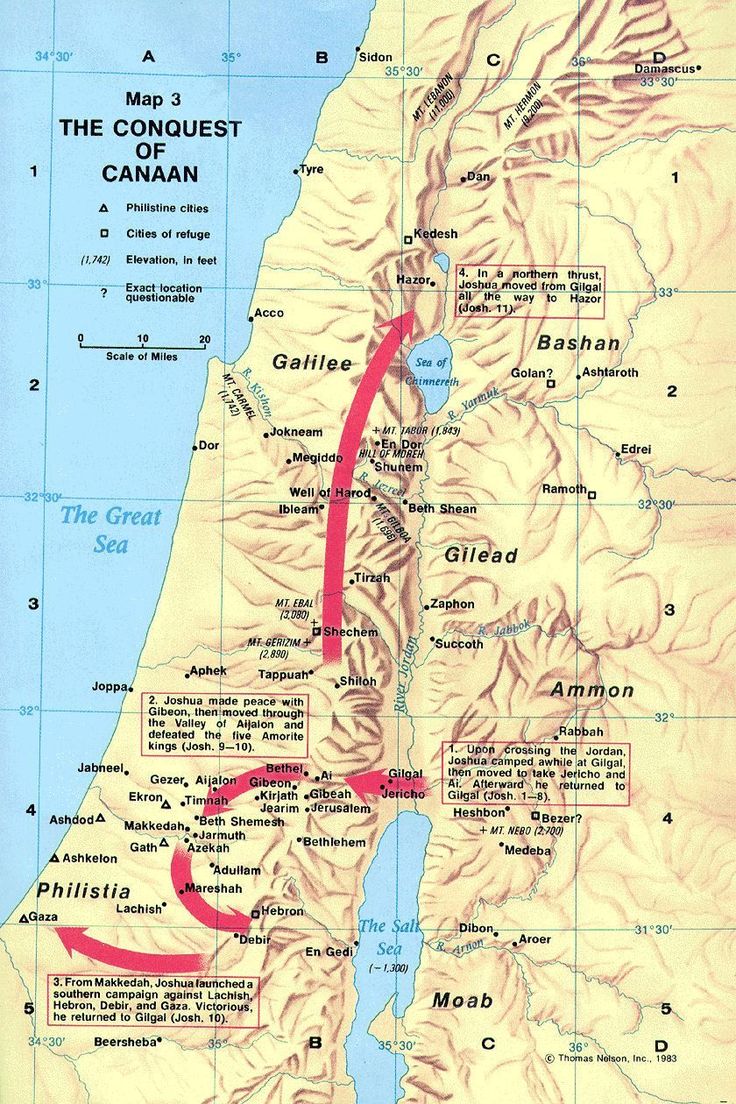
But while Saul was busy plowing, the enemies of Israel were plotting. This chapter opens up with a rather abrupt introduction to Nahash the Ammonite who, for some reason, picked this particular moment to besiege the town of Jabesh-gilead. It’s impossible to know if Nahash’s actions were motivated by news that Israel had a new king. Perhaps he chose to mobilize his forces before Saul had time to set up his kingdom and consolidate the 12 tribes of Israel. At this point, each tribe was on their own and was forced to defend themselves against enemy attacks. So, Nahash ordered his siege on Jabesh-gilead, located on the eastern side of the Jordan River in the territory of Gad, knowing that his chances of success were high.

Another possible motivating factor behind Nahash’s decision is recorded in the Book of Judges. During the time when Israel was ruled by God-appointed judges, the Ammonites proved to be a persistent problem. This Semitic people group was made up of the descendants of Lot, the nephew of Israelite’s great patriarch, Abraham. The Ammonites, the byproduct of Lot’s incestuous relationship with his younger daughter, had settled in the region around the Jordan River, which served as the western border to the territory of Gad. According to Judges 11, “the Ammonites made war against Israel” (Judges 11:5 ESV). In response to this threat, the elders of Gilead called on Jephthah, a great warrior from the town of Mizpah of Gilead. This son of a prostitute led Israel into battle against their enemies and God gave him a great victory.

So Jephthah crossed over to the Ammonites to fight against them, and the Lord gave them into his hand. And he struck them from Aroer to the neighborhood of Minnith, twenty cities, and as far as Abel-keramim, with a great blow. So the Ammonites were subdued before the people of Israel. – Judges 11:32-33 ESV

Nahash was likely seeking revenge for this earlier Ammonite defeat at the hands of Jephthah the Gileadite. But whatever the reason, Nahash besieged Jabesh-gilead, forcing its inhabitants to negotiate for a peaceful treaty. But the terms of that treaty proved to be unacceptable.

Nahash the Ammonite said to them, “On this condition I will make a treaty with you, that I gouge out all your right eyes, and thus bring disgrace on all Israel.” – 1 Samuel 11:2 ESV

Having successfully negotiated a seven-day cease-fire, the people of Jabesh-gilead sent word to the rest of the tribes of Israel, hoping that reinforcements would arrive to rescue them from their predicament.

When the news reached Saul, he embraced his role as king and summoned the people of Israel to battle. But the text makes it clear that his actions were the result of the Spirit’s empowerment, not his own strength or initiative.

Then the Spirit of God came powerfully upon Saul, and he became very angry. He took two oxen and cut them into pieces and sent the messengers to carry them throughout Israel with this message: “This is what will happen to the oxen of anyone who refuses to follow Saul and Samuel into battle!” – 1 Samuel 11:6-7 NLT

This was a God-ordained opportunity for Saul to demonstrate that his divine commissioning had been real and not a fluke. He was about to make the unlikely transition from farmer to deliverer – all under the power of the Spirit of God.

What Saul does next seems rather strange to our modern sensibilities, but it has precedence. Judges 19 records the story of the rape and murder of a young woman who was the concubine of a Levite. She met her fate in the town of Gibeah, Saul’s hometown. The Levite, who had been passing through Gibeah on his way home, responded to the young woman’s murder by dismembering her body and sending the pieces to the various tribes of Israel. He demanded revenge against the men of Gibeah who had committed this atrocity. The 11 other tribes answered the call, resulting in a brief civil war between the tribe of Benjamin and the rest of the tribes of Israel.

It’s likely that Saul had this story in mind when he slaughtered his own oxen and sent the pieces to the tribes of Israel. He was calling the people to unify and confront the enemy together. With God’s help, his grizzly message had its intended effect.

…the Lord made the people afraid of Saul’s anger, and all of them came out together as one. – 1 Samuel 11: NLT

More than 33,000 Israelite warriors showed up at Jabesh-gilead and their rout of the Ammonites was complete. Nahash and his troops were slaughtered or scattered to the four winds. And the people of Israel took this resounding victory as proof of Saul’s calling. He had led them in battle against the Ammonites and proven himself an effective leader and military strategist. Any lingering doubts about Saul’s calling were gone and the people voiced their unified confidence in their new king.

“Now where are those men who said, ‘Why should Saul rule over us?’ Bring them here, and we will kill them!” – 1 Samuel 11:12 NLT

But rather than seek vengeance on his detractors, Saul called for peace and a commitment to build a kingdom that would unify all the tribes as one.

“Come, let us all go to Gilgal to renew the kingdom.” – 1 Samuel 11:14 NLT

Chapter 11 ends on a decisively upbeat note.

So they all went to Gilgal, and in a solemn ceremony before the Lord they made Saul king. Then they offered peace offerings to the Lord, and Saul and all the Israelites were filled with joy. – 1 Samuel 11:15 NLT

Things were looking up in Israel but, as the next chapter will reveal, this utopia would be short-lived if the people failed to honor God. Having a king was not going to solve all their problems. One man was not going to revitalize the spiritual state of an entire nation. Samuel will make it abundantly clear that if the people of Israel want to see their new kingdom last, they must honor God, not Saul. Future victory would be tied to their faithfulness to Yahweh. If they wanted to see their king succeed and their nation prosper, they would need to live in submission and obedience to the one true King.

English Standard Version (ESV) The Holy Bible, English Standard Version. ESV® Permanent Text Edition® (2016). Copyright © 2001 by Crossway Bibles, a publishing ministry of Good News Publishers.

New Living Translation (NLT) Holy Bible, New Living Translation, copyright © 1996, 2004, 2015 by Tyndale House Foundation. Used by permission of Tyndale House Publishers Inc., Carol Stream, Illinois 60188. All rights reserved.
All According to Plan

When he turned his back to leave Samuel, God gave him another heart. And all these signs came to pass that day. 10 When they came to Gibeah, behold, a group of prophets met him, and the Spirit of God rushed upon him, and he prophesied among them. 11 And when all who knew him previously saw how he prophesied with the prophets, the people said to one another, “What has come over the son of Kish? Is Saul also among the prophets?” 12 And a man of the place answered, “And who is their father?” Therefore it became a proverb, “Is Saul also among the prophets?” 13 When he had finished prophesying, he came to the high place.

14 Saul’s uncle said to him and to his servant, “Where did you go?” And he said, “To seek the donkeys. And when we saw they were not to be found, we went to Samuel.” 15 And Saul’s uncle said, “Please tell me what Samuel said to you.” 16 And Saul said to his uncle, “He told us plainly that the donkeys had been found.” But about the matter of the kingdom, of which Samuel had spoken, he did not tell him anything. – 1 Samuel 10:9-16 ESV

It’s difficult to discern exactly what is meant by the phrase, “God gave him another heart”(1 Samuel 10:9 ESV). Over the centuries, there has been a lot of speculation and debate about what happened to Saul in that moment. Some have tied his heart change to the filling of the Spirit of God. But it seems that his inner transformation, whatever it may have been, took place the moment “he turned his back to leave Samuel” (1 Samuel 10:9 ESV).

From the overall context, it would appear that Saul walked away with a new perspective. His attitude had been transformed by his encounter with Samuel and the news that God had anointed him to be Israel’s king. When Saul first met Samuel, the prophet told him, “I am here to tell you that you and your family are the focus of all Israel’s hopes” (1 Samuel 9:20 NLT). But this cryptic message left Saul uncomfortable and confused, prompting him to respond, “But I’m only from the tribe of Benjamin, the smallest tribe in Israel, and my family is the least important of all the families of that tribe! Why are you talking like this to me?” (1 Samuel 9:21 NLT).

Saul had no idea what Samuel was talking about and as the rest of the day unfolded, he became even more unsettled and uncertain. Things were happening so fast and it was almost impossible for him to take it all in. But the moment when Samuel anointed Saul with oil proved to be a game changer. That experience, coupled with the prophetic words spoken by the prophet, left Saul a different man. God transformed his reluctance into belief, empowering Saul to step out in faith and do what Samuel had told him to do. He obeyed the will of God and, as a result, “all Samuel’s signs were fulfilled that day” (1 Samuel 10:9 NLT). Had Saul refused to believe and act on Samuel’s words, the story would have ended there; none of Samuel’s predictions would have come to fruition. But the all-powerful, invisible God of Israel was operating behind the scenes, softening Saul’s heart and prompting his obedience.

As Saul and his servant entered the town of Gibeah, they encountered a group of prophets, just as Samuel had predicted. What happened next must have caught Saul by surprise and left his unwitting servant in disbelief.

Then the Spirit of God came powerfully upon Saul, and he, too, began to prophesy. – 1 Samuel 10:10 NLT

Samuel had told Saul that this would happen (1 Samuel 10:6) but experiencing it was another matter altogether. In a matter of seconds, Saul was filled with the Holy Spirit and began to prophesy. The inference is that Saul came under the power of the Holy Spirit and was no longer in control of his actions. He became an instrument in the hands of God. There is no explanation given as to how or what Saul prophesied. When Samuel predicted this encounter, he provided an important detail: “…you will meet a band of prophets coming down from the place of worship. They will be playing a harp, a tambourine, a flute, and a lyre, and they will be prophesying” (1 Samuel 10:5 NLT). These men were musicians who may have been connected to the Tabernacle and assisted in the worship of Yahweh. If this is true, they would have been Levites. Their presence in Gibeah is unexplained and the exact nature of their prophesying is unclear. But it seems that they were singing God’s praises under the Holy Spirit’s influence. And before he could take it all in, Saul joined in. This young man from the tribe of Benjamin suddenly broke out in song and joined the procession of prophets as they proclaimed the glories of God.

 This strange scene didn’t go unnoticed. The bystanders who took it all in began to question what they were seeing. Here was Saul, the son of Kish, dancing and singing along with the prophets of God. This unexpected and unprecedented behavior by this young man caused them to ask, “Can anyone become a prophet, no matter who his father is?” (1 Samuel 10:12 NLT). It reminds me of the lyrics from an old Sesame Street song.

One of these sounds is not like the others
One of these sounds doesn’t belong
Can you tell which sound is not like the other
By the time I finish my song?

Saul didn’t belong in the band of prophets. As a member of the tribe of Benjamin, he had no right to take part in their God-appointed duties. But there he was, big as life, and clearly exhibiting the evidence of being Spirit-empowered, which left the people asking, “How did the son of Kish become a prophet?” (1 Samuel 10:11 NLT).

But Saul’s moment in the spotlight came to an end and he went on his way. When his uncle demanded to know where he had been, Saul chose to present a truncated and sanitized version of his experience.

“We were looking for the donkeys,” Saul replied, “but we couldn’t find them. So we went to Samuel to ask him where they were.” – 1 Samuel 10:14 NLT

This wasn’t a lie but it wasn’t exactly the truth either. For whatever reason, Saul decided to withhold some of the pertinent information regarding his encounter with Samuel. He fails to mention the banquet, his anointing with oil, or Samuel’s prophesy concerning his call to be Israel’s king. Perhaps Saul was concerned about how his family would receive this news and he wanted to be the one to tell his father and mother all that had happened. Had he told his uncle the full story, the news could have spread quickly, creating an even greater uproar than his short-term role as a prophet had caused. So, “Saul didn’t tell his uncle what Samuel said about the kingdom” (1 Samuel 10:16 NLT).

Saul’s reticence to divulge the full story was in keeping with the words of Samuel. The prophet had given him clear instructions.

“…go down to Gilgal ahead of me. I will join you there to sacrifice burnt offerings and peace offerings. You must wait for seven days until I arrive and give you further instructions.” – 1 Samuel 10:8 NLT

Saul had not been told to make the news of his anointing known to anyone, including his own family. He was instructed to go to Gilgal and wait for the prophet, and that is what he did.

This entire plan had a God-ordained schedule associated with it. Everything had to happen according to God’s well-timed and predetermined schedule. The seminal event in Israel’s storied history was not going to happen by chance or according to the whims or wishes of men. God was implementing His divine plan and nothing could stand in His way.

English Standard Version (ESV) The Holy Bible, English Standard Version. ESV® Permanent Text Edition® (2016). Copyright © 2001 by Crossway Bibles, a publishing ministry of Good News Publishers.

New Living Translation (NLT) Holy Bible, New Living Translation, copyright © 1996, 2004, 2015 by Tyndale House Foundation. Used by permission of Tyndale House Publishers Inc., Carol Stream, Illinois 60188. All rights reserved.

Not What He Was Looking For

1 There was a man of Benjamin whose name was Kish, the son of Abiel, son of Zeror, son of Becorath, son of Aphiah, a Benjaminite, a man of wealth. And he had a son whose name was Saul, a handsome young man. There was not a man among the people of Israel more handsome than he. From his shoulders upward he was taller than any of the people.

Now the donkeys of Kish, Saul’s father, were lost. So Kish said to Saul his son, “Take one of the young men with you, and arise, go and look for the donkeys.” And he passed through the hill country of Ephraim and passed through the land of Shalishah, but they did not find them. And they passed through the land of Shaalim, but they were not there. Then they passed through the land of Benjamin, but did not find them.

When they came to the land of Zuph, Saul said to his servant who was with him, “Come, let us go back, lest my father cease to care about the donkeys and become anxious about us.” But he said to him, “Behold, there is a man of God in this city, and he is a man who is held in honor; all that he says comes true. So now let us go there. Perhaps he can tell us the way we should go.” Then Saul said to his servant, “But if we go, what can we bring the man? For the bread in our sacks is gone, and there is no present to bring to the man of God. What do we have?” The servant answered Saul again, “Here, I have with me a quarter of a shekel of silver, and I will give it to the man of God to tell us our way.” (Formerly in Israel, when a man went to inquire of God, he said, “Come, let us go to the seer,” for today’s “prophet” was formerly called a seer.) 10 And Saul said to his servant, “Well said; come, let us go.” So they went to the city where the man of God was.

11 As they went up the hill to the city, they met young women coming out to draw water and said to them, “Is the seer here?” 12 They answered, “He is; behold, he is just ahead of you. Hurry. He has come just now to the city, because the people have a sacrifice today on the high place. 13 As soon as you enter the city you will find him, before he goes up to the high place to eat. For the people will not eat till he comes, since he must bless the sacrifice; afterward those who are invited will eat. Now go up, for you will meet him immediately.” 14 So they went up to the city. As they were entering the city, they saw Samuel coming out toward them on his way up to the high place.

15 Now the day before Saul came, the Lord had revealed to Samuel: 16 “Tomorrow about this time I will send to you a man from the land of Benjamin, and you shall anoint him to be prince over my people Israel. He shall save my people from the hand of the Philistines. For I have seen my people, because their cry has come to me.” 17 When Samuel saw Saul, the Lord told him, “Here is the man of whom I spoke to you! He it is who shall restrain my people.” 18 Then Saul approached Samuel in the gate and said, “Tell me where is the house of the seer?” 19 Samuel answered Saul, “I am the seer. Go up before me to the high place, for today you shall eat with me, and in the morning I will let you go and will tell you all that is on your mind. 20 As for your donkeys that were lost three days ago, do not set your mind on them, for they have been found. And for whom is all that is desirable in Israel? Is it not for you and for all your father’s house?” 21 Saul answered, “Am I not a Benjaminite, from the least of the tribes of Israel? And is not my clan the humblest of all the clans of the tribe of Benjamin? Why then have you spoken to me in this way?”

22 Then Samuel took Saul and his young man and brought them into the hall and gave them a place at the head of those who had been invited, who were about thirty persons. 23 And Samuel said to the cook, “Bring the portion I gave you, of which I said to you, ‘Put it aside.’” 24 So the cook took up the leg and what was on it and set them before Saul. And Samuel said, “See, what was kept is set before you. Eat, because it was kept for you until the hour appointed, that you might eat with the guests.”

So Saul ate with Samuel that day. – 1 Samuel 9:1-24 ESV

God had agreed to give Israel a king. Now the time had come for God to reveal the identity of the man who would rule over His chosen people. There is no indication as to how much time had passed between the peoples’ demand for a king and its actual fulfillment. Days, months, or years could have passed. Life went on as usual, with the elder Samuel continuing to perform his duties as the God-ordained judge of Israel. This man may have been rejected by the people but he would play a significant role in the selection and dedication of Israel’s first king.

Chapter 8 ended with God’s commanding Samuel, “Obey their voice and make them a king” (1 Samuel 8:22 ESV). But who was Samuel to crown? He had a commission but no candidate to fulfill the position. It’s almost as if God placed the responsibility of selecting Israel’s first king on the frail shoulders of the elderly Samuel. Burdened with this ominous task and no clue as to how to fulfill it, Samuel said to the men of Israel, “Go every man to his city” (1 Samuel 8:22 ESV). He sent everyone home but his job had just begun.

But chapter 9 reveals that God had not left Samuel on his own. The Almighty was working behind the scenes, divinely orchestrating every minute detail of the story. While Samuel and the Israelites were going about their daily business, God was busy setting the stage for the “great reveal.” The truth is, most Israelites, including Samuel, had probably forgotten all about the events of chapter 8. It was business as usual for everyone in Israel, including Samuel. As the text reveals, he had just arrived in the city of Zuph, where he was preparing “to take part in a public sacrifice up at the place of worship” (1 Samuel 9:12 NLT).

We know from chapter 7, that Samuel traveled extensively in his role as judge, serving as a prophet, priest, and mediator for the people.

Each year he traveled around, setting up his court first at Bethel, then at Gilgal, and then at Mizpah. He judged the people of Israel at each of these places. Then he would return to his home at Ramah, and he would hear cases there, too. And Samuel built an altar to the Lord at Ramah. – 1 Samuel 7:16-17 NLT

On this occasion, Samuel’s itinerary included a city called Zuph. Little did Samuel know that his arrival in Zuph would include a divine appointment that would change his life forever. When he woke up that morning, he idea what God had in store for him.

But there was another individual who began his day in a similar state of ignorance and unawareness of God’s sovereign, providential activity. A young man named Saul woke up to find that his father had a job for him to do. During the night, some of the family’s donkeys had gone missing and Saul’s father put him in charge of their recovery.

This good-looking young man from a wealthy and prestigious family was assigned the less-than-inviable task of searching for some lost livestock. Saul was the son of Kish, “a Benjaminite, a man of wealth” (1 Samuel 9:1 ESV). This young man had everything going for him. Not only was he from a well-to-do family, but he was tall and extremely good-looking. The text goes out of its way to stress this final point.

Saul was the most handsome man in Israel—head and shoulders taller than anyone else in the land. – 1 Samuel 9:2 NLT

But at this point in the story, Saul’s looks took a back seat to his ability to search and recover his father’s missing donkeys. Height and good looks weren’t exactly vital assets when it came to seeking lost livestock. But Saul proved to be obedient and faithfully followed his father’s instructions. Yet, little did Saul know that his travels would lead him to an encounter with the judge of Israel and a life-changing call from the God of Israel.

While God is not mentioned in the opening verses of this chapter, His presence is everywhere. Every facet of this story shouts the sovereignty of God and reveals how He operates unseen and undetected in the lives of His people. Verse 4 states that, in their quest to recover the lost donkeys, Saul and his servant “passed through the hill country of Ephraim and passed through the land of Shalishah, but they did not find them. And they passed through the land of Shaalim, but they were not there. Then they passed through the land of Benjamin, but did not find them” (1 Samuel 9:4 ESV).

Don’t miss the subtle glimpse of God’s sovereignty in this passage. Saul’s search was not going as he had planned, but his circuitous route was according to God’s pre-ordained and precise plan for Saul’s life. God was leading him right to where he needed to be.

It just so happened that Saul and Samuel would end up in the same town on the same day. That’s not a case of blind luck, kismet, happenstance, or fate. It is proof of God’s sovereign control over every phase of this story. God even uses Saul’s servant to carry out His divine plan and help to direct Saul to the city of Zuph.

“I’ve just thought of something! There is a man of God who lives here in this town. He is held in high honor by all the people because everything he says comes true. Let’s go find him. Perhaps he can tell us which way to go.” – 1 Samuel 9:6 NLT

When Saul chose this servant to accompany him on his journey, he had no way of knowing that this man would have that kind of knowledge. He had no reason to need that kind of information. But that servant would prove to be an invaluable resource, leading Saul to the very person God wanted him to meet.

What stands out in this story is the seeming lack of spiritual insight both Saul and his servant display. Yes, the servant knew the whereabouts of the “man of God” but he viewed Samuel as little more than a fortune teller. Evidently, this is how most Israelites viewed men like Samuel. The text clarifies that “In those days if people wanted a message from God, they would say, ‘Let’s go and ask the seer,’ for prophets used to be called seers” (1 Samuel 9:9 NLT).

Saul and his servant display little in the way of reverence for Samuel’s role as judge. They simply hope to use his divining skills to ascertain the location of the missing donkeys, and they’re willing to pay for it. It’s interesting to note that the well-to-do son of the wealthy father has no money to pay the seer, so the lowly servant has to anty up the payment for Samuel’s services.

Once again, the text reveals how God is working behind the scenes. As Saul and his servant enter the town, they just happen to meet a young woman who knows the exact location of the man of God. Following her precise directions, they enter the town and immediately run into Samuel as he makes his way to the place of worship. What Saul didn’t know was that Samuel had been prepared for this “chance” encounter.

Now the Lord had told Samuel the previous day, “About this time tomorrow I will send you a man from the land of Benjamin. Anoint him to be the leader of my people, Israel. He will rescue them from the Philistines, for I have looked down on my people in mercy and have heard their cry.” – 1 Samuel 9:15-16 NLT

Saul was looking for a seer to help him find his lost livestock but Samuel was looking for the man who would become Israel’s king – and they just happened to run into one another. This divine appointment would provide Saul with far more information than he was seeking. Not only would he discover that the donkeys had been found but that God had a plan for his life. The unwitting Saul must have been shocked to hear the seer announce, “I am here to tell you that you and your family are the focus of all Israel’s hopes” (1 Samuel 9:20 NLT). He had no way of understanding the significance of those words. His brain must have short-circuited as he attempted to grasp what he was being told. And his first response was to question the validity of Samuel’s statement.

“But I’m only from the tribe of Benjamin, the smallest tribe in Israel, and my family is the least important of all the families of that tribe! Why are you talking like this to me?” – 1 Samuel 9:21 NLT

Saul was in shock. He had come looking for information about missing donkeys and was now being told that he was the hope of all Israel. His response had been described as humble but it may have been his way of saying, “You’ve got the wrong guy!” It’s unclear whether Saul understood the full import of Samuel’s words. He doesn’t seem to grasp what is being said and falsely portrays himself as an undeserving candidate for whatever Samuel has in mind.

But Samuel refuses to answer Saul’s question. Instead, he takes the shell-shocked Saul into the hall and seats him at the place of honor. In the gaze of the 30 invited guests, Saul stared in wonder as the choicest meat was placed before him. He was being treated like royalty and couldn’t comprehend the significance of it all. He had no way of knowing what God had in store for him but the coming days would prove to be a whirlwind of epic proportions. His life would never be the same again.

English Standard Version (ESV) The Holy Bible, English Standard Version. ESV® Permanent Text Edition® (2016). Copyright © 2001 by Crossway Bibles, a publishing ministry of Good News Publishers.

New Living Translation (NLT) Holy Bible, New Living Translation, copyright © 1996, 2004, 2015 by Tyndale House Foundation. Used by permission of Tyndale House Publishers Inc., Carol Stream, Illinois 60188. All rights reserved.
God’s Indestructible and Unstoppable Plan

27 And there came a man of God to Eli and said to him, “Thus says the Lord, ‘Did I indeed reveal myself to the house of your father when they were in Egypt subject to the house of Pharaoh? 28 Did I choose him out of all the tribes of Israel to be my priest, to go up to my altar, to burn incense, to wear an ephod before me? I gave to the house of your father all my offerings by fire from the people of Israel. 29 Why then do you scorn my sacrifices and my offerings that I commanded for my dwelling, and honor your sons above me by fattening yourselves on the choicest parts of every offering of my people Israel?’ 30 Therefore the Lord, the God of Israel, declares: ‘I promised that your house and the house of your father should go in and out before me forever,’ but now the Lord declares: ‘Far be it from me, for those who honor me I will honor, and those who despise me shall be lightly esteemed. 31 Behold, the days are coming when I will cut off your strength and the strength of your father’s house, so that there will not be an old man in your house. 32 Then in distress you will look with envious eye on all the prosperity that shall be bestowed on Israel, and there shall not be an old man in your house forever. 33 The only one of you whom I shall not cut off from my altar shall be spared to weep his eyes out to grieve his heart, and all the descendants of your house shall die by the sword of men. 34 And this that shall come upon your two sons, Hophni and Phinehas, shall be the sign to you: both of them shall die on the same day. 35 And I will raise up for myself a faithful priest, who shall do according to what is in my heart and in my mind. And I will build him a sure house, and he shall go in and out before my anointed forever. 36 And everyone who is left in your house shall come to implore him for a piece of silver or a loaf of bread and shall say, “Please put me in one of the priests’ places, that I may eat a morsel of bread.”’” – 1 Samuel 2:27-36 ESV

Eli had heard the reports concerning the behavior of his sons and he had confronted and warned them but his words had fallen on deaf ears. His adult sons displayed no fear of God and a stubborn unwillingness to repent from their blasphemous actions. As their father and priestly superior, Eli was ultimately responsible for their behavior. He was the high priest of Israel and was tasked with maintaining the holiness of God’s dwelling place, the Tabernacle. Yet, by their actions, his own sons were desecrating God’s house and treating their priestly role with contempt.

God had set apart the tribe of Levi to be the caretakers of the Tabernacle and the custodians of the Mosaic Law, and He had warned them: “You must faithfully keep all my commands by putting them into practice, for I am the Lord. Do not bring shame on my holy name, for I will display my holiness among the people of Israel. I am the Lord who makes you holy” (Leviticus 22:31-32 NLT).

But Hophni and Phinehas had defamed God’s name and their father failed to deal with them appropriately. So, God stepped in and declared His intention to mete out justice. But first, He confronted Eli about his negligence in handling the problem.

“I chose your ancestor Aaron from among all the tribes of Israel to be my priest, to offer sacrifices on my altar, to burn incense, and to wear the priestly vest as he served me. And I assigned the sacrificial offerings to you priests. So why do you scorn my sacrifices and offerings? Why do you give your sons more honor than you give me—for you and they have become fat from the best offerings of my people Israel!” – 1 Samuel 2:28-29 NLT

God reminded Eli of the distinctive nature of the Levitical priesthood. Aaron, the brother of Moses, had not earned his role as the first high priest, and the tribe of Levi had done nothing to deserve their set-apart status as God’s priestly caste. God had graciously chosen them and designated them as His personal servants.

And the Lord spoke to Moses, saying, “Bring the tribe of Levi near, and set them before Aaron the priest, that they may minister to him. They shall keep guard over him and over the whole congregation before the tent of meeting, as they minister at the tabernacle. They shall guard all the furnishings of the tent of meeting, and keep guard over the people of Israel as they minister at the tabernacle. And you shall give the Levites to Aaron and his sons; they are wholly given to him from among the people of Israel. And you shall appoint Aaron and his sons, and they shall guard their priesthood.” – Numbers 3:5-10 NLT

But these men had blatantly violated their divine commission and failed to guard their priesthood. And when Eli neglected his duties as the high priest by allowing this egregious behavior to continue unchecked, God was obligated to protect the integrity of His name.

“I will show how holy my great name is—the name on which you brought shame…” – Ezekiel 36:23 NLT

God warned Eli that judgment was coming.

I promised that your branch of the tribe of Levi would always be my priests. But I will honor those who honor me, and I will despise those who think lightly of me. – 1 Samuel 2:30 ESV

The role of priest was a privilege but it came with conditions. Only members of the tribe of Levi could serve in this distinctive capacity but their uniqueness as God’s servants required faithfulness and a commitment to honor Him at all costs. While all the tribes of Israel were important to God, He had placed a special emphasis on this one tribe and had promised to protect and provide for them.

“Behold, I have taken the Levites from among the people of Israel instead of every firstborn who opens the womb among the people of Israel. The Levites shall be mine, for all the firstborn are mine. On the day that I struck down all the firstborn in the land of Egypt, I consecrated for my own all the firstborn in Israel, both of man and of beast. They shall be mine: I am the Lord.” – Numbers 3:12-13 ESV

“You shall have no inheritance in their land, neither shall you have any portion among them. I am your portion and your inheritance among the people of Israel. – Numbers 18:20 ESV

The elderly Eli must have been stunned by the divine pronouncement delivered by the prophet of God.

The time is coming when I will put an end to your family, so it will no longer serve as my priests. All the members of your family will die before their time. None will reach old age. – 1 Samuel 2:31 ESV

The consequences were far worse than anything Eli could have imagined. Not only would his sons receive divine judgment for their sins, but his entire line would suffer early and untimely deaths. It would not be enough for them to lose their rights to serve as priests; they must suffer the just and righteous consequences for their actions.

This punishment may seem overly severe to our modern sensibilities, but it reflects the weighty nature of the sin of Hophne and Phinehas. They had dishonored not only their priestly position but also the name of God. And it would appear that their actions had already infected the rest of their clan. Sin never operates in a vacuum; it tends to spread and infect others. So, it is likely that the actions of Hophne and Phinehas, while the prime focus of this passage, were far from isolated or unique. The entire clan of Eli had become corrupt and unworthy of serving as God’s servants.

The intensity of God’s pronouncement must not be overlooked. Eli needed to fully understand the weight of his sons’ actions. God was making a powerful and unforgettable statement about sin and its consequences, and to drive home His message, God informs Eli that both of his sons will suffer death on the very same day. Their lives of decadence and disobedience will come to a quick and ignominious end.

The final paragraph of this chapter contains a glimmer of hope surrounding a dark cloud of sorrow for Eli. With the death of Eli’s sons, God promises to raise up their replacement.

“Then I will raise up a faithful priest who will serve me and do what I desire. I will establish his family, and they will be priests to my anointed kings forever. – 1 Samuel 2:35 NLT

This would not have come across as good news to Eli. But it was God’s way of promoting His providential and sovereign will. Despite what Hophne and Phinehas had done, God’s plan would prevail. While the clan of Eli would lose their priestly rights and die untimely deaths, God had another line of Levites who could serve in their place.

God was informing Eli that His will would still be done. The sins of Hophne and Phinehas and the negligence of Eli could not alter God’s divine plan. And this prophetic promise from God is meant to highlight the immediate as well as the distant future. As the following chapters of this book will reveal, Samuel will fulfill this promise – in part. But centuries later, during the reign of King Solomon, Zadok became the high priest, replacing Abiathar, a descendant of Eli. From that point forward, no other member of Eli’s clan will serve in that capacity.

But the final fulfillment of God’s promise will take place with the coming of Jesus, who served as the final high priest even though He was not of the tribe of Levi. The author of the Book of Hebrews spells out how Jesus, a member of the tribe of Judah, became the great high priest and fulfilled the promise of God.

So if the priesthood of Levi, on which the law was based, could have achieved the perfection God intended, why did God need to establish a different priesthood, with a priest in the order of Melchizedek instead of the order of Levi and Aaron?

And if the priesthood is changed, the law must also be changed to permit it. For the priest we are talking about belongs to a different tribe, whose members have never served at the altar as priests. What I mean is, our Lord came from the tribe of Judah, and Moses never mentioned priests coming from that tribe.

This change has been made very clear since a different priest, who is like Melchizedek, has appeared. Jesus became a priest, not by meeting the physical requirement of belonging to the tribe of Levi, but by the power of a life that cannot be destroyed. – Hebrews 7:11-16 NLT

Hophne and Phinehas had blown it, and Eli had refused to deal with it. But God was not done yet. His plan is indestructible and unstoppable. The entire clan of Eli could drop the ball and God would not miss a beat. He already had Samuel in place and, in time, the guilty would suffer the consequences for their sins and the next step in God’s divine plan would unfold. And the opening line of the very next chapter sets the tone for all that is to come.

Now the boy Samuel was ministering to the Lord in the presence of Eli. – 1 Samuel 3:1 ESV

English Standard Version (ESV) The Holy Bible, English Standard Version. ESV® Permanent Text Edition® (2016). Copyright © 2001 by Crossway Bibles, a publishing ministry of Good News Publishers.

New Living Translation (NLT) Holy Bible, New Living Translation, copyright © 1996, 2004, 2015 by Tyndale House Foundation. Used by permission of Tyndale House Publishers Inc., Carol Stream, Illinois 60188. All rights reserved.
Our All-Knowing God Always Knows What Is Best

16 The Lord spoke to Moses, saying, 17 “These are the names of the men who shall divide the land to you for inheritance: Eleazar the priest and Joshua the son of Nun. 18 You shall take one chief from every tribe to divide the land for inheritance. 19 These are the names of the men: Of the tribe of Judah, Caleb the son of Jephunneh. 20 Of the tribe of the people of Simeon, Shemuel the son of Ammihud. 21 Of the tribe of Benjamin, Elidad the son of Chislon. 22 Of the tribe of the people of Dan a chief, Bukki the son of Jogli. 23 Of the people of Joseph: of the tribe of the people of Manasseh a chief, Hanniel the son of Ephod. 24 And of the tribe of the people of Ephraim a chief, Kemuel the son of Shiphtan. 25 Of the tribe of the people of Zebulun a chief, Elizaphan the son of Parnach. 26 Of the tribe of the people of Issachar a chief, Paltiel the son of Azzan. 27 And of the tribe of the people of Asher a chief, Ahihud the son of Shelomi. 28 Of the tribe of the people of Naphtali a chief, Pedahel the son of Ammihud.” 29 These are the men whom the Lord commanded to divide the inheritance for the people of Israel in the land of Canaan. 

1 The Lord spoke to Moses in the plains of Moab by the Jordan at Jericho, saying, “Command the people of Israel to give to the Levites some of the inheritance of their possession as cities for them to dwell in. And you shall give to the Levites pasturelands around the cities. The cities shall be theirs to dwell in, and their pasturelands shall be for their cattle and for their livestock and for all their beasts. The pasturelands of the cities, which you shall give to the Levites, shall reach from the wall of the city outward a thousand cubits all around. And you shall measure, outside the city, on the east side two thousand cubits, and on the south side two thousand cubits, and on the west side two thousand cubits, and on the north side two thousand cubits, the city being in the middle. This shall belong to them as pastureland for their cities.

“The cities that you give to the Levites shall be the six cities of refuge, where you shall permit the manslayer to flee, and in addition to them you shall give forty-two cities. All the cities that you give to the Levites shall be forty-eight, with their pasturelands. And as for the cities that you shall give from the possession of the people of Israel, from the larger tribes you shall take many, and from the smaller tribes you shall take few; each, in proportion to the inheritance that it inherits, shall give of its cities to the Levites.” Numbers 34:16-35:8 ESV

God provided Moses with the name of one man from each of the ten tribes of Israel. These men, hand-picked by God, would assist Eleazar, the high priest, and Joshua in the distribution of the land. The tribes of Gad and Reuben were not included because they had chosen to settle outside the boundaries of Canaan. These men were well-respected leaders among their respective tribes and would help to guarantee that the land was fairly apportioned and that each tribe, regardless of its size, was treated equitably and fairly. There was to be no favoritism or any form of nepotism. The larger tribes, whose numbers would be based on the recent census taken by Moses, would be allotted more extensive land allotments. But was not a guarantee that they would receive the best land. God was giving these ten men the weighty responsibility of dividing up the Israelites’ inheritance in a way that would satisfy all the parties involved, and that would not be an easy task.

The next thing on God’s agenda was to arrange for the needs of the tribe of Levi, his own tribe. He had already informed Moses that the Levites would inherit no land in Canaan. God had set apart the tribe of Levi as His special possession and had dedicated them to the care and maintenance of the Tabernacle. As a result, God promised to be their inheritance.

“Remember that the Levitical priests—that is, the whole of the tribe of Levi—will receive no allotment of land among the other tribes in Israel. Instead, the priests and Levites will eat from the special gifts given to the Lord, for that is their share. They will have no land of their own among the Israelites. The Lord himself is their special possession, just as he promised them.” – Deuteronomy 18:1-2 NLT

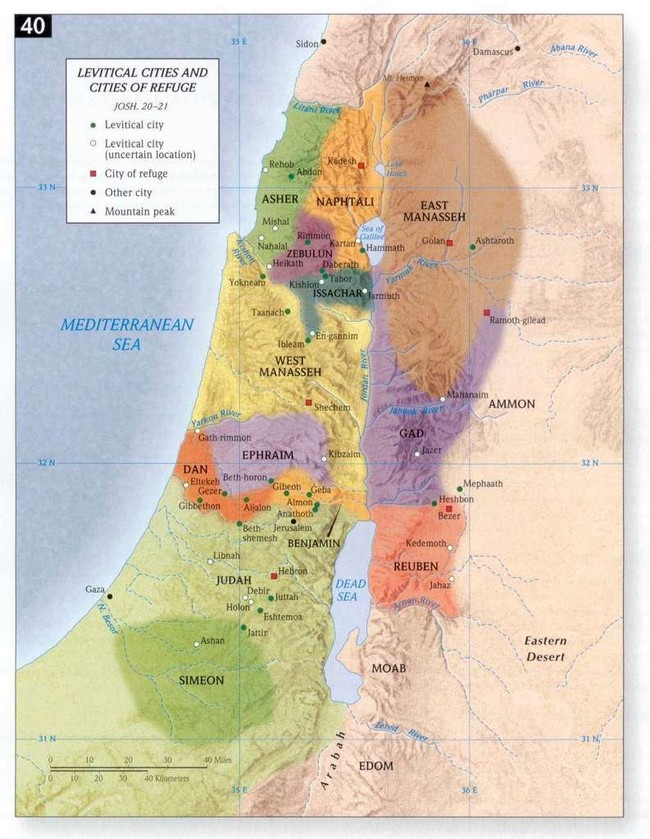
But while the Levites would be allotted no land in Canaan, they would be awarded the deeds to 48 cities located within the territories of each of the other 11 tribes (Joshua 21). Even the tribes of Gad, Reuben, and the half-tribe of Manasseh were required to provide the Levites with towns and pastureland for their flocks on the other side of the Jordan River. God had made ample accommodations for the Levites.

These Levitical cities were to be strategically located throughout the nation of Israel so that every Israelite was no more than ten miles from one of them. This helped to ensure that the people of God were never far away from a member of the Levitical priesthood, whose job was to provide instruction in the ways of God. The Levitical priests served as judges (Deuteronomy 17:8-13) and teachers of God’s law (Deuteronomy 33:10). So, it was essential that every Israelite had ready access to a Levitical town and a priest of God.

Of the 48 towns awarded to the Levites, six were to be designated as cities of refuge. These were specially sanctioned zones within the boundaries of Israel where anyone guilty of committing a non-premediated murder could seek asylum. God had already declared His ruling concerning murder (Exodus 20:13), but He had Moses present a special provision for cases involving accidental homicide.

“If someone kills another person unintentionally, without previous hostility, the slayer may flee to any of these cities to live in safety. – Deuteronomy 19:4 NLT

He even had Moses provide a potential scenario in which a city of refuge would become necessary.

“For example, suppose someone goes into the forest with a neighbor to cut wood. And suppose one of them swings an ax to chop down a tree, and the ax head flies off the handle, killing the other person. In such cases, the slayer may flee to one of the cities of refuge to live in safety.” – Deuteronomy 19:5 NLT

God knew that life would happen and that deadly accidents would be a part of the Israelites’ existence in the land. Men would be killed and justice would need to be pursued. But what He didn’t want was some form of vigilante justice running rampant through the nation. Yet God knew that the relatives of a murder victim would tend to seek revenge against the guilty party and ask questions later. The cities of refuge were intended to protect the innocent while justice was being served.

Since Israel had no professional police force, these kinds of accidents could easily turn into bloodbaths where the relatives of the victim sought to avenge their loved one’s death. So, these cities, occupied by the Levites, would provide a place where the guilty party could find solace and seek a fair judgment concerning his guilt or innocence. In His plans for the land of promise, God was leaving nothing to chance. He was creating a well-designed system for dealing with the inevitable problem of sin among His chosen people. He was going to distribute the Levitical priesthood among them to provide spiritual enlightenment and He was going to create safe havens for those who unwittingly committed even the gravest of sins. God was providing for and protecting His people.

English Standard Version (ESV) The Holy Bible, English Standard Version. ESV® Permanent Text Edition® (2016). Copyright © 2001

New Living Translation (NLT) Holy Bible, New Living Translation, copyright © 1996, 2004, 2015 by Tyndale House Foundation. Used by permission of Tyndale House Publishers Inc., Carol Stream, Illinois 60188. All rights reserved.

It Ain’t Much, But It’s Ours

The Lord spoke to Moses, saying, “Command the people of Israel, and say to them, When you enter the land of Canaan (this is the land that shall fall to you for an inheritance, the land of Canaan as defined by its borders), your south side shall be from the wilderness of Zin alongside Edom, and your southern border shall run from the end of the Salt Sea on the east. And your border shall turn south of the ascent of Akrabbim, and cross to Zin, and its limit shall be south of Kadesh-barnea. Then it shall go on to Hazar-addar, and pass along to Azmon. And the border shall turn from Azmon to the Brook of Egypt, and its limit shall be at the sea.

“For the western border, you shall have the Great Sea and its coast. This shall be your western border.

“This shall be your northern border: from the Great Sea you shall draw a line to Mount Hor. From Mount Hor you shall draw a line to Lebo-hamath, and the limit of the border shall be at Zedad. Then the border shall extend to Ziphron, and its limit shall be at Hazar-enan. This shall be your northern border.

10 “You shall draw a line for your eastern border from Hazar-enan to Shepham. 11 And the border shall go down from Shepham to Riblah on the east side of Ain. And the border shall go down and reach to the shoulder of the Sea of Chinnereth on the east. 12 And the border shall go down to the Jordan, and its limit shall be at the Salt Sea. This shall be your land as defined by its borders all around.”

13 Moses commanded the people of Israel, saying, “This is the land that you shall inherit by lot, which the Lord has commanded to give to the nine tribes and to the half-tribe. 14 For the tribe of the people of Reuben by fathers’ houses and the tribe of the people of Gad by their fathers’ houses have received their inheritance, and also the half-tribe of Manasseh. 15 The two tribes and the half-tribe have received their inheritance beyond the Jordan east of Jericho, toward the sunrise.” Numbers 34:1-15 ESV

As the people prepared to enter the land of promise, Moses provided them with the boundary markers that would establish their future territory. But it is important to note that the description given by Moses is distinctly different than the one God had originally given to Abram at the point of his calling. The borders that Moses outlines in this passage are far more restrictive than the ones God proposed to Abram.  At that point in time, God had designated a far larger area as the future homeland for Abram’s descendants.

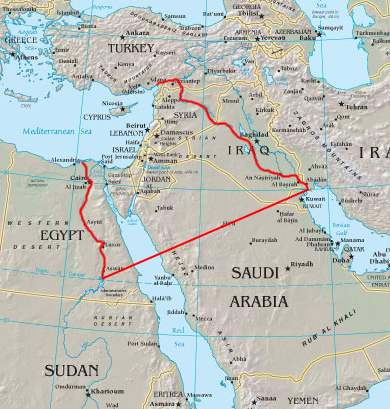
“To your offspring I give this land, from the river of Egypt to the great river, the river Euphrates…” – Genesis 15:18 ESV

The two primary boundary markers that God gave Abram were “the river of Egypt,” which most likely refers to the Nile, to “the river Euphrates,” which extends from the southern border of modern-day Turkey all the way to the Persian Gulf.

God had a much larger geographic region in mind when He made His original promise to Abram. But centuries later, by the time the descendants of Abram were ready to cross over the Jordan and occupy the land, the boundaries had shrunk significantly.

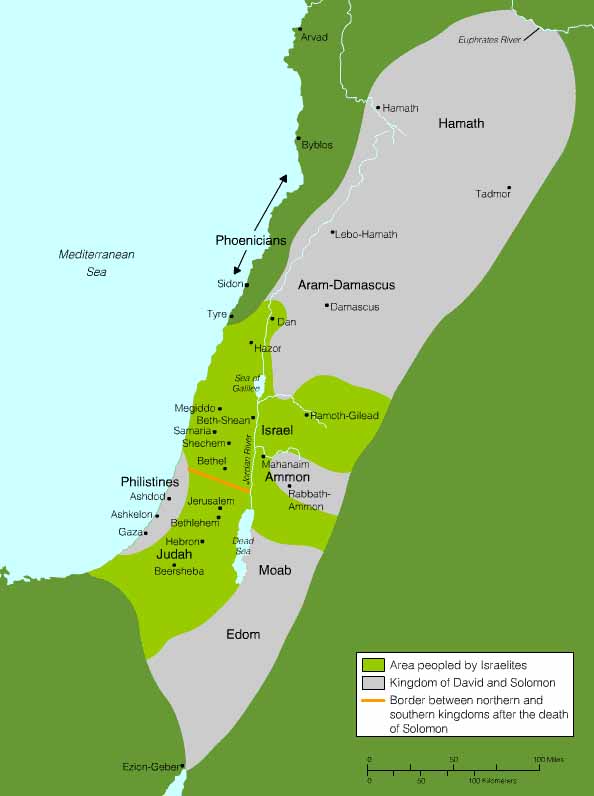
Moses provided a detailed description of the eastern, western, southern, and northern boundaries of the Israelite’s future homeland. At this point in their history, they were not ready or equipped to conquer and occupy the much larger region promised by God to Abram. Their army was far too small to attempt a conquest of the original promised land. Even though the nation was comprised of 12 tribes, there were not enough soldiers to take on the armies of “the Kenites, the Kenizzites, the Kadmonites, the Hittites, the Perizzites, the Rephaim, the Amorites, the Canaanites, the Girgashites and the Jebusites” (Genesis 15:19-21 NLT).

In a sense, God was starting small, but He had every intention of sticking to His original promise if the people of Israel proved obedient and successful at accomplishing His will. The reduced boundaries were not a sign of God reneging on His promise or going back on His word. He was simply asking the people of Israel to prove their willingness to be faithful and obedient.

The borders of the land, while greatly reduced, would prove more than enough territory for the 12 tribes of Israel. In fact, as Moses points out, two and a half of the tribes would end up settling in the Transjordan, outside the new boundaries for the promised land.

“This territory is the homeland you are to divide among yourselves by sacred lot. The Lord has commanded that the land be divided among the nine and a half remaining tribes. The families of the tribes of Reuben, Gad, and half the tribe of Manasseh have already received their grants of land  on the east side of the Jordan River, across from Jericho toward the sunrise.” – Numbers 34:13-15 NLT

Technically, according to the original description given by God to Abram, the land occupied by the tribes of Reuben, Gad, and half the tribe of Manasseh was in the land of promise. However, their land allotments would be considered separate from the rest of the tribes. Yet, one day, God would extend Israel’s borders under the leadership of King David. When David died and his son Solomon came to power, the kingdom would expand even further. God would slowly extend the borders of Israel but because of the nation’s disobedience, He would one day spit the kingdom in half and dramatically reduce their land holdings and influence in the region.

Yet at the point at which Moses was preparing the send the people into the land for the very first time, they were faced with the formidable and seemingly insurmountable task of conquering a vast expanse of enemy-occupied territory. That is what prompted Moses to remind them that the land was as good as theirs.

“This shall be your land as defined by its borders all around.” – Numbers 34:15 ESV

It was theirs, but they would have to do their part. According to God, it was as good as theirs but it wouldn’t come without a fight. It was Jesus who declared the need for follow-through in the life of God’s people.

“…a servant who knows what the master wants, but isn’t prepared and doesn’t carry out those instructions, will be severely punished. But someone who does not know, and then does something wrong, will be punished only lightly. When someone has been given much, much will be required in return; and when someone has been entrusted with much, even more will be required.” – Luke 12:47-48 NLT

The Israelites had their marching orders and a detailed map of their battle zone. Now it was time to exhibit faith and fight for what was rightfully theirs. According to the Book of Deuteronomy, also written by Moses, God had divinely decreed the apportionment of land for all the peoples of the world – with His chosen people in mind.

When the Most High gave to the nations their inheritance,
    when he divided mankind,
he fixed the borders of the peoples
    according to the number of the sons of God.
But the Lord‘s portion is his people,
    Jacob his allotted heritage. – Deuteronomy 32:8-9 ESV

He had always intended for the land of Canaan to be the homeland of His people. This fertile land sat in the geographic center of the known world at that time and would prove to be a focal point for human history for thousands of years. The Israelites would eventually conquer and occupy this relatively small tract of land in the Middle East, but only to find their homeland become a hotbed of conflict for centuries to come. Global superpowers would fight over the right to possess it. Nations would go to war for the right to claim it as their own, and the battles still rage today. But God intended Canaan to belong to His chosen people, and at this point in the story of their history, it is theirs to be had, if only they will step out in faith and obey God’s command.

English Standard Version (ESV) The Holy Bible, English Standard Version. ESV® Permanent Text Edition® (2016). Copyright © 2001

New Living Translation (NLT) Holy Bible, New Living Translation, copyright © 1996, 2004, 2015 by Tyndale House Foundation. Used by permission of Tyndale House Publishers Inc., Carol Stream, Illinois 60188. All rights reserved.

There’s No Need To Bargain With God

1 Moses spoke to the heads of the tribes of the people of Israel, saying, “This is what the Lord has commanded. If a man vows a vow to the Lord, or swears an oath to bind himself by a pledge, he shall not break his word. He shall do according to all that proceeds out of his mouth.

“If a woman vows a vow to the Lord and binds herself by a pledge, while within her father’s house in her youth, and her father hears of her vow and of her pledge by which she has bound herself and says nothing to her, then all her vows shall stand, and every pledge by which she has bound herself shall stand. But if her father opposes her on the day that he hears of it, no vow of hers, no pledge by which she has bound herself shall stand. And the Lord will forgive her, because her father opposed her.

“If she marries a husband, while under her vows or any thoughtless utterance of her lips by which she has bound herself, and her husband hears of it and says nothing to her on the day that he hears, then her vows shall stand, and her pledges by which she has bound herself shall stand. But if, on the day that her husband comes to hear of it, he opposes her, then he makes void her vow that was on her, and the thoughtless utterance of her lips by which she bound herself. And the Lord will forgive her. (But any vow of a widow or of a divorced woman, anything by which she has bound herself, shall stand against her.) 10 And if she vowed in her husband’s house or bound herself by a pledge with an oath, 11 and her husband heard of it and said nothing to her and did not oppose her, then all her vows shall stand, and every pledge by which she bound herself shall stand. 12 But if her husband makes them null and void on the day that he hears them, then whatever proceeds out of her lips concerning her vows or concerning her pledge of herself shall not stand. Her husband has made them void, and the Lord will forgive her. 13 Any vow and any binding oath to afflict herself, her husband may establish, or her husband may make void. 14 But if her husband says nothing to her from day to day, then he establishes all her vows or all her pledges that are upon her. He has established them, because he said nothing to her on the day that he heard of them. 15 But if he makes them null and void after he has heard of them, then he shall bear her iniquity.”

16 These are the statutes that the Lord commanded Moses about a man and his wife and about a father and his daughter while she is in her youth within her father’s house. Numbers 30:1-16 ESV

The people of Israel are encamped near the border of the land of Canaan, and Moses is attempting to prepare them for the fast-approaching day when they will have to cross over that border and begin their conquest of the land promised to them by God. Much of what Moses has communicated to them has been practical advice concerning matters of worship and sacrifice.

When they finally enter the land, their lives will be consumed by fighting and attempting to create new lives for themselves. Their old way of life will be over as they transform from wanderers to conquerors. Rather than living in tents as nomads, they will find themselves enjoying the comforts of home in houses and cities they didn’t build.

With all the changes they will face in the days ahead, Moses stressed their need to maintain the religious rites and rituals that God had given them at Sinai. They were to keep all the commands regarding sacrifices and offerings. Just because they were entering a time marked by military conquest, they were not to abandon their relationship with and commitment to God.

Now, in chapter 30, Moses addresses a rather strange topic that is unfamiliar to the modern Western mindset. Suddenly, as if out of nowhere, Moses brings up the issue of making vows. This is not a reference to wedding vows, but to the making of verbal commitments and, in most cases, commitments made to God. They are sometimes referred to as oaths.

Now, why would Moses be bringing up this topic at this particular point? It sounds a bit out of place, but it makes sense when one considers that the Israelites were preparing to enter a strange new land where they would face a host of unexpected and unfamiliar situations. As they found themselves going into battles against much larger and more skilled armies, it would be tempting to make vows to God in an effort to secure success. A vow could be a promise made to God in exchange for His blessing or a guarantee of safety. It might go something like this: “God, if you will bring me back safely from this battle, I will dedicate my firstborn child to Your service.”

We see just such a conversation in the book of Judges. Jephthah, one of the judges of Israel found himself facing a battle against the Ammonites. In an attempt to garner God’s assistance in defeating his enemy, Jephthah made a bargain with the Almighty.

And Jephthah made a vow to the Lord. He said, “If you give me victory over the Ammonites, I will give to the Lord whatever comes out of my house to meet me when I return in triumph. I will sacrifice it as a burnt offering.” – Judges 1130-31 NLT

Jephthah meant well, but his vow would come back to haunt him. The text goes on to indicate that “Jephthah led his army against the Ammonites, and the Lord gave him victory” (Judges 11:32 NLT). But then it adds this unexpected note:

When Jephthah returned home to Mizpah, his daughter came out to meet him, playing on a tambourine and dancing for joy. She was his one and only child; he had no other sons or daughters. When he saw her, he tore his clothes in anguish. “Oh, my daughter!” he cried out. “You have completely destroyed me! You’ve brought disaster on me! For I have made a vow to the Lord, and I cannot take it back.” – Judges 11:34-35 NLT

According to the book of Judges, Jephthah kept the vow that he had made. But the whole point of the story is the danger of making rash or hasty vows. God takes the swearing of oaths and the making of vows seriously.

When you make a promise to God, don’t delay in following through, for God takes no pleasure in fools. Keep all the promises you make to him. It is better to say nothing than to make a promise and not keep it. Don’t let your mouth make you sin. And don’t defend yourself by telling the Temple messenger that the promise you made was a mistake. That would make God angry, and he might wipe out everything you have achieved. – Ecclesiastes 4:4-6 NLT

“When you make a vow to the Lord your God, be prompt in fulfilling whatever you promised him. For the Lord your God demands that you promptly fulfill all your vows, or you will be guilty of sin. However, it is not a sin to refrain from making a vow. But once you have voluntarily made a vow, be careful to fulfill your promise to the Lord your God. – Deuteronomy 23:21-23 NLT

Notice the last part of that Deuteronomy passage. “It is not a sin to refrain from making a vow.” In other words, vows should be made circumspectly and cautiously. As the Ecclesiastes passage puts it: “It is better to say nothing than to make a promise and not keep it.”

In chapter 30 of Numbers, Moses addresses this potentially dangerous issue of oath-making because he knows the people will soon encounter difficult situations that will tempt them to make unwise commitments to God in an effort to guarantee a particular outcome. So, he reminds them to do so with caution.

A man who makes a vow to the Lord or makes a pledge under oath must never break it. He must do exactly what he said he would do. – Numbers 30:2 NLT

But then, Moses adds a few important exceptions or exclusions to this rule. He addresses the vows made by women, particularly married women and single young women who are still living under their father’s authority. He begins with those who are unmarried. If one of these young ladies was to make a vow to God, it would be binding, unless her father overheard it and determined to disavow or dismiss it. As the head of the household, he had that right and authority.

“Vows were voluntary promises to do or not do specified things if God would or would not do something else. They also expressed thanks when God had done something special. They usually involved fasting or abstaining from other lawful things or giving God some special gift or offering. Moses explained the basic principles governing vows first (v. 2). The Israelites were to take their promises to God seriously and not brake them (cf. Eccles, 5:4-5).” – Dr. Thomas L. Constable, Notes on Numbers

If a father became aware of his daughter’s vow and deemed it unacceptable, he could annul it, and she would be bound by her father’s decision. His annulment of her vow would release the young lady from her commitment to God.

The same thing would be true for a married woman. If she made a vow to God and her husband determined it to be unacceptable, she would be obligated to submit to his decision. His disavowal would free her from any obligation to God.

if her husband refuses to accept her vow or impulsive pledge on the day he hears of it, he nullifies her commitments, and the Lord will forgive her. – Numbers 30:8 NLT

This all hinges on the issue of headship. A young woman, while unmarried, remained under his father’s protection and authority. As soon as she married, she came under the headship of her husband. And both the father and the husband answered directly to God. The test does not address whether God would hold the father or husband responsible for the breaking of the vow. There could be a case in which a father forced his daughter to break her vow but, in doing so, he violated the will of God. This authority given to the father and husband was not to be taken lightly, and Moses makes it clear that if the father or husband failed to dismiss the woman’s vow, she remained obligated to God.

In the case of widows or divorcees, they were directly answerable to God. With no husband to watch over them, God acted as their protector and provider. So, if they made a vow to God, they would be held responsible for keeping it.

If, however, a woman is a widow or is divorced, she must fulfill all her vows and pledges. – Numbers 30:9 NLT

This admonition was intended to make these women think twice before making vows to God. But it also suggests that God would be watching over them and protecting them from doing anything rash or thoughtless.

As the psalmist later attested, vows were to be taken seriously and made soberly.

Make vows to the Lord your God, and keep them.
    Let everyone bring tribute to the Awesome One. – Psalm 76:11 NLT

Once the Israelites entered the land, they were to refrain from making bargains with God. If they attempted to buy God off by making vows they never intended to keep, they would pay dearly for it. This entire section of the Book of Numbers seems to be advocating for a simple trust in God’s sovereignty and providential care. There was no need to make deals by offering God something in exchange for His blessings. He had already promised to go before them and pave the way for their success. His faithfulness guaranteed His presence and provision for all their needs. Vows would be unnecessary and, yet, once made, they were to be taken seriously. God would hold His people accountable. But He was also gracious and provided a means by which rash vows could be disavowed.

English Standard Version (ESV) The Holy Bible, English Standard Version. ESV® Permanent Text Edition® (2016). Copyright © 2001

New Living Translation (NLT) Holy Bible, New Living Translation, copyright © 1996, 2004, 2015 by Tyndale House Foundation. Used by permission of Tyndale House Publishers Inc., Carol Stream, Illinois 60188. All rights reserved.

Sovereign Over All

13 And Balak said to him, “Please come with me to another place, from which you may see them. You shall see only a fraction of them and shall not see them all. Then curse them for me from there.” 14 And he took him to the field of Zophim, to the top of Pisgah, and built seven altars and offered a bull and a ram on each altar. 15 Balaam said to Balak, “Stand here beside your burnt offering, while I meet the Lord over there.” 16 And the Lord met Balaam and put a word in his mouth and said, “Return to Balak, and thus shall you speak.” 17 And he came to him, and behold, he was standing beside his burnt offering, and the princes of Moab with him. And Balak said to him, “What has the Lord spoken?” 18 And Balaam took up his discourse and said,

“Rise, Balak, and hear;
    give ear to me, O son of Zippor:
19 God is not man, that he should lie,
    or a son of man, that he should change his mind.
Has he said, and will he not do it?
    Or has he spoken, and will he not fulfill it?
20 Behold, I received a command to bless:
    he has blessed, and I cannot revoke it.
21 He has not beheld misfortune in Jacob,
    nor has he seen trouble in Israel.
The Lord their God is with them,
    and the shout of a king is among them.
22 God brings them out of Egypt
    and is for them like the horns of the wild ox.
23 For there is no enchantment against Jacob,
    no divination against Israel;
now it shall be said of Jacob and Israel,
    ‘What has God wrought!’
24 Behold, a people! As a lioness it rises up
    and as a lion it lifts itself;
it does not lie down until it has devoured the prey
    and drunk the blood of the slain.”

25 And Balak said to Balaam, “Do not curse them at all, and do not bless them at all.” 26 But Balaam answered Balak, “Did I not tell you, ‘All that the Lord says, that I must do’?” Numbers 23:13-26 ESV

Balak was doggedly determined in his efforts to have the Israelites cursed, and he seems to have believed that Balaam’s reluctance to do so was based on fear of their overwhelming numbers. After all, from his earlier vantage point, Balaam had stressed the size of the Israelite camp.

“I see them from the cliff tops;
    I watch them from the hills.
I see a people who live by themselves,
    set apart from other nations.
Who can count Jacob’s descendants, as numerous as dust?
    Who can count even a fourth of Israel’s people?” – Numbers 23:9-10 NLT

So, Balak suggested a change of venue where Balaam’s view of the Israelite encampment might be somewhat restricted. Perhaps if the seer saw fewer Israelites he would be less wary of issuing a curse upon them.

“Please come with me to another place, from which you may see them. You shall see only a fraction of them and shall not see them all. Then curse them for me from there.” – Numbers 23:13 NLT

Balak’s desperation was at an all-time high, and he was willing to do anything to ensure that his hired diviner carried out his assignment. He even built seven more altars and sacrificed an additional seven bulls in the hopes that this location might create the right environment for Balaam to conjure up a devastating curse against the enemy camp. But, once again, Balaam informed the king that he would have to consult Jehovah, the God of the Israelites.

“Stand here by your burnt offerings while I go over there to meet the Lord.” – Numbers 23: 15 NLT

By this point, Balaam knew that he would be a fool to do anything that angered Israel’s God. It wasn’t the size of Israel’s camp that scared Balaam; it was the power of their God. Yet, there seems to be a part of Balaam that hoped he could convince Jehovah to change His mind. Why else would he agree to offer additional sacrifices and call on Jehovah yet again? He must have harbored hopes that this time he would get a different response.

“Balaam is constantly shifting, prevaricating, equivocating, changing—he is himself the prime example of the distinction between God and man.” – Ronald B. Allen, “Numbers.” In Genesis—Numbers. Vol. 2 of The Expositor’s Bible Commentary

But, unlike Balaam, God would prove to be unchanging in His covenant commitment to Israel. He was not fickle or would not be easily swayed to change His mind. So, when Balaam heard from God a second time, the message he received was aimed directly at Balak and it contained a stern lesson concerning God’s faithfulness and His commitment to bless His chosen people. There was nothing Balaam or Balak could do to alter His plans for the nation of Israel.

First, God had Balaam teach Balaam the doctrine of divine immutability.

“Rise up, Balak, and listen!
    Hear me, son of Zippor.
God is not a man, so he does not lie.
    He is not human, so he does not change his mind.
Has he ever spoken and failed to act?
    Has he ever promised and not carried it through? – Numbers 23:18-19 NLT

Jehovah was not anything like the false gods that Balak worshiped. He wasn’t a human on steroids, a mere man with supernatural powers and a flawed character. Israel’s God was otherworldly and without equal. He could not be bought off, coerced, or expected to do anything that would violate His divine will.

And Balaam delivered the less-than-encouraging news that there was nothing he could do to thwart God’s plans for Israel.

“God has blessed, and I cannot reverse it!
No misfortune is in his plan for Jacob;
    no trouble is in store for Israel.
For the Lord their God is with them;
    he has been proclaimed their king.” – Numbers 23:20-21 NLT

This not-so-subtle point was aimed directly at Balak. God was letting this inconsequential king know that he was no match for the one true King. Balak was outclassed and out of his league. His paltry army and insignificant kingdom were up against the God of the universe and the odds were totally against him. Even Balaam was forced to admit that his parlor tricks would be of no use against the all-powerful God of Israel.

“God brought them out of Egypt;
    for them he is as strong as a wild ox.
No curse can touch Jacob;
    no magic has any power against Israel.” – Numbers 23:22-23 NLT

Whether Balaam realized it or not, he was echoing the failures of the Egyptian magicians who had tried to replicate the supernatural miracles of Moses.

So Moses and Aaron did just as the Lord had commanded them. When Aaron raised his hand and struck the ground with his staff, gnats infested the entire land, covering the Egyptians and their animals. All the dust in the land of Egypt turned into gnats. Pharaoh’s magicians tried to do the same thing with their secret arts, but this time they failed. – Exodus 8:17-18 NLT

Magicians and magistrates are powerless against Jehovah. Human kings and kingdoms have no hope of victory against the King of kings. The psalmist pointed out the futility of attempting to wage war against the Almighty.

Why do the nations rage
    and the peoples plot in vain?
The kings of the earth set themselves,
    and the rulers take counsel together,
    against the Lord and against his Anointed, saying,
“Let us burst their bonds apart
    and cast away their cords from us.”

He who sits in the heavens laughs;
    the Lord holds them in derision.
Then he will speak to them in his wrath,
    and terrify them in his fury, saying,
“As for me, I have set my King
    on Zion, my holy hill.” – Psalm 2:1-6 ESV

The King on Zion had one last bit of bad news for the king of Moab, and this final part of the message must have left Balak on the verge of depression.

“For now it will be said of Jacob,
    ‘What wonders God has done for Israel!’
These people rise up like a lioness,
    like a majestic lion rousing itself.
They refuse to rest
    until they have feasted on prey,
    drinking the blood of the slaughtered!” – Numbers 23:23-24 NLT

Desperate to find a silver lining in this dark cloud of depressing news, Balak pleaded with Balaam, “if you won’t curse them, at least don’t bless them!” (Numbers 23:25 NLT). He was grasping for any semblance of hope among all the doom and gloom of Balaam’s latest message. If the seer couldn’t curse them then, by all means, the least he could do was not bless them. But, once again, the hapless sage was forced to confess his powerlessness to do anything that would conflict with God’s will.

“Didn’t I tell you that I can do only what the Lord tells me?” – Numbers 23:26 NLT

But it will become evident that Balak was just as unchanging and immutable as Jehovah. Unwilling to take no for an answer, the stubborn potentate would try one last time to convince Balaam to curse the Israelites. It was his only hope. But his stubbornness would prove to be no match for God’s covenant faithfulness.

The one enigma in this entire sequence of events is Balaam, the seer from Aram. This pagan soothsayer had been chosen by the king of Moab for his skills at divination and, more specifically, for his reputation for casting curses. Yet this very same man was used by God to deliver a series of divine pronouncements concerning the people of Israel.
There are some who would label him a prophet of God because he spoke on behalf of God, but he was far from being a faithful follower of the Almighty. He was an equal-opportunity idolator who must have been surprised when he heard from this unknown God of the Israelites.

This man was, at best, an opportunist, who made his living by the use of divination. Dr. J. Vernon McGee describes him as “one of the bad men of the Bible, a rogue of revelation, a scoundrel of Scripture, a villain of the volume. He was a strange character. He was a heathen prophet with magical powers (Numbers 22:6). He is specifically labeled a soothsayer (Joshua 13:22). He received the rewards of “divination” (Numbers 22:7)” (Dr. J. Vernon McGee, Notes for Numbers).

Dr. McGee goes on to provide a stunning assessment of this Old Testament character based on the views of some rather significant pastors and theologians

“Every preacher of any consequence has preached on Balaam. Here are a few observations from some of these men. Bishop Butler: ‘Self-deception — Balaam persuaded himself that his sin could be brought into rules of conscience and revelation.’ Cardinal Newman: ‘The dark shadow cast over a noble course by standing always on the ladder of advancement and by the suspense of a worldly ambition never satisfied.’ Charles Spurgeon: ‘Double-minded man — he could see the right, and yet his lower nature turned him from it.’ B. H. Carroll: ‘He had but one real mind — greed and power. Religion — a stalking-horse.” – Dr. J. Vernon McGee, Notes for Numbers.

Yet, God chose to use this flawed individual to deliver His messages and accomplish His will. But this did not make Balaam a prophet of God. There were other occasions when God used the most unlikely of characters to deliver His word. Consider King Saul’s consultation with the witch of Endor (1 Samuel 28). Saul had been informed by the prophet of God that the Lord had decided to replace him as king, so he knew his days were numbered. The Almighty had removed His hand of blessing from Saul. To make matters worse, Samuel, the prophet of God, had died. So, when Saul found himself facing the forces of the Philistines, he became desperate.

Saul inquired of the Lord, the Lord did not answer him, either by dreams, or by Urim, or by prophets. – 1 Samuel 28:6 ESV

This led him to seek the help of a female medium, a necromancer whom he hoped could communicate with the deceased prophet, Samuel. Amazingly, God allowed this “witch” speak to the dead prophet so he could deliver one last message to Saul.

“Why then do you ask me, since the Lord has turned from you and become your enemy?  The Lord has done to you as he spoke by me, for the Lord has torn the kingdom out of your hand and given it to your neighbor, David. Because you did not obey the voice of the Lord and did not carry out his fierce wrath against Amalek, therefore the Lord has done this thing to you this day.” – 1 Samuel 28:16-18 ESV

This woman was used by God, but this did not make her a prophet of God. She was instrumental in delivering God’s message but she remained a pagan and an unbeliever. Like Balaam, she was nothing more than an instrument in the hands of God. Jehovah can and does use the wicked to accomplish His will. His sovereignty controls the lives of both the righteous and the wicked, and there is nothing that lies outside His divine power and providence. The Israelites were oblivious to any of the events taking place in this story. They sat in their camp completely unaware of the plans of Balak and the discussions between Balaam and Jehovah. But their God had their backs. He was in control and they had nothing to fear.

English Standard Version (ESV) The Holy Bible, English Standard Version. ESV® Permanent Text Edition® (2016). Copyright © 2001

New Living Translation (NLT) Holy Bible, New Living Translation, copyright © 1996, 2004, 2015 by Tyndale House Foundation. Used by permission of Tyndale House Publishers Inc., Carol Stream, Illinois 60188. All rights reserved.

Their God Is Their Appetite

16 Then the Lord said to Moses, “Gather for me seventy men of the elders of Israel, whom you know to be the elders of the people and officers over them, and bring them to the tent of meeting, and let them take their stand there with you. 17 And I will come down and talk with you there. And I will take some of the Spirit that is on you and put it on them, and they shall bear the burden of the people with you, so that you may not bear it yourself alone. 18 And say to the people, ‘Consecrate yourselves for tomorrow, and you shall eat meat, for you have wept in the hearing of the Lord, saying, “Who will give us meat to eat? For it was better for us in Egypt.” Therefore the Lord will give you meat, and you shall eat. 19 You shall not eat just one day, or two days, or five days, or ten days, or twenty days, 20 but a whole month, until it comes out at your nostrils and becomes loathsome to you, because you have rejected the Lord who is among you and have wept before him, saying, “Why did we come out of Egypt?”’” 21 But Moses said, “The people among whom I am number six hundred thousand on foot, and you have said, ‘I will give them meat, that they may eat a whole month!’ 22 Shall flocks and herds be slaughtered for them, and be enough for them? Or shall all the fish of the sea be gathered together for them, and be enough for them?” 23 And the Lord said to Moses, “Is the Lord’s hand shortened? Now you shall see whether my word will come true for you or not.”

24 So Moses went out and told the people the words of the Lord. And he gathered seventy men of the elders of the people and placed them around the tent. 25 Then the Lord came down in the cloud and spoke to him, and took some of the Spirit that was on him and put it on the seventy elders. And as soon as the Spirit rested on them, they prophesied. But they did not continue doing it.

26 Now two men remained in the camp, one named Eldad, and the other named Medad, and the Spirit rested on them. They were among those registered, but they had not gone out to the tent, and so they prophesied in the camp. 27 And a young man ran and told Moses, “Eldad and Medad are prophesying in the camp.” 28 And Joshua the son of Nun, the assistant of Moses from his youth, said, “My lord Moses, stop them.” 29 But Moses said to him, “Are you jealous for my sake? Would that all the Lord’s people were prophets, that the Lord would put his Spirit on them!” 30 And Moses and the elders of Israel returned to the camp. Numbers 11:16-30 ESV

Moses was feeling a bit overwhelmed by his responsibilities as the leader of Israel. From the very first moment he had introduced himself to them as their God-appointed deliverer, he had run into opposition. Even when he had successfully led them out of Egypt and across the Red Sea, they proved to be far from compliant and quick to complain. He had been forced to deal with their rebellion at Mount Sinai, when they had begun to worship the golden calves while he was on the mountaintop receiving the Ten Commandments from God.

They were incessantly complaining about everything, from the quality of the food to the scarcity of water. Some questioned Moses’ leadership skills and tried to displace him. Others tried to mount an insurrection and orchestrate an immediate return to Egypt. Hardly a day went by when Moses didn’t have to deal with a disgruntled Israelite or face another round of searing criticism. Having reached the limits of his patience andin a state of frustration and self-pity, he decided to turn in his resignation to God.

I can’t carry all these people by myself! The load is far too heavy! If this is how you intend to treat me, just go ahead and kill me. Do me a favor and spare me this misery!” – Numbers 11:14-15 NLT

But God wasn’t going to let Moses off the hook quite so easily; He had more for His servant to do. God was aware that the Israelites were stubborn people who could be disobedient, disrespectful, and ungrateful. Even on a good day, they were difficult to manage. But when things didn’t go the way they expected or desired, they could be virtually ungovernable and intolerable to deal with.

So, God instructed Moses to choose 70 men from among the elders and leaders of Israel. These hand-picked individuals would serve as Moses’ assistants and provide him with much-needed help in managing the day-to-day affairs of the nation. To ensure their capacity for godly leadership, God promised to anoint them with His Spirit. And to prove to the people that these men had been appointed by God, they would receive the gift of prophecy.

“Prophesying here does not refer to prediction or even to proclamation but to giving (in song or speech) praise and similar expressions without prior training (see the comparable experience of Saul in 1 Sam. 10:9-11)” – Eugene H. Merrill, “Numbers.” In The Bible Knowledge Commentary: Old Testament, pp. 215-58.

Their ability to prophesy would testify to their status as God’s chosen messengers. These men were already recognized as leaders among their people, but now they would be seen as God’s messengers and Moses’ co-administrators.

“They will bear the burden of the people along with you, so you will not have to carry it alone.” – Numbers 11:17 NLT

Having dealt with Moses’ complaint about feeling overworked and overwhelmed, God turned His attention to the people’s criticism of the cuisine. They had expressed great displeasure with God’s culinary skills, citing their distaste and disgust for the manna He had provided. They were sick of it and demanded a change in diet.

“Oh, for some meat!” they exclaimed. “We remember the fish we used to eat for free in Egypt. And we had all the cucumbers, melons, leeks, onions, and garlic we wanted. But now our appetites are gone. All we ever see is this manna!” – Numbers 11:4-6 NLT

Despite their complaining and their rather obvious case of selective memory, God had Moses inform the Israelites that He was going to give in to their demand.

“Purify yourselves, for tomorrow you will have meat to eat. You were whining, and the Lord heard you when you cried, ‘Oh, for some meat! We were better off in Egypt!’ Now the Lord will give you meat, and you will have to eat it. And it won’t be for just a day or two, or for five or ten or even twenty. You will eat it for a whole month until you gag and are sick of it. – Numbers 11:18-20 NLT

The old adage, “Be careful what you wish for” applies here. In demanding that God give them meat to eat, the people were rejecting His providence and provision. He is the one who had graciously and miraculously given them the manna to eat, but they had grown tired of His bland and monotonous diet plan. Driven by their physical appetites and controlled by their fleshly desires, they dared to question God’s goodness and demanded that He meet their needs according to their own criteria. In essence, they were telling God that knew what was best for them. The apostle Paul provides an apt description of these kinds of people.

Their end is destruction, their god is their belly, and they glory in their shame, with minds set on earthly things. – Philippians 3:19 ESV

Yet God promised to fulfill their wish – in abundance. For a solid month, they would consume nothing but meat, and their chosen diet would soon become repugnant to them. Eventually, they would long for the manna of God but meat would remain their only choice on the menu. This novel 30-day diet plan was God’s way of punishing them for their rejection of Him. This wasn’t about food choices but about their unwillingness to submit to God’s will for them. At the heart of their demand for meat was their rejection of God’s entire redemptive plan for them.

“For you have rejected the Lord, who is here among you, and you have whined to him, saying, ‘Why did we ever leave Egypt?’” – Numbers 11:20 NLT

God was attempting to move them forward – toward Canaan – but they were constantly looking backward to Egypt. They were living in the past and refusing to trust God’s future plan for them. They disliked His chosen path for their lives and wanted to return to the “good old days” of Egypt. But their memories were clouded and their faith had been contaminated by a fear of the unknown and a resistance to anything they considered unpleasant. Their journey to the promised land had not turned out to be a walk in the park.

It had been a year since they left Egypt and the promised land was nowhere in sight. Each morning they woke up in the wilderness and waited to see what God would do. Would they stay encamped where they were or would the cloud of God’s presence move from above the Tabernacle and lead them to their next destination? There was no clear end in sight. But the blessings of God required obedience. If they wanted to enjoy His presence, power, and provision, they would have to trust Him and submit to His will. But for the next 30 days, they would be forced to eat their own words and endure a one-dimensional diet of nothing but meat.

When Moses heard what God planned to do, he immediately questioned the logic and logistics of it all. He couldn’t fathom how God intended to provide enough meat to feed so many people. Even if they slaughtered all their livestock and emptied the rivers and streams of every fish, they wouldn’t have enough meat to feed the people of Israel for a month, and they would end up depleting their herds and flocks. So, Moses informed God that His plan was impossible. But God reminded His doubting deliverer that He was fully capable of carrying out His plan.

“Has my arm lost its power? Now you will see whether or not my word comes true!” – Numbers 11:23 NLT

God didn’t tell Moses how He was going to accomplish His meat miracle. He simply instructed Moses to select 70 men and bring them to the Tabernacle for their anointing by the Spirit. Moses obeyed and God fulfilled His promise by pouring out His Spirit and empowering these men to prophesy. For some reason, two of the men never made it to the Tabernacle. Yet, even though they had remained in the camp, the Spirit of God descended upon them, and they too received the gift of prophecy. When Joshua heard about these two outliers, he demanded that Moses put a stop to what he believed to be an unauthorized display of divine power. Yet, Moses refused to do so, instead expressing his desire that every single Israelite would receive the same anointing of God.

“Are you jealous for my sake? I wish that all the Lord’s people were prophets and that the Lord would put his Spirit upon them all!” – Numbers 11:29 NLT

For whatever reason, Eldad and Medad had remained behind in the camp. Yet they had been chosen by Moses and were therefore anointed by God. Their proximity to the Tabernacle was not essential to their calling and their distance from the other 68 men had no impact on their anointing by God. Much to their surprise, the Spirit came upon them and they prophesied in the camp. This display of divine power caught Joshua by surprise and he viewed their prophesying as an attempt to displace Moses as God’s appointed leader.

But rather than seeing Eldad and Medad as competition, Moses expressed his desire that all the people of Israel could experience that same degree of divine endorsement and empowerment. Little did he know that his wish would one day be fulfilled. The prophet Ezekiel speaks of a day when God will pour out His Spirit on all His people.

“Therefore say to the house of Israel, Thus says the Lord God: …I will give you a new heart, and a new spirit I will put within you. And I will remove the heart of stone from your flesh and give you a heart of flesh. And I will put my Spirit within you, and cause you to walk in my statutes and be careful to obey my rules.” – Ezekiel 36:22, 26-27 ESV

While the people would not receive the anointing of the Spirit, they would have a different kind of blessing poured out upon them. God was going to fulfill His promise of meat on a grand scale, and Moses and the rest of the Israelites would learn that God’s arm had not lost its power to provide. But they would also learn the sad lesson that God’s arm had not lost its power to punish.

English Standard Version (ESV) The Holy Bible, English Standard Version. ESV® Permanent Text Edition® (2016). Copyright © 2001

New Living Translation (NLT) Holy Bible, New Living Translation, copyright © 1996, 2004, 2015 by Tyndale House Foundation. Used by permission of Tyndale House Publishers Inc., Carol Stream, Illinois 60188. All rights reserved.