Wanted: A Divine Deliverer

22 Now Eli was very old, and he kept hearing all that his sons were doing to all Israel, and how they lay with the women who were serving at the entrance to the tent of meeting. 23 And he said to them, “Why do you do such things? For I hear of your evil dealings from all these people. 24 No, my sons; it is no good report that I hear the people of the Lord spreading abroad. 25 If someone sins against a man, God will mediate for him, but if someone sins against the Lord, who can intercede for him?” But they would not listen to the voice of their father, for it was the will of the Lord to put them to death.

26 Now the boy Samuel continued to grow both in stature and in favor with the Lord and also with man. – 1 Samuel 2:22-26 ESV

It’s interesting to note that this short section is bookended by two verses that provide a stark contrast to the scene going on in and around the Tabernacle. We’ve already been given an unflattering glimpse into the spiritual state of the priestly caste of Israel. Now Samuel records the dysfunctional relationship between Eli and his two wicked sons. These three men represent the spiritual elite of Israel. They were to be the keepers of the flame of faith, instructing the people in the ways of God and helping them maintain a right relationship with Him through the faithful administration of the sacrificial system.

But Hophni and Phinehas were “worthless men” who “did not know the Lord” (1 Samuel 2:12 ESV). Their personal relationships with God were not what He had intended them to be. Rather than faithfully executing their duties as the teachers of God’s statutes and the mediators of His grace-based sacrificial system, these men had become icons for vice rather than virtue.  Yet, despite their flawed faith and penchant for wickedness, “Samuel grew in the presence of the Lord” (Samuel 2:21 ESV). Even while growing up in a less-than-ideal environment with Hophni and Phinehas as his spiritual mentors and advisors, Samuel managed to maintain his faith in God. Verse 26 states that “the boy Samuel continued to grow both in stature and in favor with the Lord and also with man” (1 Samuel 2:26 ESV).

That rather matter-of-fact statement conveys a powerful message about God’s sovereignty and power. That Samuel could experience even a modicum of spiritual growth in an atmosphere of such wickedness is nothing short of a miracle. God was personally overseeing this young boy’s spiritual journey and protecting him from the evil influence of his two older mentors.

It should not be overlooked that Samuel was spending all his waking moments with these two men. Ever since his mother handed him over to Eli in fulfillment of her vow, Samuel had been immersed in a household of moral corruption and parental dysfunction. That is not to say that Eli himself was guilty of the same wickedness as his two sons or complicit in their immoral activities. The text seems to indicate that he was either clueless about their X-rated exploits or had decided to turn a blind eye to all that was going on in his household.

Eli was an old man who had lived a long life and was ready to turn over the priestly responsibilities to his two sons. Yet, he kept hearing rumors about their activities that should have provided him with ample evidence that his sons were unqualified for their roles.

…he would hear about everything that his sons used to do to all the people of Israel and how they used to go to bed with the women who were stationed at the entrance to the tent of meeting. – 1 Samuel 2:22 NLT

It seems obvious from the text that this news disturbed Eli because he confronted his sons about it. As the high priest, he knew they were in direct violation of God’s commands.

“They [the priests] must be set apart as holy to their God and must never bring shame on the name of God. They must be holy, for they are the ones who present the special gifts to the Lord, gifts of food for their God.” – Leviticus 21:6 NLT

“The high priest may marry only a virgin. He may not marry a widow, a woman who is divorced, or a woman who has defiled herself by prostitution. She must be a virgin from his own clan, so that he will not dishonor his descendants among his clan, for I am the Lord who makes him holy.” – Leviticus 21:13-15 NLT

“Tell Aaron and his sons to be very careful with the sacred gifts that the Israelites set apart for me, so they do not bring shame on my holy name. I am the Lord. 3 Give them the following instructions.” – Leviticus 22:2 NLT

Hophni and Phinehas had broken every one of these commands, and Eli knew their actions were worthy of death. God had clearly stipulated the punishment for priestly disobedience.

“The priests must follow my instructions carefully. Otherwise they will be punished for their sin and will die for violating my instructions. I am the Lord who makes them holy.” – Leviticus 22:9 NLT

But rather than mete out God’s justice, Eli took a more passive approach, he tried to reason with his sons. Desperate to see his sons change the error of their ways, Eli pleaded, “Why do you do these things, these evil things that I hear about from all these people?  No, my sons! For the report that I hear circulating among the Lord’s people is not good” (1 Samuel 2:23-24 NLT).

Talk about a gross understatement. Eli doesn’t seem to doubt the rumors about his sons’s activities, but he diminishes the weight of their actions by describing them as “not good.” But he knew better. He even warned his sons that, if even half of what the rumors said was true, God would be forced to act.

“…if a man sins against the Lord, who can intercede for him?” – 1 Samuel 2:25 NLT

To be fair, Eli did warn his sons but he refused to take action. As the high priest, he was obligated to step in and preserve the sanctity of God’s house. His two sons had committed sins against God that were worthy of death but he refused to do the right thing. As a father, he kept hoping they would change their ways. But the text states that they were unwilling to repent.

“But they would not listen to the voice of their father, for it was the will of the Lord to put them to death.” – 1 Samuel 2:25 ESV

That last line is somewhat disconcerting because it paints a rather disturbing picture of God. It conveys the idea that God prevented their repentance because He had preordained their deaths. It is reminiscent of an interaction between Moses and Pharaoh. The Book of Exodus states the following: “But the LORD hardened Pharaoh’s heart, and just as the LORD had predicted to Moses, Pharaoh refused to listen” (Exodus 9:12 NLT).

God had just brought a plague of debilitating boils on the people of Egypt in an attempt to persuade Pharaoh to release the people of Israel from their enslavement. But Pharaoh refused to comply with God’s command because God had hardened his heart. This is one of several occasions when God is said to have stepped in and prevented Pharaoh from changing his mind. But the fact is that Pharaoh already had a hardened heart and he had demonstrated his obstinance repeatedly. Any chance of Pharaoh changing his mind was completely dependent upon the grace and mercy of God. The only hope Pharaoh had of repenting was if God had softened his already-hardened heart. So, when it states that God hardened Pharaoh’s heart, it is best to understand it as a statement of inaction. He refused to intervene and empower Pharaoh to do the right thing. Why? Because God had a plan that included ten plagues and the ultimate release of His enslaved people.

God had a plan for Hophni and Phinehas as well. Their hearts were wicked and the only chance they had of changing the error of their ways was if God intervened and transformed them from the inside out. But their fate was sealed. They had repeatedly violated God’s commands, desecrated His Tabernacle, and defamed His name. Now they would suffer the consequences.

The sinful actions of Hophni and Phinehas were nothing new. Likely, these men were well into their 50s by the time this story unfolds. So, they were not impulsive young men who lacked understanding or maturity. They were seasoned veterans who had developed a lifelong habit of violating God’s commands, and He had seen enough. It was time to clean house and start again.

That’s why this passage ends with the statement: “Now the boy Samuel continued to grow both in stature and in favor with the Lord and also with man” (1 Samuel 2:26 ESV). God already had a plan in place that included judgment on the house of Eli and the elevation of Samuel to the dual roles of priest and prophet of Israel. All that has happened in the story thus far has been the result of God’s sovereign plan. Despite the unfaithfulness of Hophni and Phinehas and the inaction of Eli, God was faithfully implementing His plan to restore order to the chaos. He was acting, not reacting. He was implementing His plan, not impulsively but strategically.

As the following verses will make clear, God had plans for Eli and his sons. But He also had plans for Samuel and the people of Israel. Long before the need arose, God determined a solution to Israel’s leadership crisis. He miraculously ordained the birth of a baby who would grow to be Israel’s deliverer. Just as He had done with Moses, God would raise up and preserve a man who would serve as His messenger and mediator. In a time when the people of God were desperate for deliverance, God provided a divinely ordained deliverer to do the job.

English Standard Version (ESV) The Holy Bible, English Standard Version. ESV® Permanent Text Edition® (2016). Copyright © 2001 by Crossway Bibles, a publishing ministry of Good News Publishers.

New Living Translation (NLT) Holy Bible, New Living Translation, copyright © 1996, 2004, 2015 by Tyndale House Foundation. Used by permission of Tyndale House Publishers Inc., Carol Stream, Illinois 60188. All rights reserved.
The Grass Is Always Greener…

1 Now the people of Reuben and the people of Gad had a very great number of livestock. And they saw the land of Jazer and the land of Gilead, and behold, the place was a place for livestock. 2 So the people of Gad and the people of Reuben came and said to Moses and to Eleazar the priest and to the chiefs of the congregation, 3 “Ataroth, Dibon, Jazer, Nimrah, Heshbon, Elealeh, Sebam, Nebo, and Beon, 4 the land that the Lord struck down before the congregation of Israel, is a land for livestock, and your servants have livestock.” 5 And they said, “If we have found favor in your sight, let this land be given to your servants for a possession. Do not take us across the Jordan.”

6 But Moses said to the people of Gad and to the people of Reuben, “Shall your brothers go to the war while you sit here? 7 Why will you discourage the heart of the people of Israel from going over into the land that the Lord has given them? 8 Your fathers did this, when I sent them from Kadesh-barnea to see the land. 9 For when they went up to the Valley of Eshcol and saw the land, they discouraged the heart of the people of Israel from going into the land that the Lord had given them. 10 And the Lord‘s anger was kindled on that day, and he swore, saying, 11 ‘Surely none of the men who came up out of Egypt, from twenty years old and upward, shall see the land that I swore to give to Abraham, to Isaac, and to Jacob, because they have not wholly followed me, 12 none except Caleb the son of Jephunneh the Kenizzite and Joshua the son of Nun, for they have wholly followed the Lord.’ 13 And the Lord‘s anger was kindled against Israel, and he made them wander in the wilderness forty years, until all the generation that had done evil in the sight of the Lord was gone. 14 And behold, you have risen in your fathers’ place, a brood of sinful men, to increase still more the fierce anger of the Lord against Israel! 15 For if you turn away from following him, he will again abandon them in the wilderness, and you will destroy all this people.”

16 Then they came near to him and said, “We will build sheepfolds here for our livestock, and cities for our little ones, 17 but we will take up arms, ready to go before the people of Israel, until we have brought them to their place. And our little ones shall live in the fortified cities because of the inhabitants of the land. 18 We will not return to our homes until each of the people of Israel has gained his inheritance. 19 For we will not inherit with them on the other side of the Jordan and beyond, because our inheritance has come to us on this side of the Jordan to the east.” 20 So Moses said to them, “If you will do this, if you will take up arms to go before the Lord for the war, 21 and every armed man of you will pass over the Jordan before the Lord, until he has driven out his enemies from before him 22 and the land is subdued before the Lord; then after that you shall return and be free of obligation to the Lord and to Israel, and this land shall be your possession before the Lord. 23 But if you will not do so, behold, you have sinned against the Lord, and be sure your sin will find you out. 24 Build cities for your little ones and folds for your sheep, and do what you have promised.” 25 And the people of Gad and the people of Reuben said to Moses, “Your servants will do as my lord commands. 26 Our little ones, our wives, our livestock, and all our cattle shall remain there in the cities of Gilead, 27 but your servants will pass over, every man who is armed for war, before the Lord to battle, as my lord orders.” – Numbers 32:1-27 ESV

This chapter contains one of those familiar and oft-quoted verses that are often taken out of context and hastily applied to all kinds of situations. Moses’ line, “Be sure your sin will find you out” (verse 23) has become a clichéd catchphrase that has been used as both a threat and a word of encouragement over the centuries, but few who quote it realize its original context or meaning. We’ve all heard before it, but probably never knew where it came from.

“Be sure your sins will find you out!” are words that have flowed from the lips of many a parent and usually in the direction of a disobedient child. But it may surprise you to see these familiar words in their original context. Many of us have forgotten or never known just why Moses spoke them in the first place.

As the people of God prepared to begin their conquest of the land of Canaan, Moses was approached by leaders of the tribes of Reuben and Gad. These two tribes possessed a lot of flocks and had taken note that the land east of the Jordan had abundant pastureland. Having recently defeated the Midianites in battle, this territory was up for grabs, so the tribes of Reuben and Gad asked Moses for permission to settle their tribes on the east side of the river instead of crossing over with everyone else into Canaan.

Moses was dumbstruck by their request and quickly aired his opinion. While four decades had passed since the previous generation of Israelites had refused to enter the land of Canaan, Moses couldn’t help but view this request as another sign of rebellion among the people of God. That earlier event was still a sore spot for Moses because it had resulted in the deaths of an entire generation of Israelites. To dissuade the Reubenites and Gadites from repeating the same mistake, Moses reminded them what had happened 40 years earlier.

“Why do you want to discourage the rest of the people of Israel from going across to the land the Lord has given them? Your ancestors did the same thing when I sent them from Kadesh-barnea to explore the land. After they went up to the valley of Eshcol and explored the land, they discouraged the people of Israel from entering the land the Lord was giving them. Then the Lord was very angry with them…” – Numbers 32:7-10 NLT

On that occasion, Moses had sent spies into the land of Canaan to bring back news of its fruitfulness and the military strength of its occupants. But upon their return, ten of the 12 spies gave a mixed review; the land was rich and plentiful, but its occupants were powerful and unconquerable. This negative news led the people to refuse to enter the land, choosing instead to disobey God and plot a return to Egypt. But that decision resulted in God’s wrath and punishment.

Now, 40 years later, that generation had died off and their descendants stood on the edge of Canaan, preparing to enter the land again. So, when Moses heard the request of the tribes of Reuben and Gad to settle outside the land of promise, he was naturally incensed.

“Are you trying to discourage the rest of the people of Israel from going across to the land the LORD has given them? This is what your ancestors did when I sent them from Kadesh–barnea to explore the land.” – Numbers 32:7-8 NLT

For Moses, this was déjà vu all over again. He saw their request as selfish and short-sighted, and another instance of disobedience. But the Reubenites and Gadites assured Moses that they were not abandoning the people of God or attempting to dissuade them from entering the land; they simply wanted to take advantage of better pastureland on the east side of the river. They expressed their willingness to fight alongside their brothers and assist them in conquering the land of Canaan until every tribe had gained their portion of the inheritance promised to Abraham.

To convince Moses of their intentions, they made a vow not to settle east of the Jordan until the land of Canaan was conquered and the other ten tribes had received their inheritance. This assurance calmed Moses’ fears, but he still issued his familiar, yet stern warning.

“But if you don’t do what you say, you will be sinning against GOD; you can be sure that your sin will track you down.” – Numbers 32:23 MSG

Moses expected them to keep their word and reminded them that if they failed to do so, their sin would be against God, and He would hold them accountable. Jehovah would deal with them severely if they broke their commitment.

The Book of Joshua records that, in the end, these tribes held up their end of the bargain.

The armed warriors from the tribes of Reuben, Gad, and the half-tribe of Manasseh led the Israelites across the Jordan, just as Moses had directed. These armed men—about 40,000 strong—were ready for battle, and the Lord was with them as they crossed over to the plains of Jericho. – Joshua 4:12-13

But despite their willingness to keep their word, their plan was not necessarily what God had in mind. It would appear that they were motivated by greed and self-interest and their decision to settle east of the Jordan overshadowed the promise that God had made to provide them with abundant land on the west side of the Jordan. The vacant Midianite territory was readily available and had everything they were looking for. In other words, it looked good physically and materially. So rather than wait for the land that God had promised them on the other side of the Jordan, they chose what they could see with their eyes. They allowed the temptation of immediate gratification to keep them from waiting on God’s will.

There seems to be an assumption on their part that there might not be any land on the west side of the Jordan useful for raising flocks, so they chose to settle outside the land of “promise.” Their decision, while approved by Moses, would prove to be a problem in the years to come. Physical distance from the other tribes would end up producing a spirit of misunderstanding and disunity (Joshua 22). It would also create a hole in the defensive lines of the Israelites. This region east of the Jordan was often the first to experience invasion, and Israel would lose control of it several times in its later history (2 Kings 15:29).

So what’s the point? First, there is truth to the adage, “Be sure your sins will find you out.” Sin has a way of tracking down the perpetrator and coming back to haunt them. That’s why we need to take our commitments and our sins seriously – because God certainly does. We also need to look closely at the motivation behind our decisions. We must constantly ask ourselves, “Why am I doing what I am about to do?” We must assess whether greed and selfishness lie behind our decisions, and we must determine the long-term ramifications of our decisions if they are wrongly motivated.

Moses was right; our sins will find us out. They will come back to haunt us, but so will those decisions that are motivated by instant gratification and a lack of trust in the will of God. These two tribes had been offered their share of the inheritance promised by God but they had a different plan in mind. They decided that they knew better, and God decided to let them have their way, and both decisions would have long-term ramifications.

English Standard Version (ESV) The Holy Bible, English Standard Version. ESV® Permanent Text Edition® (2016). Copyright © 2001

New Living Translation (NLT) Holy Bible, New Living Translation, copyright © 1996, 2004, 2015 by Tyndale House Foundation. Used by permission of Tyndale House Publishers Inc., Carol Stream, Illinois 60188. All rights reserved.

A New Leader But the Same Old People

12 The Lord said to Moses, “Go up into this mountain of Abarim and see the land that I have given to the people of Israel. 13 When you have seen it, you also shall be gathered to your people, as your brother Aaron was, 14 because you rebelled against my word in the wilderness of Zin when the congregation quarreled, failing to uphold me as holy at the waters before their eyes.” (These are the waters of Meribah of Kadesh in the wilderness of Zin.) 15 Moses spoke to the Lord, saying, 16 “Let the Lord, the God of the spirits of all flesh, appoint a man over the congregation 17 who shall go out before them and come in before them, who shall lead them out and bring them in, that the congregation of the Lord may not be as sheep that have no shepherd.” 18 So the Lord said to Moses, “Take Joshua the son of Nun, a man in whom is the Spirit, and lay your hand on him. 19 Make him stand before Eleazar the priest and all the congregation, and you shall commission him in their sight. 20 You shall invest him with some of your authority, that all the congregation of the people of Israel may obey. 21 And he shall stand before Eleazar the priest, who shall inquire for him by the judgment of the Urim before the Lord. At his word they shall go out, and at his word they shall come in, both he and all the people of Israel with him, the whole congregation.” 22 And Moses did as the Lord commanded him. He took Joshua and made him stand before Eleazar the priest and the whole congregation, 23 and he laid his hands on him and commissioned him as the Lord directed through Moses. – Numbers 27:12-23 ESV

The day Moses had been dreading had finally arrived. He had known for some time that he would not be leading the people of Israel into the land of Canaan. Due to Moses’ uncharacteristic actions in the wilderness of Zin, God had determined to ban his servant from entering the promised land.

“Because you did not trust me enough to demonstrate my holiness to the people of Israel, you will not lead them into the land I am giving them!” – Numbers 20:12 NLT

In a moment of extreme frustration with the constantly whining Israelites, Moses had snapped and disobeyed the command of God.

“You and Aaron must take the staff and assemble the entire community. As the people watch, speak to the rock over there, and it will pour out its water. You will provide enough water from the rock to satisfy the whole community and their livestock.” – Numbers 20:8 NLT

Rather than speaking to the rock as God had ordered him to do, Moses lashed out in anger and repeatedly struck the rock with his staff. His anger and frustration with the people had caused him to disobey and dishonor God in the eyes of the people. It appears that Moses’ real crime was that he attempted to rob God of glory by claiming responsibility for producing the miracle.

“Listen, you rebels!” he shouted. “Must we bring you water from this rock?”– Numbers 20:10 NLT

His attempt to inflate his own identity in the eyes of the people cost him dearly. While his impromptu actions successfully produced water from the rock and probably earned him a bit of respect from the people, his little stunt resulted in his permanent ban from the land of promise; he would never have the pleasure of entering God’s rest. Instead, he would die in the wilderness, just as Miriam and Aaron had.

So, with the Israelites on the verge of entering Canaan, God informed Moses that his days on this earth had come to an end. His debt had come due. But before taking Moses’ life, God gave His servant one more chance to see the land of promise from a distance. God led Moses up a mountain and allowed him to take in the view.

“Climb one of the mountains east of the river, and look out over the land I have given the people of Israel. After you have seen it, you will die like your brother, Aaron, for you both rebelled against my instructions in the wilderness of Zin. When the people of Israel rebelled, you failed to demonstrate my holiness to them at the waters.” – Numbers 27:12-14 NLT

For nearly four decades, this land had been the focus of Moses’ life. Ever since he had led the people out of Egypt, his life’s mission had been to guide them to this very spot. But now, as he looked out over the fertile valley below, he was doing so for the very last time. He would not be going in and it was time to turn over his leadership responsibilities to someone else.

Ever the consummate leader, Moses begged God to appoint the right man for the task. He knew from firsthand experience just how stubborn and headstrong the people could be and they would never make it without strong leadership.

“O Lord, you are the God who gives breath to all creatures. Please appoint a new man as leader for the community. Give them someone who will guide them wherever they go and will lead them into battle, so the community of the Lord will not be like sheep without a shepherd.”– Nmbers 27:16-17 NLT

This request from Moses reveals a great deal about his heart. Despite all the difficulties the people of Israel had caused him over the last forty years, Moses cared deeply for them. He knew that, without strong leadership, they would never make it. As difficult as the last four decades had been, their conquering of the land of Canaan would pose a far greater test of their resolve and faithfulness. The next leader would need to be able to do battle with the rebellion-prone Israelites as well as the occupants of the land.

While Moses had been required to lead the people across the wilderness, his replacement would be tasked with leading them into battle. Their conquest of Canaan would be difficult and fraught with danger, and these people who had made a habit of whining about the lack of water and food would certainly find the thought of military service distasteful. So, they were going to need a man who was equal parts warrior and shepherd. He would have to be both a fighting man and a kind-hearted guide who could lead the people with patience and care.

But Moses’ concerns were unnecessary because God already had a man in mind. He suggested Joshua, one of the two men who had been part of the 12-man contingent of spies who had reconnoitered the land 40 years earlier. Joshua and Caleb had been the voices of reason among the fearful and disheartened men who recommended that the people not enter the land of promise. While the majority of the spies had deemed the land unconquerable and to be avoided at all costs, Joshua and Caleb had provided a dissenting opinion:

Two of the men who had explored the land, Joshua son of Nun and Caleb son of Jephunneh, tore their clothing. They said to all the people of Israel, “The land we traveled through and explored is a wonderful land! And if the Lord is pleased with us, he will bring us safely into that land and give it to us. It is a rich land flowing with milk and honey. Do not rebel against the Lord, and don’t be afraid of the people of the land. They are only helpless prey to us! They have no protection, but the Lord is with us! Don’t be afraid of them!” – Numbers 14:6-9 NLT

While the people eventually rejected the counsel of Joshua and Caleb, these two men had powerfully declared their faith in God and demonstrated their belief in His power and goodness. Despite the odds, they had called the people to trust and obey their sovereign God. Four decades later, God chose Joshua to be Moses’ successor.

“Take Joshua son of Nun, who has the Spirit in him, and lay your hands on him. Present him to Eleazar the priest before the whole community, and publicly commission him to lead the people.” – Numbers 27:18-19 NLT

“This spirit was not something that now came upon Joshua, or was temporary (such as the coming of the spirit on the elders in 11:17, 25-26); it already existed in Joshua and was the basis of God’s choice of him. Deut. 34:9 applies the phrase ‘full of the spirit of Wisdom’ to Joshua, confirming the thought here.” – Timothy R. Ashley, The Book of Numbers.

Joshua was God’s man for the moment. He had been chosen by God long before this day arrived, and the Spirit of God had been preparing him for the next phase of Israel’s journey.

But God’s relationship with Joshua would be different than the one He had with Moses. While God had interacted with Moses face-to-face, Joshua received his instructions through the high priest and the use of “the Urim—one of the sacred lots cast before the Lord” (Numbers 27:21 NLT). This new method of communication would feature built-in safeguards, allowing Eleazar, the high priest, to act as a source of confirmation for all decisions. This would prevent Joshua from acting on his own and risking the wrath of God.

Having received God’s plan for his replacement and knowing that he would soon be breathing his last breath on Earth, Moses descended from the mountain and went about preparing Joshua for his new role.

So Moses did as the Lord commanded. He presented Joshua to Eleazar the priest and the whole community. Moses laid his hands on him and commissioned him to lead the people, just as the Lord had commanded through Moses. – Numbers 27:22-23 NLT

With new leadership called and commissioned, it was time to begin the final phase of the mission. This generation of Israelites was about to do what their mothers and fathers had failed to do: Enter the land of promise. This had been the goal all along. It had always been God’s intention for the wilderness to be a means to this end. From the moment they left Egypt and began their long trek to the Jordan River, the Israelites had been on a journey to the land of promise. Now, their inheritance lay across the river and all they had to do was step out in faith and take it as their own. But as Joshua would soon discover, that would be easier said than done. As Moses’ God-appointed replacement, he had his work cut out for him and his reliance upon God was about to be sorely tested.

English Standard Version (ESV) The Holy Bible, English Standard Version. ESV® Permanent Text Edition® (2016). Copyright © 2001

New Living Translation (NLT) Holy Bible, New Living Translation, copyright © 1996, 2004, 2015 by Tyndale House Foundation. Used by permission of Tyndale House Publishers Inc., Carol Stream, Illinois 60188. All rights reserved.

The High Cost of Compromise

1 While Israel lived in Shittim, the people began to whore with the daughters of Moab. 2 These invited the people to the sacrifices of their gods, and the people ate and bowed down to their gods. 3 So Israel yoked himself to Baal of Peor. And the anger of the Lord was kindled against Israel. 4 And the Lord said to Moses, “Take all the chiefs of the people and hang them in the sun before the Lord, that the fierce anger of the Lord may turn away from Israel.” 5 And Moses said to the judges of Israel, “Each of you kill those of his men who have yoked themselves to Baal of Peor.”

6 And behold, one of the people of Israel came and brought a Midianite woman to his family, in the sight of Moses and in the sight of the whole congregation of the people of Israel, while they were weeping in the entrance of the tent of meeting. 7 When Phinehas the son of Eleazar, son of Aaron the priest, saw it, he rose and left the congregation and took a spear in his hand 8 and went after the man of Israel into the chamber and pierced both of them, the man of Israel and the woman through her belly. Thus the plague on the people of Israel was stopped. 9 Nevertheless, those who died by the plague were twenty-four thousand.

10 And the Lord said to Moses, 11 “Phinehas the son of Eleazar, son of Aaron the priest, has turned back my wrath from the people of Israel, in that he was jealous with my jealousy among them, so that I did not consume the people of Israel in my jealousy. 12 Therefore say, ‘Behold, I give to him my covenant of peace, 13 and it shall be to him and to his descendants after him the covenant of a perpetual priesthood, because he was jealous for his God and made atonement for the people of Israel.’”

14 The name of the slain man of Israel, who was killed with the Midianite woman, was Zimri the son of Salu, chief of a father’s house belonging to the Simeonites. 15 And the name of the Midianite woman who was killed was Cozbi the daughter of Zur, who was the tribal head of a father’s house in Midian.

16 And the Lord spoke to Moses, saying, 17 “Harass the Midianites and strike them down, 18 for they have harassed you with their wiles, with which they beguiled you in the matter of Peor, and in the matter of Cozbi, the daughter of the chief of Midian, their sister, who was killed on the day of the plague on account of Peor.” – Numbers 25:1-18 ESV

There is no way to escape the fact that this is a graphic and disturbing text, and its close proximity to the oracles of blessing pronounced by God through Balaam makes it all the more difficult to reconcile. In what appears to be a relatively short period of time, King Balak’s hopes of placing Israel under a curse seem to take place without the help of Balaam or any other seer or sage. The amazing thing is, the Israelites bring it on themselves.

Moses describes the situation in less-than-flattering terms: “…the people began to whore with the daughters of Moab” (Numbers 25:1 ESV). It seems that the residents of Moab had done what their king had been unable to do. They managed to find a chink in the armor of God’s chosen people, and it involved the two evils of immorality and idolatry. While Balaam had been unsuccessful in pronouncing a curse on the people of God, the citizens of Moab came up with an ingenious plan for destroying the Israelites from within.

But where did this idea come from? Who was behind the strategy that motivated the Moabite women to “whore” with the men of Israel? According to Moses, it was Balaam. Later in the book of Numbers, after the Israelites defeated the forces of Midian, Moses pointed out an apparent problem with their victory.

…the people of Israel took captive the women of Midian and their little ones, and they took as plunder all their cattle, their flocks, and all their goods. – Numbers 31:9 ESV

As far as Moses was concerned, this was not a positive outcome. The very source of the temptation that had caused the men of Israel to sin went unpunished. The Midianite women were allowed to live and taken as plunder. This decision only made matters worse and Moses pointed out the error of their ways.

Moses said to them, “Have you let all the women live? Behold, these, on Balaam’s advice, caused the people of Israel to act treacherously against the Lord in the incident of Peor, and so the plague came among the congregation of the Lord.” – Numbers 31:15 ESV

Moses made it clear that Balaam had been the driving force behind this entire plan to get the Israelites to compromise their convictions. While the Israelites had been encamped in the plains of Moab, waiting for the next phase of their conquest of Canaan, the men became distracted by and attracted to the women of Moab. But the women had been encouraged to throw themselves at the Israelite men, in a last-gasp attempt to diminish the danger posed by this vast host of former slaves.

Before long, “the men defiled themselves by having sexual relations with local Moabite women” (Numbers 25:1 NLT). But this was actually a military strategy concocted by none other than Balaam. If the Lord wouldn’t let him curse the Israelites, he would simply use the old-fashioned tactic of temptation and sexual sin.

In the book of Revelation, the apostle John records the words that Jesus spoke to the church at Pergamum, comparing their actions to that of the immoral Israelites.

“But I have a few things against you: you have some there who hold the teaching of Balaam, who taught Balak to put a stumbling block before the sons of Israel, so that they might eat food sacrificed to idols and practice sexual immorality.” – Revelation 2:14 ESV

He accuses the believers in Pergamum of making concessions and compromises, the same thing that happened to the hapless Israelites. Because of the inability or the unwillingness of the Israelites males to deny their sexual desires or avoid the allure of idolatry, in no time the set-apart status of the Israelites was eventually jeopardized. What began as illicit sexual encounters between the men of Israel and the women of Moab turned into spiritual adultery and apostasy.

These women invited them to attend sacrifices to their gods, so the Israelites feasted with them and worshiped the gods of Moab. – Numbers 25:2 NLT

Uncontrolled sexual desires led to compromised convictions. Suddenly, the Israelites’ physical allure for the Moabite women created a spiritual attraction for their rogues’ gallery of deities. Forbidden fruit created an insatiable appetite for false gods.

What makes this whole affair so egregious is that it comes fresh on the heels of God’s promise to bless the people of Israel.

“No curse can touch Jacob;
    no magic has any power against Israel.
For now it will be said of Jacob,
    ‘What wonders God has done for Israel!’” – Numbers 23:23 NLT

Balaam had not been allowed to curse them; his “magic” had proven unsuccessful. But the women of Moab had managed to cast a spell on the unsuspecting men of Israel. They simply used their feminine wiles to bewitch the hapless Israelites and cause them to turn their backs on Jehovah. Because men were responsible for the spiritual oversight of their households, it wasn’t long before the apostasy spread throughout the camp and got the attention of God.

Israel joined in the worship of Baal of Peor, causing the Lord’s anger to blaze against his people. – Numbers 25:3 NLT

The fallout from this act of unfaithfulness was immediate and widespread, but God quickly intervened, ordering Moses to take immediate action.

“Seize all the ringleaders and execute them before the Lord in broad daylight, so his fierce anger will turn away from the people of Israel.” – Numbers 25:4 NLT

There would be no compromise on God’s part. He would not tolerate sin in the camp of Israel, especially that involving immorality and idolatry. The guilty were to be made examples of, delivering a sobering warning to the rest of the nation of Israel.

Moses was quick to follow God’s instructions, calling on the judges of the tribes of Israel to carry out the executions of all those who had taken part in this act of rebellion against God. This is where the story earns its NC-17 rating. What happens next is both shocking and unimaginable. As a result of this corporate act of sin and God’s prescribed solution, the people had been called to gather before the Tabernacle. Moses describes the tone as sorrowful, likely because of the deaths of some of their sons, fathers, and husbands. Yet as the people wept over their sin and the loss of their loved ones, one of the guilty men did something difficult to believe. He brazenly took a Moabite woman into his tent, in full view of Moses and the rest of the assembly. He exhibited no shame and, completely controlled by his sexual desires, displayed a total lack of self-control.

He did the unthinkable. Either he was flaunting his personal preferences in the face of Moses and God, or he was so consumed by his physical appetites that he could no longer control himself. The apostle Paul describes such people in condemning terms: “Their god is their appetite, they brag about shameful things, and they think only about this life here on earth” (Philippians 3:19 NLT).

As Moses and the rest of the people looked on in shock, this moral reprobate flaunted his disdain for the holiness of God and rejected his own personal guilt. He showed no regret, remorse, or repentance. But his unprecedented display of disrespect for God got the attention of Phinehas, the son of Eleazar the high priest. This young man,  the grandson of Aaron the former high priest, took his role as a servant of God seriously. Unwilling to stand back and watch this affront to God’s holiness take place, he took matters into his own hands – literally. 

…he jumped up and left the assembly. He took a spear and rushed after the man into his tent. Phinehas thrust the spear all the way through the man’s body and into the woman’s stomach. – Numbers 25:7-8 NLT

This was about far more than an uncontrolled sexual encounter with a pagan woman. This couple was engaged in an act of worship associated with Baal, the false god of the Moabites. Sexual promiscuity was a regular feature in the rites and rituals associated with this pagan deity. But Phinehas refused to turn a blind eye to their immorality and idolatry, executing the guilty couple on the spot. Moses indicates that the quick action of Phinehas brought an end to a plague that had already ravaged the lives of 24,000 Israelites.

As a result of his efforts, Phinehas received a covenant promise from God.

“Phinehas son of Eleazar and grandson of Aaron the priest has turned my anger away from the Israelites by being as zealous among them as I was. So I stopped destroying all Israel as I had intended to do in my zealous anger. Now tell him that I am making my special covenant of peace with him. In this covenant, I give him and his descendants a permanent right to the priesthood, for in his zeal for me, his God, he purified the people of Israel, making them right with me.” – Numbers 25:11-13 NLT

Phinehas was rewarded by God. This young man executed the righteous judgment of God and, in so doing, spared the nation from further deaths. God’s anger was satisfied and the nation’s sins were atoned for. But God was not done carrying out His judgment. Because the woman found in the tent was of Midianite extraction, God ordered that the Midianites be completely destroyed for the role they played in Israel’s rebellion against Him.

“Attack the Midianites and destroy them, because they assaulted you with deceit and tricked you into worshiping Baal of Peor, and because of Cozbi, the daughter of a Midianite leader, who was killed at the time of the plague because of what happened at Peor.” – Numbers 25:17-18 NLT

In a sense, Cozbi had accomplished what Balaam had failed to do. She and the other Midianite and Moabite women had successfully cursed a portion of the Israelite camp by luring them into immorality and idolatry. While this resulted in the deaths of 24,000 Israelites, it did nothing to thwart God’s plans to bless them and provide them with the inheritance He had promised to them. It would be the Moabites and Midianites who suffered the greatest losses due to this fateful event. But God would prove faithful to His covenant promises to Israel.

English Standard Version (ESV) The Holy Bible, English Standard Version. ESV® Permanent Text Edition® (2016). Copyright © 2001

New Living Translation (NLT) Holy Bible, New Living Translation, copyright © 1996, 2004, 2015 by Tyndale House Foundation. Used by permission of Tyndale House Publishers Inc., Carol Stream, Illinois 60188. All rights reserved.

Look and Live

1 When the Canaanite, the king of Arad, who lived in the Negeb, heard that Israel was coming by the way of Atharim, he fought against Israel, and took some of them captive. 2 And Israel vowed a vow to the Lord and said, “If you will indeed give this people into my hand, then I will devote their cities to destruction.” 3 And the Lord heeded the voice of Israel and gave over the Canaanites, and they devoted them and their cities to destruction. So the name of the place was called Hormah.

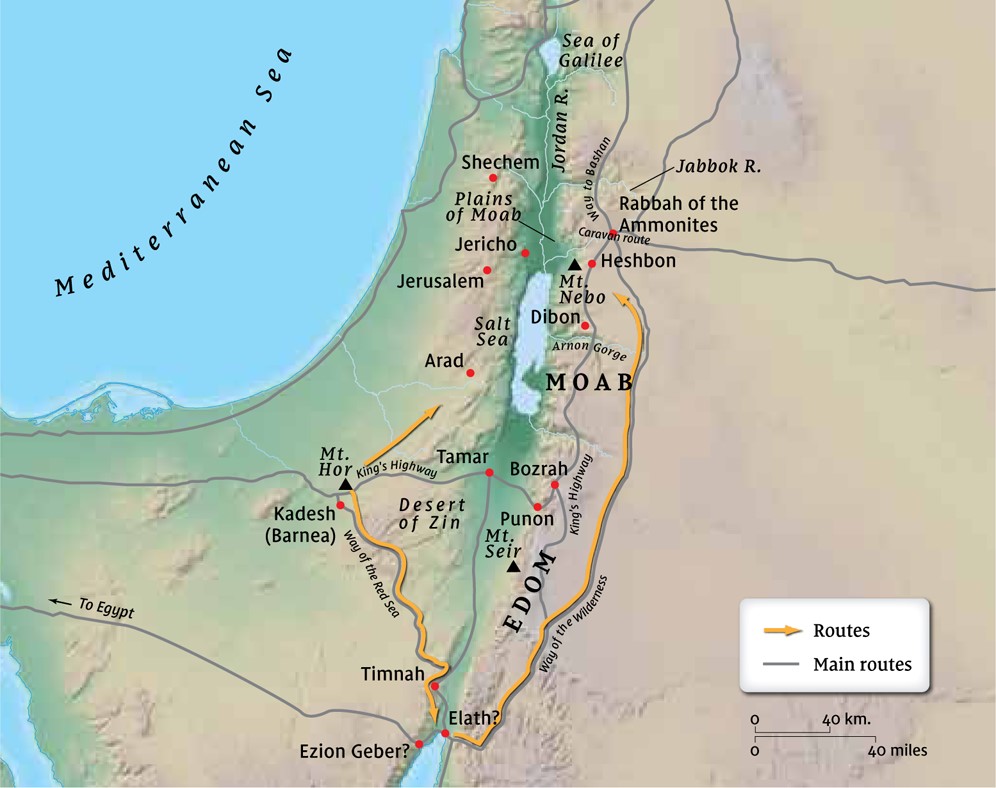
4 From Mount Hor they set out by the way to the Red Sea, to go around the land of Edom. And the people became impatient on the way. 5 And the people spoke against God and against Moses, “Why have you brought us up out of Egypt to die in the wilderness? For there is no food and no water, and we loathe this worthless food.” 6 Then the Lord sent fiery serpents among the people, and they bit the people, so that many people of Israel died. 7 And the people came to Moses and said, “We have sinned, for we have spoken against the Lord and against you. Pray to the Lord, that he take away the serpents from us.” So Moses prayed for the people. 8 And the Lord said to Moses, “Make a fiery serpent and set it on a pole, and everyone who is bitten, when he sees it, shall live.” 9 So Moses made a bronze serpent and set it on a pole. And if a serpent bit anyone, he would look at the bronze serpent and live. – Numbers 21:1-9 ESV

One of the things the Israelites seemed to quickly forget was that their presence in the wilderness was their own fault. God had led them from Egypt to the edge of the land of promise 40 years earlier, but they had decided that entrance into the land was way too risky. The 12 spies they had sent in to reconnoiter the land had returned with a conflicting report concerning conditions in Canaan.

“We entered the land you sent us to explore, and it is indeed a bountiful country—a land flowing with milk and honey. Here is the kind of fruit it produces. But the people living there are powerful, and their towns are large and fortified. We even saw giants there, the descendants of Anak!” – Numbers 13:27-28 ESV

The second half of their report left the Israelites dejected and demoralized. Despite the news that this land was fertile and filled with abundant fruit, the presence of “giants” was too much for the Israelites, and the spies fed their doubts and anxieties by confirming their worst fears.

“We can’t go up against them! They are stronger than we are!” So they spread this bad report about the land among the Israelites: “The land we traveled through and explored will devour anyone who goes to live there. All the people we saw were huge. We even saw giants there, the descendants of Anak. Next to them we felt like grasshoppers, and that’s what they thought, too!” – Numbers 13:31-33 ESV

These rumors succeeded in convincing the Israelites that God’s promise of victory over their enemies was impossible. Rather than enter the land and risk certain death, they decided it would make more sense to return to Egypt. This bit of twisted logic earned them the wrath of God. He made the fateful decision to allow that entire generation to spend the rest of their lives wandering aimlessly in the wilderness until none of them was left. They would not be allowed to enter Canaan or return to Egypt. Instead, they would spend the remaining days of their lives in a kind of existential limbo that lasted four decades.

During that time, both Miriam and Aaron died. Many of their friends and family members succumbed to the effects of old age and illness, and they all discovered that life in the wilderness was no picnic. Their persistent presence near the borders of Canaan had attracted the attention of the land’s occupants. These nations had heard the rumors about this massive host of people who had escaped from Egypt and were headed their way. It is likely that they knew the Israelites to be the descendants of Jacob and were afraid that they would be looking for a place to live. This was a migrant problem of epic proportions. The thought of two million-plus Israelites invading their borders caused these nations to react with fear and brute force.

The last chapter revealed that the Edomites sent a large army to dissuade the Israelites from attempting to pass through their land; they wanted nothing to do with them. Now, “The Canaanite king of Arad, who lived in the Negev, heard that the Israelites were approaching on the road through Atharim. So he attacked the Israelites and took some of them as prisoners” (Numbers 21:2 NLT). Nothing was going well for the Israelites. As a nation, they were persona non grata in Canaan. They had no homeland and were even finding the nations outside the borders of Canaan to be just as dangerous as the “giants“ they had refused to confront. Their refusal to enter the land had come with serious repercussions.

Yet, there is one glimmer of hope in this dark period of Israel’s existence. Their self-inflicted troubles caused them to call out to God. When some of their people were captured by the forces of the king of Arad, the Israelites begged God to come to their aid. What’s interesting to note is that these are the very same people who had seen their odds of defeating the occupants of Canaan as insurmountable, yet they were suddenly ready to take on all comers. They even made a vow to completely annihilate the opposition if God would come to their aid.

“If you will hand these people over to us, we will completely destroy all their towns.” – Numbers 21:2 NLT

What makes this even more fascinating is that the Israelites had been here before. Thirty-eight years earlier, after having refused to enter the land of Canaan the first time, God had sentenced them to a life of wandering in the wilderness. In response to this death sentence from God, they quickly changed their minds and decided to enter the land after all. But Moses warned them that it was too late.

“Why are you now disobeying the Lord’s orders to return to the wilderness? It won’t work. Do not go up into the land now. You will only be crushed by your enemies because the Lord is not with you. When you face the Amalekites and Canaanites in battle, you will be slaughtered. The Lord will abandon you because you have abandoned the Lord.” – Numbers 14:41-43 NLT

But the people refused to listen, and “defiantly pushed ahead toward the hill country, even though neither Moses nor the Ark of the Lord’s Covenant left the camp” (Numbers 14:44 NLT). The result was a rout. The Israelites were soundly defeated because they attempted to take on their enemies without God’s permission or help.

Now, 38 years later, they decided to seek God’s assistance, and He “heard the Israelites’ request and gave them victory over the Canaanites. The Israelites completely destroyed them and their towns” (Numbers 22:3 NLT). Amazingly, what they had feared was impossible four decades earlier, was actually quite easy when they did it God’s way. Their victory was assured when they chose to seek God’s permission and assistance.

But even after that exhilarating display of God’s power, they quickly reverted to their old habit of complaining about their lot in life. While they had enjoyed a great victory, they were not allowed to occupy the towns they had conquered. Instead, they had to backtrack to Mount Hor and then travel further south and east to skirt the borders of Edom. They had gotten a taste of success, but still found themselves cursed to wander through the wilderness. Those conquered cities and villages were not theirs to occupy.

As the people made the long trek around Edom, the thrill of victory soon gave way to the agony of defeat and despair.

…the people grew impatient with the long journey, and they began to speak against God and Moses. “Why have you brought us out of Egypt to die here in the wilderness?” they complained. “There is nothing to eat here and nothing to drink. And we hate this horrible manna!” – Numbers 21:4-5 NLT

Even though they had brought all of this on themselves, they were still adept at casting blame on others. Their seemingly neverending trek through the wilderness soon led to discontentment with God’s will. They were unhappy with the way things were going and they let Moses know about it. But in response to their complaining, God let them have it. He sent a plague of poisonous snakes among them, and soon the bodies of the dead began to pile up. Suddenly, the people were singing a different tune.

“We have sinned by speaking against the Lord and against you. Pray that the Lord will take away the snakes.” – Numbers 21:7 NLT

God’s judgment produced a confession. The people repented of their sin and begged Moses to intercede with God on their behalf, asking for the removal of the curse of the snakes. When Moses complied and sought God, he was given the following instructions.

“Make a replica of a poisonous snake and attach it to a pole. All who are bitten will live if they simply look at it!” – Numbers 21:8 NLT

This rather strange command makes it appear as if God was asking Moses to make an idol. But the serpent on a stick was not meant to be worshiped;. it was intended to be a test of their faith.

God did not answer their request to eradicate the snakes. In fact, He indicated that the snakes would continue to do what He had sent them to do. They would keep inflicting pain, suffering, and death upon the Israelites as punishment for their ingratitude and their disregard for His holiness. What God did was create a rather bizarre plan for receiving deliverance over certain death. The snakes were sent from God as punishment for Israel’s sin. Their bite produced death, and the only way to escape that outcome was to look at the image of the serpent on the pole and they would be healed. But that simple glance would require faith.

God did not remove the penalty for their sins; they would still be bitten by the snakes. But now they had a means of escaping the penalty of death. The bite of the snakes would no longer prove deadly but only if the victim displayed faith in God. They were required to believe that the God they had offended could and would heal them. But that faith required the one who had been bitten to look their death sentence in the face. They had to turn their eyes to the pole and see their condemnation on public display. If they refused, they would die.

The apostle John would later record the words of Jesus where He stated that this entire scene in the wilderness was meant to foreshadow His coming and His substitutionary death on the cross.

…the Son of Man has come down from heaven. And as Moses lifted up the bronze snake on a pole in the wilderness, so the Son of Man must be lifted up, so that everyone who believes in him will have eternal life. – John 3:13-15 NLT

When a sinner looks at the cross, he sees the wrath of God poured out on the sins of mankind. Jesus was not the cause of our death but the means of our victory over it. He bore our sins so that we might not have to pay for them with our own lives. And that is exactly what the apostle Paul told the believers in Corinth.

God made Him who knew no sin to be sin on our behalf, so that in Him we might become the righteousness of God. – 2 Corinthians 5:21 BSB

And Peter would state the same blessed hope.

He himself bore our sins in his body on the tree, that we might die to sin and live to righteousness. By his wounds you have been healed. – 1 Peter 2:24 ESV

The key to victory over death is faith. One must “believe in Him” to be saved. The Israelites had only to look at the serpent on the pole to be saved from death. This scene in the wilderness foreshadowed the death of Christ, when He gave His life as a payment for the sins of humanity. The apostle Paul described the universal nature of mankind’s sin problem.

For we have already charged that all, both Jews and Greeks, are under sin, as it is written: “None is righteous, no, not one…” – Romans 3:9-10 ESV

…all have sinned and fall short of the glory of God. – Romans 3:23 ESV

Paul also declared that “the wages of sin is death” (Romans 6:23 ESV). Every Israelite deserved to be bitten and every sinful human being deserves God’s penalty of death. As the sovereign God of the universe, Hee is just and right when He punishes those who rebel against His authority. But in His mercy and grace, He provided a way for all those under the penalty of death to escape their sentence by looking to the cross of Christ. That simple act of faith produces life rather than death.

It should be noted that this entire scene began with the people complaining about the manna that God had graciously given as a source of life. Their ingratitude was met with God’s judgment. They had refused His offer of the bread that could sustain life and, as a result, they faced the sting of death. The only means of salvation would be faith in His mercy and grace.

“The bread is a picture of Jesus; as the Bread of Heaven he is the proper nourisher of his people. The bronze snake is a picture of Jesus, who became sin for us as he hung on that awful tree. The manna had to be eaten. The snake had to be seen. The commands of Scripture are for doing. The manna was no good if left to rot. The metal snake would not avail if none looked at it. The manna and the snake are twin aspects of the grace of God.” – Ronald B. Allen, “Numbers.” In Genesis—Numbers. Vol. 2 of The Expositor’s Bible Commentary

The anecdote to the Israelite’s death sentence was simple: Look and live. If they would only trust God and cast their eyes upon the bronze serpent, they would experience God’s mercy and grace. As long as they looked at their wound, they would die. If they attempted to heal themselves, they would fail. But if they would face their sin and trust that only God could save them, their lives would be spared. What an amazing picture of God’s gracious gift of eternal life made possible through His Son.

For the wages of sin is death, but the free gift of God is eternal life in Christ Jesus our Lord. – Romans 6:23 ESV

English Standard Version (ESV) The Holy Bible, English Standard Version. ESV® Permanent Text Edition® (2016). Copyright © 2001

New Living Translation (NLT) Holy Bible, New Living Translation, copyright © 1996, 2004, 2015 by Tyndale House Foundation. Used by permission of Tyndale House Publishers Inc., Carol Stream, Illinois 60188. All rights reserved.

Our Gracious God

1 Now the Lord spoke to Moses and to Aaron, saying, 2 “This is the statute of the law that the Lord has commanded: Tell the people of Israel to bring you a red heifer without defect, in which there is no blemish, and on which a yoke has never come. 3 And you shall give it to Eleazar the priest, and it shall be taken outside the camp and slaughtered before him. 4 And Eleazar the priest shall take some of its blood with his finger, and sprinkle some of its blood toward the front of the tent of meeting seven times. 5 And the heifer shall be burned in his sight. Its skin, its flesh, and its blood, with its dung, shall be burned. 6 And the priest shall take cedarwood and hyssop and scarlet yarn, and throw them into the fire burning the heifer. 7 Then the priest shall wash his clothes and bathe his body in water, and afterward he may come into the camp. But the priest shall be unclean until evening. 8 The one who burns the heifer shall wash his clothes in water and bathe his body in water and shall be unclean until evening. 9 And a man who is clean shall gather up the ashes of the heifer and deposit them outside the camp in a clean place. And they shall be kept for the water for impurity for the congregation of the people of Israel; it is a sin offering. 10 And the one who gathers the ashes of the heifer shall wash his clothes and be unclean until evening. And this shall be a perpetual statute for the people of Israel, and for the stranger who sojourns among them. – Numbers 19:1-10 ESV

One of the things to keep in mind when reading these verses is the recent judgment that God had enacted upon the people of God. As a result of Korah’s rebellion, nearly 15,000 Israelites died from a plague that God had sent among the people. This large-scale pandemic had left the survivors with a massive clean-up task. The bodies of the fallen had to be gathered and properly buried, which rendered unclean all those who participated in the operation. Having come into contact with the bodies of the dead, these individuals would have been considered defiled and in need of purification, and God had already provided clear instructions regarding the treatment of the unclean.

“Command the people of Israel that they put out of the camp everyone who is leprous or has a discharge and everyone who is unclean through contact with the dead. You shall put out both male and female, putting them outside the camp, that they may not defile their camp, in the midst of which I dwell.” And the people of Israel did so, and put them outside the camp; as the Lord said to Moses, so the people of Israel did. – Numbers 5:2-4 ESV

Due to the sheer number of volunteers necessary to dispose of nearly 15,000 corpses, the Israelites would have needed a tent city to house all those who had become defiled and ceremonially unclean. So, God instituted a new command that would bring a quick resolution to the problem.

“Tell the people of Israel to bring you a red heifer, a perfect animal that has no defects and has never been yoked to a plow. Give it to Eleazar the priest, and it will be taken outside the camp and slaughtered in his presence. Eleazar will take some of its blood on his finger and sprinkle it seven times toward the front of the Tabernacle.” – Numbers 19:2-4 NLT

This was to be a corporate endeavor, with the entire congregation participating, whether they were personally unclean or not. They were to choose a red heifer that was free from defects and had never been used to pull a plow. This means it would have been a highly valuable animal in the prime of health; they were not free to bring a maimed or diseased heifer. There was no option to offer an older, less valuable animal or one that was worn out by a lifetime of hard work. This sacrifice was going to cost them something.

The whole point of this ceremony was to protect the holiness of the Tabernacle. The deaths of the rebels would have ended up defiling the entire congregation, and their defilement posed a very real and present danger to the holiness of the Tabernacle itself. But the death of the heifer was not meant for atonement. In other words, its death was not intended to provide cleansing from sin but to purify from defilement.

Notice the detailed instructions God provided for Aaron. First, the animal was to be slaughtered and some of its blood was to be used for purification.

Eleazar will take some of its blood on his finger and sprinkle it seven times toward the front of the Tabernacle. – Numbers 19:4 NLT

Eleazar was one of the four sons of Aaron and served as a priest alongside his father and brothers. His job was to supervise the entire process, ensuring that the remains of the heifer were taken outside the camp and burned. As the body was cremated, Eleazar was to add a stick of cedar, a hyssop branch, and some scarlet yarn.

“Cedar wood was not as subject to decay as most other woods and so represented the continuance of life. It was also aromatic when burnt and was probably either the common brown-berried cedar or the Phoenician juniper. Hyssop stood for purification from corruption, and the priests used it to apply blood, as in the Passover ritual. Scarlet wool symbolized the strong vital energy connected with blood (cf. Lev. 14:6). All of these elements combined to signify all that strengthened life. The person in charge added these elements to the heifer ashes as the heifer was burning.” – Thomas L. Constable, Notes on Numbers

The leftover ashes were to be collected and kept in a specific location outside the camp. All those involved in the sacrifice of the heifer were required to go through a special purification process before they could return to the camp. The ashes were to be maintained for the future purification of any who became defiled through contact with the dead; the ashes were to be mixed with water and used as a purifying agent. The death of the innocent and unblemished heifer was required for the cleansing properties of the water to be effective. The ashes mixed with water would provide purification from defilement and restore the guilty to a state of holiness. They could once again enter the camp and enjoy access to the Tabernacle and all the rites associated with it.

While all the imagery in this passage is difficult for us to understand, and the burning of the red heifer seems rather strange to our modern sensibilities, the entire process provides a beautiful illustration of God’s patience, grace, and mercy. Even after all that the Israelites had done to offend Him, God provided a means for the guilty to receive forgiveness and the unclean to be purified from the devastating effects of sin and death. Korah’s rebellion had been a direct attack on God’s sovereignty, and the perpetrators had suffered the ultimate consequence for their efforts: Death. Their actions had not only left the people of Israel with a massive clean-up effort but also the problem of how to deal with a community-wide defilement. Sin always has consequences; it impacts and infects far more than the guilty party. Rectifying the negative ramifications of Korah’s actions was going to take time and would require the efforts of the entire community. But the very one whom Korah and his cohorts had chosen to disobey was the one who graciously provided a path to purification and restoration for the people of Israel. God intervened, yet again.

English Standard Version (ESV) The Holy Bible, English Standard Version. ESV® Permanent Text Edition® (2016). Copyright © 2001

New Living Translation (NLT) Holy Bible, New Living Translation, copyright © 1996, 2004, 2015 by Tyndale House Foundation. Used by permission of Tyndale House Publishers Inc., Carol Stream, Illinois 60188. All rights reserved.

Misunderstand God’s Ways Leads to Misjudging His Character

1 The Lord spoke to Moses, saying, 2 “Speak to the people of Israel, and get from them staffs, one for each fathers’ house, from all their chiefs according to their fathers’ houses, twelve staffs. Write each man’s name on his staff, 3 and write Aaron’s name on the staff of Levi. For there shall be one staff for the head of each fathers’ house. 4 Then you shall deposit them in the tent of meeting before the testimony, where I meet with you. 5 And the staff of the man whom I choose shall sprout. Thus I will make to cease from me the grumblings of the people of Israel, which they grumble against you.” 6 Moses spoke to the people of Israel. And all their chiefs gave him staffs, one for each chief, according to their fathers’ houses, twelve staffs. And the staff of Aaron was among their staffs. 7 And Moses deposited the staffs before the Lord in the tent of the testimony.

8 On the next day Moses went into the tent of the testimony, and behold, the staff of Aaron for the house of Levi had sprouted and put forth buds and produced blossoms, and it bore ripe almonds. 9 Then Moses brought out all the staffs from before the Lord to all the people of Israel. And they looked, and each man took his staff. 10 And the Lord said to Moses, “Put back the staff of Aaron before the testimony, to be kept as a sign for the rebels, that you may make an end of their grumblings against me, lest they die.” 11 Thus did Moses; as the Lord commanded him, so he did.

12 And the people of Israel said to Moses, “Behold, we perish, we are undone, we are all undone. 13 Everyone who comes near, who comes near to the tabernacle of the Lord, shall die. Are we all to perish?” – Numbers 17:1-13 ESV

The Israelites had proven themselves to be all-star professional whiners who could grumble with the best of them. Repeatedly, since the day they left Egypt, they had found reasons to complain – about everything from the food God provided to the leadership He had placed over them. Most recently, it had been God’s decision to have only the Levites serve as priests in the Tabernacle that had left them disgruntled and ready to voice their displeasure. God had given the tribe of Levi the sole responsibility of serving in the place of the first-born males of every tribe. The Levites had been divinely chosen to serve as substitutes.

But the people had decided they didn’t like this plan. Under the leadership of Korah and a few other leaders, the people had risen up against Moses and Aaron, demanding their version of equality and inclusion, but their demands were met with the discipline of God. He destroyed all those who instigated the rebellion against Moses and Aaron and then brought a plague against those who blamed Moses and Aaron for the deaths of their friends. Only the quick action of Aaron, who offered an atoning sacrifice for the people, spared even more from death that day.

In light of all the complaining, God came up with a plan to settle the matter once and for all. He knew the people were far from done, and it was just a matter of time before something else stirred them up and caused them to question His will and grumble against His chosen leaders. So, God instructed Moses to have each tribe select a branch from an almond tree and inscribe on it the name of the prince or head of their tribe. These 12 rods were then to be placed in the Tabernacle before the Lord.

The people agreed to God’s proposal and each tribe submitted their staff to Moses. He placed each of them in the Holy of Holies before the Ark of the Covenant. The next day, Moses went in and discovered that the rod bearing Aaron’s name had budded, blossomed, and borne fruit. Miraculously, Aaron’s rod had gone through an entire growing season overnight. Devoid of water and the benefits of the tree from which it had been taken, this one rod evidenced a supernatural capacity for fruitfulness. This amazing visual display was intended to convince the Israelites that God had selected Aaron and his sons to serve Him as priests – case closed. There was no more reason for the people to question or complain because God had settled the dispute once and for all.

Or maybe not. Immediately after this event, the people cranked up their complaining once again. This time it was about their physical well-being. They said, “We are as good as dead. Everyone who even comes close to the Tabernacle of the LORD dies. We are all doomed!” (Numbers 17:12-13 NLT). Instead of praising God for what He had done with the almond rod, they focused their attention on their own well-being. They were so busy pitying themselves, that they had no time to think about God’s miraculous demonstration of power and His clear endorsement of Aaron and his sons.

God’s divine display had been intended to settle the leadership dispute. He had unquestionably reaffirmed His selection of the Aaronic priesthood. He even commanded that the rod be placed alongside the Ark of the Covenant as a permanent reminder of Aaron’s selection. God had spoken and the matter was settled. His will was not up for debate and He expected His commands to be obeyed at all times.

But the people saw His actions as a statement of judgment and feared further retribution from God. They had just witnessed the earth open up and swallow the families of Korah, Dathan, and Abiram. Then they stood back and watched as the fire of the Lord consumed the 250 leaders who had joined in the rebellion. Finally, they had seen 14,700 of their fellow Israelites die from the plague that God had sent upon them.

So, they viewed the budding of Aaron’s rod as a further indictment of their guilt and reacted with fear.

“Look, we are doomed! We are dead! We are ruined! Everyone who even comes close to the Tabernacle of the Lord dies. Are we all doomed to die?” – Numbers 17:12-13 NLT

Rather than glorying in the greatness of God, they cowered in fear. Instead of repenting for their rebellion against Him, they accused Him of being a vengeful, bloodthirsty deity. They displayed no remorse. They exhibited no signs of sorrow for their sins. They simply expressed their fear of God’s judgment and wrath. After all the time they had spent in His presence, enjoying His power and provision, they still had no idea who He was and how they were to respond to Him. Centuries later, the psalmist would record God’s assessment of this generation of Israelites.

“For forty years I loathed that generation
    and said, ‘They are a people who go astray in their heart,
    and they have not known my ways.’” – Psalm 95:10 ESV

The author of The Letter to the Hebrews quoted this very passage when writing to his audience of Jewish converts to Christianity, and he followed it up with this admonition:

Take care, brothers, lest there be in any of you an evil, unbelieving heart, leading you to fall away from the living God. But exhort one another every day, as long as it is called “today,” that none of you may be hardened by the deceitfulness of sin. – Hebrews 3:12-13 ESV

Even this New Testament congregation of Jewish believers was struggling with disbelief and doubt. Having placed their faith in Jesus as their Messiah, they were beginning to have second thoughts because their lot in life had not improved. Living outside the land of Israel and surrounded by pagan Gentiles, these Jewish Christians were in the minority and even despised by their fellow Hebrews. Their decision to follow Christ had left them ostracized by their own people and questioning the validity of the gospel message they had so eagerly embraced. Their difficult circumstances caused them to question the validity of Jesus’ Messiahship and tempted them to return to Judaism and the Mosaic Law.

But isn’t that what we do? We can get so consumed by dissatisfaction over our lot in life that we fail to see the miracles of God taking place all around us. We whine and moan, and spend all our time grumbling to God that we become blind to His goodness and greatness. Yet God patiently endures our rejection of Him and continues to shower us with His grace and unmerited favor.

The author of Hebrews encouraged his readers to remain committed to Christ, their Messiah.

For we have come to share in Christ, if indeed we hold our original confidence firm to the end. – Hebrews 3:14 ESV

Rather than return to life under the Law, he wanted them to keep their eyes on the One who had set them free trying to earn their way into God’s good graces. Jesus had come to provide them with access to God’s presence through the effort of His saving work, not their own. Jesus had died for their sins so that they might enjoy full forgiveness and a restored relationship with God. This incredible gift of grace, made available by God through the death and resurrection of Jesus, was to become the focus of their lives. They no longer needed to fear God and there was no need to look to the Law as a way of earning His favor. Everything they needed had been provided by Jesus.

…let us also lay aside every weight, and sin which clings so closely, and let us run with endurance the race that is set before us, looking to Jesus, the founder and perfecter of our faith, who for the joy that was set before him endured the cross, despising the shame, and is seated at the right hand of the throne of God. – Hebrews 12:1-2 ESV

The Israelites had sinned against God but had also been graciously spared. But rather than rejoice in His mercy, they feared His retribution. They had rejected His will and now, they failed to understand His ways. Because they had sinned, they expected judgment. Yet the budding of Aaron’s rod was less an indictment of their sin than it was a confirmation of God’s will. He wanted them to trust Him. His ways were righteous, just, and worthy of their obedience.

They had turned their backs on God but He had not abandoned them. The guilty had suffered the just and righteous penalty for their sins. But the vast majority of the Israelites had graciously been granted the mercy of God. Yet, they couldn’t fathom what God was doing. Rather than rejoice in His forgiveness, they expressed their fear of pending judgment. Despite all God had done, they remained ignorant of His ways and distrustful of His goodness.

The truth is, as God’s people, we still turn our back on Him, but He never abandons us. He disciplines us, but He never stops loving us. He is faithful, even when we are unfaithful. He provides us with leadership, direction, sustenance, and everything we need to survive in this hostile and sin-prone world. Yet we continually misunderstand His ways and misjudge His character. Worse yet, we end up fearing Him rather than basking in the love He pours out on us. Like the Israelites, we live as if God is out to get us, not to bless us. We view Him as a cosmic killjoy, not a loving Father who wants to meet our every need in Christ.

Sin is ultimately self-centered; it always has been. It ends up being all about me, and when I constantly focus on myself, I tend to lose sight of Him. If I’m not careful, that myopic, me-centered perspective will lead me to mischaracterize God and miss out on the joy of His blessings, just like the Israelites did.

“We are bound to die! We perish, we all perish! Anyone who even comes close to the tabernacle of the Lord will die! Are we all to die?” – Numbers 17:12-13 NLT

English Standard Version (ESV) The Holy Bible, English Standard Version. ESV® Permanent Text Edition® (2016). Copyright © 2001

New Living Translation (NLT) Holy Bible, New Living Translation, copyright © 1996, 2004, 2015 by Tyndale House Foundation. Used by permission of Tyndale House Publishers Inc., Carol Stream, Illinois 60188. All rights reserved.

Redemption in the Face of Rebellion

36 Then the Lord spoke to Moses, saying, 37 “Tell Eleazar the son of Aaron the priest to take up the censers out of the blaze. Then scatter the fire far and wide, for they have become holy. 38 As for the censers of these men who have sinned at the cost of their lives, let them be made into hammered plates as a covering for the altar, for they offered them before the Lord, and they became holy. Thus they shall be a sign to the people of Israel.” 39 So Eleazar the priest took the bronze censers, which those who were burned had offered, and they were hammered out as a covering for the altar, 40 to be a reminder to the people of Israel, so that no outsider, who is not of the descendants of Aaron, should draw near to burn incense before the Lord, lest he become like Korah and his company—as the Lord said to him through Moses.

41 But on the next day all the congregation of the people of Israel grumbled against Moses and against Aaron, saying, “You have killed the people of the Lord.” 42 And when the congregation had assembled against Moses and against Aaron, they turned toward the tent of meeting. And behold, the cloud covered it, and the glory of the Lord appeared. 43 And Moses and Aaron came to the front of the tent of meeting, 44 and the Lord spoke to Moses, saying, 45 “Get away from the midst of this congregation, that I may consume them in a moment.” And they fell on their faces. 46 And Moses said to Aaron, “Take your censer, and put fire on it from off the altar and lay incense on it and carry it quickly to the congregation and make atonement for them, for wrath has gone out from the Lord; the plague has begun.” 47 So Aaron took it as Moses said and ran into the midst of the assembly. And behold, the plague had already begun among the people. And he put on the incense and made atonement for the people. 48 And he stood between the dead and the living, and the plague was stopped. 49 Now those who died in the plague were 14,700, besides those who died in the affair of Korah. 50 And Aaron returned to Moses at the entrance of the tent of meeting, when the plague was stopped. – Numbers 16:36-50 ESV

God cleaned house. He purged the wickedness from the midst of the camp of Israel by swallowing the households of Korah, Dathan, and Abiram. Then He consumed the 250 co-conspirators with fire as they attempted to offer unacceptable sacrifices to Him. When the smoke had lifted, all that was left were their bronze censers lying among the ashes with their charred bones.

This macabre scene was the result of a test that Moses had arranged to determine who among the Israelites was truly holy to the Lord.

“Korah, you and all your followers must prepare your incense burners. Light fires in them tomorrow, and burn incense before the Lord. Then we will see whom the Lord chooses as his holy one.” – Numbers 16:6-7 NLT

God had declared the outcome of the test in no uncertain terms; the guilty and unholy had been punished. Yet, their destruction produced a rather strange result. The incense burners these rebels had been carrying at the time of their destruction had been purified in the process. The Lord ordered Moses to have them gathered and hammered into a covering for the altar.

“Tell Eleazar son of Aaron the priest to pull all the incense burners from the fire, for they are holy. Also tell him to scatter the burning coals. Take the incense burners of these men who have sinned at the cost of their lives, and hammer the metal into a thin sheet to overlay the altar. Since these burners were used in the Lord’s presence, they have become holy. Let them serve as a warning to the people of Israel.” – Numbers 16:37-38 NLT

Those men had presented their censers filled with burning incense to the Lord, but He had consumed them with flames because they were guilty of rebelling against Him. But because their incense burners had been presented to God, they had become holy or set apart for His use.

“As we think about the notion of the ‘holy,’ we recognize that things are made holy in Scripture, not because people are holy, but because the things are presented to the Lord, who is holy. Since these wicked men presented their censers to the Lord, the censers are holy, despite the men’s own wickedness.” – Ronald B. Allen, “Numbers.” In Genesis—Numbers. Vol. 2 of The Expositor’s Bible Commentary

This entire story provides a powerful reminder of the ever-present danger of doubt in the life of the follower of God. Doubt has a way of turning into disobedience, and disobedience against God is nothing more than rebellion against His Word and His will.

In chapter eight of Numbers, this pattern was lived out in the lives of Korah, Dathan, Abiram, and On. These men were descendants of Levi and, as such, they were responsible for the care and upkeep of the tabernacle of God. God had set them apart as His servants and their jobs were essential to the spiritual well-being of the people of Israel. However, they were dissatisfied with God’s plan and wanted to debate His distribution of roles and responsibilities; they wanted more authority and a recognition of their own importance.

“You take too much upon yourselves, seeing that the whole community is holy, every one of them, and the Lord is among them. Why then do you exalt yourselves above the community of the Lord?” – Numbers 16:3 NLT

Korah’s thinly veiled expression of care for the entire community was nothing more than a ruse to cover his own desire for a greater role in the affairs of Israel. He and his companions aspired to supplant Moses and Aaron as the designated leaders of the nation. In their estimation, those two men were no better than they were. As citizens of the nation of Israel and members of the tribe of Levi, they felt they were just as qualified for leadership as Moses and his brother.

They doubted God’s order of things and demanded a restructuring of responsibilities and duties. Like Miriam in chapter 12, these men expressed their doubt in God’s preordained order of things and it led to their open disobedience and rebellion.

As a holy, righteous King, God was unwilling to tolerate the blatant actions of these men. While the actions of Korah, Dathan, and Abiram were more pronounced and worthy of God’s wrath, the truth is that the entire congregation was guilty of turning against God. They had allowed the inflammatory words of Korah to sway their thinking and turn them against Moses and Aaron.

Korah assembled the whole community against them at the entrance of the tent of meeting… – Numbers 16:19 NLT

In response to this open display of communal solidarity and insurrection, God swore to pour out His divine judgment, telling Moses, “Separate yourselves from among this community, that I may consume them in an instant” (Numbers 16:21 NLT). But Moses and Aaron interceded and begged God to spare the congregation and punish only the ring leaders. Yet God would not tolerate rebellion among His people because He knew it was like cancer that, if left unchecked, would spread and infect the entire community. So He set out to eradicate it but, in keeping with Moses’ request, He chose to spare the people.

But despite Moses’ intercession and God’s gracious acquittal of the people, the text reveals that “on the next day all the congregation of the people of Israel grumbled against Moses and against Aaron, saying, ‘You have killed the people of the Lord’” (Numbers 16:41 ESV). Unwilling to express gratitude for God’s sparing of their lives, they once again display their ignorance of God’s ways. Refusing to believe that the previous day’s events had been God’s will, they openly rebelled against God’s representatives and accused them of murder.

Once again, God warned Moses and Aaron to separate themselves from the people because He was about to destroy them. But Moses interceded yet again, telling Aaron to take his censer and “carry it quickly to the congregation and make atonement for them, for wrath has gone out from the Lord; the plague has begun” (Numbers 16:36 ESV).

The judgment of God had already begun, and Moses’ quick thinking and Aarons’ immediate response spared the lives of many. Despite the brothers’ rapid response, 14,700 people died that day – at the hand of God. Yet, the number would have been much higher had Moses and Aaron not taken immediate steps to intercede. The rebellion of the people had been a sin against God, and only the atoning work of Aaron, the high priest, had been able to satisfy the righteous judgment of God against them.

Doubt is inevitable and, if left unchecked, it will always result in disobedience and rebellion against God. Mankind is prone to unfaithfulness, even those who call themselves followers of God. Disobedience is in our nature and the risk of rebellion is a constant threat for each of us.

In the gospel of Luke, there is another story of the people of God rebelling against the will of God. He had sent His Son as the Savior of the world but Jesus didn’t come in the form the Israelites had expected. He failed to measure up to the standards they had set for their long-awaited Messiah. Rather than appearing as a conquering king on a white horse leading a powerful army, Jesus had shown up as a carpenter from the small hamlet of Nazareth, accompanied by a rag-tag group of disciples. Instead of revering Jesus as their long-awaited Messiah, the religious leaders of Israel responded with revulsion. As His popularity spread, their desire to eliminate Him grew stronger; they longed to rid themselves of His presence. Eventually, they had Him arrested and dragged before Pilate, the Roman governor. Their goal was to convince Pilate that Jesus was a potential threat to Roman rule by portraying Him as an insurrectionist and troublemaker. Their hope was for a speedy trial and the execution of this upstart Rabbi from Nazareth. But much to their surprise and disappointment, Pilate found Jesus to be innocent of any wrongdoing. He tried repeatedly to release Him, but the Jewish leaders convinced the people to demand His crucifixion. Out of fear that the people would stage a riot, Pilate gave in to their demands.

Their doubt led to disobedience, which resulted in rebellion, and led to the death of the One whom God had sent. They doubted God’s Word and rejected His will. Writing more than 750 years before the events of the crucifixion, the prophet Isaiah predicted, “But he was pierced for our rebellion, crushed for our sins. He was beaten so we could be whole. He was whipped so we could be healed” (Isaiah 53:5 NLT).

God sent His Son to deal with the rebellion of mankind. Yet, Jesus did not come to pour out the wrath of His Father on sinful humanity. In fact, He declared, “I did not come to judge the world but to save the world” (John 12:47 ESV). His incarnation was the first step in God’s grand redemptive plan to restore humanity to a right relationship with Himself. Jesus provided a means by which sinful men and women could be healed and made whole. He paid the debt that humanity’s sin had incurred. He suffered the death that was the penalty for mankind’s rebellion against His Father. He took on the penalty for our rebellion against God.

It’s interesting to note that Aaron was able to atone for the sins of the people by taking fire from the altar of God and using it to ignite incense in a censer. The same fire that had consumed the 250 leaders who had rejected God’s will was used to atone for and spare the rebellious Israelites. An incense burner in the hand of God’s anointed was how God redeemed the unholy and undeserving. The all-consuming fire of God actually averted the deaths of tens of thousands of Israelites who had been deserving of God’s judgment. The plague was averted and the people were spared.

In much the same way, Jesus, the Son of God and the second person of the Trinity provides healing and atonement for sinful humanity. The Light of the world did not come to condemn and consume but to enlighten the darkness and provide life to those living under the penalty of death. As Jesus told the woman accused of adultery, “…neither do I condemn you,” Jesus declared. “Now go and sin no more.” Once again, Jesus spoke to the people and said, “I am the light of the world. Whoever follows Me will never walk in the darkness, but will have the light of life” (John 8:11-12 BSB).

Even in the face of man’s ongoing rebellion, God is gracious to provide a way of redemption.

English Standard Version (ESV) The Holy Bible, English Standard Version. ESV® Permanent Text Edition® (2016). Copyright © 2001

New Living Translation (NLT) Holy Bible, New Living Translation, copyright © 1996, 2004, 2015 by Tyndale House Foundation. Used by permission of Tyndale House Publishers Inc., Carol Stream, Illinois 60188. All rights reserved.

Contentiousness is Contagious and Deadly

15 And Moses was very angry and said to the Lord, “Do not respect their offering. I have not taken one donkey from them, and I have not harmed one of them.”

16 And Moses said to Korah, “Be present, you and all your company, before the Lord, you and they, and Aaron, tomorrow. 17 And let every one of you take his censer and put incense on it, and every one of you bring before the Lord his censer, 250 censers; you also, and Aaron, each his censer.” 18 So every man took his censer and put fire in them and laid incense on them and stood at the entrance of the tent of meeting with Moses and Aaron. 19 Then Korah assembled all the congregation against them at the entrance of the tent of meeting. And the glory of the Lord appeared to all the congregation.

20 And the Lord spoke to Moses and to Aaron, saying, 21 “Separate yourselves from among this congregation, that I may consume them in a moment.” 22 And they fell on their faces and said, “O God, the God of the spirits of all flesh, shall one man sin, and will you be angry with all the congregation?” 23 And the Lord spoke to Moses, saying, 24 “Say to the congregation, Get away from the dwelling of Korah, Dathan, and Abiram.”

25 Then Moses rose and went to Dathan and Abiram, and the elders of Israel followed him. 26 And he spoke to the congregation, saying, “Depart, please, from the tents of these wicked men, and touch nothing of theirs, lest you be swept away with all their sins.” 27 So they got away from the dwelling of Korah, Dathan, and Abiram. And Dathan and Abiram came out and stood at the door of their tents, together with their wives, their sons, and their little ones. 28 And Moses said, “Hereby you shall know that the Lord has sent me to do all these works, and that it has not been of my own accord. 29 If these men die as all men die, or if they are visited by the fate of all mankind, then the Lord has not sent me. 30 But if the Lord creates something new, and the ground opens its mouth and swallows them up with all that belongs to them, and they go down alive into Sheol, then you shall know that these men have despised the Lord.”

31 And as soon as he had finished speaking all these words, the ground under them split apart. 32 And the earth opened its mouth and swallowed them up, with their households and all the people who belonged to Korah and all their goods. 33 So they and all that belonged to them went down alive into Sheol, and the earth closed over them, and they perished from the midst of the assembly. 34 And all Israel who were around them fled at their cry, for they said, “Lest the earth swallow us up!” 35 And fire came out from the Lord and consumed the 250 men offering the incense. – Numbers 16:15-35 ESV

Moses displays a range of emotions in this story. First, he was shocked by the accusations of Korah and his companions. After their initial confrontation Moses literally “fell on his face” (Numbers 16:4) in dismay. But then, he rallied and challenged their audacity to question his leadership and scolded them for their misguided refusal to accept God’s will for their lives. They were unwilling to remain in their God-ordained roles and demanded more, and their brazen attitude floored Moses.

But he rallied and proposed a test. He told the malcontents to gather at the Tabernacle and bring incense to burn before the Lord. But they refused.

“We will not come up. Is it a small thing that you have brought us up out of a land flowing with milk and honey, to kill us in the wilderness, that you must also make yourself a prince over us?” – Numbers 16:12-13 ESV

Once again, these prideful men attacked Moses and accused him of leadership malpractice. They declared their unwillingness to obey his commands because he had failed to do what he had promised to do. He had been unsuccessful in gaining them entrance into the land of promise. According to them, their wilderness wanderings were all his fault.

“…you have not brought us into a land flowing with milk and honey, nor given us inheritance of fields and vineyards. Will you put out the eyes of these men? We will not come up.” – Numbers 16:14 ESV

This time, Moses responded in anger and voiced his feelings to God. He declared his innocence and pleaded for God to refuse their sacrifices. He had done nothing to deserve their harsh treatment and was offended that these men treated him with such ingratitude and distrust. But Moses rallied yet again. One more time, he challenged Korah and his cohort of priestly wannabes to come to the Tabernacle with their incense burners.

“You and all your followers must come here tomorrow and present yourselves before the Lord. Aaron will also be here. You and each of your 250 followers must prepare an incense burner and put incense on it, so you can all present them before the Lord. Aaron will also bring his incense burner.” – Numbers 16:16-17 NLT

This time, Korah and his 250 co-conspirators agreed to the challenge and showed up at the Tabernacle with their incense burners and fire in hand. This was intended to be a showdown, and the odds were not in Moses’ favor. It was Korah and his 250 followers standing opposed to Aaron, and Moses made it clear that this was going to be a test to determine who was right and who was wrong.

“Tomorrow morning the Lord will show us who belongs to him and who is holy. The Lord will allow only those whom he selects to enter his own presence.” – Numbers 16:5 NLT

God showed up, revealing His glory to all the people of Israel. But in the meantime, Korah had managed to turn the entire congregation against Moses and Aaron. He had spent the evening spreading rumors and riling up the rest of the community.

Meanwhile, Korah had stirred up the entire community against Moses and Aaron, and they all gathered at the Tabernacle entrance. – Numbers 16:19 NLT

So, when the Almighty appeared and saw the host standing before the Tabernacle, He told Moses and Aaron to separate themselves from the entire congregation because He was going to destroy them all. He was furious and expressed His intentions to wipe out Korah and everyone who had dared to side with him.

“Get away from all these people so that I may instantly destroy them!” – Numbers 16:21 NLT

But amazingly, Moses and Aaron stepped in and pleaded with God to show mercy.

“O God,” they pleaded, “you are the God who gives breath to all creatures. Must you be angry with all the people when only one man sins?” – Numbers 16:22 NLT

They blamed the whole affair on one person: Korah. He alone was responsible for fomenting unrest among the other leaders and the congregation, and they begged God not to punish the many for the sins of a few.

As a result of the intercession of Moses and Aaron, God instructed them to separate the people from the rest of the rebels, and Moses did as God commanded.

“Quick!” he told the people. “Get away from the tents of these wicked men, and don’t touch anything that belongs to them. If you do, you will be destroyed for their sins.” So all the people stood back from the tents of Korah, Dathan, and Abiram. – Numbers 16:26-27 NLT

As the people stood back and watched, Moses declared the conditions of the test that was about to take place. God was going to determine who was in the right.

“This is how you will know that the Lord has sent me to do all these things that I have done—for I have not done them on my own. If these men die a natural death, or if nothing unusual happens, then the Lord has not sent me. But if the Lord does something entirely new and the ground opens its mouth and swallows them and all their belongings, and they go down alive into the grave, then you will know that these men have shown contempt for the Lord.” – Numbers 16:28-30 NLT

Imagine the scene as Korah, Dathan, and Abiram stood with their burning censers in hand and their families gathered around them. While they stood waiting for God’s approval, the judgment of God fell. In a miraculous display of His power and righteous indignation, God caused the ground to open up and swallow alive every single one of the guilty individuals who had dared to question His wisdom and challenge Moses’ leadership.

The earth closed over them, and they all vanished from among the people of Israel. – Numbers 16:33 NLT

It was a shocking and disturbing scene, and the 250 leaders who had aligned themselves with Korah, Dathan, and Abiram, were forced to witness the whole affair. They stood there with their censers in hand as their former leaders disappeared from sight. At the sight of this shocking display of divine retribution, the rest of the congregation if Israel fled the scene in fear, but before the 250 co-conspirators could get far, a fire descended from heaven and consumed them. The small fires of their incense burners were no match for the purging fire of God. Their offerings of incense were anything but a sweet aroma to the Lord. He had judged their hearts, declared them guilty of sedition, and punished them accordingly.

God had cleansed the camp. He had purged His people of the sin that had begun to spread throughout their midst. In doing so, He clearly and powerfully confirmed His unwavering approval of Moses and Aaron as His appointed leaders. There would no longer be any question about who was in charge. The people had been given a stark reminder that rebellion of any kind was ultimately an attack on God’s sovereignty because Moses and Aaron acted on His behalf. Any attempt to question or overthrow their rule was a direct attack on the will of God. These men were His representatives and they were to be obeyed – at all costs.

This entire episode deals with the danger of allowing a contentious few to demand their way and disrupt and destabilize God’s household. Korah and his disgruntled band of malcontents were infecting the camp with their cries of inequity and injustice. They were questioning God’s wisdom and attempting to replace His will with their own. Dissatisfied with the status quo, they attempted to campaign among the people and garner converts for their cause, and, in doing so, they fostered instability and insubordination among God’s people.

This kind of dissension is alive and well today and can take place in any congregation. The New Testament deals with the presence of the very same problem among members of the body of Christ.

If people are causing divisions among you, give a first and second warning. After that, have nothing more to do with them. For people like that have turned away from the truth, and their own sins condemn them. – Titus 3:10-11 NLT

And now I make one more appeal, my dear brothers and sisters. Watch out for people who cause divisions and upset people’s faith by teaching things contrary to what you have been taught. Stay away from them. Such people are not serving Christ our Lord; they are serving their own personal interests. By smooth talk and glowing words they deceive innocent people. – Romans 16:17-18 NLT

The psalmist reminds us, “Behold, how good and pleasant it is when brothers dwell in unity!” (Psalm 133:1 ESV). In His high priestly prayer, Jesus asked His Heavenly Father to unify His followers, “that they may be one, even as we are one” (John 17:11 ESV). His greatest desire for His followers was that they would remain unified and reflect the very nature of the Godhead.

“I do not ask for these only, but also for those who will believe in me through their word, that they may all be one, just as you, Father, are in me, and I in you, that they also may be in us, so that the world may believe that you have sent me.” – John 17:20-21 ESV

Unity is essential for true community, and unity requires a submission to the leadership of those whom God has placed in authority over His people. Had Korah and his companions had access to the book of Hebrews, they might have thought twice about staging their ill-fated coup, sparing the people of God from judgment and saving their own lives.

Obey your spiritual leaders, and do what they say. Their work is to watch over your souls, and they are accountable to God. Give them reason to do this with joy and not with sorrow. That would certainly not be for your benefit. – Hebrews 13:17 NLT

English Standard Version (ESV) The Holy Bible, English Standard Version. ESV® Permanent Text Edition® (2016). Copyright © 2001

New Living Translation (NLT) Holy Bible, New Living Translation, copyright © 1996, 2004, 2015 by Tyndale House Foundation. Used by permission of Tyndale House Publishers Inc., Carol Stream, Illinois 60188. All rights reserved.

Discontentment in the Camp

1 Now Korah the son of Izhar, son of Kohath, son of Levi, and Dathan and Abiram the sons of Eliab, and On the son of Peleth, sons of Reuben, took men. 2 And they rose up before Moses, with a number of the people of Israel, 250 chiefs of the congregation, chosen from the assembly, well-known men. 3 They assembled themselves together against Moses and against Aaron and said to them, “You have gone too far! For all in the congregation are holy, every one of them, and the Lord is among them. Why then do you exalt yourselves above the assembly of the Lord?” 4 When Moses heard it, he fell on his face, 5 and he said to Korah and all his company, “In the morning the Lord will show who is his, and who is holy, and will bring him near to him. The one whom he chooses he will bring near to him. 6 Do this: take censers, Korah and all his company; 7 put fire in them and put incense on them before the Lord tomorrow, and the man whom the Lord chooses shall be the holy one. You have gone too far, sons of Levi!” 8 And Moses said to Korah, “Hear now, you sons of Levi: 9 is it too small a thing for you that the God of Israel has separated you from the congregation of Israel, to bring you near to himself, to do service in the tabernacle of the Lord and to stand before the congregation to minister to them, 10 and that he has brought you near him, and all your brothers the sons of Levi with you? And would you seek the priesthood also? 11 Therefore it is against the Lord that you and all your company have gathered together. What is Aaron that you grumble against him?”

12 And Moses sent to call Dathan and Abiram the sons of Eliab, and they said, “We will not come up. 13 Is it a small thing that you have brought us up out of a land flowing with milk and honey, to kill us in the wilderness, that you must also make yourself a prince over us? 14 Moreover, you have not brought us into a land flowing with milk and honey, nor given us inheritance of fields and vineyards. Will you put out the eyes of these men? We will not come up.” – Numbers 16:1-14 ESV

The story of the Israelites’ journey through the wilderness is a fascinating one, filled with plenty of twists and turns, plot changes, and storylines. It’s easy to read this chronicle of the lives of the people of God and wonder how they could be so slow to learn. How could they refuse to obey God after all He had done for them? Why would they continue to whine, complain, and moan about their lot in life when the God of the universe was leading them, providing for them, and revealing Himself to them day after day? But the truth is, as believers, we have the Spirit of God living within us and the Word of God made available to us and yet we still struggle with obedience and belief. So, we probably shouldn’t be too quick to judge the Israelites harshly.

Yet in today’s story from chapter 16, we have another occurrence of jealousy and rebellion. It seems that Korah, a grandson of Kohath, and a member of the tribe of Levi, decided that he had every right to take part in the priestly responsibilities. As a Kohathite, he was part of the clan responsible for the transportation and care of all the vessels and utensils of the Tabernacle. They had been assigned that role by God.

“The duties of the Kohathites at the Tabernacle will relate to the most sacred objects.” – Numbers 4:4 NLT

According to God’s instructions, the Kohathites had a very specific role to play. For them to do that job, Aaron, the high priest, and his sons had to prepare all the sacred objects for transport.

“When the camp moves, Aaron and his sons must enter the Tabernacle first to take down the inner curtain and cover the Ark of the Covenant with it. Then they must cover the inner curtain with fine goatskin leather and spread over that a single piece of blue cloth. Finally, they must put the carrying poles of the Ark in place.” – Numbers 4:5-6 NLT

Every item had to be carefully prepared according to God’s painstaking instructions. If Aaron and his sons failed to do everything just as God had commanded, it would have devastating consequences for Korah and the rest of his clan.

“The camp will be ready to move when Aaron and his sons have finished covering the sanctuary and all the sacred articles. The Kohathites will come and carry these things to the next destination. But they must not touch the sacred objects, or they will die.” – Numbers 4:15 NLT

“Do not let the Kohathite clans be destroyed from among the Levites! This is what you must do so they will live and not die when they approach the most sacred objects. Aaron and his sons must always go in with them and assign a specific duty or load to each person. The Kohathites must never enter the sanctuary to look at the sacred objects for even a moment, or they will die.” – Numbers 4:18-20 NLT

All the holy objects were to be covered with cloths to prevent the Kohathites from inadvertently touching them. The larger items featured poles that were inserted into specially crafted rings that allowed the Kohathites to carry the sacred objects safely and securely without risk of death. It should have been considered an honor to carry these holy furnishings that were essential for the worship of Yahweh. Yet, we learn that Korah was not content with the God-ordained role he and his clan had been assigned. He wanted more.

Driven by jealousy and a desire for greater prominence, he enlisted the support of others, and, together, they incited a rebellion against Moses, along with 250 other leaders of the community; all “prominent members of the assembly” (Numbers 4:2 NLT). It was a coup.

Korah appealed to other men in the camp to join him in his rebellion. He stirred up members of the tribe of Reuben by getting them to see that Moses had taken away the right of the firstborn of every tribe to serve God by replacing them with the sons of Levi. His argument was that every single Israelite was holy; not just Moses, Aaron, and his sons.

He accused Moses of exalting himself above everyone else. He and his compatriots went to Moses and said, “You have gone too far! Everyone in Israel has been set apart by the LORD, and he is with all of us. What right do you have to act as though you are greater than anyone else among all these people of the LORD?” (Numbers 16:3 NLT).

Although Korah was from the tribe of Levi, he and his clan were not allowed to serve as priests, and he found this slight to be unacceptable. He viewed their God-assigned role as “moving men” to be less-than-acceptable and more than a bit demeaning.

In his defense, Korah was basing his argument on a statement given by God when the people of Israel were still in Egypt.

“Now therefore, if you will indeed obey my voice and keep my covenant, you shall be my treasured possession among all peoples, for all the earth is mine; and you shall be to me a kingdom of priests and a holy nation.” – Exodus 19:5-6 NLT

But what Korah failed to remember was that the entire nation had done irreparable damage to their holy status when they had been encamped at Mount Sinai. While Moses had been up on the mountaintop receiving the Ten Commandments from God, the people had decided to turn their back on God and worship a newly constructed golden calf (Exodus 32). And as punishment for their sin, God had given Moses orders to execute all those who had taken part in the idolatrous festivities.

So he stood at the entrance to the camp and shouted, “All of you who are on the Lord’s side, come here and join me.” And all the Levites gathered around him.

Moses told them, “This is what the Lord, the God of Israel, says: Each of you, take your swords and go back and forth from one end of the camp to the other. Kill everyone—even your brothers, friends, and neighbors.” The Levites obeyed Moses’ command, and about 3,000 people died that day. – Exodus 32:26-28 NLT

It had been the Levites who stood by Moses’ side and carried out God’s orders. As a result, Moses rewarded them for their show of faithfulness and obedience.

“Today you have ordained yourselves for the service of the Lord, for you obeyed him even though it meant killing your own sons and brothers. Today you have earned a blessing.” – Exodus 32:29 NLT

But Korah wasn’t satisfied with God’s will. He demanded that a new plan be put in place. Yet, Moses attempted to reason with his disgruntled kinsman.

“Does it seem insignificant to you that the God of Israel has chosen you from among all the community of Israel to be near him so you can serve in the Lord’s Tabernacle and stand before the people to minister to them? Korah, he has already given this special ministry to you and your fellow Levites. Are you now demanding the priesthood as well?” – Numbers 16:9-10 NLT

Moses couldn’t understand why Korah considered himself and his clansmen as second-class citizens. Why was he unable to view their God-ordained role as vital and worthy of their best efforts? And Moses tried to warn them that their complaint was really with God, not himself or Aaron.

“The Lord is the one you and your followers are really revolting against! For who is Aaron that you are complaining about him?” – Numbers 16:11 NLT

Korah was walking on thin ice. He was venturing into uncharted waters that would bring him to a far-from-pleasant destination. Moses attempted to reason with Korah’s compatriots, but they refused to listen to what he had to say.

“We refuse to come before you! Isn’t it enough that you brought us out of Egypt, a land flowing with milk and honey, to kill us here in this wilderness, and that you now treat us like your subjects? What’s more, you haven’t brought us into another land flowing with milk and honey. You haven’t given us a new homeland with fields and vineyards. Are you trying to fool these men? We will not come.” – Numbers 16:12-14 NLT

The stage was set. The lines were drawn. Korah and his disenchanted companions stood their ground and refused to heed the warnings of Moses. They were done taking orders from Moses and Aaron. As far as they were concerned, it was their time to shine and they would not be satisfied until they were the ones calling the shots.

But they failed to recognize that their complaints had reached the ears of God. He had been listening to their arrogant demands and knew that their discontentment was ultimately directed at Him. It’s interesting to note that the very people who were responsible for transporting the holy objects from the Tabernacle were carrying resentment for the very one for whom the Tabernacle had been made. They might as well have discarded the holy object on the side of the path somewhere in the wilderness. Their disrespectful and divisive treatment of God’s chosen leader was no less egregious than if they had desecrated the holy objects under their care. Korah despised his God-ordained role and coveted a spot in the limelight. But he would soon discover that his discontentment would be met with God’s disapproval.

English Standard Version (ESV) The Holy Bible, English Standard Version. ESV® Permanent Text Edition® (2016). Copyright © 2001

New Living Translation (NLT) Holy Bible, New Living Translation, copyright © 1996, 2004, 2015 by Tyndale House Foundation. Used by permission of Tyndale House Publishers Inc., Carol Stream, Illinois 60188. All rights reserved.