The Son Gives Life

19 So Jesus said to them, “Truly, truly, I say to you, the Son can do nothing of his own accord, but only what he sees the Father doing. For whatever the Father does, that the Son does likewise. 20 For the Father loves the Son and shows him all that he himself is doing. And greater works than these will he show him, so that you may marvel. 21 For as the Father raises the dead and gives them life, so also the Son gives life to whom he will. 22 For the Father judges no one, but has given all judgment to the Son, 23 that all may honor the Son, just as they honor the Father. Whoever does not honor the Son does not honor the Father who sent him. 24 Truly, truly, I say to you, whoever hears my word and believes him who sent me has eternal life. He does not come into judgment, but has passed from death to life.” John 5:19-24 ESV

John made it quite clear that the Jewish leaders took a strong exception to Jesus healing on the Sabbath. And when Jesus had deemed His actions as acceptable because He was doing the work of God, His Father, they had become infuriated.

This was why the Jews were seeking all the more to kill him, because not only was he breaking the Sabbath, but he was even calling God his own Father, making himself equal with God. – John 5:18 ESV

Now, John records Jesus’ bold response to these powerful and potentially dangerous adversaries. Jesus was fully aware of their desire to put Him to death, but He was undeterred in proclaiming His claim of divinity which gave Him full authority to do the things He did. Even when faced with the threat of death, Jesus refuses to back down. In fact, in the short span of 11 verses, Jesus mentions God as His Father eight times, and He refers to Himself as the Son of God 10 times. He ups the ante and heightens the tension by repeatedly declaring His unique relationship with God.

Throughout John’s gospel, he records Jesus explaining His co-equal, yet subordinate relationship with His Heavenly Father. At one point, Jesus declared, “The Father and I are one” (John 10:39 NLT). But, at the same time, He clarified that their unity was marked by a willing submission on His part to the Father’s will.

“My food is to do the will of him who sent me and to accomplish his work. – John 4:34 ESV

“I can do nothing on my own. As I hear, I judge, and my judgment is just, because I seek not my own will but the will of him who sent me. – John 5:30 ESV

So Jesus said to them, “When you have lifted up the Son of Man, then you will know that I am he, and that I do nothing on my own authority, but speak just as the Father taught me. And he who sent me is with me. He has not left me alone, for I always do the things that are pleasing to him.” – John 8:28-29 ESV

“For I have not spoken on my own authority, but the Father who sent me has himself given me a commandment—what to say and what to speak. And I know that his commandment is eternal life. What I say, therefore, I say as the Father has told me.” – John 12:49-50 ESV

“If you keep my commandments, you will abide in my love, just as I have kept my Father’s commandments and abide in his love.” – John 15:10 ESV

Jesus had a role to play. He had been given a divine assignment from the Father and He was in complete agreement with it, willingly accepting His part in God’s redemptive plan for mankind. Jesus declared Himself to be one with God, acting and speaking in perfect union with His Father’s wishes. He was not being forced to do what He did. He was a son and not a slave.

Jesus boldly proclaimed that His miracles were nothing more than earthly expressions of His Heavenly Father’s will. He was simply manifesting on earth the very same things God did from His throne in heaven. God had been performing signs and wonders for centuries. He had been healing the lame and even raising the dead long before His Son took on human flesh. And, according to the apostle Paul, Jesus, in His pre-incarnate state, had been integral in the divine

He is the image of the invisible God, the firstborn of all creation. For by him all things were created, in heaven and on earth, visible and invisible, whether thrones or dominions or rulers or authorities—all things were created through him and for him. – Colossians 1:15-16 ESV

And Paul went on to explain that Jesus not only took part in the creation of the world, but He became the fullness of God in human flesh so that He might reconcile and restore the sin-damaged world.

For in him all the fullness of God was pleased to dwell, and through him to reconcile to himself all things, whether on earth or in heaven… – Colossians 1:19-20 ESV

And because Jesus is doing only what He sees His Father doing, He cannot be in violation of God’s law. Every miracle Jesus performed was in keeping with the wishes of His Heavenly Father. And Jesus let the Jewish leaders know that there were far greater miracles to come.

“And greater works than these will he show him, so that you may marvel. – John 5:20 ESV

In essence, Jesus was telling them that they hadn’t seen anything yet. A paralyzed man walking would be nothing when compared to the future signs and wonders God had in store. This is likely a reference to the resurrection. Remember, in verse 18, John made reference to the intentions of the religious leaders to kill Jesus. And eventually, they would succeed in accomplishing their goal, convincing the Romans to put Jesus to death for claiming to be the Son of God. But the death of Jesus would be followed by the greatest and most important miracle of all: The resurrection of the Son by the Father.

And this seems to be the point Jesus is trying to make in verse 21.

“For as the Father raises the dead and gives them life, so also the Son gives life to whom he will.” – John 5:21 ESV

It will be the death and resurrection of Jesus that makes possible the gift of eternal life. That is the point Jesus made to Nicodemus when He said, “And as Moses lifted up the serpent in the wilderness, so must the Son of Man be lifted up, that whoever believes in him may have eternal life” (John 3:14 ESV).

Jesus had been sent by the Father to restore to life the spiritually dead. But in order to do so, Jesus would have to die in their place. And the Father, who “raises the dead and gives them life,” would give His Son new life, declaring that His the sacrifice of His life was fully acceptable and a worthy offering for the sins of men.

It is likely that none of this made any sense to the Pharisees and Sadducees in Jesus’ audience. Even His disciples would have found these words difficult to comprehend. And the next statement from the lips of Jesus would have further confused the disciples and infuriated the religious leaders.

“For the Father judges no one, but has given all judgment to the Son, that all may honor the Son, just as they honor the Father. Whoever does not honor the Son does not honor the Father who sent him.” – John 5:22-23 ESV

Jesus was claiming to be the judge of all mankind, and this would not have sat well with His opponents. According to their Scriptures, God alone was the judge of the whole earth (Genesis 18:25). What they heard Jesus saying was that He was their judge. They would one day answer to Him. And they were right in their assessment of His claim. Every Jew believed in a final judgment day when they would stand before God. They fully expected their works to be judged one day by the Almighty, but it was totally unthinkable and unacceptable to consider that this Jew from Nazareth would be the one to whom they owed their entrance into the Kingdom of Heaven.

But Jesus tries to explain that their judgment has already taken place. They stood before God as condemned because as the apostle Paul declared, “all have sinned and fall short of the glory of God” (Romans 3:23 ESV). And to make matters worse, Paul informed the Jews that “by works of the law no human being will be justified in his [God’s] sight” (Romans 3:20 ESV).

Those self-righteous, self-assured Pharisees and Sadducees could not believe their ears. They were convinced that they were deserving of entrance into the eternal kingdom because of their good deeds. They prided themselves in their rule-keeping and zealous adherence to all the commands, including those ordained by God and the ones they had made up themselves. Yet, Jesus is informing them that they have already been judged and stand justly condemned. But if they will listen to what He has to say and believe His claim to be the Son of God and their Savior from sin, they can pass from death to life. They can have the assurance of their future resurrection from the dead.

“Truly, truly, I say to you, whoever hears my word and believes him who sent me has eternal life. He does not come into judgment, but has passed from death to life.” – John 5:24 ESV

But all of this was more than they could handle. When they looked at Jesus they saw nothing more than a threat to the status quo. He was a thorn in their sides, a deranged individual who had delusions of grandeur and was proving to be a dangerous and divisive distraction. In their minds, He was a lunatic who was in league with the devil and in need of immediate elimination. But the truth is, they were blind to the truth. They loved the darkness rather than the light. And, as a result, they would continue in their quest to put to death the very one who could give them eternal life.

English Standard Version (ESV) The Holy Bible, English Standard Version. ESV® Permanent Text Edition® (2016). Copyright © 2001 by Crossway Bibles, a publishing ministry of Good News Publishers.

New Living Translation (NLT)
Holy Bible, New Living Translation, copyright © 1996, 2004, 2015 by Tyndale House Foundation. Used by permission of Tyndale House Publishers Inc., Carol Stream, Illinois 60188. All rights reserved.

The Message (MSG)Copyright © 1993, 1994, 1995, 1996, 2000, 2001, 2002 by Eugene H. Peterson
Lord of the Sabbath

1 After this there was a feast of the Jews, and Jesus went up to Jerusalem.

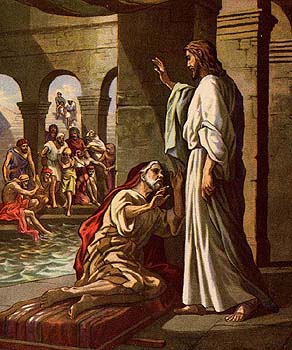
Now there is in Jerusalem by the Sheep Gate a pool, in Aramaic called Bethesda, which has five roofed colonnades. In these lay a multitude of invalids—blind, lame, and paralyzed. One man was there who had been an invalid for thirty-eight years. When Jesus saw him lying there and knew that he had already been there a long time, he said to him, “Do you want to be healed?” The sick man answered him, “Sir, I have no one to put me into the pool when the water is stirred up, and while I am going another steps down before me.” Jesus said to him, “Get up, take up your bed, and walk.” And at once the man was healed, and he took up his bed and walked.

Now that day was the Sabbath. 10 So the Jews said to the man who had been healed, “It is the Sabbath, and it is not lawful for you to take up your bed.” 11 But he answered them, “The man who healed me, that man said to me, ‘Take up your bed, and walk.’ 12 They asked him, “Who is the man who said to you, ‘Take up your bed and walk’?” John 5:1-12 ESV

With the opening of chapter 5, John begins to explore the growing tension between Jesus and the religious authorities. While the meeting between Jesus and Nicodemus, a Pharisees himself, had been somewhat controversial, it had remained cordial. But with Jesus’ return to Jerusalem, the anger and resentment of the Pharisees and Sadduccees will become increasingly more evident and intense.

John will not abandon the theme of belief that has characterized the first four chapters, but he will now juxtapose it with the growing unbelief of the religious elite of Israel. In a sense, John will use the Pharisees and Sadduccees as a counterpoint to Jesus. These men were to have been the shepherds of Israel, leading the people to the truth of God’s Word and exemplifying a life of obedience. But as John will point out, their legalistic, rule-keeping mindset and arrogant self-righteousness stand in stark contrast to Jesus’ commitment to put the will of God above all else.  

“For I have come down from heaven, not to do my own will but the will of him who sent me. And this is the will of him who sent me, that I should lose nothing of all that he has given me, but raise it up on the last day. For this is the will of my Father, that everyone who looks on the Son and believes in him should have eternal life, and I will raise him up on the last day.” – John 6:38-40 ESV

Jesus was on a mission and He would not allow anything or anyone to hinder Him fulfilling the role assigned to Him by His Heavenly Father. He had divine authority to do the things He did. As the Son of God, Jesus did not need the permission of the legal or religious authorities because He was acting on behalf of God Almighty. The will of God superseded that of all other human authorities and allowed Jesus to perform signs and wonders that appeared to contradict the laws of nature and violate the rules of men.

After His brief excursion into the northern region of Galilee, Jesus made a second trip to Jerusalem in order to attend yet another Jewish festival. There were three annual feasts that all Jewish males were required to attend: Passover, Pentecost, and Tabernacles. In recounting this particular story, John leaves the name of the festival out, evidently deeming it as irrelevant to the point he was trying to make.

But John was quite specific when describing the location for this event. The context was critical to understanding what is going on in the story. Jesus arrived at the Pool of Bethesda, just outside the walls of the temple compound. This was a well-known and well-trafficked spot in Jerusalem because the waters of the spring-fed pool were believed to have healing qualities. The setting is key to understanding what is about to take place. As John stated in verse 3, the pool was a magnet for the “blind, lame, and paralyzed.” They all made their way to the pool each day in the hopes that the miraculous powers of the water might make them whole.

While John pointed out that “a multitude of invalids” surrounded the pool, he focused his attention on one particular man whose paralytic condition had persisted for 38 years. It is not clear whether this man had been coming to the pool for nearly four decades or if this was his first time to seek help from its healing waters. But John’s emphasis on the length of time is meant to accentuate the hopelessness of the man’s plight. And Jesus, upon seeing the man, was immediately aware of the decades-long nature of his condition, which makes the question He asks sound so unnecessary and out-of-place.

“Do you want to be healed?” – John 5:6 ESV

Of course, he did. What kind of question is that to ask at a time like this? This poor man had somehow made it all the way to the pool, in spite of his paralysis. He would not have been lying beside the waters if he had not wanted to experience healing.

John does not explain why Jesus chose to single out this one man. There were obviously others at the pool that day, and each and every one of them was there hoping for the same thing: Healing. But Jesus chose to speak to this man. And in response to Jesus’ question, the man explained his plight.

Sir, I have no one to put me into the pool when the water is stirred up, and while I am going another steps down before me.” – John 4:7 ESV

His problem was not a lack of desire, but it was a lack of opportunity and capacity. His paralysis made it physically impossible for him to pursuit healing. His very condition proved to be a barrier to ever seeing his greatest desire fulfilled. Evidently, the pool’s healing powers were only available when the water was “stirred up.” It was only at that particular moment that a miracle could be expected, but it was reserved for the one who entered the water first. And this man, completely incapacitated by his illness and without anyone to assist him, was left to watch and wait, helplessly and hopelessly.

The description of the man’s plight is meant to stir the heart of the reader. But it is also meant to reveal the spiritual condition of each and every human being as they stand in need of healing but without the means by which to avail themselves of it. The healing waters were within this man’s reach, but he lacked the power to enter them. In a sense, he couldn’t heal himself. He needed help. And this is where Jesus stepped in.

Jesus said to him, “Get up, take up your bed, and walk.” And at once the man was healed, and he took up his bed and walked. – John 5:8-9 ESV

With a word, Jesus provided what the man lacked: The power to change. In a split second, this hopeless, helpless, bed-ridden paralytic was transformed into a completely healthy and whole specimen of a man. And no waters were necessary. Jesus spoke and the man walked.

But right when the story should be taking a decidedly upbeat turn, John reveals an underlying tension. He rather abruptly states, “Now that day was the Sabbath” (John 5:9 ESV). Rather than mentioning the celebration that would have followed such a miraculous moment, John simply points out that this had all taken place on the Sabbath. It was a holy day and, as such, it was to have been a day of rest. 

This significant detail is meant to point out the seeming problem with what Jesus said to the man and all that followed. Jesus specifically instructed the man to take up his bed and walk. He could have just told him to walk. Why was it necessary for him to gather up his bedroll? Because it was the Sabbath. Jesus knew exactly what day it was and His instructions to the man were given with that knowledge in mind. And His words produced the desired results. Yes, the man was healed, but not only that, the Pharisees were incensed. These religious rule-keepers witnessed the man carrying his bed and immediately confronted him for his blatant violation of the Sabbath law.

“It is the Sabbath, and it is not lawful for you to take up your bed.” – John 5:10 ESV

It is not clear whether these men had witnessed the healing, but even if they had, they were more concerned with what they saw as a flagrant disregard for the Mosaic Law.

The man, unaware of who Jesus was, told the religious leaders that he was simply obeying the words of the one who had healed him. But they still demanded to know the identity of this Sabbath law-breaker.

Jesus had specifically chosen the Sabbath day to perform this miracle. And His instructions to the lame man had been very precise. This entire scene was designed to set up a contrast between Jesus, the Son of God, and the religious leaders of Israel. He was their Messiah, sent from God to deliver the people from their bondage to sin and death. And as the Savior of the world, He had divine authority to accomplish the will of His Father. But for the religious leaders, their sacred rules and regulations were more important than the will of God. In their minds, adherence to the Sabbath blinded them to the presence of their Savior.

Yet, Jesus would later inform the Pharisees, “the Son of Man is Lord, even over the Sabbath!” (Matthew 12:8 NLT). This was all about authority and authenticity. Jesus was the Son of God and the long-awaited Messiah. And His audacious decision to heal on the Sabbath was proof of His deity and His divine authority.

English Standard Version (ESV) The Holy Bible, English Standard Version. ESV® Permanent Text Edition® (2016). Copyright © 2001 by Crossway Bibles, a publishing ministry of Good News Publishers.

New Living Translation (NLT)
Holy Bible, New Living Translation, copyright © 1996, 2004, 2015 by Tyndale House Foundation. Used by permission of Tyndale House Publishers Inc., Carol Stream, Illinois 60188. All rights reserved.

The Message (MSG)Copyright © 1993, 1994, 1995, 1996, 2000, 2001, 2002 by Eugene H. Peterson

Speechless and Powerless.

13 Now when they saw the boldness of Peter and John, and perceived that they were uneducated, common men, they were astonished. And they recognized that they had been with Jesus. 14 But seeing the man who was healed standing beside them, they had nothing to say in opposition. 15 But when they had commanded them to leave the council, they conferred with one another, 16 saying, “What shall we do with these men? For that a notable sign has been performed through them is evident to all the inhabitants of Jerusalem, and we cannot deny it. 17 But in order that it may spread no further among the people, let us warn them to speak no more to anyone in this name.” 18 So they called them and charged them not to speak or teach at all in the name of Jesus. 19 But Peter and John answered them, “Whether it is right in the sight of God to listen to you rather than to God, you must judge, 20 for we cannot but speak of what we have seen and heard.” 21 And when they had further threatened them, they let them go, finding no way to punish them, because of the people, for all were praising God for what had happened. 22 For the man on whom this sign of healing was performed was more than forty years old.  – Acts 4:13-22 ESV

The Jewish council or Sanhedrin had a problem on their hands, and it was one they had experienced before. While they had hoped that the death of Jesus would have put an end to all the talk about Him being the Messiah, they found themselves dealing with Him once again. This time, it was His disciples preaching and healing in His name and claiming that Jesus was not dead, but had been brought back to life by God, confirming His role as Messiah. And these uneducated, common men were drawing large crowds of followers, just like Jesus had done while He was alive. In fact, they say virtually the same thing about Peter and John as they did about Jesus.

The Jews therefore marveled, saying, “How is it that this man has learning, when he has never studied?” – John 7:15 ESV

The Jews had expected nothing from Jesus when He appeared on the scene, because He was nothing more than a lowly carpenter from the backwater town of Nazareth. And Jesus had told them the source of His ability to teach.

16 So Jesus answered them, “My teaching is not mine, but his who sent me. 17 If anyone’s will is to do God’s will, he will know whether the teaching is from God or whether I am speaking on my own authority. 18 The one who speaks on his own authority seeks his own glory; but the one who seeks the glory of him who sent him is true, and in him there is no falsehood. – John 7:16-18 ESV

Like Jesus, Peter had simply been doing the will of the Father. His authority to do and say the things he did was from God, passed on to Him by the Son. At the point in time when Jesus had given the disciples their commission, He had told them, “All authority in heaven and on earth has been given to me” (Matthew 28:18 ESV). And He had passed that authority on to each of them.

The members of the Sanhedrin were at a loss as to what to say or do. Luke uses the Greek word thaumazō to describe their response to the surprising boldness and eloquence of Peter and John. It’s a word that conveys the idea of wonder, even admiration at what they had seen. These men lacked formal education, but they spoke with power and authority. They weren’t intimidated by having to stand before the 70 members of the Sanhedrin, in their flowing robes and palpable air of superiority. The demeanor of the two disciples and the presence of the former;y lame beggar left the religious leaders speechless and at a loss as to what to do. So they sent Peter and John out of the room in order to discuss next steps.

They had to admit that a miracle had been done. Peter and John had performed an undeniable sign and the gentleman who had been seen leaping, dancing and worshiping in the Temple was proof. And there were plenty of witnesses, including the thousands who had expressed belief in Jesus at the words of Peter and John. The Sanhedrin had a problem. They wanted this to all go away, but they were reluctant to punish Peter and John because they feared the reaction of the people. But they desperately wanted to put a stop to the disciples spreading their talk of Jesus being alive, so they came up with the plan to threaten Peter and John.

17 But to keep them from spreading their propaganda any further, we must warn them not to speak to anyone in Jesus’ name again.” 18 So they called the apostles back in and commanded them never again to speak or teach in the name of Jesus. – Acts 4:17-18 NLT

Armed with their authority as the official religious leaders of Israel, they demanded that Peter and John refrain from talking about Jesus any longer. They put a gag order on them, believing that these two men would acquiesce our of fear of reprisals. But they were in for an even greater shock. Peter, as usual, was the first to respond to their demand.

“Do you think God wants us to obey you rather than him? We cannot stop telling about everything we have seen and heard.” – Acts 4:19-20 NLT

Peter answers with logic. What the Sanhedrin were demanding of he and John was absurd. Were they really expecting the disciples to willingly disobey God and stop speaking about Jesus, the Messiah? Did they really believe they could stop what God was doing by shutting up Peter and John? That was what they had tried to do by putting Jesus to death, and look how successful that had been. This was much bigger than the Sanhedrin, the high priest, Peter and John, or even Rome. They would not be able to stop would God had ordained. Peter most likely recalled the words Jesus had spoken to him when he had described Jesus as “the Christ, the Son of the living God” (Matthew 16:16 NLT). Jesus had blessed him and told him that this testimony was God-given, revealed from the Father Himself. And then Jesus had said, “And I tell you, you are Peter, and on this rock I will build my church, and the gates of hell shall not prevail against it” (Matthew 16:18 NLT). Peter’s testimony concerning Jesus’ identity as the Messiah would be the “rock” upon which the church would be built. And no one and nothing would be able to conquer it, including the all-powerful religious leaders of Israel. They were completely impotent when it came to stifling the work of the Spirit of God. Yes, they could punish the disciples. They could imprison them, beat them, even kill them. But Peter and John most likely recalled the words of Jesus, recorded in Luke gospel. “Dear friends, don’t be afraid of those who want to kill your body; they cannot do any more to you after that” (Luke 12:4 NLT). Jesus had been killed, but had been raised back to life, and Peter and John had seen it with their own eyes. So, they weren’t exactly intimidated by the threat of death. They believed that what they were doing was the will of God and nothing was going to prevent them from doing what they had been commissioned to do.

The Sanhedrin were flabbergasted by the disciples’ response and were at a loss as to what to do next, so they threatened them one last time and released. And Luke records, “everyone was praising God for this miraculous sign—the healing of a man who had been lame for more than forty years” (Acts 4:21-22 NLT). God had shown up and this man’s healing had been the proof. But his healing had been intended as a sign. It was evidence of Peter and John’s God-given authority to speak on behalf of Jesus and act as His representatives on earth. The healing had validated their claims of apostleship. Their real mission was not to heal the sick, but to save the lost. Their primary calling was to restore sinners to a right relationship with God, not sight to the blind or the ability to walk to the lame. Those actions, while miraculous and attention-getting, were a means to a greater end, and Peter had made it perfectly clear: “There is salvation in no one else! God has given no other name under heaven by which we must be saved” (Acts 4:12 NLT). 

It is so easy to get hung up on the signs and miss out on the Savior. We can become enamored with the idea of miracles and lose sight of the Messiah. Jesus had many followers when He walked the earth, but there were those in the crowds who only wanted physical healing, not spiritual renewal. Others were waiting to see if He would feed them, but failed to recognize Him as the bread of life. The majority were seeking a sign, but when it showed up, they never saw the Savior behind it. They missed the point. Peter and John were out to save souls. They were determined to preach the good news of salvation through faith in Jesus Christ. And nothing was going to stand in their way, not even the Sanhedrin.

English Standard Version (ESV)
The Holy Bible, English Standard Version. ESV® Permanent Text Edition® (2016). Copyright © 2001 by Crossway Bibles, a publishing ministry of Good News Publishers.

New Living Translation (NLT)
Holy Bible, New Living Translation, copyright © 1996, 2004, 2015 by Tyndale House Foundation. Used by permission of Tyndale House Publishers Inc., Carol Stream, Illinois 60188. All rights reserved.

The Message (MSG)  Copyright © 1993, 1994, 1995, 1996, 2000, 2001, 2002 by Eugene H. Peterson

Day 129 – Matthew 26:57, 59-68; Mark 14:53, 55-65; Luke 22:54, 63-65; John 18:24

Guilty As Charged.

Matthew 26:57, 59-68; Mark 14:53, 55-65; Luke 22:54, 63-65; John 18:24

Jesus replied, “I Am. And you will see the Son of Man seated in the place of power at God’s right hand and coming on the clouds of heaven.” – Mark 14:62 NLT

When Jesus was finally brought before Caiaphas, the high priest, He found Himself in a room crowded with leading priests, elders and teachers of religious law. Even the high council or Sanhedrin was there. They had pulled out all the big guns for this final showdown with Jesus. There is little doubt that they intended this evening to result in the elimination of Jesus as a threat to their authority and way of life. He had been a thorn in their side for far too long, and now they were going to deal with Him. The only problem was that they needed solid accusations for which to bring this matter before the Roman authorities. They were wanting to have Jesus put to death and they did not have the authority to do so. They were going to have to convince the Roman authorities that Jesus had committed a crime worthy of death. So all these well-educated religious leaders were attempting to find any evidence that they could use against Jesus. But even when they couldn’t find any charges worthy of death, they didn’t let that stop them. They had arranged for a variety of individuals to come and give witness against Jesus, but they all ended up contradicting one another. These people were more than willing to accuse Jesus, probably for the hope of financial gain. Finally, some men stood up and claimed that they heard Jesus say that He was going to destroy the Temple. “We heard him say, ‘I will destroy this Temple made with human hands, and in three days I will build another, made without human hands’” (Mark 14:58 NLT). These men were actually twisting what Jesus had actually said. What Jesus had actually said was, “Destroy this temple, and in three days I will raise it up (John 2:19 NLT). Jesus had made this statement early in His ministry. It took place immediately after He had cleansed the Temple for the first time. The Jewish leaders had confronted Him, asking Him what He thought He was doing and who gave Him the authority to do it. Then they asked Him to give them a miraculous sign to prove His authority. That’s when Jesus made His statement regarding the destruction and raising of the “temple.” They obviously didn’t understand that He was talking about His own death and resurrection. They saw Jesus’ statement as ridiculous, exclaiming, “What! It has taken forty-six years to build this Temple, and you can rebuilt it in three days?” (John 2:20 NLT).

So in the minds of those accusing Jesus, His statement came across as the words of an insurrectionist. He had claimed He was going to destroy the Temple – Herod’s Temple. Now they were getting somewhere. This was just the kind of evidence they needed to bring before the Romans. The last thing the Roman authorities would want is someone threatening the peace and security of Jerusalem. But to the obvious disappointment of the religious leaders, even the men who accused Jesus couldn’t get their stories straight. So in frustration, the high priest asked Jesus, “Well, aren’t you going to answer these charges? What do you have to say for yourself?” (Mark 14:60 NLT). But Jesus said nothing. The charges were false and He remained silent. Then the high priest asked Him point blank, “Are you the Messiah, the Son of the Blessed One?” (Mark 14:61 NLT). This was the real issue. When all was said and done, this was the main point of contention between Jesus and the religious leaders. He had claimed to be the Messiah. That was the reason the people followed Him. It was for that reason the people welcomed Him with palm branches and shouts of “Hosanna!” when He had arrived in Jerusalem the previous Sunday. He had set Himself up as having been sent by God. Not only that, He had claimed to be the Son of God. Jesus responded to Caiaphas’ question by saying, “I Am. And you will see the Son of Man seated in the place of power at God’s right hand and coming on the clouds of heaven” (Mark 14:62 NLT). His statement brought an immediate reaction from the crowd because they knew exactly what He was saying. He was claiming to be God. His use of the phrase, “I Am” was intentional. It was the very same way God referred to Himself when He spoke to Moses at the burning bush. Moses had asked God what name He should give when the people ask who it was who sent him. God said to tell them, “I Am who I Am” had sent him. Jesus was clearly associating Himself with God. He was using the same language that God had used in order to refer to Himself. On top of that, Jesus claimed that He was going to be sitting at God’s right hand, a place of honor and power, and that He would be returning some day. That was all they needed. Caiaphas tore his clothes in shock. They no longer needed any witnesses. Jesus had committed the unpardonable sin: blasphemy. He had claimed to be God. In reality, it was Jesus’ words that were the problem. Blasphemy was based on injurious or disrespectful words or speech. In their minds, by saying what He said, Jesus had diminished the holiness of God. He had treated God with disrespect and dishonored His “otherness” or set-apartness. By claiming to be God, Jesus had become an offense to God – at least in their minds.

Their immediate response was violent. They began to spit on Him. They blindfolded him and beat Him with their fists. They mocked Him, telling Him to use His “divine” powers to tell them who it was who was hitting Him. The one piece of evidence they needed, Jesus gave them. And all He did was speak the truth. He acknowledged who He was. To do anything other than that would have truly been blasphemy. If Jesus had denied His deity, He would have been an offense to God. So He spoke the truth, and it set in motion everything that was about to happen. Jesus was guilty as charged. Not of blasphemy, but of being the Son of God and the Savior of the world. His crime was being God. And His punishment would be death. But it was for just that purpose He had come. God had come to die on behalf of sinful men. He had come to sacrifice His own life for the lives of all those who deserved death. It was because Jesus was spotless, sinless, and blameless that He was condemned to die. His worthiness was what led to His demise. He was guilty of being God, and nothing else. And it is for that reason that He made a perfect sacrifice. He was guilty as charged and we are innocent because of it.

Father, Your sinless Son was put to death because He was holy, righteous, and fully God. He was killed because He was who He said He was. He died because He was the only one who was undeserving of death. He was innocent, and we were guilty, but He is the one who died. All so that we might have life. What an amazing turn of events. What an incredible plan.  Amen.

Ken Miller
Grow Pastor & Minister to Men
kenm@christchapelbc.org

Day 107 – Mark 12:41-44; Luke 21:1-4

The True Heart of Sacrifice.

Mark 12:41-44; Luke 21:1-4

“I tell you the truth,” Jesus said, “this poor widow has given more than all the rest of them. For they have given a tiny part of their surplus, but she, poor as she is, hsa given everything she has.” – Mark 21:3 NLT

Jesus and His disciples are standing in the Temple grounds. He has just had a discussion with the religious leaders regarding His authority. Three separate times they have approached Him, asking questions designed to trap and expose Him. But Jesus has graciously and effectively handled all their inquiries, even taking the opportunity to ask a question of His own. There in the Temple courtyard, He is on enemy territory. This is the domain of the priests and religious leaders. He is on their turf. And yet Jesus has just warned the crowd to “Beware of these teachers of religious law! For they love to parade around in flowing robes and love to receive respectful greetings as they walk in the marketplaces. And how they love the seats of honor in the synagogues and the head table at banquets. Yet they shamelessly cheat widows out of their property and then pretend to be pious by making long prayers in public. Because of this, they will be severely punished” (Luke 20:46-47 NLT).

These were not exactly kind and gracious words. I can’t help but imagine that as Jesus spoke these words, He was able to look at the various priests, religious leaders, Pharisees and Sadducees walking around the courtyard in their flowing robes, trailing a retinue of dedicated disciples. But it is within this same environment, that Jesus points out the poor widow. While His disciples were probably enamored by the beauty of the Temple buildings and impressed by the pomp and circumstance of the religious elite, Jesus takes notice of the obscure and overlooked widow. Mark and Luke tell us that “he watched the rich people dropping their gifts in the collection box” (Luke 21:1 NLT). Jesus was people watching, but with a purpose. He was going to teach a lesson on giving for the benefit of His disciples. The process of giving in this context was a very visible one. The people lined up and one-by-one deposited their gift in the box. This would have been one of 13 different trumpet-shaped receptacles located around the Temple grounds. They were made of metal and the “dropping” of each person’s gift would have made a distinctive sound. And of course, the more you gave, the louder the noise. So it would have been noticeable when the rich deposited their gifts. Those waiting in line or standing nearby would have heard the clanking of the metal coins as they were dropped into the container. To the untrained eye, it would have appeared that the wealthy were giving more than anyone else. But Jesus points out a very important point when it comes to giving. It is not so much the size of the gift, as it is the degree of sacrifice required of the one giving. Jesus points out that this poor widow, who only put in two measly coins, had actually given MORE than anyone else that day. Why? Because Jesus somehow knew that her gift represented the greatest degree of sacrifice. In spite of her poverty, she had given everything she had. Her gift was truly sacrificial and not superficial.

Jesus is not so much denigrating the gifts of the others as much as He is pointing out the true motive behind giving. Our giving is not to be for show. It should not be done to impress. But it should also not be done in such a way that it requires little or no sacrifice on our part. If you think about it, God does not need our money. He doesn’t require our talents. When we give, whether it is our time, talents or treasures, we should do so as an expression of gratitude to Him for all He has done for us. He gave His Son so that we might have eternal life. But when we give to Him and we do it like the rich people Jesus saw – giving just a small portion out of their surplus – what does that communicate to God? We are giving Him something that costs us nothing. It is almost meaningless and of little value to us. But this widow gave all she had. She gave sacrificially and willingly. At the heart of true giving is sacrifice. It expresses to God that He has more value to us than whatever it is we are giving to Him. He is worthy of all that we have. He does not require that we give Him all, but He is not honored when we give what costs us nothing.

Father, too often I give to You out of my reserves or surplus. Or I give to you out of the dregs and leftovers of my time and energy. I give You those moments at the end of the day when I am exhausted and drained. I try to pray as I fall asleep, hoping that in some way that will honor You. I can so easily spend my money on my own needs and desires, giving to You something out of what I have leftover at the end of the month. Jesus pointed out this widow for a reason. It was not the size of the gift, but the heart of the one giving. May my giving, whether of my time, treasures or talents, be a holy sacrifice to You for all that You have done and continue to do for me. Amen.

Ken Miller
Grow Pastor & Minister to Men
kenm@christchapelbc.org

Day 103 – Matthew 22:23-33; Mark 12:18-27; Luke 20:27-40

Intelligent, But Ignorant.

Matthew 22:23-33; Mark 12:18-27; Luke 20:27-40

Jesus replied, “Your mistake is that you don’t know the Scriptures, and you don’t know the power of God.” – Matthew 22:29 NLT

Jesus is facing yet another confrontation with the religious leaders. This time it is the Sadducees. They were the religious liberals of their day who refused to believe in the afterlife, the doctrine of the resurrection or the reality of angels. For them, this life was the only life and it was to be lived in strict adherence to the written law as found in the Torah. They were elitists who rejected the oral law of the Pharisees, the “traditions of the elders” that contained hundreds of additional laws or expansions of the written law. But while they were not exactly bosom buddies with the Pharisees, they shared one thing in common with them: their hatred for Jesus. So we see them coming to Jesus posing a question that they intended to use to expose Jesus’ heretical views on the resurrection. Their question is a lengthy one, in the form of a short story. It’s a fictitious scenario involving what was called the Levirate Law, part of the Law of Moses found in the book of Deuteronomy. This law ruled that when a man died, leaving a wife as a widow with no children, one of the deceased man’s brothers was obligated to marry the woman so that she might have a son by him and so that son might carry on the name of her deceased first husband and inherit his land.  The law states, “If two brothers are living together on the same property and one of them dies without a son, his widow may not be married to anyone from outside the family. Instead, her husband’s brother should marry her and have intercourse with her to fulfill the duties of a brother-in-law. The first son she bears to him will be considered the son of the dead brother, so that his name will not be forgotten in Israel” (Deuteronomy 25:5-6 NLT).

These Sadducees create a highly unlikely scenario where the woman ends up marrying seven different brothers, each one dying before they could father a son with her. Then finally, the woman herself dies. And at last they ask Jesus their question. Matthew makes it clear that the real point behind their question is the resurrection. They are not really interested in Jesus’ interpretation of the law, but in His views on the resurrection. So they ask, “So tell us, whose wife will she be in the resurrection? For all seven were married to her” (Matthew 22:28 NLT).

They think they have Jesus trapped. Because the Torah did not teach explicitly about the resurrection, they did not believe in it. Their little story was designed to expose the ridiculousness of the whole idea of the resurrection. In their minds, they had shown that the very concept of the resurrection would conflict with the law itself. How could a woman have seven husbands in heaven? But Jesus exposes the flaw in their thinking and the problem in their lives. He simply states, “Your mistake is that you don’t know the Scriptures, and you don’t know the power of God” (Matthew 22:29 NLT). This would have been like a sucker punch to the stomach. Jesus had caught them off guard and wiped the smug look of satisfaction off their faces with one simple sentence. They prided themselves on their knowledge and understanding of the Scriptures and here was Jesus telling them they didn’t really know them. They were intelligent, but ignorant. In all their study of the Word of God, they had missed out on the power of God. They had relegated all they know about life to the here and now and rejected the idea of a hereafter. So Jesus shocks them by letting them know that in the resurrected state there will be no marriage. Their whole scenario is pointless and irrelevant. The woman will not be married to any of the brothers, “For when the dead rise, they will neither marry nor be given in marriage” (Matthew 22:30 NLT). This may be just as shocking to many reading these words right now. Your concept of heaven has always included marriage. You have assumed that if you are married here on earth, you will be married in heaven. But what would be the purpose of marriage in heaven. As an institution, it was designed to illustrate the relationship between Christ and His bride, the Church. It was intended to be a physical representation of the spiritual reality. In heaven, the union of Christ and the Church will be complete. There will no longer be a need for a symbol of that union. And while we may find that idea disturbing and possibly disappointing, we have to remember that our condition in our resurrected state will be one of perfection. We will be like Christ and have perfect fellowship with God the Father. Our primary relationship will be with Him. There will no longer be the need for another person to complete us.

But Jesus knows that the real issue behind their question is their view on the resurrection, so He cuts to the chase and takes it head on. “But now, as to whether there will be a resurrection of the dead—haven’t you ever read about this in the Scriptures? Long after Abraham, Isaac, and Jacob had died, God said,‘I am the God of Abraham, the God of Isaac, and the God of Jacob.’So he is the God of the living, not the dead” (Matthew 22:31-32 NLT). Once again, Jesus questions their knowledge of the Scriptures, letting them know that in spite of all their study, they had missed a key point. When referring to His relationship with the great patriarchs of the Hebrew people, God had spoken in the PRESENT tense. He said, “I am the God of Abraham, the God of Isaac, and the God of Jacob.” These words were spoken long after all three of these men were dead and gone, and yet God refers to them in the present tense. Jesus makes it clear that this is not a grammatical error, but a theological truth. There is an afterlife and there will be a resurrection. The problem of the Sadducees was that they studied the Scriptures with a biased view and a limited understanding of the power of God. The idea of the resurrection was impossible to them. It was inconceivable. So they simply refused to believe in it. In establishing their doctrinal views, they had unknowingly limited the power of God. Because they couldn’t understand something, they simply eliminated it from consideration. But Jesus made it clear that the resurrection was not only possible, it was undeniable, because of the unlimited power of God.

For the Sadducees, life had become all about what they could see and explain. Their view was limited and restrictive. They had no room in their theology for an afterlife, because they couldn’t explain or control it. So they put all their eggs in basket, concentrating all their efforts on making the most out of this life. In doing so, they had missed the whole concept of the afterlife, of heaven and the resurrected state. For them, this earthly life was the only life. Nothing more, nothing less. And yet, there are many who live that way today. Even those who claim to be Christ-followers live as if there is no eternal life, focusing all their attention and energies on making the most of this life. They ignore what they can’t explain or understand. And yet, we are encouraged throughout the Word of God to run the race of life with the end in mind. We are to set our affections on things above, not the things of this earth. We are told to consider ourselves as strangers here, and to remember that this world is not our home, we are simply passing through on our way to somewhere better. There is an afterlife. There is a heaven. This is not all there is. And we should live with that reality in mind.

Father, it is easy to begin to believe that this really is all there is. The ever-present reality of this world can easily overshadow the idea that there is something more. Don’t let me lose sight of the fact that heaven is a real place, the resurrection is a future reality and not a myth, and that You have much more in store for me than what I can see or even understand here. Amen.

Ken Miller
Grow Pastor & Minister to Men
kenm@christchapelbc.org

Day 101 – Matthew 21:33-22:14; Mark 11:27-12:12; Luke 20:1-19

The Three Parables.

Matthew 21:33-22:14; Mark 11:27-12:12; Luke 20:1-19

They demanded, “By what authority are you doing all these things? Who gave you the right to do them?” – Mark 11:28 NLT

This question posed by the Pharisees seems a bit odd, unless you keep it within its context. Jesus is walking with His disciples through the Temple area. They have just recently arrived back in town from their long walk from the village of Bethany where they are staying during the Passover celebration. According to Mark’s chronology of the events surrounding this last week of Jesus’ life, the day before Jesus had been in this same area, but was in a slightly different mood. He had walked on to the Temple grounds and angrily cleared out the moneychangers, overturning their tables. He drove away all those buying and selling animals for the sacrifices. And most importantly, Mark tells us, “he stopped everyone from using the Temple as a marketplace” (Mark 11:16 NLT). If you think about it, Jesus completely disrupted the entire sacrificial system for that day. He threw a wrench into the well-oiled machine of the corrupt religious system that had somehow replaced what God had established through Moses in the wilderness. What He observed taking place in the Temple that first Sunday He arrived in Jerusalem was more about men than God. He witnessed a religious system built on greed and corruption. Extortion and graft were rampant. At this point in time, even the priestly office had become more political than spiritual. They held their offices thanks to Rome and many of them held their positions based on payoffs made to the Roman government. So Jesus shut the whole thing down – even if only for one day.

That sets up the passage we are dealing with today. It is the next day and Jesus has arrived back in town. He is immediately confronted by the leading priests, the teachers of religious law and the elders. They demand to know who has given Him the authority to do what He has done. They are specifically talking about His disruption of the sacrificial system the day before. They are incensed because His efforts have made a personal impact on their pocketbooks. These men benefited financially from the sale of the sheep and doves for sacrifice. It is said that they had arranged the system in such a way that when people brought their sacrificial lamb to the priests for inspection to deem whether it was unblemished or not, the priests would find some fault with it, then require them to buy one of the truly unblemished lambs they had for sale. Then they would take the very lamb they had rejected and turn around and sell it to the next person in line. They had also set up a system that required everyone to exchange their currency for Temple currency, tacking on a high fee for the privilege. All of this revenue went into the Temple treasury, but much of it lined the pockets of the leading priests. So when they came to Jesus, they had a personal stake in this whole thing.

Their question had to do with authority or right. By asking their question, they are inferring that Jesus had no right or authority to do what He did. His actions were not in keeping with accepted tradition. In their mind, Jesus was a renegade and a trouble maker. He was not one of them. He had not gone through the proper channels or training. He had no authority because He had never been a disciple of one of the great rabbis. He was an imposter and needed to be dealt with as such. Without knowing it, they were actually questioning Jesus’ kingship. Remember, just a few days before Jesus had rode into town to the shouts of “Praise God! Blessings on the one who comes in the name of the Lord! Blessings on the coming Kingdom of our ancestor David! Praise God in highest heaven!” (Mark 11:9-10 NLT). Jesus had been welcomed as a king. But now they were questioning His authority and attempting to paint Him as a radical and a revolutionary.

Rather than answer their question, Jesus counters with one of His own. “I’ll tell you by what authority I do these things if you answer one question,” Jesus replied. “Did John’s authority to baptize come from heaven, or was it merely human? Answer me!” (Mark 11:29-30 NLT). Jesus puts them squarely on the horns of a dilemma. If they said John’s authority was from heaven, they would be guilty of rejecting God. If they said it was of human origin, they risked alienating the people who saw John as a prophet. So they decided to plead ignorance. “We don’t know,” they responded. And as a result, Jesus refused to address their question regarding His authority. But in reality Jesus does answer their question. He does so by telling three short parables. He turns to the crowd and begins to teach in His usual method, using simple stories to teach a much deeper truth. But the context tells us what Jesus has in mind by telling these stories. The issue is one of authority and Jesus uses these stories to address their original question.

Three Parables – One Message

Over in Matthew’s account, we have the three parables and they are the parable of the two sons, the parable of the landowner, and the parable of the wedding feast. In the first one, Jesus tells about a father with two sons, who orders the first son to go into the household vineyard and work. The son refused, but later repented and did what the father had asked. He orders the second sons to go and he initially agrees, feigning obedience, but later refuses, never doing what the father asked. Jesus asked, “Which one obeyed?” and they answered, “The first son.” So what’s the point? The religious leaders believed they were sons of the kingdom due to their heritage as descendants of Abraham. Jesus makes it clear that corrupt tax collectors and prostitutes will get into God’s Kingdom before they will. Why? Repentance and belief. The religious leaders refused to repent. They refused to believe. They would not acknowledge Jesus’ claim to be the Messiah and His authority as their rightful King.

In the second parable, Jesus tells of a landowner who planted a vineyard and then leased it out and moved to another country. When the grape harvest came, he sent his servants to collect his share of the crop. But the farmers to whom he had leased the land, beat one servant, killed another and stoned the last. So the landowner sent a larger group or servants and they were treated in the same way. Finally, he decides to send his own son, hoping that they will show him the respect he deserves. But when he arrives, they grab him, drag him out of the vineyard and kill him. Jesus asks what they think the landowner will do to these farmers when he returns. “The religious leaders replied, “He will put the wicked men to a horrible death and lease the vineyard to others who will give him his share of the crop after each harvest” (Matthew 21:41 NLT). Their own answer condemns them. So what’s the point? Over the centuries, God had sent His prophets to His people, and they had been abused, rejected, and in many cases, killed. So He sent more and they were treated the same way. And now He had sent His Son, but He too would be killed in just a matter of days. In telling this particular parable, Jesus was referring to a story from the book of Isaiah (Isaiah 5:1-7). Jesus makes sure they get the meaning of the story. “I tell you, the Kingdom of God will be taken away from you and given to a nation that will produce proper fruit. Anyone who stumbles over that stone will be broken to pieces, and it will crush anyone it falls on” (Matthew 21:43-44 NLT).

Jesus is the stone that the builders will reject, but He will become the cornerstone. And Jesus, as King, had the authority to do as He wished – even if it meant taking away the Kingdom of God from those who rejected Him. The Pharisees didn’t miss the point. “When the leading priests and Pharisees heard this parable, they realized he was telling the story against them – they were the wicked farmers. They wanted to arrest him, but they were afraid of the crowds, who considered Jesus to be a prophet” (Matthew 21:45-46 NLT).

In the final parable, Jesus tells about a king who prepares a wedding for his son. He sent his servants to to get the guests he had invited. But they all refuse to come. So he sends more servants, but the invited guests ignore them, giving excuses and even trying to murder the servants. The king, obviously upset and offended, sent out his army to destroy these people and burn their town. Then he sent his servants to invite anyone they saw – good, bad or indifferent – to fill the banquet hall for his son’s wedding. Evidently, the king even supplied wedding clothes to these people, because they would not have had any. But one man showed up improperly dressed, having failed to put on what he had been given. He was promptly bound and thrown out.

So what’s the point? God had invited the nation of Israel into His kingdom. Over the centuries He had sent His messengers, the prophets, to the Jewish people, with His call to repentance, but they had refused God’s messengers, rejecting and even killing them. So Jesus told His listeners that God was going to deal harshly with that generation and with those of His own day. As a result, the invitation would be extended to any and all (Gentiles). God would open up the invitation to even those outside the Jewish community, even providing the proper “attire” for the wedding. Through His upcoming death on the cross, Jesus would clothe those who believed in Him with His own righteousness. He would replace their rags of sin with garments of righteousness, acceptable before God the Father. But if anyone tries to enter God’s Kingdom clothed in their own righteousness, they will be rejected.

It’s all about a Kingdom and a King

Jesus had authority as the Son of God. The entire Old Testament message from the prophets spoke of Him. The nation of Israel had been invited to enter into His kingdom, but they would refuse. They had rejected the message of the prophets, of John the Baptist and would reject the offer of Jesus Christ. And the question you have to ask today, is whether Jesus Christ is the authority in your life. Do you listen to what He says and obey it? Have you accepted His invitation, or are you too busy, too good, or too smart to buy into something so hard to believe? Does the way you live your life reveal that you sometimes question whether Jesus has authority over your life? Do you refuse to put on the righteousness He has provided because you prefer your life just the way it is? Jesus not only wants to be the Savior, He wants to be your King. He wants to rule and reign in your life. He wants to lead you and direct you. He wants you to worship and obey Him. He wants you to live in submission to Him. Because He loves You and He alone knows what is best for you. He is a gracious, loving, merciful, righteous King who longs to provide for and protect His people.

Lord, there are so many times I question Your authority in my life. I want to do things my way. I want to rule and reign, making decisions according to my terms and on my timeline. I love the fact they You died for me, but sometimes, I’m not quite so sure I want You to decide for me. But You have the right and authority to be my King and my Lord. I have no business rejecting Your rule in my life. Forgive me and help me submit willingly to Your loving leadership in my life. Amen.

Ken Miller
Grow Pastor & Minister to Men
kenm@christchapelbc.org

Day 86 – Luke 16:1-18

Spiritual Stewardship.

Luke 16:1-18

“And if you are untrustworthy about worldly wealth, who will trust you with the true riches of heaven? And if you are not faithful with other people’s things, why should you be trusted with things of your own?” – Luke 16:11-12 NLT

This is a difficult passage, and if we’re not careful, we could draw all kinds of faulty conclusions Jesus never intended when He spoke these words. As always, it helps if we consider the context. The passage right before this has Jesus addressing the Pharisees and the teachers of religious law because of their complaining about His association with sinners. Jesus used three parables or stories to make a very powerful point about their mistaken view that they were NOT sinners. These men viewed themselves as righteous because of their positions and because of their heritage as descendants of Abraham. They did not consider themselves “lost” and so, therefore, they had no need to be “found” by Jesus. In the stories Jesus told, these men represent the 99 sheep who get left in the wilderness by their owner so he can go search for the ONE lost sheep. They are the nine coins that get ignored while the woman searches every nook and cranny of her house to find the ONE coin that was truly lost. And they are the older brother in the story who thought he deserved the party and the presents more than his younger brother, because he had worked like a slave and done everything his father had told him to do. But he ended up on the outside of the party looking in – just as the Pharisees would.

Luke continues his account by sharing a story that Jesus told to His disciples. This one involved a rich man who had a dishonest steward or manager who worked for him. He managed his household and his personal finances. It was a position of power, authority and great responsibility. But it seems this man had been wasting the rich man’s money. The term in the original language paints the picture that he had been throwing it into the wind, squandering it needlessly and wastefully. When the rich man found out, he fired him. But before his termination took place, the dishonest steward came up with an ingenious, if not self-serving, plan. He was not only dishonest, he was lazy. He didn’t want to have to do any kind of manual labor to survive, because he had gotten used to the easy life of a manager. He also was admittedly too proud to beg. So he devised a plan to win over all those who owed money to his boss. He called them in one at a time and asked them what they owed. He then renegotiated their debt, lowering it to a more manageable level – much to their delight and gratitude. This man used his boss’s resources to secure his future. He knew that when he lost his job these people would be so grateful for what he had done, that they would take care of him in his need. He may have been dishonest, but he was shrewd. Even his former boss admired what he had done.

Now, Jesus is NOT encouraging His followers to do as this man did. We are not to emulate this man’s dishonest actions. But we should take careful note of what he did. I can’t help but think that Jesus has the Jewish religious leaders in mind. This is a story about them. They were the dishonest steward who had been trusted by his employer with all that he had. These men had been entrusted by God to care for the Word of God and the people of God. But they had been wasteful and careless with God’s possessions. And like the steward in the story, their Master was calling them to account. Which is what Jesus had been doing since He started His earthly ministry. He had been blasting the Pharisees and other religious leaders for their hypocrisy, lack of spiritual leadership, poor care for the sheep of God, and stubborn refusal to recognize Him as the Son of God. Jesus seems to be telling the religious leaders that they must recognize the precarious nature of their position and their future, and consider what it is they must do. The man in the story took steps to secure his future. He did so by caring about others. This part is hard to see at first. It appears at first blush that he is simply being self-serving, but if you look closer, he goes to the very people who had owed his master all along and begins to collect the debts they owed. This is probably one of the ways in which he had been slack and wasteful. He was not collecting what was owed. He was letting his master’s creditors get away without paying what they owed. And it may have been that they were unable to pay. So he renegotiates their debts, accomplishing several things at once. He makes their debt more manageable. He collects the past-due accounts owed to his master. And he secures the gratitude of these individuals. It is as if Jesus is encouraging the religious leaders to look at what the man in the story did and wake up to the reality that they are going to have to answer to God for their actions here on earth. Jesus says, “And if you are untrustworthy about worldly wealth, who will trust you with the true riches of heaven?” (Luke 16:11 NLT). Right in the middle of this little discourse by Jesus, Luke places the statement, “The Pharisees, who dearly loved their money heard all this and scoffed at him” (Luke 16:14 NLT). This is there for a reason. It is still all about the Pharisees. They loved their money and their positions. They put more value on those things than on doing the will of God, their ultimate Master. And they would one day have to answer to God. Jesus condemns them for their outward displays of righteousness. He warns them that God knows their hearts and detests the very things they love.

The real point seems to be that the man in the story recognized what he had done, and shrewdly did what he had to do to secure his future. Jesus is encouraging these men to do the same. They can’t serve two masters. They can’t have it both ways. They can’t love money more than God. They can’t serve the things of this world and God at the same time. They needed to get their eyes off of themselves and start caring about the needs of others. They needed to care about what the Master cared about. The man in the story wasn’t trying to get money. He was simply trying to secure his future. Jesus is encouraging the religious leaders to do the same. I really don’t think this is a story about money or stewardship. It is about eternal life.

Father, this is a hard one. Jesus doesn’t take us aside and explain it as He has done in so many other cases. But I pray that we can learn from the man in the story and the lives of the religious leaders in Jesus’ day. We all must answer to You some day as our Master. We have been given a stewardship of all that we have, because it all ultimately belongs to You. We need to manage it well, not for our own benefit, but for Your glory. It isn’t about us. It is always about You. It isn’t about our petty little kingdoms, but about Your eternal one. Never let us lose sight of that fact.  Amen.

Ken Miller
Grow Pastor & Minister to Men
kenm@christchapelbc.org

Day 78 – John 9

Spiritual Blindness.

John 9

“If you were blind, you wouldn’t be guilty,” Jesus replied, “But you remain guilty because you claim you can see.” – John 9:41 NLT

This entire chapter deals with the interaction between Jesus and a common peasant man who had been blind since birth. It all took place on the Sabbath, which usually meant that Jesus was going to do something that would put Him at odds with the religious leaders, who were always looking for more excuses to attack and discredit Him. Jesus didn’t disappoint. His disciples were the first to point out the man in question, using him as a visual aid to assist them in asking Jesus a theological question: “Why was this man born blind? Was it because of his own sins or his parents’ sins? (John 9:2 NLT). They were expressing a common viewpoint among the Jews that all physical suffering, illness or trouble of any kind was due to sin. From their perspective, this man was blind because of either something he or his parents had done. But Jesus shocks them by saying the man’s blindness was for a totally different reason – “so the power of God could be seen in him” (John 9:3 NLT). The man’s blindness was an opportunity for God to reveal His power, but no necessarily just through healing. Paul expressed it so well when he wrote, “That’s why I take pleasure in my weaknesses, and in the insults, hardships, persecutions, and troubles that I suffer for Christ. For when I am weak, then I am strong: (2 Corinthians 12:10 NLT). Weakness of any kind, whether physical, emotional, financial, or psychological, can be a place where we can discover the power of God in our lives. And Jesus was going to display His Father’s power in this man’s life as an illustration to His disciples.

Interestingly enough, Jesus chooses to heal this man in a manner He had not done before. He could have simply spoken a word and the man’s eyes would have been opened. But instead, Jesus spit on the ground, makes mud and spread it over the man’s eyes. He then instructed the man to go to the Pool of Siloam and wash the mud away. The thing to remember is that this was the Sabbath, and what Jesus did (according to the legalistic religious leaders) would have been construed as “work” – a direct violation of the Sabbath laws concerning rest or cessation from work. And Jesus knew exactly what He was doing and for whose benefit. When the man comes back from the pool completely healed and able to see for the first time in his life, it didn’t take long for the word to spread. This brought the religious leaders, who began to question the man regarding what had happened. They are incredulous, disbelieving and choose to deny that the man had been blind at all. They question his parents in an attempt to discredit the man’s story, but fail. When the realize that they are not going to be able to debunk the reality of the man’s miraculous healing, they demand that he give the glory to God and not Jesus, “because we know this man Jesus is a sinner” (John 9:24 NLT). The man, while just a common peasant and a former beggar with no theological training, is astute enough to respond, “I don’t know whether he is a sinner, but I know this: I was blind, and now I can see!” (John 9:25 NLT). What a great line!

The religious leaders reveal that they don’t believe in Jesus because they don’t know where He comes from. In other words, He had no authority. He had no credibility. He had no right to say what He said or do what He did. He was not one of their own. But once again, the man who had been healed by Jesus simply says, “Why that’s very strange! He healed my eyes, and yet you don’t know where he comes from? We know that God doesn’t listen to sinners, but he is ready to hear those who worship him and do his will. Ever since the world began, no one has been able to open the eyes of someone born blind. If this man were not from God, he couldn’t have done it” (John 9:30-33 NLT). From this man’s limited perspective, it was clear that Jesus was from God. And the debate over whether He was a sinner or not was cleared up by the very fact that God seemed to be on His side. This formerly blind man could see the truth clearly. His spiritual eyes were opened and he was able to perceive the truth of who Jesus was and who He came from. But the religious leaders were blind. In a rage, they threw him out of the synagogue. Jesus heard what had happened and found the man and asked him, “Do you believe in the Son of Man?” (John 9:35 NLT). The man replies, “Who is he, sir? I want to believe in him” (John 9:36 NLT). This man was still learning to see spiritually. He was not yet clear on exactly who Jesus was, but he wanted to know. So Jesus tells him, “You have seen him, and he is speaking to you” (John 9:38 NLT). The man responds with a resounding statement of belief and heartfelt worship. Then Jesus makes a statement to him that sums up this entire chapter. “I entered into this world to render judgment – to give sight to the blind and to show those who think they see that they are blind” (John 9:39 NLT). In the spiritual economy of that day, this man had been viewed since the day he was born, as a sinner who was being punished by God with physical blindness. The religious leaders were viewed as righteous, holy and the personal favorites of God because of their position and their strict adherence to the law. God was “blessing” them for their righteousness and punishing this man for his unrighteousness. But Jesus destroys this paradigm, revealing that it was the religious leaders who were truly blind. If they would simply admit their need and confess their own weakness, they could receive healing from God through Jesus. But they remained blind and guilty because they claimed they could see. They thought they knew better. Their own self-righteousness blinded them to the truth and prevented them from seeing the Son of God standing in their midst. Their refusal to admit their spiritual blindness condemned them and left them stumbling around in darkness. Jesus had already said, “I am the light of the world. If you follow me, you won’t have to walk in darkness, because you will have the light that leads to life” (John 8:12 NLT). This man had been blind, but now he saw. He had also been spiritually blind, living in spiritual darkness. But He had had His eyes opened and was now living in the light of the Son of God.

Father, You sent Your Son into the world to shed His light in the midst of the prevailing darkness. He came into the very world he created, but the world didn’t recognize Him. There are countless millions who continue to choose darkness over His light. They prefer sin over salvation. They refuse to admit their own spiritual blindness, all the while arrogantly claiming that they can see. Thank You for opening my eyes. Thank You for exposing my blindness and shining the light of Your Son into the darkness of my world. Help me be a light in the dark to all those around me. Amen.

Ken Miller

Grow Pastor & Minister to Men
kenm@christchapelbc.org

Day 63 – Matthew 16:1-4; Mark 8:10-13

How Much More Proof Do You Need?

Matthew 16:1-4; Mark 8:10-13

“When he heard this, he sighed deeply in his spirit and said, ‘Why do these people keep demanding a miraculous sign? I tell you the truth, I will not give this generation any such sign.’” – Mark 8:12 NLT

Rarely did the Pharisees and Sadducees ever agree on anything. They were both religious parties of the Jews, but they disagreed about a number of things and disliked one another very much. But they shared a common enemy: Jesus. And on this occasion they joined forces in order to trick and trap Jesus. Their life ambition was to eliminate Jesus as a threat to their way of doing things. His arrival on the scene had disrupted their way of life. He had stirred things up with His message about the kingdom and his constant use of miracles. The people were flocking to Him in droves and they didn’t like sharing the spotlight with anyone. And Jesus hadn’t done Himself any favors with the way in which He talked about these men. He was unrelenting in His criticism of them, exposing them as hypocrites, charlatans, and unworthy of trust or admiration.

But the one thing that meant more to these men than anything else was the concept of authority. In their religious world, you had to have authority to say or do anything. And authority was passed down from one influential rabbi to another. They put high stock in tradition and deemed it necessary for anyone who wanted to make a statement about anything, to have received authority to do so from someone other than themselves. As far as they were concerned, Jesus had no authority. He had sat under no one’s leadership or tutelage. He had not apprenticed with any known rabbi or religious expert. Much of what He was saying and teaching was heresy to them because it was new information. He was teaching things they had never heard before. And He had no authority to do so. That’s why you see them constantly confronting Jesus about where He got His authority to do what He did. And that’s what was driving them on this day. Mark tells us that when they arrived, they “started to argue with him. Testing him, they demanded that he show them a miraculous sign from heaven to prove his authority” (Mark 8:11 NLT).

It is interesting to note that Jesus had already claimed to be the Messiah. He also claimed to have been sent by God, His own Father. He had healed the sick, cast out demons and raised the dead. But that was not enough proof for these men. They had already attributed Jesus’ powers to Satan, not God. They considered Him a blasphemer for claiming to be the Son of God. The healings he performed were not enough for them. They wanted more. They wanted a sign from heaven. More than likely, they were looking for signs like Moses had given the Israelites in Egypt. They probably wanted to see Jesus bring down fire and brimstone on the Romans. They would have loved to have seen Him strike dead all the firstborn males in all the Roman households. They wanted a sign from heaven – from God Himself. Then that would prove Jesus’ authority. But they really never expected Him to be able to pull off such a feat. Because they didn’t believe He was who He said He was. Honestly, Jesus had already done more than enough to prove who He was and to demonstrate His authority. And He wasn’t going to do anything more. He would not give them the kind of sign they were looking for because that is not why He came. He did not come to set them free from Roman rule. He came to set men free from slavery to sin. And for that to happen, Jesus had to die. And the amazing thing is that even after Jesus had died and was miraculously raised back to life by the power of God, these very same men would deny the veracity of the disciples’ claim that Jesus was alive. They would go out of their way to disprove it and discredit the disciples.

Jesus refused to give them the kind of sign they were looking for. And the one sign that should have proven to them once and for all that He was the Son of God – His resurrection – they would eventually choose to ignore and deny. To their own detriment. Refusing to recognize Jesus’ authority is a dangerous thing. Denying His God-given right to rule and reign in the lives of men is an unhealthy game to play. But like the Pharisees and Sadducees of Jesus’ day, there are thousands upon thousands of people doing just that today. They refuse to acknowledge Jesus’ authority over their lives. They can’t bring themselves to believe that Jesus has authority over sin and death. They struggle believing that Jesus alone has the authority to set them free slavery to sin. “So he got back into the boat and left them, and he crossed to the other side of the lake” (Mark 8:13 NLT).

Father, it is so hard to understand why so many still reject Jesus’ authority over their lives today. But I know it happens. Their hardened hearts blind them to the reality of who He is. They stubbornly refuse to acknowledge His God-given authority and His power over sin and death. And as a result, they remain in their sins, unforgiven and unrepentant. Open their eyes Father. Help them to see. Give those of us who know Your Son the courage to speak openly and honestly about what we know and what we have seen. But only You can open the eyes of men and soften their hearts to see the truth. Amen.

Ken Miller

Grow Pastor & Minister to Men
kenm@christchapelbc.org