God Is Not Yet Done

22 And over the people who remained in the land of Judah, whom Nebuchadnezzar king of Babylon had left, he appointed Gedaliah the son of Ahikam, son of Shaphan, governor. 23 Now when all the captains and their men heard that the king of Babylon had appointed Gedaliah governor, they came with their men to Gedaliah at Mizpah, namely, Ishmael the son of Nethaniah, and Johanan the son of Kareah, and Seraiah the son of Tanhumeth the Netophathite, and Jaazaniah the son of the Maacathite. 24 And Gedaliah swore to them and their men, saying, “Do not be afraid because of the Chaldean officials. Live in the land and serve the king of Babylon, and it shall be well with you.” 25 But in the seventh month, Ishmael the son of Nethaniah, son of Elishama, of the royal family, came with ten men and struck down Gedaliah and put him to death along with the Jews and the Chaldeans who were with him at Mizpah. 26 Then all the people, both small and great, and the captains of the forces arose and went to Egypt, for they were afraid of the Chaldeans.

27 And in the thirty-seventh year of the exile of Jehoiachin king of Judah, in the twelfth month, on the twenty-seventh day of the month, Evil-merodach king of Babylon, in the year that he began to reign, graciously freed Jehoiachin king of Judah from prison. 28 And he spoke kindly to him and gave him a seat above the seats of the kings who were with him in Babylon. 29 So Jehoiachin put off his prison garments. And every day of his life he dined regularly at the king’s table, 30 and for his allowance, a regular allowance was given him by the king, according to his daily needs, as long as he lived. – 2 Kings 25:22-30 ESV

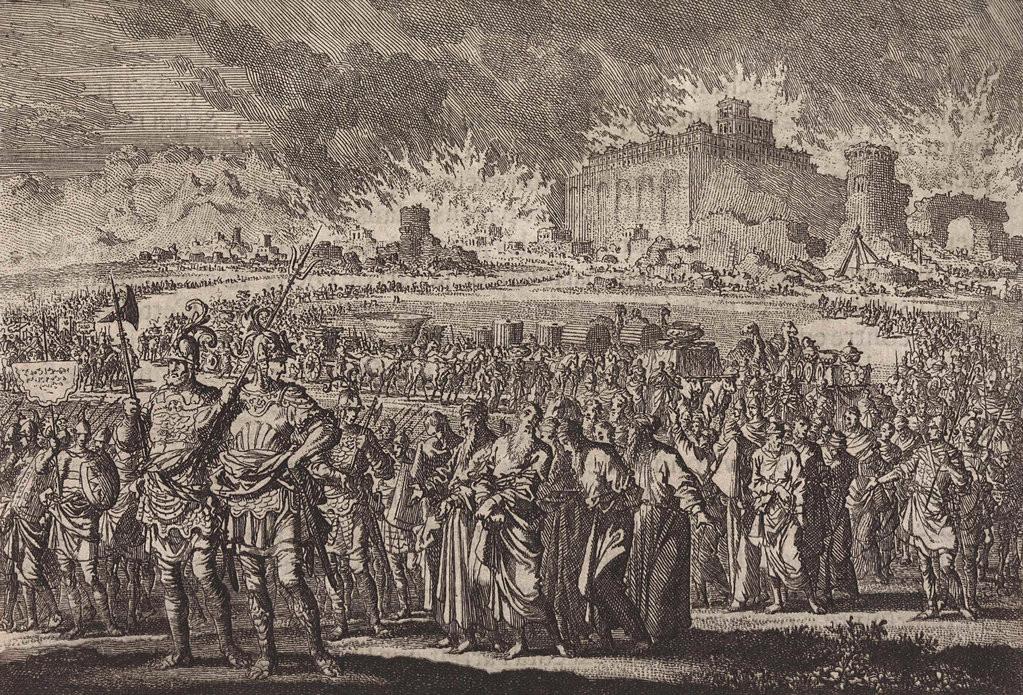
The scene in Jerusalem was one of utter destruction and devastation. The once-formidable city walls had been reduced to rubble. The massive doors that hung at the gates into Jerusalem had been torn from their hinges and burned. The homes of both the rich and the poor had been destroyed, leaving the city virtually uninhabitable. Even the king’s royal palace had been ransacked and turned into a smoldering ruin, and the Babylonians had not spared the house of God either. It had become a place of refuge for many trying to flee from the bloodthirsty Babylonians, but they found no help or hope within the walls of the Temple they had long neglected.

The Babylonians killed Judah’s young men, even chasing after them into the Temple. They had no pity on the people, killing both young men and young women, the old and the infirm. – 2 Chronicles 36:17 NLT

The grand house that Solomon had constructed, the long-standing symbol of God’s presence and power among His people, was desecrated and then destroyed.

The king took home to Babylon all the articles, large and small, used in the Temple of God, and the treasures from both the LORD’s Temple and from the palace of the king and his officials. Then his army burned the Temple of God… – 2 Chronicles 36:18 NLT

And none of this should have come as a surprise to the people of Judah. On the very day that Solomon had consecrated the newly opened Temple, God had warned him:

“I have answered your prayer and your request for help that you made to me. I have consecrated this temple you built by making it my permanent home; I will be constantly present there. You must serve me with integrity and sincerity, just as your father David did. Do everything I commanded and obey my rules and regulations. Then I will allow your dynasty to rule over Israel permanently, just as I promised your father David, ‘You will not fail to have a successor on the throne of Israel.’

“But if you or your sons ever turn away from me, fail to obey the regulations and rules I instructed you to keep, and decide to serve and worship other gods, then I will remove Israel from the land I have given them, I will abandon this temple I have consecrated with my presence, and Israel will be mocked and ridiculed among all the nations. This temple will become a heap of ruins; everyone who passes by it will be shocked and will hiss out their scorn, saying, ‘Why did the LORD do this to this land and this temple?’ Others will then answer, ‘Because they abandoned the LORD their God, who led their ancestors out of Egypt. They embraced other gods whom they worshiped and served. That is why the LORD has brought all this disaster down on them.’” – 2 Kings 9:3-9 NLT

More than three-and-a-half centuries had passed since Yahweh issued that warning to King Solomon. During that time, the majority of the kings of Judah had chosen to abandon Yahweh for the false gods of the nations around them. They led the nation into idolatry and apostasy, and now, as the people of Judah made their way in chains to Babylon, they could look over their shoulders and see the fiery fulfillment of God’s words to Solomon.

As Nebuchadnezzar and his forces departed Judah, they left a destroyed city and a decimated populace behind.

King Nebuchadnezzar took all of Jerusalem captive, including all the commanders and the best of the soldiers, craftsmen, and artisans—10,000 in all. Only the poorest people were left in the land. – 2 Kings 24:14 NLT

Nebuchadnezzar appointed a man named Gedaliah to serve as governor over the greatly diminished and demoralized citizenry of Jerusalem. They would no longer have a king to rule over them. Gedaliah was a Jew, but not a descendant of Solomon. He had no royal blood and would wield no kingly authority. He served at the behest of Nebuchadnezzar and was under the watchful eye of the ever-present Babylonian garrison. His was a thankless job that was more managerial than magisterial. In time, he would come to be seen as nothing more than a puppet of the occupying Babylonian forces.

The commanders of Judah’s army who had fled from the city of Jerusalem when the walls were breached returned when they heard that Gedaliah had been appointed governor. But they didn’t like the pro-Babylonian rhetoric that Gedaliah was spouting.

Gedaliah vowed to them that the Babylonian officials meant them no harm. “Don’t be afraid of them. Live in the land and serve the king of Babylon, and all will go well for you,” he promised. – 2 Kings 25:24 NLT

This compromising stance ultimately cost Gedaliah his life. Ishmael, one of Judah’s former military commanders, orchestrated the assassination of Gedaliah. It’s not clear what Ishmael hoped to accomplish by the murder of the Babylonian-appointed governor, but it seems obvious that this was an act of rebellion against the occupying forces. Ishmael murdered Gedaliah and his Jewish officials, along with members of the Babylonian garrison, and this resulted in a swift reprisal from Nebuchadnezzar. Ishmael’s attempt to drive the Babylonians out of Judah backfired on him. Instead, “all the people of Judah, from the least to the greatest, as well as the army commanders, fled in panic to Egypt, for they were afraid of what the Babylonians would do to them” (2 Kings 25:26 NLT).

This scene is intended to convey a strong sense of irony. The disobedient people of God were returning to the very place from which He had freed them centuries earlier. While some of their friends and family members had been deported to Babylon as slaves, this remnant of God’s chosen people would seek refuge in the land where their forefathers had been served as slaves for more than 400 years.

Once again, all of this had been predicted by God. Centuries earlier, as the people of Israel stood on the shore of the River Jordan, preparing to enter the Land of Promise, He had told them that if they would faithfully obey Him, they would experience His blessings. But if they chose to disobey Him, they would experience “long-lasting afflictions and severe, enduring illnesses” (Deuteronomy 28:59 NLT). Moses went on to warn them, “He will afflict you with all the diseases of Egypt that you feared so much, and you will have no relief. The LORD will afflict you with every sickness and plague there is, even those not mentioned in this Book of Instruction, until you are destroyed.” (Deuteronomy 28:60-61 NLT).

And Moses had been very specific when outlining the devastating nature of the curses they would encounter should they fail to “fear the glorious and awesome name of the LORD your God” (Deuteronomy 28:58 NLT).

The LORD will scatter you among all nations, from one end of the earth to the other. There you will worship other gods that neither you nor your ancestors have known, gods of wood and stone. Among those nations you will have no rest, nor will there be a place of peaceful rest for the soles of your feet, for there the Lord will give you an anxious heart, failing eyesight, and a spirit of despair. Your life will hang in doubt before you; you will be terrified by night and day and will have no certainty of surviving from one day to the next. In the morning you will say, ‘If only it were evening!’ And in the evening you will say, ‘I wish it were morning!’ because of the things you will fear and the things you will see. Then the LORD will make you return to Egypt by ship, over a route I said to you that you would never see again. There you will sell yourselves to your enemies as male and female slaves, but no one will buy you.” – Deuteronomy 28:64-68 NLT

Some 850 years after God had redeemed the people of Israel from their captivity in Egypt, a remnant of their still rebellious descendants would return. But it’s interesting to note that these poor, disheveled exiles would find no hope in Egypt. They won’t even be able to sell themselves as slaves. They will become paupers and aliens living outside the Land of Promise and under the curse of the God they chose to reject.

But despite all the dire imagery portrayed in this closing chapter of the book of 2 Kings, there is a silver lining on the dark cloud of Judah’s history. The author ends his book with a new king ascending to the throne of Babylon. These closing verses seem to be a mirror image of the scene found in the book of Genesis that preceded Israel’s 400-year enslavement in Egypt. Exodus 1:8 records, “Now there arose a new king over Egypt, who did not know Joseph.” This new Pharaoh came to power and, having no first-hand knowledge of Joseph and the people of Israel, decided that they were a threat to his administration. So, he launched a campaign to afflict and enslave them. This would lead to four centuries’ worth of unprecedented misery and maltreatment.

But when Evil-merodach replaced Nebuchadnezzar as the ruler over the Babylonian empire, he made a decision to release King Jehoiachin of Judah from his enslavement. He released him from prison and “spoke kindly to Jehoiachin and gave him a higher place than all the other exiled kings in Babylon” (2 Kings 25:28 NLT). For the remainder of his life in Babylon, Jehoiachin lived like a king. He was given royal robes to wear and was allowed to dine at Evil-merodach’s table.

But why is this important? It foreshadows something highly significant. Back in the book that bears his name, the prophet Jeremiah pronounced a curse on Jehoiachin, who was also known as Coniah.

“Why is this man Jehoiachin like a discarded, broken jar?
    Why are he and his children to be exiled to a foreign land?
O earth, earth, earth!
    Listen to this message from the LORD!
This is what the LORD says:
‘Let the record show that this man Jehoiachin was childless.
    He is a failure,
for none of his children will succeed him on the throne of David
    to rule over Judah.’”– Jeremiah 22:28-30 NLT

And yet, if we fast-forward to the gospel of Matthew, we find the following words in his genealogy of Jesus.

Josiah was the father of Jehoiachin and his brothers (born at the time of the exile to Babylon).
After the Babylonian exile:
Jehoiachin was the father of Shealtiel.
Shealtiel was the father of Zerubbabel.
Zerubbabel was the father of Abiud.
Abiud was the father of Eliakim.
Eliakim was the father of Azor.
Azor was the father of Zadok.
Zadok was the father of Akim.
Akim was the father of Eliud.
Eliud was the father of Eleazar.
Eleazar was the father of Matthan.
Matthan was the father of Jacob.
Jacob was the father of Joseph, the husband of Mary.
Mary gave birth to Jesus, who is called the Messiah. – Matthew 1:11-16 NLT

Here, in the genealogy of Jesus, we find Jehoiachin’s name. The very man who was told that none of his children would succeed him as king is listed as a progenitor of the King of kings. Of Jehoiachin’s seven sons, not one of them would ascend to the throne of David, but Jesus would. Yahweh would graciously reverse the curse, producing a royal heir who would reign in righteousness and deliver His people from their enslavement to sin and death.

Notice one more name in the lineage of Jesus: Zerubbabel. This descendant of Jehoiachin would later become the governor of Judea when the exiles returned from their captivity in Babylon. The prophet Haggai would pronounce a blessing from God on Zerubbabel that foreshadowed a great reversal of fortunes for His chosen people.

“Speak to Zerubbabel, governor of Judah, saying, I am about to shake the heavens and the earth, and to overthrow the throne of kingdoms. I am about to destroy the strength of the kingdoms of the nations, and overthrow the chariots and their riders. And the horses and their riders shall go down, every one by the sword of his brother. On that day, declares the LORD of hosts, I will take you, O Zerubbabel my servant, the son of Shealtiel, declares the LORD, and make you like a signet ring, for I have chosen you, declares the LORD of hosts.” – Haggai 2:21-23 NLT

The Book of 2 Kings ends on a positive note because God’s will concerning the people of Israel was far from done. The story of the redemption of His chosen people and the restoration of the world He created was not yet over. The Messiah, the Savior of the world, would one day come, and His arrival would usher in a new day and a new hope for the people of God and the nations of the world.

English Standard Version (ESV) The Holy Bible, English Standard Version. ESV® Permanent Text Edition® (2016). Copyright © 2001 by Crossway Bibles, a publishing ministry of Good News Publishers.

New Living Translation (NLT) Holy Bible, New Living Translation, copyright © 1996, 2004, 2015 by Tyndale House Foundation. Used by permission of Tyndale House Publishers Inc., Carol Stream, Illinois 60188. All rights reserved.
Submission is Not a Dirty Word

18 Wives, submit to your husbands, as is fitting in the Lord. 19 Husbands, love your wives, and do not be harsh with them. 20 Children, obey your parents in everything, for this pleases the Lord. 21 Fathers, do not provoke your children, lest they become discouraged. 22 Bondservants, obey in everything those who are your earthly masters, not by way of eye-service, as people-pleasers, but with sincerity of heart, fearing the Lord. 23 Whatever you do, work heartily, as for the Lord and not for men, 24 knowing that from the Lord you will receive the inheritance as your reward. You are serving the Lord Christ. 25 For the wrongdoer will be paid back for the wrong he has done, and there is no partiality.

1 Masters, treat your bondservants justly and fairly, knowing that you also have a Master in heaven. Colossians 3:18-4:1 ESV

Paul now takes those other-oriented, selfless, and love-motivated character traits and applies them to everyday life. Since he was writing to believers living in Colossae, he customized his words for their particular context. He wanted them to know what seeking and setting their minds on things that are above would look like on a daily basis. He wasn’t promoting an ethereal and impractical brand of religious pietism and asceticism. No, he was recommending a highly practical brand of faith that revealed the transformative nature of the gospel in everyday life.

They were to “put on the new self, which is being renewed in knowledge after the image of its creator” (Colossians 3:10 ESV). As God’s chosen ones, they were to put on “compassionate hearts, kindness, humility, meekness, and patience” (Colossians 3:12 ESV). But none of these “add-ons” would be effective without love.

…put on love, which binds everything together in perfect harmony… – Colossians 3:14 ESV

Since God is love and He best expressed that love through the gift of His Son, Paul called the Colossians to “do everything in the name of the Lord Jesus” (Colossians 3:17 ESV). But what does that look like? How were they supposed to make these powerful admonitions practical? Well, Paul makes it plain and simple for them. He begins with the family unit, one of the most foundational and universal arenas of personal relationships in this life.

The family was God’s idea. He originated and ordained the union of one man and one woman, creating an indissoluble bond between them as husband and wife. The creation account found in the opening chapters of Genesis records God’s creation of the first marriage.

So the Lord God caused a deep sleep to fall upon the man, and while he slept took one of his ribs and closed up its place with flesh. And the rib that the Lord God had taken from the man he made into a woman and brought her to the man. Then the man said,

“This at last is bone of my bones
    and flesh of my flesh;
she shall be called Woman,
    because she was taken out of Man.”

Therefore a man shall leave his father and his mother and hold fast to his wife, and they shall become one flesh. – Genesis 2:21-24 ESV

Jesus Himself confirmed the validity of the Genesis account by stating, “Have you not read that he who created them from the beginning made them male and female, and said, ‘Therefore a man shall leave his father and his mother and hold fast to his wife, and the two shall become one flesh’? So they are no longer two but one flesh. What therefore God has joined together, let not man separate” (Matthew 19:4-6 ESV).

So, Paul begins at the beginning – with the family unit. He calls believing wives to submit to their believing husbands. But he adds an important, yet often overlooked, distinction: “as is fitting in the Lord” (Colossians 3:18 ESV). The New Living Translation puts it this way: “as is fitting for those who belong to the Lord.”

Paul’s use of the word “submission” was directly linked to his call that all believers conduct themselves with compassionate hearts, kindness, humility, meekness, and patience. If there was ever a relationship where those characteristics were necessary, it was the union between a husband and wife. So, he calls wives to lovingly, humbly, meekly, and patiently relate to their husbands in such a way that honors their role as the God-appointed head of the household. Paul provided additional insight into the headship role of the husband when writing to the church in Ephesus.

…submit to one another out of reverence for Christ. For wives, this means submit to your husbands as to the Lord. For a husband is the head of his wife as Christ is the head of the church. He is the Savior of his body, the church. As the church submits to Christ, so you wives should submit to your husbands in everything. – Ephesians 5:21-24 NLT

The biblical concept of submission has nothing to do with superiority or inferiority. Paul is not suggesting that women are somehow second-class citizens. He is simply articulating the divinely ordained concept of headship within the family unit. Just as Christ is the head of the church, the believing husband is responsible for the well-being of his family, and that role comes with a heavy dose of accountability.

Paul made it painfully clear that one of the primary leadership responsibilities of a godly husband was to selflessly love his wife. Once again, Paul provides further clarity in his letter to the church in Ephesus.

…this means love your wives, just as Christ loved the church. He gave up his life for her to make her holy and clean, washed by the cleansing of God’s word. – Ephesians 5:25-26 NLT

To lovingly and graciously submit to her husband, a wife must surrender her pride and natural desire for autonomy. In other words, she would have to “put off the old self with its practices” (Colossians 3:9 ESV). Submission doesn’t come naturally or easily for anyone. It requires a sacrifice of the human will. For anyone to submit in a way that “is fitting for those who belong to the Lord” (Colossians 3:18 NLT), they have to “put to death the sinful, earthly things lurking within” (Colossians 3:18 NLT). And according to Peter, submission isn’t required for wives alone. He calls all believers to model godly submission to all those in authority.

Be subject for the Lord’s sake to every human institution, whether it be to the emperor as supreme, or to governors as sent by him to punish those who do evil and to praise those who do good. For this is the will of God – 1 Peter 2:13-15 ESV

Regardless of their gender, each believer’s life is to be marked by an attitude of humble submission to others – for this is the will of God. According to Paul, one of the greatest displays of dying to self was to be a husband’s selfless expression of love for his wife. He was to put his wife’s life ahead of his own, even sacrificing his own life if necessary.

At the core of Paul’s teaching on submission is the contrast between humility and pride. There was no place for self-aggrandizement in the life of a believer.

Do nothing out of selfish ambition or empty pride, but in humility consider others more important than yourselves. Each of you should look not only to your own interests, but also to the interests of others. – Philippians 2:3-4 BSB

Even children had a part to play in God’s divine order for the home. They were to obey their parents in everything. Why? Because this was pleasing to the Lord. It was in keeping with His divine will. A child’s obedience was a form of submission to the God-ordained authority of their parents. Again, this is not normal or natural. As the proverb states, “Foolishness is bound up in the heart of a child…” (Proverbs 22:15 BSB).

It’s interesting to note that the disobedience of children was one of the characteristics Paul listed when describing the state of the world in the last days.

You should know this, Timothy, that in the last days there will be very difficult times. For people will love only themselves and their money. They will be boastful and proud, scoffing at God, disobedient to their parents, and ungrateful. They will consider nothing sacred. They will be unloving and unforgiving; they will slander others and have no self-control. They will be cruel and hate what is good. They will betray their friends, be reckless, be puffed up with pride, and love pleasure rather than God. – 2 Timothy 3:1-4 NLT

But, according to Paul, an obedient child is the byproduct of a loving and godly father.

Fathers, do not aggravate your children, or they will become discouraged. – Colossians 3:21 NLT

Proverbs 22 goes on to say, “A youngster’s heart is filled with foolishness, but physical discipline will drive it far away” (Proverbs 22:15 NLT). Yet, too much discipline, done in an unloving and heavy-handed manner, can do more harm than good. It can cause a child to become discouraged. Discipline that is unloving and lacking in compassion can disincentivize a child from trying to obey. It can actually result in rebellion rather than submission. So, Paul warns fathers to use their role as heads of their households with care.

Next, Paul moves from addressing the family unit to dealing with another relationship that was ubiquitous in the Colossian community: slavery. While we find this topic uncomfortable and somewhat off-putting, it was a normal part of everyday life for the citizens of Colossae.

“Scholars estimate about 10% (but possibly up to 20%) of the Roman empire’s population were enslaved. This would mean, for an estimated Roman empire population of 50 million (in the first century AD) between five and ten million were enslaved. This number would have been unequally distributed across the empire, with a higher concentration of enslaved people in urban areas and in Italy.” – http://www.britishmuseum.org

Slavery was an everyday part of daily life in Colossae. Yet Paul doesn’t attempt to address the moral implications of slavery. Instead, he shows the Colossian believers how their new identity in Christ should impact every area of life. The reality was that slaves were coming to faith in Christ and becoming a part of the local congregation of believers. It was highly likely that the church in Colossae had slaves attending worship services with their own masters. This presented a particularly difficult problem for Paul and the church’s leadership. How were these people supposed to relate to one another? How should their mutual relationship with Christ impact their interpersonal relationship with one another?

Paul addresses both parties. He tells slaves, “obey your earthly masters in everything you do. Try to please them all the time, not just when they are watching you. Serve them sincerely because of your reverent fear of the Lord” (Colossians 3:22 NLT). Then he turns his attention to the masters.

…be just and fair to your slaves. Remember that you also have a Master—in heaven. – Colossians 4:1 NLT

Notice his emphasis on God. Both parties were to recognize that their earthly relationship with one another had been dramatically altered by their new identity in Christ. While nothing had changed regarding their worldly status, Paul wanted them to know that God viewed them in a new light.

In this new life, it doesn’t matter if you are a Jew or a Gentile, circumcised or uncircumcised, barbaric, uncivilized, slave, or free. Christ is all that matters, and he lives in all of us. – Colossians 3:11 NLT

Paul’s words to slaves teach an invaluable and universal lesson. These were individuals who had no choice regarding their condition. Their position as slaves required that they submit, whether they wanted to or not. But Paul challenged them to take a different attitude.

Work willingly at whatever you do, as though you were working for the Lord rather than for people. Remember that the Lord will give you an inheritance as your reward, and that the Master you are serving is Christ. – Colossians 3:23-24 NLT

This call to a new outlook applied to every believer in the local church in Colossae. It’s what Paul meant when he wrote, “Set your minds on things that are above, not on things that are on earth” (Colossians 3:2 ESV). A slave was to live with an eternal perspective, knowing that his current circumstance was temporal. There was a reward awaiting him that made his present suffering pale in comparison. But that heavenly-minded, future-focused perspective was to motivate the life of every believer in Colossae, regardless of their gender, race, or social status.

English Standard Version (ESV) The Holy Bible, English Standard Version. ESV® Permanent Text Edition® (2016). Copyright © 2001 by Crossway Bibles, a publishing ministry of Good News Publishers.

New Living Translation (NLT) Holy Bible, New Living Translation, copyright © 1996, 2004, 2015 by Tyndale House Foundation. Used by permission of Tyndale House Publishers Inc., Carol Stream, Illinois 60188. All rights reserved.

If You Won’t, God Will

47 “If a stranger or sojourner with you becomes rich, and your brother beside him becomes poor and sells himself to the stranger or sojourner with you or to a member of the stranger’s clan, 48 then after he is sold he may be redeemed. One of his brothers may redeem him, 49 or his uncle or his cousin may redeem him, or a close relative from his clan may redeem him. Or if he grows rich he may redeem himself. 50 He shall calculate with his buyer from the year when he sold himself to him until the year of jubilee, and the price of his sale shall vary with the number of years. The time he was with his owner shall be rated as the time of a hired worker. 51 If there are still many years left, he shall pay proportionately for his redemption some of his sale price. 52 If there remain but a few years until the year of jubilee, he shall calculate and pay for his redemption in proportion to his years of service. 53 He shall treat him as a worker hired year by year. He shall not rule ruthlessly over him in your sight. 54 And if he is not redeemed by these means, then he and his children with him shall be released in the year of jubilee. 55 For it is to me that the people of Israel are servants. They are my servants whom I brought out of the land of Egypt: I am the Lord your God. Leviticus 25:47-55 ESV

God provides one final example of an Israelite who has hit upon hard times and has been forced to seek recourse by selling himself to a “stranger or sojourner” living among them. This is a reference to a non-Israelite or foreigner. What God describes here would have been considered a travesty because it revealed that this destitute Israelite had no other options. No one within the community of faith had come to his aid (verse 35). There wasn’t even a fellow Israelite willing to make this man his indentured servant. Desperate to alleviate his own debt and care for his family, the man was forced to sell himself to someone outside the family of God.

“This would be on the face of it an embarrassment and the opposite of what God had in mind for his people. Foreigners in God’s economy were not to rule over the covenant people. Foreigners were welcomed and well treated by the Hebrews, but they were to be under the social orbit of the native Israelites. Israelites were permitted to purchase slaves who were foreigners but never fellow covenant members.” – Kenneth A. Matthews, Leviticus: Holy People, Holy God

In the Book of the Covenant, God had given His commands concerning the treatment of strangers and sojourners living among the Israelites.

When a foreigner resides with you in your land, you must not oppress him. You must treat the foreigner living among you as native-born and love him as yourself, for you were foreigners in the land of Egypt. I am the LORD your God. – Leviticus 20:33-34 BSB

But while foreigners were welcome to live among the Israelites, these “strangers” were never considered part of the covenant community. Many of them may have been proselytes to the Hebrew religion or what became known as “God-fearers,” but they were never allowed to share in the inheritance of the land of Canaan. These “God-fearing” pagans were Gentiles who had chosen to attach themselves to Yahweh and His people but had not fully converted to Judaism. Many of them may have been Egyptians who chose to accompany the Israelites when they were delivered by God (Exodus 12:38).

These God-fearing foreigners were allowed to dwell among the Israelites, but they were never to possess any of the lands that had been given by God as an inheritance to His covenant people. But if a foreigner had somehow been able to accrue enough wealth to purchase an Israelite as his slave, he might well end up with rights to that man’s property. This would have been unacceptable to God. So, to protect His people and the land He had given them, God made special provisions for this kind of situation.

“If any of your fellow Israelites fall into poverty and are forced to sell themselves to such a foreigner or to a member of his family, they still retain the right to be bought back, even after they have been purchased. They may be bought back by a brother, an uncle, or a cousin. In fact, anyone from the extended family may buy them back. – Leviticus 25:47-49 NLT

Even in this worst-case scenario, God gave His people a second chance to do the right thing. If one of their own became so desperate that they sold themselves to a foreigner, the rest of the Israelite community was expected to step in and rectify the situation. Not only was the land considered sacred, but it also belonged to Yahweh (Leviticus 25:23). The people had no right to sell it in order to profit from it. And they were to do everything in their power to see that the land remained occupied by God’s chosen people. Foreigners were welcome but they were not allowed to possess what rightfully belonged to God. And to ensure that the land of God and the people of God remained His possessions, God provided the Year of Jubilee as a final form of restitution and redemption.

Set this year apart as holy, a time to proclaim freedom throughout the land for all who live there. It will be a jubilee year for you, when each of you may return to the land that belonged to your ancestors and return to your own clan. – Leviticus 25:10 NLT

When the Year of Jubilee arrived, any lands that had been leased or mortgaged were returned to their original owners, and all slaves and bonded laborers were provided with their freedom. If the people did not redeem their own, God would do it.

But God did not want His people to treat the Year of Jubilee like some kind of divine lottery system. They were not to wait around until the 50th year, living as slaves to one another or outsiders. Each individual was expected to do whatever was necessary to settle his debts and seek freedom. Redemption was the focus. They were not to bide their time and settle for a life of slavery while waiting for the redemption of God. No, they were to do everything in their power to seek redemption.

“…they still retain the right to be bought back, even after they have been purchased. They may be bought back by a brother, an uncle, or a cousin. In fact, anyone from the extended family may buy them back. They may also redeem themselves if they have prospered.” – Leviticus 25:48-49 NLT

During the 49 years that led up to the Year of Jubilee, the Israelites were to be pursuing their own redemption and that of their neighbors. There were no shortcuts and workarounds. To settle their debts, they were required to calculate the value of their services based on the time remaining until the Year of Jubilee.

If many years still remain until the jubilee, they will repay the proper proportion of what they received when they sold themselves. If only a few years remain until the Year of Jubilee, they will repay a small amount for their redemption. – Leviticus 25:51-52 NLT

Restoration and redemption came with a price. They had to pay back what they owed. And anyone who had purchased the debt of an Israelite was to treat their “servant” with dignity and respect. The debtor, despite his dire circumstances, remained a child of God and deserved to be treated that way. No foreigner was allowed to mistreat an Israelite. No Israelite was permitted to denigrate a brother by taking advantage of his impoverished condition and abusing him like a slave. The people of God were never to forget their former condition as slaves in Egypt.

Always remember that you were slaves in Egypt and that the Lord your God redeemed you from your slavery. That is why I have given you this command. – Deuteronomy 24:18 NLT

And God reminded His people that each of them belonged to Him. The rich and the poor, the social elite, and the common peasant were all considered God’s possessions.

For the people of Israel belong to me. They are my servants, whom I brought out of the land of Egypt. I am the Lord your God. – Leviticus 25:55 NLT

The land belonged to God and so did the people, and that is why God expected the Israelites to treat both with equal honor and dignity. The land was not theirs to sell, profit from, abuse, or neglect. God had given them the land to provide for their needs and to serve as their permanent homeland. But God had also chosen the entire nation of Israel as His treasured possession (Deuteronomy 14:2). Each of them, from the greatest to the least, was considered holy in the eyes of God.

“…you are a holy people, who belong to the Lord your God. Of all the people on earth, the Lord your God has chosen you to be his own special treasure.” – Deuteronomy 7:6 NLT

There was to be no hierarchy or caste system within the people of God. The rich were not to lord it over the poor. The destitute were not to be treated as second-class citizens. And God provided His people with plenty of examples of how He expected this to unfold in daily life.

“If your neighbor is poor and gives you his cloak as security for a loan, do not keep the cloak overnight. Return the cloak to its owner by sunset so he can stay warm through the night and bless you, and the Lord your God will count you as righteous.” – Deuteronomy 24:12-13 NLT

Never take advantage of poor and destitute laborers, whether they are fellow Israelites or foreigners living in your towns.Deuteronomy 24:14 NLT

“True justice must be given to foreigners living among you and to orphans, and you must never accept a widow’s garment as security for her debt.Deuteronomy 24:17 NLT

“When you are harvesting your crops and forget to bring in a bundle of grain from your field, don’t go back to get it. Leave it for the foreigners, orphans, and widows. Then the Lord your God will bless you in all you do.Deuteronomy 24:19 NLT

The land and the people belonged to God. They were His possessions and were to be treated as holy. And when His people inevitably failed to honor that which belonged to God, He would see to it that redemption was achieved. The Year of Jubilee was designed to remedy the sins of man and restore that which belonged to God to its rightful place as His possession.

English Standard Version (ESV) The Holy Bible, English Standard Version. ESV® Permanent Text Edition® (2016). Copyright © 2001

New Living Translation (NLT) Holy Bible, New Living Translation, copyright © 1996, 2004, 2015 by Tyndale House Foundation. Used by permission of Tyndale House Publishers Inc., Carol Stream, Illinois 60188. All rights reserved.

Guidelines for Living in a Fallen World

35 “If your brother becomes poor and cannot maintain himself with you, you shall support him as though he were a stranger and a sojourner, and he shall live with you. 36 Take no interest from him or profit, but fear your God, that your brother may live beside you. 37 You shall not lend him your money at interest, nor give him your food for profit. 38 I am the Lord your God, who brought you out of the land of Egypt to give you the land of Canaan, and to be your God.

39 “If your brother becomes poor beside you and sells himself to you, you shall not make him serve as a slave: 40 he shall be with you as a hired worker and as a sojourner. He shall serve with you until the year of the jubilee. 41 Then he shall go out from you, he and his children with him, and go back to his own clan and return to the possession of his fathers. 42 For they are my servants, whom I brought out of the land of Egypt; they shall not be sold as slaves. 43 You shall not rule over him ruthlessly but shall fear your God. 44 As for your male and female slaves whom you may have: you may buy male and female slaves from among the nations that are around you. 45 You may also buy from among the strangers who sojourn with you and their clans that are with you, who have been born in your land, and they may be your property. 46 You may bequeath them to your sons after you to inherit as a possession forever. You may make slaves of them, but over your brothers the people of Israel you shall not rule, one over another ruthlessly.” Leviticus 25:35-46 ESV

In this section, God deals with the issue of poverty among the people of Israel. It was an inevitable and unavoidable reality that some within the Israelite community would end up impoverished and in need of assistance. God has already addressed the future scenario of someone having to sell their land to pay off debts. Now, He deals with how the community was to respond to the less fortunate among them. The poor were to be treated fairly and with compassion.

“If one of your fellow Israelites falls into poverty and cannot support himself, support him as you would a foreigner or a temporary resident and allow him to live with you. – Leviticus 25:35 NLT

The Hebrew word that is translated as “brother” in the ESV is (‘āḥ), which can refer to a brother of the same parents, a half-brother, a member of the same clan or tribe, or, more broadly, a fellow Israelite. Since God’s focus throughout this chapter has been on the national celebration of the Year of Jubilee, it would seem that He is dealing with the much broader level of the Israelite community and not just a familial relationship. The same terminology is used in the book of Deuteronomy where God prohibits the Israelites from charging of interest to a “brother.”

“You shall not charge interest on loans to your brother, interest on money, interest on food, interest on anything that is lent for interest. You may charge a foreigner interest, but you may not charge your brother interest, that the Lord your God may bless you in all that you undertake in the land that you are entering to take possession of it. – Deuteronomy 23:19-20 ESV

It makes more sense to view this from the much broader perspective of the brotherhood that existed between all Israelites. As the chosen people of God, they were to care for their own. God expected His people to show mercy and extend grace to one another. The poor were never to be treated as second-class citizens or to be taken advantage of because of their unfortunate circumstances. Instead, the Israelites were to provide them with assistance which include food and shelter, as well as interest-free loans. God commanded that they treat these individuals like family.

“…show your fear of God by letting him live with you as your relative.” – Leviticus 25:36 NLT

God reminds His people that there was a time when they were poor and enslaved, but He had shown them mercy and graciously provided for all their needs.

“I am the Lord your God, who brought you out of the land of Egypt to give you the land of Canaan and to be your God.” – Leviticus 25:38 NLT

When they were living as nothing more than slaves in Egypt, God treated them like family and provided them with freedom, food, and the promise of a land to call their own. He welcomed them with open arms and guaranteed them a part of His inheritance. Now, He was asking the Israelites to do the same with one another.

When the Israelites arrived in the land of Canaan, they would each receive their portion of the inheritance. But despite the graciousness and goodness of God, some would still end up in poverty. Human nature and sin would combine to create less-than-ideal outcomes that left some among the people of God destitute and desperate. Financial ruin would drive some to take drastic measures, such as selling themselves as servants to their wealthier Israelite neighbors. But God had already made provision for such circumstances in His diving of the Book of the Covenant.

“If you buy a Hebrew slave, he may serve for no more than six years. Set him free in the seventh year, and he will owe you nothing for his freedom. If he was single when he became your slave, he shall leave single. But if he was married before he became a slave, then his wife must be freed with him. – Exodus 21:2-3 NLT

And God would later reiterate this command and provide further conditions concerning the release of these indentured servants.

“If a fellow Hebrew sells himself or herself to be your servant and serves you for six years, in the seventh year you must set that servant free.

“When you release a male servant, do not send him away empty-handed. Give him a generous farewell gift from your flock, your threshing floor, and your winepress. Share with him some of the bounty with which the Lord your God has blessed you. Remember that you were once slaves in the land of Egypt and the Lord your God redeemed you! That is why I am giving you this command.” – Deuteronomy 15:12-15 NLT

The Israelites were never to exploit the less fortunate among them. They were to recognize that the rich and the poor were all equal in the eyes of God. He showed no partiality but treated all His children fairly and justly, and expected them to do the same.

“For the Lord your God is the God of gods and Lord of lords. He is the great God, the mighty and awesome God, who shows no partiality and cannot be bribed. He ensures that orphans and widows receive justice. He shows love to the foreigners living among you and gives them food and clothing. So you, too, must show love to foreigners, for you yourselves were once foreigners in the land of Egypt. – Deuteronomy 10:17-19 NLT

God wanted the Israelites to remember that He considered each of them His servants and, as such, they were not to enslave one another. Pharaoh had attempted to enslave God’s people and suffered deadly consequences for his actions, and the people of Israel were not to avoid repeating his mistake. An indentured servant was never to be treated as a slave, and they could not be sold like property. While an individual was paying off his debt in the employment of a fellow Israelite, he was to be treated fairly and justly. And when the sabbatical year came, he was to be set free and provided with a generous gift to assist him in rebuilding his life within the community.

But in verses 44-46, God deals with the highly uncomfortable and unpopular topic of slavery. And, in this case, He is not talking about Israelites paying off their debts as indentured servants; He is dealing with foreign slaves.

“However, you may purchase male and female slaves from among the nations around you. You may also purchase the children of temporary residents who live among you, including those who have been born in your land. You may treat them as your property, passing them on to your children as a permanent inheritance. You may treat them as slaves, but you must never treat your fellow Israelites this way. – Leviticus 25:44-46 NLT

Passages like this one are difficult to reconcile and explain. They seem to fly in the face of our more modern and enlightened sensibilities. They appear to paint God in a negative light, portraying Him as supportive of the institution of slavery. But is God actually sanctioning the enslavement of human beings or is He attempting to regulate what had become a ubiquitous and inevitable part of the fallen world?

“Because men and women are sinners and live in a fallen world, such things as divorce, and we can add for our purposes, slavery, occur. It is sadly a part of the human experience, and the Bible sets out to first regulate treatment of slaves and the to set the grounds for slavery’s elimination. The Bible makes is clear that slaves were not mere chattel but had God-given protections and certain rights (e.g., Exodus 21:7-11). For example, a runaway slave from a foreign country was not to be returned to his master (Deuteronomy 23:15, 16). The motivation for gentler treatment of slaves was theological: The Israelites had once been slaves in Egypt whom God had delivered. The cruelty that they experienced in Egypt was not tolerated in Israel.” – Kenneth A. Matthew, Leviticus: Holy God, Holy People

Over the centuries, many have expressed disappointment and even disdain for the Bible’s lack of an outright ban on the institution of slavery. After all, in His declaration of the Decalogue, God clearly outlawed murder. But consider the fact that He did not prohibit war. In fact, God would later sanction and even participate in the battles between His people and the nations of the earth. God also declared the marriage union to be indissoluble and binding (Genesis 2:24; Matthew 9:5-6). Yet, despite God’s hatred for divorce (Malachi 2:16), He made concessions for it because He knew that, because of sin, it was inevitable (Deuteronomy 24:1-4). God, who never changes, did not alter His view on divorce but made provisions for its inevitable presence among His people. Because of their sinful natures, they would follow the ways of the world and choose to disobey His commands regarding everything from divorce, murder, sexual immorality, and slavery. And when these egregious activities showed up among His people, God provided guidelines for dealing with them. He did not eradicate all sin among His people but provided them with wise and righteous laws to regulate how they were to live in a fallen world filled with all kinds of ungodly temptations.

Fast forward to the New Testament and the apostle Paul provides a new perspective on the issue of slavery based on the death and resurrection of Jesus. With Jesus’ sacrificial death on the cross, He leveled the playing field, making salvation available to any and all, regardless of their ethnicity, gender, or social standing.

There is neither Jew nor Greek, there is neither slave nor free, there is no male and female, for you are all one in Christ Jesus. – Galatians 3:28 ESV

Paul did not call for the elimination of all slavery. It was an accepted part of the social fabric of his day. But Paul was not an advocate of the institution of slavery. Instead, he was a proponent of the gospel of Jesus Christ, which was accessible to all people from every walk of life.

It is interesting to note that God had allowed His own people to live as slaves for centuries before He released them from their captivity. And even after their miraculous deliverance from the evils of slavery, the Israelites would find it tempting to enslave others. Their release did not naturally create a revulsion for the institution of slavery. Just as they were predisposed to lying, cheating, sexual immorality, and idolatry, they would be drawn to the allure of slavery as a form of power and control. God knew His people would follow the ways of the world, so He provided them with stringent guidelines that were intended to separate them from all the other nations.

English Standard Version (ESV) The Holy Bible, English Standard Version. ESV® Permanent Text Edition® (2016). Copyright © 2001

New Living Translation (NLT) Holy Bible, New Living Translation, copyright © 1996, 2004, 2015 by Tyndale House Foundation. Used by permission of Tyndale House Publishers Inc., Carol Stream, Illinois 60188. All rights reserved.

Practical Laws For Real Life

1 “Now these are the rules that you shall set before them. When you buy a Hebrew slave, he shall serve six years, and in the seventh he shall go out free, for nothing. If he comes in single, he shall go out single; if he comes in married, then his wife shall go out with him. If his master gives him a wife and she bears him sons or daughters, the wife and her children shall be her master’s, and he shall go out alone. But if the slave plainly says, ‘I love my master, my wife, and my children; I will not go out free,’ then his master shall bring him to God, and he shall bring him to the door or the doorpost. And his master shall bore his ear through with an awl, and he shall be his slave forever.” – Exodus 21:1-6 ESV

Beginning with chapter 21 and running through the 19th verse of chapter 23, Moses delivers the expanded version of God’s law to His people. He later refers to it as “the Book of the Covenant” (Exodus 24:7 ESV. This more comprehensive collection of commands was intended to be an extension of the Decalogue. It is “an application of the Decalogue to the specific social context of Israel as a nation” (John D. Currid, A Study Commentary on Exodus).

The Decalogue and the Book of the Covenant were not given in a complete moral or legal vacuum. By the time of the exodus, various ancient societies had developed legal codes to help regulate human behavior and interaction. Many of these codes contain prohibitions similar to those found in the Book of the Covenant. These include the Laws of Esnunna, created by the Akkadian civilization located in Mesopotamia. The Sumerian civilization had the Code of Lipit-Istar. And centuries later, the Babylonians would come up with the more familiar Code of Hammurabi.

It is important to note that the Israelites had not been living in a lawless state. Even in Egypt, their lives had been governed by a series of written and oral legal codes. God created humanity with a basic understanding of His righteous standards. The apostle Paul wrote about how God has placed within all men an instinctive understanding of His law.

Even Gentiles, who do not have God’s written law, show that they know his law when they instinctively obey it, even without having heard it. They demonstrate that God’s law is written in their hearts, for their own conscience and thoughts either accuse them or tell them they are doing right. – Romans 2:13-15 NLT

When Adam and Eve sinned in the garden, they violated a clear command of God.

“You may surely eat of every tree of the garden, but of the tree of the knowledge of good and evil you shall not eat, for in the day that you eat of it you shall surely die.” – Genesis 2:16-17 ESV

And their motivation for breaking that command was their desire to “be like God, knowing good and evil” (Genesis 3:5 ESV). As soon as they chose to disobey God’s prohibition, “the eyes of both were opened, and they knew that they were naked” (Genesis 3:7 ESV). They gained an immediate awareness of their sinful state. In that moment, their innocence was replaced with guilt, as they considered the ramifications of their actions.

From the very beginning, God’s moral law permeated His creation. And despite the sin of Adam and Eve, mankind maintained a rudimentary understanding of God’s will concerning human behavior. Cain knew murder was wrong, and he understood that there were painful consequences for those who took the life of the innocent.

Cain said to the Lord, “My punishment is greater than I can bear. – Exodus 4:13 ESV

But all the legal codes in the world could not correct mankind’s moral spiral into disobedience and decadence. By the time we get to chapter six of Genesis, the moral state of human society had hit an all-time low.

The Lord observed the extent of human wickedness on the earth, and he saw that everything they thought or imagined was consistently and totally evil. – Genesis 6:5 NLT

Their problem was not a lack of laws, but a general unwillingness and inability to obey those laws. Things had deteriorated so badly, that the text indicates there was only one righteous man left on the earth.

Noah was a righteous man, the only blameless person living on earth at the time, and he walked in close fellowship with God. – Genesis 6:9 NLT

This led God to begin again, providing Noah and his extended family with a means of escaping His judgment against the rest of human society. And post-flood, God’s unwritten law continued to hold sway, dictating the behavior of all those who descended from Noah’s three sons. But the generations that followed proved to be no different than their pre-flood ancestors. They also willingly and regularly violated God’s righteous standards.

This led God to begin again with a man named Abram, an elderly pagan from the land of Ur in Mesopotamia. God chose this obscure individual to carry out His divine plan for restoring sinful mankind to a right relationship with Himself. And long before Abram and his barren wife, Sarai, had ever conceived their first child, God made a covenant with them. This legal agreement was intended to set apart Abram and his descendants as a special people, who would enjoy a one-of-a-kind relationship with God Almighty.

“As for you, you shall keep my covenant, you and your offspring after you throughout their generations. This is my covenant, which you shall keep, between me and you and your offspring after you: Every male among you shall be circumcised. You shall be circumcised in the flesh of your foreskins, and it shall be a sign of the covenant between me and you.” – Genesis 17:9-11 ESV

Circumcision was a sign of the covenant. It was a legal requirement mandated by God that was intended to signify their unwavering commitment to their newfound status as His chosen people. God had promised to produce from Abram and his barren wife a great and mighty nation. And that promise was passed down from Abram to his son, Isaac, and then from Isaac to Jacob. And the Israelites whom God redeemed out of captivity in Egypt were the direct descendants of Jacob. They were the great nation that God had promised and they were to be His treasured possession, a kingdom of priests, and a holy nation (Exodus 19:5-6).

But after 400 years of living in Egypt, separated from God and influenced by the idolatry and immorality of that land, the people of Israel needed a more concrete and comprehensive understanding of God’s expectations of them. So, He gave them His law. The Ten Commandments were the summary statement of His moral requirements. The Book of the Covenant provided the application of those “ten words” to everyday life situations. These practical and highly specific laws were given to the people of Israel. They were intended to govern their conduct and set them apart from every other people group on the earth. These laws were not to be universally applied or mandated for all cultures but were designed to differentiate the people of God from everyone else.

In a sense, the Ten Commandments are timeless and universal in their application. But the Book of the Covenant was meant to apply to a specific people group living at a particular time in human history.

“…the Book of the Covenant was never intended to address every possible situation. It was more a guide to cases than a statutory code. Whereas the Ten Commandments were expressed as universal absolutes, the laws in the Book of the Covenant dealt with specific situations. They provided a series of legal precedents that wise elders could use in settling disputes. While these case laws could not possibly cover every new situation that might arise, they illustrated basic legal principles for living in community with the people of God.” – Philip Graham Ryken, Exodus: Saved For God’s Glory

But why does God begin his Book of the Covenant with laws concerning slavery? The answer is found in the prologue that God gave before delivering the Decalogue to Moses.

And God spoke all these words, saying,

“I am the Lord your God, who brought you out of the land of Egypt, out of the house of slavery. – Exodus 20:1-2 ESV

The Israelites had just been delivered from slavery in Egypt. They had spent several centuries under the heavy hand of the Pharaohs, toiling as indentured servants and enduring unrelenting persecution and suffering at the hands of their masters. But now, they were free. And God wanted them to use their newfound freedom as an incentive to treat others with greater dignity and respect.

It can’t be overlooked that, in His giving of the law, God does not abolish the practice of slavery. Instead, He provides moral guidelines for the treatment of those who find themselves enslaved. In a world where slavery was ubiquitous and universal, God provided a new way of regulating this institution that was of human origin. Slavery, like adultery, murder, incest, lying, and idolatry, was never God’s intention. They are all the result of sin’s entrance into the world. And slavery, as an institution and practice, became a symbol of mankind’s relationship with sin.

Jesus understood this undeniable link between mankind and sin. He described its vice-like grip on humanity in a statement He made to the Pharisees.

“Truly, truly, I say to you, everyone who practices sin is a slave to sin. – John 8:34 ESV

The apostle Paul would later declare the remarkable significance of Jesus’ death on the cross, which provided the only means of being delivered from slavery to sin.

We know that our old self was crucified with him in order that the body of sin might be brought to nothing, so that we would no longer be enslaved to sin. For one who has died has been set free from sin. – Romans 6:6-7 ESV

God had delivered Israel from their slavery in Egypt. And when they exited that land, they brought with them a “mixed multitude” (Exodus 12:38) that most likely included their own personal slaves. In fact, when God instituted the Passover, He gave strict instructions concerning those slaves.

“…every slave that is bought for money may eat of it after you have circumcised him.” – Exodus 12:44 ESV

God knew that slavery was going to be a permanent part of human society, in one form or another. And it would provide a glaring and ongoing illustration of mankind’s hopeless relationship with sin. Just as there were those who were born into slavery, every human being is born into a state of sin. And just as there were those who sold themselves into slavery to satisfy a debt, there are those who willfully choose a life of sin in the hopes of finding relief from their guilt and shame.

From our current cultural vantage point, it is difficult for us to comprehend these verses. We struggle with the idea of God somehow condoning a practice our society knows to be abhorrent and has worked hard to abolish. But these passages are dealing with a subject that was woven into the social fabric of the times. Indentured servitude was a way of life. Every nation practiced it. And God wanted His people to exhibit a completely different approach to this painful and pervasive part of the human condition. So, He provided His chosen people with binding laws that were to govern their interactions with everyone in their community, including slaves.

English Standard Version (ESV) The Holy Bible, English Standard Version. ESV® Permanent Text Edition® (2016). Copyright © 2001

New Living Translation (NLT) Holy Bible, New Living Translation, copyright © 1996, 2004, 2015 by Tyndale House Foundation. Used by permission of Tyndale House Publishers Inc., Carol Stream, Illinois 60188. All rights reserved.

A Radical Change in Relationships

Bondservants, obey your earthly masters with fear and trembling, with a sincere heart, as you would Christ, not by the way of eye-service, as people-pleasers, but as bondservants of Christ, doing the will of God from the heart, rendering service with a good will as to the Lord and not to man, knowing that whatever good anyone does, this he will receive back from the Lord, whether he is a bondservant or is free. Masters, do the same to them, and stop your threatening, knowing that he who is both their Master and yours is in heaven, and that there is no partiality with him. Ephesians 6:5-9 ESV

Paul continues to discuss the practical implications of walking as children of light, in love and in submission to one another. But in doing so, he brings up a relationship that is particularly difficult for 21st-Century believers to understand. He has already addressed the relationship between believing husbands and their wives, and he has covered God’s will concerning children and their parents. But now he takes on the the rather awkward topic of slaves and their masters. But in keeping with the rest of his letter, he is still focusing his attention on believers. So, in this case he is addressing slaves who have come to faith in Christ but still find themselves in the same hopeless position they had been in before their conversion.

Based on this passage, there are those who have accused Paul of being a proponent of the institution of slavery, because he refuses to speak out against it. But Paul, like Jesus Himself, was not out to revolutionize the civil or cultural institutions of his day. Nor was he out to bring about social upheaval. He was interested in redeeming the lives of all those who made up the the variegated fabric of society. So, while it’s true that Paul did not condemn the socially accepted practice of slavery in his day, it doesn’t mean he was in favor of it. In fact, in his letter to Philemon, he makes an appeal to his brother in Christ regarding one of his slaves, a man called Onesimus. Evidently, Onesimus had run away from Philemon and had somehow ended up meeting Paul in Rome. Under the apostle’s influence, Onesimus became a follower of Christ.

He ended up ministering to Paul while he was under house arrest. Eventually, Paul encouraged Onesimus to do the right thing and return to his master. Slavery was legal in Paul’s day and Onesimus was obligated to return to Philemon or face severe punishment. But Paul sent his letter to Philemon explaining the change that had taken place in the life of Onesimus and to ask Philemon to see his former slave as a brother in Christ.

For perhaps he was for this reason separated from you for a while, that you would have him back forever, no longer as a slave, but more than a slave, a beloved brother, especially to me, but how much more to you, both in the flesh and in the Lord. – Philemon 1:15-16 NLT

This is exactly the kind of context Paul is addressing in his letter to the Ephesians. Slavery was a socially-accepted and legally-sanctioned part of the culture of the day. And yet Paul was calling those slaves and masters who had come to faith in Christ to radically change their perspective regarding their relationship and the institution that determined dictated it. The interesting thing is that slaves, who were viewed as property and sub-human in many ways, were coming to faith in Christ. Not only that, they were becoming members of the local churches. It was not uncommon for a 1st-Century church to have slaves and their masters as part of its congregation. And within the context of the church, there was a unity and equality that was unheard of anywhere else in the culture of that day.

This is why Paul wrote to the churches in Galatia: “For you are all children of God through faith in Christ Jesus. And all who have been united with Christ in baptism have put on Christ, like putting on new clothes. There is no longer Jew or Gentile, slave or free, male and female. For you are all one in Christ Jesus” (Galatians 3:26-28 NLT).

In the context of the body of Christ, everyone was on an equal footing. But while coming to faith in Christ had set Onesimus free from sin, it had not freed him from slavery. In fact, Paul wrote to the Corinthians and told them, “Yes, each of you should remain as you were when God called you. Are you a slave? Don’t let that worry you—but if you get a chance to be free, take it. And remember, if you were a slave when the Lord called you, you are now free in the Lord. And if you were free when the Lord called you, you are now a slave of Christ” (1 Corinthians 7:20-22 NLT).

Paul’s primary concern was the behavior of believers. He was focused on their walk – the daily living out of their faith within the context of their existing social relationships. This is reflected in what he wrote to the church in Ephesus.

Slaves, obey your earthly masters with deep respect and fear. Serve them sincerely as you would serve Christ. – Ephesians 6:5 NLT

We see once again, that their motivation was to be Christ-centered, as if they were serving Christ. Jesus had became a slave on their behalf, even dying in their place so that they might be freed from slavery to sin. Now He was calling them to serve their earthly masters with deep respect and fear. Rather than forced subservience, Paul was calling them to willing submission. Paul gives them some very specific instruction about how their faith should manifest itself in their relationship with their masters.

Try to please them all the time, not just when they are watching you. As slaves of Christ, do the will of God with all your heart. Work with enthusiasm, as though you were working for the Lord rather than for people. – Ephesians 6:6-7 NLT

Notice that Paul encourages them to do the will of God with all their heart. What would the will of God be in their particular situation? To walk as children of light. To walk in love. To walk in a manner worthy of their calling. Yes, even within their context as slaves because, in reality, they were slaves of Christ. Their earthly situation was temporary. So, they could work with enthusiasm, performing their earthly responsibilities as if they were doing it for the Lord, knowing that “the Lord will reward each one of us for the good we do, whether we are slaves or free” (Ephesians 6:8 NLT).

But Paul is not done. He also addresses those individuals in the churches in Ephesus who happened to be masters. He tells them, “Masters, treat your slaves in the same way. Don’t threaten them; remember, you both have the same Master in heaven, and he has no favorites” (Ephesians 6:9 NLT).

Their faith in Christ was to have a relationship-altering impact on their lives. Their slaves were now their brothers. And everything they did was to be done as to the Lord. This was a game-changing, life-altering moment in the lives of these individuals. Can you imagine what kinds of renewing of the mind and shifting of their paradigm was taking place as they wrestled with their new-found faith in Christ and its impact on the social construct in which they found themselves? This particular relationship between slaves and masters would put the daily application of faith in Christ to the test like no other. 

Jesus did not come to revolutionize the structures of society, but He came to dramatically transform the lives of the people who make up that society. He did not come to radically alter institutions, but to redeem individuals. Political change or legal sanctions do nothing to remedy the condition of the heart. Overthrowing the evil social structures of a society through rebellion or civil disobedience may bring about external change, but it will never fix the problem of sin. Believers living as children of light in the midst of darkness, loving unconditionally, submitting to one another willingly, and obeying Christ joyfully are the true change-agents in the world.

As modern-day Christians, we find Paul’s discussion of slavery to be distasteful and outdated. After all, we live in a nation that outlawed slavery a long time ago. But in Paul’s day it was alive and well. And becoming a believer did not set slaves free from slavery. It didn’t change their circumstances, but it did radically alter the way they were to live their lives. Because of the indwelling presence of the Holy Spirit, slaves were expected to do their jobs differently. They were expected to relate to their masters differently. They were to obey with “deep respect and fear.” And they were to do it as they would serve Christ. Their subservience was now to become willing submission, performed for the Lord, not for their earthly masters. Their work ethic was to be motivated by their love for the Lord. They were still slaves, but they were slaves who had been changed by Christ and had a new capacity to love – even within the context of their slavery. And those masters who happened to be believers, were to treat their slaves with dignity and respect, knowing that they would one day be held accountable by God for their actions.

Paul makes a significant statement regarding God’s view of slaves and masters. He says, “remember, you both have the same Master in heaven, and he has no favorites” (Ephesians 6:9 NLT). God doesn’t see as man sees. While He has ordained there to be order, structure, and degrees of authority in the world, He sees all men as equals. He views husbands and wives as equals. He regards parents and children as equals. And He sees slaves and masters in the same way. The key issue is how His Spirit can radically change each of the individuals in those relationships and give them a new capacity to interact and interrelate so that He is honored.

Spirit-filled, Spirit-controlled believers bring a whole new meaning to their earthly relationships. They view their roles and responsibilities differently. They see their positions as opportunities to serve others and honor God. They do their work as unto the Lord. They serve others as they would serve Christ. They submit to others as they would submit to Him. They love as He would love. They obey as if He were the one giving the command. Living under the influence of the Spirit is a life-changing, relationship-altering experience.

English Standard Version (ESV) The Holy Bible, English Standard Version. ESV® Permanent Text Edition® (2016). Copyright © 2001 by Crossway Bibles, a publishing ministry of Good News Publishers.

New Living Translation (NLT) Holy Bible, New Living Translation, copyright © 1996, 2004, 2015 by Tyndale House Foundation. Used by permission of Tyndale House Publishers Inc., Carol Stream, Illinois 60188. All rights reserved.

New English Translation (NET)NET Bible® copyright ©1996-2017 by Biblical Studies Press, L.L.C. http://netbible.com All rights reserved.


Greater Love Has No Man

18 Then Judah went up to him and said, “Oh, my lord, please let your servant speak a word in my lord’s ears, and let not your anger burn against your servant, for you are like Pharaoh himself. 19 My lord asked his servants, saying, ‘Have you a father, or a brother?’ 20 And we said to my lord, ‘We have a father, an old man, and a young brother, the child of his old age. His brother is dead, and he alone is left of his mother’s children, and his father loves him.’ 21 Then you said to your servants, ‘Bring him down to me, that I may set my eyes on him.’ 22 We said to my lord, ‘The boy cannot leave his father, for if he should leave his father, his father would die.’ 23 Then you said to your servants, ‘Unless your youngest brother comes down with you, you shall not see my face again.’

24 “When we went back to your servant my father, we told him the words of my lord. 25 And when our father said, ‘Go again, buy us a little food,’ 26 we said, ‘We cannot go down. If our youngest brother goes with us, then we will go down. For we cannot see the man’s face unless our youngest brother is with us.’ 27 Then your servant my father said to us, ‘You know that my wife bore me two sons. 28 One left me, and I said, “Surely he has been torn to pieces,” and I have never seen him since. 29 If you take this one also from me, and harm happens to him, you will bring down my gray hairs in evil to Sheol.’

30 “Now therefore, as soon as I come to your servant my father, and the boy is not with us, then, as his life is bound up in the boy’s life, 31 as soon as he sees that the boy is not with us, he will die, and your servants will bring down the gray hairs of your servant our father with sorrow to Sheol. 32 For your servant became a pledge of safety for the boy to my father, saying, ‘If I do not bring him back to you, then I shall bear the blame before my father all my life.’ 33 Now therefore, please let your servant remain instead of the boy as a servant to my lord, and let the boy go back with his brothers. 34 For how can I go back to my father if the boy is not with me? I fear to see the evil that would find my father.” – Genesis 44:18-34 ESV

The Egyptian governor has accused Benjamin, the youngest son of Jacob, of having stolen a valuable silver goblet. As his punishment, the boy will be forced to remain in Egypt as a slave while his 10 brothers return home to Canaan. Of course, the entire affair had been the brainchild of Joseph, who had ordered that the goblet be placed in Benjamin’s belongings before the brothers started their journey home. In a sense, Joseph had framed his own brother for the crime so that he might determine the true condition of his brothers’ hearts. He had absolved them of any guilt and given them the option of returning to Canaan without Benjamin. Now, it was time to see what his brothers would do. Had they changed? Or, in order to save their own skins, would they abandon Benjamin to a life of slavery just as they had done to him?

Judah was the first to speak up. He approached the Egyptian governor and begged him to reconsider. Judah explained that Benjamin was the youngest son of their father, Jacob, and that boy was near and dear to the old man’s heart. When they had returned the first time and informed Jacob that the governor demanded that they bring Benjamin back to Egypt, Jacob had become distressed at the thought of losing another son. Judah explained, in a rather abbreviated form, that their father had lost another son and had never really gotten over the pain of his sudden and unexpected disappearance.

What makes this dialogue so ironic is that the one to whom it was directed was already very familiar with the details of the story. Joseph knew exactly what Judah was including and all that he was leaving out. Understandably so, Judah expressed no ownership for the “disappearance” of Joseph. He shared nothing about the role he and his brothers played in selling their younger brother to Ishmaelite traders. To do so would have been an acknowledgment that they were all untrustworthy men. So, Judah sanitized the story, emphasizing the tragic loss of their brother while never divulging their involvement in it. He also failed to share how they deceived their own father, allowing him to believe that Joseph had been killed by a wild animal.

All Judah chose to share was the devastating impact the governor’s decree had on their father. Not only had they returned without Simeon, but they had been forced to tell their aging father that he would never see Simeon again unless Benjamin returned to Egypt with them. And Jacob had found this news to be more than he could bear.

“As you know, my wife had two sons, and one of them went away and never returned. Doubtless he was torn to pieces by some wild animal. I have never seen him since. Now if you take his brother away from me, and any harm comes to him, you will send this grieving, white-haired man to his grave.” – Genesis 44:27-29 NLT

Judah was pulling at the governor’s heartstrings. He was desperately attempting to appeal to Zaphenath-paneah’s emotions, hoping that this powerful Egyptian ruler might empathize with their plight and rescind his order.

But the next words to come out of Judah’s mouth revealed to Joseph that his brother was serious about saving Benjamin’s life. Judah painted a gut-wrenching image of their elderly and grief-stricken father waiting anxiously back in Canaan. But he also expressed his willingness to offer his own life as a substitute for Benjamin’s. Judah told the governor how he had assured his father that he would take personal responsibility for the boy.

“My lord, I guaranteed to my father that I would take care of the boy. I told him, ‘If I don’t bring him back to you, I will bear the blame forever.’” – Genesis 44:32 NLT

And this is where Judah reveals the true nature of his heart. This very same man who had come up with the idea of selling Joseph to the Ishmaelite slave traders offered to trade his life for that of Benjamin.

“So please, my lord, let me stay here as a slave instead of the boy, and let the boy return with his brothers. For how can I return to my father if the boy is not with me? I couldn’t bear to see the anguish this would cause my father!” – Genesis 44:33-34 NLT

Judah was willing to forfeit his own freedom so that his younger brother could be set free and return to their father. Judah was not the same callous individual who had allowed jealousy and envy to cloud his thinking and drive him to betray his own brother. All those years ago, Judah had shown no love for Joseph and he had exhibited no remorse for causing his father so much pain. But Judah was not that same man. He had grown up and was now willing to stand up and do the right thing. Judah’s sacrificial and selfless offer reflects the kind of love described and demonstrated by Jesus.

“Greater love has no one than this, that someone lay down his life for his friends. – John 15:13 ESV

Judah was making a huge sacrifice. He had a family back home that was dependent upon his return. But he was willing to jeopardize his own wife and children in order to honor his father and protect the life of his brother. Judah was offering to redeem the life of Benjamin by substituting his life as payment for Benjamin’s debt. He would pay the penalty on behalf of Benjamin, allowing the boy to return to the embrace of his father. And it’s important to note that Jesus would come through the line of Judah. And years later, Jacob would bestow on Judah a very special blessing that would have future ramifications.

The scepter shall not depart from Judah,
    nor the ruler’s staff from between his feet,
until tribute comes to him;
    and to him shall be the obedience of the peoples. – Genesis 49:10 ESV

“Jacob will crown Judah with kingship because he demonstrates that he has become fit to rule according to God’s ideal of kingship that the king serves the people, not vice versa. Judah is transformed from one who sells his brother as a slave to one who is willing to be the slave for his brother. With that offer he exemplifies Israel’s ideal kingship.” – Bruce K. Waltke and Cathi J. Fredricks, Genesis: A Commentary

English Standard Version (ESV) The Holy Bible, English Standard Version. ESV® Permanent Text Edition® (2016). Copyright © 2001 by Crossway Bibles, a publishing ministry of Good News Publishers.

New Living Translation (NLT) Holy Bible, New Living Translation, copyright © 1996, 2004, 2015 by Tyndale House Foundation. Used by permission of Tyndale House Publishers Inc., Carol Stream, Illinois 60188. All rights reserved.

New English Translation (NET)NET Bible® copyright ©1996-2017 by Biblical Studies Press, L.L.C. http://netbible.com All rights reserved.


From Sonship to Slavery

12 Now his brothers went to pasture their father’s flock near Shechem. 13 And Israel said to Joseph, “Are not your brothers pasturing the flock at Shechem? Come, I will send you to them.” And he said to him, “Here I am.” 14 So he said to him, “Go now, see if it is well with your brothers and with the flock, and bring me word.” So he sent him from the Valley of Hebron, and he came to Shechem. 15 And a man found him wandering in the fields. And the man asked him, “What are you seeking?” 16 “I am seeking my brothers,” he said. “Tell me, please, where they are pasturing the flock.” 17 And the man said, “They have gone away, for I heard them say, ‘Let us go to Dothan.’” So Joseph went after his brothers and found them at Dothan.

18 They saw him from afar, and before he came near to them they conspired against him to kill him. 19 They said to one another, “Here comes this dreamer. 20 Come now, let us kill him and throw him into one of the pits. Then we will say that a fierce animal has devoured him, and we will see what will become of his dreams.” 21 But when Reuben heard it, he rescued him out of their hands, saying, “Let us not take his life.” 22 And Reuben said to them, “Shed no blood; throw him into this pit here in the wilderness, but do not lay a hand on him”—that he might rescue him out of their hand to restore him to his father. 23 So when Joseph came to his brothers, they stripped him of his robe, the robe of many colors that he wore. 24 And they took him and threw him into a pit. The pit was empty; there was no water in it.

25 Then they sat down to eat. And looking up they saw a caravan of Ishmaelites coming from Gilead, with their camels bearing gum, balm, and myrrh, on their way to carry it down to Egypt. 26 Then Judah said to his brothers, “What profit is it if we kill our brother and conceal his blood? 27 Come, let us sell him to the Ishmaelites, and let not our hand be upon him, for he is our brother, our own flesh.” And his brothers listened to him. 28 Then Midianite traders passed by. And they drew Joseph up and lifted him out of the pit, and sold him to the Ishmaelites for twenty shekels of silver. They took Joseph to Egypt.

29 When Reuben returned to the pit and saw that Joseph was not in the pit, he tore his clothes 30 and returned to his brothers and said, “The boy is gone, and I, where shall I go?” 31 Then they took Joseph’s robe and slaughtered a goat and dipped the robe in the blood. 32 And they sent the robe of many colors and brought it to their father and said, “This we have found; please identify whether it is your son’s robe or not.” 33 And he identified it and said, “It is my son’s robe. A fierce animal has devoured him. Joseph is without doubt torn to pieces.” 34 Then Jacob tore his garments and put sackcloth on his loins and mourned for his son many days. 35 All his sons and all his daughters rose up to comfort him, but he refused to be comforted and said, “No, I shall go down to Sheol to my son, mourning.” Thus his father wept for him. 36 Meanwhile the Midianites had sold him in Egypt to Potiphar, an officer of Pharaoh, the captain of the guard.  Genesis 37:12-36 ESV

Joseph and his father had a unique relationship. While Joseph enjoyed the privileged status of being his father’s favorite son, he also appears to have served as Jacob’s personal spy, keeping tabs on the activities of his older brothers. Verse 2 reveals that “Joseph reported to his father some of the bad things his brothers were doing.” (Genesis 37:2 NLT). This doesn’t necessarily prove that Joseph was a snitch, but it does help to explain why his brothers hated him so much. They probably believed that Joseph’s royal treatment by their father was a form of compensation for his role as an informant. Joseph’s older brothers viewed him as spoiled, arrogant, and untrustworthy. He seemed to delight in telling them about his dreams, in which they were always cast as his groveling subjects. When he paraded around in the robe of many colors his father had given him, it only served to aggravate the seething envy of his brothers.

Sadly, Jacob appears to have been oblivious to the animosity he was stirring up in his own home. He doesn’t appear to recognize that his favored treatment of Joseph was driving a wedge between his 17-year-old son and his brothers that would soon reach a dangerous tipping point. Without realizing it, Jacob was fostering an atmosphere of distrust and dissension within his own home, and it was about to come back to haunt him.

Unwittingly, Jacob gave Joseph an assignment that would result in his disappearance and apparent death. He sent his young son to check up on his older brothers who were shepherding their flocks near Shechem, some 60 miles north of Hebron. Jacob owned land there, that he had bought from Hamor, the king of Shechem (Genesis 33:19). It was there that the son of Hamor had raped Jacob’s daughter Dinah and that her brothers, Simeon and Levi, had taken revenge by slaughtering all the males in Shechem. Now, years later, the sons of Jacob had returned to the scene of the crime, but rather than slaughtering and plundering, they were shepherding.

Eager to please his father, Joseph donned his multicolored robe and set off with the intention of returning with a full report of his brothers’ activities. But, unable to locate his brothers, Joseph sought the aid of a local resident and discovered his brothers had headed north to Dothan. Moses doesn’t reveal why the brothers left Shechem for Dothan, but the name “Dothan” means “two wells,” so it could be that they went there in search of water for their flocks. It just so happens that Dothan was located on a major trading route between Syria and Egypt. Perhaps the brothers intended to sell or trade some of their sheep or wool.

Moses indicates that the brothers saw Joseph coming from a distance. Most likely, due to his colorful coat. And, as soon as they saw him, their anger reached a fever pitch. No longer content to simply despise Jacob, they began to plot his death.

“Here comes this dreamer. Come now, let us kill him and throw him into one of the pits. Then we will say that a fierce animal has devoured him, and we will see what will become of his dreams.” – Genesis 37:19-20 ESV

They may not have understood the meaning behind the dreams or known the source of their content, but they recognized an arrogant spoiled brat when they saw one. And they had had enough of Joseph. But Reuben, the eldest son of Jacob, intervened and pleaded with his brothers to spare Joseph’s life. He offered an alternative solution, suggesting that they throw Joseph in a nearby pit or cistern. Since the pit was located in the wilderness, far from prying eyes, the brothers assumed that Reuben was suggesting that they leave Joseph to die by natural causes. But his real intention was to come back later and rescue him. As the firstborn son, Reuben felt an obligation to protect his younger brother.

Having stripped Joseph of his colorful robe, they threw him into the empty cistern and sat down to enjoy a meal together. But their reverie was soon interrupted by a caravan of Ishmaelite traders. These men would have been close relatives of Reuben and his brothers because Ishmael had been the brother of their grandfather, Isaac. And, in verse 28, Moses indicates that there were also Midianites in the caravan. They were also close relatives of Jacob’s sons because Midian had been a brother to Ishmael and Isaac, having been born to Abraham through his second wife, Keturah.

So, this entire transaction was a family affair. The brothers of Joseph sold him to the brothers of Isaac, their grandfather. And it was Judah, a younger brother of Reuben, who came up with the idea of profiting off their brother rather than simply letting him die.

“What profit is it if we kill our brother and conceal his blood? Come, let us sell him to the Ishmaelites, and let not our hand be upon him, for he is our brother, our own flesh.” – Genesis 37:27 ESV

Their dislike for Joseph was so great that they all agreed to sell him as a slave in exchange for twenty shekels of silver. They literally sold out their younger brother. Unaware that this transaction had taken place, Reuben returned to find Joseph gone and he immediately felt the weight of his responsibility as the eldest son. What was he going to tell his father? How would Jacob ever get over the loss of his favorite son?

But his brothers had already come up with a plan. They took Joseph’s infamous robe and covered it with animal blood, then they concocted a story that had Joseph being killed and consumed by a wild animal. These men made a mutual pact to hide their actions from their father and deceive him into believing that his favorite son was dead. And their plan worked. When they returned to Hebron and informed their father, he was deeply distraught.

Jacob tore his clothes and dressed himself in burlap. He mourned deeply for his son for a long time. His family all tried to comfort him, but he refused to be comforted. – Genesis 37:34-35 NLT

But while Jacob mourned Joseph’s death, his missing son was actually on his way to Egypt (Genesis 37:28). No longer wearing his signature robe or enjoying his father’s favor, Joseph was transported to Egypt, where he was sold “to Potiphar, an officer of Pharaoh, the king of Egypt. Potiphar was captain of the palace guard” (Genesis 37:36 NLT).

Hundreds of miles from where Jacob was living a nightmare, mourning the loss of his favorite son, God was actually paving the way for the fulfillment of Joseph’s dreams. This entire scenario was part of God’s sovereign plan for the people of Israel, and He had foreshadowed it in a message He had given Abraham hundreds of years earlier.

“You can be sure that your descendants will be strangers in a foreign land, where they will be oppressed as slaves for 400 years. But I will punish the nation that enslaves them, and in the end they will come away with great wealth. (As for you, you will die in peace and be buried at a ripe old age.) After four generations your descendants will return here to this land, for the sins of the Amorites do not yet warrant their destruction.” – Genesis 15:13-16 NLT

God had a plan and He was bringing it about through the actions of Jacob and his sons. These men were completely unaware that their decisions were being sovereignly orchestrated by God Almighty in order to bring about His divine will. Jacob’s unwise favoring of his son had caused strife within his home, but God would use that animosity for good. Joseph would pridefully flaunt his status as the favored son and inflame the anger of his brothers. And those men would allow their jealousy and rage to treat their brother with contempt and disdain, selling him out for a few pieces of silver. But as bad as it all seemed, it was all the work of a loving, gracious, and all-knowing God, who was preparing to do something far greater than they could have ever imagined.

English Standard Version (ESV) The Holy Bible, English Standard Version. ESV® Permanent Text Edition® (2016). Copyright © 2001 by Crossway Bibles, a publishing ministry of Good News Publishers.

New Living Translation (NLT) Holy Bible, New Living Translation, copyright © 1996, 2004, 2015 by Tyndale House Foundation. Used by permission of Tyndale House Publishers Inc., Carol Stream, Illinois 60188. All rights reserved.

New English Translation (NET)NET Bible® copyright ©1996-2017 by Biblical Studies Press, L.L.C. http://netbible.com All rights reserved.

A Useless Vessel

Israel is swallowed up;
    already they are among the nations
    as a useless vessel.
For they have gone up to Assyria,
    a wild donkey wandering alone;
    Ephraim has hired lovers.
10 Though they hire allies among the nations,
    I will soon gather them up.
And the king and princes shall soon writhe
    because of the tribute.

11 Because Ephraim has multiplied altars for sinning,
    they have become to him altars for sinning.
12 Were I to write for him my laws by the ten thousands,
    they would be regarded as a strange thing.
13 As for my sacrificial offerings,
    they sacrifice meat and eat it,
    but the Lord does not accept them.
Now he will remember their iniquity
    and punish their sins;
    they shall return to Egypt.
14 For Israel has forgotten his Maker
    and built palaces,
and Judah has multiplied fortified cities;
    so I will send a fire upon his cities,
    and it shall devour her strongholds. Hosea 8:8-14 ESV

With these seven verses, God issues some of His harshest words of criticism against the two kingdoms of Israel and Judah. He pulls no punches in delivering His well-deserved indictment against His chosen people because they stand before Him as condemned and worthy of all that is coming their way.

And God doesn’t mince words. He comes right out and predicts their coming defeat and does so by talking in the past tense – as if it has already taken place.

The people of Israel have been swallowed up;
    they lie among the nations like an old discarded pot. – Hosea 8:8 NLT

The English Standard Version translation renders that last phrase as “a useless vessel.” The Hebrew word for “useless” is ḥēp̄eṣ and it can mean “that in which one takes delight or pleasure.” The inference is that Israel was at one time a delight to God, but not longer holds that distinction. The people of Israel had been a valuable instrument in the hands of God but had now been rendered useless or undesirable because of their constant sin. Their constant rebellion against God had turned them from vessels of honor to vessels of dishonor. They were soiled beyond use. And the apostle Paul would later warn the believers in Rome to not repeat the same mistake.

Do not let any part of your body become an instrument of evil to serve sin. Instead, give yourselves completely to God, for you were dead, but now you have new life. So use your whole body as an instrument to do what is right for the glory of God. – Romans 6:13 NLT

Paul, as a good Jew and a former Pharisee, would have known all these Old Testament passages concerning Israel’s loss of standing and usefulness in the eyes of God. That is why he used it as a constant illustration for followers of God in his day. He warned his young protégé Timothy:

In a wealthy home some utensils are made of gold and silver, and some are made of wood and clay. The expensive utensils are used for special occasions, and the cheap ones are for everyday use. If you keep yourself pure, you will be a special utensil for honorable use. Your life will be clean, and you will be ready for the Master to use you for every good work. – 2 Timothy 2:20-21 NLT

Israel and Judah had both forfeited their right to be used by God because they had failed to keep themselves pure. Their value was not to be found in who they were (gold, silver, clay, or wood), but in the One who had set them apart as His own. It was God who gave their lives worthy, whether they were vessels of gold or clay. He had chosen to sanctify or set them apart for His use and glory, but they had used their bodies for something other than what God had intended. And, in doing so, they had rendered themselves useless and worthy of being discarded.

Amazingly, the very nation God was going to use to deliver His judgment against the nation of Israel was the same nation they had turned to for help. Rather than seek the aid of God, they had thrown themselves at the Assyrians, in the hopes that they could deliver them from their enemies. God unflatteringly describes them as “a wild donkey looking for a mate” (Hosea 8:9 NLT). Like an animal in heat, they allowed their physical urges to override their natural instinct to avoid danger. They knew the Assyrians were wicked, cruel, idolatrous, and highly ambitious. They were the up-and-coming would-be world superpower that was throwing its weight around the region. The Assyrians had aspersions of greatness and Israel had been dumb enough to make an alliance with them. Now the Israelites would pay for turning their backs on God and turning to the pagan Assyrians instead.

But this was just one of many ill-conceived alliances that Israel had made. They had a long and abysmal track record for signing treaties with foreign powers. And God describes them as having “sold themselves to many lovers” (Hosea 8:9 NLT). They had become like a prostitute that just can’t say no. But no matter how many peace treaties they had made, they would soon discover that no one was going to be able to save them from the wrath of God Almighty.

I will now gather them together for judgment.
Then they will writhe
    under the burden of the great king. – Hosea 8:10 NLT

God was going to bring King Sennacherib and all the forces of Assyria against His rebellious people. Their former ally would become their destroyer. The prophet Isaiah described with great detail what would happen and why.

…the people will still not repent.
    They will not seek the Lord of Heaven’s Armies.
Therefore, in a single day the Lord will destroy both the head and the tail,
    the noble palm branch and the lowly reed.
The leaders of Israel are the head,
    and the lying prophets are the tail.
For the leaders of the people have misled them.
    They have led them down the path of destruction. – Isaiah 8:13-16 NLT

It was not as if the people of Israel were irreligious. It was that they practiced the wrong religions and worshiped the wrong gods. They had altars all over Israel where they made sacrifices to their false gods in order to receive forgiveness for their sins. But God announces that every time the Israelites used these religious sites they were actually increasing their sin debt to Him.

Israel has built many altars to take away sin,
    but these very altars became places for sinning! – Hosea 8:11 NLT

They were only making matters worse. In worshiping other gods, they were actually breaking the law that God had given them. And God accuses them of acting “as if those laws don’t apply to them” (Hosea 8:12 NLT). In a sense, they had deemed themselves “above the law.”

What is amazing to consider is that the Israelites were still worshiping Yahweh all during this time. They had not completely abandoned Him but had simply added a whole litany of other gods to their religious activities. They had become syncretic, which simply means they had combined a variety of religious practices into one amalgamated concoction that was totally offensive to God.

Even when they offered sacrifices to God, they ended up violating His law to do so. They broke His command to abstain from eating meat that had been sacrificed. Instead, they consumed the meat with total disregard for God’s law. And God had had enough.

The people love to offer sacrifices to me,
    feasting on the meat,
    but I do not accept their sacrifices.
I will hold my people accountable for their sins,
    and I will punish them. – Hosea 8:13 NLT

God warns them that they are about to find themselves reliving the experience of their ancestors. He tells them that “They will return to Egypt” (Hosea 8:13 NLT). This was meant to recall the 400 years of slavery and oppression the Israelites had suffered in the land of Egypt. This generation would soon find themselves in their own “Egypt” but it would actually be the land of Assyria. God makes the clear in chapter 11.

“But since my people refuse to return to me,
    they will return to Egypt
    and will be forced to serve Assyria.” – Hosea 11:5 NLT

Because of their sin and rebellion, the formerly freed and redeemed people of God would become the enslaved people of God. They would reverse the journey of their ancestors, going from the land of promise to the land of captivity.

In the end, both Israel and Judah would be punished by God. They had acted as if God was unnecessary, building fine homes for themselves and constructing fortified cities to provide them with protection from their enemies. God points out these actions as evidence of their self-sufficiency and autonomy. They no longer needed Him. And now there were going to learn what life would be like without Him.

English Standard Version (ESV) The Holy Bible, English Standard Version. ESV® Permanent Text Edition® (2016). Copyright © 2001 by Crossway Bibles, a publishing ministry of Good News Publishers.

New Living Translation (NLT) Holy Bible, New Living Translation, copyright © 1996, 2004, 2015 by Tyndale House Foundation. Used by permission of Tyndale House Publishers Inc., Carol Stream, Illinois 60188. All rights reserved.

The Message (MSG)Copyright © 1993, 1994, 1995, 1996, 2000, 2001, 2002 by Eugene H. Peterson

Unrequited Love

1 And the Lord said to me, “Go again, love a woman who is loved by another man and is an adulteress, even as the Lord loves the children of Israel, though they turn to other gods and love cakes of raisins.” So I bought her for fifteen shekels of silver and a homer and a lethech of barley. And I said to her, “You must dwell as mine for many days. You shall not play the whore, or belong to another man; so will I also be to you.” For the children of Israel shall dwell many days without king or prince, without sacrifice or pillar, without ephod or household gods. Afterward the children of Israel shall return and seek the Lord their God, and David their king, and they shall come in fear to the Lord and to his goodness in the latter days. Hosea 3:1-5 ESV

Hosea’s marriage to Gomer was meant to parallel the relationship between God and the apostate nation of Israel. And it seems that Gomer played the part of the unfaithful and adulterous wife quite well. It appears that, at some point, she abandoned Hosea and sought out the love of another man. We are provided with none of the backstory to Gomer’s fateful decision and are told nothing of the pain Hosea experienced when she left him. Since few details are provided, it is impossible to know how long Gomer has been gone. But regardless of the length of time and the level of pain that Hosea suffered, he receives a clear, yet difficult command from God.

Go and love your wife again, even though she commits adultery with another lover.” – Hosea 3:1 NLT

Hosea was being given a non-negotiable assignment from God. He was to seek out and restore his unfaithful wife. And what made this command particularly difficult was that she had left him and was now in a relationship with another man. Her actions clearly indicate that she had replaced Hosea with someone else. And God points out to Hosea the glaring similarities between Gomer and the people of Israel. By seeking to restore his adulterous and unloving wife, Hosea will be demonstrating God’s unfailing love for Israel.

“This will illustrate that the Lord still loves Israel, even though the people have turned to other gods and love to worship them.” – Hosea 3:1 NLT

As difficult as all of this was for Hosea, God fully understood and could easily empathize with the hurt and anger that he was feeling. In a sense, Hosea was being allowed to experience the very real pain of rejection that God had endured for centuries. His relationship with the people of Israel had been marred by their constant unfaithfulness and repeated rejections of His love. Regardless of how many times He had demonstrated His steadfast love for them, they proved to be spiritual adulterers who made a habit out of giving their love and affection to other gods. And every time they bowed themselves before another “lover,” they were rejecting and spurning the love of God. They were thumbing their noses in the face of the one who had redeemed them from their former life of slavery and had pledged to shower them with His undeserved love and affection.

So, Hosea obeyed the Lord and sought out his wayward wife. Once again, we’re not told how long it took Hosea to locate Gomer. It could be that he knew right where she was all along. It’s more than likely that the rumor mill had been in full effect and Hosea had heard where she was and even knew the name of her new lover. But getting Gomer to return was going to prove difficult and costly. This isn’t one of those Hallmark Cards movies where Gomer runs into the waiting arms of Hosea as the music swells in the background. No, Hosea was forced to buy back his own wife, and he shares the exact price he had to pay.

So I bought her back for fifteen pieces of silver and five bushels of barley and a measure of wine. – Hosea 3:2 NLT

It’s difficult to know just how costly this purchase was for Hosea. But the Mosaic Law provides a bit of context. It outlines the penalty that was to be paid if one man’s ox gored and killed another man’s slave.

…if the ox gores a slave, either male or female, the animal’s owner must pay the slave’s owner thirty silver coins. – Exodus 21:32 NLT

It seems that Gomer’s new relationship was not as loving as it may have appeared. Her new “husband” was willing to enter into negotiations with Hosea to determine a fair price to let her go. And the final price worked out to be about 30 pieces of silver. Hosea paid half of it in cash and the rest in barley and wine. Gomer’s lover sold her out for the price of a dead slave.

Once Hosea had finalized the purchase, he informed Gomer of the new conditions of their relationship. He laid down new rules of engagement that prohibited any further adulterous behavior on her part.

“You must dwell as mine for many days. You shall not play the whore, or belong to another man; so will I also be to you.” – Hosea 3:3 ESV

Hosea was pledging his faithfulness to Gomer and declaring his expectation that she return the favor. Something that is easy to overlook in all of this is the difficulty this new arrangement would pose for Gomer. She had a proven track record of unfaithfulness and was going to find Hosea’s demands to be restrictive and repugnant. She had already left him once and it is likely that she would be tempted to do so again. But her forced “faithfulness” was intended to illustrate what was going to happen to the people of Israel. God was going to take them through a time of corporate cleansing that would deny them access to their false gods. And it would come in the form of their defeat and deportation at the hands of the Assyrians.

During their time in exile, the Israelites would find themselves living outside the land of promise and with no access to their former idols or places of pagan worship. They would have no king to lead them or priests to guide them in their worship of their false gods.

“Israel will go a long time without a king or prince, and without sacrifices, sacred pillars, priests, or even idols!” – Hosea 3:4 NLT

And they would be denied any access to God Almighty. Some scholars believe that Hosea told Gomer that their physical relationship would be put on hold as well. Not only would she be denied access to other lovers, she would not be allowed to enjoy intimacy with Hosea.

“You must live in my house for many days and stop your prostitution. During this time, you will not have sexual relations with anyone, not even with me. – Hosea 3:3 NLT

Hosea was placing his unfaithful wife in a form of isolation, and that is exactly what God ended up doing with the unfaithful people of Israel. He sent them into captivity in Assyria, where they were denied all the privileges and prerogatives they once enjoyed as His chosen people. Their unfaithfulness, like that of Gomer, came with consequences.

But God gives Hosea good news. He informs His faithful prophet that the day will come when Israel returns to Him. And it won’t be a forced relationship based on rules and mandatory restrictions. They will willingly return to God and express to Him their love and affection.

“But afterward the people will return and devote themselves to the Lord their God and to David’s descendant, their king. In the last days, they will tremble in awe of the Lord and of his goodness.” – Hosea 3:5 NLT

The prophet Ezekiel provides further insight into this future day when God will restore His disobedient people.

“I will take you from the nations and gather you from all the countries and bring you into your own land. I will sprinkle clean water on you, and you shall be clean from all your uncleannesses, and from all your idols I will cleanse you. And I will give you a new heart, and a new spirit I will put within you. And I will remove the heart of stone from your flesh and give you a heart of flesh. And I will put my Spirit within you, and cause you to walk in my statutes and be careful to obey my rules. You shall dwell in the land that I gave to your fathers, and you shall be my people, and I will be your God. And I will deliver you from all your uncleannesses.” – Ezekiel 36:24-29 ESV

Even their return to Him will be the result of His gracious power and provision. He will be the one to restore their hearts and provide them with the capacity to love Him unconditionally and faithfully. The prophet Jeremiah makes this point quite clear.

“I will give them a heart to know that I am the Lord, and they shall be my people and I will be their God, for they shall return to me with their whole heart.” – Jeremiah 24:7 ESV

“I will give them one heart and one way, that they may fear me forever, for their own good and the good of their children after them.” – Jeremiah 32:39 ESV

Hosea did not possess the ability to instill this kind of change in the heart of Gomer. He had no guarantee that his unfaithful wife would ever return his love and affection. But he faithfully obeyed the will of God and continued to display his love to her, without ever knowing if she would reciprocate. But God provided him with a glimmer of hope by revealing His plans for the disobedient people of Israel. If God could restore and redeem them, perhaps there was a chance that Gomer could one day learn to love Hosea.

English Standard Version (ESV) The Holy Bible, English Standard Version. ESV® Permanent Text Edition® (2016). Copyright © 2001 by Crossway Bibles, a publishing ministry of Good News Publishers.

New Living Translation (NLT) Holy Bible, New Living Translation, copyright © 1996, 2004, 2015 by Tyndale House Foundation. Used by permission of Tyndale House Publishers Inc., Carol Stream, Illinois 60188. All rights reserved.

The Message (MSG)Copyright © 1993, 1994, 1995, 1996, 2000, 2001, 2002 by Eugene H. Peterson