The Light On the Horizon

22 And over the people who remained in the land of Judah, whom Nebuchadnezzar king of Babylon had left, he appointed Gedaliah the son of Ahikam, son of Shaphan, governor. 23 Now when all the captains and their men heard that the king of Babylon had appointed Gedaliah governor, they came with their men to Gedaliah at Mizpah, namely, Ishmael the son of Nethaniah, and Johanan the son of Kareah, and Seraiah the son of Tanhumeth the Netophathite, and Jaazaniah the son of the Maacathite. 24 And Gedaliah swore to them and their men, saying, “Do not be afraid because of the Chaldean officials. Live in the land and serve the king of Babylon, and it shall be well with you.” 25 But in the seventh month, Ishmael the son of Nethaniah, son of Elishama, of the royal family, came with ten men and struck down Gedaliah and put him to death along with the Jews and the Chaldeans who were with him at Mizpah. 26 Then all the people, both small and great, and the captains of the forces arose and went to Egypt, for they were afraid of the Chaldeans.

27 And in the thirty-seventh year of the exile of Jehoiachin king of Judah, in the twelfth month, on the twenty-seventh day of the month, Evil-merodach king of Babylon, in the year that he began to reign, graciously freed Jehoiachin king of Judah from prison. 28 And he spoke kindly to him and gave him a seat above the seats of the kings who were with him in Babylon. 29 So Jehoiachin put off his prison garments. And every day of his life he dined regularly at the king’s table, 30 and for his allowance, a regular allowance was given him by the king, according to his daily needs, as long as he lived. – 2 Kings 25:22-30 ESV

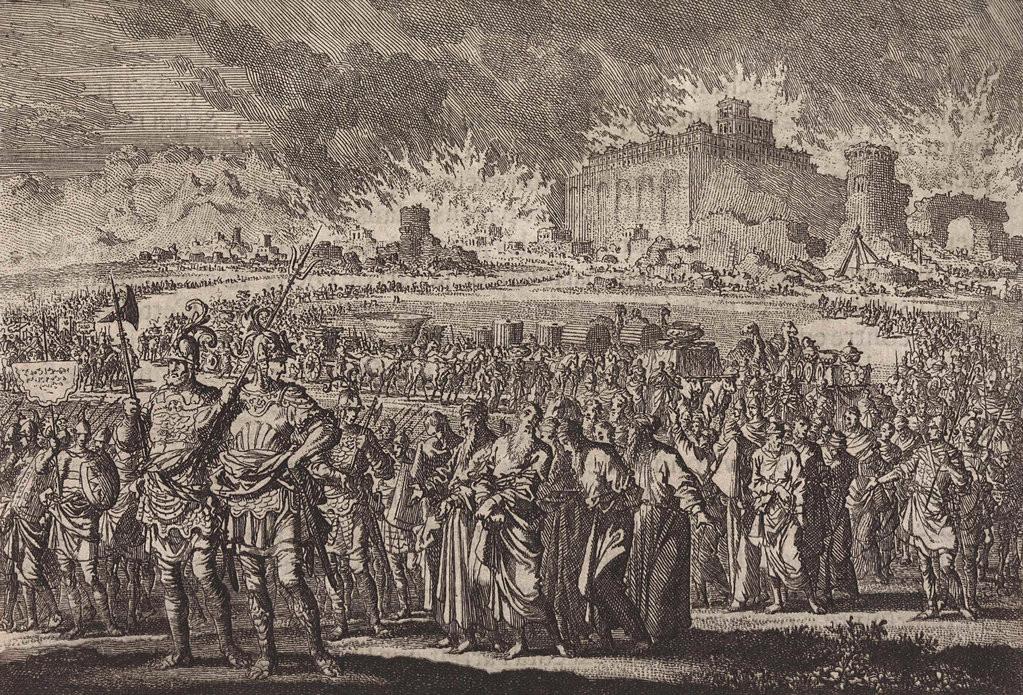
The scene in Jerusalem was one of utter destruction and devastation. The once-formidable walls of the city had been reduced to rubble. The massive doors that stood at the gates into Jerusalem had been torn from their hinges and burned. The homes of both the rich and the poor had been destroyed, leaving the city virtually uninhabitable. Even the king’s royal palace had been ransacked and turned into a smoldering ruin. And the Babylonians had not spared the house of God either. It had become a place of refuge for many trying to flee from the bloodthirsty Babylonians, but they found no help or hope within the walls of the temple they had long neglected.

The Babylonians killed Judah’s young men, even chasing after them into the Temple. They had no pity on the people, killing both young men and young women, the old and the infirm. – 2 Chronicles 36:17 NLT

The grand house that Solomon had constructed, the long-standing symbol of God’s presence and power among His people, was desecrated and then destroyed.

The king took home to Babylon all the articles, large and small, used in the Temple of God, and the treasures from both the Lord’s Temple and from the palace of the king and his officials. Then his army burned the Temple of God… – 2 Chronicles 36:18 NLT

And none of this should have come as a surprise to the people of Judah. On the very day that Solomon had consecrated the newly opened temple, God had warned him:

“I have answered your prayer and your request for help that you made to me. I have consecrated this temple you built by making it my permanent home; I will be constantly present there. You must serve me with integrity and sincerity, just as your father David did. Do everything I commanded and obey my rules and regulations. Then I will allow your dynasty to rule over Israel permanently, just as I promised your father David, ‘You will not fail to have a successor on the throne of Israel.’

“But if you or your sons ever turn away from me, fail to obey the regulations and rules I instructed you to keep, and decide to serve and worship other gods, then I will remove Israel from the land I have given them, I will abandon this temple I have consecrated with my presence, and Israel will be mocked and ridiculed among all the nations. This temple will become a heap of ruins; everyone who passes by it will be shocked and will hiss out their scorn, saying, ‘Why did the Lord do this to this land and this temple?’ Others will then answer, ‘Because they abandoned the Lord their God, who led their ancestors out of Egypt. They embraced other gods whom they worshiped and served. That is why the Lord has brought all this disaster down on them.’” – 2 Kings 9:3-9 NLT

More than three-and-a-half centuries had passed since God had issued that warning to King Solomon. And during that time, the majority of the kings of Judah had chosen to abandon Yahweh for the false gods of the nations around them. They had led the nation into idolatry and apostasy and now, as the people of Judah made their way in chains to Babylon, they could look over their shoulders and see the fiery fulfillment of God’s words to Solomon.

As Nebuchadnezzar and his forces departed Judah, they left a destroyed city and decimated populace behind.

King Nebuchadnezzar took all of Jerusalem captive, including all the commanders and the best of the soldiers, craftsmen, and artisans—10,000 in all. Only the poorest people were left in the land. – 2 Kings 24:14 NLT

And he appointed a man named Gedaliah as governor over the greatly diminished and demoralized citizenry of Jerusalem. There would no longer be a king to rule over Judah. Gedaliah was a Jew, but not a descendant of Solomon. He had no royal blood and would wield no kingly authority. He served at the behest of Nebuchadnezzar and was under the watchful eye of the ever-present Babylonian garrison. His was a thankless job that was more managerial than magisterial. And in time, he would come to be seen as nothing more than a puppet of the occupying Babylonian forces.

The commanders of Judah’s army who had fled from the city of Jerusalem when the walls were breached, returned when they heard that Gedaliah had been appointed governor. But they didn’t like the pro-Babylonian rhetoric that Gedaliah was spouting.

Gedaliah vowed to them that the Babylonian officials meant them no harm. “Don’t be afraid of them. Live in the land and serve the king of Babylon, and all will go well for you,” he promised. – 2 Kings 25:24 NLT

This compromising stance would ultimately cost Gedaliah his life. One of the former military commanders, a man named Ishmael, orchestrated the assassination of Gedaliah. It’s not exactly clear what Ishmael had hoped to accomplish by the murder of the Babylonian-appointed governor. But it seems obvious that this was an act of rebellion against the occupying forces. Along with Gedaliah and his Jewish officials, Ishmael murdered members of the Babylonian garrison, and this resulted in a swift reprisal from Nebuchadnezzar. Ishmael’s attempt to drive the Babylonians out of Judah backfired on him. Instead, “all the people of Judah, from the least to the greatest, as well as the army commanders, fled in panic to Egypt, for they were afraid of what the Babylonians would do to them” (2 Kings 25:26 NLT).

This scene is intended to convey a strong sense of irony. The disobedient people of God were returning to the very place from which He had free them centuries earlier. While some of their friends and family members had been deported to Babylon as slaves, this remnant of God’s chosen people would seek refuge in the land where their forefathers had been captives for more than 400 years.

Once again, all of this had been predicted by God. Centuries earlier, as the people of Israel stood on the shore of the River Jordan, preparing to enter the land of promise, God had given them a word of warning through Moses. He had told them that if they would faithfully obey Him, they would experience His blessings. But if they chose to disobey God, Moses warned them that they would experience “long-lasting afflictions and severe, enduring illnesses. He will infect you with all the diseases of Egypt that you dreaded, and they will persistently afflict you. Moreover, the Lord will bring upon you every kind of sickness and plague not mentioned in this scroll of commandments, until you have perished” (Deuteronomy 28:59-61 NLT).

And Moses had been very specific when outlining the devastating nature of the curses they would encounter should they failed to “fear this glorious and awesome name, the Lord your God” (Deuteronomy 28:58 NLT).

The Lord will scatter you among all nations, from one end of the earth to the other. There you will worship other gods that neither you nor your ancestors have known, gods of wood and stone. Among those nations you will have no rest, nor will there be a place of peaceful rest for the soles of your feet, for there the Lord will give you an anxious heart, failing eyesight, and a spirit of despair. Your life will hang in doubt before you; you will be terrified by night and day and will have no certainty of surviving from one day to the next. In the morning you will say, ‘If only it were evening!’ And in the evening you will say, ‘I wish it were morning!’ because of the things you will fear and the things you will see. Then the Lord will make you return to Egypt by ship, over a route I said to you that you would never see again. There you will sell yourselves to your enemies as male and female slaves, but no one will buy you.” – Deuteronomy 28:64-68 NLT

Some 850 years after God had redeemed the people of Israel from their captivity in Egypt, a remnant of their still rebellious descendants would return. But it’s interesting to note that these poor disheveled exiles will find no hope in Egypt. They won’t even be able to sell themselves as slaves. They will become paupers and aliens living outside the land of promise and under the curse of the God they had chosen to reject.

But despite all the dire imagery portrayed in this closing chapter of the book of 2 Kings, there is a silver lining on the dark cloud of Judah’s history. The author ends his book with a new king ascending to the throne of Babylon. These closing verses seem to be a mirror image of the scene found in the book of Genesis that preceded Israel’s 400-year enslavement in Egypt. Exodus 1:8 records, “Now there arose a new king over Egypt, who did not know Joseph.” This new Pharaoh came to power and, having no first-hand knowledge of Joseph and the people of Israel, decided that they were a threat to his administration. So, he launched a campaign to afflict and enslave them. This would lead to four centuries worth of unprecedented misery and maltreatment.

But when Evil-merodach replaced Nebuchadnezzar as the ruler over the Babylonian empire, he made a decision to release King Jehoiachin of Judah from his enslavement. He released him from prison and “spoke kindly to Jehoiachin and gave him a higher place than all the other exiled kings in Babylon” (2 Kings 25:28 NLT). For the remainder of his life in Babylonian, Jehoiachin lived like a king. He was given royal robes to wear and allowed to dine at Evil-merodach’s table.

But why is this important? Because it foreshadows something highly significant. Back in the book that bears his name, the prophet Jeremiah pronounced a curse on Jehoiachin, who was also known as Coniah.

“Why is this man Jehoiachin like a discarded, broken jar?
    Why are he and his children to be exiled to a foreign land?
O earth, earth, earth!
    Listen to this message from the Lord!
This is what the Lord says:
‘Let the record show that this man Jehoiachin was childless.
    He is a failure,
for none of his children will succeed him on the throne of David
    to rule over Judah.’”– Jeremiah 22:28-30 NLT

And yet, if we fast-forward to the gospel of Matthew, we find the following words in his genealogy of Jesus.

Josiah was the father of Jehoiachin and his brothers (born at the time of the exile to Babylon).
After the Babylonian exile:
Jehoiachin was the father of Shealtiel.
Shealtiel was the father of Zerubbabel.
Zerubbabel was the father of Abiud.
Abiud was the father of Eliakim.
Eliakim was the father of Azor.
Azor was the father of Zadok.
Zadok was the father of Akim.
Akim was the father of Eliud.
Eliud was the father of Eleazar.
Eleazar was the father of Matthan.
Matthan was the father of Jacob.
Jacob was the father of Joseph, the husband of Mary.
Mary gave birth to Jesus, who is called the Messiah. – Matthew 1:11-16 NLT

Here, in the genealogy of Jesus, we find the name of the Jehoiachin. The very man who was told that none of his children would succeed him as king is listed as a progenitor of the King of kings. Of Jehoiachin’s seven sons, not one of them would ascend to the throne of David. But Jesus would. God would graciously reverse the curse, producing a royal heir who would reign in righteousness and deliver His people from their enslavement to sin and death.

Notice one more name in the lineage of Jesus: Zerubbabel. This descendant of Jehoiachin would later become the governor of Judea when the exiles returned from their captivity in Babylon. And the prophet Haggai would pronounce a blessing on Zerubbabel that foreshadowed a great reversal of fortunes for the people of God.

“Speak to Zerubbabel, governor of Judah, saying, I am about to shake the heavens and the earth, and to overthrow the throne of kingdoms. I am about to destroy the strength of the kingdoms of the nations, and overthrow the chariots and their riders. And the horses and their riders shall go down, every one by the sword of his brother. On that day, declares the Lord of hosts, I will take you, O Zerubbabel my servant, the son of Shealtiel, declares the Lord, and make you like a signet ring, for I have chosen you, declares the Lord of hosts.” – Haggai 2:21-23 NLT

The book of 2 Kings ends on a positive note because God’s will concerning the people of Israel was far from done. The story of the redemption of His chosen people and the restoration of the world He created was not yet over. The Messiah, the Savior of the world, would one day come. And His arrival would usher in a new day and a new hope for the people of God and the nations of the world.

English Standard Version (ESV) The Holy Bible, English Standard Version. ESV® Permanent Text Edition® (2016). Copyright © 2001 by Crossway Bibles, a publishing ministry of Good News Publishers.

New Living Translation (NLT) Holy Bible, New Living Translation, copyright © 1996, 2004, 2015 by Tyndale House Foundation. Used by permission of Tyndale House Publishers Inc., Carol Stream, Illinois 60188. All rights reserved.

The Message (MSG)Copyright © 1993, 1994, 1995, 1996, 2000, 2001, 2002 by Eugene H. Peterson

Free to Love One Another

12 I am sending him back to you, sending my very heart. 13 I would have been glad to keep him with me, in order that he might serve me on your behalf during my imprisonment for the gospel, 14 but I preferred to do nothing without your consent in order that your goodness might not be by compulsion but of your own accord. 15 For this perhaps is why he was parted from you for a while, that you might have him back forever, 16 no longer as a bondservant but more than a bondservant, as a beloved brother—especially to me, but how much more to you, both in the flesh and in the Lord. – Philemon 1:12-16 ESV

Paul was sending Onesimus back to Philemon. And Paul makes it clear that this had not been an easy decision. In a sense, Paul was sending his very heart. He loved Onesimus as if he was his own son. This young man had come to mean a great deal to the apostle and it must have grieved him deeply to think of him leaving his side. But Paul wanted to do the right thing. He knew that the rift between Onesimus and Philemon needed to be healed.

But as difficult as it was for Paul, stop and consider the feelings of Onesimus. They say there are two sides to every story, and in the case of Onesimus, we know next to nothing about how he came to be a slave, why he ran away, or what kind of conditions he had lived under while serving in Philemon’s house. But it seems likely that his decision to escape his condition as a slave was motivated by something. Perhaps it was nothing more than the natural human desire to be free.

It is fascinating to speculate on the back story of Onesimus. Perhaps he had sold himself into servitude in order to pay back a debt he owed to Philemon. Or he could have been born into his condition, the unfortunate son of slave parents. Then there’s the very real possibility that Onesimus had been a prisoner of war who Philemon purchased from the slave market.

But regardless of how Onesimus had come to be a slave or why he had decided to run away, Paul had somehow convinced him to return. What a fascinating conversation that must have been. Just imagine how long Paul must have wrestled with the idea before he ever brought it up with Onesimus. And then, consider how Onesimus must have received Paul’s counsel that he go back to Philemon and make things right.

There were great risks involved. And yet, Onesimus had agreed to follow Paul’s advice, despite knowing that his return could result in his re-enslavement. Not only that, but he could also face severe legal repercussions for his actions. As a runaway slave, he could be beaten, sold, or even put to death. His fate would be in the hands of Philemon. But this young man had willingly chosen to take the risks in order to do what he believed to be the right thing.

In an attempt to prepare Philemon for the arrival of his former slave and newfound brother in Christ, Paul uses an interesting tactic. He implies that all the while Onesimus had been ministering to him during his imprisonment in Rome, he had done so on Philemon’s behalf. And Paul states that he had been tempted to maintain this arrangement, but had not wanted to make that decision for Philemon.

I would have been glad to keep him with me, in order that he might serve me on your behalf during my imprisonment for the gospel, but I preferred to do nothing without your consent in order that your goodness might not be by compulsion but of your own accord. – Philemon 1:13-14 ESV

Interestingly enough, Paul seemed to view Onesimus as a gift from Philemon. And yet, the only way Paul could have known about the relationship between Onesimus and Philemon was because Onesimus had divulged it to him. At some point in their relationship, Onesimus had revealed his status as a runaway slave. And when Paul had heard the name of Onesimus’ master, Paul had recognized the hand of God in it all. Philemon was a dear friend of Paul’s. And Philemon had a slave who had run away and ended up in Rome, where he had met Paul and come to faith in Christ. Paul knew that none of this had been the result of happenstance, luck, kismet, or karma. It was the handiwork of God.

And Paul tried to get Philemon to view these events from a divine perspective, stating, “It seems you lost Onesimus for a little while so that you could have him back forever” (Philemon 1:15 NLT). For Philemon, the loss of his slave had been nothing more than a financial setback. He had lost his property. But Paul reminded Philemon that his loss had actually resulted in great gain. He had lost a slave but was receiving back a brother in Christ.

He is no longer like a slave to you. He is more than a slave, for he is a beloved brother, especially to me. Now he will mean much more to you, both as a man and as a brother in the Lord. – Philemon 1:16 NLT

The young man who was about to walk through Philemon’s door was no longer his property, but a fellow member of the family of God. Onesimus was no longer Philemon’s personal possession. His life had been paid for by the blood of Jesus Christ.

At one point, early in his earthly ministry, Jesus had returned to Nazareth, where he had entered the synagogue and read from the book of Isaiah.

“The Spirit of the Lord is upon me,
    because he has anointed me
    to proclaim good news to the poor.
He has sent me to proclaim liberty to the captives
    and recovering of sight to the blind,
    to set at liberty those who are oppressed,
to proclaim the year of the Lord’s favor.” – Luke 4:18-19 NLT

And having read this Messianic passage, Jesus handed the scroll back to the attendant and said, “The Scripture you’ve just heard has been fulfilled this very day!” (Luke 4:21 NLT). Jesus had come to proclaim liberty to the captives and to set at liberty those who are oppressed. Of course, He was speaking in terms of spiritual captivity to sin and death, and freedom from the oppression that comes with trying to earn favor with God through human effort. And that is exactly what Onesimus had experienced. He had been set free and, as Jesus had said, “if the Son sets you free, you are truly free” (John 8:36 NLT). 

That verse is found in the middle of a discourse by Jesus in which he was discussing the ability of the truth to set men free. And he describes all those who sin as slaves.

“I tell you the truth, everyone who sins is a slave of sin. A slave is not a permanent member of the family, but a son is part of the family forever. So if the Son sets you free, you are truly free.” – Philemon 8:35-36 NLT

Prior to coming to faith in Christ, Philemon had been a slave to sin. But he had been set free and now enjoyed status as a son of God. But the same thing was true of Onesimus. He had also been set free from slavery to sin and death, and he had become Philemon’s spiritual brother. So, why would Philemon continue to treat his brother as a slave?

Paul was asking both of these men to make difficult decisions. Onesimus had made his choice and was returning home. But Philemon still had a choice to make. How would he respond? What would he do when he saw Onesimus?

Jesus came to change the condition of the human heart. He died so that men might experience the life-transformative power of God, that could not only restore fallen men to a right relationship with Himself but with one another.

“The supreme work of Christianity is to transform men, so that out of their transformed lives shall come the transformation of all social conditions, and the victories of righteousness and of love.” – G. Campbell Morgan, Living Messages of the Books of the Bible

Paul greatly desired that these two men, who both meant a great deal to him, would allow their faith in Christ to transform the relationship between them. Paul knew that their choice to live as brothers rather than as slave and master would be a testimony to the Gospel’s power. And it would spread throughout the local congregation and into the community.

English Standard Version (ESV)
The Holy Bible, English Standard Version. ESV® Permanent Text Edition® (2016). Copyright © 2001 by Crossway Bibles, a publishing ministry of Good News Publishers.

New Living Translation (NLT)
Holy Bible, New Living Translation, copyright © 1996, 2004, 2015 by Tyndale House Foundation. Used by permission of Tyndale House Publishers Inc., Carol Stream, Illinois 60188. All rights reserved.

The Message (MSG)Copyright © 1993, 1994, 1995, 1996, 2000, 2001, 2002 by Eugene H. Peterson

The Heart of the Issue

Accordingly, though I am bold enough in Christ to command you to do what is required, yet for love’s sake I prefer to appeal to you—I, Paul, an old man and now a prisoner also for Christ Jesus— 10 I appeal to you for my child, Onesimus, whose father I became in my imprisonment. 11 (Formerly he was useless to you, but now he is indeed useful to you and to me.) – Philemon 1:8-11 ESV

Bringing up a difficult topic with someone you care about can be tricky. An attempt to point out someone else’s faults, failures, or blind spots, even if done with the best of intentions, can turn out poorly. Confrontation is risky. That’s why, more often than not, most of us choose to avoid the conflict altogether. But Paul loved Philemon too much to remain silent. And he knew that this particular issue had far greater implications than just the relationship between Philemon and his runaway slave, Onesimus.

For Paul, this was all about the body of Christ. Yes, he had strong affections for the two men mired in the middle of this situation, but he also had a heart for the spiritual well-being of the church. The relationships between believers within the local body of Christ were vital to the spread of the Gospel because they were evidence of its life-transformative power. There was no place for division or disunity among believers, a message he communicated to the church in Corinth.

I appeal to you, dear brothers and sisters, by the authority of our Lord Jesus Christ, to live in harmony with each other. Let there be no divisions in the church. Rather, be of one mind, united in thought and purpose. – 1 Corinthians 1:10 NLT

So, as Paul prepared to bring up a potentially controversial issue with Philemon, he had the greater good of the body of Christ in mind. He knew that Philemon’s treatment of Onesimus would have a ripple effect on the church. Because of his leadership role in the church, Philemon was admired by its members and his actions carried great influence.

It’s essential that we understand the nature of the problem that Paul was about to address with his friend. Philemon was a believer but also a slaveholder. This was not uncommon in those days. In fact, it was quite normal because slavery was a vital part of the Roman economy. In the early days of the church, as the Gospel spread throughout the Roman Empire, people from all walks of life were coming to faith in Christ, including slaves. The message of faith in Jesus was non-discriminatory. It was not reserved for the rich or religious, the upper class or the highly educated. As Paul pointed out to the believers in Corinth, the Gospel was for the foolish, the powerless, and the despised.

Remember, dear brothers and sisters, that few of you were wise in the world’s eyes or powerful or wealthy when God called you. Instead, God chose things the world considers foolish in order to shame those who think they are wise. And he chose things that are powerless to shame those who are powerful. God chose things despised by the world, things counted as nothing at all, and used them to bring to nothing what the world considers important. As a result, no one can ever boast in the presence of God. – 1 Corinthians 1:26-29 NLT

It would appear that Philemon was a relatively wealthy individual, with a home large enough to host the local fellowship of believers. He also had the financial resources to purchase bondslaves. But, while Philemon was well-resourced, he had not been purchased his salvation. It had been a gift, a point that Peter makes perfectly clear.

For you know that God paid a ransom to save you from the empty life you inherited from your ancestors. And it was not paid with mere gold or silver, which lose their value. It was the precious blood of Christ, the sinless, spotless Lamb of God. – 1 Peter 1:18-19 NLT

But Philemon, like every other individual who had come to faith in Christ, was having to deal with the impact of the Gospel message on his daily life. He was a Christ-follower, but he also remained a businessman with financial obligations. He was also a citizen of the Roman Empire with certain legal rights and responsibilities. And as a slaveholder who had recently suffered a financial loss when one of his slaves had run away, he would have known his rights concerning redress and legal recourse.

But little did Philemon know that his runaway slave had just happened to run into his friend, the apostle Paul. One of the things I love about this story is the way it so subtly portrays the sovereign will of God. The last thing Philemon expected to hear from Paul was an update on his runaway slave. And yet, here was Paul getting ready to announce the news that, not only did he know Onesimus, he considered him his child in the faith. Philemon’s runaway slave had become a fellow follower of Christ and a personal friend of Paul’s, ministering to him during his imprisonment in Rome. What a bizarre turn of events. And one can only imagine the look on Philemon’s face as he read this surprising news from Paul.

But don’t miss the sovereign hand of God in all of this. At some point, Philemon had made the conscious decision to purchase Philemon as a slave. It had been a fully legal transaction based on sound financial planning. But then, somewhere along the way, Onesimus had come up with a plan of his own. He ran away. He had taken the risk of seeking his freedom, knowing that, if caught, he would face severe punishment or even death. And hundreds of miles away, Paul had made a plea to have his case tried before the emperor in Rome, where he was then taken and placed under house arrest.

Each of these decisions was made by a man, but as the book of Proverbs points out, their plans were orchestrated by God. He was operating behind the scenes in ways they could not see or know.

We can make our plans, but the LORD determines our steps. – Proverbs 16:9 NLT

You can make many plans, but the LORD’s purpose will prevail. – Proverbs 19:21 NLT

We have no details concerning how Onesimus met Paul. But he did. And we can rest in the knowledge that God was directing the steps of this young runaway slave so that his path would cross that of Paul’s. God had fully intended for the slave of Philemon to encounter the prisoner of Nero. And the life of Onesimus would never be the same. But Philemon’s life was also about to undergo a radical realignment as Paul presented him with a paradigm-shifting request.

As an apostle, Paul knew that he had the authority to force Philemon to do the right thing. But instead, he appealed to Philemon’s heart. Paul wanted Philemon to act out of love, not out of obligation or duty. So, he let Philemon know that it was “for love’s sake” that he was making his request. Paul knew that love would be the only thing that could heal the broken relationship between Philemon and Onesimus. It was going to take a miracle for this slaveholder to forgive his former slave. But for Paul, forgiveness was not going to be enough. He was out to change the relationship between these two men in ways that neither one of them could imagine.

Paul makes an interesting side comment to Philemon, stating that Onesimus “was useless to you, but now he is indeed useful to you and to me” (Philemon 1:11 ESV). The Greek word Paul used is achrēstos, which means “unprofitable.” It’s not exactly clear what Paul in inferring by this statement, but he could simply be implying that, as long as Onesimus was on the run, he had been no use to Philemon. But his absence had proved extremely beneficial to Paul. This young man had been ministering to Paul during his house arrest. But I think there is a more significant meaning behind Paul’s use of this term. As a slave, Onesimus had been little more than property to Philemon. His value was based solely on the work he did for Philemon or the price he could bring at auction.

But now, as a brother in Christ, Onesimus was a valuable member of the faith community and an asset to the Kingdom of Christ. At one time, Philemon had considered Onesimus to be foolish, powerless, and despised. But Christ had changed all that. Now, Onesimus was a joint-heir with Jesus Christ. He was a valuable and valued member of the body of Christ. He had gifts to share and a part to play in the ongoing spread of the Gospel.

Paul wanted Philemon to view his former slave through the lens of the Gospel. God was going to use Onesimus, someone the world once “counted as nothing at all…to bring to nothing what the world considers important” (1 Corinthians 1:28 NLT). In the world in which Philemon lived, slavery was an important part of his livelihood. It was a powerful force in the local economy. It was a common practice that few questioned and virtually all had learned to accept as the status quo. But Jesus had come to replace man’s ways with God’s ways. The Gospel was meant to be a game-changer, shining the light of God’s love into the darkness of a fallen world.

And Philemon was about to have the light of God’s truth illuminate the recesses of his own heart, revealing yet one more hidden area of sin that needed to be exposed and expelled by the love of Christ.

English Standard Version (ESV)
The Holy Bible, English Standard Version. ESV® Permanent Text Edition® (2016). Copyright © 2001 by Crossway Bibles, a publishing ministry of Good News Publishers.

New Living Translation (NLT)
Holy Bible, New Living Translation, copyright © 1996, 2004, 2015 by Tyndale House Foundation. Used by permission of Tyndale House Publishers Inc., Carol Stream, Illinois 60188. All rights reserved.

The Message (MSG)Copyright © 1993, 1994, 1995, 1996, 2000, 2001, 2002 by Eugene H. Peterson

Faith in Action

I always thank my God when I pray for you, Philemon, because I keep hearing about your faith in the Lord Jesus and your love for all of God’s people. And I am praying that you will put into action the generosity that comes from your faith as you understand and experience all the good things we have in Christ. Your love has given me much joy and comfort, my brother, for your kindness has often refreshed the hearts of God’s people. – Philemon 1:4-7 ESV

It’s not hard to recognize Paul’s intense and sincere love for Philemon. These are not the pious-sounding platitudes of a pastor, but they are legitimate expressions of love from a close friend. And Paul tells his friend that news of his faith and love causes him to offer up prayers of thanksgiving to God. Paul is grateful for the tangible expressions of life change that have become evident in Philemon’s life. His faith in Jesus Christ’s love for him has resulted in visible displays of selfless love for the people of God.

The apostle John used this same combination of faith in Jesus and love for others in his first letter.

And this is his commandment: We must believe in the name of his Son, Jesus Christ, and love one another, just as he commanded us. – 1 John 3:23 NLT

And John went on to call for a consistent and persistent kind of love that would reflect the believer’s new relationship with their gracious and loving Father, who is the source of all love.

Dear friends, let us continue to love one another, for love comes from God. Anyone who loves is a child of God and knows God. But anyone who does not love does not know God, for God is love. – 1 John 4:7-8 NLT

John emphasized that the believer’s capacity to love others was evidence of their newfound relationship with God and was made possible because God had loved them enough to send His Son to die in their place as the payment for their sins.

We love each other because he loved us first. – 1 John 4:19 NLT

Paul complimented Philemon for his love of others. But you can sense that Paul is setting Philemon up. He is lovingly preparing his friend to hear some news that will likely prove difficult to receive. It will involve Philemon’s runaway slave, Onesimus.

Paul begins by explaining to Philemon the content of his ongoing prayers for him: “I pray that the sharing of your faith may become effective for the full knowledge of every good thing that is in us for the sake of Christ” (Philemon 1:6 NLT). Paul has already complimented Philemon for his love for others. But he wanted Philemon to know and experience the full impact of the Gospel in his life. Paul deeply desired that his friend’s faith would grow in depth and intensity so that he might know and experience all the fulness of joy promised to him in Christ. Jesus had told His disciples:

“Abide in my love. If you keep my commandments, you will abide in my love, just as I have kept my Father’s commandments and abide in his love. These things I have spoken to you, that my joy may be in you, and that your joy may be full. This is my commandment, that you love one another as I have loved you. Greater love has no one than this, that someone lay down his life for his friends.” – John 15:9-13 ESV

Paul wanted more for Philemon. He was not content to allow his friend to rest on his laurels or to become complacent in his faith. While there was obvious evidence of fruit in Philemon’s life, there would always be room for further growth. And Paul wanted Philemon to understand that God’s transformative work in his life would never be complete in this life. It would be ongoing and never-ending. And Paul made it a habit to pray for the continual spiritual enlightenment of all those he loved and to whom he ministered.

I pray that your hearts will be flooded with light so that you can understand the confident hope he has given to those he called—his holy people who are his rich and glorious inheritance.

I also pray that you will understand the incredible greatness of God’s power for us who believe him. This is the same mighty power that raised Christ from the dead and seated him in the place of honor at God’s right hand in the heavenly realms. – Ephesians 1:18-20 NLT

Paul wanted Philemon to know that his love for others was contagious, having spread far beyond the confines of their local faith community. News of Philemon’s love had reached the ears of Paul, as he sat under house arrest in Rome. And Paul told him, “I have derived much joy and comfort from your love” (Philemon 1:7 ESV). But why? What was it about Philemon’s actions that caused Paul to rejoice and be encouraged? Paul provides the answer:  “because the hearts of the saints have been refreshed through you” (Philemon 1:7 ESV).

As an apostle, teacher, and fellow Christ-follower, Paul found great joy in watching believers live out their faith in the power of the Holy Spirit. When he was able to witness the body of Christ functioning as intended, he couldn’t help but be encouraged. Unity and true community within Christ’s church was important to Paul. That’s why he told the church in Philippi:

…complete my joy by being of the same mind, having the same love, being in full accord and of one mind. Do nothing from selfish ambition or conceit, but in humility count others more significant than yourselves. Let each of you look not only to his own interests, but also to the interests of others. – Philippians 2:2-4 ESV

Philemon had no idea what was coming. As he, Apphia, and Archippus read this letter together, he must have been deeply encouraged. But the other shoe was about to drop. Paul was preparing to test Philemon’s faith in a profound way. His concept of what it means to love others was going to be stretched. His ideas regarding justice and mercy were going to be challenged as never before. His secular and sacred worlds were about to collide, causing him to reconsider his faith in a whole new light.

Philemon had a blind spot. But he was not alone, and this is probably the reason Paul had included Apphia and Archippus as recipients of his letter. The topic Paul was about to bring up was going to be controversial for each and every member of the local congregation who met in Philemon’s home. They would have known about Philemon’s runaway slave. And most, if not all of them, would have been familiar with and agreeable to Philemon’s legal rights as a master. But Paul was about to rock their collective world.

While the early church seemed to have no problem with slaves coming to faith in Christ and even attending their local fellowships, a social stigma remained. There was a lingering sense of separation and segregation. And Paul addressed this issue repeatedly in his letters to the churches. He was out to tear down the societal standards of his day that were creating division within the body of Christ. In their place, he called for a sense of oneness in Christ.

The human body has many parts, but the many parts make up one whole body. So it is with the body of Christ. Some of us are Jews, some are Gentiles, some are slaves, and some are free. But we have all been baptized into one body by one Spirit, and we all share the same Spirit. – 1 Corinthians 12:12-13 NLT

For you are all children of God through faith in Christ Jesus. And all who have been united with Christ in baptism have put on Christ, like putting on new clothes. There is no longer Jew or Gentile, slave or free, male and female. For you are all one in Christ Jesus. Galatians 3:26-28 NLT

In this new life, it doesn’t matter if you are a Jew or a Gentile, circumcised or uncircumcised, barbaric, uncivilized, slave, or free. Christ is all that matters, and he lives in all of us. – Colossians 3:11 NLT

While the world outside the doors of the church was practicing segregation, enslavement, and every conceivable form of social prejudice, Paul was calling the body of Christ to practice “the unity of the Spirit in the bond of peace” (Ephesians 3:3 ESV). There was no place for division and disunity in God’s family. Everyone stands as equals at the foot of the cross. And as Paul reminded the believers in Rome: “For God does not show favoritism” (Romans 2:11 NLT).

No, in God’s Kingdom, all share the unique and undeserved privilege of adoption as His sons and daughters, regardless of race, creed, color, or social standing.

There is one body and one Spirit—just as you were called to the one hope that belongs to your call—one Lord, one faith, one baptism, one God and Father of all, who is over all and through all and in all. – Ephesians 3:4-6 ESV

English Standard Version (ESV)
The Holy Bible, English Standard Version. ESV® Permanent Text Edition® (2016). Copyright © 2001 by Crossway Bibles, a publishing ministry of Good News Publishers.

New Living Translation (NLT)
Holy Bible, New Living Translation, copyright © 1996, 2004, 2015 by Tyndale House Foundation. Used by permission of Tyndale House Publishers Inc., Carol Stream, Illinois 60188. All rights reserved.

The Message (MSG)Copyright © 1993, 1994, 1995, 1996, 2000, 2001, 2002 by Eugene H. Peterson

From the Pen of a Prisoner

This letter is from Paul, a prisoner for preaching the Good News about Christ Jesus, and from our brother Timothy.

I am writing to Philemon, our beloved co-worker, and to our sister Apphia, and to our fellow soldier Archippus, and to the church that meets in your house.

May God our Father and the Lord Jesus Christ give you grace and peace. – Philemon 1:1-3 ESV

Paul’s letter to Philemon provides a fascinating glimpse into the culture of the 1st-Century. It is a somewhat uncomfortable read for 21st-Century Christians because it deals with a topic that most of us find reprehensible and off-putting – that of slavery. Yet, slavery was an everyday and unavoidable reality for those living in that part of the world at the beginning of the new millennium.

Slavery was ubiquitous throughout the Roman Empire. In fact, the inhabitants of the empire were comprised of two basic groups: Those who were free and those who were slaves. And an individual’s status as a slave usually had nothing to do with their race or ethnicity. Yes, many slaves were members of conquered people groups who represented a particular race, but they had not been enslaved for that reason. Their slavery had been the result of war. Roman slaves included prisoners of war as well as those captured and sold by pirates. But it was not uncommon for Roman citizens to end up as slaves due to economic hard times. If someone was unable to pay a debt, indentured servitude was their most likely fate. They would work for their lender until their debt was paid in full.

Sadly, there were also cases where financially strapped families would raise money by selling their own children into slavery. It is estimated that 1 out of every 5 people living in the Roman Empire were slaves, and by the 1st-Century, the primary source of slaves were the children born to slaves. A child born to a female slave was also a slave, regardless of the status of the father.

With all that as background, Paul’s letter to Philemon should come into greater clarity for us. When reading the apostle’s comments concerning Onesimus, a runaway slave belonging to Philemon, it would be easy to question why Paul fails to condemn the practice of slavery outright. Why doesn’t he demand that Philemon set this young man free? What is preventing Paul from attacking the institution of slavery and exposing his friend’s obvious injustice toward his fellow man?

But we have to understand that Paul was not out to revolutionize the culture of his day through the radical overturn of the social fabric. He, like Jesus, was a revolutionary, but with an agenda that focused on change within the human heart, not within the political and civil structures of society. You get a glimpse of Paul’s perspective on all of this in his first letter to the church in Corinth.

Yes, each of you should remain as you were when God called you. Are you a slave? Don’t let that worry you—but if you get a chance to be free, take it. And remember, if you were a slave when the Lord called you, you are now free in the Lord. And if you were free when the Lord called you, you are now a slave of Christ. God paid a high price for you, so don’t be enslaved by the world. Each of you, dear brothers and sisters, should remain as you were when God first called you. – 1 Corinthians 7:20-24 NLT

Paul was not encouraging insurrection on the part of the slaves. He was not fomenting a spirit of revolution or sedition. But he was calling for Christians, regardless of their social status, to have a radically different outlook on their identity. You get a sense of his agenda from reading his letter to the believers in Galatia, another Roman province.

There is no longer Jew or Gentile, slave or free, male and female. For you are all one in Christ Jesus. – Galatians 3:28 NLT

Paul encouraged the Colossian believers to focus on their unity in Christ, not on their social status or ethnic identity.

Put on your new nature, and be renewed as you learn to know your Creator and become like him. In this new life, it doesn’t matter if you are a Jew or a Gentile, circumcised or uncircumcised, barbaric, uncivilized, slave, or free. Christ is all that matters, and he lives in all of us.

Since God chose you to be the holy people he loves, you must clothe yourselves with tenderhearted mercy, kindness, humility, gentleness, and patience. – Colossians 3:10-12 NLT

So, as we begin our study of Paul’s letter to Philemon, it is essential that we consider the social conditions of the day alongside the spiritual concerns that drove the apostle’s heart. Paul had no love affair for the institution of slavery. And the content of his letter contains neither a stinging condemnation or a subtle condoning of it. Slavery will not be the subject of this letter. But freedom in Christ and a love for our brothers and sisters in Christ will be. So, it is best if we read it from a 1st-Century perspective and with our ear tuned to hear Paul’s heart for the life-transformative power of the Gospel.

As Paul opens up his letter, he identifies himself as “a prisoner for Christ Jesus” (Philemon 1:1 ESV). He is desmios, one in bonds. Paul was writing from Rome, where he was being held under house arrest while awaiting his trial before the emperor. It is no coincidence that Paul uses this terminology to introduce himself to his friend, Philemon. The rest of the letter will deal with another “prisoner” or bondslave by the name of Onesimus. Interestingly enough, Paul and Onesimus were experiencing a somewhat ironic change in circumstances. Onesimus, the slave, was enjoying the life of a free man, while Paul, the Roman citizen, was experiencing the life of a captive.

But Paul was a prisoner for Christ Jesus. He had been confined for his ministry on behalf of the gospel. He was not a prisoner of war or a captive as a result of an unpaid debt. No, his imprisonment was on behalf, and because of his faith in Jesus Christ. And Paul was perfectly content with his situation. In fact, he told the church in Philippi that he had learned to live with any circumstance that came his way, knowing that Christ would use it for his good and God’s glory.

I have learned how to be content with whatever I have. I know how to live on almost nothing or with everything. I have learned the secret of living in every situation, whether it is with a full stomach or empty, with plenty or little. For I can do everything through Christ, who gives me strength. – Philippians 4:11-13 NLT

Paul’s letter, while addressed primarily to Philemon, is intended for a much broader audience, including Apphia, Archippus, and the rest of the members of the church that met in Philemon’s house. It is clear that Philemon was a well-respected member of the local congregation in Colosse. And he played a major part in the church by providing his home as a meeting place for their worship services.

Christian congregations were dependent upon the hospitality of wealthy members who could furnish their own houses for this purpose. This note then contains an indication of the social status of Philemon. In a large city there would be several such assemblies. Whether the church at Colossae had more than one place of assembly is not known. Probably they did. – Hiebert, D. Edmond. Titus and Philemon

So, Philemon was a leader in the local fellowship and a person of influence. That’s probably why Paul was addressing his letter directly to him. Paul knew that if he could help enlighten Philemon, it would spread throughout the congregation. While this particular issue involved Philemon and his runaway slave, Paul realized that it had far greater implications that would impact the entire faith community.

Each of their relationships with one another were to be influenced by the Gospel. Their new natures, provided by the indwelling presence of the Holy Spirit, were to alter their conduct and attitudes. In another letter, written to the entire membership of the church in Colosse, Paul reminded them that they had been raised to new life with Christ, and their behavior was to reflect that new life.

Put on your new nature, and be renewed as you learn to know your Creator and become like him. In this new life, it doesn’t matter if you are a Jew or a Gentile, circumcised or uncircumcised, barbaric, uncivilized, slave, or free. Christ is all that matters, and he lives in all of us.

Since God chose you to be the holy people he loves, you must clothe yourselves with tenderhearted mercy, kindness, humility, gentleness, and patience. Make allowance for each other’s faults, and forgive anyone who offends you. Remember, the Lord forgave you, so you must forgive others. Above all, clothe yourselves with love, which binds us all together in perfect harmony. And let the peace that comes from Christ rule in your hearts. For as members of one body you are called to live in peace. And always be thankful. – Colossians 3:10-15 NLT

As members of one body, whether slave or free, they were called to live in peace. And Paul wraps up the salutation of his letter to Philemon with his heartfelt prayer for his friend and the members of the local fellowship in Colosse.

May God our Father and the Lord Jesus Christ give you grace and peace. – Philemon 1:3 ESV

English Standard Version (ESV)
The Holy Bible, English Standard Version. ESV® Permanent Text Edition® (2016). Copyright © 2001 by Crossway Bibles, a publishing ministry of Good News Publishers.

New Living Translation (NLT)
Holy Bible, New Living Translation, copyright © 1996, 2004, 2015 by Tyndale House Foundation. Used by permission of Tyndale House Publishers Inc., Carol Stream, Illinois 60188. All rights reserved.

The Message (MSG)Copyright © 1993, 1994, 1995, 1996, 2000, 2001, 2002 by Eugene H. Peterson

Exodus Reversed

58 “If you are not careful to do all the words of this law that are written in this book, that you may fear this glorious and awesome name, the Lord your God, 59 then the Lord will bring on you and your offspring extraordinary afflictions, afflictions severe and lasting, and sicknesses grievous and lasting. 60 And he will bring upon you again all the diseases of Egypt, of which you were afraid, and they shall cling to you. 61 Every sickness also and every affliction that is not recorded in the book of this law, the Lord will bring upon you, until you are destroyed. 62 Whereas you were as numerous as the stars of heaven, you shall be left few in number, because you did not obey the voice of the Lord your God. 63 And as the Lord took delight in doing you good and multiplying you, so the Lord will take delight in bringing ruin upon you and destroying you. And you shall be plucked off the land that you are entering to take possession of it.

64 “And the Lord will scatter you among all peoples, from one end of the earth to the other, and there you shall serve other gods of wood and stone, which neither you nor your fathers have known. 65 And among these nations you shall find no respite, and there shall be no resting place for the sole of your foot, but the Lord will give you there a trembling heart and failing eyes and a languishing soul. 66 Your life shall hang in doubt before you. Night and day you shall be in dread and have no assurance of your life. 67 In the morning you shall say, ‘If only it were evening!’ and at evening you shall say, ‘If only it were morning!’ because of the dread that your heart shall feel, and the sights that your eyes shall see. 68 And the Lord will bring you back in ships to Egypt, a journey that I promised that you should never make again; and there you shall offer yourselves for sale to your enemies as male and female slaves, but there will be no buyer.” Deuteronomy 28:58-68 ESV

In this last portion of chapter 28, Moses makes an unmistakable link between the future state of Israel and their former condition in Egypt. In effect, he describes them experiencing a reverse exodus. More than four decades earlier, God had graciously delivered the people of Israel from their captivity in Egypt and led them to the land of Canaan – the land He had promised to give to the descendants of Abraham. Now, as Moses attempts to prepare the people to enter the land and conquer it, he warns them of the dangers associated with disobeying God’s commands. If they fail to keep God’s laws, they will experience a litany of curses that will leave them in a state of physical and moral degradation.

And Moses ends his bone-chilling description of the curses of God by letting them know that they will experience a complete reversal of fortunes, including their return to captivity in Egypt.

“And the Lord will bring you back in ships to Egypt, a journey that I promised that you should never make again; and there you shall offer yourselves for sale to your enemies as male and female slaves, but there will be no buyer.” – Deuteronomy 28:68 ESV

Think about how this news would have impacted the Israelites. They were standing on the border of Canaan, preparing to enter the land God had promised as their inheritance, and now Moses is telling them that failure to comply with God’s laws will result in their return to their former state as slaves in Egypt. But long before that happens, they will have to endure the same kind of pain and suffering the Egyptians had endured as a result of the ten plagues brought upon them by God.

“…the Lord will bring on you and your offspring extraordinary afflictions, afflictions severe and lasting, and sicknesses grievous and lasting. And he will bring upon you again all the diseases of Egypt, of which you were afraid, and they shall cling to you.” – Deuteronomy 28:59-60 ESV

God had punished the Egyptians for their refusal to let His people go. Repeatedly, Moses had appeared before Pharaoh, asking that he release the Israelites from their captivity. But each time, Pharaoh had refused. And his stubborn resistance to the will of God had been met with a series of plagues that grew in their intensity. Eventually, God brought upon the entire nation of Egypt the death of the firstborn, a devastating tragedy that struck every household, including Pharaoh’s.

And Moses warns that all this and more will happen to the Israelites – should they choose to live in rebellion to God.

One of the things we tend to overlook or downplay in these warnings from Moses is the extreme dichotomy they represent. Things would not be as they were meant to be. The promised land had been meant to be a place of rest. It was intended to be the polar opposite of their time spend in Egypt. In fact, when God had chosen Moses to be the one to deliver the people of Israel from captivity, He had told him:

“I have surely seen the affliction of my people who are in Egypt and have heard their cry because of their taskmasters. I know their sufferings, and I have come down to deliver them out of the hand of the Egyptians and to bring them up out of that land to a good and broad land, a land flowing with milk and honey…” – Exodus 3:7-8 ESV

Canaan was to be a place of fruitfulness, abundance, blessing, rest, and peace. And the first time thei Israelites had arrived at the border, they had chosen to reject God’s command to enter the land, out of fear of its inhabitant. And the author of Hebrews used that ocassion as a lesson for New Testament Christians.

“Today when you hear his voice,
    don’t harden your hearts
    as Israel did when they rebelled.”

And who was it who rebelled against God, even though they heard his voice? Wasn’t it the people Moses led out of Egypt? And who made God angry for forty years? Wasn’t it the people who sinned, whose corpses lay in the wilderness? And to whom was God speaking when he took an oath that they would never enter his rest? Wasn’t it the people who disobeyed him? So we see that because of their unbelief they were not able to enter his rest. – Hebrews 3:15-19 NLT

They were not allowed to “enter his rest.” Their rebellion resulted in their deaths in the wilderness. That generation would spend 40 years wandering in the wilderness, until each of them had died off, before the next generation would be given another opportunity to obey God and conquer the land.

And Moses has warned that second generation not to repeat the mistakes of their forefathers, or they too would find themselves being cast out of the land. They would go from enjoying God’s rest to experiencing slavery in Egypt again.

It was God’s will that the people of Israel “fear this glorious and awesome name, the Lord your God” (Deuteronomy 28:58 ESV). And Moses reminds the Israelites, “the Lord took delight in doing you good and multiplying you” (Deuteronomy 28:63 ESV). But their disobedience would result in the polar opposite reaction from God.

“The Lord will take delight in bringing ruin upon you and destroying you.” – Deuteronomy 28:63 ESV

God would leave the Israelites scattered, demoralized, oppressed, weary, and suffering from “a trembling heart and failing eyes and a languishing soul” (Deuteronomy 28:65 ESV). Their hearts will be filled with dread. Their lives will be marked by regret, loss, and a longing for each day to come to an end. But the nighttime will be no better. The hours will drag by as they long for the new day to dawn. Then the miserable cycle of frustration and despair will repeat itself.

And Moses ends this dismal list of curses with a bleak prediction of Israel restored to captivity in Egypt – right back to where they started. They will be forced to watch as the promised land fades into the distance as they make their way back to Egypt as slaves. They will endure the shame and humiliation of a reverse exodus. And their lives will once again be marked by bondage, not freedom. There will be no more rest. They will enjoy no more rewards or blessings from God. All because they decided to disobey the law of God.

English Standard Version (ESV) The Holy Bible, English Standard Version. ESV® Permanent Text Edition® (2016). Copyright © 2001 by Crossway Bibles, a publishing ministry of Good News Publishers.

New Living Translation (NLT) Holy Bible, New Living Translation, copyright © 1996, 2004, 2015 by Tyndale House Foundation. Used by permission of Tyndale House Publishers Inc., Carol Stream, Illinois 60188. All rights reserved.

The Message (MSG) Copyright © 1993, 1994, 1995, 1996, 2000, 2001, 2002 by Eugene H. Peterson

Regulations For Real Life

15 “You shall not give up to his master a slave who has escaped from his master to you. 16 He shall dwell with you, in your midst, in the place that he shall choose within one of your towns, wherever it suits him. You shall not wrong him.

17 “None of the daughters of Israel shall be a cult prostitute, and none of the sons of Israel shall be a cult prostitute. 18 You shall not bring the fee of a prostitute or the wages of a dog into the house of the Lord your God in payment for any vow, for both of these are an abomination to the Lord your God.

19 “You shall not charge interest on loans to your brother, interest on money, interest on food, interest on anything that is lent for interest. 20 You may charge a foreigner interest, but you may not charge your brother interest, that the Lord your God may bless you in all that you undertake in the land that you are entering to take possession of it.

21 “If you make a vow to the Lord your God, you shall not delay fulfilling it, for the Lord your God will surely require it of you, and you will be guilty of sin. 22 But if you refrain from vowing, you will not be guilty of sin. 23 You shall be careful to do what has passed your lips, for you have voluntarily vowed to the Lord your God what you have promised with your mouth.

24 “If you go into your neighbor’s vineyard, you may eat your fill of grapes, as many as you wish, but you shall not put any in your bag. 25 If you go into your neighbor’s standing grain, you may pluck the ears with your hand, but you shall not put a sickle to your neighbor’s standing grain. – Deuteronomy 23:15-25 ESV

Moses now moves his point of emphasis from times of war to the everyday affairs of life. There would be periods of peace in Israel and during these times the men of war would return home to the normal circumstances of life. These occasions would call for an additional set of regulations to govern  a wide range of situations, and Moses left nothing up to chance.

The first scenario involves an escaped slave. The context seems to indicate that this fugitive slave has arrived in Israel from a distant land. This does not appear to be a reference to an indentured servant. There were slaves in Israel, but many of these individuals were fellow Israelites whose financial circumstances had obligated them to take on the role of a household servant in order to pay a debt they owed. And there were very strict rules regarding the treatment of these fellow Israelites, including the Year of Jubilee, when theses servants were to be set free and their debt wiped clean.

If you buy a Hebrew slave, he may serve for no more than six years. Set him free in the seventh year, and he will owe you nothing for his freedom. – Exodus 21:2 NLT

The reference to an escaped slave found in verses 15-16 would appear to be dealing with a foreign slave who has shown up in Israel seeking refuge. In this case, there would be no obligation to return the slave to his master, because the master would be considered a pagan. Any rules concerning Hebrew slaves  would not apply in this case. But if an escaped slave showed up in Israel seeking asylum, they were to be treated with compassion and given the right to settle anywhere within the borders of Israel. These individuals were not be oppressed or treated like property. Instead, they were to be extended every courtesy and considered as a guest of the nation.

The very fact that the Bible deals with the topic of slavery yet never explicitly demands its abolition, leaves many modern-day Christians confused. Non-Christians have used the Bible’s seeming silence regarding the issue of slavery as a reason for rejecting the faith. But it is important to remember that the Bible is to be read and observed in its entirety. As a book, it covers a great stretch of time and deals with a wide range of social issues. The Bible neither condemns or condones slavery. Slavery, like so many other social aberrations, was the direct result of the fall. When sin entered the scene, not only was man’s relationship with God damanged, but the interpersonal dynamic between individuals changed for the worse. Not long after Adam and Eve rebelled against God, one of their own sons murdered his brother. And it goes downhill from there. The Bible is not about God telling man how to restore everything back to the way it was before the fall. It is about God revealing just how bad man’s spiritual condition had become because of the fall.

All of these laws given to the Israelites were designed to reveal man’s inherent sinfulness. The apostle Paul answers the age-old question, “Why, then, was the law given?” by stating,  “It was given alongside the promise to show people their sins” (Galatians 19 NLT). He wrote the very same thing to the believers in Rome.

For no one can ever be made right with God by doing what the law commands. The law simply shows us how sinful we are. – Romans 3:20 NLT

The Mosaic Law was not intended to rectify all of man’s sinful inclinations. But it was meant to regulate behavior. Without the law, men would not even be aware that what they were doing was sin. Again, Paul provides us with a clarification on the purpose of the law.

I would not have known what sin was had it not been for the law. For I would not have known what coveting really was if the law had not said, “You shall not covet.” – Romans 7:7 NIV

Murder, slavery, adultery, lust, rape, incest – all of these things are the sad and inevitable outcomes of the fall. Everything has been perverted. The entire creation has been marred by sin. And the Scriptures provides an overview of mankind’s relationship with God ever since the entrance of sin into His creation. The answer to the problem of slavery is not its abolition, but the redemption of mankind from slavery to sin. Telling sinful human beings not to enslave one another would be no more effective then demanding that they not lust after one another. The underlying problem is the heart.

So, all of these scenarios deal with what were everyday issues confronting the Israelites. Slavery was an everyday part of life because mankind was plagued by sin. And the second scenario deals with an other common problem during that day: Cult prostitution. We don’t react to this quite like we could slavery, but it was just as egregious a problem. The pagan nations surrounding Israel had incorporated sexual immorality into the worship of their false gods. But God prohibited Israel from emulating these pagan practices. They were forbidden from allowing their sons and daughters to serve as cult prostitutes. This kind of immoral practice was off-limits for the Israelites. And they were not allowed to use any money earned through this activity as a form of tithe or offering. In essense, Moses was preventing the Israelites from rationalizing their immoral behavior through apparent acts of righteousness.

The final set of regulations seem disconnected and dissimilar. But they all have to do with the interpersonal relationships between members of the covenant community of Israel. God placed a high priority on these relationships, providing the Israelites with very specific regulations regarding their actions toward one another. They were not allowed to charge one another interest. They could loan one another money, but they were not to do so in order to make a profit. This was really intended as a kind of social welfare system, designed to ensure that no Israelite was ever in need. But God allowed the charging of interest to non-Jews.

If an Israelite made a vow, he was expected to keep it. Vowing to do something in God’s name was to be taken seriously. It was a promise that was guaranteed by the holiness and integrity of God. To fail to keep that commitment was a grave sin. So, it was better not to vow at all, since the making of a vow was totally voluntary. Failing to keep your commitments was to be seen as unacceptable behavior among the Israelites. Jesus provided an important clarification on this matter in His Sermon on the Mount.

“You have also heard that our ancestors were told, ‘You must not break your vows; you must carry out the vows you make to the Lord.’ But I say, do not make any vows!…

“Just say a simple, ‘Yes, I will,’ or ‘No, I won’t.’ Anything beyond this is from the evil one.” – Matthew 5:33-34, 37 NLT

The final verses in this section deal with the sharing of one’s resources. If an Israelite was passing through another man’s vineyard or field of grain, he was free to gather enough food to sustain him on his journey. In other words, he could meet his immediate need for food, but he was not allowed to harvest the crops belonging to another man. To do so would be theft. But as long as he was taking just enough grapes to satisfy his hunger, he was free to do so. The Israelites were expected to care for the needs of one another, but they were also respect one another’s rights.

All of these regulations were intended to govern the everyday lives of the people of Israel. They cover with a wide range of topics, but they all deal with the daily interactions between the people of God. The nation of Israel had been set apart by God and were expected to glorify His name through the way they lived their lives. While the nations around them were operating according to their sin natures, Israel had been provided with the Mosaic Law, a gracious gift from God designed to expose their own sinful dispositions and remind them of the holiness of their God.

English Standard Version (ESV) The Holy Bible, English Standard Version. ESV® Permanent Text Edition® (2016). Copyright © 2001 by Crossway Bibles, a publishing ministry of Good News Publishers.

New Living Translation (NLT) Holy Bible, New Living Translation, copyright © 1996, 2004, 2015 by Tyndale House Foundation. Used by permission of Tyndale House Publishers Inc., Carol Stream, Illinois 60188. All rights reserved.

The Message (MSG) Copyright © 1993, 1994, 1995, 1996, 2000, 2001, 2002 by Eugene H. Peterson

An Unexpected Outcome.

When Joseph saw Benjamin with them, he said to the steward of his house, “Bring the men into the house, and slaughter an animal and make ready, for the men are to dine with me at noon.” The man did as Joseph told him and brought the men to Joseph’s house. And the men were afraid because they were brought to Joseph’s house, and they said, “It is because of the money, which was replaced in our sacks the first time, that we are brought in, so that he may assault us and fall upon us to make us servants and seize our donkeys.” So they went up to the steward of Joseph’s house and spoke with him at the door of the house, and said, “Oh, my lord, we came down the first time to buy food. And when we came to the lodging place we opened our sacks, and there was each man’s money in the mouth of his sack, our money in full weight. So we have brought it again with us, and we have brought other money down with us to buy food. We do not know who put our money in our sacks.” He replied, “Peace to you, do not be afraid. Your God and the God of your father has put treasure in your sacks for you. I received your money.” Then he brought Simeon out to them. And when the man had brought the men into Joseph’s house and given them water, and they had washed their feet, and when he had given their donkeys fodder, they prepared the present for Joseph’s coming at noon, for they heard that they should eat bread there. – Genesis 43:16-25 ESV

Jacob had sent his sons back to Egypt, but he had not been in an overly enthusiastic mood. “And as for me, if I am bereaved of my children, I am bereaved” (Genesis 43:14 ESV). He did not have high hopes that all of this was going to turn out well. After all, his son, Simeon, was being held as ransom in an Egyptian prison by the governor. This powerful man had accused Jacob’s sons of being spies and demanded they prove their innocence by returning with their youngest brother as proof of their story. On top of that, when they left with their bags full of grain, they discovered that the money they had given as payment had been returned to them. Now they could be accused of stealing. So Jacob was understandably pessimistic when it came to the eventual outcome of these events.

But when the brothers returned to Egypt, things did not go quite like they had feared. It is likely that, on their long journey, they had found plenty of time to conjure up all kinds of unpleasant scenarios concerning what was going to happen to them when they arrived in Egypt. Their minds most likely reeled and raced as they thought about their fates and the possible reactions they would get from the governor. Would he accept their younger brother, Benjamin, as proof of their innocence? Would he believe them when they said they knew nothing about the money in their sacks? Would their brother, Simeon, still be alive? And if he was, would they all soon be joining him in prison?  The unknown can cause a great deal of anxiety and lead to fear. Not knowing what is going to happen in a given circumstance can leave us drawing wrong conclusions and developing our own means of escape or rescue. The brothers had come expecting the worst and prepared to attempt to buy their way out of trouble. Jacob had sent them with gifts for the governor, telling them, “Take some of the best products of the land in your bags, and take a gift down to the man—a little balm and a little honey, spices and myrrh, pistachios and almonds. Take double the money with you; you must take back the money that was returned in the mouths of your sacks—perhaps it was an oversight.” (Genesis 43:11-12 NLT). 

When they arrived in Egypt, they went straight to see the governor, but he instructed that they be taken to his home. The brothers did not see this as a good sign. They concluded, “We are being brought in because of the money that was returned in our sacks last time. He wants to capture us, make us slaves, and take our donkeys!” (Genesis 43:18 NLT). They feared for their lives and they begged the governor’s steward for mercy, explaining to him the truth about all that had happened. They had brought back their younger brother just as the governor had commanded. They had returned with the money. They were innocent. But the steward gave them some shocking, but also comforting news. “‘Everything is fine,’ the man in charge of Joseph’s household told them. ‘Don’t be afraid. Your God and the God of your father has given you treasure in your sacks. I had your money’” (Genesis 43:23 NLT). In other words, the money they had originally brought to pay for grain was not the money they had found in their sacks. That money had another explanation: God. The brothers had automatically assumed the worst. But unbeknownst to them, Joseph had placed the money in their bags as a gift to them, their father and families. And ultimately, that gift was from God. because He was the one who prompted Joseph to give it.

This entire series of events would prove to be a gift from God. Even the sale of their brother into slavery would reveal itself to have been a providential gift from the hand of God Almighty. This is not to say that God caused the brothers to sin by forcing them to sell Joseph to the Midianites. James reminds us, “Let no one say when he is tempted, ‘I am being tempted by God,’ for God cannot be tempted with evil, and he himself tempts no one” (James 1:13 ESV). The brothers made the decision to sell Joseph on their own. But God redeemed their sinful choice by using it to accomplish His divine will. “In their hearts humans plan their course, but the LORD establishes their steps” (Proverbs 16:9 NIV). We can choose to ignore or disobey the revealed will of God, but we cannot thwart the preordained plans of God. Think of the high priest and the religious leaders who planned, schemed and orchestrated the arrest and crucifixion of Jesus. They rejected Him as their Messiah and, instead, did everything in their power to assure that He was eliminated as a threat to their power and influence. And yet, in his sermon after Pentecost, Peter would tell these very same men:

“Men of Israel, hear these words: Jesus of Nazareth, a man attested to you by God with mighty works and wonders and signs that God did through him in your midst, as you yourselves know—this Jesus, delivered up according to the definite plan and foreknowledge of God, you crucified and killed by the hands of lawless men. God raised him up, loosing the pangs of death, because it was not possible for him to be held by it… Let all the house of Israel therefore know for certain that God has made him both Lord and Christ, this Jesus whom you crucified. – Acts 2:22-24, 36 ESV

Joseph’s sale into slavery, his elevation to the governor’s post, the seven years of famine, the brothers’ original trip to Egypt, the accusation of spying, the imprisonment of Simeon, the demand to return with their brother, the money in the sacks – it had all been a gift from God. The problem is that we can’t always recognize God’s gifts for what they are. We misinterpret and misunderstand them. We judge them based on our limited perspective. Famine is devastating, and no possible good can come from it. False accusations are damaging, so how can anything worthwhile result from them? The thought of imprisonment is deplorable. How could anything redeeming result from something so demeaning? And yet, the gifts of God often come in confusing forms. His blessings are sometimes cloaked and obscured by what appear to be curses. David spent years running from King Saul. But it was those years in the wilderness, learning to trust God, that made him the king God had chosen him to be. Paul spent years in prison, but it was from those confines that he penned the majority of his letters which make up the New Testament. Jesus was falsely accused and tried as a common criminal. He was hung on a Roman cross and executed. And yet it is because of His death that we have been given access to eternal life.

The Providential Plan of God.

Then they sat down to eat. And looking up they saw a caravan of Ishmaelites coming from Gilead, with their camels bearing gum, balm, and myrrh, on their way to carry it down to Egypt. Then Judah said to his brothers, “What profit is it if we kill our brother and conceal his blood? Come, let us sell him to the Ishmaelites, and let not our hand be upon him, for he is our brother, our own flesh.” And his brothers listened to him. Then Midianite traders passed by. And they drew Joseph up and lifted him out of the pit, and sold him to the Ishmaelites for twenty shekels of silver. They took Joseph to Egypt.

When Reuben returned to the pit and saw that Joseph was not in the pit, he tore his clothes and returned to his brothers and said, “The boy is gone, and I, where shall I go?” Then they took Joseph’s robe and slaughtered a goat and dipped the robe in the blood. And they sent the robe of many colors and brought it to their father and said, “This we have found; please identify whether it is your son’s robe or not.” And he identified it and said, “It is my son’s robe. A fierce animal has devoured him. Joseph is without doubt torn to pieces.” Then Jacob tore his garments and put sackcloth on his loins and mourned for his son many days. All his sons and all his daughters rose up to comfort him, but he refused to be comforted and said, “No, I shall go down to Sheol to my son, mourning.” Thus his father wept for him. Meanwhile the Midianites had sold him in Egypt to Potiphar, an officer of Pharaoh, the captain of the guard. – Genesis 37:25-36 ESV

After having thrown Joseph into an empty cistern, his brothers sit down and share a meal together. They weren’t exactly distraught over their actions or showing any signs of remorse. The only one to speak up and interrupt their meal was Judah, who offered an alternative plan that entailed selling their brother to Ishmaelite traders, rather than leaving him to die in an empty cistern. They could be rid of their brother, make some money, and not have his blood on their hands. It was a win-win proposition. So all the brothers agreed, except for Reuben, who had earlier convinced them to throw Joseph into the pit so he could sneak in and rescue him later. For whatever reason, he was not there when this decision was made. But everyone else was fully complicit and on board with this latest plan.

So they sold their younger brother to Ishmaelite traders for 20 shekels of silver. The Ishmaelites were descendants of Ishmael, the son of Abraham and Hagar, the maidservant of Sarah. When Sarah realized that she was unable to provide a son to Abraham, she convinced him to impregnate her maidservant so that they might fulfill the promise of God. But once the child was born, Sarah changed her mind and demanded that Abraham get rid of the boy and his mother. And God told Abraham to do as Sarah commanded, saying, “ I will make a nation of the son of the slave woman also, because he is your offspring” (Genesis 21:13 ESV). So Abraham sent Hagar and Ishmael away, providing them with water, but little else. When the water ran out, Hagar laid her son under a bush to die and then she cried out to God. Moses records, “…and the angel of God called to Hagar from heaven and said to her, ‘What troubles you, Hagar? Fear not, for God has heard the voice of the boy where he is.  Up! Lift up the boy, and hold him fast with your hand, for I will make him into a great nation.’ Then God opened her eyes, and she saw a well of water. And she went and filled the skin with water and gave the boy a drink. And God was with the boy, and he grew up. He lived in the wilderness and became an expert with the bow. He lived in the wilderness of Paran, and his mother took a wife for him from the land of Egypt” (Genesis 21:17-21 ESV).

This is an important detail in the story of Joseph, because of the connection between Ishmael and Egypt. His wife would be Egyptian and while his descendants would become Bedouins, they would develop an ongoing trading relationship with the Egyptians. So when the brothers of Joseph decided to sell him, they chose to do business with Ishmaelites, who just so happen to take Joseph to Egypt.

When Reuben returned and found Joseph no longer in the pit, he panicked. His brothers shared with him what they had done and took the news poorly. But yet another decision was made to concoct a story to tell to their father, Jacob. They took Joseph’s multicolored tunic, tore it and covered it in goat’s blood. And then they carried it the 70 miles back home and told their father that his favorite son had been killed by a wild beast. This news was devastating to Jacob. He was distraught and refused to be comforted. Perhaps he couldn’t stop thinking about Joseph’s dreams and wondering that had happened. Had the dreams not been of God? Had God’s plan somehow been thwarted by a random act of violence perpetrated by a wild animal? His favored son was dead and the dreams of Joseph had died along with him.

But there is something Jacob does not know. While his world had seemingly caved in on him, Moses reminds us that the story of Joseph is far from over.  “Meanwhile the Midianites had sold him in Egypt to Potiphar, an officer of Pharaoh, the captain of the guard” (Genesis 37:36 ESV). Joseph was not dead. Neither were his dreams. Because God was not done. The brothers of Joseph thought they had gotten rid of him once and for all. Any chance of them ever having to bow down to their younger brother had been completely eliminated. Or so they thought. Little did they know that they had actually facilitated the very thing they dreaded. They had helped set in motion a chain of events that would result in the fulfillment of Joseph’s dreams and the realization of their worst nightmare. Years earlier, when Sarah decided to give her handmaiden to Abraham, she had no way of knowing the outcome. She had initially hoped that Hagar would give birth to a son who would become the father of a great nation, and that is exactly what had happened. But not according to Sarah’s original plan. God had another plan in mind. The descendants of Ishmael would play a role in the future of the people of Israel. They would facilitate the sale of Joseph into slavery in Egypt. None of this was blind luck or the result of fate. The sovereign, providential hand of God was at work behind the scenes, orchestrating His plan and preparing the descendants of Abraham to receive the fulfillment of the promises He had made to him years earlier. He was going to make of them a great nation. The question was, “How?” And the answer was, “According to His providential plan.

A Change of Heart, Not Circumstance.

Only let each person lead the life that the Lord has assigned to him, and to which God has called him. This is my rule in all the churches. Was anyone at the time of his call already circumcised? Let him not seek to remove the marks of circumcision. Was anyone at the time of his call uncircumcised? Let him not seek circumcision. For neither circumcision counts for anything nor uncircumcision, but keeping the commandments of God. Each one should remain in the condition in which he was called. Were you a bondservant when called? Do not be concerned about it. (But if you can gain your freedom, avail yourself of the opportunity.) For he who was called in the Lord as a bondservant is a freedman of the Lord. Likewise he who was free when called is a bondservant of Christ. You were bought with a price; do not become bondservants of men. So, brothers, in whatever condition each was called, there let him remain with God. – 1 Corinthians 7:17-24 ESV

Three times in this passage Paul tells the Corinthians to remain as they were when God called them. He is really addressing the issue of contentment, of remaining in the circumstances of life in which they found themselves when they first came to faith in Christ. The change that God is interested in most is internal, not external. Divorcing your spouse because they are an unbeliever will not make you more spiritual. For a believing slave to somehow get out from under his master’s rule would not make him any more free than he already is in Christ. God is interested in heart change. But as human beings, we tend to deal with externals. We think a change of circumstances is the answer to all of life’s problems. If our marriage is less-than-satisfactory, divorce seems to be the best option to us. If our job is not as fulfilling as we would like, a change in employment is the answer. This was especially true for the believers in Corinth who seemed to believe that their new faith in Christ was a license to start all over. Social status was an important concept within the Greek community. It would have been easy for a slave who came to faith in Christ to immediately assume that his salvation gave him a right to experience freedom just like all the other believers in the church. But Paul would have them understand that their “calling” has nothing to do with their career choice, social standing, marital status, financial outlook, or any other circumstantial condition. God’s call on their life was to live in obedience and submission to Him regardless of what their external circumstances might be. If God called them while they were a slave, He had a perfectly good reason for doing so. His Son did not die in order to set them free from physical slavery, but from bondage to sin. If they were married when they came to Christ, they should remain so. Jesus did not give His life so that they might experience freedom from the demands of marriage, but so that they might love their spouse sacrificially and selflessly. Their calling was to Christ-likeness, a radical change in their heart that would have a dramatic impact on their behavior. Paul told the church in Ephesus, “I therefore, a prisoner for the Lord, urge you to walk in a manner worthy of the calling to which you have been called, with all humility and gentleness, with patience, bearing with one another in love, eager to maintain the unity of the Spirit in the bond of peace” (Ephesians 4:1-3 ESV). He prayed for the Colossian believers that they would “be filled with the knowledge of his will in all spiritual wisdom and understanding, so as to walk in a manner worthy of the Lord, fully pleasing to him: bearing fruit in every good work and increasing in the knowledge of God” (Colossians 1:9-10 ESV).

Like most of us, the Corinthians were convinced that a change in circumstances was the key to contentment. But Paul wanted them to understand that God called them where they were so they He might change who they are. His Son died so that they might be new creations and experience a new nature, not get a new lease on life through a change in circumstances. The Philippian jailer, after coming to faith in Christ, more than likely continued to be a jailer. The Ethiopian eunech, after accepting Christ as his Savior, was no less a eunech than he was before. Zacchaeus didn’t give up being a tax collector after having met Jesus, he simply became an honest one.

One of the most important lines in this passage is the first one: “ Only let each person lead the life that the Lord has assigned to him, and to which God has called him.” This has nothing to do with our career path. Paul isn’t talking about job titles or employment opportunities. God has a unique calling on each of our lives as believers. He has redeemed us for a reason. And rather than worrying so much about what we do for a living, we would do well to think about what God has for us to do on behalf of His Kingdom. Our jobs are simply opportunities to live out our faith in daily life. Our marriages are to be less about self-satisfaction than they are about self-sacrifice and contexts within which we can model our Christ-likeness in tangible ways.

A new job may make you happy, but it won’t make you a better Christian. The idea of a new marriage partner may sound appealing, but God would rather make you a godly spouse and teach you to love the one you’re with selflessly and sacrificially.

All of this does not preclude the fact that God sometimes changes our circumstances. Jesus told the woman caught in adultery to “go, and sin no more” (John 8:11 ESV). A change in circumstances was required. Jesus changed the career paths of several of the disciples, making them fishers of men rather than fishermen. Paul himself experienced a radical change in his occupational focus, going from persecutor of the church to proclaimer of the gospel. There are times when God calls us to new circumstances. But His greatest desire is to give us a new heart and to create in us a new desire to live for Him wherever we find ourselves. We need godly husbands and wives, Christ-like politician and plumbers, Spirit-filled teachers and selfless lawyers. To Paul, it would be better to be a godly slave than an ungodly master. He considered it far more important to pursue holiness in less-than-ideal circumstances than happiness in the best of conditions. That is why he could say, “I have learned how to be content with whatever I have. I know how to live on almost nothing or with everything. I have learned the secret of living in every situation, whether it is with a full stomach or empty, with plenty or little. For I can do everything through Christ, who gives me strength” (Philippians 4:11-13 NLT). Our circumstances must take a back seat to our submission to the will of God for our lives: our holiness.