Blind Man’s Bluff

Now the rest of the deeds of Jehoiakim and all that he did, are they not written in the Book of the Chronicles of the Kings of Judah? So Jehoiakim slept with his fathers, and Jehoiachin his son reigned in his place. And the king of Egypt did not come again out of his land, for the king of Babylon had taken all that belonged to the king of Egypt from the Brook of Egypt to the river Euphrates.

Jehoiachin was eighteen years old when he became king, and he reigned three months in Jerusalem. His mother’s name was Nehushta the daughter of Elnathan of Jerusalem. And he did what was evil in the sight of the LORD, according to all that his father had done.

10 At that time the servants of Nebuchadnezzar king of Babylon came up to Jerusalem, and the city was besieged. 11 And Nebuchadnezzar king of Babylon came to the city while his servants were besieging it, 12 and Jehoiachin the king of Judah gave himself up to the king of Babylon, himself and his mother and his servants and his officials and his palace officials. The king of Babylon took him prisoner in the eighth year of his reign 13 and carried off all the treasures of the house of the LORD and the treasures of the king’s house, and cut in pieces all the vessels of gold in the Temple of the LORD, which Solomon king of Israel had made, as the LORD had foretold. 14 He carried away all Jerusalem and all the officials and all the mighty men of valor, 10,000 captives, and all the craftsmen and the smiths. None remained, except the poorest people of the land. 15 And he carried away Jehoiachin to Babylon. The king’s mother, the king’s wives, his officials, and the chief men of the land he took into captivity from Jerusalem to Babylon. 16 And the king of Babylon brought captive to Babylon all the men of valor, 7,000, and the craftsmen and the metal workers, 1,000, all of them strong and fit for war. 17 And the king of Babylon made Mattaniah, Jehoiachin’s uncle, king in his place, and changed his name to Zedekiah.

18 Zedekiah was twenty-one years old when he became king, and he reigned eleven years in Jerusalem. His mother’s name was Hamutal the daughter of Jeremiah of Libnah. 19 And he did what was evil in the sight of the LORD, according to all that Jehoiakim had done. 20 For because of the anger of the LORD it came to the point in Jerusalem and Judah that he cast them out from his presence.

And Zedekiah rebelled against the king of Babylon. – 2 Kings 24:5-20 ESV

Eliakim was the second son of Joash to sit on the throne of Judah. The reign of his younger brother, Jehoahaz, had only lasted three months before he was deposed and taken captive by Neco, the king of Egypt. He became the puppet-king of the Egyptians and was forced to pay an exorbitant annual tribute to secure his throne. He even faced the indignity of having his name changed to Jehoiakim. But the time came when his Egyptian overlords were displaced by the new bully on the block, the Babylonians. The army of King Nebuchadnezzar defeated the combined forces of the Assyrians and Egyptians at the Battle of Carchemish in 605 BC. This decisive victory dramatically altered the political landscape of the Middle East and set the stage for Judah’s eventual fall.

The Babylonians’ defeat of the Egyptians provided Jehoiakim with a brief reprieve, but it was not long before he found himself facing yet another Gentile superpower with aspirations of global dominance. Nebuchadnezzar eventually set his sights on Judah, and for three years, he forced Jehoiakim back into his familiar and just as unpleasant role as a vassal. For eight years of his 11-year reign, Jehoiakim had served as Pharaoh’s virtual slave. Now, after three more years of Babylonian oppression and control, he decided enough was enough and rebelled against King Nebuchadnezzar. But Jehoiakim failed to realize that this entire scenario was the handiwork of God Almighty. Yahweh had sovereignly appointed the Babylonians to be His agents of judgment against the rebellious nation of Judah. So, when Jehoiakim rebelled against Nebuchadnezzar, he was really attempting to resist the will of God.

Yahweh had repeatedly warned His rebellious people that their fate would be far from pleasant if they continued to reject His calls for repentance.

“Go back to King Zedekiah and tell him, ‘This is what the Lord, the God of Israel, says: I will make your weapons useless against the king of Babylon and the Babylonians who are outside your walls attacking you. In fact, I will bring your enemies right into the heart of this city. I myself will fight against you with a strong hand and a powerful arm, for I am very angry. You have made me furious! I will send a terrible plague upon this city, and both people and animals will die. And after all that, says the Lord, I will hand over King Zedekiah, his staff, and everyone else in the city who survives the disease, war, and famine. I will hand them over to King Nebuchadnezzar of Babylon and to their other enemies. He will slaughter them and show them no mercy, pity, or compassion.’ – Jeremiah 21:3-7 NLT

But despite Jeremiah’s dire predictions of Judah’s fall, the people of Judah remained unrepentant, and their leaders continued to doubt the reality of Yahweh’s sovereignty, until it was too late.

Then the LORD sent bands of Babylonian, Aramean, Moabite, and Ammonite raiders against Judah to destroy it, just as the LORD had promised through his prophets. These disasters happened to Judah because of the LORD’s command. He had decided to banish Judah from his presence because of the many sins of Manasseh… – 2 Kings 24:2-3 NLT

The fall of Judah was inevitable because God had ordained it, and there was nothing Jehoiakim could do to avoid or escape it. And eventually, God repaid Jehoiakim for his stubborn resistance to His will by allowing the Babylonians to capture the capital city of Jerusalem.

Then King Nebuchadnezzar of Babylon came to Jerusalem and captured it, and he bound Jehoiakim in bronze chains and led him away to Babylon. Nebuchadnezzar also took some of the treasures from the Temple of the Lord, and he placed them in his palace in Babylon. – 2 Chronicles 36:6-7 NLT

Jehoiakim, dethroned and disgraced, was replaced by his 18-year-old son, Jehoiachin. And just like his father and his uncle before him, “Jehoiachin did what was evil in the LORD’s sight” (2 Kings 24:9 NLT). Not only did Jehoiachin offend God by encouraging idolatry and apostasy, but he also attempted to resist God’s will by rebelling against the Babylonians whom God had sent. This forced Nebuchadnezzar to lay siege to the city of Jerusalem, which he eventually captured. With Jerusalem’s fall, Jehoiachin found himself without a capital city or a throne. He and the royal family were taken captive and deported to Babylon.

Then King Jehoiachin, along with the queen mother, his advisers, his commanders, and his officials, surrendered to the Babylonians. – 2 Kings 24:12 NLT

And none of this should have come as a shock to King Jehoiachin because God had warned that it would happen. He had repeatedly sent His prophets to deliver His message of impending destruction, but they would not listen. The prophet Jeremiah had given Jehoiachin’s father, Jehoiakim, a stark description of what God had planned for the nation of Judah.

“You made me furious by worshiping idols you made with your own hands, bringing on yourselves all the disasters you now suffer. And now the LORD of Heaven’s Armies says: Because you have not listened to me, I will gather together all the armies of the north under King Nebuchadnezzar of Babylon, whom I have appointed as my deputy. I will bring them all against this land and its people and against the surrounding nations. I will completely destroy you and make you an object of horror and contempt and a ruin forever. I will take away your happy singing and laughter. The joyful voices of bridegrooms and brides will no longer be heard. Your millstones will fall silent, and the lights in your homes will go out. This entire land will become a desolate wasteland. Israel and her neighboring lands will serve the king of Babylon for seventy years. – Jeremiah 25:7-11 NLT

And in the eighth year of Nebuchadnezzar’s reign, the prophecy of Jeremiah was fulfilled.

King Nebuchadnezzar took all of Jerusalem captive, including all the commanders and the best of the soldiers, craftsmen, and artisans—10,000 in all. Only the poorest people were left in the land. – 2 Kings 24:14 NLT

But this would prove to be just the beginning of the end. Over time, there would be far more people deported from the land of Judah to Babylon. Despite the fall of Jerusalem, the stubbornness of the people of Judah was not yet abated. Those who remained in the land still refused to bow their knees to Yahweh. And when Nebuchadnezzar placed Jehoiachin’s uncle, Mattaniah, on the throne, they seemed to assume that life would go on as usual. But when Nebuchadnezzar changed Mattaniah’s name to Zedekiah, the people should have realized that they were far from an independent nation. They were little more than slaves of a foreign power, and, in time, many of them would find themselves joining their exiled brothers and sisters in Babylon.

The people had a new king, and that king had a new name, but little else changed in the nation of Judah. They continued in their old rebellious ways, and Zedekiah proved to be just as evil as all those kings who had occupied the throne before him. The author of 2 Kings makes it painfully clear that their persistent and pervasive rebellion had finally brought upon them the righteous wrath of God.

These things happened because of the LORD’s anger against the people of Jerusalem and Judah, until he finally banished them from his presence and sent them into exile. – 2 Kings 24:20 NLT

But even Yahweh’s judgment failed to get the attention of the king and his people; they remained stubbornly unrepentant and persistently unfaithful, right to the bitter end.

Zedekiah was a hard and stubborn man, refusing to turn to the LORD, the God of Israel. Likewise, all the leaders of the priests and the people became more and more unfaithful. They followed all the pagan practices of the surrounding nations, desecrating the Temple of the LORD that had been consecrated in Jerusalem. – 2 Chronicles 36:13-14 NLT

Zedekiah had been given ample warning, but he refused to listen. The prophet Jeremiah had delivered to Zedekiah Yahweh’s very clear warnings.

“…you must submit to Babylon’s king and serve him; put your neck under Babylon’s yoke! I will punish any nation that refuses to be his slave, says the LORD. I will send war, famine, and disease upon that nation until Babylon has conquered it.” – Jeremiah 27:9 NLT

Jeremiah had even advised the king to submit to King Nebuchadnezzar as an agent of God Almighty.

“If you want to live, submit to the yoke of the king of Babylon and his people. Why do you insist on dying—you and your people? Why should you choose war, famine, and disease, which the LORD will bring against every nation that refuses to submit to Babylon’s king? Do not listen to the false prophets who keep telling you, ‘The king of Babylon will not conquer you.’ They are liars. This is what the LORD says: ‘I have not sent these prophets! They are telling you lies in my name, so I will drive you from this land. You will all die—you and all these prophets, too.’” – Jeremiah 27:12-15 NLT

But Zedekiah refused to heed the words of Yahweh’s prophet, and in the ninth year of his reign, the stubborn king of Judah would learn the painful lesson that resistance to the will of God never ends well.

English Standard Version (ESV) The Holy Bible, English Standard Version. ESV® Permanent Text Edition® (2016). Copyright © 2001 by Crossway Bibles, a publishing ministry of Good News Publishers.

New Living Translation (NLT) Holy Bible, New Living Translation, copyright © 1996, 2004, 2015 by Tyndale House Foundation. Used by permission of Tyndale House Publishers Inc., Carol Stream, Illinois 60188. All rights reserved.

The Self-Delusion of “Self-Made” Men

1 Manasseh was twelve years old when he began to reign, and he reigned fifty-five years in Jerusalem. His mother’s name was Hephzibah. And he did what was evil in the sight of the LORD, according to the despicable practices of the nations whom the LORD drove out before the people of Israel. For he rebuilt the high places that Hezekiah his father had destroyed, and he erected altars for Baal and made an Asherah, as Ahab king of Israel had done, and worshiped all the host of heaven and served them. And he built altars in the house of the LORD, of which the LORD had said, “In Jerusalem will I put my name.” And he built altars for all the host of heaven in the two courts of the house of the LORD. And he burned his son as an offering and used fortune-telling and omens and dealt with mediums and with necromancers. He did much evil in the sight of the LORD, provoking him to anger. And the carved image of Asherah that he had made he set in the house of which the LORD said to David and to Solomon his son, “In this house, and in Jerusalem, which I have chosen out of all the tribes of Israel, I will put my name forever. And I will not cause the feet of Israel to wander anymore out of the land that I gave to their fathers, if only they will be careful to do according to all that I have commanded them, and according to all the Law that my servant Moses commanded them.” But they did not listen, and Manasseh led them astray to do more evil than the nations had done whom the LORD destroyed before the people of Israel.

10 And the LORD said by his servants the prophets, 11 “Because Manasseh king of Judah has committed these abominations and has done things more evil than all that the Amorites did, who were before him, and has made Judah also to sin with his idols, 12 therefore thus says the LORD, the God of Israel: Behold, I am bringing upon Jerusalem and Judah such disaster that the ears of everyone who hears of it will tingle. 13 And I will stretch over Jerusalem the measuring line of Samaria, and the plumb line of the house of Ahab, and I will wipe Jerusalem as one wipes a dish, wiping it and turning it upside down. 14 And I will forsake the remnant of my heritage and give them into the hand of their enemies, and they shall become a prey and a spoil to all their enemies, 15 because they have done what is evil in my sight and have provoked me to anger, since the day their fathers came out of Egypt, even to this day.” 2 Kings 21:1-15 ESV

When reading the opening lines of 2 Kings 21, an old proverb comes to mind that states: “All good things must come to an end.”

With the end of Hezekiah’s life, the fortunes of Israel took a decidedly dark turn for the worse. While Hezekiah was far from a perfect king, he had proved to be faithful to Yahweh, doing “what was right in the eyes of the LORD” (2 Kings 18:3 ESV). As a result, “the LORD was with him; wherever he went out, he prospered” (2 Kings 18:7 ESV). Hezekiah had been an ambitious reformer who attempted to restore and reinvigorate the worship of Yahweh in Judah. But the last 15 years of his reign, which were marked by peace and great prosperity, became fertile ground for Hezekiah’s pride to take root and grow. In time, he developed an unhealthy preoccupation with his own success and self-importance. 

Hezekiah was very wealthy and highly honored. He built special treasury buildings for his silver, gold, precious stones, and spices, and for his shields and other valuable items. He also constructed many storehouses for his grain, new wine, and olive oil; and he made many stalls for his cattle and pens for his flocks of sheep and goats. He built many towns and acquired vast flocks and herds, for God had given him great wealth. He blocked up the upper spring of Gihon and brought the water down through a tunnel to the west side of the City of David. And so he succeeded in everything he did. – 2 Chronicles 32:27-30 NLT

It is important to remember that those years of life and prosperity had been a gracious gift from God, in answer to Hezekiah’s humble prayer as he lay near death. God heard and restored his health, then granted him another 15 years of life. During the last 11 years, up until the day of his death in 686 BC, Hezekiah’s son, Manasseh, had served as his co-regent. But upon Hezekiah’s death, Manasseh assumed the burden and responsibilities of leadership as the king of Judah at the age of 23.

Manasseh had begun his co-regency at the young age of 12. So, for 11 years this young man had been able to serve alongside his father, learning valuable life lessons on everything from leadership and diplomacy to fiduciary responsibility and spiritual fidelity. But unfortunately, Manasseh was exposed to some of Hezekiah’s less flattering years in office. He served alongside his father at a time when Judah was prospering and Hezekiah was more interested in building his kingdom and reputation than in promoting the worship of Yahweh.

It appears quite obvious that Manasseh’s 11-year apprenticeship under his father’s tutelage failed to prepare him to be a godly king. His ascension to the throne ushered in one of the darkest periods in Judah’s long and tumultuous history, and his reign would reverse most, if not all, of the religious reforms his father had implemented. Virtually overnight, he radically transformed the kingdom of Judah into a spiritual wasteland by systematically rescinding all of his father’s earlier reforms.

He did what was evil in the LORD’s sight, following the detestable practices of the pagan nations that the LORD had driven from the land ahead of the Israelites. He rebuilt the pagan shrines his father, Hezekiah, had destroyed. He constructed altars for Baal and set up an Asherah pole, just as King Ahab of Israel had done. He also bowed before all the powers of the heavens and worshiped them. – 2 Kings 21:2-3 NLT

This ambitious young man seemed determined to eradicate all vestiges of Yahweh from the hearts and minds of the people. He erected altars to false gods inside the Temple, rendering it unholy and unfit for Yahweh’s presence. He encouraged the practice of sorcery and divination, and even promoted the use of human sacrifices as an acceptable form of worship, offering up his own son as a payment to his false god.

Everything he did was in direct violation of God’s commands and seemed to be part of a well-calculated plan to destroy all that his father had accomplished. He purposefully dismantled the spiritual legacy his father had left, but the text provides no explanation as to what prompted Manasseh’s actions. His mother is mentioned, but we know nothing about her or the role she may have played in his spiritual formation. However, it is painfully clear that while Manasseh inherited his father’s throne, he did not inherit his father’s love for Yahweh. In fact, he led the nation of Judah to “do even more evil than the pagan nations that the LORD had destroyed when the people of Israel entered the land” (2 Kings 21:9 NLT).

This young king led the nation of Judah in a wave of apostasy and spiritual infidelity that would have shocked the land’s former pagan occupants. During this period of spiritual decline, Yahweh used men like the prophet Jeremiah to communicate His displeasure and warn of His pending discipline for their egregious behavior.

“Go west and look in the land of Cyprus;
    go east and search through the land of Kedar.
Has anyone ever heard of anything
    as strange as this?
Has any nation ever traded its gods for new ones,
    even though they are not gods at all?
Yet my people have exchanged their glorious God
    for worthless idols!
The heavens are shocked at such a thing
    and shrink back in horror and dismay,”
    says the Lord.
“For my people have done two evil things:
They have abandoned me—
    the fountain of living water.
And they have dug for themselves cracked cisterns
    that can hold no water at all!” – Jeremiah 2:10-13 NLT

All that his father had spent years building, Manasseh painstakingly and systematically destroyed. But while Manasseh was busy dismantling the spiritual legacy bequeathed to him by his father, Yahweh was far from silent. The author of 2 Chronicles states that “The LORD spoke to Manasseh and his people, but they ignored all his warnings” (2 Chronicles 33:10 NLT). God didn’t sit idly by, watching in silence as the young king led an insurrection against His sovereign will and authority. He sent His prophets to warn the king and his compliant subjects that their insubordination would have dire consequences. Jeremiah would deliver a particularly stinging indictment against the people of Judah for their willing participation in Manasseh’s apostasy.

“I will send four kinds of destroyers against them,” says the LORD. “I will send the sword to kill, the dogs to drag away, the vultures to devour, and the wild animals to finish up what is left. Because of the wicked things Manasseh son of Hezekiah, king of Judah, did in Jerusalem, I will make my people an object of horror to all the kingdoms of the earth.” – Jeremiah 15:3-4 NLT

Jeremiah would go on to record God’s words concerning the capital city of Jerusalem, where Manasseh instigated his wicked and rebellious anti-reform measures.

“Who will feel sorry for you, Jerusalem?
    Who will weep for you?
    Who will even bother to ask how you are?
You have abandoned me
    and turned your back on me,”
    says the Lord.
“Therefore, I will raise my fist to destroy you.
    I am tired of always giving you another chance.” – Jeremiah 15:5-6 NLT

Yahweh declared Manasseh to be more wicked than the pagan nations who had previously occupied the land of Canaan before the arrival of the Israelites. This leader of God’s chosen people managed to out-sin the godless Amorites. Rather than follow in his father’s footsteps, Manasseh decided to emulate the behavior of Ahab, the infamous king of Israel who, with the help of his wife, Jezebel, led the northern kingdom into such depths of moral and spiritual decay that God eventually destroyed them. Now, under Manasseh’s leadership, Judah was headed down the very same path and facing a similar outcome.

I will judge Jerusalem by the same standard I used for Samaria and the same measure I used for the family of Ahab. I will wipe away the people of Jerusalem as one wipes a dish and turns it upside down.” – 2 Kings 21:13 NLT

Manasseh may have been the sovereign ruler over the kingdom of Judah, but he would soon discover that he was no match for the King of the universe. His ongoing disregard and disrespect for Yahweh would not be tolerated.  God would not be mocked, and those who refused to honor their covenant commitments would not go unpunished. Yahweh’s blunt assessment of Judah leaves no doubt concerning their guilt and well-deserved condemnation.

“…they have done great evil in my sight and have angered me ever since their ancestors came out of Egypt.” – 2 Kings 21:15 NLT

Manasseh believed that he had the freedom and authority to replace Yahweh. After all, he was king. But he was about to learn the same painful lesson that Yahweh taught to Ahab, Sennacherib, and so many other human kings: there is but one King over all the earth, and He alone decides who rules and reigns over its inhabitants. Manasseh served at God’s discretion, and he would soon discover that his ego was no match for God’s divine will. Years later, another pride-filled king would learn the same timeless lesson from the lips of another prophet of God. Years after the fall of Jerusalem at the hands of the Babylonians, the prophet Daniel would inform King Nebuchadnezzar, “the Most High rules over the kingdoms of the world. He gives them to anyone he chooses—even to the lowliest of people” (Daniel 4:17 NLT).

Neither Nebuchadnezzar nor Manasseh was a match for the Almighty. While they both allowed their power to go to their heads, it was Yahweh who ruled, and it was He who would determine the destiny of their dynasties.

English Standard Version (ESV) The Holy Bible, English Standard Version. ESV® Permanent Text Edition® (2016). Copyright © 2001 by Crossway Bibles, a publishing ministry of Good News Publishers.

New Living Translation (NLT) Holy Bible, New Living Translation, copyright © 1996, 2004, 2015 by Tyndale House Foundation. Used by permission of Tyndale House Publishers Inc., Carol Stream, Illinois 60188. All rights reserved.

They Would Not Listen

1 In the twelfth year of Ahaz king of Judah, Hoshea the son of Elah began to reign in Samaria over Israel, and he reigned nine years. And he did what was evil in the sight of the LORD, yet not as the kings of Israel who were before him. Against him came up Shalmaneser king of Assyria. And Hoshea became his vassal and paid him tribute. But the king of Assyria found treachery in Hoshea, for he had sent messengers to So, king of Egypt, and offered no tribute to the king of Assyria, as he had done year by year. Therefore the king of Assyria shut him up and bound him in prison. Then the king of Assyria invaded all the land and came to Samaria, and for three years he besieged it.

In the ninth year of Hoshea, the king of Assyria captured Samaria, and he carried the Israelites away to Assyria and placed them in Halah, and on the Habor, the river of Gozan, and in the cities of the Medes.

And this occurred because the people of Israel had sinned against the LORD their God, who had brought them up out of the land of Egypt from under the hand of Pharaoh king of Egypt, and had feared other gods and walked in the customs of the nations whom the LORD drove out before the people of Israel, and in the customs that the kings of Israel had practiced. And the people of Israel did secretly against the LORD their God things that were not right. They built for themselves high places in all their towns, from watchtower to fortified city. 10 They set up for themselves pillars and Asherim on every high hill and under every green tree, 11 and there they made offerings on all the high places, as the nations did whom the LORD carried away before them. And they did wicked things, provoking the LORD to anger, 12 and they served idols, of which the LORD had said to them, “You shall not do this.” 13 Yet the LORD warned Israel and Judah by every prophet and every seer, saying, “Turn from your evil ways and keep my commandments and my statutes, in accordance with all the Law that I commanded your fathers, and that I sent to you by my servants the prophets.”

14 But they would not listen, but were stubborn, as their fathers had been, who did not believe in the LORD their God. 15 They despised his statutes and his covenant that he made with their fathers and the warnings that he gave them. They went after false idols and became false, and they followed the nations that were around them, concerning whom the LORD had commanded them that they should not do like them. 16 And they abandoned all the commandments of the LORD their God, and made for themselves metal images of two calves; and they made an Asherah and worshiped all the host of heaven and served Baal. 17 And they burned their sons and their daughters as offerings and used divination and omens and sold themselves to do evil in the sight of the LORD, provoking him to anger. 18 Therefore the LORD was very angry with Israel and removed them out of his sight. None was left but the tribe of Judah only. 2 Kings 17:1-18 ESV

Chapter 17 marks the beginning of the end of the northern kingdom of Israel. It had been two centuries since God had divided Solomon’s domain in half and placed the ten northern tribes under the leadership of Jeroboam. Now, some 200 years later, God was about to bring judgment upon His disobedient children. It all takes place during the reign of Hoshea, who will have the not-so-pleasant privilege of serving as the last king of Israel. Like many of his predecessors, Hoshea had come to the throne by means of intrigue and insurrection. Under King Pekah’s leadership, Israel had suffered significant losses in terms of both land and lives. King Tiglath-Pileser of Assyria had conducted a relentless campaign of terror, eventually capturing “the towns of Ijon, Abel-beth-maacah, Janoah, Kedesh, and Hazor. He also conquered the regions of Gilead, Galilee, and all of Naphtali, and he took the people to Assyria as captives” (2 Kings 15:29 ESV). 

These actions left the nation in disarray and weakened Pekah’s hold on the throne of Israel. Hoshea took full advantage of the volatile conditions and launched a coup that resulted in Pekah’s assassination and his own ascension to the throne of Israel. But he had chosen a poor time to become king. The Assyrians had completely dominated and demoralized the Israelite army, leaving Hoshea with no choice but to become a vassal to King Tiglath-Pileser. He was nothing more than a puppet king, answering to the more powerful king of Assyria. But when Tiglath-Pileser was forced to return to Mesopotamia to address problems in his own land, Hoshea rebelled and declared Israel free of Assyrian rule. He stopped all tribute payments to Assyria and, to prevent further invasions, he formed an alliance with the Egyptians. Things appeared to be going in his favor.

Tiglath-Pileser eventually died and was replaced by his son, Shalmaneser. For two years, the new king of Assyria remained preoccupied with problems on the home front. But in 725 BC, he once again set his sights on the land of Philistia. One of the first things Shalmaneser did was order the arrest and imprisonment of the recalcitrant king of Israel. Hoshea was removed from the throne and placed in a prison cell, where he would wait out the fall of his kingdom. For three years, the Assyrians laid siege to the capital city of Samaria, and in 722 BC, it fell.

…in the ninth year of King Hoshea’s reign, Samaria fell, and the people of Israel were exiled to Assyria. They were settled in colonies in Halah, along the banks of the Habor River in Gozan, and in the cities of the Medes. – 2 Kings 17:6 NLT

But even worse than the fall of the capital was the capture and deportation of the people. They were forcibly removed from the land and taken as prisoners to Assyria. They were herded like animals and marched out of Israel, never to set foot in the land of promise again. And the author makes it painfully clear the reason behind their horrific fate.

This disaster came upon the people of Israel because they worshiped other gods. They sinned against the LORD their God, who had brought them safely out of Egypt and had rescued them from the power of Pharaoh, the king of Egypt. – 2 Kings 17:7 NLT

None of this should have come as a surprise because Yahweh had repeatedly warned them that they would face serious consequences if they chose to rebel against Him. Long before they had entered the land of Canaan, He had given them a detailed description of what would happen if they refused to remain faithful to their covenant commitment to Him. Moses pulled no punches when he outlined the devastating consequences of their rebellion to them.

“The LORD will exile you and your king to a nation unknown to you and your ancestors. There in exile you will worship gods of wood and stone! You will become an object of horror, ridicule, and mockery among all the nations to which the LORD sends you.” – Deuteronomy 28:36-37 NLT

“You will have sons and daughters, but you will lose them, for they will be led away into captivity.”Deuteronomy 28:41 NLT

“Just as the LORD has found great pleasure in causing you to prosper and multiply, the LORD will find pleasure in destroying you. You will be torn from the land you are about to enter and occupy. – Deuteronomy 28:63 NLT

And now, centuries later, the foreboding words of Moses had been fulfilled. God did what He had said He would do, and the author of 2 Kings puts all the blame on the people of Israel.

They had followed the practices of the pagan nations – vs 8

The people of Israel had also secretly done many things that were not pleasing to the LORD their God. – vs 9

They built pagan shrines for themselves – vs 9

They set up sacred pillars and Asherah poles – vs 10

They offered sacrifices on all the hilltops, just like the nations the LORD had driven from the land ahead of them – vs 11

Yes, they worshiped idols, despite the LORD’s specific and repeated warnings. – vs 12

And they had done all of this despite the repeated warnings of God’s prophets.

Again and again the LORD had sent his prophets and seers to warn both Israel and Judah: “Turn from all your evil ways. Obey my commands and decrees—the entire law that I commanded your ancestors to obey, and that I gave you through my servants the prophets.” – 2 Kings 17:13 NLT

But they had refused to listen. They rejected the prophets’ warnings and refused to believe that God would carry out His threat of judgment and destruction. In fact, the author states that “they despised all his warnings” (2 Kings 17:15 NLT). And it had all begun as soon as God had placed the ten northern tribes under the leadership of Jeroboam. In response to this tremendous responsibility given to him by God, Jeroboam had ordered the creation of two idols of gold made in the form of a calf. These false gods became the first of many that the people of Israel worshiped in place of Yahweh.

on the advice of his counselors, the king made two gold calves. He said to the people, “It is too much trouble for you to worship in Jerusalem. Look, Israel, these are the gods who brought you out of Egypt!”

He placed these calf idols in Bethel and in Dan—at either end of his kingdom. But this became a great sin, for the people worshiped the idols, traveling as far north as Dan to worship the one there. – 1 Kings 12:28-30 NLT

Centuries later, the spiritual state in Israel had not improved; it had actually worsened.

They set up an Asherah pole and worshiped Baal and all the forces of heaven. They even sacrificed their own sons and daughters in the fire. They consulted fortune-tellers and practiced sorcery and sold themselves to evil, arousing the LORD’s anger. – 2 Kings 17:16-17 NLT

King after king, generation after generation, the people of Israel would repeat the sins of their fathers. Meanwhile, the prophets of God repeated the warnings of Moses, calling the people to repent and return to their covenant commitment.

But the Israelites would not listen. They were as stubborn as their ancestors who had refused to believe in the LORD their God. – 2 Kings 17:14 NLT

So, God “swept them away from his presence” (2 Kings 17:18 NLT). In a sense, the ten northern tribes ceased to exist. Yes, even after the exile, many would remain in the land, but they would never have another king to rule over them. This remnant of God’s chosen people would live under the constant threat of enemy attack, and the former “land of promise” would become a place of hopelessness and heartache. The residual impact of the Assyrian invasion would be long-term and devastatingly difficult, just as God had warned.

Its armies will devour your livestock and crops, and you will be destroyed. They will leave you no grain, new wine, olive oil, calves, or lambs, and you will starve to death. – Deuteronomy 28:51 NLT

The people of God had turned their backs on Yahweh. Despite His many blessings and the constant demonstrations of His covenant faithfulness, they made a conscious decision to replace Him. He had warned them, but they had refused to listen. And now they were facing the consequences. Yahweh could be ignored, but He would not be mocked. They could refuse to heed His warnings, but they could not escape His judgment. The covenant commitment their ancestors made with Yahweh had been binding and irreversible. There was no excuse for their refusal to obey.

All the way back to their days in the wilderness after their deliverance from slavery in Egypt, the Israelites had eagerly agreed to keep their covenant commitment to Yahweh, not once but twice.

Then Moses went down to the people and repeated all the instructions and regulations the Lord had given him. All the people answered with one voice, “We will do everything the LORD has commanded. – Exodus 24:3 NLT

Then he took the Book of the Covenant and read it aloud to the people. Again they all responded, “We will do everything the LORD has commanded. We will obey. – Exodus 24:7 NLT

But “they despised his statutes and his covenant that he made with their fathers and the warnings that he gave them” (2 Kings 17:15 ESV). Rather than doing everything the LORD commanded, “they went after false idols and became false, and they followed the nations that were around them” (2 KINGS 17:15 ESV). Now, they were paying the price. 

English Standard Version (ESV) The Holy Bible, English Standard Version. ESV® Permanent Text Edition® (2016). Copyright © 2001 by Crossway Bibles, a publishing ministry of Good News Publishers.

New Living Translation (NLT) Holy Bible, New Living Translation, copyright © 1996, 2004, 2015 by Tyndale House Foundation. Used by permission of Tyndale House Publishers Inc., Carol Stream, Illinois 60188. All rights reserved.

Godly Grief Vs Worldly Grief

1 In the twenty-third year of Joash the son of Ahaziah, king of Judah, Jehoahaz the son of Jehu began to reign over Israel in Samaria, and he reigned seventeen years. He did what was evil in the sight of the LORD and followed the sins of Jeroboam the son of Nebat, which he made Israel to sin; he did not depart from them. And the anger of the LORD was kindled against Israel, and he gave them continually into the hand of Hazael king of Syria and into the hand of Ben-hadad the son of Hazael. Then Jehoahaz sought the favor of the LORD, and the LORD listened to him, for he saw the oppression of Israel, how the king of Syria oppressed them. (Therefore the LORD gave Israel a savior, so that they escaped from the hand of the Syrians, and the people of Israel lived in their homes as formerly. Nevertheless, they did not depart from the sins of the house of Jeroboam, which he made Israel to sin, but walked in them; and the Asherah also remained in Samaria.) For there was not left to Jehoahaz an army of more than fifty horsemen and ten chariots and ten thousand footmen, for the king of Syria had destroyed them and made them like the dust at threshing. Now the rest of the acts of Jehoahaz and all that he did, and his might, are they not written in the Book of the Chronicles of the Kings of Israel? So Jehoahaz slept with his fathers, and they buried him in Samaria, and Joash his son reigned in his place. 2 Kings 13:1-9 ESV

God had used the Syrians to inflict judgment upon the southern kingdom of Judah. Because of the rebellion of His people, God had given King Hazael and his Syrian troops a resounding victory over the much larger and more powerful army of King Jehoash. Having been wounded in battle against the Syrians, Jehoash became an easy target for some of his disgruntled officials. They strongly opposed his murder of Zechariah, the son of Jehoiada the priest, and saw the nation’s recent defeat by a much smaller Syrian force as a sign of God’s judgment. So, these two men took it upon themselves to assassinate the king while he was lying in bed recovering from his injuries. He was then replaced by his son, Amaziah.

In the meantime, the northern kingdom of Israel was having its own set of struggles with the Syrians. Jehoahaz had ascended to the throne of his father, Jehu, and had managed to keep Israel’s legacy of apostasy alive and well.

He did what was evil in the sight of the LORD and followed the sins of Jeroboam the son of Nebat, which he made Israel to sin; he did not depart from them. – 2 Kings 13:2 ESV

In other words, it was business as usual in Israel. But God had grown weary of watching each successive royal administration try to outdo the sins of their predecessors. Fed up with their stubbornness and blatant unfaithfulness, He unleashed His righteous indignation against Israel and “gave them continually into the hand of Hazael king of Syria and into the hand of Ben-hadad the son of Hazael” (2 Kings 13:3 ESV).

The Syrians became the proverbial thorn in the side of the disobedient Israelites. This imagery was in keeping with God’s earlier warnings against Israel compromising with the pagan nations that occupied the promised land.

But if you do not drive out the inhabitants of the land from before you, then those of them whom you let remain shall be as barbs in your eyes and thorns in your sides, and they shall trouble you in the land where you dwell. – Numbers 33:55 ESV

God would later provide the Israelites with another warning, meant to discourage them from intermarrying with the pagan nations that occupied the land of Canaan.

…know for certain that the LORD your God will no longer drive out these nations before you, but they shall be a snare and a trap for you, a whip on your sides and thorns in your eyes, until you perish from off this good ground that the LORD your God has given you. – Joshua 23:13 ESV

And when the Israelites failed to drive out the inhabitants of the land, God announced that they were on their own; He was abandoning them to their wicked ways. They would have to deal with the consequences of their disobedience.

“So now I say, I will not drive them out before you, but they shall become thorns in your sides, and their gods shall be a snare to you.” – Judges 2:3 ESV

Yet, when God sent the Syrians to plague and provoke the unfaithful people of Israel, King Jehoahaz “sought the favor of the LORD” (2 Kings 13:4 ESV). The constant pain inflicted by this divinely-ordained “thorn” was more than Jehoahaz could bear, so he did something none of his predecessors had ever done: He humbled himself and cried out to God. And his cry was heard and answered. The author states that God, the very one who sent the Syrians, “saw the oppression of Israel, how the king of Syria oppressed them” (2 Kings 13:4 ESV). This statement makes it sound like God was surprised by what He saw, but it would be better interpreted as a declaration of God’s recognition of the suffering His chosen people were having to endure. His judgment, while fully just and well-deserved, had produced its intended results, and He felt compassion for the plight of His people. His discipline of His children was not because He had fallen out of love with them. In fact, the book of Proverbs reminds us, “the LORD corrects those he loves, just as a father corrects a child in whom he delights” (Proverbs3:12 NLT). And the author of Hebrews quotes this very proverb, then adds a further point of clarification.

As you endure this divine discipline, remember that God is treating you as his own children. Who ever heard of a child who is never disciplined by its father? If God doesn’t discipline you as he does all of his children, it means that you are illegitimate and are not really his children at all. – Hebrews 12:7-8 NLT

God had lovingly disciplined them for their disobedience and unfaithfulness. But, as the text reveals, He heard the humbled cry of their king and responded in love and compassion. He did for them what they couldn’t do for themselves; He rescued them from the very plight they had brought upon themselves.

Therefore the LORD gave Israel a savior, so that they escaped from the hand of the Syrians, and the people of Israel lived in their homes as formerly… – 2 Kings 13:5 ESV

This scene brings to mind the book of Judges, which chronicles the period of Israelite history long before they had a king. They had managed to enter Canaan, but failed to completely eliminate the pagan nations that occupied the land before them. As a result, they ended up intermarrying with these nations and worshiping their false gods. This led God to punish them.

…the people of Israel did what was evil in the sight of the LORD and served the Baals. And they abandoned the LORD, the God of their fathers, who had brought them out of the land of Egypt. They went after other gods, from among the gods of the peoples who were around them, and bowed down to them. And they provoked the LORD to anger. They abandoned the LORD and served the Baals and the Ashtaroth.  So the anger of the LORD was kindled against Israel, and he gave them over to plunderers, who plundered them. And he sold them into the hand of their surrounding enemies, so that they could no longer withstand their enemies. – Judges 2:11-14 ESV

But in time, God raised up deliverers who rescued His wayward people and restored them to a right relationship with Him.

Then the LORD raised up judges, who saved them out of the hand of those who plundered them. – Judges 2:17 ESV

Sadly, this cycle would repeat itself over and over again. The people would sin, so God would send a plunderer. Then, when the suffering became unbearable, the people would cry out, and another deliverer would show up to rescue them.

Now, hundreds of years later, the people of Israel would reveal that little had changed. They cried out, and God sent them a savior. We have no way of knowing the identity of this individual. Some have speculated that it was King Adad-Nirari III of Assyria. The Assyrians were the new kids on the block, an up-and-coming nation that was beginning to flex its military muscle in the region. To access the Mediterranean Sea and the fertile valleys located in Canaan, they would have to pass through the land belonging to Syria. It could be that God used this rapidly expanding world power to harass and distract the Syrians, buying King Jehoahaz and the Israelites a much-needed respite.

But regardless of the identity of this God-appointed “savior,” the people of Israel proved to be far from grateful for their rescue. In time, they fell back into their old habits.

But they continued to sin, following the evil example of Jeroboam. They also allowed the Asherah pole in Samaria to remain standing. – 2 Kings 13:6 NLT

Nothing had changed. Jehoahaz remained just as stubborn and unrepentant as always. Even the fact that God had allowed the Syrians to drastically reduce the fighting capacity of Israel’s army failed to elicit a change in Jehoahaz. The oppression of the Syrians got his attention and forced him to cry out to God, but once rescued, he continued to pursue the same ungodly agenda as before. The loving discipline and gracious deliverance of God failed to make a lasting impression on Jehoahaz. He was allowed to complete his reign, but with his decimated army,  he was a king in name only. He would die, and his son would inherit his throne and a diminished kingdom.

God’s loving discipline was meant to bring His wayward people to repentance. But Jehoahaz, like so many of his predecessors, failed to respond to God’s gracious deliverance appropriately. Despite his decimated army, Jehoahaz enjoyed an unexpected break from the Syrian oppression because Yahweh sent a “savior” to restore their fortunes. Yet, once the people “escaped from the hand of the Syrians, and…lived in their homes as formerly” (2 Kings 13:5 ESV), they refused to give up their old pagan practices. With the threat of the Syrians eliminated and their former lifestyles restored, the Israelites forsook Yahweh once again. The author provides an unflattering assessment of their response to Yahweh’s deliverance. “They continued to sin, following the evil example of Jeroboam. They also allowed the Asherah pole in Samaria to remain standing” (2 Kings 13:6 NLT).

This brings to mind a message that Jesus gave to the church in Laodicea, recorded in the Book of Revelation by the apostle John.

“I know all the things you do, that you are neither hot nor cold. I wish that you were one or the other! But since you are like lukewarm water, neither hot nor cold, I will spit you out of my mouth! You say, ‘I am rich. I have everything I want. I don’t need a thing!’ And you don’t realize that you are wretched and miserable and poor and blind and naked. So I advise you to buy gold from me—gold that has been purified by fire. Then you will be rich. Also buy white garments from me so you will not be shamed by your nakedness, and ointment for your eyes so you will be able to see. I correct and discipline everyone I love. So be diligent and turn from your indifference. – Revelation 3:15-19 NLT

That last line says it all. God the Father and Jesus Christ His Son demand true and lasting repentance. The apostle Paul refers to this kind of repentance and associates it with “godly grief.”

I rejoice, not because you were grieved, but because you were grieved into repenting. For you felt a godly grief, so that you suffered no loss through us.

For godly grief produces a repentance that leads to salvation without regret, whereas worldly grief produces death. – 2 Corinthians 7:9-10 ESV

The beleaguered people of Israel had suffered under the unrelenting attacks of the Syrians, and it seems that their grief was worldly and not godly. This produced a false form of repentance that failed to recognize their need for Yahweh. Once delivered from their oppression, their “grief” was replaced with a false sense of optimism and hope, but failed to produce a reverence for and dependence upon Yahweh as their true “savior.” They stubbornly refused to admit that they were “wretched and miserable and poor and blind and naked” (Revelation 3:17 NLT). And their “worldly grief” would ultimately result in death. 

English Standard Version (ESV) The Holy Bible, English Standard Version. ESV® Permanent Text Edition® (2016). Copyright © 2001 by Crossway Bibles, a publishing ministry of Good News Publishers.

New Living Translation (NLT) Holy Bible, New Living Translation, copyright © 1996, 2004, 2015 by Tyndale House Foundation. Used by permission of Tyndale House Publishers Inc., Carol Stream, Illinois 60188. All rights reserved.

You Can Run, But You Can’t Hide

1 After the death of Ahab, Moab rebelled against Israel.

Now Ahaziah fell through the lattice in his upper chamber in Samaria, and lay sick; so he sent messengers, telling them, “Go, inquire of Baal-zebub, the god of Ekron, whether I shall recover from this sickness.” But the angel of the LORD said to Elijah the Tishbite, “Arise, go up to meet the messengers of the king of Samaria, and say to them, ‘Is it because there is no God in Israel that you are going to inquire of Baal-zebub, the god of Ekron? Now therefore thus says the LORD, You shall not come down from the bed to which you have gone up, but you shall surely die.’” So Elijah went.

The messengers returned to the king, and he said to them, “Why have you returned?” And they said to him, “There came a man to meet us, and said to us, ‘Go back to the king who sent you, and say to him, Thus says the LORD, Is it because there is no God in Israel that you are sending to inquire of Baal-zebub, the god of Ekron? Therefore you shall not come down from the bed to which you have gone up, but you shall surely die.’” He said to them, “What kind of man was he who came to meet you and told you these things?” They answered him, “He wore a garment of hair, with a belt of leather about his waist.” And he said, “It is Elijah the Tishbite.”

Then the king sent to him a captain of fifty men with his fifty. He went up to Elijah, who was sitting on the top of a hill, and said to him, “O man of God, the king says, ‘Come down.’” 10 But Elijah answered the captain of fifty, “If I am a man of God, let fire come down from heaven and consume you and your fifty.” Then fire came down from heaven and consumed him and his fifty.

11 Again the king sent to him another captain of fifty men with his fifty. And he answered and said to him, “O man of God, this is the king’s order, ‘Come down quickly!’” 12 But Elijah answered them, “If I am a man of God, let fire come down from heaven and consume you and your fifty.” Then the fire of God came down from heaven and consumed him and his fifty.

13 Again the king sent the captain of a third fifty with his fifty. And the third captain of fifty went up and came and fell on his knees before Elijah and entreated him, “O man of God, please let my life, and the life of these fifty servants of yours, be precious in your sight. 14 Behold, fire came down from heaven and consumed the two former captains of fifty men with their fifties, but now let my life be precious in your sight.” 15 Then the angel of the LORD said to Elijah, “Go down with him; do not be afraid of him.” So he arose and went down with him to the king 16 and said to him, “Thus says the LORD, ‘Because you have sent messengers to inquire of Baal-zebub, the god of Ekron—is it because there is no God in Israel to inquire of his word?—therefore you shall not come down from the bed to which you have gone up, but you shall surely die.’”

17 So he died according to the word of the LORD that Elijah had spoken. Jehoram became king in his place in the second year of Jehoram the son of Jehoshaphat, king of Judah, because Ahaziah had no son. 18 Now the rest of the acts of Ahaziah that he did, are they not written in the Book of the Chronicles of the Kings of Israel? 2 Kings 1:1-18 ESV

The Book of 2 Kings continues the chronicle of the kings of Judah and Israel. With Ahab’s death, his son Ahaziah ascended to the throne, and he proved to be cut from the same cloth. “He did what was evil in the sight of the Lord and walked in the way of his father and in the way of his mother…” (1 Kings 22:52 ESV). In other words, he was just as immoral and spiritually bankrupt as every other king who had ruled over the northern kingdom. He not only inherited his father’s kingdom but also his predilection for false gods.  “He served Baal and worshiped him and provoked the LORD, the God of Israel, to anger in every way that his father had done” (1 Kings 22:53 ESV). And, as the opening chapter of 2 Kings reveals, his penchant for idolatry would prove to be his undoing.

But before the author reveals the fate of Ahaziah, he opens the second half of his history of the kings of Israel and Judah with a somewhat parenthetical statement: “After the death of Ahab, Moab rebelled against Israel” (2 Kings 1:1 ESV). It seems that Ahab had been extracting a sizeable annual tribute from the Moabites, literally fleecing his smaller neighbor to the east. But upon Ahab’s death, King Mesha put an end to these debilitating payments. 

Now Mesha king of Moab was a sheep breeder, and he had to deliver to the king of Israel 100,000 lambs and the wool of 100,000 rams. But when Ahab died, the king of Moab rebelled against the king of Israel. – 2 Kings 3:4-5 ESV

Before the very outset of his reign, Ahaziah would find himself having to deal with the sins of his father. Ahab had been a harsh and uncaring king who made a lot of enemies along the way, and Ahaziah would have his hands full trying to manage the royal mess his father had left him.

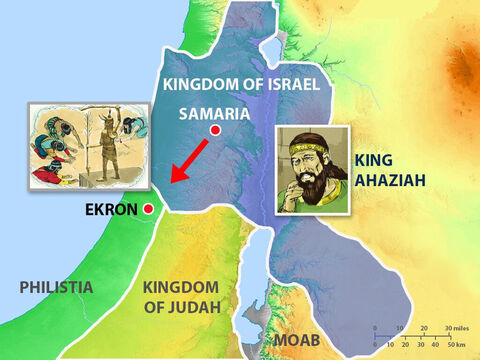
But before Ahaziah had a chance to deal with the rebellious Moabites, he suffered a life-threatening fall that left him confined to his bed in the royal palace in Samaria. His injuries were severe enough that he was concerned about whether he would fully recover. So, he sent messengers to the temple of Baal-zebub, the god of Ekron, seeking a divine prediction concerning his fate. It had been Ahaziah’s parents who had introduced Baal worship to Israel, and he proved to be a faithful adherent to their false religion. In his time of suffering, he sought the counsel of Baal rather than Yahweh, the covenant God of Israel. While Baal worship was rampant throughout the northern kingdom, Ahaziah sent his messengers to Ekron, which was located on Israel’s eastern border with Philistia. Ekron was a renowned occult center, and it was far enough away from Samaria that the news of the king’s injuries might be kept a secret.

However, Ahaziah’s messengers never reached Ekron. They were met along the way by Elijah, the prophet of Yahweh. Ahab’s old nemesis appears on the scene once again, but this time, he has bad news for Ahab’s son. Elijah had received instructions from Yahweh, commanding him to intercept the king’s messengers and inform them of their master’s fate. Ahaziah was hoping to hear a positive word from Baal, but instead, he would receive bad news from the God of Israel.

“Is there no God in Israel? Why are you going to Baal-zebub, the god of Ekron, to ask whether the king will recover? Now, therefore, this is what the LORD says: You will never leave the bed you are lying on; you will surely die.” – 2 Kings 1:3-4 NLT

There is a hint of sarcasm in this message. Yahweh is chiding Ahaziah for sending his messengers all the way to Ekron to seek a word from his false god. Baal worship was rampant within the nation of Israel. There were shrines and high places dedicated to Baal and Asherah all over the northern kingdom. In fact, Ahaziah had access to a Baal temple that his father had built in the capital city of Samaria.

He [Ahab] erected an altar for Baal in the house of Baal, which he built in Samaria. – 1 Kings 15:32 ESV

And there were literally hundreds of priests and prophets who served on behalf of Baal. Yet, Ahaziah had sent his messengers on a field trip all the way to Ekron in hopes of hearing something from his god. Perhaps he had started his search for an answer at the local temple, but had come up empty-handed. This could have led him to his “long-distance-call” to Ekron.

When Ahaziah heard the less-than-positive pronouncement his messengers delivered, he grew suspicious. This was not the news he had been expecting. So, he asked for a description of the man who had predicted his pending death. As soon as he heard what the man looked like, his suspicions were confirmed; it was Elijah the Tishbite. As the son of Ahab and Jezebel, Ahaziah would have grown up hearing the stories of Elijah and his defeat of the prophets of Baal on Mount Carmel. He would have been very familiar with his mother’s intense hatred for this prophet of Yahweh. The ongoing battle of words and will between his father and Elijah would have taken place right in front of him. So, when he discovered that Elijah had once again interjected himself into Israel’s affairs, he sent guards to arrest him. But, just like the messengers he had sent to Ekron, the guards never made it to their destination.

As visible proof of his role as a spokesman for Yahweh, Elijah called down fire from heaven that wiped out all 50 men, including their captain. But this display of power made no impression on the stubborn and unrepentant Ahaziah. He simply sent another 50 guards who suffered the very same fate. The third commander recognized the divine nature of Elijah’s role and wisely chose to beg for mercy.

“O man of God, please spare my life and the lives of these, your fifty servants. See how the fire from heaven came down and destroyed the first two groups. But now please spare my life!” – 2 Kings 1:13-14 NLT

The angel of God intervened, instructing Elijah to spare the lives of these men and accompany them back to Samaria. When he arrived in the capital city, Elijah reiterated his earlier message, but this time, directly to Ahaziah. He confirmed that the king would not recover from his injuries. Ahaziah’s stubborn refusal to seek God even in his time of greatest need would come with a death sentence. His unjustified yet unwavering allegiance to Baal had sealed his fate. As always, the words of Elijah proved to be true.

So Ahaziah died, just as the LORD had promised through Elijah. – 2 Kings 1:17 NLT

Yet another king of Israel met an untimely but well-deserved end. The legacy of unfaithfulness, begun by Jeroboam, had been passed down from generation to generation, infecting each successive king and bringing the just and righteous judgment of God upon them. And because Ahaziah had no male heir to whom he could leave the throne, his brother Jehoram became king of Israel.

Ahaziah, like his predecessors, failed to recognize Yahweh as the one true God. He acted as if Yahweh no longer existed in Israel. But he had been proven wrong. Yahweh was still alive and well, and His power was undiminished. While Ahaziah refused to seek Yahweh’s face, he could not escape Yahweh’s sovereign will. The God of Israel could be ignored, but He would not go away.

Ahaziah had made the fateful mistake of rejecting the one true God. Like his father, Ahaziah had stubbornly refused to acknowledge the supremacy of Yahweh, choosing instead to act as if the God of Israel was non-existent and powerless. But as King David declared in one of his psalms, only a fool would dare deny Yahweh’s existence.

Only fools say in their hearts,
    “There is no God.”
They are corrupt, and their actions are evil;
    not one of them does good!

The LORD looks down from heaven
    on the entire human race;
he looks to see if anyone is truly wise,
    if anyone seeks God.
But no, all have turned away;
    all have become corrupt.
No one does good,
    not a single one!

Will those who do evil never learn?
    They eat up my people like bread
    and wouldn’t think of praying to the Lord.
Terror will grip them,
    for God is with those who obey him.
The wicked frustrate the plans of the oppressed,
    but the LORD will protect his people. – Psalm 14:1-6 NLT

Ahaziah tried to pretend that Yahweh didn’t exist, but he paid for his folly with his life.

English Standard Version (ESV) The Holy Bible, English Standard Version. ESV® Permanent Text Edition® (2016). Copyright © 2001 by Crossway Bibles, a publishing ministry of Good News Publishers.

New Living Translation (NLT) Holy Bible, New Living Translation, copyright © 1996, 2004, 2015 by Tyndale House Foundation. Used by permission of Tyndale House Publishers Inc., Carol Stream, Illinois 60188. All rights reserved.

A Mind of His Own

19 Then Daniel, whose name was Belteshazzar, was dismayed for a while, and his thoughts alarmed him. The king answered and said, “Belteshazzar, let not the dream or the interpretation alarm you.” Belteshazzar answered and said, “My lord, may the dream be for those who hate you and its interpretation for your enemies! 20 The tree you saw, which grew and became strong, so that its top reached to heaven, and it was visible to the end of the whole earth, 21 whose leaves were beautiful and its fruit abundant, and in which was food for all, under which beasts of the field found shade, and in whose branches the birds of the heavens lived— 22 it is you, O king, who have grown and become strong. Your greatness has grown and reaches to heaven, and your dominion to the ends of the earth. 23 And because the king saw a watcher, a holy one, coming down from heaven and saying, ‘Chop down the tree and destroy it, but leave the stump of its roots in the earth, bound with a band of iron and bronze, in the tender grass of the field, and let him be wet with the dew of heaven, and let his portion be with the beasts of the field, till seven periods of time pass over him,’ 24 this is the interpretation, O king: It is a decree of the Most High, which has come upon my lord the king, 25 that you shall be driven from among men, and your dwelling shall be with the beasts of the field. You shall be made to eat grass like an ox, and you shall be wet with the dew of heaven, and seven periods of time shall pass over you, till you know that the Most High rules the kingdom of men and gives it to whom he will. 26 And as it was commanded to leave the stump of the roots of the tree, your kingdom shall be confirmed for you from the time that you know that Heaven rules. 27 Therefore, O king, let my counsel be acceptable to you: break off your sins by practicing righteousness, and your iniquities by showing mercy to the oppressed, that there may perhaps be a lengthening of your prosperity.”

28 All this came upon King Nebuchadnezzar. 29 At the end of twelve months he was walking on the roof of the royal palace of Babylon, 30 and the king answered and said, “Is not this great Babylon, which I have built by my mighty power as a royal residence and for the glory of my majesty?” 31 While the words were still in the king’s mouth, there fell a voice from heaven, “O King Nebuchadnezzar, to you it is spoken: The kingdom has departed from you, 32 and you shall be driven from among men, and your dwelling shall be with the beasts of the field. And you shall be made to eat grass like an ox, and seven periods of time shall pass over you, until you know that the Most High rules the kingdom of men and gives it to whom he will.” 33 Immediately the word was fulfilled against Nebuchadnezzar. He was driven from among men and ate grass like an ox, and his body was wet with the dew of heaven till his hair grew as long as eagles’ feathers, and his nails were like birds’ claws. – Daniel 4:10-33 ESV

In the earlier episode, when forced to reveal and interpret the king’s dream, Daniel took the matter to God. He gathered his three friends together and they prayed, asking God to tell them the content of the dream and its meaning, and God obliged. This time, however, there is no indication that Daniel utilized prayer to discern the interpretation of the king’s second dream. It appears Daniel knew the meaning of the dream as soon as the king described it, but he hesitated and was  “dismayed for a while, and his thoughts alarmed him” (Daniel 4:19 ESV). No explanation is given for Daniel’s disturbed state of mind but when the king sensed his reluctance to speak and encouraged him to reveal what he knew, Daniel replied, “I wish the events foreshadowed in this dream would happen to your enemies, my lord, and not to you!” (Daniel 4:19 NLT).

Daniel may have been well into his 50s by the time this incident occurred. He would have spent decades in Nebuchadnezzar’s employment, serving as the chief of all the king’s wise men. It’s likely that, during that time, Daniel and the king would have developed a close relationship. Despite their ethnic and religious differences, the two men would have shared a mutual respect and affinity for one another. Daniel’s hesitancy to reveal the dream’s meaning was born out of his care and concern for Nebuchadnezzar, not a fear of repercussions.

Buoyed by the king’s kind words of encouragement, Daniel broke his silence and said, “That tree, Your Majesty, is you. For you have grown strong and great; your greatness reaches up to heaven, and your rule to the ends of the earth” (Daniel 4:22 NLT). That part of the dream would have been easy to deliver because it was what Nebuchadnezzar wanted to hear. But it was the second half of the interpretation that had disturbed Daniel and caused him to hesitate. The blissful, happy image of the king’s reign would not end well. The watcher in the dream was a bad omen that signaled an unpleasant and unavoidable end to the king’s fame and fortune.

Your Majesty, and what the Most High has declared will happen to my lord the king. You will be driven from human society, and you will live in the fields with the wild animals. You will eat grass like a cow, and you will be drenched with the dew of heaven. Seven periods of time will pass while you live this way, until you learn that the Most High rules over the kingdoms of the world and gives them to anyone he chooses.” – Daniel 4:24-25 NLT

Daniel had to be the bearer of bad news but he didn’t deliver his message with any sense of joy or vindictiveness. He found no comfort in informing Nebuchadnezzar of his fate. Daniel seems completely aware that Nebuchadnezzar was going to get what he deserved. After all his years in the king’s employment, Daniel knew from personal experience that Nebuchadnezzar had a pride problem. He would have regularly witnessed the king’s growing arrogance and overconfidence in his own self-worth. Nebuchadnezzar was the most powerful man in the world and he had built an empire that was second to none. But Daniel knew that God was about to send a powerful and irrefutable message to his pride-filled boss.

What’s interesting to note is the focus of God’s judgment. He chooses to mess with Nebuchadnezzar’s mind, not his might. God could have dealt a death blow to the kingdom of Babylon but, instead, he threatens the king with temporary insanity. Babylon posed no problem for God. He was not intimidated by Babylonian supremacy and their reputation as an invincible superpower. As Daniel reveals in his interpretation of the dream, “…the Most High rules over the kingdoms of the world and gives them to anyone he chooses” ( Daniel 4:25 NLT). God had chosen to use Babylon as His instrument of judgment against the nation of Judah. He had raised Nebuchadnezzar to power for the sole purpose of fulfilling His promise of divine discipline against His disobedient children.

“Therefore thus says the Lord of hosts: Because you have not obeyed my words, behold, I will send for all the tribes of the north, declares the Lord, and for Nebuchadnezzar the king of Babylon, my servant, and I will bring them against this land and its inhabitants, and against all these surrounding nations. I will devote them to destruction, and make them a horror, a hissing, and an everlasting desolation. – Jeremiah 25:8-9 ESV

But Nebuchadnezzar had grown overconfident and self-assured. In his eyes, he was a self-made man who took full credit for his own success and saw no end to his dream of world dominance. But God had other plans. Little did Nebuchadnezzar know that his 15 minutes of fame would one day come to an end. God had given Jeremiah a second part to the divine plan for Babylon’s future.

Moreover, I will banish from them the voice of mirth and the voice of gladness, the voice of the bridegroom and the voice of the bride, the grinding of the millstones and the light of the lamp. This whole land shall become a ruin and a waste, and these nations shall serve the king of Babylon seventy years. Then after seventy years are completed, I will punish the king of Babylon and that nation, the land of the Chaldeans, for their iniquity, declares the Lord, making the land an everlasting waste. I will bring upon that land all the words that I have uttered against it, everything written in this book, which Jeremiah prophesied against all the nations. For many nations and great kings shall make slaves even of them, and I will recompense them according to their deeds and the work of their hands.” – Jeremiah 25:10-14 NLT

But that prophecy was to be fulfilled at a later date. Nebuchadnezzar faced a much more imminent problem – the loss of his mind, not his kingdom. What God had in store for him was going to be personal and painful. His kingdom would remain intact but his sanity would be removed for “seven periods of time” ( Daniel 4:25 NLT). Most scholars believe this is a reference to years. If so, then the king was going to go through a protracted period of unprecedented insanity. He would live like an animal with no recollection of his former status as king and no interaction with other humans. The once great and greatly feared king of Babylon would become a madman, and there was nothing he could do to prevent it from happening.

There is no indication that Nebuchadnezzar could forestall the inevitable. He had no power to prevent God Most High from fulfilling His edict. Daniel will plead with the king to change his ways, but even he does not seem confident that it will do any good.

“King Nebuchadnezzar, please accept my advice. Stop sinning and do what is right. Break from your wicked past and be merciful to the poor. Perhaps then you will continue to prosper. – Daniel 4:27 NLT

God knew Nebuchadnezzar’s heart better than Daniel did. He knew the king would never bow the knee or renounce his pride and arrogance. Even the threat of losing his most precious possession, his mind, would not be enough to cause Nebuchadnezzar to repent.

But there was good news. While God would destroy Nebuchadnezzar’s mind, it would only be for a season. In time, God would relent and restore the king’s sanity. But it would only happen when the king had learned his lesson. God had Daniel inform Nebuchadnezzar of the meaning behind the stump in his dream.

“…the stump and roots of the tree were left in the ground. This means that you will receive your kingdom back again when you have learned that heaven rules.” – Daniel 4:26 NLT

Nebuchadnezzar’s mind would be bound by God until he was willing to admit the reality of God’s sovereignty. There was only one King and He alone rules and reigns over all the kingdoms of Earth. And despite Daniel’s desperate pleas for Nebuchadnezzar to repent, the king will continue in his stubborn, pride-filled ways.

English Standard Version (ESV) The Holy Bible, English Standard Version. ESV® Permanent Text Edition® (2016). Copyright © 2001 by Crossway Bibles, a publishing ministry of Good News Publishers.

New Living Translation (NLT) Holy Bible, New Living Translation, copyright © 1996, 2004, 2015 by Tyndale House Foundation. Used by permission of Tyndale House Publishers Inc., Carol Stream, Illinois 60188. All rights reserved.

New English Translation (NET)NET Bible® copyright ©1996-2017 by Biblical Studies Press, L.L.C. http://netbible.com All rights reserved.

The Crippling Effect of Self-Sufficiency

1 When Ish-bosheth, Saul’s son, heard that Abner had died at Hebron, his courage failed, and all Israel was dismayed. Now Saul’s son had two men who were captains of raiding bands; the name of the one was Baanah, and the name of the other Rechab, sons of Rimmon a man of Benjamin from Beeroth (for Beeroth also is counted part of Benjamin; the Beerothites fled to Gittaim and have been sojourners there to this day).

Jonathan, the son of Saul, had a son who was crippled in his feet. He was five years old when the news about Saul and Jonathan came from Jezreel, and his nurse took him up and fled, and as she fled in her haste, he fell and became lame. And his name was Mephibosheth.

Now the sons of Rimmon the Beerothite, Rechab and Baanah, set out, and about the heat of the day they came to the house of Ish-bosheth as he was taking his noonday rest. And they came into the midst of the house as if to get wheat, and they stabbed him in the stomach. Then Rechab and Baanah his brother escaped. When they came into the house, as he lay on his bed in his bedroom, they struck him and put him to death and beheaded him. They took his head and went by the way of the Arabah all night, and brought the head of Ish-bosheth to David at Hebron. And they said to the king, “Here is the head of Ish-bosheth, the son of Saul, your enemy, who sought your life. The Lord has avenged my lord the king this day on Saul and on his offspring.” But David answered Rechab and Baanah his brother, the sons of Rimmon the Beerothite, “As the Lord lives, who has redeemed my life out of every adversity, 10 when one told me, ‘Behold, Saul is dead,’ and thought he was bringing good news, I seized him and killed him at Ziklag, which was the reward I gave him for his news. 11 How much more, when wicked men have killed a righteous man in his own house on his bed, shall I not now require his blood at your hand and destroy you from the earth?” 12 And David commanded his young men, and they killed them and cut off their hands and feet and hanged them beside the pool at Hebron. But they took the head of Ish-bosheth and buried it in the tomb of Abner at Hebron. – 2 Samuel 4:1-12 ESV

The transition of the kingdom from Saul to David has been anything but smooth up to this point. With Saul’s death, one would think that the path for David’s God-ordained ascension to the throne would have been cleared of all roadblocks. But then Abner showed up and convinced Saul’s son, Ish-bostheth to claim the crown for himself. This set up a long, drawn-out conflict between the tribe of Judah and the remaining tribes of Israel. Then, when David’s men routed the army of Ish-bosheth, it seemed obvious that Abner, the commander of Ish-bosheth’s troops, would have recommended surrender. But instead, he returned home and committed the cardinal sin of sleeping with one of Saul’s concubines. When Ish-bosheth questioned Abner’s motives, he the general showed his true colors, turning his back on the house of Saul and offering his services and the allegiance of the remaining tribes of Israel to David.

To solidify his claim to the crown, David took Abner up on his offer and made a peace treaty with him, with a special addendum, that Ish-bosheth agree to return David’s wife, Michal, to him. The only problem with David’s deal with Abner is that he never informed Joab, his own military commander. This oversight proved to be a major mistake on David’s part because he failed to take into account that Abner had murdered Joab’s brother, Ahasel. Joab took David’s treaty with Abner as a personal affront and decided to take matters into his own hands by murdering Abner. This forced David into damage control, prompting him to throw a huge state funeral for Abner and pronounce a devastating generational curse on his own military commander.

Things were spinning out of control and would only get worse. Upon hearing of Abner’s death, Ish-bosheth, the son of Saul and the king of the remaining tribes of Israel lost his nerve. Up until that point, he had been little more than a puppet king, relying heavily on Abner’s charisma and leadership to survive. Now that Abner was dead, he was on his own, a thought that scared him to death. Not only that, the people of Israel had no confidence in his ability to lead the nation without Abner’s assistance. This fact would become painfully clear for the young king.

Suspecting that Ish-bosheth’s fledgling reign was coming to an end, two Israelites came up with a plan to assassinate him. Rechab and Baanah believed that with Ish-bosheth out of the way they could hand over the kingdom to David, and receive a reward for their act of allegiance.

But the one thing missing from this twisted tale is any semblance of a word from God. Everyone is acting on their own initiative and for their own good, with no regard for what God would have them do. The assassination of Ish-bosheth was the brainchild of Rechab and Baanah, who were attempting to facilitate the outcome that best suited their own personal interests. Just like Abner, Rechab and Baanah were not fans of David; they were in it for what they could get out of it. Ish-bosheth was nothing more than a means to an end. He was their ticket to notoriety and reward.

What’s important to note is that all of this began with David’s decision to make an alliance with Abner, a plan concocted by Abner without the approval of God. At no point in the story does David seek or receive God’s permission to sign a deal with Abner. Yet, in doing so, David created a highly unstable and potentially dangerous atmosphere.

God didn’t need David’s help in uniting the kingdom and He had not sanctioned a treaty with Abner. But because David chose to act without God’s approval, Abner was murdered by Joab, who was cursed by David. and Ish-bosheth ended up assassinated by Rechab and Baanah. In the end, those two men would be executed by David’s order, with their heads and hands cut off and their bodies hung up for public display. What a great way to start a kingdom!

There is one subtle ray of light that illuminates the darkness of these events but it’s easy to miss. Verse four mentions Jonathan’s son, Mephibosheth. This verse is like a parenthetical statement that comes out of the blue. It doesn’t seem to fit the context, but it sets up something that happens later in the story and is recorded in chapter nine. Mephibosheth was the grandson of Saul, and as such, he would have been a potential heir to the throne of Saul. But as a child, he suffered from a tragic accident that left him a permanent physical disability.

He was five years old when the news about Saul and Jonathan arrived from Jezreel. His nurse picked him up and fled, but in her haste to get away, he fell and was injured. Mephibosheth was his name. – 2 Samuel 4:4 NLT

In the middle of all the death, deceit, self-centered promotional efforts, jockeying for position, seeking of rewards, and looking out for number one, Mephibosheth’s name appears as a subtle hint that it is the helpless and hopeless, the overlooked and the down-and-out who God protects. Abner could make deals, but he would eventually have to deal with God. Rechab and Baanah could come up with plans to line their pockets and improve their futures, but ultimately, their futures were in God’s hands. Joab could seek to mete out revenge on his own terms but would learn that vengeance, when not left up to God, can end up as a curse rather than a blessing. David could attempt to speed up his ascension to the throne of all Israel but he would learn that trying to accomplish God’s will his own way rarely ends well.

We’re told that Mephibosheth “was crippled in his feet.” Could it be that this little description was meant to provide a not-so-subtle insight into how David, in an attempt to help God out, was actually crippling his own kingship? The helplessness of Mephibosheth provides a dramatic reminder of David’s need for God. This young boy, who could not walk on his own, would find himself at the mercy of the king. He would have no other choice but to entrust his life to the sovereign will of his grandfather’s successor. And David was still learning that his life, kingdom, and future reign over the house of Israel were completely at the mercy of God Almighty. Waiting on and resting in Him would be the best course of action.

English Standard Version (ESV) The Holy Bible, English Standard Version. ESV® Permanent Text Edition® (2016). Copyright © 2001 by Crossway Bibles, a publishing ministry of Good News Publishers.

New Living Translation (NLT) Holy Bible, New Living Translation, copyright © 1996, 2004, 2015 by Tyndale House Foundation. Used by permission of Tyndale House Publishers Inc., Carol Stream, Illinois 60188. All rights reserved.

Suffer the Fool

16 And Jonathan made a covenant with the house of David, saying, “May the Lord take vengeance on David’s enemies.” 17 And Jonathan made David swear again by his love for him, for he loved him as he loved his own soul.

18 Then Jonathan said to him, “Tomorrow is the new moon, and you will be missed, because your seat will be empty. 19 On the third day go down quickly to the place where you hid yourself when the matter was in hand, and remain beside the stone heap. 20 And I will shoot three arrows to the side of it, as though I shot at a mark. 21 And behold, I will send the boy, saying, ‘Go, find the arrows.’ If I say to the boy, ‘Look, the arrows are on this side of you, take them,’ then you are to come, for, as the Lord lives, it is safe for you and there is no danger. 22 But if I say to the youth, ‘Look, the arrows are beyond you,’ then go, for the Lord has sent you away. 23 And as for the matter of which you and I have spoken, behold, the Lord is between you and me forever.”

24 So David hid himself in the field. And when the new moon came, the king sat down to eat food. 25 The king sat on his seat, as at other times, on the seat by the wall. Jonathan sat opposite, and Abner sat by Saul’s side, but David’s place was empty.’

26 Yet Saul did not say anything that day, for he thought, “Something has happened to him. He is not clean; surely he is not clean.” 27 But on the second day, the day after the new moon, David’s place was empty. And Saul said to Jonathan his son, “Why has not the son of Jesse come to the meal, either yesterday or today?” 28 Jonathan answered Saul, “David earnestly asked leave of me to go to Bethlehem. 29 He said, ‘Let me go, for our clan holds a sacrifice in the city, and my brother has commanded me to be there. So now, if I have found favor in your eyes, let me get away and see my brothers.’ For this reason he has not come to the king’s table.”

30 Then Saul’s anger was kindled against Jonathan, and he said to him, “You son of a perverse, rebellious woman, do I not know that you have chosen the son of Jesse to your own shame, and to the shame of your mother’s nakedness? 31 For as long as the son of Jesse lives on the earth, neither you nor your kingdom shall be established. Therefore send and bring him to me, for he shall surely die.” 32 Then Jonathan answered Saul his father, “Why should he be put to death? What has he done?” 33 But Saul hurled his spear at him to strike him. So Jonathan knew that his father was determined to put David to death. 34 And Jonathan rose from the table in fierce anger and ate no food the second day of the month, for he was grieved for David, because his father had disgraced him. – 1 Samuel 20:16-34 ESV

David and Jonathan had come up with a plan. David would purposefully miss the feast of the new moon, knowing that his absence would be noticed by Saul. When Saul inquired of Jonathan where David was, he was to tell his father that David had gone home to celebrate the feast with his family in Bethlehem. If Saul accepted this news without incident, David would know it was safe to return home. But if Saul became angry and flew off the handle, Jonathan was to secretly inform David so that he could escape.

When the fateful day came and David was not at his place for the feast, Saul missed him but assumed that something had come up. But by the second day, Saul became suspicious and asked Jonathan for an explanation. What he heard infuriated him and he accused his son of trying to pull a fast one by conspiring with David against him. Saul lashed out in anger at the perceived betrayal of his own son, using X-rated language to convey his disappointment.

“Saul, now incensed and enraged over Jonathan’s liaison with David, is actually hurling very coarse and emotionally charged words at his son. The translation of this phrase suggested by Koehler and Baumgartner is ‘bastard of a wayward woman’ (HALOT 796 s.v. עוה), but this is not an expression commonly used in English. A better English approximation of the sentiments expressed here by the Hebrew phrase would be ‘You stupid son of a bitch!’” – NET Bible study notes

Saul is beside himself with rage. His own son has taken sides with someone he sees as an enemy and a threat to his throne. Saul even reminds Jonathan that his actions will keep him from inheriting the kingship.

As long as that son of Jesse is alive, you’ll never be king. Now go and get him so I can kill him!” – 1 Samuel 20:31 NLT

Saul’s anger is uncontrollable and he fails to recognize that his efforts to kill David are in direct opposition to the words spoken by Samuel the prophet. He knows his reign is coming to an end and his replacement has already been chosen by God.

And Samuel said to Saul, “You have done foolishly. You have not kept the command of the Lord your God, with which he commanded you. For then the Lord would have established your kingdom over Israel forever. But now your kingdom shall not continue. The Lord has sought out a man after his own heart, and the Lord has commanded him to be prince over his people, because you have not kept what the Lord commanded you.” – 1 Samuel 13:13-14 ESV

And Samuel said to Saul, “I will not return with you. For you have rejected the word of the Lord, and the Lord has rejected you from being king over Israel.” – 1 Samuel 15:26 ESV

But Saul stubbornly refused to accept his fate. He somehow believed that he could hold onto his throne despite God’s statements to the contrary. In a blatant display of obstinance and self-preservation, Saul refuses to repent and accept God’s just and righteous punishment for his past sins. As Saul has done before, he displays a habit of shifting blame and denying culpability.

Early on in his reign, Saul had received instructions to wait seven days for Samuel to join him. At that time, the prophet would offer sacrifices to God. But Saul became impatient and took it upon himself to play the part of both priest and king. When confronted by Samuel for offering a burnt offering on his own, rather than waiting on the prophet as he had been instructed, Saul simply offered up excuses:

Now the Philistines will come down against me at Gilgal, and I have not sought the favor of the Lord.’ So I forced myself, and offered the burnt offering.” – 1 Samuel 13:12 ESV

He claims to have forced himself to do what he did. He didn’t want to do it, but he had no other choice. But Saul knew his behavior was unacceptable to God. As a Jew, he knew that only a priest was authorized to offer sacrifices to God. Yet Saul, impatient and impulsive, took matters into his own hands and decided to do things his way.

On another occasion, when Saul had been instructed by God to wipe out all the Amalekites, he again chose to do things his own way. The text tells us, “But Saul and the people spared Agag and the best of the sheep and of the oxen and of the fattened calves and the lambs, and all that was good, and would not utterly destroy them. All that was despised and worthless they devoted to destruction” (1 Samuel 15:9 ESV). When Samuel confronted him about his disobedience, he simply responded, the people spared the best of the sheep and of the oxen to sacrifice to the Lord your God, and the rest we have devoted to destruction” (1 Samuel 15:15 ESV). Rather than confessing his sin, he blamed the people. It wasn’t his fault.

Saul never found repentance easy. He struggled to accept responsibility for his own sinfulness and had difficulty accepting God’s decision to remove him from the throne for his repeated disobedience. It’s as if he believed he could get around God’s plan to replace him and remain on the throne by sheer willpower. Saul was the quintessential fool with all the attributes outlined in the book of Proverbs.

Fools think their own way is right… – Proverbs 12:15 NLT

The words of the godly are like sterling silver;
    the heart of a fool is worthless. – Proverbs 10:20 NLT

The fear of the Lord is the beginning of knowledge;
   fools despise wisdom and instruction. – Proverbs 1:7 ESV

For the simple are killed by their turning away,
    and the complacency of fools destroys them.
– Proverbs 1:32 ESV

The way of a fool is right in his own eyes,
    but a wise man listens to advice. – Proverbs. 12:15 ESV

A prudent man conceals knowledge,
    but the heart of fools proclaims folly.
 – Proverbs 12:23 ESV

Saul was foolish to think he could escape the inevitable judgment of God. He was foolish to think he could defeat the man who had been chosen by God as his replacement. He was foolish to believe that his disobedience to God would not have consequences or that the divine will of God could somehow be circumvented. In fact, Saul lived as if there was no God, a hallmark of the foolish lifestyle.

David himself would later write, “Only fools say in their hearts, ‘There is no God.’ They are corrupt, and their actions are evil; not one of them does good!” (Psalm 14:1 NLT). Saul’s actions revealed his foolish assumption that God was either impotent or irrelevant. He was going to do what he wanted to do – as if God didn’t even exist. His stubbornness would ultimately be the end of him but not before he spent the next years of his life foolishly shaking his fist in the face of the Almighty. He wrongly believed that his wisdom was greater than that of God. But he would be proven wrong, as fools always are.

English Standard Version (ESV) The Holy Bible, English Standard Version. ESV® Permanent Text Edition® (2016). Copyright © 2001 by Crossway Bibles, a publishing ministry of Good News Publishers.

New Living Translation (NLT) Holy Bible, New Living Translation, copyright © 1996, 2004, 2015 by Tyndale House Foundation. Used by permission of Tyndale House Publishers Inc., Carol Stream, Illinois 60188. All rights reserved.

Too Little, Too Late

26 And the Lord spoke to Moses and to Aaron, saying, 27 “How long shall this wicked congregation grumble against me? I have heard the grumblings of the people of Israel, which they grumble against me. 28 Say to them, ‘As I live, declares the Lord, what you have said in my hearing I will do to you: 29 your dead bodies shall fall in this wilderness, and of all your number, listed in the census from twenty years old and upward, who have grumbled against me, 30 not one shall come into the land where I swore that I would make you dwell, except Caleb the son of Jephunneh and Joshua the son of Nun. 31 But your little ones, who you said would become a prey, I will bring in, and they shall know the land that you have rejected. 32 But as for you, your dead bodies shall fall in this wilderness. 33 And your children shall be shepherds in the wilderness forty years and shall suffer for your faithlessness, until the last of your dead bodies lies in the wilderness. 34 According to the number of the days in which you spied out the land, forty days, a year for each day, you shall bear your iniquity forty years, and you shall know my displeasure.’ 35 I, the Lord, have spoken. Surely this will I do to all this wicked congregation who are gathered together against me: in this wilderness they shall come to a full end, and there they shall die.”

36 And the men whom Moses sent to spy out the land, who returned and made all the congregation grumble against him by bringing up a bad report about the land— 37 the men who brought up a bad report of the land—died by plague before the Lord. 38 Of those men who went to spy out the land, only Joshua the son of Nun and Caleb the son of Jephunneh remained alive.

39 When Moses told these words to all the people of Israel, the people mourned greatly. 40 And they rose early in the morning and went up to the heights of the hill country, saying, “Here we are. We will go up to the place that the Lord has promised, for we have sinned.” 41 But Moses said, “Why now are you transgressing the command of the Lord, when that will not succeed? 42 Do not go up, for the Lord is not among you, lest you be struck down before your enemies. 43 For there the Amalekites and the Canaanites are facing you, and you shall fall by the sword. Because you have turned back from following the Lord, the Lord will not be with you.” 44 But they presumed to go up to the heights of the hill country, although neither the ark of the covenant of the Lord nor Moses departed out of the camp. 45 Then the Amalekites and the Canaanites who lived in that hill country came down and defeated them and pursued them, even to Hormah.  Numbers 14:26-45 ESV

God essentially told the Israelites that the worst-case scenario they had conjured up in their minds was going to take place. Their greatest fears were going to become reality. In an attempt to rationalize their rebellion against Moses’ leadership, they had predicted a foreboding future if they stayed where they were.

“Would that we had died in the land of Egypt! Or would that we had died in this wilderness! Why is the Lord bringing us into this land, to fall by the sword? Our wives and our little ones will become a prey. – Numbers 14:2-3 ESV

And God let them know that their projections of doom and gloom would come true.

“As surely as I live, declares the Lord, I will do to you the very things I heard you say. You will all drop dead in this wilderness! Because you complained against me, every one of you who is twenty years old or older and was included in the registration will die. You will not enter and occupy the land I swore to give you. – Numbers 14:28-30 NLT

As punishment for their rebellion, God revealed their fate. They would not be returning to Egypt and they would never enter the land of promise. Instead, they would spend the next four decades wandering in the wilderness. During that time, the entire first generation of Israelites would die of natural causes as they wandered just outside the border of Canaan. They wouldn’t have to worry about dying in battle because they would never make it to the promised land. No, their deaths would be from old age as they spent the next 40 years living a nomadic and pointless lifestyle; a year for every day the 12 spies had spent in Canaan.

There would be no supernatural cosmological display of fire and brimstone to consume the wicked. The ground wouldn’t open up and swallow all those who were guilty. In fact, for the next 40 years, God would continue to provide for their physical needs; providing them with manna, quail, and fresh drinking water. Despite their rebellious actions, God was not going to abandon or annihilate them. His presence would remain with them. The Tabernacle would be available to them for worship and sacrifice. They would continue to tend their flocks and herds, raise their children, and live out their days in relative peace and security. But they would never enter the land that God had promised as their inheritance.

“Not one of you from this wicked generation will live to see the good land I swore to give your ancestors.” – Deuteronomy 1:25 NLT

Canaan was to have been their final destination. It was a rich and fertile land, just as the spies had reported, and even before God had brought a single plague against Egypt, He had promised to lead the descendants of Jacob to their new homeland.

“I have promised to rescue you from your oppression in Egypt. I will lead you to a land flowing with milk and honey—the land where the Canaanites, Hittites, Amorites, Perizzites, Hivites, and Jebusites now live.” – Exodus 3:17 NLT

But as a result of their stubborn refusal to trust God, they would spend 40 long years living on the wrong side of the border of Canaan. In time, one by one, they would succumb to old age and die, and their bodies would be buried in the barren wastelands of the wilderness. The stiff punishment for their rebellion led the author of Hebrews to use it as a warning to a new generation of Jews who had been offered another promise of future inheritance by God.

“Today when you hear his voice,
    don’t harden your hearts
as Israel did when they rebelled,
    when they tested me in the wilderness.
There your ancestors tested and tried my patience,
    even though they saw my miracles for forty years.
So I was angry with them, and I said,
‘Their hearts always turn away from me.
    They refuse to do what I tell them.’
So in my anger I took an oath:
    ‘They will never enter my place of rest.’” – Hebrews 3:7-11 NLT

Canaan was to have been their place of rest. That doesn’t mean Canaan was going to be a stress-free environment, devoid of difficulties. The spies had been right; there were enemies in the land and the Israelites would have to do battle with each of them if they wanted to make the land their own. But God had promised them victory. He was going to use the Israelites to purge the land of all the wickedness, immorality, and godlessness that had filled it since their departure more than 430 years earlier.

Yet, rather than obeying God and trusting Him to give them victory over the inhabitants of Canaan, the Israelites ended up making an enemy of God.

“Because your men explored the land for forty days, you must wander in the wilderness for forty years—a year for each day, suffering the consequences of your sins. Then you will discover what it is like to have me for an enemy.” – Numbers 14:34 NLT

What makes this story so painful and impactful is that it involves the people of God. These were His chosen ones whom He had redeemed out of slavery in Egypt. He had graciously offered them freedom and a permanent homeland of their own where they could enjoy His presence, power, and provision. Yet, because the conquest of the land appeared to be a more difficult undertaking than they had imagined, they turned their back on God’s gracious offer. Once again, the author of Hebrews emphasizes the disbelieving nature of God’s chosen people.

And who was it who rebelled against God, even though they heard his voice? Wasn’t it the people Moses led out of Egypt? And who made God angry for forty years? Wasn’t it the people who sinned, whose corpses lay in the wilderness? And to whom was God speaking when he took an oath that they would never enter his rest? Wasn’t it the people who disobeyed him? So we see that because of their unbelief they were not able to enter his rest. – Hebrews 3:16-19 NLT

And he warns his fellow Jews to learn from their ancestors’ mistakes.

Be careful then, dear brothers and sisters. Make sure that your own hearts are not evil and unbelieving, turning you away from the living God. For if we are faithful to the end, trusting God just as firmly as when we first believed, we will share in all that belongs to Christ. – Hebrews 3:12, 14 NLT

God’s promise of rest required obedience. The land was theirs, but they would have to do battle to take full possession of it. A non-negotiable prerequisite for occupying the land was the cleansing of all its impurities, and that would require hard work and faith. Any effort they put forth would have to be based on their belief that God would go before them and provide them with victory. But for the Israelites, a long march back to Egypt and the promise of certain enslavement were more appealing than the risk of obeying the will of God. As a result, they would never enter His rest.

And, as for the ten spies who convinced the people to rebel against God, they faced a more immediate and unpleasant outcome for their role.

The ten men Moses had sent to explore the land—the ones who incited rebellion against the Lord with their bad report—were struck dead with a plague before the Lord. – Numbers 14:36-37 NLT

God had not changed His mind. His promise to provide an inheritance for the descendants of Abraham, Isaac, and Jacob remained just as firm as ever. But there would be some who would never get to enjoy it; they had forfeited that right.

But when the people heard the news of God’s judgment against them, they were grieved and attempted to change God’s mind by feigning repentance and declaring their rejuvenated willingness to march into Canaan.

“We realize that we have sinned, but now we are ready to enter the land the Lord has promised us.” – Numbers 14:40 NLT

But it was too little, too late. Moses even warned them that they were only making matters worse by attempting to escape God’s judgment through their faux display of faithfulness. After watching the ten spies die from a plague, the people were suddenly motivated to obey God’s command and march into Canaan. They were suggesting immediate entrance into the land, even though that was not what God had ordered. They thought a show of enthusiasm might temper God’s anger. But Moses warned them against making such an ill-fated decision.

“Why are you now disobeying the Lord’s orders to return to the wilderness? It won’t work. Do not go up into the land now. You will only be crushed by your enemies because the Lord is not with you. When you face the Amalekites and Canaanites in battle, you will be slaughtered. The Lord will abandon you because you have abandoned the Lord.” – Numbers 14:41-43 NLT

But stubborn as always, the people rejected Moses’ counsel and attempted to enter Canaan – without God’s approval or help – and they failed miserably. They had forfeited their right to the inheritance. The land would never be theirs and they would never enjoy the rest that God had promised. The apostle Paul provides a powerful application of this story for those who long to enter the eternal rest that comes through faith in Christ.

I don’t want you to forget, dear brothers and sisters, about our ancestors in the wilderness long ago. All of them were guided by a cloud that moved ahead of them, and all of them walked through the sea on dry ground. In the cloud and in the sea, all of them were baptized as followers of Moses. All of them ate the same spiritual food, and all of them drank the same spiritual water. For they drank from the spiritual rock that traveled with them, and that rock was Christ. Yet God was not pleased with most of them, and their bodies were scattered in the wilderness.

These things happened as a warning to us, so that we would not crave evil things as they did, or worship idols as some of them did. – 1 Corinthians 10:1-7 NLT

The Israelites had experienced the power and presence of God. He had defeated their Egyptian overlords and delivered them from captivity. He had led them, fed them, protected them, and provided for them. But when it came time to enter the land, they had rebelled against Him. And when Moses warned them against taking matters into their own hands by entering the land without God’s blessing or presence, they rebelled yet again.

But the people defiantly pushed ahead toward the hill country, even though neither Moses nor the Ark of the Lord’s Covenant left the camp. Then the Amalekites and the Canaanites who lived in those hills came down and attacked them and chased them back as far as Hormah. – Numbers 14:44-45 NLT

They attempted to do God’s will without God’s permission and power, and they failed miserably. They thought they could correct their former act of disobedience with an enthusiastic but unsanctioned assault on the enemies of God. But without His permission and presence, their efforts proved powerless.

English Standard Version (ESV) The Holy Bible, English Standard Version. ESV® Permanent Text Edition® (2016). Copyright © 2001

New Living Translation (NLT) Holy Bible, New Living Translation, copyright © 1996, 2004, 2015 by Tyndale House Foundation. Used by permission of Tyndale House Publishers Inc., Carol Stream, Illinois 60188. All rights reserved.

Plague Number Eight

1 Then the Lord said to Moses, “Go in to Pharaoh, for I have hardened his heart and the heart of his servants, that I may show these signs of mine among them, and that you may tell in the hearing of your son and of your grandson how I have dealt harshly with the Egyptians and what signs I have done among them, that you may know that I am the Lord.”

So Moses and Aaron went in to Pharaoh and said to him, “Thus says the Lord, the God of the Hebrews, ‘How long will you refuse to humble yourself before me? Let my people go, that they may serve me. For if you refuse to let my people go, behold, tomorrow I will bring locusts into your country, and they shall cover the face of the land, so that no one can see the land. And they shall eat what is left to you after the hail, and they shall eat every tree of yours that grows in the field, and they shall fill your houses and the houses of all your servants and of all the Egyptians, as neither your fathers nor your grandfathers have seen, from the day they came on earth to this day.’” Then he turned and went out from Pharaoh.

Then Pharaoh’s servants said to him, “How long shall this man be a snare to us? Let the men go, that they may serve the Lord their God. Do you not yet understand that Egypt is ruined?” So Moses and Aaron were brought back to Pharaoh. And he said to them, “Go, serve the Lord your God. But which ones are to go?” Moses said, “We will go with our young and our old. We will go with our sons and daughters and with our flocks and herds, for we must hold a feast to the Lord.” 10 But he said to them, “The Lord be with you, if ever I let you and your little ones go! Look, you have some evil purpose in mind. 11 No! Go, the men among you, and serve the Lord, for that is what you are asking.” And they were driven out from Pharaoh’s presence.

12 Then the Lord said to Moses, “Stretch out your hand over the land of Egypt for the locusts, so that they may come upon the land of Egypt and eat every plant in the land, all that the hail has left.” 13 So Moses stretched out his staff over the land of Egypt, and the Lord brought an east wind upon the land all that day and all that night. When it was morning, the east wind had brought the locusts. 14 The locusts came up over all the land of Egypt and settled on the whole country of Egypt, such a dense swarm of locusts as had never been before, nor ever will be again. 15 They covered the face of the whole land, so that the land was darkened, and they ate all the plants in the land and all the fruit of the trees that the hail had left. Not a green thing remained, neither tree nor plant of the field, through all the land of Egypt. 16 Then Pharaoh hastily called Moses and Aaron and said, “I have sinned against the Lord your God, and against you. 17 Now therefore, forgive my sin, please, only this once, and plead with the Lord your God only to remove this death from me.” 18 So he went out from Pharaoh and pleaded with the Lord. 19 And the Lord turned the wind into a very strong west wind, which lifted the locusts and drove them into the Red Sea. Not a single locust was left in all the country of Egypt. 20 But the Lord hardened Pharaoh’s heart, and he did not let the people of Israel go. – Exodus 10:1-20 ESV

Exodus 12:12 contains a stunning statement from God that comes well after He has delivered nine of the ten plagues on the nation of Egypt. He simply states, “on all the gods of Egypt I will execute judgments: I am the Lord” (Exodus 12:12 ESV). As He prepares to launch the tenth and final judgment, He reminds Moses and Aaron that every one of the devastating signs He has sent upon Egypt has been a direct assault on their false and, therefore, unreliable gods.

And chapter ten contains Moses’ account of the eighth plague which brought a supernatural infestation of locusts upon the land. This too meant to pit the God of the Israelites against one or more of the gods of Egypt. Locusts were nothing new to the Egyptians. These voracious and destructive insects were a normal part of life in that region of the world. Their arrival and the subsequent damage they could do to all vegetation could wreak havoc on the Egyptian agricultural economy. That’s why the Egyptians had gods they relied upon to ward off this destructive menace, including the grain gods Neper, Nepri, Heneb, and Renenutet, as well as Isis and Set, two gods responsible for protecting the nation’s crops. Renenutet, in particular, was revered as a goddess of nourishment and the harvest. She was responsible for the fertility of the fields but was also deemed the protector of the royal office and power.

But with this eighth plague, God would bring another wave of destruction upon the land that would virtually destroy the nation’s economy and cripple Pharaoh’s administration.

God makes it clear to Moses that Pharaoh’s hardness of heart has all been part of the plan. From the very beginning, God had intended to bring a series of judgments against the Egyptians that would prepare the way for His people’s deliverance. Each plague was pre-planned and necessary and, all combined, they would have a cumulative effect that eventually forced Pharaoh to submit to God’s will. Not only that, they would serve as powerful reminders to the people of Israel of God’s power and providence.

“I have made him and his officials stubborn so I can display my miraculous signs among them. I’ve also done it so you can tell your children and grandchildren about how I made a mockery of the Egyptians and about the signs I displayed among them—and so you will know that I am the Lord.” – Exodus 10:1-2 NLT

Moses and Aaron did as they had done so many times before. They came before Pharaoh and delivered their latest message from God.

Let my people go, so they can worship me. If you refuse, watch out! For tomorrow I will bring a swarm of locusts on your country. They will cover the land so that you won’t be able to see the ground. They will devour what little is left of your crops after the hailstorm, including all the trees growing in the fields. They will overrun your palaces and the homes of your officials and all the houses in Egypt. Never in the history of Egypt have your ancestors seen a plague like this one!” – Exodus 10:3-6 NLT

But, by now, the reader has already come to expect the same outcome as before. Pharaoh will reject their warning. And that is exactly what happens, despite the pleas of Pharaoh’s officials. They warn the king that the nation may not survive another assault from the Israelite’s God. The plague of hail left their crops and orchards in ruin. What was not destroyed would most certainly be devastated by an infestation of locusts. So, they strongly suggested that Pharaoh make a concession to allow the men of Israel to go and worship their God. By demanding that the women and children remain in Goshen, it would ensure that the men would return to their families. In a sense, Pharaoh’s counselors were suggesting that he use the women and children as hostages.

But when Pharaoh announces his intention to let only the men go and worship, Moses argued, “We must all join together in celebrating a festival to the Lord” (Exodus 10:9 NLT). Unused to having his will opposed, Pharaoh erupted against Moses and told him that the deal was off. It was going to be his way or no way at all. At this, Moses and Aaron left the king’s presence and the locusts descended upon the land.

…the locusts swarmed over the whole land of Egypt, settling in dense swarms from one end of the country to the other. It was the worst locust plague in Egyptian history, and there has never been another one like it. – Exodus 10:14 NLT

Once again, the gods of Egypt proved powerless to stand before Jehovah. The Egyptians probably cried out to their gods, but there was no answer. They offered sacrifices and offerings, but there was no relief in sight. Wave after wave of locusts descended upon their fields and orchards, devouring “every plant in the fields and all the fruit on the trees that had survived the hailstorm” (Exodus 10:15 NLT).

And it didn’t take long before Moses and Aaron were summoned back into Pharaoh’s presence. They had gotten his attention and he was ready to negotiate. But first, he begged them to pray to their God so that this latest plight might come to an end.

“Forgive my sin, just this once, and plead with the Lord your God to take away this death from me.” – Exodus 10:17 NLT

He appears to be sincere. His pride appears to be broken. But after Moses prayed and God miraculously removed every last locust from the land of Egypt, Pharaoh resorted back to his old stubborn ways and refused to let the people go.

The land lay in utter disarray, devastated by the effects of the hail and the damage done by the locusts. But Pharaoh remained steadfast in his refusal to give in to God’s demands. He still thought he was in control. Despite all that God had done to his land, Pharaoh believed he remained the king over his domain. His great pride would not allow him to bend the knee to another, even the all-powerful God of the Israelites. He somehow believed he could win this battle of wills. But what he failed to understand was that the sovereign will of Yahweh can be resisted but never thwarted. Pharaoh could stubbornly stand his ground, but he would one day bow his knee to the all-powerful, all-knowing God of the universe.

English Standard Version (ESV) The Holy Bible, English Standard Version. ESV® Permanent Text Edition® (2016). Copyright © 2001

New Living Translation (NLT) Holy Bible, New Living Translation, copyright © 1996, 2004, 2015 by Tyndale House Foundation. Used by permission of Tyndale House Publishers Inc., Carol Stream, Illinois 60188. All rights reserved.