Too Little, Too Late

26 And the Lord spoke to Moses and to Aaron, saying, 27 “How long shall this wicked congregation grumble against me? I have heard the grumblings of the people of Israel, which they grumble against me. 28 Say to them, ‘As I live, declares the Lord, what you have said in my hearing I will do to you: 29 your dead bodies shall fall in this wilderness, and of all your number, listed in the census from twenty years old and upward, who have grumbled against me, 30 not one shall come into the land where I swore that I would make you dwell, except Caleb the son of Jephunneh and Joshua the son of Nun. 31 But your little ones, who you said would become a prey, I will bring in, and they shall know the land that you have rejected. 32 But as for you, your dead bodies shall fall in this wilderness. 33 And your children shall be shepherds in the wilderness forty years and shall suffer for your faithlessness, until the last of your dead bodies lies in the wilderness. 34 According to the number of the days in which you spied out the land, forty days, a year for each day, you shall bear your iniquity forty years, and you shall know my displeasure.’ 35 I, the Lord, have spoken. Surely this will I do to all this wicked congregation who are gathered together against me: in this wilderness they shall come to a full end, and there they shall die.”

36 And the men whom Moses sent to spy out the land, who returned and made all the congregation grumble against him by bringing up a bad report about the land— 37 the men who brought up a bad report of the land—died by plague before the Lord. 38 Of those men who went to spy out the land, only Joshua the son of Nun and Caleb the son of Jephunneh remained alive.

39 When Moses told these words to all the people of Israel, the people mourned greatly. 40 And they rose early in the morning and went up to the heights of the hill country, saying, “Here we are. We will go up to the place that the Lord has promised, for we have sinned.” 41 But Moses said, “Why now are you transgressing the command of the Lord, when that will not succeed? 42 Do not go up, for the Lord is not among you, lest you be struck down before your enemies. 43 For there the Amalekites and the Canaanites are facing you, and you shall fall by the sword. Because you have turned back from following the Lord, the Lord will not be with you.” 44 But they presumed to go up to the heights of the hill country, although neither the ark of the covenant of the Lord nor Moses departed out of the camp. 45 Then the Amalekites and the Canaanites who lived in that hill country came down and defeated them and pursued them, even to Hormah.  Numbers 14:26-45 ESV

God essentially told the Israelites that the worst-case scenario they had conjured up in their minds was going to take place. Their greatest fears were going to become reality. In an attempt to rationalize their rebellion against Moses’ leadership, they had predicted a foreboding future if they stayed where they were.

“Would that we had died in the land of Egypt! Or would that we had died in this wilderness! Why is the Lord bringing us into this land, to fall by the sword? Our wives and our little ones will become a prey. – Numbers 14:2-3 ESV

And God let them know that their projections of doom and gloom would come true.

“As surely as I live, declares the Lord, I will do to you the very things I heard you say. You will all drop dead in this wilderness! Because you complained against me, every one of you who is twenty years old or older and was included in the registration will die. You will not enter and occupy the land I swore to give you. – Numbers 14:28-30 NLT

As punishment for their rebellion, God revealed their fate. They would not be returning to Egypt and they would never enter the land of promise. Instead, they would spend the next four decades wandering in the wilderness. During that time, the entire first generation of Israelites would die of natural causes as they wandered just outside the border of Canaan. They wouldn’t have to worry about dying in battle because they would never make it to the promised land. No, their deaths would be from old age as they spent the next 40 years living a nomadic and pointless lifestyle; a year for every day the 12 spies had spent in Canaan.

There would be no supernatural cosmological display of fire and brimstone to consume the wicked. The ground wouldn’t open up and swallow all those who were guilty. In fact, for the next 40 years, God would continue to provide for their physical needs; providing them with manna, quail, and fresh drinking water. Despite their rebellious actions, God was not going to abandon or annihilate them. His presence would remain with them. The Tabernacle would be available to them for worship and sacrifice. They would continue to tend their flocks and herds, raise their children, and live out their days in relative peace and security. But they would never enter the land that God had promised as their inheritance.

“Not one of you from this wicked generation will live to see the good land I swore to give your ancestors.” – Deuteronomy 1:25 NLT

Canaan was to have been their final destination. It was a rich and fertile land, just as the spies had reported, and even before God had brought a single plague against Egypt, He had promised to lead the descendants of Jacob to their new homeland.

“I have promised to rescue you from your oppression in Egypt. I will lead you to a land flowing with milk and honey—the land where the Canaanites, Hittites, Amorites, Perizzites, Hivites, and Jebusites now live.” – Exodus 3:17 NLT

But as a result of their stubborn refusal to trust God, they would spend 40 long years living on the wrong side of the border of Canaan. In time, one by one, they would succumb to old age and die, and their bodies would be buried in the barren wastelands of the wilderness. The stiff punishment for their rebellion led the author of Hebrews to use it as a warning to a new generation of Jews who had been offered another promise of future inheritance by God.

“Today when you hear his voice,
    don’t harden your hearts
as Israel did when they rebelled,
    when they tested me in the wilderness.
There your ancestors tested and tried my patience,
    even though they saw my miracles for forty years.
So I was angry with them, and I said,
‘Their hearts always turn away from me.
    They refuse to do what I tell them.’
So in my anger I took an oath:
    ‘They will never enter my place of rest.’” – Hebrews 3:7-11 NLT

Canaan was to have been their place of rest. That doesn’t mean Canaan was going to be a stress-free environment, devoid of difficulties. The spies had been right; there were enemies in the land and the Israelites would have to do battle with each of them if they wanted to make the land their own. But God had promised them victory. He was going to use the Israelites to purge the land of all the wickedness, immorality, and godlessness that had filled it since their departure more than 430 years earlier.

Yet, rather than obeying God and trusting Him to give them victory over the inhabitants of Canaan, the Israelites ended up making an enemy of God.

“Because your men explored the land for forty days, you must wander in the wilderness for forty years—a year for each day, suffering the consequences of your sins. Then you will discover what it is like to have me for an enemy.” – Numbers 14:34 NLT

What makes this story so painful and impactful is that it involves the people of God. These were His chosen ones whom He had redeemed out of slavery in Egypt. He had graciously offered them freedom and a permanent homeland of their own where they could enjoy His presence, power, and provision. Yet, because the conquest of the land appeared to be a more difficult undertaking than they had imagined, they turned their back on God’s gracious offer. Once again, the author of Hebrews emphasizes the disbelieving nature of God’s chosen people.

And who was it who rebelled against God, even though they heard his voice? Wasn’t it the people Moses led out of Egypt? And who made God angry for forty years? Wasn’t it the people who sinned, whose corpses lay in the wilderness? And to whom was God speaking when he took an oath that they would never enter his rest? Wasn’t it the people who disobeyed him? So we see that because of their unbelief they were not able to enter his rest. – Hebrews 3:16-19 NLT

And he warns his fellow Jews to learn from their ancestors’ mistakes.

Be careful then, dear brothers and sisters. Make sure that your own hearts are not evil and unbelieving, turning you away from the living God. For if we are faithful to the end, trusting God just as firmly as when we first believed, we will share in all that belongs to Christ. – Hebrews 3:12, 14 NLT

God’s promise of rest required obedience. The land was theirs, but they would have to do battle to take full possession of it. A non-negotiable prerequisite for occupying the land was the cleansing of all its impurities, and that would require hard work and faith. Any effort they put forth would have to be based on their belief that God would go before them and provide them with victory. But for the Israelites, a long march back to Egypt and the promise of certain enslavement were more appealing than the risk of obeying the will of God. As a result, they would never enter His rest.

And, as for the ten spies who convinced the people to rebel against God, they faced a more immediate and unpleasant outcome for their role.

The ten men Moses had sent to explore the land—the ones who incited rebellion against the Lord with their bad report—were struck dead with a plague before the Lord. – Numbers 14:36-37 NLT

God had not changed His mind. His promise to provide an inheritance for the descendants of Abraham, Isaac, and Jacob remained just as firm as ever. But there would be some who would never get to enjoy it; they had forfeited that right.

But when the people heard the news of God’s judgment against them, they were grieved and attempted to change God’s mind by feigning repentance and declaring their rejuvenated willingness to march into Canaan.

“We realize that we have sinned, but now we are ready to enter the land the Lord has promised us.” – Numbers 14:40 NLT

But it was too little, too late. Moses even warned them that they were only making matters worse by attempting to escape God’s judgment through their faux display of faithfulness. After watching the ten spies die from a plague, the people were suddenly motivated to obey God’s command and march into Canaan. They were suggesting immediate entrance into the land, even though that was not what God had ordered. They thought a show of enthusiasm might temper God’s anger. But Moses warned them against making such an ill-fated decision.

“Why are you now disobeying the Lord’s orders to return to the wilderness? It won’t work. Do not go up into the land now. You will only be crushed by your enemies because the Lord is not with you. When you face the Amalekites and Canaanites in battle, you will be slaughtered. The Lord will abandon you because you have abandoned the Lord.” – Numbers 14:41-43 NLT

But stubborn as always, the people rejected Moses’ counsel and attempted to enter Canaan – without God’s approval or help – and they failed miserably. They had forfeited their right to the inheritance. The land would never be theirs and they would never enjoy the rest that God had promised. The apostle Paul provides a powerful application of this story for those who long to enter the eternal rest that comes through faith in Christ.

I don’t want you to forget, dear brothers and sisters, about our ancestors in the wilderness long ago. All of them were guided by a cloud that moved ahead of them, and all of them walked through the sea on dry ground. In the cloud and in the sea, all of them were baptized as followers of Moses. All of them ate the same spiritual food, and all of them drank the same spiritual water. For they drank from the spiritual rock that traveled with them, and that rock was Christ. Yet God was not pleased with most of them, and their bodies were scattered in the wilderness.

These things happened as a warning to us, so that we would not crave evil things as they did, or worship idols as some of them did. – 1 Corinthians 10:1-7 NLT

The Israelites had experienced the power and presence of God. He had defeated their Egyptian overlords and delivered them from captivity. He had led them, fed them, protected them, and provided for them. But when it came time to enter the land, they had rebelled against Him. And when Moses warned them against taking matters into their own hands by entering the land without God’s blessing or presence, they rebelled yet again.

But the people defiantly pushed ahead toward the hill country, even though neither Moses nor the Ark of the Lord’s Covenant left the camp. Then the Amalekites and the Canaanites who lived in those hills came down and attacked them and chased them back as far as Hormah. – Numbers 14:44-45 NLT

They attempted to do God’s will without God’s permission and power, and they failed miserably. They thought they could correct their former act of disobedience with an enthusiastic but unsanctioned assault on the enemies of God. But without His permission and presence, their efforts proved powerless.

English Standard Version (ESV) The Holy Bible, English Standard Version. ESV® Permanent Text Edition® (2016). Copyright © 2001

New Living Translation (NLT) Holy Bible, New Living Translation, copyright © 1996, 2004, 2015 by Tyndale House Foundation. Used by permission of Tyndale House Publishers Inc., Carol Stream, Illinois 60188. All rights reserved.

Plague Number Eight

1 Then the Lord said to Moses, “Go in to Pharaoh, for I have hardened his heart and the heart of his servants, that I may show these signs of mine among them, and that you may tell in the hearing of your son and of your grandson how I have dealt harshly with the Egyptians and what signs I have done among them, that you may know that I am the Lord.”

So Moses and Aaron went in to Pharaoh and said to him, “Thus says the Lord, the God of the Hebrews, ‘How long will you refuse to humble yourself before me? Let my people go, that they may serve me. For if you refuse to let my people go, behold, tomorrow I will bring locusts into your country, and they shall cover the face of the land, so that no one can see the land. And they shall eat what is left to you after the hail, and they shall eat every tree of yours that grows in the field, and they shall fill your houses and the houses of all your servants and of all the Egyptians, as neither your fathers nor your grandfathers have seen, from the day they came on earth to this day.’” Then he turned and went out from Pharaoh.

Then Pharaoh’s servants said to him, “How long shall this man be a snare to us? Let the men go, that they may serve the Lord their God. Do you not yet understand that Egypt is ruined?” So Moses and Aaron were brought back to Pharaoh. And he said to them, “Go, serve the Lord your God. But which ones are to go?” Moses said, “We will go with our young and our old. We will go with our sons and daughters and with our flocks and herds, for we must hold a feast to the Lord.” 10 But he said to them, “The Lord be with you, if ever I let you and your little ones go! Look, you have some evil purpose in mind. 11 No! Go, the men among you, and serve the Lord, for that is what you are asking.” And they were driven out from Pharaoh’s presence.

12 Then the Lord said to Moses, “Stretch out your hand over the land of Egypt for the locusts, so that they may come upon the land of Egypt and eat every plant in the land, all that the hail has left.” 13 So Moses stretched out his staff over the land of Egypt, and the Lord brought an east wind upon the land all that day and all that night. When it was morning, the east wind had brought the locusts. 14 The locusts came up over all the land of Egypt and settled on the whole country of Egypt, such a dense swarm of locusts as had never been before, nor ever will be again. 15 They covered the face of the whole land, so that the land was darkened, and they ate all the plants in the land and all the fruit of the trees that the hail had left. Not a green thing remained, neither tree nor plant of the field, through all the land of Egypt. 16 Then Pharaoh hastily called Moses and Aaron and said, “I have sinned against the Lord your God, and against you. 17 Now therefore, forgive my sin, please, only this once, and plead with the Lord your God only to remove this death from me.” 18 So he went out from Pharaoh and pleaded with the Lord. 19 And the Lord turned the wind into a very strong west wind, which lifted the locusts and drove them into the Red Sea. Not a single locust was left in all the country of Egypt. 20 But the Lord hardened Pharaoh’s heart, and he did not let the people of Israel go. – Exodus 10:1-20 ESV

Exodus 12:12 contains a stunning statement from God that comes well after He has delivered nine of the ten plagues on the nation of Egypt. He simply states, “on all the gods of Egypt I will execute judgments: I am the Lord” (Exodus 12:12 ESV). As He prepares to launch the tenth and final judgment, He reminds Moses and Aaron that every one of the devastating signs He has sent upon Egypt has been a direct assault on their false and, therefore, unreliable gods.

And chapter ten contains Moses’ account of the eighth plague which brought a supernatural infestation of locusts upon the land. This too meant to pit the God of the Israelites against one or more of the gods of Egypt. Locusts were nothing new to the Egyptians. These voracious and destructive insects were a normal part of life in that region of the world. Their arrival and the subsequent damage they could do to all vegetation could wreak havoc on the Egyptian agricultural economy. That’s why the Egyptians had gods they relied upon to ward off this destructive menace, including the grain gods Neper, Nepri, Heneb, and Renenutet, as well as Isis and Set, two gods responsible for protecting the nation’s crops. Renenutet, in particular, was revered as a goddess of nourishment and the harvest. She was responsible for the fertility of the fields but was also deemed the protector of the royal office and power.

But with this eighth plague, God would bring another wave of destruction upon the land that would virtually destroy the nation’s economy and cripple Pharaoh’s administration.

God makes it clear to Moses that Pharaoh’s hardness of heart has all been part of the plan. From the very beginning, God had intended to bring a series of judgments against the Egyptians that would prepare the way for His people’s deliverance. Each plague was pre-planned and necessary and, all combined, they would have a cumulative effect that eventually forced Pharaoh to submit to God’s will. Not only that, they would serve as powerful reminders to the people of Israel of God’s power and providence.

“I have made him and his officials stubborn so I can display my miraculous signs among them. I’ve also done it so you can tell your children and grandchildren about how I made a mockery of the Egyptians and about the signs I displayed among them—and so you will know that I am the Lord.” – Exodus 10:1-2 NLT

Moses and Aaron did as they had done so many times before. They came before Pharaoh and delivered their latest message from God.

Let my people go, so they can worship me. If you refuse, watch out! For tomorrow I will bring a swarm of locusts on your country. They will cover the land so that you won’t be able to see the ground. They will devour what little is left of your crops after the hailstorm, including all the trees growing in the fields. They will overrun your palaces and the homes of your officials and all the houses in Egypt. Never in the history of Egypt have your ancestors seen a plague like this one!” – Exodus 10:3-6 NLT

But, by now, the reader has already come to expect the same outcome as before. Pharaoh will reject their warning. And that is exactly what happens, despite the pleas of Pharaoh’s officials. They warn the king that the nation may not survive another assault from the Israelite’s God. The plague of hail left their crops and orchards in ruin. What was not destroyed would most certainly be devastated by an infestation of locusts. So, they strongly suggested that Pharaoh make a concession to allow the men of Israel to go and worship their God. By demanding that the women and children remain in Goshen, it would ensure that the men would return to their families. In a sense, Pharaoh’s counselors were suggesting that he use the women and children as hostages.

But when Pharaoh announces his intention to let only the men go and worship, Moses argued, “We must all join together in celebrating a festival to the Lord” (Exodus 10:9 NLT). Unused to having his will opposed, Pharaoh erupted against Moses and told him that the deal was off. It was going to be his way or no way at all. At this, Moses and Aaron left the king’s presence and the locusts descended upon the land.

…the locusts swarmed over the whole land of Egypt, settling in dense swarms from one end of the country to the other. It was the worst locust plague in Egyptian history, and there has never been another one like it. – Exodus 10:14 NLT

Once again, the gods of Egypt proved powerless to stand before Jehovah. The Egyptians probably cried out to their gods, but there was no answer. They offered sacrifices and offerings, but there was no relief in sight. Wave after wave of locusts descended upon their fields and orchards, devouring “every plant in the fields and all the fruit on the trees that had survived the hailstorm” (Exodus 10:15 NLT).

And it didn’t take long before Moses and Aaron were summoned back into Pharaoh’s presence. They had gotten his attention and he was ready to negotiate. But first, he begged them to pray to their God so that this latest plight might come to an end.

“Forgive my sin, just this once, and plead with the Lord your God to take away this death from me.” – Exodus 10:17 NLT

He appears to be sincere. His pride appears to be broken. But after Moses prayed and God miraculously removed every last locust from the land of Egypt, Pharaoh resorted back to his old stubborn ways and refused to let the people go.

The land lay in utter disarray, devastated by the effects of the hail and the damage done by the locusts. But Pharaoh remained steadfast in his refusal to give in to God’s demands. He still thought he was in control. Despite all that God had done to his land, Pharaoh believed he remained the king over his domain. His great pride would not allow him to bend the knee to another, even the all-powerful God of the Israelites. He somehow believed he could win this battle of wills. But what he failed to understand was that the sovereign will of Yahweh can be resisted but never thwarted. Pharaoh could stubbornly stand his ground, but he would one day bow his knee to the all-powerful, all-knowing God of the universe.

English Standard Version (ESV) The Holy Bible, English Standard Version. ESV® Permanent Text Edition® (2016). Copyright © 2001

New Living Translation (NLT) Holy Bible, New Living Translation, copyright © 1996, 2004, 2015 by Tyndale House Foundation. Used by permission of Tyndale House Publishers Inc., Carol Stream, Illinois 60188. All rights reserved.
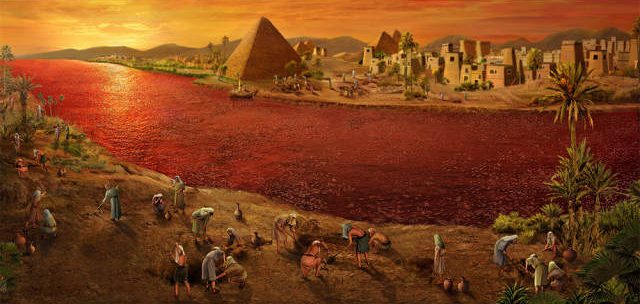
Plague Number One

14 Then the Lord said to Moses, “Pharaoh’s heart is hardened; he refuses to let the people go. 15 Go to Pharaoh in the morning, as he is going out to the water. Stand on the bank of the Nile to meet him, and take in your hand the staff that turned into a serpent. 16 And you shall say to him, ‘The Lord, the God of the Hebrews, sent me to you, saying, “Let my people go, that they may serve me in the wilderness.” But so far, you have not obeyed. 17 Thus says the Lord, “By this you shall know that I am the Lord: behold, with the staff that is in my hand I will strike the water that is in the Nile, and it shall turn into blood. 18 The fish in the Nile shall die, and the Nile will stink, and the Egyptians will grow weary of drinking water from the Nile.”’” 19 And the Lord said to Moses, “Say to Aaron, ‘Take your staff and stretch out your hand over the waters of Egypt, over their rivers, their canals, and their ponds, and all their pools of water, so that they may become blood, and there shall be blood throughout all the land of Egypt, even in vessels of wood and in vessels of stone.’”

20 Moses and Aaron did as the Lord commanded. In the sight of Pharaoh and in the sight of his servants he lifted up the staff and struck the water in the Nile, and all the water in the Nile turned into blood. 21 And the fish in the Nile died, and the Nile stank, so that the Egyptians could not drink water from the Nile. There was blood throughout all the land of Egypt. 22 But the magicians of Egypt did the same by their secret arts. So Pharaoh’s heart remained hardened, and he would not listen to them, as the Lord had said. 23 Pharaoh turned and went into his house, and he did not take even this to heart. 24 And all the Egyptians dug along the Nile for water to drink, for they could not drink the water of the Nile.

25 Seven full days passed after the Lord had struck the Nile. – Exodus 7:14-25 ESV

Things were about to get busy for God’s two elderly representatives. At an age when most men would be slowing down, Moses and Aaron had been assigned the God-ordained task of delivering His people from their captivity in Egypt. And this formidable responsibility wasn’t made any easier by the recalcitrant Pharaoh. As God had warned, the king of Egypt would do everything in his considerable power to keep the Israelites enslaved.

God was not surprised by Pharaoh’s actions. He had actually predicted it and claimed that He was the motivating factor behind Pharaoh’s stubborn resistance.  The Almighty knew the king’s heart and was using his predispositions and natural tendencies to bring about the preordained plan for Israel’s exodus from Egypt. Pharaoh’s “hard heart” would play a major role in God’s redemptive plan.

Having enacted their first sign in the presence of Pharaoh, Moses and Aaron were given instructions to take things to the next level. Araon’s staff turning into a snake was a mere parlor trick compared to what God was about to do. Pharaoh’s arrogant refusal to accept the terms of God’s demands would be met with severe judgment. God was going to strike at the heart of Egypt’s economic, religious, and cultural life: The Nile.

This vast river was the source of all life for the people of Egypt. Its annual flood cycle ensured the dissemination of nutrient-rich silt on the shorelines, providing fertility and prosperity to the land. The Egyptians believed the Nile to be a gift of the gods and they associated a number of their deities with the river itself.

There were Apis and Isis, the god and goddess of the Nile. Khnum was considered the guardian of the Nile. There were at least two gods who were deemed responsible for the Nile’s flooding. The first was the crocodile-like deity Sobek, whose domain consisted of the Nile’s waters. The second was Hapi, who was sometimes referred to as “Lord of the River Bringing Vegetation.” Because of his role in the annual flood cycle, Hapi was also considered a god of fertility.

It makes perfect sense that God would choose this revered natural resource to be the site of His first judgment. He sent Moses and Aaron to meet Pharaoh on the banks of the river the next morning. The omniscient God of Israel foreknew that Pharaoh would be making a morning visit to the river’s banks and He instructed His two agents to get there early and be ready to confront the king upon his arrival.

Moses was instructed to have Aaron take the same staff that God had transformed into a snake and use it to strike the waters of the Nile. But before doing so, Moses was to deliver to Pharaoh the following short speech from God.

So this is what the Lord says: “I will show you that I am the Lord.” Look! I will strike the water of the Nile with this staff in my hand, and the river will turn to blood. The fish in it will die, and the river will stink. The Egyptians will not be able to drink any water from the Nile.’” – Exodus 7:17-18 NLT

It is likely that Pharaoh was accompanied by a royal retinue of armed guards, servants, and administrative officials. Perhaps his visit had religious overtones and there were priests to assist him in making sacrifices to one or more of the gods of the Nile.

But at the sight of these two elderly Hebrews standing on the bank of the river, Pharaoh must have been more than a bit surprised and irritated. And to hear them pronounce their far-fetched plan to turn the river to blood must have left him bemused. Who did these men think they were? Did they not know they were dealing with one of the most powerful men in the world?

But Moses and Aaron did as God had instructed them.

As Pharaoh and all of his officials watched, Aaron raised his staff and struck the water of the Nile. Suddenly, the whole river turned to blood! The fish in the river died, and the water became so foul that the Egyptians couldn’t drink it. There was blood everywhere throughout the land of Egypt. – Exodus 7:20-21 NLT

In a matter of minutes, the entire river had been transformed into blood. This supernatural display of God’s power was meant to demonstrate His superiority and sovereignty. The God of creation was giving irrefutable evidence of His status as the one true God. Hapi, Khnum, Apis, and Isis were all defenseless before the majesty and might of Jehovah. They could not protect their own domain from the devastating judgment of the God of the Hebrews. And all Pharaoh could do was stand back and watch.

According to the text, the effects of this miracle were not localized but widespread throughout Egypt, impacting “all its rivers, canals, ponds, and all the reservoirs” (Exodus 7:19 NLT). Every source of drinking water was affected. And, not only that, the fish that served as a primary source of food for the Egyptians were wiped out as a result of this nationwide catastrophe. 

In what will become a rather strange and repeated scene, Pharaoh’s magicians responded to this devastating display of God’s judgment by replicating it. In other words, they mimicked the actions of God and actually made matters worse. If they had the power to turn water into blood, why did they not choose to do the opposite? Once again, God seems to be using these so-called magicians as instruments of His sovereign will. It is ironic that they display similar power to that of Moses and Aaron, but they cannot repair or resist what God’s agents have done. They can only replicate it and increase the suffering of their own people.

Seven days would pass. During that time, Pharaoh would go about his business as if nothing had happened. He refused to think about the devastation brought upon his nation by the God of Moses and Aaron. Safely ensconced in his palace, he was unaware that his people were busy digging wells in a vain attempt to find fresh drinking water.  And little did Pharaoh know that this was just the beginning. The book of Psalms records the litany of miraculous judgments that were headed Pharaoh’s way.

They did not remember his power
    or the day when he redeemed them from the foe,
when he performed his signs in Egypt
    and his marvels in the fields of Zoan.
He turned their rivers to blood,
    so that they could not drink of their streams.
He sent among them swarms of flies, which devoured them,
    and frogs, which destroyed them.
He gave their crops to the destroying locust
    and the fruit of their labor to the locust.
He destroyed their vines with hail
    and their sycamores with frost.
He gave over their cattle to the hail
    and their flocks to thunderbolts.
He let loose on them his burning anger,
    wrath, indignation, and distress,
    a company of destroying angels.
He made a path for his anger;
    he did not spare them from death,
    but gave their lives over to the plague.
He struck down every firstborn in Egypt,
    the firstfruits of their strength in the tents of Ham.
Then he led out his people like sheep
    and guided them in the wilderness like a flock. – Psalm 78:42-52 ESV

The blood-filled Nile was only the precursor to so much more that God had planned for the nation of Egypt. And when He was done, they would know that He alone was Lord.

English Standard Version (ESV) The Holy Bible, English Standard Version. ESV® Permanent Text Edition® (2016). Copyright © 2001

New Living Translation (NLT) Holy Bible, New Living Translation, copyright © 1996, 2004, 2015 by Tyndale House Foundation. Used by permission of Tyndale House Publishers Inc., Carol Stream, Illinois 60188. All rights reserved.

The Final Purging

21 In the twelfth year of our exile, in the tenth month, on the fifth day of the month, a fugitive from Jerusalem came to me and said, “The city has been struck down.” 22 Now the hand of the Lord had been upon me the evening before the fugitive came; and he had opened my mouth by the time the man came to me in the morning, so my mouth was opened, and I was no longer mute.

23 The word of the Lord came to me: 24 “Son of man, the inhabitants of these waste places in the land of Israel keep saying, ‘Abraham was only one man, yet he got possession of the land; but we are many; the land is surely given us to possess.’ 25 Therefore say to them, Thus says the Lord God: You eat flesh with the blood and lift up your eyes to your idols and shed blood; shall you then possess the land? 26 You rely on the sword, you commit abominations, and each of you defiles his neighbor’s wife; shall you then possess the land? 27 Say this to them, Thus says the Lord God: As I live, surely those who are in the waste places shall fall by the sword, and whoever is in the open field I will give to the beasts to be devoured, and those who are in strongholds and in caves shall die by pestilence. 28 And I will make the land a desolation and a waste, and her proud might shall come to an end, and the mountains of Israel shall be so desolate that none will pass through. 29 Then they will know that I am the Lord, when I have made the land a desolation and a waste because of all their abominations that they have committed.

30 “As for you, son of man, your people who talk together about you by the walls and at the doors of the houses, say to one another, each to his brother, ‘Come, and hear what the word is that comes from the Lord.’ 31 And they come to you as people come, and they sit before you as my people, and they hear what you say but they will not do it; for with lustful talk in their mouths they act; their heart is set on their gain. 32 And behold, you are to them like one who sings lustful songs with a beautiful voice and plays well on an instrument, for they hear what you say, but they will not do it. 33 When this comes—and come it will!—then they will know that a prophet has been among them.” Ezekiel 33:21-33 ESV

Exactly three years earlier, “in the ninth year, in the tenth month, on the tenth day of the month” (Ezekiel 24:1 ESV), the prophet Ezekiel had received a message from Yahweh concerning the coming destruction of Jerusalem. He was told to “write down today’s date, because on this very day the king of Babylon is beginning his attack against Jerusalem” (Ezekiel 24:2 NLT). And God informed His prophet that the Babylonian siege would last three years, then end with the city’s fall.

“Son of man, on the day I take away their stronghold—their joy and glory, their heart’s desire, their dearest treasure—I will also take away their sons and daughters. And on that day a survivor from Jerusalem will come to you in Babylon and tell you what has happened. And when he arrives, your voice will suddenly return so you can talk to him, and you will be a symbol for these people. Then they will know that I am the Lord.” – Ezekiel 24:25-27 NLT

Up until that point, Ezekiel had been struck mute by God and was completely unable to speak to the people. He was restricted to conveying his messages through dramatic demonstrations as dictated by God. But Ezekiel was informed that his muteness would come to an end on the day he received news of Jerusalem’s destruction. And chapter 33 of Ezekiel records that fateful day.

The night before the messenger arrived from Jerusalem with news of the city’s devastating end, God had opened Ezekiel’s mouth so that he could speak. The prophet’s renewed capacity for speech would be put to use immediately as God provided him with a message for “the scattered remnants of Israel living among the ruined cities” (Ezekiel 33:24 NLT). It seems that for seven-and-a-half years, Ezekiel had only been able to speak when God allowed him to do so.

“I will make your tongue stick to the roof of your mouth so that you will be speechless and unable to rebuke them, for they are rebels. But when I give you a message, I will loosen your tongue and let you speak. Then you will say to them, ‘This is what the Sovereign Lord says!” – Ezekiel 3:26-27 NLT

But with Jerusalem’s demise, this on-again-off-again condition was removed and Ezekiel had full freedom to speak on behalf of God with no restrictions. His first message was to all those Israelites who were living as exiles in foreign lands or who had taken up residence in the wastelands of Canaan. Within these two groups, there were those who believed they had every right to return to the land and make it their own. Their assumption was based on their identity as children of Abraham, and the logic behind it was simple.

“Abraham was only one man, yet he gained possession of the entire land. We are many; surely the land has been given to us as a possession.” – Ezekiel 33:24 NLT

In a sense, they were right. The land had been promised to them by God, but that promise came with conditions. God expected them to live in obedience to His commands. Their status as descendants of Abraham was not enough. Prior to them entering the land of Canaan for the first time, Moses had clearly communicated God’s expectations.

If you fully obey the Lord your God and carefully keep all his commands that I am giving you today, the Lord your God will set you high above all the nations of the world. You will experience all these blessings if you obey the Lord your God.” – Deuteronomy 28:1-2 NLT

Obedience was the key to blessing. And those blessings would help to set them apart as God’s chosen people.

“If you obey the commands of the Lord your God and walk in his ways, the Lord will establish you as his holy people as he swore he would do. Then all the nations of the world will see that you are a people claimed by the Lord, and they will stand in awe of you. – Deuteronomy 28:9-10 NLT

But now, centuries later, the Israelites were the laughingstock of the world. Hundreds of years earlier, the northern kingdom of Israel had fallen to the Assyrians and now the southern kingdom of Judah was a vassal state of the Babylonians. Its cities lay in ruins and its people had been relegated to a life of poverty and dispossession. Yet, they still believed they had every right to return to the land and enjoy all its benefits.

But God had other plans for them because He knew they remained unrepentant and unworthy to occupy His holy land. Their sinful actions had left the land of promise defiled and in need of divine purging, and God was merciless in exposing their culpability.

You eat meat with blood in it, you worship idols, and you murder the innocent. Do you really think the land should be yours? Murderers! Idolaters! Adulterers! Should the land belong to you?” – Ezekiel 33:25-26 NLT

They were law-breakers and covenant violators and God knew that even the fall of Jerusalem would not cause them to acknowledge their sins and repent. Over the centuries, they had developed a track record of stubborn resistance to God’s calls for repentance, and now they were going to experience the full extent of His wrath, just as He had outlined it to Moses centuries earlier.

“…if you do not listen to me or obey all these commands, and if you break my covenant by rejecting my decrees, treating my regulations with contempt, and refusing to obey my commands, I will punish you.” – Leviticus 26:14-16 NLT

God had given Moses a detailed description of His judgments, clearly indicating the escalating nature of their intensity if the people refused to respond.

And if, in spite of all this, you still disobey me, I will punish you seven times over for your sins. – Leviticus 26:18 NLT

“If even then you remain hostile toward me and refuse to obey me, I will inflict disaster on you seven times over for your sins. – Leviticus 26:21 NLT

“And if you fail to learn the lesson and continue your hostility toward me, then I myself will be hostile toward you. I will personally strike you with calamity seven times over for your sins.” – Leviticus 26:23-24 NLT

“If in spite of all this you still refuse to listen and still remain hostile toward me, then I will give full vent to my hostility. I myself will punish you seven times over for your sins. – Leviticus 26:27-28 NLT

Every if-then statement was fulfilled because the people of Israel refused to listen. No judgment awakened their sense of shame or caused them to repent of their sins. They stubbornly clung to their ways and watched as wave after wave of God’s judgments came against them. And now, God declares that He is going to bring the last phase of His judgment, just as He had predicted through the pen of Moses.

“And for those of you who survive, I will demoralize you in the land of your enemies. You will live in such fear that the sound of a leaf driven by the wind will send you fleeing. You will run as though fleeing from a sword, and you will fall even when no one pursues you. Though no one is chasing you, you will stumble over each other as though fleeing from a sword. You will have no power to stand up against your enemies. You will die among the foreign nations and be devoured in the land of your enemies. Those of you who survive will waste away in your enemies’ lands because of their sins and the sins of their ancestors.” – Leviticus 26:36-39 NLT

That day had come. God declares to Ezekiel, “I will completely destroy the land and demolish her pride. Her arrogant power will come to an end” (Ezekiel 33:28 NLT). The time for purging and cleansing had arrived.

And as for the exiles among whom Ezekiel ministered, God had a word for them as well. Their plaintive pleas for the prophet to give them a message from God were a sham. They had no intentions of keeping the commands of God, whether written on a scroll as part of the Mosaic Law or spoken from the lips of His prophet.

“…my people come pretending to be sincere and sit before you. They listen to your words, but they have no intention of doing what you say. Their mouths are full of lustful words, and their hearts seek only after money. – Ezekiel 33:31 NLT

God informs Ezekiel that his audience only feigns interest. They listen politely and intently to what he has to say but have no intentions of changing their behavior. Yet God assures His prophet, “when all these terrible things happen to them—as they certainly will—then they will know a prophet has been among them” (Ezekiel 33:33 NLT). God hints at a day when the people will finally wake up and realize what they have done. The full weight of God’s judgment will have its full effect, awakening His rebellious people to their need for God’s healing and forgiveness. While this chapter ends on a negative note, it gives a glimpse of the good news to come. God’s judgment had a purpose and His plan was not yet complete.

English Standard Version (ESV) The Holy Bible, English Standard Version. ESV® Permanent Text Edition® (2016). Copyright © 2001

New Living Translation (NLT) Holy Bible, New Living Translation, copyright © 1996, 2004, 2015 by Tyndale House Foundation. Used by permission of Tyndale House Publishers Inc., Carol Stream, Illinois 60188. All rights reserved.

You Will Know

17 In the twelfth year, in the twelfth month, on the fifteenth day of the month, the word of the Lord came to me: 18 “Son of man, wail over the multitude of Egypt, and send them down, her and the daughters of majestic nations, to the world below, to those who have gone down to the pit:

19 ‘Whom do you surpass in beauty?
    Go down and be laid to rest with the uncircumcised.’

20 They shall fall amid those who are slain by the sword. Egypt is delivered to the sword; drag her away, and all her multitudes. 21 The mighty chiefs shall speak of them, with their helpers, out of the midst of Sheol: ‘They have come down, they lie still, the uncircumcised, slain by the sword.’

22 “Assyria is there, and all her company, its graves all around it, all of them slain, fallen by the sword, 23 whose graves are set in the uttermost parts of the pit; and her company is all around her grave, all of them slain, fallen by the sword, who spread terror in the land of the living.

24 “Elam is there, and all her multitude around her grave; all of them slain, fallen by the sword, who went down uncircumcised into the world below, who spread their terror in the land of the living; and they bear their shame with those who go down to the pit. 25 They have made her a bed among the slain with all her multitude, her graves all around it, all of them uncircumcised, slain by the sword; for terror of them was spread in the land of the living, and they bear their shame with those who go down to the pit; they are placed among the slain.

26 “Meshech-Tubal is there, and all her multitude, her graves all around it, all of them uncircumcised, slain by the sword; for they spread their terror in the land of the living. 27 And they do not lie with the mighty, the fallen from among the uncircumcised, who went down to Sheol with their weapons of war, whose swords were laid under their heads, and whose iniquities are upon their bones; for the terror of the mighty men was in the land of the living. 28 But as for you, you shall be broken and lie among the uncircumcised, with those who are slain by the sword.

29 “Edom is there, her kings and all her princes, who for all their might are laid with those who are killed by the sword; they lie with the uncircumcised, with those who go down to the pit.

30 “The princes of the north are there, all of them, and all the Sidonians, who have gone down in shame with the slain, for all the terror that they caused by their might; they lie uncircumcised with those who are slain by the sword, and bear their shame with those who go down to the pit.

31 “When Pharaoh sees them, he will be comforted for all his multitude, Pharaoh and all his army, slain by the sword, declares the Lord God. 32 For I spread terror in the land of the living; and he shall be laid to rest among the uncircumcised, with those who are slain by the sword, Pharaoh and all his multitude, declares the Lord God.” Ezekiel 32:17-32 ESV

Fourteen days later, Ezekiel received the second part of God’s oracle concerning Egypt’s demise. In it, he is told to “weep for the hordes of Egypt and for the other mighty nations” (Ezekiel 32:18 NLT). The scene depicted by God is that of a funeral and Ezekiel is instructed to “bury” Egypt in a grave, sending the deceased nation “to the world below” (Ezekiel 32:18 ESV); to the afterlife. The entire nation of Egypt is portrayed as a corpse ready for burial and Ezekiel is given the responsibility of interring the body and conducting the funeral.

But despite Egypt’s vast wealth and reputation for extravagance as illustrated by its many architectural wonders, the funeral described is that of a pauper. Rather than a royal entombment attended by visiting dignitaries and marked by solemnity and almost worshipful sorrow by the adoring public, this burial is of a relative unknown. God even gives Ezekiel the words of the eulogy he is to speak at the graveside.

“O Egypt, are you lovelier than the other nations?
    No! So go down to the pit and lie there among the outcasts.” – Ezekiel 32:19 NLT

The nation of Egypt would experience the same fate as the “uncircumcised” heathen. When the Babylonians swept through the land, they would be indiscriminate in their destruction. Nebuchadnezzar’s forces would be merciless and show no pity to anyone, leaving the bodies of the wealthy and well-educated lying in the streets alongside the poor and disenfranchised. God even describes their welcome in Sheol with biting sarcasm.

“Down in the grave mighty leaders will mockingly welcome Egypt and its allies, saying, ‘They have come down; they lie among the outcasts, hordes slaughtered by the sword.’” – Ezekiel 32:21 NLT

Egypt will join the other nations that have fallen before them. People from Assyria, Elam, Meshech-Tubal, Edom, the princes of the north, and the Sidonians have all entered the grave and will be ready to greet its newest occupant with open arms. At one time, all these nations “struck terror in the hearts of people everywhere, but now they have been slaughtered by the sword” (Ezekiel 32:23 NLT). They had been major players and had enjoyed their moment in the spotlight, but now there were relegated to an eternal existence of obscurity and irrelevance in the grave. And Egypt would suffer the same fate.

This message, given by God to Ezekiel, was intended to be shared with the Jewish exiles living in Babylon. It was meant to persuade these displaced people from putting any hope in Egypt as a potential source of salvation for Judah. When the Babylonians had first appeared on the scene, threatening the peace of the region, the people of Judah looked for help from their more powerful allies. The Egyptians were a logical choice because they had a track record of success. As one of the oldest nations in the region, they had a long history of military dominance and hegemony. So, it was only natural for Judah to place its hope in their neighbor to the south. Even the exiles were tempted to see the Egyptians as the key to the survival of their homeland and the means of their eventual return from captivity.

But God wanted them to know that Pharaoh would not be their savior. While his people believed him to be a god, he was just another man and his nation would prove to be just another victim of Babylon’s seemingly unstoppable global expansion.

“You too, Egypt, will lie crushed and broken among the outcasts, all slaughtered by the sword. – Ezekiel 32:28 NLT

From chapter 25 to chapter 32, the phrase “know I am the LORD” occurs 19 times. The oracles contained within these chapters serve as a powerful indictment against the nations of the world but are really a divine dismissal of the gods of this world. The nation of Judah, like its northern neighbor, Israel, was guilty of spiritual adultery. For centuries, they had made a habit of worshiping the false gods of the nations that occupied the land of Canaan. They had become equal-opportunity idolaters who saw nothing wrong with adopting the gods of their pagan neighbors and treating them with the same awe and reverence they had once reserved for Yahweh.

During their 400-year exile in Egypt, the people of Israel worshiped the gods of the Egyptians. In the process of delivering them from their captivity, God exhibited His superiority over these false gods through the ten plagues He sent against the people of Egypt. Each plague was a direct attack on one of their many gods. And when God had finished His divine smackdown of Egypt’s deities, He led them out of bondage and to the land He had promised them. But even after arriving in the land of Canaan, the people of Israel continued their love affair with false gods. In direct violation of God’s commands, they embraced the gods of the Canaanites and the neighboring nations. And despite God’s repeated calls to repent and return to Him, they stubbornly refused.

Prior to the people of Israel entering the land of Canaan, Moses stood before them and issued a covenant commitment.

“I am making this covenant both with you who stand here today in the presence of the Lord our God, and also with the future generations who are not standing here today.

“You remember how we lived in the land of Egypt and how we traveled through the lands of enemy nations as we left. You have seen their detestable practices and their idols made of wood, stone, silver, and gold. I am making this covenant with you so that no one among you—no man, woman, clan, or tribe—will turn away from the Lord our God to worship these gods of other nations, and so that no root among you bears bitter and poisonous fruit.” – Deuteronomy 29:15-18 NLT

But his words had little or no lasting impact. It didn’t take them long to break their covenant with Moses and violate the laws given to them by God. Their entire history is replete with examples of their unfaithfulness and spiritual infidelity. Now, as Ezekiel ministered to the people of God living as exiles in Babylon, they were reaping the consequences of their disobedience. They were experiencing exactly what Joshua had warned their ancestors would happen in they turned to the false gods of Canaan.

“…as surely as the Lord your God has given you the good things he promised, he will also bring disaster on you if you disobey him. He will completely destroy you from this good land he has given you.  If you break the covenant of the Lord your God by worshiping and serving other gods, his anger will burn against you, and you will quickly vanish from the good land he has given you.” – Joshua 23:15-16 NLT

And all those nations from whom they had adopted their false gods would fall before the righteous wrath of Yahweh. Each would eventually pay the price for its idolatry and refusal to acknowledge the one true God. But their destruction would be a sobering warning to the people of Judah, reminding them of the words of God: “Then they will know that I am the Lord.”

English Standard Version (ESV) The Holy Bible, English Standard Version. ESV® Permanent Text Edition® (2016). Copyright © 2001

New Living Translation (NLT) Holy Bible, New Living Translation, copyright © 1996, 2004, 2015 by Tyndale House Foundation. Used by permission of Tyndale House Publishers Inc., Carol Stream, Illinois 60188. All rights reserved.

No More Delay

21 And the word of the Lord came to me: 22 “Son of man, what is this proverb that you have about the land of Israel, saying, ‘The days grow long, and every vision comes to nothing’? 23 Tell them therefore, ‘Thus says the Lord God: I will put an end to this proverb, and they shall no more use it as a proverb in Israel.’ But say to them, The days are near, and the fulfillment of every vision. 24 For there shall be no more any false vision or flattering divination within the house of Israel. 25 For I am the Lord; I will speak the word that I will speak, and it will be performed. It will no longer be delayed, but in your days, O rebellious house, I will speak the word and perform it, declares the Lord God.”

26 And the word of the Lord came to me: 27 “Son of man, behold, they of the house of Israel say, ‘The vision that he sees is for many days from now, and he prophesies of times far off.’ 28 Therefore say to them, Thus says the Lord God: None of my words will be delayed any longer, but the word that I speak will be performed, declares the Lord God.  Ezekiel 12:21-28 ESV

Ezekiel was just one more prophet among many who were each tasked with warning the people of Israel about God’s pending judgment. There had been a number of prophets whom God had sent to the northern kingdom of Judah before it fell to the Assyrians. And there were prophets like Isaiah and Jeremiah whom God had sent to warn the southern kingdom of Judah that they faced a similar fate if they did abandon their idolatrous ways and return to Him in repentance.

For hundreds of years, God had been calling His rebellious people to repent or face certain judgment. The Jews living as exiles in Babylon knew from firsthand experience just how real God’s judgment could be. They had been deported after Nebuchadnezzar had made his first incursion into Judah and ransacked the city of Jerusalem. It was Ezekiel’s responsibility to carry God’s message to these displaced Jews and warn them that their compatriots back home were about to experience more of the same.

But God points out that, back in Judah, there were two prevalent attitudes concerning His judgment. First, there were those who believed that the prophets of God were all talk, not action. In other words, they talked a good game but nothing they prophesied ever came to fruition. Their dire warnings never amounted to much. This perspective had even become a popular proverb.

“Time passes, and prophecies come to nothing.” – Ezekiel 12:21 NLT

For centuries, God had been warning about the fall of Jerusalem, but the city still stood. Nothing had changed. So, people began to view the prophets as overreactive naysayers whose pessimistic pronouncements never materialized. It was like the story of the boy who cried wolf.

As the story goes, a young shepherd boy found himself bored with his job, so to add a little excitement to his day, he ran into town crying, “Wolf! Wolf! The Wolf is chasing the sheep!” The townspeople ran to his aid, only to find the flock grazing peacefully. Irritated with the boy’s antics, they warned him, “Don’t cry ‘wolf’, shepherd boy when there’s no wolf!”

As they made their way back to town, grumbling as they went, they once again heard the excited cries of the boy. “Wolf! Wolf! The wolf is chasing the sheep!” To his delight, the shepherd boy watched as the villagers ran back up the hill to confront the wolf that threatened their flocks. But, as before, there was no wolf.

Then one day, the unexpected happened. A real wolf showed up. But when the villagers heard the boy’s excited cries for help, they assumed it was just another trick, so they remained in the village. The next morning they found the shepherd boy weeping in the fields where his flocks once grazed. When they asked him what happened, he said, “There really was a wolf here! The flock has scattered! I cried out, “Wolf!” Why didn’t you come?”

The people of Judah, like the villagers in the story, had begun to believe that the prophets’ cries of danger were not to be believed. They had been listening to these doomsayers for generations and nothing they predicted ever came true. So, they began to write off everything these men said.

From their perspective, not much had changed in Jerusalem. Even the arrival of the Babylonians had done little to change their way of life. Sure, there had been some adjustments to make after the first siege and the initial deportation of some of their friends and neighbors. But, for the most part, life went on as before. And those who remained behind in Jerusalem became increasingly complacent and callous to the message of the prophets. They wrongly assumed that God was not going to act. Nothing was going to happen. In their estimation, the prophets were all bark and no bite. Or were they?

God had a different perspective and commanded Ezekiel to replace their proverb with a new one.

“I will put an end to this proverb, and you will soon stop quoting it. Now give them this new proverb to replace the old one: ‘The time has come for every prophecy to be fulfilled!’” – Ezekiel 12:23 NLT

Time was running out. The lack of measurable activity on God’s part was not to be mistaken for inaction or indifference. Time may have passed but God’s wrath had not abated. He had not forgotten their past sins and was not oblivious to their current moral condition. He had simply been waiting for the perfect moment to unleash His divinely timed plan for Jerusalem’s destruction.

How easy it is to discount the warnings of God because they don’t ever seem to come true. These Old Testament stories become little more than moral fairy tales that portray God as short-tempered and lacking in love. He comes across as overly judgmental and harsh and we discount this image of God as incompatible with the one portrayed in the New Testament. We prefer the God of grace, mercy, forgiveness, and love. But we fail to recognize that God is unchanging. He still hates sin. He still warns His people about the dangers of unfaithfulness and idolatry. He constantly reminds us that there are consequences for our sins. But when we sin and nothing happens, we wrongly assume that we can get away with our indiscretions and infidelity. As a result, we stop listening to His calls to confess our sins.

If we claim we have no sin, we are only fooling ourselves and not living in the truth. But if we confess our sins to him, he is faithful and just to forgive us our sins and to cleanse us from all wickedness. If we claim we have not sinned, we are calling God a liar and showing that his word has no place in our hearts. – 1 John 1:8-10 NLT

But there was a second problem in Judah. While some were claiming that the warnings of the prophets would never come true, there were others who admitted that the warnings were true but would not take place in their lifetimes. They claimed, “He’s talking about the distant future. His visions won’t come true for a long, long time” (Ezekiel 12:27 NLT). While the words of the prophets were true and the judgments of God were inevitable, they had nothing to worry about because they would fall upon a future generation. For the time being, they were safe and sound.

But God wanted them to know that their assumption was deadly wrong. The long delay was over and it was their generation that would have to live through the final destruction of Jerusalem.

“No more delay! I will now do everything I have threatened. I, the Sovereign Lord, have spoken!’” – Ezekiel 12:28 NLT

They could go on denying the veracity of the prophecies and live as if God’s judgment was never coming. They could even convince themselves the prophecies were true but did not pose an immediate threat. But they would soon discover just how wrong they were. And this tendency to doubt, deny, or delay God’s warnings of judgment is still a problem. Even after the incarnation, resurrection, and ascension of Christ, the apostle Peter warned of the danger of denying or ignoring the reality of His ultimate return. In his second letter, he provided the first-century believers with a sobering reminder.

I want you to remember what the holy prophets said long ago and what our Lord and Savior commanded through your apostles. – 2 Peter 3:2 NLT

The Old Testament Scriptures are filled with prophecies concerning Christ’s first coming, but they also predict His return at the end of the age. But more than 2,000 years have passed since Peter penned his letter, and we still await the second coming of Christ. In his day, there were those who had already begun to doubt whether Christ was ever coming back.

I want to remind you that in the last days scoffers will come, mocking the truth and following their own desires. They will say, “What happened to the promise that Jesus is coming again? From before the times of our ancestors, everything has remained the same since the world was first created.” – 2 Peter 3:3-4 NLT

Delay had caused doubt. Christ’s apparent failure to return had led the first-century Christians to have second thoughts. But Peter reminded them that God, who made the universe in eternity past, stands outside of time. To Him, “a day is like a thousand years…and a thousand years is like a day” (2 Peter 3:8 NLT). God does not grow impatient. What appears to be a delay to us is actually the perfectly timed plan of God.

Peter didn’t want his readers to mistake God’s delay as inaction or indifference. It was actually evidence of His patience and love.

The Lord isn’t really being slow about his promise, as some people think. No, he is being patient for your sake. He does not want anyone to be destroyed, but wants everyone to repent. – 2 Peter 3:9 NLT

But that doesn’t mean we should abuse God’s loving patience by living as if we have all the time in the world. Peter assures his readers that God’s judgment will come.

But the day of the Lord will come as unexpectedly as a thief. Then the heavens will pass away with a terrible noise, and the very elements themselves will disappear in fire, and the earth and everything on it will be found to deserve judgment. – 2 Peter 3:10 NLT

And that judgment will come with the return of the Lord. When He comes the second time, it will not be as Savior but as judge of all the earth. And, “on that day, he will set the heavens on fire, and the elements will melt away in the flames” (2 Peter 3:12 NLT). And Peter reminds his readers to live with that thought in mind.

Since everything around us is going to be destroyed like this, what holy and godly lives you should live, looking forward to the day of God and hurrying it along. – 2 Peter 3:11-12 NLT

The inevitable judgment of God should cause His people to live soberly and circumspectly. We should pursue godly and holy lives that reflect our status as His children and our citizenship in His Kingdom. We should avoid the perspective that plagued the people of Judah. Rather than live in keeping with God’s will and in fear of His judgment, they lived in a state of denial or simply viewed God’s judgment as so distant that it posed no threat to their way of life.

English Standard Version (ESV) The Holy Bible, English Standard Version. ESV® Permanent Text Edition® (2016). Copyright © 2001

New Living Translation (NLT) Holy Bible, New Living Translation, copyright © 1996, 2004, 2015 by Tyndale House Foundation. Used by permission of Tyndale House Publishers Inc., Carol Stream, Illinois 60188. All rights reserved.

It’s Worse Than You Thought

1 In the sixth year, in the sixth month, on the fifth day of the month, as I sat in my house, with the elders of Judah sitting before me, the hand of the Lord God fell upon me there. Then I looked, and behold, a form that had the appearance of a man. Below what appeared to be his waist was fire, and above his waist was something like the appearance of brightness, like gleaming metal. He put out the form of a hand and took me by a lock of my head, and the Spirit lifted me up between earth and heaven and brought me in visions of God to Jerusalem, to the entrance of the gateway of the inner court that faces north, where was the seat of the image of jealousy, which provokes to jealousy. And behold, the glory of the God of Israel was there, like the vision that I saw in the valley.

Then he said to me, “Son of man, lift up your eyes now toward the north.” So I lifted up my eyes toward the north, and behold, north of the altar gate, in the entrance, was this image of jealousy. And he said to me, “Son of man, do you see what they are doing, the great abominations that the house of Israel are committing here, to drive me far from my sanctuary? But you will see still greater abominations.”

And he brought me to the entrance of the court, and when I looked, behold, there was a hole in the wall. Then he said to me, “Son of man, dig in the wall.” So I dug in the wall, and behold, there was an entrance. And he said to me, “Go in, and see the vile abominations that they are committing here.” 10 So I went in and saw. And there, engraved on the wall all around, was every form of creeping things and loathsome beasts, and all the idols of the house of Israel. 11 And before them stood seventy men of the elders of the house of Israel, with Jaazaniah the son of Shaphan standing among them. Each had his censer in his hand, and the smoke of the cloud of incense went up. 12 Then he said to me, “Son of man, have you seen what the elders of the house of Israel are doing in the dark, each in his room of pictures? For they say, ‘The Lord does not see us, the Lord has forsaken the land.’” 13 He said also to me, “You will see still greater abominations that they commit.”

14 Then he brought me to the entrance of the north gate of the house of the Lord, and behold, there sat women weeping for Tammuz. 15 Then he said to me, “Have you seen this, O son of man? You will see still greater abominations than these.”

16 And he brought me into the inner court of the house of the Lord. And behold, at the entrance of the temple of the Lord, between the porch and the altar, were about twenty-five men, with their backs to the temple of the Lord, and their faces toward the east, worshiping the sun toward the east. 17 Then he said to me, “Have you seen this, O son of man? Is it too light a thing for the house of Judah to commit the abominations that they commit here, that they should fill the land with violence and provoke me still further to anger? Behold, they put the branch to their nose. 18 Therefore I will act in wrath. My eye will not spare, nor will I have pity. And though they cry in my ears with a loud voice, I will not hear them.” Ezekiel 8:1-18 ESV

At some point during Ezekiel’s lengthy, non-verbal prophetic demonstration, he received a vision from God. He was seated in his home with a contingent of elders from the Jewish exiles in Babylon. He does not give a reason for their visit but it is safe to say that this was not a cordial or friendly affair. They were likely upset with the nature of his dramatic performance and the negative impact it was having on the community. His visual illustration predicting Jerusalem’s fall would have greatly disturbed his fellow exiles, who had been hoping that God would eventually return them to their homeland. But Ezekiel had ruled out that possibility.

When God had finally given Ezekiel permission to speak, He didn’t exactly give him an easy message to deliver. Chapter seven records the dire warning Ezekiel was commanded to share with the exiles in Babylon, and what he had to say did nothing to help him win friends and influence enemies.

God told them, “Soon I will pour out my fury on you and unleash my anger against you. I will call you to account for all your detestable sins” (Ezekiel 7:8 NLT). God was fed up. He had had enough. He saw that His chosen people had become proud, wealthy, self-sufficient, and over-confident. They didn’t need Him. They had become affluent and apathetic toward God, even using their wealth to create their own gods. They no longer knew God or feared Him. And to prove to Ezekiel just how bad things were back home in Jerusalem, God gave him a special “birds-eye” tour of the holy city that sounds like something straight out of Dicken’s A Christmas Carol.

While seated with the elders in his home Ezekiel received a vision from God. There is no indication that the other men in the room were aware of what was happening, but for Ezekiel, this proved to be a disturbing and eye-opening adventure.

In his vision, an angel picked up Ezekiel by his hair and transported him to Jerusalem. His first stop? The northern gate of the inner courtyard of the temple. And what did he see? An idol to a false god. He describes it as “the seat of the image of jealousy, which provokes to jealousy” (Ezekiel 8:3 ESV). A huge idol sitting directly in the middle of the temple courtyard. Ezekiel does not give the name of this god, but it could have been a statue of Asherah, the Canaanite goddess of fertility, whose worship encouraged sexual immorality and promoted self-gratification.

Yet, Ezekiel noted that “the glory of the God of Israel was there” (Ezekiel 8:4 ESV). Despite the unexpected sight of an idol in the temple, he recognized the presence of God’s glory and majesty, just as he had seen in his previous vision.

Ezekiel must have been shocked by what he saw, but God assured them that this magical mystery tour of Judah’s sins was just getting started.

“Son of man,” he said, “do you see what they are doing? Do you see the detestable sins the people of Israel are committing to drive me from my Temple? But come, and you will see even more detestable sins than these!” – Ezekiel 8:6 NLT

Next, the angel took him to the door of the temple courtyard. In the adjacent wall was a small hole, which the angel commanded Ezekiel to expand. Upon enlarging the hole, Ezekiel discovered a hidden door. After entering the now-exposed passage, Ezekiel discovered 70 civic leaders of Israel conducting themselves as if they were priests. But they weren’t worshiping Yahweh. The walls of the hidden room were covered with “engravings of all kinds of crawling animals and detestable creatures” (Ezekiel 8:9 NLT), and there were idols of all of the false gods of Israel. Ezekiel had stumbled upon a secret sanctuary dedicated to the practice of pagan idolatry, right in the middle of the temple of God.

And their excuse for their actions? “The Lord doesn’t see us, he has deserted our land” (Ezekiel 8:12b NLT). They blamed God, accusing Him of having abandoned them, and forcing them to worship other gods in the hope of finding a solution to their problem. But they were the problem.

Ezekiel must have been appalled by what he saw, but God assured him that the worst was yet to come.

“Come, and I will show you even more detestable sins than these!” – Ezekiel 8:13 NLT

The angel brought Ezekiel to the north gate of the temple where he saw women weeping for the god Tammuz, the Babylonian god of spring. It was believed that he died at the beginning of every summer, only to resurrect again in the spring. The mournful nature of these women reflects the pervasive presence of idolatry within Israel. But, once again, God assured the slack-jawed Ezekiel that this was just the tip of the iceberg.

I will show you even more detestable sins than these! – Ezekiel 8:15 NLT

The angel to the inner courtyard of the Lord’s temple, where he saw 25 men standing with their backs to the sanctuary of God. They were facing east and worshiping the sun. The symbolism of the scene is difficult to miss. These unidentified men had turned their backs on God and were worshiping the creation rather than the Creator. They were guilty of the very thing Paul outlines in his letter to the Romans.

Claiming to be wise, they became fools, and exchanged the glory of the immortal God for images resembling mortal man and birds and animals and creeping things… they exchanged the truth about God for a lie and worshiped and served the creature rather than the Creator, who is blessed forever! – Romans 1:22-23, 25 ESV

They had replaced God. They had turned their backs on Him and were placing their hopes elsewhere. Rather than trust God for their future and return to Him in repentance over their sins, they were searching high and low for a solution to their predicament. Unwilling to admit their own culpability, they refused to own their sins and repent. Instead, they looked for another way to resolve their issues. They searched for another savior. They prayed for another deliverer.

God had given Ezekiel ample evidence of the wickedness of the people of Israel. It seems that the timing of this vision was tied to the presence of the elders in Ezekiel’s home. Evidently, they had come with the intent to convince Ezekiel that things were not that bad back in Jerusalem. They had probably tried to persuade him that his assessment of Israel’s sinfulness was overblown and his message of God’s pending judgment was inaccurate.

But God assured Ezekiel that things were far worse than he could have imagined, and He was determined to do something about it.

“Have you seen this, son of man?” he asked. “Is it nothing to the people of Judah that they commit these detestable sins, leading the whole nation into violence, thumbing their noses at me, and provoking my anger?” – Ezekiel 8:17 NLT

God was done warning His rebellious people. They had turned their backs on Him and now, He was going to return the favor.

But what about us? As we look around the world today and see all that is happening, what is our response? When we witness the physical and spiritual drought taking place in our country, do we turn to God in repentance, or do we pursue other solutions? Do we put our hope in politicians? Do we turn to science? Do we rely on our own wealth and distract ourselves with entertainment and affluence?

Paul went on to describe the stark outcome of a life lived in disobedience and unfaithfulness to God, and it isn’t a pretty picture. But it is the fate of all those who fail to acknowledge Him for who He is.

Since they thought it foolish to acknowledge God, he abandoned them to their foolish thinking and let them do things that should never be done. Their lives became full of every kind of wickedness, sin, greed, hate, envy, murder, quarreling, deception, malicious behavior, and gossip. They are backstabbers, haters of God, insolent, proud, and boastful. They invent new ways of sinning, and they disobey their parents. They refuse to understand, break their promises, are heartless, and have no mercy. They know God’s justice requires that those who do these things deserve to die, yet they do them anyway. Worse yet, they encourage others to do them, too. – Romans 1:28-32 NLT

Men can deny God’s existence, but they will never escape His judgment.

English Standard Version (ESV) The Holy Bible, English Standard Version. ESV® Permanent Text Edition® (2016). Copyright © 2001

New Living Translation (NLT) Holy Bible, New Living Translation, copyright © 1996, 2004, 2015 by Tyndale House Foundation. Used by permission of Tyndale House Publishers Inc., Carol Stream, Illinois 60188. All rights reserved.

A Difficult Calling

And he said to me, “Son of man, go to the house of Israel and speak with my words to them. For you are not sent to a people of foreign speech and a hard language, but to the house of Israel— not to many peoples of foreign speech and a hard language, whose words you cannot understand. Surely, if I sent you to such, they would listen to you. But the house of Israel will not be willing to listen to you, for they are not willing to listen to me: because all the house of Israel have a hard forehead and a stubborn heart. Behold, I have made your face as hard as their faces, and your forehead as hard as their foreheads. Like emery harder than flint have I made your forehead. Fear them not, nor be dismayed at their looks, for they are a rebellious house.” 10 Moreover, he said to me, “Son of man, all my words that I shall speak to you receive in your heart, and hear with your ears. 11 And go to the exiles, to your people, and speak to them and say to them, ‘Thus says the Lord God,’ whether they hear or refuse to hear.”

12 Then the Spirit lifted me up, and I heard behind me the voice of a great earthquake: “Blessed be the glory of the Lord from its place!” 13 It was the sound of the wings of the living creatures as they touched one another, and the sound of the wheels beside them, and the sound of a great earthquake. 14 The Spirit lifted me up and took me away, and I went in bitterness in the heat of my spirit, the hand of the Lord being strong upon me. 15 And I came to the exiles at Tel-abib, who were dwelling by the Chebar canal, and I sat where they were dwelling. And I sat there overwhelmed among them seven days. – Ezekiel 3:4-15 ESV

After consuming the scroll that God had given him, Ezekiel was commanded to regurgitate its content to his fellow captives living in the land of Babylon. While the message contained in the scroll was filled with words of “lamentation and mourning and woe” (Ezekiel 2:10 ESV), Ezekiel found it to taste “as sweet as honey” (Ezekiel 3:3 ESV). Ezekiel had discovered the truth behind the psalm.

How sweet are your words to my taste, sweeter than honey to my mouth! – Psalm 119:103 ESV).

And the prophet Jeremiah also learned to develop a hunger and delight for the word of the Lord.

Your words were found, and I ate them, and your words became to me a joy and the delight of my heart, for I am called by your name, O LORD, God of hosts. – Jeremiah 15:16 ESV

God’s Word may be difficult to hear but, when obeyed, it always proves to be a delight to the soul because it is filled with wisdom and truth. Ezekiel had feasted on the Word of God and found it to be both pleasant and filling. But the difficulty would come when he tried to share that message with his fellow exiles. This young priest-turned-prophet was going to have to share what he had learned with the rest of the Jews living along the Kebar River in Babylon, and God warned him that they would not be a receptive audience.

“…the people of Israel won’t listen to you any more than they listen to me! For the whole lot of them are hard-hearted and stubborn.” – Ezekiel 3:7 NLT

The Almighty God had chosen to reveal Himself to Ezekiel in the middle of a Judaen refuge camp in the land of Babylon, and He had delivered to Ezekiel a message that was intended solely for the people of God. The words contained on the scroll had been directed at His chosen people and not the Babylonians. God was not above delivering words of warning to foreign countries. He had used Isaiah to pronounce a powerful message of future destruction to the Babylonians.

Babylon, the most glorious of kingdoms,
    the flower of Chaldean pride,
will be devastated like Sodom and Gomorrah
    when God destroyed them.
Babylon will never be inhabited again.
    It will remain empty for generation after generation.
Nomads will refuse to camp there,
    and shepherds will not bed down their sheep. – Isaiah 13:19-20 NLT

But the message God had given Ezekiel was for the people of Judah alone. And God seems to infer that Ezekiel’s task would have been much easier if his audience was made up of foreigners who spoke a completely different language.

I am not sending you to a foreign people whose language you cannot understand. No, I am not sending you to people with strange and difficult speech. If I did, they would listen! – Ezekiel 3:5 NLT

The problem Ezekiel was going to encounter would not be that of a language barrier. No, his audience would hear and understand every word he said, but their stubborn and sin-hardened hearts would prevent them from responding in repentance. The same words that Ezekiel found to be as sweet as honey would be bitter and distasteful to the rebellious people of God.

But Ezekiel was not to be afraid or disheartened. In fact, God declared that he would be divinely equipped for the task. The people of Israel would meet their match in Ezekiel.

“I have made you as obstinate and hard-hearted as they are. I have made your forehead as hard as the hardest rock! So don’t be afraid of them or fear their angry looks, even though they are rebels.” – Ezekiel 3:8-9 NLT

God was going to equip Ezekiel with a supernatural source of stamina and determination that would allow him to stay strong even in the face of repeated rejection and the evident failure of his mission. God knew that there would be days when Ezekiel felt as if his task was ill-fated and his ministry was doomed to defeat. He would be tempted to throw in the towel and abandon his mission. That’s why God encouraged him to take time and meditate on the words he was about to deliver. He was to think long and hard about the content of God’s message long before he began to deliver it.

“Son of man, let all my words sink deep into your own heart first. Listen to them carefully for yourself. Then go to your people in exile and say to them, ‘This is what the Sovereign Lord says!’ Do this whether they listen to you or not.” – Ezekiel 3:10-11 NLT

Ezekiel was to be more than just a conduit through which the words of God flowed. He had been commanded to ingest the words of God so that they might flow from his heart and not just his lips. It was essential that the messenger believe the words of the message and trust the One who had delivered it. God wanted Ezekiel to learn the truth found in Psalm 119.

I will meditate on your precepts
    and fix my eyes on your ways.
I will delight in your statutes;
    I will not forget your word. – Psalm 119:15-16 ESV

The Lord knew that Ezekiel would need endurance in the days ahead. The ministry to which he was being called would prove difficult and disheartening. His message would fall on deaf ears. His calls to repentance would be rejected. And the psalmist seemed to have presaged Ezekiel’s pending predicament.

My soul longs for your salvation;
    I hope in your word.
My eyes long for your promise;
    I ask, “When will you comfort me?”
For I have become like a wineskin in the smoke,
    yet I have not forgotten your statutes.
How long must your servant endure?
    When will you judge those who persecute me?
The insolent have dug pitfalls for me;
    they do not live according to your law.
All your commandments are sure;
    they persecute me with falsehood; help me!
They have almost made an end of me on earth,
    but I have not forsaken your precepts.
In your steadfast love give me life,
    that I may keep the testimonies of your mouth. – Psalm 119:81-88 ESV

And, as if to provide Ezekiel with one more tangible form of encouragement, God allowed him to hear a thunderous proclamation from heaven.

“Blessed be the glory of the Lord from its place!” – Ezekiel 3:12 ESV

The entire vision Ezekiel had been given the privilege of seeing had been a dramatic display of God’s glory, and now a voice from heaven confirmed it. And Ezekiel saw and heard the wings of the four living creatures flapping in unison and the wheels within wheels turning as the glory of God began to move. This was not a static scene in which Ezekiel could remain and worship the glory of God forever. He had a job to do. And the Spirit of God lifted Ezekiel up and took him away. The vision had ended but his mission had just begun, and Ezekiel expressed his dismay by stating, “I went in bitterness and turmoil” (Ezekiel 3:14a NLT). He was struggling with doubt and fear. The mission before him was overwhelming and he felt underqualified for the task. And yet, he declared, “the Lord’s hold on me was strong” (Ezekiel 3:14b NLT).

Ezekiel had received a commission from God Almighty, and while he wrestled with doubt and feelings of inadequacy, he could not resist the calling. He must obey. So, with the vision completed, Ezekiel returned to his mission field among the exiles from Judah. And for seven days, he continued to struggle with an overwhelming sense of fear and foreboding as he contemplated his new assignment. His life had been radically altered by God and he would no longer be able to enjoy the same relationship he had once had with his friends and neighbors. He had been set apart by God and his life would never be the same.

English Standard Version (ESV) The Holy Bible, English Standard Version. ESV® Permanent Text Edition® (2016). Copyright © 2001

New Living Translation (NLT) Holy Bible, New Living Translation, copyright © 1996, 2004, 2015 by Tyndale House Foundation. Used by permission of Tyndale House Publishers Inc., Carol Stream, Illinois 60188. All rights reserved.

Flee From Fools

1 Like snow in summer or rain in harvest,
    so honor is not fitting for a fool.
Like a sparrow in its flitting, like a swallow in its flying,
    a curse that is causeless does not alight.
A whip for the horse, a bridle for the donkey,
    and a rod for the back of fools.
Answer not a fool according to his folly,
    lest you be like him yourself.
Answer a fool according to his folly,
    lest he be wise in his own eyes.
Whoever sends a message by the hand of a fool
    cuts off his own feet and drinks violence.
Like a lame man’s legs, which hang useless,
    is a proverb in the mouth of fools.
Like one who binds the stone in the sling
    is one who gives honor to a fool.
Like a thorn that goes up into the hand of a drunkard
    is a proverb in the mouth of fools.
10 Like an archer who wounds everyone
    is one who hires a passing fool or drunkard.
11 Like a dog that returns to his vomit
    is a fool who repeats his folly.
12 Do you see a man who is wise in his own eyes?
    There is more hope for a fool than for him.
13 The sluggard says, “There is a lion in the road!
    There is a lion in the streets!”
14 As a door turns on its hinges,
    so does a sluggard on his bed.
15 The sluggard buries his hand in the dish;
    it wears him out to bring it back to his mouth.
16 The sluggard is wiser in his own eyes
    than seven men who can answer sensibly..
– Proverbs 26:1-16 ESV

This collection of 28 verses contains a series of unflattering portraits of the fool that provide ample evidence that a fool should be avoided at all costs. Eleven times in the first 16 verses, the character of the fool is described through the use of a series of unlikely but very accurate comparisons.

This section of Proverbs has been called The Book of Fools because of its emphasis on this particular character trait. And it is interesting to note that this particular collection of proverbs was compiled by the sages who worked for King Hezekiah. He had commissioned these men to scour the royal archives to see if there might be any additional wise sayings that Solomon wrote or compiled. These admonitions or warnings concerning the fool were part of what they discovered.

It appears that they collated these various proverbs and organized them into a single unit for dramatic effect. And one of the primary main messages they seemed to be conveying was the folly of having a fool for a king. The opening line warns against elevating a fool to a place of honor.

Honor is no more associated with fools
    than snow with summer or rain with harvest. – Proverbs 26:1 NLT

“Honor” in this passage probably means respect, external recognition of worth, accolades, advancement to high position, etc. All of these would be out of place with a fool; so the sage is warning against elevating or acclaiming those who are worthless. – NET Bible Study Notes

Verse eight goes on to provide an apt illustration that reveals just how silly it is to honor a fool.

Honoring a fool
    is as foolish as tying a stone to a slingshot. – Proverbs 26:8 NLT

Such an act would be senseless and self-defeating. A sling with a stone tied to it would be rendered completely useless and of no value. And elevating a fool to a position of prominence or power would be equally ridiculous.

In the book of Proverbs, there  are at least five different Hebrew words that are translated as “fool.” In this chapter, the word is kecîyl, which means “fool, stupid fellow, dullard, simpleton, arrogant one.”

Throughout Proverbs, this term is used to describe a particular brand of fool, an individual who has some strikingly dangerous qualities that should neither be ignored nor emulated.

• He rejects the discipline of parents or authorities
• They are determined to make the wrong choices
• He focuses on that which brings him immediate pleasure
• He does not have a mental deficiency but rejects the wisdom of God
• He glories in that of which he should be ashamed
• He is unreasonable
• His motives and methods are subtle
• He should be avoided at all costs

A fool is like an unbridled and untamed pack animal. He requires a heavy hand of discipline.

Guide a horse with a whip, a donkey with a bridle,
    and a fool with a rod to his back! – Proverbs 26:3 NLT

And verse two suggests that a fool, like a stubborn beast, will be quick to declare his displeasure at such discipline by uttering baseless curses that bear no weight.

Like a fluttering sparrow or a darting swallow,
    an undeserved curse will not land on its intended victim. – Proverbs 26:2 NLT

Words of anger and accusation will flow from the mouth of a fool who receives just punishment for his behavior. But those exclamations should be ignored and treated as what they are: The rantings of a fool.

In fact, verse four warns against getting into a verbal sparring match with a fool.

Don’t answer the foolish arguments of fools,
    or you will become as foolish as they are. – Proverbs 26:4 NLT

Yet the very next verse seems to contain contradictory counsel.

Be sure to answer the foolish arguments of fools,
    or they will become wise in their own estimation. – Proverbs 26:5 NLT

But notice the difference. In verse four, the advice is warning against getting into a shouting match with a fool. It’s a dangerous thing to allow yourself to descend to the level of a fool, casting curses back and forth, and using foolish epitaphs in an attempt to score points in a senseless battle of dimwits.

Verse five suggests that fools must be answered with words of wisdom. They will prove defenseless against words of admonition that are based on logic and reason. And an unchallenged and uncorrected fool will only make the false assumption that he was right all along. His ego will become ever more inflated and his love affair with foolishness will remain unchecked.

These proverbs are remorseless in their assessment of the fool. They pull no punches and spare no amount of sarcasm and irony.

Trusting a fool to convey a message
    is like cutting off one’s feet or drinking poison!

A proverb in the mouth of a fool
    is as useless as a paralyzed leg. – Proverbs 26:6-7 NLT

Those are brutally harsh statements that leave little to the imagination. They certainly don’t portray foolishness as some kind of silly, childlike quality that is to be smiled at and taken lightly. Trusting a fool to convey an important message is compared to drinking poison or amputating your own foot. Those two shocking illustrations of self-harm are meant to get the reader’s attention. No one in their right mind would willingly drink poison or cut off a perfectly good limb. So, why would anyone risk a vital message by placing it in the hands of a person of questionable integrity?

In the mouth of a fool, even the helpful words of a wise saying become as useless as a paralyzed leg. They provide no one with any benefit, including the fool who speaks them. In fact, wise words in the mouth of a fool will only end up doing more harm than good.

A proverb in the mouth of a fool
    is like a thorny branch brandished by a drunk. – Proverbs 26:9 NLT

And, according to Solomon, it would be foolish to hire a fool.

An employer who hires a fool or a bystander
    is like an archer who shoots at random. – Proverbs 26:10 NLT

Such an act would be senseless and wasteful. You might as well throw your money into a pit or set it on fire. A fool makes a bad king and a lousy employee because they can’t be trusted. They won’t come through. Instead, they will display a habit of doing the same foolish things over and over again.

As a dog returns to its vomit,
    so a fool repeats his foolishness. – Proverbs 26:11 NLT

Fools rarely change. The very things that made them “sick” in the first place will remain attractive, despite any pain or discomfort they might have caused. But to make matters worse, most fools fail to recognize their own foolishness. In fact, they are convinced of their own wisdom.

There is more hope for fools
    than for people who think they are wise. – Proverbs 26:12 NLT

A fool who knows he’s a fool might respond to correction. But a fool who thinks he’s wise will constantly reject the counsel of others because he doesn’t think he needs it.

Lazy people consider themselves smarter
    than seven wise counselors. – Proverbs 26:16 NLT

And to make matters worse, fools lack any kind of a work ethic. They’re inherently lazy. And they use their laziness as an excuse to avoid hard work.

The lazy person claims, “There’s a lion on the road!
    Yes, I’m sure there’s a lion out there!” – Proverbs 26:13 NLT

They come up with clever-sounding excuses to maintain their sedentary lifestyle.

As a door swings back and forth on its hinges,
    so the lazy person turns over in bed. – Proverbs 26:14 NLT

In a starkly satirical line, the fool is described as being so lazy that he can’t even muster up enough strength to feed himself.

Lazy people take food in their hand
    but don’t even lift it to their mouth. – Proverbs 26:15 NLT

A lazy, unteachable fool is to be avoided at all costs. Don’t make him a king and don’t hire him as an employee. But even more importantly, don’t become a fool yourself.

English Standard Version (ESV) The Holy Bible, English Standard Version. ESV® Permanent Text Edition® (2016). Copyright © 2001 by Crossway Bibles, a publishing ministry of Good News Publishers.

New Living Translation (NLT) Holy Bible, New Living Translation, copyright © 1996, 2004, 2015 by Tyndale House Foundation. Used by permission of Tyndale House Publishers Inc., Carol Stream, Illinois 60188. All rights reserved.

New English Translation (NET)NET Bible® copyright ©1996-2017 by Biblical Studies Press, L.L.C. http://netbible.com All rights reserved.

The Wisdom of Experience

1 My son, be attentive to my wisdom;
    incline your ear to my understanding,
that you may keep discretion,
    and your lips may guard knowledge.
For the lips of a forbidden woman drip honey,
    and her speech is smoother than oil,
but in the end she is bitter as wormwood,
    sharp as a two-edged sword.
Her feet go down to death;
    her steps follow the path to Sheol;
she does not ponder the path of life;
    her ways wander, and she does not know it.

And now, O sons, listen to me,
    and do not depart from the words of my mouth.
Keep your way far from her,
    and do not go near the door of her house,
lest you give your honor to others
    and your years to the merciless,
10 lest strangers take their fill of your strength,
    and your labors go to the house of a foreigner,
11 and at the end of your life you groan,
    when your flesh and body are consumed,
12 and you say, “How I hated discipline,
    and my heart despised reproof!
13 I did not listen to the voice of my teachers
    or incline my ear to my instructors.
14 I am at the brink of utter ruin
    in the assembled congregation.”

15 Drink water from your own cistern,
    flowing water from your own well.
16 Should your springs be scattered abroad,
    streams of water in the streets?
17 Let them be for yourself alone,
    and not for strangers with you.
18 Let your fountain be blessed,
    and rejoice in the wife of your youth,
19     a lovely deer, a graceful doe.
Let her breasts fill you at all times with delight;
    be intoxicated always in her love.
20 Why should you be intoxicated, my son, with a forbidden woman
    and embrace the bosom of an adulteress?
21 For a man’s ways are before the eyes of the Lord,
    and he ponders all his paths.
22 The iniquities of the wicked ensnare him,
    and he is held fast in the cords of his sin.
23 He dies for lack of discipline,
    and because of his great folly he is led astray. – Proverbs 5:1-23 ESV

This sounds like strange, if not hypocritical, advice coming from a man who had 700 wives and 300 concubines (1 Kings 11:3). It would appear that wise sayings weren’t the only things that Solomon made a habit of collecting. This king with the overactive libido had an eye for the ladies. So, it seems a bit disingenuous for Solomon to be giving his sons a lecture on avoiding the “forbidden woman.” How could he presume that he was the right man to give counsel not to “drink water from your own cistern” (Proverbs 5:15 ESV).

Yet, Solomon was the perfect person to be passing on his life experiences to his as-yet-unmarried sons. He wasn’t simply spouting pious-sounding platitudes he had discovered along the way, but he was sharing the painful life lessons he had been forced to learn as a result of his own pride and stupidity. Verses 12-13 are actually Solomon’s personal testimony.

“How I hated discipline,
    and my heart despised reproof!
I did not listen to the voice of my teachers
    or incline my ear to my instructors.”

Solomon is offering up a painful confession. And yet, Solomon’s admission would not have been news to his boys. In fact, it is likely that, while they all shared Solomon as their father, they each had a different mother. They suffered from no delusions that their father was a one-woman man. Each knew that their dad had been less-than-faithful to their own mother. And the older they became and the more knowledge they gained about the Word of God, they would have known that their father’s actions were out of step with the will of God.

Now King Solomon loved many foreign women. Besides Pharaoh’s daughter, he married women from Moab, Ammon, Edom, Sidon, and from among the Hittites. The LORD had clearly instructed the people of Israel, “You must not marry them, because they will turn your hearts to their gods.” Yet Solomon insisted on loving them anyway. He had 700 wives of royal birth and 300 concubines. And in fact, they did turn his heart away from the LORD.

In Solomon’s old age, they turned his heart to worship other gods instead of being completely faithful to the LORD his God, as his father, David, had been. – 1 Kings 11:1-4 ESV

Somewhere along the way, Solomon had made the decision to violate the command of God. His personal preferences and passions took precedence over God’s will. He would have been very familiar with God’s command concerning the kings of Israel.

The king must not take many wives for himself, because they will turn his heart away from the LORD. – Deuteronomy 17:17 NLT

But Solomon had decided that he knew best and he began to fill his home and his harem with beautiful women, collecting them like treasures to showcase his power and prestige.

But over in Proverbs 14:12 we read, “There is a way that seems right to a man, but in the end it leads to death.” That phrase “in the end” seems to pop up on a regular basis in the Proverbs. It refers to a day of accountability, not necessarily the day of the judgment of the Lord, but of a day of consequence. Every action has an outcome. Every path we take in life has a destination or an end. If a young man or woman chooses a life of immorality, it will have an outcome, and probably not the one they were expecting. Sin never does.

Solomon is speaking from experience when he states, “the lips of an immoral woman are as sweet as honey, and her mouth is smoother than oil – in the end she is as bitter as poison” (Proverbs 14:3-4 NLT). He knew what he was talking about and he wanted his sons to know that what appears to be tempting and tantalizing doesn’t always turn out quite as advertised.

One of the characteristics of foolishness or a lack of godly wisdom is the inability to foresee consequences. We are either oblivious to them or simple choose to ignore them. But more than likely, it is just a case of ignorance. A child touches a hot stove because they don’t know any better. They are ignorant of the consequences. But there comes a time in all of our lives when we become aware of the consequences of sin and still stubbornly continue to commit them. We think those consequences won’t apply to us. We refuse to consider “the end.” We choose to live in the pleasure of the moment, putting off any thought of the consequences, or simply refusing to believe there will be any negative ramifications for our actions. But to think that way is not only foolish, it’s deadly. We can end up losing everything – our honor, all we’ve achieved in life, the fruit of all our labor, the blessings of God, and the love and respect of those we once held dear. Like Solomon, we will find ourselves sadly looking back at our actions and saying, “How I hated discipline! If only I had not ignored all the warnings! Oh, why didn’t I listen to my teachers? Why didn’t I pay attention to my instructors? I have come to the brink of utter ruin, and now I must face public disgrace” (Proverbs 5:12-14 NLT).

In the end, you will have regrets because the path you chose had consequences. But nobody thinks about the potential consequences when facing the alluring temptation of sin – except the godly. But obviously, Solomon is an example of the godly man who took his eyes off the Lord and began to seek satisfaction and significance somewhere else. It began with the allure of the forbidden fruit of many wives, but it wasn’t long before that sin produced an even greater one: the worship of their false gods. Solomon’s lust for women turned into a loss of love for God.

Sin is so tempting, and it’s allure is real, making it a constant problem for men and women alike. And while Solomon wrote his proverbs a long time ago, some things never change. We still need to hear his words of wisdom and warning. He spends an entire Proverb warning his sons against the dangers of the immoral woman or prostitute. It was a problem then and it remains a problem today. Promiscuity is alive and well, and it may be even more acceptable today than ever before. The increase in casual sex and a growing comfortableness and complacency with sex outside the confines of marriage make this message particularly timely for our sex-saturated society. Solomon’s warning to his sons was necessary in his day and it is needed in ours as well. But it sounds so antiquated and puritanical! At least that’s what many in our society would say. But it is a warning against the lies of all temptations. Satan is the father of lies and the great deceiver. He loves to package his product in such a way that it hides the dangers within. He is the master of manipulation and deception, creating the allusion of pleasure, but all the while hiding the true consequences. The prostitute is a perfect illustration of his methodologies. She is attractive, flattering, enticing, and appeals to man’s basic instincts. She knows man’s weakness and aims right for it. The apostle John warned us, “For the world offers only a craving for physical pleasure, a craving for everything we see, and pride in our achievements and possessions” (1 John 2:16 NLT).

That is Satan’s strategy. Everything he offers is designed to appeal to what we crave and desire, to fulfill our insatiable need for pleasure, and to satisfy our hunger for significance. A prostitute goes out of her way to make her “client” feel wanted, important, and significant. She offers to provide him with physical and emotional pleasure and to satisfy all his needs. But in the end, “her feet go down to death.” Like all sin, the consequences are dangerous and deadly. It never delivers as promised. It is the ultimate in false advertising, yet we fall prey to it each and every day in so many ways. We take the bait and suffer the consequences of broken marriages, unfulfilled expectations, destroyed reputations, and shattered lives.

So what’s the solution? Wisdom, wise counsel, and discernment. Solomon warns his sons in graphic detail of the dangers facing them. He doesn’t sugarcoat or ignore it. He paints a vivid and compelling picture of the dangers of sin. He talks openly about the consequences. He wanted them to know the truth and he was willing for his sons to learn from his own mistakes.

Our congregations need to hear the truth. The enemy is filling their minds with lies day after day, and he has more resources available than ever before. The media provides him with a constant venue for propagating his lies and distributing his message of falsehood. We need to speak truth. We need to share the wisdom of God’s Word. We need to promote the non-negotiable requirement of living according to God’s way – unapologetically and boldly. The dangers are real. The consequences are devastating. Wisdom, wise counsel, and discernment are needed more than ever before.

English Standard Version (ESV) The Holy Bible, English Standard Version. ESV® Permanent Text Edition® (2016). Copyright © 2001 by Crossway Bibles, a publishing ministry of Good News Publishers.

New Living Translation (NLT) Holy Bible, New Living Translation, copyright © 1996, 2004, 2015 by Tyndale House Foundation. Used by permission of Tyndale House Publishers Inc., Carol Stream, Illinois 60188. All rights reserved.

New English Translation (NET)NET Bible® copyright ©1996-2017 by Biblical Studies Press, L.L.C. http://netbible.com All rights reserved.