Our Sin Substitute

11 And when David arose in the morning, the word of the Lord came to the prophet Gad, David’s seer, saying, 12 “Go and say to David, ‘Thus says the Lord, Three things I offer you. Choose one of them, that I may do it to you.’” 13 So Gad came to David and told him, and said to him, “Shall three years of famine come to you in your land? Or will you flee three months before your foes while they pursue you? Or shall there be three days’ pestilence in your land? Now consider, and decide what answer I shall return to him who sent me.”’ 14 Then David said to Gad, “I am in great distress. Let us fall into the hand of the Lord, for his mercy is great; but let me not fall into the hand of man.”

15 So the Lord sent a pestilence on Israel from the morning until the appointed time. And there died of the people from Dan to Beersheba 70,000 men. 16 And when the angel stretched out his hand toward Jerusalem to destroy it, the Lord relented from the calamity and said to the angel who was working destruction among the people, “It is enough; now stay your hand.” And the angel of the Lord was by the threshing floor of Araunah the Jebusite. 17 Then David spoke to the Lord when he saw the angel who was striking the people, and said, “Behold, I have sinned, and I have done wickedly. But these sheep, what have they done? Please let your hand be against me and against my father’s house.”

18 And Gad came that day to David and said to him, “Go up, raise an altar to the Lord on the threshing floor of Araunah the Jebusite.” 19 So David went up at Gad’s word, as the Lord commanded. 20 And when Araunah looked down, he saw the king and his servants coming on toward him. And Araunah went out and paid homage to the king with his face to the ground. 21 And Araunah said, “Why has my lord the king come to his servant?” David said, “To buy the threshing floor from you, in order to build an altar to the Lord, that the plague may be averted from the people.” 22 Then Araunah said to David, “Let my lord the king take and offer up what seems good to him. Here are the oxen for the burnt offering and the threshing sledges and the yokes of the oxen for the wood. 23 All this, O king, Araunah gives to the king.” And Araunah said to the king, “May the Lord your God accept you.” 24 But the king said to Araunah, “No, but I will buy it from you for a price. I will not offer burnt offerings to the Lord my God that cost me nothing.” So David bought the threshing floor and the oxen for fifty shekels of silver. 25 And David built there an altar to the Lord and offered burnt offerings and peace offerings. So the Lord responded to the plea for the land, and the plague was averted from Israel. – 2 Samuel 24:12-25 ESV

David had sinned. He had conducted a census to determine the size of his nation and, ultimately, his army. His actions revealed that his trust was not in the Lord but in the size and strength of his army. But having completed his ill-fated census, David immediately regretted his decision and recognized it as an affront to God.

“I have sinned greatly in what I have done. But now, O Lord, please take away the iniquity of your servant, for I have done very foolishly.” – 2 Samuel 24:10 ESV

David was wise to confess his sin, but his iniquity and guilt remained. He knew that restitution would need to be made. Some form of payment would be required to cover the sin he had committed. David was well-acquainted with the requirements of the sacrificial law and knew that his sin must be atoned for. The author of Hebrews reminds us: “Indeed, under the law almost everything is purified with blood, and without the shedding of blood there is no forgiveness of sins” (Hebrews 9:22 ESV).

David couldn’t just say, “I’m sorry” and then expect everything to go back to the way it was before. Payment for sin was required, and God offered David three different payment plans. He sent word to David through a prophet named Gad.

“I will give you three choices. Choose one of these punishments, and I will inflict it on you.” – 2 Samuel 24:12 NLT

His three choices included a lengthy famine, a devastating plague, or a three-month time period when his mighty army would be powerless against its enemies. In all three cases, death was a non-negotiable outcome. His people were either going to die by the sword, starvation, or sickness. David’s response seems to indicate that the one option he ruled out was the three months’ worth of defeat at the hands of his enemies. He cried out to God, “let us fall into the hands of the Lord, for his mercy is great. Do not let me fall into human hands” (2 Samuel 24:14 NLT). This man who had just taken a census to determine the size of his army had no desire to go to war. It wasn’t that he was afraid of a good fight, it was that he knew this one would be a losing proposition. For someone used to always coming out on the winning side, the thought of being humiliated by his enemies was not an option. So, he begged God to remove that option.

“…let us fall into the hands of the Lord, for his mercy is great. Do not let me fall into human hands.” – 2 Samuel 24:14 NLT

David opted to have God mete out the punishment, trusting in His mercy and grace. So, God sent a plague across the entire nation of Israel. The nature of God’s chosen form of punishment should not be overlooked. David had just finished numbering his people and determining the size of his fighting force. The census revealed that he had a potential army of one million three hundred thousand men, a fact that must have pleased David greatly. During his reign, the population of Israel had increased greatly, making him the ruler of a mighty nation and the commander of a formidable army.

But God’s judgment would prove costly and go directly to the heart of David’s sin: His misplaced trust in the size of his army. As a result of the plague, David lost 70,000 men, a staggering figure that represents close to 20 percent of his fighting force. Sadly, these men all died as a result of David’s sin, not because they had done anything to deserve it. They didn’t have the honor of sacrificing their lives in the heat of battle while facing the enemies of Israel. They were struck down by a debilitating plague because of a sin committed by their commander-in-chief, and they were not alone. An undetermined number of women and children also died as a result of the plague.

The text makes it clear that the death toll was going to increase greatly because God’s angel “was preparing to destroy Jerusalem” (2 Samuel 24:16 NLT). The plague had already lasted three days and now the city of David was to be the target of God’s wrath. But when David witnessed the destruction he had brought upon his people, he cried out to God again.

“I am the one who has sinned and done wrong! But these people are as innocent as sheep—what have they done? Let your anger fall against me and my family.” – 2 Samuel 24:17 NLT

As a result of David’s plea, God sent the prophet Gad with instructions.

“Go up and build an altar to the Lord on the threshing floor of Araunah the Jebusite.” – 2 Samuel 24:18 NLT

This is where it all gets interesting. The threshing floor of Araunah was where the angel of the Lord had been stopped by God from bringing any more destruction upon the people.

But as the angel was preparing to destroy Jerusalem, the Lord relented and said to the death angel, “Stop! That is enough!” At that moment the angel of the Lord was by the threshing floor of Araunah the Jebusite. – 2 Samuel 24:16 NLT

This place held special significance for the Israelites. Centuries earlier, the patriarch Abraham had gone to this very same spot to offer up his son Isaac as a sacrifice to God.  He and his wife Sarah had waited over 60 years for Isaac to be born. Yet God, who had promised to give Abraham a son and had miraculously caused his barren wife to give birth, commanded that the long-awaited child be put to death.

“Take your son, your only son—yes, Isaac, whom you love so much—and go to the land of Moriah. Go and sacrifice him as a burnt offering on one of the mountains, which I will show you.” – Genesis 22:2 ESV

Amazingly, Abraham obeyed the command of God and prepared to sacrifice the life of his son. But at the last second, God intervened and an angel of the Lord stayed Abraham’s hand. Then God provided a substitute sacrifice, a ram whose horns had been caught in a thicket. That ram took Isaac’s place and its blood was spilled on his behalf.

So he [Abraham] took the ram and sacrificed it as a burnt offering in place of his son. Abraham named the place Yahweh-Yireh (which means “the Lord will provide”). – Genesis 22:13-14 NLT

Now, centuries later, God commanded David to build an altar to offer a sacrifice on behalf of his people.

David built an altar there to the Lord and sacrificed burnt offerings and peace offerings. And the Lord answered his prayer for the land, and the plague on Israel was stopped. – 2 Samuel 24:25 NLT

This was no coincidence. God chose this spot for a reason. It was at this location that He had spared the life of Isaac. It was here that He would spare the people of Israel. And it would be on this very same spot, the threshing floor of Araunah, that Solomon would build his magnificent temple, where countless sacrifices would be made on behalf of the people. Sacrifice was required for forgiveness to be received because without the shedding of blood there is no forgiveness of sins. David could confess his sins, but payment was still required.

As followers of Christ, we live under a different dispensation. We are no longer required to make payment for our sins. We don’t have to shed the blood of an innocent animal to satisfy the just demands of a holy God. Why? Because our sins have been paid for in full. The apostle John reminds us, “But if we confess our sins to him, he is faithful and just to forgive us our sins and to cleanse us from all wickedness” (1 John 1:9 NLT). All we have to do is confess our sins. There is no more condemnation for our sins. There is no further payment required because Jesus paid it all. The author of Hebrews tells us just how different things are now because of what Jesus did for us on the cross.

The sacrifices under that system [the Mosaic law] were repeated again and again, year after year, but they were never able to provide perfect cleansing for those who came to worship. If they could have provided perfect cleansing, the sacrifices would have stopped, for the worshipers would have been purified once for all time, and their feelings of guilt would have disappeared. But instead, those sacrifices actually reminded them of their sins year after year. For it is not possible for the blood of bulls and goats to take away sins. – Hebrews 10:1-4 NLT

But he goes on to give us the good news:

For God’s will was for us to be made holy by the sacrifice of the body of Jesus Christ, once for all time. – Hebrews 10:10 NLT

Our sins, past, present, and future, have all been paid for by Christ’s death on the cross. He paid the debt we owed. He covered our sins with His blood. As a result, we have complete forgiveness for ALL of our sins. We don’t have to ask for forgiveness; we simply have to confess our sins. The forgiveness is guaranteed. When we sin, God’s Spirit convicts us, and that conviction leads us to confess our sins to God. To confess means to agree with Him that we have sinned against Him. When we confess, He responds with forgiveness – each and every time – faithfully and fully.

English Standard Version (ESV) The Holy Bible, English Standard Version. ESV® Permanent Text Edition® (2016). Copyright © 2001 by Crossway Bibles, a publishing ministry of Good News Publishers.

New Living Translation (NLT) Holy Bible, New Living Translation, copyright © 1996, 2004, 2015 by Tyndale House Foundation. Used by permission of Tyndale House Publishers Inc., Carol Stream, Illinois 60188. All rights reserved.

God Will…

1  Now when the king lived in his house and the Lord had given him rest from all his surrounding enemies, 2 the king said to Nathan the prophet, “See now, I dwell in a house of cedar, but the ark of God dwells in a tent.” 3 And Nathan said to the king, “Go, do all that is in your heart, for the Lord is with you.”

4 But that same night the word of the Lord came to Nathan, 5 “Go and tell my servant David, ‘Thus says the Lord: Would you build me a house to dwell in? 6 I have not lived in a house since the day I brought up the people of Israel from Egypt to this day, but I have been moving about in a tent for my dwelling. 7 In all places where I have moved with all the people of Israel, did I speak a word with any of the judges of Israel, whom I commanded to shepherd my people Israel, saying, “Why have you not built me a house of cedar?”’ 8 Now, therefore, thus you shall say to my servant David, ‘Thus says the Lord of hosts, I took you from the pasture, from following the sheep, that you should be prince over my people Israel. 9 And I have been with you wherever you went and have cut off all your enemies from before you. And I will make for you a great name, like the name of the great ones of the earth. 10 And I will appoint a place for my people Israel and will plant them, so that they may dwell in their own place and be disturbed no more. And violent men shall afflict them no more, as formerly, 11 from the time that I appointed judges over my people Israel. And I will give you rest from all your enemies. Moreover, the Lord declares to you that the Lord will make you a house. 12 When your days are fulfilled and you lie down with your fathers, I will raise up your offspring after you, who shall come from your body, and I will establish his kingdom. 13 He shall build a house for my name, and I will establish the throne of his kingdom forever. 14 I will be to him a father, and he shall be to me a son. When he commits iniquity, I will discipline him with the rod of men, with the stripes of the sons of men, 15 but my steadfast love will not depart from him, as I took it from Saul, whom I put away from before you. 16 And your house and your kingdom shall be made sure forever before me. Your throne shall be established forever.’” 17 In accordance with all these words, and in accordance with all this vision, Nathan spoke to David. – 2 Samuel 7:1-17 ESV

There is some debate as to where chapter seven fits into the timeline of the Book of 2 Samuel. The natural assumption is that chapter seven follows chapter six in chronological order but that poses some problems. First of all, the chapter opens with the words, “Now when the king lived in his house and the Lord had given him rest from all his surrounding enemies” (2 Samuel 7:1 ESV). This would seem to indicate that God had given David rest from all his surrounding enemies. In other words, Israel was enjoying a period of national peace. Yet, chapter eight opens up with the words, “After this David defeated the Philistines and subdued them” (2 Samuel 7:1 ESV).

Some believe that the term “rest” simply means that David was experiencing a lull in the fighting. But others believe that chapter eight covers a time in David’s reign when he had completed the task originally given to Joshua; that of subduing all the enemies of Israel remaining in the land of Canaan. That would mean that chapter seven is not in chronological order but was placed where it is because of its mention of David’s desire to build a house for God.

Chapter six describes David’s placement of the Ark of the Covenant in a tent he had pitched for it. So it would seem that throughout his entire reign, the ark had remained in that same spot until David came up with the idea to build a temple to house it.

Chapter seven appears where it does, not because it fits in chronologically, but because it lays an important framework for the rest of the book. It helps explain the future reign of Solomon and provides a foundation for understanding why God remained committed to the kingdom of Israel, even though the majority of their kings failed to remain faithful to Him.

The covenant outlined in this chapter, known as the Davidic Covenant, was actually a type of treaty, commonly referred to as a grant treaty. In this form of treaty, the sovereign makes a commitment to his servant that is typically unconditional. In the case of chapter 7, God the King is making a promise or covenant with His servant, David, and it is not contingent upon David’s actions or requiring him to hold up his end of the bargain. It is a unilateral covenant, not a bilateral covenant. God is promising to do something for David that has no basis in David’s obedience or faithfulness. A close examination of God’s words reveals the one-sided aspect of this treaty. Ten different times God states His intention to act unilaterally and with no expectation of reciprocation on David’s part.

“I will make for you a great name…”  – vs 9

“I will appoint a place for my people Israel and will plant them…” – vs 10

“I will give you rest from all your enemies…” – vs 11

“the Lord will make you a house…” – vs 11

“I will raise up your offspring after you, who shall come from your body, and I will establish his kingdom” – vs 12

“I will establish the throne of his kingdom forever…” – vs 13

“I will be to him a father, and he shall be to me a son…” – vs 14

“When he commits iniquity, I will discipline him with the rod of men, with the stripes of the sons of men…” – vs 14

“my steadfast love will not depart from him, as I took it from Saul…” – vs 15

This covenant was dependent solely on God and required nothing of David. It provides a vivid picture of God’s faithfulness and love but says nothing of David’s worthiness or obedience. David had done nothing to earn or deserve this covenant from God. Even his desire to build a house for God had been flatly rejected. God never asked David to build Him a temple because He didn’t need one. While David’s heart was in the right place, his intentions were misguided. He desired to make God’s name great by constructing a temple worthy of His glory. But why had David waited so long to come up with a plan to upgrade God’s dwelling place? He had enjoyed years living in the luxury of his royal palace while the Ark of the Covenant sat in a tent. It would appear that David’s change of heart was motivated more by embarrassment than a divinely inspired epiphany. He came to the sudden realization that he had prioritized his own needs over those of God. This led him to confess, “I am living in a beautiful cedar palace, but the Ark of God is out there in a tent!” (2 Samuel 7:2 NLT).

But God had other plans of which David and Nathan the prophet were both ignorant. When David first ran his idea by Nathan, the prophet had given him the go-ahead. It sounded like a great idea to him and he gave his hearty approval, even suggesting that God was fully behind the project. But Nathan soon discovered that God had something else in mind. His plans for David did not include the construction of a temple. In fact, God turned the tables and informed David that it was He who would do the house-building.

“…the Lord declares that he will make a house for you—a dynasty of kings!” – 2 Samuel 7:11 NLT

God didn’t need David to build Him a house. But David needed God’s help in building a kingdom. Basking in the peace and prosperity that marked the latter days of his reign, David decided it was time to shift his focus from warfare to worship. He was convicted over his neglect of God’s house and wanted to do something about it but God went out of His way to clarify their roles. He did not need David to build Him a house. In fact, He never commissioned David to do so. It was God who would do the building and it was not a temple or a palace He had in mind.

God promised to give David a legacy that would last long after his death. David’s son, Solomon, would follow him as king, and his reign would be marked by unprecedented peace and prosperity. Solomon would be the one to build a magnificent temple for God but Solomon’s great reign would not end well. He would prove to be disobedient to God, having married hundreds of foreign wives and worshiping their false gods. As a result, God would split the kingdom in half. While descendants of David would continue to rule over Judah from his throne in Jerusalem, another line of kings would reign over the northern kingdom of Israel. Then the time would come when both kingdoms would end up in captivity, the result of their stubborn disobedience and unfaithfulness to God. From that point forward, no kings would rule over Israel or Judah. To this day, there is no king in Israel.

But that is what makes this covenant so significant. What did God mean when He told David, “Your house and your kingdom will continue before me for all time, and your throne will be secure forever” (2 Samuel 7:16 NLT)? There is no throne in Jerusalem and, even if there was, there is no king to sit on that throne. There is no descendant of David to rule and reign over God’s chosen people.

But there is. There is the King of kings and Lord of lords, who will one day return and reclaim the throne of David. Centuries after David received this covenant commitment from God, an angel would appear to a young virgin, telling her, “You will conceive and give birth to a son, and you will name him Jesus. He will be very great and will be called the Son of the Most High. The Lord God will give him the throne of his ancestor David. And he will reign over Israel forever; his Kingdom will never end!” (Luke 1:31-33 NLT).

The prophet Isaiah foretold of the coming of this King when he wrote, “For a child is born to us, a son is given to us. The government will rest on his shoulders. And he will be called: Wonderful Counselor, Mighty God, Everlasting Father, Prince of Peace. His government and its peace will never end. He will rule with fairness and justice from the throne of his ancestor David for all eternity” (Isaiah 9:6-7 NLT).

Daniel also told of a kingdom to come: “…the God of heaven will set up a kingdom that will never be destroyed or conquered. It will crush all these kingdoms into nothingness, and it will stand forever” (Daniel 2:44 NLT).

The apostle John, in the vision given to him while exiled on the island of Patmos, saw this coming King in all His glory.

“…and I saw a throne in heaven and someone sitting on it. The one sitting on the throne was as brilliant as gemstones—like jasper and carnelian. And the glow of an emerald circled his throne like a rainbow. Twenty-four thrones surrounded him, and twenty-four elders sat on them. They were all clothed in white and had gold crowns on their heads…the twenty-four elders fall down and worship the one sitting on the throne (the one who lives forever and ever). And they lay their crowns before the throne and say, ‘You are worthy, O Lord our God, to receive glory and honor and power. For you created all things, and they exist because you created what you pleased.’” – Revelation 4:2-4, 10-11 ESV

Chapter seven is a watershed moment in the story of David’s life. God is letting David know that his kingdom will be far greater and far more impactful than anything he could ever imagine. God’s plans for David go far beyond his reign or that of his son, and while the descendants of David will prove unfaithful and unreliable, God will remain committed to His covenant and faithful to fulfill what He has promised. The apostle John concludes his great book of Revelation with the stirring image of Christ’s reign on the throne of David:

“And I saw the holy city, new Jerusalem, coming down out of heaven from God, prepared as a bride adorned for her husband. And I heard a loud voice from the throne saying, ‘Behold, the dwelling place of God is with man. He will dwell with them, and they will be his people, and God himself will be with them as their God. He will wipe away every tear from their eyes, and death shall be no more, neither shall there be mourning, nor crying, nor pain anymore, for the former things have passed away.’” – Revelation 21:2-4 ESV

English Standard Version (ESV) The Holy Bible, English Standard Version. ESV® Permanent Text Edition® (2016). Copyright © 2001 by Crossway Bibles, a publishing ministry of Good News Publishers.

New Living Translation (NLT) Holy Bible, New Living Translation, copyright © 1996, 2004, 2015 by Tyndale House Foundation. Used by permission of Tyndale House Publishers Inc., Carol Stream, Illinois 60188. All rights reserved.
Full Assurance of Faith

19 Therefore, brothers, since we have confidence to enter the holy places by the blood of Jesus, 20 by the new and living way that he opened for us through the curtain, that is, through his flesh, 21 and since we have a great priest over the house of God, 22 let us draw near with a true heart in full assurance of faith, with our hearts sprinkled clean from an evil conscience and our bodies washed with pure water. 23 Let us hold fast the confession of our hope without wavering, for he who promised is faithful. 24 And let us consider how to stir up one another to love and good works, 25 not neglecting to meet together, as is the habit of some, but encouraging one another, and all the more as you see the Day drawing near. – Hebrews 10:19-25 ESV

There should be a proper response when considering all that Jesus accomplished on behalf of sinful humanity. For ten chapters, the author of Hebrews has labored diligently to point out all the ways in which Jesus’ incarnation, crucifixion, resurrection, and ascension have provided not only a better way for sinful men to be made right with God, but He has made possible the only way.

Although he was a son, he learned obedience through what he suffered. And being made perfect, he became the source of eternal salvation to all who obey him, being designated by God a high priest after the order of Melchizedek. – Hebrews 5:8-10 ESV

…he entered once for all into the holy places, not by means of the blood of goats and calves but by means of his own blood, this securing an eternal redemption. – Hebrews 9:12 ESV

And just as it is appointed for man to die once, and after that comes judgment, so Christ, having been offered once to bear the sins of many, will appear a second time, not to deal with sin but to save those who are eagerly waiting for him. – Hebrews 9:28 ESV

The all-sufficient nature of His sacrifice should produce in the believer the confidence to come into the very presence of God, with “our hearts sprinkled clean from an evil conscience and our bodies washed with pure water” (Hebrews 10:22 ESV).

At the moment of Jesus’ death, a  number of supernatural events took place that signified the momentous nature of the occasion. In the dark recesses of the Temple the veil between the Holy Place and the Holy of Holies was torn in half.

Then Jesus shouted out again, and he released his spirit. At that moment the curtain in the sanctuary of the Temple was torn in two, from top to bottom. – Matthew 27:50-51 NLT

This elaborate tapestry served as the doorway into God’s presence and was accessible only by the high priest on one day out of the year, on the Day of Atonement. On no other occasion was it permissible for anyone to enter the Holy of Holies. To do so would result in divine judgment and certain death. For the high priest to pass through the veil into God’s presence, he had to obey all of God’s commands concerning personal purification and he had to perform every rite and ritual just as God had prescribed.

But when Jesus died, the veil was ripped in half from top to bottom, signifying that the barrier to God’s presence had been removed. That divine act symbolized what Jesus’ death had accomplished. The veil of separation between man and God had been removed – for all time. Up until that moment, only one man could gain access to God’s presence. But that all changed when Jesus died. The veil was torn, and the barrier to God was removed. It was a visible demonstration of the bold claim that Jesus had made.

“I am the door. If anyone enters by me, he will be saved and will go in and out and find pasture.” – John 10:9 ESV)

Those who place their faith in Jesus as their sin substitute can enjoy access to God. As His sheep, they can enter into His presence without fear of death or rejection. Their sins are forgiven and they bear the righteousness of Christ, making them worthy of standing before a holy God.

But this newly available access to God, made possible by the sacrifice of Jesus, should create in us not only a confident assurance but a desire to live in obedience to His will. The author reminds his readers to “consider how to stir up one another to love and good works, not neglecting to meet together” (Hebrews 10:24-25 ESV). They were to continue to pursue righteousness, not in the hopes of gaining God’s approval, but in gratefulness for the fact that they were already approved in His eyes. Their hearts had already been sprinkled clean. Their bodies had been washed with pure water, which allowed them to stand before God as holy and wholly righteous.

The apostle Paul understood the remarkable nature of his new standing before God, made possible by his faith in Jesus. He confidently asserted that his acceptance by God had nothing to do with himself and everything to do with the work of Christ.

…I count everything as loss because of the surpassing worth of knowing Christ Jesus my Lord. For his sake I have suffered the loss of all things and count them as rubbish, in order that I may gain Christ and be found in him, not having a righteousness of my own that comes from the law, but that which comes through faith in Christ, the righteousness from God that depends on faith. – Philippians 3:8-9 ESV

His past accomplishments, Hebrew heritage, attempts at keeping the Law, and even his circumcision did nothing to earn him favor with God. It was his faith in the saving work of Jesus. Paul knew that he stood before God as righteous, based solely on what Jesus accomplished on the cross.

But this did not mean that Paul was without sin. He knew he still retained his old sin nature. He was fully aware that he still had the capacity for and propensity to sin. But his sins could no longer keep him apart from God. He had been extended forgiveness. he had been fully acquitted. Paul believed wholeheartedly what the apostle John wrote.

If we confess our sins, he is faithful and just to forgive us our sins and to cleanse us from all unrighteousness. – 1 John 1:9 ESV

Paul had access to the Holy of Holies, at all times, where he could receive mercy, grace, and forgiveness. He was free from condemnation and no longer had to fear death as the penalty for his sins.

The author of Hebrews wanted his Jewish audience to embrace the good news that Paul proclaimed and personally believed. That is why he told them to “hold fast the confession of our hope without wavering, for he who promised is faithful” (Hebrews 10:23 ESV).

This is the same thought he expressed back in chapter six.

So God has given both his promise and his oath. These two things are unchangeable because it is impossible for God to lie. Therefore, we who have fled to him for refuge can have great confidence as we hold to the hope that lies before us. This hope is a strong and trustworthy anchor for our souls. It leads us through the curtain into God’s inner sanctuary. – Hebrews 6:18-19 NLT

Earlier in that same chapter, he wrote, “Our great desire is that you will keep on loving others as long as life lasts, in order to make certain that what you hope for will come true. Then you will not become spiritually dull and indifferent. Instead, you will follow the example of those who are going to inherit God’s promises because of their faith and endurance” (Hebrews 6:11-12 NLT).

We must keep our focus on the promise to come. Our hope is to be based on the completed work of Christ. He is coming again. That is why the author tells us, “so Christ, having been offered once to bear the sins of many, will appear a second time, not to deal with sin but to save those who are eagerly waiting for him” (Hebrews 9:28 ESV).

Jesus came, but our hope is based on the fact that He is coming again. And we are to hold fast to that reality. It should provide us with the motivation we need to remain faithful until the end. It should give us the encouragement we need to live obediently and not complacently. The apostle John reminds us, “And now, dear children, remain in fellowship with Christ so that when he returns, you will be full of courage and not shrink back from him in shame. Since we know that Christ is righteous, we also know that all who do what is right are God’s children” (1 John 2:28-29 NLT).

It is our hope in Christ that gives us the help we need to live godly lives as we wait for His return. It is our faith in His return that provides us with the determination to remain faithful till the end. We must hold fast. We must finish strong. We must fight the good fight and finish the race set before us – “for he who promised is faithful” (Hebrews 10:23 ESV).

English Standard Version (ESV) The Holy Bible, English Standard Version. ESV® Permanent Text Edition® (2016). Copyright © 2001

New Living Translation (NLT) Holy Bible, New Living Translation, copyright © 1996, 2004, 2015 by Tyndale House Foundation. Used by permission of Tyndale House Publishers Inc., Carol Stream, Illinois 60188. All rights reserved.

The Time of Reformation

1 Now even the first covenant had regulations for worship and an earthly place of holiness. 2 For a tent was prepared, the first section, in which were the lampstand and the table and the bread of the Presence. It is called the Holy Place. 3 Behind the second curtain was a second section called the Most Holy Place, 4 having the golden altar of incense and the ark of the covenant covered on all sides with gold, in which was a golden urn holding the manna, and Aaron’s staff that budded, and the tablets of the covenant. 5 Above it were the cherubim of glory overshadowing the mercy seat. Of these things we cannot now speak in detail.

6 These preparations having thus been made, the priests go regularly into the first section, performing their ritual duties, 7 but into the second only the high priest goes, and he but once a year, and not without taking blood, which he offers for himself and for the unintentional sins of the people. 8 By this the Holy Spirit indicates that the way into the holy places is not yet opened as long as the first section is still standing 9 (which is symbolic for the present age). According to this arrangement, gifts and sacrifices are offered that cannot perfect the conscience of the worshiper, 10 but deal only with food and drink and various washings, regulations for the body imposed until the time of reformation. – Hebrews 9:1-10 ESV

In verse ten of this section of Hebrews, the author makes an interesting statement. He refers to “the time of reformation.” The Greek word he used was diorthōsis and it means “a making straight, restoring to its natural and normal condition something which in some way protrudes or has got out of line, as broken or misshapen limbs” (Greek Lexicon :: G1357 (KJV) Blue Letter Bible).

It could also mean to straighten thoroughly, rectify or restore. Some Bible translations refer to it as the “new order” or the time “when things will be put right.” But it is clear that the author is referring to the new covenant. The old way has been replaced by something new and improved. The author gives a brief description of the old way by listing some of the more important characteristics of the Tabernacle and the worship that took place there. He mentions the Holy Place which contained the golden lampstand and the table of shewbread which held the bread of the presence. He brings up the curtain that separated the Holy Place from the Most Holy Place, in which there was the golden altar of incense and the ark of the covenant. He includes a reference to the priests and the high priest, who were responsible for making sacrifices on behalf of themselves and the people. But he can’t help but remind his readers that “according to this arrangement, gifts and sacrifices are offered that cannot perfect the conscience of the worshiper” (Hebrews 9:9 ESV).

The sad reality was that the old covenant could never provide the worshiper with intimate access to God or the assurance that their sin debt was paid in full and their relationship with God was completely restored.

The very fact that the average Jew could not enter the Most Holy Place, but had to rely on the high priest to minister on their behalf, paints a picture of the inadequacy of the old way. It could not make the worshiper fully justified before a holy and righteous God or provide a personal experience of His presence. By these things “the Holy Spirit indicates that the way into the holy places is not yet opened as long as the first section is still standing” (Hebrews 9:8 ESV). As long as the Tabernacle or the Temple were still in use, the people would never fully experience the joy of access to and intimacy with God. These man-made structures could only emulate or model something greater to come. Even the priests who ministered in the Tabernacle and the Temple “serve in a system of worship that is only a copy, a shadow of the real one in heaven” (Hebrews 8:5 NLT).

Yet, Jesus “ministers in the heavenly Tabernacle, the true place of worship that was built by the Lord and not by human hands” (Hebrews 8:2 NLT). This “heavenly Tabernacle” was what the earthly version was intended to model. It was designed by God and based on the true Tabernacle located in the heavenly realm. But it was made by human hands and required constant purification from the sinful influence of God’s chosen people. In this earthly Tabernacle, access to the Most Holy Place, where the presence of God dwelled over the mercy seat, was highly restricted. Once a year, on the Day of Atonement, the high priest was allowed to pass through the curtain separating the Holy Place from the Most Holy Place. But only after he “offered blood for his own sins and for the sins the people had committed in ignorance” (Hebrews 9:7 NLT).

Even the high priest was restricted from entering God’s presence. There were conditions that had to be met and regulations that had to be obeyed. 

By these regulations the Holy Spirit revealed that the entrance to the Most Holy Place was not freely open as long as the Tabernacle and the system it represented were still in use. – Hebrews 9:8 NLT

It seems that the author is using the separation between the Holy Place and the Most Holy Place as a metaphor for the difference between the earthly Tabernacle and the one that exists in heaven. As long as the Tabernacle or Temple were still in use, the people of Israel would never enjoy access to the true Holy of Holies in heaven, where God Himself dwells alongside His resurrected Son, the Messiah. And as long as the Jewish Christians to whom this book was written continued to harbor thoughts of returning to their former adherence to the law and the sacrificial system, they would be erecting a barrier between themselves and God. The Tabernacle and the Temple were meant to be temporary.

The Tabernacle that the Israelites utilized during their years traveling through the wilderness was eventually replaced by the Temple that Solomon constructed in Jerusalem. But even that glorious structure was eventually destroyed when the Babylonians entered and plundered the city of Jerusalem. More than 70 years later, it was rebuilt by the remnant of Israelites who returned to Judah. But this new Temple was a far cry from the grand architectural wonder that Solomon had built. And it would be centuries later that King Herod instituted his plans to remodel and expand the Temple. It was to this structure that Jesus referred to when speaking with His disciples in the latter days of His earthly life.

John’s gospel records an encounter Jesus had with the Jewish leadership outside Herod’s Temple just after He had chased out the money changers. With the Temple as a backdrop, Jesus boldly declared, “Destroy this temple, and in three days I will raise it up” (John 2:19 ESV). 

Angered and more than a bit confused by Jesus’ statement, the Jews responded, “It has taken forty-six years to build this temple, and will you raise it up in three days?” (John 2:20 ESV). But John provides insight into the meaning of Jesus’ statement.

But he was speaking about the temple of his body. – John 2:21 ESV

In this brief exchange, we are provided with a glimpse of the “time of reformation” to which the author of Hebrews refers. Jesus was the temple of God through which men would enter into His presence and receive full acquittal for their sentence of death and complete forgiveness for their sins. In other words, they would be made right with God through the death, burial, and resurrection of Jesus. Not only is He the high priest and the sinless sacrifice, but He serves as the Temple of God. He alone can provide access to the Father. This is why, when He breathed His last breath on the cross, something truly significant took place.

At that moment the curtain in the sanctuary of the Temple was torn in two, from top to bottom. The earth shook, rocks split apart. – Matthew 27:51 NLT

With the death of Jesus, the barrier to God’s presence was removed. His blood provided atonement for the sins of mankind – once and for all. This is why Paul reminds us, “Because of Christ and our faith in him, we can now come boldly and confidently into God’s presence” (Ephesians 3:12 NLT). That is why the author of Hebrews was able to write, “So let us come boldly to the throne of our gracious God. There we will receive his mercy, and we will find grace to help us when we need it most” (Hebrews 4:16 NLT). The veil was torn. The barrier was removed. Access to God was restored. But it was all due to the sacrificial death of Jesus – the sinless Lamb of God, the High Priest of Heaven, and the true earthly Temple in which God’s presence was made available to all men.

Therefore, since we have been justified by faith, we have peace with God through our Lord Jesus Christ. Through him we have also obtained access by faith into this grace in which we stand, and we rejoice in hope of the glory of God. – Romans 5:1-12 ESV

English Standard Version (ESV) The Holy Bible, English Standard Version. ESV® Permanent Text Edition® (2016). Copyright © 2001

New Living Translation (NLT) Holy Bible, New Living Translation, copyright © 1996, 2004, 2015 by Tyndale House Foundation. Used by permission of Tyndale House Publishers Inc., Carol Stream, Illinois 60188. All rights reserved.

Just As He Promised

13 Thus says the Lord God: “This is the boundary by which you shall divide the land for inheritance among the twelve tribes of Israel. Joseph shall have two portions. 14 And you shall divide equally what I swore to give to your fathers. This land shall fall to you as your inheritance.

15 “This shall be the boundary of the land: On the north side, from the Great Sea by way of Hethlon to Lebo-hamath, and on to Zedad, 16 Berothah, Sibraim (which lies on the border between Damascus and Hamath), as far as Hazer-hatticon, which is on the border of Hauran. 17 So the boundary shall run from the sea to Hazar-enan, which is on the northern border of Damascus, with the border of Hamath to the north. This shall be the north side.

18 “On the east side, the boundary shall run between Hauran and Damascus; along the Jordan between Gilead and the land of Israel; to the eastern sea and as far as Tamar. This shall be the east side.

19 “On the south side, it shall run from Tamar as far as the waters of Meribah-kadesh, from there along the Brook of Egypt to the Great Sea. This shall be the south side.

20 “On the west side, the Great Sea shall be the boundary to a point opposite Lebo-hamath. This shall be the west side.

21 “So you shall divide this land among you according to the tribes of Israel. 22 You shall allot it as an inheritance for yourselves and for the sojourners who reside among you and have had children among you. They shall be to you as native-born children of Israel. With you they shall be allotted an inheritance among the tribes of Israel. 23 In whatever tribe the sojourner resides, there you shall assign him his inheritance, declares the Lord God.” – Ezekiel 47:13-23 ESV

In this brief, yet critical, passage, God provides Ezekiel with a detailed description of the tribal land allotment in the Millennial Kingdom. With the people of Israel returning to the land, there will need to be a reassignment of the boundaries that will determine each tribe’s portion of the newly reconstituted nation. Over the centuries, those boundaries have all but been eliminated, and in its current state, the land of Palestine no longer reflects the territorial boundaries that God had given to Moses.

Prior to entering the land of Canaan for the first time, Moses received a detailed description from God as to what the actual boundaries of the “Promised Land” would be.

“Give these instructions to the Israelites: When you come into the land of Canaan, which I am giving you as your special possession, these will be the boundaries.” – Numbers 34:2 NLT

What God described to Moses is similar to what He shares with Ezekiel. The exterior boundaries of the Millennial Kingdom will be virtually the same as those of the Promised Land given to the descendants of Abraham. But the actual tribal allotment will look quite different. There is an order to the arrangement of the tribes that sets it apart from the original layout given to Moses. Things appear to be arranged in a more linear/sequential order, with the tribes dispersed from north to south in a very particular pattern. The boundary to the west is “the Great Sea,” which refers to the Mediterranean Sea. The primary boundary to the east is the Jordan River. The southern boundary extends from Kadesh Barnea to the “Brook of Egypt,” which Jewish tradition takes to be a reference to the Nile. To the north, the boundaries will run from the  Mediterranean Sea (Mount Hor) to Hamath to Zedad.

Within these borders, each of the 12 tribes will receive a new allotment of land to occupy, and at the center will be the special holy allotment that will contain the temple compound in Jerusalem. Ezekiel recorded the layout and dimensions of this holy district in chapter 45.

“When you divide the land among the tribes of Israel, you must set aside a section for the Lord as his holy portion. This piece of land will be 8 1⁄3 miles long and 6 2⁄3 miles wide. The entire area will be holy. A section of this land, measuring 875 feet by 875 feet, will be set aside for the Temple. An additional strip of land 87 1⁄2 feet wide is to be left empty all around it. Within the larger sacred area, measure out a portion of land 8 1⁄3 miles long and 3 1⁄3 miles wide. Within it the sanctuary of the Most Holy Place will be located. This area will be holy, set aside for the priests who minister to the Lord in the sanctuary. They will use it for their homes, and my Temple will be located within it. The strip of sacred land next to it, also 8 1⁄3 miles long and 3 1⁄3 miles wide, will be a living area for the Levites who work at the Temple. It will be their possession and a place for their towns.” – Ezekiel 45:1-5 NLT

The tribe of Levi would live within this central section of holy (set apart) land. It would be their portion within the new Millennial Kingdom. But each of the other tribes would receive new allotments, with the two tribes of Joseph (Ephraim and Manasseh) receiving two portions. Just before Jacob died in the land of Egypt, he pronounced a blessing on his sons, including his favorite son, Joseph. As part of that blessing, he swore to adopt Joseph’s two sons, Ephraim and Manasseh, as his own, guaranteeing them a right to his inheritance.

“Now I am claiming as my own sons these two boys of yours, Ephraim and Manasseh, who were born here in the land of Egypt before I arrived. They will be my sons…” – Genesis 48:5 NLT

The descendants of those two boys did receive their allotment of land in Canaan. And in the Millennial Kingdom, they will also occupy their own tracts of land.

The arrangement of the tribes in the Millennial Kingdom is fascinating to consider. First of all, the tribes of Gad, Asher, Dan, and Naphtali are all located on the northern and southern edges of the land. These were the sons born to Zilpah and Bilhah, the two concubines given to Jacob by his two wives so that he might bear additional sons. The descendants of these four sons will have land in the Millennial Kingdom, but it will be further from the holy district at the center.

The two tribes that will sandwich the holy district where the new Millennial Temple will reside are those of Judah and Benjamin. Those were the two tribes that made up the southern kingdom of Judah after God divided the kingdom of Solomon as punishment for his idolatry. What set the southern kingdom apart was the city of Jerusalem, the nation’s capital and the home of the temple that Solomon had built to honor Yahweh. Even in the Millennial Kingdom, these two tribes will still find themselves in close proximity to God’s house.

It’s interesting to note that every tribe will receive an equal apportionment of the land. No one tribe will have a large portion. God makes it clear that “each tribe will receive an equal share” (Ezekiel 47:14 NLT). And God reminds Ezekiel that this would all be in fulfillment of His covenant promise.

“I took a solemn oath and swore that I would give this land to your ancestors, and it will now come to you as your possession.” – Ezekiel 47:14 NLT

God will keep His word. He will honor His commitment to the people of Israel by restoring them to the land He promised to their forefather, Abraham.

But this land will not be strictly reserved for the descendants of Abraham. God makes it clear that there will be Gentiles living among His chosen people in the Millennial Kingdom.

“Distribute the land as an allotment for yourselves and for the foreigners who have joined you and are raising their families among you. They will be like native-born Israelites to you and will receive an allotment among the tribes.” – Ezekiel 47:22 NLT

The Millennial Kingdom will into being as a result of Christ’s second coming. He will return at the end of the seven years of the Tribulation, defeat the armies of the world, and reestablish the Davidic line by ascending the throne in Jerusalem, where He will rule for 1,000 years on earth.

With the end of the Tribulation, all those who survived the judgments of God will still remain on earth. That will include Jews who survived the persecutions of the Antichrist, Gentiles who lived through the judgments of God, and all those (Jews and Gentiles) who came to faith in Christ during those terrible days. All of these people will be living on the earth during Christ’s earthly reign. Over the ten centuries of His rule, children will be born and generations will come and go. There will be unbelievers living on the earth with Jesus Christ, the righteous King ruling over them. There will be unbelieving Jews who will be participating in the newly inaugurated sacrificial system in the new Millennial Temple. But salvation will come by faith in Christ alone, not by the blood of bulls and goats. Everything in the Millennial Kingdom will point to Christ. He will occupy the throne of David in Jerusalem from within that holy district that lies in the center of the newly restored land of Israel.

The presence of Gentiles within the land should not surprise us. God will still be redeeming those who are willing to seek salvation through His Son. While the land belongs to the Israelites, the chosen people of God, He sent His Son to be the Savior of the world. All of this is in keeping with the promise God made to Abraham when He first called him.

“I will make you into a great nation. I will bless you and make you famous, and you will be a blessing to others. I will bless those who bless you and curse those who treat you with contempt. All the families on earth will be blessed through you.” – Genesis 12:2-3 NLT

All of this will be a preface for what is yet to come. While the Millennial Kingdom will be 1,000 years in length, it will still be temporary and not eternal. It will be followed by the eternal state. But this future time period is when God will finally fulfill all the promises He has made to His covenant people. He will honor His word by returning them to the land and restoring them to a right relationship with Himself, because He is faithful, righteous, and good.

English Standard Version (ESV) The Holy Bible, English Standard Version. ESV® Permanent Text Edition® (2016). Copyright © 2001

New Living Translation (NLT) Holy Bible, New Living Translation, copyright © 1996, 2004, 2015 by Tyndale House Foundation. Used by permission of Tyndale House Publishers Inc., Carol Stream, Illinois 60188. All rights reserved.

The Holy and the Common

15 “But the Levitical priests, the sons of Zadok, who kept the charge of my sanctuary when the people of Israel went astray from me, shall come near to me to minister to me. And they shall stand before me to offer me the fat and the blood, declares the Lord God. 16 They shall enter my sanctuary, and they shall approach my table, to minister to me, and they shall keep my charge. 17 When they enter the gates of the inner court, they shall wear linen garments. They shall have nothing of wool on them, while they minister at the gates of the inner court, and within. 18 They shall have linen turbans on their heads, and linen undergarments around their waists. They shall not bind themselves with anything that causes sweat. 19 And when they go out into the outer court to the people, they shall put off the garments in which they have been ministering and lay them in the holy chambers. And they shall put on other garments, lest they transmit holiness to the people with their garments. 20 They shall not shave their heads or let their locks grow long; they shall surely trim the hair of their heads. 21 No priest shall drink wine when he enters the inner court. 22 They shall not marry a widow or a divorced woman, but only virgins of the offspring of the house of Israel, or a widow who is the widow of a priest. 23 They shall teach my people the difference between the holy and the common, and show them how to distinguish between the unclean and the clean. 24 In a dispute, they shall act as judges, and they shall judge it according to my judgments. They shall keep my laws and my statutes in all my appointed feasts, and they shall keep my Sabbaths holy. 25 They shall not defile themselves by going near to a dead person. However, for father or mother, for son or daughter, for brother or unmarried sister they may defile themselves. 26 After he has become clean, they shall count seven days for him. 27 And on the day that he goes into the Holy Place, into the inner court, to minister in the Holy Place, he shall offer his sin offering, declares the Lord God.

28 “This shall be their inheritance: I am their inheritance: and you shall give them no possession in Israel; I am their possession. 29 They shall eat the grain offering, the sin offering, and the guilt offering, and every devoted thing in Israel shall be theirs. 30 And the first of all the firstfruits of all kinds, and every offering of all kinds from all your offerings, shall belong to the priests. You shall also give to the priests the first of your dough, that a blessing may rest on your house. 31 The priests shall not eat of anything, whether bird or beast, that has died of itself or is torn by wild animals. – Ezekiel 44:15-31 ESV

Ezekiel has been informed that not all of the descendants of the Levitical priesthood will be allowed to serve in the same capacity within the Millennial Temple. Some will be restricted in terms of their daily tasks and responsibilities because of the sins of their fathers.

“…the men of the tribe of Levi who abandoned me when Israel strayed away from me to worship idols must bear the consequences of their unfaithfulness. They may still be Temple guards and gatekeepers, and they may slaughter the animals brought for burnt offerings and be present to help the people.” – Ezekiel 44:10-11 NLT

The ancestors of these future Millennial priests were guilty of having led the people of Israel astray. Rather than modeling holiness and encouraging faithfulness among the people, they had set the precedence for apostasy.

 “…they encouraged my people to worship idols, causing Israel to fall into deep sin.” – Ezekiel 44:12 NLT

As a result of the role these men played in Israel’s spiritual decline, their descendants would face punishment from God.

“They may not approach me to minister as priests. They may not touch any of my holy things or the holy offerings, for they must bear the shame of all the detestable sins they have committed.” – Ezekiel 4:13 NLT

This news must have concerned Ezekiel. How would the sacrificial system function without priests? What good was a rebuilt temple without qualified men to serve within its walls? Ezekiel would have known that only the descendants of Levi could fill this role, so hearing God’s plans to exclude them from service would have been disconcerting. For the new temple to function properly, the descendants of Levi were absolutely necessary. So, God quickly informed Ezekiel that there was nothing to worry about.

“…the Levitical priests of the family of Zadok continued to minister faithfully in the Temple when Israel abandoned me for idols. These men will serve as my ministers. They will stand in my presence and offer the fat and blood of the sacrifices, says the Sovereign Lord. They alone will enter my sanctuary and approach my table to serve me. They will fulfill all my requirements.” – Ezekiel 44:15-16 NLT

Zadok was a descendant of Aaron, the brother of Moses and the first high priest of Israel. Zadok served during the reign of King David and was the one who anointed the head of Solomon, formerly setting him apart as David’s successor for the contested throne of Israel. God describes the family of Zadok as having been faithful to their calling. They took their roles seriously, serving as dedicated ministers in the temple and as committed servants to the kingdom. And for this, they would be rewarded by God.

In chapter 40, verse 46, God revealed to Ezekiel that a special room on the south side of the temple sanctuary was reserved for the descendants of Zadok.

“The room beside the south inner gate is for the priests in charge of the altar—the descendants of Zadok—for they alone of all the Levites may approach the Lord to minister to him.” – Ezekiel 40:46 NLT

This faithful remnant of the Levitical priesthood would find themselves serving as God’s personal ministers within the new Millennial Temple. In this passage, God reminds Ezekiel that these holy priests who served in the future temple would have the same job descriptions and responsibilities that they had in the old one. But God emphasizes their need for holiness. Repeatedly, God states, “they shall…”

“they shall keep my charge” – vs 16

“they shall wear linen garments” – vs 17

“they shall not bind themselves with anything that causes sweat” – vs 18

“they shall not shave their heads or let their locks grow long” – vs 20

“they shall not marry a widow or a divorced woman” – vs 22

Each of these commands is tied to the issue of holiness. These men, as priests, were to remain consecrated to God at all times. Their behavior was to reflect their set-apart status as God’s chosen servants. Everything they did was to model holiness before the people. And, not only that, they were to teach the people the importance of holiness.

“They will teach my people the difference between what is holy and what is common, what is ceremonially clean and unclean.” – Ezekiel 44:23 NLT

One of the most significant roles they were to play was that of an instructor. Their very lives were to be a living example of what it means to live set apart to God. By keeping God’s regulations concerning the sacrifices, they would be showing the people what a set-apart life looks like. There was to be no cutting of corners, no concessions or compromises concerning God’s laws. As priests, they were responsible for the spiritual integrity of the people of God.

And along with providing instruction in holiness, they were to act as judges, resolving disagreements among the people based on the regulations handed down by God. God’s laws concerning defilement and impurity will still be in play, even in the Millennial Kingdom. With Christ serving as the righteous King of Israel, holiness will be of higher priority than ever before. And God makes it clear that all the rules and restrictions concerning the Levitical priesthood will remain as they were in the Old Testament. His laws and decrees are eternally holy and do not change.

Even now, during the church age, God demands holiness among His chosen people. At the present time, there is no temple, no sacrificial system, and no functioning Levitical priesthood. But according to the apostle Peter, there is a remnant of priests who are charged with serving God and instructing others about the difference between the holy and the common.

“for you are a chosen people. You are royal priests, a holy nation, God’s very own possession. As a result, you can show others the goodness of God, for he called you out of the darkness into his wonderful light. – 1 Peter 2:9 NLT

We are priests in the kingdom of God and we have a responsibility to model a life of holiness to the world. We are to teach others the difference between the holy and the ordinary, and there should be a clear and irrefutable difference. Our lives should not blend in with the world around us. We should be distinctive in more than just name or religious affiliation. We should not have to TELL someone we are Christians. It should be evident in the way we live our lives, and Peter describes the kind of life we are to live.

So think clearly and exercise self-control. Look forward to the gracious salvation that will come to you when Jesus Christ is revealed to the world. So you must live as God’s obedient children. Don’t slip back into your old ways of living to satisfy your own desires. You didn’t know any better then. But now you must be holy in everything you do, just as God who chose you is holy. For the Scriptures say, “You must be holy because I am holy.” – 1 Peter 1:13-16 NLT

They say the best lessons are caught, not taught. The most effective form of teaching is still modeling. It is in the way we live our lives that we convey the true difference between that which is holy and that which is common or ordinary. When we live as if we have been set apart by God for His use, we model holiness. When we live for His glory and not our own, we display holiness. When we put His will ahead of our own, we exude holiness. When we seek the good of His kingdom instead of our own, we demonstrate holiness. When we love others more than we love ourselves, we reveal what it means to be truly holy.

People were attracted to the distinctiveness of Jesus. The book of Acts records the explosive growth of the early church, and it was directly tied to the distinctiveness of the apostles and the unusual way in which they lived their lives. Holiness is attractive when modeled correctly and lived out sincerely. As priests of God, we are here to teach the difference between the holy way of life and the ways of this world. We are to be different, distinct, and set apart – holy unto the Lord.

English Standard Version (ESV) The Holy Bible, English Standard Version. ESV® Permanent Text Edition® (2016). Copyright © 2001

New Living Translation (NLT) Holy Bible, New Living Translation, copyright © 1996, 2004, 2015 by Tyndale House Foundation. Used by permission of Tyndale House Publishers Inc., Carol Stream, Illinois 60188. All rights reserved.

The Lamb for Sinners Slain

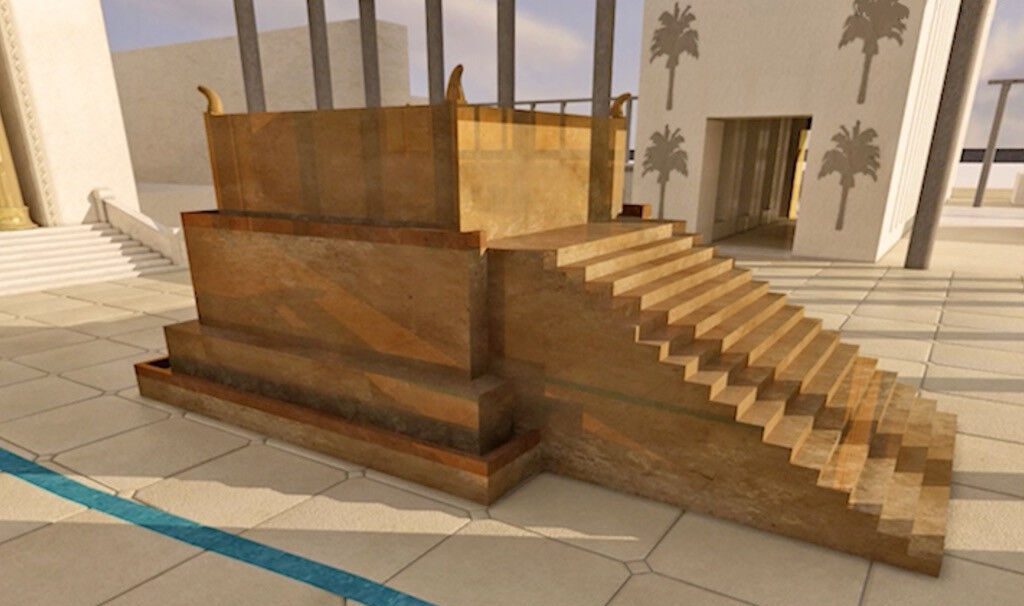
13 “These are the measurements of the altar by cubits (the cubit being a cubit and a handbreadth): its base shall be one cubit high and one cubit broad, with a rim of one span around its edge. And this shall be the height of the altar: 14 from the base on the ground to the lower ledge, two cubits, with a breadth of one cubit; and from the smaller ledge to the larger ledge, four cubits, with a breadth of one cubit; 15 and the altar hearth, four cubits; and from the altar hearth projecting upward, four horns. 16 The altar hearth shall be square, twelve cubits long by twelve broad. 17 The ledge also shall be square, fourteen cubits long by fourteen broad, with a rim around it half a cubit broad, and its base one cubit all around. The steps of the altar shall face east.”

18 And he said to me, “Son of man, thus says the Lord God: These are the ordinances for the altar: On the day when it is erected for offering burnt offerings upon it and for throwing blood against it, 19 you shall give to the Levitical priests of the family of Zadok, who draw near to me to minister to me, declares the Lord God, a bull from the herd for a sin offering. 20 And you shall take some of its blood and put it on the four horns of the altar and on the four corners of the ledge and upon the rim all around. Thus you shall purify the altar and make atonement for it. 21 You shall also take the bull of the sin offering, and it shall be burned in the appointed place belonging to the temple, outside the sacred area. 22 And on the second day you shall offer a male goat without blemish for a sin offering; and the altar shall be purified, as it was purified with the bull. 23 When you have finished purifying it, you shall offer a bull from the herd without blemish and a ram from the flock without blemish. 24 You shall present them before the Lord, and the priests shall sprinkle salt on them and offer them up as a burnt offering to the Lord. 25 For seven days you shall provide daily a male goat for a sin offering; also, a bull from the herd and a ram from the flock, without blemish, shall be provided. 26 Seven days shall they make atonement for the altar and cleanse it, and so consecrate it. 27 And when they have completed these days, then from the eighth day onward the priests shall offer on the altar your burnt offerings and your peace offerings, and I will accept you, declares the Lord God.” – Ezekiel 43:13-27 ESV

It should be no surprise that the focus of everything in the Millennial Kingdom will be holiness. At that moment in human history, everything will be set apart unto God. His Son will rule over all the earth from His throne in Jerusalem, just as the angel had promised to his mother, Mary.

“You will conceive and give birth to a son, and you will name him Jesus. He will be very great and will be called the Son of the Most High. The Lord God will give him the throne of his ancestor David. And he will reign over Israel forever; his Kingdom will never end!” – Luke 1:31-33 NLT

This will be in fulfillment of the promise that God made to King David.

“And I will provide a homeland for my people Israel, planting them in a secure place where they will never be disturbed. Evil nations won’t oppress them as they’ve done in the past, starting from the time I appointed judges to rule my people Israel. And I will give you rest from all your enemies.…Your house and your kingdom will continue before me for all time, and your throne will be secure forever.” – 2 Samuel 7:10-11, 16 NLT

In this future kingdom, Jesus Christ, the Son of God, will be the King of kings and Lord of lords. He will rule supreme and His status as the Holy One of God will allow Him to mete out perfect righteousness as the sovereign head of state. With His sacrificial death and resurrection, Jesus earned the right to sit on David’s throne. Paul speaks of Jesus’ elevation to this highest honor because “he humbled himself in obedience to God and died a criminal’s death on a cross” (Philippians 2:8 NLT).

And because Jesus faithfully fulfilled the will of His Heavenly Father, He was rewarded with a return to His rightful place at His Father’s side.

God elevated him to the place of highest honor
    and gave him the name above all other names,
that at the name of Jesus every knee should bow,
    in heaven and on earth and under the earth,
and every tongue declare that Jesus Christ is Lord,
    to the glory of God the Father. – Philippians 2:9-11 NLT

But the latter part of this passage has yet to be fulfilled. We live in an age where the majority of people on earth refuse to honor the name of Christ or bow in submission to His will. They do not acknowledge Him as Lord. Yet, God’s redemptive plan includes a day when all that will change. The prophet, Micah, refers to this future restoration of the Kingdom of Israel and Christ’s reign as King.

In the last days, the mountain of the Lord’s house
    will be the highest of all—
    the most important place on earth.
It will be raised above the other hills,
    and people from all over the world will stream there to worship.
People from many nations will come and say,
“Come, let us go up to the mountain of the Lord,
    to the house of Jacob’s God.
There he will teach us his ways,
    and we will walk in his paths.”
For the Lord’s teaching will go out from Zion;
    his word will go out from Jerusalem.
The Lord will mediate between peoples
    and will settle disputes between strong nations far away. – Micah 4:1-3 NLT

Isaiah prophesied about the future earthly reign of Christ, declaring that “the government will rest on his shoulders” (Isaiah 9:6 NLT), and that government will be marked by peace.

His government and its peace
    will never end.
He will rule with fairness and justice from the throne of his ancestor David
    for all eternity. – Isaiah 9:7 NLT

Justice will rule in the wilderness
    and righteousness in the fertile field.
And this righteousness will bring peace.
    Yes, it will bring quietness and confidence forever.
My people will live in safety, quietly at home.
    They will be at rest. – Isaiah 32:16-18 NLT

So, why does God reveal to Ezekiel that this same Millennial Kingdom will be marked by a reinstitution of the sacrificial system? If Jesus’ paid the final debt for all sins and accomplished what the blood of bulls and goats could never do, why would God bring back the temple, the altar, and the practice of blood sacrifice?

“The existence of the millennial temple and the reinstatement of the sacrificial system [though not necessarily the reinstatement of the Mosaic Covenant] is not only understandable but predictable. Ezekiel’s vision of a restored sacrificial system was really not so amazing after all. The millennium will afford Israel the opportunity for the first time in its history to use the symbols of their covenant with Jesus as Messiah in view. It will be their first time to be a kingdom of priests and a holy nation showing forth to the world the redemptive work of Yahweh in the person of Jesus Christ the Messiah (Isa 53:7; 61:1-3; Zech 4:1 [sic 3:10]; John 1:29; Acts 8:32-35; 1 Pet 1:19; Rev 7:13-14; 5:9; 13:8; 15:3).” – L. E. Cooper Sr., Ezekiel

The author of Hebrews reminds us that the old sacrificial system functioned as a symbol or representation of something far greater to come.

The old system under the law of Moses was only a shadow, a dim preview of the good things to come, not the good things themselves. The sacrifices under that system were repeated again and again, year after year, but they were never able to provide perfect cleansing for those who came to worship. If they could have provided perfect cleansing, the sacrifices would have stopped, for the worshipers would have been purified once for all time, and their feelings of guilt would have disappeared.

But instead, those sacrifices actually reminded them of their sins year after year. For it is not possible for the blood of bulls and goats to take away sins. – Hebrews 10:1-4 NLT

According to this passage, the main purpose behind the Old Testament sacrificial system was to remind God’s people of their sins. It could never provide full and complete atonement. That’s why the sacrifices were perpetual and never-ending. The people lived in an endless cycle of sin-sacrifice-atonement-forgiveness. With their sins forgiven, they would simply repeat the cycle again, year after year. But Jesus came to be the “Lamb of God who takes away the sins of the world” (John 1:29). With His death on the cross, Jesus broke that endless cycle of sacrifice for sins.

So, why bring it back? It seems that the future sacrificial system described in Ezekiel has a distinctly different purpose. Rather than providing atonement for sins, it will point to the ultimate atoning sacrifice: Jesus Christ. The blood offered up on the Millennial Altar will commemorate “the precious blood of Christ, the sinless, spotless Lamb of God” (1 Peter 1:19 NLT).

When Christians partake of the elements of the Lord’s Table, they are not literally breaking the body of Christ or spilling His blood. They are practicing a symbolic rite designed to remind them of what Christ has done on their behalf. That’s why, on the night Jesus instituted the Lord’s Table, He told His disciples “do this in remembrance of me” (1 Corinthians 11:25).

God gives Ezekiel the dimensions for the altar of sacrifice. Then He provides very clear instructions regarding the ritual cleansing of the altar and the preparation of the sacrifices to be offered on it. This entire process is similar to that given by God to Moses when He first instituted the sacrificial system in the Judean wilderness. For the Israelites living in the Millennial Kingdom, this entire process of ceremonial cleansing and purification will be highly familiar, and it will serve as a powerful reminder of their past sins as a nation. But it will point them to the all-sufficient sacrifice of Jesus, whose blood has cleansed them from all their sins (1 John 1:7).

“The offerings presented thereon were meant to be memorials, much as the Lord’s Supper is no efficacious sacrifice but a memorial of a blessedly adequate and all-sufficient sacrifice for all time. Thus, whereas the sacrifices of the Old Testament economy were prospective, these are retrospective.” – Charles Lee Feinberg, The Prophecy of Ezekiel

The focus of this chapter is holiness – the holiness of God, His people, His Kingdom, and His Son. Everything in the Millennial Kingdom will be set apart for His glory. It will all be dedicated to His name and exist to point all people to Him alone. In a remarkable blending of old and new imagery, God provides Ezekiel a glimpse of a future age when the Old Testament sacrificial system will exist in perfect harmony with the resurrected and enthroned Lamb of God. During His thousand-year reign on earth, there will be believers and unbelievers living under His righteous rule. All those who survived the seven years of the Tribulation will have the pleasure of living as citizens of Christ’s earthly kingdom, but not all will worship Him as Lord. Perhaps this renewed sacrificial system will serve as a means of purification for all those who wish to enter the presence of the King of kings. Holiness will reign supreme in the Millennial Kingdom, and God has ordained a place and purpose for the sacrificial system in that time.

English Standard Version (ESV) The Holy Bible, English Standard Version. ESV® Permanent Text Edition® (2016). Copyright © 2001

New Living Translation (NLT) Holy Bible, New Living Translation, copyright © 1996, 2004, 2015 by Tyndale House Foundation. Used by permission of Tyndale House Publishers Inc., Carol Stream, Illinois 60188. All rights reserved.

Set Apart

1 Then he led me out into the outer court, toward the north, and he brought me to the chambers that were opposite the separate yard and opposite the building on the north. 2 The length of the building whose door faced north was a hundred cubits, and the breadth fifty cubits. 3 Facing the twenty cubits that belonged to the inner court, and facing the pavement that belonged to the outer court, was gallery against gallery in three stories. 4 And before the chambers was a passage inward, ten cubits wide and a hundred cubits long, and their doors were on the north. 5 Now the upper chambers were narrower, for the galleries took more away from them than from the lower and middle chambers of the building. 6 For they were in three stories, and they had no pillars like the pillars of the courts. Thus the upper chambers were set back from the ground more than the lower and the middle ones. 7 And there was a wall outside parallel to the chambers, toward the outer court, opposite the chambers, fifty cubits long. 8 For the chambers on the outer court were fifty cubits long, while those opposite the nave were a hundred cubits long. 9 Below these chambers was an entrance on the east side, as one enters them from the outer court.

10 In the thickness of the wall of the court, on the south also, opposite the yard and opposite the building, there were chambers 11 with a passage in front of them. They were similar to the chambers on the north, of the same length and breadth, with the same exits and arrangements and doors, 12 as were the entrances of the chambers on the south. There was an entrance at the beginning of the passage, the passage before the corresponding wall on the east as one enters them.

13 Then he said to me, “The north chambers and the south chambers opposite the yard are the holy chambers, where the priests who approach the Lord shall eat the most holy offerings. There they shall put the most holy offerings—the grain offering, the sin offering, and the guilt offering—for the place is holy. 14 When the priests enter the Holy Place, they shall not go out of it into the outer court without laying there the garments in which they minister, for these are holy. They shall put on other garments before they go near to that which is for the people.”

15 Now when he had finished measuring the interior of the temple area, he led me out by the gate that faced east, and measured the temple area all around. 16 He measured the east side with the measuring reed, 500 cubits by the measuring reed all around. 17 He measured the north side, 500 cubits by the measuring reed all around. 18 He measured the south side, 500 cubits by the measuring reed. 19 Then he turned to the west side and measured, 500 cubits by the measuring reed. 20 He measured it on the four sides. It had a wall around it, 500 cubits long and 500 cubits broad, to make a separation between the holy and the common. – Ezekiel 42:1-20 ESV

I find it interesting that in the middle of all the detailed descriptions of the layout of the future temple complex, Ezekiel’s “guide” pointed to a set of rooms and designated them as being “holy.”

Then he said to me, “The north and south rooms adjacent to the open area are holy rooms where the priests who come before GOD eat the holy offerings. There they place the holy offerings–grain offerings, sin offerings, and guilt offerings. These are set-apart rooms, holy space. After the priests have entered the Sanctuary, they must not return to the outside courtyard and mingle among the people until they change the sacred garments in which they minister and put on their regular clothes.” – Ezekiel 42:13-14 MSG

Wouldn’t the entire temple be holy? Since the whole structure would be dedicated to the worship of God, wouldn’t every room, wall, hallway, courtyard, and gateway be considered holy? Well, in a sense, yes. But the use of the word “holy” in this context gives us another important aspect of its meaning. It simply means to be “set-apart or separated.”

These rooms were dedicated or set apart for a distinct purpose.

“Here the priests who offer sacrifices to the Lord will eat the most holy offerings.” – Ezekiel 42:13 NLT

According to Ezekiel’s divine tour guide, these rooms would also be used for storage of the elements used in the various offerings.

“…because these rooms are holy, they will be used to store the sacred offerings—the grain offerings, sin offerings, and guilt offerings.” – Ezekiel 42:13 NLT

Even within this future temple complex, there will be places that are “set apart” and distinctive from all others. These rooms will be dedicated to a specific purpose and will not be available for any others use.

When the priests complete their job of ministering in the sanctuary, they will be required to leave their “holy” garments in one of these “holy” rooms, and change into their “street” clothes.  The robes they wear in the sanctuary will be dedicated solely to use within that area of the temple. The book of Exodus describes these sacred garments.

“Make sacred garments for Aaron that are glorious and beautiful. Instruct all the skilled craftsmen whom I have filled with the spirit of wisdom. Have them make garments for Aaron that will distinguish him as a priest set apart for my service.” – Exodus 28:2-3 NLT

These would not be ordinary, run-of-the-mill clothes, but acquisitive garments of great beauty and detail.

“These are the garments they are to make: a chestpiece, an ephod, a robe, a patterned tunic, a turban, and a sash. They are to make these sacred garments for your brother, Aaron, and his sons to wear when they serve me as priests. So give them fine linen cloth, gold thread, and blue, purple, and scarlet thread.” – Exodus 28:4-5 NLT

Even when ministering within the far smaller and less opulent tabernacle, the priests were required to wear God-ordained and designed garments that set them apart for His service.

“For Aaron’s sons, make tunics, sashes, and special head coverings that are glorious and beautiful. Clothe your brother, Aaron, and his sons with these garments, and then anoint and ordain them. Consecrate them so they can serve as my priests. Also make linen undergarments for them, to be worn next to their bodies, reaching from their hips to their thighs. These must be worn whenever Aaron and his sons enter the Tabernacle or approach the altar in the Holy Place to perform their priestly duties. Then they will not incur guilt and die.” – Exodus 28:41-43 NLT

Holiness was important to God. It’s why He told His people, “You must be holy because I, the Lord your God, am holy” (Leviticus 19:2 NLT). He had chosen them and set them apart as His own. They were His special possession and their lives were to reflect their unique status as His children. And every area of this future temple will be set apart for God’s glory and use. Each brick, decorative accent, room, doorway, wall, and ceiling will exist for one purpose only: To bring glory to God Almighty.

Even the garments the priests wore were to be considered as holy or set apart. Before they could enter the rest of the temple or go into the more public or common areas, they had to remove their “holy” clothes, because those clothes had been dedicated to God.

All this makes me think about how we have been set apart by God for His use. We are His people. We have been made holy or set apart by the indwelling presence of the Spirit of God. We belong to God. The apostle Paul reminds us of this unique status as His holy people.

Since God chose you to be the holy people he loves, you must clothe yourselves with tenderhearted mercy, kindness, humility, gentleness, and patience. – Colossians 3:12 NLT

God set us apart for a purpose. We are now dedicated to Him and for His use. Our lives no longer belong to us, but to him and we should be used only in the way that He sees fit. The priests could not use the holy garments for any other purpose. They were not free to use those holy rooms for any other reason than the one that God had prescribed for them. In fact, the book of Nehemiah records an incident in which one of the priests violated this very command.

Eliashib the priest, who had been appointed as supervisor of the storerooms of the Temple of our God and who was also a relative of Tobiah, had converted a large storage room and placed it at Tobiah’s disposal. The room had previously been used for storing the grain offerings, the frankincense, various articles for the Temple, and the tithes of grain, new wine, and olive oil (which were prescribed for the Levites, the singers, and the gatekeepers), as well as the offerings for the priests. – Nehemiah 4:4-5 NLT

Notice that Eliashib had taken one of the “holy” rooms and turned it into an apartment for one of his relatives. When Nehemiah got wind of what had happened, he was furious and took immediate action.

When I arrived back in Jerusalem, I learned about Eliashib’s evil deed in providing Tobiah with a room in the courtyards of the Temple of God. I became very upset and threw all of Tobiah’s belongings out of the room. Then I demanded that the rooms be purified, and I brought back the articles for God’s Temple, the grain offerings, and the frankincense. – Nehemiah 4:7-9 NLT

Eliashib had taken liberties with that which belonged to God. He had the audacity to assign a new and totally different use for that which God had set apart. And, in doing so, he desecrated what God had deemed as wholly for His use.

And we can be guilty of the same thing. As God’s children, we have been set apart for His service. When God commands, “You must be holy because I am holy” (1 Peter 1:16 NLT), He is telling us that we must be set apart, distinct, and different, just as He is. We must reflect His holiness. We must remain dedicated to His use. When we take what He has set apart (our bodies) and use it for some other purpose, we profane it. When we use our bodies for purposes other than those for which God has set them apart, we denigrate their God-given value. That is why Peter provides a sobering warning to live as who we are and for the purpose we have been assigned.

And you are living stones that God is building into his spiritual temple. What’s more, you are his holy priests. Through the mediation of Jesus Christ, you offer spiritual sacrifices that please God. – 1 Peter 2:5 NLT

And the apostle Paul echoes Peter’s sentiments when he writes:

Don’t you realize that your body is the temple of the Holy Spirit, who lives in you and was given to you by God? You do not belong to yourself, for God bought you with a high price. So you must honor God with your body. – 1 Corinthians 6:19-20 NLT

English Standard Version (ESV) The Holy Bible, English Standard Version. ESV® Permanent Text Edition® (2016). Copyright © 2001

New Living Translation (NLT) Holy Bible, New Living Translation, copyright © 1996, 2004, 2015 by Tyndale House Foundation. Used by permission of Tyndale House Publishers Inc., Carol Stream, Illinois 60188. All rights reserved.

The Most Holy Place

44 On the outside of the inner gateway there were two chambers in the inner court, one at the side of the north gate facing south, the other at the side of the south gate facing north. 45 And he said to me, “This chamber that faces south is for the priests who have charge of the temple, 46 and the chamber that faces north is for the priests who have charge of the altar. These are the sons of Zadok, who alone among the sons of Levi may come near to the Lord to minister to him.” 47 And he measured the court, a hundred cubits long and a hundred cubits broad, a square. And the altar was in front of the temple.

48 Then he brought me to the vestibule of the temple and measured the jambs of the vestibule, five cubits on either side. And the breadth of the gate was fourteen cubits, and the sidewalls of the gate were three cubits on either side. 49 The length of the vestibule was twenty cubits, and the breadth twelve cubits, and people would go up to it by ten steps. And there were pillars beside the jambs, one on either side.

1 Then he brought me to the nave and measured the jambs. On each side six cubits was the breadth of the jambs. 2 And the breadth of the entrance was ten cubits, and the sidewalls of the entrance were five cubits on either side. And he measured the length of the nave, forty cubits, and its breadth, twenty cubits. 3 Then he went into the inner room and measured the jambs of the entrance, two cubits; and the entrance, six cubits; and the sidewalls on either side of the entrance, seven cubits. 4 And he measured the length of the room, twenty cubits, and its breadth, twenty cubits, across the nave. And he said to me, “This is the Most Holy Place.”– Ezekiel 40:44-41:4 ESV

Ezekiel’s vision of the Millennial Temple included a view of two chambers located just outside the northern and southern inner gates. In Hebrew, these rooms are described as liškâ šîr, which might best be translated as “the chambers of the singing men.”

These would have been members of the tribe of Levi who served as priests in the temple but also functioned as musicians as part of their service to God. The book of 2 Chronicles mentions these men.

And the Levites who were musicians—Asaph, Heman, Jeduthun, and all their sons and brothers—were dressed in fine linen robes and stood at the east side of the altar playing cymbals, lyres, and harps. They were joined by 120 priests who were playing trumpets. The trumpeters and singers performed together in unison to praise and give thanks to the Lord. – 2 Chronicles 5:12-13 NLT

These men were responsible for providing musical praise to God as part of peoples’ worship.

Accompanied by trumpets, cymbals, and other instruments, they raised their voices and praised the Lord with these words:

“He is good!
    His faithful love endures forever!”  – 2 Chronicles 5:14 NLT

And the book of 1 Chronicles states that they lived in special rooms dedicated to their use in the temple.

The musicians, all prominent Levites, lived at the Temple. They were exempt from other responsibilities since they were on duty at all hours. All these men lived in Jerusalem. They were the heads of Levite families and were listed as prominent leaders in their genealogical records. – 1 Chronicles 9:33-34 NLT

The Psalms are filled with descriptions of music as a form of worship and singing as a means of praising God for all He has done.

Come, let us sing to the Lord!
    Let us shout joyfully to the Rock of our salvation.
Let us come to him with thanksgiving.
    Let us sing psalms of praise to him. – Psalm 95:1-2 NLT

Shout to the Lord, all the earth;
    break out in praise and sing for joy!
Sing your praise to the Lord with the harp,
    with the harp and melodious song,
with trumpets and the sound of the ram’s horn.
    Make a joyful symphony before the Lord, the King! – Psalm 98:4-6 NLT

And, according to Ezekiel’s vision, this musical expression of praise and glory for God’s goodness and greatness will continue into the Millennial Kingdom.

The praise of God will never cease in the Millennial Kingdom as God’s people express their heartfelt gratitude for all that He has done. And these priests will be accompanied by others who be responsible for maintaining the temple itself as well as all the elements associated with the altar and the sacrificial system. Each priest will perform his duties with joy and gladness so that the temple may function seamlessly and in full compliance with God’s decrees.

And Ezekiel is told that these men will be the descendants of Zadok, who served as a priest during the reigns of David and Solomon. This ensures the prophet that God will miraculously maintain the line of Zadok so that they may serve Him in this future temple.

As the vision unfolds before Ezekiel’s eyes, he is escorted into the actual doorway of the temple itself, through a portico or inner room that opens into the temple proper. As he moves forward into the recesses of the temple, Ezekiel passes through the Holy Place and into the Holy of Holies. With each step, he moves into a progressively smaller space that is meant to focus his attention on the significance of his final destination: The most holy place.  This was the innermost room of the temple where God’s presence was said to dwell above the mercy seat. In Solomon’s temple, this room was highly restricted and off-limits to anyone but the high priest, who could only enter one day out of the entire year, on the Day of Atonement. God had told Moses to warn his brother, Aaron, the high priest, not to venture into the Holy of Holies on any other day or he would face certain death.

The Lord said to Moses, “Warn your brother, Aaron, not to enter the Most Holy Place behind the inner curtain whenever he chooses; if he does, he will die. For the Ark’s cover—the place of atonement—is there, and I myself am present in the cloud above the atonement cover.” – Leviticus 16:2 NLT

Aaron was given a series of ceremonial tasks to perform so that he might offer a sacrifice on behalf of the people. It all began with his personal purification and included cleansing of the Holy of Holies, the altar, priests, the congregation, and the tabernacle itself. It all concluded with the release of the scapegoat.

“He will lay both of his hands on the goat’s head and confess over it all the wickedness, rebellion, and sins of the people of Israel. In this way, he will transfer the people’s sins to the head of the goat. Then a man specially chosen for the task will drive the goat into the wilderness. As the goat goes into the wilderness, it will carry all the people’s sins upon itself into a desolate land.” – Leviticus 16:21-22 NLT

What makes this so important is that, in the future Millennial Kingdom, there will be no need for the scapegoat because of Jesus’ once-for-all sacrifice. He bore the sins of mankind with His death on the cross and provided a permanent means of forgiveness for all those who place their faith in Him. Yet, God told Moses and the people of Israel that His commands concerning the Day of Atonement would be permanent.

“This is a permanent law for you. In future generations, the purification ceremony will be performed by the priest who has been anointed and ordained to serve as high priest in place of his ancestor Aaron. He will put on the holy linen garments and purify the Most Holy Place, the Tabernacle, the altar, the priests, and the entire congregation. This is a permanent law for you, to purify the people of Israel from their sins, making them right with the Lord once each year.” – Leviticus 16:31-34 NLT

But what makes the future temple so unique is that it will exist as part of the Millennial Kingdom of Jesus Christ, who will reign as King over Jerusalem, the land of Israel, and the rest of the world. Because of His sacrificial death, resurrection, ascension, and ultimate return as the King of kings and Lord of lords, there will be no need for future purification of the temple. The scapegoat will be unnecessary. Cleansing from sin will no longer be needed.

The Most Holy Place will be permanently holy. The people of God will be eternally righteous, cleansed, and forgiven. Because God and His Son will take up permanent residence with His people.

English Standard Version (ESV) The Holy Bible, English Standard Version. ESV® Permanent Text Edition® (2016). Copyright © 2001

New Living Translation (NLT) Holy Bible, New Living Translation, copyright © 1996, 2004, 2015 by Tyndale House Foundation. Used by permission of Tyndale House Publishers Inc., Carol Stream, Illinois 60188. All rights reserved.

Nothing But the Blood of Jesus

17 Then he brought me into the outer court. And behold, there were chambers and a pavement, all around the court. Thirty chambers faced the pavement. 18 And the pavement ran along the side of the gates, corresponding to the length of the gates. This was the lower pavement. 19 Then he measured the distance from the inner front of the lower gate to the outer front of the inner court, a hundred cubits on the east side and on the north side.

20 As for the gate that faced toward the north, belonging to the outer court, he measured its length and its breadth. 21 Its side rooms, three on either side, and its jambs and its vestibule were of the same size as those of the first gate. Its length was fifty cubits, and its breadth twenty-five cubits. 22 And its windows, its vestibule, and its palm trees were of the same size as those of the gate that faced toward the east. And by seven steps people would go up to it, and find its vestibule before them. 23 And opposite the gate on the north, as on the east, was a gate to the inner court. And he measured from gate to gate, a hundred cubits.

24 And he led me toward the south, and behold, there was a gate on the south. And he measured its jambs and its vestibule; they had the same size as the others. 25 Both it and its vestibule had windows all around, like the windows of the others. Its length was fifty cubits, and its breadth twenty-five cubits. 26 And there were seven steps leading up to it, and its vestibule was before them, and it had palm trees on its jambs, one on either side. 27 And there was a gate on the south of the inner court. And he measured from gate to gate toward the south, a hundred cubits.

28 Then he brought me to the inner court through the south gate, and he measured the south gate. It was of the same size as the others. 29 Its side rooms, its jambs, and its vestibule were of the same size as the others, and both it and its vestibule had windows all around. Its length was fifty cubits, and its breadth twenty-five cubits. 30 And there were vestibules all around, twenty-five cubits long and five cubits broad. 31 Its vestibule faced the outer court, and palm trees were on its jambs, and its stairway had eight steps.

32 Then he brought me to the inner court on the east side, and he measured the gate. It was of the same size as the others. 33 Its side rooms, its jambs, and its vestibule were of the same size as the others, and both it and its vestibule had windows all around. Its length was fifty cubits, and its breadth twenty-five cubits. 34 Its vestibule faced the outer court, and it had palm trees on its jambs, on either side, and its stairway had eight steps.

35 Then he brought me to the north gate, and he measured it. It had the same size as the others. 36 Its side rooms, its jambs, and its vestibule were of the same size as the others, and it had windows all around. Its length was fifty cubits, and its breadth twenty-five cubits. 37 Its vestibule faced the outer court, and it had palm trees on its jambs, on either side, and its stairway had eight steps.

38 There was a chamber with its door in the vestibule of the gate, where the burnt offering was to be washed. 39 And in the vestibule of the gate were two tables on either side, on which the burnt offering and the sin offering and the guilt offering were to be slaughtered. 40 And off to the side, on the outside as one goes up to the entrance of the north gate, were two tables; and off to the other side of the vestibule of the gate were two tables. 41 Four tables were on either side of the gate, eight tables, on which to slaughter. 42 And there were four tables of hewn stone for the burnt offering, a cubit and a half long, and a cubit and a half broad, and one cubit high, on which the instruments were to be laid with which the burnt offerings and the sacrifices were slaughtered. 43 And hooks, a handbreadth long, were fastened all around within. And on the tables the flesh of the offering was to be laid. – Ezekiel 40:17-43 ESV

The temple complex in Ezekiel’s vision revealed an outer wall with three gates or entrances; one to the north, another to the east, and a final one to the south. The wall surrounding the temple was over ten feet wide and ten feet tall. The eastern gate, which faced the Kidron Valley across from the Mount of Olives, had a set of steps leading up to its gate. This was the main entry point to the temple complex and led to an outer court. On the perimeter of the wall’s interior were a series of rooms that lined its northern. eastern, and southern sides. No explanation is given for the purpose of these rooms.

The distance between the outer eastern gate and the inner eastern gate that led to the inner court was 166 feet. This expanse formed the outer court. In Solomon’s temple, this would have been called The Court of the Women. But in his vision, Ezekiel is provided with no designation for this expansive space.

Upon entering the outer court, the three entrances to the inner court came into view. These three inner gate complexes were similar in size and design to the outer gates and provided access to the temple itself. There is a repeated pattern or design intended to regulate entrance into God’s presence. And upon passing through one of these three gates, one would find themself inside the inner court and the place of sacrifice. A room was dedicated to the washing of the animals planned for sacrifice. The priests would purify each animal before offering it up to God as a burnt offering. On the outside of this room were eight stone tables, where the sacrificial animals were slaughtered for the burnt offerings, sin offerings, and guilt offerings. Four additional stone tables held the priests’ butchering implements and were where the prepared meat was placed before being offered as a sacrifice.

Ezekiel was also shown two rooms, one was “for the priests who supervise the Temple maintenance” (Ezekiel 40:45 NLT) and the other was for the priests in charge of the altar” (Ezekiel 40:46 NLT). And Ezekiel was informed that these priests are “the descendants of Zadok—for they alone of all the Levites may approach the Lord to minister to him” (Ezekiel 40:46 NLT). In other words, this future temple will be administered according to God’s original command. He had ordained that the tribe of Levi would serve as keepers of the tabernacle and later, the temple.

…the Lord your God chose the tribe of Levi out of all your tribes to minister in the Lord’s name forever. – Deuteronomy 18:5 NLT

From among the Levites would come the priests who were tasked with offering the sacrifices on behalf of the people. Zadok was a descendant of Levi and had served during the reign of King David. It will be the priestly descendants of Zadok who serve in this future millennial temple. This is another sign that God will restore everything to the way He had intended it to be from the beginning.

But there is one question that comes to mind when considering the presence of the temple, priests, and blood sacrifices in the millennial kingdom. Why would God reinstitute this ritual when the book of Hebrews states that Jesus offered His life as a final, once-for-all sacrifice for the sins of mankind?

So Christ has now become the High Priest over all the good things that have come. He has entered that greater, more perfect Tabernacle in heaven, which was not made by human hands and is not part of this created world. With his own blood—not the blood of goats and calves—he entered the Most Holy Place once for all time and secured our redemption forever. – Hebrews 9:11-12 NLT

The original sacrificial system was intended to purify the ungodly, including the priests themselves, making them worthy of coming into God’s presence and capable of receiving His forgiveness.

For without the shedding of blood, there is no forgiveness.

That is why the Tabernacle and everything in it, which were copies of things in heaven, had to be purified by the blood of animals. But the real things in heaven had to be purified with far better sacrifices than the blood of animals. – Hebrews 9:22-23 NLT

Jesus provided a better sacrifice, a new-and-improved way of being made right with God. He offered His own life, shedding His own blood, in order that sinful men and women might receive new life and a restored relationship with God.

Christ was offered once for all time as a sacrifice to take away the sins of many people. – Hebrews 9:28 NLT

So, why is Ezekiel given a vision of what appears to be a renewed sacrificial system in the millennial temple? The author of Hebrews provides insight into this seeming contradiction. He states that the Old Testament priests served “in a system of worship that is only a copy, a shadow of the real one in heaven” (Hebrews 8:5 NLT). In other words, their priestly duties, including the blood sacrifices they offered as atonement for the sins of the people, were a foreshadowing of Jesus’ ultimate and final sacrifice. They pointed forward to something far greater. It seems that in the Millennial temple, these sacrifices will look back, commemorating the atoning work of Jesus. Rather than redemptive in nature, they will be commemorative. Much like the New Testament Church celebrates the death of Christ through the ordinance of the Lord’s Table.

The author of Hebrews goes on to state that the blood sacrifices “actually reminded them of their sins year after year. For it is not possible for the blood of bulls and goats to take away sins” (Hebrews 10:3-4 NLT). But in the future, those very same sacrifices will be used to remind people of their Savior.

Again, the author of Hebrews provides helpful insight into this future scene that Ezekiel was privileged to see.

“This is the new covenant I will make
    with my people on that day, says the Lord:
I will put my laws in their hearts,
    and I will write them on their minds.”

Then he says,

“I will never again remember
    their sins and lawless deeds.”

And when sins have been forgiven, there is no need to offer any more sacrifices. – Hebrews 10:16-18 NLT

There will no longer be any need to offer sacrifices for the forgiveness of sins because Christ has paid the full and final price for those sins. Yet, there will be ample reason for people to offer sacrifices of praise and thanksgiving for the gracious gift of eternal life they have received.

As the author of Hebrews makes clear, “it is not possible for the blood of bulls and goats to take away sins” (Hebrews 10:4 NLT). But in Ezekiel’s vision, he is shown that the blood of bulls and goats can do what it was always intended to do: Point to the blood of Christ that made possible mankind’s full and complete redemption and restoration to God. As the apostle, John reminds us, “the blood of Jesus his Son cleanses us from all sin” (1 John 2:17 ESV).

English Standard Version (ESV) The Holy Bible, English Standard Version. ESV® Permanent Text Edition® (2016). Copyright © 2001

New Living Translation (NLT) Holy Bible, New Living Translation, copyright © 1996, 2004, 2015 by Tyndale House Foundation. Used by permission of Tyndale House Publishers Inc., Carol Stream, Illinois 60188. All rights reserved.