I Will Put My Temple Among Them

1 In the twenty-fifth year of our exile, at the beginning of the year, on the tenth day of the month, in the fourteenth year after the city was struck down, on that very day, the hand of the Lord was upon me, and he brought me to the city. 2 In visions of God he brought me to the land of Israel, and set me down on a very high mountain, on which was a structure like a city to the south. 3 When he brought me there, behold, there was a man whose appearance was like bronze, with a linen cord and a measuring reed in his hand. And he was standing in the gateway. 4 And the man said to me, “Son of man, look with your eyes, and hear with your ears, and set your heart upon all that I shall show you, for you were brought here in order that I might show it to you. Declare all that you see to the house of Israel.”

5 And behold, there was a wall all around the outside of the temple area, and the length of the measuring reed in the man’s hand was six long cubits, each being a cubit and a handbreadth in length. So he measured the thickness of the wall, one reed; and the height, one reed. 6 Then he went into the gateway facing east, going up its steps, and measured the threshold of the gate, one reed deep. 7 And the side rooms, one reed long and one reed broad; and the space between the side rooms, five cubits; and the threshold of the gate by the vestibule of the gate at the inner end, one reed. 8 Then he measured the vestibule of the gateway, on the inside, one reed. 9 Then he measured the vestibule of the gateway, eight cubits; and its jambs, two cubits; and the vestibule of the gate was at the inner end. 10 And there were three side rooms on either side of the east gate. The three were of the same size, and the jambs on either side were of the same size. 11 Then he measured the width of the opening of the gateway, ten cubits; and the length of the gateway, thirteen cubits. 12 There was a barrier before the side rooms, one cubit on either side. And the side rooms were six cubits on either side. 13 Then he measured the gate from the ceiling of the one side room to the ceiling of the other, a breadth of twenty-five cubits; the openings faced each other. 14 He measured also the vestibule, sixty cubits. And around the vestibule of the gateway was the court. 15 From the front of the gate at the entrance to the front of the inner vestibule of the gate was fifty cubits. 16 And the gateway had windows all around, narrowing inwards toward the side rooms and toward their jambs, and likewise the vestibule had windows all around inside, and on the jambs were palm trees. – Ezekiel 40:1-16 ESV

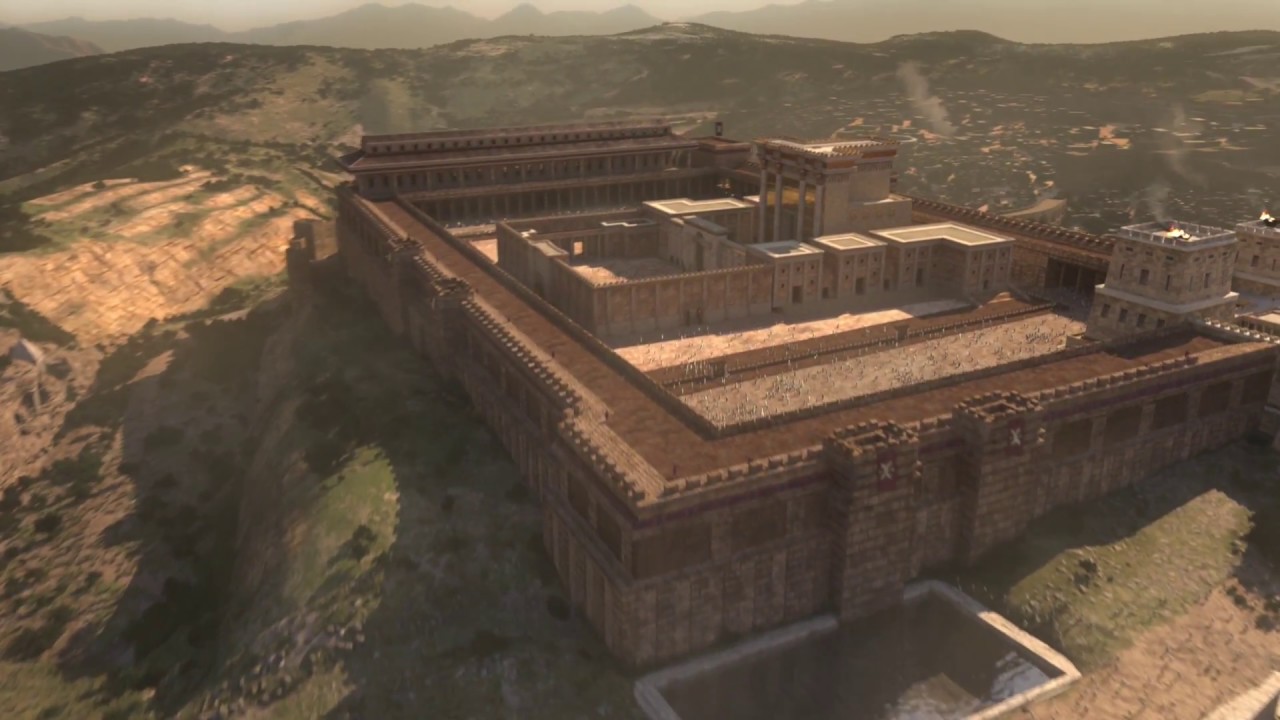
Over the next nine chapters, Ezekiel is going to describe a vision given to him by God. The length of this vision rivals the one that the apostle John experienced and recorded in the book of Revelation. Ezekiel’s vision came not long after God’s declaration of His future plans to restore Israel to the land of Canaan and renew His covenant relationship with them. Part of that plan was to rebuild the temple and reintroduce the sacrificial system.

“…I will put my Temple among them forever. I will make my home among them. I will be their God, and they will be my people. And when my Temple is among them forever, the nations will know that I am the Lord, who makes Israel holy.”– Ezekiel 37:26-28 NLT

Ezekiel was given a vision of that future temple in all its glory and majesty, and it would be nothing like the temple that the Babylonians had destroyed. According to Ezekiel’s dating, he was given this vision 12 years after having received news of the fall of Jerusalem and the original temple’s destruction.

In the twelfth year of our exile, in the tenth month, on the fifth day of the month, a fugitive from Jerusalem came to me and said, “The city has been struck down.”– Ezekiel 33:21 ESV

Now, more than a decade later, he records, “In the twenty-fifth year of our exile, at the beginning of the year, on the tenth day of the month, in the fourteenth year after the city was struck down, on that very day, the hand of the Lord was upon me, and he brought me to the city” (Ezekiel 40:1 ESV).

But rather than finding the temple in a state of disrepair and decay, he sees “a structure like a city to the south” (Ezekiel 40:2 ESV). Before his eyes lay a massive complex of buildings and walls that appears more like a city than a temple. In his vision, Ezekiel receives a guided tour of the temple complex by a divine guide. And this is not the first time Ezekiel has met this individual. Back in chapter 8, he records a previous encounter with what appears to be the same “man whose appearance was like bronze, with a linen cord and a measuring reed in his hand” (Ezekiel 40:3 ESV).

Then I looked, and behold, a form that had the appearance of a man. Below what appeared to be his waist was fire, and above his waist was something like the appearance of brightness, like gleaming metal.He put out the form of a hand and took me by a lock of my head, and the Spirit lifted me up between earth and heaven and brought me in visions of God to Jerusalem, to the entrance of the gateway of the inner court… – Ezekiel 8:2-3 ESV

But in Ezekiel’s prior vision, what he saw taking place in the temple was disturbing and disconcerting.

“Son of man, do you see what they are doing, the great abominations that the house of Israel are committing here, to drive me far from my sanctuary? But you will see still greater abominations.” – Ezekiel 8:6 ESV

In that vision, Ezekiel was given a glimpse into the temple in Jerusalem where the priests and leaders of Judah were committing idolatry and apostasy. They had denigrated the name of God by worshiping false gods in the very temple that had been dedicated to Him alone.

But that vision had taken plan two decades earlier and now the temple was a pile of rubble. Nebuchadnezzar’s forces had completely destroyed the once-glorious house built by King Solomon for the glory of God. Yet, God provided Ezekiel with a telescopic view into the distant future so that He could see a rebuilt and more magnificent temple that far exceeded Solomon’s temple in glory and grandeur. And the whole purpose for this second visit to the temple in Jerusalem was so that Ezekiel might tell his fellow exiles what he saw.

“Son of man, watch and listen. Pay close attention to everything I show you. You have been brought here so I can show you many things. Then you will return to the people of Israel and tell them everything you have seen.”– Ezekiel 40:4 NLT

In interpreting the meaning behind this vision, it is important to consider the audience to whom it was given. Ezekiel is specifically told to give this message to “the people of Israel.” Some have concluded that this vision is purely spiritual in nature and is not to be taken literally. They posit that everything Ezekiel saw was predicting the coming of the church after the resurrection and ascension of Jesus. Therefore, the images are figurative and not literal. But this view does not explain the great details found in the vision regarding the temple’s size and structure. It is impossible to spiritualize all that Ezekiel sees.

Another view is that this vision was fulfilled when the Israelites returned to the promised land under the leadership of Ezra and Nehemiah. But the temple they rebuilt had no resemblance to what is described in Ezekiel’s vision. And the later expansions to the temple under King Herod would still lack any similarities to what Ezekiel saw in his vision.

The most logical explanation is that Ezekiel was given a view of a literal, eschatological temple that will exist during the millennial reign of Christ. God had already promised Ezekiel that the day was coming when He would put His temple among them forever. Therefore, it cannot be a temporary structure built with human hands. It must be of a supernatural design and built to last throughout eternity.

“Why did Ezekiel take so much space to describe the millennial temple? Here are two reasons: (1) The sanctuary was the visible symbol of God’s presence among His people. The prelude to Israel’s judgment began when God’s glory departed from Solomon’s temple in Jerusalem (Ezek. 8-11). The climax to her restoration as a nation will come when God’s glory reenters the new temple in Jerusalem (43:1-5). (2) The new temple will become the visible reminder of Israel’s relationship to God through His New Covenant. Since God gave detailed instructions for building the tabernacle to accompany His inauguration of the Mosaic Covenant (cf. Ez. 25-40), it is not unusual that He would also supply detailed plans for His new center of worship to accompany the implementation of the New Covenant. This temple will be the focal point for the visible manifestation of Israel’s new relationship with her God.” – Charles H. Dyer, Ezekiel

What Ezekiel receives is a literal blueprint for the millennial temple complex. When Noah received God’s blueprint instructions for the ark, God expected him to build it. But that is not the case here. Ezekiel was not expected to use these detailed measurements to construct this future temple. That would be the work of God. But God wanted Ezekiel to be able to describe in minute detail what he saw in the vision. It would have been next to impossible for Ezekiel to put into words what he saw. And it would have been difficult for his audience to grasp the glory of this eschatological temple without the measurements to provide some idea of its scope and size. And God left nothing out.

From the height of the surrounding wall to the threshold of each gate, God provided Ezekiel with precise measurements for each part of the temple complex. Guard rooms, alcoves, courtyards,  and gateways were all included in the guided tour. And the amount of emphasis on gates and guard rooms suggests that the future temple will have restricted access. God will prevent anyone who is unclean or unworthy from entering His holy temple. It will once again be a place of righteousness where God’s presence dwells and God’s people can gather to offer their sacrifices of praise and thanksgiving.

English Standard Version (ESV) The Holy Bible, English Standard Version. ESV® Permanent Text Edition® (2016). Copyright © 2001

New Living Translation (NLT) Holy Bible, New Living Translation, copyright © 1996, 2004, 2015 by Tyndale House Foundation. Used by permission of Tyndale House Publishers Inc., Carol Stream, Illinois 60188. All rights reserved.

No Right to Mourn

15 The word of the Lord came to me: 16 “Son of man, behold, I am about to take the delight of your eyes away from you at a stroke; yet you shall not mourn or weep, nor shall your tears run down. 17 Sigh, but not aloud; make no mourning for the dead. Bind on your turban, and put your shoes on your feet; do not cover your lips, nor eat the bread of men.” 18 So I spoke to the people in the morning, and at evening my wife died. And on the next morning I did as I was commanded.

19 And the people said to me, “Will you not tell us what these things mean for us, that you are acting thus?” 20 Then I said to them, “The word of the Lord came to me: 21 ‘Say to the house of Israel, Thus says the Lord God: Behold, I will profane my sanctuary, the pride of your power, the delight of your eyes, and the yearning of your soul, and your sons and your daughters whom you left behind shall fall by the sword. 22 And you shall do as I have done; you shall not cover your lips, nor eat the bread of men. 23 Your turbans shall be on your heads and your shoes on your feet; you shall not mourn or weep, but you shall rot away in your iniquities and groan to one another. 24 Thus shall Ezekiel be to you a sign; according to all that he has done you shall do. When this comes, then you will know that I am the Lord God.’

25 “As for you, son of man, surely on the day when I take from them their stronghold, their joy and glory, the delight of their eyes and their soul’s desire, and also their sons and daughters, 26 on that day a fugitive will come to you to report to you the news. 27 On that day your mouth will be opened to the fugitive, and you shall speak and be no longer mute. So you will be a sign to them, and they will know that I am the Lord.” – Ezekiel 24:15-27 ESV

After providing Ezekiel with the parable of the boiling pot, God informs His faithful prophet of a pending personal tragedy that will become another powerful illustration to His rebellious people. With everything else going on in his life, the last thing Ezekiel expected to hear was a divine pronouncement of his wife’s imminent death. Up to this point in the narrative, there has been no mention of Ezekiel’s family, so the sudden mention of his wife’s death is unexpected. And this tragic news must have hit Ezekiel with the emotional impact of a freight train.

But the gut-wrenching news of her death was accompanied by an equally difficult command from God. Not only is Ezekiel told that his wife, his “dearest treasure,” is going to die suddenly, but he is forbidden by God to mourn or weep for her publicly.

“Son of man, realize that I am about to take the delight of your eyes away from you with a jolt, but you must not mourn or weep or shed tears.” – Ezekiel 24:16 NET

Ezekiel will not be allowed to show any outward signs of mourning. The normal rituals and rites associated with the loss of a loved one will be off-limits to him. Even when well-meaning friends heard the tragic news and brought him meals, he was not allowed to eat with them. God expected Ezekiel to act as if nothing happened, putting his turban on his head, his sandals on his feet, and going about his prophetic responsibilities as usual. And Ezekiel was given little time to prepare himself for this devastating event. Within 24 hours, his wife was dead.

So I spoke to the people in the morning, and at evening my wife died.  – Ezekiel 24:18 ESV

When Ezekiel’s fellow exiles saw that he showed no signs of mourning over his wife’s sudden passing, they were confused and confronted him about it.

“Will you not tell us what these things mean for us, that you are acting thus?” – Ezekiel 24:19 ESV

From their past experience with Ezekiel, they knew that something was up. He did nothing without a reason and seldom spoke without having a message to convey from God. So, they suspected that there was something behind his bizarre behavior, and they were right.

Ezekiel informed them that his response to his wife’s unexpected death was meant to be an example for them to follow. When the Babylonian siege ended and the city of Jerusalem fell, God was going to bring about the destruction of the temple. For the people of Judah, the temple was the symbol of their relationship with Yahweh and a constant reminder of their status as His chosen people. God describes it as “the pride of your power, the delight of your eyes, and the yearning of your soul” (Ezekiel 24:21 ESV). They took great pride in the temple. It was a majestic structure that dominated the city’s skyline from its vantage point on Mount Moriah. It was beautiful and built to last for generations. Yet, God was about to reduce it to a pile of rubble and, when He did, they were not to mourn over its loss. They were to follow Ezekiel’s example.

“…you will do as Ezekiel has done. You will not mourn in public or console yourselves by eating the food brought by friends. Your heads will remain covered, and your sandals will not be taken off. You will not mourn or weep, but you will waste away because of your sins. You will groan among yourselves for all the evil you have done.” – Ezekiel 24:22-23 NLT

But the temple would not be the only loss they suffered. God informs them that when Jerusalem falls, many of them will suffer the loss of family members who remained behind in Judah.

“Son of man, on the day I take away their stronghold—their joy and glory, their heart’s desire, their dearest treasure—I will also take away their sons and daughters. And on that day a survivor from Jerusalem will come to you in Babylon and tell you what has happened.” – Ezekiel 24:25-26 NLT

The exiles would not escape the devastating impact of the siege and subsequent fall of Jerusalem. Like Ezekiel, they would soon receive the unexpected and unwanted news of personal tragedy and loss, and God expected them to keep their mourning to themselves. God’s prohibition against any public displays of sorrow was meant to accentuate their guilt and prevent them from portraying their loss as somehow undeserved.

“Ezekiel had a right to mourn his undeserved personal loss but did not. The Israelites had no right to mourn for their well-deserved national loss and could not . . .” – Douglas Stuart, Ezekiel

God was going to use Ezekiel’s timely personal tragedy as a vivid illustration for the people of Judah living in captivity. Their glorious temple was about to be destroyed. It was the source of their security and pride. It held a special place in their hearts and lives, even from 1600 miles away in Babylon. As long as the temple stood, they had hope because it represented the presence of God. But God was going to allow His house to be destroyed and the exiles living in Babylon, who had been taken captive years earlier, were to mourn its loss in silence.

But what are we to do we do with the 800-pound gorilla in the room – the tragic death of Ezekiel’s innocent wife? Did God cause it? Did He deliberately take this woman’s life just to make a point? To answer these uncomfortable questions one must first consider the complete character of God as unveiled in the Scriptures. Attempting to put God on trial based on a single Old Testament story is risky business. So, it is necessary to consider the full scope of God’s divine attributes when confronted with a disturbing and somewhat confusing passage like this one.

There is no doubt that God was in control of the situation. He was sovereign over every event that happened, including the death of Ezekiel’s wife. But whether God caused her death or simply allowed it is difficult to know for sure. Based on what the rest of Scripture reveals about the character of God, it seems to make the most sense that God allowed Ezekiel’s wife to die at this particular time. Due to His omniscience and foreknowledge, God was fully aware of the timing surrounding her death. He knew in advance what was already going to happen.

Had she been sick? The passage doesn’t say. Was her condition the result of disease or plague? There is no way to know. But her death was timely. It came at just the right moment and was used by God as a power and memorable illustration to His rebellious people.

It is essential that we interpret this event based on other revelations of God’s character found in the Word. The question is not whether God could have caused her death, but whether He would kill an innocent woman just to illustrate a point. Would that be consistent with His character? In his Notes on Ezekiel, Dr. Thomas Constable writes, “The text does not say that God put her to death as an object lesson. She could have been ill for some time before she died. Another similar situation involved God allowing the death of His innocent Son to occur at precisely the time God intended as another expression of His love and judgment.”

In reading the Old Testament, we must be careful to interpret what it seems to reveal about God’s character by comparing what we read with other passages and revelations about God. Otherwise, we can easily build a case that God is callous, hard, vindictive, and heartless. But even in this very difficult book, we see that God is ultimately loving, kind, patient, and forgiving. While He punishes, He also restores. While He brings well-deserved judgment, He also brings undeserved mercy and grace. He is not one-dimensional, but multi-faceted and complex. And He is always righteous and just in all His actions.

English Standard Version (ESV) The Holy Bible, English Standard Version. ESV® Permanent Text Edition® (2016). Copyright © 2001

New Living Translation (NLT) Holy Bible, New Living Translation, copyright © 1996, 2004, 2015 by Tyndale House Foundation. Used by permission of Tyndale House Publishers Inc., Carol Stream, Illinois 60188. All rights reserved.
Destroyed By the Very Thing You Love

22 Therefore, O Oholibah, thus says the Lord God: “Behold, I will stir up against you your lovers from whom you turned in disgust, and I will bring them against you from every side: 23 the Babylonians and all the Chaldeans, Pekod and Shoa and Koa, and all the Assyrians with them, desirable young men, governors and commanders all of them, officers and men of renown, all of them riding on horses. 24 And they shall come against you from the north with chariots and wagons and a host of peoples. They shall set themselves against you on every side with buckler, shield, and helmet; and I will commit the judgment to them, and they shall judge you according to their judgments. 25 And I will direct my jealousy against you, that they may deal with you in fury. They shall cut off your nose and your ears, and your survivors shall fall by the sword. They shall seize your sons and your daughters, and your survivors shall be devoured by fire. 26 They shall also strip you of your clothes and take away your beautiful jewels. 27 Thus I will put an end to your lewdness and your whoring begun in the land of Egypt, so that you shall not lift up your eyes to them or remember Egypt anymore.

28 “For thus says the Lord God: Behold, I will deliver you into the hands of those whom you hate, into the hands of those from whom you turned in disgust, 29 and they shall deal with you in hatred and take away all the fruit of your labor and leave you naked and bare, and the nakedness of your whoring shall be uncovered. Your lewdness and your whoring 30 have brought this upon you, because you played the whore with the nations and defiled yourself with their idols. 31 You have gone the way of your sister; therefore I will give her cup into your hand. 32 Thus says the Lord God:

“You shall drink your sister’s cup
    that is deep and large;
you shall be laughed at and held in derision,
    for it contains much;
33 you will be filled with drunkenness and sorrow.
A cup of horror and desolation,
    the cup of your sister Samaria;
34 you shall drink it and drain it out,
    and gnaw its shards,
    and tear your breasts;

for I have spoken, declares the Lord God. 35 Therefore thus says the Lord God: Because you have forgotten me and cast me behind your back, you yourself must bear the consequences of your lewdness and whoring.” – Ezekiel 23:22-35 ESV

Both Israel and Judah had developed the habit of reaching out to foreign powers when they found themselves in need of military assistance. Rather than relying upon their omnipotent God, they sought aid from the superpowers of their day. Egypt, Assyria, and Babylon were three of the most powerful nations on earth at the time and each of them lusted after the land of Canaan, viewing it as prime real estate to add to their growing empires.

God uses sardonic imagery to describe the southern kingdom of Judah as a love-struck woman fawning over the glamour shots of the handsome Babylonian soldiers in their impressive military uniforms.

“She saw men carved on the wall, images of the Chaldeans carved in bright red,  wearing belts on their waists and flowing turbans on their heads, all of them looking like officers, the image of Babylonians whose native land is Chaldea. When she saw them, she lusted after them and sent messengers to them in Chaldea. The Babylonians crawled into bed with her. They defiled her with their lust…” – Ezekiel 23:14-17 NLT

While God portrays Judah as a love-struck, starry-eyed woman with lust on her mind, His assessment of the southern kingdom was spot-on. There had been a time when King Ahaz of Judah had reached out to the Assyrians in hopes that they could assist him in his ongoing conflict with the northern kingdom of Israel.

King Ahaz sent messengers to King Tiglath-pileser of Assyria with this message: “I am your servant and your vassal. Come up and rescue me from the attacking armies of Aram and Israel.” Then Ahaz took the silver and gold from the Temple of the Lord and the palace treasury and sent it as a payment to the Assyrian king. – 2 Kings 16:7-8 NLT

Both Judah and Israel were guilty of viewing these foreign powers as their preferred source of salvation. But God had used the prophet, Jeremiah, to remind them that these “love affairs” rarely produced the outcome they desired.

“What have you gained by your alliances with Egypt
    and your covenants with Assyria?
What good to you are the streams of the Nile
    or the waters of the Euphrates River?” – Jeremiah 2:18 NLT

Yet, they never seemed to learn from their mistakes. They would get in bed with these attractive-looking saviors, only to find out that their desires were driven by lust and not love.

“…after she was defiled by them, she became disgusted with them. When she lustfully exposed her nakedness, I was disgusted with her, just as I had been disgusted with her sister.” – Ezekiel 23:17-18 NLT

Once the thrill of the hunt was over, the attraction was quickly replaced by loathing. Regret would eventually set in, but it never seemed to diminish Judah’s lustful quest for power and protection from outside sources. So, God warns them that He is going to use their former lovers to destroy them.

“I am about to stir up against you the lovers with whom you were disgusted; I will bring them against you from every side: the Babylonians and all the Chaldeans, Pekod, Shoa, and Koa, and all the Assyrians with them, desirable young men, all of them governors and officials, officers and nobles, all of them riding on horses.” – Ezekiel 23:22-23 NLT

At the time Ezekiel penned these words, the Assyrians had been subsumed by the more powerful Babylonian empire. Pekod, Shoa, and Koa are references to tribes that lived in what was formerly Assyrian territory but were now part of the rapidly expanding Babylonian empire. By this time, the northern kingdom of Israel had already fallen to the Assyrians, and God is warning the rebellious northern kingdom of Judah that they are about to feel the full weight of His wrath in the form of the Babylonians.

“They will attack you with weapons, chariots, wagons, and with a huge army; they will array themselves against you on every side with large shields, small shields, and helmets. I will assign them the task of judgment; they will punish you according to their laws.” – Ezekiel 23:24 NLT

And God makes it clear that all of this will be His doing.

“I will direct my jealous anger against you, and they will deal with you in rage.” – Ezekiel 23:25 NLT

The Babylonians will become His instrument of judgment. The very nation that Judah turned to for hope and help would become their destroyer. Their former lover would turn on them and become their executioner. And the destruction would be devastating. God describes Judah as being defaced and deformed, having its former symbols of beauty and vitality violently marred.

“They will strip your clothes off you and take away your beautiful jewelry.” – Ezekiel 23:26 NLT

And the book of 2 Kings describes exactly what happened when that fateful day finally arrived.

As the Lord had said beforehand, Nebuchadnezzar carried away all the treasures from the Lord’s Temple and the royal palace. He stripped away all the gold objects that King Solomon of Israel had placed in the Temple. King Nebuchadnezzar took all of Jerusalem captive, including all the commanders and the best of the soldiers, craftsmen, and artisans—10,000 in all. Only the poorest people were left in the land. – 2 Kings 24:13-14 NLT

In this chapter, God has repeatedly referred to Judah by the name Oholibah, which means “my tent is in her.” The coming destruction of Jerusalem by the Babylonians was going to leave God’s “tent” or temple completely destroyed. Nebuchadnezzar’s forces would tear it down stone by stone, leveling this once-magnificent edifice to rubble and leaving its former beauty unrecognizable.

On August 14 of that year, which was the nineteenth year of King Nebuchadnezzar’s reign, Nebuzaradan, the captain of the guard and an official of the Babylonian king, arrived in Jerusalem. He burned down the Temple of the Lord, the royal palace, and all the houses of Jerusalem. He destroyed all the important buildings in the city. Then he supervised the entire Babylonian army as they tore down the walls of Jerusalem on every side. Then Nebuzaradan, the captain of the guard, took as exiles the rest of the people who remained in the city, the defectors who had declared their allegiance to the king of Babylon, and the rest of the population. But the captain of the guard allowed some of the poorest people to stay behind to care for the vineyards and fields. – 2 Kings 25:8-12 NLT

The people of Judah thought the temple was their get-out-of-jail-free card. They truly believed it gave them carte blanche and allowed them to do as they pleased. The prophet Jeremiah accused them of boldly proclaiming, “The LORD’s Temple is here! The LORD’s Temple is here!” (Jeremiah 7:4 NLT). It was their ultimate security blanket. Yet, God had repeatedly warned them that the temple would not and could not save them.

“Don’t be fooled into thinking that you will never suffer because the Temple is here. It’s a lie! Do you really think you can steal, murder, commit adultery, lie, and burn incense to Baal and all those other new gods of yours, and then come here and stand before me in my Temple and chant, ‘We are safe!’—only to go right back to all those evils again? Don’t you yourselves admit that this Temple, which bears my name, has become a den of thieves? Surely I see all the evil going on there. I, the LORD, have spoken!” – Jeremiah 7:8-11 NLT

And the day would come when God’s warnings came to fruition. He would bring about the destruction of the house that bore His name, and He would destroy the very people who had repeatedly defamed His name before the nations.

English Standard Version (ESV) The Holy Bible, English Standard Version. ESV® Permanent Text Edition® (2016). Copyright © 2001

New Living Translation (NLT) Holy Bible, New Living Translation, copyright © 1996, 2004, 2015 by Tyndale House Foundation. Used by permission of Tyndale House Publishers Inc., Carol Stream, Illinois 60188. All rights reserved.

From Rags to Riches and Back Again

1 Again the word of the Lord came to me: 2 “Son of man, make known to Jerusalem her abominations, 3 and say, Thus says the Lord God to Jerusalem: Your origin and your birth are of the land of the Canaanites; your father was an Amorite and your mother a Hittite. 4 And as for your birth, on the day you were born your cord was not cut, nor were you washed with water to cleanse you, nor rubbed with salt, nor wrapped in swaddling cloths. 5 No eye pitied you, to do any of these things to you out of compassion for you, but you were cast out on the open field, for you were abhorred, on the day that you were born.

6 “And when I passed by you and saw you wallowing in your blood, I said to you in your blood, ‘Live!’ I said to you in your blood, ‘Live!’ 7 I made you flourish like a plant of the field. And you grew up and became tall and arrived at full adornment. Your breasts were formed, and your hair had grown; yet you were naked and bare.

8 “When I passed by you again and saw you, behold, you were at the age for love, and I spread the corner of my garment over you and covered your nakedness; I made my vow to you and entered into a covenant with you, declares the Lord God, and you became mine. 9 Then I bathed you with water and washed off your blood from you and anointed you with oil. 10 I clothed you also with embroidered cloth and shod you with fine leather. I wrapped you in fine linen and covered you with silk. 11 And I adorned you with ornaments and put bracelets on your wrists and a chain on your neck. 12 And I put a ring on your nose and earrings in your ears and a beautiful crown on your head. 13 Thus you were adorned with gold and silver, and your clothing was of fine linen and silk and embroidered cloth. You ate fine flour and honey and oil. You grew exceedingly beautiful and advanced to royalty. 14 And your renown went forth among the nations because of your beauty, for it was perfect through the splendor that I had bestowed on you, declares the Lord God. – Ezekiel 16:1-14 ESV

Chapter 16 contains the remarkable rags-to-riches story of the nation of Israel. In it, God uses the city of Jerusalem as a symbol of His chosen people, describing how it rose to a place of prominence and privilege from its humble and rather sordid beginnings. And this unprecedented transformation had been the result of God’s unmerited mercy and love.

God begins with a depiction of Jerusalem’s less-than-flattering origins.

“You are nothing but a Canaanite! Your father was an Amorite and your mother a Hittite.” – Ezekiel 16:2 NLT

The city of Jerusalem had begun its rather sordid history as a Canaanite city, having been founded by Amorites and Hittites. At one time, it had been occupied by Jebusites and received its original name of Jebus. But during the lifetime of Abraham, it had been ruled over by a king named Melchizedek and bore the name of Salem (Genesis 14:18). At some point, its name was changed to Jerusalem and this was the city that King David attacked, conquered, and established as his royal capital.

David then led his men to Jerusalem to fight against the Jebusites, the original inhabitants of the land who were living there. The Jebusites taunted David, saying, “You’ll never get in here! Even the blind and lame could keep you out!” For the Jebusites thought they were safe. But David captured the fortress of Zion, which is now called the City of David. – 2 Samuel 5:6-7 NLT

So David made the fortress his home, and he called it the City of David. He extended the city, starting at the supporting terraces and working inward. And David became more and more powerful, because the Lord God of Heaven’s Armies was with him. – 2 Samuel 5:9-10 NLT

But God describes Jerusalem’s origins as far from impressive.

On the day you were born, no one cared about you. – Ezekiel 16:4 NLT

On the day you were born, you were unwanted, dumped in a field and left to die. – Ezekiel 16:5 NLT

Jerusalem had never been an impressive place. It was not located along any trade routes and it had no natural resources from which to profit. It was located a significant distance from the Mediterranean Sea and the nearest body of water was the salt-infused and, therefore, lifeless Dead Sea. Though it was located on the lower slope of Mount Moriah, Jerusalem was not blessed with natural defensive qualities. To secure his city, David was required to build large walls and this effort was completed by Solomon, his son and heir to his throne.

But long before Jerusalem’s glory days as the capital city of Israel, it had been nothing but an insignificant and unimpressive dot on the proverbial map. In its original state, Jerusalem had nothing to offer. As cities go, it wasn’t much to look at and there weren’t a lot of people beating down the door to live within its walls. Yet, God had shown pity on this pitiful place.

“But I came by and saw you there, helplessly kicking about in your own blood. As you lay there, I said, ‘Live!’ And I helped you to thrive like a plant in the field. You grew up and became a beautiful jewel. Your breasts became full, and your body hair grew, but you were still naked.” – Ezekiel 16:6-7 NLT

Through the efforts of David and Solomon, God slowly transformed Jerusalem into a magnificent city. And He describes the city’s metamorphosis in terms of a lover bestowing expensive gifts on his bride.

“I gave you expensive clothing of fine linen and silk, beautifully embroidered, and sandals made of fine goatskin leather. I gave you lovely jewelry, bracelets, beautiful necklaces, a ring for your nose, earrings for your ears, and a lovely crown for your head. And so you were adorned with gold and silver. Your clothes were made of fine linen and costly fabric and were beautifully embroidered. You ate the finest foods—choice flour, honey, and olive oil—and became more beautiful than ever. You looked like a queen, and so you were!” – Ezekiel 16:10-13 NLT

God knew that the people of Judah, even those living in exile in Babylon, had placed a great deal of hope in the existence of the former hometown. At one time, they had all enjoyed the amenities and perks that came with living in this beautiful incredible city. They had personally benefited from the many blessings God had bestowed upon Jerusalem. For centuries, the people of Israel had walked within its walls and taken in the grandeur of the king’s palace and the splendor of the magnificent temple that Solomon had built and dedicated to Yahweh. On their annual pilgrimages to Jerusalem to celebrate the feast of Pentecost, the people of Israel would sing songs celebrating the greatness of their God and the city that contained His house.

I was glad when they said to me,
    “Let us go to the house of the Lord.”
And now here we are,
    standing inside your gates, O Jerusalem.
Jerusalem is a well-built city;
    its seamless walls cannot be breached. – Psalm 122:1-3 NLT

Those who trust in the Lord are as secure as Mount Zion;
    they will not be defeated but will endure forever.
Just as the mountains surround Jerusalem,
    so the Lord surrounds his people, both now and forever. – Psalm 125:1-2 NLT

God knew that the exiles were still counting on the fact that He would continue to protect their former home. They couldn’t imagine their God allowing the city of David to fall into enemy hands. Any thought of the Babylonians breaking through the impregnable walls of the city was beyond their imaginations. It was impossible, inconceivable, and highly improbable. Or so they thought.

What they failed to understand was that the city was nothing more than a symbol of their spiritual state as a nation. It had once been an insignificant and unimpressive backwater town, but God had transformed it into a city of great beauty and power. The same was true of Israel as a nation. There had been a time when they were few in number and far from impressive and yet God had chosen them as His own. Moses records their transformation from relative obscurity to prominence in the book of Deuteronomy.

“The Lord did not set his heart on you and choose you because you were more numerous than other nations, for you were the smallest of all nations! Rather, it was simply that the Lord loves you, and he was keeping the oath he had sworn to your ancestors. That is why the Lord rescued you with such a strong hand from your slavery and from the oppressive hand of Pharaoh, king of Egypt.” – Deuteronomy 7:7-8 NLT

Long before the people of Israel conquered the land of Canaan and occupied the city of Jerusalem, God had demanded that they live in faithful obedience to His commands.

“He is the faithful God who keeps his covenant for a thousand generations and lavishes his unfailing love on those who love him and obey his commands. But he does not hesitate to punish and destroy those who reject him. Therefore, you must obey all these commands, decrees, and regulations I am giving you today.” – Deuteronomy 7:9-11 NLT

Centuries later, when Solomon had completed the construction of the temple and dedicated it to the Lord, he received a sobering warning from God.

“…if you or your descendants abandon me and disobey the commands and decrees I have given you, and if you serve and worship other gods, then I will uproot Israel from this land that I have given them. I will reject this Temple that I have made holy to honor my name. I will make Israel an object of mockery and ridicule among the nations. And though this Temple is impressive now, all who pass by will be appalled and will gasp in horror. They will ask, ‘Why did the Lord do such terrible things to this land and to this Temple?’” – 1 Kings 9:6-8 NLT

The temple and the city of Jerusalem were nothing more than symbols of God’s glory and goodness. They existed to demonstrate His blessings upon the obedient people of Israel. But should the people who lived within the city’s walls and worshiped within the temple’s courtyard fail to honor and obey Him as God, they would see their circumstances drastically altered and their city dramatically destroyed.

English Standard Version (ESV) The Holy Bible, English Standard Version. ESV® Permanent Text Edition® (2016). Copyright © 2001

New Living Translation (NLT) Holy Bible, New Living Translation, copyright © 1996, 2004, 2015 by Tyndale House Foundation. Used by permission of Tyndale House Publishers Inc., Carol Stream, Illinois 60188. All rights reserved.

Repent and Rebuild

1 In the second year of Darius the king, in the sixth month, on the first day of the month, the word of the Lord came by the hand of Haggai the prophet to Zerubbabel the son of Shealtiel, governor of Judah, and to Joshua the son of Jehozadak, the high priest: 2 “Thus says the Lord of hosts: These people say the time has not yet come to rebuild the house of the Lord.” 3 Then the word of the Lord came by the hand of Haggai the prophet, 4 “Is it a time for you yourselves to dwell in your paneled houses, while this house lies in ruins? 5 Now, therefore, thus says the Lord of hosts: Consider your ways. 6 You have sown much, and harvested little. You eat, but you never have enough; you drink, but you never have your fill. You clothe yourselves, but no one is warm. And he who earns wages does so to put them into a bag with holes.” – Haggai 1:1-6 ESV

This relatively short prophetic book bears the name of Haggai, who was evidently its author. We are given scant details regarding Haggai’s life, other than a brief mention in the book of Ezra. According to the prophet Ezra, Haggai was a fellow prophet who served the Jews living in Judah and Jerusalem.

Now the prophets, Haggai and Zechariah the son of Iddo, prophesied to the Jews who were in Judah and Jerusalem, in the name of the God of Israel who was over them. – Ezra 5:1 ESV

Context is important to understanding the content of Haggai’s book. He provides “the second year of Darius the king” as the time at which he received his message from God. That would date his letter sometime around 520 BC. This would have been about 66 years after the fall of Judah and Jerusalem to the Babylonians. In 538 BC, King Cyrus of Persia had issued a decree that allowed the Jews who had been taken captive in the fall of Judah, to return to their land. In 537 BC, the first wave of exiles made their way back to the land under the leadership of Sheshbazzar, who was later replaced by Zerubbabel. In 458 BC, a second wave of 42,000 Israelites left Babylon and returned to the land of promise under the leadership of Ezra. Then in 444 BC, Nehemiah led a third and final wave of exiles on the long and arduous journey home to Judah. It is believed that Haggai and Zechariah both returned with the first wave of refugees. That means that Haggai had been living back in the land of Judah for 17 years before he received his message from God.

During that time, the people had begun an aggressive rebuilding program, attempting to restore the city of Jerusalem’s damaged walls and gates. Under Zerubbabel, the first group of returned exiles had rebuilt the brazen altar in Jerusalem and reinstituted the sacrificial system. But the temple remained in ruins. They would lay the foundation for the temple’s construction, but due to opposition, they would postpone its construction for 16 years. That means that Haggai had been an eye-witness to the apathy that had set in among the people. He had stood back and watched as the rebuilding program ground to a halt and the rubble of the temple would have been a constant reminder of the people’s unwillingness to honor God. They had gone about the construction of their own homes but had failed to rebuild the house of God. Their priorities were misaligned and their neglect of God’s house was another sign of their continuing unfaithfulness. God had honored His promise to restore them to the land, and yet, in refusing to complete the temple, they were treating Him as a second-class citizen. Any gratitude they may have felt for their undeserved restoration to their homeland had been replaced by greed and selfishness. And God was going to use Haggai to call them out.

Like any other prophet, Haggai was a messenger. He spoke on behalf of God. And the first message God gave Haggai to deliver was addressed to Zerubbabel, the governor of Judah, and Joshua, the high priest. God was going to hold these two men responsible for the people’s failure to complete the construction of the temple. But it’s important to note that God was not angry because He needed a place to live. When King David had come up with the original idea of building a house for God, he had received a not-so-subtle message from God delivered through the prophet Nathan.

“Go and tell my servant David, ‘Thus says the Lord: Would you build me a house to dwell in? I have not lived in a house since the day I brought up the people of Israel from Egypt to this day, but I have been moving about in a tent for my dwelling. In all places where I have moved with all the people of Israel, did I speak a word with any of the judges of Israel, whom I commanded to shepherd my people Israel, saying, “Why have you not built me a house of cedar?”’ – 2 Samuel 7:5-7 ESV

God did not need a house to live in. Because He is transcendent and omnipresent, He cannot be contained in a single location. But God eventually allowed David’s son, Solomon, to build a magnificent temple and He graced it with His name and vowed to watch over it – as long as Solomon and the people remained faithful to follow Him. At the dedication of that original temple, God had sworn an oath to Solomon and the people of Israel.

“I have heard your prayer and your plea, which you have made before me. I have consecrated this house that you have built, by putting my name there forever. My eyes and my heart will be there for all time. And as for you, if you will walk before me, as David your father walked, with integrity of heart and uprightness, doing according to all that I have commanded you, and keeping my statutes and my rules, then I will establish your royal throne over Israel forever, as I promised David your father, saying, ‘You shall not lack a man on the throne of Israel.’ But if you turn aside from following me, you or your children, and do not keep my commandments and my statutes that I have set before you, but go and serve other gods and worship them, then I will cut off Israel from the land that I have given them, and the house that I have consecrated for my name I will cast out of my sight, and Israel will become a proverb and a byword among all peoples. And this house will become a heap of ruins.” – 1 Kings 9:3-8 ESV

Of course, history reveals that Solomon failed to keep his commitment to God. He ended his reign by erecting idols to the false gods of his many wives and concubines. He led the people of Israel into idolatry and apostasy, which led God to split his kingdom in two, resulting in the northern kingdom of Israel and the southern kingdom of Judah. And the kings that followed Solomon would fare no better in keeping the covenant commitments to God. Their track records of unfaithfulness and disobedience would eventually result in the fall of the northern kingdom to the Assyrians and the destruction of the southern kingdom by the Babylonians.

God’s message to Zerubbabel about the delay in building the temple was not about a divine housing shortage. It was about a shortfall in the people’s faithfulness to God. God accused them of complacency and procrastination.

“Thus says the Lord of hosts: These people say the time has not yet come to rebuild the house of the Lord.” – Haggai 1:2 ESV

They had made a determination to disobey the will of God. The whole reason God had allowed them to return to the land was to rebuild, restore, and repopulate it. But when they had initially begun the process, they had encountered opposition.

Now when the adversaries of Judah and Benjamin heard that the returned exiles were building a temple to the Lord, the God of Israel, they approached Zerubbabel and the heads of fathers’ houses and said to them, “Let us build with you, for we worship your God as you do, and we have been sacrificing to him ever since the days of Esarhaddon king of Assyria who brought us here.” But Zerubbabel, Jeshua, and the rest of the heads of fathers’ houses in Israel said to them, “You have nothing to do with us in building a house to our God; but we alone will build to the Lord, the God of Israel, as King Cyrus the king of Persia has commanded us.”

Then the people of the land discouraged the people of Judah and made them afraid to build and bribed counselors against them to frustrate their purpose, all the days of Cyrus king of Persia, even until the reign of Darius king of Persia. – Ezra 4:1-5 ESV

These “adversaries” were actually Jews who had been left in the land after the fall of the northern kingdom of Israel to the Assyrians. Over the years they had intermarried with foreigners from Cutha, Ava, and Sepharvaim, who had been relocated to the land of Israel by the King of Assyria. Many of these people had migrated into the southern kingdom of Judah after it fell to the Babylonians. So, when the exiled eventually returned, these interlopers were not keen on giving up their newly acquired land or seeing the southern kingdom of Judah restored to its former glory. As a result, they did everything in their power to delay any plans for rebuilding the city of Jerusalem.

But somehow, even in the face of opposition, the returned exiles had managed to build houses for themselves. And God points out the inconsistency of their behavior.

“Why are you living in luxurious houses while my house lies in ruins?” – Ezra 1:4 NLT

They had been disobedient to God’s command. Their neglect of God’s house revealed the true nature of their hearts. Perhaps they assumed that God would be with them whether He had a house or not. But their failure to honor Him by rebuilding the house that bore His name revealed the selfish and self-centered conditions of their hearts. And God revealed that their disobedience had already begun to have consequences. But they were completely oblivious to what was happening to them.

“Look at what’s happening to you! You have planted much but harvest little. You eat but are not satisfied. You drink but are still thirsty. You put on clothes but cannot keep warm. Your wages disappear as though you were putting them in pockets filled with holes!” – Haggai 1:5-6 NLT

All their efforts were producing diminished results. Because they had chosen to neglect God, they were experiencing negligible returns on their investments. They were unable to produce enough food to meet their needs. Their clothes were insufficient to keep them warm. Their wells and cisterns proved incapable of satisfying their thirst. And they never seemed to have enough money to meet their needs.

Don’t miss the point that God is making. They had beautiful homes, bountiful fields and vineyards, reliable water sources, ample clothing, and a ready source of income. But they were missing the blessing of God. They had put all their hope and trust in material things, and now they were finding that their sources of significance and sustenance were insufficient to meet their needs. It was time to rebuild. Haggai was going to make sure they understood that obedience to God took precedence over everything. As Jesus would later teach in His Sermon on the Mount, God expects His children to seek His Kingdom above all else.

“Why do you have so little faith? So don’t worry about these things, saying, ‘What will we eat? What will we drink? What will we wear?’ These things dominate the thoughts of unbelievers, but your heavenly Father already knows all your needs. Seek the Kingdom of God above all else, and live righteously, and he will give you everything you need.” – Matthew 6:30-33 NLT

English Standard Version (ESV) The Holy Bible, English Standard Version. ESV® Permanent Text Edition® (2016). Copyright © 2001 by Crossway Bibles, a publishing ministry of Good News Publishers.

New Living Translation (NLT) Holy Bible, New Living Translation, copyright © 1996, 2004, 2015 by Tyndale House Foundation. Used by permission of Tyndale House Publishers Inc., Carol Stream, Illinois 60188. All rights reserved.

New English Translation (NET)NET Bible® copyright ©1996-2017 by Biblical Studies Press, L.L.C. http://netbible.com All rights reserved.

We’re In This Together

4 As you come to him, a living stone rejected by men but in the sight of God chosen and precious, 5 you yourselves like living stones are being built up as a spiritual house, to be a holy priesthood, to offer spiritual sacrifices acceptable to God through Jesus Christ. 6 For it stands in Scripture:

“Behold, I am laying in Zion a stone,
    a cornerstone chosen and precious,
and whoever believes in him will not be put to shame.”

7 So the honor is for you who believe, but for those who do not believe,

“The stone that the builders rejected
    has become the cornerstone,”

8 and

“A stone of stumbling,
    and a rock of offense.”

They stumble because they disobey the word, as they were destined to do.

9 But you are a chosen race, a royal priesthood, a holy nation, a people for his own possession, that you may proclaim the excellencies of him who called you out of darkness into his marvelous light. 10 Once you were not a people, but now you are God’s people; once you had not received mercy, but now you have received mercy. – 1 Peter 2:4-10 ESV

Peter spoke to his audience, not so much as individuals, but as a corporate community. In verse two he addressed them as “newborn infants,” using the plural designation rather than the singular. Together, they represented a collection of “born again” people who all shared a common bond as the children of God. And it was together that they were to “grow up into salvation” (1 Peter 2:2 ESV). The walk of faith is not a solo sport, but a community event in which God’s people engage in a symbiotic and mutually beneficial relationship with one another. And Peter emphasizes the communal nature of that relationship by switching to a building metaphor.

Each believer shared a common story. They had come to faith in Jesus “according to the foreknowledge of God the Father, in the sanctification of the Spirit, for obedience to Jesus Christ and for sprinkling with his blood” (1 Peter 1:2 ESV). It was their individual relationships with Jesus that bonded them together into one family in which they shared God as their Heavenly Father. These people probably came from different economic, social, and even ethnic backgrounds. Yet, they each had come to Jesus “the living cornerstone of God’s temple,” who was “rejected by people, but he was chosen by God for great honor” (1 Peter 2:4 NLT).

Jesus was the foundation of their shared faith story. Their new lives were being built upon and around Him. A cornerstone was a massive piece of cut stone that, when put in place, established the pattern for all the other stone to come. It provided a guide for the builder, determining the right angles necessary for laying perfectly perpendicular rows of stones. Without the cornerstone, the walls could become easily misaligned, leaving the final structure unsightly and even unsafe for use.

But Peter describes his readers as “living stones that God is building into his spiritual temple” (1 Peter 2:5 NLT). At one time, each of them had been an unfinished, rough-hewn stone. But God had chosen and carefully prepared them to fit into the plan for His holy temple. They were in the process of having their rough edges smoothed away. Their shape was being reformed by the Builder, so that they might become a seamless and integral part of God’s glorious House. Peter’s point seems to be that you can’t build a house with a single stone. Even Jesus Himself was the “cornerstone” and not the house itself. And while it is true that every believer has the Holy Spirit living within them, Paul pointed out that it is the collective body of Christ that forms the temple of God.

Don’t you realize that all of you together are the temple of God and that the Spirit of God lives in you? – 1 Corinthians 3:16 NLT

Back in verse nine of 1 Corinthians, Paul declared to the believers in Corinth: “You are God’s building.” Then in verse 17, he re-emphasizes their collective status as God’s temple.

God’s temple is holy, and you are that temple. – 1 Corinthians 3:17 NLT

And Paul used this same building metaphor when writing to the believers in Ephesus.

So now you Gentiles are no longer strangers and foreigners. You are citizens along with all of God’s holy people. You are members of God’s family. Together, we are his house, built on the foundation of the apostles and the prophets. And the cornerstone is Christ Jesus himself. We are carefully joined together in him, becoming a holy temple for the Lord. Through him you Gentiles are also being made part of this dwelling where God lives by his Spirit. – Ephesians 2:19-22 NLT

Don’t miss what Paul is saying.

Together, we are his house…

We are carefully joined together…

We are being made part of this dwelling where God lives…

Paul is stressing our unity and shared sense of identity and purpose. The temple was the place where God’s glory dwelt, and as His “spiritual house,” we serve as the dwelling place of His presence and power in this day and age. This spiritual structure, like the Old Testament temple, is meant to be the place where the priests of God mediate on behalf of the people of God. In this holy place, sinners can discover the grace of God and receive cleansing from their sins. The church, the body of Christ, is to be the place where the condemned can find full acquittal for their sins. They are the messengers of God’s gracious act of redemption made possible through the sacrifice of His own Son on the cross. It is the place where the holy priesthood “offer spiritual sacrifices acceptable to God through Jesus Christ” (1 Peter 2:5 ESV). Peter is not inferring that additional blood sacrifices must be made to atone for sin, but that the church was to be a place marked by selfless and sacrificial service to God. That’s exactly what Paul wrote to the believers in Rome.

I plead with you to give your bodies to God because of all he has done for you. Let them be a living and holy sacrifice—the kind he will find acceptable. This is truly the way to worship him. – Romans 12:1 NLT

This is the same thought that Paul had expressed earlier in the same letter.

…present yourselves to God as those who have been brought from death to life, and your members to God as instruments for righteousness. – Romans 6:13 NLT

After stressing the communal aspect of their faith and their corporate status as God’s dwelling place, Peter returned to the metaphor of the cornerstone. Quoting from Isaiah 28:16 and Psalm 118:22, Peter discloses that Jesus was the fulfillment of Old Testament prophecies concerning the Messiah. Jesus had been the cornerstone whom God had promised, but the Jewish people ended up rejecting Him. They set aside the One who had been destined to be the source of their hope and salvation. They cast Him aside like an ill-formed stone, refusing to recognize Him as “chosen and precious” (1 Peter 2:6 ESV). And quoting from another Old Testament passage (Isaiah 8:14), Peter makes the sad assessment that the Jews had ended up turning the cornerstone into “A stone of stumbling, and a rock of offense” (1 Peter 2:8 ESV). The One who could have offered them salvation became a cause of their stumbling and eventual fall.

It was the apostle Paul who wrote, “we preach Christ crucified, a stumbling block to Jews and folly to Gentiles” (1 Corinthians 1:23 ESV). Because Jesus didn’t appear in the form they were expecting or produce the outcome they were anticipating, they stumbled over Him. And Peter points out the cause of their fall.

They stumble because they do not obey God’s word, and so they meet the fate that was planned for them. – 1 Peter 2:8 NLT

John the Baptist had appeared on the scene, preaching, “Repent, for the kingdom of heaven is at hand” (Mark 3:2 ESV), and Jesus had picked up on that same message when He began His earthly ministry. But the majority of the Jewish people refused to heed the message and ended up rejecting the King for whom they had long been waiting. And Peter pointed out that they met “the fate that was planned for them.”

But Peter had good news for the believers to whom he wrote his letter.

But you are not like that, for you are a chosen people. You are royal priests, a holy nation, God’s very own possession. – 1 Peter 2:9 NLT

Peter borrows from Old Testament imagery that was most often associated with the people of Israel. Because they had rejected the cornerstone, the message concerning the good news of the Kingdom was taken to the Gentiles. And when they accepted God’s gracious offer of salvation through faith alone in Christ alone, they became the chosen people of God, His royal priests, a holy nation, and His chosen possession. And Peter stressed the amazing nature of this transformation in their status. They had once been living in darkness, but God had graciously called them out and exposed them to the wonderful light of life – His Son.

And Peter goes out of his way to remind them of the staggering implications of their spiritual rags-to-riches story. And, once again, he uses an Old Testament passage, most often associated with the people of Israel to make his point.

Once you had no identity as a people;
    now you are God’s people.
Once you received no mercy;
    now you have received God’s mercy.  – 1 Peter 2:10 NLT

The apostle Paul provides another reminder of this remarkable and undeserved transformation that has taken place in the life of every believer.

He has delivered us from the domain of darkness and transferred us to the kingdom of his beloved Son, in whom we have redemption, the forgiveness of sins. – Colossians 1:13-14 ESV

And as Peter will point out, that transformation should produce a complete renovation of our character and conduct.

English Standard Version (ESV) The Holy Bible, English Standard Version. ESV® Permanent Text Edition® (2016). Copyright © 2001 by Crossway Bibles, a publishing ministry of Good News Publishers.

New Living Translation (NLT) Holy Bible, New Living Translation, copyright © 1996, 2004, 2015 by Tyndale House Foundation. Used by permission of Tyndale House Publishers Inc., Carol Stream, Illinois 60188. All rights reserved.

New English Translation (NET)NET Bible® copyright ©1996-2017 by Biblical Studies Press, L.L.C. http://netbible.com All rights reserved.


True Greatness

1 Jesus looked up and saw the rich putting their gifts into the offering box, 2 and he saw a poor widow put in two small copper coins. 3 And he said, “Truly, I tell you, this poor widow has put in more than all of them. 4 For they all contributed out of their abundance, but she out of her poverty put in all she had to live on.”

5 And while some were speaking of the temple, how it was adorned with noble stones and offerings, he said, 6 “As for these things that you see, the days will come when there will not be left here one stone upon another that will not be thrown down.” – Luke 21:1–6 ESV

Jesus and His disciples remain in the temple courtyard, where He underwent a series of confrontations with the religious leaders who had been attempting to entrap Him. In a bold affront to their arrogant sense of superiority, Jesus had labeled their displays of self-righteousness as nothing more than hypocrisy.

“Beware of these teachers of religious law! For they like to parade around in flowing robes and love to receive respectful greetings as they walk in the marketplaces. And how they love the seats of honor in the synagogues and the head table at banquets.” – Luke 20:46 NLT

These men were addicted to fine clothes and flattery. They craved recognition and demanded the respect of all those whom they considered their inferiors. And almost as if to provide a glaring contrast to their style of behavior, Jesus directs the attention of His disciples to a poor widow. He has positioned Himself opposite the temple treasury where He is silently observing the various people bringing their offerings and placing them in one of the 13 trumpet-shaped receptacles arranged around the perimeter of the Courtyard of the Women.

As Jesus looks on, a variety of people drop their freewill offerings into the boxes, many of whom are wealthy and can be seen donating large sums of money. Luke’s inference seems to be that their actions were intended to attract attention. The size of their contributions was intended to be noticed. Since all currency was in the form of coins, their gift would have made a great deal of noise as it clanged on the metal trumpet that topped the offering box. All heads would have turned to see who was giving such a generous amount.

But Jesus takes note of “a poor widow put in two small copper coins” (Luke 21:2 ESV). This woman’s small gift would have garnered little attention from the people who crowded the temple courtyard, but she caught the eye of Jesus. She was exactly the kind of person He had mentioned in His diatribe against the scribes.

“…they shamelessly cheat widows out of their property and then pretend to be pious by making long prayers in public.” – Luke 20:47 NLT

This widow was someone the scribes and other religious leaders would have taken advantage of in order to line their own pockets. Yet, to Jesus, she represented the truly righteous. Her two small coins would have made little noise as they descended into the offering box, but to Jesus, her actions spoke volumes. So, He pointed her out to His disciples and said, “Truly, I tell you, this poor widow has put in more than all of them” (Luke 21:3 ESV).

It was not the size of her gift that mattered, but it was the state of her heart. She had not given to be noticed. Her gift had not been meant to impress. But Jesus knew that her gift had been a great sacrifice because she had “given everything” she had to live on (Luke 12:4 NLT). This entire scene is a visual demonstration of Jesus’ lesson from His sermon on the mount.

“Watch out! Don’t do your good deeds publicly, to be admired by others, for you will lose the reward from your Father in heaven. When you give to someone in need, don’t do as the hypocrites do—blowing trumpets in the synagogues and streets to call attention to their acts of charity! I tell you the truth, they have received all the reward they will ever get.” – Matthew 6:1-2 NLT

This woman, though poor, had sacrificed everything in order to give her freewill offering to God. But the others had given “out of their abundance” (Luke 21:4 ESV). It had cost them nothing. Their gifts, while impressive in size, had required no sacrifice on their part. They had actually profited from their efforts, having garnered the praise and admiration of others for their obviously generous contributions.

By pointing out this widow to His disciples, Jesus had been trying to continue His lesson on greatness in the Kingdom of God. But it seems that His disciples remained stubbornly oblivious to all that He was trying to teach them. In fact, as they made their way out of the temple courtyard, none of the disciples mention the widow and her sacrificial gift. But one of them takes note of the grandeur and opulence of the temple.

“Look, Teacher, what wonderful stones and what wonderful buildings!” – Mark 13:1 ESV

The temple was a magnificent complex that made an impressive sight from its prominent location atop Mount Zion. The Jews took great pride in this grand structure and the disciples were rightfully proud of and impressed by its sheer size and beauty. After all, it was the dwelling place of God.

The image of the poor widow had faded from their collective memories. Now, as they made their way out of the temple and back to the Mount of Olives, their attention was fixated on the structure that Herod the Great had helped expand and improve. The original temple, built by King Solomon, had been destroyed by the Babylonians in 587 B.C. Seventy years later, God had allowed a remnant of the people who had been exiled to Babylon to return and rebuild the temple. But, when completed, the new temple was just a shadow of its former glory. Herod the Great, in an attempt to win over the people, had decreed a massive rebuilding program that resulted in the grand structure that now dominated the landscape and captivated the attention of the disciples.

But Jesus, always ready to turn every moment into a teaching opportunity, told His disciples, “The time is coming when all these things will be completely demolished. Not one stone will be left on top of another!” (Luke 21:6 ESV). This news will shock the disciples. They couldn’t believe what they were hearing. How could God allow His beautiful house to be destroyed? But as hard as it was to fathom, everything Jesus said eventually came true. In A.D. 70, the Roman army, under the leadership of Titus, besieged Jerusalem in an effort to put an end to a long-standing Jewish revolt against Roman rule. After a three-month standoff, the Romans invaded the city, destroying and eventually burning the temple to the ground. They left no stone upon another.

The disciples had been unimpressed with the generous widow, but they couldn’t help but notice the grandeur of the temple. But Jesus ended up commending the woman and condemning the temple. She was elevated as an icon of righteousness and virtue, while the temple was declared to be the symbol of all that was wrong with Israel. As Jesus had declared earlier, the temple of God had become a “den of robbers” (Mark 11:17 ESV). The dwelling place of God had been desecrated by the very ones who were responsible for its care and protection.

Jesus was reminding His disciples of the words of God, spoken centuries earlier through Isaiah the prophet and directed at the rebellious people of Israel.

“‘Don’t be fooled into thinking that you will never suffer because the Temple is here. It’s a lie! Do you really think you can steal, murder, commit adultery, lie, and burn incense to Baal and all those other new gods of yours, and then come here and stand before me in my Temple and chant, “We are safe!”—only to go right back to all those evils again? Don’t you yourselves admit that this Temple, which bears my name, has become a den of thieves? Surely I see all the evil going on there. I, the LORD, have spoken!” – Jeremiah 7;8-11 NLT

Nothing had changed. Just as the original temple had been destroyed by God, so would this remarkable structure come under His judgment. Because the people of God failed to live in obedience to the will of God.

English Standard Version (ESV) The Holy Bible, English Standard Version. ESV® Permanent Text Edition® (2016). Copyright © 2001 by Crossway Bibles, a publishing ministry of Good News Publishers.

New Living Translation (NLT) Holy Bible, New Living Translation, copyright © 1996, 2004, 2015 by Tyndale House Foundation. Used by permission of Tyndale House Publishers Inc., Carol Stream, Illinois 60188. All rights reserved.

The Message (MSG)Copyright © 1993, 1994, 1995, 1996, 2000, 2001, 2002 by Eugene H. Peterson

Who Do You Think You Are?

1 One day, as Jesus was teaching the people in the temple and preaching the gospel, the chief priests and the scribes with the elders came up 2 and said to him, “Tell us by what authority you do these things, or who it is that gave you this authority.” 3 He answered them, “I also will ask you a question. Now tell me, 4 was the baptism of John from heaven or from man?” 5 And they discussed it with one another, saying, “If we say, ‘From heaven,’ he will say, ‘Why did you not believe him?’ 6 But if we say, ‘From man,’ all the people will stone us to death, for they are convinced that John was a prophet.” 7 So they answered that they did not know where it came from. 8 And Jesus said to them, “Neither will I tell you by what authority I do these things.” – Luke 20:1-8 ESV

Not long after His unexpected and surprising display of righteous indignation in the temple, Jesus returned to the scene of the “crime” and began to teach. It was business as usual for Jesus as He entered the temple court and began to proclaim the gospel. But the chief priest, scribes, and elders had neither forgotten or forgiven Jesus for what they viewed as an unjustified and unauthorized display of authority. They were still fuming over the costly disruption Jesus had caused on their turf. This renegade Rabbi had entered the temple grounds, the domain of the Sanhedrin, the high court of Israel, and He had literally “cleaned house.”

Mark records that Jesus “entered the temple and began to drive out those who sold and those who bought in the temple, and he overturned the tables of the money-changers and the seats of those who sold pigeons” (Mark 11:15 ESV). He accused the religious leaders of turning His Father’s house, a place of prayer, into a den of robbers.  While the temple was primarily a place of sacrifice, it was to be characterized by prayer. This harks back to the dedication ceremony conducted by King Solomon on the day the temple was opened. In his dedicatory prayer, Solomon asked God to graciously hear and answer the prayers that the people of Israel directed toward the temple, God’s dwelling place.

“May you watch over this Temple day and night, this place where you have said you would put your name. May you always hear the prayers I make toward this place. May you hear the humble and earnest requests from me and your people Israel when we pray toward this place. Yes, hear us from heaven where you live, and when you hear, forgive.” – 2 Chronicles 6:20-21 NLT

But Jesus had entered the courtyard of the temple and found a carnival-like atmosphere where personal gain had taken precedence over piety. The religious leaders of Israel had turned the celebration of Passover into a moneymaking enterprise that lined their pockets and further inflated their out-of-control egos. Rather than serving as shepherds to the sheep of Israel, they acted as opportunists who fleeced the flock and fattened their wallets with the illicit gain.

According to Matthew’s gospel, Jesus demonstrated just how antithetical His ministry was to that of the Jewish religious leaders. Even after cleaning out the money-grubbing vendors, Jesus stayed behind. And Matthew reports that “the blind and the lame came to him in the temple, and he healed them” (Matthew 21:14 ESV). The Lamb of God demonstrated concern for  the sheep of God, while the so-called shepherds of Israel grew fat and happy by using and abusing those under their care.

But the disgruntled members of the Sanhedrin were furious with this upstart Rabbi from Nazareth and demanded to know by what authority He did the things He did. In their minds, He had no right to question their motives or criticize their behavior. They were the righteous ones. They held all the power and authority and answered to no one, especially an itinerant, unintelligent Rabbi from the god-forsaken region of Galilee. So, as Jesus taught in the temple courtyard, these men showed up and demanded that Jesus explain His actions from the day before.

“By what authority are you doing all these things? Who gave you the right?” – Luke 20:2 NLT

In their minds, Jesus was way out of bounds. He was out of His league and suffered from an unwarranted case of self-importance.  While He claimed to be the Messiah and had even blasphemed by declaring to be the Son of God, they considered Him as little more than a lunatic who had serious delusions of grandeur. According to Mark’s gospel, the Sanhedrin had already made up their minds about what to do with Jesus.

When the leading priests and teachers of religious law heard what Jesus had done, they began planning how to kill him. But they were afraid of him because the people were so amazed at his teaching. – Mark 11:18 NLT

Jesus was a walking dead man because the Jewish religious leaders had already placed a price on His head. It was just a matter of time. And their demand that Jesus explain Himself was just one more attempt to get Him to further incriminate Himself. They were looking for additional evidence to take before the Roman authorities so they could demand His execution.

But Jesus saw through their little ploy and answered their question with a question.

“Let me ask you a question first,” he replied. “Did John’s authority to baptize come from heaven, or was it merely human?” – Luke 20:3-4 NLT

Jesus stayed on the topic at hand, but He deftly returned service by lobbing the ball back into their court. It was an easy question, but it didn’t come with an easy answer.  Immediately, His interrogators were flustered and floundering around for an answer. They found themselves on the horn of a dilemma.

They talked it over among themselves. “If we say it was from heaven, he will ask why we didn’t believe John. But if we say it was merely human, the people will stone us because they are convinced John was a prophet.” – Luke 20:5-6 NLT

They knew full well the John to which Jesus had referred. It was the late John the Baptist, who had just recently been executed by Herod, the governor of Galilee. Until his death, John had been a popular and polarizing figure throughout Judea,. He and the religious leaders had enjoyed their fair share of confrontations. At one point, they  showed up in the Judean wilderness demanding that John baptize them. But John saw that their motives were less than sincere and he boldly confronted them for their hypocrisy.

…when he saw many Pharisees and Sadducees coming to watch him baptize, he denounced them. “You brood of snakes!” he exclaimed. “Who warned you to flee the coming wrath? Prove by the way you live that you have repented of your sins and turned to God. Don’t just say to each other, ‘We’re safe, for we are descendants of Abraham.’ That means nothing, for I tell you, God can create children of Abraham from these very stones. Even now the ax of God’s judgment is poised, ready to sever the roots of the trees. Yes, every tree that does not produce good fruit will be chopped down and thrown into the fire. ” – Matthew 3:7-10 NLT

John knew they were unrepentant and only seeking baptism as proof that they were prime candidates for the coming kingdom of God which John had proclaimed. Since everyone else was flocking to the Jordan River to be baptized, they didn’t want to be left out. But unlike the common people, the religious leaders didn’t believe in John or his message. That’s why Jesus’ question caused them so much concern. If they denied that John’s message concerning the coming kingdom was not from God, they would face the ire of the people. But if they were to agree that John had been sent from God, then Jesus would want to know why they refused to believe his message. John had also claimed that Jesus was “the Lamb of God, who takes away the sin of the world!” ( John 1:29 ESV). So, by rejecting the message of John, they had also rejected his identification of Jesus as the Messiah of Israel.

Caught in a trap, these highly educated men decided to plead ignorance.

…they answered that they did not know where it came from. – Luke 20:7 ESV

And because they unwilling to declare their true disdain for John and his message, Jesus notified them that He had no intention of answering their question.

“Then I won’t tell you by what authority I do these things.” – Luke 20:8 NLT

Jesus already knew that they had rejected His claim to divinity. They refused to accept Him as the Son of God or the Messiah of Israel. So, anything He said was destined to fall on deaf ears. He had already confronted them about their predilection for falsehood and their propensity to believe lies rather than embrace truth.

“For you are the children of your father the devil, and you love to do the evil things he does. He was a murderer from the beginning. He has always hated the truth, because there is no truth in him. When he lies, it is consistent with his character; for he is a liar and the father of lies. So when I tell the truth, you just naturally don’t believe me! Which of you can truthfully accuse me of sin? And since I am telling you the truth, why don’t you believe me? Anyone who belongs to God listens gladly to the words of God. But you don’t listen because you don’t belong to God.” – John 6:44-47 NLT

Jesus had cleaned out the temple based on His authority as the Son of God. Quoting from Isaiah 56:7, Jesus referred to the temple as “My house.” And this statement had not escaped the ears of the religious leaders. They knew that Jesus was claiming to be on an equal standing with God Almighty. He was declaring His divinity. And to them, that was nothing less than blasphemy. The whole point behind their original question was to get Jesus to reiterate that claim in front of the crowds. That way, they would have all the witnesses they needed to convict Jesus and demand His execution. But Jesus’ time of death was drawing close, it was not yet time. There was more for Him to do. And Jesus followed this tense encounter with His arch rivals with a simple parable, and its message would deal with the topic of authority.

English Standard Version (ESV) The Holy Bible, English Standard Version. ESV® Permanent Text Edition® (2016). Copyright © 2001 by Crossway Bibles, a publishing ministry of Good News Publishers.

New Living Translation (NLT) Holy Bible, New Living Translation, copyright © 1996, 2004, 2015 by Tyndale House Foundation. Used by permission of Tyndale House Publishers Inc., Carol Stream, Illinois 60188. All rights reserved.

The Message (MSG)Copyright © 1993, 1994, 1995, 1996, 2000, 2001, 2002 by Eugene H. Peterson

Righteous Indignation Against Unrighteous Indifference

45 And he entered the temple and began to drive out those who sold, 46 saying to them, “It is written, ‘My house shall be a house of prayer,’ but you have made it a den of robbers.”

47 And he was teaching daily in the temple. The chief priests and the scribes and the principal men of the people were seeking to destroy him, 48 but they did not find anything they could do, for all the people were hanging on his words. – Luke 19:45-48 ESV

Jesus clearing the templeThere are few scenes related to the life of Jesus that are more recognizable than the one of Him cleansing the temple. But the image of the Savior of the world wielding a whip in His hands and angrily clearing the temple courtyard is difficult for most of us to reconcile. It seems so out of character. Just a few verses earlier, Matthew described Jesus riding serenely on the colt of a donkey, basking in the adulation and praise of the crowd. People were shouting His praises, declaring Him to be “the prophet Jesus, from Nazareth of Galilee” (Matthew 21:16 ESV).

But here we see the prophet doing what prophets were prone to do: Calling the people of God to account. He walked into the temple, His Father’s house, witnessed the unacceptable, carnival-like atmosphere, and was appalled.

It’s important to remember what the people had said about Jesus as He made His way into Jerusalem. “Blessed is the King who comes in the name of the Lord! Peace in heaven and glory in the highest!” (Luke 19:38 ESV). In his gospel account, Matthew adds that the enthusiastic crowd shouted,  “Hosanna to the Son of David!” (Matthew 21:9 ESV). They were acknowledging Jesus to be a descendant of David and the legal heir to his throne. And as such, He would have the God-given responsibility to protect the integrity of God’s house and name.

When Solomon, King David’s son and heir to the throne, had dedicated the newly constructed temple, God said to him:

“I have heard your prayer and your plea, which you have made before me. I have consecrated this house that you have built, by putting my name there forever. My eyes and my heart will be there for all time. And as for you, if you will walk before me, as David your father walked, with integrity of heart and uprightness, doing according to all that I have commanded you, and keeping my statutes and my rules, then I will establish your royal throne over Israel forever, as I promised David your father, saying, ‘You shall not lack a man on the throne of Israel.’ But if you turn aside from following me, you or your children, and do not keep my commandments and my statutes that I have set before you, but go and serve other gods and worship them, then I will cut off Israel from the land that I have given them, and the house that I have consecrated for my name I will cast out of my sight, and Israel will become a proverb and a byword among all peoples. And this house will become a heap of ruins.” – 1 Kings 9:3-8 ESV

Solomon was responsible for the protection of the temple but, more importantly, he was charged with protecting the integrity of his own walk. He was to be a model son of God and a faithful king to the people of God. But he failed. And, as a result, God eventually brought about the destruction of the structure that bore His name. The book of 2 Kings tells us exactly how it happened.

In the fifth month, on the seventh day of the month—that was the nineteenth year of King Nebuchadnezzar, king of Babylon—Nebuzaradan, the captain of the bodyguard, a servant of the king of Babylon, came to Jerusalem. And he burned the house of the Lord and the king’s house and all the houses of Jerusalem; every great house he burned down. – 2 Kings 25:8-9 ESV

And here, in Luke’s gospel, we find Jesus walking into Herod’s temple, a far-less-luxurious version of the original temple, and seeing signs of Israel’s sordid spiritual condition yet again.

second_temple1.jpgThis scene most likely took place in the Court of the Gentiles. This was the only place on the temple grounds where non-Jews were allowed to gather. The religious leaders had turned this area into a marketplace filled with money-changing booths, as well as vendors selling doves and other sacrificial animals. You would have heard the bleating of goats and lambs, the bellowing of oxen, and been confronted with all the smells that come with large herds of domesticated animals. And to top it all off, there was graft and corruption taking place. The priests were responsible for approving the animals brought for sacrifice. And if someone brought an unacceptable animal, they would be sold a replacement, at a healthy profit. Then the priests would take the original “blemished” animal and recycle it for sale to another pilgrim.

It was this atmosphere of blatant sin and corruption that angered Jesus. Quoting from Isaiah 56:7, Jesus emphasized the glaring difference between God’s view of His temple and that of the religious leaders of Israel.

“…these I will bring to my holy mountain,
    and make them joyful in my house of prayer;
their burnt offerings and their sacrifices
    will be accepted on my altar;
for my house shall be called a house of prayer
    for all peoples.” – Isaiah 56:7 ESV

God had been relegated to the background. The Feast of Passover, intended to commemorate and celebrate God’s deliverance of the people of Israel from Egypt, had been desecrated by the greed and avarice of men. And the sacred sacrificial system that God had ordained to provide atonement for the sins of men had become a man-made spectacle that had little or no bearing on its original intent. God had designed the temple as a place for the people to receive cleansing for their sins. Now, they were committing sins within the very gates where sacrifice and forgiveness for sins were to be found.

Hundreds of years earlier, the prophet Isaiah had recorded God’s anger against Israel for their blatant disregard for His holiness and their own unrighteousness.

“Thus says the Lord of hosts, the God of Israel: Amend your ways and your deeds, and I will let you dwell in this place. Do not trust in these deceptive words: ‘This is the temple of the Lord, the temple of the Lord, the temple of the Lord.’” – Jeremiah 7:3-4 ESV

The people of Israel were guilty of viewing the temple as a kind of security blanket, providing them with comfort and a sense of God’s approval, regardless of how they actually lived their lives. But God had bad news for them.

“Behold, you trust in deceptive words to no avail. Will you steal, murder, commit adultery, swear falsely, make offerings to Baal, and go after other gods that you have not known, and then come and stand before me in this house, which is called by my name, and say, ‘We are delivered!’—only to go on doing all these abominations? Has this house, which is called by my name, become a den of robbers in your eyes? Behold, I myself have seen it, declares the Lord.” – Jeremiah 7:8-11 ESV

God accused them of exploiting foreigners, orphans, and widows. He described them as murderers and idolaters. And yet, they continued to come to the temple to offer their sacrifices to God, as if nothing was wrong. They were unrepentant and unapologetic, stubbornly clinging to their sinful behavior.

And, over the centuries, nothing had changed. There was a new temple, but they suffered from the same old problem. They were putting all their hope in a building. In their minds, it was the temple that assured them of God’s presence. Like their ancestors, they stood before God in the temple courtyard and said, “We are delivered.” But they were wrong. The temple’s existence was not a guarantee of God’s presence. And it certainly was not a sign of God’s approval of their lifestyle.

It is important to remember that Jesus had come to Jerusalem with a single objective in mind. He was on His way to the cross, to give His life as a ransom for the sins of mankind. He was to be the sacrificial lamb who, as John the Baptist had stated, “takes away the sin of the world” (John 1:29 ESV). We can only imagine the anger Jesus must have felt at the spectacle He witnessed. The priests, scribes, Pharisees, and Sadducees had turned the sacrificial system of God into a farce. It had become nothing more than a ritualistic, holiday-like scene where the grace and mercy of God had been crowded out and long forgotten.

But Jesus had come to change all that. He came to give His life as a payment for man’s sins. And unlike the sacrifices that took place in the temple, His death would be a one-time, and once for-all-time sacrifice.

He has no need, like those high priests, to offer sacrifices daily, first for his own sins and then for those of the people, since he did this once for all when he offered up himself. – Hebrews 7:27 ESV

…so also Christ died once for all time as a sacrifice to take away the sins of many people. – Hebrews 9:28 NLT

What an amazing contrast. Here was the sinless Lamb of God having to cleanse the house of God, because the people of God had defiled it once again with their very presence. The place where atonement was to be found had become a spēlaion or hiding place for thieves, idolaters, liars, the immoral, and the ungodly. They felt no conviction for their sins. Instead, they viewed themselves as right with God. But they were sorely mistaken.

Earlier in this same chapter, Luke recorded how Jesus was impacted when He saw the city of Jerusalem as He made His way from the Mount of Olives.

“How I wish today that you of all people would understand the way to peace. But now it is too late, and peace is hidden from your eyes. Before long your enemies will build ramparts against your walls and encircle you and close in on you from every side. They will crush you into the ground, and your children with you. Your enemies will not leave a single stone in place, because you did not recognize it when God visited you.” – Luke 19:42-44 NLT

Jesus was prophesying the future destruction of Jerusalem, when on August 10, 70 A.D., the Romans would quell a Jewish revolt by putting the city to the torch and destroying the temple. Jesus would later predict the devastating nature of this event, letting His disciples know that the destruction of the temple would be complete.

“Do you see all these buildings? I tell you the truth, they will be completely demolished. Not one stone will be left on top of another!” – Matthew 24:2 NLT

The people of Israel were not interested in a Savior. They viewed themselves as the chosen people of God and, therefore, protected by His hand. As long as they had the temple and the sacrificial system, they were safe. Or so they thought. They had long ago forgotten that the temple was to be a place of prayer, but a specific kind of prayer. Solomon, in his prayer of dedication of the temple, had been very specific about the kind of prayer that was to be prayed.

“…if they pray toward this place and acknowledge your name and turn from their sin, when you afflict them, then hear in heaven and forgive the sin of your servants, your people Israel…” – 1 Kings 8:35-36 ESV

But the people of Israel remained unrepentant. Even now, with the Messiah standing in their midst, they would refuse to accept Him as their Savior. Yet, Jesus would go through with His God-ordained mission to provide a permanent solution for man’s sin problem. He would die. Not in spite of their sin, but because of it. And His death would do what no other sacrifice could: Provide sinful men with a means by which they could be restored to a right relationship with God.

English Standard Version (ESV) The Holy Bible, English Standard Version. ESV® Permanent Text Edition® (2016). Copyright © 2001 by Crossway Bibles, a publishing ministry of Good News Publishers.

New Living Translation (NLT) Holy Bible, New Living Translation, copyright © 1996, 2004, 2015 by Tyndale House Foundation. Used by permission of Tyndale House Publishers Inc., Carol Stream, Illinois 60188. All rights reserved.

The Message (MSG)Copyright © 1993, 1994, 1995, 1996, 2000, 2001, 2002 by Eugene H. Peterson

From Boy to Man to Messiah

39 And when they had performed everything according to the Law of the Lord, they returned into Galilee, to their own town of Nazareth. 40 And the child grew and became strong, filled with wisdom. And the favor of God was upon him.

41 Now his parents went to Jerusalem every year at the Feast of the Passover. 42 And when he was twelve years old, they went up according to custom. 43 And when the feast was ended, as they were returning, the boy Jesus stayed behind in Jerusalem. His parents did not know it, 44 but supposing him to be in the group they went a day’s journey, but then they began to search for him among their relatives and acquaintances, 45 and when they did not find him, they returned to Jerusalem, searching for him. 46 After three days they found him in the temple, sitting among the teachers, listening to them and asking them questions. 47 And all who heard him were amazed at his understanding and his answers. 48 And when his parents saw him, they were astonished. And his mother said to him, “Son, why have you treated us so? Behold, your father and I have been searching for you in great distress.” 49 And he said to them, “Why were you looking for me? Did you not know that I must be in my Father’s house?” 50 And they did not understand the saying that he spoke to them. 51 And he went down with them and came to Nazareth and was submissive to them. And his mother treasured up all these things in her heart.

52 And Jesus increased in wisdom and in stature and in favor with God and man. – Luke 2:39-52 ESV

Once Mary and Joseph had fulfilled all the requirements prescribed for them in the Mosaic Law, they were able to return home to Nazareth in Galilee. But for some unexplained reason, Luke chose to leave out the family’s flight to Egypt. Not only that, he also fails to mention the visit of the wise men who traveled all the way to Bethlehem to see the fulfillment of the prophecy concerning “he who has been born king of the Jews” (Matthew 2:2 ESV). When these foreign visitors had arrived in Jerusalem seeking the newly born king, they sought aid from Herod, the Roman-appointed king of Judea. But Herod was surprised by their news and made plans to eliminate this new competitor to his throne.

After the wise men had paid their respects to Jesus in Bethlehem, Joseph had a dream in which an angel of the Lord warned him about Herod’s plan to kill Jesus.

“Rise, take the child and his mother, and flee to Egypt, and remain there until I tell you, for Herod is about to search for the child, to destroy him.” – Matthew 2:13 ESV

The angel’s warning proved true, as Herod “sent and killed all the male children in Bethlehem and in all that region who were two years old or under, according to the time that he had ascertained from the wise men” (Matthew 2:16 ESV). Joseph would keep his family in Egypt until he received another dream alerting him to the news that Herod had died, and it was safe to return home. But Joseph’s initial plan had been to return to Bethlehem.

But when he heard that Archelaus was reigning over Judea in place of his father Herod, he was afraid to go there. After being warned in a dream, he went to the regions of Galilee. He came to a town called Nazareth and lived there. Then what had been spoken by the prophets was fulfilled, that Jesus would be called a Nazarene.– Matthew 2:21-23 ESV

Bethlehem was located in Judea, the province over which Herod had been given jurisdiction by the Romans. Since Herod’s son, Archelaus had taken his place as king of Judea, Joseph was directed by God to take his family back to Nazareth.

So, there was a lot that had happened in the young life of Jesus before we reach the events recorded in today’s passage. Luke simply picks up the story after their return, stating, “the child grew and became strong, filled with wisdom. And the favor of God was upon him” (Luke 2:40 ESV). Herod’s attempt to kill Jesus had failed. The infant soon became a healthy young boy, growing up in the small town of Nazareth. Luke seems to want his readers to understand that Jesus had a childhood. The Messiah of Israel had been born and raised just like any other Jewish boy of His day. He had been taught by His parents and provided with instructions in the Mosaic Law and introduced to the sacrificial system of Israel.

Luke reports that, for 12 years, Jesus and His family made the annual trip to Jerusalem for the celebration of Passover. This was one of three festivals that required all Jewish males to travel to the capital city where the temple of Yahweh was located. Many would bring their families with them so that they might experience the sights and sounds of this important national commemoration of Israel’s deliverance by God from their captivity in Egypt.

But on this particular occasion, Luke reports that something significant happened. When the feast had ended, the family joined the thousands of other pilgrims who filled the streets leaving Jerusalem. It was likely that Joseph, Mary, and Jesus were traveling with friends and other extended family members. And it was common practice for the men and women to travel in separate groups. This may help explain how neither Mary or Joseph seemed to notice that Jesus had stayed behind and was not part of the caravan that made its way back to Nazareth. Each of them just assumed that the child was traveling with the other parent. It was not until that evening that they discovered Jesus was missing. In a panic, they made the long trek back to Jerusalem.

But all the while, Jesus had been “in the temple, sitting among the teachers, listening to them and asking them questions” (Luke 2:46 ESV). This young boy of 12 had been quizzing the religious leaders, most likely peppering them with questions about the law and other matters of faith and religion. And this seemingly precocious pre-teen from the backwater town of Nazareth left an impression on His elders.

…all who heard him were amazed at his understanding and his answers. – Luke 2:47 ESV

But while Jesus had been busy in the temple, His poor parents had been in a panic, searching for their “lost” child all throughout the city of Jerusalem. When they finally discovered Jesus in the temple, Mary and Joseph were dumbfounded. Luke uses the Greek word, ekplēssō, which can be translated “to strike with panic, shock, or astonishment.”

You can sense Mary’s concern and consternation in her response to Jesus: “Son, why have you treated us so? Behold, your father and I have been searching for you in great distress” (Luke 2:48 ESV). Like any concerned mother, she is relieved and, at the same time, a bit put out with her son. For three days she has had to suffer all the anxieties and fears that accompany the realization that your child is missing. And Mary had the added pressure of knowing that her son was to be the long-awaited Savior of Israel, and now she had somehow managed to misplace the Messiah.

But when Mary confronted Jesus about His behavior, the young boy answered confidently,  “Why were you looking for me? Did you not know that I must be in my Father’s house?” (Luke 2:49 ESV). There was no disrespect or dishonor in Jesus’ words. He simply stated what appeared to HIm to be obvious.

What Jesus actually said was something along the lines of “Did you not know that I must be about the things of my Father’s?” The Greek word that ends the sentence is patēr, which is translated as “father.” With this statement, Jesus is revealing that He understands the identity of His true Father. He knows that He is the Son of God, and He is asking His mother why she seems so surprised to have found Him in His Father’s house. Where else would He be? Where else would He go?

But Luke reveals that Mary and Joseph did not understand what Jesus meant. It was all too much for them to take comprehend. So, with great relief, they took their Son and started the long journey back to Nazareth. And Luke notes that Jesus “went down with them and came to Nazareth, and was obedient to them” (Luke 2:51 NLT). This statement seems to indicate that, at this point, Jesus fully understood who He was and what God had planned for Him to do. But He realized that His time had not yet come to begin His earthly ministry. So, He willingly submitted Himself to His parent’s care, waiting patiently for the preordained time His Messianic ministry would begin.

And for the next two decades, Jesus would remain in Nazareth, growing from a young boy into full adulthood. Luke makes note that, during those years, Jesus “increased in wisdom and in stature and in favor with God and man” (Luke 2:52 ESV). There was a natural progression to Jesus’ physical, mental, and spiritual maturity. He grew up just like any young man would do. He learned and experienced life. And it would seem that His awareness of His true identity and future mission became increasingly more clear over time. God was preparing His Son for His eventual mission.

English Standard Version (ESV) The Holy Bible, English Standard Version. ESV® Permanent Text Edition® (2016). Copyright © 2001 by Crossway Bibles, a publishing ministry of Good News Publishers.

New Living Translation (NLT) Holy Bible, New Living Translation, copyright © 1996, 2004, 2015 by Tyndale House Foundation. Used by permission of Tyndale House Publishers Inc., Carol Stream, Illinois 60188. All rights reserved.

The Message (MSG)Copyright © 1993, 1994, 1995, 1996, 2000, 2001, 2002 by Eugene H. Peterson