He Died So That We Might Live

16 For where a will is involved, the death of the one who made it must be established. 17 For a will takes effect only at death, since it is not in force as long as the one who made it is alive. 18 Therefore not even the first covenant was inaugurated without blood. 19 For when every commandment of the law had been declared by Moses to all the people, he took the blood of calves and goats, with water and scarlet wool and hyssop, and sprinkled both the book itself and all the people, 20 saying, “This is the blood of the covenant that God commanded for you.” 21 And in the same way he sprinkled with the blood both the tent and all the vessels used in worship. 22 Indeed, under the law almost everything is purified with blood, and without the shedding of blood there is no forgiveness of sins.

23 Thus it was necessary for the copies of the heavenly things to be purified with these rites, but the heavenly things themselves with better sacrifices than these. 24 For Christ has entered, not into holy places made with hands, which are copies of the true things, but into heaven itself, now to appear in the presence of God on our behalf. 25 Nor was it to offer himself repeatedly, as the high priest enters the holy places every year with blood not his own, 26 for then he would have had to suffer repeatedly since the foundation of the world. But as it is, he has appeared once for all at the end of the ages to put away sin by the sacrifice of himself. 27 And just as it is appointed for man to die once, and after that comes judgment, 28 so Christ, having been offered once to bear the sins of many, will appear a second time, not to deal with sin but to save those who are eagerly waiting for him. – Hebrews 9:16-28 ESV

Throughout this section of his letter, the author has been attempting to establish the superiority of Christ’s sacrifice. His death ushered in a new and better covenant. The shedding of His blood was necessary for that new covenant to replace the old one, and the blood that was shed resulted in death. This point is key to understanding the effectual nature of Christ’s sacrifice. The Son of God had to die so that the sins of mankind could be atoned for, and the author uses a clever play on words to make an important point. The Greek word for “covenant” is diathēkē, but it can also be translated as “testament” or “will.” In verse 16, the author states that “where there is a testament (diathēkē), the death of the testator (diatithēmi) must of necessity come in” (Douah-Rheims Bible).

For a will to go into effect, the one who made the will must die. In the same way, for the new covenant to replace the old one, Jesus’ death was “a necessity” (anagkē). Without His death, the promise of atonement, forgiveness of sins, and eternal life would have remained unfulfilled. Had Jesus not sacrificed His life, the old covenant would have remained in effect, leaving mankind with an awareness of sin but with no way to remove the guilt and condemnation that came with it.

The Jewish recipients of this letter were very familiar with blood sacrifices. Before coming to faith in Christ, they had taken part in the sacrificial system of Israel, in which the shedding of blood was an everyday reality. Under the old covenant, blood and death were unavoidable necessities if any Jew wanted to have his sins forgiven and his relationship with God restored.

When Moses dedicated the Tabernacle in the wilderness, he sacrificed unblemished animals and sprinkled their blood on the book of the law, the people, as well as the Tabernacle and its contents. Before the new house of God could be opened and the presence of God could fill the Holy of Holies, everything and everyone associated with it had to be purified. For, as the author reminds his readers, “under the law almost everything is purified with blood, and without the shedding of blood there is no forgiveness of sins” (Hebrews 9:22 ESV).

In the same way, the new covenant went into effect when Jesus sacrificed His life and allowed His blood to be poured out as a spiritual offering to God on behalf of sinful humanity. At the final Passover meal He shared with His disciples, Jesus held up a cup of wine and stated, “…this is my blood, which confirms the covenant between God and his people. It is poured out as a sacrifice to forgive the sins of many” (Matthew 26:28 NLT).

Just hours later, Jesus would shed His blood on the cross, sacrificing His sinless life on behalf of sinful mankind. And that sacrifice would prove to be better and more effective than any other sacrifice that had ever been given. When Moses inaugurated the Tabernacle, he said, “This is the blood of the covenant that God commanded for you” (Hebrews 9:20 ESV). And when Jesus had prepared to use His body as the new means of sacrifice and the key to atonement, He said, “…this is my blood of the covenant, which is poured out for many for the forgiveness of sins” (Matthew 26:28 NLT).

Both covenants were sealed in blood. But there is a huge difference between the two. The old covenant involved the blood of bulls and goats. The new covenant was based on the blood of the sinless Son of God. He “appeared once for all at the end of the ages to put away sin by the sacrifice of himself” (Hebrews 9:26 ESV). Jesus didn’t require an animal sacrifice because He was without sin. He needed no atonement. Instead, His death was vicarious in nature, as He served as a substitute for sinful humanity. He became the Lamb of God who takes away the sins of the world (John 1:20).

And His sacrifice was not offered in some Tabernacle made with human hands.

For Christ has entered, not into holy places made with hands, which are copies of the true things, but into heaven itself, now to appear in the presence of God on our behalf. –  Hebrews 9:24 ESV

Under the old covenant, the high priest was allowed to enter the Holy of Holies once a year on the Day of Atonement. After offering sacrifices for his own sins, the high priest could pass through the veil and enter the Most Holy Place where he would sprinkle the blood of a sacrificed bull on the ark of the covenant. He would also sacrifice a goat and sprinkle its blood on the ark of the covenant and the mercy seat “because of the defiling sin and rebellion of the Israelites” (Leviticus 16:16 NLT). Then he would take a second goat and “lay both of his hands on the goat’s head and confess over it all the wickedness, rebellion, and sins of the people of Israel” (Leviticus 16:21 NLT). This symbolic action would “transfer the people’s sins to the head of the goat” (Leviticus 16:21 NLT). That living goat would become the “scapegoat,” bearing the sins of the people and being led into the wilderness where it would inevitably die.

But with His death, Jesus entered into the presence of God. He did something no other sacrifice had been able to do. He died and was brought back to life by the power of God’s Spirit, which signified that His sacrifice had been acceptable by God. Jesus did not cease to exist after death. While His earthly body died and remained in the grave for three days, the Holy Spirit raised that body back to life.

When Jesus appeared to His disciples after His resurrection, they fully recognized Him because He was, in a sense, His old self. His body even carried the holes left by the nails in His hands and feet. The disciples could clearly see the wound from the spear that had pierced His side. Jesus had died but was now alive. And as the author makes clear, Jesus was not going to have to die again. His sacrifice was fully sufficient.

he did not enter heaven to offer himself again and again, like the high priest here on earth who enters the Most Holy Place year after year with the blood of an animal. If that had been necessary, Christ would have had to die again and again, ever since the world began. – Hebrews 9:25-26 NLT

Paul reminds us of the incredible power that raised Jesus back to life because we have it available to us in the form of the indwelling Holy Spirit. The Spirit’s power not only brought the body of Jesus back to life but it raised Him back to heaven where He sits at the right hand of God the Father.

I also pray that you will understand the incredible greatness of God’s power for us who believe him. This is the same mighty power that raised Christ from the dead and seated him in the place of honor at God’s right hand in the heavenly realms. Now he is far above any ruler or authority or power or leader or anything else—not only in this world but also in the world to come. – Ephesians 1:19-21 NLT

And just as Jesus came the first time in order to die for the sins of mankind, He is coming a second time to complete what He began. We all face the inevitable and inescapable reality of death. But the author of Hebrews gives us the good news regarding the death of those who have accepted Christ as their Savior.

And just as each person is destined to die once and after that comes judgment, so also Christ was offered once for all time as a sacrifice to take away the sins of many people. He will come again, not to deal with our sins, but to bring salvation to all who are eagerly waiting for him. – Hebrews 9:27-28 NLT

Jesus is coming again. And to all those who have placed their faith in His substitutionary sacrifice, He will provide victory over death. They will receive new resurrected and redeemed bodies, free from pain, suffering, and sin. Those living under the old covenant depended on the blood of animals to cleanse them from their sins and any atonement they received was temporary in nature. They lived to sin again. They enjoyed forgiveness for the moment, but would eventually be required to offer another sacrifice. And they had the constant presence of their guilt before them and the fear of death facing them. But because of Jesus’ death, those of us who call Him Savior no longer live with the condemnation of sin or the fear of death. We are forgiven. We have the firm assurance of our promised inheritance. Our future is secure. Because we have placed our hope in a better sacrifice.

English Standard Version (ESV) The Holy Bible, English Standard Version. ESV® Permanent Text Edition® (2016). Copyright © 2001

New Living Translation (NLT) Holy Bible, New Living Translation, copyright © 1996, 2004, 2015 by Tyndale House Foundation. Used by permission of Tyndale House Publishers Inc., Carol Stream, Illinois 60188. All rights reserved.
Faith Is the Victory

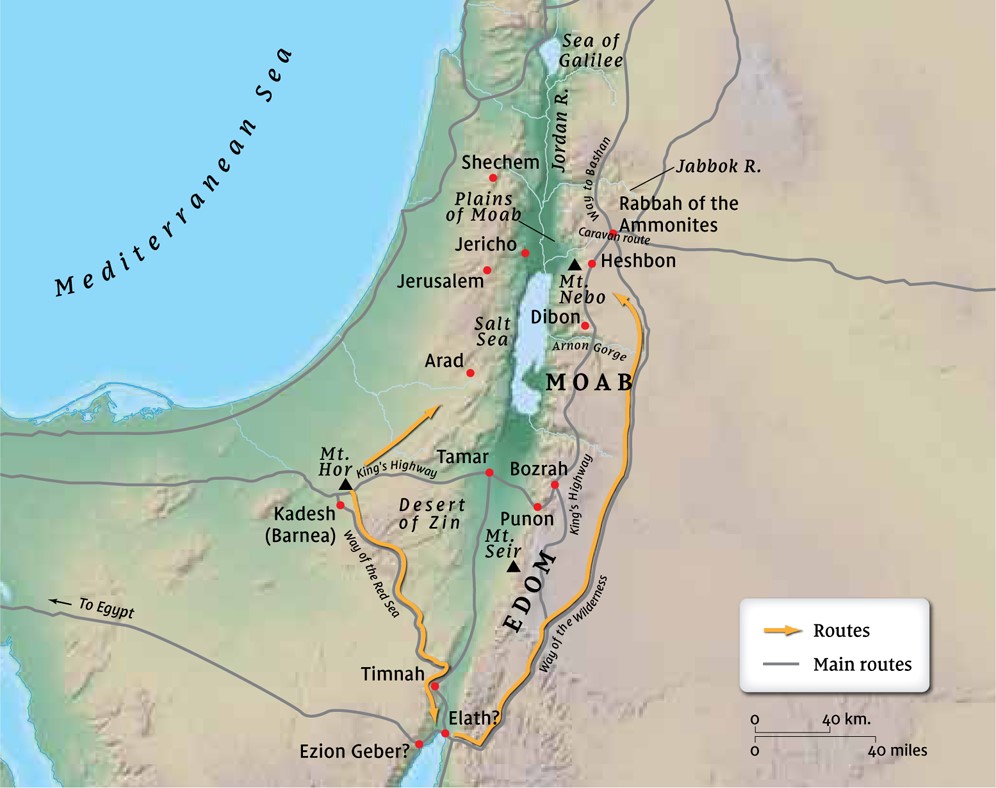
1 When the Canaanite, the king of Arad, who lived in the Negeb, heard that Israel was coming by the way of Atharim, he fought against Israel, and took some of them captive. And Israel vowed a vow to the Lord and said, “If you will indeed give this people into my hand, then I will devote their cities to destruction.” And the Lord heeded the voice of Israel and gave over the Canaanites, and they devoted them and their cities to destruction. So the name of the place was called Hormah.

From Mount Hor they set out by the way to the Red Sea, to go around the land of Edom. And the people became impatient on the way. And the people spoke against God and against Moses, “Why have you brought us up out of Egypt to die in the wilderness? For there is no food and no water, and we loathe this worthless food.” Then the Lord sent fiery serpents among the people, and they bit the people, so that many people of Israel died. And the people came to Moses and said, “We have sinned, for we have spoken against the Lord and against you. Pray to the Lord, that he take away the serpents from us.” So Moses prayed for the people. And the Lord said to Moses, “Make a fiery serpent and set it on a pole, and everyone who is bitten, when he sees it, shall live.” So Moses made a bronze serpent and set it on a pole. And if a serpent bit anyone, he would look at the bronze serpent and live. Numbers 21:1-9 ESV

One of the things the Israelites seemed to quickly forget was that their presence in the wilderness was their own fault. God had led them from Egypt to the edge of the land of promise 40 years earlier, but they had decided that entrance into the land was way too risky. The 12 spies they had in to reconnoiter the land had returned with a conflicting report concerning conditions in Canaan.

“We entered the land you sent us to explore, and it is indeed a bountiful country—a land flowing with milk and honey. Here is the kind of fruit it produces. But the people living there are powerful, and their towns are large and fortified. We even saw giants there, the descendants of Anak! – Numbers 13:27-28 ESV

The second half of their report left the Israelites dejected and demoralized. Despite the news that this land was fertile and filled with abundant fruit, the presence of “giants” was too much for the Israelites. And the spies fed their doubts and anxieties by confirming their worst fears.

“We can’t go up against them! They are stronger than we are!” So they spread this bad report about the land among the Israelites: “The land we traveled through and explored will devour anyone who goes to live there. All the people we saw were huge. We even saw giants there, the descendants of Anak. Next to them we felt like grasshoppers, and that’s what they thought, too!” – Numbers 13:31-33 ESV

These rumors succeeded in convincing the Israelites that God’s promise of victory over their enemies was impossible. Rather than enter the land and risk certain death, they decided it would make more sense to return to Egypt. This bit of twisted logic earned them the wrath of God. He made the fateful decision to allow that entire generation to spend the rest of their lives wandering aimlessly in the wilderness until none of them was left. They would not be allowed to enter Canaan or return to Egypt. Instead, they would spend the remaining days of their lives in a kind of existential limbo that lasted four decades.

During that time, both Miriam and Aaron died. Many of their friends and family members succumbed to the effects of old age and illness. And they all discovered that life in the wilderness was no picnic. Their persistent presence near the borders of Canaan had attracted the attention of the land’s occupants. These nations had heard the rumors about this massive host of people who had escaped from Egypt and were headed their way. It is likely that they knew the Israelites to be the descendants of Jacob and were afraid that they would be looking to find a place to live. This was a migrant problem of epic proportions. The thought of two million-plus Israelites invading their borders caused these nations to react with fear and brute force.

The last chapter revealed that the Edomites sent a large army to dissuade the Israelites from attempting to pass through their land. They wanted nothing to do with them. And now, “The Canaanite king of Arad, who lived in the Negev, heard that the Israelites were approaching on the road through Atharim. So he attacked the Israelites and took some of them as prisoners” (Numbers 21:2 NLT). Nothing was going well for the Israelites. As a nation, they were persona non grata. They had no home and were finding the nations outside the borders of Canaan to be just as dangerous as the “giants“ they had refused to confront. Their refusal to enter the land had come with serious repercussions.

Yet, there is one glimmer of hope in this dark period of Israel’s existence. Their self-inflicted troubles caused them to call out to God. When some of their people were captured by the forces of the king of Arad, the Israelites begged God to come to their aid. And what’s interesting to note is that these very same people who had seen the odds in Canaan as insurmountable were suddenly ready to take on all comers. They even made a vow to completely annihilate the opposition if God would come to their aid.

“If you will hand these people over to us, we will completely destroy all their towns.” – Numbers 21:2 NLT

What makes this even more fascinating is that the Israelites had been here before. Thirty-eight years earlier, after having refused to enter the land of Canaan the first time, God had sentenced them to their life of wandering in the wilderness. In response to this death sentence from God, they quickly changed their minds and decided to enter the land after all. But Moses warned them that it was too late.

“Why are you now disobeying the Lord’s orders to return to the wilderness? It won’t work. Do not go up into the land now. You will only be crushed by your enemies because the Lord is not with you. When you face the Amalekites and Canaanites in battle, you will be slaughtered. The Lord will abandon you because you have abandoned the Lord.” – Numbers 14:41-43 NLT

But the people refused to listen, and “defiantly pushed ahead toward the hill country, even though neither Moses nor the Ark of the Lord’s Covenant left the camp” (Numbers 14:44 NLT). The result was a rout. The Israelites were soundly defeated because they attempted to take on their enemies without God’s permission or help.

Now, 38 years later, they decided to seek God’s assistance, and He “heard the Israelites’ request and gave them victory over the Canaanites. The Israelites completely destroyed them and their towns” (Numbers 22:3 NLT). Amazingly, what they had feared was impossible four decades earlier, was actually quite easy when they did it God’s way. Their victory was assured when they chose to seek God’s permission and assistance.

But even after that exhilarating display of God’s power, they quickly reverted to their old habit of complaining about their lot in life. While they had enjoyed a great victory, they were not allowed to occupy the towns they had conquered. Instead, they had to backtrack to Mount Hor and then travel further south and east in order to skirt the borders of Edom. They had gotten a taste of success, but still found themselves cursed to wander through the wilderness. Those conquered cities and villages were not theirs to occupy.

And as the people made the long trek around Edom, the thrill of victory soon gave way to the agony of defeat and despair.

…the people grew impatient with the long journey, and they began to speak against God and Moses. “Why have you brought us out of Egypt to die here in the wilderness?” they complained. “There is nothing to eat here and nothing to drink. And we hate this horrible manna!” – Numbers 21:4-5 NLT

The incessant wandering they had brought on themselves soon led to discontentment and dissidence with God’s will. They were not happy with the way things were going and they let Moses know. And God let them have it. He sent a plague of poisonous snakes among them, and soon the bodies of the dead began to pile up. And suddenly, the people were singing a different tune.

“We have sinned by speaking against the Lord and against you. Pray that the Lord will take away the snakes.” – Numbers 21:7 NLT

God’s judgment produced a confession. The people repented of their sin and begged Moses to intercede on their behalf and ask God to remove the curse of the snakes. And when Moses sought God, he was given the following instructions.

“Make a replica of a poisonous snake and attach it to a pole. All who are bitten will live if they simply look at it!” – Numbers 21:8 NLT

This rather strange command makes it appear as if God was asking Moses to make an idol. But the serpent on a stick was not meant to be worshiped. It was intended to be a test of their faith.

God did not answer their request to remove the snakes. In fact, He indicated that the snakes would continue to do what He had sent them to do. They would keep inflicting pain, suffering, and death upon the Israelites as punishment for their ingratitude and dishonor of His holiness. What God did was create a rather bizarre plan for receiving deliverance over certain death. When bitten, all the people had to do was look at the serpent on the pole and they would be healed. But that simple glance would require faith.

God did not remove the penalty for their sins. They would still be bitten by the snakes. But now they had a means of receiving life rather than death. The bite of the snake would no longer prove deadly. But the secret to receiving life rather than death was faith – the belief that God could and would heal. And that faith required the one who had been bitten to look their death sentence in the face. They had to turn their eyes to the pole and see their condemnation on public display. And if they refused, they would die.

And the apostle John would later record the words of Jesus where He stated that this entire scene in the wilderness was meant to foreshadow His coming and His substitutionary death on the cross.

…the Son of Man has come down from heaven. And as Moses lifted up the bronze snake on a pole in the wilderness, so the Son of Man must be lifted up, so that everyone who believes in him will have eternal life. – John 3:13-15 NLT

When a sinner looks at the cross, he sees the wrath of God poured out on the sins of mankind. Jesus was not the cause of our death but the means of our victory over it. He bore our sins so that we might not have to pay for them with our own lives. And that is exactly what the apostle Paul told the believers in Corinth.

God made Him who knew no sin to be sin on our behalf, so that in Him we might become the righteousness of God. – 2 Corinthians 5:21 BSB

And Peter would state the same blessed hope.

He himself bore our sins in his body on the tree, that we might die to sin and live to righteousness. By his wounds you have been healed. – 1 Peter 2:24 ESV

And the key to victory over death is faith. One must “believe in Him” to be saved. The Israelites had only to look at the serpent on the pole to be saved from death. And all those under the death sentence that comes as a result of sin need only look at the cross of Christ to receive life everlasting.

It should be noted that this entire scene began with the people complaining about the manna that God had graciously given as a source of life. Their ingratitude was met with God’s judgment. They had refused His offer of the bread of life and faced the sting of death. And the only means of salvation would be faith in His mercy and grace.

“The bread is a picture of Jesus; as the Bread of Heaven he is the proper nourisher of his people. The bronze snake is a picture of Jesus, who became sin for us as he hung on that awful tree. The manna had to be eaten. The snake had to be seen. The commands of Scripture are for doing. The manna was no good if left to rot. The metal snake would not avail if none looked at it. The manna and the snake are twin aspects of the grace of God.” – Ronald B. Allen, “Numbers.” In Genesis—Numbers. Vol. 2 of The Expositor’s Bible Commentary

English Standard Version (ESV) The Holy Bible, English Standard Version. ESV® Permanent Text Edition® (2016). Copyright © 2001

New Living Translation (NLT) Holy Bible, New Living Translation, copyright © 1996, 2004, 2015 by Tyndale House Foundation. Used by permission of Tyndale House Publishers Inc., Carol Stream, Illinois 60188. All rights reserved.

The Sufficiency of the Gospel

See to it that no one takes you captive by philosophy and empty deceit, according to human tradition, according to the elemental spirits of the world, and not according to Christ. For in him the whole fullness of deity dwells bodily, 10 and you have been filled in him, who is the head of all rule and authority. 11 In him also you were circumcised with a circumcision made without hands, by putting off the body of the flesh, by the circumcision of Christ, 12 having been buried with him in baptism, in which you were also raised with him through faith in the powerful working of God, who raised him from the dead. 13 And you, who were dead in your trespasses and the uncircumcision of your flesh, God made alive together with him, having forgiven us all our trespasses, 14 by canceling the record of debt that stood against us with its legal demands. This he set aside, nailing it to the cross. 15 He disarmed the rulers and authorities and put them to open shame, by triumphing over them in him. Colossians 2:8-15 ESV

Paul now warms to his primary task: warning the Colossian believers about the dangers of the doctrinal heresy threatening their congregation. He has established the preeminence of Christ and emphasized the foundational nature of His divinity and humanity. Now Paul presents a stinging indictment of the false teachers, labeling their rhetoric concerning Jesus as nothing more than a purely human-based philosophy based on tradition and filled with empty deceit. Paul’s use of the term “philosophy” was not meant to refer to an academic or scientific study of thought but the teaching of “certain Jewish Christian ascetics, which busied itself with refined and speculative inquiries into the nature and classes of angels, into the ritual of the Mosaic law and the regulations of Jewish tradition respecting practical life” (The Online Bible: Outline of Biblical Usage).

Paul emphasized that the teaching infiltrating the Colossian church was purely speculative and not based on divine revelation. It was not according to or in keeping with the prophetic pronouncement concerning Christ in the Old Testament. Nor was it in line with Christ’s teachings concerning Himself. No, these men propagated false doctrines based on “the elemental spirits of the world” (Colossians 2:8 ESV). The word translated as “spirits” is στοιχεῖον (stoicheion), which might be better translated as “principles.” Paul seems to be juxtaposing Christ-centered teaching with worldly and man-centered teaching. According to Paul, the elemental or fundamental theories of a non-Christian, fallen world were insufficient to explain or guide the Christian life. The false teachers were attempting to use human reasoning to explain spiritual truths.

Paul addressed this lack of spiritual discernment in his first letter to the churches in Corinth. He informed his audience that the gospel’s message was impossible to discern without assistance from the Holy Spirit.

When we tell you these things, we do not use words that come from human wisdom. Instead, we speak words given to us by the Spirit, using the Spirit’s words to explain spiritual truths. But people who aren’t spiritual can’t receive these truths from God’s Spirit. It all sounds foolish to them and they can’t understand it, for only those who are spiritual can understand what the Spirit means. Those who are spiritual can evaluate all things, but they themselves cannot be evaluated by others. For,

“Who can know the Lord’s thoughts?
    Who knows enough to teach him?”

But we understand these things, for we have the mind of Christ. – 1 Corinthians 2:13-16 NLT

Paul explained that “the word of the cross is folly to those who are perishing, but to us who are being saved it is the power of God” (1 Corinthians 1:18 ESV). He followed up this statement by quoting Isaiah 29:14.

For it is written,

“I will destroy the wisdom of the wise,
and the discernment of the discerning I will thwart.”

Then Paul excoriated the false teachers and religious traditionalists of his day, exposing them as frauds and fools who pridefully rejected the message of the gospel.

Where is the one who is wise? Where is the scribe? Where is the debater of this age? Has not God made foolish the wisdom of the world? For since, in the wisdom of God, the world did not know God through wisdom, it pleased God through the folly of what we preach to save those who believe. For Jews demand signs and Greeks seek wisdom, but we preach Christ crucified, a stumbling block to Jews and folly to Gentiles, but to those who are called, both Jews and Greeks, Christ the power of God and the wisdom of God. For the foolishness of God is wiser than men, and the weakness of God is stronger than men. – 1 Corinthians 1:20-25 ESV

Some found the apostles’ teaching concerning Christ to be illogical and unacceptable. They found the idea that Jesus was the embodiment of divinity and humanity untenable and indefensible. For others, the belief in Jesus’ sacrificial death and resurrection was little more than wishful thinking or a fairy tale. But Paul refers to his teaching concerning Christ as the power and wisdom of God.

Paul considered the false teachers’ denial of Christ’s divinity a particularly egregious sin. That’s why he unapologetically stated, “In Christ lives all the fullness of God in a human body” (Colossians 2:9 ESV). This was a foundational truth concerning the doctrine of salvation, and without it, the validity of Christ’s substitutionary death was rendered impotent. The sinlessness of Christ was based on His divinity. He was the unblemished God-man who was “tempted as we are, yet without sin” (Hebrews 4:15 ESV).

For God made Christ, who never sinned, to be the offering for our sin, so that we could be made right with God through Christ. – 2 Corinthians 5:21 NLT

To deny Jesus’ deity was to invalidate His entire ministry. He was the sinless and fully righteous Son of God who took on human flesh so that He might do what no man had ever been able to do before: Jesus fully obeyed every one of the commands of God found in the Mosaic Law.

For God has done what the law, weakened by the flesh, could not do. By sending his own Son in the likeness of sinful flesh and for sin, he condemned sin in the flesh… – Romans 8:3 ESV

The deity and humanity of Christ were both non-negotiable aspects of His character. Jesus was fully divine and entirely human. He was not a phantom or a god masquerading as a man. Some taught that Jesus only appeared to be human, and this erroneous teaching led to a distorted understanding of Jesus’ death on the cross. If He wasn’t truly human, then His death was little more than theater — a clever form of play-acting that accomplished nothing. It would mean the substitutionary nature of His death was invalid. Not only that, if Jesus didn’t die, then there was no resurrection, and if there was no resurrection, then mankind has no hope.

if Christ has not been raised, then your faith is useless and you are still guilty of your sins. In that case, all who have died believing in Christ are lost! And if our hope in Christ is only for this life, we are more to be pitied than anyone in the world. – 1 Corinthians 15:17-19 NLT

Paul assures the Colossians believers that the resurrection of Jesus was real and that its implications for their lives were substantial.

…you were raised to new life because you trusted the mighty power of God, who raised Christ from the dead. – Colossians 2:12 NLT

He wanted them to understand that they needed nothing more than Christ. Despite the claims of the false teachers, the believers in Colossae did not miss anything from their spiritual experience. They had been filled with the fullness of Christ. The Spirit of Christ indwelled them, making the nature of Christ available to them. The righteousness of Christ had been imputed to them. Unlike the Judaizers, who taught that Gentiles needed to be circumcised to be fully saved, Paul emphasized a spiritual form of circumcision.

When you came to Christ, you were “circumcised,” but not by a physical procedure. Christ performed a spiritual circumcision—the cutting away of your sinful nature. – Colossians 2:11 NLT

This was the same thought Paul had shared with the believers in Rome.

For you are not a true Jew just because you were born of Jewish parents or because you have gone through the ceremony of circumcision. No, a true Jew is one whose heart is right with God. And true circumcision is not merely obeying the letter of the law; rather, it is a change of heart produced by the Spirit. And a person with a changed heart seeks praise from God, not from people. – Romans 2:28-29 NLT

Paul reminded the Colossians that, before encountering Christ, they had been spiritually dead because their “sinful nature was not yet cut away” (Colossians 2:13 NLT). But that problem had been taken care of by God.

God made you alive with Christ, for he forgave all our sins. He canceled the record of the charges against us and took it away by nailing it to the cross. – Colossians 2:13-14 NLT

In doing so, God “disarmed the rulers and authorities” (Colossians 2:15 ESV). This is most likely a reference to “the spiritual forces of evil in the heavenly places” (Ephesians 6:12 ESV). Paul describes them as “the cosmic powers over this present darkness” (Ephesians 6:12 ESV). In conquering sin and death on the cross, God effectively silenced Satan and his minions, voiding the accusations of guilt and shame they level against God’s people. In Revelation 12:10, Satan is described as the accuser of the brethren, “who accuses them day and night before our God.” But, because of the atoning nature of the cross, Satan’s accusations carry no weight. His weapons lack any power against the children of God. But, just as Paul warned the believers in Ephesus, the Colossians were to “Put on the whole armor of God, that you may be able to stand against the schemes of the devil” (Ephesians 6:11 ESV).

The false teachers were attempting to undermine the effectiveness of Christ’s death and resurrection by questioning its validity. These godless men were acting as pawns of the enemy by sowing doubts among the believers in Colossae. But Paul exposed their so-called truths as nothing more than cleverly disguised lies meant to deceive and destroy the faith of God’s people.

For Paul, the gospel was enough. No new teaching was required, and the power of the cross required no additional enhancement or improvement. As Paul told the believers in Corinth, the gospel’s message required no help from human reasoning and cleverly crafted rhetoric.

When I first came to you, dear brothers and sisters, I didn’t use lofty words and impressive wisdom to tell you God’s secret plan. For I decided that while I was with you I would forget everything except Jesus Christ, the one who was crucified.

Rather than using clever and persuasive speeches, I relied only on the power of the Holy Spirit. I did this so you would trust not in human wisdom but in the power of God. – 1 Corinthians 2:1-2, 4-5 NLT

English Standard Version (ESV) The Holy Bible, English Standard Version. ESV® Permanent Text Edition® (2016). Copyright © 2001 by Crossway Bibles, a publishing ministry of Good News Publishers.

New Living Translation (NLT) Holy Bible, New Living Translation, copyright © 1996, 2004, 2015 by Tyndale House Foundation. Used by permission of Tyndale House Publishers Inc., Carol Stream, Illinois 60188. All rights reserved.


English Standard Version (ESV) The Holy Bible, English Standard Version. ESV® Permanent Text Edition® (2016). Copyright © 2001 by Crossway Bibles, a publishing ministry of Good News Publishers.

New Living Translation (NLT) Holy Bible, New Living Translation, copyright © 1996, 2004, 2015 by Tyndale House Foundation. Used by permission of Tyndale House Publishers Inc., Carol Stream, Illinois 60188. All rights reserved.

New English Translation (NET)NET Bible® copyright ©1996-2017 by Biblical Studies Press, L.L.C. http://netbible.com All rights reserved.


The Very Power of God

31 And taking the twelve, he said to them, “See, we are going up to Jerusalem, and everything that is written about the Son of Man by the prophets will be accomplished. 32 For he will be delivered over to the Gentiles and will be mocked and shamefully treated and spit upon. 33 And after flogging him, they will kill him, and on the third day he will rise.” 34 But they understood none of these things. This saying was hidden from them, and they did not grasp what was said. Luke 18:31-34 ESV

For quite some time, Jesus has been hinting at the fate that awaits Him in Jerusalem. He has repeatedly tried to let His discloses know that His earthly mission was going to end in an unexpected manner.

The days will come when the bridegroom is taken away from them, and then they will fast in those days.” – Luke 5:35 ESV

He had a God-ordained assignment to complete that would end in His brutal crucifixion rather than a royal  coronation.

“I have a baptism to be baptized with, and how great is my distress until it is accomplished!” – Luke 12:50 ESV

And as He drew ever closer to Jerusalem, the day of His death drew nearer as well. So, His rhetoric became increasingly less cryptic.

“I must go on my way today and tomorrow and the day following, for it cannot be that a prophet should perish away from Jerusalem.” – Luke 13:33 ESV

“For as the lightning flashes and lights up the sky from one side to the other, so will the Son of Man be in his day. But first he must suffer many things and be rejected by this generation.” – Luke 17:24-25 ESV

But now, Jesus dispenses with any semblance of subtlety, choosing instead to reveal the exact nature of His pending suffering and death. He hides nothing from His disciples because He wants them to know that while His entrance into Jerusalem would be met with fanfare, it would end with His execution and not His exaltation.

the Son of Man…will be delivered over to the Gentiles and will be mocked and shamefully treated and spit upon. And after flogging him. they will kill him…“ – Luke 18:32-33 ESV

Up to this point, everything Jesus had disclosed to His disciples had been tied to life in the kingdom of heaven. He had been trying to get them to understand that things were not going to be as they expected. While they believed Him to be the Messiah, they were defining the term according to their own standards. In their minds, the Messiah would be a conquering king. He would come with power and set up His kingdom in Jerusalem, from where He would rule and reign, placing Israel back in a position of political prominence. But here was Jesus, once again, announcing that His journey to Jerusalem would end with a cross, not a crown. And His death would be the direct result of His betrayal into the hands of the Jewish religious leaders, who would condemn Him to death. Rather than welcome Jesus as their long-awaited Messiah, they would hand Him over to the Roman government to be mocked, flogged and crucified.

While we know how this story turned out, the disciples did not. They were oblivious to the “good news” associated with Jesus’ death. In fact, it seems evident that they never grasped what Jesus meant when He indicated that he would “be raised on the third day.” The reality of the resurrection escaped them. All they heard was the shockingly bad news regarding Jesus’ death. And, as before, this news left them dazed and confused.

What is truly amazing is all that they had missed. As God-fearing Jews, each of these men had been raised to revere the Hebrew Scriptures, which included the writings of the prophets. They had been exposed to the countless Old Testament passages that predicted the coming of the Messiah, but like all those who came before them, they had conveniently ignored the Scriptures that foretold of the Messiah as the suffering servant.

So, when Jesus informs His disciples that “everything that is written about the Son of Man by the prophets will be accomplished” (Luke 18:31 ESV), suffering is the last thing to come into their mind. As far as they understood, the prophets had promised the arrival of a conquering king who would defeat the enemies of Israel much as King David had done. But Jesus had already warned them that His mission was going to be much different than that of David.

“The Son of Man must suffer many things and be rejected by the elders and chief priests and scribes, and be killed, and on the third day be raised.” – Luke 9:22 ESV

Even in the upper room where Jesus celebrated His last Passover with the disciples, He told them: “For I tell you that this Scripture must be fulfilled in me: ‘And he was numbered with the transgressors.’ For what is written about me has its fulfillment” (Luke 22:37 ESV). And the Scripture Jesus referred to is found in the 53rd chapter of the book of Isaiah the prophet. All throughout this chapter, Isaiah predicted the suffering of the coming Messiah in graphic terms.

He was despised and rejected by men,
    a man of sorrows and acquainted with grief – Isaiah 53:3 ESV

he was despised, and we esteemed him not. – Isaiah 53:3 ESV

…he has borne our griefs
    and carried our sorrows;
yet we esteemed him stricken,
    smitten by God, and afflicted. – Isaiah 53:4 ESV

he was pierced for our transgressions;
    he was crushed for our iniquities… – Isaiah 53:5 ESV

upon him was the chastisement that brought us peace,
    and with his wounds we are healed. – Isaiah 53:5 ESV

the Lord has laid on him
    the iniquity of us all. – Isaiah 53:6 ESV

He was oppressed, and he was afflicted,
    yet he opened not his mouth;
like a lamb that is led to the slaughter,
    and like a sheep that before its shearers is silent,
    so he opened not his mouth. – Isaiah 53:7 ESV

By oppression and judgment he was taken away – Isaiah 53:8 ESV

…he was cut off out of the land of the living,
    stricken for the transgression of my people… – Isaiah 53:8 ESV

…they made his grave with the wicked
    and with a rich man in his death,
although he had done no violence,
    and there was no deceit in his mouth. – Isaiah 53:9 ESV

…it was the will of the Lord to crush him;
    he has put him to grief… – Isaiah 53:10 ESV

Not exactly a description of glory and greatness. And most certainly, it was not at all what the disciples had been anticipating. Yet, even after His death and resurrection, Jesus appeared to His disciples and reminded them that exactly what happened had been in keeping with the words of the prophets.

“These are my words that I spoke to you while I was still with you, that everything written about me in the Law of Moses and the Prophets and the Psalms must be fulfilled.” Then he opened their minds to understand the Scriptures, and said to them, “Thus it is written, that the Christ should suffer and on the third day rise from the dead, and that repentance for the forgiveness of sins should be proclaimed in his name to all nations, beginning from Jerusalem. You are witnesses of these things.” – Luke 24:44-48 ESV

On this occasion, after having been raised back to life through the power of the Holy Spirit, Jesus continued to teach His disciples that this was all part of God’s preordained plan. He had not been an innocent victim of the Jewish religious leaders or the passive subject of the Roman legal system. He had been in full control of the circumstances and in perfect submission to the will of His Heavenly Father. That is why He could say, “No one can take my life from me. I sacrifice it voluntarily. For I have the authority to lay it down when I want to and also to take it up again. For this is what my Father has commanded” (John 10:18 NLT).

But as Jesus and His disciples made their way to Jerusalem and He continued to disclose the gruesome nature of His destiny, they were having a difficult time taking it all in. Luke even indicates that their inability to comprehend His words was divinely orchestrated.

But they didn’t understand any of this. The significance of his words was hidden from them, and they failed to grasp what he was talking about. – Luke 18:34 NLT

For reasons known only to God alone, the disciples were prevented from comprehending the full import of Jesus’ words. And, later on, when they walked by His side into Jerusalem to the cheers of the adoring crowd, they probably assumed that the time had finally arrived when Jesus would set up His earthly kingdom. They believed Him to be only hours away from a crown of gold and the royal throne. But in reality, Jesus would end up adorned with a crown of thorns and nailed to a Roman cross. All in fulfillment of God’s sovereign plan for man’s salvation.

At the moment, none of it made sense to the disciples, but in time, it would.

The message of the cross is foolish to those who are headed for destruction! But we who are being saved know it is the very power of God. – 1 Corinthians 1:18 NLT

English Standard Version (ESV) The Holy Bible, English Standard Version. ESV® Permanent Text Edition® (2016). Copyright © 2001 by Crossway Bibles, a publishing ministry of Good News Publishers.

New Living Translation (NLT) Holy Bible, New Living Translation, copyright © 1996, 2004, 2015 by Tyndale House Foundation. Used by permission of Tyndale House Publishers Inc., Carol Stream, Illinois 60188. All rights reserved.

The Message (MSG)Copyright © 1993, 1994, 1995, 1996, 2000, 2001, 2002 by Eugene H. Peterson

The Stronger Man

14 Now he was casting out a demon that was mute. When the demon had gone out, the mute man spoke, and the people marveled. 15 But some of them said, “He casts out demons by Beelzebul, the prince of demons,” 16 while others, to test him, kept seeking from him a sign from heaven. 17 But he, knowing their thoughts, said to them, “Every kingdom divided against itself is laid waste, and a divided household falls. 18 And if Satan also is divided against himself, how will his kingdom stand? For you say that I cast out demons by Beelzebul. 19 And if I cast out demons by Beelzebul, by whom do your sons cast them out? Therefore they will be your judges. 20 But if it is by the finger of God that I cast out demons, then the kingdom of God has come upon you. 21 When a strong man, fully armed, guards his own palace, his goods are safe; 22 but when one stronger than he attacks him and overcomes him, he takes away his armor in which he trusted and divides his spoil. 23 Whoever is not with me is against me, and whoever does not gather with me scatters.” – Luke 11:14-23 ESV

After recording Jesus’ instructions to His disciples on the subject of prayer, Luke seems to make a rather abrupt shift in the topic. There were a lot of rumors concerning Jesus. Some believed Him to be the Messiah, while others speculated that He might be Elijah or one of the other prophets, resurrected from the dead. His miracles and messages had made a powerful impression on many people, but there were those who took exception to this enigmatic Rabbi from Nazareth. And their speculation regarding His identity had been heavily influenced by the rumors the religious leaders had begun to spread.

We know from the gospel accounts of Matthew and Mark that the Sanhedrin had begun to circulate the rumor that Jesus was demon-possessed. Even while He had been ministering in Galilee, a contingent of Pharisees had been sent from Jerusalem to the region around the northern shore of the Sea of Galilee. It was on this occasion that these men pronounced their verdict regarding the source of Jesus’ miraculous powers.

“He’s possessed by Satan, the prince of demons. That’s where he gets the power to cast out demons.” – Mark 3:22 NLT

Matthew seems to record a similar, yet different situation in which Jesus cast a demon out of a man and was immediately accused by the Pharisees of having done so by the power of Satan.

“No wonder he can cast out demons. He gets his power from Satan, the prince of demons.” – Matthew 12:24 NLT

These men had been trying to counteract the enthusiasm of the crowd. Some of those who had witnessed this miraculous healing had begun to wonder out loud if Jesus really was their long-awaited Messiah.

Could it be that Jesus is the Son of David, the Messiah?” – Matthew 12:23 NLT

The Pharisees could not tolerate this kind of speculation, so they began to accuse Jesus of being in league with Satan. Unable to deny His power, they decided to question its source. And in all three cases, Jesus strongly refuted their accusations, exposing the illogical nature of their claim.

In Luke’s account, it appears that the Pharisees had been successful in circulating their rumor concerning the satanic source of Jesus’ power. They had planted the seed of doubt and it had begun to take root. On this occasion, it was not a Pharisee who leveled the accusation against Jesus, but one of the onlookers.

“He casts out demons by Beelzebul, the prince of demons…” – Luke 11:15 ESV

The Jewish people commonly used the name, Beelzebul, when referring to Satan. It is derived from two words, Baal, which was the name for the chief Canaanite deity, and Zebul, which means “exalted dwelling.” In the Greek New Testament, it is sometimes spelled Beelzeboul, which can be translated as “lord of dung.” It was a commonly used euphemism for Satan himself, the prince of demons.

So, on this occasion, you have some in the crowd accusing Jesus of being a tool of Satan, while others are demanding that He show them some kind of heavenly sign to prove He is the Messiah. It was a volatile and intensely polarized scene. But, just as He had done before, Jesus calmly and patiently addressed the unsubstantiated and blasphemous rumors being leveled against Him.

None of it made any sense. Why in the world, Jesus asked, would Satan cast out one of his own? That would not only be illogical but highly unproductive. And to drive home His point, Jesus forces His accusers to consider the absurd nature of their argument.

“Any kingdom divided by civil war is doomed. A family splintered by feuding will fall apart. You say I am empowered by Satan. But if Satan is divided and fighting against himself, how can his kingdom survive?” – Luke 11:17-18 NLT

It would be totally irrational for Satan to provide Jesus with the power to cast out demons. To do so would be self-defeating and self-destructive. And those who had witnessed Jesus cast out demons would have recognized that the demons never left willingly or without a fight. On many occasions, they opposed Jesus, verbally acknowledging Him as the Son of God. Luke records an earlier situation in which Jesus was confronted by a disgruntled demon and his companions who fully recognized and confessed His divine power and authority.

“Why are you interfering with us, Jesus of Nazareth? Have you come to destroy us? I know who you are—the Holy One of God!” – Luke 4:34 NLT

Jesus’ ability to cast out demons was a clear indication of His sovereign power and validation of His identity as the Messiah. He was the King and, in exorcising demons, He was exercising His divinely ordained power and authority over the enemy. The demons clearly recognized this fact, but the Pharisees could not or simply would not.

And Jesus points out the hypocrisy of it all. The exorcism of demons was not uncommon among the Jewish people. And Jesus raises the logical question that since there were others who claimed to possess the power to cast out demons, were they also in cooperation with Satan? They couldn’t have it both ways. Either exorcism was divinely empowered or it was not. It was a work of God or it was a work of Satan. But Jesus points out the most logical and significant conclusion.

“But if I am casting out demons by the power of God, then the Kingdom of God has arrived among you.” – Luke 11:20 NLT

Whether they realized it or not, those in the crowd who had demanded a sign had already received one. Jesus was operating by the power of God and, in doing so, was giving evidence that He was the King of Israel. And His arrival was proof that the long-awaited promise of the kingdom was being fulfilled. He was the Messiah, the stronger man who was defeating the strong man (Satan) by the power of God. He was the chosen one who had been sent to bring release to all those held captive by the enemy. Ever since the fall, Satan had operated as the prince of this world, enslaving and controlling mankind, and waging a relentless war against God. Even at the incarnation, Satan had attempted to destroy the Son of God through the demon-possessed efforts of Herod (Matthew 2:1-18). Immediately after Jesus’ baptism, He was led by the Holy Spirit into the Judean wilderness, where Satan launched an all-out assault designed to derail Jesus from His God-ordained mission. But he failed.

And now Jesus was waging war on Satan. With every exorcism He performed, Jesus was giving evidence that Satan’s power was waning and his days were numbered. In Jesus, Satan, the strong man, had more than met his match. And Jesus informs His accusers that their disbelief was tantamount to insurrection. By accusing Jesus of operating by the power of Satan, they were actually illustrating their own cooperation with the enemy.

“Anyone who isn’t with me opposes me, and anyone who isn’t working with me is actually working against me. – Luke 11:23 NLT

This is essentially the same message Peter had received when he had rebuked Jesus for speaking of His coming suffering and death in Jerusalem. Jesus had strongly admonished His well-meaning but misinformed friend, “Get away from me, Satan! You are a dangerous trap to me. You are seeing things merely from a human point of view, not from God’s” (Matthew 16:23 NLT). In opposing Jesus’ declaration of God’s will, Peter had unknowingly aligned himself with the aims of the enemy. He had essentially become the tool of Satan, trying to thwart the redemptive plan that God had ordained for His Son. What Peter failed to realize was that Jesus’ death was going to be the key to breaking Satan’s power over mankind. With Jesus’ crucifixion, Satan would assume he had won the victory. But he would be wrong – dead wrong. The sacrificial death of Jesus would bring about the emancipation of all those who were held captive by the enemy. The author of Hebrews reminds us:

Because God’s children are human beings—made of flesh and blood—the Son also became flesh and blood. For only as a human being could he die, and only by dying could he break the power of the devil, who had the power of death. Only in this way could he set free all who have lived their lives as slaves to the fear of dying. – Hebrews 2:14-15 NLT

And the apostle John adds, “the Son of God came to destroy the works of the devil” (1 John 3:8 NLT). While Jesus walked this earth, He demonstrated His power over the enemy. But it was on the cross, as He breathed His last breath, that Jesus delivered the death blow to Satan. With the willful sacrifice of His life, Jesus fulfilled the curse that God had placed upon Satan as a result of his temptation of Adam and Eve.

“And I will cause hostility between you and the woman, and between your offspring and her offspring. He will strike your head, and you will strike his heel.” – Genesis 3:15 NLT

Jesus, the stronger man, has defeated Satan. Yes, he still wields his power and displays an open disdain for God and His people, but he is a defeated foe. His days are numbered and his future is sealed. He fights a futile war with a preordained outcome. All because Jesus, the Son of God, fulfilled the will of God and gave His life as a ransom for many.

English Standard Version (ESV) The Holy Bible, English Standard Version. ESV® Permanent Text Edition® (2016). Copyright © 2001 by Crossway Bibles, a publishing ministry of Good News Publishers.

New Living Translation (NLT) Holy Bible, New Living Translation, copyright © 1996, 2004, 2015 by Tyndale House Foundation. Used by permission of Tyndale House Publishers Inc., Carol Stream, Illinois 60188. All rights reserved.

The Message (MSG)Copyright © 1993, 1994, 1995, 1996, 2000, 2001, 2002 by Eugene H. Peterson

It Is Finished!

28 After this, Jesus, knowing that all was now finished, said (to fulfill the Scripture), “I thirst.” 29 A jar full of sour wine stood there, so they put a sponge full of the sour wine on a hyssop branch and held it to his mouth. 30 When Jesus had received the sour wine, he said, “It is finished,” and he bowed his head and gave up his spirit.

31 Since it was the day of Preparation, and so that the bodies would not remain on the cross on the Sabbath (for that Sabbath was a high day), the Jews asked Pilate that their legs might be broken and that they might be taken away. 32 So the soldiers came and broke the legs of the first, and of the other who had been crucified with him. 33 But when they came to Jesus and saw that he was already dead, they did not break his legs. 34 But one of the soldiers pierced his side with a spear, and at once there came out blood and water. 35 He who saw it has borne witness—his testimony is true, and he knows that he is telling the truth—that you also may believe. 36 For these things took place that the Scripture might be fulfilled: “Not one of his bones will be broken.” 37 And again another Scripture says, “They will look on him whom they have pierced.” John 19:28-37 ESV

Just as he did with his recounting of Jesus’ trials, John presents a highly truncated version of Jesus’ crucifixion. In some sense, John portrays the death of Jesus as the work of men. The Sanhedrin had plotted and planned for it to happen, and the Roman governor had given his official approval, commanding his troops to carry out the execution of Jesus. John has portrayed Jesus as the King of the Jews and purposefully juxtaposed Him with two of the most powerful men in Israel at the time: The chief priest and the Roman prefect. These two men played significant roles in the death of Jesus, ensuring that His crucifixion was carried out. And John’s abbreviated treatment of the death of Jesus may simply be His way of diminishing or downplaying the power of men over the Son of God.

During his interrogation of Jesus, Pilate had arrogantly proclaimed, “Do you not know that I have authority to release you and authority to crucify you?” (John 19:10 ESV). Pilate was backed by the full power and authority of the Roman government. He had been appointed by Caesar and had thousands of well-trained and heavily armed Romans legionnaires at his disposal. He could issue a command and it would be carried out. But Jesus, unphased by Pilate’s boastful declaration, had calmly responded, “You would have no authority over me at all unless it had been given you from above” (John 19:11 ESV).

In His trial before the Sanhedrin, Jesus had been confronted by Caiaphas, the high priest, who had demanded that Jesus publicly state His claim to be the Messiah.

“I demand in the name of the living God—tell us if you are the Messiah, the Son of God.” – Matthew 26:63 NLT

Caiaphas was looking for a confession from Jesus, not some kind of confirmation. He harbored no suspicions that Jesus might truly be the Messiah. He was simply wanting Jesus to condemn Himself by proclaiming His claim to be the Son of God – in public and in front of witnesses. This powerful and influential leader of Israel’s religious elite believed that he held the fate of Jesus in his hands. But Jesus had responded by stating, “…in the future you will see the Son of Man seated in the place of power at God’s right hand and coming on the clouds of heaven” (Matthew 26:64 NLT).

Like Pilate, Caiaphas had no power over Jesus. And for John, the crucifixion seemed to represent man’s vain attempt to thwart the plans of God. Their treatment of Jesus had been cruel and unjust. They were putting to death an innocent man. But little did they know that they were actually fulfilling the will of God and the desires of Jesus. They were not the ones in control. While they believed they were taking the life of Jesus, He had made it clear that no one had that kind of authority over Him.

“No one can take my life from me. I sacrifice it voluntarily. For I have the authority to lay it down when I want to and also to take it up again. For this is what my Father has commanded.” – John 10:18 NLT

The death of Jesus was the will of God. It was being carried out by men, utilizing a man-made instrument of death, but it was all according to the sovereign and providential plan of God and the full consent of the Son of God. So, John seems to fast-forward through the gruesome details surrounding the crucifixion, focusing only on a few carefully chosen scenes. He is more interested in what happens next.

After recording how Jesus had personally commissioned him to care for His mother, John provides an interesting first-person impression of what he saw. He describes Jesus as “knowing that all was now finished” (John 19:28 ESV). Somehow, John ascertains that Jesus was reaching not only the end of His life but also the completion of His mission. And he reports hearing Jesus say: “I thirst” (John 19:28 ESV).

The one who had stated, “whoever drinks of the water that I will give him will never be thirsty again” (John 4:14 ESV), was declaring His own thirst. He was nearing the completion of His earthly ministry, having suffered greatly at the hands of sinful men, and He found Himself suffering from intense spiritual thirst. John indicates that the words of Jesus were in fulfillment of Scripture. It is likely that he is referring to two passages found in the Psalms that seem to prophesy this very moment.

I am poured out like water,
    and all my bones are out of joint;
my heart is like wax;
    it is melted within my breast;
my strength is dried up like a potsherd,
    and my tongue sticks to my jaws;
    you lay me in the dust of death. – Psalm 22: 14-15 ESV

You know my reproach,
    and my shame and my dishonor;
    my foes are all known to you.
Reproaches have broken my heart,
    so that I am in despair.
I looked for pity, but there was none,
    and for comforters, but I found none.
They gave me poison for food,
    and for my thirst they gave me sour wine to drink. – Psalm 69:19-21 ESV

But Jesus’ expression of thirst has even great implications because they tie back into His earlier declaration: “My food is to do the will of him who sent me and to accomplish his work” (John 4:34 ESV). Jesus was about to complete the work of His Father, and that work had been grueling, painful, and exhausting. It had left Him physically and spiritually depleted. Jesus had told James and John that they would not be able to drink from the cup that He would be forced to drink (Mark 10:38). This cup represented the wrath of God (Jeremiah 25:15-16). In His crucifixion, Jesus was taking on Himself the full weight of God’s wrath against the sins of mankind. And, as He had told Peter, “shall I not drink the cup that the Father has given me?” (John 18:11 ESV).

Doing the work of His Father had left Jesus thirsting after righteousness. He was bearing the sins of mankind and, in doing so, feeling the displeasure of His Father for the first time in His life. And He longed to be restored to fellowship. Isaiah describes the extreme nature of His sacrifice.

because he poured out his soul to death
    and was numbered with the transgressors;
yet he bore the sin of many,
    and makes intercession for the transgressors. – Isaiah 53:12 ESV

It is impossible for us to comprehend the burden that Jesus bore on our behalf. When Isaiah states that “the Lord has laid on him the iniquity of us all” (Isaiah 53:6 ESV), we have a difficult time understanding the gravity and intensity of that weight.

And in response to Jesus’ words, He was given a sponge dipped in sour wine. The one who had turned ordinary water into extraordinary wine was given sour wine to slake His spiritual thirst. He who had poured out His blood as a drink offering to satisfy the just demands of a holy God was given spoiled wine to satisfy His need for refreshment.

And then, John records the last words Jesus would utter from the cross: “It is finished” (John 19:30 ESV). With His final breath, Jesus proclaimed the successful completion of His God-ordained mission. He had done what He had come to do. Now, the rest was in the hands of His Heavenly Father.

In order to expedite death, the Roman soldiers broke the legs of the three men, making it impossible for them to push themselves up in order to breathe. But Jesus was spared this indignity because He was already dead. Yet, as a precaution, one of the soldiers pierced Jesus’ body with a spear. Even in death, Jesus was subjected to indignity and disrespect. And John declares that all that he has written is true because he saw it with his own eye.

This report is from an eyewitness giving an accurate account. He speaks the truth so that you also may continue to believe. – John 19:35 NLT

John reveals the reason why he chose to report the things he did. The facts that the legs of Jesus remained unbroken and that His side was pierced are crucial to John. For him, they provide further proof of Jesus identity as the Son of God. He sees these two details as evidence of the deity of Jesus because they fulfill Old Testament prophecy. John seems to have three primary passages in mind: Exodus 12:46; Numbers 9:12; and Psalm 34:20. The first two deal with the divine prohibition against breaking the bones of the Passover lambs. In His death, Jesus performed the role of the Lamb who takes away the sins of the world (John 1:29). Paul ties Jesus directly to the Passover lamb, stating, “Christ, our Passover lamb, has been sacrificed” (1 Corinthians 5:7 ESV). Psalm 34:20 describes how God protects the truly righteous man, preventing anyone from breaking his bones.

Even in His death, Jesus was fulfilling the prophecies of Scripture, providing further evidence that He truly was the Son of God and the Savior of the world. And for John, the proofs for Jesus’ identity are far from over.

English Standard Version (ESV) The Holy Bible, English Standard Version. ESV® Permanent Text Edition® (2016). Copyright © 2001 by Crossway Bibles, a publishing ministry of Good News Publishers.

New Living Translation (NLT) Holy Bible, New Living Translation, copyright © 1996, 2004, 2015 by Tyndale House Foundation. Used by permission of Tyndale House Publishers Inc., Carol Stream, Illinois 60188. All rights reserved.

The Message (MSG)Copyright © 1993, 1994, 1995, 1996, 2000, 2001, 2002 by Eugene H. Peterson

Completely Cleansed

1 Now before the Feast of the Passover, when Jesus knew that his hour had come to depart out of this world to the Father, having loved his own who were in the world, he loved them to the end. During supper, when the devil had already put it into the heart of Judas Iscariot, Simon’s son, to betray him, Jesus, knowing that the Father had given all things into his hands, and that he had come from God and was going back to God, rose from supper. He laid aside his outer garments, and taking a towel, tied it around his waist. Then he poured water into a basin and began to wash the disciples’ feet and to wipe them with the towel that was wrapped around him. He came to Simon Peter, who said to him, “Lord, do you wash my feet?” Jesus answered him, “What I am doing you do not understand now, but afterward you will understand.” Peter said to him, “You shall never wash my feet.” Jesus answered him, “If I do not wash you, you have no share with me.” Simon Peter said to him, “Lord, not my feet only but also my hands and my head!” 10 Jesus said to him, “The one who has bathed does not need to wash, except for his feet, but is completely clean. And you are clean, but not every one of you.” 11 For he knew who was to betray him; that was why he said, “Not all of you are clean.” John 13:1-11 ESV

As Jesus senses the day of His death drawing closer, He begins to focus His attention more directly on the men He has chosen to carry on His work in His absence. His public ministry is officially over. The raising of Lazarus from the dead would be His last miracle. There would be no more debates with the religious leaders or discourses with the people in the temple. At this point, with just days remaining before He went to the cross, Jesus’ primary mission became the preparation of His disciples for all that was about to happen.

In his account of Jesus’ final week on earth, John diverges from the narratives found in the Synoptic Gospels. While Matthew, Mark, and Luke place considerable emphasis on the institution of the Lord’s Supper, while John chooses to leave it out. It would appear that John wrote his account late in the 1st-Century, likely making it the last of the four gospels to be written. Having had access to the accounts of Matthew, Mark, and Luke, John knew that they had amply covered the institution of the Lord’s Supper so, rather than echoing the same content, he focused his attention on Jesus’ teaching to the disciples. His record of the Passover meal shared by Jesus and His followers contains material not found in the other three gospels. In fact, he is the only one who records the well-known scene of Jesus washing the feet of His disciples.

It is important to remember that John’s purpose for writing his gospel was to support the very important doctrine of the deity of Jesus. Even by the end of the 1st-Century when John likely wrote his gospel, there were those who had begun to reject or repudiate the doctrine of the deity of Jesus. And because John had addressed his gospel to a Christian audience, he was attempting to reassure them that Jesus truly was who He claimed to be. John even reminded his readers of his purpose for putting pen to paper:  “that you may continue to believe that Jesus is the Messiah, the Son of God” (John 20:31 NLT).

So, while the Lord’s Supper was important to John, it was not pertinent to what John was trying to convey to his audience. Instead, he chose to focus on an event that the other gospel writers left out of their accounts: The powerful object lesson of Jesus washing His disciples’ feet.

John presents a very compressed and compacted account of what took place that night. He sets the scene by juxtaposing the heart of Judas with that of Jesus.

the devil had already put it into the heart of Judas Iscariot, Simon’s son, to betray him – John 13:2 ESV

Jesus, knowing that the Father had given all things into his hands, and that he had come from God and was going back to God, rose from supper… – John 13:3-4 ESV

The heart of Jesus was motivated by love for His own. He knew He was about to leave His disciples and He greatly desired to provide them with some final words of encouragement and insight. Jesus, knowing “that his hour had come to depart out of this world” (John 13:1 ESV), performed an act of unspeakable humility and love.

So he got up from the table, took off his robe, wrapped a towel around his waist, and poured water into a basin. Then he began to wash the disciples’ feet, drying them with the towel he had around him. – John 13:4-5 NLT

The Son of God visibly placed Himself in the role of a servant and willingly washed the feet of His disciples. He provided them with an object lesson that left them stunned, embarrassed, and confused. Jesus even washed the feet of the one who would betray Him. And He did so with full awareness of His deity and superiority. He was living out the words He had spoken earlier.

“…the Son of Man came not to be served but to serve, and to give his life as a ransom for many.” – Matthew 20:28 ESV

But the disciples were shocked by Jesus’ actions, as evidenced by Peter’s response.

“Lord, are you going to wash my feet?” – John 13:6 NLT

Always the first to speak his mind, Peter exhibited reticence at the thought of his master washing his feet. He knew this was not appropriate. Jesus was doing the work of a common slave and this embarrassed Peter. But there is far more going on here than first meets the eye. John describes Jesus as laying aside His outer garments. John did not use the normal Greek word for the removal of a piece of clothing. In fact, he will use this very same word again, when Jesus asks Peter, “Will you lay down your life for me?” (John 13:38 ESV). It is the same word Jesus used when speaking of His coming death.

“I lay down my life that I may take it up again. No one takes it from me, but I lay it down of my own accord. I have authority to lay it down, and I have authority to take it up again.” – John 10:17-18 ESV

This imagery of Jesus laying down and taking up His life is played out in the upper room, as Jesus lays down of His outer garments and then takes them back up again. And in-between doing so, He performs a sacrificial act of cleansing. But Peter and the disciples didn’t grasp the significance of what Jesus was doing. They didn’t make the connection. And Jesus makes this point perfectly clear.

“What I am doing you do not understand now, but afterward you will understand.” – John 13:7 ESV

When Peter vehemently refused to be cleansed by Jesus, he was unknowingly exhibiting the prideful, self-righteous attitude of the religious leaders.

In Peter’s response we see the pride and self-will that is at the heart of all sin and that is the very thing for which the cross will atone and bring healing. Peter is working from a worldly point of view, and not for the first time. – Rodney A. Whitaker, John: The IVP New Testament Commentary Series

But Jesus responded to Peter with a word of warning: “If I do not wash you, you have no share with me” (John 13:8 ESV). It would only be through Jesus’ death on the cross that true cleansing from sin could be attained. And without it, no one could have a right relationship with Christ or the Father.

Jesus’ words seemed to have gotten Peter’s attention because he immediately demanded that Jesus wash his hands and his head as well. If getting his feet washed by Jesus was a non-negotiable requirement, Peter wanted to show his enthusiasm by requesting even more cleansing. But he was missing the point.

Yet, Jesus doesn’t exactly clear up Peter’s confusion. His next statement is rather cryptic, providing the disciples with little clarity as to what He is talking about.

“The one who has bathed does not need to wash, except for his feet, but is completely clean. And you are clean, but not every one of you.” – John 13:10 ESV

It would seem that Jesus is trying to let Peter and his companions know that they belong to Him. By having been chosen by God and placed in the care of His Son, the disciples have been set apart as His servants. In a sense, they have been cleansed, but not completely. The final phase of their cleansing will take place on the cross. And when that happens, they will be made ready for the indwelling presence of the Holy Spirit. Their lives will have been completely purified and made worthy vessels for the Spirit of God. It would not be until Jesus died, was raised again, and ascended, that the Holy Spirit would be poured out on His followers.

But there was one of them who would not experience this cleansing. He would not live to enjoy the coming of the Spirit of God. Judas was not clean. He was not a true believer in Jesus. He was a betrayer. And the death of Jesus would provide Him with no further cleansing from sin. As Matthew recorded in his gospel, Peter had clearly expressed His belief in Jesus when he stated, “You are the Christ, the Son of the living God” (Matthew 16:16 ESV). But evidently, Judas did not share that belief. He was not fully convinced by Jesus’ claims to be divine. He likely began following Jesus because he had hopes that He was the Messiah. But as time went by and Jesus failed to announce His Kingdom on earth, Judas lost patience and interest. And he would walk out that very night with a preconceived plan to make the most of his relationship with Jesus by betraying Him to the religious authorities. But for the time being, Peter and the rest of the disciples would remain by Jesus’ side.

English Standard Version (ESV) The Holy Bible, English Standard Version. ESV® Permanent Text Edition® (2016). Copyright © 2001 by Crossway Bibles, a publishing ministry of Good News Publishers.

New Living Translation (NLT) Holy Bible, New Living Translation, copyright © 1996, 2004, 2015 by Tyndale House Foundation. Used by permission of Tyndale House Publishers Inc., Carol Stream, Illinois 60188. All rights reserved.

The Message (MSG)Copyright © 1993, 1994, 1995, 1996, 2000, 2001, 2002 by Eugene H. Peterson

Father, Glorify Your Name

28 “Father, glorify your name.” Then a voice came from heaven: “I have glorified it, and I will glorify it again.” 29 The crowd that stood there and heard it said that it had thundered. Others said, “An angel has spoken to him.” 30 Jesus answered, “This voice has come for your sake, not mine. 31 Now is the judgment of this world; now will the ruler of this world be cast out. 32 And I, when I am lifted up from the earth, will draw all people to myself.” 33 He said this to show by what kind of death he was going to die. 34 So the crowd answered him, “We have heard from the Law that the Christ remains forever. How can you say that the Son of Man must be lifted up? Who is this Son of Man?” 35 So Jesus said to them, “The light is among you for a little while longer. Walk while you have the light, lest darkness overtake you. The one who walks in the darkness does not know where he is going. 36 While you have the light, believe in the light, that you may become sons of light.” John 12:28-36 ESV

In four simple words, Jesus provides a succinct yet accurate summary of the attitude behind His entire earthly ministry. All He said or did was driven by His unwavering desire to bring glory to His Heavenly Father. And John has provided ample evidence of Jesus’ commitment to glorify God through His life.

The one who speaks on his own authority seeks his own glory; but the one who seeks the glory of him who sent him is true, and in him there is no falsehood. – John 7:18 ESV

“When you have lifted up the Son of Man, then you will know that I am he, and that I do nothing on my own authority, but speak just as the Father taught me. And he who sent me is with me. He has not left me alone, for I always do the things that are pleasing to him. – John 8:28-29 ESV

Yet I do not seek my own glory; there is One who seeks it, and he is the judge.” – John 8:50 ESV

Matthew records the impassioned words of Jesus that He prayed to His Father in the garden on the night He was betrayed.

“My Father, if it be possible, let this cup pass from me; nevertheless, not as I will, but as you will.” – Matthew 26:39 ESV

Earlier, in one of His confrontations with the religious leaders, Jesus had boldly proclaimed His unity with the Father when He stated, “I and the Father are one” (John 10:30 ESV). Jesus was claiming equality with God. He had been at His Father’s side at the creation of the world and, as John wrote, “All things were made through him, and without him was not any thing made that was made” (John 1:3 ESV).

And yet, though Jesus was the Son of God, the Co-Creator of the universe, and shared the same divine attributes of His Father, He was not out to make a name for Himself. In fact, Paul reminds us that Jesus “did not count equality with God a thing to be grasped, but emptied himself, by taking the form of a servant, being born in the likeness of men” (Philippians 2:6-7 ESV). And it is in His human state that Jesus is desiring to glorify God. Adam and Eve were created by the Holy Trinity and placed in the garden that they might serve as stewards over the rest of creation. They were created in the image of God and given a divine mandate to care for every other living thing on the earth.

“Let us make man in our image, after our likeness. And let them have dominion over the fish of the sea and over the birds of the heavens and over the livestock and over all the earth and over every creeping thing that creeps on the earth.” – Genesis 1:2 ESV

But Adam and Eve failed to bring God glory because they failed to live in obedience to His commands. He had deemed one tree in the garden as off-limits, prohibiting them from eating its fruit. But they willfully disobeyed Him, choosing to listen to the lie of Satan instead. Blatantly contradicting the words of God, Satan told Eve that if she ate the fruit of the forbidden tree, rather than experience death, she would become like God. She would experience self-glorification and have the same divine capabilities as God, knowing good and evil.

“You will not surely die. For God knows that when you eat of it your eyes will be opened, and you will be like God, knowing good and evil.” – Genesis 3:4-5 ESV

And Eve, enticed by the offer of glorification, ate of the fruit and shared it with her complacent and compliant husband. And the rest is history.

But Jesus, by taking on human flesh, was out to set the record straight and prove that a man could live according to the commands of God and glorify Him in the process. Jesus knew that the only way His life would bring glory to His Father would be to live in perfect obedience to His will, and that included suffering death on the cross. And Paul describes what this willful submission to the Father’s will looked like for Jesus.

[Jesus] emptied himself, by taking the form of a servant, being born in the likeness of men. And being found in human form, he humbled himself by becoming obedient to the point of death, even death on a cross. – Philippians 2:7-8 ESV

And in his letter to the believers in Rome, Paul juxtaposes the disobedience of Adam with the obedience of Jesus. One’s attempt to glorify himself resulted in condemnation for all men, while the other’s commitment to glorify God resulted in justification and forgiveness for many.

Yes, Adam’s one sin brings condemnation for everyone, but Christ’s one act of righteousness brings a right relationship with God and new life for everyone. Because one person disobeyed God, many became sinners. But because one other person obeyed God, many will be made righteous. – Romans 5:18-19 ESV

In response to Jesus’ request that God be glorified through His life, His Father responded, “I have glorified it, and I will glorify it again” (John 12:28 ESV). God was confirming that His Son’s entire life, up to that very moment, had been glorifying to Him. The incarnation of Jesus was God-glorifying because it the invisible God visible (Colossians 1:15). Every one of the miracles Jesus performed glorified the Father because He did them in keeping with the will of God and by the power of God. And the final and greatest act of glorification was coming. God would be glorified through Jesus’ death, burial, and resurrection.

Every aspect of Jesus’ life brought glory to God because all that He did was in obedience to the will of God. He did nothing for His own glory. He never allowed His own human will to supersede the will of His heavenly Father. This is exactly what He meant when He prayed, “I want your will to be done, not mine” (Matthew 26:39 NLT).

The crowd surrounding Jesus heard the voice of God but were unaware of who it was or what it meant. But Jesus clarified what His Father had meant when He had said “I will glorify it again” (John 12:28 ESV).

“Now is the judgment of this world; now will the ruler of this world be cast out. And I, when I am lifted up from the earth, will draw all people to myself.” He said this to show by what kind of death he was going to die.” – John 12:31-33 ESV

God was about to implement the final phase of His redemptive plan for mankind, and it would entail the death of His Son. By being “lifted up” on the cross, Jesus would “draw all people” to Himself. The cross would become the focal point of all human history. On the cross, the righteous wrath of God would be poured out on His sinless Son. But at the same time, the gracious love of God would be poured out in abundance on all who would lift their eyes to the broken and bloodied body of the Lamb of God and accept Him as the one who takes away the sins of the world.

After the death of Jesus, the cross, long a symbol of death in the Roman world, would become a symbol of life among believers. Because Jesus would faithfully fulfill the will of His Father, accepting His divine assignment to serve as the atoning sacrifice for the sins of mankind, God would be glorified. His will would be done. And, as a result, God would glorify Jesus by raising Him from the dead, proving that His sacrifice had been acceptable and effective. The resurrection of Jesus would be followed by His ascension. The faithful Son would be glorified, returning to His rightful place at His Father’s side.

But as usual, the crowd was confused by all they heard. They seem to have understood that Jesus was discussing His coming death, but this did not gel with the concept of the Messiah. They were expecting a conquering king, not a suffering servant. Their confusion is clearly evident in the questions they posed to Jesus.

“We understood from Scripture that the Messiah would live forever. How can you say the Son of Man will die? Just who is this Son of Man, anyway?” – John 12:34 NLT

But rather than answer their questions, Jesus reiterated His warning that the light of His presence would not always be with them. He was going away.

“My light will shine for you just a little longer. Walk in the light while you can, so the darkness will not overtake you. Those who walk in the darkness cannot see where they are going. Put your trust in the light while there is still time; then you will become children of the light.” – John 12:35-36 NLT

Like much of what Jesus said, these words were probably aimed at the ears of a small contingent of individuals, including His 12 disciples, and others like Mary, Martha, and Lazarus, who were His committed followers. Jesus is letting them know that the days ahead were going to become increasingly dark. The spiritual battle that had been taking place for years was going to intensify, and the full fury of the enemy was going to fall on Him. But regardless of all that was about to happen, Jesus wanted His followers to remain faithful and to continue to walk in the light of His word right up to the bitter end.

English Standard Version (ESV) The Holy Bible, English Standard Version. ESV® Permanent Text Edition® (2016). Copyright © 2001 by Crossway Bibles, a publishing ministry of Good News Publishers.

New Living Translation (NLT) Holy Bible, New Living Translation, copyright © 1996, 2004, 2015 by Tyndale House Foundation. Used by permission of Tyndale House Publishers Inc., Carol Stream, Illinois 60188. All rights reserved.

The Message (MSG)Copyright © 1993, 1994, 1995, 1996, 2000, 2001, 2002 by Eugene H. Peterson

For This Purpose I Have Come

20 Now among those who went up to worship at the feast were some Greeks. 21 So these came to Philip, who was from Bethsaida in Galilee, and asked him, “Sir, we wish to see Jesus.” 22 Philip went and told Andrew; Andrew and Philip went and told Jesus. 23 And Jesus answered them, “The hour has come for the Son of Man to be glorified. 24 Truly, truly, I say to you, unless a grain of wheat falls into the earth and dies, it remains alone; but if it dies, it bears much fruit. 25 Whoever loves his life loses it, and whoever hates his life in this world will keep it for eternal life. 26 If anyone serves me, he must follow me; and where I am, there will my servant be also. If anyone serves me, the Father will honor him.

27 “Now is my soul troubled. And what shall I say? ‘Father, save me from this hour’? But for this purpose I have come to this hour.” John 12:20-27 ESV

Back in chapter 10, John records Jesus’ revealing of Himself as the “Good Shepherd.” In doing so, He presented Himself as the model leader, one who selflessly cares for those under His care, even to the point of laying down His life for them.

“I am the good shepherd. I know my own and my own know me, just as the Father knows me and I know the Father; and I lay down my life for the sheep. And I have other sheep that are not of this fold. I must bring them also, and they will listen to my voice. So there will be one flock, one shepherd.” – John 10:14-16 ESV

As part of this discourse, He made a surprising revelation that His flock would contain sheep from outside the fold of Israel. Even to His disciples, who were all Jews, this would have been a shocking disclosure. And although they had been eyewitnesses to His ministry among the Samaritans, they would have had a difficult time accepting the fact that their long-awaited Messiah would include Gentiles in His Kingdom.

But as Jesus makes His triumphal entry into Jerusalem, John records a brief and seemingly unimportant scene involving “some Greeks.” These were likely Gentiles who were recognized as being Greek for their appearance or accents. John indicates that they were there to worship at the feast. So, they were likely proselytes to Judaism who had come to participate in the celebration of Passover. But upon seeing all the commotion surrounding Jesus’ entry into the city, they approached Philip, one of Jesus’ disciples, and said, “Sir, we wish to see Jesus.” (John 12:21 ESV). And then, mysteriously, they disappear from John’s record, never to seen or heard from again. 

Yet, their simple request speaks volumes and sets up a short, but significant pronouncement from Jesus regarding His pending death.

“Now the time has come for the Son of Man to enter into his glory. I tell you the truth, unless a kernel of wheat is planted in the soil and dies, it remains alone. But its death will produce many new kernels—a plentiful harvest of new lives.” – John 12:23-24 NLT

These unidentified “Greeks” expressed their desire to see Jesus. And while John never reveals whether they got their wish or not, their request indicates that they had been drawn to Jesus. Even as Gentiles, they found themselves mysteriously attracted to this Jewish Rabbi from Nazareth. And when Jesus was told that the Greeks wished to see Him, He disclosed it as further proof that His hour had come.

It was time. His death was fast approaching. And it would usher in a remarkable paradigm shift that would forever alter the spiritual landscape of the world. He had told the Samaritan woman, “the hour is coming, and is now here, when the true worshipers will worship the Father in spirit and truth, for the Father is seeking such people to worship him” (John 4:23 ESV). Jesus had come to offer His life as a ransom for many, preparing the way for Jews and Gentiles to be restored to a right relationship with God the Father through faith in Him.

And when the Greeks expressed their desire to see Jesus, He saw it as a simple sign of a significant change to the status quo. His death would turn the religious world on its ear. No longer would Gentiles have to seek the God of Israel through the practice of Judaism. They would find access to Him through Jesus, His Son. The sacrificial death of Jesus would level the playing field, making salvation available to all, regardless of their ethnicity, religious background, gender, or economic status. The apostle Paul would rejoice in the homogeneous nature of God’s redemptive plan made possible through Jesus’ sacrificial death.

There is neither Jew nor Greek, there is neither slave nor free, there is no male and female, for you are all one in Christ Jesus. – Galatians 3:28 ESV

Or is God the God of Jews only? Is he not the God of Gentiles also? Yes, of Gentiles also, since God is one—who will justify the circumcised by faith and the uncircumcised through faith. – Romans 3:29-30 ESV

It is interesting to note how Jesus described what was awaiting Him. He saw His pending death as the pathway to glorification.

The hour has come for the Son of Man to be glorified.” – John 12:23 ESV

Jesus was not just referring to His resurrection and ascension. Because those two events would be impossible without His death. The cross was the means by which His future glorification would take place. The cross was intended to be the focal point of the redemptive plan of God. It was only by willingly sacrificing His sinless life on behalf of sinful mankind that Jesus could experience glorification. Paul put it this way:

He humbled himself, by becoming obedient to the point of death—even death on a cross! As a result God highly exalted him and gave him the name that is above every name, so that at the name of Jesus every knee will bow—in heaven and on earth and under the earth—and every tongue confess that Jesus Christ is Lord to the glory of God the Father. – Philippians 2:8-11 NLT

The death of Jesus would be the greatest expression of God’s love for mankind. It would be on the cross that Jesus revealed God the Father with the greatest clarity. Jesus would glorify the Father by expressing His love in the starkest of terms. And John would later write of this remarkable manifestation of God’s love in his first letter.

By this the love of God is revealed in us: that God has sent his one and only Son into the world so that we may live through him. In this is love: not that we have loved God, but that he loved us and sent his Son to be the atoning sacrifice for our sins. – 1 John 4:9-10 NLT

And Jesus explains the seeming incongruity of His death as an expression of God’s love.

“Truly, truly, I say to you, unless a grain of wheat falls into the earth and dies, it remains alone; but if it dies, it bears much fruit.” – John 12:24 ESV

Even within the natural realm, death plays an essential role in the creation of life. And so, His own death would serve a vital and necessary role in producing new life among the spiritually dead. Jesus was expressing His willingness to sacrifice His life so that others might live. He was fully confident that His death would be efficacious, resulting in abundant fruit – the transformed lives of countless individuals.

But Jesus was also using His death as a model for those who would enjoy the fruit of His labors. It would be His willing obedience to give up His earthly life that would result in eternal life for others. Even His future glorification and return to His Father’s side was dependent upon His giving up of His earthly life. So, He tells His disciples that they too will be expected to follow His example of divine prioritization.

“Whoever loves his life loses it, and whoever hates his life in this world will keep it for eternal life.” – John 12:25 ESV

The Greek word translated as “life” is psyché rather than the more common word zoe. It refers to far more than just physical life. It encompasses the entire nature of man, and was often used to describe the soul or heart, including the feelings, desires, and affections. Jesus was letting His disciples know that there would be a sacrifice required for all those who chose to follow Him. There is no place in the life of a Christ-follower for love of self. Had Jesus modeled self-love, He would never have gone to the cross. But rather than focusing on self-preservation, Jesus committed Himself to selfless oblation, the sacrifice of Himself for the good of others. And He expected His followers to do the same. A point He made perfectly clear.

“If anyone serves me, he must follow me; and where I am, there will my servant be also. If anyone serves me, the Father will honor him.” – John 12:26 ESV

As usual, this disclosure went over the heads of His disciples. They were not yet able to grasp the meaning or significance of His words. But in time, they would. Most of the disciples would eventually follow Him by giving their lives for the cause. It is believed that most of the disciples ended up being martyred for their faith. They too would become grains of wheat that fell to the earth and died, resulting in much fruit. And, in death, they would follow Jesus in glorification, being honored by God for their faithful service and enjoying fellowship with He and the Son for eternity.

But the knowledge of how His death would result in fruitfulness did not prevent Jesus from wrestling with the reality of the suffering He was about to face. With His next statement, Jesus reveals the human side of His nature, providing us with a glimpse into the battle going on between His desire to obey His Father and the natural desire to avoid the pain and suffering that awaited Him.

“Now is my soul troubled. And what shall I say? ‘Father, save me from this hour’? But for this purpose I have come to this hour. – John 12:27 ESV

His humanity was expressing its natural desire to preserve self. But Jesus’ divinity would not allow Him to give in to the temptation. It would have been the height of rebellion for Jesus to attempt to escape what God the Father had planned. And Jesus knew that the entire purpose behind His incarnation had been the cross and all the suffering and pain it entailed. It was for this reason He had come. And it was for this reason He would overcome His fear with faithful obedience to His Father’s will. Because He understood all that His death would accomplish

But he was pierced for our transgressions;
    he was crushed for our iniquities;
upon him was the chastisement that brought us peace,
    and with his wounds we are healed.
All we like sheep have gone astray;
    we have turned—every one—to his own way;
and the Lord has laid on him
    the iniquity of us all. – Isaiah 53:5-6 ESV

English Standard Version (ESV) The Holy Bible, English Standard Version. ESV® Permanent Text Edition® (2016). Copyright © 2001 by Crossway Bibles, a publishing ministry of Good News Publishers.

New Living Translation (NLT) Holy Bible, New Living Translation, copyright © 1996, 2004, 2015 by Tyndale House Foundation. Used by permission of Tyndale House Publishers Inc., Carol Stream, Illinois 60188. All rights reserved.

The Message (MSG)Copyright © 1993, 1994, 1995, 1996, 2000, 2001, 2002 by Eugene H. Peterson

Down, But Not Out

55 There were also many women there, looking on from a distance, who had followed Jesus from Galilee, ministering to him, 56 among whom were Mary Magdalene and Mary the mother of James and Joseph and the mother of the sons of Zebedee.

57 When it was evening, there came a rich man from Arimathea, named Joseph, who also was a disciple of Jesus. 58 He went to Pilate and asked for the body of Jesus. Then Pilate ordered it to be given to him. 59 And Joseph took the body and wrapped it in a clean linen shroud 60 and laid it in his own new tomb, which he had cut in the rock. And he rolled a great stone to the entrance of the tomb and went away. 61 Mary Magdalene and the other Mary were there, sitting opposite the tomb.

62 The next day, that is, after the day of Preparation, the chief priests and the Pharisees gathered before Pilate 63 and said, “Sir, we remember how that impostor said, while he was still alive, ‘After three days I will rise.’ 64 Therefore order the tomb to be made secure until the third day, lest his disciples go and steal him away and tell the people, ‘He has risen from the dead,’ and the last fraud will be worse than the first.” 65 Pilate said to them, “You have a guard of soldiers. Go, make it as secure as you can.” 66 So they went and made the tomb secure by sealing the stone and setting a guard. – Matthew 27:55-66 ESV

Jean_Jouvenet_Descent_From_The_Cross

Man’s sin debt had been paid, but the cost had been high. Jesus, the Son of God, had given His life so that those condemned to death might experience eternal life. He died so that others might live. But, as the apostle Peter reminds us, “God paid a ransom to save you from the empty life you inherited from your ancestors. And the ransom he paid was not mere gold or silver. It was the precious blood of Christ, the sinless, spotless Lamb of God” (1 Peter 1:18-19 NLT).

But as the Roman soldiers removed the lifeless body of Jesus from the cross, He was anything but spotless. His body had been beaten and bruised. His face had been slapped repeatedly leaving it swollen and practically unrecognizable. And hundreds of years earlier, the prophet Isaiah had described just how badly Jesus would be disfigured by this tragic event.

But many were amazed when they saw him. His face was so disfigured he seemed hardly human, and from his appearance, one would scarcely know he was a man. – Isaiah 52:14 NLT

Jesus was covered with His own blood that had flowed from the wounds left by the large nails pounded into his hands and feet. He had a gaping wound in His side from the point of the spear that had been meant to ensure His death. The crown of thorns that had been mockingly pressed onto His head had caused blood to flow down His face and into His eyes. The sinless, spotless Lamb of God had been brutally and mercilessly murdered.

In the book of Revelation, John records a vision he received of Jesus in His resurrected and glorified state, standing in the throne room of God Almighty. And John’s description of Jesus is quite interesting.

…between the throne and the four living creatures and among the elders I saw a Lamb standing, as though it had been slain. – Revelation 5:6 ESV

Jesus doesn’t appear in the form of a man but as a Lamb. And John adds the telling descriptor: “as though it had been slain.” The Greek word translated as “slain” is sphazō and was commonly used to refer to the slaughter of an animal for sacrifice. It can also be translated as “butchered.” Jesus was the sacrificial Lamb, offered for the sins of many, and the ordeal had left its marks on Him.

It’s interesting to note how Matthew describes those followers of Christ who had remained at Golgotha to the bitter end. He says they were looking on from a distance. Yet, he only mentions the names of women. Not a single one of the disciples is named. And among the women was “the mother of the sons of Zebedee” (Matthew 27:56 ESV).

One has to wonder what had been going through her mind as she watched Jesus being crucified between the two thieves. She is the one who had come to Jesus and begged Him, “Say that these two sons of mine are to sit, one at your right hand and one at your left, in your kingdom” (Matthew 20:21 ESV). And Jesus had told her, “You do not know what you are asking” (Matthew 20:22 ESV). It’s likely that, as she watched Jesus die, she imagined her own two sons, James and John, hanging on the crosses to His right and left. Little had she shown that Jesus’ crowning as King was going to involve thorns, not gold. His entrance into His Kingdom was going to demand crucifixion, not a coronation. His exaltation would be proceeded by humiliation and death. And rather than taking up residence in a palace, Jesus would be placed in a borrowed tomb.

Joseph of Arimathea, a follower of Jesus, offered up his own tomb so that Jesus could have a proper burial. And once again, the prophet Isaiah spoke of this long before it ever happened.

But he was buried like a criminal; he was put in a rich man’s grave. – Isaiah 53:9 NLT

As Joseph had the stone rolled across the opening to his own tomb, the entire scene has a sense of finality to it. Jesus was dead. The crowds had dispersed. The supernatural darkness had passed and the light had returned. And everyone in Jerusalem had gone back to their lives as usual. Only a handful of women stood by, watching as Jesus was buried. This sad and sobering scene was also foretold by Isaiah.

He was despised and rejected—
    a man of sorrows, acquainted with deepest grief.
We turned our backs on him and looked the other way.
    He was despised, and we did not care. – Isaiah 53:3 NLT

But the religious leaders, still wary of the influence Jesus had over the people, took steps to ensure that nothing would happen that might resurrect the memory of Jesus. They knew that Jesus had predicted that He would rise again. So, in order to prevent His disciples from stealing the body of Jesus and spreading rumors that He was alive, they stationed guards at the tomb with orders to remain there until the three days had passed. Evidently, they had attempted to get Pilate to provide Roman guards, but he had refused. “So they went and made the tomb secure by sealing the stone and setting a guard” (Matthew 27:55 ESV).

And they waited.

This chapter ends in sadness. Its tragic conclusion provides the reader with little in the way of hope. Jesus is dead. The disciples have scattered to the four winds. The mother of Jesus and the women who loved and followed Him are in deep sorrow, having not been given the opportunity to anoint His body for burial. Which makes the anointing of Jesus in Bethany so important. Matthew records that “a woman came up to him with an alabaster flask of very expensive ointment, and she poured it on his head as he reclined at table” (Matthew 26:7 ESV), and Jesus had clearly pronounced, “In pouring this ointment on my body, she has done it to prepare me for burial” (Matthew 26:12 ESV).

As dark as this moment may appear, the invisible, yet sovereign hand of God is evident throughout the narrative. Everything is taking place according to His divine plan – down to the last detail.

…he was pierced for our rebellion, crushed for our sins… – Isaiah 53:5 NLT

…He was beaten so we could be whole. – Isaiah 53:5 NLT

…He was whipped so we could be healed. – Isaiah 53:5 NLT

…He was oppressed and treated harshly. – Isaiah 53:7 NLT

…He was led like a lamb to the slaughter. – Isaiah 53:7 NLT

…Unjustly condemned, he was led away. – Isaiah 53:8 NLT

his life was cut short in midstream… – Isaiah 53:8 NLT

…he was struck down for the rebellion of my people. – Isaiah 53:8 NLT

he was buried like a criminal; he was put in a rich man’s grave. – Isaiah 53:9 NLT

All of this had been pre-ordained by the will of God. And Jesus had willingly played His role in the whole affair – out of obedience to His heavenly Father and as an expression of His love for mankind. And while the closing verses of chapter 27 present a dark and dismal scene, we know that the story was far from over. There was more to come. God’s plan was not yet complete. And Isaiah provides us with yet one more premonition of what lies ahead.

And because of his experience,
    my righteous servant will make it possible
for many to be counted righteous,
    for he will bear all their sins. – Isaiah 53:11 NLT

English Standard Version (ESV)
The Holy Bible, English Standard Version. ESV® Permanent Text Edition® (2016). Copyright © 2001 by Crossway Bibles, a publishing ministry of Good News Publishers.

New Living Translation (NLT)
Holy Bible, New Living Translation, copyright © 1996, 2004, 2015 by Tyndale House Foundation. Used by permission of Tyndale House Publishers Inc., Carol Stream, Illinois 60188. All rights reserved.

The Message (MSG)Copyright © 1993, 1994, 1995, 1996, 2000, 2001, 2002 by Eugene H. Peterson