You Don’t Have to Understand God to Trust Him

5 The dead tremble
    under the waters and their inhabitants.
6 Sheol is naked before God,
    and Abaddon has no covering.
7 He stretches out the north over the void
    and hangs the earth on nothing.
8 He binds up the waters in his thick clouds,
    and the cloud is not split open under them.
9 He covers the face of the full moon
    and spreads over it his cloud.
10 He has inscribed a circle on the face of the waters
    at the boundary between light and darkness.
11 The pillars of heaven tremble
    and are astounded at his rebuke.
12 By his power he stilled the sea;
    by his understanding he shattered Rahab.
13 By his wind the heavens were made fair;
    his hand pierced the fleeing serpent.
14 Behold, these are but the outskirts of his ways,
    and how small a whisper do we hear of him!
    But the thunder of his power who can understand?” – Job 26:5-14 ESV

Job is convinced of God’s greatness and that is what motivates his cries for the Almighty’s help. He is calling on the only one who is able to assist him during his time of need. His God was majestic and mighty in power and that is exactly why Job was willing to place himself at God’s mercy.

Job understood that God was all-knowing and all-powerful. This great God knows things that no human being could ever hope to know. His knowledge is far beyond anything the human mind can comprehend. Just take a look at some of the Hubble Telescope images of the universe and the scope and size of God’s knowledge starts to become clear. Job seemed to have a solid grasp of the greatness of God and could see it reflected in the world around him.

“By his hand the north is stretched out in space, and the earth is hanging on nothing. By him the waters are shut up in his thick clouds, and the cloud does not give way under them. By him the face of his high seat is veiled, and his cloud stretched out over it. By him a circle is marked out on the face of the waters, to the limits of the light and the dark.” – Job 26:7-10 BBE

Job tells his friends that while they seem to be speaking for God, they have no clue what what they are talking about. They are ignorant of the ways of God, and are presumptuous to think that they have figured out the mysteries of life. These men have repeatedly made assumptions about Job’s guilt as if they know for sure what has taken place, but they don’t know. Only God does.

We can’t understand the ways of God; our understanding is limited. We can’t fully comprehend or explain what God does or why He does it, and He doesn’t explain Himself to us. For Job, all he could rest on was his own integrity and his hope in God’s rescue. He stood firm on his claim of innocence and, as he states in the very next chapter, he would go to his grave knowing he had done nothing wrong.

“Let it be far from me! I will certainly not say that you are right! I will come to death before I give up my righteousness. I will keep it safe, and will not let it go: my heart has nothing to say against any part of my life.” – Job 27:5-6 BBE

Job didn’t understand why he was suffering. He couldn’t explain the reasons for all his losses. All he knew was that he had done nothing wrong to deserve any of it. And when it came to his understanding of God, Job was relegated to examining the world around him. He could not see God but he could gather insights about God from nature.

The apostle Paul provides insight into God’s divine display of His glory through His creation. The universe bears the mark of its Maker, giving ample proof of His existence and providing visible illustrations of His power, immensity, creativity, and sovereignty.

They know the truth about God because he has made it obvious to them. For ever since the world was created, people have seen the earth and sky. Through everything God made, they can clearly see his invisible qualities—his eternal power and divine nature. So they have no excuse for not knowing God. – Romans 1:19-20 NLT

At the end of the day, all any man can know about God is what He chooses to reveal about Himself. Job could see aspects of God’s power and creativity in nature and within the world around him, but he couldn’t fully comprehend how it all worked.

As modern human beings, we can look into the design of the human cell and appreciate its intricacy and complexity, but we can’t explain how God made it. There is so much about God that we don’t understand but we do know that He is powerful. His creation provides a daily demonstration of His power. From the sun, moon, and stars hung in the night sky to the storms that rage on this singular planet floating in the vastness of space, we have been given ample evidence of God’s existence and essence.

King David recognized this cosmic display of God’s glory and immortalized it in words.

The heavens proclaim the glory of God.
    The skies display his craftsmanship.
Day after day they continue to speak;
    night after night they make him known.
They speak without a sound or word;
    their voice is never heard.
Yet their message has gone throughout the earth,
    and their words to all the world. – Psalm 9:1-4 NLT

Yet, fallen man has a way of looking past the signs of God’s glory that surround him. In his pride and arrogance, he tries to write God out of the script by providing his own explanations for the existence of the universe. Yet, humanity would have a difficult time answering the probing questions that God directed at His servant Job.

“Where were you when I laid the foundations of the earth?
    Tell me, if you know so much.
Who determined its dimensions
    and stretched out the surveying line?
What supports its foundations,
    and who laid its cornerstone
as the morning stars sang together
    and all the angels shouted for joy?” –Job 38:4-7 NLT

No man was there when God created the universe. Yet the creature still tries to explain away the Creator. Man, in his huberis, attempts to play god by providing answers to all the mysteries of life. But God exposes the absurdity of it all.

“Where does light come from,
    and where does darkness go?
Can you take each to its home?
    Do you know how to get there?
But of course you know all this!
For you were born before it was all created,
    and you are so very experienced!” – Job 38:19-21 NLT

When all is said and done, all we can really know about God is what He chooses to reveal about Himself. He is the unknowable, unsearchable God. He is beyond finding out and impossible to comprehend and yet He has made Himself known through His creation. And Job knew this God. He knew of the power and majesty of God. But He also knew of God’s love, sovereignty, righteousness, and justice. He knew that God was always watching.

Job knew these things and he rested in them. While knowing these things did not stop his pain or eliminate his suffering, it did give him a sense of hope in the midst of it all. Job’s approach to his situation is similar to that of King David reflected in another one of his psalms.

I said to myself, “I will watch what I do
    and not sin in what I say.
I will hold my tongue
    when the ungodly are around me.”
But as I stood there in silence—
    not even speaking of good things—
    the turmoil within me grew worse.
The more I thought about it,
    the hotter I got,
    igniting a fire of words:
“Lord, remind me how brief my time on earth will be.
    Remind me that my days are numbered—
    how fleeting my life is.
You have made my life no longer than the width of my hand.
    My entire lifetime is just a moment to you;
    at best, each of us is but a breath.”

We are merely moving shadows,
    and all our busy rushing ends in nothing.
We heap up wealth,
    not knowing who will spend it.
And so, Lord, where do I put my hope?
    My only hope is in you. – Psalms 39:1-7 NLT

My only hope is in You. Is God where you put your hope? Is He the first place you turn to in times of trouble? There is much about life we will never understand, but we can know that God is faithful, just, righteous, merciful, powerful, and completely in control of any and all circumstances. We can trust Him.

Father, I want to trust You, but I struggle so often with wanting to understand first. I want to have everything explained to me, THEN I’ll trust You. But You aren’t obligated to explain Yourself to me. You don’t have to justify Your actions to me. Part of trusting You is learning to rely on You even when I don’t understand You. You’ve never proven Yourself untrustworthy, Lord, so I’m not sure why I struggle so much with trust. But thank You for your patience. Thank You for Your love. Thank You for Your faithfulness. Amen.

English Standard Version (ESV) The Holy Bible, English Standard Version. ESV® Permanent Text Edition® (2016). Copyright © 2001

New Living Translation (NLT) Holy Bible, New Living Translation, copyright © 1996, 2004, 2015 by Tyndale House Foundation. Used by permission of Tyndale House Publishers Inc., Carol Stream, Illinois 60188. All rights reserved.

The Dwelling Place of God

5 Then he measured the wall of the temple, six cubits thick, and the breadth of the side chambers, four cubits, all around the temple. 6 And the side chambers were in three stories, one over another, thirty in each story. There were offsets all around the wall of the temple to serve as supports for the side chambers, so that they should not be supported by the wall of the temple. 7 And it became broader as it wound upward to the side chambers, because the temple was enclosed upward all around the temple. Thus the temple had a broad area upward, and so one went up from the lowest story to the top story through the middle story. 8 I saw also that the temple had a raised platform all around; the foundations of the side chambers measured a full reed of six long cubits. 9 The thickness of the outer wall of the side chambers was five cubits. The free space between the side chambers of the temple and the 10 other chambers was a breadth of twenty cubits all around the temple on every side. 11 And the doors of the side chambers opened on the free space, one door toward the north, and another door toward the south. And the breadth of the free space was five cubits all around.

12 The building that was facing the separate yard on the west side was seventy cubits broad, and the wall of the building was five cubits thick all around, and its length ninety cubits.

13 Then he measured the temple, a hundred cubits long; and the yard and the building with its walls, a hundred cubits long; 14 also the breadth of the east front of the temple and the yard, a hundred cubits.

15 Then he measured the length of the building facing the yard that was at the back and its galleries on either side, a hundred cubits.

The inside of the nave and the vestibules of the court, 16 the thresholds and the narrow windows and the galleries all around the three of them, opposite the threshold, were paneled with wood all around, from the floor up to the windows (now the windows were covered), 17 to the space above the door, even to the inner room, and on the outside. And on all the walls all around, inside and outside, was a measured pattern. 18 It was carved of cherubim and palm trees, a palm tree between cherub and cherub. Every cherub had two faces: 19 a human face toward the palm tree on the one side, and the face of a young lion toward the palm tree on the other side. They were carved on the whole temple all around. 20 From the floor to above the door, cherubim and palm trees were carved; similarly the wall of the nave.

21 The doorposts of the nave were squared, and in front of the Holy Place was something resembling 22 an altar of wood, three cubits high, two cubits long, and two cubits broad. Its corners, its base, and its walls were of wood. He said to me, “This is the table that is before the Lord.” 23 The nave and the Holy Place had each a double door. 24 The double doors had two leaves apiece, two swinging leaves for each door. 25 And on the doors of the nave were carved cherubim and palm trees, such as were carved on the walls. And there was a canopy[j] of wood in front of the vestibule outside. 26 And there were narrow windows and palm trees on either side, on the sidewalls of the vestibule, the side chambers of the temple, and the canopies. – Ezekiel 41:5-26 ESV

The level of detail in Ezekiel’s vision is staggering. His guided tour of the Millennial Temple was conducted by “man whose face shone like bronze” (Ezekiel 40:3 NLT), who held “a linen measuring cord and a measuring rod” (Ezekiel 40:3 NLT) in his hand. Each time they entered a new area of the temple complex, “the man” provided detailed measurements to indicate the exact dimensions involved. The temple itself, which was the focal point of the entire compound, was an elaborate, multi-storied structure surrounded by three rows of antechambers. There were 90 of these small rooms stacked three stories high along three different sides of the temple. There is no information given regarding their purpose but they would have formed the outer wall of the temple itself. It seems that with each successive story, the rooms became slightly larger in size. 

To the west of the temple was another free-standing building that was roughly 116 feet deep and 150 feet wide. There is no indication as to the nature or purpose of this structure. But from all the details provided, it is clear that this future temple complex is far larger and more complex than any of the previous iterations of the temple. And its dimensions dwarf the original tabernacle used by the Israelites during their wilderness wanderings.

In verses 16-26, Ezekiel records the dimensions and decorative embellishments of the temple’s interior. The walls are paneled in wood and “decorated with carved cherubim and palm trees” (Ezekiel 41:25 NLT).  These images are meant to convey a powerful message regarding the temple’s occupant.

“In these figures aspirations of life and prosperity (palm) and security (cherubim) coalesce. In Israelite thought, the divine resident of this house was the source of both. – Daniel I. Block, The Book of Ezekiel

God is the giver of all life and the sole source of man’s prosperity and protection. God had already told Ezekiel that the day would come when He would restore His people to their land and take up residence among them once again.

“I will set them in their land and multiply them, and will set my sanctuary in their midst forevermore. My dwelling place shall be with them, and I will be their God, and they shall be my people.” – Ezekiel 37:26-27 ESV

God’s house will be of immense proportions and feature beautifully ornate architectural embellishments designed to reflect His divine glory and greatness. Everything about the temple and its surrounding grounds will be striking and attention-getting. This beautiful building will be a showcase of God Almighty and serve as a permanent reminder of His presence and power.

English Standard Version (ESV) The Holy Bible, English Standard Version. ESV® Permanent Text Edition® (2016). Copyright © 2001

New Living Translation (NLT) Holy Bible, New Living Translation, copyright © 1996, 2004, 2015 by Tyndale House Foundation. Used by permission of Tyndale House Publishers Inc., Carol Stream, Illinois 60188. All rights reserved.

Down to the Last Detail

13 And King Solomon sent and brought Hiram from Tyre. 14 He was the son of a widow of the tribe of Naphtali, and his father was a man of Tyre, a worker in bronze. And he was full of wisdom, understanding, and skill for making any work in bronze. He came to King Solomon and did all his work.

15 He cast two pillars of bronze. Eighteen cubits was the height of one pillar, and a line of twelve cubits measured its circumference. It was hollow, and its thickness was four fingers. The second pillar was the same. 16 He also made two capitals of cast bronze to set on the tops of the pillars. The height of the one capital was five cubits, and the height of the other capital was five cubits. 17 There were lattices of checker work with wreaths of chain work for the capitals on the tops of the pillars, a lattice for the one capital and a lattice for the other capital. 18 Likewise he made pomegranates in two rows around the one latticework to cover the capital that was on the top of the pillar, and he did the same with the other capital. 19 Now the capitals that were on the tops of the pillars in the vestibule were of lily-work, four cubits. 20 The capitals were on the two pillars and also above the rounded projection which was beside the latticework. There were two hundred pomegranates in two rows all around, and so with the other capital. 21 He set up the pillars at the vestibule of the temple. He set up the pillar on the south and called its name Jachin, and he set up the pillar on the north and called its name Boaz. 22 And on the tops of the pillars was lily-work. Thus the work of the pillars was finished.

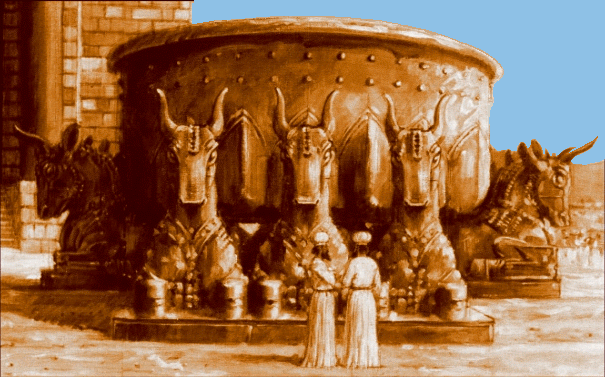
23 Then he made the sea of cast metal. It was round, ten cubits from brim to brim, and five cubits high, and a line of thirty cubits measured its circumference. 24 Under its brim were gourds, for ten cubits, compassing the sea all around. The gourds were in two rows, cast with it when it was cast. 25 It stood on twelve oxen, three facing north, three facing west, three facing south, and three facing east. The sea was set on them, and all their rear parts were inward. 26 Its thickness was a handbreadth, and its brim was made like the brim of a cup, like the flower of a lily. It held two thousand baths.

27 He also made the ten stands of bronze. Each stand was four cubits long, four cubits wide, and three cubits high. 28 This was the construction of the stands: they had panels, and the panels were set in the frames, 29 and on the panels that were set in the frames were lions, oxen, and cherubim. On the frames, both above and below the lions and oxen, there were wreaths of beveled work. 30 Moreover, each stand had four bronze wheels and axles of bronze, and at the four corners were supports for a basin. The supports were cast with wreaths at the side of each. 31 Its opening was within a crown that projected upward one cubit. Its opening was round, as a pedestal is made, a cubit and a half deep. At its opening there were carvings, and its panels were square, not round. 32 And the four wheels were underneath the panels. The axles of the wheels were of one piece with the stands, and the height of a wheel was a cubit and a half. 33 The wheels were made like a chariot wheel; their axles, their rims, their spokes, and their hubs were all cast. 34 There were four supports at the four corners of each stand. The supports were of one piece with the stands. 35 And on the top of the stand there was a round band half a cubit high; and on the top of the stand its stays and its panels were of one piece with it. 36 And on the surfaces of its stays and on its panels, he carved cherubim, lions, and palm trees, according to the space of each, with wreaths all around. 37 After this manner he made the ten stands. All of them were cast alike, of the same measure and the same form.

38 And he made ten basins of bronze. Each basin held forty baths, each basin measured four cubits, and there was a basin for each of the ten stands. 39 And he set the stands, five on the south side of the house, and five on the north side of the house. And he set the sea at the southeast corner of the house. – 1 Kings 7:13-39 ESV

The first question that comes to mind when reading this section of chapter seven is why the author took such great pains to describe each and every item in such precise detail. The amount of information is almost overwhelming, and even with all the helpful descriptions, it’s virtually impossible to determine what each item actually looked like.  So, why dedicate so much time and space to their description?

In a sense, the author is telling his readers that Solomon was a man who took a keen interest in every phase of the massive construction project he had commissioned. His father had left him with the overwhelming responsibility to create a house worthy of the God of Israel, and it was not something he took lightly. Solomon was a hands-on construction manager who cared deeply about every detail concerning this once-in-a-lifetime undertaking. And while he delegated a great deal of the work, there was never a moment when Solomon was not intimately and personally involved. He cared deeply about this project and wanted to make sure that the finished product was both beautiful and functional. When completed, the temple would become the focal point of Israel’s worship of their God. So, Solomon intended for each and every item associated with its construction and its ultimate operation were of the finest craftsmanship.

From the quarrying of the massive stones with which the temple was built to the carving of the intricate relief that adorned the bronze stands, Solomon oversaw everything. And to ensure that the workmanship was of the highest quality, Solomon hired the finest craftsman money could buy.

Verse 13 states that Solomon sought out the services of a man from the city of Tyre who was a gifted worker in bronze. But notice the additional details concerning Hiram’s qualifications:

And he was full of wisdom, understanding, and skill for making any work in bronze. – 1 Kings 7:1 ESV

This brings to mind a passage from the book of Exodus where God provided Moses with the identity of another man who would assist in the construction of the tabernacle.

The Lord said to Moses, “See, I have called by name Bezalel the son of Uri, son of Hur, of the tribe of Judah, and I have filled him with the Spirit of God, with ability and intelligence, with knowledge and all craftsmanship, to devise artistic designs, to work in gold, silver, and bronze, in cutting stones for setting, and in carving wood, to work in every craft.” – Exodus 31:1-5 ESV

As was the case with Moses, it seems that Solomon was receiving divine assistance in procuring the services of the right people to help him complete this one-of-a-kind project. Hiram came highly recommended and divinely gifted for the job.

Once he arrived in Jerusalem, Hiram set to work casting the two bronze pillars that would grace the entrance to the temple. At 27-feet in height, these two immense pillars were likely more decorative than functional. Because they were cast from a relatively soft metal like bronze and featured hollow interiors, they would have been incapable of providing support to the temple’s roof.

These pillars were intended to frame the opening to the entrance of the temple and provide symbolic significance to the One who dwelled inside. Each pillar had a name. One was called Boaz, which means “In Him is strength.” The other was named Jachin, which means “He shall establish.” Both names were clear references to the God of Israel. Every detail that adorned these pillars, from the water lilies to the pomegranates, was intended to illustrate the goodness and greatness of God. The Israelites served a God who provided them with everything they needed, including fertility and fruitfulness.

Next, Hiram crafted “the sea,” a large bronze basin that would sit outside the entrance to the temple. This massive bowl was designed to take the place of the bronze laver that God had prescribed for the tabernacle, but it would serve the same function as the original. According to Exodus 30, the first laver was used by the priests to purify themselves before offering sacrifices to God.

“You shall also make a basin of bronze, with its stand of bronze, for washing. You shall put it between the tent of meeting and the altar, and you shall put water in it, with which Aaron and his sons shall wash their hands and their feet. When they go into the tent of meeting, or when they come near the altar to minister, to burn a food offering to the Lord, they shall wash with water, so that they may not die. They shall wash their hands and their feet, so that they may not die. It shall be a statute forever to them, even to him and to his offspring throughout their generations.” – Exodus 30:18-21 ESV

The new basin was 15 feet in diameter, 47 feet in circumference, with a depth of 7.5 feet. It could hold up to 18,000 gallons of water, and it seems that its large size was meant to allow the priests to completely immerse themselves, rather than just washing their hands and feet. It rested on the backs of 12 bronze oxen, arranged in groups of three, which each group facing a different direction on the compass. These bronze bulls may have been intended to represent the 12 tribes of Israel. But regardless, they were clearly symbols of strength.

Hiram then crafted ten mobile carts, each equipped with a large bronze basin. They featured wheels that allowed it to be moved about the temple courtyard.

He also made ten basins in which to wash, and set five on the south side, and five on the north side. In these they were to rinse off what was used for the burnt offering, and the sea was for the priests to wash in. – 2 Chronicles 4:6 ESV

These carts were each six feet square, five and one-half feet high, and held a bronze basin that could hold up to 240 gallons of water. And as the Chronicles passage indicates, they were strategically located around the temple courtyard and used by the priests to cleanse the blood from the sacrificial animals before they were offered up to God.

You can almost sense that Solomon is attempting to improve on every one of the items made for the tabernacle. Every item Hiram creates is bigger and better than the original. Solomon is obsessed with making the house of God a grand and glorious structure, with every detail reflecting the majesty of its divine occupant. He could have saved himself a lot of time and money by reusing the original items. But Solomon would not be satisfied with anything less than the best. So, he poured countless hours and resources into creating a temple worthy of his great God.

English Standard Version (ESV) The Holy Bible, English Standard Version. ESV® Permanent Text Edition® (2016). Copyright © 2001 by Crossway Bibles, a publishing ministry of Good News Publishers.

New Living Translation (NLT) Holy Bible, New Living Translation, copyright © 1996, 2004, 2015 by Tyndale House Foundation. Used by permission of Tyndale House Publishers Inc., Carol Stream, Illinois 60188. All rights reserved.
The Message (MSG)Copyright © 1993, 1994, 1995, 1996, 2000, 2001, 2002 by Eugene H. Peterson

The Greatness of God.

There was war again between the Philistines and Israel, and David went down together with his servants, and they fought against the Philistines. And David grew weary. And Ishbi-benob, one of the descendants of the giants, whose spear weighed three hundred shekels of bronze, and who was armed with a new sword, thought to kill David. But Abishai the son of Zeruiah came to his aid and attacked the Philistine and killed him. Then David’s men swore to him, “You shall no longer go out with us to battle, lest you quench the lamp of Israel.”

After this there was again war with the Philistines at Gob. Then Sibbecai the Hushathite struck down Saph, who was one of the descendants of the giants. And there was again war with the Philistines at Gob, and Elhanan the son of Jaare-oregim, the Bethlehemite, struck down Goliath the Gittite, the shaft of whose spear was like a weaver’s beam. And there was again war at Gath, where there was a man of great stature, who had six fingers on each hand, and six toes on each foot, twenty-four in number, and he also was descended from the giants. And when he taunted Israel, Jonathan the son of Shimei, David’s brother, struck him down. These four were descended from the giants in Gath, and they fell by the hand of David and by the hand of his servants. – 2 Samuel 21:15-22 ESV

It is impossible to tell from the text at what point these events occurred in David’s reign. It is assumed that they took place in the early days of his kingship, but there is really no way of knowing definitively. As part of the “appendix” to the book, they are designed to provide the reader with an overview of David’s rule. In these closing verses of chapter 21, we are given insight into the ongoing war David waged with the Philistines. Ever since his days as the young shepherd boy and his defeat of Goliath, the Philistine champion, David had been in a constant war with the Philistines. And it seems that Goliath had relatives who held a grudge against David for his victory over their champion. We are introduced to four of them in these verses: Ishbi-benob, Saph, Goliath, and the unnamed man with 26 toes and 26 fingers. Each of these men were larger than life, both literally and figuratively, and posed a real threat to David and the nation of Israel. But they fell at the hands of David’s men. Their massive size and formidable weapons were no match for David’s men. But why? It would be tempting to make this all about the four men who accomplished these mighty deeds on behalf of David and the nation of Israel: Abishai, Sibbecai, Elhanan, and Jonathan. Chapter 23 will even introduce us to the “mighty men of David”, a select group of individuals who displayed almost supernatural military prowess. But rather than put our focus on these men, we should immediately recognize the hand of God. The victories of Israel over the Philistines and their seemingly endless line of champions was due to God, not these men. Yes, they had to fight. They were required to go into battle against superior adversaries and risk life and limb, but their victory was due to God, not themselves. Verse 22 tells us, “These four were descended from the giants in Gath, and they fell by the hand of David and by the hand of his servants.” But once again, their victories were made possible by God. The author’s emphasis on each Philistine’s larger-than-normal size and bigger-than-usual weapons is meant to paint a picture of impossible odds. Yet, David’s men came out victorious. There were not normal foes. One of them even had six fingers on each hand and six toes on each foot. But they fell at the hands of David’s men because God was with them.

David’s reign would be marked by war. His battles against the enemies of Israel would never end. And, once again, we must recall the fact that this characteristic of David’s reign was due to the failure of Joshua and the people of Israel to obey God and rid the land of all its inhabitants. They had been partially obedient and, therefore, semi-successful. And as a result, David was left with the task of finishing what Joshua had begun. And his battles would last the entirety of his reign. It would be his son, Solomon, who would reign over a kingdom marked by peace. But David’s tenure as king would be one of constant war and bloodshed. And God would be with him. That is the message found within these verses.

And what should really jump out at us is the faithfulness of God even in the midst of all the unfaithfulness surrounding David and the people of Israel. David’s victories were not the result of his own faithfulness, but that of God. God was sparing him in spite of him. Time and time again, we have seen David fail God in sometimes epic fashion. But God remained faithful to His promises to David. It would have been easy for the men of David to make much of their individual successes. They could have, and probably did, brag about their victories over superior enemies. But the message for us is one of dependence upon God. We are only as great as our God. To be victorious we must understand that our God is glorious.

English Standard Version (ESV)
The Holy Bible, English Standard Version. ESV® Permanent Text Edition® (2016). Copyright © 2001 by Crossway Bibles, a publishing ministry of Good News Publishers.

New Living Translation (NLT)
Holy Bible, New Living Translation, copyright © 1996, 2004, 2015 by Tyndale House Foundation. Used by permission of Tyndale House Publishers Inc., Carol Stream, Illinois 60188. All rights reserved.

The Message (MSG)Copyright © 1993, 1994, 1995, 1996, 2000, 2001, 2002 by Eugene H. Peterson

Greatly To Be Praised.

I will extol you, my God and King, and bless your name forever and ever. Every day I will bless you and praise your name forever and ever. Great is the Lord, and greatly to be praised, and his greatness is unsearchable. – Psalm 145:1-3 ESV

Psalm 145

David loved God. In fact, he talked about Him and to Him constantly. God seemed to be on David’s mind a lot. Maybe it was because he knew just how much he needed God. He seemed to have a firm grasp on the reality of his dependence upon God – for everything. God had chosen him while he was just a shepherd boy and transformed him into the king of Israel. God had given David victory over Goliath, the Philistines, Saul and a host of other enemies. God had spared David from the full ramifications of his own sin with Bathsheba and allowed him to continue his reign as king. David had much to be grateful for and he constantly praised God for who He was and for all He had done. David extolled God. He lifted Him up, exalted Him and gave Him the glory and honor due Him. He didn’t treat God flippantly or casually. David refused to see God as common place or take Him for granted. In David’s estimation, God was great and greatly to be praised. As a matter of fact, God’s greatness was unsearchable. In other words, you could never plumb the depths of His greatness. Just when you think you know how great God is, He surprises you. God’s greatness isn’t limited or exhaustible. He doesn’t run out of wonders or miracles to perform – a fact that David had experienced personally, time and time again.

Here was David the king of Israel acknowledging Yahweh as his God and as his King. David would not have used the term “king” lightly. He was a king himself and he knew well the implications of that title. God was sovereign. He was the ruler over everyone and everything, including David himself. God was not just a deity to be worshiped, but a King to be honored and obeyed. God’s word was final. His majesty was incomparable. There was no other king who could compare to Him, including David. God was great and He deserved David’s praise, and David was more than happy to give it – each and every day of his life.

But what about us? Do we find God great and greatly to be praised? Is He worthy of our adoration, honor and daily praise? Do we think enough of Him or about Him that it results in us telling Him how much we love Him? Sometimes our problem is that we don’t give God enough thought. We allow our minds to be occupied with thoughts of anything and everything but God, including ourselves. We can end up praising all kinds of things but God. But David would remind us that God alone is worthy of our praise. He would encourage us to recognize and appropriately respond to the greatness of God. And he would have us see God as not only as a great God, but as our King. Recognition of God’s sovereignty and rule over our lives includes submission to His will for our lives. It entails giving up our rights for His righteous rule over every area of our lives. David was king, but he knew that his reign was subject to God’s. Any authority he enjoyed was God-ordained and could be removed by God at His discretion. David’s greatness was solely due to God’s goodness and graciousness. God had made him king. God had blessed his kingship. God had given him victory over his enemies. God had made him powerful. So God was worthy of honor and praise. Our failure to recognize God’s greatness can result in a tendency toward self-exaltation. We can begin to believe that we are responsible for our own achievements. We can end up taking credit for who we are and all that we have done. But an awareness of God’s greatness keeps us from becoming enamored with our own significance. All that we have and all that we are we owe to Him. He alone gives life and breath. He alone sustains and blesses. He alone does mighty deeds. He alone is worthy to be praised. But the truth is, we only praise that for which we are grateful and that holds our affections. So we praise our health, our homes, our jobs, our material possessions, our family and our own accomplishments – forgetting that we owe it all to God. He is great and greatly to be praised. He is our God and King. Every day we wake up, we should offer Him the praise, honor and gratitude He so richly deserves. And no matter how often we praise Him, we will never run out praiseworthy  things for which to honor Him. Because His greatness is unsearchable.

None Like You.

Because of your promise, and according to your own heart, you have brought about all this greatness, to make your servant know it. Therefore you are great, O Lord God. For there is none like you, and there is no God besides you, according to all that we have heard with our ears. – 2 Samuel 7:21-22 ESV

2 Samuel 7:18-29

God had transformed David from an obscure shepherd boy into a mighty king over the nation of Israel – God’s chosen people. Not only that, God had promised to give David an everlasting dynasty, with one of his descendants occupying the throne in Jerusalem. David could look back over his life and see the hand of God, and now he could contemplate the future with confidence, knowing that God had it all under control. Yes, David was going to have to die to his dream of building a temple for God, but his disappointment was replaced with joy as soon as he understood that God had an even great plan in store. The interesting thing to note is the David, the king of Israel, willingly submitted himself to God, the King of the universe. In fact, David repeatedly refers to himself as God’s servant throughout this prayer. Yes, he was king and held the most powerful position in the land. But he humbly submitted himself to God because he recognized that any power, authority, success or significance he enjoyed was due to the sovereign hand of God. He confessed to God, “you have brought about all this greatness”. David could look back over his life and see God intimately involved every step along the way. From his unlikely selection by Samuel to be the next king of Israel to his defeat of the Philistine warrior, Goliath, David saw God’s divine fingerprints. He knew that it had been God who had protected him all those years he lived in exile in the wilderness with a bounty on his head issued by King Saul. He knew that it had been God who had arranged his ascent to the throne. God had given him his victories over the enemies of Israel. God had been the one to forgive his sin with Bathsheba and allowed him to continue his reign. Everywhere David looked, he could see the hand of God.

They say hindsight is 20/20. It sometimes takes the passing of time and the opportunity to contemplate where we have been to give us a true perspective on just what has happened. Looking back allows us to view the events of our life more realistically. We are able to see the lessons learned even in the darkest moments. From our present vantage point, we are more apt to understand now what was going on then. In fact, our reflection on the past often leads us to say, “If I had only known then what I know now”. But as believers in Christ, there is far more benefit to reflection on the past than potential life lessons to be learned. Like David, we should be able to look and see God’s fingerprints all over every aspect of our lives. We should be able to see how He was leading us and eventually calling us to Himself. We should recognize the moments in which He had protected us or possibly disciplined us. Looking back allows us to better see our own sin and God’s gracious acts of salvation all along the way. And the result of our reflection should be the same as that of David. “Therefore you are great, O Lord God. For there is none like you, and there is no God besides you.”

But not only does looking back allow us to see the handiwork of God in our lives, so does looking forward. David could “see” into the future and rest easy, knowing that God had promised that He would “raise up your offspring after you, who shall come from your body, and I will establish his kingdom” (2 Samuel 7:12 ESV). God had told David that He would “establish the throne of his kingdom forever” (2 Samuel 7:13 ESV). And one of the reasons David could trust God’s word regarding the future was because he had experienced God’s faithfulness in the past. He had learned to trust God. He had no reason to doubt that God would fulfill His promises for the future because God had already proven Himself trustworthy and good for His word.

The greatness of God. Sometimes I think that reality escapes many of us who call ourselves Christians. We have somehow lost our awe for God. Rather than see Him as great, we simply take Him for granted. We fail to look back and see His hand in our lives. Any success we have achieved, we tend to take credit for. Any difficulties we have endured, we fail to see any value in. Some of us simply regret the past. Others of us inordinately revel in it. And either way, we can fail to see God in it. Recognizing God’s involvement in our past is essential if we are going to trust His promises for the future. If we don’t believe He has been there for us all along the way, we are going to have a hard time believing He will be there for us in the days ahead. One of the greatest lessons we can learn in this life is to recognize and appreciate the greatness of God. He is always great, whether we see it or are willing to acknowledge it. Sometimes, the best way to comprehend His greatness is to come to grips with our own weakness and insignificance. For David, the very thought that God had chosen him, an insignificant shepherd boy, and made him a king, was mind blowing. That God had chosen to protect him all those years he was running from a psycho king with a one-track mind focused on David’s annihilation, was almost too much for him to believe. But he did believe and he was grateful. He was awed at God’s greatness. And so should we be. Like David, we should be able and willing to exclaim, “Great is the LORD! He is most worthy of praise! No one can measure his greatness” (Psalm 145:3 NLT).

God Knows.

Talk no more so very proudly, let not arrogance come from your mouth; for the Lord is a God of knowledge, and by him actions are weighed. The bows of the mighty are broken, but the feeble bind on strength. Those who were full have hired themselves out for bread, but those who were hungry have ceased to hunger. The barren has borne seven, but she who has many children is forlorn. – 1 Samuel 2:3-5 ESV

1 Samuel 2:1-10

“The Lord is a God of knowledge.” What an interesting statement for Hannah to make. But it came from her own experience with Him. He had seen her distress, heard her cry for help and He had answered. Now Hannah was expressing praise to Him for all He had done, but also for who He was. Her God was all-knowing. Nothing escaped His notice. He saw all that was going on. He knew of Hannah’s plight. He was fully aware of her barrenness. He also knew of her ill-treatment at the hands of her husband’s second wife. The God to whom Hannah prayed was wise, caring, compassionate and just. He cared for the humble and the hurting. He came alongside the hungry and the hopeless. How did Hannah know this? She had experienced it. She had been the recipient of God’s grace, mercy and love. She had been downcast and He had lifted her up. She had been barren, but God had give her a son. She had downcast and God had lifted her up. She had cried out and God had answered.

This prayer is not a promise that God is going to right every wrong in our lifetime. It is not a guarantee that God will eliminate every problem we face. It is certainly telling us that every barren woman who cried out to God will bear a child. But it is a sobering reminder that our God is sovereign. He knows all. He is fully aware of all that is going on in our lives. If we are facing injustice or ill-treatment, God knows. If we are suffering from hunger or facing unemployment, God knows. If our spouse treats us with contempt, God knows. If our child is living in open rebellion against us and God, He knows. And while God’s answer may not come in just the same way as it did for Hannah, He will answer us when we call out to Him. We can cry out and know that He hears us. He sees us. He cares for us. He has a plan in mind for us. Hannah had no idea what kind of role her son, Samuel, would play in the future affairs of the nation of Israel. She was clueless as to what was going to happen as a result of her dedication of Samuel to God. But she knew that God knew. Just as God had told the people of Israel living in exile in Babylon, “For I know the plans I have for you, declares the LORD, plans for welfare and not for evil, to give you a future and a hope” (Jeremiah 29:11 ESV), we need to learn to trust God with our circumstances. We need to see Him for who He is: a sovereign, just, all-powerful, merciful and loving God. He can exalt the lowly, humble the prideful, bless the barren, knock the arrogant down to size, protect the weak, defeat the strong, and right wrongs.

The key to faith is believing these truths without necessarily having seen them or experienced them. It is to pray expectantly to God, hopefully waiting on His answer because we trust in His character. It is why Hannah cried out to God in the first place. “O Lord of hosts, if you will indeed look on the affliction of your servant and remember me and not forget your servant, but will give to your servant a son, then I will give him to the Lord all the days of his life, and no razor shall touch his head” (1 Samuel 1:11 ESV). She was appealing to God based on what she believed about Him. He looks on the affliction of His servants. He remembers and does not forget. He knows. He sees. He answers. He is just, righteous, good and gracious.

It is interesting to note that in this prayer recorded in verses 1-10 of chapter two of 1 Samuel, there is NOT petition. Hannah does not ask for anything. She simply praises God for who He is. It is a prayer of thanksgiving for what He has done. It is an acknowledgement of His sovereignty and a statement of His character. While Hannah was grateful for the son God had so graciously given her, she would be going home without him. He belonged to God now. And yet, her prayer is one of joy, gratitude and worship. Because the real gift she had received was the knowledge that God loved her and cared about her. Rather than make her son the object of her worship, she focused her attention of the one who had made his birth possible. Too often we worship the gift rather than the Giver. We can end up focusing less on God than on what we hope to get from Him. Our desire for blessings from God can overshadow our worship of God. When we are faced with a difficulty or trial, it is enough to know that God knows. We can share our requests. We can make known our desires. But our faith grows as we learn to trust Him for the outcome. He knows what is best. He will do what is right. We can trust Him.

Too Heavy Too Handle.

How precious to me are your thoughts, O God! How vast is the sum of them! If I would count them, they are more than the sand. I awake, and I am still with you. – Psalm 139:17-18 ESV

Psalm 139.

David is blown away with God. The very fact that God created him and knows everything about him was just too much for him. He uses a Hebrew word, yaqar to describe his feelings. It can mean to “be valuable, be precious, be costly”. But it can also be used metaphorically to mean “be heavy” or “hard to understand”. It is the same word used in the book of Daniel when the king asked his magicians to tell him his dream and his meaning. Their response was, “The thing that the king asks is difficult, and no one can show it to the king except the gods, whose dwelling is not with flesh” (Daniel 2:11 ESV). Given the context, it would seem that David is saying that God’s thoughts regarding him are too heavy or difficult for him to comprehend. Remember, David has been speaking of God’s creation of him, how He knew David before he was even formed in the womb. God already knew the day of his birth and the length of his life – long before his conception. God was aware of David’s thoughts – even before they came out of his mouth as words. All of this was too much for David to get his head around. He said, “How vast is the sum of them!” He could have gone on forever, recounting even more amazing facts regarding God and His intimate involvement in his life.

David seems to say that when he goes to bed, he falls asleep thinking about about it and when he wakes up, there’s still more. The word translated, “I am still with you” is `owd  and it means “a going round, continuance” (Strong’s Exhaustive Concordance). It can simply mean “more”. In other words, David says he wakes up in the morning and there is even more to be amazed about regarding God’s thoughts for him. It reminds me of another psalm of David where he writes, “When I look at your heavens, the work of your fingers, the moon and the stars, which you have set in place, what is man that you are mindful of him, and the son of man that you care for him?” (Psalm 8:3-4 ESV). Even Job, in his suffering, said to God, “What is man, that you make so much of him, and that you set your heart on him, visit him every morning and test him every moment?” (Job 7:17-18 ESV). The very idea that God takes notice of us, created us, cares for us, never takes His eyes off of us, and loves us, should astound us. To think that the God of the universe gives me a second thought at all should blow me away as it did David. As David has already acknowledged, “You know when I sit down and when I rise up; you discern my thoughts from afar” (Psalm 139:2 ESV). God is not some distant, disconnected deity who has no knowledge about or interest in His creation. He cares. In fact, He loves us so much that He sent His Son to die for us. He knows our weaknesses. He fully understands our inability to live up to His righteous standards. He is fully aware that we are incapable of not sinning. So He provided a way for us to be made right with Him that is not based on our own human effort, but on the death of His own Son. God knows us. And in spite of that, He still loves us. He knows our thoughts, even when we think we have kept them hidden. And yet, He is still willing to forgive us of those thoughts, if we will simply confess them to Him. He sees everything we do – the good, the bad, the ugly – and is still willing to show us mercy and extend to us His grace. That truly is amazing.

To think that God even gives me a second thought should leave me astounded. How easy it is for me to live my life thinking that all I say, think and do is done is obscurity. I am just one among billions. I am virtually unknown and little more than a blip on the radar screen of life. I can easily conclude that my contribution to life is inconsequential and of little value. But God, the one who created me, knows me, cares for me, watches over me, thinks about me, loves me enough to discipline me, and gave His Son to die for me. That’s heavy. That’s mind-boggling. But what a great reminder from the pen of David. I need to constantly consider the fact that I am known and loved by God. I must never forget that He made me – just as I am. As David said, He “formed my inward parts” and “knitted me together in my mother’s womb”. He made me for a reason. He saved me, not because of anything I had done to deserve it, but simply because He loved me. He is constantly transforming me into the likeness of His Son. He never takes His eyes off of me. He holds me in His hands. He protects me, provides for me, guides me and disciplines me. And He always knows what is best for me. Hard to believe? No doubt about it. But my disbelief won’t do anything but rob me of the joy of knowing just how much my God loves me. “Humble yourselves, therefore, under the mighty hand of God so that at the proper time he may exalt you, casting all your anxieties on him, because he cares for you” (1 Peter 5:6-7 ESV).

Isaiah 23-14, 2 Peter 1

The Greatness of God.

Isaiah 23-14, 2 Peter 1

The Lord of Hosts has sworn: “As I have planned, so shall it be, and as I have purposed, so shall it stand.” – Isaiah 14:24 ESV

Our God is unstoppable. His plans are unalterable and His will unchangeable. He will finish what He starts and always accomplish what He purposes. For Isaiah, the future was a mixed bag of God’s coming punishment upon the people of Israel, as well as eminent destruction of their enemies. God was giving Isaiah a panoramic view of His divine plan concerning Israel and the nations. Babylon, which in the days of Isaiah, was still not yet a powerful nation, would rise to prominence and become a key world player. But the pride and arrogance of that great nation, personified in its kings, would be brought low by the Lord God Almighty. From a human perspective, the things that happen in our world can appear so random and uncontrolled. The events of our day can seem so arbitrary and as if they are nothing more than the outcome of blind fate. But God wanted Isaiah to know that His will was being done at all times. He was behind the affairs of men, orchestrating events and individuals in such a way that His plan was always being accomplished. God asked Isaiah, “For the Lord of hosts has purposed, and who will annul it? His hand is stretched out, and who will turn it back?” (Isaiah 14:27 ESV). God had plans for the people of Israel. Those plans included their ultimate punishment for their sin and rebellion. But those plans also included their future restoration and redemption. God would use the Babylonians and Assyrians to carry out His judgment on the people of Israel, but He would also eventually turn the tables and exalt Israel while humbling their enemies.

What does this passage reveal about God?

Sometimes we can find ourselves judging the efficiency and effectiveness of God based on what we can see. We look around us and see nothing but trouble, trials, difficulties and despair. It can appear as if the enemy is winning and our side is losing. But in those moments, it is not our God who is lacking, but our perspective. We are limited in our outlook. And our nearsighted approach can blind us to the reality that God is in control, whether it looks like it or not. Some of the problem lies in the fact that we often confuse our plan with God’s plan. When things don’t turn out quite the way we envisioned, we can jump to the conclusion that God’s will is not being done. But what we fail to understand is that His ways are not our ways. He sometimes works in ways that are contradictory and contrary to our expectations. Captivity and enslavement was the last thing they Israelites expected. They saw themselves as God’s chosen people, the descendants of Abraham. They were the apple of God’s eye. But it was their very position as His people that made their punishment inevitable. God was not going to allow them to live in open rebellion to His ways. God was going to discipline them as a father disciplines his children. Their seemingly negative circumstances were actually a sign of God’s love for them. “My son, do not regard lightly the discipline of the Lord, nor be weary when reproved by him. For the Lord disciplines the one he loves, and chastises every son whom he receives” (Hebrews 12:5-6 ESV).

What does this passage reveal about man?

Our goal in this life should be to learn to see God in all the ups and downs of life. The enemy and the world are constantly attempting us to take our eyes off of God and to focus on anything and anyone else but Him. Our greatest temptation will be to forget that God is in control and to wrongly conclude that our lives are nothing more than a series of random events left to chance and our own limited powers. Even as believers, we can somehow conclude that our spiritual lives are completely up to us. We may fully believe that our salvation was the work of Jesus Christ, but wrongly assume that our sanctification – our growth in Christ-likeness – is somehow up to us. For many of us, our spiritual growth is nothing more than an ongoing attempt at self-improvement, done in our own strength and marked more by failure than success. We forget that our sanctification is just as dependent upon the work of God as our salvation. Paul reminds us, “And I am sure of this, that he who began a good work in you will bring it to completion at the day of Jesus Christ” (Philippians 1:6 ESV). It is God who must complete the transformation of our lives into the likeness of Christ. And Peter echoed these sentiments when he wrote, “His divine power has granted to us all things that pertain to life and godliness, through the knowledge of him who called us to his own glory and excellence,  by which he has granted to us his precious and very great promises, so that through them you may become partakers of the divine nature, having escaped from the corruption that is in the world because of sinful desire” (2 Peter 1:3-4 ESV). The New Living Translation puts it this way… “By his divine power, God has given us everything we need for living a godly life.” How easy it is to forget that.

How would I apply what I’ve read to my own life?

But that does not mean I have no role to play. God sovereignty does not eliminate my responsibility. Peter goes on to say, “In view of all this, make every effort to respond to God’s promises. Supplement your faith with a generous provision of moral excellence, and moral excellence with knowledge, and knowledge with self-control, and self-control with patient endurance, and patient endurance with godliness, and godliness with brotherly affection, and brotherly affection with love for everyone” (2 Peter 1:5-7 NLT). God has given me all that I need to live the life He has called me to live. He has provided me with His Spirit. He has equipped me with His Word. He has placed me within the body of Christ, the Church. But I still must supplement my faith. I must seek to add to my life the qualities that are characteristic of Christ-likeness. And I must grow in my understanding that God uses anything and everything in my life to accomplish His will for my life. My troubles and trials are instruments in His divine hands. The circumstances of my life are actually opportunities for me to witness God’s power as He exposes my sins and expresses His strength through my weakness. The goal is to grow in my awareness of His greatness and in my dependence upon His grace. The discipline of God should remind me of His love. The difficulties of life should drive me to my knees in dependence upon Him. The successes of life should cause me to rejoice in His blessings. God is accomplishing His will in my life, whether I recognize or realize it. 

Father, You are a great God and greatly to be praised. You are working out Your plan in my life and in this world in ways that I cannot always see or fathom. Your will is unstoppable. Your plan is unalterable. May I learn to trust You more. May I learn to lean on You more. May I grow to understand that You have given me everything I need for living a godly life. But I must turn to You for help and hope. I must lean on You for strength. Because You alone are great. Amen

Ken Miller
Grow Pastor & Minister to Men
kenm@christchapelbc.org

1 Kings 19-20, 2 Corinthians 8

Putting Limits On God’s Grace and Greatness.

1 Kings 19-20, 2 Corinthians 8

For you know the grace of our Lord Jesus Christ, that though he was rich, yet for your sake he became poor, so that you by his poverty might become rich. – 2 Corinthians 8:9 ESV

A big part of the narrative of the Bible is its focus on the greatness of God. From the creation account found in the opening chapters of Genesis all the way to the image of God’s recreation of the world and the redemption of man found in the book of Revelation, we can see His greatness on display. But one of the things we human beings tend to do is limit God. We fail to recognize just how great, gracious and good He truly is. We put limits on His capacity to love and His capability to intervene in the affairs of mankind. In the story recorded in chapters 19-20 of 1 Kings, we see even Elijah, the prophet of God, who had just witnessed an unmistakable display of God’s greatness through the defeat of the prophets of Baal. And yet, this man who had displayed such unwavering faith in God suddenly finds himself faced with the wrath of Jezebel, the wicked queen. The next thing we know, Elijah is on the run and wishing he was dead. Two different times Elijah responds to a question from God with the same answer: “I have been very jealous for the Lord, the God of hosts. For the people of Israel have forsaken your covenant, thrown down your altars, and killed your prophets with the sword, and I, even I only, am left, and they seek my life, to take it away” (1 Kings 19:10 ESV). Elijah was having himself a first-class pity party, whining over his sorry lot in life. But what he was really doing was limiting the power of His God. It seems that Elijah’s God was great enough to defeat the prophets of Baal, but He was not match to the revenge-seeking, false-god worshiping wife of the king of Israel.

But Elijah wasn’t the only one limiting God’s greatness. It seems that the king of Syria had no qualms attaching the nation of Israel, with the help of a 32-nation alliance. He saw his odds as pretty good and his army as greater than the God of the Israelites. But he was wrong. The Israelites won a great victory over the Syrians, with God’s help. But then the Syrians decided that the only reason they had lost the batlle was because the “gods” of the Israelites were gods of the hills. Since their defeat had taken place in the hills, it only made sense to attack the Israelites on the plains, where their “gods” would be impotent. But they were wrong.

What does this passage reveal about God?

God is great – all the time. His greatness never diminishes. His power never decreases. His all-encompassing, incomparable strength never changes. It didn’t matter if the Syrians fought the Israelites in the hills, the plains, the valleys, the forests or along the shores of the sea, the God of Israel would always prove greater than any god they might worship or any army they might muster. Elijah’s God was not only great enough to defeat the prophets of Baal, He was great enough to handle the likes of Jezebel. Contrary to Elijah’s assertion, he was NOT the only one left. He was not the only faithful Israelite left in the world. God was still in charge – in spite of Jezebel’s threats, Elijah’s doubts, the Syrian’s faulty logic, and any evidence that might point to the contrary.

What does this passage reveal about man?

The greatness of God is not just a pious-sounding platitude or religious catch-phrase we use to impress one another with our apparent faith. It is a non-debatable reality. But occasionally, we have a hard time believing it. Elijah had been a witness to an extraordinary display of God’s power. Fire came out of heaven, consuming “the burnt offering and the wood and the stones and the dust, and licked up the water that was in the trench” (1 Kings 18:38 ESV). Elijah himself had single-handedly killed the 450 prophets of Baal – all in the power provided by God. He even received supernatural strength to outrun King Ahab and his royal chariot. going on the way from Mount Carmel to Jezreel on foot and in record time. But in spite of all this, Elijah still put limits on God’s greatness and grace. While things seemed to have turned out remarkably well that day on the mountain, they evidently didn’t turn out quite like Elijah had expected them to. The death threat on his life from the irate queen left him feeling like things were worse than ever. But rather than focus on all the great things God had done through and around him, Elijah put limits on what God could do. A common trait in even the most godly of men.

How would I apply what I’ve read to my own life?

God’s greatness goes hand-in-hand with His grace. His power is provides Him with the capacity to extend grace to sinful men. Paul reminds us that it was the death of Jesus Christ, provided for us by God Himself. that made possible our redemption and reconciliation with Him. But it was God’s power that made it possible. Yes, Jesus had to die. But had not God’s power raised Him from death back to life, the cross would have ended in nothing more than tragedy, and Jesus would have been nothing more than just another human martyr for a worthy cause. But God’s incomparable greatness made it possible for Him to provide us with His invaluable grace. And Jesus displayed grace to us by sacrificing not only His life, but His very place at the right hand of God by taking on human flesh and dying a sinner’s death on our behalf. Why in the world would I ever doubt God’s greatness after all He has done for me? Why would I place any limits on His capacity to great things in and around my life, when He has already done so much on my behalf? Our God is truly great and His grace is greater than all our sins.

Grace, grace, God’s grace,
Grace that will pardon and cleanse within;
Grace, grace, God’s grace,
Grace that is greater than all our sin.

Father, You truly are great. Please forgive me for the many times I doubt Your greatness and put limits on Your power. I have no reason to do so. You have proven Yourself great and gracious time and time again in my life. Amen

Ken Miller
Grow Pastor & Minister to Men
kenm@christchapelbc.org