Praise the LORD!

1 Praise the LORD!
Praise the LORD, O my soul!
I will praise the LORD as long as I live;
    I will sing praises to my God while I have my being.

Put not your trust in princes,
    in a son of man, in whom there is no salvation.
When his breath departs, he returns to the earth;
    on that very day his plans perish.

Blessed is he whose help is the God of Jacob,
    whose hope is in the LORD his God,
who made heaven and earth,
    the sea, and all that is in them,
who keeps faith forever;
    who executes justice for the oppressed,
    who gives food to the hungry.

The LORD sets the prisoners free;
    the LORD opens the eyes of the blind.
The LORD lifts up those who are bowed down;
    the LORD loves the righteous.
The LORD watches over the sojourners;
    he upholds the widow and the fatherless,
    but the way of the wicked he brings to ruin.

10 The LORD will reign forever,
    your God, O Zion, to all generations.
Praise the LORD! – Psalm 146:1-10 ESV

The last five psalms are anonymous and form the final Hallel (praise) section of the Psalter. Due to the similarity of their content, they were likely written by the same author. Each begins with the same call to action: “Praise the LORD.” This imperative statement is not intended as a suggestion, but as a command to give Yahweh all the dignity, honor, worship, and praise He rightly deserves. The psalmist calls for wholehearted worship on the part of the people of God, and he sets the tone by declaring his sold-out allegiance to the Almighty.

I will praise the LORD as long as I live;
    I will sing praises to my God while I have my being. – Psalm 146:2 ESV

His statement of devotion to Yahweh is reminiscent of the address Joshua gave to the Israelites near the end of his life. Ever since the death of Moses, Joshua had served as the God-appointed leader of the Israelites, helping them cross the Jordan River and begin their conquest of the land of Canaan. Over the years, Joshua led the Israelites in their effort to conquer the inhabitants of the land so they could take possession of the inheritance promised to them by Yahweh. They had fought and won many battles, and successfully occupied a large portion of Canaan, but Yahweh reminded them that He had been behind it all.

“It was not your swords or bows that brought you victory. I gave you land you had not worked on, and I gave you towns you did not build—the towns where you are now living. I gave you vineyards and olive groves for food, though you did not plant them.” – Joshua 24:12-13 NLT

Despite his leadership role, Joshua knew that he had been little more than an instrument in Yahweh’s hands. He had led the people into battle, but the victories had been the LORD’s doing. So, Joshua commanded the Israelites to show their gratitude to Yahweh by treating Him with honor and unadulterated reverence.

“So fear the LORD and serve him wholeheartedly. Put away forever the idols your ancestors worshiped when they lived beyond the Euphrates River and in Egypt. Serve the LORD alone. But if you refuse to serve the LORD, then choose today whom you will serve. Would you prefer the gods your ancestors served beyond the Euphrates? Or will it be the gods of the Amorites in whose land you now live? But as for me and my family, we will serve the LORD.” – Joshua 24:14-15 NLT

Like the psalmist, Joshua tried to spur the people’s obedience by using himself as an example. He declared his intention to live out his final days in total submission to and reliance upon Yahweh, and he committed his family to follow his lead.

Joshua warned the Israelites about the dangers of idolatry because he knew their history of spiritual infidelity. He had been there when Aaron made the golden calf in the wilderness, and he had witnessed the people’s response to this false god they had crafted from the plunder taken from the Egyptians.

The people got up early the next morning to sacrifice burnt offerings and peace offerings. After this, they celebrated with feasting and drinking, and they indulged in pagan revelry. – Exodus 34:6 NLT

Yahweh had delivered them from slavery in Egypt and given them victory over their enemies, but they gave their allegiance to a nonexistent god they had made with their own hands.

The psalmist stressed a different problem facing his peers. He was less concerned about idolatry and the worship of false gods than their tendency to worship men.

Don’t put your confidence in powerful people;
    there is no help for you there.
When they breathe their last, they return to the earth,
    and all their plans die with them. – Psalm 146:3-4 NLT

While idolatry continued to be a problem for the Israelites throughout their existence as a nation, their real struggle was the worship of men. Ever since the day they rejected Samuel’s leadership and demanded, “Give us a king to judge us like all the other nations have” (1 Samuel 8:5 NLT), the people of Israel had exhibited a preference for human kings over the King of kings. Yahweh would repeatedly warn them about their tendency to replace His authority with that of mere men.

This is what the Lord says:
“Cursed are those who put their trust in mere humans,
    who rely on human strength
    and turn their hearts away from the Lord.
They are like stunted shrubs in the desert,
    with no hope for the future.
They will live in the barren wilderness,
    in an uninhabited salty land.” – Jeremiah 17:5-6 NLT

The psalmist knew his people well and wanted them to think twice about putting their trust in powerful men who could never measure up to Yahweh’s standards. As far as the psalmist was concerned, there was no comparison between mortal men and the infinite, all-powerful God of the universe.

He made heaven and earth,
    the sea, and everything in them.
    He keeps every promise forever.
He gives justice to the oppressed
    and food to the hungry.
The LORD frees the prisoners.
   The LORD opens the eyes of the blind.
The LORD lifts up those who are weighed down.
    The LORD loves the godly.
The LORD protects the foreigners among us.
    He cares for the orphans and widows,
    but he frustrates the plans of the wicked. – Psalm 146:6-9 NLT

No man could ever hope to compete with Yahweh. No king who ever lived could claim to hold a candle to Yahweh’s glory and greatness. The anonymous author of Psalm 2 exposed the futility of earthly kings trying to oppose the one true King.

Why are the nations so angry?
    Why do they waste their time with futile plans?
The kings of the earth prepare for battle;
    the rulers plot together
against the LORD
    and against his anointed one.
“Let us break their chains,” they cry,
    “and free ourselves from slavery to God.”

But the one who rules in heaven laughs.
    The LORD scoffs at them.
Then in anger he rebukes them,
    terrifying them with his fierce fury. – Psalm 2:1-5 NLT

The prophet Isaiah declared Yahweh’s superiority and supremacy over all mankind.

God sits above the circle of the earth.
    The people below seem like grasshoppers to him!
He spreads out the heavens like a curtain
    and makes his tent from them.
He judges the great people of the world
    and brings them all to nothing. – Isaiah 40:22-23 NLT

In Isaiah’s estimation, the worship of men was unwarranted and a waste of time. They would always be poor substitutes for Yahweh because they couldn’t measure up to His glorious standards. Even Yahweh declared Himself to be incomparable and irreplaceable.

“To whom will you compare me?
    Who is my equal?” asks the Holy One. – Isaiah 40:25 NLT

The psalmist understood that Yahweh’s immensity and eternality set Him apart from all false gods and every man with god-like aspirations. He deserved man’s praise because He was praiseworthy. Yahweh wasn’t a figment of man’s fertile imagination and had not been formed by human hands. He was the maker of “heaven and earth, the sea, and everything in them” (Psalm 146:6 NLT). Yahweh is the uncreated Creator of the universe who has no beginning and end. He is eternal and all-powerful. He is holy and wholly righteous. He is “the same yesterday and today and forever” (Hebrews 13:8 ESV). With those thoughts in mind, the psalmist closes his song in the same way he opened it, with a call to praise the eternal, always-present, forever faithful God.

The LORD will reign forever.
    He will be your God, O Jerusalem, throughout the generations.

Praise the Lord! – Psalm 146:10 NLT

Father, I must confess that I do not always recognize and honor Your greatness. I say I believe in it but, far too often, my actions and attitudes reflect something altogether different. I don’t praise You enough. I fail to trust You fully. I tend to put my hope in men, even in myself, rather than trusting in Your proven track record of greatness and goodness. While I could easily deny any worship of false gods, I know it would be a lie. My idols are far more subtle than those of the Israelites, but they are idols all the same. Anything I turn to instead of You is a false god that will always provide false hope. No man or human institution can replace you. No idealogy, political party, or human leader can replace You or hope to compete with You. Yet, it is so easy to put my trust in those things that will always prove untrustworthy. Help me to heed the psalmist’s call and learn to praise You for who You are and all that You have done. Amen

English Standard Version (ESV) The Holy Bible, English Standard Version. ESV® Permanent Text Edition® (2016). Copyright © 2001 by Crossway Bibles, a publishing ministry of Good News Publishers.

New Living Translation (NLT) Holy Bible, New Living Translation, copyright © 1996, 2004, 2015 by Tyndale House Foundation. Used by permission of Tyndale House Publishers Inc., Carol Stream, Illinois 60188. All rights reserved.
Singing Yahweh’s Praises

A Song of Praise. Of David.

1 I will extol you, my God and King,
    and bless your name forever and ever.
Every day I will bless you
    and praise your name forever and ever.
Great is the LORD, and greatly to be praised,
    and his greatness is unsearchable.

One generation shall commend your works to another,
    and shall declare your mighty acts.
On the glorious splendor of your majesty,
    and on your wondrous works, I will meditate.
They shall speak of the might of your awesome deeds,
    and I will declare your greatness.
They shall pour forth the fame of your abundant goodness
    and shall sing aloud of your righteousness.

The LORD is gracious and merciful,
    slow to anger and abounding in steadfast love.
The LORD is good to all,
    and his mercy is over all that he has made.

10 All your works shall give thanks to you, O LORD,
    and all your saints shall bless you!
11 They shall speak of the glory of your kingdom
    and tell of your power,
12 to make known to the children of man your mighty deeds,
    and the glorious splendor of your kingdom.
13 Your kingdom is an everlasting kingdom,
    and your dominion endures throughout all generations.

[The LORD is faithful in all his words
    and kind in all his works.]
14 The LORD upholds all who are falling
    and raises up all who are bowed down.
15 The eyes of all look to you,
    and you give them their food in due season.
16 You open your hand;
    you satisfy the desire of every living thing.
17 The LORD is righteous in all his ways
    and kind in all his works.
18 The LORD is near to all who call on him,
    to all who call on him in truth.
19 He fulfills the desire of those who fear him;
    he also hears their cry and saves them.
20 The LORD preserves all who love him,
    but all the wicked he will destroy.

21 My mouth will speak the praise of the LORD,
    and let all flesh bless his holy name forever and ever. – Psalm 145:1-21 ESV

David loved the LORD, and talked about Him and to Him constantly. Maybe it was because he knew how much he needed Yahweh — for everything. David had much to be grateful for, and he continually praised God for who He was and for all He had done. He didn’t treat God flippantly or casually and refused to take Him for granted. In David’s estimation, God was great and greatly to be praised. As a matter of fact, God’s greatness was unsearchable; you could never plumb its depths. Just when you think you know how great God is, He surprises you. God’s greatness is unlimited and inexhaustible. He doesn’t run out of wonders or miracles to perform – a fact that David had experienced personally, time and time again.

Here was David, the king of Israel, acknowledging Yahweh as his God and as his King. David was a king himself, and he knew well the implications of that title. God is sovereign and rules over everyone and everything, including David. God is not just a deity to be worshiped, but a King to be honored and obeyed. God’s word is final, and His majesty is incomparable. There is no other king who could compare to Him, including David.

But for David, Yahweh’s greatness was not just something to be admired; it was to be declared. In verses 4-7, he emphasizes the importance of passing on the news of God’s glory and goodness to the next generation. According to David, the only time we should be silent about God is to meditate on the splendor of His majesty and on His wondrous works. But those times of meditation should provide us with food for thought and then words of testimony and praise. Our thoughts about God and His greatness should be transformed into words that inform and influence others.

Yahweh deserves praise, and we are intended to use our voices to verbally acknowledge who He is and all that He has done. We are to commend, declare, speak, pour forth, and sing aloud. Of all people, believers should have the most to say about God. We tend to praise that which we appreciate. We talk about what interests us. When we see a beautiful sunrise, we feel the urge to share it with someone. When we take a memorable vacation, we can’t help talking about it. When we are proud of our children, no one can stop us from bragging about them. We unashamedly testify to others about what we find meaningful in our lives. It could be a delicious meal at a local restaurant, a good book, a movie, a newly discovered musical group, a recent Facebook post, or a personal achievement. But how often do we declare the greatness of God? How many times do we commend Him to others? How frequently do praises concerning God come from our lips and to the ears of those we meet? Are we prone to sing God’s praises out loud and outside the context of a Sunday morning worship service?

David states that the heavens declare the glory of God. We can see it in a sunrise or sunset, a cloud formation, a night sky filled with stars, or the gentle breeze on a warm summer night. God’s creation constantly praises Him. The angels in heaven never cease to offer Him verbal praise and adoration. But as human beings, the pinnacle of His creative energies, we remain silent far too often. Rather than commend God to others, we complain. Instead of declaring the mighty acts He has already done, we demand that He do more. We speak, but do the words that come out of our mouths concern God? Do words of praise, thanksgiving, and honor for God pour forth from our lips? Do we sing aloud of His righteousness?

David found no shortage of reasons to praise Yahweh.

The LORD is merciful and compassionate,
    slow to get angry and filled with unfailing love.
The LORD is good to everyone.
    He showers compassion on all his creation. – Psalm 145:9 NLT

He knew from firsthand experience that Yahweh was gracious, caring, merciful, and forgiving, and he was not shy in declaring his amazement and gratitude. He was blown away by the fact that the God of the universe not only showed an interest in him, but showered him with love and compassion. David was a firm believer that God’s creation was a living testament to His glory. In an earlier psalm, he wrote, “The heavens proclaim the glory of God. The skies display his craftsmanship. Day after day they continue to speak; night after night they make him known” (Psalm 19:1-2 NLT). People can look at nature and see the power and creativity of God, but creation does not necessarily display His grace, mercy, love, and forgiveness. But when they look at a child of God, they can see a sinner transformed into a saint by the priceless gift of God’s grace. When they hear us talk about all that God has done and continues to do for us, they hear a different side of His glory and greatness. But for them to hear, we must speak; we must make God known. We have a responsibility to act as God’s personal press agents, telling everyone we meet of His glory, grace, mercy, love, and forgiveness.

David puts it plainly. Those who have been blessed by God will brag about God.

your faithful followers will praise you.
They will speak of the glory of your kingdom;
    they will give examples of your power. – Psalm 145:10-11 NLT

As a king, David understood the importance of establishing an enduring kingdom. No king wants to be a one-trick pony whose kingdom dies with him. He dreams of establishing a long-lasting dynasty that will carry on his legacy through the generations. When David thought about Yahweh, he couldn’t help but think about the everlasting nature and incomparable power of His Kingdom.

For your kingdom is an everlasting kingdom.
    You rule throughout all generations. – Psalm 145:13 NLT

David was amazed at the sheer size and scope of Yahweh’s dominion. He ruled and reigned over all. David couldn’t help but compare his own reign with that of God, and when he did, he realized that God’s Kingdom was far greater and His responsibilities were more extensive. Yet, God was faithful in all His words and kind in all His works. Everyone looked to Him to provide their food and fulfill their desires, whether they acknowledged Him as King or not. David recognized that it was God who opened His hand and satisfied the desires of every living thing. God is gracious and merciful to all.

From David’s perspective, Yahweh was the perfect model of a king. He always keeps His promises and is gracious at all times. He assists the fallen and bears the burdens of the oppressed. He provides food for the hungry and water for the thirsty. He is righteous in all that He does and filled with kindness. When called upon, He answers. When needed, He shows up. Yahweh was the consummate King who ruled over His extensive Kingdom with righteousness, compassion, mercy, grace, and love.

Unlike human kings, God always does what is right. He always keeps His word. He doesn’t lie, deceive, renege on a promise, or act unjustly. We may not always understand His actions, but we can never question His integrity. Based on what we see happening around us, we can easily conclude that God is either indifferent or incapable of doing what needs to be done. It can appear as if the wicked are winning. The psalmist felt that way and cried out, “Rise up, O judge of the earth; repay to the proud what they deserve! O Lord, how long shall the wicked, how long shall the wicked exult?” (Psalm 94:2-3 ESV). Ethan the Ezrahite wrote, “How long, O Lord? Will you hide yourself forever? How long will your wrath burn like fire? Remember how short my time is! For what vanity you have created all the children of man!” (Psalm 89:46-47 ESV).

There are times when it feels like God is either out of control or out of earshot. It seems as if He is not listening to our pleas for help or seeing the gravity of our situation. However, God is a righteous King who is always in complete control of the circumstances. Yes, it may appear as if the wicked are prospering and the unrighteous are getting all the breaks, but God knows exactly what He is doing. He is not fooled or duped by the ways of men. He knows that “there is none righteous, no not one” (Romans 3:10 ESV). No one deserves the benefits of rain or crops. No one has earned God’s favor through their acts of righteousness. The fact that any of us exists at all is a testimony to the enduring patience of God.

But David reminds us that “The Lord is close to all who call on him” (Psalm 145:18 NLT). He would have us know that God is always near. He always hears. He always preserves those who love Him. But how God does so may not coincide with our own expectations. We rarely go to God without some well-thought-out idea of what we want Him to do for us. In fact, most of our prayers consist of clear-cut instructions for God, telling Him exactly what it is we want Him to do and when we want it done. If we have a bone to pick with God, it is because He doesn’t always answer our prayers the way we desire. But His job is to do His will, not ours. He knows what is best for us.

Paul gives us some timeless counsel: “Don’t worry about anything; instead, pray about everything. Tell God what you need, and thank him for all he has done” (Philippians 4:6 NLT). It is perfectly okay to tell God what we need. It is even OK to share with Him what we want. But at that point, we have to let go of our wishes and come to grips with the fact that His will may not be the same as our wish. He may choose to do something different altogether. And if His answer comes back in a different form or on a different schedule, it DOES NOT mean He is not near or that He does not hear.

Like David, we must learn to trust Him because He is trustworthy. When we look back on our lives, we will be able to see that He is a righteous, loving, and compassionate God who knows what is best and always does what is right. Then we will say with David, “I will praise the Lord, and may everyone on earth bless his holy name forever and ever” (Psalm 145:21 NLT).

Father, You are worthy of praise because You are the righteous King of the Universe. You are mighty, majestic, incomparable, holy, just, and without equal. But that is not the extent of Your praiseworthiness. You have given me ample reasons to praise You because You have shown up in my life in tangible ways that have proven Your love for me. You have saved me, redeemed me, guided, disciplined, and loved me through thick and thin. You have patiently put up with me and graciously forgiven me, time and time again. You have listened to my prayers and endured my complaints. You have watched me stray and graciously led me back. But despite all You have done for me, I remain far too silent when it comes to singing Your praises and expressing my gratitude. I want that to change. Give me a heart like David had and a passion to praise You to the next generation and beyond. Amen

English Standard Version (ESV) The Holy Bible, English Standard Version. ESV® Permanent Text Edition® (2016). Copyright © 2001 by Crossway Bibles, a publishing ministry of Good News Publishers.

New Living Translation (NLT) Holy Bible, New Living Translation, copyright © 1996, 2004, 2015 by Tyndale House Foundation. Used by permission of Tyndale House Publishers Inc., Carol Stream, Illinois 60188. All rights reserved.

A Life Worth Living

Taw

169 O LORD, listen to my cry;
    give me the discerning mind you promised.
170 Listen to my prayer;
    rescue me as you promised.
171 Let praise flow from my lips,
    for you have taught me your decrees.
172 Let my tongue sing about your word,
    for all your commands are right.
173 Give me a helping hand,
    for I have chosen to follow your commandments.
174 O LORD, I have longed for your rescue,
    and your instructions are my delight.
175 Let me live so I can praise you,
    and may your regulations help me.
176 I have wandered away like a lost sheep;
    come and find me,
    for I have not forgotten your commands. Psalm 119:169-176 ESV

The psalmist has reached the last letter in the Hebrew alphabet, bringing his lengthy poem to an end. Utilizing the pattern he has used throughout the psalm, he begins each sentence of these last eight verses with the letter taw or tav. This last strophe serves as the conclusion or coda of his psalm.

As he prepares to wrap up his song, the psalmist intensifies his request for deliverance, begging Yahweh to listen to his cry and prayer. He not only wants to be heard, but he wants to experience Yahweh’s intervention. Fearing death, he longs to live so he can continue to interact with God’s word. Throughout this psalm, the author has repeatedly expressed his deep love and affection for the Scriptures

I have rejoiced in your laws
as much as in riches. – Psalm 119:14 NLT

Your laws please me;
they give me wise advice. – Psalm 119:24 NLT

I long to obey your commandments!– Psalm 119:40 NLT

How I delight in your commands!
How I love them! – Psalm 119:47 NLT

Your instructions are more valuable to me
than millions in gold and silver.– Psalm 119:72 NLT

your instructions are my delight.– Psalm 119:77 NLT

Oh, how I love your instructions!
I think about them all day long.– Psalm 119:97 NLT

How sweet your words taste to me;
they are sweeter than honey. – Psalm 119:103 NLT

Your laws are my treasure;
they are my heart’s delight.– Psalm 119:111 NLT

…no wonder I love to obey your laws! – Psalm 119:119 NLT

I stand in awe of your regulations. – Psalm 119:120 NLT

Truly, I love your commands
more than gold, even the finest gold.– Psalm 119:127 NLT

Your laws are wonderful.
No wonder I obey them!– Psalm 119:127 NLT

See how I love your commandments, LORD.– Psalm 119:159 NLT

I rejoice in your word 
like one who discovers a great treasure. – Psalm 119:162 NLT

I love your instructions. – Psalm 119:163 NLT

I have obeyed your laws,
for I love them very much. – Psalm 119:167 NLT

This isn’t hyperbole or pious-sounding rhetoric. The psalmist sincerely means what he is saying. Over his lifetime, he has grown to love the word of God because it has proven to be faithful, true, reliable, wise, and encouraging. While his life has not been easy, his reliance upon the Scriptures has provided him with hope because it reveals the character of his God.

The stories contained in God’s word portray His power, love, mercy, grace, justice, sovereignty, and righteousness. The Books of the Law reveal the righteous demands Yahweh has placed on His covenant people, but also outline the sacrificial system He provided to provide atonement when they failed to keep His commands. The psalmist had read the Books of History and seen how Yahweh had shown mercy and grace to His rebellious people. Yes, He had punished them for their sins, but He had also forgiven and restored them on more than one occasion.

The Books of Wisdom had provided the psalmist with insight into God’s nature, outlining the importance of godly wisdom and the need to pursue it with unbridled enthusiasm.

Tune your ears to wisdom,
and concentrate on understanding.
Cry out for insight,
and ask for understanding.
Search for them as you would for silver;
seek them like hidden treasures.
Then you will understand what it means to fear the LORD,
and you will gain knowledge of God.
– Proverbs 2:2-5 NLT

This has been the pattern of the psalmist’s life. He has taken to heart all the lessons found in Scripture and applied the many admonitions to make God’s word a priority. But he longs for more. He is far from satisfied and not ready to end his quest to know God better. That is why he cries out, “rescue me as you promised” (Psalm 119:170 NLT). He is not ready for death, but longs to experience more of life so he can grow in his understanding of Yahweh.

Let me live so I can praise you” (Psalm 119:175 NLT), he pleads. For the psalmist, life was essential to experiencing God’s presence and power; it was also vital for responding in praise. The psalmist’s mindset reflects that of the prophet Isaiah when he wrote:

For the dead cannot praise you;
they cannot raise their voices in praise.
Those who go down to the grave
can no longer hope in your faithfulness.
Only the living can praise you as I do today.– Isaiah 38:18-19 NLT

Another psalmist shared this same sentiment when he wrote:

The dead cannot sing praises to the LORD,
for they have gone into the silence of the grave.
But we can praise the LORD
both now and forever!– Psalm 115:17-18 NLT

These men were not discounting the idea of an afterlife, but their doctrine of life after death was not fully formed. The ancient Hebrews did not have a well-developed understanding of the hereafter. They believed in some kind of post-death existence, but found it difficult to understand its exact nature. For them, life was the realm in which Yahweh’s blessings were experienced. Health, wealth, and prosperity were the signs of a blessed life. Suffering and sorrow were evidence of a disobedient life. That is why the psalmist is confused by the circumstances surrounding his life. He had been faithful and obedient to God’s commands, yet he was suffering.

Many persecute and trouble me,
yet I have not swerved from your laws.– Psalm 119:157 NLT

I am insignificant and despised,
but I don’t forget your commandments.– Psalm 119:141 NLT

The psalmist wanted to live because he was not done pursuing God’s word. He wanted to experience more of God’s blessings and was convinced they could only be experienced in life, not death. He believed praise to be the purview of the living, not the dead. He desperately wants to live, not so he can experience more of what life has to offer, but so he can continue to experience the life-changing lessons God’s word has to offer.

O Lord, I have longed for your rescue,
and your instructions are my delight.
Let me live so I can praise you,
and may your regulations help me.– Psalm 119:174-175 NLT

Suffering wasn’t enjoyable, and it didn’t always make sense. But, for the psalmist, it was an opportunity to seek Yahweh’s help and see His deliverance. The struggles of life drove him to his knees and made him increasingly more dependent upon the LORD. Problems were the launching ground for praise. Without a need for God’s assistance and deliverance, praise would become unnecessary. But God’s rescue has a way of making His people rejoice. When God shows up, His people tend to shout out His praises. And the psalmist wants to live so he can continue to witness God’s presence, experience God’s power, and respond in praise.

The psalmist closes out his song with a cry of complete dependence upon Yahweh’s help. He describes himself as a lost sheep who has unintentionally wandered away from the fold and find himself in danger.

I have wandered away like a lost sheep;
come and find me,
for I have not forgotten your commands. – Psalms 119:174 NLT

This lost-sheep motif is found throughout the Old Testament Scriptures. God used this analogy to describe the state of His covenant people.

“My people have been lost sheep.
Their shepherds have led them astray
and turned them loose in the mountains.
They have lost their way
and can’t remember how to get back to the sheepfold.” – Jeremiah 50:6 NLT

Speaking on behalf of his fellow Israelites, the prophet Isaiah confessed their self-imposed state of spiritual lostness.

All of us, like sheep, have strayed away.
We have left God’s paths to follow our own.– Isaiah 53:6 NLT

The psalmist could relate to this imagery of wandering sheep, and he longed for the Good Shepherd to seek him out and restore him to safety and rest. He desired to be back in the fold, where he could continue to experience the love and protective presence of his Master. It isn’t farfetched to imagine that the psalmist had the words of David in mind as he concluded his psalm. It was the shepherd of Israel who wrote the following tribute to Yahweh’s faithfulness and love.

The LORD is my shepherd;
I have all that I need.
He lets me rest in green meadows;
he leads me beside peaceful streams.
He renews my strength.
He guides me along right paths,
bringing honor to his name.
Even when I walk
through the darkest valley,
I will not be afraid,
for you are close beside me.
Your rod and your staff
protect and comfort me.
You prepare a feast for me
in the presence of my enemies.
You honor me by anointing my head with oil.
My cup overflows with blessings.
Surely your goodness and unfailing love will pursue me
all the days of my life,
and I will live in the house of the LORD
forever.– Psalm 23:1-6 NLT

The psalmist wanted what David described. He had experienced it before and was not ready for it to end. Life was worth living because it was the avenue through which Yahweh revealed Himself to men. Yes, life could be full of green meadows and peaceful streams. There were times of feasting and rejoicing.  But there were also dark valleys and fear-filled moments when the Shepherd seemed nowhere to be found. But, like David, the psalmist believed that God’s goodness and unfailing love would pursue him
all the days of his life, so life was worth living. He truly believed that life was the key to loving and praising God, and would have fully agreed with the words of Psalm 150:6:

Let everything that has breath praise the Lord!

Father, I want to love life, not because of all the perks and benefits it provides, but because it is the platform upon which I get to see and experience Your power and presence. Too often, I see the trials and troubles as setbacks and unnecessary bumps on the road of life. I try to avoid them like the plague or pray them away when eluding them fails. But it is in the difficulties of life that You show up. It is in those moments when I have no more tricks up my sleeve or any other options to pursue, that I tend to turn to You. My weakness makes me aware of my need for Your strength. When times get tough, my prayer life improves. When I don’t know what to do, I am forced to turn to You. And when I do, You always show up. Thank you for life, not because it’s always perfect and free from trials, but because it is the place where my weakness gets exposed and Your power is displayed. Amen

English Standard Version (ESV) The Holy Bible, English Standard Version. ESV® Permanent Text Edition® (2016). Copyright © 2001 by Crossway Bibles, a publishing ministry of Good News Publishers.

New Living Translation (NLT) Holy Bible, New Living Translation, copyright © 1996, 2004, 2015 by Tyndale House Foundation. Used by permission of Tyndale House Publishers Inc., Carol Stream, Illinois 60188. All rights reserved.

Who Can Stand Before You?

To the choirmaster: with stringed instruments. A Psalm of Asaph. A Song.

1 In Judah God is known;
    his name is great in Israel.
His abode has been established in Salem,
    his dwelling place in Zion.
There he broke the flashing arrows,
    the shield, the sword, and the weapons of war. Selah

Glorious are you, more majestic
    than the mountains full of prey.
The stouthearted were stripped of their spoil;
    they sank into sleep;
all the men of war
    were unable to use their hands.
At your rebuke, O God of Jacob,
    both rider and horse lay stunned.

But you, you are to be feared!
    Who can stand before you
    when once your anger is roused?
From the heavens you uttered judgment;
    the earth feared and was still,
when God arose to establish judgment,
    to save all the humble of the earth. Selah

10 Surely the wrath of man shall praise you;
    the remnant of wrath you will put on like a belt.
11 Make your vows to the LORD your God and perform them;
    let all around him bring gifts
    to him who is to be feared,
12 who cuts off the spirit of princes,
    who is to be feared by the kings of the earth. Psalm 76:1-12 ESV

In this psalm, Asaph sings Yahweh’s praises by reciting His matchless power and capacity to deliver His people from any and all enemies. Asaph mentions no specific act of deliverance, but instead, he gives a rather generic description of Yahweh’s past actions on Israel’s behalf.

God is honored in Judah;
    his name is great in Israel.
Jerusalem is where he lives;
    Mount Zion is his home.
There he has broken the fiery arrows of the enemy,
    the shields and swords and weapons of war. – Psalm 76:1-3 NLT

Yahweh had proven Himself to be faithful and trustworthy, having repeatedly delivered His chosen people from their enemies. From the day the Israelites entered the promised land under Joshua’s leadership, they faced constant opposition from its inhabitants. Hostile nations, opposed to their presence and determined to prevent their settlement in Canaan, posed a threat to their very existence. Over the centuries, the Philistines, Moabites, Canaanites, and Ammonites waged war against the Israelites and attempted to intimidate and eliminate God’s chosen people. But time after time, Yahweh intervened, protecting those who bore His name and providing miraculous victories over the greatest of enemies.

Asaph could have given a number of examples to prove his point. In 701 B.C., not long after King Sennacherib and the Assyrians defeated the northern kingdom of Israel, the southern kingdom of Judah found itself the target of Sennacherib‘s wrath and ambition. Not satisfied with his acquisition of Israel, Sennacherib sent his troops into Judah, capturing many of its fortified cities and threatening to enter the capital city of Jerusalem. King Hezekiah attempted to buy off the Assyrians by offering tribute to Sennacherib.

King Hezekiah sent this message to the king of Assyria at Lachish: “I have done wrong. I will pay whatever tribute money you demand if you will only withdraw.” The king of Assyria then demanded a settlement of more than eleven tons of silver and one ton of gold. To gather this amount, King Hezekiah used all the silver stored in the Temple of the Lord and in the palace treasury. Hezekiah even stripped the gold from the doors of the Lord’s Temple and from the doorposts he had overlaid with gold, and he gave it all to the Assyrian king. – 2 Kings 18:14-16 NLT

Unwilling to accept Hezekiah’s offer, Sennacharib ordered his troops to surround the city and gave his emissaries a message to deliver to its inhabitants.

“This is what the great king of Assyria says: What are you trusting in that makes you so confident? Do you think that mere words can substitute for military skill and strength? Who are you counting on, that you have rebelled against me? On Egypt? If you lean on Egypt, it will be like a reed that splinters beneath your weight and pierces your hand. Pharaoh, the king of Egypt, is completely unreliable!

“But perhaps you will say to me, ‘We are trusting in the Lord our God!’ But isn’t he the one who was insulted by Hezekiah? Didn’t Hezekiah tear down his shrines and altars and make everyone in Judah and Jerusalem worship only at the altar here in Jerusalem?

“I’ll tell you what! Strike a bargain with my master, the king of Assyria. I will give you 2,000 horses if you can find that many men to ride on them! With your tiny army, how can you think of challenging even the weakest contingent of my master’s troops, even with the help of Egypt’s chariots and charioteers? What’s more, do you think we have invaded your land without the Lord’s direction? The Lord himself told us, ‘Attack this land and destroy it!’” – 2 Kings 18:19-25 NLT

This arrogant and self-assured king belittled the people of Judah and accused Hezekiah of having offended their God by tearing down all the pagan shrines in Judah. Sennacharib knew little about Yahweh and even less about the reforms that Hezekiah had instituted in Jerusalem. During his reign, Hezekiah had reestablished Jerusalem as the sole center of religious activity in Judah. He had actively dismantled and destroyed high places (bamot), sacred pillars, and Asherah poles, which were sites of pagan worship. He repaired and cleansed the Temple, re-establishing proper temple rituals and practices, including organizing priests and Levites into divisions for service. He also initiated a large-scale Passover celebration and invited the remnant remaining in Israel to participate.

Sennacharib mistakenly viewed these reforms as rebellion against Judah’s God and viewed Hezekiah as being in no position to expect divine assistance. But he was wrong.

Hezekiah would turn to the prophet Isaiah for counsel, seeking to know what God would have them do. They were outnumbered and powerless to stand against the Assyrian army. The message he delivered to Isaiah was far from positive or hopeful.

“This is what King Hezekiah says: Today is a day of trouble, insults, and disgrace. It is like when a child is ready to be born, but the mother has no strength to deliver the baby. But perhaps the Lord your God has heard the Assyrian chief of staff, sent by the king to defy the living God, and will punish him for his words. Oh, pray for those of us who are left!” – 2 Kings 19:3-4 NLT

But Isaiah’s response was far more optimistic and revealed that Yahweh was not intimidated by the boastful words of the Assyrian king.

“Say to your master, ‘This is what the Lord says: Do not be disturbed by this blasphemous speech against me from the Assyrian king’s messengers. Listen! I myself will move against him, and the king will receive a message that he is needed at home. So he will return to his land, where I will have him killed with a sword.’” – 2 Kings 19:5-7 NLT

Yahweh had a plan, and Sennacharib was powerless to oppose it. In time, Sennacharib received news “that King Tirhakah of Ethiopia was leading an army to fight against him” (2 Kings 19:9 NLT), and he prepared to abandon his siege of Jerusalem. But before he left he sent a final message to Hezekiah.

This message is for King Hezekiah of Judah. Don’t let your God, in whom you trust, deceive you with promises that Jerusalem will not be captured by the king of Assyria. You know perfectly well what the kings of Assyria have done wherever they have gone. They have completely destroyed everyone who stood in their way! Why should you be any different? Have the gods of other nations rescued them—such nations as Gozan, Haran, Rezeph, and the people of Eden who were in Tel-assar? My predecessors destroyed them all! What happened to the king of Hamath and the king of Arpad? What happened to the kings of Sepharvaim, Hena, and Ivvah?” – 2 Kings 19:10-13 NLT

This arrogant, overly confident king would never return to Jerusalem. In fact, Isaiah delivered to Hezekiah a personal promise from Yahweh that assured His protection of Judah.

“His armies will not enter Jerusalem.
    They will not even shoot an arrow at it.
They will not march outside its gates with their shields
    nor build banks of earth against its walls.
The king will return to his own country
    by the same road on which he came.
He will not enter this city,
    says the Lord.
For my own honor and for the sake of my servant David,
    I will defend this city and protect it.” – 2 Kings 19:32-34 NLT

Asaph could have had this story in mind when he penned the words of his psalm, or he could have been thinking about Yahweh’s defeat of the Egyptian army at the Red Sea.

No warrior could lift a hand against us.
At the blast of your breath, O God of Jacob,
    their horses and chariots lay still. – Psalm 76:5-6 NLT

The examples of God’s power and protection of His chosen people were endless. Asaph could confidently declare God’s greatness because the evidence was clear and compelling. Judah’s history was filled with examples of Yahweh’s miraculous interventions, and Asaph was confident that He would show up in the future.

You stand up to judge those who do evil, O God,
    and to rescue the oppressed of the earth. Interlude
Human defiance only enhances your glory,
    for you use it as a weapon. – Psalm 76:9- 10 NLT

No earthly king or nation could stand against the King of the universe. No potentate could oppose Yahweh and expect to succeed. That is why Asaph calls his audience to sing Yahweh’s praises because “he breaks the pride of princes, and the kings of the earth fear him” (Psalm 76:12 NLT). 

Father, it is so easy to forget Your greatness and to doubt Your power. When things take a turn for the worse, our tendency is to question Your presence and to wonder whether You can or will deliver us from our problems. But as Asaph reminds us, You are sovereign over all and always ready to prove Your faithfulness by displaying Your matchless power in the most difficult of circumstances. King Hezekiah was surrounded and feared defeat at the hands of a poweful enemy, but You stepped in and did the unimaginable. You removed the threat without an arrow being shot or a spear being thrown. No battle was required, and no lives were lost. Nothing is impossible for You. But how quickly we forget that reality when we allow our troubles to overshadow Your greatness and goodness. Amen

English Standard Version (ESV) The Holy Bible, English Standard Version. ESV® Permanent Text Edition® (2016). Copyright © 2001 by Crossway Bibles, a publishing ministry of Good News Publishers.

New Living Translation (NLT) Holy Bible, New Living Translation, copyright © 1996, 2004, 2015 by Tyndale House Foundation. Used by permission of Tyndale House Publishers Inc., Carol Stream, Illinois 60188. All rights reserved.

Describing the Indescribable

To the choirmaster. A Psalm of David, the servant of the LORD, who addressed the words of this song to the Lord on the day when the Lord delivered him from the hand of all his enemies, and from the hand of Saul. He said:

1 I love you, O LORD, my strength.
The LORD is my rock and my fortress and my deliverer,
    my God, my rock, in whom I take refuge,
    my shield, and the horn of my salvation, my stronghold.
I call upon the LORD, who is worthy to be praised,
    and I am saved from my enemies.

The cords of death encompassed me;
    the torrents of destruction assailed me;
the cords of Sheol entangled me;
    the snares of death confronted me.

In my distress I called upon the Lord;
    to my God I cried for help.
From his temple he heard my voice,
    and my cry to him reached his ears.

Then the earth reeled and rocked;
    the foundations also of the mountains trembled
    and quaked, because he was angry.
Smoke went up from his nostrils,
    and devouring fire from his mouth;
    glowing coals flamed forth from him.
He bowed the heavens and came down;
    thick darkness was under his feet.
10 He rode on a cherub and flew;
    he came swiftly on the wings of the wind.
11 He made darkness his covering, his canopy around him,
    thick clouds dark with water.
12 Out of the brightness before him
    hailstones and coals of fire broke through his clouds.

13 The LORD also thundered in the heavens,
    and the Most High uttered his voice,
    hailstones and coals of fire.
14 And he sent out his arrows and scattered them;
    he flashed forth lightnings and routed them.
15 Then the channels of the sea were seen,
    and the foundations of the world were laid bare
at your rebuke, O LORD,
    at the blast of the breath of your nostrils.

16 He sent from on high, he took me;
    he drew me out of many waters.
17 He rescued me from my strong enemy
    and from those who hated me,
    for they were too mighty for me.
18 They confronted me in the day of my calamity,
    but the LORD was my support.
19 He brought me out into a broad place;
    he rescued me, because he delighted in me.

20 The Lord dealt with me according to my righteousness;
    according to the cleanness of my hands he rewarded me.
21 For I have kept the ways of the Lord,
    and have not wickedly departed from my God.
22 For all his rules were before me,
    and his statutes I did not put away from me.
23 I was blameless before him,
    and I kept myself from my guilt.
24 So the LORD has rewarded me according to my righteousness,
    according to the cleanness of my hands in his sight.

25 With the merciful you show yourself merciful;
    with the blameless man you show yourself blameless;
26 with the purified you show yourself pure;
    and with the crooked you make yourself seem tortuous.
27 For you save a humble people,
    but the haughty eyes you bring down.
28 For it is you who light my lamp;
    the LORD my God lightens my darkness.
29 For by you I can run against a troop,
    and by my God I can leap over a wall.
30 This God—his way is perfect;
    the word of the LORD proves true;
    he is a shield for all those who take refuge in him.

31 For who is God, but the LORD?
    And who is a rock, except our God?—
32 the God who equipped me with strength
    and made my way blameless.
33 He made my feet like the feet of a deer
    and set me secure on the heights.
34 He trains my hands for war,
    so that my arms can bend a bow of bronze.
35 You have given me the shield of your salvation,
    and your right hand supported me,
    and your gentleness made me great.
36 You gave a wide place for my steps under me,
    and my feet did not slip.
37 I pursued my enemies and overtook them,
    and did not turn back till they were consumed.
38 I thrust them through, so that they were not able to rise;
    they fell under my feet.
39 For you equipped me with strength for the battle;
    you made those who rise against me sink under me.
40 You made my enemies turn their backs to me,
    and those who hated me I destroyed.
41 They cried for help, but there was none to save;
    they cried to the LORD, but he did not answer them.
42 I beat them fine as dust before the wind;
    I cast them out like the mire of the streets.

43 You delivered me from strife with the people;
    you made me the head of the nations;
    people whom I had not known served me.
44 As soon as they heard of me they obeyed me;
    foreigners came cringing to me.
45 Foreigners lost heart
    and came trembling out of their fortresses.

46 The LORD lives, and blessed be my rock,
    and exalted be the God of my salvation—
47 the God who gave me vengeance
    and subdued peoples under me,
48 who rescued me from my enemies;
    yes, you exalted me above those who rose against me;
    you delivered me from the man of violence.

49 For this I will praise you, O LORD, among the nations,
    and sing to your name.
50 Great salvation he brings to his king,
    and shows steadfast love to his anointed,
    to David and his offspring forever. Psalm 18:1-50 ESV

Victory has a way of changing one’s perspective and in this Psalm, David uses language that borders on hyperbole to explain his gratitude to God for his recent successes. The introduction makes it clear that David was enjoying a well-deserved respite from his long-standing dispute with King Saul. David had spent years living as a fugitive because Saul viewed his former employee as a threat to his throne. On several occasions, Saul had tried to murder David. The king had also placed a bounty on David’s head and hired mercenaries to hunt him down. Fueled by jealousy and an evil spirit (1 Samuel 16:14), Saul had been relentless in pursuing David. He was a man possessed and obsessed. But God had plans for David. He was to be the next king of Israel, replacing Saul, who had proved to be disobedient and disappointing. The prophet Samuel had warned the king that his days were numbered.

“You have done foolishly. You have not kept the command of the Lord your God, with which he commanded you. For then the Lord would have established your kingdom over Israel forever. But now your kingdom shall not continue. The Lord has sought out a man after his own heart, and the Lord has commanded him to be prince over his people, because you have not kept what the Lord commanded you.” – 1 Samuel 13:13-14 ESV

God had already commanded Samuel to anoint David the next king of Israel, but it would be 13 years before Saul was killed in battle and David ascended to the throne. During that lengthy delay, David’s life was marked by war, political intrigue, and death threats. He was a man on the run. But then God delivered him. That is what this Psalm celebrates and the imagery is classic David.

The simple, yet powerful words David uses to describe his God are found throughout the Psalms he penned. They are a vivid example of someone trying to describe the indescribable using terminology to which he can easily relate. David refers to God as his strength, rock, fortress, savior, and a source of protection. These divine attributes were the basis of David’s love for the LORD. They describe what God means to David. They illustrate characteristics of God that David has come to know and love during his days of exile and suffering.

This Psalm was likely written late in David’s life because it is almost a word-for-word copy of the song David sings near the end of his life, which is recorded in 2 Samuel 22. On that occasion, David was near death and recalled all God had done for him over a long, distinguished, and sometimes difficult life. C. H. Spurgeon calls this Psalm “The Grateful Retrospect.” David expresses appreciation, praise, and love for God’s unmistakable role in his life. He used a variety of powerful words and phrases to convey God’s activity: Pays back, subdues, rescues, holds me safe, saves me, gives victory, shows unfailing love.

David opens up this Psalm with praise for God’s characteristics. Then he closes it in the same way. It is a classic chiastic structure, where the first half of the Psalm mirrors the second half. The main point is found at the beginning and the end. God is David’s rock (sela). The Hebrew word describes a rock, cliff, or a hollowed-out place that provides safety, refuge, and protection. Why would David describe God in those terms? Why would a king who lived in a luxurious palace use that kind of imagery? Because he knew what it was like to live in rocks and caves, seeking refuge from Saul’s soldiers. David had spent over ten years of his life hiding in the wilderness, attempting to keep from being killed by King Saul. He hid in caves and lived in the remote wilderness, finding refuge and protection among the cliffs, rocks, and mountains.

These rocky redoubts had been David’s home where he hid from his enemy and found refuge in times of difficulty. Those rocks and caves became familiar to David and were a constant reminder of God’s protection and love. Yes, they were remote, foreboding, and uninviting, but to David they were familiar and comfortable. There were probably many times during his lengthy reign when he preferred to be back in those same caves. In fact, when his son Absalom stole his kingdom, David headed back to the wilderness again. It was familiar territory where he knew God would meet with him and provide for him.

Where do you and I run when times get tough? Do we have a place where God has shown Himself strong in the past? If we had to pick words to describe who God is to us and what He has done for us, which ones would we use? David spoke of God from experience. His knowledge of God and love for Him was not based on academics, but first-hand experience. I love what Eugene Peterson says about David and his relationship with God:

“The single most characteristic thing about David is God. David believed in God, thought about God, imagined God, addressed God, prayed to God. The largest part of David’s existence wasn’t David, but God. The evidence of David’s pervasive, saturated awareness of God is in his profusion of metaphors: bedrock, castle, knight, crag, boulder, hideout. David was immersed in God. Every visibility revealed for him an invisibility.” – Eugene Peterson, Leap Over a Wall

I long to have that kind of relationship with God. I want to see Him all around me and to view Him through all my circumstances. The words we use to describe God are a great indicator of just how well we know Him.

David’s language is highly descriptive, but borders on the fantastic. He describes God’s activity like an earthquake, causing the earth to reel and rock and the foundations of the mountains to tremble (vs 7). With his imaginative mind, David saw God as fire-breathing, cherub-riding, darkness-shrouded deity whose judgment was accompanied by hailstones and burning coals. He was fierce and fearsome. He thunders and flashes forth lightning. God isn’t obscure, distant, or disinterested in the affairs of men’s lives; He is active and powerful.

David saw God as mighty and merciful. He is intimidating in His power but intimate when it comes to His love for His people. David describes God as his rescuer, deliverer, protector, support, light in the darkness, shield of salvation, and source of strength and victory. David’s God was all-powerful and deserving of awe and respect. But He was also merciful, kind, compassionate, and unfailing in His love. And David closes his Psalm with his commitment to praise God for all He has done.

For this, O Lord, I will praise you among the nations;
    I will sing praises to your name.
You give great victories to your king;
    you show unfailing love to your anointed,
    to David and all his descendants forever. – Psalm 18:49-50 NLT

Father, You are my provider, banker, counselor, guide, shelter, and the Kevlar vest I wear when the enemy attacks. You are the umbrella that keeps me dry in the storms of life, the life preserver when my boat goes out from under me, the warm fire when the lights go out and the heat goes off, and the unexpected check in the mail when my account is empty and my hopes are lost. Father, You have been there for me so often in my life. You have never failed to provide for me, protect me, and shower me with Your grace. Thank You! Amen

English Standard Version (ESV) The Holy Bible, English Standard Version. ESV® Permanent Text Edition® (2016). Copyright © 2001 by Crossway Bibles, a publishing ministry of Good News Publishers.

New Living Translation (NLT) Holy Bible, New Living Translation, copyright © 1996, 2004, 2015 by Tyndale House Foundation. Used by permission of Tyndale House Publishers Inc., Carol Stream, Illinois 60188. All rights reserved.

God of the Impossible

1 The oracle of the word of the LORD is against the land of Hadrach
    and Damascus is its resting place.
For the Lord has an eye on mankind
    and on all the tribes of Israel,
and on Hamath also, which borders on it,
    Tyre and Sidon, though they are very wise.
Tyre has built herself a rampart
    and heaped up silver like dust,
    and fine gold like the mud of the streets.
But behold, the Lord will strip her of her possessions
    and strike down her power on the sea,
    and she shall be devoured by fire.

Ashkelon shall see it, and be afraid;
    Gaza too, and shall writhe in anguish;
    Ekron also, because its hopes are confounded.
The king shall perish from Gaza;
    Ashkelon shall be uninhabited;
a mixed people shall dwell in Ashdod,
    and I will cut off the pride of Philistia.
I will take away its blood from its mouth,
    and its abominations from between its teeth;
it too shall be a remnant for our God;
    it shall be like a clan in Judah,
    and Ekron shall be like the Jebusites.
Then I will encamp at my house as a guard,
    so that none shall march to and fro;
no oppressor shall again march over them,
    for now I see with my own eyes. – Zechariah 9:1-8 ESV

Yahweh now delivers an oracle to Zechariah. The Hebrew word translated as “oracle” is maśśā’, which means “to lift up” or “to bear up.” Figuratively, it could refer to a pronouncement or prophecy that had a “burden” or “weight” associated with it. In this case, Yahweh is predicting the coming destruction of Israel’s many enemies. At the same time, He is announcing the coming of Israel’s long-awaited King and Messiah. The first eight verses paint a bleak and inescapable future for the nations that have stood opposed to Israel’s well-being for centuries. Zechariah is informed that each of these pagan nations will suffer the consequences for their treatment of God’s chosen people.

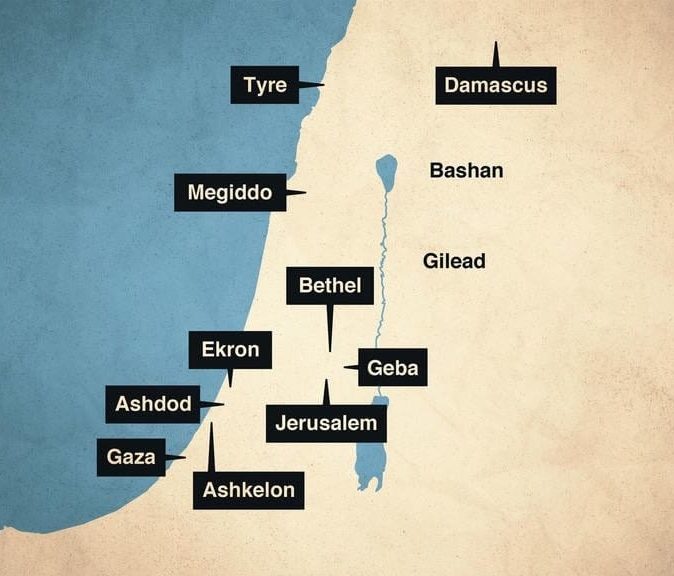
Yahweh lists a variety of cities surrounding Jerusalem, from Damascus in the north to Ashkelon in the south. He begins His list in the north in the region known as Hadrach, but He focuses His oracle on the city of Damascus. From there, Yahweh moves south, listing the names of additional doomed cities as He makes His way to Ashdod, Ashkelon, and Gaza. This north-to-south route is significant because it mirrors the path the Assyrians and Babylonians took when they conquered Israel and Judah. Earlier prophets had predicted the coming destruction of the northern and southern kingdoms by these two nations, a fate ordained by God for His people’s continued rebellion against Him.

“But I have stirred up a leader who will approach from the north.
From the east he will call on my name.
I will give him victory over kings and princes.
He will trample them as a potter treads on clay. – Isaiah 41:25 NLT

“Yes,” the Lord said, “for terror from the north will boil out on the people of this land. Listen! I am calling the armies of the kingdoms of the north to come to Jerusalem. I, the Lord, have spoken!

“They will set their thrones
at the gates of the city.
They will attack its walls
and all the other towns of Judah.
I will pronounce judgment
on my people for all their evil—
for deserting me and burning incense to other gods.
Yes, they worship idols made with their own hands! – Jeremiah 1:14-16 NLT

“This is what the Sovereign Lord says: From the north I will bring King Nebuchadnezzar of Babylon against Tyre. He is king of kings and brings his horses, chariots, charioteers, and great army. First he will destroy your mainland villages. Then he will attack you by building a siege wall, constructing a ramp, and raising a roof of shields against you.He will pound your walls with battering rams and demolish your towers with sledgehammers. The hooves of his horses will choke the city with dust, and the noise of the charioteers and chariot wheels will shake your walls as they storm through your broken gates. His horsemen will trample through every street in the city. They will butcher your people, and your strong pillars will topple. – Ezekiel 7:7-11 NLT

Yahweh is announcing His intention to take the same path of destruction to mete out judgment upon the enemies of His people. He will begin in the north with Damascus and work His way down the coast to the land of the Philistines.

This prophecy was partially fulfilled in 333 B.C. when Alexander the Great passed through the region on his way to Egypt. He focused his attention on the coastal cities, destroying all ports used by the Achaemenid Empire but leaving the Jews relatively undisturbed. Alexander’s march to the south left many of these same cities destroyed but they would eventually rise from the ashes and continue their mistreatment of the people of Israel. What Yahweh has in store for them will be far more destructive and permanent than anything they suffered at the hands of the Greeks.

The English Standard Version translates verse 1 as “the LORD has an eye on mankind and on all the tribes of Israel.” While it is obvious that the all-knowing, all-seeing Yahweh is always watching over the affairs of men, most translators render this verse differently.

…the eyes of humanity, including all the tribes of Israel, are on the LORD. – NLT

…the eyes of men and of all the tribes of Israel are upon the LORD. – BSB

…for the eyes of mankind, especially of all the tribes of Israel, are toward the LORD. – NASB

This human-based perspective is important because it indicates that all will know and understand that this future judgment is the work of Yahweh. Everyone will comprehend the divine nature of the destruction. This won’t be the work of some world super-power, it will be the hand of Adonai, the LORD of Hosts.

the Lord will strip away Tyre’s possessions
and hurl its fortifications into the sea,
and it will be burned to the ground.– Zechariah 9:4 NLT

The city of Ashkelon will see Tyre fall
and will be filled with fear.
Gaza will shake with terror,
as will Ekron, for their hopes will be dashed.
Gaza’s king will be killed,
and Ashkelon will be deserted.– Zechariah 9:4 NLT

These powerful, wealthy, and influential cities will suffer fear, humiliation, and elimination at the hands of Israel’s God. Their wealth will do them no good. Their armies will be impotent and unable to defend them. The once-great Philistine empire that had plagued the people of Israel for centuries would fall, never to rise again. The oracle even predicts the conversion of any Philistines who manage to make it out alive.

Then the surviving Philistines will worship our God
    and become like a clan in Judah.
The Philistines of Ekron will join my people,
    as the ancient Jebusites once did. – Zechariah 9:7 NLT

The content of this oracle must have been difficult for Zechariah to get his head around. It was good news but it all sounded so far-fetched and impossible. It didn’t get any more believable when God claimed, “I will guard my Temple and protect it from invading armies. I am watching closely to ensure that no more foreign oppressors overrun my people’s land” (Zechariah 9:8 NLT).

God was telling Zechariah incredible news regarding Israel’s future. Not only will Israel be restored, Jerusalem rebuilt, and the Temple completed, but the people of Israel will prosper, filling the land, and serving Him faithfully. Things were going to be radically different. Instead of punishing His people as He had done in the past, God was going to bless them abundantly and restore them to favor. This news had to be difficult for Zechariah to comprehend as he looked around at a partially completed foundation on the Temple, the broken-down walls, and the demoralized remnant who struggled to fulfill the task God had given them due to the scope of the project and the presence of opposition. Yet, Yahweh had assured Zechariah that He was the God of the impossible.

“This is what the Lord of Heaven’s Armies says: All this may seem impossible to you now, a small remnant of God’s people. But is it impossible for me? says the Lord of Heaven’s Armies.” – Zechariah 8:6 NLT

It’s as if God said, “I know this doesn’t look so good right now, but don’t judge Me based on what you see.” Yahweh wanted Zechariah to focus on His promises, not the pressing problems that seemed to never go away.

Yahweh knew that Zechariah and the beleaguered people of Judah were struggling to keep the faith. They were growing weary and questioning whether all their hard work would be worth it. So, God pointed them to the future. He predicted a brighter tomorrow that was beyond their powers of comprehension. But He had proven Himself faithful in the past and could be trusted to fulfill His plans for the future.

Yet, God’s people have always struggled with doubt and the inability to take God at His word. Even today, those who claim to believe in an all-powerful, promise-keeping God, find themselves wondering where He is and what He is doing. They take a look at their current circumstances and make sweeping judgments regarding everything from God’s faithfulness and presence to His love and power. When things don’t go well, God’s people automatically assume that He is either angry or oblivious to their needs. He is upset and punishing them. He is out of touch and ignorant of them. Their prayers don’t get answered, so they conclude He does not hear or does not care.

In time, their view of life begins to influence their view of God. In a sense, Yahweh tells Zechariah, “I know this all seems impossible to you right now. After all, there’s just a handful of you and the job is far from complete. BUT THIS ISN’T ABOUT YOU!”

The point of it all was that God could do the impossible. He knew what was going on and was well aware of the situation taking place in Jerusalem. He had a full grasp of the facts regarding the status of the Temple, the presence of opposition, the size of the workforce, and the condition of their hearts. Which explains the depth and detail of His message to Zechariah.

He told Zechariah, “Be strong and finish the task!” (Zechariah 8:9 NLT) and “Don’t be afraid. Be strong, and get on with rebuilding the Temple” (Zechariah 8:13 NLT). It wasn’t about their strength and ability to get things done, it was about their faith and trust in a God who could do ANYTHING. They just needed to do what He had called them to do and leave the rest up to Him. God had returned them to the promised land, provided a royal edict to secure their work, and secured the funds to pay for the entire restoration project. He had done His part but they had failed to complete theirs. It was far too easy for them to look at their relative lack of success and the overwhelming size of the task and become disillusioned.

The same thing can be true of us. We get overwhelmed by circumstances and begin to feel we are in over our heads. We start to wonder if God is with us at all. But whenever we think it’s all up to us, we miss the point. Nothing is impossible for God. There is nothing He can’t handle. There is nothing we face that is outside of His sovereign control and divine will. Like Zechariah and the people of Judah, we must constantly remind ourselves that nothing is impossible for God. That’s the message we need to hear. There is nothing that He can’t do. There is not a single circumstance that is out of His ability or power to handle. And not only that, but nothing is impossible for God. That’s the message of the Bible. It is all about God, not us. It is about His power, His will, His promises, His faithfulness, His salvation, His Kingdom, and His ability to finish what He has begun and restore what is broken. Nothing is impossible for Him.

English Standard Version (ESV)
The Holy Bible, English Standard Version. ESV® Permanent Text Edition® (2016). Copyright © 2001 by Crossway Bibles, a publishing ministry of Good News Publishers.

New Living Translation (NLT)
Holy Bible, New Living Translation, copyright © 1996, 2004, 2015 by Tyndale House Foundation. Used by permission of Tyndale House Publishers Inc., Carol Stream, Illinois 60188. All rights reserved.

Worthy of Our Praise

1 David and the chiefs of the service also set apart for the service the sons of Asaph, and of Heman, and of Jeduthun, who prophesied with lyres, with harps, and with cymbals. The list of those who did the work and of their duties was: Of the sons of Asaph: Zaccur, Joseph, Nethaniah, and Asharelah, sons of Asaph, under the direction of Asaph, who prophesied under the direction of the king. Of Jeduthun, the sons of Jeduthun: Gedaliah, Zeri, Jeshaiah, Shimei, Hashabiah, and Mattithiah, six, under the direction of their father Jeduthun, who prophesied with the lyre in thanksgiving and praise to the Lord. Of Heman, the sons of Heman: Bukkiah, Mattaniah, Uzziel, Shebuel and Jerimoth, Hananiah, Hanani, Eliathah, Giddalti, and Romamti-ezer, Joshbekashah, Mallothi, Hothir, Mahazioth. All these were the sons of Heman the king’s seer, according to the promise of God to exalt him, for God had given Heman fourteen sons and three daughters. They were all under the direction of their father in the music in the house of the Lord with cymbals, harps, and lyres for the service of the house of God. Asaph, Jeduthun, and Heman were under the order of the king. The number of them along with their brothers, who were trained in singing to the Lord, all who were skillful, was 288. And they cast lots for their duties, small and great, teacher and pupil alike.

The first lot fell for Asaph to Joseph; the second to Gedaliah, to him and his brothers and his sons, twelve; 10 the third to Zaccur, his sons and his brothers, twelve; 11 the fourth to Izri, his sons and his brothers, twelve; 12 the fifth to Nethaniah, his sons and his brothers, twelve; 13 the sixth to Bukkiah, his sons and his brothers, twelve; 14 the seventh to Jesharelah, his sons and his brothers, twelve; 15 the eighth to Jeshaiah, his sons and his brothers, twelve; 16 the ninth to Mattaniah, his sons and his brothers, twelve; 17 the tenth to Shimei, his sons and his brothers, twelve; 18 the eleventh to Azarel, his sons and his brothers, twelve; 19 the twelfth to Hashabiah, his sons and his brothers, twelve; 20 to the thirteenth, Shubael, his sons and his brothers, twelve; 21 to the fourteenth, Mattithiah, his sons and his brothers, twelve; 22 to the fifteenth, to Jeremoth, his sons and his brothers, twelve; 23 to the sixteenth, to Hananiah, his sons and his brothers, twelve; 24 to the seventeenth, to Joshbekashah, his sons and his brothers, twelve; 25 to the eighteenth, to Hanani, his sons and his brothers, twelve; 26 to the nineteenth, to Mallothi, his sons and his brothers, twelve; 27 to the twentieth, to Eliathah, his sons and his brothers, twelve; 28 to the twenty-first, to Hothir, his sons and his brothers, twelve; 29 to the twenty-second, to Giddalti, his sons and his brothers, twelve; 30 to the twenty-third, to Mahazioth, his sons and his brothers, twelve; 31 to the twenty-fourth, to Romamti-ezer, his sons and his brothers, twelve. – 1 Chronicles 25:1-31 ESV

David had a strong attention to detail. In his effort to make preparations for the future Temple, he left no matter unattended, carefully covering all his bases so that everything about the house of God was taken care of. As this chapter reveals, he even included the appointment of men who would ensure that the worship of God was accompanied by music. This was not a feature of the Tabernacle and does not seem to have been ordained by God but David, who was a musician himself, understood the power of musical instruments to enhance one’s worship of God.

This was not music for music’s sake but was intended to accompany those who prophesied in the name of the Lord.

David …appointed men from the families of Asaph, Heman, and Jeduthun to proclaim God’s messages to the accompaniment of lyres, harps, and cymbals. – 1 Chronicles 25:1 NLT

David appointed various men “who proclaimed God’s messages by the king’s orders” (1 Chronicles 25:2 NLT). This included Asaph, Jeduthun, and Heman, who was the king’s seer. As these men prophesied, they were to be accompanied by their sons who provided “music in the house of the Lord with cymbals, harps, and lyres for the service of the house of God” (1 Chronicles 25:6 ESV). Those who were chosen for this special service were accomplished musicians.

They and their families were all trained in making music before the Lord, and each of them—288 in all—was an accomplished musician. – 1 Chronicles 25:7 NLT

The Temple David had dreamed of building would be more than just a place to offer sacrifices; it would feature the perpetual worship of God. He would be the solitary focus within its walls 24 hours a day, seven days a week. The men listed in this chapter were worship leaders responsible for speaking the truth of God set to music. In essence, they formed a temple choir to praise God through music and song.  Music, always near and dear to David’s heart, would play a significant role in the new Temple that Solomon would construct.

The Temple is most often associated with the sacrificial system and the Holy of Holies, that innermost room where the presence of God dwelt above the Mercy Seat. But as this passage indicates, there was so much more to Temple worship than animal sacrifices. The building was an incredible sight to behold with its magnificent gold overlays, tapestries, pillars, and ornate furnishings. But it was to be a feast for the ears as much as it was for the eyes. Music would fill the structure through the artful blending of musical instruments and human voices, and the music was to accompany the prophesying of God’s truth.

Visiting the completed Temple would have been a sensory overload – filled with sights and sounds designed to praise and bring glory to God. He was the focus. Walking into the temple would have left little doubt that God was the center of attention. The sacrifices were for Him, but so was the music. The entire structure was designed with Him in mind.

Consider the difference between then and now. Today, so much of what takes place within the typical “house of God” is about the worshipers and not the One being worshiped. Our churches are built with our comfort in mind and intended to accommodate our needs. In many ways, even the music is designed to entertain and encourage us. The sermons are written and delivered for our benefit. Rather than lifting up the name of God and celebrating the Word of God, many messages delivered from pulpits across our country have become little more than positive motivational speeches or Ted Talks filled with tips on living a better life. While the buildings themselves may be impressive architecturally, they do little to lift up and glorify God. Sadly to say, they have become man-centered, rather than God-honoring.

Yet David was not interested in building a place where men could feel encouraged and entertained. He wanted to create a house suitable for his God, where everything pointed to the glory and majesty of God. It was to be magnificent in every detail because David’s God was transcendent and majestic. From the smallest brick laid to the highest note played, everything about the Temple was to be about God because He alone was worthy.

Psalm 150 declares the purpose behind David’s efforts to equip God’s house with a living sound system that would fill its corridors and rooms with music and messages that reflect God’s truth and worthiness.

Praise him with a blast of the ram’s horn;
    praise him with the lyre and harp!
Praise him with the tambourine and dancing;
    praise him with strings and flutes!
Praise him with a clash of cymbals;
    praise him with loud clanging cymbals.
Let everything that breathes sing praises to the Lord!

Praise the Lord! – Psalm 150:3-6 NLT

English Standard Version (ESV)
The Holy Bible, English Standard Version. ESV® Permanent Text Edition® (2016). Copyright © 2001 by Crossway Bibles, a publishing ministry of Good News Publishers.

New Living Translation (NLT)
Holy Bible, New Living Translation, copyright © 1996, 2004, 2015 by Tyndale House Foundation. Used by permission of Tyndale House Publishers Inc., Carol Stream, Illinois 60188. All rights reserved.

The Most Important Thing About You

What do you know about God? If someone asked you to describe your understanding of who God is and how He operates in the world, what would you tell them? It was A. W. Tozer who wrote, “What comes into our minds when we think about God is the most important thing about us” (A. W. Tozer, The Knowledge of the Holy). But far too often, we think far too little about God. Even when He comes to mind our thoughts about Him can be inaccurate or simply incomplete.
Tozer goes on to say, “It is impossible to keep our moral practices sound and our inward attitudes right while our idea of God is erroneous or inadequate. If we would bring back spiritual power to our lives, we must begin to think of God more nearly as He is” (A. W. Tozer, The Knowledge of the Holy).
So, the question before us is “What is the nature of our God?” This is not the kind of question one should take lightly because the answer will reveal much about an individual’s moral well-being. Our view of God is the lens through which we view and understand the world. Once again, Tozer provides insight into this matter.

“…no people has ever risen about its religion, and man’s spiritual history will positively demonstrate that no religion has ever been greater than its idea of God. Worship is pure or base as the worshiper entertains high or low thoughts of God.” (A. W. Tozer, The Knowledge of the Holy)

Determining our view of God is a worthy exercise that will pay dividends in the future. It will force us to face our errant ideas about the Almighty and bring them into alignment with what the Scriptures have to say about Him. Interestingly, God’s Word is one of the places where humanity is encouraged to question His identity and character.

To whom then will you liken God,
    or what likeness compare with him? Isaiah 40:18 ESV

“To whom will you liken me and make me equal, and compare me, that we may be alike?” – Isaiah 46:5 ESV

Who is like you, O LORD, among the gods? Who is like you, majestic in holiness, awesome in glorious deeds, doing wonders? – Exodus 15:11 ESV

Who is a God like you, pardoning iniquity and passing over transgression for the remnant of his inheritance? – Micah 7:18 ESV

If we’re honest, there is much about God of which we are ignorant or, perhaps, indifferent. Some of us have known Him for decades but, if put to the test, there would be little we could share that could give evidence that we knew Him intimately. So much of what we know about God is academic in nature, a compilation of disconnected bits of information that bear little resemblance to the one true God.

If I asked you if you knew the President of the United States, you would probably respond by telling me his name. If pressed, you could probably tell me the year he was elected, his political party affiliation, his wife’s name, and your personal assessment of his administration’s policies and programs. Your knowledge of him would have been gleaned from news reports, the op-ed section of the local paper, and from the opinions of others. You would have had no personal encounters with him. No one-on-one conversations would have taken place between the two of you. Any claim to truly know him would be a stretch of the imagination.

Sadly, it’s likely that the average Christian has more familiarity with the Commander-in-Chief of our nation than they do with God. Some of us spend far more time keeping up with the Kardashians than we do with the Creator God. We live in the information age, a time when access to knowledge about virtually any topic or individual is at our fingertips. And yet, we suffer from a lack of intimacy with and intelligence about God.

The goal of this series of posts is to help us get to know our God better. To do so, we will explore the attributes of God that He alone possesses. As the verses above so clearly state, our God is without equal and totally incomparable. He is not one among many; He is the solitary and sovereign God of the universe whose power, knowledge, and all-pervading presence are unparalleled and non-reproducible. God can be mimicked but never matched. He is, to put it mildly, one of a kind. Yet, how easy it is to treat Him with a familiarity that borders on contempt.

To know God. That was the divinely ordained objective when God created Adam and Eve in the garden. They were made so that they might enjoy unbroken fellowship and undiminished intimacy with Him. But sin changed all that. Because the first man and woman chose to disobey God, they were banned from His presence. They found themselves cast from the garden and operating in isolation far from the one who had made them. And with each succeeding generation, humanity moved further and further away from the garden and, at the same time, far from the presence of God.

But God still desires for men to know Him, not just cognitively but intimately and personally. As the apostle Paul points out, God has revealed Himself in the universe He created. He has placed signs of His presence and proofs of His character all around us. Yet, most of humanity has remained blind to the evidence and oblivious concerning the God to whom it points.

They know the truth about God because he has made it obvious to them. For ever since the world was created, people have seen the earth and sky. Through everything God made, they can clearly see his invisible qualities—his eternal power and divine nature. So they have no excuse for not knowing God.

Yes, they knew God, but they wouldn’t worship him as God or even give him thanks. And they began to think up foolish ideas of what God was like. As a result, their minds became dark and confused. Claiming to be wise, they instead became utter fools. And instead of worshiping the glorious, ever-living God, they worshiped idols made to look like mere people and birds and animals and reptiles. – Romans 1:19-23 NLT

Despite the sobering nature of Paul’s words, the prophet Jeremiah points out that God still longs for mankind to know Him, and he intimates that this relationship with God is not only possible but preferable.

This is what the Lord says:
“Don’t let the wise boast in their wisdom,
    or the powerful boast in their power,
    or the rich boast in their riches.
But those who wish to boast
    should boast in this alone:
that they truly know me and understand that I am the Lord
    who demonstrates unfailing love
    and who brings justice and righteousness to the earth,
and that I delight in these things.
    I, the Lord, have spoken!” – Jeremiah 9:23-24 NLT

God is knowable but He is also irreplicable. There is nothing in all creation that remotely resembles Him. Even men, who are made in the image of God, are not mini versions of God. We can reflect His glory but are incapable of sharing it.  Even in His thought processes, God remains distinctly different from humanity.

“My thoughts are nothing like your thoughts,” says the Lord.
    “And my ways are far beyond anything you could imagine.
For just as the heavens are higher than the earth,
    so my ways are higher than your ways
    and my thoughts higher than your thoughts.” – Isaiah 55:8-9 NLT

Yet, we tend to view God as little more than a slightly more powerful version of ourselves. Because of the finite nature of our minds, we are incapable of fully grasping the “otherness” of God. Unable to comprehend His transcendence, we try to transform the incomparable God into a new and improved version of ourselves. The psalmist alludes to this common misconception when he quotes God’s assessment of man’s dumbing down of His divine image.

“…you thought that I was one like yourself.” – Psalm 50:21 ESV

The French agnostic, Voltaire is reported to have said, “God created man in His own image, and man returned the favor.” And his rather sarcastic statement supports what Paul wrote in his letter to the Romans.

…they knew God, but they wouldn’t worship him as God or even give him thanks. And they began to think up foolish ideas of what God was like. As a result, their minds became dark and confused. Claiming to be wise, they instead became utter fools. And instead of worshiping the glorious, ever-living God, they worshiped idols made to look like mere people and birds and animals and reptiles. – Romans 1:21-23 NLT

Failure to know and recognize God for who He is creates a vacuum in the soul of man that must be filled. When we neglect a proper understanding of God, we end up with false views of His character. We fabricate our own version of Him, leaving us with an emasculated, impotent deity who looks nothing like the God of the Bible.

Psalm 97:9 describes God as “most high over all the earth” and as “exalted far above all gods.” He is transcendent. That simply means that He is totally distinct from all that He has made. He cannot be reproduced and there is nothing that remotely mirrors His likeness. Psalm 99:2 adds that God “is exalted over all the peoples.” Men are not mini-gods. Being made in His image does not infer that we resemble God. That is why Isaiah 40:18 asks the rhetorical question: “To whom then will you liken God, or what likeness compare with him?” The answer is “No one and nothing!” God alone is God.

God needs nothing. He has no lack or insufficiencies. He requires no complement or counterpart to complete Himself. He did not create humanity because He was lonely or needed companionship. Nothing was missing in God’s character; His being is whole and holy. The apostle John reminds us, “God is light, and in him is no darkness at all” (1 John 1:5 ESV). Timothy adds, “He alone is immortal and dwells in unapproachable light” (1 Timothy 6:16 BSB).

Yet, God has made Himself known to men. He has displayed His divine attributes through the universe He has made. We are surrounded by the evidence of His power, glory, wisdom, creativity, grace, mercy, and love. Our very existence is proof that He exists. Even man, with his vast knowledge and scientific discoveries, has been unable to explain the universe’s existence. Our most educated and well-reasoned theories are little more than shots in the dark.

In the book of Job, we have recorded the words of God as He confronts the arrogance and audacity of mere humans who question His will and His work.

“Who is this that questions my wisdom
    with such ignorant words?
Brace yourself like a man,
    because I have some questions for you,
    and you must answer them.

“Where were you when I laid the foundations of the earth?
    Tell me, if you know so much.
Who determined its dimensions
    and stretched out the surveying line?
What supports its foundations,
    and who laid its cornerstone
as the morning stars sang together
    and all the angels shouted for joy?

“Who kept the sea inside its boundaries
    as it burst from the womb,
and as I clothed it with clouds
    and wrapped it in thick darkness?
For I locked it behind barred gates,
    limiting its shores.
I said, ‘This far and no farther will you come.
    Here your proud waves must stop!’” – Job 38:2-11 NLT

Man has no business questioning God or trying to explain the existence of the universe apart from God. Everything, both the invisible and the visible, exists by the expressed will of God. He spoke and it came into being, and all that He made God reveals His glory and greatness. But that points out one of the most important aspects of God’s nature. He must reveal Himself to man to be known by man. Humanity cannot discover God on its own. Left to his own devices, no man would even attempt to find God. According to the apostle Paul, “no one seeks for God” (Romans 3:11 ESV), and his assessment echoes the words of David.

God looks down from heaven
    on the entire human race;
he looks to see if anyone is truly wise,
    if anyone seeks God.
But no, all have turned away;
    all have become corrupt. – Psalm 53:2-3 NLT

Amazingly enough, this transcendent, invisible, and unfathomable God has chosen to reveal Himself to man. And we will see more of His divine attributes on display as we continue our quest to know God better.

English Standard Version (ESV)
The Holy Bible, English Standard Version. ESV® Permanent Text Edition® (2016). Copyright © 2001 by Crossway Bibles, a publishing ministry of Good News Publishers.

New Living Translation (NLT)
Holy Bible, New Living Translation, copyright © 1996, 2004, 2015 by Tyndale House Foundation. Used by permission of Tyndale House Publishers Inc., Carol Stream, Illinois 60188. All rights reserved.

Facing the Giants

15 There was war again between the Philistines and Israel, and David went down together with his servants, and they fought against the Philistines. And David grew weary. 16 And Ishbi-benob, one of the descendants of the giants, whose spear weighed three hundred shekels of bronze, and who was armed with a new sword, thought to kill David. 17 But Abishai the son of Zeruiah came to his aid and attacked the Philistine and killed him. Then David’s men swore to him, “You shall no longer go out with us to battle, lest you quench the lamp of Israel.”

18 After this there was again war with the Philistines at Gob. Then Sibbecai the Hushathite struck down Saph, who was one of the descendants of the giants. 19 And there was again war with the Philistines at Gob, and Elhanan the son of Jaare-oregim, the Bethlehemite, struck down Goliath the Gittite, the shaft of whose spear was like a weaver’s beam. 20 And there was again war at Gath, where there was a man of great stature, who had six fingers on each hand, and six toes on each foot, twenty-four in number, and he also was descended from the giants. 21 And when he taunted Israel, Jonathan the son of Shimei, David’s brother, struck him down. 22 These four were descended from the giants in Gath, and they fell by the hand of David and by the hand of his servants. 2 Samuel 21:15-22 ESV

It is impossible to tell from the text at what point these events occurred in David’s reign. It is assumed that they took place in the early days of his kingship, but there is no definitive proof to support that position. As part of the “appendix” to the book, these stories are intended to provide the reader with an overview of David’s reign. As the author wraps up his chronicle of David’s life, he includes these colorful and captivating “snap shots” that capture key moments along the way.

Throughout his years as Israel’s God-appointed leader, David faced ongoing conflicts with the dreaded Philistines. His first encounter with these perennial foes of the Israelites took place in the valley of Elah. King Saul and the Israelite army were camped in the valley of Elah, preparing to face off with the Philistines. David, fresh off his anointing by the prophet of God, showed up at the Israelite camp with orders from his father to check on the welfare of his brothers. David was a young shepherd boy with no military experience, but he was shocked to find the entire Israelite army paralyzed by the threats of a brash and loud-mouthed Philistine named Goliath. This giant of a man had been taunting Saul and his troops, demanding that they send out a worthy opponent to face him in hand-to-hand combat. It would be a winner-takes-all affair with an extremely costly outcome for the losing side; they would be forced to become their enemy’s slaves.

As the story goes, David stepped up and volunteered to take on the giant. His brothers ridiculed him and King Saul doubted him. But, with no other viable options to which to turn, Saul eventually gave David permission to face Goliath. The rest, as they say, is history. David miraculously won the contest with nothing more than a slingshot and five smooth stones. He killed the giant and saved the day. But it seems that the Philistines never kept their end of the agreement. Rather than surrender to the Israelites, they panicked and ran. The Israelites slaughtered many of the Philistines and pillaged their camp, but the conflict between these two nations was far from over.

The closing verses of chapter 21 provide insight into the ongoing war David waged with the Philistines. His victory over Goliath, while epic in nature, did not eliminate the Philistine threat. Even during the years when he was forced to escape the wrath of King Saul, David continued to fight with the Philistines. On two separate occasions, David sought refuge among his mortal enemies in an attempt to escape the armed mercenaries who had been sent by Saul to take his life. Yet David would discover that there was no hope of forming alliances with these sworn enemies of Israel.

Ever since his days as the young shepherd boy, David had been in constant war with the Philistines. And it seems that the Philistines held a special disdain for David because of his defeat of their beloved champion, Goliath. They never forgot how David’s unexpected victory had rallied the Israelite army and turned the tide of the battle. Over the years, their hatred for David only intensified and their attacks on the Israelites increased. In this chapter, the author introduces us to four of Goliath’s big-boned relatives who made the defeat of the Israelites a personal matter.

There was Ishbi-benob, Saph, Goliath, and another unidentified man who was born with 12 toes and 12 fingers. Each of these men was larger than life, both literally and figuratively, and posed a real threat to David and the nation of Israel. But they fell at the hands of David’s men. Their massive size and formidable weapons were no match for the mighty men of David. But why? It would be tempting to make this all about the four men who accomplished these mighty deeds on behalf of David and the nation of Israel: Abishai, Sibbecai, Elhanan, and Jonathan.

Chapter 23 will even introduce us to the “mighty men of David,” a select group of individuals who displayed almost supernatural military prowess. But rather than put our focus on these men, we should immediately recognize the hand of God. The victories of Israel over the Philistines and their seemingly endless line of champions were due to God, not the efforts of these men. Yes, they had to fight. They were required to go into battle against superior adversaries and risk life and limb, but their victory was due to God, not themselves. Verse 22 states, “These four were descended from the giants in Gath, and they fell by the hand of David and by the hand of his servants.” But once again, their victories were made possible by God. The author’s emphasis on each Philistine’s larger-than-normal size and bigger-than-usual weapons is meant to paint a picture of impossible odds. Yet, David’s men came out victorious.

It’s interesting to note that the author claims that these Philistines “fell by the hand of David and by the hand of his servants.” Yet, it doesn’t appear that David played any part in the deaths of these four Philistine champions. In fact, out of concern for his safety, David’s men forbade him from accompanying them in battle.

“You are not going out to battle with us again! Why risk snuffing out the light of Israel?” – 2 Samuel 21:17 NLT

But because of his role as king, David is given credit for the deaths of these Philistine warriors. His faithful and fearless warriors fought on his behalf and gladly shared with him the glory of their victories.

Once again, it is unclear when all these duels between David’s men and the Philistines took place. It doesn’t appear that they occurred at the same time or in one epic battle. These were ongoing encounters between the disgruntled relatives of Goliath who longed to avenge the legacy of their fallen family member. The text makes it clear that these were not normal foes; they were “descended from the giants” (2 Samuel 21:20 ESV). The Hebrew word translated as “giants” is Rephaim, but its etymology is unclear. “Whatever the origin of the Rephaim, it is certain that a race of ‘giants’ — strong, tall people—did exist at one time, and many cultures had dealings with them” (“Who Were the Rephaim” GotQuestions.org. https://www.gotquestions.org/who-were-the-rephaim.html).

Regardless of the genetic background of these men, the vital point of the story is their defeat at the hands of David’s men. But these victories over seemingly supernatural foes are really the handiwork of God Almighty. Even in his defeat of Goliath, David knew that his success had been God’s doing and not his own. Even as David faced off with Goliath in the valley of Elah, he warned his foe, “You come to me with sword, spear, and javelin, but I come to you in the name of the Lord of Heaven’s Armies—the God of the armies of Israel, whom you have defied. Today the Lord will conquer you, and I will kill you and cut off your head. And then I will give the dead bodies of your men to the birds and wild animals, and the whole world will know that there is a God in Israel!” (2 Samuel 17:45-46 NLT).

David’s reign would be marked by war and his battles against the enemies of Israel would never end. This perpetual state of warfare was the direct result of Israel’s failure to obey God and rid the land of all its inhabitants. Centuries earlier, under the leadership of Joshua, they had been ordered by God to eradicate all the pagan people groups that occupied the land that was to be their inheritance. Their partial obedience to God’s command had allowed nations like the Philistines to remain alive and well in the land. As a result, David was left with the task of finishing what Joshua had begun, and his battles would last the entirety of his reign. It would be his son Solomon who would reign over a kingdom marked by peace. But David’s tenure as king would be one of constant war and bloodshed. Yet God would be with him and that is the message found within these verses.

What should really stand out is God’s unwavering faithfulness in the face of so much unfaithfulness on the part of David and the people of Israel. David’s victories were the result of God’s grace and mercy, and not because David was a faithful and fully obedient servant. David didn’t earn or deserve his success as a military commander. He didn’t merit the expansion of his kingdom. God was blessing him in spite of him. Time and time again, David failed God in sometimes epic fashion. But God remained faithful to His promises to David. It would have been easy for the men of David to make much of their individual successes. They could have, and probably did, brag about their victories over superior enemies. But the message for us is one of dependence upon God. Our victories are His doing. Our successes are His alone. We are only as great as our God. To be victorious we must understand that our God is glorious.

English Standard Version (ESV) The Holy Bible, English Standard Version. ESV® Permanent Text Edition® (2016). Copyright © 2001 by Crossway Bibles, a publishing ministry of Good News Publishers.

New Living Translation (NLT) Holy Bible, New Living Translation, copyright © 1996, 2004, 2015 by Tyndale House Foundation. Used by permission of Tyndale House Publishers Inc., Carol Stream, Illinois 60188. All rights reserved.

Give God Glory Rather Than Advice

19 “Where is the way to the dwelling of light,
    and where is the place of darkness,
20 that you may take it to its territory
    and that you may discern the paths to its home?
21 You know, for you were born then,
    and the number of your days is great!

22 “Have you entered the storehouses of the snow,
    or have you seen the storehouses of the hail,
23 which I have reserved for the time of trouble,
    for the day of battle and war?
24 What is the way to the place where the light is distributed,
    or where the east wind is scattered upon the earth?

25 “Who has cleft a channel for the torrents of rain
    and a way for the thunderbolt,
26 to bring rain on a land where no man is,
    on the desert in which there is no man,
27 to satisfy the waste and desolate land,
    and to make the ground sprout with grass?

28 “Has the rain a father,
    or who has begotten the drops of dew?
29 From whose womb did the ice come forth,
    and who has given birth to the frost of heaven?
30 The waters become hard like stone,
    and the face of the deep is frozen.

31 “Can you bind the chains of the Pleiades
    or loose the cords of Orion?
32 Can you lead forth the Mazzaroth in their season,
    or can you guide the Bear with its children?
33 Do you know the ordinances of the heavens?
    Can you establish their rule on the earth?

34 “Can you lift up your voice to the clouds,
    that a flood of waters may cover you?
35 Can you send forth lightnings, that they may go
    and say to you, ‘Here we are’?
36 Who has put wisdom in the inward parts
    or given understanding to the mind?
37 Who can number the clouds by wisdom?
    Or who can tilt the waterskins of the heavens,
38 when the dust runs into a mass
    and the clods stick fast together?

39 “Can you hunt the prey for the lion,
    or satisfy the appetite of the young lions,
40 when they crouch in their dens
    or lie in wait in their thicket?
41 Who provides for the raven its prey,
    when its young ones cry to God for help,
    and wander about for lack of food?– Job 38:19-41 ESV

God finally speaks. Job has heard from his three friends and Elihu, the young, arrogant upstart. But now he hears from the only one who matters; God Himself. And God’s response is full of not-so-subtle sarcasm as He peppers Job with rhetorical questions designed to accentuate His divine nature. He starts out His response to Job by saying, “Brace yourself, because I have some questions for you, and you must answer them” (Job 38:3 NLT). God tells Job to brace himself like a man because He has a few questions for him. “Who are you…?” “Where were you when…” “Have you ever…?” “Can you…?” “Do you know…?”

At one point, God’s sarcasm becomes painfully clear and pointed. He sardonically states, “But of course you know all this! For you were born before it was all created, and you are so very experienced!” (Job 38:21 NLT).

God is questioning Job’s right to question Him. Who is Job, a mere man, to question the intentions and integrity of the holy, righteous, all-powerful, God of the universe? Every one of His questions is a statement of His sovereignty and superiority. He is providing Job and his four friends with a much-needed reminder of His surpassing greatness. God’s emphasis on nature is intended to get Job’s focus off of himself. His myopic and rather morbid perspective has tainted his view of God, and produced faulty reasoning and a fragile faith.

“The function of the questions needs to be properly understood. As a rhetorical device, a question can be another way of making a pronouncement, much favoured by orators. For Job, the questions in the Lord’s speeches are not such roundabout statements of fact; they are invitations, suggestions about discoveries he will make as he tries to find his own answers. They are not catechetical, as if Job’s knowledge is being tested. They are educative, in the true and original meaning of that term. Job is led out into the world. The questions are rhetorical only in the sense that none of them has any answer ventured by Job. But this is not because the questions have no answers. Their initial effect of driving home to Job his ignorance is not intended to humiliate him. On the contrary the highest nobility of every person is to be thus enrolled by God Himself in His school of Wisdom. And the schoolroom is the world! For Job the exciting discoveries to which God leads him bring a giant advance in knowledge, knowledge of himself and of God, for the two always go together in the Bible.” – Francis I. Andersen,
Job

By drawing Job’s attention to the wonders of creation, God is showcasing His power and providential care. There are wonders surrounding Job that reveal just how great and good God really is. The presence of light and dark are the handiwork of God. From the human perspective, these elements simply appear in the sky and little thought is given as to their source. But God demands that Job explain where light comes from and where the darkness goes in the morning. Then He sarcastically adds, “But of course you know all this! For you were born before it was all created, and you are so very experienced!” (Job 38:21 NLT).

God is not being mean; He is simply driving home the extents of the vast gulf between His own reality and man’s infallibility. He wants Job to contemplate the inconceivable greatness of the One who controls the entire universe and all it contains, including Job.

Job wants answer from God. He demands to know the source of his own pain and suffering, but God asks him, “Where is the path to the source of light? Where is the home of the east wind?” (Job 38:24 NLT). God is letting Job know that there are greater questions to consider other than the ones he keeps asking. If Job wants to understand the nature of his circumstances he needs to know his God, and a quick look at the creative order would provide Job a masters-level course in theology.

King David had graduated with honors from God’s divine school of wisdom, having learned the lessons of God’s greatness found in the world around him.

The heavens proclaim the glory of God.
    The skies display his craftsmanship.
Day after day they continue to speak;
    night after night they make him known.
They speak without a sound or word;
    their voice is never heard.
Yet their message has gone throughout the earth,
    and their words to all the world. – Psalm 19:1 NLT

And it was Jesus who used nature to teach His disciples the wonder of God’s providential care so that they might understand His unwavering faithfulness and their need for enduring faith.

“That is why I tell you not to worry about everyday life—whether you have enough food and drink, or enough clothes to wear. Isn’t life more than food, and your body more than clothing? Look at the birds. They don’t plant or harvest or store food in barns, for your heavenly Father feeds them. And aren’t you far more valuable to him than they are? Can all your worries add a single moment to your life?

“And why worry about your clothing? Look at the lilies of the field and how they grow. They don’t work or make their clothing, yet Solomon in all his glory was not dressed as beautifully as they are. And if God cares so wonderfully for wildflowers that are here today and thrown into the fire tomorrow, he will certainly care for you. Why do you have so little faith? – Matthew 6:25-30 NLT

God turns Job’s attention to the clouds that produce rain, ice, hail, thunder, and lightning. These everyday, commonplace meteorological events are not the result of chance but are the handiwork of God. The very presence of rain is a reminder of God’s faithfulness. Without it, nothing on earth would survive. Yet, God can turn life-giving rain into crop-destroying hail. He can transform a gentle rain into a torrential, flood-producing downpour that takes away life and livelihood. These kinds of occurrences are an inexplicable yet inescapable part of life on this planet, and so is human suffering.

God’s point seems to be that there are some things men will never fully comprehend. Despite our modern scientific capabilities and our incessant obsession with solving the riddle of the universe’s creation, there are certain aspects of God’s creative order that will remain a mystery to us. Job was earth-bound and suffered from a limited understanding of the heavens. He could see the stars and even know some of them by name, but he could not explain their existence or comprehend the magnitude of their number.

In a sense, Job had been trying to give God directions concerning the future of his own life. He wanted to provide the God of the universe with some helpful guidance regarding his future state. But God asks Job if he has any insight into the “the movement of the stars” (Job 38:31 NLT). If Job knows that is best for himself, can he also “direct the constellations through the seasons?” (Job 38:32 NLT). And the answer is clearly, “No!”

Job has no business giving God advice. He is in no place to tell God what to do. And to ensure that Job understands that point, God asks, “Do you know the laws of the universe? Can you use them to regulate the earth?” (Job 38:33 NLT). If the answer is no, then why does Job seem to believe he knows the laws concerning his own universe and how they should be used to regulate the affairs of his life?

Sometimes, a simple upward glance will help take our eyes off of the worries and concerns we face in this world. The prophet Isaiah echoes the words of God and provides a much-needed reminder to reminder to acknowledge the greatness of God rather than attempt to advise Him.

Who else has held the oceans in his hand?
    Who has measured off the heavens with his fingers?
Who else knows the weight of the earth
    or has weighed the mountains and hills on a scale?
Who is able to advise the Spirit of the Lord?
    Who knows enough to give him advice or teach him?
Has the Lord ever needed anyone’s advice?
    Does he need instruction about what is good?
Did someone teach him what is right
    or show him the path of justice? – Isaiah 40:12-14 NLT

And Isaiah recommends that we consider a bit of star-gazing before we resort to advice-giving. God doesn’t need our recommendations, but He is worthy of our veneration.

Look up into the heavens.
    Who created all the stars?
He brings them out like an army, one after another,
    calling each by its name.
Because of his great power and incomparable strength,
    not a single one is missing. – Isaiah 40:33 NLT

English Standard Version (ESV) The Holy Bible, English Standard Version. ESV® Permanent Text Edition® (2016). Copyright © 2001

New Living Translation (NLT) Holy Bible, New Living Translation, copyright © 1996, 2004, 2015 by Tyndale House Foundation. Used by permission of Tyndale House Publishers Inc., Carol Stream, Illinois 60188. All rights reserved.