The Power of God’s Presence

1 Then Solomon assembled the elders of Israel and all the heads of the tribes, the leaders of the fathers’ houses of the people of Israel, before King Solomon in Jerusalem, to bring up the ark of the covenant of the LORD out of the city of David, which is Zion. And all the men of Israel assembled to King Solomon at the feast in the month Ethanim, which is the seventh month. And all the elders of Israel came, and the priests took up the ark. And they brought up the ark of the LORD, the tent of meeting, and all the holy vessels that were in the tent; the priests and the Levites brought them up. And King Solomon and all the congregation of Israel, who had assembled before him, were with him before the ark, sacrificing so many sheep and oxen that they could not be counted or numbered. Then the priests brought the ark of the covenant of the LORD to its place in the inner sanctuary of the house, in the Most Holy Place, underneath the wings of the cherubim. For the cherubim spread out their wings over the place of the ark, so that the cherubim overshadowed the ark and its poles. And the poles were so long that the ends of the poles were seen from the Holy Place before the inner sanctuary; but they could not be seen from outside. And they are there to this day. There was nothing in the ark except the two tablets of stone that Moses put there at Horeb, where the LORD made a covenant with the people of Israel, when they came out of the land of Egypt. 10 And when the priests came out of the Holy Place, a cloud filled the house of the LORD, 11 so that the priests could not stand to minister because of the cloud, for the glory of the LORD filled the house of the LORD. 1 Kings 8:1-11 ESV

After nearly seven and a half years of construction, the temple was finally completed. The only thing left to do was to retrieve the Ark of the Covenant from its resting place in the City of David and transfer it to its new home within the Most Holy place of the new Temple. However, while this might sound like a relatively easy task, considering all the time, energy, and effort that went into building the Temple, it is actually a challenging and dangerous endeavor. As the son of David, Solomon would have been well aware of the stories surrounding his father’s past attempts to transport the Ark. He was not interested in repeating his father’s mistakes.

God had given Moses precise instructions on the proper way to move the Ark from one place to another. Because it was considered to be holy, it had to be handled with extreme care and treated with deep reverence. God had provided clear guidelines concerning both how and who was to transport the Ark and the other holy vessels.

“When the camp is to set out, Aaron and his sons shall go in and take down the veil of the screen and cover the ark of the testimony with it. Then they shall put on it a covering of goatskin and spread on top of that a cloth all of blue, and shall put in its poles.… And when Aaron and his sons have finished covering the sanctuary and all the furnishings of the sanctuary, as the camp sets out, after that the sons of Kohath shall come to carry these, but they must not touch the holy things, lest they die. These are the things of the tent of meeting that the sons of Kohath are to carry.” – Numbers 4:5-6, 15 ESV

Throughout the 40 years that the Israelites spent wandering in the wilderness, long before they settled in the land of Canaan, this was the method used to transport the Ark from place to place. But after Israel finally settled in the land of promise, the Ark had come to rest in the town of Kiriath-jearim, and was kept under the care of a man named Abinadab. When David became the second king of Israel and established Jerusalem as his capital, he determined to relocate the Ark and the Tent of Meeting (also known as the Tabernacle). So, he consulted with all his officials, including the generals and captains of his army, and then announced his plans to the people of Israel.

“If you approve and if it is the will of the LORD our God, let us send messages to all the Israelites throughout the land, including the priests and Levites in their towns and pasturelands. Let us invite them to come and join us. It is time to bring back the Ark of our God, for we neglected it during the reign of Saul.” – 1 Chronicles 13:2-3 NLT

Having received the unanimous support of the people, David organized an elaborate parade to accompany the Ark on its journey from the home of Abinadab to Jerusalem. It was a festive and joyous occasion, featuring music, dancing, and a worshipful celebration of God.

Then David and all Israel went to Baalah of Judah (also called Kiriath-jearim) to bring back the Ark of God, which bears the name of the Lord who is enthroned between the cherubim. They placed the Ark of God on a new cart and brought it from Abinadab’s house. Uzzah and Ahio were guiding the cart. David and all Israel were celebrating before God with all their might, singing songs and playing all kinds of musical instruments—lyres, harps, tambourines, cymbals, and trumpets. – 1 Chronicles 13:6-8 NLT

But the joy quickly turned to sorrow, and the dancing was replaced by mourning. David had disobeyed God’s commands. In his zeal to move the Ark of the Covenant, he had neglected to do so according to God’s clearly revealed will. As a result, tragedy struck.

But when they arrived at the threshing floor of Nacon, the oxen stumbled, and Uzzah reached out his hand and steadied the Ark of God. Then the LORD’s anger was aroused against Uzzah, and God struck him dead because of this. So Uzzah died right there beside the Ark of God. – 2 Samuel 6:6-8 NLT

God had never commanded the Ark to be transported by a cart pulled by oxen. However, David had devised this ingenious plan to expedite the process of transporting the Ark. In his mind, it would be a much quicker and easier way of getting the job done. But his plan resulted in Uzzah’s death. As the oxen stumbled and the Ark began to fall, Uzzah attempted to steady the Ark with his hand. In doing so, he disobeyed God’s command.

“…they must not touch the holy things, lest they die.” – Numbers 4:15 ESV

David was angry and frustrated over Uzzah’s death. But he was also confused and wondered how he would ever get the Ark safely transported into Jerusalem. Unsure of what to do, he simply ordered the Ark to be moved to the house of Obed-edom of Gath, where it remained for three months. Eventually, David was informed that the presence of the Ark had resulted in great blessings for Obed-edom. This news appears to have prompted David to take another chance at moving the Ark, but this time he chose to do it God’s way.

So David went there and brought the Ark of God from the house of Obed-edom to the City of David with a great celebration. After the men who were carrying the Ark of the LORD had gone six steps, David sacrificed a bull and a fattened calf. And David danced before the LORD with all his might, wearing a priestly garment. So David and all the people of Israel brought up the Ark of the LORD with shouts of joy and the blowing of rams’ horns. – 2 Samuel 6:12-15 NLT

Fortunately, Solomon was able to use his knowledge of these past events and the wisdom given to him by God to make the right decision. He chose to follow God’s commands and treat the Ark of the Covenant with the honor and reverence it deserved.

…the priests took up the ark. And they brought up the ark of the LORD, the tent of meeting, and all the holy vessels that were in the tent; the priests and the Levites brought them up. – 1 Kings 8:3-4 ESV

When the priests had successfully moved the Ark into the Most Holy Place of the new Temple, a significant event occurred. Because they had followed God’s instructions, they received a visible sign that God was pleased with their efforts.

When the priests came out of the Holy Place, a thick cloud filled the Temple of the LORD. The priests could not continue their service because of the cloud, for the glorious presence of the LORD filled the Temple of the LORD. – 1 Kings 8:10-11 NLT

Yahweh showed up. He entered the Most Holy Place, in the form of a cloud, and settled over the Mercy Seat, which covered the Ark of the Covenant. This visible manifestation was meant to assure Solomon and the people of Israel that Yahweh had taken up residence in the newly completed Temple. It was a tangible reminder of how God had revealed Himself to their ancestors in the wilderness hundreds of years earlier.

Then the cloud covered the tent of meeting, and the glory of the LORD filled the tabernacle. And Moses was not able to enter the tent of meeting because the cloud settled on it, and the glory of the LORD filled the tabernacle. – Exodus 40:34-35 ESV

Solomon had managed to build a one-of-a-kind structure of unsurpassed beauty. But it was the presence of the cloud that transformed what was an opulent but ordinary building into the dwelling place of God. Solomon had built a building. But only when God showed up did it truly become a Temple. The apostle Paul would later remind his fellow believers in Christ that they, too, had become temples of God because of the presence of the Spirit of God within them.

Don’t you realize that your body is the temple of the Holy Spirit, who lives in you and was given to you by God? You do not belong to yourself, for God bought you with a high price. So you must honor God with your body. – 1 Corinthians 6:19-20 NLT

Do you not know that you yourselves are God’s temple, and that God’s Spirit dwells in you? – 1 Corinthians 3:16 BSB

It was not the massive stones, elaborate carvings, precious gems, intricately woven fabrics, and expensive metals that made the Temple glorious; it was the presence of God. The cloud of His presence made the Temple holy, just as the presence of the Holy Spirit sets apart every believer as “a vessel for honorable use, set apart as holy, useful to the master of the house, ready for every good work” (2 Timothy 2:21 ESV).

Yahweh anointed Solomon’s Temple with His divine presence. In a sense, He gave the Temple His Good Housekeeping Seal of Approval. Without the presence of Yahweh, the Temple would have remained just another building. It would have been impressive to look at, but devoid of power. It was only when Yahweh showed up that the Temple was transformed from a brick-and-mortar edifice to the earthly dwelling place of Israel’s God. The apostle Paul reminds us that the same thing takes place each time the Spirit of God takes up residence in the life of a believer.

For God, who said, “Let there be light in the darkness,” has made this light shine in our hearts so we could know the glory of God that is seen in the face of Jesus Christ.

We now have this light shining in our hearts, but we ourselves are like fragile clay jars containing this great treasure. This makes it clear that our great power is from God, not from ourselves. – 2 Corinthians 4:6-7 NLT

As human beings, our only claim to fame is that we have been made in the image of God. But because of indwelling sin, our ability to reflect His image has been marred. However, when a sinner places His faith in the life-transforming work of the Son of God, he is immediately filled with the Holy Spirit and receives “power from on high” (Luke 24:49 ESV). At that moment, the glory of God takes up residence in the believer’s life and transforms a fragile clay jar into a temple worthy of Yahweh’s presence and overflowing with Yahweh’s power.

English Standard Version (ESV) The Holy Bible, English Standard Version. ESV® Permanent Text Edition® (2016). Copyright © 2001 by Crossway Bibles, a publishing ministry of Good News Publishers.

New Living Translation (NLT) Holy Bible, New Living Translation, copyright © 1996, 2004, 2015 by Tyndale House Foundation. Used by permission of Tyndale House Publishers Inc., Carol Stream, Illinois 60188. All rights reserved.
No Detail Too Small

13 And King Solomon sent and brought Hiram from Tyre. 14 He was the son of a widow of the tribe of Naphtali, and his father was a man of Tyre, a worker in bronze. And he was full of wisdom, understanding, and skill for making any work in bronze. He came to King Solomon and did all his work.

15 He cast two pillars of bronze. Eighteen cubits was the height of one pillar, and a line of twelve cubits measured its circumference. It was hollow, and its thickness was four fingers. The second pillar was the same. 16 He also made two capitals of cast bronze to set on the tops of the pillars. The height of the one capital was five cubits, and the height of the other capital was five cubits. 17 There were lattices of checker work with wreaths of chain work for the capitals on the tops of the pillars, a lattice for the one capital and a lattice for the other capital. 18 Likewise he made pomegranates in two rows around the one latticework to cover the capital that was on the top of the pillar, and he did the same with the other capital. 19 Now the capitals that were on the tops of the pillars in the vestibule were of lily-work, four cubits. 20 The capitals were on the two pillars and also above the rounded projection which was beside the latticework. There were two hundred pomegranates in two rows all around, and so with the other capital. 21 He set up the pillars at the vestibule of the Temple. He set up the pillar on the south and called its name Jachin, and he set up the pillar on the north and called its name Boaz. 22 And on the tops of the pillars was lily-work. Thus the work of the pillars was finished.

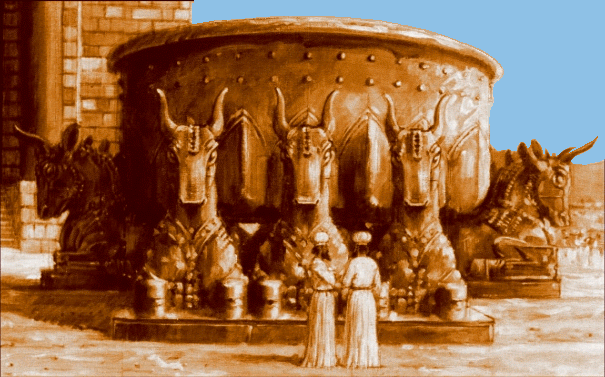
23 Then he made the sea of cast metal. It was round, ten cubits from brim to brim, and five cubits high, and a line of thirty cubits measured its circumference. 24 Under its brim were gourds, for ten cubits, compassing the sea all around. The gourds were in two rows, cast with it when it was cast. 25 It stood on twelve oxen, three facing north, three facing west, three facing south, and three facing east. The sea was set on them, and all their rear parts were inward. 26 Its thickness was a handbreadth, and its brim was made like the brim of a cup, like the flower of a lily. It held two thousand baths.

27 He also made the ten stands of bronze. Each stand was four cubits long, four cubits wide, and three cubits high. 28 This was the construction of the stands: they had panels, and the panels were set in the frames, 29 and on the panels that were set in the frames were lions, oxen, and cherubim. On the frames, both above and below the lions and oxen, there were wreaths of beveled work. 30 Moreover, each stand had four bronze wheels and axles of bronze, and at the four corners were supports for a basin. The supports were cast with wreaths at the side of each. 31 Its opening was within a crown that projected upward one cubit. Its opening was round, as a pedestal is made, a cubit and a half deep. At its opening there were carvings, and its panels were square, not round. 32 And the four wheels were underneath the panels. The axles of the wheels were of one piece with the stands, and the height of a wheel was a cubit and a half. 33 The wheels were made like a chariot wheel; their axles, their rims, their spokes, and their hubs were all cast. 34 There were four supports at the four corners of each stand. The supports were of one piece with the stands. 35 And on the top of the stand there was a round band half a cubit high; and on the top of the stand its stays and its panels were of one piece with it. 36 And on the surfaces of its stays and on its panels, he carved cherubim, lions, and palm trees, according to the space of each, with wreaths all around. 37 After this manner he made the ten stands. All of them were cast alike, of the same measure and the same form.

38 And he made ten basins of bronze. Each basin held forty baths, each basin measured four cubits, and there was a basin for each of the ten stands. 39 And he set the stands, five on the south side of the house, and five on the north side of the house. And he set the sea at the southeast corner of the house. 1 Kings 7:13-39 ESV

The first question that comes to mind when reading this section of Chapter Seven is why the author took such great pains to describe each and every item in such precise detail. The amount of information is almost overwhelming, and even with all the helpful descriptions, it’s virtually impossible to determine what each item actually looked like.  So, why dedicate so much time and space to their description?

In a sense, the author is telling his readers that Solomon was a man who took a keen interest in every phase of the massive construction project he had commissioned. His father had left him with the overwhelming responsibility to create a house worthy of the God of Israel, and that was not something he took lightly. Solomon was a hands-on construction manager who cared deeply about every detail concerning this once-in-a-lifetime undertaking. While he delegated much of the work, there was never a moment when Solomon was not intimately and personally involved in it. He cared deeply about this project and wanted to ensure that the finished product was both beautiful and functional. When completed, the Temple would become the focal point of Israel’s worship of Yahweh. So, Solomon intended for every item associated with its construction and its ultimate operation to be of the finest craftsmanship.

From the quarrying of the massive stones used to build the temple to the carving of the intricate reliefs that adorned the bronze stands, Solomon oversaw everything. To ensure that the workmanship was of the highest quality, Solomon hired the finest craftsman money could buy.

Verse 13 states that Solomon sought out the services of a skilled craftsman from the city of Tyre, a gifted worker in bronze. But notice the additional details concerning Hiram’s qualifications:

And he was full of wisdom, understanding, and skill for making any work in bronze. – 1 Kings 7:1 ESV

This brings to mind a passage from the book of Exodus where God provided Moses with the identity of another man who would assist in the construction of the Tabernacle.

The LORD said to Moses, “See, I have called by name Bezalel the son of Uri, son of Hur, of the tribe of Judah, and I have filled him with the Spirit of God, with ability and intelligence, with knowledge and all craftsmanship, to devise artistic designs, to work in gold, silver, and bronze, in cutting stones for setting, and in carving wood, to work in every craft.” – Exodus 31:1-5 ESV

As was the case with Moses, it seems that Solomon was receiving divine assistance in procuring the services of the right people to help him complete this one-of-a-kind project. Hiram came highly recommended and divinely gifted for the job.

Once he arrived in Jerusalem, Hiram set to work casting the two bronze pillars that would grace the entrance to the Temple. At 27 feet in height, these two immense pillars were likely more decorative than functional. Since they were cast from a relatively soft metal like bronze and featured hollow interiors, they would have been incapable of providing support to the Temple’s roof.

These pillars were intended to frame the entrance to the Temple and provide symbolic significance to the One who dwelt within. Each pillar had a name. One was called Boaz, which means “In Him is strength.” The other was named Jachin, which means “He shall establish.” Both names were explicit references to the God of Israel. Every detail that adorned these pillars, from the water lilies to the pomegranates, was intended to illustrate the goodness and greatness of God. The Israelites served a God who provided them with everything they needed, including fertility and fruitfulness.

Next, Hiram crafted “the sea,” a large bronze basin that would sit outside the Temple’s entrance. This massive bowl was designed to replace the bronze laver that God had prescribed for the Tabernacle, while serving the same function as the original. According to Exodus 30, the first laver was used by the priests to purify themselves before offering sacrifices to God.

“You shall also make a basin of bronze, with its stand of bronze, for washing. You shall put it between the tent of meeting and the altar, and you shall put water in it, with which Aaron and his sons shall wash their hands and their feet. When they go into the tent of meeting, or when they come near the altar to minister, to burn a food offering to the Lord, they shall wash with water, so that they may not die. They shall wash their hands and their feet, so that they may not die. It shall be a statute forever to them, even to him and to his offspring throughout their generations.” – Exodus 30:18-21 ESV

The new basin was 15 feet in diameter, 47 feet in circumference, with a depth of 7.5 feet. It could hold up to 18,000 gallons of water, and its large size appears to have been designed to allow priests to completely immerse themselves, rather than just washing their hands and feet. It rested on the backs of 12 bronze oxen, arranged in groups of three, with each group facing a different direction on the compass. These bronze bulls may have been intended to represent the 12 tribes of Israel. But regardless, they were clearly symbols of strength.

Hiram then crafted ten mobile carts, each equipped with a large bronze basin. They featured wheels that allowed them to be moved about the Temple courtyard.

He also made ten basins in which to wash, and set five on the south side, and five on the north side. In these they were to rinse off what was used for the burnt offering, and the sea was for the priests to wash in. – 2 Chronicles 4:6 ESV

Each cart was six feet square and five and one-half feet high, and it held a bronze basin that could hold up to 240 gallons of water. As the Chronicles passage indicates, they were strategically located around the Temple courtyard and used by the priests to cleanse the blood from the sacrificial animals before they were offered to God.

You can almost sense that Solomon was attempting to improve on every item used in the original Tabernacle. He was making significant upgrades. Every item Hiram created was bigger and better than the original. Solomon was obsessed with making the house of God a grand and glorious structure, with every detail reflecting the majesty of its divine occupant. He could have saved himself a lot of time and money by reusing the original items, but Solomon would not settle for anything less than the best. So, he poured countless hours and resources into creating a Temple worthy of his great God, down to the last detail.

Solomon was following the instructions Yahweh gave to Moses from Mount Sinai when He ordered the creation of the original Tabernacle.

“Have the people of Israel build me a holy sanctuary so I can live among them. You must build this Tabernacle and its furnishings exactly according to the pattern I will show you.” – Exodus 25:8-9 NLT

Moses received detailed plans for the construction of the LORD’s house, with nothing left to the imagination. God was explicit in describing every facet of the Tabernacle’s design, and ordered Moses, “Be sure that you make everything according to the pattern I have shown you here on the mountain” (Exodus 25:40 NLT). Evidently, Moses received a vision of what the completed Tabernacle should look like, and he was to ensure that the finished product was an accurate facsimile. He was not to cut corners, leave out any detail, or make alterations to its design. No expense was to be spared, no shortcuts taken, and no cost-cutting measures considered because this was to be the house of Yahweh. The God of the universe deserved nothing but the best. If the people of Israel expected Him to dwell among them, they would need to build a house worthy of housing His presence. 

“I will meet the people of Israel there, in the place made holy by my glorious presence. Yes, I will consecrate the Tabernacle and the altar, and I will consecrate Aaron and his sons to serve me as priests. Then I will live among the people of Israel and be their God, and they will know that I am the LORD their God. I am the one who brought them out of the land of Egypt so that I could live among them. I am the LORD their God. – Exodus 29:43-46 NLT

Solomon shared Moses’ commitment to build a house that Yahweh would deem worthy of bearing His name and containing His glory. So, he went out of his way to ensure that this house met Yahweh’s exacting standards, because he longed for the assurance of Yahweh’s presence and power.

English Standard Version (ESV) The Holy Bible, English Standard Version. ESV® Permanent Text Edition® (2016). Copyright © 2001 by Crossway Bibles, a publishing ministry of Good News Publishers.

New Living Translation (NLT) Holy Bible, New Living Translation, copyright © 1996, 2004, 2015 by Tyndale House Foundation. Used by permission of Tyndale House Publishers Inc., Carol Stream, Illinois 60188. All rights reserved.

A Costly Endeavor

1 Now Hiram king of Tyre sent his servants to Solomon when he heard that they had anointed him king in place of his father, for Hiram always loved David. And Solomon sent word to Hiram, “You know that David my father could not build a house for the name of the LORD his God because of the warfare with which his enemies surrounded him, until the LORD put them under the soles of his feet. But now the LORD my God has given me rest on every side. There is neither adversary nor misfortune. And so I intend to build a house for the name of the LORD my God, as the LORD said to David my father, ‘Your son, whom I will set on your throne in your place, shall build the house for my name.’ Now therefore command that cedars of Lebanon be cut for me. And my servants will join your servants, and I will pay you for your servants such wages as you set, for you know that there is no one among us who knows how to cut timber like the Sidonians.”

As soon as Hiram heard the words of Solomon, he rejoiced greatly and said, “Blessed be the LORD this day, who has given to David a wise son to be over this great people.” And Hiram sent to Solomon, saying, “I have heard the message that you have sent to me. I am ready to do all you desire in the matter of cedar and cypress timber. My servants shall bring it down to the sea from Lebanon, and I will make it into rafts to go by sea to the place you direct. And I will have them broken up there, and you shall receive it. And you shall meet my wishes by providing food for my household.” 10 So Hiram supplied Solomon with all the timber of cedar and cypress that he desired, 11 while Solomon gave Hiram 20,000 cors of wheat as food for his household, and 20,000 cors of beaten oil. Solomon gave this to Hiram year by year. 12 And the LORD gave Solomon wisdom, as he promised him. And there was peace between Hiram and Solomon, and the two of them made a treaty.

13 King Solomon drafted forced labor out of all Israel, and the draft numbered 30,000 men. 14 And he sent them to Lebanon, 10,000 a month in shifts. They would be a month in Lebanon and two months at home. Adoniram was in charge of the draft. 15 Solomon also had 70,000 burden-bearers and 80,000 stonecutters in the hill country, 16 besides Solomon’s 3,300 chief officers who were over the work, who had charge of the people who carried on the work. 17 At the king’s command they quarried out great, costly stones in order to lay the foundation of the house with dressed stones. 18 So Solomon’s builders and Hiram’s builders and the men of Gebal did the cutting and prepared the timber and the stone to build the house. 1 Kings 5:1-18 ESV

Solomon possessed both great wisdom and wealth. But the one characteristic he possessed that truly set his life apart was his faithfulness. Solomon kept his word. He was always careful to follow through on his commitments. Solomon had made a pledge to David that, after his death, he would settle affairs with some of his former adversaries, and Solomon had quickly and effectively accomplished all of his father’s wishes.

But there remained one last piece of unfinished business. David had assigned his son the formidable task of building a house or temple for God. When David had conquered all his enemies and was enjoying a period of relative peace, he became convicted about his relatively opulent lifestyle. He lived in a sumptuous palace while the dwelling place of God remained little more than a glorified tent. This seeming contradiction prompted him to tell the prophet, Nathan, “See now, I dwell in a house of cedar, but the ark of God dwells in a tent” (2 Samuel 2 ESV). With Nathan’s blessing, David came up with a plan to build a “house of cedar” for God. But that night, God spoke to Nathan in a dream, giving him a message to deliver to David.

“Go and tell my servant David, ‘Thus says the LORD: Would you build me a house to dwell in? I have not lived in a house since the day I brought up the people of Israel from Egypt to this day, but I have been moving about in a tent for my dwelling. In all places where I have moved with all the people of Israel, did I speak a word with any of the judges of Israel, whom I commanded to shepherd my people Israel, saying, “Why have you not built me a house of cedar?”’’ – 2 Samuel 7:5-7 ESV

It seems that David’s well-intentioned plan to construct a house for God had not come from God. The sovereign God of the universe did not need a man-made house in which to dwell. No palace made with human hands could compare to the grandeur of God’s heavenly home.

“Heaven is my throne,
    and the earth is my footstool;
what is the house that you would build for me,
    and what is the place of my rest?
All these things my hand has made,
    and so all these things came to be,
declares the LORD.” – Isaiah 66:1-2 ESV

Nathan told David that if anyone was going to build a house, it would be God Almighty. The King of the universe promised to extend David’s dynasty and kingdom by “building a house” for David that would last far longer than the cedar palace in which David lived.

“Moreover, the LORD declares to you that the LORD will make you a house. When your days are fulfilled and you lie down with your fathers, I will raise up your offspring after you, who shall come from your body, and I will establish his kingdom. He shall build a house for my name, and I will establish the throne of his kingdom forever.” – 2 Samuel 7:11-13 ESV

God told David that the honor of building a house for Him would fall to someone else. One of David’s descendants would be allowed to fulfill his dream and complete the construction of the Temple. David graciously accepted God’s plan and later explained to his son, Solomon, why this important task had been passed on to him.

“My son, I wanted to build a Temple to honor the name of the LORD my God,” David told him. “But the LORD said to me, ‘You have killed many men in the battles you have fought. And since you have shed so much blood in my sight, you will not be the one to build a Temple to honor my name. But you will have a son who will be a man of peace. I will give him peace with his enemies in all the surrounding lands. His name will be Solomon, and I will give peace and quiet to Israel during his reign. He is the one who will build a Temple to honor my name.’” – 1 Chronicles 22:7-10 NLT

David had been the warrior-king, spending the vast majority of his reign doing battle with the enemies of God. While done on behalf of God, his many military exploits had resulted in much bloodshed and, therefore, disqualified him from building a house for God. But rather than allow his zeal for the project to diminish, David redirected his energies into developing the plans and gathering all the materials required to make this project a success. He personally selected the construction site and supervised the drafting of the plans and the initial procurement of building materials.

“My son Solomon is still young and inexperienced. And since the Temple to be built for the LORD must be a magnificent structure, famous and glorious throughout the world, I will begin making preparations for it now.” So David collected vast amounts of building materials before his death. – 1 Chronicles 22:5 NLT

David went out of his way to ensure that Solomon had everything he would need to build the finest temple imaginable.

So David gave orders to call together the foreigners living in Israel, and he assigned them the task of preparing finished stone for building the Temple of God. David provided large amounts of iron for the nails that would be needed for the doors in the gates and for the clamps, and he gave more bronze than could be weighed. He also provided innumerable cedar logs, for the men of Tyre and Sidon had brought vast amounts of cedar to David. – 1 Chronicles 22:2-4 NLT

But, despite David’s meticulous planning, Solomon still found himself in need of additional construction materials, including cedar logs from Lebanon’s famed forests. So, Solomon negotiated a contract with Hiram, the king of Tyre, that provided all the lumber needed to complete the project in exchange for wheat and olive oil.

Combined with David’s careful planning and procurement strategy, Solomon’s arrangement with Hiram guaranteed that he had all he needed to begin construction. But one thing was missing: Workers. This is where it gets interesting. The author reveals that Solomon instituted a non-military draft to supply the workers needed to complete the construction of the Temple.

Then King Solomon conscripted a labor force of 30,000 men from all Israel. He sent them to Lebanon in shifts, 10,000 every month, so that each man would be one month in Lebanon and two months at home. Adoniram was in charge of this labor force. Solomon also had 70,000 common laborers, 80,000 quarry workers in the hill country, and 3,600 foremen to supervise the work. – 1 Kings 5:13-16 NLT

This piece of information should bring to mind the words of Samuel, spoken to the people of Israel when they first demanded that God give them a king.

“These will be the ways of the king who will reign over you: he will take your sons and appoint them to his chariots and to be his horsemen and to run before his chariots. And he will appoint for himself commanders of thousands and commanders of fifties, and some to plow his ground and to reap his harvest, and to make his implements of war and the equipment of his chariots. He will take your daughters to be perfumers and cooks and bakers. He will take the best of your fields and vineyards and olive orchards and give them to his servants. He will take the tenth of your grain and of your vineyards and give it to his officers and to his servants. He will take your male servants and female servants and the best of your young men and your donkeys, and put them to his work. He will take the tenth of your flocks, and you shall be his slaves. And in that day you will cry out because of your king, whom you have chosen for yourselves, but the LORD will not answer you in that day.” – 1 Samuel 8:11-18 ESV

The text states that “Adoniram was in charge of this labor force” (1 Kings 5:14 NLT). He would eventually become Solomon’s official chief of conscription, and he would hold this position when Solomon’s son, Rehoboam, took the throne. Early in this reign, Rehoboam was warned that the people were disgruntled with the way Solomon had treated them. 

“Your father was a hard master,” they said. “Lighten the harsh labor demands and heavy taxes that your father imposed on us. Then we will be your loyal subjects.” – 2 Chronicles 10:4 NLT

But rather than listen to their demands, Rehoboam took the advice of his counselors.

“This is what you should tell those complainers who want a lighter burden: ‘My little finger is thicker than my father’s waist! Yes, my father laid heavy burdens on you, but I’m going to make them even heavier! My father beat you with whips, but I will beat you with scorpions!’” – 2 Chronicles 10:10-11 NLT

The people rebelled, and Rehoboam was forced to send Adoniram to quell the unrest.

King Rehoboam sent Adoniram, who was in charge of forced labor, to restore order, but the people of Israel stoned him to death. – 2 Chronicles 10:18 NLT

Solomon had set the precedent, and his son followed his lead. Solomon was God’s chosen successor to King David, and he had been blessed with godly wisdom and insight. Yet, even this divinely appointed king would still end up making unwise decisions. Solomon was the king, but he was just a man and proved to be a poor substitute for the King of the universe. In demanding that Samuel appoint a king over them, the people of Israel had rejected God as their sovereign ruler. Now, even under the wise and godly leadership of Solomon, they were going to discover that their demand for a human king came with a cost. The price for building the Temple was going to include blood, sweat, and tears. It would take nearly eight years to construct this architectural masterpiece, a period filled with pain, sacrifice, and suffering. The Temple David envisioned would become a living nightmare for many of the people of Israel. They would ultimately sacrifice their sons and daughters to the cause. Some likely died during the construction of the temple. Others probably suffered debilitating injuries, some of a permanent nature.

Solomon employed the wisdom given to him by God and benefited from the preparations made by his father, David. However, even his best efforts, undertaken with the best of intentions, still harmed God’s chosen people. The Temple would be built, but at a high price. The people had their king, but his reign did not come without consequences. It should not be overlooked that the construction of a house for God, the one true King of Israel, also came at a cost.

English Standard Version (ESV) The Holy Bible, English Standard Version. ESV® Permanent Text Edition® (2016). Copyright © 2001 by Crossway Bibles, a publishing ministry of Good News Publishers.

New Living Translation (NLT) Holy Bible, New Living Translation, copyright © 1996, 2004, 2015 by Tyndale House Foundation. Used by permission of Tyndale House Publishers Inc., Carol Stream, Illinois 60188. All rights reserved.

The Danger of Misplaced Priorities

1 Solomon made a marriage alliance with Pharaoh king of Egypt. He took Pharaoh’s daughter and brought her into the city of David until he had finished building his own house and the house of the LORD and the wall around Jerusalem. The people were sacrificing at the high places, however, because no house had yet been built for the name of the LORD.

Solomon loved the LORD, walking in the statutes of David his father, only he sacrificed and made offerings at the high places. And the king went to Gibeon to sacrifice there, for that was the great high place. Solomon used to offer a thousand burnt offerings on that altar. 1 Kings 3:1-4 ESV

Chapter two ended with the words, “So the kingdom was established in the hand of Solomon” (1 Kings 2:36-46 ESV). He had successfully completed his purging of those who had played a part in the failed coup attempt that would have robbed him of his right to the throne. He had also kept his father’s dying wish and brought to justice a small list of individuals whom David had declared worthy of judgment.

However, the opening verses of Chapter 3 introduce a shift in tone and purpose to the historical narrative. David has died, and the reign of his son has begun. The last vestiges of David’s influence have been removed, and Solomon has the opportunity to start his rule on his own terms. It is interesting to note that the author records Solomon’s first official act as king as an alliance he made with the Egyptians. The Pharaoh of Egypt sealed their agreement by giving Solomon the hand of his daughter in marriage.

The matter-of-fact manner in which this news is conveyed gives the impression that it was nothing more than an official act of business on the part of the royal administration. Making treaties and alliances was a necessary part of being a king, and marital alliances were commonplace among the nations of the world at that time. But there is something ominous and prophetic about the news of Solomon’s first official act as king. Any Jew who read this historical record would have recognized it.

Long before Israel had a king, God provided His chosen people with a list of prohibitions concerning the behavior of any man who would rule over them. He knew that the kingly role would come with all kinds of temptations and snares. The power and prestige that accompanied the crown would prove to be addictive and dangerous. Therefore, God provided His people with non-negotiable rules to govern and regulate the actions of the kings of Israel.

“You are about to enter the land the LORD your God is giving you. When you take it over and settle there, you may think, ‘We should select a king to rule over us like the other nations around us.’ If this happens, be sure to select as king the man the LORD your God chooses. You must appoint a fellow Israelite; he may not be a foreigner.

“The king must not build up a large stable of horses for himself or send his people to Egypt to buy horses, for the LORD has told you, ‘You must never return to Egypt.’ The king must not take many wives for himself, because they will turn his heart away from the LORD. And he must not accumulate large amounts of wealth in silver and gold for himself.” – Deuteronomy 17:14-17 NLT

As a precautionary measure, God commanded that any man who ruled as king over Israel was to have a personal copy of the Mosaic Law, which he was to read from daily.

“This regular reading will prevent him from becoming proud and acting as if he is above his fellow citizens. It will also prevent him from turning away from these commands in the smallest way. And it will ensure that he and his descendants will reign for many generations in Israel.” – Deuteronomy 17:21 NLT

Notice that the king was prohibited from accumulating all the usual trappings of kingly success. All Israelite kings were to be different, refusing to model their administration on the nations around them. Stables filled with fine horses, treasuries overflowing with great wealth, and palaces full of wives and concubines were off-limits to the kings of Israel. Yahweh also forbade His kings from doing any business with Egypt, even denying them the right to buy horses from their former enemies. Yet, one of the first decisions Solomon made as king was to broker a deal with the Pharaoh of Egypt that would set a dangerous precedent for his reign.

While the author provides no immediate commentary regarding Solomon’s actions, he later reveals the sinister and infectious nature of this decision.

Now King Solomon loved many foreign women. Besides Pharaoh’s daughter, he married women from Moab, Ammon, Edom, Sidon, and from among the Hittites. The LORD had clearly instructed the people of Israel, “You must not marry them, because they will turn your hearts to their gods.” Yet Solomon insisted on loving them anyway. He had 700 wives of royal birth and 300 concubines. And in fact, they did turn his heart away from the LORD. – 1 Kings 11:1-3 NLT

Something is foreboding in the statement that Solomon “brought her into the city of David until he had finished building his own house and the house of the LORD and the wall around Jerusalem” (1 Kings 3:1 ESV). One of his very first acts as king was to bring this foreign-born, pagan princess into the city of David, where her presence would have a profound impact not only on him but also on the entire kingdom. Solomon had not even taken the time to build a palace or begun construction on the Temple for Yahweh, for which his father had provided the funding. He had taken no action to expand and protect the city of Jerusalem through the construction of defensive walls.

But the author clearly states that “Solomon loved the LORD, walking in the statutes of David his father” (1 Kings 3:3 ESV). Yet, it will become increasingly more apparent that Solomon suffered from divided allegiances. Notice the critical contrast between the following verses.

Solomon loved the LORD… 1 Kings 3:3

King Solomon loved many foreign wives… – 1 Kings 11:1

God had warned that any king who accumulated many wives for himself would run the risk of having his heart turned away from the LORD. His love for Yahweh would be distracted and diminished. Because Solomon prioritized forming an alliance with Egypt over building a house for God, he ultimately had to make offerings and sacrifices on the high places (1 Kings 3:3). As a result, his worship became diluted and polytheistic. As will become evident, many of these high places were actually the former sites of pagan shrines to false gods. The Israelites had repurposed them for the worship of Yahweh, but God had given Solomon the responsibility and privilege of constructing a permanent Temple where all worship and sacrifices were to be made. David had provided Solomon with everything he needed to build the Temple, from the construction plans to the financial resources to pay for it. And David had warned Solomon to make this task a high priority.

“So take this seriously. The LORD has chosen you to build a Temple as his sanctuary. Be strong, and do the work.”

Then David gave Solomon the plans for the Temple and its surroundings, including the entry room, the storerooms, the upstairs rooms, the inner rooms, and the inner sanctuary—which was the place of atonement. David also gave Solomon all the plans he had in mind for the courtyards of the LORD’s Temple, the outside rooms, the treasuries, and the rooms for the gifts dedicated to the LORD. The king also gave Solomon the instructions concerning the work of the various divisions of priests and Levites in the Temple of the LORD. And he gave specifications for the items in the Temple that were to be used for worship. – 1 Chronicles 28:10-13 NLT

But Solomon had established other priorities. He chose to align himself with Egypt, making what he believed would be an essential treaty with this once-powerful nation. But in doing so, Solomon placed his hope and trust in something other than God Almighty. At this point in history, Solomon was reigning over one of the most powerful nations in the known world. His father, David, had built Israel into a formidable force in the region, having expanded its boundaries and secured its peace through his victories over the surrounding nations.

Solomon had inherited this kingdom and was privileged to rule during a time of relative peace and security. David had virtually eliminated any threat from the Philistines, Moabites, Edomites, Arameans, Ammonites, and Amalekites.

King David dedicated all these gifts to the Lord, as he did with the silver and gold from the other nations he had defeated—from Edom, Moab, Ammon, Philistia, and Amalek—and from Hadadezer son of Rehob, king of Zobah. – 2 Samuel 8:11-12 NLT

Solomon did not need to make a treaty with Egypt. Their days as a world power were over, and they had nothing to offer Solomon. David had left his son with clear instructions as to the pressing priorities of his reign.

“Realize now that the LORD has chosen you to build a temple as his sanctuary. Be strong and do it!”

“Be strong and brave! Do it! Don’t be afraid and don’t panic! For the LORD God, my God, is with you. He will not leave you or abandon you before all the work for the service of the LORD’s temple is finished.” – 1 Chronicles 28:10, 20 NLT

But rather than heeding his father’s counsel to construct a house for Yahweh, Solomon went about building his kingdom according to his own terms and agenda.

The prophet Isaiah would later warn the people of Israel about their propensity to seek alliances with and assistance from Egypt.

“What sorrow awaits my rebellious children,”
    says the LORD.
“You make plans that are contrary to mine.
    You make alliances not directed by my Spirit,
    thus piling up your sins.
For without consulting me,
    you have gone down to Egypt for help.
You have put your trust in Pharaoh’s protection.
    You have tried to hide in his shade.” – Isaiah 30:1-2 NLT

Without even realizing it, Solomon was stepping outside the protective boundaries of God and pursuing what he believed to be the best strategy for building his kingdom. But through it all, Solomon maintained a love and devotion for God, even offering thousands of sacrifices to Him on the high place in Gibeon. The book of 1 Chronicles provides us with the reason why Solomon chose Gibeon as the place to offer his sacrifices to God.

For the tabernacle of the LORD, which Moses had made in the wilderness, and the altar of burnt offering were at that time in the high place at Gibeon. – 1 Chronicles 21:29 ESV

This location had been designated by God. Formerly the site of a threshing floor, David had purchased it and transformed it into the nation of Israel’s primary worship center. It would be at this critical location that Solomon would receive a gracious and undeserved gift from God. Despite his impulsiveness and blatant disobedience to God’s commands, he would be given the one thing that would set his reign apart from all those who would come after him. It would become the defining characteristic of his life. Solomon didn’t need more horses, wives, wealth, or treaties with his enemies. What he really needed was something only God could provide: Wisdom.

English Standard Version (ESV) The Holy Bible, English Standard Version. ESV® Permanent Text Edition® (2016). Copyright © 2001 by Crossway Bibles, a publishing ministry of Good News Publishers.

New Living Translation (NLT) Holy Bible, New Living Translation, copyright © 1996, 2004, 2015 by Tyndale House Foundation. Used by permission of Tyndale House Publishers Inc., Carol Stream, Illinois 60188. All rights reserved.

Give Thanks Where Thanks Is Due

Of David.

1 I give you thanks, O LORD, with my whole heart;
    before the gods I sing your praise;
I bow down toward your holy temple
    and give thanks to your name for your steadfast love and your faithfulness,
    for you have exalted above all things
    your name and your word.
On the day I called, you answered me;
    my strength of soul you increased.

All the kings of the earth shall give you thanks, O LORD,
    for they have heard the words of your mouth,
and they shall sing of the ways of the LORD,
    for great is the glory of the LORD.
For though the LORD is high, he regards the lowly,
    but the haughty he knows from afar.

Though I walk in the midst of trouble,
    you preserve my life;
you stretch out your hand against the wrath of my enemies,
    and your right hand delivers me.
The LORD will fulfill his purpose for me;
    your steadfast love, O LORD, endures forever.
    Do not forsake the work of your hands. – Psalm 138:1-8 ESV

There are times when I don’t even know myself. I do and say things that surprise even me. I can never be certain how I will react to a given situation. I may respond in calmness and patience one day, then explode in anger and impatience the next. I have a limited understanding of what motivates me and why I act the way I do. Sometimes words come out of my mouth that catch me off guard. I can be disappointed in my own response to people and circumstances. There are those moments when I can appear as a stranger – even to myself.

But God knows me. In fact, He knows me better than I know myself. David understood this prescient aspect of Yahweh’s character. He knew that God was all-knowing, all-powerful, and always present. He knew that God was always there, and that God knew every single detail of his life, including what he was thinking and what he was going to say, even before the words came out of his mouth. In the following psalm, also penned by David, he expresses his astonishment regarding Yahweh’s omnipotence.

O LORD, you have examined my heart
    and know everything about me.
You know when I sit down or stand up.
    You know my thoughts even when I’m far away.
You see me when I travel
    and when I rest at home.
    You know everything I do.
You know what I am going to say
    even before I say it, LORD. – Psalm 139:1-4 NLT

David also understood that God had a plan for his life and was orchestrating that plan every day.  From David’s perspective, things might not have always looked like God was in control, but he had learned to view his circumstances through the lens of Yahweh’s faithfulness.

Though I am surrounded by troubles,
    you will protect me from the anger of my enemies.
You reach out your hand,
    and the power of your right hand saves me. – Psalm 138:7 NLT

This psalm is a song of thanksgiving from a grateful God-follower. In reflecting on his life, David had seen ample reasons to give Yahweh praise for His unfailing goodness and grace.

I give you thanks, O LORD, with all my heart;
    I will sing your praises before the gods.
I bow before your holy Temple as I worship.
    I praise your name for your unfailing love and faithfulness;
for your promises are backed
    by all the honor of your name. – Psalm 138:1-2 NLT

David’s recollection of Yahweh’s faithfulness prompted him to declare his thankfulness in tangible ways. Despite being surrounded by nations that worshiped their false gods with equal enthusiasm, David was willing to sing Yahweh’s praises in their hearing. He wasn’t afraid of the pagans and their idols hearing his adoration and elevation of the one true God: Yahweh.

One of the ways David displayed his reverence for Yahweh was through worship. He made it a habit to come before the LORD, offering prayers, offerings, and sacrifices in His “holy temple.” At this point, the Temple was still an unrealized dream in David’s mind. He had desired to build a house for the LORD, but it would be his son Solomon who would construct the Temple. The Hebrew word David used is hêḵāl, and it can be translated as “sanctuary” or “palace.” When David moved the Ark of the Covenant into Jerusalem, he ordered that a tent be erected in which to house this focal point of the Israelites’ sacrificial system. It remained there until Solomon completed the construction of the permanent and more palatial Temple.

But David didn’t allow the humble nature of his hêḵāl to diminish the quality of his worship. He approached it as if it were the palace of the King and a holy sanctuary where the God of the universe chose to dwell among His people. It was to this hêḵāl that David went to pray to Yahweh, whom he found to be attentive and quick to answer.

As soon as I pray, you answer me;
   you encourage me by giving me strength.
– Psalm 138:3 NLT

One of the reasons David was willing to praise Yahweh “before the gods” (Psalm 138:1) was so that the kings who worshiped these false gods might understand that “the LORD is God; there is no other besides Him” (Isaiah 4:35 BSB). By singing Yahweh’s praises and verbally declaring His greatness, David hoped to influence those who placed their hope in non-existent, impotent figments of their imaginations. He envisioned a day when “all the kings of the earth” (Psalm 138:4) would give Yahweh thanks.

While David didn’t see this happen in his lifetime, his son Solomon did. The Book of 1 Kings records that Solomon’s fame spread throughout the known world, even reaching the throne room of the Queen of Sheba.

When the queen of Sheba heard of Solomon’s fame, which brought honor to the name of the LORD, she came to test him with hard questions. – 1 Kings 10:1 NLT

She had heard rumors of Solomon’s wisdom and wealth, but when she saw it all with her own eyes, she was blown away. The size of his kingdom, the beauty of his royal palace, and the opulence of the Temple to his God left her breathless, but not without words.

“Everything I heard in my country about your achievements and wisdom is true! I didn’t believe what was said until I arrived here and saw it with my own eyes. In fact, I had not heard the half of it! Your wisdom and prosperity are far beyond what I was told. How happy your people must be! What a privilege for your officials to stand here day after day, listening to your wisdom! Praise the LORD your God, who delights in you and has placed you on the throne of Israel. Because of the LORD’s eternal love for Israel, he has made you king so you can rule with justice and righteousness.” – 1 Kings 10:6-9 NLT

When she witnessed the splendor of Solomon’s kingdom, she praised Yahweh. She attributed Solomon’s success to his God. She even viewed Solomon’s reign as an expression of Yahweh’s love for His people. She sang “about the LORD’s ways, for the glory of the LORD is very great” (Psalm 138:5 NLT).

David knew he had been greatly blessed by Yahweh, and he wanted everyone to know about it. He was determined to sing Yahweh’s praises so everyone, from the lowliest peasant to the highest officials in the land, could understand that there is no one like the LORD.

But David provides a warning to all those who discover Yahweh’s superiority and supremacy.

Though the LORD is great, he cares for the humble,
    but he keeps his distance from the proud. – Psalm 138:6 NLT

This great God is no respecter of persons. “For God does not show favoritism” (Romans 2:11 NLT). He is not impressed by anyone’s credentials or accomplishments. In fact, according to James, “God opposes the proud but gives grace to the humble” (James 4:6 NLT). James expanded on this idea in the opening chapter of his letter.

Believers who are poor have something to boast about, for God has honored them. And those who are rich should boast that God has humbled them. They will fade away like a little flower in the field. The hot sun rises and the grass withers; the little flower droops and falls, and its beauty fades away. In the same way, the rich will fade away with all of their achievements. – James 1:9-11 NLT

David understood this aspect of Yahweh’s nature, having experienced both the blessings of Yahweh as a lowly shepherd and the righteous judgment of Yahweh as a mighty king. David had learned the invaluable truth that humility was a non-negotiable requirement for those who want to experience Yahweh’s presence and promises.

Even as a king, David had experienced many trials and setbacks. His crown did not immunize him from difficulty. His power and wealth could not inoculate him from suffering and sorrow. He had his fair share of enemies, problems, setbacks, roadblocks, disappointments, and moments of discouragement, but he had learned to lean on God.

You reach out your hand,
    and the power of your right hand saves me. – Psalm 138:7 NLT

A humble king is a blessed king because he is willing to submit himself to the one true King. He had learned the same great truth that James included in his letter: “Humble yourselves before the Lord, and he will lift you up in honor” (James 4:10 NLT).  Despite his apparent success, David had become increasingly dependent on the LORD. He didn’t allow his palace, power, and possessions to feed his pride and boost his ego. He understood that, without Yahweh, he was nothing, which prompted him to pray:

The LORD will work out his plans for my life—
    for your faithful love, O LORD, endures forever.
    Don’t abandon me, for you made me. – Psalm 138:8 NLT

Father, I want to become increasingly more dependent upon You., but not is some weak and passive sense. You have blessed me with gifts and abilities, and you expect me to use them — for Your glory. You have provided me with wisdom through Your Word and power through the presence of Your indwelling Holy Spirit, and You want me to put them to use. But I don’t ever want to become cocky or overconfident in what appears to be my own strength or capabilities. David knew he was nothing without You and I want to share his perspective. I want to sing Your praises for all to hear. I want them to know that I am completely reliant upon You because You have been incredibly gracious to me. Amen

English Standard Version (ESV) The Holy Bible, English Standard Version. ESV® Permanent Text Edition® (2016). Copyright © 2001 by Crossway Bibles, a publishing ministry of Good News Publishers.

New Living Translation (NLT) Holy Bible, New Living Translation, copyright © 1996, 2004, 2015 by Tyndale House Foundation. Used by permission of Tyndale House Publishers Inc., Carol Stream, Illinois 60188. All rights reserved.

On That Day…

1 The oracle of the word of the LORD concerning Israel: Thus declares the LORD, who stretched out the heavens and founded the earth and formed the spirit of man within him: “Behold, I am about to make Jerusalem a cup of staggering to all the surrounding peoples. The siege of Jerusalem will also be against Judah. On that day I will make Jerusalem a heavy stone for all the peoples. All who lift it will surely hurt themselves. And all the nations of the earth will gather against it. On that day, declares the LORD, I will strike every horse with panic, and its rider with madness. But for the sake of the house of Judah I will keep my eyes open, when I strike every horse of the peoples with blindness. Then the clans of Judah shall say to themselves, ‘The inhabitants of Jerusalem have strength through the LORD of hosts, their God.’

“On that day I will make the clans of Judah like a blazing pot in the midst of wood, like a flaming torch among sheaves. And they shall devour to the right and to the left all the surrounding peoples, while Jerusalem shall again be inhabited in its place, in Jerusalem.

“And the LORD will give salvation to the tents of Judah first, that the glory of the house of David and the glory of the inhabitants of Jerusalem may not surpass that of Judah. On that day the LORD will protect the inhabitants of Jerusalem, so that the feeblest among them on that day shall be like David, and the house of David shall be like God, like the angel of the LORD, going before them. And on that day I will seek to destroy all the nations that come against Jerusalem.” – Zechariah 12:1-9 ESV

Zechariah receives yet another oracle from Yahweh, providing further insights into the future day of Israel’s redemption and restoration. Yahweh introduces Himself as the Creator God “who stretched out the heavens, laid the foundations of the earth, and formed the human spirit” (Zechariah 12:1 NLT). This reference to His creation of the universe is meant to remind Zechariah and the people of Judah that His power to re-create them is beyond measure. But His description of their future transformation is couched in very negative terms. It begins with the description of another siege against the city of Jerusalem. While few in Zechariah’s audience had been alive when the first siege of Jerusalem occurred, they would have heard the graphic stories of its devastating impact.

During the Babylonian invasion of Judah, there were actually two sieges, ten years apart. The first was in 597 B.C. and resulted in the city’s capture and the deportation of around 10,000 of its occupants. Ten years later, Nebuchadnezzar ordered a second siege because of the continued rebellion of its puppet king. The city endured great deprivation during the siege, and the Temple of Solomon was burned to the ground. Long before it happened, Yahweh provided Jeremiah the prophet with a graphic depiction of Jerusalem’s fall.

“I will reduce Jerusalem to ruins, making it a monument to their stupidity. All who pass by will be astonished and will gasp at the destruction they see there. I will see to it that your enemies lay siege to the city until all the food is gone. Then those trapped inside will eat their own sons and daughters and friends. They will be driven to utter despair.’

“As these men watch you, Jeremiah, smash the jar you brought. Then say to them, ‘This is what the Lord of Heaven’s Armies says: As this jar lies shattered, so I will shatter the people of Judah and Jerusalem beyond all hope of repair. They will bury the bodies here in Topheth, the garbage dump, until there is no more room for them. This is what I will do to this place and its people, says the Lord. I will cause this city to become defiled like Topheth. Yes, all the houses in Jerusalem, including the palace of Judah’s kings, will become like Topheth—all the houses where you burned incense on the rooftops to your star gods, and where liquid offerings were poured out to your idols.’” – Jeremiah 19:8-13 NLT

So, Yahweh’s mention of another siege would have stunned Zechariah and his fellow Judahites. They were still trying to rebuild the Temple and the thought of the city falling yet again would have been unfathomable. Yet, Yahweh softens the blow of this bad news with an important disclosure.

I will make Jerusalem like an intoxicating drink that makes the nearby nations stagger when they send their armies to besiege Jerusalem and Judah. On that day I will make Jerusalem an immovable rock. All the nations will gather against it to try to move it, but they will only hurt themselves. – Zechariah 12:2-3 NLT

While the news of another siege was shocking, Yahweh described a completely different outcome that was meant to provide encouragement to His beleaguered people. Six different times, Yahweh uses the phrase, “On that day” to let them know that this event lies in the distant future. It will feature a battle of epic proportions that will mirror the fall of Jerusalem but without the deaths and destruction. On that day, Jerusalem will be like a rock that cannot be moved. Its walls will not fall. Its enemies will be deprived of victory. In fact, the nations that come against Jerusalem will end up drinking the cup of God’s wrath. This will be a radical departure from the days when God poured out His wrath on the people of Israel.

“Wake up, wake up, O Jerusalem!
    You have drunk the cup of the Lord’s fury.
You have drunk the cup of terror,
    tipping out its last drops.
Not one of your children is left alive
    to take your hand and guide you.
These two calamities have fallen on you:
    desolation and destruction, famine and war.
And who is left to sympathize with you?
    Who is left to comfort you?
For your children have fainted and lie in the streets,
    helpless as antelopes caught in a net.
The Lord has poured out his fury;
    God has rebuked them. – Isaiah 51:17-20 NLT

In that same passage, Yahweh goes on to predict the same future day that Zechariah is hearing about.

“This is what the Sovereign Lord,
    your God and Defender, says:
“See, I have taken the terrible cup from your hands.
    You will drink no more of my fury.
Instead, I will hand that cup to your tormentors,
    those who said, ‘We will trample you into the dust
    and walk on your backs.’” – Jeremiah 51:22-23 NLT

On that day, the attackers will discover that Yahweh the God of Israel is too powerful to overcome. He will fight on Israel’s behalf and miraculously thwart their armies and negate the impact of their weapons. They will be powerless before Yahweh Sabaoth, the LORD of Hosts. The future residents of Jerusalem and the citizens of Judah will respond to this miraculous event with wonder, recognizing Yahweh’s hand in it all. They will express their amazement with words that acknowledge Yahweh’s deliverance.

The inhabitants of Jerusalem have strength through the LORD of hosts, their God.” – Zechariah 12:5 ESV

The resilience of the inhabitants of Jerusalem and the remarkable nature of their defiant stance against their enemies will light a fire in the rest of the nation. They will respond with God-empowered zeal that turns them into an unstoppable force.

“On that day I will make the clans of Judah like a flame that sets a woodpile ablaze or like a burning torch among sheaves of grain. They will burn up all the neighboring nations right and left, while the people living in Jerusalem remain secure. – Zechariah 12:6 NLT

Yahweh announces that victory over the enemies of Israel will first take place outside the walls of Jerusalem. As the city remains under siege, the clans of Judah will rout the combined forces of their adversaries and completely destroy them. The city will be saved because the enemy is eradicated. This order of events is important because it lets the people of Judah know that the city itself is not the focus of Yahweh’s love and attention. Yahweh makes it clear that He will “give victory to the rest of Judah first, before Jerusalem, so that the people of Jerusalem and the royal line of David will not have greater honor than the rest of Judah” (Zechariah 12:7 ESV). Yahweh’s love extends to all His people, not just those who live in Jerusalem or those who belong to David’s line. In fact, Yahweh describes a day when all will stand as equals before Him.

“On that day the LORD will defend the people of Jerusalem; the weakest among them will be as mighty as King David! And the royal descendants will be like God, like the angel of the LORD who goes before them!” – Zechariah 12:8 NLT

They will all “be like God” because they will be embued with His power and fight in His name, just as King David had done. They will share the same attribute that David had: A heart for God that expressed itself in faithful obedience (1 Samuel 13:14; Acts 13:22). What is being described here is the fulfillment of the promise that Yahweh made to Ezekiel.

I will give you a new heart, and I will put a new spirit in you. I will take out your stony, stubborn heart and give you a tender, responsive heart. And I will put my Spirit in you so that you will follow my decrees and be careful to obey my regulations. –  Ezekiel 36:26-27 NLT

With this oracle, Yahweh announces that the future of Israel will feature continued opposition and warfare. The rebuilding and repopulation of Jerusalem would not eliminate all threats of future difficulty. Reconstructing the city’s walls would not eliminate the threat of future enemy attacks. Completing the Temple would not innoculate the people from further rebellion and apostasy. This was not about a city, a building, or even a nation. It was about Yahweh and His chosen people. In 70 A.D., the city would fall again and the Temple that Zechariah helped to build would be destroyed. To this date, there is no Temple in Jerusalem. But the day will come when Yahweh orchestrates its reconstruction one last time. The prophet Daniel was given a vision of this end times event.

“A period of seventy sets of seven has been decreed for your people and your holy city to finish their rebellion, to put an end to their sin, to atone for their guilt, to bring in everlasting righteousness, to confirm the prophetic vision, and to anoint the Most Holy Place. Now listen and understand! Seven sets of seven plus sixty-two sets of seven will pass from the time the command is given to rebuild Jerusalem until a ruler—the Anointed One—comes. Jerusalem will be rebuilt with streets and strong defenses, despite the perilous times. – Daniel 9:24-25 NLT

After the Rapture of the Church (1 Thessalonians 4:13-18), the seven-year-long period known as the Tribulation will begin. The first half of this future era features the rise of a charismatic leader who will rule over a global empire. He will negotiate a peace treaty with the people of Israel, giving them permission to rebuild the Temple in Jerusalem. But midway through the seven years of the Tribulation, He will turn on them, ordering an end to all sacrifices and demanding that they worship him alone. He will also desecrate the Temple by erecting an idol of himself in the Holy of Holies. This will usher in the last half of the seven years, commonly referred to as the Great Tribulation. Jerusalem and the Jews will come under constant opposition from the Antichrist and his forces. Tens of thousands will suffer martyrdom at his hands.

But Zechariah is told of a day when God will “destroy all the nations that come against Jerusalem” (Zechariah 12:9 NLT). Antichrist and his global empire will fall to the King of kings and LORD of lords, an event described by John in the Book of Revelation.

Then I saw heaven opened, and a white horse was standing there. Its rider was named Faithful and True, for he judges fairly and wages a righteous war. His eyes were like flames of fire, and on his head were many crowns. A name was written on him that no one understood except himself. He wore a robe dipped in blood, and his title was the Word of God. The armies of heaven, dressed in the finest of pure white linen, followed him on white horses. From his mouth came a sharp sword to strike down the nations. He will rule them with an iron rod. He will release the fierce wrath of God, the Almighty, like juice flowing from a winepress. On his robe at his thigh was written this title: King of all kings and Lord of all lords.” – Revelation 19:12-16 NLT

John goes on to describe the outcome of this epic conflict.

I saw the beast and the kings of the world and their armies gathered together to fight against the one sitting on the horse and his army. And the beast was captured, and with him the false prophet who did mighty miracles on behalf of the beast—miracles that deceived all who had accepted the mark of the beast and who worshiped his statue. Both the beast and his false prophet were thrown alive into the fiery lake of burning sulfur. Their entire army was killed by the sharp sword that came from the mouth of the one riding the white horse. And the vultures all gorged themselves on the dead bodies. – Revelation 19:19-21 NLT

On that day, Yahweh will fulfill the promises He has made by sending His Son to complete the mission He began with His incarnation. The King will return to right all wrongs, put an end to sin and death, restore righteousness, and establish His earthly Kingdom. It will be a day reserved for praise, joy, and celebration.

“Praise the Lord!
    Salvation and glory and power belong to our God.
His judgments are true and just.
    He has punished the great prostitute
who corrupted the earth with her immorality.
    He has avenged the murder of his servants.” – Revelation 19:1-2 NLT

English Standard Version (ESV)
The Holy Bible, English Standard Version. ESV® Permanent Text Edition® (2016). Copyright © 2001 by Crossway Bibles, a publishing ministry of Good News Publishers.

New Living Translation (NLT)
Holy Bible, New Living Translation, copyright © 1996, 2004, 2015 by Tyndale House Foundation. Used by permission of Tyndale House Publishers Inc., Carol Stream, Illinois 60188. All rights reserved.

Bad News and Good News

1 Open your doors, O Lebanon,
    that the fire may devour your cedars!
Wail, O cypress, for the cedar has fallen,
    for the glorious trees are ruined!
Wail, oaks of Bashan,
    for the thick forest has been felled!
The sound of the wail of the shepherds,
    for their glory is ruined!
The sound of the roar of the lions,
    for the thicket of the Jordan is ruined!

Thus said the LORD my God: “Become shepherd of the flock doomed to slaughter. Those who buy them slaughter them and go unpunished, and those who sell them say, ‘Blessed be the LORD, I have become rich,’ and their own shepherds have no pity on them. For I will no longer have pity on the inhabitants of this land, declares the LORD. Behold, I will cause each of them to fall into the hand of his neighbor, and each into the hand of his king, and they shall crush the land, and I will deliver none from their hand.” – Zechariah 11:1-6 ESV

In these verses, Yahweh seems to be warning His people that they are doomed to repeat the sins of their forefathers. Despite their recent return to the land and their ongoing efforts to rebuild the Temple, they will continue to display the same proclivity for apostasy and idolatry. Yahweh wants to bless them and fully intends to restore their fortunes but He knows that their long-term future is bleak because of their hearts are far from Him.

All of the future hope He has outlined for them will come with the arrival of the Messiah at the end of the age. Until then, Israel’s prospects will include continued apostasy, no king, constant oppression from outside forces, and a longing for a return to their former days of glory. Under Zechariah’s leadership, the people of Judah would complete the construction of the new Temple, but its presence would do little to transform their hearts or alter their behavior.

The Temple was finished in 516 B.C. and then refurbished and expanded by Herod the Great about 18 B.C. This “second” Temple was still standing when Jesus began His earthly ministry. But the Romans destroyed that beautiful structure nearly 90 years later. Jesus predicted this devastating event when discussing the beauty of Herod’s renovated Temple with His disciples.

As Jesus was leaving the Temple that day, one of his disciples said, “Teacher, look at these magnificent buildings! Look at the impressive stones in the walls.”

Jesus replied, “Yes, look at these great buildings. But they will be completely demolished. Not one stone will be left on top of another!” – Mark 13:1-2 NLT

The disciples were obviously disturbed by what Jesus said but He had far more to say about the matter that would leave them disheartened and confused. First, He warned them not to be fooled by the appearance of false Messiahs, offering deliverance from the wars, famines, and earthquakes that would come. But His premonitions concerning their own fate must have hit the hardest.

“You will be handed over to the local councils and beaten in the synagogues. You will stand trial before governors and kings because you are my followers. But this will be your opportunity to tell them about me. For the Good News must first be preached to all nations.” – Mark 13:9-10 NLT

The future would be difficult and feature a disintegration of the social fabric.

“A brother will betray his brother to death, a father will betray his own child, and children will rebel against their parents and cause them to be killed. And everyone will hate you because you are my followers. But the one who endures to the end will be saved. – Mark 13:12-13 NLT

Jesus’ next words must have left His disciples staggering in disbelief. He described a period of great tribulation and turmoil – like nothing the world has ever seen.

“For there will be greater anguish in those days than at any time since God created the world. And it will never be so great again. In fact, unless the Lord shortens that time of calamity, not a single person will survive. But for the sake of his chosen ones he has shortened those days.” – Mark 13:19-20 NLT

However, the disciples failed to understand that many of these things would not occur until long after they were gone. After His ascension, they would suffer persecution, being arrested, tried, beaten, and even martyred for their proclamation of the Good News. But they would not live to see the full extent of the prophecy He outlined.

Jesus was speaking of His second coming, the future day when He would return to complete God’s plan for the redemption of Israel and the establishment of His Kingdom on earth.

“Then everyone will see the Son of Man coming on the clouds with great power and glory. And he will send out his angels to gather his chosen ones from all over the world—from the farthest ends of the earth and heaven. – Mark 13:26-27 NLT

But what does all this have to do with Zechariah 10:1-4? Everything. In these verses, the prophet delivers Yahweh’s message concerning the destruction of the Temple. Zechariah must have found these words difficult to write down because He was still trying to finish the construction of the Temple. It would have been highly demotivating and demoralizing to hear that their work would be in vain. He had no idea that 576 years would pass before the Romans destroyed the Temple.

While Yahweh used poetic language to describe the future fate of the Temple, His message would have been clear to Zechariah. Verse one describes the Temple in a rather strange way but one that Zechariah and the people of Judah would have understood.

Open your doors, O Lebanon,
    that the fire may devour your cedars! – Zechariah 11:1 ESV

When Solomon prepared to build the original Temple, he procured wood for its construction from the forests of Lebanon. He sent a message to the King of Tyre requesting all the lumber necessary to complete his plans for God’s house.

“Now therefore command that cedars of Lebanon be cut for me. And my servants will join your servants, and I will pay you for your servants such wages as you set, for you know that there is no one among us who knows how to cut timber like the Sidonians.” – 1 Kings 5:6 ESV

The text goes on to reveal that Hiram honored Solomon’s request and provided all the timber necessary for the Temple project.

So Hiram supplied Solomon with all the timber of cedar and cypress that he desired. – 1 Kings 5:10 ESV

Wood featured prominently in the design of the Temple.

So Solomon built the house and finished it. He lined the walls of the house on the inside with boards of cedar. From the floor of the house to the walls of the ceiling, he covered them on the inside with wood, and he covered the floor of the house with boards of cypress. He built twenty cubits of the rear of the house with boards of cedar from the floor to the walls, and he built this within as an inner sanctuary, as the Most Holy Place. The house, that is, the nave in front of the inner sanctuary, was forty cubits long. The cedar within the house was carved in the form of gourds and open flowers. All was cedar; no stone was seen. – 1 Kings 6:14-18 ESV

Because of the sheer quantity of lumber from Lebanon used in the Temple’s construction, According to the Talmud, God’s house was affectionately nicknamed, “Lebanon.” When Solomon finished his palace, he called it “the House of the Forest of Lebanon” (1 Kings 7:2 ESV).

So, verse 1 contains a thinly veiled reference to the destruction of the Temple. But Yahweh describes other “glorious trees” like cypress and oak that will also face destruction.

Wail, O cypress, for the cedar has fallen,
    for the glorious trees are ruined!
Wail, oaks of Bashan,
    for the thick forest has been felled! – Zechariah 11:2 ESV

Some scholars believe these are references to the people of Israel but, given the context, it makes more sense to see this as a further description of the Temple’s ultimate destruction. All the wood used to frame and decorate the Temple would be burned in the fire started by the Roman soldiers. For the second time, the glorious House of God was destroyed by the enemies of Israel. As a result of this devastation, the priests (shepherds) wail as they witness the destruction of their place of the LORD’s house and their place of employment.

The sound of the wail of the shepherds,
    for their glory is ruined! – Zechariah 11:3 ESV

But it would seem that these verses foreshadow something far greater than the fall of Jerusalem in 70 A.D. In the rest of the chapter, Yahweh expands the scope of His prophecy, describing a much greater devastation than that which took place in the 1st Century A.D. Once again, He provides a stark vision of the future that must have disturbed Zechariah but came without explanation or interpretation. Like Jesus’ disciples, the prophet had no way of knowing when these things might occur. But Yahweh gives a command that provides a vital clue to understanding what He is talking about.

“Become shepherd of the flock doomed to slaughter. – Zechariah 11:4 ESV

This can be taken as a reference to Zechariah but it also has future implications. In chapter 10, Yahweh described the arrival of a new shepherd who would care for His forsaken flock.

“…the Lord of Heaven’s Armies has arrived
    to look after Judah, his flock.
He will make them strong and glorious,
    like a proud warhorse in battle. – Zechariah 10:3 ESV

That shepherd would be the Good Shepherd, Jesus, who came to lay down His life for the sheep (John 10:11). God intended to send His Son as the ultimate Shepherd who would lovingly care for His neglected and mistreated flock.

“So I will rescue my flock, and they will no longer be abused. I will judge between one animal of the flock and another. And I will set over them one shepherd, my servant David. He will feed them and be a shepherd to them.” – Ezekiel 34:23-24 NLT

Matthew records that when Jesus came He saw the people of Israel with the eyes of a shepherd.

He saw the crowds, He was moved with compassion for them, because they were harassed and helpless, like sheep without a shepherd. – Matthew 9:36 BSB

But John records, “He came to his own people, and even they rejected him” (John 1:11 NLT). Jesus came to be the Great Shepherd, but the sheep of Israel refused to hear His voice. In fact, according to the apostle Peter, they played a significant role in His death.

“This is the same Jesus whom you handed over and rejected before Pilate, despite Pilate’s decision to release him. You rejected this holy, righteous one and instead demanded the release of a murderer. You killed the author of life, but God raised him from the dead. And we are witnesses of this fact! – Acts3:13-15 NLT

In some sense, verses 4-6 of Zechariah 11 refer to God’s prophet. He was the “shepherd of the flock doomed to slaughter” (Zechariah 11:4 ESV). But, in this, he served as a type of foreshadowing of the greater shepherd to come. The author of Hebrews describes Jesus as “the great Shepherd of the sheep” (Hebrews 13:20 NLT). Jesus came to serve as the one true Shepherd, but His own flock refused to listen to His voice or accept His offer of care and compassion. But one day, Jesus will return again to gather up the scattered flock of God and restore them to His Father’s fold.

“I am the good shepherd; I know my own sheep, and they know me, just as my Father knows me and I know the Father. So I sacrifice my life for the sheep. I have other sheep, too, that are not in this sheepfold. I must bring them also. They will listen to my voice, and there will be one flock with one shepherd.” – John 10:14-16 NLT

But long before that event takes place, there will be a period of prolonged suffering and separation for the unfaithful flock of God. That is what God describes for His prophet Zechariah.

“For I will no longer have pity on the inhabitants of this land, declares the Lord. Behold, I will cause each of them to fall into the hand of his neighbor, and each into the hand of his king, and they shall crush the land, and I will deliver none from their hand.” – Zechariah 11:6 ESV

For Zechariah, those events lay in the distant future and he would not live to see them. But God was revealing the details of Israel’s destiny and assuring His prophet that there was a complete and fully reliable plan in place for their future well-being.

English Standard Version (ESV)
The Holy Bible, English Standard Version. ESV® Permanent Text Edition® (2016). Copyright © 2001 by Crossway Bibles, a publishing ministry of Good News Publishers.

New Living Translation (NLT)
Holy Bible, New Living Translation, copyright © 1996, 2004, 2015 by Tyndale House Foundation. Used by permission of Tyndale House Publishers Inc., Carol Stream, Illinois 60188. All rights reserved.

Good News of Great Joy

Rejoice greatly, O daughter of Zion!
    Shout aloud, O daughter of Jerusalem!
Behold, your king is coming to you;
    righteous and having salvation is he,
humble and mounted on a donkey,
    on a colt, the foal of a donkey.
10 I will cut off the chariot from Ephraim
    and the war horse from Jerusalem;
and the battle bow shall be cut off,
    and he shall speak peace to the nations;
his rule shall be from sea to sea,
    and from the River to the ends of the earth.
11 As for you also, because of the blood of my covenant with you,
    I will set your prisoners free from the waterless pit.
12 Return to your stronghold, O prisoners of hope;
    today I declare that I will restore to you double.
13 For I have bent Judah as my bow;
    I have made Ephraim its arrow.
I will stir up your sons, O Zion,
    against your sons, O Greece,
    and wield you like a warrior’s sword.
– Zechariah 9:9-13 ESV

Any Christian who reads these verses will likely recall gospel accounts of Jesus’ Triumphal Entry into Jerusalem. All four gospel accounts describe Jesus entering the city mounted on the foal of a donkey, but only Matthew and John quote Zechariah 9:9, inferring that Jesus fulfilled the prophecy concerning Israel’s future king.

The next day the large crowd that had come to the feast heard that Jesus was coming to Jerusalem. So they took branches of palm trees and went out to meet him, crying out, “Hosanna! Blessed is he who comes in the name of the Lord, even the King of Israel!” And Jesus found a young donkey and sat on it, just as it is written,

“Fear not, daughter of Zion;
behold, your king is coming,
    sitting on a donkey’s colt!”

His disciples did not understand these things at first, but when Jesus was glorified, then they remembered that these things had been written about him and had been done to him. – John 12:12-16 ESV

Now when they drew near to Jerusalem and came to Bethphage, to the Mount of Olives, then Jesus sent two disciples, saying to them, “Go into the village in front of you, and immediately you will find a donkey tied, and a colt with her. Untie them and bring them to me. If anyone says anything to you, you shall say, ‘The Lord needs them,’ and he will send them at once.” This took place to fulfill what was spoken by the prophet, saying,

“Say to the daughter of Zion,
‘Behold, your king is coming to you,
    humble, and mounted on a donkey,
    on a colt, the foal of a beast of burden.’” – Matthew 21:1-5 ESV

In both passages, Jesus is shown to be the one who orchestrates the details of His grand entrance into the city. He gives His disciples detailed instructions for finding and procuring the donkey and its foal because He had the Zechariah 9 passage in mind. Jesus was intentionally fulfilling the declaration His Father made to Zechariah nearly 500 years earlier. But this was not a case of play-acting on Jesus’ part. The gospels make it clear that the donkey and its foal had been pre-ordained for their part in the prophecy’s fulfillment. Luke records that Jesus sent two of His men to a specific village where they would find the two animals. While donkeys were ubiquitous in Judean villages, Jesus added the important distinction, “You will find a colt tied, on which no one has ever yet sat” (Luke 19:30 ESV).

Jesus was not sending them to find any donkey or foal. He knew the village and the location of the two animals that were preordained for use in His dramatic, prophecy-fulfilling entrance into Jerusalem. Jesus even knew that the disciples would be questioned for their apparent purloining of the beasts and told them to respond, “The Lord has need of it and will send it back here immediately” (Mark 11:3 ESV).

The disciples must have found Jesus’ instructions to be a bit odd. John points out that they “didn’t understand at the time that this was a fulfillment of prophecy” (John 12:16 NLT). Even as faithful Jews, they didn’t have the Scriptural knowledge to associate Jesus’ actions with the prophecy in Zechariah. But John adds, “After Jesus entered into his glory, they remembered what had happened and realized that these things had been written about him” (John 12:16 NLT).

For Christians, reading prophetic passages like those found in Zechariah 9 provides a sense of validation and evidence for Jesus’ claim to be the Son of God and Israel’s long-awaited Messiah. Yet, for the disciples, the events unfolding around them did not meet their Messianic expectations. They believed Jesus was the Messiah but few of His actions seemed to fit their vision for how this future King of Israel would make His appearance. They were looking for a conquering king who would appear on the scene and radically restore the fortunes of the people of Israel. Their understanding of Old Testament prophecy painted the image of a descendant of David riding into Jerusalem on a white horse and prepared to lead an insurrection against the occupying forces of Rome.

But Jesus had spent most of His ministry years teaching, performing miracles, debating with the Jewish religious leaders, and telling obscure, difficult-to-understand parables concerning His kingdom. Yet the disciples kept wondering when that kingdom would actually come. Even after His death and resurrection, they questioned whether He was getting ready to fulfill His Messianic responsibilities.

So when the apostles were with Jesus, they kept asking him, “Lord, has the time come for you to free Israel and restore our kingdom?” – Acts 1:6 NLT

Jesus understood their curiosity and their eager hope that His resurrection was the sign they had been looking for, but He simply answered, “The Father alone has the authority to set those dates and times, and they are not for you to know.” (Acts 1:7 NLT).

With all this in mind, it’s easy to understand how Zechariah might have had reservations about the prophecy God had given him. He would have been familiar with the prophecies of men like Zephaniah who, more than three centuries earlier, had declared the following words of encouragement from the lips of Yahweh.

Sing aloud, O daughter of Zion;
    shout, O Israel!
Rejoice and exult with all your heart,
    O daughter of Jerusalem!
The Lord has taken away the judgments against you;
    he has cleared away your enemies.
The King of Israel, the Lord, is in your midst;
    you shall never again fear evil.” – Zephaniah 3:14-15 ESV

Zechariah would have been well-versed with the writings of Isaiah.

For a child is born to us,
    a son is given to us.
The government will rest on his shoulders.
    And he will be called:
Wonderful Counselor, Mighty God,
    Everlasting Father, Prince of Peace.
His government and its peace
    will never end.
He will rule with fairness and justice from the throne of his ancestor David
    for all eternity.
The passionate commitment of the Lord of Heaven’s Armies
    will make this happen! – Isaiah 9:6-7 NLT

While living in Babylon, Zechariah would have been exposed to the writings of Daniel, a fellow exile who, a century earlier, had served in the Babylonian court and as a prophet of Yahweh. It was Daniel who was given a vision of Israel’s coming king and recorded it for posterity.

As my vision continued that night, I saw someone like a son of man coming with the clouds of heaven. He approached the Ancient One and was led into his presence. He was given authority, honor, and sovereignty over all the nations of the world, so that people of every race and nation and language would obey him. His rule is eternal—it will never end. His kingdom will never be destroyed. – Daniel 7:13-14 NLT

Zechariah would also have been exposed to the writings of Jeremiah, another fellow prophet whose ministry preceded his by at least a century.

“Behold, the days are coming, declares the Lord, when I will raise up for David a righteous Branch, and he shall reign as king and deal wisely, and shall execute justice and righteousness in the land. In his days Judah will be saved, and Israel will dwell securely. And this is the name by which he will be called: ‘The Lord is our righteousness.’” – Jeremiah 23:5-6 ESV

So, when Yahweh told Zechariah, “Your king is coming to you; righteous and having salvation is he, humble and mounted on a donkey, on a colt, the foal of a donkey” (Zechariah 9:9 ESV), he would not have been surprised. But it’s likely he was slow to understand or comprehend the full scope of Yahweh’s words. As Zechariah stood in the still-dilapidated surroundings of Jerusalem, it must have been difficult for him to believe what he was hearing. The walls of the city remained little more than rubble. The houses were uninhabitable and the Temple was unfinished. The enemies of Israel were numerous and their opposition to the rebuilding efforts was relentless. And to top it all off, the Persians remained firmly in control of the entire region.

But almost as if to assuage Zechariah’s doubts, Yahweh provides the following description of what He will accomplish through the coming king.

“I will remove the battle chariots from Israel
    and the warhorses from Jerusalem.
I will destroy all the weapons used in battle,
    and your king will bring peace to the nations.
His realm will stretch from sea to sea
    and from the Euphrates River to the ends of the earth. – Zechariah 9:10 NLT

Little did Zechariah know that these verses formed two bookends that covered the foretold the first and second comings of the Messiah. Verse 9 predicts Jesus in His first advent, entering Jerusalem at the end of His earthly ministry to serve as the Lamb of God who takes away the sins of the world (John 1:29). But verse 10 prophecies Jesus’ second advent when He returns to earth as the King of kings and Lord of lords (Revelation 19:16). In His first coming, Jesus was the humble servant who willingly laid down His life for the sheep (John 10:15). He came to die for the sins of men, sacrificing His life in their place and offering His righteousness in exchange for their guilt. In His second advent, Jesus will return as the victorious King and deal a death blow to both sin and death. He will conquer the rebellious nations of the earth and render judgment against the unrighteous.

Sandwiched in-between these two verses lies the entire Church Age. From the moment of Jesus’ ascension to His eventual return, the Church will be the focus of God’s ministry. It is not that He will take His eyes off of Israel or replace them with the Church, but that the growth and spread of the bride of Christ will be His primary concern. But as verse 10 makes clear, God will one day finish what He began with Israel. He will keep every promise He has made to His covenant people, including their restoration as a nation and the revitalization of their relationship with Him.

There was so much about this prophecy that Zechariah did not understand. But Yahweh was giving His faithful prophet a glimpse of His future plans for the people of Israel. Like the shepherds who received the angelic announcement concerning the birth of Jesus, Zechariah was the recipient of Yahweh’s good news of great joy.

And in the same region there were shepherds out in the field, keeping watch over their flock by night. And an angel of the Lord appeared to them, and the glory of the Lord shone around them, and they were filled with great fear. And the angel said to them, “Fear not, for behold, I bring you good news of great joy that will be for all the people. For unto you is born this day in the city of David a Savior, who is Christ the Lord. And this will be a sign for you: you will find a baby wrapped in swaddling cloths and lying in a manger.” And suddenly there was with the angel a multitude of the heavenly host praising God and saying,

“Glory to God in the highest,
    and on earth peace among those with whom he is pleased!” – Luke 2:8-14 NLT

English Standard Version (ESV)
The Holy Bible, English Standard Version. ESV® Permanent Text Edition® (2016). Copyright © 2001 by Crossway Bibles, a publishing ministry of Good News Publishers.

New Living Translation (NLT)
Holy Bible, New Living Translation, copyright © 1996, 2004, 2015 by Tyndale House Foundation. Used by permission of Tyndale House Publishers Inc., Carol Stream, Illinois 60188. All rights reserved.

Robbing God of Glory

1 Again I lifted my eyes and saw, and behold, a flying scroll! And he said to me, “What do you see?” I answered, “I see a flying scroll. Its length is twenty cubits, and its width ten cubits.” Then he said to me, “This is the curse that goes out over the face of the whole land. For everyone who steals shall be cleaned out according to what is on one side, and everyone who swears falsely shall be cleaned out according to what is on the other side. I will send it out, declares the Lord of hosts, and it shall enter the house of the thief, and the house of him who swears falsely by my name. And it shall remain in his house and consume it, both timber and stones. Zechariah 5:1-4 ESV

In God’s economy, the roles of king and priest were essential for maintaining the civil and moral order of the nation. Together, Zerubbabel and Joshua were responsible for rebuilding the Temple and reinstituting the sacrificial system of Israel. But Yahweh knew that the Temple could not guarantee an obedient people and the sacrifices could devolve into repetitious rituals that held no meaning and made no difference in the people’s behavior.

The reason the people of Judah had spent 70 years exiled in Babylon was because of their sinfulness and disobedience. Jeremiah the prophet had warned them that the Temple could not save them from God’s righteous wrath.

“Even now, if you quit your evil ways, I will let you stay in your own land. But don’t be fooled by those who promise you safety simply because the LORD’s Temple is here. They chant, ‘The LORD’s Temple is here! The LORD’s Temple is here!’ But I will be merciful only if you stop your evil thoughts and deeds and start treating each other with justice; only if you stop exploiting foreigners, orphans, and widows; only if you stop your murdering; and only if you stop harming yourselves by worshiping idols. Then I will let you stay in this land that I gave to your ancestors to keep forever.” – Jeremiah 7:4-7 NLT

The prophet Isaiah delivered a stinging indictment against God’s chosen people for their faux-faithfulness and hypocritical display of ritualistic and heartless worship.

the Lord says,
    “These people say they are mine.
They honor me with their lips,
    but their hearts are far from me.
And their worship of me
    is nothing but man-made rules learned by rote.” – Isaiah 29:13 NLT

God had warned them of the consequences of their disingenuous displays of adoration and rule-keeping.

“…I will bring disaster upon you,
    and there will be much weeping and sorrow.…

“I will be your enemy,
    surrounding Jerusalem and attacking its walls.
I will build siege towers
    and destroy it.” – Isaiah 29:2-3 NLT

God expected both heart transformation and behavior modification. His Law was intended to be a road map for righteous living. The sacrificial system was graciously provided as a means for maintaining a right standing with Him when the sins were inevitably committed.

In his role as governor, Zerubbabel was expected to deal with matters related to law and order. He was responsible for policing and enforcement of all civil laws designed to ensure the community’s safety and well-being.

When there is moral rot within a nation, its government topples easily.
    But wise and knowledgeable leaders bring stability. – Proverbs 28:2 NLT

As the high priest, Joshua was responsible for fostering the spiritual well-being of the nation. He and his fellow priests, along with the Levites, were to care for the Temple and orchestrate the sacrifices and feasts prescribed by God. But they were also to serve as judges, providing legal counsel and judicial decisions on difficult cases.

“Suppose a case arises in a local court that is too hard for you to decide—for instance, whether someone is guilty of murder or only of manslaughter, or a difficult lawsuit, or a case involving different kinds of assault. Take such legal cases to the place the Lord your God will choose, and present them to the Levitical priests or the judge on duty at that time. They will hear the case and declare the verdict. You must carry out the verdict they announce and the sentence they prescribe at the place the Lord chooses. You must do exactly what they say.” – Deuteronomy 17:8-10 NLT

Zerubbabel and Joshua represent the religious and civil leadership of the nation. As God’s appointed caretakers, they were expected to shepherd His flock. This would require equal amounts of love and discipline, something their predecessors failed to provide.

“What sorrow awaits the leaders of my people—the shepherds of my sheep—for they have destroyed and scattered the very ones they were expected to care for,” says the LORD. – Jeremiah 23:1 NLT

All of these factors provide important background to what takes place in chapter 5. In his sixth vision, Zechariah is shown a giant scroll, measuring 30 feet in length and 15 feet in height. On one side of this massive parchment is a list of all those who have committed theft. The other side contains the names of all who are guilty of swearing. This massive scroll contains only the names of thieves and those who pledge false oaths. But why did God focus on these two transgressions? Aren’t there far worse crimes that deserve God’s attention and judgment?

It seems that these two categories of sin both deal with taking what something that belongs to another. The seventh commandment clearly forbade stealing, and God but in the Book of Leviticus God expands His list of prohibitions.

“Do not steal. Do not deceive or cheat one another. Do not bring shame on the name of your God by using it to swear falsely. I am the Lord. Do not defraud or rob your neighbor. Do not make your hired workers wait until the next day to receive their pay. Do not insult the deaf or cause the blind to stumble. You must fear your God; I am the Lord. Do not twist justice in legal matters by favoring the poor or being partial to the rich and powerful. Always judge people fairly. Do not spread slanderous gossip among your people.” – Leviticus 19:11-16 NLT

Stealing and swearing seem to serve as broad categories that encompass all sins of speech and action. There are a lot of ways to steal from someone else. You can take their property and possessions but you can also rob them of their reputation. An employer can commit theft by failing to pay his workers a decent wage or by withholding payment for purely selfish reasons. However, as the Leviticus passage makes clear, our words can also rob others of their joy, honor, dignity, and self-worth.

Later in this same book, God will expand on this topic of theft and swearing.

“I am determined to bless Jerusalem and the people of Judah. So don’t be afraid. 16 But this is what you must do: Tell the truth to each other. Render verdicts in your courts that are just and that lead to peace. Don’t scheme against each other. Stop your love of telling lies that you swear are the truth. I hate all these things, says the Lord.” – Zechariah 8:15-17 NLT

But there appears to be more here than meets the eye. This scroll and the names of the guilty it contains are meant to get Zechariah’s attention. Its sheer size conveys the number of names that Zechariah saw, and he must have recognized many of them. Perhaps he saw his own name in the list. It seems likely that everyone living in Judah at the time would have found their name written on both sides of the scroll.

In the Book of Malachi, God issues a stern warning to the descendants of Jacob, calling them to change their behavior. He accuses them of stealing from Him and they seem shocked by His words.

“For I the LORD do not change; therefore you, O children of Jacob, are not consumed. From the days of your fathers you have turned aside from my statutes and have not kept them. Return to me, and I will return to you, says the LORD of hosts. But you say, ‘How shall we return?’ Will man rob God? Yet you are robbing me. But you say, ‘How have we robbed you?’ In your tithes and contributions. You are cursed with a curse, for you are robbing me, the whole nation of you. – Malachi 3:6-9 ESV

The people were guilty of short-changing God. They had repeatedly failed to give the required tithes and offerings, leaving the storehouses of the Temple empty. And God declares the entire nation to be guilty of this crime.

But that wasn’t the only transgression God’s people had committed. According to the Book of Numbers, God outlawed the making of false or fraudulent pledges to Him.

“This is what the Lord has commanded: A man who makes a vow to the Lord or makes a pledge under oath must never break it. He must do exactly what he said he would do. – Numbers 30:1-2 NLT

The Book of Numbers reiterates this command.

“When you make a vow to the Lord your God, be prompt in fulfilling whatever you promised him. For the Lord your God demands that you promptly fulfill all your vows, or you will be guilty of sin. – Deuteronomy 23:21-21 NLT

Swearing an oath to God and failing to honor it was a form of stealing. It was to rob God of what was rightfully His. Jesus picked up on this theme of vows and swearing in His Sermon on the Mount. As with all His other saying in this famous sermon, Jesus took the Old Testament teachings on vows, swearing, and oaths and made them even more practical.

“You have also heard that our ancestors were told, ‘You must not break your vows; you must carry out the vows you make to the LORD.’ But I say, do not make any vows! Do not say, ‘By heaven!’ because heaven is God’s throne. And do not say, ‘By the earth!’ because the earth is his footstool. And do not say, ‘By Jerusalem!’ for Jerusalem is the city of the great King. Do not even say, ‘By my head!’ for you can’t turn one hair white or black. Just say a simple, ‘Yes, I will,’ or ‘No, I won’t.’ Anything beyond this is from the evil one.” – Matthew 5:33-37 NLT

Stealing and swearing were common practices among the people of God in Zechariah’s day, and Zerubbabel and Joshua were far from guiltless. All stood before God condemned of robbing Him of glory, cheating Him of what was rightfully His, and offering false assurances of adoration and praise to cover up for their transgressions. But God wanted His people to know that He took their sins seriously and would deal with them harshly.

“…my curse will remain in that house and completely destroy it—even its timbers and stones.” – Zechariah 5:4 NLT

Yahweh wanted true heart change. He would not be satisfied with false piety, faux faithfulness, or fraudulent forms of worship. And God’s expectations remain just as high today. The apostle Paul reminded the believers in Thessalonica that God demanded words and actions that reflected true devotion and a commitment to holiness. Their behavior was to reflect their beliefs.

God’s will is for you to be holy, so stay away from all sexual sin. Then each of you will control his own body and live in holiness and honor—not in lustful passion like the pagans who do not know God and his ways. Never harm or cheat a fellow believer in this matter by violating his wife, for the Lord avenges all such sins, as we have solemnly warned you before. God has called us to live holy lives, not impure lives. Therefore, anyone who refuses to live by these rules is not disobeying human teaching but is rejecting God, who gives his Holy Spirit to you. – 1 Thessalonians 4:3-8 NLT

English Standard Version (ESV)
The Holy Bible, English Standard Version. ESV® Permanent Text Edition® (2016). Copyright © 2001 by Crossway Bibles, a publishing ministry of Good News Publishers.

New Living Translation (NLT)
Holy Bible, New Living Translation, copyright © 1996, 2004, 2015 by Tyndale House Foundation. Used by permission of Tyndale House Publishers Inc., Carol Stream, Illinois 60188. All rights reserved.

Little Is Much When God Is In It

Then the word of the Lord came to me, saying, “The hands of Zerubbabel have laid the foundation of this house; his hands shall also complete it. Then you will know that the Lord of hosts has sent me to you. 10 For whoever has despised the day of small things shall rejoice, and shall see the plumb line in the hand of Zerubbabel.

“These seven are the eyes of the Lord, which range through the whole earth.” 11 Then I said to him, “What are these two olive trees on the right and the left of the lampstand?” 12 And a second time I answered and said to him, “What are these two branches of the olive trees, which are beside the two golden pipes from which the golden oil is poured out?” 13 He said to me, “Do you not know what these are?” I said, “No, my lord.” 14 Then he said, “These are the two anointed ones who stand by the Lord of the whole earth.” Zechariah 4:8-14 ESV

In 538 B.C., Zerubbabel and Joshua the high priest had led the first wave of exiles who returned to Judah from Babylon. Their primary responsibility was to rebuild the Temple that had been destroyed by Nebuchadnezzar’s forces when Jerusalem had fallen. The Persian king, Cyrus, had issued a decree ordering the Temple’s

“The Lord, the God of heaven, has given me all the kingdoms of the earth. He has appointed me to build him a Temple at Jerusalem, which is in Judah.Any of you who are his people may go to Jerusalem in Judah to rebuild this Temple of the Lord, the God of Israel, who lives in Jerusalem. And may your God be with you! Wherever this Jewish remnant is found, let their neighbors contribute toward their expenses by giving them silver and gold, supplies for the journey, and livestock, as well as a voluntary offering for the Temple of God in Jerusalem. – Ezra 1:2-4 NLT

However, after arriving in Judah, they made little progress on the Temple. It took two years just to lay the foundation and then opposition from the Samaritans led to another delay (Ezra 4:1-4). So, 18 years after Cyrus issued his decree, Zerubbabel received a message from Yahweh declaring His dissatisfaction with the unfinished state of the House of God.

“This is what the LORD of Heaven’s Armies says: Look at what’s happening to you! Now go up into the hills, bring down timber, and rebuild my house. Then I will take pleasure in it and be honored, says the Lord. You hoped for rich harvests, but they were poor. And when you brought your harvest home, I blew it away. Why? Because my house lies in ruins, says the LORD of Heaven’s Armies, while all of you are busy building your own fine houses. It’s because of you that the heavens withhold the dew and the earth produces no crops. I have called for a drought on your fields and hills—a drought to wither the grain and grapes and olive trees and all your other crops, a drought to starve you and your livestock and to ruin everything you have worked so hard to get.”– Haggai 1:7-11 NLT

During that same time, Yahweh provided Zechariah with a more positive message to deliver to Zerubbabel.

“Zerubbabel is the one who laid the foundation of this Temple, and he will complete it. Then you will know that the LORD of Heaven’s Armies has sent me. – Zechariah 4:9 NLT

Yahweh wanted Zerubbabel to know that his efforts would produce positive results. The “mountainous” task of rebuilding the Temple would be accomplished with the LORD’s help. Zerubbabel, who had laid the cornerstone of the Temple, would also lay the capstone. At that momentous occasion, the people would recognize the sovereign hand of God and shout, “Grace, grace to it!” (Zechariah 4:7 ESV). The grace of God would make the Temple’s construction possible and from this House of God, more grace would flow for generations to come.

Yahweh reminded Zerubbabel not to “despise these small beginnings” (Zechariah 4:10 NLT). Yes, the work would be difficult and the Samaritan resistance would continue, but if the people of God remained faithful and completed their task, they would one day rejoice.

For whoever has despised the day of small things shall rejoice, and shall see the plumb line in the hand of Zerubbabel. – Zechariah 4:10 NLT

The Hebrew word translated as “plumbline” could also refer to a “large stone.” The people will have the privilege and joy of seeing Zerubbabel lay the final capstone for the completed project. Four years later, the people got to experience what God predicted.

The Temple of God was then dedicated with great joy by the people of Israel, the priests, the Levites, and the rest of the people who had returned from exile. During the dedication ceremony for the Temple of God, 100 young bulls, 200 rams, and 400 male lambs were sacrificed. And 12 male goats were presented as a sin offering for the twelve tribes of Israel. Then the priests and Levites were divided into their various divisions to serve at the Temple of God in Jerusalem, as prescribed in the Book of Moses. – Ezra 6:16-18 NLT

As Zechariah listened to God’s encouraging message of future success, the angel provided a rather out-of-place explanation for the earlier vision. He states, “These seven are the eyes of the Lord, which range through the whole earth” (Zechariah 4:10 ESV). This refers to the seven lamps surrounding the bowl on the top of the golden lampstand. Zechariah had wanted to know what the vision meant, and now the angel explains that the lamps symbolize God’s insight into all things. Seven is the number of perfection and God knows and sees all perfectly and clearly. He can see the past and the future simultaneously. Nothing is hidden from His sight, so He can assure Zechariah that the Temple will be completed.

But now, Zechariah’s curiosity has peaked. He wants to know more, so he peppers the angel with questions.

“What are these two olive trees on each side of the lampstand, and what are the two olive branches that pour out golden oil through two gold tubes?”– Zechariah 4:11-12 NLT

The angel expresses surprise at Zechariah’s line of questioning, asking, “Do you not know what these are?” (Zechariah 4:13 ESV). The angel considers the meaning to be so obvious that he is shocked at Zechariah’s confusion. But he refuses to make it easy for the perplexed prophet.

“These are the two anointed ones who stand by the LORD of the whole earth.” – Zechariah 4:14 ESV

It’s almost as if the angel is waiting for the lightbulb to illuminate over Zechariah’s head. In effect, the angel doesn’t answer Zechariah’s question directly. He describes the two trees as “the two anointed ones,” but this answer doesn’t provide Zechariah with much clarity. It simply begs another question: Who are the two anointed ones? But the angel believes Zechariah should be able to discern the answer to his own question. He and Joshua are the two olive trees that stand on either side of the golden lampstand. Zechariah is the God-appointed governor of Judah, while Joshua serves as the God-anointed high priest. Together they represent the offices of priest and king. In a sense, these two men are branches in their respective trees, pouring out the oil of the Spirit of God into the bowl on top of the lampstand of God. These two men had been divinely ordained to serve the people of God by carrying out His will.

Zerubbabel and Joshua serve as representatives of the kingly and priestly roles that will one day be combined in the reign of Christ. In chapter 3, God told Joshua that he and his fellow priests were signs of a greater priest to come.

“Hear now, O Joshua the high priest, you and your friends who sit before you, for they are men who are a sign: behold, I will bring my servant the Branch. – Zechariah 3:8 ESV

The author of Hebrews revealed Jesus to be the fulfillment of this promise.

…we have a great High Priest who has entered heaven, Jesus the Son of God, let us hold firmly to what we believe. This High Priest of ours understands our weaknesses, for he faced all of the same testings we do, yet he did not sin. So let us come boldly to the throne of our gracious God. There we will receive his mercy, and we will find grace to help us when we need it most. – Hebrews 4:14-16 NLT

According to the message the angel Gabriel delivered to Mary, Jesus would also become a king in the line of David.

“He will be great and will be called the Son of the Most High. And the Lord God will give to him the throne of his father David, and he will reign over the house of Jacob forever, and of his kingdom there will be no end.”– Luke 1:32-33 ESV

Zerubbabel and Joshua represented the King-Priest who was to come. In their respective roles, they foreshadowed the coming of Messiah. The Book of Hebrews points to Jesus’ role as the priest-king when it compares Him to the Old Testament character, Melchizedek, who was “king of the city of Salem and also a priest of God Most High” (Hebrews 7:1 NLT). The author describes Jesus as “a different priest, who is like Melchizedek” (Hebrews 7:15 NLT). With His appearance, “Jesus became a priest, not by meeting the physical requirement of belonging to the tribe of Levi, but by the power of a life that cannot be destroyed” (Hebrews 7:16 NLT).

Jesus combined the offices of priest and king so that He might provide atonement for the sins of humanity and rule over them in righteousness and, “because Jesus lives forever, his priesthood lasts forever. Therefore he is able, once and forever, to save those who come to God through him. He lives forever to intercede with God on their behalf” (Hebrews 7:24-25 NLT).

He is the kind of high priest we need because he is holy and blameless, unstained by sin. He has been set apart from sinners and has been given the highest place of honor in heaven. – Hebrews 7:26 NLT

In this place of honor, Jesus is also recognized as the King of kings and Lord of lords. He is the perfect High Priest and all-powerful King.

Therefore, God elevated him to the place of highest honor
    and gave him the name above all other names,
that at the name of Jesus every knee should bow,
    in heaven and on earth and under the earth,
and every tongue declare that Jesus Christ is Lord,
    to the glory of God the Father. – Philippians 2:9-11 NLT

Through their obedience to God, Zechariah and Joshua foreshadowed the Branch to come, who would pour out the oil of God’s grace and mercy on undeserving sinners. Zechariah did not grasp the full significance of what he had seen and heard. The angel’s explanation must have seemed cryptic and obscure to the curious and confused prophet. But this message points to the future when God will fulfill all His promises through Jesus Christ, the Prophet, Priest, and King.

Zechariah was not to despise “the day of small things” (Zechariah 4:10 ESV). He and Joshua were to fulfill their respective roles with faithfulness and diligence, and not according to their own strength. If they were obedient and carried out their divine commissions, God would do His part and carry out His will for the people of Israel and the nations of the world. One day, He would send His Son to complete His grand plan of redemption and set up His Kingdom on earth – all in keeping with God’s promises.

“The kingdom of the world has become the kingdom of our Lord and of his Christ, and he shall reign forever and ever.” – Revelation 11:15 ESV

English Standard Version (ESV)
The Holy Bible, English Standard Version. ESV® Permanent Text Edition® (2016). Copyright © 2001 by Crossway Bibles, a publishing ministry of Good News Publishers.

New Living Translation (NLT)
Holy Bible, New Living Translation, copyright © 1996, 2004, 2015 by Tyndale House Foundation. Used by permission of Tyndale House Publishers Inc., Carol Stream, Illinois 60188. All rights reserved.