Zealous for God

1 After the plague, the Lord said to Moses and to Eleazar the son of Aaron, the priest, “Take a census of all the congregation of the people of Israel, from twenty years old and upward, by their fathers’ houses, all in Israel who are able to go to war.” And Moses and Eleazar the priest spoke with them in the plains of Moab by the Jordan at Jericho, saying, “Take a census of the people, from twenty years old and upward,” as the Lord commanded Moses. The people of Israel who came out of the land of Egypt were:

Reuben, the firstborn of Israel; the sons of Reuben: of Hanoch, the clan of the Hanochites; of Pallu, the clan of the Palluites; of Hezron, the clan of the Hezronites; of Carmi, the clan of the Carmites. These are the clans of the Reubenites, and those listed were 43,730. And the sons of Pallu: Eliab. The sons of Eliab: Nemuel, Dathan, and Abiram. These are the Dathan and Abiram, chosen from the congregation, who contended against Moses and Aaron in the company of Korah, when they contended against the Lord 10 and the earth opened its mouth and swallowed them up together with Korah, when that company died, when the fire devoured 250 men, and they became a warning. 11 But the sons of Korah did not die.

12 The sons of Simeon according to their clans: of Nemuel, the clan of the Nemuelites; of Jamin, the clan of the Jaminites; of Jachin, the clan of the Jachinites; 13 of Zerah, the clan of the Zerahites; of Shaul, the clan of the Shaulites. 14 These are the clans of the Simeonites, 22,200.

15 The sons of Gad according to their clans: of Zephon, the clan of the Zephonites; of Haggi, the clan of the Haggites; of Shuni, the clan of the Shunites; 16 of Ozni, the clan of the Oznites; of Eri, the clan of the Erites; 17 of Arod, the clan of the Arodites; of Areli, the clan of the Arelites. 18 These are the clans of the sons of Gad as they were listed, 40,500.

19 The sons of Judah were Er and Onan; and Er and Onan died in the land of Canaan. 20 And the sons of Judah according to their clans were: of Shelah, the clan of the Shelanites; of Perez, the clan of the Perezites; of Zerah, the clan of the Zerahites. 21 And the sons of Perez were: of Hezron, the clan of the Hezronites; of Hamul, the clan of the Hamulites. 22 These are the clans of Judah as they were listed, 76,500.

23 The sons of Issachar according to their clans: of Tola, the clan of the Tolaites; of Puvah, the sclan of the Punites; 24 of Jashub, the clan of the Jashubites; of Shimron, the clan of the Shimronites. 25 These are the clans of Issachar as they were listed, 64,300.

26 The sons of Zebulun, according to their clans: of Sered, the clan of the Seredites; of Elon, the clan of the Elonites; of Jahleel, the clan of the Jahleelites. 27 These are the clans of the Zebulunites as they were listed, 60,500.

28 The sons of Joseph according to their clans: Manasseh and Ephraim. 29 The sons of Manasseh: of Machir, the clan of the Machirites; and Machir was the father of Gilead; of Gilead, the clan of the Gileadites. 30 These are the sons of Gilead: of Iezer, the clan of the Iezerites; of Helek, the clan of the Helekites; 31 and of Asriel, the clan of the Asrielites; and of Shechem, the clan of the Shechemites; 32 and of Shemida, the clan of the Shemidaites; and of Hepher, the clan of the Hepherites. 33 Now Zelophehad the son of Hepher had no sons, but daughters. And the names of the daughters of Zelophehad were Mahlah, Noah, Hoglah, Milcah, and Tirzah. 34 These are the clans of Manasseh, and those listed were 52,700.

35 These are the sons of Ephraim according to their clans: of Shuthelah, the clan of the Shuthelahites; of Becher, the clan of the Becherites; of Tahan, the clan of the Tahanites. 36 And these are the sons of Shuthelah: of Eran, the clan of the Eranites. 37 These are the clans of the sons of Ephraim as they were listed, 32,500. These are the sons of Joseph according to their clans.

38 The sons of Benjamin according to their clans: of Bela, the clan of the Belaites; of Ashbel, the clan of the Ashbelites; of Ahiram, the clan of the Ahiramites; 39 of Shephupham, the clan of the Shuphamites; of Hupham, the clan of the Huphamites. 40 And the sons of Bela were Ard and Naaman: of Ard, the clan of the Ardites; of Naaman, the clan of the Naamites. 41 These are the sons of Benjamin according to their clans, and those listed were 45,600.

42 These are the sons of Dan according to their clans: of Shuham, the clan of the Shuhamites. These are the clans of Dan according to their clans. 43 All the clans of the Shuhamites, as they were listed, were 64,400.

44 The sons of Asher according to their clans: of Imnah, the clan of the Imnites; of Ishvi, the clan of the Ishvites; of Beriah, the clan of the Beriites. 45 Of the sons of Beriah: of Heber, the clan of the Heberites; of Malchiel, the clan of the Malchielites. 46 And the name of the daughter of Asher was Serah. 47 These are the clans of the sons of Asher as they were listed, 53,400.

48 The sons of Naphtali according to their clans: of Jahzeel, the clan of the Jahzeelites; of Guni, the clan of the Gunites; 49 of Jezer, the clan of the Jezerites; of Shillem, the clan of the Shillemites. 50 These are the clans of Naphtali according to their clans, and those listed were 45,400.

51 This was the list of the people of Israel, 601,730. Numbers 26:1-51 ESV

Chapter 25 of the book of Numbers contains a watershed moment. It details a pivotal point in the lives of the Israelites and in their relationship with God. They stood on the brink of the Promised Land, after 40 years of wandering in the wilderness – their punishment for having doubted God and having listened to the negative report of the spies (Numbers 14:26-31). They were poised to enter the land of promise after years of wandering and waiting. God had just ordained a blessing on their behalf out of the mouth of Balaam, who had been hired to curse them Numbers 24). And while all this was happening, the people were busy aligning themselves with the daughters of Moab. The Expositors Bible Commentary has this to say about this important point in time:

The issue is that of apostasy from the Lord by participation in the debased, sexually centered Canaanite religious rites of Baal worship—that which would become the bane of Israel’s experience in the land. This chapter is an end and a beginning. It marks the end of the first generation; it also points to the beginning of a whole new series of wicked acts that will finally lead to Israel’s punishment…

The whole scene is reminiscent of what happened when the Law was given to Moses on Mount Sinai. While God was blessing them with the giving of the Law, the people were busy creating a golden calf that they could worship. In other words, they were turning away from God and choosing to replace Him with a god of their own making.

And Numbers 25 reveals the people of Israel doing the same thing all over again. Verse two makes it clear that this was not just about sex, it was about religion.

It started when the women invited the men to their sex-and-religion worship. They ate together and then worshiped their gods. – Numbers 25:2 NLT

Rather than remain set apart as God had commanded, the people were intimately joining themselves with the people of the land. They were violating the commands of God just so they could enjoy the sensual and sexual pleasures all around them, and the people likely justified their actions.

We’re just trying to fit in!” some probably said. “We’re just being ecumenical!” others claimed. “We don’t want to be judgmental,” a few might have suggested. Rationalization reigned and the people brought dishonor to the name of God. So God brought a plague on them. He ordered the execution of all those who led this rebellion against His authority. But this thing was so out of hand that one of the Israelites had the audacity to bring one of the Midianite women into camp, right in front of Moses and the people as they wept in front of the Tabernacle. He took her straight into his tent. No shame. No remorse. He was totally controlled by his sensual desires.

But one man took action. His name was Phinehas. Spear in hand, Phinehas followed the man into his tent and executed him and his Midianite accomplice. His actions halted the plague that God had sent on the people. And God acknowledges that it was the actions of this one man that spared the lives of the people of Israel. “Phinehas son of Eleazar and grandson of Aaron the priest has turned my anger away from the Israelites by displaying passionate zeal among them on my behalf. So I have stopped destroying all Israel as I had intended to do in my anger” (Numbers 25:11 NLT).

Phinehas was motivated by a passionate zeal for God. He was not going to let the name of God get dragged through the mud. The literal translation is “he was zealous with my zeal.”

The emphasis on zeal is meant to stress his passion. The word “zeal” means a “passionate intensity to protect or preserve divine or social institutions.” Phinehas didn’t just stand by and watch, he acted. He couldn’t contain himself, and the Israelites are fortunate he was unable to restrain his actions because it was his quick response that saved their lives. That one man’s actions made a life-and-death difference for the whole community.

That sets up the events of chapter 26. After the plague eliminated 24,000 of the Israelites, God ordered Moses to take a census of the people.

“From the whole community of Israel, record the names of all the warriors by their families. List all the men twenty years old or older who are able to go to war.” – Numbers 26:2 NLT

God was preparing them to cross the border and begin their conquest of the land of Canaan. But he wanted them to know just how many warriors they had to work with. So, Moses and Eleazar canvassed each tribe to determine the size of Israel’s fighting force and the number came to 601,730 men. And it would appear that, because of the plague, that number was far less than it had been. It’s impossible to know if all 24,000 who died as a result of the plague had been males older than 20 years of age. But it seems likely that a good portion of the deceased would have been eligible for combat.

Yet, despite the disobedience of the people and the devastating results of the plague, God was providing Moses and Eleazar with the assurance they needed to move forward. If God could conquer the enemy of apostasy with the help of one man, He could certainly deliver the land of Canaan into the hands of the Israelites with more than 600,000 men.

But as will become clear, there was more to this census than determining the size of Israel’s army. These numbers would be used to determine the land allotment once the people entered Canaan. God had increased the number of Israelites dramatically since the day, more than 400 years earlier, when Jacob and his 70 family members had fled to Egypt to escape the famine in Canaan. God had kept His promise to Abraham and created a great nation from his son, Isaac. Now, that nation stood poised and prepared to take possession of their inheritance. More than 600,000 strong, they were a formidable force, and, with God’s help, they would conquer and dispossess all those godless nations that had taken up residence in the land of promise. But like Phinehas, they would need to display a zeal for the Lord and a willingness to obey His commands. If they did, nothing would be impossible for them.

English Standard Version (ESV) The Holy Bible, English Standard Version. ESV® Permanent Text Edition® (2016). Copyright © 2001

New Living Translation (NLT) Holy Bible, New Living Translation, copyright © 1996, 2004, 2015 by Tyndale House Foundation. Used by permission of Tyndale House Publishers Inc., Carol Stream, Illinois 60188. All rights reserved.
Gifts Worthy of a Great God

1 On the day when Moses had finished setting up the tabernacle and had anointed and consecrated it with all its furnishings and had anointed and consecrated the altar with all its utensils, the chiefs of Israel, heads of their fathers’ houses, who were the chiefs of the tribes, who were over those who were listed, approached and brought their offerings before the Lord, six wagons and twelve oxen, a wagon for every two of the chiefs, and for each one an ox. They brought them before the tabernacle. Then the Lord said to Moses, “Accept these from them, that they may be used in the service of the tent of meeting, and give them to the Levites, to each man according to his service.” So Moses took the wagons and the oxen and gave them to the Levites. Two wagons and four oxen he gave to the sons of Gershon, according to their service. And four wagons and eight oxen he gave to the sons of Merari, according to their service, under the direction of Ithamar the son of Aaron the priest. But to the sons of Kohath he gave none, because they were charged with the service of the holy things that had to be carried on the shoulder. 10 And the chiefs offered offerings for the dedication of the altar on the day it was anointed; and the chiefs offered their offering before the altar. 11 And the Lord said to Moses, “They shall offer their offerings, one chief each day, for the dedication of the altar.” Numbers 7:1-11 ESV

Chapter seven is the second-longest chapter in the entire Bible and, upon closer examination, we will discover that much of its length is due to its repetitiveness. In this chapter, Moses records the offerings that each tribe made at the dedication of the newly built Tabernacle. The events recorded in chapters 7-9 actually precede those in covered in chapters 1-6. This chronological flash-back allows Moses to revert back to the previous month when the Israelites had completed the construction of the Tabernacle. At that point, the various tribal leaders brought to Moses what appears to have been an unsolicited, spontaneous gift of six wagons and 12 oxen. The twelve tribes gave these gifts to assist the Levites with the transport of the Tabernacle and all its contents from the wilderness to the Promised Land.

While it seems that God did not prescribe or demand these gifts, it was obviously prompted by God’s Spirit. The six wagons and 12 oxen would prove highly beneficial when transporting the large quantities of material associated with the Tabernacle.  The gifts were distributed by Moses to the Levites.

God had Moses distribute the wagons and oxen based on the needs of the Gershonites and Merarites. Because the Merarites were responsible for transporting the heavier and bulkier materials associated with the Tabernacle, they received four wagons and eight oxen.

“Their only duty at the Tabernacle will be to carry loads. They will carry the frames of the Tabernacle, the crossbars, the posts, and the bases; also the posts for the courtyard walls with their bases, pegs, and ropes; and all the accessories and everything else related to their use. – Numbers 4:31-32 NLT

The Gershonites received the remainder of the wagons and oxen for carrying the lighter and less bulky construction materials. God had commanded the Kohathites to use poles to carry the holy objects located in the Holy Place and the Holy of Holies, so they received no wagons or oxen.

On the day of the Tabernacle’s dedication, the leaders of the 12 tribes of Israel brought additional gifts that were to be used as sacrificial offerings to properly consecrate God’s house. Each tribe was expected to participate and the list of gifts they brought was exactly the same as every other tribe. The size of the tribe did not determine the size of their gifts. The length of the chapter is due in part to the repetitive nature of the listing of sacrificial offerings.

Each tribe gave equally and generously, and their giving was reminiscent of their response to Moses’ original call to fund the construction of the Tabernacle. When Moses had first announced God’s plans for the Israelites to build Him a house, he had challenged them to underwrite its construction.

“This is what the Lord has commanded: Take a sacred offering for the Lord. Let those with generous hearts present the following gifts to the Lord:

gold, silver, and bronze;
blue, purple, and scarlet thread;
fine linen and goat hair for cloth;
tanned ram skins and fine goatskin leather;
acacia wood;
olive oil for the lamps;
spices for the anointing oil and the fragrant incense;
onyx stones, and other gemstones to be set in the ephod and the priest’s chestpiece.” – Exodus 35:4-9 NLT

Moses also instructed the people to use whatever talents they had to help in the crafting of the various parts of the Tabernacle, and they responded to the call.

All whose hearts were stirred and whose spirits were moved came and brought their sacred offerings to the Lord. They brought all the materials needed for the Tabernacle, for the performance of its rituals, and for the sacred garments. Both men and women came, all whose hearts were willing. They brought to the Lord their offerings of gold—brooches, earrings, rings from their fingers, and necklaces. They presented gold objects of every kind as a special offering to the Lord. – Exodus 35:21-22 NLT

The people had given so graciously and abundantly that the craftsmen were inundated with donated material, far more than they needed to complete the project. This led them to ask Moses to put a hold on any further contributions.

“The people have given more than enough materials to complete the job the Lord has commanded us to do!”

So Moses gave the command, and this message was sent throughout the camp: “Men and women, don’t prepare any more gifts for the sanctuary. We have enough!” So the people stopped bringing their sacred offerings. Their contributions were more than enough to complete the whole project.  – Exodus 36:5-7 NLT

Now that the Tabernacle was completed and ready for God to take up residence within it, the entire complex needed to be properly consecrated. This entire process was done in an orderly fashion and took place over a 12-day period. Each day, the Levites would accept the offerings of a single tribe and sacrifice them on the bronze altar in the courtyard of the Tabernacle. It all began with the tribe of Judah, as their leader, Nahshon the son of Amminadab, placed their gifts before the altar.

Once again, the repetitive nature of the listing of the gifts makes the length of the chapter a bit excessive, but it is meant to accentuate the equality of each tribe and the shared need for proper atonement. Regardless of each tribe’s size, it was expected to bring the exact same offering.

A silver plate weighing 130 shekels filled with fine flour mixed with oil

A silver basin weighing 70 shekels filled with fine flour mixed with oil

A golden dish of 10 shekels, full of incense

A bull for a burnt offering

A ram for a burnt offering

A one-year-old male lamb a year old for a burnt offering

A male goat for a sin offering

Two oxen, five rams, five male goats, and five male lambs a year old for the sacrifice of peace offerings

These were costly items that would have required sacrifice on the part of each tribe and each was required regardless of the number of families within the tribe. There were grain offerings, offerings of incense, burnt offerings, sin offerings, and peace offerings. Nothing could be left out. No corners could be cut. From the largest to the smallest tribe, each was expected to bring the same gifts to the altar of the Lord. This presentation of the offerings was designed to be an act of worship and celebration as they anticipated the glory of the Lord taking up residence within the newly completed Tabernacle. But these offerings were also expressions of gratitude for all that God had done for them over the last year. He had graciously and miraculously delivered them from captivity in Egypt. He had set them free and led them all the way to Mount Sinai, where He had given them His law and the plans for the Tabernacle. He had appeared to them in the form of a mighty storm on the top of Mount Sinai. He had punished them for their disobedience in worshiping the golden calf. He had led them, fed them, clothed them, and repeatedly forgiven them for the obstinance and grumbling.

Now, He was preparing to take up residence among them, just as He had promised.

“Have the people of Israel build me a holy sanctuary so I can live among them. You must build this Tabernacle and its furnishings exactly according to the pattern I will show you. – Exodus 25:8-9 NLT

The Tabernacle was finished. The Levites had been set apart. The priests had been consecrated. Now the people offered their gifts to God as an expression of their gratitude, reverence, and dependence. Day after day, the gifts were placed before the altar of God, the burnt offerings were sacrificed, and each tribe worshiped the one true God who had set them apart as His own. This 12-day ceremony was intended to accentuate the Israelites’ unique status as God’s chosen people.

God had kept His word. He had delivered them, led them, clothed them, and now was coming to dwell among them.

I am the Lord, and I will bring you out from under the burdens of the Egyptians, and I will deliver you from slavery to them, and I will redeem you with an outstretched arm and with great acts of judgment. I will take you to be my people, and I will be your God, and you shall know that I am the Lord your God, who has brought you out from under the burdens of the Egyptians. I will bring you into the land that I swore to give to Abraham, to Isaac, and to Jacob. I will give it to you for a possession. I am the Lord. – Exodus 6:6-8 ESV

They could trust Him to finish what He had begun. He would lead them to the promised land but they would need to remain faithful and fully committed to Him alone. This 12-day ceremony was intended to drive home their need for consecration and dedication to Yahweh, the God of Abraham, Isaac, and Jacob. He was with them and would go before them, but they would need to remain faithful to Him. Sacrifice was the key to their future. He had set them apart as His own but they would need to dedicate themselves to remaining wholeheartedly committed to His will and prepared to offer Him the reverence He deserved.

English Standard Version (ESV) The Holy Bible, English Standard Version. ESV® Permanent Text Edition® (2016). Copyright © 2001

New Living Translation (NLT) Holy Bible, New Living Translation, copyright © 1996, 2004, 2015 by Tyndale House Foundation. Used by permission of Tyndale House Publishers Inc., Carol Stream, Illinois 60188. All rights reserved.

Responsible for the Holiness of a Nation

40 And the Lord said to Moses, “List all the firstborn males of the people of Israel, from a month old and upward, taking the number of their names. 41 And you shall take the Levites for me—I am the Lord—instead of all the firstborn among the people of Israel, and the cattle of the Levites instead of all the firstborn among the cattle of the people of Israel.” 42 So Moses listed all the firstborn among the people of Israel, as the Lord commanded him. 43 And all the firstborn males, according to the number of names, from a month old and upward as listed were 22,273.

44 And the Lord spoke to Moses, saying, 45 “Take the Levites instead of all the firstborn among the people of Israel, and the cattle of the Levites instead of their cattle. The Levites shall be mine: I am the Lord. 46 And as the redemption price for the 273 of the firstborn of the people of Israel, over and above the number of the male Levites, 47 you shall take five shekels per head; you shall take them according to the shekel of the sanctuary (the shekel of twenty gerahs), 48 and give the money to Aaron and his sons as the redemption price for those who are over.” 49 So Moses took the redemption money from those who were over and above those redeemed by the Levites. 50 From the firstborn of the people of Israel he took the money, 1,365 shekels, by the shekel of the sanctuary. 51 And Moses gave the redemption money to Aaron and his sons, according to the word of the Lord, as the Lord commanded Moses. – Numbers 3:40-51 ESV

The next thing God commanded Moses to do was to determine the exact number of firstborn males among the people of Israel. Moses was to include all one-month-old baby boys to adult males. He had already taken a census of the people, numbering all the adult males “twenty years old and upward, all in Israel who are able to go to war” (Numbers 1:3 ESV). When that list had been compiled, it revealed that there were 603,550 adult males among the Israelites who were of fighting age.

But this new list was to serve a different purpose. God wanted Moses to come up with the exact number of firstborn males among the Israelites, and it was to include even one-month-old infants, toddlers, adolescents, and boys as old as 19. This list was not to include the Levites because God had separated them to serve as the caretakers of His earthly house, the Tabernacle.

According to verse 39, Moses had already determined the exact number of Levites who were one month old and older.

All those listed among the Levites, whom Moses and Aaron listed at the commandment of the Lord, by clans, all the males from a month old and upward, were 22,000. – Numbers 3:39 ESV

When he had completed his list of firstborn Israelite males, the number was 22,273. According to the Book of Exodus, all the firstborn males of Israel were to be dedicated to God. They rightfully belonged to Him.

The firstborn of your sons you shall give to me. You shall do the same with your oxen and with your sheep: seven days it shall be with its mother; on the eighth day you shall give it to me. – Exodus 22:29-30 ESV

The Israelites had been ordered to dedicate all their firstborn males to God’s service because He had spared them from death on the night that the “destroyer” had passed through the land of Egypt. On that fateful night, God had ordered His people to sacrifice an unblemished lamb and sprinkle its blood on the doorpost and lintel of their homes. As the death angel passed through the land of Egypt, he passed over any home on which the blood was visible. As a result of their act of faith, their firstborn were spared. But the Egyptians were not so fortunate.

At midnight the Lord struck down all the firstborn in the land of Egypt, from the firstborn of Pharaoh who sat on his throne to the firstborn of the captive who was in the dungeon, and all the firstborn of the livestock. – Exodus 12:29 NLT

The next morning, Pharaoh, still mourning the loss of his own firstborn son, released the Israelites from their captivity, and “the people of Israel journeyed from Rameses to Succoth, about six hundred thousand men on foot, besides women and children” (Exodus 12:37 NLT). As a result of His gracious sparing of the firstborn among their sons, flocks, and herds, God placed a non-negotiable and permanent requirement upon the people of Israel.

“Dedicate to me every firstborn among the Israelites. The first offspring to be born, of both humans and animals, belongs to me.” – Exodus 13:1 NLT

God went on to explain the significance of this command.

“This is what you must do when the Lord fulfills the promise he swore to you and to your ancestors. When he gives you the land where the Canaanites now live, you must present all firstborn sons and firstborn male animals to the Lord, for they belong to him. A firstborn donkey may be bought back from the Lord by presenting a lamb or young goat in its place. But if you do not buy it back, you must break its neck. However, you must buy back every firstborn son.

“And in the future, your children will ask you, ‘What does all this mean?’ Then you will tell them, ‘With the power of his mighty hand, the Lord brought us out of Egypt, the place of our slavery. Pharaoh stubbornly refused to let us go, so the Lord killed all the firstborn males throughout the land of Egypt, both people and animals. That is why I now sacrifice all the firstborn males to the Lord—except that the firstborn sons are always bought back.’ This ceremony will be like a mark branded on your hand or your forehead. It is a reminder that the power of the Lord’s mighty hand brought us out of Egypt.” – Exodus 13:11-16 NLT

When the Israelites arrived in the land of Canaan, they would be required to redeem their firstborn sons. This ceremony would entail each Israelite family paying a price to ransom their son from service to the Lord. But this ceremony was never enacted because, long before the Israelites arrived in Canaan, God ordered the Levites to serve as the payment for the firstborn sons of Israel.

Moses’ census revealed that there were 22,273 firstborn Israelites males. However, there were only 22,000 male Levites who were above the age of 20. So, what was Moses to do about the discrepancy of the 273 unredeemed Israelites? God had a plan.

“…for the redemption of the 273 firstborn males of the Israelites who exceed the number of the Levites,  collect five shekels for each one individually; you are to collect this amount in the currency of the sanctuary shekel (this shekel is twenty gerahs).  And give the money for the redemption of the excess number of them to Aaron and his sons.” – Numbers 3:46-48 NLT

Those 273 firstborn sons would need to be ransomed by the payment of a five-shekel fee that would be paid to the Levites. This entire process was designed to free the firstborn sons of Israel from their obligation to dedicate their lives to the service of God. Because God had spared the lives of all the firstborn sons of Israel on the night of Passover, all future firstborn sons were to be His personal possession. They were to serve at God’s behest and were no longer free to meet the needs of the families. But in Numbers 3, God alters this plan by allowing the Levites to serve as substitutes for the firstborn sons of Israel.

Up to this point, God had expected all Israelites to serve as His priests.

“…you shall be my treasured possession among all peoples, for all the earth is mine; and you shall be to me a kingdom of priests and a holy nation.” – Exodus 19:5-6 ESV

But with His designation of the Levites as the priestly caste, God allowed them to serve on behalf of all the people. The Levites took on the responsibility of the firstborn, dedicating their lives to the service of God, the care of the Tabernacle, and the spiritual oversight of the people of Israel.

From this point forward, the Levites would be required to serve as substitutes for the rest of the Israelites. Unlike all the other tribes, they would receive no land allotment in Canaan. God would care for their needs by giving them cities located within the various tribal land grants. But their primary source of sustenance would be God Almighty.

“Remember that the Levitical priests—that is, the whole of the tribe of Levi—will receive no allotment of land among the other tribes in Israel. Instead, the priests and Levites will eat from the special gifts given to the Lord, for that is their share. They will have no land of their own among the Israelites. The Lord himself is their special possession, just as he promised them. – Deuteronomy 19:1-2 NLT

This special relationship with God came with a price. Not only would they receive no land allotment in Canaan, but they would be required to protect the integrity of God’s name and preserve the holiness of His earthly sanctuary, the Tabernacle.

And the Lord said to Aaron, “You priests will receive no allotment of land or share of property among the people of Israel. I am your share and your allotment. As for the tribe of Levi, your relatives, I will compensate them for their service in the Tabernacle. Instead of an allotment of land, I will give them the tithes from the entire land of Israel.

“From now on, no Israelites except priests or Levites may approach the Tabernacle. If they come too near, they will be judged guilty and will die. Only the Levites may serve at the Tabernacle, and they will be held responsible for any offenses against it.” Numbers 18:20-23 NLT

This one tribe was set apart to serve as God’s priests, ministering in His house and offering their lives on behalf of the people of Israel. Their unique role as God’s servants would prove crucial to the spiritual well-being of the nation of Israel, for many years to come. During the 40 years Israel spent wandering in the wilderness, the Levites would care for and transport God’s dwelling place, ensuring that His presence remained among the people of Israel and that the means of atonement from sin was always available. Without them, the Tabernacle would have fallen into disarray. Without the Tabernacle, the sacrificial system would have been of no benefit. It was God’s presence above the mercy seat that made atonement possible. But it was the Levites who were responsible for maintaining the sanctity of the sanctuary so that God’s presence would remain.

Of all the tribes of Israel, the Levites would be held to a higher standard and required to live up to God’s righteous expectations.

“I am the LORD your God. You must consecrate yourselves and be holy, because I am holy.” – Leviticus 11:44 NLT

English Standard Version (ESV) The Holy Bible, English Standard Version. ESV® Permanent Text Edition® (2016). Copyright © 2001

New Living Translation (NLT) Holy Bible, New Living Translation, copyright © 1996, 2004, 2015 by Tyndale House Foundation. Used by permission of Tyndale House Publishers Inc., Carol Stream, Illinois 60188. All rights reserved.

Our Proactive and Protective God

16 The Lord spoke to Moses, saying, 17 “These are the names of the men who shall divide the land to you for inheritance: Eleazar the priest and Joshua the son of Nun. 18 You shall take one chief from every tribe to divide the land for inheritance. 19 These are the names of the men: Of the tribe of Judah, Caleb the son of Jephunneh. 20 Of the tribe of the people of Simeon, Shemuel the son of Ammihud. 21 Of the tribe of Benjamin, Elidad the son of Chislon. 22 Of the tribe of the people of Dan a chief, Bukki the son of Jogli. 23 Of the people of Joseph: of the tribe of the people of Manasseh a chief, Hanniel the son of Ephod. 24 And of the tribe of the people of Ephraim a chief, Kemuel the son of Shiphtan. 25 Of the tribe of the people of Zebulun a chief, Elizaphan the son of Parnach. 26 Of the tribe of the people of Issachar a chief, Paltiel the son of Azzan. 27 And of the tribe of the people of Asher a chief, Ahihud the son of Shelomi. 28 Of the tribe of the people of Naphtali a chief, Pedahel the son of Ammihud.” 29 These are the men whom the Lord commanded to divide the inheritance for the people of Israel in the land of Canaan. 

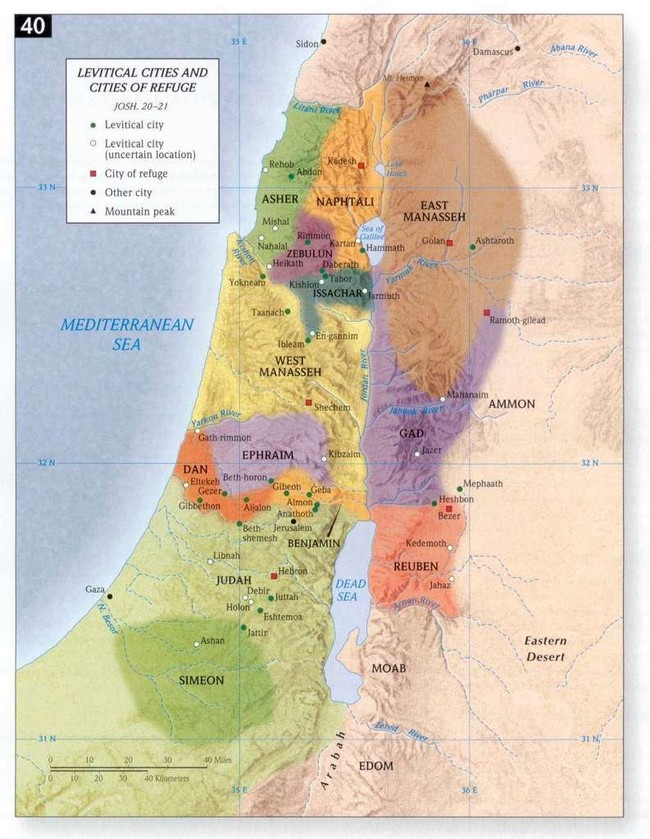
1 The Lord spoke to Moses in the plains of Moab by the Jordan at Jericho, saying, “Command the people of Israel to give to the Levites some of the inheritance of their possession as cities for them to dwell in. And you shall give to the Levites pasturelands around the cities. The cities shall be theirs to dwell in, and their pasturelands shall be for their cattle and for their livestock and for all their beasts. The pasturelands of the cities, which you shall give to the Levites, shall reach from the wall of the city outward a thousand cubits all around. And you shall measure, outside the city, on the east side two thousand cubits, and on the south side two thousand cubits, and on the west side two thousand cubits, and on the north side two thousand cubits, the city being in the middle. This shall belong to them as pastureland for their cities.

“The cities that you give to the Levites shall be the six cities of refuge, where you shall permit the manslayer to flee, and in addition to them you shall give forty-two cities. All the cities that you give to the Levites shall be forty-eight, with their pasturelands. And as for the cities that you shall give from the possession of the people of Israel, from the larger tribes you shall take many, and from the smaller tribes you shall take few; each, in proportion to the inheritance that it inherits, shall give of its cities to the Levites.” Numbers 34:16-35:8 ESV

God provided Moses with the name of one man from each of the ten tribes of Israel. These men, hand-picked by God, would assist Eleazar, the high priest, and Joshua in the distribution of the land. The tribes of Gad and Reuben were not included because they had chosen to settle outside the boundaries of Canaan. These men were well-respected leaders among their respective tribes and would help to guarantee that the land was fairly apportioned and that each tribe, regardless of its size, was treated equitably and fairly. There was to be no favoritism or any form of nepotism. The larger tribes, whose numbers would be based on the recent census taken by Moses, would be allotted more extensive land allotments. But that did not mean they would get the best land. God was giving these ten men the weighty responsibility of dividing up the Israelites’ inheritance in a way that would satisfy all the parties involved, and that would not be an easy task.

The next thing on God’s agenda was to arrange for the needs of the tribe of Levi. He had already informed Moses that the Levites would inherit no land in Canaan. He had set apart the tribe of Levi as His special possession and had dedicated them to the care and maintenance of the tabernacle. As a result, God promised to be their inheritance.

“Remember that the Levitical priests—that is, the whole of the tribe of Levi—will receive no allotment of land among the other tribes in Israel. Instead, the priests and Levites will eat from the special gifts given to the Lord, for that is their share. They will have no land of their own among the Israelites. The Lord himself is their special possession, just as he promised them.” – Deuteronomy 18:1-2 NLT

But while the Levites would be allotted no land in Canaan, they would be awarded the deeds to 48 cities located within the territories of each of the other 11 tribes (Joshua 21). Even the tribes of Gad, Reuben, and the half-tribe of Manasseh were required to provide the Levites with towns and pastureland for their flocks. God had made accommodations for the Levites.

These Levitical cities were to be strategically located throughout the nation of Israel so that every Israelite was no more than ten miles from one of them. This helped to ensure that the people of God were never far away from a member of the Levitical priesthood, whose job was to provide instruction in the ways of God. The Levitical priests served as judges (Deuteronomy 17:8-13) and teachers of God’s law (Deuteronomy 33:10). So, it was essential that every Israelite had ready access to a Levitical town and a priest of God.

Of the 48 towns awarded to the Levites, six were to be designated as cities of refuge. These were specially sanctioned zones within the boundaries of Israel where anyone guilty of committing a non-premediated murder could seek asylum. God had already declared His ruling concerning murder (Exodus 20:13), but He had Moses present a special provision for cases involving accidental homicide.

“If someone kills another person unintentionally, without previous hostility, the slayer may flee to any of these cities to live in safety. – Deuteronomy 19:4 NLT

He even had Moses provide a potential scenario in which a city of refuge would become necessary.

“For example, suppose someone goes into the forest with a neighbor to cut wood. And suppose one of them swings an ax to chop down a tree, and the ax head flies off the handle, killing the other person. In such cases, the slayer may flee to one of the cities of refuge to live in safety.” – Deuteronomy 19:5 NLT

God knew that life would happen and that deadly accidents would be a part of the Israelites’ existence in the land. Men would be killed and justice would need to be pursued. But what He didn’t want was some form of vigilante justice running rampant through the nation. Yet God knew that the relatives of a murder victim would tend to seek revenge against the guilty party and ask questions later. The cities of refuge were intended to protect the innocent while justice was being served.

Since Israel had no professional police force, these kinds of accidents could easily turn into bloodbaths where the relatives of the victim sought to avenge their loved one’s death. So, these cities, occupied by the Levites, would provide a place where the guilty party could find solace and seek a fair judgment concerning his guilt or innocence. In His plans for the land of promise, God was leaving nothing to chance. He was creating a well-designed system for dealing with the inevitable problem of sin among His chosen people. He was going to distribute the Levitical priesthood among them to provide spiritual enlightenment and He was going to create safe havens for those who unwittingly committed even the gravest of sins. God was providing for and protecting His people.

English Standard Version (ESV) The Holy Bible, English Standard Version. ESV® Permanent Text Edition® (2016). Copyright © 2001

New Living Translation (NLT) Holy Bible, New Living Translation, copyright © 1996, 2004, 2015 by Tyndale House Foundation. Used by permission of Tyndale House Publishers Inc., Carol Stream, Illinois 60188. All rights reserved.

Here We Go Again.

But Abner the son of Ner, commander of Saul’s army, took Ish-bosheth the son of Saul and brought him over to Mahanaim, and he made him king over Gilead and the Ashurites and Jezreel and Ephraim and Benjamin and all Israel. Ish-bosheth, Saul’s son, was forty years old when he began to reign over Israel, and he reigned two years. But the house of Judah followed David. And the time that David was king in Hebron over the house of Judah was seven years and six months. 
Abner the son of Ner, and the servants of Ish-bosheth the son of Saul, went out from Mahanaim to Gibeon. And Joab the son of Zeruiah and the servants of David went out and met them at the pool of Gibeon. And they sat down, the one on the one side of the pool, and the other on the other side of the pool. And Abner said to Joab, “Let the young men arise and compete before us.” And Joab said, “Let them arise.” Then they arose and passed over by number, twelve for Benjamin and Ish-bosheth the son of Saul, and twelve of the servants of David. And each caught his opponent by the head and thrust his sword in his opponent’s side, so they fell down together. Therefore that place was called Helkath-hazzurim, which is at Gibeon. And the battle was very fierce that day. And Abner and the men of Israel were beaten before the servants of David. – 2 Samuel 2:8-17 ESV

The fact that verse 8 starts with with the word “but” should tell us something. The is something about to happen that is going to stand in direct contrast to the events of the first seven verses. David had received a warm welcome from the people of Judah, but that was to be expected, since he was of the tribe of Judah. David knew he was going to have a more difficult time winning over the rest of the tribes of Israel and convincing them to make him their king. That’s part of the reason behind his overtures to the men of Jabesh-gilead, because they were of the tribe of Gad. The nation of Israel, while having been united under the leadership of Saul, was still little more than a loose confederation of 12 tribes. Their relationships with each other were typically fractious and contentious. Now, David was attempting to unite them under his leadership and sovereignty as king.

But that’s not the only “but” in these verses. There was yet another facing David’s quest to become the king of Israel. It seems that not all of Saul’s sons died with him on the battlefield. There was one name left out: Ish-bosheth. He was the youngest of Saul’s four sons and would have been about 40-years old when his father and brothers fell at the battle of Gilboa. His given name was Eshbaal,which provides us with an interesting insight into King Saul. Baal was a Canaanite deity. And the name Eshbaal means “man of Baal”. So Saul names his youngest son after a false god. Interestingly enough, the Jews would not repeat the name of this pagan idol, so they substituted the word, “boshesh”, which meant shame of confusion. So, Eshbaal became known as Ish-bosheth. And the son Jonathan, who will appear later on in the story, was known as Mephibosheth.
But back to Ish-bosheth. It seems that this one son of Saul either survived the battle at Gilboa or was not even present. And Abner, the commander of Saul’s armies, decided to use this sole surviving son as a tool to keep David from ascending to the throne. Keep in mind that Saul was of the tribe of Benjamin, as was Abner, his uncle. So it seems that Abner was attempting to keep the crown within the ranks of the Benjaminites.
So, Saul “appointed him king over Gilead, the Geshurites, Jezreel, Ephraim, Benjamin, and all Israel” (2 Samuel 2:9 ESV). This would have been way out of Abner’s area of responsibility as Saul’s former commander in chief. It was not up to him to choose and appoint the king. The Israelites were to be a theocracy, ruled over by God Almighty. It was up to Him to choose their king, just as He had chosen Saul. Abner did not have authority or permission from God to do what he did. But he didn’t let that small detail stand in his way.
Lest we think this was small matter that was of little or no significance, notice that Ish-bosheth was made king over Geshur. That was an area within the territory belonging to the tribe of Manasseh. Jezreel was in the land belonging to the tribe of Issachar. And then the text goes on to include the tribes of Ephraim, Benjamin and “all Israel”. So effectively, Abner crowned Ish-bosheth as king over all Israel, even countering David’s claim to be king over Judah. And we’re told that Ish-bosheth reigned for two years. This was no short-lived, flash-in-the-pan event. Once again, David found himself with serious opposition and facing another enemy from within his own nation. Saul was dead, but his son was alive and so was Abner. And Abner had probably never forgotten the little lecture David had given him at Gibeah, after David had snuck into their camp and taken Saul’s spear and water jug as he slept.
“Well, Abner, you’re a great man, aren’t you?” David taunted. “Where in all Israel is there anyone as mighty? So why haven’t you guarded your master the king when someone came to kill him? This isn’t good at all! I swear by the Lord that you and your men deserve to die, because you failed to protect your master, the Lord’s anointed! Look around! Where are the king’s spear and the jug of water that were beside his head?” – 1 Samuel 26:15-16 NLT
Abner even led his troops into battle against David and his men, meeting them at the pool of Gibeon. The initial conflict was an agreed-upon battle between 24 men, 12 from each side. This mini-battle ended in a draw, with all 24 men dead. But that was not the end of the hostilities. It was followed by a pitched battle between the forces of these two opposing kings. Many would die that day. Like our own Civil War, this battle represented brother fighting against brother. It characterized the divided nature of the kingdom at that time. And this was the contentious atmosphere in which David was forced to begin his reign.
David’s path to the throne had been anything but easy, and it was not getting any smoother. He had been anointed by Samuel years earlier, but it had taken a long time before a crown was placed on his head. And even when it was, it represented the allegiance of a single tribe, his own. Winning over the other 11 tribes and solidifying his God-appointed position as King of Israel was going to be difficult and drawn out. There were still lessons for David to learn. And God was providentially shifting the mindset of the tribes of Israel from autonomous people groups living in isolation and under self-rule to that of a single nation united under one king. God was unifying what had been fractious. He was solidifying what had been disparate. He was making of the divided tribes of Israel a great nation that would be ruled by a great king who was a man after His own heart. The days ahead would be rocky. They would be filled with disappointment. Many would die. Others would loose loved ones as a result of the battles that followed. David’s fledgling kingdom would suffer before it ever experienced any success. But it was all part of God’s sovereign plan.

English Standard Version (ESV)
The Holy Bible, English Standard Version. ESV® Permanent Text Edition® (2016). Copyright © 2001 by Crossway Bibles, a publishing ministry of Good News Publishers.

New Living Translation (NLT)
Holy Bible, New Living Translation, copyright © 1996, 2004, 2015 by Tyndale House Foundation. Used by permission of Tyndale House Publishers Inc., Carol Stream, Illinois 60188. All rights reserved.

The Message (MSG)Copyright © 1993, 1994, 1995, 1996, 2000, 2001, 2002 by Eugene H. Peterson

:)

Psalms 122 & 124 – Day 2

A Love For God’s House.
(Based on Psalm 122)

I was ecstatic when I heard the news that it was time to head to God’s house.
We were going to get to stand within the very gates of Jerusalem.
Jerusalem was established as a city to unify the people of God by bringing them together,
It is where all the tribes of Israel gather to keep their promise to worship God,
To show gratitude for His reputation as their God.
There in Jerusalem, are thrones of judgment, including the throne of the house of David.
We need to pray for the peace, welfare and prosperity of Jerusalem,
Because as long as Jerusalem prospers, so will all those who love this city.
We pray for peace to exist throughout the city, inside its walls and its palaces,
For the sake of fellow Israelites, I say, “May there be peace in Jerusalem!”
Because the house of God is there, I will seek the good of Jerusalem.

God Is On Our Side.
(Based on Psalm 124)

Let us remind ourselves, “What if God had not been on our side?”
May all of Israel say, “What if God had not been on our side when our enemies rose up against us?”
We would have easily defeated by them when they turned their anger against us.
We would have been overwhelmed, our souls would have been drowned.
The raging waters would have flooded over our soul.
But let us kneel before God, who didn’t let any of that happen,
He helped us escape, like a bird from a trap set by a fowler,
God broke the snare and we escaped.
We find help in the reputation of the Lord, the one who made heaven and earth.