Spiritual Maturity Is Non-Optional and Impossible Without God

1 But I, brothers, could not address you as spiritual people, but as people of the flesh, as infants in Christ. 2 I fed you with milk, not solid food, for you were not ready for it. And even now you are not yet ready, 3 for you are still of the flesh. For while there is jealousy and strife among you, are you not of the flesh and behaving only in a human way? 4 For when one says, “I follow Paul,” and another, “I follow Apollos,” are you not being merely human?

5 What then is Apollos? What is Paul? Servants through whom you believed, as the Lord assigned to each. 6 I planted, Apollos watered, but God gave the growth. 7 So neither he who plants nor he who waters is anything, but only God who gives the growth. 8 He who plants and he who waters are one, and each will receive his wages according to his labor. 9 For we are God’s fellow workers. You are God’s field, God’s building. – 1 Corinthians 3:1-9 ESV

There is nothing particularly wrong with acting like a child – if you are one. But we all know how awkward it is to be around someone who refuses to act their age. Watching a grown man behave like a teenager is painful and extremely disappointing. It’s obvious to all that something is wrong with his behavior. He has refused to grow up and own up to the responsibilities that come with adulthood, and his immature actions usually end up impacting every area of his life.

The same can be said for spiritual immaturity. It’s not that it’s wrong. Every believer starts out as a spiritual infant in Christ. We begin the journey of faith as metaphorical newborns who require what Paul refers to as the “milk” of God’s Word. This is normal, natural, and to be expected. It was Peter who wrote, “Like newborn infants, long for the pure spiritual milk, that by it you may grow up into salvation” (1 Peter 2:2 ESV). There is a time in every believer’s life when their spiritual diet must be simple and easily digestible. But as they grow, they must move on to the “meat” of the Word. They are to grow up into salvation, learning to grasp the depth of God’s love, the significance of His grace, their complete dependence upon His strength, and the full weight of His call to holiness. The author of the book of Hebrews had some strong words to say to the recipients of his letter:

You have been believers so long now that you ought to be teaching others. Instead, you need someone to teach you again the basic things about God’s word. You are like babies who need milk and cannot eat solid food. For someone who lives on milk is still an infant and doesn’t know how to do what is right. – Hebrews 5:12-13 NLT

They were stuck on the basics, the elemental principles of God’s Word. They knew that Jesus was the Son of God and that He had died for their sins. They also understood their complete dependence upon Him for salvation. In placing their faith in Jesus, they believed they would be restored to a right relationship with God the Father. But their knowledge of God’s Word had not gone beyond that point. Their grasp of all that God had done and all that He had in store for them remained limited, and their behavior remained so as well.

Paul gave the Ephesian believers a goal to “be mature in the Lord, measuring up to the full and complete standard of Christ” (Ephesians 4:13 NLT). He expected them to grow in Christ-likeness, becoming increasingly more like Him in their daily conduct. The result of this spiritual growth would be clearly evident.

Then we will no longer be immature like children. We won’t be tossed and blown about by every wind of new teaching. We will not be influenced when people try to trick us with lies so clever they sound like the truth. Instead, we will speak the truth in love, growing in every way more and more like Christ, who is the head of his body, the church. – Ephesians 4:14-15 NLT

The problem with the believers in Corinth was that their behavior was revealing their spiritual immaturity. They were bickering, boasting, fighting, and fuming over who was more spiritual based on which teacher they followed. Paul exposed the shallow and immature nature of their behavior. “There is jealousy and strife among you,” he wrote, and that was proof that they were “of the flesh and behaving only in a human way” (1 Corinthians 3:3 ESV). They were acting like children, arguing over things that didn’t matter and revealing their lack of understanding of God’s ways.

They were making much of men rather than making much of God. They misunderstood that their spiritual mentors were merely messengers who had been acting on behalf of God. This led Paul to ask, “Who is Apollos? Who is Paul? We are only God’s servants through whom you believed the Good News. Each of us did the work the Lord gave us” (1 Corinthians 3:5 ESV). They were nothing more than instruments in God’s hands. Their value came from God’s decision to use them to accomplish His will. In a subsequent letter to the Corinthians, Paul reemphasized his understanding of his role as a supporting cast member. 

You see, we don’t go around preaching about ourselves. We preach that Jesus Christ is Lord, and we ourselves are your servants for Jesus’ sake. For God, who said, “Let there be light in the darkness,” has made this light shine in our hearts so we could know the glory of God that is seen in the face of Jesus Christ. We now have this light shining in our hearts, but we ourselves are like fragile clay jars containing this great treasure. This makes it clear that our great power is from God, not from ourselves. – 2 Corinthians 4:5-7 NLT

Mature believers have a growing awareness that God is the source of all that we enjoy regarding our faith. It was He who called us. It was His Son who died for us. It was His Spirit who opened our eyes so that we could understand the truth of the gospel. It is His Word that provides us with insight into His nature and daily guidance for our journey of faith. And it is God who provides His Church with apostles, prophets, evangelists, pastors, and teachers “to equip God’s people to do his work and build up the church, the body of Christ” (Ephesians 4:12 NLT).

Paul reminded the believers in Corinth that he, Cephas, and Apollos were nothing more than “God’s fellow workers” and they were “God’s field, God’s building” (1 Corinthians 3:9 ESV). Maturing believers have a growing understanding of and appreciation for God’s work in their lives. Over time, their appreciation for His love and mercy increases as they experience His grace and mercy. They grow in their gratitude for His unfailing forgiveness. They grow in their desire to please Him, not to earn His love, but to express gratitude for His love. They grow in their dependence upon Him. They grow in their desire for Him. They grow in their hunger for His Word. They grow in their trust in His promises. They grow into their salvation. And all this growth shows up in their behavior.

Father, You don’t just expect me to grow, You have provided everything I need to see that it happens. You are the source of everything. You alone have provided the means for my salvation and sanctification, and, one day, You will bring about my future glorification. Your Spirit convicts, comforts, guides, and produces His fruit through me. Through Your Word, You reveal Yourself to  me. I owe everything to You., including my capacity to grow up in my salvation. I am completely dependent upon You, and I believe that You will complete what You started in my life. As Paul told the Philippians believers, “God, who began the good work within you, will continue his work until it is finally finished on the day when Christ Jesus returns” (Philippians 1:6 NLT). Keep me focused on Your faithfulness and totally reliant upon Your goodness, grace, mercy, and love. So that I will continue to grow up and stand out for You. Amen

English Standard Version (ESV) The Holy Bible, English Standard Version. ESV® Permanent Text Edition® (2016). Copyright © 2001 by Crossway Bibles, a publishing ministry of Good News Publishers.

New Living Translation (NLT) Holy Bible, New Living Translation, copyright © 1996, 2004, 2015 by Tyndale House Foundation. Used by permission of Tyndale House Publishers Inc., Carol Stream, Illinois 60188. All rights reserved.

Boast in the Lord

26 For consider your calling, brothers: not many of you were wise according to worldly standards, not many were powerful, not many were of noble birth. 27 But God chose what is foolish in the world to shame the wise; God chose what is weak in the world to shame the strong; 28 God chose what is low and despised in the world, even things that are not, to bring to nothing things that are, 29 so that no human being might boast in the presence of God. 30 And because of him you are in Christ Jesus, who became to us wisdom from God, righteousness and sanctification and redemption, 31 so that, as it is written, “Let the one who boasts, boast in the Lord.” – 1 Corinthians 1:26-31 ESV

The division taking place within the church at Corinth was based on pride. They were boastfully claiming, “‘I follow Paul,’ or ‘I follow Apollos,’ or ‘I follow Cephas,’ or ‘I follow Christ’” (1 Corinthians 1:12 ESV). They each saw themselves as somehow better or more spiritual because of their choice of leader. They were even bragging about who had baptized them, claiming to have been baptized in their name. This led Paul to declare, “I thank God that I baptized none of you except Crispus and Gaius, so that no one may say that you were baptized in my name” (1 Corinthians 1:14-15 ESV). Even those who were claiming to follow Christ were emphasizing His teaching more than His role as Messiah. They had become followers of men and adherents of their particular teachings, rather than followers of the very one whose death had made their salvation possible. 

So Paul felt compelled to remind them of their pre-conversion state. For the most part, none of them had been wise, wealthy, or powerful. They were not from the upper crust of society or recognized for their intelligence and erudition. Their influence and power had been minimal. In fact, Paul flatly states that they had been foolish, weak, and despised. Not exactly a flattering assessment. But Paul’s seeming put-down was intended to get them to see the “foolish” nature of their salvation, not stroke their egos. There was nothing about them that warranted what God had done for them. Even from a worldly perspective, they had been undeserving of God’s amazing grace and mercy. They were not the brightest and best, the richest and wisest, or the movers and shakers of society.

When Jesus ministered on the earth, He did not choose His disciples from among the wealthy, wise, and powerful. Those 12 men had been lowly fishermen, tax collectors, and commoners. Those who had followed Him during His three years of earthly ministry had been, for the most part, from the peasant class, and this trend continued long after Christ’s resurrection. Paul reminded the Corinthians, “God chose things the world considers foolish in order to shame those who think they are wise. And he chose things that are powerless to shame those who are powerful. God chose things despised by the world, things counted as nothing at all, and used them to bring to nothing what the world considers important” (1 Corinthians 1:27-28 NLT).

None of them had cause for boasting, and they had done nothing to deserve their salvation. Their pride was misplaced because their spiritual status in God’s eyes had nothing to do with who baptized or taught them. Those men were nothing more than instruments in the hands of God. They were His messengers, but not the Messiah.

Later in this same letter, Paul writes, “Be imitators of me, as I am of Christ” (1 Corinthians 11:1 ESV). It was only as Paul displayed the character of Christ that he was to be considered someone to model their lives after. His life was meaningless unless it emulated that of Christ. Paul’s ministry was never meant to be about him, but, instead, it was intended to point to the life-transforming nature of Christ’s death and resurrection.

Paul wanted them to remember that their status as children of God had been the work of God. It was He who had called them, which is why Paul tells them, “consider your calling.” The Greek word Paul used was βλέπω (blepō) and it means, “to turn the thoughts or direct the mind to a thing, to consider, contemplate, to look at, to weigh carefully, examine” (“G991 – blepō – Strong’s Greek Lexicon (KJV).” Blue Letter Bible). Paul wanted them to take a long, hard look at their calling by God. So he reminds them three times:

God chose what is foolish…

God chose what is weak…

 God chose what is low and despised…

God chose. In other words, it was His doing and was not based on any merit or worth of the ones chosen. It was solely based on God’s divine mercy and grace. That is why Paul reminds them that it was “because of him [God] you are in Christ Jesus” (1 Corinthians 1:30 ESV), not because of themselves and due to the efforts of Paul, Cephas, or Apollos. Those men had been used by God to carry the gospel to the Corinthians, but they were simply messengers. It had been God who had made it possible for the believers in Corinth to have a relationship with Jesus, and it had been Jesus who had revealed to them God’s wisdom. By His death on the cross, Jesus opened a way for men to receive righteousness, sanctification, and redemption. With His death on the cross, Jesus took on the sins of mankind, and those who placed their faith in Christ had their sins imputed to Him and received His righteousness in exchange. They now stood before God as righteous because of the work of Christ, and they are going through the process of sanctification, their ongoing transformation into the likeness of Christ, through the power of the indwelling Holy Spirit. Ultimately, they would enjoy their final redemption or release from the power of sin in their lives when God glorifies them.

No man can make these things possible. No human teacher can provide us with righteousness before God. No pastor can transform us into the likeness of Christ. No evangelist or theologian can make our glorification possible. These things are all the work of God, just as our salvation was. He called, chose, justified, sanctifies, and will one day redeem. So if we are going to boast, we need to boast in God; we need to brag about all that He has done, is currently doing, and will accomplish in the future. He made our salvation possible, He has made our daily sanctification obtainable, and He will one day accomplish the seemingly impossible: our glorification. We owe it all to Him.

Nothing in my hand I bring,
simply to the cross I cling;
naked, come to thee for dress;
helpless, look to thee for grace;
foul, I to the fountain fly;
wash me, Savior, or I die. – Rock of Ages, Augustus Toplady

Father, we are a prideful people. Even those of us who have received Your undeserved mercy and grace tend to find ways to make it all about us. We can become overconfident about our spiritual status and convince ourselves that we somehow deserved to be chosen by You. We have a habit of forgetting our sinful past and failing to recall just how desperate we were before we heard the good news of Jesus Christ. But as Augustus Toplady reminds us, we bring nothing to our salvation other than our sin, shame, and a need for a Savior. Our wisdom and wealth play no part. Our accomplishments are of no value. But You accept us based on nothing more than our faith in Christ and His finished work on the cross. May we never forget our inadequacy and His all-sufficiency. Amen

English Standard Version (ESV) The Holy Bible, English Standard Version. ESV® Permanent Text Edition® (2016). Copyright © 2001 by Crossway Bibles, a publishing ministry of Good News Publishers.

New Living Translation (NLT) Holy Bible, New Living Translation, copyright © 1996, 2004, 2015 by Tyndale House Foundation. Used by permission of Tyndale House Publishers Inc., Carol Stream, Illinois 60188. All rights reserved.

Faith In Christ’s Faithfulness

1 Finally, brothers, pray for us, that the word of the Lord may speed ahead and be honored, as happened among you, 2 and that we may be delivered from wicked and evil men. For not all have faith. 3 But the Lord is faithful. He will establish you and guard you against the evil one. 4 And we have confidence in the Lord about you, that you are doing and will do the things that we command. 5 May the Lord direct your hearts to the love of God and to the steadfastness of Christ. – 2 Thessalonians 3:1-5 ESV

Paul was a powerful proponent of prayer and was not shy in requesting others to pray on his behalf. He knew he was engaged in a spiritual battle that required spiritual weapons, which is exactly what he told the believers in Corinth.

We are human, but we don’t wage war as humans do. We use God’s mighty weapons, not worldly weapons, to knock down the strongholds of human reasoning and to destroy false arguments. We destroy every proud obstacle that keeps people from knowing God. We capture their rebellious thoughts and teach them to obey Christ. – 2 Corinthians 10:3-5 NLT

And as he told Timothy, one of the primary weapons in our warfare with evil is prayer.

I urge you, first of all, to pray for all people. Ask God to help them; intercede on their behalf, and give thanks for them. Pray this way for kings and all who are in authority so that we can live peaceful and quiet lives marked by godliness and dignity. – 1 Timothy 2:1-2 NLT

His belief in the power and efficacy of prayer was supported by James, who wrote, “The earnest prayer of a righteous person has great power and produces wonderful results” (James 5:16 NLT). In his first letter to the Thessalonians, Paul challenged them to “pray without ceasing” (1 Thessalonians 5:17 ESV). And, as Paul told Timothy, this call to persistent prayer was his desire for every congregation to which he had ministered.

In every place of worship, I want men to pray with holy hands lifted up to God, free from anger and controversy. – 1 Timothy 2:8 NLT

Paul didn’t view prayer as optional. It was not some kind of spiritual accessory you access when it’s convenient or when you determine it’s necessary. Prayer was to be a permanent and vital part of the believer’s life, a sentiment Paul expressed to the church in Ephesus.

Pray in the Spirit at all times and on every occasion. Stay alert and be persistent in your prayers for all believers everywhere. – Ephesians 6:18 NLT

This call to persistent and perpetual prayer was because of the undeniable reality of the spiritual battle in which we are engaged. Just a few verses earlier, Paul warned the Ephesian believers of the epic spiritual war taking place around them and their role in it.

Be strong in the Lord and in his mighty power. Put on all of God’s armor so that you will be able to stand firm against all strategies of the devil. For we are not fighting against flesh-and-blood enemies, but against evil rulers and authorities of the unseen world, against mighty powers in this dark world, and against evil spirits in the heavenly places. – Ephesians 6:10-12 NLT

Paul was a man of prayer, and he coveted the prayers of others. But notice that Paul’s prayer request, while personal in nature, was not self-focused. He was asking them to pray that his ministry would continue to be successful, so “that the Lord’s message may spread quickly and be honored” (2 Thessalonians 3:1 NLT). He didn’t provide the Thessalonians with a long list of personal prayer requests that focused on his health, finances, or relational concerns. It wasn’t that Paul didn’t have problems or personal issues, but that his focus was always on the more significant cause of spreading the gospel.

Paul didn’t need better clothes, a bigger house, improved health, or a trouble-free life. And while he appreciated the concern that others showed for his well-being, he wanted them to know that he really had no needs, except the strength and determination to continue doing what he had been called to do.

How I praise the Lord that you are concerned about me again. I know you have always been concerned for me, but you didn’t have the chance to help me. Not that I was ever in need, for I have learned how to be content with whatever I have. I know how to live on almost nothing or with everything. I have learned the secret of living in every situation, whether it is with a full stomach or empty, with plenty or little. – Philippians 4:10-12 NLT

And Paul made it clear that everything he needed was provided for him by Christ.

For I can do everything through Christ, who gives me strength. – Philippians 4:13 NLT

As Paul’s letter has made clear, some opposed his teaching and were trying to add to or alter the gospel message. Not only that, but he also faced physical threats to his life because of his work on behalf of Christ. Paul provides a detailed list of his physical sufferings in his second letter to the church in Corinth. He describes how he had been “put in prison more often, been whipped times without number, and faced death again and again” (2 Corinthians 11:23 NLT). Then he gave them specific instances of his abuse. “Five different times the Jewish leaders gave me thirty-nine lashes. Three times I was beaten with rods. Once I was stoned” (2 Corinthians 11:24-25 NLT).

So, Paul asked the Thessalonians for prayer in light of the very real nature of his opposition and their relentless desire to put him out of commission.

…pray for us…that we may be delivered from perverse and evil people. For not all have faith. – 2 Thessalonians 3:1, 2 NLT

As the Thessalonians knew from their own firsthand experience, not everyone was receptive to the gospel message. Many of their own friends and family members had denied God’s gracious offer of salvation by faith alone in Christ alone. Not all have faith, Paul states, and not everyone is part of the body of Christ. Wherever believers exist, they find themselves surrounded by those who despise their message and their very existence. Jesus had warned His disciples, “You will be hated by everyone because of My name” (Matthew 10:22 BSB). And He broadened the scope of this hatred by declaring that the whole world would stand opposed to His followers.

If you were of the world, it would love you as its own. Instead, the world hates you, because you are not of the world, but I have chosen you out of the world. – John 15:19 BSB

But Paul assures his fledgling flock in Thessalonica that, while the world was filled with hostile people who did not share their faith, “the Lord is faithful” and “He will establish you and guard you against the evil one” (2 Thessalonians 3:3 ESV). No matter how bleak things appeared to be or how intense the persecution may become, the Lord stood ready to strengthen and protect them. With true pastoral conviction and a loving shepherd’s heart, Paul encouraged his flock to remain faithful to the Lord. He had not and would not abandon them. And Paul complimented the Thessalonians for their past faithfulness and assured them of his confidence that they would remain committed to Christ, no matter what happened.

…we are confident about you in the Lord that you are both doing—and will do—what we are commanding. – 2 Thessalonians 3:4 NLT

Finally, Paul offers up a prayer on their behalf, asking that God give them a greater understanding of His love for them and a deeper appreciation for the endurance Christ modeled with His own life. They needed to keep the love of God and the steadfastness of Christ on their minds constantly. As Paul told the believers in Ephesus, an understanding of God’s love as expressed through Christ’s sacrifice is the key to experiencing fullness of life and power.

…may you have the power to understand, as all God’s people should, how wide, how long, how high, and how deep his love is. May you experience the love of Christ, though it is too great to understand fully. Then you will be made complete with all the fullness of life and power that comes from God. – Ephesians 3:18-19 NLT

And as the author of Hebrews points out, a constant focus on the faithfulness of Christ goes a long way in providing world-weary Christians with the strength they need to not only survive but thrive in this life.

…let us run with endurance the race God has set before us. We do this by keeping our eyes on Jesus, the champion who initiates and perfects our faith. Because of the joy awaiting him, he endured the cross, disregarding its shame. Now he is seated in the place of honor beside God’s throne. Think of all the hostility he endured from sinful people; then you won’t become weary and give up. – Hebrews 12:1-3 NLT

Because of the unwavering love of God and the faithfulness of Christ, they had everything they needed to say as Paul did, “I can do everything through Christ, who gives me strength” (Philippians 4:13 NLT).

Father, we tend to make faith a self-produced asset that we somehow conjure up out of our own strength. But, in reality, faith has far less to do with us than it has to do with the faithfulness of Christ. The size or strength of our faith is not the point. As Jesus told His disciples, faith as small as a mustard seed can move mountains (Matthew 17:20). Focusing on the quantity or quality of our faith places the emphasis on the wrong thing. My faith is to focus on Jesus, “the author and perfecter of our faith” (Hebrews 10:12 BSB). It is because Jesus was faithful to carry out His Father’s divine plan of salvation that we have hope. As Paul states, “the Lord is faithful; he will strengthen you and guard you from the evil one” (2 Thessalonians 3:3 NLT). That is where my faith come from. And as Paul told Timothy, even when I am faithless, Jesus remains faithful (2 Timothy 2:13). He will finishe what He started. He willl complete what He began. He will protect and preserve all those who have placed their hope in His faithfulness. Thank You for that much-needed reminder. Now, help me to live by faith in the faithfulness of Christ. Amen.

English Standard Version (ESV) The Holy Bible, English Standard Version. ESV® Permanent Text Edition® (2016). Copyright © 2001 by Crossway Bibles, a publishing ministry of Good News Publishers.

New Living Translation (NLT) Holy Bible, New Living Translation, copyright © 1996, 2004, 2015 by Tyndale House Foundation. Used by permission of Tyndale House Publishers Inc., Carol Stream, Illinois 60188. All rights reserved.
Well Worth the Wait

1 Now concerning the coming of our Lord Jesus Christ and our being gathered together to him, we ask you, brothers, 2 not to be quickly shaken in mind or alarmed, either by a spirit or a spoken word, or a letter seeming to be from us, to the effect that the day of the Lord has come. 3 Let no one deceive you in any way. For that day will not come, unless the rebellion comes first, and the man of lawlessness is revealed, the son of destruction, 4 who opposes and exalts himself against every so-called god or object of worship, so that he takes his seat in the temple of God, proclaiming himself to be God. – 2 Thessalonians 2:1-4 ESV

At this point in his letter, Paul jumps into the deep end of the pool. No more paddling around in the shallow waters of easy believe-ism. The Thessalonians’ faith had been shaken by some fairly significant doctrinal errors brought to them courtesy of false teachers. These individuals had been propagating the idea that the Second Coming of Jesus had already begun, and it seems they were using the intense persecution of the Thessalonians as proof. Not only that, but they could back up their belief with the teachings of Jesus.

While sitting on the Mount of Olives, just across the Kidron Valley from the city of Jerusalem, Jesus’ disciples came to Him and asked, “Tell us, when will these things be, and what will be the sign of your coming and of the end of the age?” (Matthew 24:3 ESV). Their question had been prompted by a statement by Jesus concerning the Temple in Jerusalem.

“You see all these, do you not? Truly, I say to you, there will not be left here one stone upon another that will not be thrown down.” – Matthew 24:2 ESV

They wanted to know when this fateful day would take place. In an attempt to calm their concerns, Jesus told them, “See that no one leads you astray. For many will come in my name, saying, ‘I am the Christ,’ and they will lead many astray. And you will hear of wars and rumors of wars. See that you are not alarmed, for this must take place, but the end is not yet” (Matthew 24:4-6 ESV).

In other words, a great many things would take place long before “the end” occurred. In fact, Jesus included additional seemingly catastrophic events that would precede the end times and His Second Coming:

“For nation will rise against nation, and kingdom against kingdom, and there will be famines and earthquakes in various places. All these are but the beginning of the birth pains.” – Matthew 24:7-8 ESV

Jesus was attempting to prepare His disciples to expect suffering, civil unrest, wars, and even natural disasters. But those were simply the precursors of the end, not proof of its arrival. Things were going to get worse before they got better. And Jesus proves it by adding:

“Then they will deliver you up to tribulation and put you to death, and you will be hated by all nations for my name’s sake. And then many will fall away and betray one another and hate one another. And many false prophets will arise and lead many astray. And because lawlessness will be increased, the love of many will grow cold. But the one who endures to the end will be saved. And this gospel of the kingdom will be proclaimed throughout the whole world as a testimony to all nations, and then the end will come.” – Matthew 24:9-14 ESV

But it seems that the false teachers who were negatively influencing the believers in Thessalonica were guilty of cherry-picking the teachings of Jesus. They were proof-texting, pulling out certain phrases to support their view that the end had come, and, as a result, the Second Coming of Jesus was just around the corner. But this errant view flew in the face of Paul’s teachings concerning the end times.

In chapter one, Paul assures the Thessalonians that, concerning Christ’s Second Coming, “when the Lord Jesus is revealed from heaven with his mighty angels in flaming fire,” He would inflict “vengeance on those who do not know God and on those who do not obey the gospel of our Lord Jesus” (2 Thessalonians 1:7-8 ESV). That had clearly not taken place yet, and it would not occur until the Rapture of the church (1 Thessalonians 4:13-18).

Paul and the other apostles clearly taught the imminence of Christ’s coming. They wanted believers to know that Jesus could come at any time, but that did not mean that He would. Followers of Christ were to live with a sense of urgency and immediacy, conducting their lives in a manner that reflected their belief in His return and the reality of eternity. This world was not to be their home; they were to set their minds and hearts on heaven and the promise of their eternal state. In his first letter to the Thessalonians, Paul assured them that God would protect and preserve them for that future day.

Now may the God of peace make you holy in every way, and may your whole spirit and soul and body be kept blameless until our Lord Jesus Christ comes again. God will make this happen, for he who calls you is faithful. – 1 Thessalonians 5:23-24 NLT

What rankled Paul was the fear and doubt being fostered among the Thessalonians because of the shoddy doctrine of the false teachers. While their motivation was likely sincere and well-meaning, they were doing serious damage to the cause of Christ by speaking about things they didn’t fully understand. Their speculation was causing unnecessary anxiety among the Thessalonians regarding “the coming of our Lord Jesus Christ and our being gathered together to him” (2 Thessalonians 2:1 ESV). This statement is a direct reference to the Rapture of the church. And Paul warns his confused and fearful friends not to let this false teaching deceive or disquiet them.

Don’t be so easily shaken or alarmed by those who say that the day of the Lord has already begun. Don’t believe them, even if they claim to have had a spiritual vision, a revelation, or a letter supposedly from us. Don’t be fooled by what they say. – 2 Thessalonians 2:2-3 NLT

Paul did not give these false teachers the courtesy of treating their views as acceptable options to consider. They were wrong, their teachings were false, and were not to be believed. It didn’t matter if they claimed their views came with God’s Good Housekeeping Seal of Approval.

For Paul, the gospel was far more than just the faithful presentation of God’s offer of salvation through grace alone by faith alone in Christ alone. His concept of the gospel was all-inclusive, encompassing the full spectrum of God’s gracious plan for man’s redemption. Salvation was just the beginning, with the sanctification of the believer being just as much an integral part of God’s divine plan. And it would all culminate with the believer’s glorification when they received their new bodies, designed to last for eternity. Paul discussed this miraculous final phase of our gospel transformation in his first letter to the Corinthians.

But let me reveal to you a wonderful secret. We will not all die, but we will all be transformed! It will happen in a moment, in the blink of an eye, when the last trumpet is blown. For when the trumpet sounds, those who have died will be raised to live forever. And we who are living will also be transformed. For our dying bodies must be transformed into bodies that will never die; our mortal bodies must be transformed into immortal bodies. – 1 Corinthians 15:51-53 NLT

Salvation – sanctification – glorification. For Paul, those three aspects of the gospel were non-negotiable and not up for debate. Anyone who deviated from and added to that threefold plan was to be treated with contempt. Paul pulled no punches when declaring his feelings about those who tinkered with the gospel message.

Let God’s curse fall on anyone, including us or even an angel from heaven, who preaches a different kind of Good News than the one we preached to you. – Galatians 1:8 NLT

According to Paul, the good news regarding faith in Christ had to include all three phases of God’s redemptive plan, and he succinctly articulates it in his letter to Titus.

For the grace of God has been revealed, bringing salvation [salvation] to all people. And we are instructed to turn from godless living and sinful pleasures [sanctification]. We should live in this evil world with wisdom, righteousness, and devotion to God, while we look forward with hope to that wonderful day when the glory of our great God and Savior, Jesus Christ, will be revealed [glorification]. – Titus 2:11-13 NLT

The believer’s glorification is the final phase in God’s plan, and will take place when Christ returns for His bride, the church. Paul knew that the human body was not equipped for eternal life. It was, as he described it, a temporary tent in which we dwell until Christ returns.

“…our physical bodies cannot inherit the Kingdom of God. These dying bodies cannot inherit what will last forever.” – 1 Corinthians 15:50 NLT

But Paul firmly believed that God had a plan that included new bodies, divinely prepared for eternity.

“We will not all die, but we will all be transformed! It will happen in a moment, in the blink of an eye, when the last trumpet is blown. For when the trumpet sounds, those who have died will be raised to live forever. And we who are living will also be transformed.” – 1 Corinthians 15:51-52 NLT 

As Paul told the Thessalonians in his first letter, the Rapture of the church will result in the gathering of all God’s saints, complete with their newly glorified bodies, so they can return with Him to heaven. That great day will usher in the beginning of the end. With the removal of the church, God’s final plan of judgment for the unbelieving world will be set to begin. And Paul expounds on that future aspect of the end times in the following verses.

For that day will not come until there is a great rebellion against God and the man of lawlessness is revealed—the one who brings destruction. He will exalt himself and defy everything that people call god and every object of worship. He will even sit in the temple of God, claiming that he himself is God. – 2 Thessalonians 2:3-4 NLT

Paul didn’t want there to be any confusion regarding these matters. The Thessalonians were not to worry or fret over the claims of the false teachers. They had not missed out; the Great Tribulation had not begun. There was much that had to happen before “the end” began. All that they were experiencing was nothing more than the labor pains that naturally precede God’s future judgment of the world.

Father, You want us to live with the end in mind, but You don’t want us to  be fearful or frantic when the world takes a turn for the worse. When things look dark and depressing, it’s easy to assume that Christ’s return in right around the corner. Even worse, we can begin to doubt He’s coming back at all. But You are the promise-keeping God and You have never failed to keep Your Word. Help us to remain faithful and fearless in the face of false teaching. Give us the strength to endure the trials of this life as we await Your promise of eternal life. Your plan is perfect and Your timing is impeccable. The fact that Your Son has not yet returned is not a sign of Your unfaithfulness or our undeservedness. He will come back for His church. Your judgment will come upon this earth. And, one day, Your Son will return to set up His earthly Kingdom. You promised it and we can believe it. Amen.

English Standard Version (ESV) The Holy Bible, English Standard Version. ESV® Permanent Text Edition® (2016). Copyright © 2001 by Crossway Bibles, a publishing ministry of Good News Publishers.

New Living Translation (NLT) Holy Bible, New Living Translation, copyright © 1996, 2004, 2015 by Tyndale House Foundation. Used by permission of Tyndale House Publishers Inc., Carol Stream, Illinois 60188. All rights reserved.

Better Together

1 Therefore when we could bear it no longer, we were willing to be left behind at Athens alone, 2 and we sent Timothy, our brother and God’s coworker in the gospel of Christ, to establish and exhort you in your faith, 3 that no one be moved by these afflictions. For you yourselves know that we are destined for this. 4 For when we were with you, we kept telling you beforehand that we were to suffer affliction, just as it has come to pass, and just as you know. 5 For this reason, when I could bear it no longer, I sent to learn about your faith, for fear that somehow the tempter had tempted you and our labor would be in vain. – 1 Thessalonians 3:1-5 ESV

We know from Luke’s account of Paul’s second missionary journey, recorded in the book of Acts, that Paul and Silas were forced to flee Thessalonica because of threats against their lives. They left under the cover of night and made their way to Berea. Their initial reception in Berea was positive, and Luke records that the Jews there “received the word with all eagerness, examining the Scriptures daily to see if these things were so” (Acts 17:11 ESV). But when the Jews in Thessalonica got word that Paul and Silas were in Berea, they sent men to stir up the local populace against them.

Once again, Paul was forced to leave, but he asked Silas and Timothy to remain behind in Berea (Acts 17:14). Paul then made his way to Athens by boat. Once there, he immediately went to work sharing the gospel, even preaching in the Areopagus, an outdoor arena located on a small hill northwest of the city of Athens. The term “Areopagus” referred to a place as well as the council of rulers who met there to debate and discuss important topics. Paul addressed this learned group, using the local shrine to an “unknown god” to discuss with them the truth regarding Jesus Christ. All went well until he mentioned Jesus being raised from the dead.

Now when they heard of the resurrection of the dead, some mocked. But others said, “We will hear you again about this.” So Paul went out from their midst. But some men joined him and believed, among whom also were Dionysius the Areopagite and a woman named Damaris and others with them. – Acts 17:31-33 ESV

Despite the negative response of the council, some heard Paul’s message and believed. In his letter to the Thessalonian believers, Paul picks up the recounting of his travel itinerary.

Therefore when we could bear it no longer, we were willing to be left behind at Athens alone, and we sent Timothy, our brother and God’s coworker in the gospel of Christ, to establish and exhort you in your faith… – 1 Thessalonians 3:1-2 ESV

Paul had left Silas and Timothy back in Berea, but a further decision had been made to have Timothy return to Thessalonica to continue the work of building up the local congregation there. In a series of letters he had written to Timothy, Paul provided his young friend and ministry partner with some specific instructions regarding his work among these fledgling congregations.

Don’t let anyone think less of you because you are young. Be an example to all believers in what you say, in the way you live, in your love, your faith, and your purity. Until I get there, focus on reading the Scriptures to the church, encouraging the believers, and teaching them. – 1 Timothy 4:12-13 NLT

Preach the word of God. Be prepared, whether the time is favorable or not. Patiently correct, rebuke, and encourage your people with good teaching. – 2 Timothy 4:2 NLT

Paul reminds the Thessalonian believers that Timothy had been sent to encourage and instruct them, but also to strengthen their faith as they wrestled with the persecution they were facing.

We sent him to strengthen you, to encourage you in your faith, and to keep you from being shaken by the troubles you were going through. – 1 Thessalonians 3:2-3 NLT

A year earlier, when Paul and Silas had been in Thessalonica, a mob attacked the home of Jason, one of the members of the local congregation. He and a few other Christians were dragged before the city council and falsely accused of insurrection against the Roman government.

“They are all guilty of treason against Caesar, for they profess allegiance to another king, named Jesus.” – Acts 17:7 NLT

Jason and his companions were forced to post bond and then released, but the pressure on this small congregation did not let up. The Jews living in Thessalonica saw them as a threat and continued to stir up trouble for them. The gospel was having an impact, resulting in the conversions of some of the members of the local synagogue. This resulted in a spirit of jealousy and resentment among the Jews. The city council, answerable to the Roman government, would not tolerate anyone or anything to stir up a spirit of dissent or discord in their community. So, this small congregation of Christ-followers was under increasing pressure and growing persecution. However, Paul reminded them, “You know that we are destined for such troubles. Even while we were with you, we warned you that troubles would soon come—and they did, as you well know.” (1 Thessalonians 4:3-4 NLT).

He had told them to expect trouble, and it had shown up as promised. Evidently, this had been the motivation behind Paul’s decision to send Timothy back to Thessalonica. He was concerned that the pressure being placed upon the believers there would cause them to consider reneging on their commitment to Christ.

Paul had a strong commitment to the spiritual well-being of the local church and, knowing that persecution was inevitable, he had sent Timothy to provide godly leadership in the face of opposition. He had already provided Timothy with ample instructions regarding his role as an elder/shepherd of the people of God.

I am writing these things to you now, even though I hope to be with you soon, so that if I am delayed, you will know how people must conduct themselves in the household of God. This is the church of the living God, which is the pillar and foundation of the truth. – 1 Timothy 3:14-15 NLT

The church was to be the bedrock of the truth concerning Jesus. No opposition or oppression was to shake their confidence in the message they had received from Paul and Silas.  The local congregation in Thessalonica was meant to conduct itself in keeping with the truth of the gospel, exhibiting its life-transforming power even in the face of persecution. Paul was well aware of the fact that Satan was doing everything in his power to discourage and demoralize the young believers in Thessalonica. In fact, he confessed to them his fear that they would give in to the enemy’s attacks on their faith.

I was afraid that the tempter had gotten the best of you and that our work had been useless. – 1 Thessalonians 3:5 NLT

Paul had expressed similar concerns to the believers in Ephesus and had provided them with insights into the nature of the spiritual battle in which they were engaged.

Be strong in the Lord and in his mighty power. Put on all of God’s armor so that you will be able to stand firm against all strategies of the devil. For we are not fighting against flesh-and-blood enemies, but against evil rulers and authorities of the unseen world, against mighty powers in this dark world, and against evil spirits in the heavenly places. – Ephesians 6:10-12 NLT

Faith in Christ had resulted in salvation for the believers in Thessalonica. But it had also resulted in persecution. Their commitment to Christ had placed a bullseye on their backs and made them tempting targets for the enemy. Paul knew that the constant presence of trials and difficulties would cause some to lose faith. Their strength to stand firm in the face of opposition would weaken, and the thought of returning to their old way of life would be tempting. Paul had warned Timothy that this would happen and encouraged him to “fight the good fight, holding on to faith and a good conscience, which some have rejected and thereby shipwrecked their faith” (1 Timothy 1:18-19 BSB).

The local church has always been intended to be the pillar and foundation of the truth. It is within the fellowship of believers that the miracle of the gospel shows up in transformed lives and a loving community of Christ-centered people who love God and one another. But for the local church to be impactful, it requires individual believers to remain committed to the cause of Christ regardless of any persecutions or problems they may face.

Paul knew that the Thessalonian believers were suffering, but he also knew that they could survive and thrive. His answer to their problem of persecution was simple, and it was the very same thing he had told the believers in Corinth.

Be on guard. Stand firm in the faith. Be courageous. Be strong. And do everything with love. – 1 Corinthians 16:13 NLT

God had not left them ill-equipped or on their own; He had provided them with ample resources to fight the good fight of faith.

Therefore, put on every piece of God’s armor so you will be able to resist the enemy in the time of evil. Then after the battle you will still be standing firm. Stand your ground, putting on the belt of truth and the body armor of God’s righteousness. For shoes, put on the peace that comes from the Good News so that you will be fully prepared. In addition to all of these, hold up the shield of faith to stop the fiery arrows of the devil. Put on salvation as your helmet, and take the sword of the Spirit, which is the word of God. – Ephesians 6:13-17 NLT

Father, too often we fail to recognize the importance of the local body of Christ. We see “the church” as a place we go on Sundays for fellowship and worship, but You intended it to be so much more. It is the family of faith in which You placed when You adopted us as Your sons and daughters. And it is within these geographically bound congregations of like-minded people that Your Spirit produces fruit and accomplishes His work of sanctification. Together, we endure the trials of life and encourage one another to live godly lives marked by faith, love, and hope. Christianity is not a solo sport but a team endeavor that requires cooperation and a mutual commitment to one another’s welfare. Help me see my need for the faith community and to embrace it as a non-optional asset in my ongoing sanctification. Amen.

English Standard Version (ESV) The Holy Bible, English Standard Version. ESV® Permanent Text Edition® (2016). Copyright © 2001 by Crossway Bibles, a publishing ministry of Good News Publishers.

New Living Translation (NLT) Holy Bible, New Living Translation, copyright © 1996, 2004, 2015 by Tyndale House Foundation. Used by permission of Tyndale House Publishers Inc., Carol Stream, Illinois 60188. All rights reserved.

Anyone Can Play God

26 Then Eliakim the son of Hilkiah, and Shebnah, and Joah, said to the Rabshakeh, “Please speak to your servants in Aramaic, for we understand it. Do not speak to us in the language of Judah within the hearing of the people who are on the wall.” 27 But the Rabshakeh said to them, “Has my master sent me to speak these words to your master and to you, and not to the men sitting on the wall, who are doomed with you to eat their own dung and to drink their own urine?”

28 Then the Rabshakeh stood and called out in a loud voice in the language of Judah: “Hear the word of the great king, the king of Assyria! 29 Thus says the king: ‘Do not let Hezekiah deceive you, for he will not be able to deliver you out of my hand. 30 Do not let Hezekiah make you trust in the LORD by saying, The LORD will surely deliver us, and this city will not be given into the hand of the king of Assyria.’ 31 Do not listen to Hezekiah, for thus says the king of Assyria: ‘Make your peace with me and come out to me. Then each one of you will eat of his own vine, and each one of his own fig tree, and each one of you will drink the water of his own cistern, 32 until I come and take you away to a land like your own land, a land of grain and wine, a land of bread and vineyards, a land of olive trees and honey, that you may live, and not die. And do not listen to Hezekiah when he misleads you by saying, “The LORD will deliver us.” 33 Has any of the gods of the nations ever delivered his land out of the hand of the king of Assyria? 34 Where are the gods of Hamath and Arpad? Where are the gods of Sepharvaim, Hena, and Ivvah? Have they delivered Samaria out of my hand? 35 Who among all the gods of the lands have delivered their lands out of my hand, that the LORD should deliver Jerusalem out of my hand?’”

36 But the people were silent and answered him not a word, for the king’s command was, “Do not answer him.” 37 Then Eliakim the son of Hilkiah, who was over the household, and Shebna the secretary, and Joah the son of Asaph, the recorder, came to Hezekiah with their clothes torn and told him the words of the Rabshakeh. – 2 Kings 18:26-37 ESV

This entire scene is filled with a sense of nervous anticipation. The people of Judah are lining the eastern walls of the city, overlooking the Kidron Valley, where the Assyrian army lies spread out before them in numbers too great to count. But their eyes are locked on the three emissaries whom King Hezekiah commissioned to discuss the terms of peace with the Assyrians. Eliakim, Shebnah, and Joah hold the fate of the nation in their hands, and the people know that the negotiating skills of these three men will determine whether Judah stands or falls. So, all eyes are fixed on the momentous scene taking place at the base of the walls of the city.

But the Rabshakeh, or supreme commander of the Assyrian army, is not interested in peace negotiations; he has come to demand the unconditional surrender of the city and its inhabitants. He and his troops have repeatedly proven their superior strength, and he is confident that the city of Jerusalem will be one more domino to fall as they continue their conquest of Palestine. Speaking on behalf of his commander-in-chief, the Rabshakeh declares Hezekiah’s rebellion to be ill-conceived and ill-fated.

“This is what the great king of Assyria says: What are you trusting in that makes you so confident? Do you think that mere words can substitute for military skill and strength? Who are you counting on, that you have rebelled against me?” – 2 Kings 18:19-20 NLT

With the citizens of Jerusalem looking on and listening in, this arrogant military commander summarily dismisses any likelihood that the Egyptians will come to the aid of the city. The last-minute military alliance that King Hezekiah made with Pharaoh will prove disappointingly insufficient. The Rabshakeh sarcastically compares Pharaoh to a cane or walking stick made from a reed. It may appear to give support, but it will shatter as soon as any weight is placed upon it.

Then the overly confident Assyrian commander informs the Jewish emissaries that if they are holding out hope that Yahweh will come to their rescue, they will be sorely disappointed. Their deity will join a long list of other gods who proved unsuccessful in stopping the Assyrian juggernaut. And, hoping to further undermine their faith in divine rescue, the Rabshakeh announces to the people of Judah that Yahweh had ordered their destruction.

“What’s more, do you think we have invaded your land without the LORD’s direction? The LORD himself told us, ‘Attack this land and destroy it!’”  2 Kings 18:25 NLT

Eliakim, Shebna, and Joah could sense that all this boastful rhetoric was having its intended effect. The Rabshakeh had purposefully delivered his message in Hebrew so that all the people on the wall could hear what he had to say, and they were growing increasingly more concerned. When the king’s three emissaries asked that the conversation be switched to Aramaic, the Rabshakeh refused and called out in a loud voice, “Do you think my master sent this message only to you and your master? He wants all the people to hear it, for when we put this city under siege, they will suffer along with you. They will be so hungry and thirsty that they will eat their own dung and drink their own urine” (2 Kings 18:27 NLT).

At this point, the Rabshakeh turns his attention to the people on the walls of the city. He begins to sow seeds of doubt and suspicion by raising questions concerning King Hezekiah’s intentions and trustworthiness. By addressing the people directly, the Rabshakeh hopes to foment an uprising within the walls of the city, inciting the citizens to turn on their king and demand that he spare their lives by surrendering to the Assyrians. And to help sweeten the pot, the Rabshakeh offers them tempting promises of peace and prosperity.

“Don’t listen to Hezekiah! These are the terms the king of Assyria is offering: Make peace with me—open the gates and come out. Then each of you can continue eating from your own grapevine and fig tree and drinking from your own well. Then I will arrange to take you to another land like this one—a land of grain and new wine, bread and vineyards, olive groves and honey. Choose life instead of death!” – 2 Kings 18:31-32 NLT

Look closely at what the Assyrian king is offering the people of Judah. Essentially, this pagan king is putting himself in the place of Yahweh, promising to provide for all their needs. If they will only surrender, he will end the siege and supply them with ample food and drink. He offers them fresh water and offers to take them to “a land of grain and new wine, bread and vineyards, olive groves and honey.” That should sound familiar. When God had commissioned Moses to rescue the people of Israel from their captivity in Egypt, He promised to lead them to a “fertile and spacious land…a land flowing with milk and honey” (Exodus 3:8 NLT). And after God had successfully freed them from their captivity and led them to the land of Canaan, He reminded them again of His promise to give them “a good land of flowing streams and pools of water, with fountains and springs that gush out in the valleys and hills. It is a land of wheat and barley; of grapevines, fig trees, and pomegranates; of olive oil and honey. It is a land where food is plentiful and nothing is lacking” (Deuteronomy 8:7-9 NLT).

Now, centuries later, the pagan king of Assyria offers to replicate what God had done for His chosen people. If they would only turn their backs on Yahweh and trust in King Sennacherib, he would provide for all their needs and take them to a new “promised land.”

Sennacherib was placing himself in the role of Yahweh, declaring himself to be the source of life and death. By placing their trust in him, they would be assured of peace, prosperity, and life. But centuries earlier, Moses had delivered a much different message to the people of Israel. As they stood on the banks of the Jordan River, preparing to enter the land of promise for the very first time, he  warned them:

“Today I have given you the choice between life and death, between blessings and curses. Now I call on heaven and earth to witness the choice you make. Oh, that you would choose life, so that you and your descendants might live! You can make this choice by loving the LORD your God, obeying him, and committing yourself firmly to him. This is the key to your life. And if you love and obey the LORD, you will live long in the land the LORD swore to give your ancestors Abraham, Isaac, and Jacob.” – Deuteronomy 30:19-20 NLT

Sennacherib was playing god. This over-confident king with an overactive ego dared to place himself on equal standing with God Almighty. With his promise-filled rhetoric, he hoped to persuade the people of Judah to abandon their hope and trust in Yahweh by offering them a “better” promised land.

This scene is reminiscent of one that took place in the wilderness centuries later. After being baptized by John in the Jordan River, “Jesus was led by the Spirit into the wilderness to be tempted there by the devil. For forty days and forty nights he fasted and became very hungry” (Matthew 4:1-2 NLT). In his famished state, Jesus found Himself accosted by the enemy, who repeatedly tried to persuade Him to turn His back on God.

“If you are the Son of God, tell these stones to become loaves of bread.” – Matthew 4:3 NLT

Satan tempted Jesus to satiate His hunger by rejecting the will of His Heavenly Father and displaying His divine powers for purely selfish reasons. But Jesus refused to allow His temporary physical needs to distract Him from doing His Father’s will. He would later tell His disciples, “My nourishment comes from doing the will of God, who sent me, and from finishing his work” (John 4:34 NLT).

Next, Satan took Jesus “to the highest point of the Temple, and said, ‘If you are the Son of God, jump off! For the Scriptures say, “He will order his angels to protect you. And they will hold you up with their hands so you won’t even hurt your foot on a stone.”’” (Matthew 4:5-6 NLT). Once again, Satan tempted Jesus to circumvent His Father’s will for His life. Jesus had not taken on human flesh so He could put on a dramatic display of His Father’s power and His own self-importance. As He later told His disciples, “the Son of Man came not to be served but to serve others and to give his life as a ransom for many” (Matthew 20:28 NLT). Satan was offering Jesus a substitute source of self-glorification that God had not sanctioned, which led Jesus to respond, “You must not test the Lord your God” (Matthew 4:7 NLT).

Finally, Satan reached into his demonic bag of tricks and pulled out one final temptation. This one was in the form of a promise, much like the one that Sennacherib made to the people of Judah. Having taken Jesus to the peak of a nearby mountain, Satan “showed him all the kingdoms of the world and their glory” (Matthew 4:8 NLT). Then Satan made an offer that he believed Jesus would find impossible to turn down.

“I will give it all to you,” he said, “if you will kneel down and worship me.” – Matthew 4:9 NLT

Satan promised Jesus all the kingdoms of the world in exchange for His worship. But Satan failed to understand that those nations were not his to give because they already belonged to Jesus. The apostle Paul declared Jesus’ right of ownership based on His role as the Creator God.

…for through him God created everything in the heavenly realms and on earth. He made the things we can see and the things we can’t see— such as thrones, kingdoms, rulers, and authorities in the unseen world. Everything was created through him and for him. – Colossians 1:16 NLT

Satan was making promises he couldn’t keep and offering gifts that were not his to give, much like Sennacherib. This egotistical monarch boldly declared his god-like capacity to supply all their needs in exchange for their subjugation and obeisance.

But while the people on the wall were disturbed by what they heard, they obeyed King Hezekiah’s command and remained silent. The three emissaries, their clothes torn as a sign of mourning, returned to the king and reported all that they had heard. It was a dark day in Judah. The enemy was at the gate, and the allies of Judah were nowhere to be found. But despite the boasts of the Rabshakeh, the God of Judah was still on His throne and in complete control of all that was happening. He alone held the power of life and death in His hands, and King Sennacherib and his overconfident military commander were about to discover that they were no match for the all-powerful God of Judah.

English Standard Version (ESV) The Holy Bible, English Standard Version. ESV® Permanent Text Edition® (2016). Copyright © 2001 by Crossway Bibles, a publishing ministry of Good News Publishers.

New Living Translation (NLT) Holy Bible, New Living Translation, copyright © 1996, 2004, 2015 by Tyndale House Foundation. Used by permission of Tyndale House Publishers Inc., Carol Stream, Illinois 60188. All rights reserved.

In Whom Do You Now Trust?

13 In the fourteenth year of King Hezekiah, Sennacherib king of Assyria came up against all the fortified cities of Judah and took them. 14 And Hezekiah king of Judah sent to the king of Assyria at Lachish, saying, “I have done wrong; withdraw from me. Whatever you impose on me I will bear.” And the king of Assyria required of Hezekiah king of Judah three hundred talents of silver and thirty talents of gold. 15 And Hezekiah gave him all the silver that was found in the house of the LORD and in the treasuries of the king’s house. 16 At that time Hezekiah stripped the gold from the doors of the temple of the LORD and from the doorposts that Hezekiah king of Judah had overlaid and gave it to the king of Assyria. 17 And the king of Assyria sent the Tartan, the Rab-saris, and the Rabshakeh with a great army from Lachish to King Hezekiah at Jerusalem. And they went up and came to Jerusalem. When they arrived, they came and stood by the conduit of the upper pool, which is on the highway to the Washer’s Field. 18 And when they called for the king, there came out to them Eliakim the son of Hilkiah, who was over the household, and Shebnah the secretary, and Joah the son of Asaph, the recorder.

19 And the Rabshakeh said to them, “Say to Hezekiah, ‘Thus says the great king, the king of Assyria: On what do you rest this trust of yours? 20 Do you think that mere words are strategy and power for war? In whom do you now trust, that you have rebelled against me? 21 Behold, you are trusting now in Egypt, that broken reed of a staff, which will pierce the hand of any man who leans on it. Such is Pharaoh king of Egypt to all who trust in him. 22 But if you say to me, “We trust in the LORD our God,” is it not he whose high places and altars Hezekiah has removed, saying to Judah and to Jerusalem, “You shall worship before this altar in Jerusalem”? 23 Come now, make a wager with my master the king of Assyria: I will give you two thousand horses, if you are able on your part to set riders on them. 24 How then can you repulse a single captain among the least of my master’s servants, when you trust in Egypt for chariots and for horsemen? 25 Moreover, is it without the LORD that I have come up against this place to destroy it? The LORD said to me, “Go up against this land and destroy it.”’”  – 2 Kings 18:13-25 ESV

King Hezekiah instituted a variety of reforms in Judah, including the restoration of the Temple of God and the reestablishment of the sacrificial system. He also reconsecrated the priestly order, challenging these men to recommit themselves to their God-ordained role as the spiritual leaders of Judah.

Not long after becoming king, Hezekiah had to deal with yet another long-neglected aspect of Judah’s worship: The annual celebration of Passover. He was informed that “the people had not been celebrating it in great numbers as required in the Law” (Deuteronomy 30:5 NLT). So, Hezekiah sent couriers throughout the kingdom of Judah with letters calling the people to gather in Jerusalem to celebrate the Passover.

“O people of Israel, return to the LORD, the God of Abraham, Isaac, and Israel, so that he will return to the few of us who have survived the conquest of the Assyrian kings. Do not be like your ancestors and relatives who abandoned the LORD, the God of their ancestors, and became an object of derision, as you yourselves can see. Do not be stubborn, as they were, but submit yourselves to the LORD. Come to his Temple, which he has set apart as holy forever. Worship the LORD your God so that his fierce anger will turn away from you.

“For if you return to the LORD, your relatives and your children will be treated mercifully by their captors, and they will be able to return to this land. For the LORD your God is gracious and merciful. If you return to him, he will not continue to turn his face from you.” – Deuteronomy 30:6-9 NLT

Some of the people responded in derision, refusing to gather for this sacred celebration. But the majority heeded Hezekiah’s call and “a huge crowd assembled at Jerusalem in midspring to celebrate the Festival of Unleavened Bread” (Deuteronomy 30:13 NLT). As a result, the Passover was reinstituted and the nation experienced a much-needed spiritual renewal.

The entire assembly of Judah rejoiced, including the priests, the Levites, all who came from the land of Israel, the foreigners who came to the festival, and all those who lived in Judah. There was great joy in the city, for Jerusalem had not seen a celebration like this one since the days of Solomon, King David’s son. Then the priests and Levites stood and blessed the people, and God heard their prayer from his holy dwelling in heaven. – Deuteronomy 30:25-27 NLT

Things were looking up in Judah. The nation’s spiritual condition was on an upward trajectory, but there was trouble on the horizon. It had been 21 years since the Assyrians conquered the northern kingdom of Israel. While Judah had been graciously spared, the Assyrians remained a constant threat in the region. This powerful enemy had a new king, Sennacherib, who reinvigorated his predecessor’s grand ambitions to conquer all of Palestine. Sennacherib had established a military base in Lachish, just 28 miles from the capital city of Jerusalem. This obvious threat to Judah’s sovereignty forced Hezekiah to join an alliance with Phoenicia, Philistia, and Egypt. But to demonstrate the futility of armed resistance, the Assyrians launched a series of raids in Judah that resulted in the easy capture of several well-fortified cities. This devastating turn of events forced Hezekiah to rethink his strategy and appeal to the mercy of Sennacherib.

King Hezekiah sent this message to the king of Assyria at Lachish: “I have done wrong. I will pay whatever tribute money you demand if you will only withdraw.” – 2 Kings 18:14 NLT

The year was 701 BC, and Hezekiah was in the 14th year of his reign. He had been a good and godly king, choosing to walk in the ways of David. Unlike many of his predecessors, Hezekiah had “remained faithful to the LORD in everything, and he carefully obeyed all the commands the LORD had given Moses” (2 Kings 18:6 NLT). As a result, “the LORD was with him, and Hezekiah was successful in everything he did” (2 Kings 18:7 NLT). And yet, he now found himself facing the very same threat that had brought about the fall of Israel. The Assyrians were just 28 miles away, and King Hezekiah had to open the royal treasury to raise a hefty ransom to protect the capital city of Jerusalem.

The king of Assyria then demanded a settlement of more than eleven tons of silver and one ton of gold. To gather this amount, King Hezekiah used all the silver stored in the Temple of the LORD and in the palace treasury. Hezekiah even stripped the gold from the doors of the LORD’s Temple and from the doorposts he had overlaid with gold, and he gave it all to the Assyrian king. – 2 Kings 18:14-16 NLT

To come up with this exorbitant ransom, Hezekiah was forced to desecrate the very Temple he had painstakingly restored. To pay off this pagan king, Hezekiah ordered that the house of God be stripped of its gold and silver. This decision must have pained Hezekiah greatly, but it appeared that he had no other choice. To make matters worse, his costly and compromising decision proved ineffective. Though Hezekiah had faithfully met the full terms of Sennacherib’s demands, the Assyrians still ended up besieging Jerusalem. A massive army marched from Lachish and “took up a position beside the aqueduct that feeds water into the upper pool, near the road leading to the field where cloth is washed” (2 Kings 18:17 NLT).

The army of Assyria gathered just outside the eastern walls of Jerusalem, where they set up camp in the Kidron Valley. Their intentions were clear. When Hezekiah was summoned by the representatives of King Sennacherib, he chose to send three emissaries to negotiate with the Assyrians; evidently, the 11 tons of silver and one ton of gold were not going to be enough. The Assyrians wanted more. King Sennacherib would not be satisfied until Jerusalem and all Judah were under his control and part of his ever-expanding global empire.

Despite all his reforms and ongoing efforts to renew Judah’s spiritual state, Hezekiah still faced the same dire prospects as the apostate kings of Israel. The Assyrians, who had destroyed Samaria 14 years earlier, were now camped outside the walls of Jerusalem. But unlike his contemporaries in the northern kingdom of Israel, King Hezekiah had been faithful to Yahweh. He had done all the right things.

Hezekiah trusted in the LORD, the God of Israel. There was no one like him among all the kings of Judah, either before or after his time. He remained faithful to the LORD in everything, and he carefully obeyed all the commands the LORD had given Moses. – 2 Kings 18:5-6 NLT

And yet, his kingdom was under siege. His royal city was being threatened by a pagan king with grand aspirations of global dominance. But this time, the Assyrians were going to find that they had overstepped their bounds and were facing a foe far more powerful than any they had ever encountered. Judah had a far greater ally than the Egyptians, Phoenicians, or Philistines. They had God Almighty on their side.

But Sennacherib’s spokesman would downplay all of these potential allies, even ridiculing any hope that their God would come to their aid.

“But perhaps you will say to me, ‘We are trusting in the LORD our God!’ But isn’t he the one who was insulted by Hezekiah? Didn’t Hezekiah tear down his shrines and altars and make everyone in Judah and Jerusalem worship only at the altar here in Jerusalem?” – 2 Kings 18:22 NLT

This pagan representative of King Sennacherib had no understanding of who Yahweh was or the kind of power He wielded. To the Assyrians, Yahweh was just one more god among many, and He would prove no less able to stand against their superior forces than any of the other gods of their conquered foes. In fact, this Assyrian emissary had wrongly assumed that Hezekiah must have offended the God of Judah when he had ordered the destruction of all the altars and shrines throughout the land. This foreign dignitary had drawn faulty conclusions about Hezekiah’s spiritual reforms. From his pagan perspective, Hezekiah was in a no-win situation. Judah’s military allies would prove hopeless and helpless, and their God would abandon them. He even insinuated that the Assyrians had been sent by the God of Judah to punish them.

“Do you think we have invaded your land without the Lord’s direction? The LORD himself told us, ‘Attack this land and destroy it!’” – 2 Kings 18:25 NLT

The situation looked bleak, and the words of the Assyrian emissary must have left Hezekiah’s spokesmen speechless and in a state of panic. What would they tell  Hezekiah? How in the world could the out-manned and ill-equipped forces of Judah stand against the superior forces of Assyria? But despite the boastful arrogance of Sennacherib’s spokesman, the people of Judah were about to discover that Yahweh had not abandoned them. The odds were not in their favor, but because of Hezekiah’s faithfulness, Yahweh was still on their side. He would fight for them and they could trust in Him.

English Standard Version (ESV) The Holy Bible, English Standard Version. ESV® Permanent Text Edition® (2016). Copyright © 2001 by Crossway Bibles, a publishing ministry of Good News Publishers.

New Living Translation (NLT) Holy Bible, New Living Translation, copyright © 1996, 2004, 2015 by Tyndale House Foundation. Used by permission of Tyndale House Publishers Inc., Carol Stream, Illinois 60188. All rights reserved.

Robbing God Is Risky

17 At that time Hazael king of Syria went up and fought against Gath and took it. But when Hazael set his face to go up against Jerusalem, 18 Jehoash king of Judah took all the sacred gifts that Jehoshaphat and Jehoram and Ahaziah his fathers, the kings of Judah, had dedicated, and his own sacred gifts, and all the gold that was found in the treasuries of the house of the LORD and of the king’s house, and sent these to Hazael king of Syria. Then Hazael went away from Jerusalem.

19 Now the rest of the acts of Joash and all that he did, are they not written in the Book of the Chronicles of the Kings of Judah? 20 His servants arose and made a conspiracy and struck down Joash in the house of Millo, on the way that goes down to Silla. 21 It was Jozacar the son of Shimeath and Jehozabad the son of Shomer, his servants, who struck him down, so that he died. And they buried him with his fathers in the city of David, and Amaziah his son reigned in his place. – 2 Kings 12:17-21 ESV

With the death of Jehoiada the priest, King Jehoash became like a ship without a rudder. His former mentor and father figure had been a stabilizing factor in his life, and his departure left the king directionless and vulnerable to the influence of others. The book of 2 Chronicles reveals that not long after Jehoiada’s death, “the leaders of Judah came and bowed before King Joash and persuaded him to listen to their advice. They decided to abandon the Temple of the Lord, the God of their ancestors, and they worshiped Asherah poles and idols instead! Because of this sin, divine anger fell on Judah and Jerusalem” (2 Chronicles 24:17-18 NLT). Though God sent prophets who called the nation to repentance, the people refused to listen, and King Jehoash led the way in rejecting the messengers of Yahweh.

God placed His Spirit upon Zechariah, the son of Jehoiada, who delivered a stinging indictment against the nation.

“This is what God says: Why do you disobey the LORD’s commands and keep yourselves from prospering? You have abandoned the LORD, and now he has abandoned you!” – 2 Chronicles 24:20 NLT

But his words fell on deaf ears and hard hearts. Rather than call the people to repentance, King Jehoash repaid his former mentor, Jehoiada, by having his son stoned to death in the Temple courtyard. As Zechariah died, he cried out, “May the LORD see what they are doing and avenge my death!” (2 Chronicles 24:22 NLT).

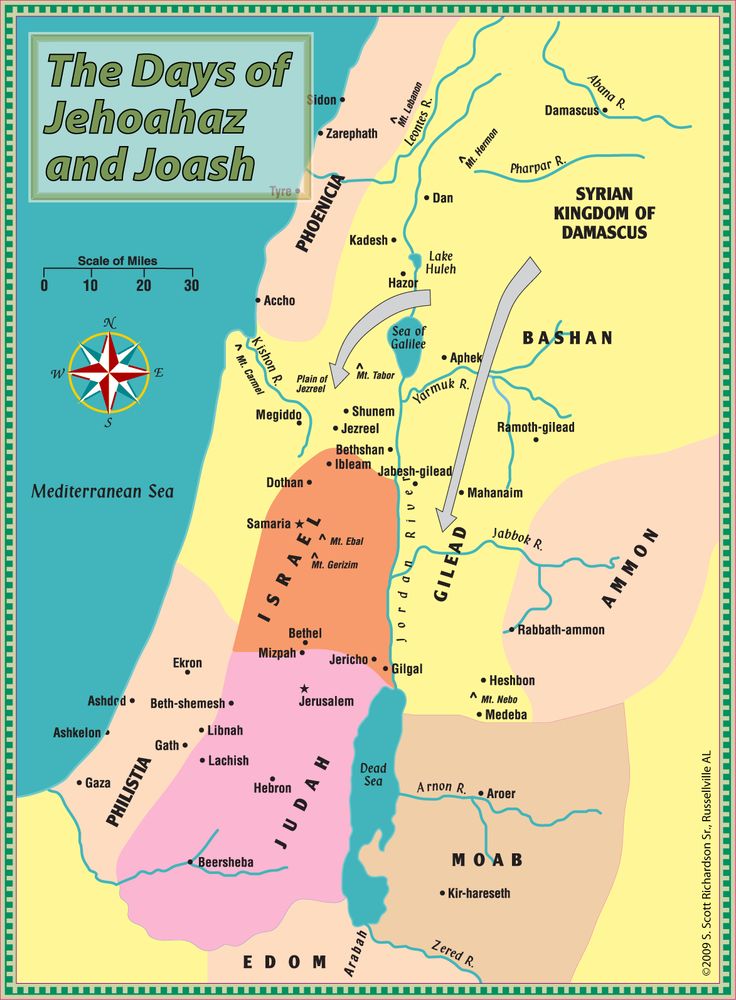
This curse from the lips of God’s dying prophet would come to fruition. God would avenge the death of Zechariah, and He would use the pagan nation of Syria to do it. For years, the Syrians had been harassing the northern kingdom of Israel. All the while Jehoash had been king in Judah, his counterpart in Israel had been waging an ongoing war against the Syrians. King Jehoahaz had ascended to the throne of his father, Jehu, and had picked up where his father had left off, doing “what was evil in the sight of the LORD and followed the sins of Jeroboam the son of Nebat” (2 Kings 13:2 ESV). As a result, God “gave them continually into the hand of Hazael king of Syria and into the hand of Ben-hadad the son of Hazael” (2 Kings 13:3 ESV). This continued throughout the reign of King Jehoahaz.

But now, God was going to use the Syrians to punish the rebellious and unrepentant nation of Judah. King Hazael took his campaign of terror further south, moving along the coast of the Mediterranean, and eventually capturing the city of Gath, deep within Judean territory. Then he set his sights on Jerusalem. In the spring of the year, Hazael and his army attacked the capital city, “and destroyed all the princes of the people from among the people and sent all their spoil to the king of Damascus” (2 Chronicles 24:23 ESV). The chronicler goes on to reveal that this victory was God-ordained.

Though the army of the Syrians had come with few men, the LORD delivered into their hand a very great army, because Judah had forsaken the LORD, the God of their fathers. Thus they executed judgment on Joash. – 2 Chronicles 24:24 ESV

The attack left Jehoash wounded, and, in desperation, the king decided to do whatever he had to do to keep Hazael from capturing the city. So, he stripped bare the Temple treasury, sending all the sacred items and the gold to Hazael as a form of ransom.

Jehoash king of Judah took all the sacred gifts that Jehoshaphat and Jehoram and Ahaziah his fathers, the kings of Judah, had dedicated, and his own sacred gifts, and all the gold that was found in the treasuries of the house of the LORD and of the king’s house, and sent these to Hazael king of Syria. Then Hazael went away from Jerusalem. – 2 Kings 12:18 ESV

This king, who had been raised by the priest of God in the house of God, sold out Yahweh. In the face of the Syrian assault, Jehoash resorted to paying off his attackers, stripping the Temple of all its holy treasures and priceless valuables. Rather than turning to Yahweh for help, Jehoash took what had been consecrated to God and used it to buy off the enemy, and his plan seemed to work.

Hazael took the treasure and left, but Jehoash’s troubles were far from over. Still suffering from the wounds he had received in the attack on Jerusalem, Jehoash was in a vulnerable state. His treasury was bankrupt, and he was a physically broken man. It seems that some of his officials recognized that Judah’s recent defeat at the hands of the Syrians had something to do with Jehoash’s decision to kill Zechariah. The curse uttered by the dying prophet had come true. So, they decided to eliminate the cause of all their troubles.

…his own officials plotted to kill him for murdering the son of Jehoiada the priest. They assassinated him as he lay in bed. – 2 Chronicles 24:25 NLT

The author of 2 Kings even provides the names of the two conspirators.

The assassins were Jozacar son of Shimeath and Jehozabad son of Shomer—both trusted advisers. – 2 Kings 12:21 NLT

These men would have had easy access to the king because he trusted them. They had become replacements for Jehoiada, providing the king with counsel and acting as his mentors. But unlike the former priest, these men had no love for Jehoash. They viewed him as a plague upon the nation and determined that his removal might placate God and prevent further judgment. Yet, it’s important to understand that their actions were ordained by God. It’s interesting to note that these two men were actually foreigners. One was the son of an Ammonite woman, and the other was the son of a Moabite woman. This reference to their birth mothers is significant because it links the events in this chapter all the way back to the Book of Genesis.

Genesis 19 contains the account of God’s rescue of Lot and his daughters from the wicked city of Sodom. Lot, the nephew of Abraham, had decided to settle in the fertile valleys of the Jordan, but it wasn’t long before he “moved his tent as far as Sodom” (Genesis 13:12 ESV). This proved to be a poor decision, because “the men of Sodom were wicked, great sinners against the LORD” (Genesis 13:12 ESV). Eventually, Lot relocated his family inside the walls of the city of Sodom. When God determined to destroy Sodom and its neighboring city of Gomorrah for the wickedness of their inhabitants, Abraham convinced God to spare Lot and his daughters. But once they were rescued by the angels of God, Lot’s daughters displayed the negative influence of their time spent in Sodom. Fearful that they would never find husbands, they came up with a plan to get their father drunk and commit incest with him, all under the guise of prolonging their father’s lineage. Their mother was dead, and their father had no sons. So, in their minds, this was the only way of preserving the family line. But their sinful decision produced a less-than-ideal outcome.

…both of Lot’s daughters became pregnant by their own father. When the older daughter gave birth to a son, she named him Moab. He became the ancestor of the nation now known as the Moabites. When the younger daughter gave birth to a son, she named him Ben-ammi. He became the ancestor of the nation now known as the Ammonites. – Genesis 19:36 NLT

The descendants of these two young ladies became the Ammonites and Moabites. These distant relatives of the Israelites were pagan nations that worshiped false gods. It’s no coincidence that the men who plotted and carried out the assassination of Jehoash had ties to these two nations. God had used the Syrians to inflict judgment upon Judah. Now, He used an Ammonite and a Moabite to bring death to the rebellious and unrepentant Jehoash.

God had preserved and protected Jehoash, allowing him to find sanctuary in the Temple and receive instruction from Jehoiada the priest. But when his godly mentor died, Jehoash was exposed for what he really was — just another king who refused to acknowledge Yahweh as the one true Sovereign. Jehoash had started out so well but ended poorly, choosing to forsake God and listen to the advice of men. Rather than heed the warnings of God’s prophet, Jehoash put him to death. Instead of placing his trust in Yahweh, Jehoash attempted to buy his way out of trouble, using the treasury of God in a failed attempt to escape the judgment of God. And he died trying.

Joash was buried with his ancestors in the City of David. Then his son Amaziah became the next king. – 2 Kings 12:21 NLT

Another king had come to power and disappeared from the scene because he refused to honor the One who had placed him on the throne to begin with. Yahweh had graciously preserved the nation of Judah, providing ample evidence of His patience and love. He would later juxtapose His faithfulness against the backdrop of Judah’s ongoing apostasy, and, interestingly enough, He would accuse them of having robbed Him.

“For I the LORD do not change; therefore you, O children of Jacob, are not consumed. From the days of your fathers you have turned aside from my statutes and have not kept them. Return to me, and I will return to you, says the LORD of hosts. But you say, ‘How shall we return?’ Will man rob God? Yet you are robbing me. But you say, ‘How have we robbed you?’ In your tithes and contributions. You are cursed with a curse, for you are robbing me, the whole nation of you. Bring the full tithe into the storehouse, that there may be food in my house. And thereby put me to the test, says the LORD of hosts, if I will not open the windows of heaven for you and pour down for you a blessing until there is no more need. I will rebuke the devourer for you, so that it will not destroy the fruits of your soil, and your vine in the field shall not fail to bear, says the LORD of hosts. Then all nations will call you blessed, for you will be a land of delight, says the LORD of hosts. – Malachi 3:6-12 NLT

The people of Judah had robbed God of what was rightfully His: their divinely ordained contributions and tithes, which were intended to be expressions of their love for and dependence upon Him. What little they had given was consecrated to Yahweh and was to be used as He prescribed. But Jehoash had taken these dedicated gifts and handed them over to the king of a pagan nation in a vain attempt to protect his kingdom from the judgment of Yahweh. In doing so, Jehoash sealed his own fate. Had he turned to God rather than stealing from God, Jehoash would have enjoyed an outpouring of blessings. But instead, Jehoash died a violent death at the hands of an Ammonite and Moabite and was buried “with his fathers in the city of David” (2 Kings 12:21 ESV).

English Standard Version (ESV) The Holy Bible, English Standard Version. ESV® Permanent Text Edition® (2016). Copyright © 2001 by Crossway Bibles, a publishing ministry of Good News Publishers.

New Living Translation (NLT) Holy Bible, New Living Translation, copyright © 1996, 2004, 2015 by Tyndale House Foundation. Used by permission of Tyndale House Publishers Inc., Carol Stream, Illinois 60188. All rights reserved.

Out With the Old

14 Thus Jehu the son of Jehoshaphat the son of Nimshi conspired against Joram. (Now Joram with all Israel had been on guard at Ramoth-gilead against Hazael king of Syria, 15 but King Joram had returned to be healed in Jezreel of the wounds that the Syrians had given him, when he fought with Hazael king of Syria.) So Jehu said, “If this is your decision, then let no one slip out of the city to go and tell the news in Jezreel.” 16 Then Jehu mounted his chariot and went to Jezreel, for Joram lay there. And Ahaziah king of Judah had come down to visit Joram.

17 Now the watchman was standing on the tower in Jezreel, and he saw the company of Jehu as he came and said, “I see a company.” And Joram said, “Take a horseman and send to meet them, and let him say, ‘Is it peace?’” 18 So a man on horseback went to meet him and said, “Thus says the king, ‘Is it peace?’” And Jehu said, “What do you have to do with peace? Turn around and ride behind me.” And the watchman reported, saying, “The messenger reached them, but he is not coming back.” 19 Then he sent out a second horseman, who came to them and said, “Thus the king has said, ‘Is it peace?’” And Jehu answered, “What do you have to do with peace? Turn around and ride behind me.” 20 Again the watchman reported, “He reached them, but he is not coming back. And the driving is like the driving of Jehu the son of Nimshi, for he drives furiously.”

21 Joram said, “Make ready.” And they made ready his chariot. Then Joram king of Israel and Ahaziah king of Judah set out, each in his chariot, and went to meet Jehu, and met him at the property of Naboth the Jezreelite. 22 And when Joram saw Jehu, he said, “Is it peace, Jehu?” He answered, “What peace can there be, so long as the whorings and the sorceries of your mother Jezebel are so many?” 23 Then Joram reined about and fled, saying to Ahaziah, “Treachery, O Ahaziah!” 24 And Jehu drew his bow with his full strength, and shot Joram between the shoulders, so that the arrow pierced his heart, and he sank in his chariot. 25 Jehu said to Bidkar his aide, “Take him up and throw him on the plot of ground belonging to Naboth the Jezreelite. For remember, when you and I rode side by side behind Ahab his father, how the LORD made this pronouncement against him: 26 ‘As surely as I saw yesterday the blood of Naboth and the blood of his sons—declares the LORD—I will repay you on this plot of ground.’ Now therefore take him up and throw him on the plot of ground, in accordance with the word of the LORD.”

27 When Ahaziah the king of Judah saw this, he fled in the direction of Beth-haggan. And Jehu pursued him and said, “Shoot him also.” And they shot him in the chariot at the ascent of Gur, which is by Ibleam. And he fled to Megiddo and died there. 28 His servants carried him in a chariot to Jerusalem, and buried him in his tomb with his fathers in the city of David.

29 In the eleventh year of Joram the son of Ahab, Ahaziah began to reign over Judah. – 2 Kings 9:14-29 ESV

Once Jehu received the news that he was to be the next king of Israel, he wasted no time. Immediately after his anointing by the prophet of God, he departed Ramoth-gilead. He headed straight to the winter palace in Jezreel, where King Jehoram was recovering from the injuries he had suffered in his battle against the Syrians.

Jehu had the full support of his fellow generals, so he ordered them to secure the city of Ramoth-gilead and prevent anyone from escaping and leaking his plans to King Jehoram. Jehu mounted his chariot and, accompanied by a contingent of loyal troops, he made his way to Jezreel. Guards posted at the city’s watchtower spotted them at a distance and notified King Jehoram. Assuming it was his own troops returning from the battle against the Syrians, he sent out a messenger to meet them, anxious to know the outcome of the conflict. When the messenger rode out to greet the returning soldiers, he asked, “Is it peace?” But Jehu gave him a somewhat cryptic answer and commanded him to ride along with him to the city.

After sending out a second messenger who failed to return, Jehoram became even more anxious to know what had happened. So, despite his wounds, he ordered his chariot and rode out to meet the returning troops. He was accompanied by King Ahaziah of Judah, who had come to visit him as he recuperated in Jezreel. When the two kings intercepted Jehu, Jehoram asked him, “Is it peace?” But Jehu’s response was not what he had been expecting.

“How can there be peace as long as the idolatry and witchcraft of your mother, Jezebel, are all around us?” – 2 Kings 9:22 NLT

Jehu called out King Jehoram, accusing him of allowing his mother, Jezebel, to lead the nation of Israel into apostasy with her idolatry and witchcraft. Though Ahab was long gone, Jezebel still continued to wield a powerful and deadly influence over Israel. Not only had she promoted the worship of false gods, but she had also introduced occult practices that included the use of sorcery and incantations. And God had declared these things to be off-limits for the people of Israel.

“There shall not be found among you anyone who burns his son or his daughter as an offering, anyone who practices divination or tells fortunes or interprets omens, or a sorcerer or a charmer or a medium or a necromancer or one who inquires of the dead, for whoever does these things is an abomination to the LORD.” – Deuteronomy 18:10-12 ESV

Jehu’s mention of Jezebel indicates that he understood just how decisive her role had been in leading the nation away from Yahweh. Any attempt he made to eradicate the evil influence of Ahab and his descendants would have to include her. As long as Jezebel remained alive, the nation would never recover from its state of spiritual apathy and apostasy.

Suddenly, aware that his life was in danger, King Jehoram ordered his chariot driver to make a hasty retreat to the safety of the city. But they never made it. Jehu killed the escaping king with a well-placed arrow in his back. Then he ordered that Jehoram’s body be dumped on the land that used to belong to Naboth. This brings the story full circle, linking the sins of Ahab with those of his son, Jehoram. In 1 Kings 21, Jezebel had arranged to illegally confiscate Naboth’s vineyard so she could give it to Ahab. She had Naboth falsely accused and convicted of cursing God and the king. The result was that the innocent man was stoned to death on his very own land. Yahweh warned King Ahab, “In the place where dogs licked up the blood of Naboth shall dogs lick your own blood” (1 Kings 21:20 ESV). And he had pronounced a similar fate for Jezebel because of her role in the affair.

“The dogs shall eat Jezebel within the walls of Jezreel.” – 1 Kings 21:23 ESV

But Ahab had eventually repented of his role in Naboth’s death and, as a result, God chose to spare him.

“Because he has humbled himself before me, I will not bring the disaster in his days; but in his son’s days I will bring the disaster upon his house.” – 1 Kings 21:29 ESV

Now, years later, God was fulfilling His promise to bring disaster upon the house of Ahab. The blood of Jehoram, the son of Ahab and Jezebel, would be poured out on the very same spot where Naboth had been stoned to death. Jehu, who had served as one of King Ahab’s generals, was familiar with the whole sordid affair concerning Naboth. He had even been present when God issued His divine judgment against Ahab through the prophet Elijah.

“Take him up and throw him on the plot of ground belonging to Naboth the Jezreelite. For remember, when you and I rode side by side behind Ahab his father, how the LORD made this pronouncement against him: ‘As surely as I saw yesterday the blood of Naboth and the blood of his sons—declares the LORD—I will repay you on this plot of ground.’ Now therefore take him up and throw him on the plot of ground, in accordance with the word of the LORD.” – 2 Kings 9:25-26 ESV

In all of this, Jehu was acting as God’s hand of judgment against the house of Ahab. He had been anointed by God to deliver divine justice and cleanse the nation of Israel from the pervasive and pernicious influence of Ahab and Jezebel. God had had enough. The time had come to fulfill His pronouncement of judgment against the house of Ahab.

“Behold, I will bring disaster upon you. I will utterly burn you up, and will cut off from Ahab every male, bond or free, in Israel. And I will make your house like the house of Jeroboam the son of Nebat, and like the house of Baasha the son of Ahijah, for the anger to which you have provoked me, and because you have made Israel to sin.” – 1 Kings 21:21-22 ESV

The purge had begun. God was cleaning house. And even King Ahaziah of Judah would not escape the purifying judgment of the Almighty. As he attempted to escape, he was struck by an arrow and only made it as far as Megiddo before he died from his wound. Ahaziah had close familial ties to the house of Ahab. His mother, Athaliah, was the granddaughter of King Omri of Israel, and Ahaziah had married one of Ahab’s daughters.

He also walked in the way of the house of Ahab and did what was evil in the sight of the Lord, as the house of Ahab had done, for he was son-in-law to the house of Ahab. – 2 Kings 8:27 ESV

He was an unwise and wicked king who had aligned himself with one of the most infamous royal families in Israel’s sordid history, and he paid for his mistake with his life.

Because of Solomon’s disobedience, God divided Israel into two kingdoms. This had been His prescribed punishment for Solomon’s foray into idolatry during the latter years of his life and reign. But the kings of Israel and Judah had decided to take matters into their own hands, attempting to realign the two nations through treaties and marital alliances. But they had neglected to fix the primary problem that had caused God to divide them in the first place: Idolatry.

God was not interested in a reunited nation that remained spiritually rebellious. So, He sent Jehu to bring an abrupt end to the man-made alliance between Israel and Judah by killing their two kings. It was time to start over. But as we will see, Jehu had one last piece of unfinished business.

English Standard Version (ESV) The Holy Bible, English Standard Version. ESV® Permanent Text Edition® (2016). Copyright © 2001 by Crossway Bibles, a publishing ministry of Good News Publishers.

New Living Translation (NLT) Holy Bible, New Living Translation, copyright © 1996, 2004, 2015 by Tyndale House Foundation. Used by permission of Tyndale House Publishers Inc., Carol Stream, Illinois 60188. All rights reserved.

Nothing Is Too Difficult for God

1 Now the sons of the prophets said to Elisha, “See, the place where we dwell under your charge is too small for us. 2 Let us go to the Jordan and each of us get there a log, and let us make a place for us to dwell there.” And he answered, “Go.” 3 Then one of them said, “Be pleased to go with your servants.” And he answered, “I will go.” 4 So he went with them. And when they came to the Jordan, they cut down trees. 5 But as one was felling a log, his axe head fell into the water, and he cried out, “Alas, my master! It was borrowed.” 6 Then the man of God said, “Where did it fall?” When he showed him the place, he cut off a stick and threw it in there and made the iron float. 7 And he said, “Take it up.” So he reached out his hand and took it. 

8 Once when the king of Syria was warring against Israel, he took counsel with his servants, saying, “At such and such a place shall be my camp.” 9 But the man of God sent word to the king of Israel, “Beware that you do not pass this place, for the Syrians are going down there.” 10 And the king of Israel sent to the place about which the man of God told him. Thus he used to warn him, so that he saved himself there more than once or twice.

11 And the mind of the king of Syria was greatly troubled because of this thing, and he called his servants and said to them, “Will you not show me who of us is for the king of Israel?” 12 And one of his servants said, “None, my lord, O king; but Elisha, the prophet who is in Israel, tells the king of Israel the words that you speak in your bedroom.” 13 And he said, “Go and see where he is, that I may send and seize him.” It was told him, “Behold, he is in Dothan.” 14 So he sent there horses and chariots and a great army, and they came by night and surrounded the city.

15 When the servant of the man of God rose early in the morning and went out, behold, an army with horses and chariots was all around the city. And the servant said, “Alas, my master! What shall we do?” 16 He said, “Do not be afraid, for those who are with us are more than those who are with them.” 17 Then Elisha prayed and said, “O LORD, please open his eyes that he may see.” So the LORD opened the eyes of the young man, and he saw, and behold, the mountain was full of horses and chariots of fire all around Elisha. 18 And when the Syrians came down against him, Elisha prayed to the LORD and said, “Please strike this people with blindness.” So he struck them with blindness in accordance with the prayer of Elisha. 19 And Elisha said to them, “This is not the way, and this is not the city. Follow me, and I will bring you to the man whom you seek.” And he led them to Samaria.

20 As soon as they entered Samaria, Elisha said, “O LORD, open the eyes of these men, that they may see.” So the LORD opened their eyes and they saw, and behold, they were in the midst of Samaria. 21 As soon as the king of Israel saw them, he said to Elisha, “My father, shall I strike them down? Shall I strike them down?” 22 He answered, “You shall not strike them down. Would you strike down those whom you have taken captive with your sword and with your bow? Set bread and water before them, that they may eat and drink and go to their master.” 23 So he prepared for them a great feast, and when they had eaten and drunk, he sent them away, and they went to their master. And the Syrians did not come again on raids into the land of Israel. – 2 Kings 6:1-23 ESV

Let’s face it, even for a prophet of God, Elisha had some rather strange experiences. And the two that are recorded in the opening verses of this chapter are among the most bizarre. At first glance, the only thing they appear to have in common is Elisha himself. But upon further examination, one can see that both stories are meant to accentuate the power of God’s prophet. The first is short and to the point, but displays the supernatural, yet highly practical nature of Elisha’s divine enablement. This man was God’s representative and, as such, he displayed the caring concern that Yahweh had for His children.

Elisha’s fellow prophets approached him, seeking his approval to build a larger complex in which to house their growing number. They had chosen a spot near the Jordan River and intended to work as a team on the construction of their new home. Elisha gave them his blessing to begin the project, but they asked him to accompany them, which he did. But as they were going through the laborious process of cutting down the trees to make logs for their new headquarters, one of the men lost the head to his ax. It flew off the handle and landed in the river, disappearing from sight. To our minds, this doesn’t appear to be a life-and-death situation. Obviously, they had more than one ax, but the author reveals that this particular ax had been borrowed, and iron was a costly commodity in those days. So, the one who had borrowed the ax was deeply concerned over his bit of bad luck. He would have been required to replace the lost ax head and, on a prophet’s salary, that would have been difficult.

It’s difficult to read this story without thinking about the words that Solomon recorded in the book of Ecclesiastes.

One who digs a pit may fall into it,
and one who breaks through a wall may be bitten by a snake.
One who quarries stones may be injured by them;
one who splits logs may be endangered by them.
If an iron axhead is blunt and a workman does not sharpen its edge,
he must exert a great deal of effort;
so wisdom has the advantage of giving success. – Ecclesiastes 10:8-10 NET

Chopping wood with a loose ax head would have certainly fit into this category of unwise decisions. But rather than embarrass this poor man for his lack of forethought, Elisha simply asked him for a general idea of where the ax head entered the water. Then Elisha did something completely unexpected but practical. He “cut a stick and threw it into the water at that spot. Then the ax head floated to the surface” (2 Kings 6:6 NLT). Miraculously, the heavy iron ax head rose to the surface, where the man easily and eagerly retrieved it. His problem was solved, thanks to Elisha’s quick thinking and practical application of the divine resources at his disposal.

The second story is a bit more complex and far more in line with what we would expect of a prophet of God. Rather than the prophets of Yahweh constructing a new dwelling place, we have the Syrian king and his officers plotting an invasion of Israel. But before they could implement their strategy, Elisha received divine insight into their plans and warned the king of Israel. And much to King Ben-hadad’s frustration, this happened repeatedly.

This led the Syrian king to assume that a traitor was in his camp; someone was passing on their top-secret plans to the Israelites.  But his officers assured him that the problem was far worse than he thought. Yahweh, the God of Israel, had been listening in on all their secret strategy sessions and then passing the information on to Elisha, who warned the king of Israel.

Determined to put a stop to this leak in his communications network, Ben-hadad sent a large contingent of troops and chariots to capture Elisha. When Elisha’s servant woke up the next morning, he saw Syrian troops as far as the eye could see, and he cried out, “Oh, sir, what will we do now?” (2 Kings 6:15 NLT). But the prophet handled the news with the same degree of calmness he had exhibited when he heard about the lost ax head. He simply stated, “Don’t be afraid! For there are more on our side than on theirs!” (2 Kings 6:16 NLT). 

The petrified servant must have questioned his master’s sanity. How in the world could the prophet think that they had the Syrians outnumbered? But Elisha had every confidence that the same God who raised the ax head from the bottom of the Jordan could raise an army to defeat the Syrians. But Elisha knew his servant lacked the faith to believe in Yahweh’s intervention, so he confidently called on the power of Yahweh.

Then Elisha prayed, “O LORD, open his eyes and let him see!” The LORD opened the young man’s eyes, and when he looked up, he saw that the hillside around Elisha was filled with horses and chariots of fire. – 2 Kings 6:17 NLT

This “heavenly host” was intended to bolster the faith of Elisha’s servant. But, interestingly enough, the horses and chariots of fire did not engage the Syrians in battle. They served to provide a tangible visual representation of God’s power. It’s similar to what happened when Elisha witnessed God take Elijah to be with Him.

As they were walking along and talking, suddenly a fiery chariot pulled by fiery horses appeared. They went between Elijah and Elisha, and Elijah went up to heaven in a windstorm. – 2 Kings 2:11 NLT

God didn’t use the fiery chariots to transport Elisha, and the angelic host wasn’t there to save Elisha or the city of Dothan. Defeating the Syrians would not require a battle; it would simply require blindness. Elisha asked God to incapacitate the Syrian soldiers by removing their sight. Then the prophet led the confused, completely helpless Syrian army to the capital city of Samaria. When they arrived, “the LORD opened their eyes, and they discovered that they were in the middle of Samaria” (2 Kings 6:20 NLT).

Upon seeing the blind and helpless Syrian mercenaries in his capital city, King Jehoram determined to slaughter them on the spot. But Elisha instructed King Jehoram: “Give them food and drink and send them home again to their master” (2 Kings 6:22 NLT). So, Jehoram threw a great feast and then sent the Syrians home. News of this incredible Israelite victory reached the palace of Ben-hadad, informing him that the God of Israel was greater than the gods of the Syrians. Yahweh had protected His prophet and had provided the innocent people of Dothan with a gracious and merciful rescue from certain destruction.

The same God who cared enough to return a lost ax head was willing to display His supernatural power over the enemies of Israel. There was no water too deep, no enemy too powerful, and no problem too difficult for God.

“O Sovereign LORD! You made the heavens and earth by your strong hand and powerful arm. Nothing is too hard for you!” – Jeremiah 32:17 NLT

English Standard Version (ESV) The Holy Bible, English Standard Version. ESV® Permanent Text Edition® (2016). Copyright © 2001 by Crossway Bibles, a publishing ministry of Good News Publishers.

New Living Translation (NLT) Holy Bible, New Living Translation, copyright © 1996, 2004, 2015 by Tyndale House Foundation. Used by permission of Tyndale House Publishers Inc., Carol Stream, Illinois 60188. All rights reserved.