All Is Well

8 One day Elisha went on to Shunem, where a wealthy woman lived, who urged him to eat some food. So whenever he passed that way, he would turn in there to eat food. 9 And she said to her husband, “Behold now, I know that this is a holy man of God who is continually passing our way. 10 Let us make a small room on the roof with walls and put there for him a bed, a table, a chair, and a lamp, so that whenever he comes to us, he can go in there.”

11 One day he came there, and he turned into the chamber and rested there. 12 And he said to Gehazi his servant, “Call this Shunammite.” When he had called her, she stood before him. 13 And he said to him, “Say now to her, ‘See, you have taken all this trouble for us; what is to be done for you? Would you have a word spoken on your behalf to the king or to the commander of the army?’” She answered, “I dwell among my own people.” 14 And he said, “What then is to be done for her?” Gehazi answered, “Well, she has no son, and her husband is old.” 15 He said, “Call her.” And when he had called her, she stood in the doorway. 16 And he said, “At this season, about this time next year, you shall embrace a son.” And she said, “No, my lord, O man of God; do not lie to your servant.” 17 But the woman conceived, and she bore a son about that time the following spring, as Elisha had said to her.

18 When the child had grown, he went out one day to his father among the reapers. 19 And he said to his father, “Oh, my head, my head!” The father said to his servant, “Carry him to his mother.” 20 And when he had lifted him and brought him to his mother, the child sat on her lap till noon, and then he died. 21 And she went up and laid him on the bed of the man of God and shut the door behind him and went out. 22 Then she called to her husband and said, “Send me one of the servants and one of the donkeys, that I may quickly go to the man of God and come back again.” 23 And he said, “Why will you go to him today? It is neither new moon nor Sabbath.” She said, “All is well.” 24 Then she saddled the donkey, and she said to her servant, “Urge the animal on; do not slacken the pace for me unless I tell you.” 25 So she set out and came to the man of God at Mount Carmel. – 2 Kings 4:8-25 ESV

When Elijah had been the prophet of God to Israel, his ministry seemed to focus on the royal household. Virtually all his interactions had been with King Ahab or his wife, Jezebel. While Elisha had begun his own prophetic ministry with a confrontation between himself and King Jehoram, he seems to have been a prophet to the people. In the last story, Elisha came to the aid of a recently widowed woman who was facing the prospect of having her two sons sold into slavery because of an unpaid debt. In a sense, this woman represented the nation of Israel. She had been left destitute by her husband, a former prophet of God. While alive, this man of God had incurred a sizeable debt, and had he made no plans for its repayment in the case of his death. In a real sense, the people of Israel found themselves spiritually destitute and owing an enormous debt to God Almighty. Their kings had taken advantage of God’s love and mercy, using His resources to fund their own profligate lifestyles. They had lived for the moment, never considering what would happen when God called their debt due. Jeroboam, Ahab, Ahaziah, and now Jehoram, all led the people into idolatry, leaving them with a debt they could not repay.

But Elisha had intervened on the widow’s behalf, providing her with a miracle that eliminated her debt, spared her sons, and met her needs for a long time to come. Through the actions of His faithful prophet, Yahweh revealed His love and concern for His covenant people. Now, the story shifts to yet another encounter between Elisha and a woman in need. But this time, the woman wasn’t even aware that she had a need.

For some unspecified reason, Elisha and his servant, Gehazi, made regular trips to the northern region of Israel that took them to the city of Shunem. In this city, Elisha made the acquaintance of a local woman who offered the prophet and his servant the use of her home so they could rest. Realizing that Elisha was a prophet of Yahweh, she showed him hospitality and even had her husband construct a room on the roof of their home where the two men could stay when they were in town.

Unlike the widow in the previous story, this woman was apparently wealthy and well taken care of. She had a husband and enjoyed a comfortable lifestyle. But she was also generous and willing to share what she had with others. The gracious hospitality she extended to the prophet of God reveals that, despite the apostasy all around her, she had maintained her dedication to Yahweh.

Desiring to thank the woman for her courtesy and care, Elisha sent his servant to inquire what they could do for her. He wanted to repay her for her kindness. But it’s interesting to note that he offered to speak a good word to the king or the commander of the army on her behalf. Why would the prophet of Yahweh offer to act as an intermediary between this woman and these two apostate leaders of Israel? Perhaps it was a test, designed to see if the woman was a faithful follower of Yahweh. Would his offer of access to the king pique her interest and reveal a self-aggrandizing side to her personality? Or, instead, would she ask the prophet of God to appeal to Yahweh on her behalf?

But the woman simply responded, “I dwell among my own people” (2 Kings 4:13 ESV). This rather cryptic-sounding statement was her way of saying, “I’m just fine. I’m well-taken care of and in need of nothing.”

Yet, Elisha somehow senses that her answer was not quite honest. She was hiding something. It was Gehazi who made the keen observation that she and her husband were childless. She had a husband and enjoyed a comfortable lifestyle, but Gehazi recognized that her husband was advanced in years, and she had no sons to carry on the family name.

While the woman in the previous story had been without a husband, she had been blessed with two sons. But the Shunnamite woman had a husband and no children. For the moment, the woman had no perceived need, but the day was coming when her husband would die with no male heirs to whom he could leave his land and estate. In that culture, the inheritance could not be passed on to the wife. So, without a son, she would be left with nothing. She didn’t realize it, but her predicament was far more precarious than she imagined.

So, Elisha called the woman in and informed her, “Next year at this time you will be holding a son in your arms!” (2 Kings 4:16 NLT). Her reaction to this news reveals that she had long ago given up hope of ever having a son.

“No, my lord!” she cried. “O man of God, don’t deceive me and get my hopes up like that.” – 2 Kings 4:16 NLT

When Elisha asked the woman what he could do for her, she had hidden her heart’s desire. She gave the impression that she had no need and was perfectly fine, but she had lied. Her heart longed for a son, but she had become convinced that her dream would never come true. So, she lived with a constant fear of the future. What would happen to her when her husband died? How would she survive?

But, once again, Elisha, operating on behalf of Yahweh, spoke a word of blessing over the woman, predicting that she would give birth to a son, and his words proved true. God performed a miracle and granted the woman her heart’s desire; she conceived and gave birth to a son. But the story doesn’t stop there. In the space of just a few verses, the author reveals that the storybook ending was about to take a dark turn. This precious gift from God was going to be suddenly and unexpectedly taken away.

One day, while visiting his father in the fields, the young boy complained of a headache. He was rushed home and, later that same day, he passed away in the arms of his mother. Every detail of this story makes the reader want to ask, “Why?” None of this makes sense. Why would God give this woman a son and then allow him to die? What good did it do for her to give birth to a son if he would never live long enough to become the heir? The woman was no better off than she had been before. If anything, her sorrow was only intensified by the loss of her long-awaited son.

But the actions of the woman reveal something about her faith. Upon her son’s death, she took the body and laid it on the prophet’s bed. Then she ordered her husband to saddle a donkey so she could fetch the prophet. At this point, it seems that the boy’s father was unaware that his son had died. For whatever reason, the woman chose to keep him in the dark, assuring him, “All is well” (2 Kings 4:23 ESV). Her son was dead, but she still had hope. She knew that the very same man who had predicted the birth of her son would know what to do. This time, rather than hide her need, she sought the one who could do something about it. And she found Elisha at Mount Carmel, the site of Elijah’s victory over the prophets of Baal.

The location where she found the prophet of God is vital because it provides the reader with a direct link to Elisha’s mentor, the prophet Elijah. The story of the wealthy woman from Shunem and the untimely death of her son is intended to recall the story of Elijah raising the dead son of the widow of Zarephath. Elijah had provided the impoverished widow and her young son with a miracle supply of oil and flour that would last until the drought in the land had ended. But this blessing was followed by what appeared to be a curse.

Some time later the woman’s son became sick. He grew worse and worse, and finally he died. Then she said to Elijah, “O man of God, what have you done to me? Have you come here to point out my sins and kill my son?” – 1 Kings 17:17-18 NLT

The distraught woman accused Elijah of taking the life of her son as judgment for her own sin. But the prophet “took the child’s body from her arms, carried him up the stairs to the room where he was staying, and laid the body on his bed. Then Elijah cried out to the LORD, ‘O Lord my God, why have you brought tragedy to this widow who has opened her home to me, causing her son to die?’” (1 Kings 17:19-20 NLT). Three times Elijah prayed over the child and “the Lord heard Elijah’s prayer, and the life of the child returned, and he revived!” (1 Kings 17:22 NLT). The woman’s response to this miraculous event was simple and yet profound. She stated, “Now I know for sure that you are a man of God, and that the LORD truly speaks through you” (1 Kings 17:24 NLT). 

The story from 1 Kings 17 is intended to inform the reader’s interpretation of the events found in 2 Kings 4. The death of the Shunnamite woman’s son should produce a sense of déjà vu, a feeling of having been here before. It is unclear whether the Shunnamite woman had heard the story of Elijah’s healing of the widow of Zarephath’s dead child, but the reader has. Therefore, there should be a growing sense of anticipation and expectation about what is about to happen. Yahweh is moving behind the scenes and is orchestrating the events with divine precision and perfect timing. The attentive reader can sense that something miraculous is about to happen because the need is dire, but Yahweh is great.

English Standard Version (ESV) The Holy Bible, English Standard Version. ESV® Permanent Text Edition® (2016). Copyright © 2001 by Crossway Bibles, a publishing ministry of Good News Publishers.

New Living Translation (NLT) Holy Bible, New Living Translation, copyright © 1996, 2004, 2015 by Tyndale House Foundation. Used by permission of Tyndale House Publishers Inc., Carol Stream, Illinois 60188. All rights reserved.
Conviction Over Compromise

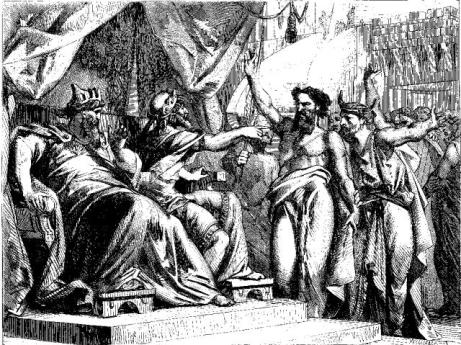
1 For three years Syria and Israel continued without war. 2 But in the third year Jehoshaphat the king of Judah came down to the king of Israel. 3 And the king of Israel said to his servants, “Do you know that Ramoth-gilead belongs to us, and we keep quiet and do not take it out of the hand of the king of Syria?” 4 And he said to Jehoshaphat, “Will you go with me to battle at Ramoth-gilead?” And Jehoshaphat said to the king of Israel, “I am as you are, my people as your people, my horses as your horses.”

5 And Jehoshaphat said to the king of Israel, “Inquire first for the word of the LORD.” 6 Then the king of Israel gathered the prophets together, about four hundred men, and said to them, “Shall I go to battle against Ramoth-gilead, or shall I refrain?” And they said, “Go up, for the Lord will give it into the hand of the king.” 7 But Jehoshaphat said, “Is there not here another prophet of the LORD of whom we may inquire?” 8 And the king of Israel said to Jehoshaphat, “There is yet one man by whom we may inquire of the LORD, Micaiah the son of Imlah, but I hate him, for he never prophesies good concerning me, but evil.” And Jehoshaphat said, “Let not the king say so.” 9 Then the king of Israel summoned an officer and said, “Bring quickly Micaiah the son of Imlah.” 10 Now the king of Israel and Jehoshaphat the king of Judah were sitting on their thrones, arrayed in their robes, at the threshing floor at the entrance of the gate of Samaria, and all the prophets were prophesying before them. 11 And Zedekiah the son of Chenaanah made for himself horns of iron and said, “Thus says the LORD, ‘With these you shall push the Syrians until they are destroyed.’” 12 And all the prophets prophesied so and said, “Go up to Ramoth-gilead and triumph; the LORD will give it into the hand of the king.”

13 And the messenger who went to summon Micaiah said to him, “Behold, the words of the prophets with one accord are favorable to the king. Let your word be like the word of one of them, and speak favorably.” 14 But Micaiah said, “As the LORD lives, what the LORD says to me, that I will speak.” – 1 Kings 22:1-14 ESV

King Ahab had been placed under a curse from God for having spared the life of Ben-hadad, the king of Syria. Rather than obey God’s command to put his enemy to death, Ahab had chosen to sign a peace treaty with him that would allow Israel to profit from Syria’s lucrative trading business. Yet, despite the judgment leveled against him by God, Ahab’s decision seems to have produced positive results.

The treaty that Ahab brokered produced three years of peace and prosperity between the two nations. Israel and Syria became allies and trading partners. According to an inscription on an Assyrian tablet discovered in 1861, Ahab and Ben-hadad were part of a 12-nation confederation that faced Emperor Shalmaneser and the Assyrians in the Battle of Qarqar in 853 BC. So, while God had decreed that Ahab’s dynasty would come to an end with his death, the king of Israel continued to enjoy a small measure of success. His insatiable desire for glory and self-aggrandizement would eventually drive him to jeopardize his peaceful and prosperous relationship with Syria.

During the time Ahab was on the throne of Israel, Jehoshaphat became the king of Judah. He succeeded his father, Asa, and, according to the book of 2 Chronicles, Jehoshaphat proved to be a good king.

The LORD was with Jehoshaphat, because he walked in the earlier ways of his father David. He did not seek the Baals, but sought the God of his father and walked in his commandments, and not according to the practices of Israel. Therefore the LORD established the kingdom in his hand. And all Judah brought tribute to Jehoshaphat, and he had great riches and honor. His heart was courageous in the ways of the LORD. And furthermore, he took the high places and the Asherim out of Judah. – 2 Chronicles 17:3-6 ESV

Because Jehoshaphat chose to remove all the false gods and restore the worship of the one true God, his reign was blessed, and the southern kingdom of Judah became a powerful force in the region. But Jehoshaphat, like his father before him, made the mistake of placing his trust in the Syrians. When King Baasha of Israel began to build a fortified city on the border between Israel and Judah, King Asa sought the help of Ben-hadad and the Syrians. Asa “took silver and gold from the treasures of the house of the LORD and the king’s house and sent them to Ben-hadad king of Syria” (2 Chronicles 16:2 ESV). He used these funds to convince Ben-hadad to break his covenant with Israel and join forces with him. His ploy worked, and Baasha stopped construction on his military outpost. But God condemned Asa for his alliance with Ben-hadad, warning that Judah would face non-stop war during the rest of his reign. Rather than trust God, Asa had placed his hope in a foreign king who worshiped false gods.

And while his son Jehoshaphat would prove to be faithful to God, he would also make an alliance with an ungodly, idol-worshiping king.

Now Jehoshaphat had great riches and honor, and he made a marriage alliance with Ahab. After some years he went down to Ahab in Samaria. And Ahab killed an abundance of sheep and oxen for him and for the people who were with him, and induced him to go up against Ramoth-gilead. – 2 Chronicles 18:1-2 ESV

This marital alliance ultimately put Jehoshaphat in a difficult position. While visiting Israel’s capital city of Samaria, Jehoshaphat was presented with an official request from Ahab for military assistance in recapturing the town of Ramoth-gilead from the Syrians. It galled Ahab that the Syrians had stolen a city that had once belonged to Israel, and nothing had been done about it.

“Do you know that Ramoth-gilead belongs to us, and we keep quiet and do not take it out of the hand of the king of Syria?” – 1 Kings 22:3 ESV

So, he called on Jehoshaphat to help him right this apparent wrong, and Jehoshaphat quickly and readily agreed.

“I am as you are, my people as your people, my horses as your horses.” – 1 Kings 22:4 ESV

But Jehoshaphat, anxious to remain obedient to God, asked Ahab to seek Yahweh’s counsel. It’s important to understand that Jehoshaphat wanted to know what the “LORD” (Yahweh) would have them do. But when Ahab commissioned his 400 prophets to seek the will of the gods, they came back with the answer:

“Go up, for the Lord (ăḏōnāy) will give it into the hand of the king.” – 1 Kings 22:6 ESV

These men did not mention the name of Yahweh, and Jehoshaphat seems to have immediately recognized that these were false prophets who had been seeking the will of their false god. So, he asked Ahab if there were no prophets of the one true God left in Israel. Ahab reluctantly confessed that one prophet of Yahweh remained, a man named Micaiah, whom he hated with a passion.

“He never prophesies anything but trouble for me!” – 1 Kings 22:8 NLT

Micaiah never told Ahab what he wanted to hear, so the king avoided him like the plague. But Jehoshaphat insisted that Micaiah be consulted before any action was taken against the Syrians.  So, Ahab sent someone to fetch his least-favorite prophet. In the meantime, his 400 false prophets bombarded Jehoshaphat with their cheery predictions of success.

“Go up to Ramoth-gilead and triumph; the LORD (Yahweh) will give it into the hand of the king.” – 1 Kings 22:12 ESV

This time, the prophets of Baal changed their tune and mentioned the name of Yahweh. Perhaps they hoped this reference to the God of Israel would convince Jehoshaphat to acquiesce and give his approval for the joint venture against the Syrians.

The text doesn’t reveal how long it took for Micaiah to be located and brought to Samaria. However, during the delay, Jehoshaphat found himself pressured to listen to the false prophets and join forces with Ahab. The temptation to compromise his convictions was great. He could have easily given in and listened to the popular opinions of the crowd, but instead, Jehoshaphat waited to hear a word from Yahweh.

Even Micaiah found himself pressured to follow the party line. The messenger who located him delivered a not-so-subtle warning that there was only one answer King Ahab wanted to hear.

“Look, all the prophets are promising victory for the king. Be sure that you agree with them and promise success.” – 1 Kings 22:13 NLT

But Micaiah would not be bullied into submission. He knew how much Ahab hated him, and he would be risking his life to disobey a direct order from the king. Yet his allegiance to Yahweh was greater than his fear of Ahab. So, he told the messenger, “As surely as the LORD lives, I will say only what the LORD tells me to say” (1 Kings 22:14 NLT).

It must have been a long and awkward trip back to Samaria for the messenger. He probably feared for his own life because he knew the prophet was determined to deliver bad news to the king. Everyone who worked for Ahab and all the people who lived in Israel knew that their king had no love affair with Yahweh. He had spent his entire reign promoting the worship of false gods like Baal and Asherah, and he had done everything he could do to ignore and even eliminate the prophets of God. Ahab knew exactly what Micaiah was going to say when he showed up, and it would not be what he wanted to hear.

Ahab needed Jehoshaphat’s help against the Syrians, and he knew that Jehoshaphat’s God would stand opposed to his ambitious plans to recapture Ramoth-gilead. Ahab didn’t want to hear from God because he was unwilling to do God’s will. Like a petulant child, Ahab was determined to get his way, even if it meant disobeying Yahweh’s will. But the prophet of the LORD was unwilling to succumb to the pressure to compromise his convictions and tell the king what he wanted to hear. He would speak the truth, even if it cost him his life. This obscure and little-known prophet was going to choose character over conformity and stand up to the threats of the wicked and powerful king of Israel.

Micaiah’s commitment to Yahweh was unassailable and non-negotiable. Nothing would convince him to compromise or sell out. He was determined to remain faithful to his God, whatever the cost. His bold determination to stand his ground in the face of intense opposition and even the threat of death is reminiscent of the actions of Shadrach, Meshach, and Abednego, the Hebrew friends of Daniel who found themselves facing a death sentence for refusing to bow to the statue King Nebuchadnezzar had erected.

“I will give you one more chance to bow down and worship the statue I have made when you hear the sound of the musical instruments. But if you refuse, you will be thrown immediately into the blazing furnace. And then what god will be able to rescue you from my power?”

Shadrach, Meshach, and Abednego replied, “O Nebuchadnezzar, we do not need to defend ourselves before you. If we are thrown into the blazing furnace, the God whom we serve is able to save us. He will rescue us from your power, Your Majesty. But even if he doesn’t, we want to make it clear to you, Your Majesty, that we will never serve your gods or worship the gold statue you have set up.” – Daniel 3:15-18 NLT

These three young men were willing to die for their beliefs and gladly faced the fires of the furnace with their commitment to Yahweh uncompromised. And their unwavering faith was rewarded.

So Shadrach, Meshach, and Abednego stepped out of the fire. Then the high officers, officials, governors, and advisers crowded around them and saw that the fire had not touched them. Not a hair on their heads was singed, and their clothing was not scorched. They didn’t even smell of smoke! – Daniel 3:26-27 NLT

The Book of Acts records another story of uncompromising faith in the face of unrelenting pressure. Peter and John had been jailed by the powerful Jewish Sanhedrin for preaching “that through Jesus there is a resurrection of the dead” (Acts 4:2 NLT). The following morning, when the two men were dragged before the council, they were ordered to cease and desist. The high priest commanded them, “never again to speak or teach in the name of Jesus” (Acts 4:18 NLT). 

But Peter and John replied, “Do you think God wants us to obey you rather than him? We cannot stop telling about everything we have seen and heard.” – Acts 4:18-20 NLT

Facing the threat of additional jail time or worse, Peter and John stood their ground and declared their intention to continue preaching the truth concerning Jesus. They could be threatened, but they would not be silenced. And, in doing so, they joined the ranks of other faithful men like Micaiah, Daniel, Shadrach, Meshach, and Abednego.

English Standard Version (ESV) The Holy Bible, English Standard Version. ESV® Permanent Text Edition® (2016). Copyright © 2001 by Crossway Bibles, a publishing ministry of Good News Publishers.

New Living Translation (NLT) Holy Bible, New Living Translation, copyright © 1996, 2004, 2015 by Tyndale House Foundation. Used by permission of Tyndale House Publishers Inc., Carol Stream, Illinois 60188. All rights reserved.
Yahweh’s Divine Tag Team

15 And the LORD said to him, “Go, return on your way to the wilderness of Damascus. And when you arrive, you shall anoint Hazael to be king over Syria. 16 And Jehu the son of Nimshi you shall anoint to be king over Israel, and Elisha the son of Shaphat of Abel-meholah you shall anoint to be prophet in your place. 17 And the one who escapes from the sword of Hazael shall Jehu put to death, and the one who escapes from the sword of Jehu shall Elisha put to death. 18 Yet I will leave seven thousand in Israel, all the knees that have not bowed to Baal, and every mouth that has not kissed him.”

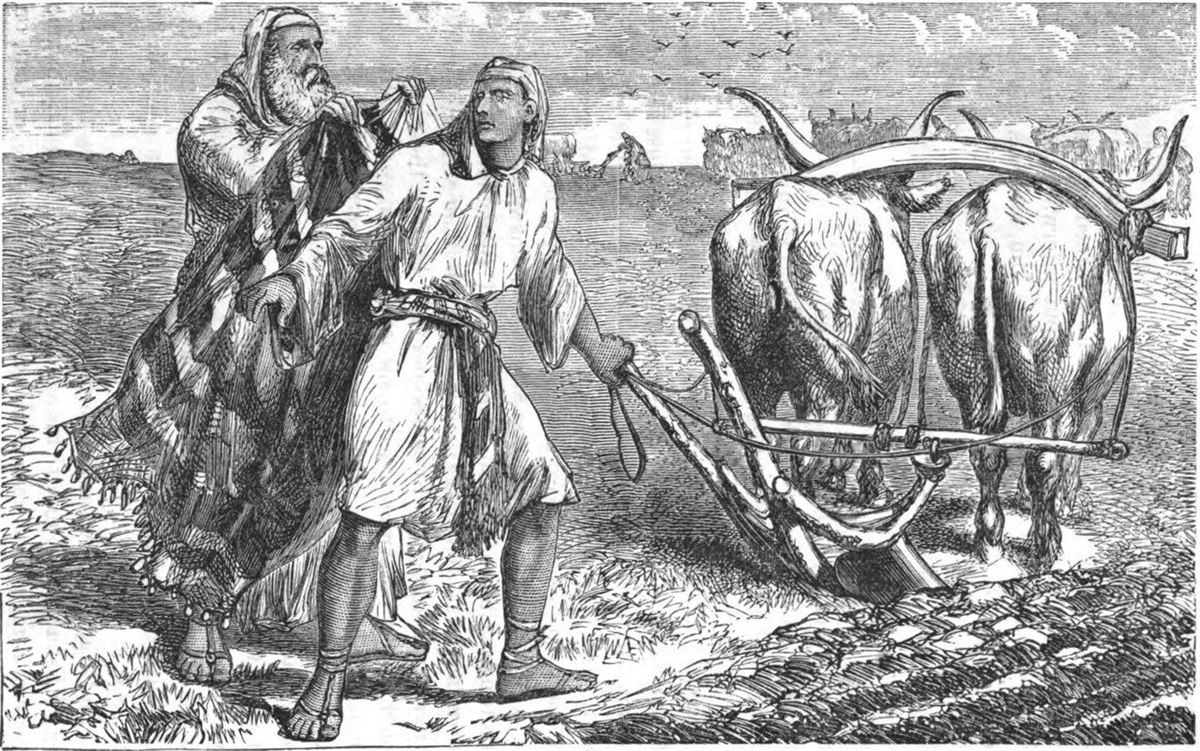
19 So he departed from there and found Elisha the son of Shaphat, who was plowing with twelve yoke of oxen in front of him, and he was with the twelfth. Elijah passed by him and cast his cloak upon him. 20 And he left the oxen and ran after Elijah and said, “Let me kiss my father and my mother, and then I will follow you.” And he said to him, “Go back again, for what have I done to you?” 21 And he returned from following him and took the yoke of oxen and sacrificed them and boiled their flesh with the yokes of the oxen and gave it to the people, and they ate. Then he arose and went after Elijah and assisted him. – 1 Kings 19:15-21 ESV

The last three and a half years had taken their toll on Elijah. He had been living in a God-ordained exile in a remote village in the region of Sidon. While God had miraculously cared for him during that time, he had to live with the knowledge that there was a bounty on his head. King Ahab and his queen, Jezebel, had never forgiven him for the drought he had placed on the land of Israel. Elijah must have woken up every morning wondering if that would be the day God called him to confront Ahab and Jezebel one more time.

When that day finally came, Elijah obeyed God and made his way to Mount Carmel, where he challenged King Ahab to pit his 450 prophets of Baal against Yahweh, the one true God. That battle ended up being a lopsided affair, with Elijah’s God as the clear victor and the false god of Ahab and Jezebel exposed as a fraud and a failure. The dead bodies of his 450 prophets, strewn across the Jezreel Valley, were evidence of his decisive defeat.

But Elijah’s hope for revival in the land was soon replaced by fear for his own life. Jezebel had vowed to kill Elijah for his slaughter of the 450 prophets of Baal. And he responded to this news by running away. The prophet of God seemed to have lost all faith in God. Yet, even in his deep state of depression and despondency, Elijah was ministered to by God. Yahweh met Elijah right where he was, in the midst of his doubt and despair, and graciously provided him with a visual demonstration of His power. However, the wind, earthquake, and fire only frightened Elijah, causing him to take refuge in a cave. But it was the quiet whisper of God that drew him out, and the gentle voice of God asked Elijah to explain his presence there. What was the prophet doing so far from the scene of the recent victory over Baal? Why was he hiding? Elijah’s answer revealed his struggle with a lack of faith and a sense of failure.

“I have been very jealous for the LORD, the God of hosts. For the people of Israel have forsaken your covenant, thrown down your altars, and killed your prophets with the sword, and I, even I only, am left, and they seek my life, to take it away.” – 1 Kings 19:14 ESV

Elijah described himself as alone and afraid. He had convinced himself that he was the last man standing, with no one to do battle at his side. In the heat of the moment, he had conveniently forgotten about the 100 prophets that God had used Obadiah to protect and preserve (1 Kings 18:13). Elijah felt alienated and alone, but his feelings were not based on reality. God even informed Elijah that He had preserved a remnant of “7,000 others in Israel who have never bowed down to Baal or kissed him!” (1 Kings 19:18 NLT). Elijah was far from alone, and God was far from finished with Elijah. But rather than rebuke His wavering prophet, God gave him his next assignment.

“Go back the same way you came, and travel to the wilderness of Damascus. When you arrive there, anoint Hazael to be king of Aram. Then anoint Jehu grandson of Nimshi to be king of Israel, and anoint Elisha son of Shaphat from the town of Abel-meholah to replace you as my prophet.” – 1 Kings 19:15 ESV

Despite his recent display of faithlessness and fear, Elijah would play a significant role in the next phase of God’s plans for Israel. God gave Elijah three assignments: First, he was to anoint a new king over the Syrians or Arameans. Then, he was to anoint a new king over Israel’s northern kingdom. Finally, he was to anoint his own successor. God provided Elijah little in the way of details. Other than the names of the men he was to anoint, Elijah had no way of knowing what any of this meant or how it would all turn out. But God was letting Elijah know that there were plans in the works of which he was unaware. Whether Elijah realized it or not, Ahab’s days were numbered, and the Syrians would end up playing a part in his eventual demise. There would be a new king in Israel one day. God had defeated the false god, Baal, and now He was going to mete out final judgment on the man responsible for Baal’s presence in Israel.

As if to further convince Elijah that he was not alone and that his mission was far from over, God revealed that the three men Elijah was to anoint would carry on the work that he had started at Mount Carmel. Elijah had killed the 450 prophets of Baal, but there were far more who needed to face the judgment of God for their apostasy and rebellion.

“Anyone who escapes from Hazael will be killed by Jehu, and those who escape Jehu will be killed by Elisha!” – 1 Kings 19:17 NLT

Judgment was coming. Yahweh was preparing to purge Israel of all those who had bowed the knee to Baal, and He would start at the top with Ahab and Jezebel. But this divine plan to cleanse Israel would not happen overnight. In fact, it would last long after Elijah was gone. That’s why God informed Elijah that he was to anoint his successor.

“…anoint Elisha son of Shaphat from the town of Abel-meholah to replace you as my prophet.” – 1 Kings 19:16 NLT

God already had Elijah’s replacement identified and a strategy in place to carry on His divine plan for Ahab’s punishment and Israel’s purification. A big reason for Elijah’s dejection was that the revival that started at Mount Carmel had stalled. When he had heard the people cry out, “The LORD, he is God; the LORD, he is God” (1 Kings 18:39 ESV), he genuinely believed that God had turned back the hearts of the people, and he expected to see an amazing renewal take place. He may have even thought that Ahab and Jezebel might repent and accept Yahweh as the one true God. But instead, the ever-defiant queen had threatened him with death.

But while Jezebel remained unwavering in her commitment to Baal, Elijah needed to understand that God was unfazed by her actions. As the sovereign, omniscient God of the universe, He had a plan in place to deal with Jezebel, Ahab, and all those who had bent the knee to Baal. And while Elijah might not live to see the final phase of that plan, he would play a decisive role in its implementation.

Revived and encouraged by Yahweh’s news, Elijah made his way to Abel-meholah, located in the Jordan Valley. While God clearly told Elijah to travel to the wilderness of Damascus and anoint Hazael to be king of Aram (1 Kings 19:15), it would appear that this was meant to be his final destination. On his way from Mount Sinai, he had to pass through the Jordan Valley, so it only made sense to stop there first and find the man who would be his replacement. He found Elisha plowing with 12 pairs of oxen in a field. This agrarian scene is significant for several reasons. First, it conveys an image of hope and expectation. After three-and-a-half years of drought, the rain had come, and now Elisha was preparing his formerly sun-baked fields for planting. He was anticipating a fruitful harvest sometime in the future. But Elisha’s presence in the field also reveals that he was a man of the land. He was not an influential figure with great wealth and prominence. He was a nondescript nobody whose only credentials were his calling by Yahweh.

What happens next appears strange to our modern sensibilities. Elijah walked up to this man, placed his cloak across his shoulders, and then simply walked away. What kind of bizarre ritual did this represent? How could Elisha have taken this unexpected action from this unknown stranger? Amazingly, it seems as if Elisha fully understood the significance of Elijah’s symbolic act. The text states that he “left the oxen standing there, ran after Elijah, and said to him, ‘First let me go and kiss my father and mother good-bye, and then I will go with you!’” (1 Kings 19:20 NLT). Perhaps God had already prepared Elisha for this moment, having revealed His plan through a dream or vision. He could have sent an angelic messenger to prepare Elisha for the prophet’s arrival. But whatever the case, Elisha seems to have been unfazed by what transpired and fully aware of what it meant. He immediately stopped his plowing and followed the man of God. His words and actions reveal that he knew who Elijah was and what he was asking him to do. His only request was that he be allowed to say goodbye to his family.

Elijah’s response to his request comes across as rather flippant.

“Go back again, for what have I done to you?” – 1 Kings 19:20 ESV

In a sense, Elijah was simply emphasizing that this had all been God’s doing, not his. He was merely the messenger. Elisha was free to do as he pleased, and the young farmer-turned-prophet demonstrated his commitment to accept the call of God. He took the plow, the symbol of his former occupation, and used the wood to build an altar. Then, on that altar, he offered up the oxen with which he had been plowing. Elisha burned every bridge to his former life. He bid his parents and his past goodbye and “arose and went after Elijah and assisted him” (1 Kings 19:21 ESV).

As Elijah and Elisha made their way from the Jordan Valley, the first phase of the second half of God’s plan began. The revival Elijah had longed for and given up on was coming. Yahweh was not yet done. Elijah had been a key player in God’s renewal plans for Israel, but his part was coming to an end. The LORD had another man ready to take the baton and finish the race. God would use this divine tag team to accomplish His will concerning Israel and usher in a period of much-needed spiritual renewal among His covenant people. The apostle Paul would later explain his understanding of how God uses a team approach to accomplish His divine will.

What then is Apollos? What is Paul? Servants through whom you believed, as the Lord assigned to each. I planted, Apollos watered, but God gave the growth. So neither he who plants nor he who waters is anything, but only God who gives the growth. He who plants and he who waters are one, and each will receive his wages according to his labor. For we are God’s fellow workers. You are God’s field, God’s building. – 1 Corinthians 3:5-9 ESV

Elijah had planted; now it was Elisha’s turn to water. But the harvest would be the LORD’s.

English Standard Version (ESV) The Holy Bible, English Standard Version. ESV® Permanent Text Edition® (2016). Copyright © 2001 by Crossway Bibles, a publishing ministry of Good News Publishers.

New Living Translation (NLT) Holy Bible, New Living Translation, copyright © 1996, 2004, 2015 by Tyndale House Foundation. Used by permission of Tyndale House Publishers Inc., Carol Stream, Illinois 60188. All rights reserved.

The Fateful Journey From Faith to Fear

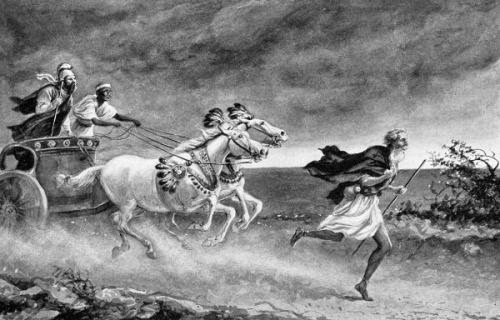
41 And Elijah said to Ahab, “Go up, eat and drink, for there is a sound of the rushing of rain.” 42 So Ahab went up to eat and to drink. And Elijah went up to the top of Mount Carmel. And he bowed himself down on the earth and put his face between his knees. 43 And he said to his servant, “Go up now, look toward the sea.” And he went up and looked and said, “There is nothing.” And he said, “Go again,” seven times. 44 And at the seventh time he said, “Behold, a little cloud like a man’s hand is rising from the sea.” And he said, “Go up, say to Ahab, ‘Prepare your chariot and go down, lest the rain stop you.’” 45 And in a little while the heavens grew black with clouds and wind, and there was a great rain. And Ahab rode and went to Jezreel. 46 And the hand of the LORD was on Elijah, and he gathered up his garment and ran before Ahab to the entrance of Jezreel. 

1 Ahab told Jezebel all that Elijah had done, and how he had killed all the prophets with the sword. 2 Then Jezebel sent a messenger to Elijah, saying, “So may the gods do to me and more also, if I do not make your life as the life of one of them by this time tomorrow.” 3 Then he was afraid, and he arose and ran for his life and came to Beersheba, which belongs to Judah, and left his servant there. – 1 Kings 18:41-19:3 ESV

Chapter 18 opened up with the words God spoke to Elijah: “Go, show yourself to Ahab, and I will send rain upon the earth” (1 Kings 18:1 ESV). This statement contains a command as well as a promise from God. After his three-and-a-half-year absence, Elijah was to return to Israel from Sidon and confront King Ahab one more time. But while this command would likely involve significant risk to the prophet, his obedience would result in a tremendous blessing on the people. God would end the prolonged drought and restore rain to the land.

It is impossible to know if Elijah was aware of all that would have to happen before the rain returned. There is no indication as to when God divulged the rest of His plan and Elijah’s role in it. But before the physical drought could end, the spiritual drought afflicting the people would have to come to a decisive conclusion that involved a dramatic confrontation between Elijah and the 450 prophets of Baal. However, the real battle would be between Yahweh, the God of Israel, and Baal, the god of Ahab and Jezebel.

Yahweh had won the day, displaying His power by sending fire from heaven that “consumed the burnt offering and the wood and the stones and the dust, and licked up the water that was in the trench” (1 Kings 18:38 ESV). This demonstrative exhibition of God’s omnipotence brought the people to their knees in fear and worship. What they had just witnessed left them thoroughly convinced that Yahweh was the one true God, and that newly revived awareness left them crying out, “The LORD, he is God; the LORD, he is God” (1 Kings 18:39 ESV). And as if to put an exclamation point on the whole scene, Elijah ordered the capture and execution of all 450 of Baal’s so-called prophets. Their god had remained silent when they cried to him for help. Now the prophet of Yahweh silenced them for good. They would no longer deceive and mislead the people of Israel with fallacious promises concerning their false god.

But there was still one thing missing: The rain that Yahweh had promised. Baal had been discredited, his prophets had been eliminated, and the peoples’ reverence for Yahweh had been rejuvenated. But the land remained under the God-ordained drought that had turned Israel into a dust bowl where water and food were scarce and daily survival was a challenge. The land that God had once described as “flowing with milk and honey” (Exodus 33:3 ESV) had become fruitless and lifeless, reflecting the spiritual state of the people who occupied it.

Hundreds of years earlier, long before the people of Israel took possession of the land of Canaan, Moses warned what would happen if they proved unfaithful.

“And if you will indeed obey my commandments that I command you today, to love the LORD your God, and to serve him with all your heart and with all your soul, he will give the rain for your land in its season, the early rain and the later rain, that you may gather in your grain and your wine and your oil. And he will give grass in your fields for your livestock, and you shall eat and be full. Take care lest your heart be deceived, and you turn aside and serve other gods and worship them; then the anger of the LORD will be kindled against you, and he will shut up the heavens, so that there will be no rain, and the land will yield no fruit, and you will perish quickly off the good land that the LORD is giving you.” – Deuteronomy 11:13-17 ESV

Years later, when God’s people continued to display their propensity for unfaithfulness, His prophet, Joel, would offer this promise of divine restoration even in the face of their disobedience.

Surely the LORD has done great things!
    Don’t be afraid, O land.
Be glad now and rejoice,
    for the LORD has done great things.
Don’t be afraid, you animals of the field,
    for the wilderness pastures will soon be green.
The trees will again be filled with fruit;
    fig trees and grapevines will be loaded down once more.
Rejoice, you people of Jerusalem!
    Rejoice in the LORD your God!
For the rain he sends demonstrates his faithfulness.
    Once more the autumn rains will come,
    as well as the rains of spring.
The threshing floors will again be piled high with grain,
    and the presses will overflow with new wine and olive oil.

The LORD says, “I will give you back what you lost…” – Joel 2:20-25 ESV

That day on Mount Carmel, the people had seen the fire of God fall from heaven, completely consuming the altar, sacrifice, and water. But they had not yet seen or felt His blessing. As Joel stated, “the rain he sends demonstrates his faithfulness.” Their land was in desperate need of restoration and rejuvenation, and so were they. After three-and-a-half years of spiritual drought, their hearts were parched and hardened. They had lost the capacity for fruitfulness and faithfulness and needed an outpouring of God’s grace and mercy.

Elijah knew what God had in store. So, he informed the shell-shocked king to “Go get something to eat and drink, for I hear a mighty rainstorm coming!” (1 Kings 18:41 NLT). There was a blessing on the horizon. Despite Ahab and Jezebel’s wickedness, God was about to pour out His goodness on the land.

The fact that Ahab had food to eat is symbolic of his self-centered approach to leadership. His sins had brought God’s curse upon the nation, but while the people suffered severely from the lack of rain, Ahab and Jezebel lived in royal comfort and ease. God would later issue an indictment against the leaders of Israel, warning them of their blatant disregard for the care of His people.

“What sorrow awaits you shepherds who feed yourselves instead of your flocks. Shouldn’t shepherds feed their sheep?” – Ezekiel 34:2 NLT

As Ahab was busy satisfying his own needs, Elijah interceded on behalf of the people of Israel. He “climbed to the top of Mount Carmel and bowed low to the ground and prayed with his face between his knees” (1 Kings 18:42 NLT). At one point during his prayer, he stopped and sent his servant to look toward the Mediterranean Sea in the east. But the servant saw nothing. This pattern repeated itself five more times with the same disappointing result. But the seventh time, the servant returned with a different report.

“I saw a little cloud about the size of a man’s hand rising from the sea.” – 1 Kings 18:44 NLT

Out on the distant horizon, the servant saw what appeared to be a glimmer of hope. It was a small and seemingly insignificant cloud, but Elijah knew what it meant. The blessing of God was about to fall and, when it did, it would come in torrents. So, he instructed his servant to warn Ahab to leave immediately, or he may not make it back to his winter palace in Jezreel. When Elijah’s servant looked to the east, he saw only a faint possibility. But through his eyes of faith,  Elijah saw something altogether different. He perceived the imminent arrival of the outpouring of God’s blessing, and before long, that small cloud developed into a massive storm that brought strong winds and torrential rains. As Ahab tried to outrun the storm in his chariot, “the LORD gave special strength to Elijah. He tucked his cloak into his belt and ran ahead of Ahab’s chariot all the way to the entrance of Jezreel” (1 Kings 18:46 NLT).

Because Jezreel was anywhere from 10 to 20 miles east of Mount Carmel, some commentators attempt to explain this last verse by saying that Ahab’s chariot got caught in the mud and delayed his arrival. Others speculate that Elijah simply took a shortcut over the ridge of Mount Carmel. But everything about this story has been focused on the matchless power of God, and it should not seem out of the question that God might endow his prophet with a supernatural capacity to outrun the chariot of his arch-nemesis. God had defeated Baal. Now, the prophet of God had defeated the benefactor of Baal.

But while Elijah had won the victory at Mount Carmel and the race to Jezreel, he would have little time to celebrate. Upon hearing the unexpected news of all that had transpired on Mount Carmel, Jezebel was outraged and directed all her anger at Elijah.

“May the gods strike me and even kill me if by this time tomorrow I have not killed you just as you killed them.” – 1 Kings 19:2 NLT

Despite all that Ahab told her about the day’s events, she remained unconvinced of Yahweh’s power. She even called on Baal and his queen mother, Asherah, to come to her aid so that she might avenge the deaths of the prophets by killing Elijah. She was still putting her hope and trust in her false gods. Even the sudden arrival of long-awaited rain did nothing to diminish her misplaced trust in her lifeless and powerless gods. Baal, Jezebel’s beloved fertility god, had done nothing to eliminate the drought that had plagued the land.

But even more surprising than Jezebel’s stubborn belief in Baal and her resistance to God was Elijah’s sudden display of fear and doubt. This man, who had called down fire from heaven and had singlehandedly executed 450 prophets of Baal, found himself intimidated by the idle threats of this self-absorbed, idol-worshiping queen. Her vow to avenge her false god should have made Elijah laugh with scorn. Her god had proven himself to be speechless, powerless, and utterly helpless in the face of Yahweh. Yet, the formerly faithful Elijah was suddenly fearful, and this time, rather than running to the problem in the strength of God, he took flight and tried to escape it. He fled for his life, covering the 25 miles from Jezreel to Beersheba, motivated by fear and in the strength of his own flesh. Faced with the threats of Jezebel, Elijah took his eyes off God and took his fate into his own hands. 

This faithful man of God allowed the words of an idol-obsessed queen to dishearten and defeat him. He had bravely faced off against the 450 prophets of Baal, but now, with Jezebel’s words ringing in his ear, Elijah ran all the way to Beersheba, located on the southern border of Judah. From there, he would enter the Judean wilderness, the very same place where the disobedient and doubtful Israelites had wandered for 40 years when they refused to enter the promised land. And, in no time at all, the once faith-filled Elijah would find himself racked by fear and desiring death rather than face the vengeful anger of Jezebel.

English Standard Version (ESV) The Holy Bible, English Standard Version. ESV® Permanent Text Edition® (2016). Copyright © 2001 by Crossway Bibles, a publishing ministry of Good News Publishers.

New Living Translation (NLT) Holy Bible, New Living Translation, copyright © 1996, 2004, 2015 by Tyndale House Foundation. Used by permission of Tyndale House Publishers Inc., Carol Stream, Illinois 60188. All rights reserved.

Drought, Doubt, and Deliverance

1 Now Elijah the Tishbite, of Tishbe in Gilead, said to Ahab, “As the LORD, the God of Israel, lives, before whom I stand, there shall be neither dew nor rain these years, except by my word.” 2 And the word of the LORD came to him: 3 “Depart from here and turn eastward and hide yourself by the brook Cherith, which is east of the Jordan. 4 You shall drink from the brook, and I have commanded the ravens to feed you there.” 5 So he went and did according to the word of the LORD. He went and lived by the brook Cherith that is east of the Jordan. 6 And the ravens brought him bread and meat in the morning, and bread and meat in the evening, and he drank from the brook. 7 And after a while the brook dried up, because there was no rain in the land.

8 Then the word of the LORD came to him, 9 “Arise, go to Zarephath, which belongs to Sidon, and dwell there. Behold, I have commanded a widow there to feed you.” 10 So he arose and went to Zarephath. And when he came to the gate of the city, behold, a widow was there gathering sticks. And he called to her and said, “Bring me a little water in a vessel, that I may drink.” 11 And as she was going to bring it, he called to her and said, “Bring me a morsel of bread in your hand.” 12 And she said, “As the LORD your God lives, I have nothing baked, only a handful of flour in a jar and a little oil in a jug. And now I am gathering a couple of sticks that I may go in and prepare it for myself and my son, that we may eat it and die.” 13 And Elijah said to her, “Do not fear; go and do as you have said. But first make me a little cake of it and bring it to me, and afterward make something for yourself and your son. 14 For thus says the LORD, the God of Israel, ‘The jar of flour shall not be spent, and the jug of oil shall not be empty, until the day that the LORD sends rain upon the earth.’” 15 And she went and did as Elijah said. And she and he and her household ate for many days. 16 The jar of flour was not spent, neither did the jug of oil become empty, according to the word of the LORD that he spoke by Elijah. – 1 Kings 17:1-16 ESV

Almost as if out of nowhere, a new character appears on the scene. His sudden and unexpected arrival seems intended to accentuate the divine nature of his mission. No background story or biographical information is provided, other than his name and the identity of his hometown.

His introduction into the narrative is timed to coincide with the rise to power of King Ahab and his Sidonian queen, Jezebel. With this new power couple ruling over the northern kingdom of Israel, the spiritual state of the ten northern tribes has reached an all-time low. The author ended chapter 16 with an unflattering description of their influence over the nation.

…he [Ahab] took for his wife Jezebel the daughter of Ethbaal king of the Sidonians, and went and served Baal and worshiped him. He erected an altar for Baal in the house of Baal, which he built in Samaria. And Ahab made an Asherah. Ahab did more to provoke the LORD, the God of Israel, to anger than all the kings of Israel who were before him. – 1 Kings 16:31-33 ESV

To claim that Ahab had managed to anger God more than any of his predecessors is a significant statement. He was following in the footsteps of some world-class, all-star-quality apostates. But when it came to wickedness and unfaithfulness, Ahab set the new gold standard. He became the proverbial poster boy for all that is wicked and ungodly, while his wife managed to earn herself a permanent spot in the spiritual hall of infamy.

In the middle of their sin-fueled and self-absorbed reign, God decides to deliver a message to them, utilizing an obscure and unknown man named Elijah. This will not be the first time God has sent a prophet to deliver a message to a wayward and rebellious king. When Jeroboam had made the fateful decision to replace Yahweh with his own false gods, an unnamed prophet appeared on the scene with a dire message for the king, and he demonstrated God’s anger by destroying one of the altars Jeroboam had dedicated to his false god. Later on, Jeroboam sent his wife to consult with another prophet of God, in hopes of getting a prognosis regarding his young son’s illness. But what he got was bad news. He was told that his son would die and that every one of his male heirs would face the same fate before they could inherit the throne. In other words, any hopes of establishing a dynasty would be destroyed.

As the seventh king to reign over the northern kingdom of Israel, Ahab would not be the first to receive a message from God. But, in his case, the prophet would play a more pronounced and prolonged role in his life. The sins of Ahab and his wife were so egregious that God made his prophet a permanent fixture in their kingdom.

Elijah’s very first encounter with the king and queen was far from favorable. He stood before this powerful couple and boldly proclaimed, “As the LORD, the God of Israel, lives, before whom I stand, there shall be neither dew nor rain these years, except by my word” (1 Kings 17:1 ESV). That took guts and a fair amount of faith. He was claiming to have the God-given authority to withhold rain from the kingdom of Israel. Any way you look at it, this had to come across as a less-than-veiled threat to Ahab and Jezebel. But before they had time to cut this arrogant upstart down to size, God gave him instructions to get out of town.

“Depart from here and turn eastward and hide yourself by the brook Cherith, which is east of the Jordan.” – 1 Kings 17:3 ES

Elijah had done his job, but now it was time for God to prepare him for the next phase of his assignment. Before sending his prophet back into the mouth of the lion’s den, God planned to equip him for what was to come. He was determined to make Elijah a faithful and obedient messenger, strong enough to handle all the vitriol and violence that was about to come his way. Standing up to Ahab and Jezebel was not going to be easy, so God graciously eased Elijah into his new role with a hands-on experience that would teach him to trust and obey.

While in God’s preparatory school for prophets, Elijah was miraculously fed and cared for; he received a twice-daily ration of bread and meat, delivered to his cave by ravens. And outside the cave was a ready source of clean, pure water. But in time, “the brook dried up, because there was no rain in the land” (1 Kings 17:7 ESV). In other words, Elijah’s prediction of drought had come true, and he suffered just like everyone else. Without rain, there was no harvest, so that meant there was no more bread or meat for the ravens to deliver. Elijah’s little oasis in the wilderness had become a death trap. So, God gave him new instructions.

“Go and live in the village of Zarephath, near the city of Sidon. I have instructed a widow there to feed you.” – 1 Kings 17:8 NLT

This would have been a long and arduous journey under normal conditions, but the presence of drought made it even more so. Interestingly, God sent Elijah to a city in the region of Sidon, the very kingdom over which Jezebel’s father was king. Elijah was being sent to the same place Ahab had acquired a queen and her false god, Baal. Zarephath lay between Tyre and Sidon, two of the most prominent Phoenician cities. But as the story makes clear, the drought had made its way all the way to the coast of the Mediterranean Sea.

God provided Elijah with scant details about what to do when he arrived in Zarephath. The prophet had no food and received no word from God regarding when and how it would come, if it did at all. So, when Elijah encountered a widow gathering sticks, he decided to throw himself on her mercy. He asked for a drink of water and a morsel of bread. But then he discovered that this woman’s state was worse than his own.

“I swear by the LORD your God that I don’t have a single piece of bread in the house. And I have only a handful of flour left in the jar and a little cooking oil in the bottom of the jug. I was just gathering a few sticks to cook this last meal, and then my son and I will die.” – 1 Kings 17:12 NLT

The drought had taken its toll, leaving the woman with no food with which to feed herself or her young son.  It shouldn’t be overlooked that Baal, the god of the Phoenicians, was considered a fertility god. He was the provider of bountiful blessings, whether in the form of crops or children. Yet, this woman was living in a drought and watching her young son starve to death. There was nothing bountiful taking place in Zarephath, and Jezebel’s god was nowhere to be found.

Then, God gave Elijah a message to deliver to the woman.

“Don’t be afraid! Go ahead and do just what you’ve said, but make a little bread for me first. Then use what’s left to prepare a meal for yourself and your son. For this is what the LORD, the God of Israel, says: There will always be flour and olive oil left in your containers until the time when the LORD sends rain and the crops grow again!” – 1 Kings 17:13-14 NLT

While the god of the Phoenicians had failed to provide, the God of Israel would meet her needs and preserve the lives of both her and her son. Even in a time of drought, God would miraculously provide flour and oil in abundance until He decided to open up the skies and end the drought.

The woman faithfully obeyed the word of the prophet, and “There was always enough flour and olive oil left in the containers, just as the LORD had promised through Elijah” (1 Kings 17:16 NLT). God graciously provided for this Sidonian widow and her son, and He continued to meet the needs of His prophet. But more importantly, God was teaching Elijah that He could be trusted. He was greater than the fertility god of the Phoenicians. He was more powerful than the false deity of Ahab and Jezebel. The brook may have dried up, but the resources of God remained unending and plentiful. The ravens may have stopped showing up, but the miracle-working power of God remained undiminished. Elijah was learning the vital truth that no circumstance is too difficult for Yahweh, and the days ahead would provide further confirmation of that fact.

English Standard Version (ESV) The Holy Bible, English Standard Version. ESV® Permanent Text Edition® (2016). Copyright © 2001 by Crossway Bibles, a publishing ministry of Good News Publishers.

New Living Translation (NLT) Holy Bible, New Living Translation, copyright © 1996, 2004, 2015 by Tyndale House Foundation. Used by permission of Tyndale House Publishers Inc., Carol Stream, Illinois 60188. All rights reserved.

God Demands Faithfulness, Not Flawlessness

1 Now in the eighteenth year of King Jeroboam the son of Nebat, Abijam began to reign over Judah. 2 He reigned for three years in Jerusalem. His mother’s name was Maacah the daughter of Abishalom. 3 And he walked in all the sins that his father did before him, and his heart was not wholly true to the LORD his God, as the heart of David his father. 4 Nevertheless, for David’s sake the LORD his God gave him a lamp in Jerusalem, setting up his son after him, and establishing Jerusalem, 5 because David did what was right in the eyes of the LORD and did not turn aside from anything that he commanded him all the days of his life, except in the matter of Uriah the Hittite. 6 Now there was war between Rehoboam and Jeroboam all the days of his life. 7 The rest of the acts of Abijam and all that he did, are they not written in the Book of the Chronicles of the Kings of Judah? And there was war between Abijam and Jeroboam. 8 And Abijam slept with his fathers, and they buried him in the city of David. And Asa his son reigned in his place. – 1 Kings 15:1-8 ESV

All throughout his record of the kings of Judah and Israel, the author has dropped slight hints or clues that provide further insight into the actions of these men. In the case of Rehoboam, the king of Judah, he reveals that “When Rehoboam died, he was buried among his ancestors in the City of David. His mother was Naamah, an Ammonite woman. Then his son Abijam became the next king” (1 Kings 14:31 NLT). Hidden away in these three sentences is a small detail that could easily be overlooked. But this seemingly innocuous fact helps to explain how the spiritual state of God’s chosen people had so quickly deteriorated.

Rehoboam was the son of Solomon, and Solomon had more than 700 wives and 300 concubines. Many of those women were foreign princesses who had been given to Solomon as part of a peace agreement made between their home country and Israel. The author has already revealed that Solomon made many such treaties that required him to marry these women from pagan nations.

Now King Solomon loved many foreign women. Besides Pharaoh’s daughter, he married women from Moab, Ammon, Edom, Sidon, and from among the Hittites. The LORD had clearly instructed the people of Israel, “You must not marry them, because they will turn your hearts to their gods.” Yet Solomon insisted on loving them anyway. – 1 Kings 11:1-2 NLT

God had strictly forbidden the Israelites from taking wives for themselves from among the nations that lived in the land of Canaan. Long before the people of Israel had entered the land, Moses had clearly communicated God’s prohibition against any fraternization with the enemy.

“When the LORD your God brings you into the land you are about to enter and occupy, he will clear away many nations ahead of you: the Hittites, Girgashites, Amorites, Canaanites, Perizzites, Hivites, and Jebusites. These seven nations are greater and more numerous than you. When the LORD your God hands these nations over to you and you conquer them, you must completely destroy them. Make no treaties with them and show them no mercy. You must not intermarry with them. Do not let your daughters and sons marry their sons and daughters, for they will lead your children away from me to worship other gods. Then the anger of the LORD will burn against you, and he will quickly destroy you.” – Deuteronomy 7:1-4 NLT

But Solomon had chosen to disobey God’s command in a significant way. He had hundreds of foreign wives and, according to the closing verses of 1 Kings 14, he had married a woman from among the Ammonites. Once again, this small detail is intended to shed light on the moral and spiritual state of the nation. To fully grasp the significance of Solomon’s marriage to this woman,  we have to understand that the Ammonites were the descendants of Lot, the nephew of Abraham. But more importantly, their very existence is tied to a sad and sordid event that took place in Lot’s life. After Lot and his two daughters had been rescued from the sinful city of Sodom by an angel of the Lord, they found themselves living in a cave in the wilderness. One night, while Lot was drunk, his two daughters had sexual relations with him, resulting in both girls becoming pregnant. The book of Genesis states that “The younger daughter also gave birth to a son and named him Ben Ammi. He is the ancestor of the Ammonites of today” (Genesis 19:38 NLT).

Hundreds of years later, when the people of Israel were making their way from Egypt to the land of Canaan, their distant relatives, the Ammonites, refused to allow them to pass through their territory. In fact, they would actually attempt to have them cursed. So, God put a permanent ban on the descendants of the Ammonites and Moabites.

No Ammonite or Moabite or any of their descendants for ten generations may be admitted to the assembly of the LORD. These nations did not welcome you with food and water when you came out of Egypt. Instead, they hired Balaam son of Beor from Pethor in distant Aram-naharaim to curse you. But the LORD your God refused to listen to Balaam. He turned the intended curse into a blessing because the LORD your God loves you. As long as you live, you must never promote the welfare and prosperity of the Ammonites or Moabites. – Deuteronomy 23:3-6 NLT

Yet Solomon had chosen to disobey the will of God by marrying an Ammonite princess. From this unauthorized and illegal union had come the next king of Israel, Rehoboam, a man who proved to be anything but loyal to God. When Rehoboam died, his son Abijam took his place. But even in announcing Abijam as the next king of Judah, the author drops another not-so-subtle hint regarding this man’s lineage. He states that “His mother’s name was Maacah the daughter of Abishalom” (1 Kings 15:2 ESV). To understand the significance of this detail, we have to look at the book of 2 Chronicles.

Rehoboam took as wife Mahalath the daughter of Jerimoth the son of David, and of Abihail the daughter of Eliab the son of Jesse, and she bore him sons, Jeush, Shemariah, and Zaham. After her he took Maacah the daughter of Absalom, who bore him Abijah, Attai, Ziza, and Shelomith. Rehoboam loved Maacah the daughter of Absalom above all his wives and concubines (he took eighteen wives and sixty concubines, and fathered twenty-eight sons and sixty daughters). – 2 Chronicles 11:18-21 ESV

Abishalom is another variation of the name Absalom, and Abijah and Abijam are one and the same person. Rehoboam married a daughter of the very man who tried to steal the crown from his grandfather, David. Absalom proved successful in staging a coup against his father, but it was short-lived. Had he managed to complete his coup attempt, Solomon would never have been the next king of Israel. Yet, Rehoboam, the son of Solomon, married the daughter of the man who attempted to deny his father his God-given right to the throne of Israel.

There are so many plots and twists to this story that remain hidden from view, but they provide the context for all that happens. The individual actions of these men are to be seen as the byproducts of a much bigger problem. The nation of Israel had a long and sordid history of disobedience to God, and each successive generation followed in the footsteps of their ancestors, displaying the lingering and infectious nature of sin. It becomes painfully clear that each indiscretion and act of insubordination, no matter how small, has consequences. Our sins against God can take on a life of their own and, just as an infectious disease can spread from one person to another, so we can end up passing on our sinful propensities to the next generation. That is precisely what happened with the son of Rehoboam.

…he walked in all the sins that his father did before him, and his heart was not wholly true to the LORD his God, as the heart of David his father. – 1 Kings 15:3 ESV

Yet, God had his hand on Abijah, giving him victories over Jeroboam and the ten tribes of Israel. But it was not because of anything Abijah had done. God was honoring the faithfulness of David.

But for David’s sake, the LORD his God allowed his descendants to continue ruling, shining like a lamp, and he gave Abijam a son to rule after him in Jerusalem. For David had done what was pleasing in the LORD’s sight and had obeyed the LORD’s commands throughout his life, except in the affair concerning Uriah the Hittite. – 1 Kings 15:4-5 NLT

Not only do our sins have consequences, but our acts of faithfulness can also be passed on. God was preserving the kingdom of the rebellious Abijah because of the faithfulness of his grandfather. Amazingly, some of David’s faithfulness had been passed down to his grandson, manifesting itself in a powerful declaration of allegiance to God, spoken to the rival forces of the ten northern tribes.

“Do you really think you can stand against the kingdom of the LORD that is led by the descendants of David? You may have a vast army, and you have those gold calves that Jeroboam made as your gods. But you have chased away the priests of the LORD (the descendants of Aaron) and the Levites, and you have appointed your own priests, just like the pagan nations. You let anyone become a priest these days! Whoever comes to be dedicated with a young bull and seven rams can become a priest of these so-called gods of yours! But as for us, the LORD is our God, and we have not abandoned him.” – 2 Chronicles 13:8-10 NLT

When the battle ensued, the people of Judah cried out to God, and He delivered them.

So Judah defeated Israel on that occasion because they trusted in the LORD, the God of their ancestors. – 2 Chronicles 13:18 NLT

Despite their track record of unfaithfulness, God gave Abijah and the people of Judah a great victory over their enemies. This rebellious young king, who had inherited many of his father’s worst traits, managed to lead his people back to the LORD, if only for a short time. Faced with overwhelming odds and the threat of defeat at the hands of Jeroboam and the ten tribes of Judah, Abijah cried out to God. In that brief, shining moment, the nation of Judah placed their hope in the Almighty, and He delivered them. Abijah was far from perfect, but he chose to lead his people back to the LORD.

The author simply records: “And Abijam slept with his fathers, and they buried him in the city of David. And Asa his son reigned in his place” ( 1 Kings 15:8 ESV).  There is no definitive declaration of Abijam’s spiritual legacy, good or bad. However, the Book of 2 Chronicles reveals that Abijam’s actions had a positive effect on his son and heir to the throne.

When Abijah died, he was buried in the City of David. Then his son Asa became the next king. There was peace in the land for ten years. Asa did what was pleasing and good in the sight of the LORD his God. He removed the foreign altars and the pagan shrines. He smashed the sacred pillars and cut down the Asherah poles. He commanded the people of Judah to seek the LORD, the God of their ancestors, and to obey his law and his commands. Asa also removed the pagan shrines, as well as the incense altars from every one of Judah’s towns. So Asa’s kingdom enjoyed a period of peace. – 2 Chronicles 14:1-5 NLT

Yahweh doesn’t demand perfection from His people; He simply asks that they be faithful. The reference to Uriah the Hittite in verse 5 is meant to convey that David was far from flawless in his actions. His affair with Bathsheba and his role in her husband’s execution are dark spots on his spiritual legacy, but Yahweh viewed David as a man after His own heart.

David did what was right in the eyes of the LORD and did not turn aside from anything that he commanded him all the days of his life. – 1 Kings 15:5 ESV

God demands faithfulness, not lawlessness. He is looking for the person who will resist the temptation to compromise their convictions and remain true to their covenant commitments to Him. Abijam was not a perfect king or a sold-out follower of Yahweh, but when the time came, he did the right thing, and his son followed his example. But will the legacy continue? What will be the nature of this new generation of leadership? Will the next king be faithful or faithless? Will he display a heart for God or a hard-headed insistence to live in rebellion against Him? Only time will tell.

English Standard Version (ESV) The Holy Bible, English Standard Version. ESV® Permanent Text Edition® (2016). Copyright © 2001 by Crossway Bibles, a publishing ministry of Good News Publishers.

New Living Translation (NLT) Holy Bible, New Living Translation, copyright © 1996, 2004, 2015 by Tyndale House Foundation. Used by permission of Tyndale House Publishers Inc., Carol Stream, Illinois 60188. All rights reserved.

The Danger of Spiritual Lukewarmness

1 Now King David was old and advanced in years. And although they covered him with clothes, he could not get warm. 2 Therefore his servants said to him, “Let a young woman be sought for my lord the king, and let her wait on the king and be in his service. Let her lie in your arms, that my lord the king may be warm.” 3 So they sought for a beautiful young woman throughout all the territory of Israel, and found Abishag the Shunammite, and brought her to the king. 4 The young woman was very beautiful, and she was of service to the king and attended to him, but the king knew her not. – 1 Kings 1:1-4 ESV

It would be easy to assume that the books of 1st and 2nd Kings are nothing more than historical accounts that provide a chronological record of the kings of Israel and Judah. They read like a two-volume ancient history textbook, providing detailed accounts of the reigns of 40 different monarchs who eventually ruled over the people of God. But these two books are far more than just a retelling of past historical events. They were written to tell a story and to provide an explanation for Israel’s sorry state of affairs after their return from exile.

While we don’t know the identity of the author of these two books, we do know to whom they were written. In their original form, they comprised one book that was addressed to the people of Israel who survived captivity in Babylon and were part of the remnant who returned to the land of Judah.

After 70 years of subjugation to the Babylonians, they made their way back to the land that had been their promised inheritance and discovered the city of Jerusalem in an abysmal state of disrepair and the beautiful temple built by King Solomon to be nothing but a pile of rubble. The gates of the city had been destroyed and the once-formidable walls lie in ruins. The former capital of Israel was a virtual ghost town, and while the people would eventually restore the city and rebuild the temple, the nation would never enjoy a return to its glory days.

But how did this happen? What caused the fall of one of the greatest nations on earth? Why did Yahweh seemingly abandon His people and allow them to undergo such devastating destruction at the hands of their enemies?

Those are the kinds of questions that the books of 1st and 2nd Kings attempt to answer. They retell the sad story of Israel’s demise. First Kings begins with the coronation of King Solomon and his dedication of the Temple. Second Kings ends with the capture of King Zedekiah and the destruction of the Temple. And in between, we are given a detailed accounting of Israel’s serial unfaithfulness to God. The author provides his audience with a no-holds-barred retelling of Israel’s fall from the heights of glory to the depths of despair and devastation, and it is not a pretty picture. But it is a memorable one, providing those who read it with a never-to-be-forgotten reminder of what happens to those who forsake the Lord.

But these two books are not all doom and gloom. Yes, they paint a not-so-attractive picture of the people of God, portraying them as unfaithful and fully deserving of God’s judgment. But they also provide undeniable evidence of God’s unwavering faithfulness. After all, those who ended up reading these two books were living on the other side of the exile. They were fortunate to be among those who had been restored to the land of promise because Yahweh had kept His word. He had told them they would go into captivity for 70 years.

“Therefore thus says the Lord of hosts: Because you have not obeyed my words, behold, I will send for all the tribes of the north, declares the Lord, and for Nebuchadnezzar the king of Babylon, my servant, and I will bring them against this land and its inhabitants, and against all these surrounding nations. I will devote them to destruction, and make them a horror, a hissing, and an everlasting desolation. Moreover, I will banish from them the voice of mirth and the voice of gladness, the voice of the bridegroom and the voice of the bride, the grinding of the millstones and the light of the lamp. This whole land shall become a ruin and a waste, and these nations shall serve the king of Babylon seventy years.” – Jeremiah 25:8-11 ESV

But He had also promised that a remnant would be allowed to return.

“For thus says the Lord: When seventy years are completed for Babylon, I will visit you, and I will fulfill to you my promise and bring you back to this place. For I know the plans I have for you, declares the Lord, plans for welfare and not for evil, to give you a future and a hope.” – Jeremiah 29:10-11 ESV

And He had been faithful to do exactly what He said He would do.

It was George Santayana who wrote in 1905, “those who cannot remember the past are condemned to repeat it.” Yahweh wanted His people to know and understand every sordid and sorry detail concerning their past relationship with Him. Their current state of affairs had historical precedence. They needed to be reminded that, as the people of God, their sin would always have consequences. Yahweh cannot allow unfaithfulness to go unpunished. Disobedience will always bring about divine discipline. And these two books were not intended to be a simple retelling of ancient history, but they were designed to prevent its repetition. Even today, there is much we modern westerners can learn from the history of the kings of Israel and Judah. They contain timeless lessons that bear repeating and offer the unflattering portraits of men whose examples we should avoid.

The very first portrait we are given is of the aging king, David. We are told he was “old and advanced in years” (1 Kings 1:1 ESV). The once-powerful king of Israel is shown to be a shadow of his former self. The warrior-king who helped establish Israel as one of the greatest nations on earth has been relegated from the battlefield to the bedroom. Rather than fighting the enemies of Israel, he is waging a hopeless battle with the effects of old-age and senility. The one of whom they used to sing: “Saul has struck down his thousands, and David his ten thousands” (1 Samuel 18:7 ESV), is now portrayed as a feeble old man, covered in blankets and fighting to stay warm.

His body is suffering the ravages of time, and David is unable to produce enough body heat to keep himself warm. In his old age, the slayer of Goliath finds himself so weak that he has to rely on the body heat of a young slave girl to keep him alive. In his prime, David suffered from an inordinate attraction to beautiful women that often got him into trouble. Because David is still the king, his advisors seek out the most beautiful woman they can find. But at this point in his life, the only pleasure David can derive from Abishag the Shunammite is the warmth her body can produce.

The author makes it clear that David received no sexual pleasure from this arrangement. It was totally utilitarian in nature.

The girl was very beautiful, and she looked after the king and took care of him. But the king had no sexual relations with her. – 1 Kings 1:4 NLT

As the book opens up, we are given a less-than-flattering glimpse of King David, confined to bed and constricted to mere survival. The great king of Israel is portrayed with diminished capacities and at the end of his life. His amazing rise to power and the record of his many accomplishments are found in the books of 1st and 2nd Samuel. But David’s glory days are behind him. His reign is coming to an end, and his fast-approaching death will usher in an important transitional period for the nation of Israel. The stability the nation enjoyed under his leadership was going to be put to the test. The peoples’ dedication and commitment to God will be exposed for what it really is: Lacking.

In some ways, the description of David’s physical condition provides a subtle portrayal of the spiritual condition of the nation. Over time, they have grown spiritually cold and incapable of rekindling the fire they once had for God. It won’t be long until they find themselves sharing their beds with the “young women” of the pagan nations in an attempt to “heat up” their languishing spiritual lives.

David had been a good king. According to Yahweh’s own estimation, he was a “man after God’s own heart” (1 Samuel 13:14). But even his godly leadership failed to produce faithfulness among the people of Israel. As will become evident, his influence over his own children proved to be lacking. Even before he breathes his final breath, David will find his kingdom under siege by his own family. From the king’s palace to the peasant’s hut, the unfaithfulness of Israel will soon be on full display.

These opening verses of 1st Kings paint David in a less-than-favorable light. He is old and in some ways, helpless. But his physical incapacity and inability to keep himself warm, mirrors the spiritual lukewarmness of the people of Israel. In the Book of Revelation, the apostle John quotes Jesus speaking a word of condemnation against the church of Laodicea.

“I know all the things you do, that you are neither hot nor cold. I wish that you were one or the other! But since you are like lukewarm water, neither hot nor cold, I will spit you out of my mouth! You say, ‘I am rich. I have everything I want. I don’t need a thing!’ And you don’t realize that you are wretched and miserable and poor and blind and naked.” – Revelation 3:15-17 NLT

Israel was guilty of the same thing and Yahweh would deal with them according to the tepidness of their spiritual fervor and unfaithfulness.

English Standard Version (ESV) The Holy Bible, English Standard Version. ESV® Permanent Text Edition® (2016). Copyright © 2001 by Crossway Bibles, a publishing ministry of Good News Publishers.

New Living Translation (NLT) Holy Bible, New Living Translation, copyright © 1996, 2004, 2015 by Tyndale House Foundation. Used by permission of Tyndale House Publishers Inc., Carol Stream, Illinois 60188. All rights reserved.

Praise the LORD!

1 Praise the LORD!
Praise the LORD, O my soul!
2 I will praise the LORD as long as I live;
    I will sing praises to my God while I have my being.

3 Put not your trust in princes,
    in a son of man, in whom there is no salvation.
4 When his breath departs, he returns to the earth;
    on that very day his plans perish.

5 Blessed is he whose help is the God of Jacob,
    whose hope is in the LORD his God,
6 who made heaven and earth,
    the sea, and all that is in them,
who keeps faith forever;
7     who executes justice for the oppressed,
    who gives food to the hungry.

The LORD sets the prisoners free;
8     the LORD opens the eyes of the blind.
The LORD lifts up those who are bowed down;
    the LORD loves the righteous.
9 The LORD watches over the sojourners;
    he upholds the widow and the fatherless,
    but the way of the wicked he brings to ruin.

10 The LORD will reign forever,
    your God, O Zion, to all generations.
Praise the LORD! – Psalm 146:1-10 ESV

The last five psalms are anonymous and form the final Hallel (praise) section of the Psalter. Due to the similarity of their content, they were likely written by the same author. Each begins with the same call to action: “Praise the LORD.” This imperative statement is not intended as a suggestion, but as a command to give Yahweh all the dignity, honor, worship, and praise He rightly deserves. The psalmist calls for wholehearted worship on the part of the people of God, and he sets the tone by declaring his sold-out allegiance to the Almighty.

I will praise the LORD as long as I live;
    I will sing praises to my God while I have my being. – Psalm 146:2 ESV

His statement of devotion to Yahweh is reminiscent of the address Joshua gave to the Israelites near the end of his life. Ever since the death of Moses, Joshua had served as the God-appointed leader of the Israelites, helping them cross the Jordan River and begin their conquest of the land of Canaan. Over the years, Joshua led the Israelites in their effort to conquer the inhabitants of the land so they could take possession of the inheritance promised to them by Yahweh. They had fought and won many battles, and successfully occupied a large portion of Canaan, but Yahweh reminded them that He had been behind it all.

“It was not your swords or bows that brought you victory. I gave you land you had not worked on, and I gave you towns you did not build—the towns where you are now living. I gave you vineyards and olive groves for food, though you did not plant them.” – Joshua 24:12-13 NLT

Despite his leadership role, Joshua knew that he had been little more than an instrument in Yahweh’s hands. He had led the people into battle, but the victories had been the LORD’s doing. So, Joshua commanded the Israelites to show their gratitude to Yahweh by treating Him with honor and unadulterated reverence.

“So fear the LORD and serve him wholeheartedly. Put away forever the idols your ancestors worshiped when they lived beyond the Euphrates River and in Egypt. Serve the LORD alone. But if you refuse to serve the LORD, then choose today whom you will serve. Would you prefer the gods your ancestors served beyond the Euphrates? Or will it be the gods of the Amorites in whose land you now live? But as for me and my family, we will serve the LORD.” – Joshua 24:14-15 NLT

Like the psalmist, Joshua tried to spur the people’s obedience by using himself as an example. He declared his intention to live out his final days in total submission to and reliance upon Yahweh, and he committed his family to follow his lead.

Joshua warned the Israelites about the dangers of idolatry because he knew their history of spiritual infidelity. He had been there when Aaron made the golden calf in the wilderness, and he had witnessed the people’s response to this false god they had crafted from the plunder taken from the Egyptians.

The people got up early the next morning to sacrifice burnt offerings and peace offerings. After this, they celebrated with feasting and drinking, and they indulged in pagan revelry. – Exodus 34:6 NLT

Yahweh had delivered them from slavery in Egypt and given them victory over their enemies, but they gave their allegiance to a nonexistent god they had made with their own hands.

The psalmist stressed a different problem facing his peers. He was less concerned about idolatry and the worship of false gods than their tendency to worship men.

Don’t put your confidence in powerful people;
    there is no help for you there.
When they breathe their last, they return to the earth,
    and all their plans die with them. – Psalm 146:3-4 NLT

While idolatry continued to be a problem for the Israelites throughout their existence as a nation, their real struggle was the worship of men. Ever since the day they rejected Samuel’s leadership and demanded, “Give us a king to judge us like all the other nations have” (1 Samuel 8:5 NLT), the people of Israel had exhibited a preference for human kings over the King of kings. Yahweh would repeatedly warn them about their tendency to replace His authority with that of mere men.

This is what the Lord says:
“Cursed are those who put their trust in mere humans,
    who rely on human strength
    and turn their hearts away from the Lord.
They are like stunted shrubs in the desert,
    with no hope for the future.
They will live in the barren wilderness,
    in an uninhabited salty land.” – Jeremiah 17:5-6 NLT

The psalmist knew his people well and wanted them to think twice about putting their trust in powerful men who could never measure up to Yahweh’s standards. As far as the psalmist was concerned, there was no comparison between mortal men and the infinite, all-powerful God of the universe.

He made heaven and earth,
    the sea, and everything in them.
    He keeps every promise forever.
He gives justice to the oppressed
    and food to the hungry.
The LORD frees the prisoners.
   The LORD opens the eyes of the blind.
The LORD lifts up those who are weighed down.
    The LORD loves the godly.
The LORD protects the foreigners among us.
    He cares for the orphans and widows,
    but he frustrates the plans of the wicked. – Psalm 146:6-9 NLT

No man could ever hope to compete with Yahweh. No king who ever lived could claim to hold a candle to Yahweh’s glory and greatness. The anonymous author of Psalm 2 exposed the futility of earthly kings trying to oppose the one true King.

Why are the nations so angry?
    Why do they waste their time with futile plans?
The kings of the earth prepare for battle;
    the rulers plot together
against the LORD
    and against his anointed one.
“Let us break their chains,” they cry,
    “and free ourselves from slavery to God.”

But the one who rules in heaven laughs.
    The LORD scoffs at them.
Then in anger he rebukes them,
    terrifying them with his fierce fury. – Psalm 2:1-5 NLT

The prophet Isaiah declared Yahweh’s superiority and supremacy over all mankind.

God sits above the circle of the earth.
    The people below seem like grasshoppers to him!
He spreads out the heavens like a curtain
    and makes his tent from them.
He judges the great people of the world
    and brings them all to nothing. – Isaiah 40:22-23 NLT

In Isaiah’s estimation, the worship of men was unwarranted and a waste of time. They would always be poor substitutes for Yahweh because they couldn’t measure up to His glorious standards. Even Yahweh declared Himself to be incomparable and irreplaceable.

“To whom will you compare me?
    Who is my equal?” asks the Holy One. – Isaiah 40:25 NLT

The psalmist understood that Yahweh’s immensity and eternality set Him apart from all false gods and every man with god-like aspirations. He deserved man’s praise because He was praiseworthy. Yahweh wasn’t a figment of man’s fertile imagination and had not been formed by human hands. He was the maker of “heaven and earth, the sea, and everything in them” (Psalm 146:6 NLT). Yahweh is the uncreated Creator of the universe who has no beginning and end. He is eternal and all-powerful. He is holy and wholly righteous. He is “the same yesterday and today and forever” (Hebrews 13:8 ESV). With those thoughts in mind, the psalmist closes his song in the same way he opened it, with a call to praise the eternal, always-present, forever faithful God.

The LORD will reign forever.
    He will be your God, O Jerusalem, throughout the generations.

Praise the Lord! – Psalm 146:10 NLT

Father, I must confess that I do not always recognize and honor Your greatness. I say I believe in it but, far too often, my actions and attitudes reflect something altogether different. I don’t praise You enough. I fail to trust You fully. I tend to put my hope in men, even in myself, rather than trusting in Your proven track record of greatness and goodness. While I could easily deny any worship of false gods, I know it would be a lie. My idols are far more subtle than those of the Israelites, but they are idols all the same. Anything I turn to instead of You is a false god that will always provide false hope. No man or human institution can replace you. No idealogy, political party, or human leader can replace You or hope to compete with You. Yet, it is so easy to put my trust in those things that will always prove untrustworthy. Help me to heed the psalmist’s call and learn to praise You for who You are and all that You have done. Amen

English Standard Version (ESV) The Holy Bible, English Standard Version. ESV® Permanent Text Edition® (2016). Copyright © 2001 by Crossway Bibles, a publishing ministry of Good News Publishers.

New Living Translation (NLT) Holy Bible, New Living Translation, copyright © 1996, 2004, 2015 by Tyndale House Foundation. Used by permission of Tyndale House Publishers Inc., Carol Stream, Illinois 60188. All rights reserved.

Longing For God’s Presence, Not Just Deliverance

A Psalm of David.

1 Hear my prayer, O LORD;
    give ear to my pleas for mercy!
    In your faithfulness answer me, in your righteousness!
2 Enter not into judgment with your servant,
    for no one living is righteous before you.

3 For the enemy has pursued my soul;
    he has crushed my life to the ground;
    he has made me sit in darkness like those long dead.
4 Therefore my spirit faints within me;
    my heart within me is appalled.

5 I remember the days of old;
    I meditate on all that you have done;
    I ponder the work of your hands.
6 I stretch out my hands to you;
    my soul thirsts for you like a parched land. Selah

7 Answer me quickly, O LORD!
    My spirit fails!
Hide not your face from me,
    lest I be like those who go down to the pit.
8 Let me hear in the morning of your steadfast love,
    for in you I trust.
Make me know the way I should go,
    for to you I lift up my soul.

9 Deliver me from my enemies, O LORD!
    I have fled to you for refuge.
10 Teach me to do your will,
    for you are my God!
Let your good Spirit lead me
    on level ground!

11 For your name’s sake, O LORD, preserve my life!
    In your righteousness bring my soul out of trouble!
12 And in your steadfast love you will cut off my enemies,
    and you will destroy all the adversaries of my soul,
    for I am your servant. – Psalm 143:1-12 ESV

In this penitential psalm, David juxtaposes Yahweh’s righteousness with his own, and concludes there is no comparison. He states, “No one living is righteous before you” (Psalm 142:1 ESV), a conclusion he reached in a previous psalm.

The Lord looks down from heaven on the children of man,
    to see if there are any who understand,
    who seek after God.

They have all turned aside; together they have become corrupt;
    there is none who does good,
    not even one. – Psalm 14:2-3 ESV

This sentiment regarding man’s unrighteous status before God was picked up by David’s son, Solomon, who included it in the Book of Ecclesiastes.

Surely there is not a righteous man on earth who does good and never sins. – Ecclesiastes 7:20 ESV

The prophets would also echo this theme, doing so with the full authority and backing of Yahweh.

We are all infected and impure with sin.
    When we display our righteous deeds,
    they are nothing but filthy rags.
Like autumn leaves, we wither and fall,
    and our sins sweep us away like the wind. – Issaiah 64:6 NLT

“The human heart is the most deceitful of all things,
    and desperately wicked.
    Who really knows how bad it is?” – Jeremiah 17:9 NLT

This rather bleak assessment of humanity’s moral state did not depress David; it provided him with a much-needed reminder of his inadequacy and insufficiency in comparison to Yahweh’s spiritual superiority and sovereignty. David needed Yahweh, not the other way around. He knew he brought nothing of value to the relationship, but was utterly dependent upon Yahweh’s mercy, grace, and favor.

It is unclear when this psalm was written, but it contains not-so-subtle hints. David’s reference to being chased and forced “to live in darkness like those in the grave” (Psalm 143:3 NLT) points to the years he spent running from Saul and hiding in caves in the Judean wilderness. In those moments of distress, as he lay in the darkened recesses of his remote hideaway, David reflected on the stories of Yahweh’s deliverance of His covenant people. 

I remember the days of old.
    I ponder all your great works
    and think about what you have done. – Psalm 143:5 NLT

His recounting of those stories from Israel’s past reminded him that Yahweh was faithful and righteous. Despite Israel’s disobedience and unfaithfulness, Yahweh remained committed to His covenant promises. He would not abandon or give up on them, a point that David took to heart and used to motivate his prayer life.

I lift my hands to you in prayer.
    I thirst for you as parched land thirsts for rain.  – Psalm 143:6 NLT

David goes on to express his belief that Yahweh will not only hear his prayer but respond.

Let me hear in the morning of your steadfast love,
    for in you I trust. – Psalm 143:8 ESV

Years later, the prophet Jeremiah, while suffering his own crisis of faith, would remind himself of Yahweh’s faithful, never-failing love.

The steadfast love of the LORD never ceases;
    his mercies never come to an end;
they are new every morning;
    great is your faithfulness.
“The LORD is my portion,” says my soul,
    “therefore I will hope in him.” – Lamentations 3:22-24 ESV

David and Jeremiah both put their trust in Yahweh. They believed He would come through in the end, and while they prayed for deliverance from their difficulties, they recognized that their suffering was a means of getting to know Yahweh better. David put it this way:

Rescue me from my enemies, LORD;
    I run to you to hide me.
Teach me to do your will,
    for you are my God. – Psalm 143:9-10 NLT

Jeremiah shared David’s belief that suffering was a tool Yahweh used to teach His people to trust Him.

For no one is abandoned
    by the LORD forever.
Though he brings grief, he also shows compassion
    because of the greatness of his unfailing love.
For he does not enjoy hurting people
    or causing them sorrow. – Lamentations 3:31-33 NLT

As the Proverb states, “The LORD corrects those he loves, just as a father corrects a child in whom he delights” (Proverbs 3:12 NLT). Yahweh’s greatest desire for His children is their holiness, which may require that they forego happiness for a while so they may find their help and hope in Him. The apostle Paul also shared David’s outlook on trusting God even amid the trials and tribulations of life.

For our present troubles are small and won’t last very long. Yet they produce for us a glory that vastly outweighs them and will last forever! So we don’t look at the troubles we can see now; rather, we fix our gaze on things that cannot be seen. For the things we see now will soon be gone, but the things we cannot see will last forever. – 2 Corinthians 4:17-18 NLT

David didn’t shy away from asking for deliverance from his difficulties, but he knew that there were lessons to be learned in the midst of them.

May your gracious Spirit lead me forward
    on a firm footing.
For the glory of your name, O LORD, preserve my life.
    Because of your faithfulness, bring me out of this distress. – Psalm 143:10-11 NLT

David wasn’t necessarily asking for a trouble-free life; he was asking for proof of Yahweh’s faithfulness. He knew trials were a part of living in a fallen world, but as a child of God, he fully expected His Father to rescue and preserve his life. Whether his suffering was a result of his own sin or that of another, David believed it would be for his good and Yahweh’s glory.

This psalm raises an interesting aspect about prayer. When we pray, we often express to God what we want done. We share what we believe to be the solutions to our problems and demand that He oblige our request. In many cases, we treat God as a kind of cosmic Genie in the sky, except this Genie doesn’t limit our wishes to just three. We can go to Him constantly with requests of all kinds, or so it would seem. But the reality is that prayer requires an understanding of who God is and what His character is like. To ask God to do something that is not in His nature or that goes against His will would be absurd, but we do it all the same. God wants us to express our needs to Him, but it seems unlikely that he requires our help when it comes to a solution.

Our prayers should be an expression of our trust and dependence on God. We go to Him because we know that He is the only one who can help. And He will help, but on His own terms and according to His perfect timing.

In this psalm, David prays openly and honestly to God. He shares that he is surrounded by enemies. He tells God about his struggle with depression and being paralyzed by fear, and asks God to rescue him. He wants Yahweh to preserve his life and deliver him from his distress. He even urges Yahweh to silence his enemies and destroy all his foes. But David seems to keep His requests consistent with his understanding of Yahweh’s character. He appealed to Yahweh’s mercy, and pleads for Him to answer because he knows Yahweh to be faithful and righteous. David understood that nothing he asked of God was too great for Him, because he had heard about all the great things God had done in the past. He knew Yahweh was loving and would listen to him when he called to Him.

David asks Yahweh, “Let me hear of your unfailing love each morning, for I am trusting in you” (Psalm 143:8 NLT). What an interesting choice of words. He seems to be asking God to preserve him through the night and cause him to wake up to a renewed recognition of God’s unfailing love and mercy. He will “hear” of God’s love each morning. This seems to indicate that David believed Yahweh’s deliverance would be the talk of the town. Others would be talking about it because Yahweh’s intervention in David’s life would be visible for all to see. Their conclusion would be that David’s miraculous deliverance was a “God-thing.”

David doesn’t just ask Yahweh for deliverance; he asks for directions.

Show me where to walk,
    for I give myself to you. – Psalm 143:8 NLT

He isn’t asking for travel directions; he is requesting insight into how to live his life in a way that will be pleasing to Yahweh. He wants to know how to be a good king, a righteous father, and a godly husband. He goes on to ask God, “Teach me to do your will, for you are my God. May your gracious Spirit lead me forward on a firm footing” (Psalm 143:10 NLT). He wants Yahweh to train him to obey. David wasn’t just asking God to deliver him from difficulty; he was expressing his desire to live a life that was pleasing to God. He wanted to live in obedience to and dependence on God.

Is that our desire? Is that what we pray and long for? David wanted rescue so that he could serve God. He sought relief from trials and troubles, so he could spend more time worshiping and less time worrying. But he also knew that Yahweh would use those very same trials and hardships to reveal Himself as He displayed His power, presence, love, mercy, and faithfulness. David trusted God. Do we?

Father, it is so easy for me to just come to You with my requests, but fail to want to get to know You. I want to hear of your unfailing love every morning. I want to wake up to a renewed realization of Your mercy and grace each day. I want You to teach me to do Your will, not mine. I want You to show me how to live my life in increasing obedience and dependence on You. You could give me all I ask for, but if I miss out on knowing You, I lose. Amen

English Standard Version (ESV) The Holy Bible, English Standard Version. ESV® Permanent Text Edition® (2016). Copyright © 2001 by Crossway Bibles, a publishing ministry of Good News Publishers.

New Living Translation (NLT) Holy Bible, New Living Translation, copyright © 1996, 2004, 2015 by Tyndale House Foundation. Used by permission of Tyndale House Publishers Inc., Carol Stream, Illinois 60188. All rights reserved.

The Self-Inflicted Sin of Self-reliance

A Psalm of David.

1 O LORD, I call upon you; hasten to me!
    Give ear to my voice when I call to you!
2 Let my prayer be counted as incense before you,
    and the lifting up of my hands as the evening sacrifice!

3 Set a guard, O LORD, over my mouth;
    keep watch over the door of my lips!
4 Do not let my heart incline to any evil,
    to busy myself with wicked deeds
in company with men who work iniquity,
    and let me not eat of their delicacies!

5 Let a righteous man strike me—it is a kindness;
    let him rebuke me—it is oil for my head;
    let my head not refuse it.
Yet my prayer is continually against their evil deeds.
6 When their judges are thrown over the cliff,
    then they shall hear my words, for they are pleasant.
7 As when one plows and breaks up the earth,
    so shall our bones be scattered at the mouth of Sheol.

8 But my eyes are toward you, O God, my Lord;
    in you I seek refuge; leave me not defenseless!
9 Keep me from the trap that they have laid for me
    and from the snares of evildoers!
10 Let the wicked fall into their own nets,
    while I pass by safely. – Psalm 141:1-10 ESV

David was a man well acquainted with conflict, difficulty, and suffering. His life had been a roller-coaster existence with more than its fair share of ups and downs and twists and turns. He had risen from obscurity as a lowly shepherd in his father’s house to rock star status as the slayer of the Philistinian champion, Goliath. He became so popular among the people of Israel that they sang songs about him. But his notoriety came at a high price because the higher his reputation soared, the greater King Saul’s jealousy rose. Saul viewed David as a threat to his reign and repeatedly attempted to have him executed, ultimately forcing David into a life of exile.

During his days as a fugitive with a bounty on his head, David had experienced many victories over Israel’s enemies. Yet, he had also been betrayed and sold out by those who wanted to win favor with the king. He had been lied to, hunted like a criminal, robbed of his reputation, denied access to his wife, and forced to seek shelter in caves.

Even when he became the king of Israel, David’s difficulties continued. His highly dysfunctional family was fraught with internecine conflict, including deceit, rape, murder, and betrayal. Two of his sons attempted to overthrow him and seize his throne. And he faced no shortage of external threats, forcing him to spend much of his reign fighting ongoing wars with the enemies of Israel.

Over the years, due to the seemingly endless wave of hardships, David had learned to seek the LORD’s help. Despite his reputation as a warrior, he knew he needed divine assistance if he was going to weather the storms of life. So, when David wrote this psalm, he opened it with a petition for Yahweh to treat his prayer as an offering. For David, turning to God was an act of willful submission and worship.

O LORD, I am calling to you. Please hurry!
    Listen when I cry to you for help!
Accept my prayer as incense offered to you,
    and my upraised hands as an evening offering. – Psalm 141:1-2 NLT

But David wasn’t just asking Yahweh to deliver him from the cares of life; he wanted divine help in avoiding the pitfalls that often accompany trials. David knew himself well and recognized his propensity to allow the sins committed against him to produce sin within him. That is why he asks Yahweh to guard his tongue and govern his conduct.

Take control of what I say, O Lord,
    and guard my lips.
Don’t let me drift toward evil
    or take part in acts of wickedness.
Don’t let me share in the delicacies
    of those who do wrong. – Psalm 141:3-4 NLT

When being attacked physically or verbally, it is only natural to respond in kind. Man’s predisposition is toward self-defense and retaliation. But David knew that responding to evil with evil was unacceptable. It was the apostle Peter who wrote: “Do not repay evil with evil or insult with insult, but with blessing, because to this you were called so that you may inherit a blessing” (1 Peter 3:9 BSB). Though he wrote this statement in the 1st century, it was based on an Old Testament teaching found in the Book of Proverbs.

Don’t say, “I will get even for this wrong.”
    Wait for the LORD to handle the matter. – Proverbs 20:22 NLT

In an earlier psalm, David expressed his understanding of this concept and his desire to trust God rather than allowing anger and rash actions to lead to further sin.

Be still in the presence of the Lord,
    and wait patiently for him to act.
Don’t worry about evil people who prosper
    or fret about their wicked schemes.

Stop being angry!
    Turn from your rage!
Do not lose your temper—
    it only leads to harm.
For the wicked will be destroyed,
    but those who trust in the Lord will possess the land. – Psalm 37:7-9 NLT

But David seemed to know that anger management without God’s help was impossible. He was an impulsive man with a tendency to speak first and respond quickly, but he had learned that waiting on the LORD produced far better outcomes in the long run. He had even learned the difficult lesson of accepting the rebuke of a loving friend. During his lifetime, David had numerous encounters with those who attempted to speak into his life, offering wise words in moments of crisis.

Nathan the prophet had confronted David after his sin with Bathsheba. Joab provided him with blunt but much-needed counsel regarding his excessive and prolonged mourning after the death of his son, Absalom. In the aftermath of Absalom’s failed coup, David refused to rejoice over the restoration of his kingdom, forcing Joab to deliver a harsh assessment of his actions.

“We saved your life today and the lives of your sons, your daughters, and your wives and concubines. Yet you act like this, making us feel ashamed of ourselves. You seem to love those who hate you and hate those who love you. You have made it clear today that your commanders and troops mean nothing to you. It seems that if Absalom had lived and all of us had died, you would be pleased. Now go out there and congratulate your troops, for I swear by the Lord that if you don’t go out, not a single one of them will remain here tonight. Then you will be worse off than ever before.” – 2 Samuel 19:5-7 NLT

David learned that God often speaks through others, which led him to declare, “Let a righteous man strike me—it is a kindness; let him rebuke me—it is oil for my head; let my head not refuse it” (Psalm 141:5 ESV). This same sentiment is expressed in the Book of Proverbs.

Better is open rebuke
    than hidden love.
Faithful are the wounds of a friend;
    profuse are the kisses of an enemy. – Proverbs 27:5-6 NLT

Whoever rebukes a man will afterward find more favor
    than he who flatters with his tongue. – Proverbs 28:23 NLT

…correct the wise,
    and they will love you.
Instruct the wise,
    and they will be even wiser.
Teach the righteous,
    and they will learn even more. – Proverbs 9:8-9 NLT

David wanted to say and do the right thing. He deeply desired to respond to wickedness with godliness. He was a man who understood his weaknesses and was quick to rely on Yahweh’s help, so that unwanted suffering would not lead to unnecessary sin.

But this reliance upon Yahweh did not prevent David from expressing his desire for judgment on his enemies. He reminds the LORD, “I pray constantly against the wicked and their deeds” (Psalm 141:5 NLT). This is an honest acknowledgment that expresses his understanding of Yahweh’s sovereignty. David would have been very familiar with the promise Yahweh gave to the people of Israel. 

“Vengeance is mine, and recompense,
    for the time when their foot shall slip;
for the day of their calamity is at hand,
    and their doom comes swiftly.” – Deuteronomy 32:35 ESV

David was simply echoing Yahweh’s words back to Him, and expressing his desire that the guilty party not just slip but get a helpful push over the edge.

When their leaders are thrown down from a cliff,
    the wicked will listen to my words and find them true. – Psalm 141:6 NLT

David was looking for vengeance and vindication. He wanted to be proven right by having his adversaries exposed as wrong. Their judgment would be his justification. Their demise would be his ultimate defense. But as David waited for Yahweh to act, he prayed not only for God to protect him, but to prevent him from doing anything rash or unrighteous — in word or deed.

I look to you for help, O Sovereign LORD.
    You are my refuge; don’t let them kill me.
Keep me from the traps they have set for me,
    from the snares of those who do wrong.
Let the wicked fall into their own nets,
    but let me escape. – Psalm 141:8-10 NLT

David knew that trials and difficulties were an unavoidable part of living life in a fallen world. He would always have enemies and faced the constant temptation to let their sins against him produce sin within him. So, he turned to the LORD. David knew God could protect him from the sinful acts of others, but he also knew God could prevent him from the self-inflicted sin of self-reliance.

In another of his many psalms, David expressed his belief in Yahweh’s faithfulness to preserve His own. The introduction to this psalm states that it was written “when the LORD delivered him from the hand of all his enemies, and from the hand of Saul.” After years of running, countless threats against his life, and numerous temptations to return evil for evil, David was able to express his confidence in Yahweh’s sovereign ability to not only protect him but also to prevent him from doing wrong.

To the faithful you show yourself faithful;
    to those with integrity you show integrity.
To the pure you show yourself pure,
    but to the crooked you show yourself shrewd.
You rescue the humble,
    but you humiliate the proud.
You light a lamp for me.
    The LORD, my God, lights up my darkness.
In your strength I can crush an army;
    with my God I can scale any wall. – Psalm 18:25-29 NLT

Father, you helped David, and you continue to do the same for me. But far too often, while I long for your deliverance from difficulty, I don’t ask for Your help in preventing suffering from producing sin in my life. I get angry. I seek vengeance. I think evil thoughts. I respond in un-Christlike ways. Like David, I ask you to take control of what I say and guard my lips. I want to trust You more and rest in the assurance that you can not only protect me from harm but prevent me from responding in sin. I want to be a man of integrity, purity, and humility, no matter the circumstances I face. But I know that is impossible without Your help. With David, I say, “I look to you for help, O Sovereign Lord. You are my refuge” (Psalm 141:8 NLT). Amen

English Standard Version (ESV) The Holy Bible, English Standard Version. ESV® Permanent Text Edition® (2016). Copyright © 2001 by Crossway Bibles, a publishing ministry of Good News Publishers.

New Living Translation (NLT) Holy Bible, New Living Translation, copyright © 1996, 2004, 2015 by Tyndale House Foundation. Used by permission of Tyndale House Publishers Inc., Carol Stream, Illinois 60188. All rights reserved.