A Priestly Presence.

Then the heads of the fathers’ houses of the Levites came to Eleazar the priest and to Joshua the son of Nun and to the heads of the fathers’ houses of the tribes of the people of Israel. And they said to them at Shiloh in the land of Canaan, “The Lord commanded through Moses that we be given cities to dwell in, along with their pasturelands for our livestock.” So by command of the Lord the people of Israel gave to the Levites the following cities and pasturelands out of their inheritance.

The lot came out for the clans of the Kohathites. So those Levites who were descendants of Aaron the priest received by lot from the tribes of Judah, Simeon, and Benjamin, thirteen cities.

And the rest of the Kohathites received by lot from the clans of the tribe of Ephraim, from the tribe of Dan and the half-tribe of Manasseh, ten cities.

The Gershonites received by lot from the clans of the tribe of Issachar, from the tribe of Asher, from the tribe of Naphtali, and from the half-tribe of Manasseh in Bashan, thirteen cities.

The Merarites according to their clans received from the tribe of Reuben, the tribe of Gad, and the tribe of Zebulun, twelve cities.

These cities and their pasturelands the people of Israel gave by lot to the Levites, as the Lord had commanded through Moses.

Out of the tribe of the people of Judah and the tribe of the people of Simeon they gave the following cities mentioned by name, 10 which went to the descendants of Aaron, one of the clans of the Kohathites who belonged to the people of Levi; since the lot fell to them first. 11 They gave them Kiriath-arba (Arba being the father of Anak), that is Hebron, in the hill country of Judah, along with the pasturelands around it. 12 But the fields of the city and its villages had been given to Caleb the son of Jephunneh as his possession.

13 And to the descendants of Aaron the priest they gave Hebron, the city of refuge for the manslayer, with its pasturelands, Libnah with its pasturelands, 14 Jattir with its pasturelands, Eshtemoa with its pasturelands, 15 Holon with its pasturelands, Debir with its pasturelands, 16 Ain with its pasturelands, Juttah with its pasturelands, Beth-shemesh with its pasturelands—nine cities out of these two tribes; 17 then out of the tribe of Benjamin, Gibeon with its pasturelands, Geba with its pasturelands, 18 Anathoth with its pasturelands, and Almon with its pasturelands—four cities. 19 The cities of the descendants of Aaron, the priests, were in all thirteen cities with their pasturelands.

20 As to the rest of the Kohathites belonging to the Kohathite clans of the Levites, the cities allotted to them were out of the tribe of Ephraim. 21 To them were given Shechem, the city of refuge for the manslayer, with its pasturelands in the hill country of Ephraim, Gezer with its pasturelands, 22 Kibzaim with its pasturelands, Beth-horon with its pasturelands—four cities; 23 and out of the tribe of Dan, Elteke with its pasturelands, Gibbethon with its pasturelands, 24 Aijalon with its pasturelands, Gath-rimmon with its pasturelands—four cities; 25 and out of the half-tribe of Manasseh, Taanach with its pasturelands, and Gath-rimmon with its pasturelands—two cities. 26 The cities of the clans of the rest of the Kohathites were ten in all with their pasturelands.

27 And to the Gershonites, one of the clans of the Levites, were given out of the half-tribe of Manasseh, Golan in Bashan with its pasturelands, the city of refuge for the manslayer, and Beeshterah with its pasturelands—two cities; 28 and out of the tribe of Issachar, Kishion with its pasturelands, Daberath with its pasturelands, 29 Jarmuth with its pasturelands, En-gannim with its pasturelands—four cities; 30 and out of the tribe of Asher, Mishal with its pasturelands, Abdon with its pasturelands, 31 Helkath with its pasturelands, and Rehob with its pasturelands—four cities; 32 and out of the tribe of Naphtali, Kedesh in Galilee with its pasturelands, the city of refuge for the manslayer, Hammoth-dor with its pasturelands, and Kartan with its pasturelands—three cities. 33 The cities of the several clans of the Gershonites were in all thirteen cities with their pasturelands.

34 And to the rest of the Levites, the Merarite clans, were given out of the tribe of Zebulun, Jokneam with its pasturelands, Kartah with its pasturelands, 35 Dimnah with its pasturelands, Nahalal with its pasturelands—four cities; 36 and out of the tribe of Reuben, Bezer with its pasturelands, Jahaz with its pasturelands, 37 Kedemoth with its pasturelands, and Mephaath with its pasturelands—four cities; 38 and out of the tribe of Gad, Ramoth in Gilead with its pasturelands, the city of refuge for the manslayer, Mahanaim with its pasturelands, 39 Heshbon with its pasturelands, Jazer with its pasturelands—four cities in all. 40 As for the cities of the several Merarite clans, that is, the remainder of the clans of the Levites, those allotted to them were in all twelve cities.

41 The cities of the Levites in the midst of the possession of the people of Israel were in all forty-eight cities with their pasturelands. 42 These cities each had its pasturelands around it. So it was with all these cities. Joshua 21:1-42 ESV

levitical-cities-map.png

During the days of Israel’s wandering in the wilderness, God had given the tribe of Levi the responsibility of caring for the tabernacle and everything associated with it. They were declared by God to be a priestly order, with their descendants holding the distinct honor of serving the rest of the tribes of Israel in a spiritual capacity.They were to be unique among all the other tribes, not only because of their  special God-ordained role, but because of God’s declaration that they not be allotted their own portion of land as an inheritance. In the book of Numbers, we have recorded God’s words to Moses that outlined His plans for the Levites.

“Bring the tribe of Levi near, and set them before Aaron the priest, that they may minister to him. They shall keep guard over him and over the whole congregation before the tent of meeting, as they minister at the tabernacle. They shall guard all the furnishings of the tent of meeting, and keep guard over the people of Israel as they minister at the tabernacle. And you shall give the Levites to Aaron and his sons; they are wholly given to him from among the people of Israel. 10 And you shall appoint Aaron and his sons, and they shall guard their priesthood. But if any outsider comes near, he shall be put to death.” – Numbers 3:6-10 ESV

And God gave Moses the reasoning behind His decision.

12 “Behold, I have taken the Levites from among the people of Israel instead of every firstborn who opens the womb among the people of Israel. The Levites shall be mine, 13 for all the firstborn are mine. On the day that I struck down all the firstborn in the land of Egypt, I consecrated for my own all the firstborn in Israel, both of man and of beast. They shall be mine: I am the Lord.” – Numbers 3:11-13 ESV

And later on, when God had given the law to Moses, He provided further details concerning the distinctive role of this particular tribe.

At that time the Lord set apart the tribe of Levi to carry the ark of the covenant of the Lord to stand before the Lord to minister to him and to bless in his name, to this day. Therefore Levi has no portion or inheritance with his brothers. The Lord is his inheritance, as the Lord your God said to him.) – Deuteronomy 10:8-9 ESV

But who were the Levites and what led God to choose them for this very special honor? To understand what is going on here, we have to go back to Exodus chapter 2, where we have recorded the birth of Moses.

1 Now a man from the house of Levi went and took as his wife a Levite woman. 2 The woman conceived and bore a son, and when she saw that he was a fine child, she hid him three months. – Exodus 2:1-2 ESV

Moses was a pure-blooded Levite. His father, Amram, was a Levite, born to Kohath, who was a son of Levi, the third son of Jacob. Moses’ mother was also a Levite. And Moses and his brother, Aaron, would become the first priests overseeing the well-being of the tribes of Israel as a whole. The Levites would become God’s ordained instruments dedicated to His service and assigned the task of ministering to the spiritual needs of the people. They belonged to God and, as His servants, they were to be cared for by God. So, when it came time to apportion the land of promise, they were not given a particular portion of land like all the other tribes. Instead, God gave them cities located within the boundaries of the other tribes – 48 cities in all. Each tribe was required to provide four cities each, and the Levites were given pasture land around those cities for their own use. This plan resulted in the Levites being equally distributed among the other tribes, providing them with ready access to the people of God so that they might instruct them in the law and in the worship of Jehovah. The Levites did not become the sole-inhabitants of these cities and the cities did not become their possessions. The cities remained the property of the tribes on whose land they existed. But the Levites were provided places to live and a means for raising flocks to care for their needs. God became their provider and benefactor.

God provided for His people. He had given them the land, but He had also provided them with a priestly clan, whose sole purpose was to teach the people the law and encourage them in their worship of God. God knew the people were going to need far more than land. He also recognized that their designation as His chosen people would not be enough to keep them faithful to His law and committed to the worship of Him alone. In fact, one of the key reasons the Levites had been chosen by God is because of the role they had played in God’s discipline of the people of Israel after they had made the golden calf in the wilderness. When Moses had seen what Aaron and the people had done while He had been on the top of Mount Sinai receiving the law from God, he called for judgment to be enacted upon the people, nd it was the Levites who responded.

26 then Moses stood in the gate of the camp and said, “Who is on the Lord‘s side? Come to me.” And all the sons of Levi gathered around him. 27 And he said to them, “Thus says the Lord God of Israel, ‘Put your sword on your side each of you, and go to and fro from gate to gate throughout the camp, and each of you kill his brother and his companion and his neighbor.’” 28 And the sons of Levi did according to the word of Moses. And that day about three thousand men of the people fell. 29 And Moses said, “Today you have been ordained for the service of the Lord, each one at the cost of his son and of his brother, so that he might bestow a blessing upon you this day.” – Exodus 32:26-29 ESV

The Levites, the tribe of Moses, came to his aid and to the defense of God’s name, and brought just judgment upon all those who had worshiped the false god. This tribe was dispersed among all the other tribes in order that they might hold the people of God accountable. They were to be a strong influence for good among the people,

9 “For they observed your word
    and kept your covenant.
10 They shall teach Jacob your rules
    and Israel your law;
they shall put incense before you
    and whole burnt offerings on your altar. – Deuteronomy 33:9-10 ESV

These men were dedicated to God. They belonged to Him and were given the indispensable and unenviable task of keeping the people of God faithful to God. From their 48 cities, spread all across the land of promise, they were to be salt and light among the tribes of Judah. Their job would not be an easy one, but it was vital to the spiritual well-being of the nation. Obedience was going to be the key to Israel getting the most out of their experience in the land. And the Levites were God’s ambassadors, tasked with teaching the people the ways of God so that they might walk in obedience to God and fully know the blessings of God.
English Standard Version (ESV) The Holy Bible, English Standard Version. ESV® Permanent Text Edition® (2016). Copyright © 2001

New Living Translation (NLT) Holy Bible, New Living Translation, copyright © 1996, 2004, 2015 by Tyndale House Foundation. Used by permission of Tyndale House Publishers Inc., Carol Stream, Illinois 60188. All rights reserved.

The Message (MSG)  Copyright © 1993, 1994, 1995, 1996, 2000, 2001, 2002 by Eugene H. Peterson
Jesus, Our Refuge.

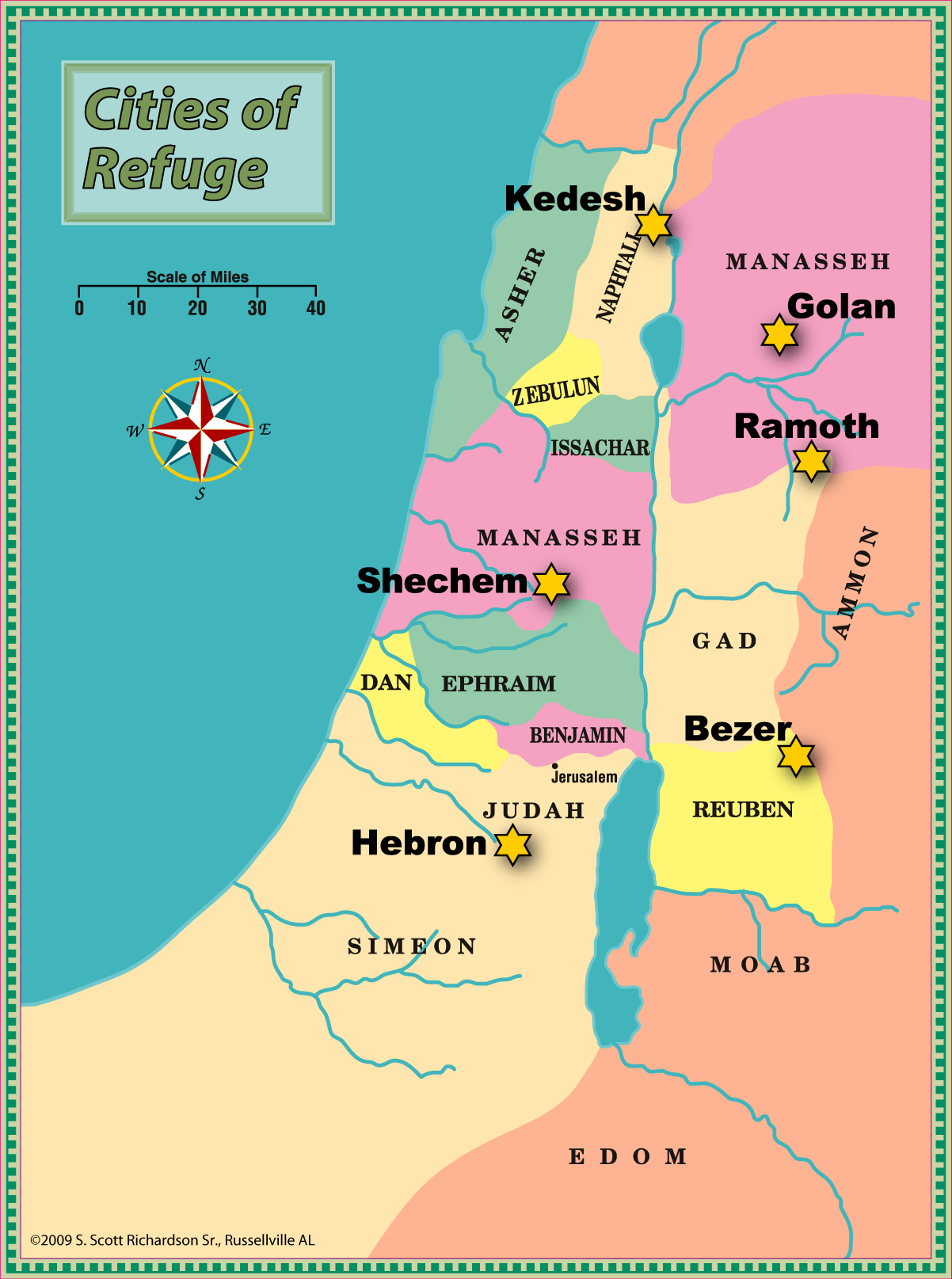
Then the Lord said to Joshua, “Say to the people of Israel, ‘Appoint the cities of refuge, of which I spoke to you through Moses, that the manslayer who strikes any person without intent or unknowingly may flee there. They shall be for you a refuge from the avenger of blood. He shall flee to one of these cities and shall stand at the entrance of the gate of the city and explain his case to the elders of that city. Then they shall take him into the city and give him a place, and he shall remain with them. And if the avenger of blood pursues him, they shall not give up the manslayer into his hand, because he struck his neighbor unknowingly, and did not hate him in the past. And he shall remain in that city until he has stood before the congregation for judgment, until the death of him who is high priest at the time. Then the manslayer may return to his own town and his own home, to the town from which he fled.’”

So they set apart Kedesh in Galilee in the hill country of Naphtali, and Shechem in the hill country of Ephraim, and Kiriath-arba (that is, Hebron) in the hill country of Judah. And beyond the Jordan east of Jericho, they appointed Bezer in the wilderness on the tableland, from the tribe of Reuben, and Ramoth in Gilead, from the tribe of Gad, and Golan in Bashan, from the tribe of Manasseh. These were the cities designated for all the people of Israel and for the stranger sojourning among them, that anyone who killed a person without intent could flee there, so that he might not die by the hand of the avenger of blood, till he stood before the congregation. Joshua 20:1-9 ESV

10-cities-of-refuge

God had given His people the land He had promised them. But they were not free to live in the land according to their own standards or apart from His divine law. He had provided them with His law while they were still in the wilderness and He had intended for them to take the law with them into the promised land, where it would determine the nature of their relationship with Him and with one another. And God, knowing the reality of man’s sin nature, had made provision for the inevitable presence of sin among His people. The entire sacrificial system was designed to provide atonement for their sins and restore them to a right relationship with God. And because the sacrificial system could not remove sin, it would be a permanent part of their communal experience for generations to come.

One of the sad realities the law was forced to address was the human potential for murder. Even though the Israelites were united in their common bond as children of God, they were sinners who were fully capable of turning on one another out of jealousy or motivated by anger, and willfully taking the life of a brother or sister. So, God had made provision for such acts of violence, telling Moses, “Whoever strikes a man so that he dies shall be put to death” (Exodus 21:12 ESV). And God went on to clarify and qualify the conditions for putting a man to death for murder. His actions had to be premeditated.

“if a man willfully attacks another to kill him by cunning, you shall take him from my altar, that he may die.” – Exodus 21:14 ESV

God knew that there would always be the potential for extenuating circumstances. In other words, there might be unforeseen issues at play that dictated whether the murder was willful or simply an accident. So, He had added an important addendum to His law, stating, “But if he did not lie in wait for him, but God let him fall into his hand, then I will appoint for you a place to which he may flee” (Exodus 21:13 ESV). God had gone on to provide the people of Israel with detailed plans concerning this important aspect of His judicial system. 

And the Lord spoke to Moses, saying, 10 “Speak to the people of Israel and say to them, When you cross the Jordan into the land of Canaan, 11 then you shall select cities to be cities of refuge for you, that the manslayer who kills any person without intent may flee there. 12 The cities shall be for you a refuge from the avenger, that the manslayer may not die until he stands before the congregation for judgment. 13 And the cities that you give shall be your six cities of refuge. 14 You shall give three cities beyond the Jordan, and three cities in the land of Canaan, to be cities of refuge. 15 These six cities shall be for refuge for the people of Israel, and for the stranger and for the sojourner among them, that anyone who kills any person without intent may flee there. – Numbers 35:9-15 ESV

God had predetermined that the Israelites would designate six cities within the land of promise that would serve as places of refuge for anyone who committed murder. And these six cities, located strategically throughout the land, were intended to be easily reached by anyone who was guilty of murder. Within the confines of these cities, the guilty party was to be offered sanctuary and protection from anyone who might want to avenge the death of the victim. And it’s important to note that these six cities were among the 42 cities set aside for the tribe of Levi as their places of residence.

“The cities that you give to the Levites shall be the six cities of refuge, where you shall permit the manslayer to flee, and in addition to them you shall give forty-two cities.” – Numbers 35:6 ESV

The one who committed the act of murder was allowed to seek refuge in one of these Levitical cities. As long as he was in the city, he was to be provided protection, until such time as the residents of the city were able to ascertain whether his act was accidental or premeditated. If it was determined that he had committed murder willfully, he was to be turned over to the “avenger” in order that he might be put to death. If evidence was produced that proved the murder was accidental, the guilty party was confined to the city of refuge for life or until the death of the high priest, at which time the prisoner was to be set free and absolved of all guilt. The death of the high priest acted as an atonement for the sin of the guilty party. But if the manslayer willingly left the protective confines of the city of refuge at any time, he would be fair game for the avenger. He took his life into his own hands. But as long as the guilty party placed his life in the hands of the Levites, he was safe. If he chose to leave the city, he forfeited his right to life.

The cities of refuge are a picture of the role that Christ was to eventually play in the life of each and every guilty sinner. The book of Hebrews provides us with a comforting reminder that we, as guilty sinners, can seek refuge in Christ, our high priest.

18 Therefore, we who have fled to him for refuge can have great confidence as we hold to the hope that lies before us. 19 This hope is a strong and trustworthy anchor for our souls. It leads us through the curtain into God’s inner sanctuary. 20 Jesus has already gone in there for us. He has become our eternal High Priest in the order of Melchizedek. – Hebrews 6:18-20 NLT

We can run to Christ and find safety and protection from the condemnation of sin and death. And Paul would have us remember that our condemnation has been removed because of Christ’s death on our behalf.

1 So now there is no condemnation for those who belong to Christ Jesus. And because you belong to him, the power of the life-giving Spirit has freed you from the power of sin that leads to death. – Romans 8:1-2 NLT

Paul goes on to tell us that because we have sought refuge in Christ, we are freed from any and all accusations of guilt or any calls for our execution.

33 Who dares accuse us whom God has chosen for his own? No one—for God himself has given us right standing with himself. 34 Who then will condemn us? No one—for Christ Jesus died for us and was raised to life for us, and he is sitting in the place of honor at God’s right hand, pleading for us. – Romans 8:33-34 NLT

God knew His people were going to sin. That’s why He gave them His law and His sacrificial system. He also knew His people would commit murder, either willingly or accidentally. So, He provided cities of refuge. But notice that the only way the manslayer could be absolved of his guilt was through death. The high priest had to die. And the only way that sinners can be absolved of their guilt before God is through the death of the great High Priest, Jesus Christ. He gave His life so that we might have forgiveness of sin and be freed from condemnation. Jesus is our High Priest, in whom we find refuge. But we don’t just hide from our guilt and sin, we are completely freed from it because of what He has done on our behalf.

24 But because Jesus lives forever, his priesthood lasts forever. 25 Therefore he is able, once and forever, to save those who come to God through him. He lives forever to intercede with God on their behalf.

26 He is the kind of high priest we need because he is holy and blameless, unstained by sin. He has been set apart from sinners and has been given the highest place of honor in heaven. 27 Unlike those other high priests, he does not need to offer sacrifices every day. They did this for their own sins first and then for the sins of the people. But Jesus did this once for all when he offered himself as the sacrifice for the people’s sins. 28 The law appointed high priests who were limited by human weakness. But after the law was given, God appointed his Son with an oath, and his Son has been made the perfect High Priest forever. – Hebrews 7:24-28 NLT

Jesus Christ, our refuge. His death set us free from our guilt and condemnation. And there is no one who can accuse us anymore.
English Standard Version (ESV) The Holy Bible, English Standard Version. ESV® Permanent Text Edition® (2016). Copyright © 2001

New Living Translation (NLT) Holy Bible, New Living Translation, copyright © 1996, 2004, 2015 by Tyndale House Foundation. Used by permission of Tyndale House Publishers Inc., Carol Stream, Illinois 60188. All rights reserved.

The Message (MSG)  Copyright © 1993, 1994, 1995, 1996, 2000, 2001, 2002 by Eugene H. Peterson

The Sovereign Work of God.

1 The second lot came out for Simeon, for the tribe of the people of Simeon, according to their clans, and their inheritance was in the midst of the inheritance of the people of Judah. And they had for their inheritance Beersheba, Sheba, Moladah, Hazar-shual, Balah, Ezem, Eltolad, Bethul, Hormah, Ziklag, Beth-marcaboth, Hazar-susah, Beth-lebaoth, and Sharuhen—thirteen cities with their villages; Ain, Rimmon, Ether, and Ashan—four cities with their villages, together with all the villages around these cities as far as Baalath-beer, Ramah of the Negeb. This was the inheritance of the tribe of the people of Simeon according to their clans. The inheritance of the people of Simeon formed part of the territory of the people of Judah. Because the portion of the people of Judah was too large for them, the people of Simeon obtained an inheritance in the midst of their inheritance.

10 The third lot came up for the people of Zebulun, according to their clans. And the territory of their inheritance reached as far as Sarid. 11 Then their boundary goes up westward and on to Mareal and touches Dabbesheth, then the brook that is east of Jokneam. 12 From Sarid it goes in the other direction eastward toward the sunrise to the boundary of Chisloth-tabor. From there it goes to Daberath, then up to Japhia. 13 From there it passes along on the east toward the sunrise to Gath-hepher, to Eth-kazin, and going on to Rimmon it bends toward Neah, 14 then on the north the boundary turns about to Hannathon, and it ends at the Valley of Iphtahel; 15 and Kattath, Nahalal, Shimron, Idalah, and Bethlehem—twelve cities with their villages. 16 This is the inheritance of the people of Zebulun, according to their clans—these cities with their villages.

17 The fourth lot came out for Issachar, for the people of Issachar, according to their clans. 18 Their territory included Jezreel, Chesulloth, Shunem, 19 Hapharaim, Shion, Anaharath, 20 Rabbith, Kishion, Ebez, 21 Remeth, En-gannim, En-haddah, Beth-pazzez. 22 The boundary also touches Tabor, Shahazumah, and Beth-shemesh, and its boundary ends at the Jordan—sixteen cities with their villages. 23 This is the inheritance of the tribe of the people of Issachar, according to their clans—the cities with their villages.

24 The fifth lot came out for the tribe of the people of Asher according to their clans. 25 Their territory included Helkath, Hali, Beten, Achshaph, 26 Allammelech, Amad, and Mishal. On the west it touches Carmel and Shihor-libnath, 27 then it turns eastward, it goes to Beth-dagon, and touches Zebulun and the Valley of Iphtahel northward to Beth-emek and Neiel. Then it continues in the north to Cabul, 28 Ebron, Rehob, Hammon, Kanah, as far as Sidon the Great. 29 Then the boundary turns to Ramah, reaching to the fortified city of Tyre. Then the boundary turns to Hosah, and it ends at the sea; Mahalab,[a] Achzib, 30 Ummah, Aphek and Rehob—twenty-two cities with their villages. 31 This is the inheritance of the tribe of the people of Asher according to their clans—these cities with their villages.

32 The sixth lot came out for the people of Naphtali, for the people of Naphtali, according to their clans. 33 And their boundary ran from Heleph, from the oak in Zaanannim, and Adami-nekeb, and Jabneel, as far as Lakkum, and it ended at the Jordan. 34 Then the boundary turns westward to Aznoth-tabor and goes from there to Hukkok, touching Zebulun at the south and Asher on the west and Judah on the east at the Jordan. 35 The fortified cities are Ziddim, Zer, Hammath, Rakkath, Chinnereth, 36 Adamah, Ramah, Hazor, 37 Kedesh, Edrei, En-hazor, 38 Yiron, Migdal-el, Horem, Beth-anath, and Beth-shemesh—nineteen cities with their villages. 39 This is the inheritance of the tribe of the people of Naphtali according to their clans—the cities with their villages.

40 The seventh lot came out for the tribe of the people of Dan, according to their clans. 41 And the territory of its inheritance included Zorah, Eshtaol, Ir-shemesh, 42 Shaalabbin, Aijalon, Ithlah, 43 Elon, Timnah, Ekron, 44 Eltekeh, Gibbethon, Baalath, 45 Jehud, Bene-berak, Gath-rimmon, 46 and Me-jarkon and Rakkon with the territory over against Joppa. 47 When the territory of the people of Dan was lost to them, the people of Dan went up and fought against Leshem, and after capturing it and striking it with the sword they took possession of it and settled in it, calling Leshem, Dan, after the name of Dan their ancestor. 48 This is the inheritance of the tribe of the people of Dan, according to their clans—these cities with their villages.

49 When they had finished distributing the several territories of the land as inheritances, the people of Israel gave an inheritance among them to Joshua the son of Nun. 50 By command of the Lord they gave him the city that he asked, Timnath-serah in the hill country of Ephraim. And he rebuilt the city and settled in it.

51 These are the inheritances that Eleazar the priest and Joshua the son of Nun and the heads of the fathers’ houses of the tribes of the people of Israel distributed by lot at Shiloh before the Lord, at the entrance of the tent of meeting. So they finished dividing the land. Joshua 19:1-51 ESV

division-of-promised-land-to-ancient-israel

This is a long chapter that contains seemingly insignificant information that is of little use to us as 21st-Century Christians. There are plenty of details regarding the borders of the various land allotments and the names of cities located within those lands, but there appears to be no theological or doctrinal insights we can glean from the passage and apply to our daily lives. It is what I tend to call a “skip-over” passage – one of those sections of Scripture, like the genealogies found in the gospels, that prompt us to skip over them rather than waste time wading through their apparently unimportant content. But their very inclusion in the Scriptures begs the question: Why are they there? If, as the Bible states, “All Scripture is inspired by God and is useful to teach us what is true and to make us realize what is wrong in our lives” (2 Timothy 3:16 NLT), why did the Holy Spirit inspire the authors of the Scriptures to include passages like this? What is remotely useful in this passage and how can it teach us what is true?

In this chapter we have the allocation of land to the remaining seven tribes. The major tribes have been taken care of, including Judah, Manasseh, and Ephraim. And the smaller, but far from insignificant tribe of Benjamin has also received its allotment. But there are seven tribes remaining, many of which we know little or nothing about. The names of Simeon, Asher, Zebulun, Napthali, Dan, and Issachar may be familiar to us, but most of us would be hard-pressed to provide any pertinent information regarding these tribes if pressed to do so. And yet, they represent the rest of the nation of Israel. They are the descendants of the sons of Jacob and, as such, they are the rightful heirs of the promises made by God to Abraham, Isaac, and Jacob. The land is as much theirs as it is Judah’s or the sons of Joseph. In Genesis 49:1-27, we have recorded the words of Jacob as he lie on his deathbed and pronounces his blessings upon each of his 12 sons. And when he was done, the text provides us with the following summary statement:

All these are the twelve tribes of Israel. This is what their father said to them as he blessed them, blessing each with the blessing suitable to him. – Genesis 49:28 ESV

Each of Jacob’s sons received a blessing that was appropriate for them, and when it came time to disperse to each of them their allotment of land in Canaan, they each received what God deemed right. It is important to remember the process that was used to discern the allotment of land. Joshua had sent out three representatives from each of the seven tribes, charging them with the task of conducting a survey of the remaining territory. They were to divide the land into seven sections and then the decision as to which tribe received what land would be determined by God, using lots.

“And you shall describe the land in seven divisions and bring the description here to me. And I will cast lots for you here before the Lord our God.” – Joshua 18:6 ESV

And after having followed Joshua’s instructions, the men returned with a map containing a detailed survey of the seven tracts of land, “and Joshua cast lots for them in Shiloh before the Lord. And there Joshua apportioned the land to the people of Israel, to each his portion” (Joshua 18:10 ESV). There was no arguing or fighting over who got what land. It was a decision determined by God. And Proverbs 16:33 clearly reflects the belief of the Jews that the casting of lots was anything but a game of chance.

The lot is cast into the lap, but its every decision is from the LORD. – Proverbs 16:33 ESV

If you compare the blessings spoken by Jacob in Genesis 49 with the allotment of the land recorded in Joshua 19, you will see some slight differences. For instance, concerning his son, Zebulun, Jacob had said:

Zebulun shall dwell at the shore of the sea; he shall become a haven for ships, and his border shall be at Sidon.” – Genesis 49:13 ESV

And yet, according to the allotment, the tribe of Zebulun ended up landlocked. The land located along the Mediterranean coast, including the city of Sidon, was actually given to the tribe of Asher. But in his Antiquities, the 1st-Century Jewish historian, Josephus wrote:

“The tribe of Zebulon’s lot included the land which lay as far as the Lake of Genesareth [Sea of Galilee], and that which belonged to Carmel and the sea [Mediterranean]”

There was evidently a certain amount of fluidity among the borders of the various tribes. Over time, the actual boundaries of their respective land allotments fluctuated. So, it is not so much that Jacob’s blessing was in error, as it reveals that God was in control of the timing and specifics of each tribe’s assignment of land. It seems that Jacob’s blessings had far more to do with the character of each of his sons and what he believed would be God’s future treatment of them. While he made vague references to the land, he was actually making a prophetic pronouncement regarding the future status of each son’s descendants. God would reward or punish each son according to his actions. And each son’s descendants would be impacted by how they had lived their lives. God’s determination of their land allotment would coincide with Jacob’s blessings, fully bringing about each and every word that Jacob had spoken.

This chapter, while a somewhat boring read, is a classic example of Scripture revealing the sovereign hand of God in the affairs of men. Jacob had 12 sons, and he had spoken 12 separate blessings over each one. Those 12 sons had descendants, who eventually made it to the land promised to Abraham by God. And those 12 tribes would be awarded their portion of the land according to the sovereign will of God. Not one tribe was left out. Each and every tribe received their fair share of the land, according to the divine will and wisdom of God. While lots were used to make the determination, this had not been a case of chance or blind luck. It was the result of the providential and predetermined will of God Almighty. And as 21st-Century Christians, we should be encouraged by the knowledge that our God was in control of every detail of the process that made the land of promise a reality for the people of Israel. Every tribe, from Judah to Issachar, received their allotment. They each were given their appropriate portion within the land that God had promised to Jacob. And the God who orchestrated every detail of this historic event is the same God who moves behind the scenes in our lives. He is in control, whether we feel like it or not. He is sovereign, whether we recognize it or not. Our God is not distant or detached, but intimately involved in the daily affairs of our lives.

English Standard Version (ESV) The Holy Bible, English Standard Version. ESV® Permanent Text Edition® (2016). Copyright © 2001

New Living Translation (NLT) Holy Bible, New Living Translation, copyright © 1996, 2004, 2015 by Tyndale House Foundation. Used by permission of Tyndale House Publishers Inc., Carol Stream, Illinois 60188. All rights reserved.

The Message (MSG)  Copyright © 1993, 1994, 1995, 1996, 2000, 2001, 2002 by Eugene H. Peterson

Son of My Right Hand.

11 The lot of the tribe of the people of Benjamin according to its clans came up, and the territory allotted to it fell between the people of Judah and the people of Joseph. 12 On the north side their boundary began at the Jordan. Then the boundary goes up to the shoulder north of Jericho, then up through the hill country westward, and it ends at the wilderness of Beth-aven. 13 From there the boundary passes along southward in the direction of Luz, to the shoulder of Luz (that is, Bethel), then the boundary goes down to Ataroth-addar, on the mountain that lies south of Lower Beth-horon. 14 Then the boundary goes in another direction, turning on the western side southward from the mountain that lies to the south, opposite Beth-horon, and it ends at Kiriath-baal (that is, Kiriath-jearim), a city belonging to the people of Judah. This forms the western side. 15 And the southern side begins at the outskirts of Kiriath-jearim. And the boundary goes from there to Ephron, to the spring of the waters of Nephtoah. 16 Then the boundary goes down to the border of the mountain that overlooks the Valley of the Son of Hinnom, which is at the north end of the Valley of Rephaim. And it then goes down the Valley of Hinnom, south of the shoulder of the Jebusites, and downward to En-rogel. 17 Then it bends in a northerly direction going on to En-shemesh, and from there goes to Geliloth, which is opposite the ascent of Adummim. Then it goes down to the stone of Bohan the son of Reuben, 18 and passing on to the north of the shoulder of Beth-arabah it goes down to the Arabah. 19 Then the boundary passes on to the north of the shoulder of Beth-hoglah. And the boundary ends at the northern bay of the Salt Sea, at the south end of the Jordan: this is the southern border. 20 The Jordan forms its boundary on the eastern side. This is the inheritance of the people of Benjamin, according to their clans, boundary by boundary all around.

21 Now the cities of the tribe of the people of Benjamin according to their clans were Jericho, Beth-hoglah, Emek-keziz, 22 Beth-arabah, Zemaraim, Bethel, 23 Avvim, Parah, Ophrah, 24 Chephar-ammoni, Ophni, Geba—twelve cities with their villages: 25 Gibeon, Ramah, Beeroth, 26 Mizpeh, Chephirah, Mozah, 27 Rekem, Irpeel, Taralah, 28 Zela, Haeleph, Jebus (that is, Jerusalem), Gibeah and Kiriath-jearim—fourteen cities with their villages. This is the inheritance of the people of Benjamin according to its clans. Joshua 18:11-28 ESV

BenjaminCityMap

Of the 12 sons and 1 daughter born to Jacob, Benjamin was the last. His mother, Rachel, died as a result of giving birth to him, but the book of Genesis tells us that, with her last breath, she provided her son with a name.

16 Then they journeyed from Bethel. When they were still some distance from Ephrath, Rachel went into labor, and she had hard labor. 17 And when her labor was at its hardest, the midwife said to her, “Do not fear, for you have another son.” 18 And as her soul was departing (for she was dying), she called his name Ben-oni; but his father called him Benjamin. 19 So Rachel died, and she was buried on the way to Ephrath (that is, Bethlehem), 20 and Jacob set up a pillar over her tomb. It is the pillar of Rachel’s tomb, which is there to this day. 21 Israel journeyed on and pitched his tent beyond the tower of Eder. – Genesis 35:16-21 ESV

Ben-oni means “son of my sorrow,” but Jacob would immediately change the name of his new son to Benjamin, which means “son of the right hand.” It seems that Jacob wanted to view this birth from a more positive perspective, in spite of the loss of his wife. The term, “right hand” is a reference to good fortune or prosperity. Benjamin became very dear to Jacob, especially when Joseph, the first son born to him by Rachel, was sold by his brothers into slavery. Thinking his son dead, Jacob turned all his attention and affection on his youngest son, Benjamin. And when famine struck the land of Canaan, his brothers were forced to go to Egypt in search of food. There they were reunited with their long-lost brother, Joseph, whom they had sold into slavery. Hiding his identity from them, Joseph, the second-most-powerful man in Egypt, demanded that his brothers return home and bring their brother Benjamin back with them. And after convincing their reluctant father to allow Benjamin to make the trip to Egypt, the brothers returned to face Joseph. Upon seeing his younger brother, Joseph was overcome with emotion.

29 And he lifted up his eyes and saw his brother Benjamin, his mother’s son, and said, “Is this your youngest brother, of whom you spoke to me? God be gracious to you, my son!” 30 Then Joseph hurried out, for his compassion grew warm for his brother, and he sought a place to weep. And he entered his chamber and wept there. – Genesis 43:29-30 ESV

When Joseph returned, he invited his brothers to eat with him. But the text tells us that he showed special favor to his younger brother, Benjamin.

Portions were taken to them from Joseph’s table, but Benjamin’s portion was five times as much as any of theirs. And they drank and were merry with him. – Genesis 43:34 ESV

Not long after this, Joseph revealed his true identity to his brothers, encouraging them to take heart and letting them know that their evil treatment of him had been all part of God’s plan to provide for and protect His people. Joseph sent his brothers back to Canaan with orders to bring back their father, Jacob, along with all their families, so that they might live in the land of Egypt.

21 The sons of Israel did so: and Joseph gave them wagons, according to the command of Pharaoh, and gave them provisions for the journey. 22 To each and all of them he gave a change of clothes, but to Benjamin he gave three hundred shekels of silver and five changes of clothes. – Genesis 45:21-22 ESV

The decision on Jacob’s part to rename Benjamin was bearing fruit. There is no way that he could have foreseen these events, but God was honoring Jacob’s faith. In spite of the loss of his wife, Jacob believed that good would come from the birth of his son, not just pain and sorrow. And Benjamin was made prosperous by a very unlikely and unexpected source: His long-lost and long-thought-dead older brother.

It is interesting to note that the tribe of Benjamin was the first tribe among the remaining seven that was awarded its allotment in the promised land. Once the tribes of Judah, Ephraim and Manasseh (the two sons of Joseph) had been taken care of, the lot fell to Benjamin. And their portion “fell between the people of Judah and the people of Joseph” (Joshua 18:11 ESV). There would remain a close affinity between the descendants of Benjamin and those of his older brother, Joseph. The smaller tribe of Benjamin would be surrounded by the lands occupied by the much-larger tribes of Judah and Ephraim. It would be nestled in a kind of protective cocoon, with Judah to its south and the tribes of Manasseh and Ephraim to its north. The descendants of the youngest son of Jacob would find themselves the proud owners of 26 cities and their villages. Jacob’s decision to name his last son, Benjamin (son of my right hand), had been truly prophetic.

English Standard Version (ESV) The Holy Bible, English Standard Version. ESV® Permanent Text Edition® (2016). Copyright © 2001

New Living Translation (NLT) Holy Bible, New Living Translation, copyright © 1996, 2004, 2015 by Tyndale House Foundation. Used by permission of Tyndale House Publishers Inc., Carol Stream, Illinois 60188. All rights reserved.

The Message (MSG)  Copyright © 1993, 1994, 1995, 1996, 2000, 2001, 2002 by Eugene H. Peterson

Place of Rest.

1 Then the whole congregation of the people of Israel assembled at Shiloh and set up the tent of meeting there. The land lay subdued before them.

There remained among the people of Israel seven tribes whose inheritance had not yet been apportioned. So Joshua said to the people of Israel, “How long will you put off going in to take possession of the land, which the Lord, the God of your fathers, has given you? Provide three men from each tribe, and I will send them out that they may set out and go up and down the land. They shall write a description of it with a view to their inheritances, and then come to me. They shall divide it into seven portions. Judah shall continue in his territory on the south, and the house of Joseph shall continue in their territory on the north. And you shall describe the land in seven divisions and bring the description here to me. And I will cast lots for you here before the Lord our God. The Levites have no portion among you, for the priesthood of the Lord is their heritage. And Gad and Reuben and half the tribe of Manasseh have received their inheritance beyond the Jordan eastward, which Moses the servant of the Lord gave them.”

So the men arose and went, and Joshua charged those who went to write the description of the land, saying, “Go up and down in the land and write a description and return to me. And I will cast lots for you here before the Lord in Shiloh.” So the men went and passed up and down in the land and wrote in a book a description of it by towns in seven divisions. Then they came to Joshua to the camp at Shiloh, 10 and Joshua cast lots for them in Shiloh before the Lord. And there Joshua apportioned the land to the people of Israel, to each his portion. Joshua 18:1-10 ESV

Tabaernacle

After having settled the tribes of Judah, Manasseh and Ephraim in the southern region of the land of Canaan, Joshua still had the task of apportioning the rest of the land between the seven remaining tribes. The tribes of Reuben and Gad had already been allotted their portions on the eastern side of the Jordan, as they had requested. But before Joshua proceeds with the final distribution of the land, he calls for an assembly of all the people of Israel at a place called Shiloh, and oversees the erecting of the tabernacle.

When God had originally given Moses His instructions regarding the construction of the tabernacle, He had included commands regarding its placement in the land of promise.

10 But when you go over the Jordan and live in the land that the Lord your God is giving you to inherit, and when he gives you rest from all your enemies around, so that you live in safety, 11 then to the place that the Lord your God will choose, to make his name dwell there, there you shall bring all that I command you: your burnt offerings and your sacrifices, your tithes and the contribution that you present, and all your finest vow offerings that you vow to the Lord. – Deuteronomy 12:10-11 ESV

So, Joshua’s choice of Shiloh as the resting place for the tabernacle was obviously determined by God. It’s interesting to note that the name, Shiloh, means “place of rest.” The tabernacle was to be a reminder of God’s presence and power, and a representation of God’s promise of rest. When God dwells with His people, they enjoy rest. His presence brings peace and an assurance of His care for them. The movement of the tabernacle from Gilgal is significant. It had been Israel’s base camp during their days of conquest of the promised land. But now that “the land lay subdued before them,” it was time to relocate the tabernacle to an appropriate place within the land of promise. And God’s choice of Shiloh was in keeping with His promise to bring Israel into the promised land, a place of rest.

When Jacob had pronounced blessings upon his sons, he had said of Judah, “The scepter shall not depart from Judah, nor the ruler’s staff from between his feet, until tribute comes to him, and to him shall be the obedience of the peoples” (Genesis 49:10 ESV). In the Hebrew, the phrase, “until tribute comes to him” actually reads “until Shiloh come.” In the Jewish Orthodox Bible, verse 10 reads, “The shevet (sceptre) shall not depart from Yehudah, nor a Mekhokek (Lawgiver) from between his raglayim, until Shiloh come; and unto him shall be the obedience of the amim (peoples, nations).

This passage, containing Jacob’s blessing of the tribe of Judah, is a Messianic prophecy. It predicts the Jesus (Shiloh) as coming from the tribe of Judah. He will one day be the ruler who will hold the scepter, a sign of authority and kingship. He will rule and reign as king. And He will come to offer rest to His people.

28 Come to me, all who labor and are heavy laden, and I will give you rest. 29 Take my yoke upon you, and learn from me, for I am gentle and lowly in heart, and you will find rest for your souls. 30 For my yoke is easy, and my burden is light.” – Matthew 11:28-29 ESV

Jesus came that He might offer rest to the weary. And Shiloh, located in the territory allotted to the tribe of Ephraim, was the location of the tabernacle. It was to be a sign of God’s presence and should have been a cause for great peace and tranquility. When the people came to offer their sacrifices and worship, they would have found forgiveness for their sins and an acceptance by their God. But years later, the prophet Isaiah would speak words of condemnation against Ephraim. They would prove to be disobedient to God. And rather than find rest, they would discover themselves suffering the wrath of God for failing to enter into His rest and enjoy His blessings. 

11 For by people of strange lips
    and with a foreign tongue
the Lord will speak to this people,
12     to whom he has said,
“This is rest;
    give rest to the weary;
and this is repose”;
    yet they would not hear. – Isaiah 28:11-12 ESV

In a single verse, the author of the book of Joshua mentions the setting up of the tabernacle in Shiloh. It was to have been a symbolic act, establishing God’s abiding presence among His people. He had brought them to the land and provided for them a place of rest. But their enjoyment of that rest would require faithful obedience on their part. And it is significant that the final apportioning of the land did not take place until after the tabernacle was established in Shiloh.

Joshua had to read the riot act to the seven remaining tribes, scolding them for having procrastinated in subduing the remainder of the land. It appears that they had failed to continue their conquest of the inhabitants of the land. Perhaps Joshua’s decision to set up the tabernacle was meant to be a form of motivation, letting the remaining tribes know that God was with them. He set out teams of three men from each tribe, having them survey the remaining land, establishing boundaries for the establishment of their potential inheritance. Once this process was complete, Joshua would cast lots, determining which portion of the land was assigned to each of the tribes.

God was in their midst. He had chosen to dwell among them, and with the erection of the tabernacle in the city of Shiloh, the place of rest, God was reminding them of their need to do their part to enjoy the rest He had promised them. Just as Jesus invites all those who are weary and burdened to accept His invitation to find rest in Him, the Israelites were going to have to take God at His word and discover that His rest came through obedience to His commands.

English Standard Version (ESV) The Holy Bible, English Standard Version. ESV® Permanent Text Edition® (2016). Copyright © 2001

New Living Translation (NLT) Holy Bible, New Living Translation, copyright © 1996, 2004, 2015 by Tyndale House Foundation. Used by permission of Tyndale House Publishers Inc., Carol Stream, Illinois 60188. All rights reserved.

The Message (MSG)  Copyright © 1993, 1994, 1995, 1996, 2000, 2001, 2002 by Eugene H. Peterson

God Provides.

Now Zelophehad the son of Hepher, son of Gilead, son of Machir, son of Manasseh, had no sons, but only daughters, and these are the names of his daughters: Mahlah, Noah, Hoglah, Milcah, and Tirzah. They approached Eleazar the priest and Joshua the son of Nun and the leaders and said, “The Lord commanded Moses to give us an inheritance along with our brothers.” So according to the mouth of the Lord he gave them an inheritance among the brothers of their father. Thus there fell to Manasseh ten portions, besides the land of Gilead and Bashan, which is on the other side of the Jordan, because the daughters of Manasseh received an inheritance along with his sons. The land of Gilead was allotted to the rest of the people of Manasseh.

The territory of Manasseh reached from Asher to Michmethath, which is east of Shechem. Then the boundary goes along southward to the inhabitants of En-tappuah. The land of Tappuah belonged to Manasseh, but the town of Tappuah on the boundary of Manasseh belonged to the people of Ephraim. Then the boundary went down to the brook Kanah. These cities, to the south of the brook, among the cities of Manasseh, belong to Ephraim. Then the boundary of Manasseh goes on the north side of the brook and ends at the sea, 10 the land to the south being Ephraim’s and that to the north being Manasseh’s, with the sea forming its boundary. On the north Asher is reached, and on the east Issachar. 11 Also in Issachar and in Asher Manasseh had Beth-shean and its villages, and Ibleam and its villages, and the inhabitants of Dor and its villages, and the inhabitants of En-dor and its villages, and the inhabitants of Taanach and its villages, and the inhabitants of Megiddo and its villages; the third is Naphath. 12 Yet the people of Manasseh could not take possession of those cities, but the Canaanites persisted in dwelling in that land. 13 Now when the people of Israel grew strong, they put the Canaanites to forced labor, but did not utterly drive them out.

14 Then the people of Joseph spoke to Joshua, saying, “Why have you given me but one lot and one portion as an inheritance, although I am a numerous people, since all along the Lord has blessed me?” 15 And Joshua said to them, “If you are a numerous people, go up by yourselves to the forest, and there clear ground for yourselves in the land of the Perizzites and the Rephaim, since the hill country of Ephraim is too narrow for you.” 16 The people of Joseph said, “The hill country is not enough for us. Yet all the Canaanites who dwell in the plain have chariots of iron, both those in Beth-shean and its villages and those in the Valley of Jezreel.” 17 Then Joshua said to the house of Joseph, to Ephraim and Manasseh, “You are a numerous people and have great power. You shall not have one allotment only, 18 but the hill country shall be yours, for though it is a forest, you shall clear it and possess it to its farthest borders. For you shall drive out the Canaanites, though they have chariots of iron, and though they are strong.” Joshua 17:3-18 ESV

1200px-The_Daughters_of_Zelophehad.jpg

When reading the Scriptures, there will be times when certain names and events are mentioned that seem to come out of nowhere and make no sense in the context. Today’s passage is a case in point. As the author describes the allotment of the land of Canaan to the tribes of Ephraim and Manasseh, the two sons of Joseph, he suddenly mentions the five daughters of Zelophehad. He even provides the names of the five women: Mahlah, Noah, Hoglah, Milcah, and Tirzah. And it’s almost as if he expects his audience to be well acquainted with these women and their story. Seemingly, out of nowhere, these women appear, making what appears to be a very bold demand of Joshua, Eleazar the priest and the leadership of Israel.

The Lord commanded Moses to give us an inheritance along with our brothers. – Joshua 17:4 ESV

This is one of those situations where, if we are not familiar with the rest of the Scriptures, we will find it difficult to understand what is going on. Are these women making up their story? Have they joined forces to fabricate a lie in an attempt to deceive Joshua and finagle a portion of the land for themselves? First of all, it is important to understand the situation in which these women found themselves. They were the sole remaining heirs of their father. He had no sons. And in that culture, the inheritance passed down through the sons. So, any allotment of land would have gone to the sons of Zelophehad, not his daughters. But years earlier, these women had seen the handwriting on the wall and had understood that with their father’s eventual death, they would be left unprotected and unprovided for. And when the people finally entered the land of Canaan, they would have no right to a portion of the land. So, they had appealed to Moses, Eleazer the priest and the leadership of Israel.

1 Then drew near the daughters of Zelophehad the son of Hepher, son of Gilead, son of Machir, son of Manasseh, from the clans of Manasseh the son of Joseph. The names of his daughters were: Mahlah, Noah, Hoglah, Milcah, and Tirzah. And they stood before Moses and before Eleazar the priest and before the chiefs and all the congregation, at the entrance of the tent of meeting, saying, “Our father died in the wilderness. He was not among the company of those who gathered themselves together against the Lord in the company of Korah, but died for his own sin. And he had no sons. Why should the name of our father be taken away from his clan because he had no son? Give to us a possession among our father’s brothers.”

Moses brought their case before the Lord. And the Lord said to Moses, “The daughters of Zelophehad are right. You shall give them possession of an inheritance among their father’s brothers and transfer the inheritance of their father to them. And you shall speak to the people of Israel, saying, ‘If a man dies and has no son, then you shall transfer his inheritance to his daughter. And if he has no daughter, then you shall give his inheritance to his brothers. 10 And if he has no brothers, then you shall give his inheritance to his father’s brothers. 11 And if his father has no brothers, then you shall give his inheritance to the nearest kinsman of his clan, and he shall possess it. And it shall be for the people of Israel a statute and rule, as the Lord commanded Moses.’” Numbers 27:1-11 ESV

Their father had died in the wilderness, leaving them, in a sense, destitute. They were unmarried and without the protection and provision of a male figure in their lives, a necessary requirement in their culture. But they had been brave and bold enough to appeal their case to Moses and the leadership of Israel. And Moses had wisely taken their case to God. Their whole argument was based on the fact that their father had been a good man and his death had not been the result of sin against God. So, why should the legacy of his name fail to carry on just because he had daughters instead of sons? And God agreed with the logic behind their argument, telling Joshua, “The daughters of Zelophehad are right. You shall give them possession of an inheritance among their father’s brothers and transfer the inheritance of their father to them” (Numbers 27:7 ESV). Not only that, God used their case as a precedence for a new law concerning inheritance. From that point forward, the inheritance of any man who had no sons, was to pass on to his daughters. And if a man was childless, his inheritance was to go to his brothers. If he had no brothers, it was to go to his uncles. And if he had no uncles, his inheritance was to go to his nearest living relative. God had taken the plea of these five women and turned it into case law, providing for His people a statutory requirement concerning the issue of inheritance. 

It is important to notice that these women were the ones who came to Joshua and reminded him of the decision handed down by Moses as he had received it from God. Had they not spoken up, there is a good chance that they may have forfeited their right to a portion of the land. These woman showed extreme faith by making their initial appeal to Moses, but also in bringing their God-decreed right to their father’s inheritance before Joshua, Eleazar and the leadership of Israel. And their faith and fearlessness to stand up for their rights was rewarded with “an inheritance among the brothers of their father” (Joshua 17:4 ESV). We can only imagine that this decision was not well-received by their uncles. When Joshua apportioned part of the land to these five women, the brothers of Zelophehad lost out. Their portion of the inheritance diminished as a result of the womens’ request. But it was their God-given right to enjoy their fair-share of the inheritance and enjoy the blessings of the land promised by God. 

The story of the daughters of Zelophehad is the positive side of this chapter. But then the chapter ends with a somewhat sad recounting of the descendants of Joseph, the tribes of Manasseh and Ephraim, coming to Joshua and complaining about the inadequacy of their allotment of land. Perhaps it was based on God’s decree to give a portion of their land to the five sisters. But whatever the case, the descendants of Joseph demanded that they were too large in number to live in the land that they had been given. But part of their problem was that they viewed portions of the land as uninhabitable. Part of it was occupied by well-armed Canaanites. The rest was forested and would require work on their part to clear and cultivate it. But Joshua challenged them to do just that. Not only that, he expected them to do what God had commanded them to do and drive out the Canaanites from the land. Yes, the land was filled with enemies and part of it was covered by forests, but it was not a case of too little land, but too little faith on the part of the people of Joseph. Trees can be cut down and Canaanites can be defeated. What God had given to them was more than enough. But the full enjoyment of their inheritance was going to require that they do their part. Joshua reminded them that they had been blessed by God and were “a numerous people and have great power” (Joshua 17:17 ESV). They saw their size as a problem, but Joshua challenged them to see it as a blessing from God. Their superior numbers would give them an advantage over their enemies, and a workforce large enough to clear the trees and cultivate the land. God had adequately provided for their needs. But they were going to have to make the most out of the gift given to them by God.

English Standard Version (ESV) The Holy Bible, English Standard Version. ESV® Permanent Text Edition® (2016). Copyright © 2001

New Living Translation (NLT) Holy Bible, New Living Translation, copyright © 1996, 2004, 2015 by Tyndale House Foundation. Used by permission of Tyndale House Publishers Inc., Carol Stream, Illinois 60188. All rights reserved.

The Message (MSG)  Copyright © 1993, 1994, 1995, 1996, 2000, 2001, 2002 by Eugene H. Peterson

Our Good God.

1 The allotment of the people of Joseph went from the Jordan by Jericho, east of the waters of Jericho, into the wilderness, going up from Jericho into the hill country to Bethel. Then going from Bethel to Luz, it passes along to Ataroth, the territory of the Archites. Then it goes down westward to the territory of the Japhletites, as far as the territory of Lower Beth-horon, then to Gezer, and it ends at the sea.

The people of Joseph, Manasseh and Ephraim, received their inheritance.

The territory of the people of Ephraim by their clans was as follows: the boundary of their inheritance on the east was Ataroth-addar as far as Upper Beth-horon, and the boundary goes from there to the sea. On the north is Michmethath. Then on the east the boundary turns around toward Taanath-shiloh and passes along beyond it on the east to Janoah, then it goes down from Janoah to Ataroth and to Naarah, and touches Jericho, ending at the Jordan. From Tappuah the boundary goes westward to the brook Kanah and ends at the sea. Such is the inheritance of the tribe of the people of Ephraim by their clans, together with the towns that were set apart for the people of Ephraim within the inheritance of the Manassites, all those towns with their villages. 10 However, they did not drive out the Canaanites who lived in Gezer, so the Canaanites have lived in the midst of Ephraim to this day but have been made to do forced labor.

1 Then allotment was made to the people of Manasseh, for he was the firstborn of Joseph. To Machir the firstborn of Manasseh, the father of Gilead, were allotted Gilead and Bashan, because he was a man of war. And allotments were made to the rest of the people of Manasseh by their clans, Abiezer, Helek, Asriel, Shechem, Hepher, and Shemida. These were the male descendants of Manasseh the son of Joseph, by their clans.Joshua 16:1-17:2 ESV

ad503-mapjos1617.jpgThe author now addresses the inheritance of the descendants of Joseph, the son of Jacob who had been sold by his brothers into slavery in Egypt. In spite of Joseph’s ill-treatment by his brothers, God blessed Joseph, sovereignly ordaining his rise to the second highest position of power in the land of Egypt. It would be Joseph who would be used by God to preserve the lives of his father and brothers when they were forced to turn to Egypt for aid when a famine struck the land of Canaan. When his brothers discovered that Joseph, who they had long considered as dead, was Pharaoh’s right-hand man, they were petrified. But Joseph had assured them that God had divinely orchestrated every event in his life for a much greater purpose.

7 “And God sent me before you to preserve for you a remnant on earth, and to keep alive for you many survivors. So it was not you who sent me here, but God. He has made me a father to Pharaoh, and lord of all his house and ruler over all the land of Egypt.” – Genesis 45:7-8 ESV

And later on, Joseph reconfirmed to his brothers his unwavering belief that God had been behind all that had taken place, so that each and every one of Jacob’s sons would remain alive.

“As for you, you meant evil against me, but God meant it for good, to bring it about that many people should be kept alive, as they are today. – Genesis 50:20 ESV

God had made a commitment to Jacob, the father of Joseph, that He would bless him and give him many descendants who would live in the land of promise. And, on his deathbed, Jacob confirmed his belief in God’s promise, choosing to bless the two sons of Joseph, born to him in Egypt. In essence, Jacob adopted his two grandsons making them his own and promising to give them a portion of the inheritance of the land.

1 After this, Joseph was told, “Behold, your father is ill.” So he took with him his two sons, Manasseh and Ephraim. And it was told to Jacob, “Your son Joseph has come to you.” Then Israel summoned his strength and sat up in bed. And Jacob said to Joseph, “God Almighty appeared to me at Luz in the land of Canaan and blessed me, and said to me, ‘Behold, I will make you fruitful and multiply you, and I will make of you a company of peoples and will give this land to your offspring after you for an everlasting possession.’ And now your two sons, who were born to you in the land of Egypt before I came to you in Egypt, are mine; Ephraim and Manasseh shall be mine, as Reuben and Simeon are. And the children that you fathered after them shall be yours. They shall be called by the name of their brothers in their inheritance.’” – Genesis 48:1-6 ESV

More than four centuries later, the 12 tribes of Israel (the sons of Jacob) were in the land promised to Jacob by God. And Joshua was in the process of dividing the land between the tribes. And in keeping with Jacob’s promise to include Ephraim and Manasseh in the inheritance, Joshua awarded a large portion of the land to the descendants of these two men.

Throughout this story, the sovereign hand of God is clearly visible. Had not God prospered Joseph in the land of Egypt, miraculously orchestrating his rise to power, the remainder of his family would have died of starvation in Canaan. God’s original covenant, made to Abraham, was seemingly jeopardized by the sinful acts of Joseph’s brothers. They had sold Joseph into slavery because they were jealous of him. They knew he was their father’s favorite son, and it didn’t help that Joseph had shared with them the content of several dreams he had experienced. In those dreams, Joseph had seen his father, mother and brothers bowing down to him. And Joseph’s disclosure of that news hadn’t won him any favors with his brothers. But the dreams were actually God-given visions of what was to come. His father, mother and brothers did eventually bow down before him, recognizing him as a powerful ruler in Egypt and the arbiter of their fate.

God had remained faithful to His covenant with Abraham. He had also kept the commitment He had made to Jacob, allowing he and his sons to find salvation from the famine in Canaan, by providing them with rest in the land of Egypt. And all of this was in fulfillment of the prophecy He had made to Abraham hundreds of years earlier.

13 Then the Lord said to Abram, “Know for certain that your offspring will be sojourners in a land that is not theirs and will be servants there, and they will be afflicted for four hundred years. 14 But I will bring judgment on the nation that they serve, and afterward they shall come out with great possessions. 15 As for you, you shall go to your fathers in peace; you shall be buried in a good old age. 16 And they shall come back here in the fourth generation, for the iniquity of the Amorites is not yet complete.” – Genesis 15:13-16 ESV

God had ordained the famine in the land. He had pre-planned Joseph’s rise to power in Egypt. And He had orchestrated the 400-year period of exile in Egypt for the descendants of Jacob. Four generations of Israelites would live in the land of Egypt before God determined it was time for them to leave and inherit the land promised to Abraham. All of this was part of His divine plan. The timing was perfect. And it was all because God was willing to keep His covenant promises, in spite of the disobedience of His chosen people. The apostle Paul recognized the sovereign hand of God in his own life, and was able to see His will being accomplished through the ups and downs and the setbacks and seeming successes of life. Which is why he could write:

And we know that for those who love God all things work together for good, for those who are called according to his purpose. – Romans 8:28 ESV

The descendants of Joseph were provided with a place in the land of promise. They were given a portion of the inheritance among the brothers of Joseph who had sold him into slavery out of jealousy. What they had meant for evil, God had meant for good. What they had done in order to bring harm to their brother, God used to bring blessing to their brother’s sons and their descendants. God works all things together for good.

English Standard Version (ESV) The Holy Bible, English Standard Version. ESV® Permanent Text Edition® (2016). Copyright © 2001

New Living Translation (NLT) Holy Bible, New Living Translation, copyright © 1996, 2004, 2015 by Tyndale House Foundation. Used by permission of Tyndale House Publishers Inc., Carol Stream, Illinois 60188. All rights reserved.

The Message (MSG)  Copyright © 1993, 1994, 1995, 1996, 2000, 2001, 2002 by Eugene H. Peterson

Powerless to Possess.

20 This is the inheritance of the tribe of the people of Judah according to their clans. 21 The cities belonging to the tribe of the people of Judah in the extreme south, toward the boundary of Edom, were Kabzeel, Eder, Jagur, 22 Kinah, Dimonah, Adadah, 23 Kedesh, Hazor, Ithnan, 24 Ziph, Telem, Bealoth, 25 Hazor-hadattah, Kerioth-hezron (that is, Hazor), 26 Amam, Shema, Moladah, 27 Hazar-gaddah, Heshmon, Beth-pelet, 28 Hazar-shual, Beersheba, Biziothiah, 29 Baalah, Iim, Ezem, 30 Eltolad, Chesil, Hormah, 31 Ziklag, Madmannah, Sansannah, 32 Lebaoth, Shilhim, Ain, and Rimmon: in all, twenty-nine cities with their villages.

33 And in the lowland, Eshtaol, Zorah, Ashnah, 34 Zanoah, En-gannim, Tappuah, Enam, 35 Jarmuth, Adullam, Socoh, Azekah, 36 Shaaraim, Adithaim, Gederah, Gederothaim: fourteen cities with their villages.

37 Zenan, Hadashah, Migdal-gad, 38 Dilean, Mizpeh, Joktheel, 39 Lachish, Bozkath, Eglon, 40 Cabbon, Lahmam, Chitlish, 41 Gederoth, Beth-dagon, Naamah, and Makkedah: sixteen cities with their villages.

42 Libnah, Ether, Ashan, 43 Iphtah, Ashnah, Nezib, 44 Keilah, Achzib, and Mareshah: nine cities with their villages.

45 Ekron, with its towns and its villages; 46 from Ekron to the sea, all that were by the side of Ashdod, with their villages.

47 Ashdod, its towns and its villages; Gaza, its towns and its villages; to the Brook of Egypt, and the Great Sea with its coastline.

48 And in the hill country, Shamir, Jattir, Socoh, 49 Dannah, Kiriath-sannah (that is, Debir), 50 Anab, Eshtemoh, Anim, 51 Goshen, Holon, and Giloh: eleven cities with their villages.

52 Arab, Dumah, Eshan, 53 Janim, Beth-tappuah, Aphekah, 54 Humtah, Kiriath-arba (that is, Hebron), and Zior: nine cities with their villages.

55 Maon, Carmel, Ziph, Juttah, 56 Jezreel, Jokdeam, Zanoah, 57 Kain, Gibeah, and Timnah: ten cities with their villages.

58 Halhul, Beth-zur, Gedor, 59 Maarath, Beth-anoth, and Eltekon: six cities with their villages.

60 Kiriath-baal (that is, Kiriath-jearim), and Rabbah: two cities with their villages.

61 In the wilderness, Beth-arabah, Middin, Secacah, 62 Nibshan, the City of Salt, and Engedi: six cities with their villages.

63 But the Jebusites, the inhabitants of Jerusalem, the people of Judah could not drive out, so the Jebusites dwell with the people of Judah at Jerusalem to this day. Joshua 15:20-63 ESV

judahAccording to this passage, the tribe of Judah received well over 100 cities and their surrounding villages as part of their inheritance and allotment of the land. The large portion awarded to them was due to the size of their tribe and it covered four distinct regions: The Negev in the south, the lowland plains, the mountains or hill country and the desert. While their territory extended all the way to the Mediterranean Sea, much of this land was occupied by the Philistines, and they would prove to be quite resistant to any attempts by Judah to remove them from the land. The city of Jerusalem was located at the northern-most boundary of their allotment and it too would continue to harbor a contingent of Canaanite enemies. While Joshua and the armies of Israel had effectively conquered that region, they had failed to capture the city of Jerusalem. So, there remained in the land a variety of potential physical and spiritual threats to the tribe of Judah. The book of Judges records that it was not until after the death of Joshua that the tribe of Judah finally captured and occupied the city of Jerusalem.

And the men of Judah fought against Jerusalem and captured it and struck it with the edge of the sword and set the city on fire. And afterward the men of Judah went down to fight against the Canaanites who lived in the hill country, in the Negeb, and in the lowland. 10 And Judah went against the Canaanites who lived in Hebron (now the name of Hebron was formerly Kiriath-arba), and they defeated Sheshai and Ahiman and Talmai. – Judges 1:8-10 ESV

The clans of Judah would continue to wage war against the remaining remnant of the Canaanites in their land, but like all the other tribes, they would prove to be unsuccessful in completely eradicating the pagan presence.

18 Judah also captured Gaza with its territory, and Ashkelon with its territory, and Ekron with its territory. 19 And the Lord was with Judah, and he took possession of the hill country, but he could not drive out the inhabitants of the plain because they had chariots of iron. 20 And Hebron was given to Caleb, as Moses had said. And he drove out from it the three sons of Anak. 21 But the people of Benjamin did not drive out the Jebusites who lived in Jerusalem, so the Jebusites have lived with the people of Benjamin in Jerusalem to this day. – Judges 1:18-21 ESV

While Judah eventually took possession of the land located along the shore of the Mediterranean Sea, they did not completely eliminate the Philistines. And the Jebusites, who were the original occupants of Jerusalem, remained in the land, co-existing alongside the people of Benjamin for years to come. And the record of Judah’s land allotment ends with an almost toss-away reference to their failure to eliminate the Jebusites.

But the Jebusites, the inhabitants of Jerusalem, the people of Judah could not drive out, so the Jebusites dwell with the people of Judah at Jerusalem to this day. – Joshua 15:63 ESV

Why is this significant? Because it reflects a nagging tendency on the part of the people of Israel that will show up in the record of each of the tribes. In each and every case, the tribes would end up failing to completely cleanse their respective land allotments of any and all pagan people groups. And it is essential that we reflect on the possible cause of their failure. Notice what verse 63 says: “But the Jebusites…the people of Judah could not drive out.” Why? Was it because God was not strong enough? Was it because the Jebusites were too powerful? God had given the city of Jericho into the hands of Joshua and his forces, completely destroying the walls of their city by way of a miracle. God had assisted the people of Israel in destroying a five-nation federation that had come against them, by wiping out part of the enemy forces with hailstones. There is no reason to think that the Jebusites were somehow too great for God to do anything about them. This reflects a failure on the part of the people of Judah, not God. They did not trust in and rely upon God. Any failure to remove their enemies from the land was not due to a lack of power on God’s part. He had not abandoned them. He had not ceased to fight for them. But it reflects a tendency on their part to try and do God’s will without God’s help.

In the original Hebrew, the text tells us that Judah was yakol yarash – they were powerless to possess. They failed to take possession of what was rightfully theirs, that which had been given to them by God. And God had promised to fight alongside them, providing them with victory over their foes. So, if they were powerless to possess, it was because they were attempting to fight their battles in their own strength. And just as, years earlier, the people of Israel had attempted to attack the city of Ai and had failed, the tribe of Judah would find themselves either unable or simply unwilling to remove the Jebusites from their land. Perhaps it was just easier to compromise and let them remain. What harm could they possibly do? How dangerous could they be? So, concessions were made. Subtle compromises were put into effect. And, by doing so, the people of Judah were not only refusing to obey God’s command, they were rejecting the gift of His inheritance. The land He had provided was not fully theirs. The rest He had promised would not be fully experienced. By allowing their enemies to remain in the land, the tribe of Judah compromised their convictions and robbed themselves of the benefits of God’s promised blessings.

There should be an overwhelming desire in the heart of each and every child of God to have any remaining sin exposed and removed. The great king, David, prayed a powerful prayer to God, asking for His divine help in eradicating hidden sin from his own heart.

23 Search me, O God, and know my heart;
    test me and know my anxious thoughts.
24 Point out anything in me that offends you,
    and lead me along the path of everlasting life. – Psalm 139:23-24 NLT

The tribe of Judah could have removed the Jebusites. All they needed to do was trust God. Had they simply acknowledged their sins of compromise and complacency, and turned to God for help, He would have given them victory over their enemies. The presence of the Jebusites was an offense to God. They were a constant reminder of Judah’s disobedience. And they would prove to be a roadblock, preventing the people of God from fully experiencing the blessings of God.

English Standard Version (ESV) The Holy Bible, English Standard Version. ESV® Permanent Text Edition® (2016). Copyright © 2001

New Living Translation (NLT) Holy Bible, New Living Translation, copyright © 1996, 2004, 2015 by Tyndale House Foundation. Used by permission of Tyndale House Publishers Inc., Carol Stream, Illinois 60188. All rights reserved.

The Message (MSG)  Copyright © 1993, 1994, 1995, 1996, 2000, 2001, 2002 by Eugene H. Peterson

The Gift of the Land.

The allotment for the tribe of the people of Judah according to their clans reached southward to the boundary of Edom, to the wilderness of Zin at the farthest south. And their south boundary ran from the end of the Salt Sea, from the bay that faces southward. It goes out southward of the ascent of Akrabbim, passes along to Zin, and goes up south of Kadesh-barnea, along by Hezron, up to Addar, turns about to Karka, passes along to Azmon, goes out by the Brook of Egypt, and comes to its end at the sea. This shall be your south boundary. And the east boundary is the Salt Sea, to the mouth of the Jordan. And the boundary on the north side runs from the bay of the sea at the mouth of the Jordan. And the boundary goes up to Beth-hoglah and passes along north of Beth-arabah. And the boundary goes up to the stone of Bohan the son of Reuben. And the boundary goes up to Debir from the Valley of Achor, and so northward, turning toward Gilgal, which is opposite the ascent of Adummim, which is on the south side of the valley. And the boundary passes along to the waters of En-shemesh and ends at En-rogel. Then the boundary goes up by the Valley of the Son of Hinnom at the southern shoulder of the Jebusite (that is, Jerusalem). And the boundary goes up to the top of the mountain that lies over against the Valley of Hinnom, on the west, at the northern end of the Valley of Rephaim. Then the boundary extends from the top of the mountain to the spring of the waters of Nephtoah, and from there to the cities of Mount Ephron. Then the boundary bends around to Baalah (that is, Kiriath-jearim). 10 And the boundary circles west of Baalah to Mount Seir, passes along to the northern shoulder of Mount Jearim (that is, Chesalon), and goes down to Beth-shemesh and passes along by Timnah. 11 The boundary goes out to the shoulder of the hill north of Ekron, then the boundary bends around to Shikkeron and passes along to Mount Baalah and goes out to Jabneel. Then the boundary comes to an end at the sea. 12 And the west boundary was the Great Sea with its coastline. This is the boundary around the people of Judah according to their clans.

13 According to the commandment of the Lord to Joshua, he gave to Caleb the son of Jephunneh a portion among the people of Judah, Kiriath-arba, that is, Hebron (Arba was the father of Anak). 14 And Caleb drove out from there the three sons of Anak, Sheshai and Ahiman and Talmai, the descendants of Anak. 15 And he went up from there against the inhabitants of Debir. Now the name of Debir formerly was Kiriath-sepher. 16 And Caleb said, “Whoever strikes Kiriath-sepher and captures it, to him will I give Achsah my daughter as wife.” 17 And Othniel the son of Kenaz, the brother of Caleb, captured it. And he gave him Achsah his daughter as wife. 18 When she came to him, she urged him to ask her father for a field. And she got off her donkey, and Caleb said to her, “What do you want?” 19 She said to him, “Give me a blessing. Since you have given me the land of the Negeb, give me also springs of water.” And he gave her the upper springs and the lower springs. Joshua 15:1-19 ESV

judahJudah was the largest of the 12 tribes and this may have been the reason its territory within the promised land was the first to be determined. As chapter 14 revealed, Caleb, a member of the tribe of Judah, was given the city of Hebron in recognition for his faithful service to and faith in God. He and Joshua had been the only two of the twelve spies who had believed that God could deliver the land to the people of Israel in spite of the presence of powerful enemies. The city of Hebron was located within the boundaries of what would be the tribe of Judah’s inheritance.

We are not told how the boundaries of the lands awarded to the various tribes was determined. But the passage provides detailed information regarding the specific geographic markers that would form the boundaries of Judah’s territory. The Dead Sea would form Judah’s eastern border. Verses 5-11 establish Judah’s northern boundary, with very specific details concerning where its territory begins and ends. This was important, because it would prevent future debates or disagreements from taking place between the tribes over their allotments and the cities found within them. The Mediterranean Sea would represent Judah’s western border.

Within these vast boundaries, the clans of Judah would be expected to complete the task of conquering and eliminating any and all of the current inhabitants. They were to capture the cities and make them their own. And Caleb, who had been awarded the city of Hebron, did his part.

And Caleb drove out from there the three sons of Anak, Sheshai and Ahiman and Talmai, the descendants of Anak. – Joshua 15:14 ESV

But Caleb didn’t stop there. He also attacked Debir and offered a special prize – the hand of his daughter in marriage – to anyone who captured the city. His own brother, Othniel, was the one who ended up garnering the reward. And Othniel would go on to become one of the judges of Israel (Judges 3:9). These two men appear to be highlighted in this passage because they provide examples of faithfulness and obedience to the will of God. They did what God had commanded all the people of Israel to do. They finished what the forces of Israel had begun, continuing the process of spiritual and moral cleansing of the land. The Canaanites were far from eradicated and it was going to take every single tribe and every member of those tribes to faithfully obey God and trust Him for the strength they would need to continue to possess the land by dispossessing its inhabitants.

Even Achsah, Caleb’s daughter, recognized that this land was a symbol of God’s promise made to Abraham, and she wanted her own part of it. While she had been given to Othniel as little more than a prize, she was not willing to go unrewarded herself. So, she requested that her father give her a portion of the land in the form of a spring.

“Give me a blessing. Since you have given me the land of the Negeb, give me also springs of water.” – Joshua 15:19 ESV).

And Caleb honored her request. The land and everything in it was of great value to the people of Israel. It represented their inheritance. Property would become a primary sign of wealth and affluence among the people of Israel. But the land given to the tribes by God was to remain within their clans. It was not theirs to sell or trade. God had made it clear that they were little more than stewards of the land, because it belonged to Him.

“The land shall not be sold in perpetuity, for the land is mine. For you are strangers and sojourners with me. – Leviticus 25:23 ESV

Actually, God had provided a provision by which the land could be sold, but He had placed very stringent restrictions and conditions on such sales.

25 “If your brother becomes poor and sells part of his property, then his nearest redeemer shall come and redeem what his brother has sold. 26 If a man has no one to redeem it and then himself becomes prosperous and finds sufficient means to redeem it, 27 let him calculate the years since he sold it and pay back the balance to the man to whom he sold it, and then return to his property. 28 But if he does not have sufficient means to recover it, then what he sold shall remain in the hand of the buyer until the year of jubilee. In the jubilee it shall be released, and he shall return to his property. – Leviticus 25:25-28 ESV

God had established what was known as The Year of Jubilee. Every 50 years, the land would be restored to its original owners. This was God’s plan for maintaining the original boundaries established between the tribes.

“You shall count seven weeks of years, seven times seven years, so that the time of the seven weeks of years shall give you forty-nine years. Then you shall sound the loud trumpet on the tenth day of the seventh month. On the Day of Atonement you shall sound the trumpet throughout all your land. 10 And you shall consecrate the fiftieth year, and proclaim liberty throughout the land to all its inhabitants. It shall be a jubilee for you, when each of you shall return to his property and each of you shall return to his clan. 11 That fiftieth year shall be a jubilee for you; in it you shall neither sow nor reap what grows of itself nor gather the grapes from the undressed vines. 12 For it is a jubilee. It shall be holy to you. You may eat the produce of the field.” – Leviticus 25:8-12 ESV

God knew His people well. He realized that they would be prone to take what He had given them and use it to prosper themselves. They would take what was rightfully His and attempt to profit from it in ways He never intended. The land was a gift from God, intended to provide for the people of God. It was not to be a bartering chip used to line their own pockets or to pay off debts. So, every 50 years, God required the mandatory release of any and all liens, deeds of ownership, and records of sale. The land returned to its original owners and was kept within the allotment as prescribed by God.

And God assured the people of Israel that obedience to His laws concerning the land would bring with it a blessing. They were to faithfully adhere to His commands and, in doing so, He would faithfully ensure their future prosperity and peace.

17 You shall not wrong one another, but you shall fear your God, for I am the Lord your God. 18 “Therefore you shall do my statutes and keep my rules and perform them, and then you will dwell in the land securely. 19 The land will yield its fruit, and you will eat your fill and dwell in it securely.” – Leviticus 25:17-19 ESV

The land was a symbol of God’s love and covenant faithfulness. It was through the land that God intended to bless His people, using it to provide for all their physical needs. The land would be their source of food, water, shelter, protection and identity. But they were not to worship the land. They were never supposed to place a higher priority and value on the land than they did on God. The gift was never to take precedence over the Giver.

English Standard Version (ESV) The Holy Bible, English Standard Version. ESV® Permanent Text Edition® (2016). Copyright © 2001

New Living Translation (NLT) Holy Bible, New Living Translation, copyright © 1996, 2004, 2015 by Tyndale House Foundation. Used by permission of Tyndale House Publishers Inc., Carol Stream, Illinois 60188. All rights reserved.

The Message (MSG)  Copyright © 1993, 1994, 1995, 1996, 2000, 2001, 2002 by Eugene H. Peterson

He Wholly Followed the Lord.

q

1 These are the inheritances that the people of Israel received in the land of Canaan, which Eleazar the priest and Joshua the son of Nun and the heads of the fathers’ houses of the tribes of the people of Israel gave them to inherit. Their inheritance was by lot, just as the Lord had commanded by the hand of Moses for the nine and one-half tribes. For Moses had given an inheritance to the two and one-half tribes beyond the Jordan, but to the Levites he gave no inheritance among them. For the people of Joseph were two tribes, Manasseh and Ephraim. And no portion was given to the Levites in the land, but only cities to dwell in, with their pasturelands for their livestock and their substance. The people of Israel did as the Lord commanded Moses; they allotted the land.

Then the people of Judah came to Joshua at Gilgal. And Caleb the son of Jephunneh the Kenizzite said to him, “You know what the Lord said to Moses the man of God in Kadesh-barnea concerning you and me. I was forty years old when Moses the servant of the Lord sent me from Kadesh-barnea to spy out the land, and I brought him word again as it was in my heart. But my brothers who went up with me made the heart of the people melt; yet I wholly followed the Lord my God. And Moses swore on that day, saying, ‘Surely the land on which your foot has trodden shall be an inheritance for you and your children forever, because you have wholly followed the Lord my God.’ 10 And now, behold, the Lord has kept me alive, just as he said, these forty-five years since the time that the Lord spoke this word to Moses, while Israel walked in the wilderness. And now, behold, I am this day eighty-five years old. 11 I am still as strong today as I was in the day that Moses sent me; my strength now is as my strength was then, for war and for going and coming. 12 So now give me this hill country of which the Lord spoke on that day, for you heard on that day how the Anakim were there, with great fortified cities. It may be that the Lord will be with me, and I shall drive them out just as the Lord said.”

13 Then Joshua blessed him, and he gave Hebron to Caleb the son of Jephunneh for an inheritance. 14 Therefore Hebron became the inheritance of Caleb the son of Jephunneh the Kenizzite to this day, because he wholly followed the Lord, the God of Israel. 15 Now the name of Hebron formerly was Kiriath-arba. (Arba was the greatest man among the Anakim.) And the land had rest from war. Joshua 14:1-15 ESV

JudahMapThe tribes of Reuben, Gad and the half-tribe of Manasseh had received their land on the eastern side of the Jordan, just as they had requested. Now, it was time to divide up the land that had been promised by God to Abraham. And God had provided Moses with a very precise plan to follow, which Moses had then passed on to Joshua. This was not going to be a free-for-all, where each tribe asserted itself and grabbed whatever land it wanted. God had dictated a very specific methodology for determining the dividing up of the land of Canaan between the tribes of Israel. There were now nine-and-a-half tribes left and the entire land of Canaan to parcel out and it was important that each received what God had ordained.

52 The Lord spoke to Moses, saying, 53 “Among these the land shall be divided for inheritance according to the number of names. 54 To a large tribe you shall give a large inheritance, and to a small tribe you shall give a small inheritance; every tribe shall be given its inheritance in proportion to its list. 55 But the land shall be divided by lot. According to the names of the tribes of their fathers they shall inherit. 56 Their inheritance shall be divided according to lot between the larger and the smaller.” – Numbers 26:52-56 ESV

God had commanded Moses to utilize the casting of lots to determine the exact location and size of each tribe’s allotment. The casting of lots was a common practice among the people of God and is mentioned some 70 times in the Old Testament. We are not exactly sure what the lots looked like or how they were used, and to our modern sensibilities, it would appear to be nothing short of a game of chance, like throwing dice. But the Jews had a different perspective. Yes, casting lots involved a degree of chance, but as the book of Proverbs makes clear, the sovereign will of God determined the outcome.

The lot is cast into the lap, but its every decision is from the LORD. – Proverbs 16:33 ESV

What might appear to us as nothing more than luck, was to the Hebrews a sign of God’s will. They believed that when the lots were cast, God was behind how they fell. They were a means of determining the will of God when it had not been made known. This means for determining the boundaries of each tribe’s inheritance provided a fair and reasonable outcome that prevented any show of favoritism on the part of Joshua. No one, but God, could know how the lots would fall. And the fact that all the tribes were willing to abide by the outcome determined by the lots, reveals that they firmly believed God was behind it all.

But before this process could be implemented, Joshua was approached by Caleb, a member of the tribe of Judah and one of the original 12 men who had spied out the land of Canaan 40 years earlier. Moses had sent Caleb and his 11 companions into the land in order to bring back a report concerning its natural resources and the military strength of its inhabitants.

17 Moses sent them to spy out the land of Canaan and said to them, “Go up into the Negeb and go up into the hill country, 18 and see what the land is, and whether the people who dwell in it are strong or weak, whether they are few or many, 19 and whether the land that they dwell in is good or bad, and whether the cities that they dwell in are camps or strongholds, 20 and whether the land is rich or poor, and whether there are trees in it or not. Be of good courage and bring some of the fruit of the land.” – Numbers 13:17-20 ESV

And when the 12 spies returned, they had brought good news and bad news. Yes, the land was abundant in fruit and rich in resources, but it was also filled with enemies who were too powerful for Israel to defeat. The spies painted a very bleak picture, causing the people of Israel to lose hope and to turn their backs on the promise of God.

32 So they brought to the people of Israel a bad report of the land that they had spied out, saying, “The land, through which we have gone to spy it out, is a land that devours its inhabitants, and all the people that we saw in it are of great height. 33 And there we saw the Nephilim (the sons of Anak, who come from the Nephilim), and we seemed to ourselves like grasshoppers, and so we seemed to them.” – Numbers 13:32-33 ESV

But Caleb had spoken up, presenting a very different outcome. He didn’t deny the presence of the enemy or attempted to underplay their strength. He simply encouraged the people to trust God. He believed that God had given them the land as an inheritance and, therefore, God would give them victory over their enemies.

But Caleb quieted the people before Moses and said, “Let us go up at once and occupy it, for we are well able to overcome it.” – Numbers 13:30 ESV

But the people did not listen to Caleb. They went with the majority report and refused to enter the land. And God punished them for their lack of faith and their demonstration of unbelief in His promises.

26 And the Lord spoke to Moses and to Aaron, saying, 27 “How long shall this wicked congregation grumble against me? I have heard the grumblings of the people of Israel, which they grumble against me. 28 Say to them, ‘As I live, declares the Lord, what you have said in my hearing I will do to you: 29 your dead bodies shall fall in this wilderness, and of all your number, listed in the census from twenty years old and upward, who have grumbled against me, 30 not one shall come into the land where I swore that I would make you dwell, except Caleb the son of Jephunneh and Joshua the son of Nun. – Numbers 14:26-30 ESV

Here we learn that Joshua was also one of the 12 spies and had sided with Caleb in his positive report and recommendation to enter the land. These two men were the only two to survive God’s purging of the people. And 40 years later, when the Israelites had finally entered the land, Joshua and Caleb were the only two from that previous generation who were still alive. Both were in their 80s and now Caleb was asking for his portion of the land he had waited so long and patiently to receive. And it is interesting to note that Caleb requested the very land that his fellow spies had said was occupied by giants. Caleb wanted to live in the very land where the Anakim lived. He was asking for the most difficult tract of land occupied by the most formidable enemy, because he was sure that God would give him victory over them.

“So now give me this hill country of which the Lord spoke on that day, for you heard on that day how the Anakim were there, with great fortified cities. It may be that the Lord will be with me, and I shall drive them out just as the Lord said.” – Joshua 14:12 ESV

And Joshua gladly honored Caleb’s request, allotting to him and his people the land of Hebron, “because he wholly followed the Lord, the God of Israel” (Joshua 14:14 ESV). And the author provides us with an important side note that states, “the name of Hebron formerly was Kiriath-arba. (Arba was the greatest man among the Anakim)” (Joshua 14:15 ESV). Caleb was given the city that belonged to the mightiest of all the descendants of Anak. Caleb would have to conquer the city of Hebron to make it his own. He would have to eliminate the Anakim in order to possess the land given to him by Joshua. And the text clearly indicates that he did. “Therefore Hebron became the inheritance of Caleb the son of Jephunneh the Kenizzite to this day” (Joshua 14:14 ESV). And the chapter ends with the a statement that Caleb kept his promise to drive out the Anakim from the land: “And the land had rest from war” (Joshua 14:15 ESV).

Caleb provides us with an illustration of faithfulness in the face of overwhelming odds. Not only did he stand opposed to the words of his fellow spies, encouraging obedience to God when everyone else was recommending rebellion, he waited decades to receive the promise of God. He had endured 40 years of wandering in the wilderness and then seven years of battle before he got the chance to enjoy his long-awaited inheritance. And even then, he had to fight to make it his own. But he did. God gave him victory, because he wholly followed the Lord, the God of Israel.

English Standard Version (ESV) The Holy Bible, English Standard Version. ESV® Permanent Text Edition® (2016). Copyright © 2001

New Living Translation (NLT) Holy Bible, New Living Translation, copyright © 1996, 2004, 2015 by Tyndale House Foundation. Used by permission of Tyndale House Publishers Inc., Carol Stream, Illinois 60188. All rights reserved.

The Message (MSG)  Copyright © 1993, 1994, 1995, 1996, 2000, 2001, 2002 by Eugene H. Peterson