The Miracle-Producing Power of One Man’s Faith

15 “But now bring me a musician.” And when the musician played, the hand of the LORD came upon him. 16 And he said, “Thus says the LORD, ‘I will make this dry streambed full of pools.’ 17 For thus says the LORD, ‘You shall not see wind or rain, but that streambed shall be filled with water, so that you shall drink, you, your livestock, and your animals.’ 18 This is a light thing in the sight of the LORD. He will also give the Moabites into your hand, 19 and you shall attack every fortified city and every choice city, and shall fell every good tree and stop up all springs of water and ruin every good piece of land with stones.” 20 The next morning, about the time of offering the sacrifice, behold, water came from the direction of Edom, till the country was filled with water.

21 When all the Moabites heard that the kings had come up to fight against them, all who were able to put on armor, from the youngest to the oldest, were called out and were drawn up at the border. 22 And when they rose early in the morning and the sun shone on the water, the Moabites saw the water opposite them as red as blood. 23 And they said, “This is blood; the kings have surely fought together and struck one another down. Now then, Moab, to the spoil!” 24 But when they came to the camp of Israel, the Israelites rose and struck the Moabites, till they fled before them. And they went forward, striking the Moabites as they went.  25 And they overthrew the cities, and on every good piece of land every man threw a stone until it was covered. They stopped every spring of water and felled all the good trees, till only its stones were left in Kir-hareseth, and the slingers surrounded and attacked it. 26 When the king of Moab saw that the battle was going against him, he took with him 700 swordsmen to break through, opposite the king of Edom, but they could not. 27 Then he took his oldest son who was to reign in his place and offered him for a burnt offering on the wall. And there came great wrath against Israel. And they withdrew from him and returned to their own land.  2 Kings 3:15-27 ESV

Verse 15 opens with the combined armies of Israel and Judah bogged down in the wilderness of Edom. Jehoram and Jehoshaphat had joined forces to attack the kingdom of Moab, but somewhere along the way, their campaign had come to an abrupt halt due to a lack of water. There, in the desert-like conditions just south of the Dead Sea, they were forced to seek the aid of Elisha, the prophet of God. While Elisha was reluctant to assist the apostate king of Israel, he agreed to help due to his respect for Jehoshaphat. When Jehoram had taken stock of their precarious circumstance, he had panicked, declaring that Yahweh was out to destroy them. But rather than assuming the worst, Jehoshaphat, the king of Judah, recommended that they seek counsel from the prophet of God.

After having agreed to come to their aid, the first thing Elisha did was call for a musician. No explanation is given for this request, but it seems evident that the music was intended to create a soothing atmosphere, conducive to hearing from God. Much to Jehoram’s surprise, the message Elisha received from Yahweh was positive, not negative.

“This is what the LORD says: This dry valley will be filled with pools of water! You will see neither wind nor rain, says the LORD, but this valley will be filled with water. You will have plenty for yourselves and your cattle and other animals.” – 2 Kings 3:16-17 NLT

God was going to do a miracle. Elisha announced that God would fill the dry valley with water, but they would never see a cloud or watch a single raindrop fall from the sky. Where once there had been nothing but sand as far as the eye could see, there would be refreshing pools of water – enough to satisfy the thirst of every soldier, horse, and pack animal. But, according to Elisha, that would be nothing compared to the real miracle God was about to perform.

“But this is only a simple thing for the LORD, for he will make you victorious over the army of Moab! You will conquer the best of their towns, even the fortified ones. You will cut down all their good trees, stop up all their springs, and ruin all their good land with stones.” – 2 Kings 3:18-19 NLT

Turning a desert into a refreshing oasis filled with fresh drinking water was nothing for God. His capacity to do the impossible is well-documented throughout Scripture, and His assertion of His

“I am the LORD, the God of all the peoples of the world. Is anything too hard for me?” – Jeremiah 32:27 NLT

“From eternity to eternity I am God.
    No one can snatch anyone out of my hand.
    No one can undo what I have done.” – Isaiah 43:13 NLT

“Is anything too difficult for the LORD?“ – Genesis 18:13 NLT

During the days of Moses, when the Israelites ran out of water in the wilderness, God produced water from a rock. Here, in the desert-like conditions of the Dead Sea, He would produce water without clouds or rain. But the real miracle would come in the form of His gracious intervention in the battle against the Moabites. He was going to turn their apparent failure into victory.

Yahweh had no love affair with the Moabites; they had been a constant problem for the people of Israel for centuries. It had all begun when the Israelites were preparing to enter the land of Canaan under the leadership of Moses. The king of Moab had watched as the Israelites easily defeated the Ammonites, and he was afraid that they would face the same fate. So, he hired the services of Balaam, a local seer, instructing him to curse the Israelites.

“Look, a vast horde of people has arrived from Egypt. They cover the face of the earth and are threatening me. Please come and curse these people for me because they are too powerful for me. Then perhaps I will be able to conquer them and drive them from the land. I know that blessings fall on any people you bless, and curses fall on people you curse.” – Numbers 22:5-6 NLT

But God repeatedly thwarted Balaam’s efforts to curse the people of Israel. So, Balaam ultimately came up with an alternative solution. He advised Balak, the king of Moab, to encourage his women to seduce the men of Israel. His ploy was to use intermarriage between the two nations to promote an alliance, and his strategy was effective.

While the Israelites were camped at Acacia Grove, some of the men defiled themselves by having sexual relations with local Moabite women. These women invited them to attend sacrifices to their gods, so the Israelites feasted with them and worshiped the gods of Moab. In this way, Israel joined in the worship of Baal of Peor, causing the LORD’s anger to blaze against his people. – Numbers 25:1-3 NLT

God ended up judging those Israelites who violated His prohibition against intermarrying with the pagan nations in Canaan, and He placed a permanent curse on the Ammonites and Moabites.

“No Ammonite or Moabite or any of their descendants for ten generations may be admitted to the assembly of the LORD.As long as you live, you must never promote the welfare and prosperity of the Ammonites or Moabites.” – Deuteronomy 23:3, 6 NLT

Despite Jehoram’s apostasy and Jehoshaphat’s unwise alliance with the idolatrous Israelite king, God would provide them with a miraculous and decisive victory over the Moabites. He would snatch victory out of the hands of defeat and, in doing so, allow these two prideful and self-possessed kings to reap a reward they didn’t deserve.

The next morning, water began to flow into the camp. Somewhere, out of sight, rain must have fallen that turned into rivers of water that flowed all the way to the wilderness of Edom. The armies of Israel and Judah woke up to the sight of pools of freshwater as far as the eye could see. But the Moabites, who were encamped along their southern border, woke up to see what they believed to be pools of blood. The rising sun reflected off the water, appearing blood red, and they immediately assumed that the armies of Israel, Judah, and Edom had turned on one another, and a bloodbath had ensued. But when they went to investigate what had happened, rather than dead bodies, they encountered a well-rested and fully rejuvenated army.

The battle quickly turned into a rout, with the armies of Israel, Judah, and Edom chasing “them into the land of Moab, destroying everything as they went. They destroyed the towns, covered their good land with stones, stopped up all the springs, and cut down all the good trees” (2 Kings 3:24-25 NLT).

In a last desperate attempt to turn the tide of the battle, the king of Moab took his son, the heir to his throne, and offered him up as a living sacrifice to his false god. His costly offering seemed to have had its intended effect, providing the demoralized Moabite troops with the inspiration they needed to hold off the Israelites and their allies. The author simply states, “there came great wrath against Israel” (2 Kings 3:27 ESV). Evidently, the Moabites rallied behind their king and were able to drive off the invaders.

God had put the Moabites in their place. What King Mesha had failed to realize was that, when he had dared to stand opposed to Jehoram, he had actually been picking a fight with Yahweh. While the Lord did not approve of Jehoram’s lifestyle or leadership as the king of Israel, God was going to defend His covenant people. This victory clearly demonstrated God’s faithfulness and His unwavering commitment to protect His people, whether they deserved it or not. The drought-like conditions of the Dead Sea proved to be no problem for God. Even the spiritual drought of His own chosen people could not prevent Him from keeping His covenant promises. He poured out a victory on His undeserving people, graciously preventing them from experiencing the defeat at the hands of their enemy.

This unlikely victory began when Jehoshaphat, the king of Judah, recommended that they seek the counsel of a prophet of Yahweh.

King Jehoshaphat of Judah asked, “Is there no prophet of the LORD with us? If there is, we can ask the LORD what to do through him.”

One of King Joram’s officers replied, “Elisha son of Shaphat is here. He used to be Elijah’s personal assistant.”

Jehoshaphat said, “Yes, the LORD speaks through him.” So the king of Israel, King Jehoshaphat of Judah, and the king of Edom went to consult with Elisha. – 2 Kings 3:11-12 NLT

One man’s faithfulness resulted in two acts of deliverance from the hands of Yahweh. He believed in the Lord, and his trust was not disappointed.

English Standard Version (ESV) The Holy Bible, English Standard Version. ESV® Permanent Text Edition® (2016). Copyright © 2001 by Crossway Bibles, a publishing ministry of Good News Publishers.

New Living Translation (NLT) Holy Bible, New Living Translation, copyright © 1996, 2004, 2015 by Tyndale House Foundation. Used by permission of Tyndale House Publishers Inc., Carol Stream, Illinois 60188. All rights reserved.
The Always Faithful Jehovah

1 In the eighteenth year of Jehoshaphat king of Judah, Jehoram the son of Ahab became king over Israel in Samaria, and he reigned twelve years. He did what was evil in the sight of the LORD, though not like his father and mother, for he put away the pillar of Baal that his father had made. Nevertheless, he clung to the sin of Jeroboam the son of Nebat, which he made Israel to sin; he did not depart from it.

Now Mesha king of Moab was a sheep breeder, and he had to deliver to the king of Israel 100,000 lambs and the wool of 100,000 rams. But when Ahab died, the king of Moab rebelled against the king of Israel. So King Jehoram marched out of Samaria at that time and mustered all Israel. And he went and sent word to Jehoshaphat king of Judah: “The king of Moab has rebelled against me. Will you go with me to battle against Moab?” And he said, “I will go. I am as you are, my people as your people, my horses as your horses.” Then he said, “By which way shall we march?” Jehoram answered, “By the way of the wilderness of Edom.”

So the king of Israel went with the king of Judah and the king of Edom. And when they had made a circuitous march of seven days, there was no water for the army or for the animals that followed them. 10 Then the king of Israel said, “Alas! The LORD has called these three kings to give them into the hand of Moab.” 11 And Jehoshaphat said, “Is there no prophet of the LORD here, through whom we may inquire of the LORD?” Then one of the king of Israel’s servants answered, “Elisha the son of Shaphat is here, who poured water on the hands of Elijah.” 12 And Jehoshaphat said, “The word of the LORD is with him.” So the king of Israel and Jehoshaphat and the king of Edom went down to him.

13 And Elisha said to the king of Israel, “What have I to do with you? Go to the prophets of your father and to the prophets of your mother.” But the king of Israel said to him, “No; it is the LORD who has called these three kings to give them into the hand of Moab.” 14 And Elisha said, “As the LORD of hosts lives, before whom I stand, were it not that I have regard for Jehoshaphat the king of Judah, I would neither look at you nor see you.” 2 Kings 3:1-14 ESV

When Ahab’s son, Ahaziah, died just two years into his reign, his brother Jehoram became the next king of the northern kingdom of Israel, and he proved to be just as evil as his father and brother had been. While he did use his royal power to eliminate the worship of Baal in Israel, “he clung to the sin of Jeroboam the son of Nebat, which he made Israel to sin; he did not depart from it” (2 Kings 3:3 ESV). He refused to remove the false gods that Jeroboam had erected in Dan and Bethel, and his failure to do so kept the spirit of idolatry and unfaithfulness alive in the land of Israel. Rather than calling the people to repentance and encouraging a return to Yahweh, Jehoram simply maintained the status quo, allowing the people to continue placing their hope in the golden calves that Jeroboam had created.

But Jehoram soon found himself in need of divine assistance. His father, who had been a wicked and oppressive king, had managed to make many enemies. One of them was the king of Moab. During his reign, Ahab forced the Moabites to pay an annual tribute consisting of “100,000 lambs and the wool of 100,000 rams” (2 Kings 3:4 ESV). But the Moabites found this yearly levy to be onerous, and, as soon as the king of Moab heard of Ahab’s death, he refused to make any further payments.

Jehoram viewed this as a blatant act of rebellion against his authority as the king of Israel. His primary concern was not the loss of the annual tribute, but the potential loss of respect he would face if he did not deal decisively with this blatant affront to his royal reputation. So, determined to teach King Mesha of Moab a lesson, Jehoram mustered all the fighting men of Israel and called on Jehoshaphat, the king of Judah, to come to their assistance. Jehoram wanted Jehoshaphat to provide troops and access through Judah’s land because he planned to attack Moab from the south.

King Jehoshaphat agreed to assist Jehoram, stating, “Why, of course! You and I are as one. My troops are your troops, and my horses are your horses” ( 2 Kings 3:7 NLT). This was not the first time that Jehoshaphat aligned himself with an Israelite king. Jehoram’s father, Ahab, had also sought the aid of King Jehoshaphat, requesting his help in winning back the Syrian-held city of Ramoth-gilead. The eager-to-please king of Judah had responded to Ahab with the very same words of commitment.

“Why, of course! You and I are as one. My troops are your troops, and my horses are your horses.” – 1 Kings 22:4 NLT

Jehoshaphat should have learned a lesson from that first ill-fated alliance with the king of Israel. It almost cost him his life and ended with Ahab dying in a pool of his own blood on the floor of his chariot. But the king of Judah proved to be a slow learner. He agreed to Jehoram’s request, providing Israel with military assistance and unhindered access to Moab through the land of Judah. Since the southern approach to Moab would require Jehoram’s forces to pass through the land of Edom, he also successfully coerced the king of Edom to join their expedition.

For seven days, the combined forces of Israel, Judah, and Edom marched around the southern tip of the Dead Sea, an inhospitable region where rain was scarce and fresh water was in short supply. And long before they could reach their final objective, they ran out of water. They found themselves in the middle of a virtual wasteland, with no means of slaking the thirst of their troops, horses, or pack animals. This mighty military force had come to a screeching halt. In a state of panic, Jehoram cried out, “The LORD has brought the three of us here to let the king of Moab defeat us” (2 Kings 3:10 ESV).

It’s interesting to note that in his most significant moment of need, Judah’s apostate king uttered the name of yᵊhōvâ – Jehovah, the one true God of Israel. He didn’t call on the golden calves of Jeroboam. He didn’t mention Baal, the god that his wicked parents worshiped. Instead, he interpreted their dire circumstances as a divine judgment from the hand of Jehovah, and concluded that He was out to destroy them.

But King Jehoshaphat provided a voice of reason. Rather than assume the worst, he suggested that they seek the aid of a prophet of God to determine what they should do. Perhaps God was simply trying to get their attention. It appears that Jehoshaphat suddenly realized they had started this entire endeavor without seeking a word from the Lord. So, he strongly suggested that they do so now.

It just so happened that Elisha, the newly appointed prophet of God, had chosen to accompany the expedition. We’re not told why Elisha was there, but it seems reasonable to assume that his presence had been divinely decreed and ordained. He was there because God, in His providence, had planned it. The very man who had purified the brackish spring water outside the city of Jericho was in their midst (2 Kings 2:19-22). In their greatest moment of need, when all seemed lost, God had placed His spokesman among them.

So, Jehoram and Jehoshaphat schedule a meeting with Elisha. But the prophet of God took full advantage of Jehoram’s predicament, chiding the idolatrous king of Israel for his apparent lack of faith in his own false gods.

“Why are you coming to me?” Elisha asked the king of Israel. “Go to the pagan prophets of your father and mother!” – 2 Kings 3:13 NLT

It is evident that Jehoram put no stock in the golden calves of Jeroboam, and he had no faith that Baal or Asherah would come to their aid. But Elisha couldn’t resist the opportunity to rub the king’s nose in the mess he had made of Israel’s spiritual state. Jehoram, like all his predecessors, had stubbornly and arrogantly chosen to reject Jehovah. He had claimed to believe in a new god. But as soon as he found himself in a predicament that called for divine assistance, his faith became as false as his god.

In his desperation, Jehoram ignored the prophet’s stinging rebuke and declared his strong belief that this was all the work of Jehovah.

“No! For it was the LORD who called us three kings here—only to be defeated by the king of Moab!” – 2 Kings 3:13 NLT

Jehoram was convinced that their expedition was doomed to failure. The God of Elisha had it in for them, and there was nothing they could do about it. But while Jehoram seems to recognize God’s hand in their predicament, he displays no sign of repentance or remorse. He does not confess his apostasy or acknowledge any guilt regarding his idolatry. In his mind, Jehovah was just another God who happened to oppose their plans. If Jehoram could get Elisha to appeal to his God, perhaps they could be spared. Was there a sacrifice they could make to appease Elisha’s God? Could they do something to please Jehovah? Was there a way to get Yahweh to change His mind? That was all Jehoram cared about, and the only reason he was willing to consult with Elisha.

The prophet was not moved by Jehoram’s desperate cries for help. He knew that Jehoram’s interest in Jehovah was motivated by fear and not faith. The threat of divine judgment, although real, had failed to draw Jehoram back to God. Elisha also knew that the king of Israel remained unrepentant and unwilling to acknowledge Jehovah as the one true God. Elisha had no respect for Jehoram, but he agreed to intervene out of respect for Jehoshaphat, the king of Judah. After all, it had been Jehoshaphat who suggested they call on the name of the Lord.

“As surely as the LORD Almighty lives, whom I serve, I wouldn’t even bother with you except for my respect for King Jehoshaphat of Judah. – 2 Kings 3:14 NLT

Here, in the desolate wilderness surrounding the Dead Sea, the God of Israel was about to show up in might and power. As He had done so many times before, He would intervene in the lives of His rebellious people. In the midst of their unfaithfulness, the always faithful Jehovah would reveal Himself and rescue His unrepentant and undeserving people yet again. Despite their years of blatant disregard for His honor and rejection of His sovereign will, they would find themselves the recipients of his unmerited grace and mercy. Neither Jehoram nor Jehoshaphat will utter a word of confession or repentance. Still, Jehovah will graciously and miraculously meet their need for water and provide them with victory over their enemy. The always faithful Jehovah will satisfy their thirst and deliver the Moabites into their hands.

English Standard Version (ESV) The Holy Bible, English Standard Version. ESV® Permanent Text Edition® (2016). Copyright © 2001 by Crossway Bibles, a publishing ministry of Good News Publishers.

New Living Translation (NLT) Holy Bible, New Living Translation, copyright © 1996, 2004, 2015 by Tyndale House Foundation. Used by permission of Tyndale House Publishers Inc., Carol Stream, Illinois 60188. All rights reserved.

You Can Run, But You Can’t Hide

1 After the death of Ahab, Moab rebelled against Israel.

Now Ahaziah fell through the lattice in his upper chamber in Samaria, and lay sick; so he sent messengers, telling them, “Go, inquire of Baal-zebub, the god of Ekron, whether I shall recover from this sickness.” But the angel of the LORD said to Elijah the Tishbite, “Arise, go up to meet the messengers of the king of Samaria, and say to them, ‘Is it because there is no God in Israel that you are going to inquire of Baal-zebub, the god of Ekron? Now therefore thus says the LORD, You shall not come down from the bed to which you have gone up, but you shall surely die.’” So Elijah went.

The messengers returned to the king, and he said to them, “Why have you returned?” And they said to him, “There came a man to meet us, and said to us, ‘Go back to the king who sent you, and say to him, Thus says the LORD, Is it because there is no God in Israel that you are sending to inquire of Baal-zebub, the god of Ekron? Therefore you shall not come down from the bed to which you have gone up, but you shall surely die.’” He said to them, “What kind of man was he who came to meet you and told you these things?” They answered him, “He wore a garment of hair, with a belt of leather about his waist.” And he said, “It is Elijah the Tishbite.”

Then the king sent to him a captain of fifty men with his fifty. He went up to Elijah, who was sitting on the top of a hill, and said to him, “O man of God, the king says, ‘Come down.’” 10 But Elijah answered the captain of fifty, “If I am a man of God, let fire come down from heaven and consume you and your fifty.” Then fire came down from heaven and consumed him and his fifty.

11 Again the king sent to him another captain of fifty men with his fifty. And he answered and said to him, “O man of God, this is the king’s order, ‘Come down quickly!’” 12 But Elijah answered them, “If I am a man of God, let fire come down from heaven and consume you and your fifty.” Then the fire of God came down from heaven and consumed him and his fifty.

13 Again the king sent the captain of a third fifty with his fifty. And the third captain of fifty went up and came and fell on his knees before Elijah and entreated him, “O man of God, please let my life, and the life of these fifty servants of yours, be precious in your sight. 14 Behold, fire came down from heaven and consumed the two former captains of fifty men with their fifties, but now let my life be precious in your sight.” 15 Then the angel of the LORD said to Elijah, “Go down with him; do not be afraid of him.” So he arose and went down with him to the king 16 and said to him, “Thus says the LORD, ‘Because you have sent messengers to inquire of Baal-zebub, the god of Ekron—is it because there is no God in Israel to inquire of his word?—therefore you shall not come down from the bed to which you have gone up, but you shall surely die.’”

17 So he died according to the word of the LORD that Elijah had spoken. Jehoram became king in his place in the second year of Jehoram the son of Jehoshaphat, king of Judah, because Ahaziah had no son. 18 Now the rest of the acts of Ahaziah that he did, are they not written in the Book of the Chronicles of the Kings of Israel? 2 Kings 1:1-18 ESV

The Book of 2 Kings continues the chronicle of the kings of Judah and Israel. With Ahab’s death, his son Ahaziah ascended to the throne, and he proved to be cut from the same cloth. “He did what was evil in the sight of the Lord and walked in the way of his father and in the way of his mother…” (1 Kings 22:52 ESV). In other words, he was just as immoral and spiritually bankrupt as every other king who had ruled over the northern kingdom. He not only inherited his father’s kingdom but also his predilection for false gods.  “He served Baal and worshiped him and provoked the LORD, the God of Israel, to anger in every way that his father had done” (1 Kings 22:53 ESV). And, as the opening chapter of 2 Kings reveals, his penchant for idolatry would prove to be his undoing.

But before the author reveals the fate of Ahaziah, he opens the second half of his history of the kings of Israel and Judah with a somewhat parenthetical statement: “After the death of Ahab, Moab rebelled against Israel” (2 Kings 1:1 ESV). It seems that Ahab had been extracting a sizeable annual tribute from the Moabites, literally fleecing his smaller neighbor to the east. But upon Ahab’s death, King Mesha put an end to these debilitating payments. 

Now Mesha king of Moab was a sheep breeder, and he had to deliver to the king of Israel 100,000 lambs and the wool of 100,000 rams. But when Ahab died, the king of Moab rebelled against the king of Israel. – 2 Kings 3:4-5 ESV

Before the very outset of his reign, Ahaziah would find himself having to deal with the sins of his father. Ahab had been a harsh and uncaring king who made a lot of enemies along the way, and Ahaziah would have his hands full trying to manage the royal mess his father had left him.

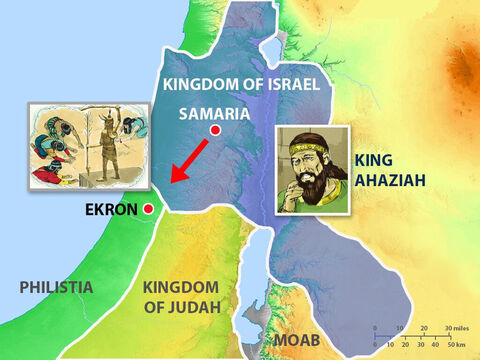
But before Ahaziah had a chance to deal with the rebellious Moabites, he suffered a life-threatening fall that left him confined to his bed in the royal palace in Samaria. His injuries were severe enough that he was concerned about whether he would fully recover. So, he sent messengers to the temple of Baal-zebub, the god of Ekron, seeking a divine prediction concerning his fate. It had been Ahaziah’s parents who had introduced Baal worship to Israel, and he proved to be a faithful adherent to their false religion. In his time of suffering, he sought the counsel of Baal rather than Yahweh, the covenant God of Israel. While Baal worship was rampant throughout the northern kingdom, Ahaziah sent his messengers to Ekron, which was located on Israel’s eastern border with Philistia. Ekron was a renowned occult center, and it was far enough away from Samaria that the news of the king’s injuries might be kept a secret.

However, Ahaziah’s messengers never reached Ekron. They were met along the way by Elijah, the prophet of Yahweh. Ahab’s old nemesis appears on the scene once again, but this time, he has bad news for Ahab’s son. Elijah had received instructions from Yahweh, commanding him to intercept the king’s messengers and inform them of their master’s fate. Ahaziah was hoping to hear a positive word from Baal, but instead, he would receive bad news from the God of Israel.

“Is there no God in Israel? Why are you going to Baal-zebub, the god of Ekron, to ask whether the king will recover? Now, therefore, this is what the LORD says: You will never leave the bed you are lying on; you will surely die.” – 2 Kings 1:3-4 NLT

There is a hint of sarcasm in this message. Yahweh is chiding Ahaziah for sending his messengers all the way to Ekron to seek a word from his false god. Baal worship was rampant within the nation of Israel. There were shrines and high places dedicated to Baal and Asherah all over the northern kingdom. In fact, Ahaziah had access to a Baal temple that his father had built in the capital city of Samaria.

He [Ahab] erected an altar for Baal in the house of Baal, which he built in Samaria. – 1 Kings 15:32 ESV

And there were literally hundreds of priests and prophets who served on behalf of Baal. Yet, Ahaziah had sent his messengers on a field trip all the way to Ekron in hopes of hearing something from his god. Perhaps he had started his search for an answer at the local temple, but had come up empty-handed. This could have led him to his “long-distance-call” to Ekron.

When Ahaziah heard the less-than-positive pronouncement his messengers delivered, he grew suspicious. This was not the news he had been expecting. So, he asked for a description of the man who had predicted his pending death. As soon as he heard what the man looked like, his suspicions were confirmed; it was Elijah the Tishbite. As the son of Ahab and Jezebel, Ahaziah would have grown up hearing the stories of Elijah and his defeat of the prophets of Baal on Mount Carmel. He would have been very familiar with his mother’s intense hatred for this prophet of Yahweh. The ongoing battle of words and will between his father and Elijah would have taken place right in front of him. So, when he discovered that Elijah had once again interjected himself into Israel’s affairs, he sent guards to arrest him. But, just like the messengers he had sent to Ekron, the guards never made it to their destination.

As visible proof of his role as a spokesman for Yahweh, Elijah called down fire from heaven that wiped out all 50 men, including their captain. But this display of power made no impression on the stubborn and unrepentant Ahaziah. He simply sent another 50 guards who suffered the very same fate. The third commander recognized the divine nature of Elijah’s role and wisely chose to beg for mercy.

“O man of God, please spare my life and the lives of these, your fifty servants. See how the fire from heaven came down and destroyed the first two groups. But now please spare my life!” – 2 Kings 1:13-14 NLT

The angel of God intervened, instructing Elijah to spare the lives of these men and accompany them back to Samaria. When he arrived in the capital city, Elijah reiterated his earlier message, but this time, directly to Ahaziah. He confirmed that the king would not recover from his injuries. Ahaziah’s stubborn refusal to seek God even in his time of greatest need would come with a death sentence. His unjustified yet unwavering allegiance to Baal had sealed his fate. As always, the words of Elijah proved to be true.

So Ahaziah died, just as the LORD had promised through Elijah. – 2 Kings 1:17 NLT

Yet another king of Israel met an untimely but well-deserved end. The legacy of unfaithfulness, begun by Jeroboam, had been passed down from generation to generation, infecting each successive king and bringing the just and righteous judgment of God upon them. And because Ahaziah had no male heir to whom he could leave the throne, his brother Jehoram became king of Israel.

Ahaziah, like his predecessors, failed to recognize Yahweh as the one true God. He acted as if Yahweh no longer existed in Israel. But he had been proven wrong. Yahweh was still alive and well, and His power was undiminished. While Ahaziah refused to seek Yahweh’s face, he could not escape Yahweh’s sovereign will. The God of Israel could be ignored, but He would not go away.

Ahaziah had made the fateful mistake of rejecting the one true God. Like his father, Ahaziah had stubbornly refused to acknowledge the supremacy of Yahweh, choosing instead to act as if the God of Israel was non-existent and powerless. But as King David declared in one of his psalms, only a fool would dare deny Yahweh’s existence.

Only fools say in their hearts,
    “There is no God.”
They are corrupt, and their actions are evil;
    not one of them does good!

The LORD looks down from heaven
    on the entire human race;
he looks to see if anyone is truly wise,
    if anyone seeks God.
But no, all have turned away;
    all have become corrupt.
No one does good,
    not a single one!

Will those who do evil never learn?
    They eat up my people like bread
    and wouldn’t think of praying to the Lord.
Terror will grip them,
    for God is with those who obey him.
The wicked frustrate the plans of the oppressed,
    but the LORD will protect his people. – Psalm 14:1-6 NLT

Ahaziah tried to pretend that Yahweh didn’t exist, but he paid for his folly with his life.

English Standard Version (ESV) The Holy Bible, English Standard Version. ESV® Permanent Text Edition® (2016). Copyright © 2001 by Crossway Bibles, a publishing ministry of Good News Publishers.

New Living Translation (NLT) Holy Bible, New Living Translation, copyright © 1996, 2004, 2015 by Tyndale House Foundation. Used by permission of Tyndale House Publishers Inc., Carol Stream, Illinois 60188. All rights reserved.

A Scarceness of Faithfulness

41 Jehoshaphat the son of Asa began to reign over Judah in the fourth year of Ahab king of Israel. 42 Jehoshaphat was thirty-five years old when he began to reign, and he reigned twenty-five years in Jerusalem. His mother’s name was Azubah the daughter of Shilhi. 43 He walked in all the way of Asa his father. He did not turn aside from it, doing what was right in the sight of the LORD. Yet the high places were not taken away, and the people still sacrificed and made offerings on the high places. 44 Jehoshaphat also made peace with the king of Israel.

45 Now the rest of the acts of Jehoshaphat, and his might that he showed, and how he warred, are they not written in the Book of the Chronicles of the Kings of Judah? 46 And from the land he exterminated the remnant of the male cult prostitutes who remained in the days of his father Asa.

47 There was no king in Edom; a deputy was king. 48 Jehoshaphat made ships of Tarshish to go to Ophir for gold, but they did not go, for the ships were wrecked at Ezion-geber. 49 Then Ahaziah the son of Ahab said to Jehoshaphat, “Let my servants go with your servants in the ships,” but Jehoshaphat was not willing. 50 And Jehoshaphat slept with his fathers and was buried with his fathers in the city of David his father, and Jehoram his son reigned in his place.

51 Ahaziah the son of Ahab began to reign over Israel in Samaria in the seventeenth year of Jehoshaphat king of Judah, and he reigned two years over Israel. 52 He did what was evil in the sight of the LORD and walked in the way of his father and in the way of his mother and in the way of Jeroboam the son of Nebat, who made Israel to sin. 53 He served Baal and worshiped him and provoked the LORD, the God of Israel, to anger in every way that his father had done. 1 Kings 22:41-53 ESV

Once again, the author shifts the focus of his narrative from Israel to Judah. With Ahab’s God-ordained demise, the northern kingdom of Israel found itself with a new ruler, Ahaziah, the son of Ahab. But in Judah, Jehoshaphat, who had survived the failed battle against Ramoth-gilead, continued his long reign over the southern kingdom. While Ahab’s exploits clearly portray him as the most wicked of all the kings of Israel, Jehoshaphat provides a refreshingly stark contrast. The author offers a brief, yet positive summary of his reign:  “Jehoshaphat was a good king, following the example of his father, Asa. He did what was pleasing in the LORD’s sight” (1 Kings 22:43 NLT).

Yet, two significant stains marred Jehoshaphat’s 25-year reign. First, while he remained committed to the worship of Yahweh, he failed to remove all the pagan shrines dedicated to the false gods of the Canaanites. As a result, the people continued to practice idolatry in direct violation of God’s command. Secondly, Jehoshaphat had made a treaty with Ahab, the king of Israel. Like his father before him, Jehoshaphat negotiated an alliance with a godless nation rather than placing his full hope and trust in Yahweh. In Asa’s case, he had chosen to align himself with Ben-hadad, the king of the Syrians, hoping he could protect Judah from the ongoing threat of Israelite aggression. But he had been reprimanded for placing his trust in someone other than God.

“Because you relied on the king of Syria, and did not rely on the LORD your God, the army of the king of Syria has escaped you. Were not the Ethiopians and the Libyans a huge army with very many chariots and horsemen? Yet because you relied on the LORD, he gave them into your hand. For the eyes of the LORD run to and fro throughout the whole earth, to give strong support to those whose heart is blameless toward him. You have done foolishly in this, for from now on you will have wars.” – 2 Chronicles 16:7-9 ESV

Now, his son, Jehoshaphat, was guilty of the same sin. In his case, he chose to work hand-in-hand with Ahab, the king of Israel. According to 2 Chronicles 19:1, Jehoshaphat made a marriage alliance with Israel, agreeing for his son, Jehoram, to marry Ahab’s daughter, Athaliah. This decision ultimately placed Jehoshaphat in an awkward position, forcing him to side with Ahab in his ill-fated battle against Ramoth-gilead. While Ahab lost his life in the fight, Jehoshaphat was able to return to the safety of Jerusalem, where he was immediately confronted by the prophet of God over his role in the whole affair.

“Should you help the wicked and love those who hate the LORD? Because of this, wrath has gone out against you from the LORD. Nevertheless, some good is found in you, for you destroyed the Asheroth out of the land, and have set your heart to seek God.” – 2 Chronicles 19:2-3 ESV

Despite these two rather egregious errors, Jehoshaphat was a good king who attempted to encourage the people of Judah to worship God. Early in his reign, he sent a contingent of officials, including Levites and priests, to all the cities of Judah, with instructions to teach the people the Book of the Law (2 Chronicles 17:7-9).

He also appointed judges in the land, instructing them to perform their duties with integrity and honesty, thereby providing the people with just and wise decisions.

“Always think carefully before pronouncing judgment. Remember that you do not judge to please people but to please the LORD. He will be with you when you render the verdict in each case. Fear the LORD and judge with integrity, for the LORD our God does not tolerate perverted justice, partiality, or the taking of bribes.” – 2 Chronicles 19:6-7 NLT

But sadly, the righteous reign of Jehoshaphat did not end well. Once again, he made an unholy and unwise alliance with the king of Israel — this time with Ahaziah, the son of Ahab. A more detailed explanation of this failed agreement is found in the book of 2 Chronicles.

Some time later King Jehoshaphat of Judah made an alliance with King Ahaziah of Israel, who was very wicked. Together they built a fleet of trading ships at the port of Ezion-geber. Then Eliezer son of Dodavahu from Mareshah prophesied against Jehoshaphat. He said, “Because you have allied yourself with King Ahaziah, the LORD will destroy your work.” So the ships met with disaster and never put out to sea. – 2 Chronicles 20:35-37 NLT

What makes Jehoshaphat’s decision so difficult to understand is that it came after God had provided Judah with a stunning victory over the Ammonites and Moabites. The people of Judah had found themselves outnumbered by their enemies, but God had given His assurance that He would fight for them, so they had no reason to fear.

“Listen, all you people of Judah and Jerusalem! Listen, King Jehoshaphat! This is what the LORD says: Do not be afraid! Don’t be discouraged by this mighty army, for the battle is not yours, but God’s. Tomorrow, march out against them. You will find them coming up through the ascent of Ziz at the end of the valley that opens into the wilderness of Jeruel. But you will not even need to fight. Take your positions; then stand still and watch the LORD’s victory. He is with you, O people of Judah and Jerusalem. Do not be afraid or discouraged. Go out against them tomorrow, for the LORD is with you!” – 2 Chronicles 20:15-17 NLT

And God had kept His word. Not only did He destroy their enemies, but he blessed the people of Judah with an abundance of unexpected wealth.

When Jehoshaphat and his people came to take their spoil, they found among them, in great numbers, goods, clothing, and precious things, which they took for themselves until they could carry no more. They were three days in taking the spoil, it was so much. – 2 Chronicles 20:25 ESV

Their God not only protected them, but He also provided for them. They lacked nothing as long as they placed their hope and trust in Yahweh. Yet, for some reason, Jehoshaphat chose to join Ahaziah in the construction of ships to bring back gold from Ophir. But those ships never made it to sea. They were destroyed before they could ever leave the port. Like his father before him, Jehoshaphat placed his trust in someone other than God and paid a high price for his mistake. And his unwise decision left a permanent stain on his legacy.

But as 2 Chronicles 17-19 reveals, there were many positive aspects to Jehoshaphat’s reign. All in all, he was a good king who loved Yahweh and tried to shepherd the people of Judah as his ancestor David had done. Yet, the same thing cannot be said of Ahaziah, the son of Ahab and the king of Israel. The author paints a rather bleak portrait of his short and sin-stained reign.

He did what was evil in the sight of the LORD and walked in the way of his father and in the way of his mother and in the way of Jeroboam the son of Nebat, who made Israel to sin. He served Baal and worshiped him and provoked the LORD, the God of Israel, to anger in every way that his father had done. – 2 Kings 22:52-53 ESV

As the old proverbial statement says, “The apple does not fall far from the tree.” Ahaziah emulated the ways of his father and continued to lead the ten northern tribes away from Yahweh. With the author’s less-than-flattering assessment of Ahaziah’s reign, the book of 1 Kings comes to an abrupt end. The two kingdoms continued the downward spiral that began with Solomon’s reign. While there were brief glimpses of faithfulness, for the most part, the nations of Israel and Judah remained plagued by infidelity and idolatry. Their kings were revealed to be flawed men who tended to use their God-given power to promote themselves and their own agendas rather than lovingly shepherd God’s flock according to His will. And that pattern will continue as the author begins the second half of his history of the divided kingdom.

English Standard Version (ESV) The Holy Bible, English Standard Version. ESV® Permanent Text Edition® (2016). Copyright © 2001 by Crossway Bibles, a publishing ministry of Good News Publishers.

New Living Translation (NLT) Holy Bible, New Living Translation, copyright © 1996, 2004, 2015 by Tyndale House Foundation. Used by permission of Tyndale House Publishers Inc., Carol Stream, Illinois 60188. All rights reserved.
The Well-Deserved Death of Ahab

29 So the king of Israel and Jehoshaphat the king of Judah went up to Ramoth-gilead. 30 And the king of Israel said to Jehoshaphat, “I will disguise myself and go into battle, but you wear your robes.” And the king of Israel disguised himself and went into battle. 31 Now the king of Syria had commanded the thirty-two captains of his chariots, “Fight with neither small nor great, but only with the king of Israel.” 32 And when the captains of the chariots saw Jehoshaphat, they said, “It is surely the king of Israel.” So they turned to fight against him. And Jehoshaphat cried out. 33 And when the captains of the chariots saw that it was not the king of Israel, they turned back from pursuing him. 34 But a certain man drew his bow at random and struck the king of Israel between the scale armor and the breastplate. Therefore he said to the driver of his chariot, “Turn around and carry me out of the battle, for I am wounded.” 35 And the battle continued that day, and the king was propped up in his chariot facing the Syrians, until at evening he died. And the blood of the wound flowed into the bottom of the chariot. 36 And about sunset a cry went through the army, “Every man to his city, and every man to his country!”

37 So the king died, and was brought to Samaria. And they buried the king in Samaria. 38 And they washed the chariot by the pool of Samaria, and the dogs licked up his blood, and the prostitutes washed themselves in it, according to the word of the LORD that he had spoken. 39 Now the rest of the acts of Ahab and all that he did, and the ivory house that he built and all the cities that he built, are they not written in the Book of the Chronicles of the Kings of Israel? 40 So Ahab slept with his fathers, and Ahaziah his son reigned in his place. 1 Kings 22:29-40 ESV

Despite being warned by the prophet Micaiah that his attack on Ramoth-gilead would end in disaster and his own death, Ahab went ahead with his ill-fated plan. But in an attempt to thwart the will of God, Ahab came up with the brilliant idea to wear a disguise that would prevent the Syrians from recognizing him as the king. He knew he would be a target of Ben-Hadad’s wrath because his attack on Ramoth-gilead was in violation of their long-standing peace agreement. And he was right to be worried because Ben-hadad had commanded his troops to focus their attention on Ahab.

Now the king of Syria had commanded the thirty-two captains of his chariots, “Fight with neither small nor great, but only with the king of Israel.” – 1 Kings 22:31 ESV

Ahab’s decision to go through with the battle despite Micaiah’s warning clearly indicates the rebellious nature of his heart and his blatant disregard for the will of Yahweh. He truly believed he could devise a plan that would allow him to escape God’s wrath and accomplish his own will at the same time. Ahab was conniving and manipulative, and evidently quite persuasive, as he was able to convince King Jehoshaphat of Judah to go into battle wearing his royal armor while he wore a disguise. He hoped that, in the heat of battle, the Syrians would mistake Jehoshaphat as the king of Israel and focus all their attention on him. Somehow, he convinced the king of Judah to go along with this blatant display of brazen self-preservation.

And his plan almost worked. As the battle began, the Syrians spotted Jehoshaphat and gave chase, but they soon realized they were pursuing the wrong man. Ahab had managed to fool the Syrians, but he would not be able to hide his identity from God Almighty. His clever plan would not protect him from the judgment that God had decreed against him.

As the battle raged, one of the Syrian archers loosed an arrow that flew through the air and struck Ahab “between the scale armor and the breastplate” (1 Kings 22:34 ESV). The text describes this unnamed individual as “a certain man,” who “drew his bow at random” (1 Kings 22:34 ESV). His name is not provided, and the target of his arrow is undisclosed. In the heat of the battle, he discharged an arrow in the general direction of the enemy, but without aiming at anyone in particular. But his shot ended up piercing between the scale armor and the breastplate of Ahab’s armor. The king had refused to wear his royal robes, but not his protective armor. He could hide, but he could not get away from the all-seeing eye of Yahweh.

The seemingly lucky shot loosed by an unidentified Syrian soldier was sovereignly ordained and directed by the hand of God. Ahab had tried to avoid God’s will but failed. His disguise didn’t fool Yahweh, and his armor proved to be insufficient protection from the divine judgment leveled against him.

As the battle continued all around him, Ahab slumped in his chariot, his blood pouring from his wound and his life slowly ebbing away. At sunset, he took his last labored breath and died, and the news of his demise quickly spread across the battlefield.

 …as evening arrived he died. Just as the sun was setting, the cry ran through his troops: “We’re done for! Run for your lives!” – 1 Kings 22:35-36 NLT

Micaiah had warned Ahab that his death was inevitable because his actions were in direct violation of God’s will. If he chose to go through with his attack on Ramoth-gilead, Ahab would suffer the divine consequences. When Ahab died, lying in a pool of his own blood on the floor of his chariot, his troops abandoned the battle. The sheep found themselves without a shepherd, so they returned to their homes in peace, just as God had predicted they would.

“I saw all Israel scattered on the mountains, as sheep that have no shepherd. And the Lord said, ‘These have no master; let each return to his home in peace.’” – 1 Kings 22:17 ESV

With Ahab’s death, the battle for Ramoth-gilead came to an abrupt end, and the armies of Syria, Israel, and Judah abandoned the field and returned home. Ahab’s body, still lying in his chariot, was returned to Samaria. Amazingly, this wicked and rebellious king was given the honor of a royal burial. But the author describes a rather macabre scene that stands in stark contrast to the state funeral given to this unrepentant and undeserving king. As Ahab’s body was interred with all the pomp and circumstance of a royal funeral, his servants went about the unpleasant task of cleaning up the grisly scene his death left behind.

…his chariot was washed beside the pool of Samaria, and dogs came and licked his blood at the place where the prostitutes bathed, just as the Lord had promised. – 1 Kings 22:38 NLT

This scene took place in direct fulfillment of the words of the prophet Elijah. He had warned King Ahab that his complicity in the death of Naboth would result in his own demise.

And you shall say to him, ‘Thus says the LORD: “In the place where dogs licked up the blood of Naboth shall dogs lick your own blood.”’” – 1 Kings 21:19 ESV

The place where the servants chose to wash Ahab’s blood from his chariot was the exact spot where the innocent Naboth had been stoned to death. Ahab’s body was buried in a royal tomb, but his life’s blood was unceremoniously poured out in a place recognized for its sin and degradation. It was a site within the walls of Samaria inhabited by those who were considered unclean and immoral. Wild dogs licked up the king’s blood, and the prostitutes of Samaria unknowingly bathed themselves in the blood-stained waters of the pool where Ahab’s blood was spilled.

Ahab’s reign as king of Israel came to an abrupt and violent end. While he would be remembered for his many achievements, he would go down in history as one of the most wicked of all Israel’s kings. His legacy would be marked by apostasy, rebellion, idolatry, and immorality. He proved to be a competent king, but his stubborn refusal to honor God would forever mar his reputation and leave a permanent stain on the northern kingdom of Israel. When the author states that “Ahab slept with his fathers” (1 Kings 22:40 ESV), it is a thinly veiled inference that Ahab died unrepentant and unforgiven, just like his predecessors. While alive, Ahab made no place for God in his kingdom. In death, he would discover that he had no place in God’s heavenly kingdom. In life, he chose to replace Yahweh with false gods, and that decision would prove to have eternal consequences.

English Standard Version (ESV) The Holy Bible, English Standard Version. ESV® Permanent Text Edition® (2016). Copyright © 2001 by Crossway Bibles, a publishing ministry of Good News Publishers.

New Living Translation (NLT) Holy Bible, New Living Translation, copyright © 1996, 2004, 2015 by Tyndale House Foundation. Used by permission of Tyndale House Publishers Inc., Carol Stream, Illinois 60188. All rights reserved.

Conviction Over Compromise

1 For three years Syria and Israel continued without war. But in the third year Jehoshaphat the king of Judah came down to the king of Israel. And the king of Israel said to his servants, “Do you know that Ramoth-gilead belongs to us, and we keep quiet and do not take it out of the hand of the king of Syria?” And he said to Jehoshaphat, “Will you go with me to battle at Ramoth-gilead?” And Jehoshaphat said to the king of Israel, “I am as you are, my people as your people, my horses as your horses.”

And Jehoshaphat said to the king of Israel, “Inquire first for the word of the LORD.” Then the king of Israel gathered the prophets together, about four hundred men, and said to them, “Shall I go to battle against Ramoth-gilead, or shall I refrain?” And they said, “Go up, for the Lord will give it into the hand of the king.” But Jehoshaphat said, “Is there not here another prophet of the LORD of whom we may inquire?” And the king of Israel said to Jehoshaphat, “There is yet one man by whom we may inquire of the LORD, Micaiah the son of Imlah, but I hate him, for he never prophesies good concerning me, but evil.” And Jehoshaphat said, “Let not the king say so.” Then the king of Israel summoned an officer and said, “Bring quickly Micaiah the son of Imlah.” 10 Now the king of Israel and Jehoshaphat the king of Judah were sitting on their thrones, arrayed in their robes, at the threshing floor at the entrance of the gate of Samaria, and all the prophets were prophesying before them. 11 And Zedekiah the son of Chenaanah made for himself horns of iron and said, “Thus says the LORD, ‘With these you shall push the Syrians until they are destroyed.’” 12 And all the prophets prophesied so and said, “Go up to Ramoth-gilead and triumph; the LORD will give it into the hand of the king.”

13 And the messenger who went to summon Micaiah said to him, “Behold, the words of the prophets with one accord are favorable to the king. Let your word be like the word of one of them, and speak favorably.” 14 But Micaiah said, “As the LORD lives, what the LORD says to me, that I will speak.” 1 Kings 22:1-14 ESV

King Ahab had been placed under a curse from God for having spared the life of Ben-hadad, the king of Syria. Rather than obey God’s command to put his enemy to death, Ahab had chosen to sign a peace treaty with him that would allow Israel to profit from Syria’s lucrative trading business. Yet, despite the judgment leveled against him by God, Ahab’s decision seems to have produced positive results.

The treaty that Ahab brokered produced three years of peace and prosperity between the two nations. Israel and Syria became allies and trading partners. According to an inscription on an Assyrian tablet discovered in 1861, Ahab and Ben-hadad were part of a 12-nation confederation that faced Emperor Shalmaneser and the Assyrians in the Battle of Qarqar in 853 BC. So, while God had decreed that Ahab’s dynasty would come to an end with his death, the king of Israel continued to enjoy a small measure of success. His insatiable desire for glory and self-aggrandizement would eventually drive him to jeopardize his peaceful and prosperous relationship with Syria.

During the time Ahab was on the throne of Israel, Jehoshaphat became the king of Judah. He succeeded his father, Asa, and, according to the book of 2 Chronicles, Jehoshaphat proved to be a good king.

The LORD was with Jehoshaphat, because he walked in the earlier ways of his father David. He did not seek the Baals, but sought the God of his father and walked in his commandments, and not according to the practices of Israel. Therefore the LORD established the kingdom in his hand. And all Judah brought tribute to Jehoshaphat, and he had great riches and honor. His heart was courageous in the ways of the LORD. And furthermore, he took the high places and the Asherim out of Judah. – 2 Chronicles 17:3-6 ESV

Because Jehoshaphat chose to remove all the false gods and restore the worship of the one true God, his reign was blessed, and the southern kingdom of Judah became a powerful force in the region. But Jehoshaphat, like his father before him, made the mistake of placing his trust in the Syrians. When King Baasha of Israel began to build a fortified city on the border between Israel and Judah, King Asa sought the help of Ben-hadad and the Syrians. Asa “took silver and gold from the treasures of the house of the LORD and the king’s house and sent them to Ben-hadad king of Syria” (2 Chronicles 16:2 ESV). He used these funds to convince Ben-hadad to break his covenant with Israel and join forces with him. His ploy worked, and Baasha stopped construction on his military outpost. But God condemned Asa for his alliance with Ben-hadad, warning that Judah would face non-stop war during the rest of his reign. Rather than trust God, Asa had placed his hope in a foreign king who worshiped false gods.

And while his son Jehoshaphat would prove to be faithful to God, he would also make an alliance with an ungodly, idol-worshiping king.

Now Jehoshaphat had great riches and honor, and he made a marriage alliance with Ahab. After some years he went down to Ahab in Samaria. And Ahab killed an abundance of sheep and oxen for him and for the people who were with him, and induced him to go up against Ramoth-gilead. – 2 Chronicles 18:1-2 ESV

This marital alliance ultimately put Jehoshaphat in a difficult position. While visiting Israel’s capital city of Samaria, Jehoshaphat was presented with an official request from Ahab for military assistance in recapturing the town of Ramoth-gilead from the Syrians. It galled Ahab that the Syrians had stolen a city that had once belonged to Israel, and nothing had been done about it.

“Do you know that Ramoth-gilead belongs to us, and we keep quiet and do not take it out of the hand of the king of Syria?” – 1 Kings 22:3 ESV

So, he called on Jehoshaphat to help him right this apparent wrong, and Jehoshaphat quickly and readily agreed.

“I am as you are, my people as your people, my horses as your horses.” – 1 Kings 22:4 ESV

But Jehoshaphat, anxious to remain obedient to God, asked Ahab to seek Yahweh’s counsel. It’s important to understand that Jehoshaphat wanted to know what the “LORD” (Yahweh) would have them do. But when Ahab commissioned his 400 prophets to seek the will of the gods, they came back with the answer:

“Go up, for the Lord (ăḏōnāy) will give it into the hand of the king.” – 1 Kings 22:6 ESV

These men did not mention the name of Yahweh, and Jehoshaphat seems to have immediately recognized that these were false prophets who had been seeking the will of their false god. So, he asked Ahab if there were no prophets of the one true God left in Israel. Ahab reluctantly confessed that one prophet of Yahweh remained, a man named Micaiah, whom he hated with a passion.

“He never prophesies anything but trouble for me!” – 1 Kings 22:8 NLT

Micaiah never told Ahab what he wanted to hear, so the king avoided him like the plague. But Jehoshaphat insisted that Micaiah be consulted before any action was taken against the Syrians.  So, Ahab sent someone to fetch his least-favorite prophet. In the meantime, his 400 false prophets bombarded Jehoshaphat with their cheery predictions of success.

“Go up to Ramoth-gilead and triumph; the LORD (Yahweh) will give it into the hand of the king.” – 1 Kings 22:12 ESV

This time, the prophets of Baal changed their tune and mentioned the name of Yahweh. Perhaps they hoped this reference to the God of Israel would convince Jehoshaphat to acquiesce and give his approval for the joint venture against the Syrians.

The text doesn’t reveal how long it took for Micaiah to be located and brought to Samaria. However, during the delay, Jehoshaphat found himself pressured to listen to the false prophets and join forces with Ahab. The temptation to compromise his convictions was great. He could have easily given in and listened to the popular opinions of the crowd, but instead, Jehoshaphat waited to hear a word from Yahweh.

Even Micaiah found himself pressured to follow the party line. The messenger who located him delivered a not-so-subtle warning that there was only one answer King Ahab wanted to hear.

“Look, all the prophets are promising victory for the king. Be sure that you agree with them and promise success.” – 1 Kings 22:13 NLT

But Micaiah would not be bullied into submission. He knew how much Ahab hated him, and he would be risking his life to disobey a direct order from the king. Yet his allegiance to Yahweh was greater than his fear of Ahab. So, he told the messenger, “As surely as the LORD lives, I will say only what the LORD tells me to say” (1 Kings 22:14 NLT).

It must have been a long and awkward trip back to Samaria for the messenger. He probably feared for his own life because he knew the prophet was determined to deliver bad news to the king. Everyone who worked for Ahab and all the people who lived in Israel knew that their king had no love affair with Yahweh. He had spent his entire reign promoting the worship of false gods like Baal and Asherah, and he had done everything he could do to ignore and even eliminate the prophets of God. Ahab knew exactly what Micaiah was going to say when he showed up, and it would not be what he wanted to hear.

Ahab needed Jehoshaphat’s help against the Syrians, and he knew that Jehoshaphat’s God would stand opposed to his ambitious plans to recapture Ramoth-gilead. Ahab didn’t want to hear from God because he was unwilling to do God’s will. Like a petulant child, Ahab was determined to get his way, even if it meant disobeying Yahweh’s will. But the prophet of the LORD was unwilling to succumb to the pressure to compromise his convictions and tell the king what he wanted to hear. He would speak the truth, even if it cost him his life. This obscure and little-known prophet was going to choose character over conformity and stand up to the threats of the wicked and powerful king of Israel.

Micaiah’s commitment to Yahweh was unassailable and non-negotiable. Nothing would convince him to compromise or sell out. He was determined to remain faithful to his God, whatever the cost. His bold determination to stand his ground in the face of intense opposition and even the threat of death is reminiscent of the actions of Shadrach, Meshach, and Abednego, the Hebrew friends of Daniel who found themselves facing a death sentence for refusing to bow to the statue King Nebuchadnezzar had erected.

“I will give you one more chance to bow down and worship the statue I have made when you hear the sound of the musical instruments. But if you refuse, you will be thrown immediately into the blazing furnace. And then what god will be able to rescue you from my power?”

Shadrach, Meshach, and Abednego replied, “O Nebuchadnezzar, we do not need to defend ourselves before you. If we are thrown into the blazing furnace, the God whom we serve is able to save us. He will rescue us from your power, Your Majesty. But even if he doesn’t, we want to make it clear to you, Your Majesty, that we will never serve your gods or worship the gold statue you have set up.” – Daniel 3:15-18 NLT

These three young men were willing to die for their beliefs and gladly faced the fires of the furnace with their commitment to Yahweh uncompromised. And their unwavering faith was rewarded.

So Shadrach, Meshach, and Abednego stepped out of the fire. Then the high officers, officials, governors, and advisers crowded around them and saw that the fire had not touched them. Not a hair on their heads was singed, and their clothing was not scorched. They didn’t even smell of smoke! – Daniel 3:26-27 NLT

The Book of Acts records another story of uncompromising faith in the face of unrelenting pressure. Peter and John had been jailed by the powerful Jewish Sanhedrin for preaching “that through Jesus there is a resurrection of the dead” (Acts 4:2 NLT). The following morning, when the two men were dragged before the council, they were ordered to cease and desist. The high priest commanded them, “never again to speak or teach in the name of Jesus” (Acts 4:18 NLT). 

But Peter and John replied, “Do you think God wants us to obey you rather than him? We cannot stop telling about everything we have seen and heard.” – Acts 4:18-20 NLT

Facing the threat of additional jail time or worse, Peter and John stood their ground and declared their intention to continue preaching the truth concerning Jesus. They could be threatened, but they would not be silenced. And, in doing so, they joined the ranks of other faithful men like Micaiah, Daniel, Shadrach, Meshach, and Abednego.

English Standard Version (ESV) The Holy Bible, English Standard Version. ESV® Permanent Text Edition® (2016). Copyright © 2001 by Crossway Bibles, a publishing ministry of Good News Publishers.

New Living Translation (NLT) Holy Bible, New Living Translation, copyright © 1996, 2004, 2015 by Tyndale House Foundation. Used by permission of Tyndale House Publishers Inc., Carol Stream, Illinois 60188. All rights reserved.

A God-Ordained Victory

15 “But now bring me a musician.” And when the musician played, the hand of the Lord came upon him. 16 And he said, “Thus says the Lord, ‘I will make this dry streambed full of pools.’ 17 For thus says the Lord, ‘You shall not see wind or rain, but that streambed shall be filled with water, so that you shall drink, you, your livestock, and your animals.’ 18 This is a light thing in the sight of the Lord. He will also give the Moabites into your hand, 19 and you shall attack every fortified city and every choice city, and shall fell every good tree and stop up all springs of water and ruin every good piece of land with stones.” 20 The next morning, about the time of offering the sacrifice, behold, water came from the direction of Edom, till the country was filled with water.

21 When all the Moabites heard that the kings had come up to fight against them, all who were able to put on armor, from the youngest to the oldest, were called out and were drawn up at the border. 22 And when they rose early in the morning and the sun shone on the water, the Moabites saw the water opposite them as red as blood. 23 And they said, “This is blood; the kings have surely fought together and struck one another down. Now then, Moab, to the spoil!” 24 But when they came to the camp of Israel, the Israelites rose and struck the Moabites, till they fled before them. And they went forward, striking the Moabites as they went.  25 And they overthrew the cities, and on every good piece of land every man threw a stone until it was covered. They stopped every spring of water and felled all the good trees, till only its stones were left in Kir-hareseth, and the slingers surrounded and attacked it. 26 When the king of Moab saw that the battle was going against him, he took with him 700 swordsmen to break through, opposite the king of Edom, but they could not. 27 Then he took his oldest son who was to reign in his place and offered him for a burnt offering on the wall. And there came great wrath against Israel. And they withdrew from him and returned to their own land.  2 Kings 3:15-27 ESV

Verse 15 opens with the combined armies of Israel and Judah bogged down in the wilderness of Edom. Jehoram and Jehoshaphat had joined forces to attack the kingdom of Moab, but somewhere along the way, their campaign had come to an abrupt halt due to lack of water. There, in the desert-like conditions just south of the Dead Sea, they were forced to seek the aid of Elisha, the prophet of God. And while Elisha was reticent to assist the apostate king of Israel, he agreed to help because of his respect for Jehoshaphat. When Jehoram had taken stock of their precarious circumstance, he had panicked, declaring that Yahweh was out to destroy them. But Jehoshaphat, rather than assuming the worst, recommended that they seek a word from the prophet of God.

And, after having agreed to come to their aid, the first thing Elisha did was call for a musician. No explanation is given for this request, but it seems evident that the music was intended to create a soothing atmosphere, conducive to hearing from God. Much to Jehoram’s surprise, the message Elisha received from Yahweh was positive and not negative.

“This is what the Lord says: This dry valley will be filled with pools of water! You will see neither wind nor rain, says the Lord, but this valley will be filled with water. You will have plenty for yourselves and your cattle and other animals.” – 2 Kings 3:16-17 NLT

God was going to do a miracle. Elisha announced that God would fill the dry valley with water, but they would never see a cloud or watch a single raindrop fall from the sky. Where once there had been nothing but sand as far as the eye could see, there would be refreshing pools of water – enough to satisfy the thirst of every soldier, horse, and pack animal. But, according to Elisha, that would be nothing compared to the real miracle God was going to perform.

“But this is only a simple thing for the Lord, for he will make you victorious over the army of Moab! You will conquer the best of their towns, even the fortified ones. You will cut down all their good trees, stop up all their springs, and ruin all their good land with stones.” – 2 Kings 3:18-19 NLT

Turning a desert into a refreshing oasis filled with fresh drinking water was nothing for God. The real miracle would come in the form of His gracious intervention in the battle against the Moabites. He was going to turn their apparent failure into victory.

God had no love affair with the Moabites. They had been a constant problem for the people of Israel for centuries. And it had all begun when the Israelites were preparing to enter the land of Canaan. The king of Moab had watched as the Israelites had easily defeated the Ammonites, and he was afraid that they would face the same fate. So, he hired the services of Balaam, a local seer, providing him with instructions to curse the Israelites.

“Look, a vast horde of people has arrived from Egypt. They cover the face of the earth and are threatening me. Please come and curse these people for me because they are too powerful for me. Then perhaps I will be able to conquer them and drive them from the land. I know that blessings fall on any people you bless, and curses fall on people you curse.” – Numbers 22:5-6 NLT

But God repeatedly thwarted Balaam’s efforts to curse the people of Israel. So, Balaam ended up coming up with an alternative solution. He advised Balak, the king of Moab, to encourage his women to seduce the men of Israel. His ploy was to use intermarriage between the two nations to encourage an alliance. And, his strategy almost worked.

While the Israelites were camped at Acacia Grove, some of the men defiled themselves by having sexual relations with local Moabite women. These women invited them to attend sacrifices to their gods, so the Israelites feasted with them and worshiped the gods of Moab. In this way, Israel joined in the worship of Baal of Peor, causing the Lord’s anger to blaze against his people. – Numbers 25:1-3 NLT

God ended up judging those Israelites who violated His prohibition against intermarrying with the pagan nations in Canaan. And He placed a permanent curse of the nation of Moab.

“No Ammonite or Moabite or any of their descendants for ten generations may be admitted to the assembly of the Lord.As long as you live, you must never promote the welfare and prosperity of the Ammonites or Moabites.” – Deuteronomy 23:3, 6 NLT

Despite Jehoram’s apostasy and Jehoshaphat’s unwise alliance with this idolatrous king, God would provide them with a miraculous and decisive victory over the Moabites. He would snatch victory out of the hands of defeat and, in doing so, allow these two prideful and self-possessed kings to reap the reward they didn’t deserve.

The next morning, water began to flow into the camp. Somewhere, out of sight, rain was falling that turned into rivers of water that flowed all the way to the wilderness of Edom. The armies of Israel and Judah woke up to the sight of pools of freshwater as far as the eye could see. But the Moabites, who were encamped along their southern border, woke up to see what they believed to be pools of blood. They immediately assumed that the armies of Israel, Judah, and Edom had turned on one another and a blood bath had ensued. But when they went to investigate what had happened, rather than dead bodies, they encountered a well-rested and fully rejuvenated army. The battle quickly turned into a rout, with the armies of Israel, Judah, and Edom chasing “them into the land of Moab, destroying everything as they went. They destroyed the towns, covered their good land with stones, stopped up all the springs, and cut down all the good trees” (2 Kings 3:24-25 NLT).

In a last desperate attempt to turn the tide of the battle, the king of Moab took his son, the heir to his throne, and offered him up as a living sacrifice to his false god. And his costly offering seemed to have had its intended effect, providing the demoralized Moabite troops with the inspiration they needed to hold off the Israelites and their allies. The author simply states “there came great wrath against Israel” (2 Kings 3:27 ESV). Evidently, the Moabites rallied behind their king and were able to drive off the invaders.

God had put the Moabites in their place. What King Mesha had failed to realize was that, when he had dared to stand opposed to Jehoram, he had actually been picking a fight with God Almighty. And while God did not approve of Jehoram’s lifestyle or leadership as the king of Israel, God was going to defend His covenant people. This victory had clearly demonstrated God’s faithfulness and His unwavering commitment to defend His people, whether they deserved it or not.

English Standard Version (ESV) The Holy Bible, English Standard Version. ESV® Permanent Text Edition® (2016). Copyright © 2001 by Crossway Bibles, a publishing ministry of Good News Publishers.

New Living Translation (NLT) Holy Bible, New Living Translation, copyright © 1996, 2004, 2015 by Tyndale House Foundation. Used by permission of Tyndale House Publishers Inc., Carol Stream, Illinois 60188. All rights reserved.

The Message (MSG)Copyright © 1993, 1994, 1995, 1996, 2000, 2001, 2002 by Eugene H. Peterson

Under God’s Judgment, But Unrepentant

1 In the eighteenth year of Jehoshaphat king of Judah, Jehoram the son of Ahab became king over Israel in Samaria, and he reigned twelve years. He did what was evil in the sight of the Lord, though not like his father and mother, for he put away the pillar of Baal that his father had made. Nevertheless, he clung to the sin of Jeroboam the son of Nebat, which he made Israel to sin; he did not depart from it.

Now Mesha king of Moab was a sheep breeder, and he had to deliver to the king of Israel 100,000 lambs and the wool of 100,000 rams. But when Ahab died, the king of Moab rebelled against the king of Israel. So King Jehoram marched out of Samaria at that time and mustered all Israel. And he went and sent word to Jehoshaphat king of Judah: “The king of Moab has rebelled against me. Will you go with me to battle against Moab?” And he said, “I will go. I am as you are, my people as your people, my horses as your horses.” Then he said, “By which way shall we march?” Jehoram answered, “By the way of the wilderness of Edom.”

So the king of Israel went with the king of Judah and the king of Edom. And when they had made a circuitous march of seven days, there was no water for the army or for the animals that followed them. 10 Then the king of Israel said, “Alas! The Lord has called these three kings to give them into the hand of Moab.” 11 And Jehoshaphat said, “Is there no prophet of the Lord here, through whom we may inquire of the Lord?” Then one of the king of Israel’s servants answered, “Elisha the son of Shaphat is here, who poured water on the hands of Elijah.” 12 And Jehoshaphat said, “The word of the Lord is with him.” So the king of Israel and Jehoshaphat and the king of Edom went down to him.

13 And Elisha said to the king of Israel, “What have I to do with you? Go to the prophets of your father and to the prophets of your mother.” But the king of Israel said to him, “No; it is the Lord who has called these three kings to give them into the hand of Moab.” 14 And Elisha said, “As the Lord of hosts lives, before whom I stand, were it not that I have regard for Jehoshaphat the king of Judah, I would neither look at you nor see you.” 2 Kings 3:1-14 ESV

When Ahab’s son, Ahaziah, died just two years into his reign, his brother Jehoram became the next king of Israel. And he proved to be just as evil as his father and brother. Yet, he did use his royal power to eliminate the worship of Baal in Israel. But “he clung to the sin of Jeroboam the son of Nebat, which he made Israel to sin; he did not depart from it” (2 Kings 3:3 ESV). He refused to remove the false gods that Jeroboam had erected in Dan and Bethel, and his failure to do so kept the spirit of idolatry and unfaithfulness alive in the land of Israel. Rather than call the people to repentance and encourage a return to Yahweh, Jehoram simply maintained the status quo, allowing the people to continue to place their hope in the golden calves Jeroboam had created.

But Jehoram soon found himself in need of divine assistance. His father, who had been a wicked and oppressive king, had managed to make a lot of enemies. One of them was the king of Moab. During his reign, Ahab had forced the Moabites to pay an annual tribute that consisted of “100,000 lambs and the wool of 100,000 rams” (2 Kings 3:4 ESV). But the Moabites found this annual levy to be onerous, and, as soon as the king of Moab heard of Ahab’s death, he refused to make any further payments.

Jehoram viewed this as a blatant act of rebellion against his authority as the king of Israel. His primary concern was not with the loss of the annual tribute but with the potential loss of respect he would face if he did not deal decisively with this blatant affront to his royal reputation. So, he determined to teach King Mesha of Moab a lesson. Jehoram mustered all the fighting men of Israel and then called on Jehoshaphat, the king of Judah, to come to their assistance. Jehoram wanted Jehoshaphat to provide troops and access through Judah’s land because he planned to attack Moab from the south.

King Jehoshaphat agreed to assist Jehoram, stating, “I will go. I am as you are, my people as your people, my horses as your horses” ( 2 Kings 3:7 ESV). This was the second time that King Jehoshaphat threw in his lot with the king of Israel. Back when Ahab had been king, he had requested Jehoshaphat’s help in attacking the Syrian-held city of Ramoth-gilead. And Jehoshaphat had responded to Ahab with the very same words of commitment: “I am as you are, my people as your people, my horses as your horses” (1 Kings 22:4 ESV).

Surely, Jehoshaphat had learned a lesson from that first ill-fated alliance with the king of Israel. It had almost cost him his life and had ended with Ahab dying in a pool of his own blood on the floor of his chariot. But the king of Judah proved to be a slow learner. He agreed to Jehoram’s request, providing Israel with military assistance and unhindered access to Moab through the land of Judah. But because the southern approach to Moab would require Jehoram’s forces to pass through the land of Edom, he had successfully coerced the king of Edom to join their expedition.

For seven days, the combined forces of Israel, Judah, and Edom marched around the Dead Sea’s southern tip, an inhospitable region where rain was rare and fresh water was in short supply. And long before they were able to reach their final objective, they ran out of water. They were in the middle of a virtual wasteland, with no means of slaking the thirst of their troops, horses, or pack animals. This mighty military force had come to a screeching halt. And in a state of panic, Jehoram cried out, “The Lord has brought the three of us here to let the king of Moab defeat us” (2 Kings 3:10 ESV).

It’s interesting to note that in his greatest moment of need, Judah’s apostate king utters the name of yᵊhōvâ – Jehovah, the one true God of Israel. He doesn’t call on the golden calves of Jeroboam. He doesn’t mention Baal, the god his father and mother worshiped. Instead, he interpreted their dire circumstances as a divine judgment from the hand of Jehovah. He concluded that God was out to destroy them.

But King Jehoshaphat provided a voice of reason. Rather than assume the worse, he suggested that they seek the aid of a prophet of God to determine what God would have them do. Perhaps God was simply trying to get their attention. It appears Jehoshaphat suddenly realized that they had started this entire endeavor without seeking a word from the Lord. So, he strongly suggested that they do so now.

It just so happened that Elisha, the newly appointed prophet of God, had chosen to accompany the expedition. We’re not told why Elisha was there, but it seems reasonable to assume that his presence had been divinely decreed and ordained. He was there because God, in His providence, had planned it. The very man who had purified the brackish spring water outside the city of Jericho was there in their midst (2 Kings 2:19-22). In their greatest moment of need, when all seemed lost, God had placed His spokesman among them.

So, Jehoram and Jehoshaphat schedule a meeting with Elisha. But the prophet of God took full advantage of Jehoram’s predicament, chiding the idolatrous king of Israel for his apparent lack of faith in his own false gods.

“Why are you coming to me?” Elisha asked the king of Israel. “Go to the pagan prophets of your father and mother!” – 2 Kings 3:13 NLT

It was obvious that Jehoram put no stock in the golden calves of Jeroboam, and he had no faith that Baal or Asherah would come to their aid. And Elisha couldn’t resist the opportunity to rub the king’s nose in the mess he had made of Israel’s spiritual state. Jehoram, like all his predecessors, had stubbornly and arrogantly chosen to reject Yahweh. He had claimed to believe in a new god. But as soon as he found himself in a predicament that called for divine assistance, his faith became as false as his god.

In his desperation, Jehoram ignored the prophet’s stinging rebuke and declared his strong belief that this was all the work of Yahweh.

“No! For it was the Lord who called us three kings here—only to be defeated by the king of Moab!” – 2 Kings 3:13 NLT

Jehoram was convinced that their expedition was doomed to failure. The God of Elisha had it in for them, and there was nothing they could do about it. But there is no sense of repentance or remorse on Jehoram’s part. He does not confess his apostasy and refuses to acknowledge any guilt regarding his idolatry. In his mind, Yahweh was just another God who happened to oppose their plans. And if Jehoram could get Elisha to appeal to his God, perhaps they could be spared. Was there a sacrifice they could make to appease Elisha’s God? Could they do something to make Jehovah happy? Was there a way to get Yahweh to change His mind? That is all Jehoram was interested in and the only reason he was willing to consult with Elisha. And the prophet was not moved by Jehoram’s desperate cries for help. He knew that Jehoram’s interest in Yahweh was motivated by fear and not faith. The threat of divine judgment, while real, had done nothing to draw Jehoram back to God. And Elisha knew that the king of Israel remained unrepentant and unwilling to acknowledge Yahweh as the one true God. He had no respect for Jehoram, but he agreed to intervene because Jehoshaphat, the king of Judah, had been the one to suggest that they call on the name of Yahweh.

“As surely as the Lord Almighty lives, whom I serve, I wouldn’t even bother with you except for my respect for King Jehoshaphat of Judah. – 2 Kings 3:14 NLT

Here, in the desolate Dead Sea wilderness, the God of Israel was about to show up in might and power. As He had done so many times before, He would intervene in the lives of His rebellious people. In the midst of their unfaithfulness, the always faithful Yahweh would show up and rescue His unrepentant and undeserving people yet again.

English Standard Version (ESV) The Holy Bible, English Standard Version. ESV® Permanent Text Edition® (2016). Copyright © 2001 by Crossway Bibles, a publishing ministry of Good News Publishers.

New Living Translation (NLT) Holy Bible, New Living Translation, copyright © 1996, 2004, 2015 by Tyndale House Foundation. Used by permission of Tyndale House Publishers Inc., Carol Stream, Illinois 60188. All rights reserved.

The Message (MSG)Copyright © 1993, 1994, 1995, 1996, 2000, 2001, 2002 by Eugene H. Peterson

The Good, the Bad, and the Ugly

41 Jehoshaphat the son of Asa began to reign over Judah in the fourth year of Ahab king of Israel. 42 Jehoshaphat was thirty-five years old when he began to reign, and he reigned twenty-five years in Jerusalem. His mother’s name was Azubah the daughter of Shilhi. 43 He walked in all the way of Asa his father. He did not turn aside from it, doing what was right in the sight of the Lord. Yet the high places were not taken away, and the people still sacrificed and made offerings on the high places. 44 Jehoshaphat also made peace with the king of Israel.

45 Now the rest of the acts of Jehoshaphat, and his might that he showed, and how he warred, are they not written in the Book of the Chronicles of the Kings of Judah? 46 And from the land he exterminated the remnant of the male cult prostitutes who remained in the days of his father Asa.

47 There was no king in Edom; a deputy was king. 48 Jehoshaphat made ships of Tarshish to go to Ophir for gold, but they did not go, for the ships were wrecked at Ezion-geber. 49 Then Ahaziah the son of Ahab said to Jehoshaphat, “Let my servants go with your servants in the ships,” but Jehoshaphat was not willing. 50 And Jehoshaphat slept with his fathers and was buried with his fathers in the city of David his father, and Jehoram his son reigned in his place.

51 Ahaziah the son of Ahab began to reign over Israel in Samaria in the seventeenth year of Jehoshaphat king of Judah, and he reigned two years over Israel. 52 He did what was evil in the sight of the Lord and walked in the way of his father and in the way of his mother and in the way of Jeroboam the son of Nebat, who made Israel to sin. 53 He served Baal and worshiped him and provoked the Lord, the God of Israel, to anger in every way that his father had done. 1 Kings 22:41-53 ESV

Once again, the author shifts the focus of his narrative from Israel to Judah. With Ahab’s God-ordained demise, the northern kingdom of Israel found itself with a new ruler, Ahaziah, the son of Ahab. But in Judah, Jehoshaphat, who had survived the failed battle against Ramoth-gilead, continued his long reign over the southern kingdom. While Ahab’s exploits clearly portray him as the most wicked of all the kings of Israel, Jehoshaphat provides a refreshingly stark contrast. The author provides a brief, yet positive summary of his reign:  “Jehoshaphat was a good king, following the example of his father, Asa. He did what was pleasing in the Lord’s sight” (1 Kings 22:43 NLT).

But two significant stains marred Jehoshaphat’s 25-year reign. First, while he remained committed to the worship of Yahweh, he failed to remove all the pagan shrines dedicated to the false gods of the Canaanites. As a result, the people continued to offer practice idolatry in direct violation of God’s command. Secondly, Jehoshaphat had made a treaty with Ahab, the king of Israel. Like his father before him, Jehoshaphat put his faith in an outside power rather than trust in Yahweh. In Asa’s case, he had chosen to align himself with Ben-hadad, the king of the Syrians, hoping he could protect Judah from the ongoing threat of Israelite aggression. But he had been reprimanded for placing his trust in someone other than God.

“Because you relied on the king of Syria, and did not rely on the Lord your God, the army of the king of Syria has escaped you. Were not the Ethiopians and the Libyans a huge army with very many chariots and horsemen? Yet because you relied on the Lord, he gave them into your hand. For the eyes of the Lord run to and fro throughout the whole earth, to give strong support to those whose heart is blameless toward him. You have done foolishly in this, for from now on you will have wars.” – 2 Chronicles 16:7-9 ESV

Now, his son, Jehoshaphat, was guilty of the same sin. Rather than making a treaty with the Syrians, he had chosen to work hand-in-hand with Ahab, the king of Israel. According to 2 Chronicles 19:1, Jehoshaphat made a marriage alliance with Israel, agreeing for his son, Jehoram, to marry Ahab’s daughter, Athaliah. And this decision would end up putting Jehoshaphat in an awkward position, forcing him to side with Ahab in his ill-fated battle against Ramoth-gilead. While Ahab lost his life in the battle, Jehoshaphat was able to return to the safety of Jerusalem, where he was immediately confronted by the prophet of God over his role in the whole affair.

“Should you help the wicked and love those who hate the Lord? Because of this, wrath has gone out against you from the Lord. Nevertheless, some good is found in you, for you destroyed the Asheroth out of the land, and have set your heart to seek God.” – 2 Chronicles 19:2-3 ESV

Yet, despite these two rather egregious mistakes, Jehoshaphat was a good king who tried to encourage the people of Judah to worship God. Early on in his reign, he had sent a contingent of officials, including Levites and priests, to all the cities of Judah, with instructions to teach the Book of the Law to the people (2 Chronicles 17:7-9).

He also appointed judges in the land, instructing them to do their jobs with integrity and honesty, providing the people with just and wise decisions.

“Always think carefully before pronouncing judgment. Remember that you do not judge to please people but to please the Lord. He will be with you when you render the verdict in each case. Fear the Lord and judge with integrity, for the Lord our God does not tolerate perverted justice, partiality, or the taking of bribes.” – 2 Chronicles 19:6-7 NLT

But sadly, the righteous reign of Jehoshaphat did not end well. Once again, he made an unholy and unwise alliance with the king of Israel – this time with Ahaziah, the son of Ahab. We get a more detailed explanation of this failed agreement in the book of 2 Chronicles.

Some time later King Jehoshaphat of Judah made an alliance with King Ahaziah of Israel, who was very wicked. Together they built a fleet of trading ships at the port of Ezion-geber. Then Eliezer son of Dodavahu from Mareshah prophesied against Jehoshaphat. He said, “Because you have allied yourself with King Ahaziah, the Lord will destroy your work.” So the ships met with disaster and never put out to sea. – 2 Chronicles 20:35-37 NLT

What makes this decision by Jehoshaphat so difficult to understand is that it came after God had provided Judah with a stunning victory over the Ammonites and Moabites. The people of Judah had found themselves outnumbered by their enemies, but God had given His assurance that He would fight for them. They had no reason to fear.

“Listen, all you people of Judah and Jerusalem! Listen, King Jehoshaphat! This is what the Lord says: Do not be afraid! Don’t be discouraged by this mighty army, for the battle is not yours, but God’s. Tomorrow, march out against them. You will find them coming up through the ascent of Ziz at the end of the valley that opens into the wilderness of Jeruel. But you will not even need to fight. Take your positions; then stand still and watch the Lord’s victory. He is with you, O people of Judah and Jerusalem. Do not be afraid or discouraged. Go out against them tomorrow, for the Lord is with you!” – 2 Chronicles 20:15-17 NLT

And God had kept His word. Not only did He destroy their enemies, but he blessed the people of Judah with an abundance of unexpected wealth.

When Jehoshaphat and his people came to take their spoil, they found among them, in great numbers, goods, clothing, and precious things, which they took for themselves until they could carry no more. They were three days in taking the spoil, it was so much. – 2 Chronicles 20:25 ESV

Their God had not only protected them, but He had provided for them. They lacked nothing as long as they placed their hope and trust in Yahweh. Yet, for some reason, Jehoshaphat chose to join Ahaziah in the construction of ships to bring back gold from Ophir. But those ships never made it to sea. They were destroyed before they could ever leave the port. Like his father before him, Jehoshaphat placed his trust in someone other than God and paid a high price for his mistake. And his unwise decision left a permanent stain on his legacy.

But as 2 Chronicles 17-19 reveals, there were many positive aspects to Jehoshaphat’s reign. All in all, he was a good king who loved Yahweh and tried to shepherd the people of Judah as his ancestor David had done. Yet, the same thing cannot be said of Ahaziah, the son of Ahab and the king of Israel. The author paints a rather bleak portrait of his short and sin-stained reign.

He did what was evil in the sight of the Lord and walked in the way of his father and in the way of his mother and in the way of Jeroboam the son of Nebat, who made Israel to sin. He served Baal and worshiped him and provoked the Lord, the God of Israel, to anger in every way that his father had done. – 2 Kings 22:52-53 ESV

And with that assessment, the book of 1 Kings comes to an abrupt and less-than-flattering end. The two kingdoms continue the downward spiral that began with the reign of Solomon. There have been brief glimpses of faithfulness, but for the most part, the nations of Israel and Judah remain plagued by infidelity and idolatry. Their kings are revealed as flawed men who tend to use their God-given power to promote themselves and their own agendas rather than lovingly shepherd the flock of God according to the will of God. And that pattern will continue as the author begins the second half of his history of the divided kingdom.

English Standard Version (ESV) The Holy Bible, English Standard Version. ESV® Permanent Text Edition® (2016). Copyright © 2001 by Crossway Bibles, a publishing ministry of Good News Publishers.

New Living Translation (NLT) Holy Bible, New Living Translation, copyright © 1996, 2004, 2015 by Tyndale House Foundation. Used by permission of Tyndale House Publishers Inc., Carol Stream, Illinois 60188. All rights reserved.

The Message (MSG)Copyright © 1993, 1994, 1995, 1996, 2000, 2001, 2002 by Eugene H. Peterson

A Life Gone to the Dogs

29 So the king of Israel and Jehoshaphat the king of Judah went up to Ramoth-gilead. 30 And the king of Israel said to Jehoshaphat, “I will disguise myself and go into battle, but you wear your robes.” And the king of Israel disguised himself and went into battle. 31 Now the king of Syria had commanded the thirty-two captains of his chariots, “Fight with neither small nor great, but only with the king of Israel.” 32 And when the captains of the chariots saw Jehoshaphat, they said, “It is surely the king of Israel.” So they turned to fight against him. And Jehoshaphat cried out. 33 And when the captains of the chariots saw that it was not the king of Israel, they turned back from pursuing him. 34 But a certain man drew his bow at random and struck the king of Israel between the scale armor and the breastplate. Therefore he said to the driver of his chariot, “Turn around and carry me out of the battle, for I am wounded.” 35 And the battle continued that day, and the king was propped up in his chariot facing the Syrians, until at evening he died. And the blood of the wound flowed into the bottom of the chariot. 36 And about sunset a cry went through the army, “Every man to his city, and every man to his country!”

37 So the king died, and was brought to Samaria. And they buried the king in Samaria. 38 And they washed the chariot by the pool of Samaria, and the dogs licked up his blood, and the prostitutes washed themselves in it, according to the word of the Lord that he had spoken. 39 Now the rest of the acts of Ahab and all that he did, and the ivory house that he built and all the cities that he built, are they not written in the Book of the Chronicles of the Kings of Israel? 40 So Ahab slept with his fathers, and Ahaziah his son reigned in his place. 1 Kings 22:29-40 ESV

Despite being warned by the prophet Micaiah that his attack of Ramoth-gilead would end in disaster and his own death, Ahab had chosen to go through with his ill-fated plan. But in an attempt to thwart the will of God, Ahab had come up with the brilliant idea to wear a disguise that would keep the Syrians from recognizing him as the king. He knew he would be a target of Ben-Hadad’s wrath because his attack on Ramoth-gilead would be in violation of their long-standing peace agreement. And he was right to be worried because Ben-hadad had commanded his troops to focus their attention on Ahab.

Now the king of Syria had commanded the thirty-two captains of his chariots, “Fight with neither small nor great, but only with the king of Israel.” – 1 Kings 22:31 ESV

Ahab’s decision to go through with the battle despite Micaiah’s warning clearly indicates the rebellious nature of his heart and his blatant disregard for the will of Yahweh. He truly believed he could devise a plan that would allow him to escape God’s wrath and accomplish his will at the same time. Ahab was conniving and manipulative and, evidently, quite persuasive because he was somehow able to convince King Jehoshaphat of Judah to go into battle wearing his royal armor while he wore a disguise. He hoped that, in the heat of battle, the Syrians would mistake Jehoshaphat for himself and focus all their attention on him. Somehow, he convinced the king of Judah to go along with this blatant display of self-centered self-preservation.

And his plan almost worked. As the battle began, the Syrians spotted Jehoshaphat and gave chase, but they soon realized they were pursuing the wrong man. Ahab had managed to fool the Syrians, but he would not be able to hide his identity from God Almighty. And he would not be able to escape the judgment God had decreed against him.

As the battle raged, one of the Syrian archers loosed an arrow that flew through the air and ended up striking Ahab “between the scale armor and the breastplate” (1 Kings 22:34 ESV). But this seemingly lucky shot had been sovereignly ordained and directed by the hand of God. Ahab had tried to escape God’s will but had failed. His disguise had been unable to hide him from God’s all-seeing eye, and his armor had proved to be insufficient protection from God’s all-powerful judgment.

And as the battle continued all around him, Ahab slumped in his chariot, his blood pouring from his wound and his life slowly ebbing away. At sunset, he took his last labored breath and died, and the news of his demise quickly spread across the battlefield.

 …at evening he died. And the blood of the wound flowed into the bottom of the chariot. And about sunset a cry went through the army, “Every man to his city, and every man to his country!” – 1 Kings 22:35-36 ESV

Micaiah had warned Ahab that his death was inevitable because his actions were in direct violation of God’s will. If he chose to go through with his attack on Ramoth-gilead, Ahab would suffer the divine consequences. And when Ahab died, lying in a pool of his own blood on the floor of his chariot, his troops abandoned the battle. The sheep found themselves without a shepherd, so they returned to their homes in peace, just as God had predicted they would.

“I saw all Israel scattered on the mountains, as sheep that have no shepherd. And the Lord said, ‘These have no master; let each return to his home in peace.’” – 1 Kings 22:17 ESV

With Ahab’s death, the battle for Ramoth-gilead came to an abrupt end, and the armies of Syria, Israel, and Judah abandoned the field and returned home. Ahab’s body, still lying in his chariot, was returned to Samaria. Amazingly, this wicked and rebellious king was given the honor of a royal burial. But the author describes a rather macabre scene that stands in stark contrast to the state funeral given to this unrepentant and undeserving king. As Ahab’s body was interred with all the pomp and circumstance that comes with a royal funeral, servants went about the unpleasant task of washing his blood from his chariot.

…his chariot was washed beside the pool of Samaria, and dogs came and licked his blood at the place where the prostitutes bathed, just as the Lord had promised. – 1 Kings 22:38 NLT

This scene took place in direct fulfillment of the words of Elijah the prophet. He had warned King Ahab that his complicity in the death of Naboth would result in his own death.

And you shall say to him, ‘Thus says the Lord: “In the place where dogs licked up the blood of Naboth shall dogs lick your own blood.”’” – 1 Kings 21:19 ESV

It would seem that the place where the servants chose to wash Ahab’s blood from the chariot was the same place where the innocent Naboth had been stoned to death. Ahab’s body was buried in a royal tomb, but his life’s blood was unceremoniously poured out in a place recognized for its sin and degradation. It was a site within the walls of Samaris inhabited by those who were considered unclean and immoral. And the king’s blood was literally licked up by scavenging dogs.

Ahab’s reign as king of Israel came to an abrupt and violent end. And while he would be remembered for many of his achievements, he would go down in history as one of the most wicked of all Israel’s kings. His legacy would be marked by apostasy, rebellion, idolatry, and immorality. He had proved to be a competent king, but his stubborn refusal to honor God would forever mar his reputation and leave a permanent stain on the northern kingdom of Israel. And when the author states that “Ahab slept with his fathers” (1 Kings 22:40 ESV), it is a thinly veiled inference that Ahab died unrepentant and unforgiven, just like his predecessors. While alive, Ahab made no place for God in his kingdom. In death, he would discover that he had no place in God’s kingdom. In life, he had chosen to replace God with false gods, and that decision would prove to have eternal consequences.

English Standard Version (ESV) The Holy Bible, English Standard Version. ESV® Permanent Text Edition® (2016). Copyright © 2001 by Crossway Bibles, a publishing ministry of Good News Publishers.

New Living Translation (NLT) Holy Bible, New Living Translation, copyright © 1996, 2004, 2015 by Tyndale House Foundation. Used by permission of Tyndale House Publishers Inc., Carol Stream, Illinois 60188. All rights reserved.

The Message (MSG)Copyright © 1993, 1994, 1995, 1996, 2000, 2001, 2002 by Eugene H. Peterson