The Lamb for Sinners Slain

13 “These are the measurements of the altar by cubits (the cubit being a cubit and a handbreadth): its base shall be one cubit high and one cubit broad, with a rim of one span around its edge. And this shall be the height of the altar: 14 from the base on the ground to the lower ledge, two cubits, with a breadth of one cubit; and from the smaller ledge to the larger ledge, four cubits, with a breadth of one cubit; 15 and the altar hearth, four cubits; and from the altar hearth projecting upward, four horns. 16 The altar hearth shall be square, twelve cubits long by twelve broad. 17 The ledge also shall be square, fourteen cubits long by fourteen broad, with a rim around it half a cubit broad, and its base one cubit all around. The steps of the altar shall face east.”

18 And he said to me, “Son of man, thus says the Lord God: These are the ordinances for the altar: On the day when it is erected for offering burnt offerings upon it and for throwing blood against it, 19 you shall give to the Levitical priests of the family of Zadok, who draw near to me to minister to me, declares the Lord God, a bull from the herd for a sin offering. 20 And you shall take some of its blood and put it on the four horns of the altar and on the four corners of the ledge and upon the rim all around. Thus you shall purify the altar and make atonement for it. 21 You shall also take the bull of the sin offering, and it shall be burned in the appointed place belonging to the temple, outside the sacred area. 22 And on the second day you shall offer a male goat without blemish for a sin offering; and the altar shall be purified, as it was purified with the bull. 23 When you have finished purifying it, you shall offer a bull from the herd without blemish and a ram from the flock without blemish. 24 You shall present them before the Lord, and the priests shall sprinkle salt on them and offer them up as a burnt offering to the Lord. 25 For seven days you shall provide daily a male goat for a sin offering; also, a bull from the herd and a ram from the flock, without blemish, shall be provided. 26 Seven days shall they make atonement for the altar and cleanse it, and so consecrate it. 27 And when they have completed these days, then from the eighth day onward the priests shall offer on the altar your burnt offerings and your peace offerings, and I will accept you, declares the Lord God.” Ezekiel 43:13-27 ESV

It should be no surprise that the focus of everything in the Millennial Kingdom will be holiness. At that moment in human history, everything will be set apart unto God. His Son will rule over all the earth from His throne in Jerusalem, just as the angel had promised to his mother, Mary.

“You will conceive and give birth to a son, and you will name him Jesus. He will be very great and will be called the Son of the Most High. The Lord God will give him the throne of his ancestor David. And he will reign over Israel forever; his Kingdom will never end!” – Luke 1:31-33 NLT

This will be in fulfillment of the promise that God made to King David.

“And I will provide a homeland for my people Israel, planting them in a secure place where they will never be disturbed. Evil nations won’t oppress them as they’ve done in the past, starting from the time I appointed judges to rule my people Israel. And I will give you rest from all your enemies.…Your house and your kingdom will continue before me for all time, and your throne will be secure forever.” – 2 Samuel 7:10-11, 16 NLT

In this future kingdom, Jesus Christ, the Son of God, will be the King of kings and Lord of lords. He will rule supreme and His status as the Holy One of God will allow Him to mete out perfect righteousness as the sovereign head of state. With His sacrificial death and resurrection, Jesus earned the right to sit on David’s throne. Paul speaks of Jesus’ elevation to this highest honor because “he humbled himself in obedience to God and died a criminal’s death on a cross” (Philippians 2:8 NLT).

And because Jesus faithfully fulfilled the will of His Heavenly Father, He was rewarded with a return to His rightful place at His Father’s side.

God elevated him to the place of highest honor
    and gave him the name above all other names,
that at the name of Jesus every knee should bow,
    in heaven and on earth and under the earth,
and every tongue declare that Jesus Christ is Lord,
    to the glory of God the Father. – Philippians 2:9-11 NLT

But the latter part of this passage has yet to be fulfilled. We live in an age where the majority of people on earth refuse to honor the name of Christ or bow in submission to His will. They do not acknowledge Him as Lord. Yet, God’s redemptive plan includes a day when all that will change. The prophet, Micah, refers to this future restoration of the Kingdom of Israel and Christ’s reign as King.

In the last days, the mountain of the Lord’s house
    will be the highest of all—
    the most important place on earth.
It will be raised above the other hills,
    and people from all over the world will stream there to worship.
People from many nations will come and say,
“Come, let us go up to the mountain of the Lord,
    to the house of Jacob’s God.
There he will teach us his ways,
    and we will walk in his paths.”
For the Lord’s teaching will go out from Zion;
    his word will go out from Jerusalem.
The Lord will mediate between peoples
    and will settle disputes between strong nations far away. – Micah 4:1-3 NLT

Isaiah prophesied about the future earthly reign of Christ, declaring that “the government will rest on his shoulders” (Isaiah 9:6 NLT), and that government will be marked by peace.

His government and its peace
    will never end.
He will rule with fairness and justice from the throne of his ancestor David
    for all eternity. – Isaiah 9:7 NLT

Justice will rule in the wilderness
    and righteousness in the fertile field.
And this righteousness will bring peace.
    Yes, it will bring quietness and confidence forever.
My people will live in safety, quietly at home.
    They will be at rest. – Isaiah 32:16-18 NLT

So, why does God reveal to Ezekiel that this same Millennial Kingdom will be marked by a reinstitution of the sacrificial system? If Jesus’ paid the final debt for all sins and accomplished what the blood of bulls and goats could never do, why would God bring back the temple, the altar, and the practice of blood sacrifice?

“The existence of the millennial temple and the reinstatement of the sacrificial system [though not necessarily the reinstatement of the Mosaic Covenant] is not only understandable but predictable. Ezekiel’s vision of a restored sacrificial system was really not so amazing after all. The millennium will afford Israel the opportunity for the first time in its history to use the symbols of their covenant with Jesus as Messiah in view. It will be their first time to be a kingdom of priests and a holy nation showing forth to the world the redemptive work of Yahweh in the person of Jesus Christ the Messiah (Isa 53:7; 61:1-3; Zech 4:1 [sic 3:10]; John 1:29; Acts 8:32-35; 1 Pet 1:19; Rev 7:13-14; 5:9; 13:8; 15:3).” – L. E. Cooper Sr., Ezekiel

The author of Hebrews reminds us that the old sacrificial system functioned as a symbol or representation of something far greater to come.

The old system under the law of Moses was only a shadow, a dim preview of the good things to come, not the good things themselves. The sacrifices under that system were repeated again and again, year after year, but they were never able to provide perfect cleansing for those who came to worship. If they could have provided perfect cleansing, the sacrifices would have stopped, for the worshipers would have been purified once for all time, and their feelings of guilt would have disappeared.

But instead, those sacrifices actually reminded them of their sins year after year. For it is not possible for the blood of bulls and goats to take away sins. – Hebrews 10:1-4 NLT

According to this passage, the main purpose behind the Old Testament sacrificial system was to remind God’s people of their sins. It could never provide full and complete atonement. That’s why the sacrifices were perpetual and never-ending. The people lived in an endless cycle of sin-sacrifice-atonement-forgiveness. With their sins forgiven, they would simply repeat the cycle again, year after year. But Jesus came to be the “Lamb of God who takes away the sins of the world” (John 1:29). With His death on the cross, Jesus broke that endless cycle of sacrifice for sins.

So, why bring it back? It seems that the future sacrificial system described in Ezekiel has a distinctly different purpose. Rather than providing atonement for sins, it will point to the ultimate atoning sacrifice: Jesus Christ. The blood offered up on the Millennial Altar will commemorate “the precious blood of Christ, the sinless, spotless Lamb of God” (1 Peter 1:19 NLT).

When Christians partake of the elements of the Lord’s Table, they are not literally breaking the body of Christ or spilling His blood. They are practicing a symbolic rite designed to remind them of what Christ has done on their behalf. That’s why, on the night Jesus instituted the Lord’s Table, He told His disciples “do this in remembrance of me” (1 Corinthians 11:25).
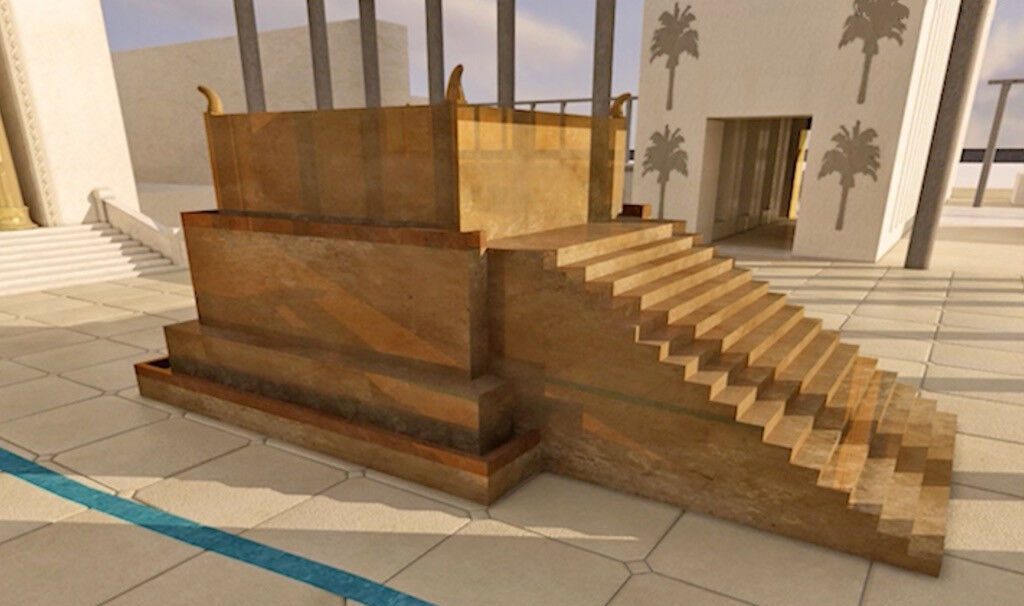
God gives Ezekiel the dimensions for the altar of sacrifice. Then He provides very clear instructions regarding the ritual cleansing of the altar and the preparation of the sacrifices to be offered on it. This entire process is similar to that given by God to Moses when He first instituted the sacrificial system in the Judean wilderness. For the Israelites living in the Millennial Kingdom, this entire process of ceremonial cleansing and purification will be highly familiar, and it will serve as a powerful reminder of their past sins as a nation. But it will point them to the all-sufficient sacrifice of Jesus, whose blood has cleansed them from all their sins (1 John 1:7).

“The offerings presented thereon were meant to be memorials, much as the Lord’s Supper is no efficacious sacrifice but a memorial of a blessedly adequate and all-sufficient sacrifice for all time. Thus, whereas the sacrifices of the Old Testament economy were prospective, these are retrospective.” – Charles Lee Feinberg, The Prophecy of Ezekiel

The focus of this chapter is holiness – the holiness of God, His people, His Kingdom, and His Son. Everything in the Millennial Kingdom will be set apart for His glory. It will all be dedicated to His name and exist to point all people to Him alone. In a remarkable blending of old and new imagery, God provides Ezekiel a glimpse of a future age when the Old Testament sacrificial system will exist in perfect harmony with the resurrected and enthroned Lamb of God. During His thousand-year reign on earth, there will be believers and unbelievers living under His righteous rule. All those who survived the seven years of the Tribulation will have the pleasure of living as citizens of Christ’s earthly kingdom, but not all will worship Him as Lord. Perhaps this renewed sacrificial system will serve as a means of purification for all those who wish to enter the presence of the King of kings. Holiness will reign supreme in the Millennial Kingdom, and God has ordained a place and purpose for the sacrificial system in that time.

English Standard Version (ESV) The Holy Bible, English Standard Version. ESV® Permanent Text Edition® (2016). Copyright © 2001

New Living Translation (NLT) Holy Bible, New Living Translation, copyright © 1996, 2004, 2015 by Tyndale House Foundation. Used by permission of Tyndale House Publishers Inc., Carol Stream, Illinois 60188. All rights reserved.

Set Apart

1 Then he led me out into the outer court, toward the north, and he brought me to the chambers that were opposite the separate yard and opposite the building on the north. The length of the building whose door faced north was a hundred cubits, and the breadth fifty cubits. Facing the twenty cubits that belonged to the inner court, and facing the pavement that belonged to the outer court, was gallery against gallery in three stories. And before the chambers was a passage inward, ten cubits wide and a hundred cubits long, and their doors were on the north. Now the upper chambers were narrower, for the galleries took more away from them than from the lower and middle chambers of the building. For they were in three stories, and they had no pillars like the pillars of the courts. Thus the upper chambers were set back from the ground more than the lower and the middle ones. And there was a wall outside parallel to the chambers, toward the outer court, opposite the chambers, fifty cubits long. For the chambers on the outer court were fifty cubits long, while those opposite the nave were a hundred cubits long. Below these chambers was an entrance on the east side, as one enters them from the outer court.

10 In the thickness of the wall of the court, on the south also, opposite the yard and opposite the building, there were chambers 11 with a passage in front of them. They were similar to the chambers on the north, of the same length and breadth, with the same exits and arrangements and doors, 12 as were the entrances of the chambers on the south. There was an entrance at the beginning of the passage, the passage before the corresponding wall on the east as one enters them.

13 Then he said to me, “The north chambers and the south chambers opposite the yard are the holy chambers, where the priests who approach the Lord shall eat the most holy offerings. There they shall put the most holy offerings—the grain offering, the sin offering, and the guilt offering—for the place is holy. 14 When the priests enter the Holy Place, they shall not go out of it into the outer court without laying there the garments in which they minister, for these are holy. They shall put on other garments before they go near to that which is for the people.”

15 Now when he had finished measuring the interior of the temple area, he led me out by the gate that faced east, and measured the temple area all around. 16 He measured the east side with the measuring reed, 500 cubits by the measuring reed all around. 17 He measured the north side, 500 cubits by the measuring reed all around. 18 He measured the south side, 500 cubits by the measuring reed. 19 Then he turned to the west side and measured, 500 cubits by the measuring reed. 20 He measured it on the four sides. It had a wall around it, 500 cubits long and 500 cubits broad, to make a separation between the holy and the common. Ezekiel 42:1-20 ESV

I find it interesting that in the middle of all the detailed descriptions of the layout of the future temple complex, Ezekiel’s “guide” pointed to a set of rooms and designated them as being “holy.”

Then he said to me, “The north and south rooms adjacent to the open area are holy rooms where the priests who come before GOD eat the holy offerings. There they place the holy offerings–grain offerings, sin offerings, and guilt offerings. These are set-apart rooms, holy space. After the priests have entered the Sanctuary, they must not return to the outside courtyard and mingle among the people until they change the sacred garments in which they minister and put on their regular clothes.” – Ezekiel 42:13-14 MSG

Wouldn’t the entire temple be holy? Since the whole structure would be dedicated to the worship of God, wouldn’t every room, wall, hallway, courtyard, and gateway be considered holy? Well, in a sense, yes. But the use of the word “holy” in this context gives us another important aspect of its meaning. It simply means to be “set-apart or separated.”

These rooms were dedicated or set apart for a distinct purpose.

“Here the priests who offer sacrifices to the Lord will eat the most holy offerings.” – Ezekiel 42:13 NLT

According to Ezekiel’s divine tour guide, these rooms would also be used for storage of the elements used in the various offerings.

“…because these rooms are holy, they will be used to store the sacred offerings—the grain offerings, sin offerings, and guilt offerings.” – Ezekiel 42:13 NLT

Even within this future temple complex, there will be places that are “set apart” and distinctive from all others. These rooms will be dedicated to a specific purpose and will not be available for any others use.

When the priests complete their job of ministering in the sanctuary, they will be required to leave their “holy” garments in one of these “holy” rooms, and change into their “street” clothes.  The robes they wear in the sanctuary will be dedicated solely to use within that area of the temple. The book of Exodus describes these sacred garments.

“Make sacred garments for Aaron that are glorious and beautiful. Instruct all the skilled craftsmen whom I have filled with the spirit of wisdom. Have them make garments for Aaron that will distinguish him as a priest set apart for my service.” – Exodus 28:2-3 NLT

These would not be ordinary, run-of-the-mill clothes, but acquisitive garments of great beauty and detail.

“These are the garments they are to make: a chestpiece, an ephod, a robe, a patterned tunic, a turban, and a sash. They are to make these sacred garments for your brother, Aaron, and his sons to wear when they serve me as priests. So give them fine linen cloth, gold thread, and blue, purple, and scarlet thread.” – Exodus 28:4-5 NLT

Even when ministering within the far smaller and less opulent tabernacle, the priests were required to wear God-ordained and designed garments that set them apart for His service.

For Aaron’s sons, make tunics, sashes, and special head coverings that are glorious and beautiful. Clothe your brother, Aaron, and his sons with these garments, and then anoint and ordain them. Consecrate them so they can serve as my priests. Also make linen undergarments for them, to be worn next to their bodies, reaching from their hips to their thighs. These must be worn whenever Aaron and his sons enter the Tabernacle or approach the altar in the Holy Place to perform their priestly duties. Then they will not incur guilt and die.” – Exodus 28:41-43 NLT

Holiness was important to God. It’s why He told His people, “You must be holy because I, the Lord your God, am holy” (Leviticus 19:2 NLT). He had chosen them and set them apart as His own. They were His special possession and their lives were to reflect their unique status as His children. And every area of this future temple will be set apart for God’s glory and use. Each brick, decorative accent, room, doorway, wall, and ceiling will exist for one purpose only: To bring glory to God Almighty.

Even the garments the priests wore were to be considered as holy or set apart. Before they could enter the rest of the temple or go into the more public or common areas, they had to remove their “holy” clothes, because those clothes had been dedicated to God.

All this makes me think about how we have been set apart by God for His use. We are His people. We have been made holy or set apart by the indwelling presence of the Spirit of God. We belong to God. The apostle Paul reminds us of this unique status as His holy people.

Since God chose you to be the holy people he loves, you must clothe yourselves with tenderhearted mercy, kindness, humility, gentleness, and patience. – Colossians 3:12 NLT

God set us apart for a purpose. We are now dedicated to Him and for His use. Our lives no longer belong to us, but to him and we should be used only in the way that He sees fit. The priests could not use the holy garments for any other purpose. They were not free to use those holy rooms for any other reason than the one that God had prescribed for them. In fact, the book of Nehemiah records an incident in which one of the priests violated this very command.

Eliashib the priest, who had been appointed as supervisor of the storerooms of the Temple of our God and who was also a relative of Tobiah, had converted a large storage room and placed it at Tobiah’s disposal. The room had previously been used for storing the grain offerings, the frankincense, various articles for the Temple, and the tithes of grain, new wine, and olive oil (which were prescribed for the Levites, the singers, and the gatekeepers), as well as the offerings for the priests. – Nehemiah 4:4-5 NLT

Notice that Eliashib had taken one of the “holy” rooms and turned it into an apartment for one of his relatives. When Nehemiah got wind of what had happened, he was furious and took immediate action.

When I arrived back in Jerusalem, I learned about Eliashib’s evil deed in providing Tobiah with a room in the courtyards of the Temple of God. I became very upset and threw all of Tobiah’s belongings out of the room. Then I demanded that the rooms be purified, and I brought back the articles for God’s Temple, the grain offerings, and the frankincense. – Nehemiah 4:7-9 NLT

Eliashib had taken liberties with that which belonged to God. He had the audacity to assign a new and totally different use for that which God had set apart. And, in doing so, he desecrated what God had deemed as wholly for His use.

And we can be guilty of the same thing. As God’s children, we have been set apart for His service. When God commands, “You must be holy because I am holy” (1 Peter 1:16 NLT), He is telling us that we must be set apart, distinct, and different, just as He is. We must reflect His holiness. We must remain dedicated to His use. When we take what He has set apart (our bodies) and use it for some other purpose, we profane it. When we use our bodies for purposes other than those for which God has set them apart, we denigrate their God-given value. That is why Peter provides a sobering warning to live as who we are and for the purpose we have been assigned.

And you are living stones that God is building into his spiritual temple. What’s more, you are his holy priests. Through the mediation of Jesus Christ, you offer spiritual sacrifices that please God. – 1 Peter 2:5 NLT

And the apostle Paul echoes Peter’s sentiments when he writes:

Don’t you realize that your body is the temple of the Holy Spirit, who lives in you and was given to you by God? You do not belong to yourself, for God bought you with a high price. So you must honor God with your body. – 1 Corinthians 6:19-20 NLT

English Standard Version (ESV) The Holy Bible, English Standard Version. ESV® Permanent Text Edition® (2016). Copyright © 2001

New Living Translation (NLT) Holy Bible, New Living Translation, copyright © 1996, 2004, 2015 by Tyndale House Foundation. Used by permission of Tyndale House Publishers Inc., Carol Stream, Illinois 60188. All rights reserved.

Nothing But the Blood of Jesus

17 Then he brought me into the outer court. And behold, there were chambers and a pavement, all around the court. Thirty chambers faced the pavement. 18 And the pavement ran along the side of the gates, corresponding to the length of the gates. This was the lower pavement. 19 Then he measured the distance from the inner front of the lower gate to the outer front of the inner court, a hundred cubits on the east side and on the north side.

20 As for the gate that faced toward the north, belonging to the outer court, he measured its length and its breadth. 21 Its side rooms, three on either side, and its jambs and its vestibule were of the same size as those of the first gate. Its length was fifty cubits, and its breadth twenty-five cubits. 22 And its windows, its vestibule, and its palm trees were of the same size as those of the gate that faced toward the east. And by seven steps people would go up to it, and find its vestibule before them. 23 And opposite the gate on the north, as on the east, was a gate to the inner court. And he measured from gate to gate, a hundred cubits.

24 And he led me toward the south, and behold, there was a gate on the south. And he measured its jambs and its vestibule; they had the same size as the others. 25 Both it and its vestibule had windows all around, like the windows of the others. Its length was fifty cubits, and its breadth twenty-five cubits. 26 And there were seven steps leading up to it, and its vestibule was before them, and it had palm trees on its jambs, one on either side. 27 And there was a gate on the south of the inner court. And he measured from gate to gate toward the south, a hundred cubits.

28 Then he brought me to the inner court through the south gate, and he measured the south gate. It was of the same size as the others. 29 Its side rooms, its jambs, and its vestibule were of the same size as the others, and both it and its vestibule had windows all around. Its length was fifty cubits, and its breadth twenty-five cubits. 30 And there were vestibules all around, twenty-five cubits long and five cubits broad. 31 Its vestibule faced the outer court, and palm trees were on its jambs, and its stairway had eight steps.

32 Then he brought me to the inner court on the east side, and he measured the gate. It was of the same size as the others. 33 Its side rooms, its jambs, and its vestibule were of the same size as the others, and both it and its vestibule had windows all around. Its length was fifty cubits, and its breadth twenty-five cubits. 34 Its vestibule faced the outer court, and it had palm trees on its jambs, on either side, and its stairway had eight steps.

35 Then he brought me to the north gate, and he measured it. It had the same size as the others. 36 Its side rooms, its jambs, and its vestibule were of the same size as the others, and it had windows all around. Its length was fifty cubits, and its breadth twenty-five cubits. 37 Its vestibule faced the outer court, and it had palm trees on its jambs, on either side, and its stairway had eight steps.

38 There was a chamber with its door in the vestibule of the gate, where the burnt offering was to be washed. 39 And in the vestibule of the gate were two tables on either side, on which the burnt offering and the sin offering and the guilt offering were to be slaughtered. 40 And off to the side, on the outside as one goes up to the entrance of the north gate, were two tables; and off to the other side of the vestibule of the gate were two tables. 41 Four tables were on either side of the gate, eight tables, on which to slaughter. 42 And there were four tables of hewn stone for the burnt offering, a cubit and a half long, and a cubit and a half broad, and one cubit high, on which the instruments were to be laid with which the burnt offerings and the sacrifices were slaughtered. 43 And hooks, a handbreadth long, were fastened all around within. And on the tables the flesh of the offering was to be laid. Ezekiel 40:17-43 ESV

The temple complex in Ezekiel’s vision revealed an outer wall with three gates or entrances; one to the north, another to the east, and a final one to the south. The wall surrounding the temple was over ten feet wide and ten feet tall. The eastern gate, which faced the Kidron Valley across from the Mount of Olives, had a set of steps leading up to its gate. This was the main entry point to the temple complex and led to an outer court. On the perimeter of the wall’s interior were a series of rooms that lined its northern. eastern, and southern sides. No explanation is given for the purpose of these rooms.

The distance between the outer eastern gate and the inner eastern gate that led to the inner court was 166 feet. This expanse formed the outer court. In Solomon’s temple, this would have been called The Court of the Women. But in his vision, Ezekiel is provided with no designation for this expansive space.

Upon entering the outer court, the three entrances to the inner court came into view. These three inner gate complexes were similar in size and design to the outer gates and provided access to the temple itself. There is a repeated pattern or design intended to regulate entrance into God’s presence. And upon passing through one of these three gates, one would find themself inside the inner court and the place of sacrifice. A room was dedicated to the washing of the animals planned for sacrifice. The priests would purify each animal before offering it up to God as a burnt offering. On the outside of this room were eight stone tables, where the sacrificial animals were slaughtered for the burnt offerings, sin offerings, and guilt offerings. Four additional stone tables held the priests’ butchering implements and were where the prepared meat was placed before being offered as a sacrifice.

Ezekiel was also shown two rooms, one was “for the priests who supervise the Temple maintenance” (Ezekiel 40:45 NLT) and the other was for the priests in charge of the altar” (Ezekiel 40:46 NLT). And Ezekiel was informed that these priests are “the descendants of Zadok—for they alone of all the Levites may approach the Lord to minister to him” (Ezekiel 40:46 NLT). In other words, this future temple will be administered according to God’s original command. He had ordained that the tribe of Levi would serve as keepers of the tabernacle and later, the temple.

…the Lord your God chose the tribe of Levi out of all your tribes to minister in the Lord’s name forever. – Deuteronomy 18:5 NLT

From among the Levites would come the priests who were tasked with offering the sacrifices on behalf of the people. Zadok was a descendant of Levi and had served during the reign of King David. It will be the priestly descendants of Zadok who serve in this future millennial temple. This is another sign that God will restore everything to the way He had intended it to be from the beginning.

But there is one question that comes to mind when considering the presence of the temple, priests, and blood sacrifices in the millennial kingdom. Why would God reinstitute this ritual when the book of Hebrews states that Jesus offered His life as a final, once-for-all sacrifice for the sins of mankind?

So Christ has now become the High Priest over all the good things that have come. He has entered that greater, more perfect Tabernacle in heaven, which was not made by human hands and is not part of this created world. With his own blood—not the blood of goats and calves—he entered the Most Holy Place once for all time and secured our redemption forever. – Hebrews 9:11-12 NLT

The original sacrificial system was intended to purify the ungodly, including the priests themselves, making them worthy of coming into God’s presence and capable of receiving His forgiveness.

For without the shedding of blood, there is no forgiveness.

That is why the Tabernacle and everything in it, which were copies of things in heaven, had to be purified by the blood of animals. But the real things in heaven had to be purified with far better sacrifices than the blood of animals. – Hebrews 9:22-23 NLT

Jesus provided a better sacrifice, a new-and-improved way of being made right with God. He offered His own life, shedding His own blood, in order that sinful men and women might receive new life and a restored relationship with God.

Christ was offered once for all time as a sacrifice to take away the sins of many people. – Hebrews 9:28 NLT

So, why is Ezekiel given a vision of what appears to be a renewed sacrificial system in the millennial temple? The author of Hebrews provides insight into this seeming contradiction. He states that the Old Testament priests served “in a system of worship that is only a copy, a shadow of the real one in heaven” (Hebrews 8:5 NLT). In other words, their priestly duties, including the blood sacrifices they offered as atonement for the sins of the people, were a foreshadowing of Jesus’ ultimate and final sacrifice. They pointed forward to something far greater. It seems that in the Millennial temple, these sacrifices will look back, commemorating the atoning work of Jesus. Rather than redemptive in nature, they will be commemorative. Much like the New Testament Church celebrates the death of Christ through the ordinance of the Lord’s Table.

The author of Hebrews goes on to state that the blood sacrifices “actually reminded them of their sins year after year. For it is not possible for the blood of bulls and goats to take away sins” (Hebrews 10:3-4 NLT). But in the future, those very same sacrifices will be used to remind people of their Savior.

Again, the author of Hebrews provides helpful insight into this future scene that Ezekiel was privileged to see.

“This is the new covenant I will make
    with my people on that day, says the Lord:
I will put my laws in their hearts,
    and I will write them on their minds.”

Then he says,

“I will never again remember
    their sins and lawless deeds.”

And when sins have been forgiven, there is no need to offer any more sacrifices. – Hebrews 10:16-18 NLT

There will no longer be any need to offer sacrifices for the forgiveness of sins because Christ has paid the full and final price for those sins. Yet, there will be ample reason for people to offer sacrifices of praise and thanksgiving for the gracious gift of eternal life they have received.

As the author of Hebrews makes clear, “it is not possible for the blood of bulls and goats to take away sins” (Hebrews 10:4 NLT). But in Ezekiel’s vision, he is shown that the blood of bulls and goats can do what it was always intended to do: Point to the blood of Christ that made possible mankind’s full and complete redemption and restoration to God. As the apostle, John reminds us, “the blood of Jesus his Son cleanses us from all sin” (1 John 2:17 ESV).

English Standard Version (ESV) The Holy Bible, English Standard Version. ESV® Permanent Text Edition® (2016). Copyright © 2001

New Living Translation (NLT) Holy Bible, New Living Translation, copyright © 1996, 2004, 2015 by Tyndale House Foundation. Used by permission of Tyndale House Publishers Inc., Carol Stream, Illinois 60188. All rights reserved.

I Will Put My Temple Among Them

1 In the twenty-fifth year of our exile, at the beginning of the year, on the tenth day of the month, in the fourteenth year after the city was struck down, on that very day, the hand of the Lord was upon me, and he brought me to the city. In visions of God he brought me to the land of Israel, and set me down on a very high mountain, on which was a structure like a city to the south. When he brought me there, behold, there was a man whose appearance was like bronze, with a linen cord and a measuring reed in his hand. And he was standing in the gateway. And the man said to me, “Son of man, look with your eyes, and hear with your ears, and set your heart upon all that I shall show you, for you were brought here in order that I might show it to you. Declare all that you see to the house of Israel.”

And behold, there was a wall all around the outside of the temple area, and the length of the measuring reed in the man’s hand was six long cubits, each being a cubit and a handbreadth in length. So he measured the thickness of the wall, one reed; and the height, one reed. Then he went into the gateway facing east, going up its steps, and measured the threshold of the gate, one reed deep. And the side rooms, one reed long and one reed broad; and the space between the side rooms, five cubits; and the threshold of the gate by the vestibule of the gate at the inner end, one reed. Then he measured the vestibule of the gateway, on the inside, one reed. Then he measured the vestibule of the gateway, eight cubits; and its jambs, two cubits; and the vestibule of the gate was at the inner end. 10 And there were three side rooms on either side of the east gate. The three were of the same size, and the jambs on either side were of the same size. 11 Then he measured the width of the opening of the gateway, ten cubits; and the length of the gateway, thirteen cubits. 12 There was a barrier before the side rooms, one cubit on either side. And the side rooms were six cubits on either side. 13 Then he measured the gate from the ceiling of the one side room to the ceiling of the other, a breadth of twenty-five cubits; the openings faced each other. 14 He measured also the vestibule, sixty cubits. And around the vestibule of the gateway was the court. 15 From the front of the gate at the entrance to the front of the inner vestibule of the gate was fifty cubits. 16 And the gateway had windows all around, narrowing inwards toward the side rooms and toward their jambs, and likewise the vestibule had windows all around inside, and on the jambs were palm trees. Ezekiel 40:1-16 ESV

Over the next nine chapters, Ezekiel is going to describe a vision given to him by God. The length of this vision rivals the one that the apostle John experienced and recorded in the book of Revelation. Ezekiel’s vision came not long after God’s declaration of His future plans to restore Israel to the land of Canaan and renew His covenant relationship with them. Part of that plan was to rebuild the temple and reintroduce the sacrificial system.

“…I will put my Temple among them forever. I will make my home among them. I will be their God, and they will be my people. And when my Temple is among them forever, the nations will know that I am the Lord, who makes Israel holy.”– Ezekiel 37:26-28 NLT

Ezekiel was given a vision of that future temple in all its glory and majesty, and it would be nothing like the temple that the Babylonians had destroyed. According to Ezekiel’s dating, he was given this vision 12 years after having received news of the fall of Jerusalem and the original temple’s destruction.

In the twelfth year of our exile, in the tenth month, on the fifth day of the month, a fugitive from Jerusalem came to me and said, “The city has been struck down.”– Ezekiel 33:21 ESV

Now, more than a decade later, he records, “In the twenty-fifth year of our exile, at the beginning of the year, on the tenth day of the month, in the fourteenth year after the city was struck down, on that very day, the hand of the Lord was upon me, and he brought me to the city” (Ezekiel 40:1 ESV).

But rather than finding the temple in a state of disrepair and decay, he sees “a structure like a city to the south” (Ezekiel 40:2 ESV). Before his eyes lay a massive complex of buildings and walls that appears more like a city than a temple. In his vision, Ezekiel receives a guided tour of the temple complex by a divine guide. And this is not the first time Ezekiel has met this individual. Back in chapter 8, he records a previous encounter with what appears to be the same “man whose appearance was like bronze, with a linen cord and a measuring reed in his hand” (Ezekiel 40:3 ESV).

Then I looked, and behold, a form that had the appearance of a man. Below what appeared to be his waist was fire, and above his waist was something like the appearance of brightness, like gleaming metal.He put out the form of a hand and took me by a lock of my head, and the Spirit lifted me up between earth and heaven and brought me in visions of God to Jerusalem, to the entrance of the gateway of the inner court… – Ezekiel 8:2-3 ESV

But in Ezekiel’s prior vision, what he saw taking place in the temple was disturbing and disconcerting.

“Son of man, do you see what they are doing, the great abominations that the house of Israel are committing here, to drive me far from my sanctuary? But you will see still greater abominations.” – Ezekiel 8:6 ESV

In that vision, Ezekiel was given a glimpse into the temple in Jerusalem where the priests and leaders of Judah were committing idolatry and apostasy. They had denigrated the name of God by worshiping false gods in the very temple that had been dedicated to Him alone.

But that vision had taken plan two decades earlier and now the temple was a pile of rubble. Nebuchadnezzar’s forces had completely destroyed the once-glorious house built by King Solomon for the glory of God. Yet, God provided Ezekiel with a telescopic view into the distant future so that He could see a rebuilt and more magnificent temple that far exceeded Solomon’s temple in glory and grandeur. And the whole purpose for this second visit to the temple in Jerusalem was so that Ezekiel might tell his fellow exiles what he saw.

Son of man, watch and listen. Pay close attention to everything I show you. You have been brought here so I can show you many things. Then you will return to the people of Israel and tell them everything you have seen.”– Ezekiel 40:4 NLT

In interpreting the meaning behind this vision, it is important to consider the audience to whom it was given. Ezekiel is specifically told to give this message to “the people of Israel.” Some have concluded that this vision is purely spiritual in nature and is not to be taken literally. They posit that everything Ezekiel saw was predicting the coming of the church after the resurrection and ascension of Jesus. Therefore, the images are figurative and not literal. But this view does not explain the great details found in the vision regarding the temple’s size and structure. It is impossible to spiritualize all that Ezekiel sees.

Another view is that this vision was fulfilled when the Israelites returned to the promised land under the leadership of Ezra and Nehemiah. But the temple they rebuilt had no resemblance to what is described in Ezekiel’s vision. And the later expansions to the temple under King Herod would still lack any similarities to what Ezekiel saw in his vision.

The most logical explanation is that Ezekiel was given a view of a literal, eschatological temple that will exist during the millennial reign of Christ. God had already promised Ezekiel that the day was coming when He would put His temple among them forever. Therefore, it cannot be a temporary structure built with human hands. It must be of a supernatural design and built to last throughout eternity.

“Why did Ezekiel take so much space to describe the millennial temple? Here are two reasons: (1) The sanctuary was the visible symbol of God’s presence among His people. The prelude to Israel’s judgment began when God’s glory departed from Solomon’s temple in Jerusalem (Ezek. 8-11). The climax to her restoration as a nation will come when God’s glory reenters the new temple in Jerusalem (43:1-5). (2) The new temple will become the visible reminder of Israel’s relationship to God through His New Covenant. Since God gave detailed instructions for building the tabernacle to accompany His inauguration of the Mosaic Covenant (cf. Ez. 25-40), it is not unusual that He would also supply detailed plans for His new center of worship to accompany the implementation of the New Covenant. This temple will be the focal point for the visible manifestation of Israel’s new relationship with her God.” – Charles H. Dyer, Ezekiel

What Ezekiel receives is a literal blueprint for the millennial temple complex. When Noah received God’s blueprint instructions for the ark, God expected him to build it. But that is not the case here. Ezekiel was not expected to use these detailed measurements to construct this future temple. That would be the work of God. But God wanted Ezekiel to be able to describe in minute detail what he saw in the vision. It would have been next to impossible for Ezekiel to put into words what he saw. And it would have been difficult for his audience to grasp the glory of this eschatological temple without the measurements to provide some idea of its scope and size. And God left nothing out.

From the height of the surrounding wall to the threshold of each gate, God provided Ezekiel with precise measurements for each part of the temple complex. Guard rooms, alcoves, courtyards,  and gateways were all included in the guided tour. And the amount of emphasis on gates and guard rooms suggests that the future temple will have restricted access. God will prevent anyone who is unclean or unworthy from entering His holy temple. It will once again be a place of righteousness where God’s presence dwells and God’s people can gather to offer their sacrifices of praise and thanksgiving.

English Standard Version (ESV) The Holy Bible, English Standard Version. ESV® Permanent Text Edition® (2016). Copyright © 2001

New Living Translation (NLT) Holy Bible, New Living Translation, copyright © 1996, 2004, 2015 by Tyndale House Foundation. Used by permission of Tyndale House Publishers Inc., Carol Stream, Illinois 60188. All rights reserved.

God versus Gog

17 “Thus says the Lord God: Are you he of whom I spoke in former days by my servants the prophets of Israel, who in those days prophesied for years that I would bring you against them? 18 But on that day, the day that Gog shall come against the land of Israel, declares the Lord God, my wrath will be roused in my anger. 19 For in my jealousy and in my blazing wrath I declare, On that day there shall be a great earthquake in the land of Israel. 20 The fish of the sea and the birds of the heavens and the beasts of the field and all creeping things that creep on the ground, and all the people who are on the face of the earth, shall quake at my presence. And the mountains shall be thrown down, and the cliffs shall fall, and every wall shall tumble to the ground. 21 I will summon a sword against Gog on all my mountains, declares the Lord God. Every man’s sword will be against his brother. 22 With pestilence and bloodshed I will enter into judgment with him, and I will rain upon him and his hordes and the many peoples who are with him torrential rains and hailstones, fire and sulfur. 23 So I will show my greatness and my holiness and make myself known in the eyes of many nations. Then they will know that I am the Lord.” Ezekiel 38:17-23 ESV

Far too often, we read the Old Testament as if it was simply a record of ancient history. We tend to look at books like Ezekiel as prophetic only in the sense that they contain detailed descriptions of what God was going to do against Israel and her enemies, and that He has already done. We view them as past tense, filled with old news about already fulfilled events that have little impact on us today, except for any insights they may provide regarding God’s character.

But in Ezekiel 38 we are given a prophecy that has yet to be fulfilled. This enigmatic passage describes a situation in which Israel finds itself back in the land of promise, experiencing God’s rich blessings, and prospering in an atmosphere of peace and abundance. God says that in that day, which has yet to happen, a mighty nation will rise up with thoughts of plunder and plans to take advantage of the seemingly defenseless people of God.

“On that day when my people Israel are living securely, you will take notice and come from your place, from the remote parts of the north, you and many peoples with you, all of them riding on horses, a great company and a vast army. You will advance against my people Israel like a cloud covering the earth.” – Ezekiel 38:14-16 NET

They will rise up against Israel but are totally unaware that God is about to use them as a visual lesson of His holiness and wrath. God then describes a scene filled with cataclysmic, end-of-the-world-like supernatural disasters.

“I will punish you and your armies with disease and bloodshed; I will send torrential rain, hailstones, fire, and burning sulfur!” – Ezekiel 38:22 NLT

It is a vivid description of God’s final judgment on all those who oppose Him and His people here on this earth. And He makes it clear that this devastating, lopsided victory has a purpose.

“In this way, I will show my greatness and holiness, and I will make myself known to all the nations of the world. Then they will know that I am the Lord.” – Ezekiel 38:23 NLT

But when will all this take place? When will this event finally be fulfilled? There have been many views proposed over the years, but the one that seems to make the most sense is based on the book of Revelation. In it, the apostle John describes a final battle that will take place at the end of Christ’s millennial reign on earth. For a period of 1,000 years, Christ will rule as the righteous King of kings and Lord of lords over all the nations of the earth. He will mete out perfect justice and administer righteousness from the throne of David for all the citizens of earth. And, according to John’s vision, at the beginning of Christ’s earthly rule, Satan will be imprisoned and prevented from using his powers to influence the nations of the world.

The angel threw him into the bottomless pit, which he then shut and locked so Satan could not deceive the nations anymore until the thousand years were finished. Afterward he must be released for a little while. – Revelation 20:3 NLT

Imagine a period of 1,000 years without the presence of the enemy whose soul “purpose is to steal and kill and destroy” (John 10:10 NLT). The great deceiver will be out of commission all during those days and the people on earth will experience what it is like to live under the godly rule of a sinless and perfectly righteous leader. Yet, John describes what happens when Satan is released from his imprisonment at the end of Christ’s 1,000-year reign.

Now when the thousand years are finished, Satan will be released from his prison and will go out to deceive the nations at the four corners of the earth, Gog and Magog, to bring them together for the battle. They are as numerous as the grains of sand in the sea. They went upon the broad plain of the earth and encircled the camp of the saints and the beloved city, but fire came down from heaven and devoured them completely. And the devil who deceived them was thrown into the lake of fire and sulfur, where the beast and the false prophet are too, and they will be tormented there day and night forever and ever. – Revelation 20:7-10 NET

Christ will have returned as the conquering King and set up His kingdom in Jerusalem, sitting on the throne of David. He will have fulfilled God’s promise to give David a descendant who would sit on his throne and rule in righteousness forever – for a period of 1,000 years. At the end of that time, Satan will be released and wage one last war against God. He will deceive the nations and cause them to rise up against God in an attempt to remove Christ from the throne. This vast army will attack Israel, but fail miserably. God will defeat them once and for all, making Himself known to all the nations of the world through His infinite, unmatchable power. When the dust settles from this last epic battle, everyone will know that He alone is God. Case closed.

In the message God gave to Ezekiel, He addressed Gog directly, asking this future world leader, “Are you the one I was talking about long ago, when I announced through Israel’s prophets that in the future I would bring you against my people?” (Ezekiel 38:17 NLT). This rhetorical question is meant to remind Ezekiel and his audience that all history is the fulfillment of God’s sovereign will. His Word is filled with messages that pronounce future events well in advance of their actual occurrence. The rise and fall of Gog will not be left to chance or be a byproduct of blind fate. God has ordained it and declared its eventual inevitability. It is all part of His divine redemptive plan.

The truth is, there have been many “Gogs” in the world. Over the centuries, countless rulers have shown up on the historical timeline who have exhibited Gog-like characteristics. They have all shared a common trait: their disdain for God and their hatred for His chosen people. But the events described in this chapter foretell a future world leader who will rise up against a recently revitalized Israel living in perfect peace and tranquility within the borders of the promised land. This “Gog” will dare to come against the people of God in a vain attempt to wipe them off the face of the earth. But he will fail.

“…this is what the Sovereign Lord says: When Gog invades the land of Israel, my fury will boil over! In my jealousy and blazing anger, I promise a mighty shaking in the land of Israel on that day. – Ezekiel 38:18-19 NLT

The book of Ezekiel is not ancient history. It is a glimpse into the eternal plan of the Sovereign God of the universe. His plan is not yet complete. His work is not yet done. But that day is coming because His Son will one day return, and the certainty of that coming event assures us that the victory is certain.

God is not a man, so he does not lie. He is not human, so he does not change his mind. Has he ever spoken and failed to act? Has he ever promised and not carried it through? – Numbers 23:19 NLT

He has declared His intentions and He will carry them out. This assurance of God’s sovereign will was meant to encourage Ezekiel and his fellow exiles. They had no reason to worry about the future because God has all things under control. The Babylonians, Assyrians, Egyptians, Moabites, Edomites, Ammonites, and even the nations of Meshech and Tubal would prove no match for God Almighty. Satan himself will eventually discover the painful truth regarding God’s unequaled greatness and holiness.

“I will show my greatness and holiness, and I will make myself known to all the nations of the world. Then they will know that I am the Lord.” – Ezekiel 38:23 NLT

English Standard Version (ESV) The Holy Bible, English Standard Version. ESV® Permanent Text Edition® (2016). Copyright © 2001

New Living Translation (NLT) Holy Bible, New Living Translation, copyright © 1996, 2004, 2015 by Tyndale House Foundation. Used by permission of Tyndale House Publishers Inc., Carol Stream, Illinois 60188. All rights reserved.

The Latter Days

1 The word of the Lord came to me: “Son of man, set your face toward Gog, of the land of Magog, the chief prince of Meshech and Tubal, and prophesy against him and say, Thus says the Lord God: Behold, I am against you, O Gog, chief prince of Meshech and Tubal. And I will turn you about and put hooks into your jaws, and I will bring you out, and all your army, horses and horsemen, all of them clothed in full armor, a great host, all of them with buckler and shield, wielding swords. Persia, Cush, and Put are with them, all of them with shield and helmet; Gomer and all his hordes; Beth-togarmah from the uttermost parts of the north with all his hordes—many peoples are with you.

“Be ready and keep ready, you and all your hosts that are assembled about you, and be a guard for them. After many days you will be mustered. In the latter years you will go against the land that is restored from war, the land whose people were gathered from many peoples upon the mountains of Israel, which had been a continual waste. Its people were brought out from the peoples and now dwell securely, all of them. You will advance, coming on like a storm. You will be like a cloud covering the land, you and all your hordes, and many peoples with you.

10 “Thus says the Lord God: On that day, thoughts will come into your mind, and you will devise an evil scheme 11 and say, ‘I will go up against the land of unwalled villages. I will fall upon the quiet people who dwell securely, all of them dwelling without walls, and having no bars or gates,’ 12 to seize spoil and carry off plunder, to turn your hand against the waste places that are now inhabited, and the people who were gathered from the nations, who have acquired livestock and goods, who dwell at the center of the earth. 13 Sheba and Dedan and the merchants of Tarshish and all its leaders will say to you, ‘Have you come to seize spoil? Have you assembled your hosts to carry off plunder, to carry away silver and gold, to take away livestock and goods, to seize great spoil?’

14 “Therefore, son of man, prophesy, and say to Gog, Thus says the Lord God: On that day when my people Israel are dwelling securely, will you not know it? 15 You will come from your place out of the uttermost parts of the north, you and many peoples with you, all of them riding on horses, a great host, a mighty army. 16 You will come up against my people Israel, like a cloud covering the land. In the latter days I will bring you against my land, that the nations may know me, when through you, O Gog, I vindicate my holiness before their eyes.” Ezekiel 38:1-16 ESV

God has promised His people that a day is coming when they will return to the land of promise and enjoy a renewed relationship with Him as His chosen people. It will be a time of peace and prosperity, free from the threat of wars, famines, or plagues.

“When I have broken their chains of slavery and rescued them from those who enslaved them, then they will know that I am the Lord. They will no longer be prey for other nations, and wild animals will no longer devour them. They will live in safety, and no one will frighten them.

“And I will make their land famous for its crops, so my people will never again suffer from famines or the insults of foreign nations.” – Ezekiel 34:27-29 NLT

This future period of tranquility and fruitfulness will be accompanied by a remarkable realignment of Israel’s spiritual priorities. The nation’s physical revitalization will be marked by a miraculous transformation of each individual’s religious affections. God will perform much-needed “heart surgery,” providing His once-rebellious people with a new capacity to love and obey Him.

“I will give you a new heart, and I will put a new spirit in you. I will take out your stony, stubborn heart and give you a tender, responsive heart. And I will put my Spirit in you so that you will follow my decrees and be careful to obey my regulations.” – Ezekiel 36:26-27 NLT

As with all prophetic pronouncements, the timing of God’s promise is left unclear. It seems clear that this divine promise of future peace and prosperity has yet to occur. To date, there has been no time at which Israel has enjoyed the kind of idyllic, war-free environment described in these passages. Even today, while Israel experiences the benefits of its status as a revitalized and prosperous nation, it is surrounded by sworn enemies who wage a relentless campaign of hostilities against its sovereignty and very existence. And, for the most part, modern Israel is a secular nation with less than half the population identifying as religious, orthodox, or traditional in terms of their faith.

When asked, “What is your present religion, if any?” virtually all Israeli Jews say they are Jewish – and almost none say they have no religion – even though roughly half describe themselves as secular and one-in-five do not believe in God. For some, Jewish identity also is bound up with Israeli national pride. Most secular Jews in Israel say they see themselves as Israeli first and Jewish second, while most Orthodox Jews (Haredim and Datiim) say they see themselves as Jewish first and then Israeli. – https://www.pewresearch.org/religion/2016/03/08/israels-religiously-divided-society/

So, this prophetic message given to Ezekiel deals with an as-yet-to-be-determined point in history that remains unfulfilled. And, according to chapter 38, Israel’s future restoration to the land will be interrupted by yet another threat of invasion from an outside enemy. Once again, out of the north, will come a powerful alliance of nations that will set its sights on the land of Israel. God personifies this enemy as “Gog of the land of Magog, the prince who rules over the nations of Meshech and Tubal” (Ezekiel 38:2 NLT). And Ezekiel is told to deliver a message to this future enemy of Israel.

“Get ready; be prepared! Keep all the armies around you mobilized, and take command of them. A long time from now you will be called into action. In the distant future you will swoop down on the land of Israel, which will be enjoying peace after recovering from war and after its people have returned from many lands to the mountains of Israel. You and all your allies—a vast and awesome army—will roll down on them like a storm and cover the land like a cloud. – Ezekiel 38:7-9 NLT

There has been much debate over the centuries as to the exact identity of the individuals and nations named in this prophecy. The names Gog and Magog appear in Ezekiel 38-39 as well as Revelation 20:7-8. This has led many scholars to conclude that both passages are referring to the same end-times event. Whoever Gog is and whatever nations Meshech and Tubal are intended to represent, we know that their arrival lies somewhere in the distant future. God describes the timing of their appearance as “the latter years” (Ezekiel 38:8 ESV) and “the latter days” (Ezekiel 38:16 ESV). On “that day” (Ezekiel 38:14 ESV), God says, “You will come from your place out of the uttermost parts of the north, you and many peoples with you, all of them riding on horses, a great host, a mighty army. You will come up against my people Israel, like a cloud covering the land. In the latter days I will bring you against my land…” (Ezekiel 38:15-16 ESV).

This coalition of northern nations will form an unholy alliance, determined to destroy God’s restored and spiritually revitalized people. The exact timing of this event is difficult to nail down, but it must take place during the end times. There are some who speculate that it will happen prior to the seven years of tribulation that will mark the end of the age. Others place it at the midway point of the tribulation when Israel is enjoying a period of peace made possible by the one-world leader known as the Antichrist. Then there are those who have concluded that this invasion of Israel is tied to the battle described in Revelation 20, which will take place at the end of Christ’s millennial reign.

When the thousand years come to an end, Satan will be let out of his prison. He will go out to deceive the nations—called Gog and Magog—in every corner of the earth. He will gather them together for battle—a mighty army, as numberless as sand along the seashore. – Revelation 20:7-8 NLT

But regardless of the identity of the participants or the exact nature of the timing of the event, God makes it clear that it will be His doing.

“In the latter days I will bring you against my land, that the nations may know me, when through you, O Gog, I vindicate my holiness before their eyes.” – Ezekiel 38:16 ESV

Whoever Gog is, he will think he is acting according to his own prerogatives.

“You will say, ‘Israel is an unprotected land filled with unwalled villages! I will march against her and destroy these people who live in such confidence!” – Ezekiel 38:11 NLT

The land of Israel will look ripe for picking and ideal for plundering. They will appear defenseless and unprotected, living out their lives in blissful ignorance and unwarranted overconfidence. But God reveals that Gog will be wrong in his assessment of the situation. Like so many times before, the Almighty will expose the unmitigated hubris of men and use their arrogant plans to display His own power and holiness. God basically states that by the time He is done with Gog and his allies, “all the nations will know that I am the Lord” (Ezekiel 38:16 NLT).

As the book of Revelation makes clear, up until the very last minute of the end times, the nations of the earth will continue to oppose God by attacking His people. Even the millennial reign of Christ will do nothing to convince the wicked to repent of their sins and turn to God. The rebelliousness of mankind that began in the Garden of Eden will continue throughout human history and only come to an end when God destroys them at the end of the age.

[Satan] will gather them together for battle—a mighty army, as numberless as sand along the seashore. And I saw them as they went up on the broad plain of the earth and surrounded God’s people and the beloved city. But fire from heaven came down on the attacking armies and consumed them. – Revelation 20:8-9 NLT

The psalmist eloquently points out the futility of the nations to oppose God. Their raging against the machine of God’s sovereign plan is useless and pointless, but they will continue to do so until God brings it all to an end.

Why are the nations so angry?
    Why do they waste their time with futile plans?
The kings of the earth prepare for battle;
    the rulers plot together
against the Lord
    and against his anointed one.
“Let us break their chains,” they cry,
    “and free ourselves from slavery to God.”

But the one who rules in heaven laughs.
    The Lord scoffs at them.
Then in anger he rebukes them,
    terrifying them with his fierce fury. – Psalm 2:1-5 NLT

English Standard Version (ESV) The Holy Bible, English Standard Version. ESV® Permanent Text Edition® (2016). Copyright © 2001

New Living Translation (NLT) Holy Bible, New Living Translation, copyright © 1996, 2004, 2015 by Tyndale House Foundation. Used by permission of Tyndale House Publishers Inc., Carol Stream, Illinois 60188. All rights reserved.

That They May Be One

15 The word of the Lord came to me: 16 “Son of man, take a stick and write on it, ‘For Judah, and the people of Israel associated with him’; then take another stick and write on it, ‘For Joseph (the stick of Ephraim) and all the house of Israel associated with him.’ 17 And join them one to another into one stick, that they may become one in your hand. 18 And when your people say to you, ‘Will you not tell us what you mean by these?’ 19 say to them, Thus says the Lord God: Behold, I am about to take the stick of Joseph (that is in the hand of Ephraim) and the tribes of Israel associated with him. And I will join with it the stick of Judah, and make them one stick, that they may be one in my hand. 20 When the sticks on which you write are in your hand before their eyes, 21 then say to them, Thus says the Lord God: Behold, I will take the people of Israel from the nations among which they have gone, and will gather them from all around, and bring them to their own land. 22 And I will make them one nation in the land, on the mountains of Israel. And one king shall be king over them all, and they shall be no longer two nations, and no longer divided into two kingdoms. 23 They shall not defile themselves anymore with their idols and their detestable things, or with any of their transgressions. But I will save them from all the backslidings in which they have sinned, and will cleanse them; and they shall be my people, and I will be their God.

24 “My servant David shall be king over them, and they shall all have one shepherd. They shall walk in my rules and be careful to obey my statutes. 25 They shall dwell in the land that I gave to my servant Jacob, where your fathers lived. They and their children and their children’s children shall dwell there forever, and David my servant shall be their prince forever. 26 I will make a covenant of peace with them. It shall be an everlasting covenant with them. And I will set them in their land and multiply them, and will set my sanctuary in their midst forevermore. 27 My dwelling place shall be with them, and I will be their God, and they shall be my people. 28 Then the nations will know that I am the Lord who sanctifies Israel, when my sanctuary is in their midst forevermore.” Ezekiel 37:15-28 ESV

For generations, Israel had been a divided nation. During the reign of King Solomon, God had announced His intention to divide the kingdom in two as a result of Solomon’s promotion of idolatry in the land. The wealthy and wise king had made the mistake of marrying many foreign princesses who brought their false gods with them into the marriage. As a result, Solomon ended up embracing these pagan deities and he erected shrines and altars to them all over the kingdom of Israel. But God was not pleased.

The Lord was very angry with Solomon, for his heart had turned away from the Lord, the God of Israel, who had appeared to him twice. He had warned Solomon specifically about worshiping other gods, but Solomon did not listen to the Lord’s command. So now the Lord said to him, “Since you have not kept my covenant and have disobeyed my decrees, I will surely tear the kingdom away from you and give it to one of your servants. But for the sake of your father, David, I will not do this while you are still alive. I will take the kingdom away from your son. And even so, I will not take away the entire kingdom; I will let him be king of one tribe, for the sake of my servant David and for the sake of Jerusalem, my chosen city.” – 1 Kings 11:9-13 NLT

The result of this divine division of the kingdom was two separate nations. Solomon’s son would rule over the southern kingdom of Judah in the south, consisting of the tribes of Judah and Benjamin. The northern kingdom would maintain the name of Israel and consist of the other ten tribes. This separation would last for centuries, leaving the once-unified tribes in a state of open animosity and competition with one another. The ten northern tribes, under the leadership of a long line of ungodly kings, would stand opposed to the two southern tribes. While there would be short periods of peace between the two nations, their relationship would be marked by both physical and spiritual warfare. While the southern kingdom would continue its worship of Yahweh in the temple in Jerusalem, the northern kingdom would establish a separate religious system with its own gods and places of worship. The two nations would remain divided all the way up to the day when the northern kingdom fell to the Assyrians in 722 B.C.

More than a century later, in 586 B.C., the southern kingdom would fall to the Babylonians. This tragic event is what Ezekiel has been prophesying about throughout his book. And at this point in the narrative, it has taken place. Jerusalem has fallen to Nebuchadnezzar’s forces and the city and its glorious temple have been destroyed. Yet, God has been communicating through Ezekiel His plans to redeem and restore His scattered people. He has promised to return them to the land one day and, more importantly, to radically alter their hearts so that they might finally serve Him faithfully.

I will sprinkle clean water on you, and you will be clean. Your filth will be washed away, and you will no longer worship idols. And I will give you a new heart, and I will put a new spirit in you. I will take out your stony, stubborn heart and give you a tender, responsive heart. And I will put my Spirit in you so that you will follow my decrees and be careful to obey my regulations. – Ezekiel 36:25-27 NLT

Ezekiel was to deliver this wonderful message of redemption and restoration to the former citizens of Jerusalem who were living as exiles in Babylon. His audience would have been up entirely of Jews from the southern kingdom of Judah, and they would have been thrilled to hear that God had plans to return them to their homeland. Yet God wanted them to know that His gracious offer of restoration was for all His chosen people, not just the tribes of Judah and Benjamin. He intended to restore that which had been divided because of Solomon’s sin, and He commanded Ezekiel to communicate this plan through yet another visual demonstration.

“Son of man, take a piece of wood and carve on it these words: ‘This represents Judah and its allied tribes.’ Then take another piece and carve these words on it: ‘This represents Ephraim and the northern tribes of Israel.’ Now hold them together in your hand as if they were one piece of wood. – Ezekiel 37:16-17 NLT

God’s instructions seem to indicate that Ezekiel was to place the two pieces of wood end to end, holding them together with his hand. This act would demonstrate that what God had once divided would be reunited and held together by His sovereign hand. He would rejoin the 12 tribes, forming them into a unified whole; a single house under the rule of one king and all serving the one true God.

I will make them one piece of wood in my hand.” – Ezekiel 37:19 NLT

“I will unify them into one nation on the mountains of Israel. One king will rule them all; no longer will they be divided into two nations or into two kingdoms.” – Ezekiel 37:22 NLT

In this message, God declares that He will reunite the nation of Israel and place over them one king.

“My servant David will be their king, and they will have only one shepherd. They will obey my regulations and be careful to keep my decrees.” – Ezekiel 37:24 NLT

But David would have been long dead by this point. How does God intend to fulfill this seemingly impossible promise? The answer lies in another promise God made to King David.

“‘Furthermore, the Lord declares that he will make a house for you—a dynasty of kings! For when you die and are buried with your ancestors, I will raise up one of your descendants, your own offspring, and I will make his kingdom strong. He is the one who will build a house—a temple—for my name. And I will secure his royal throne forever. I will be his father, and he will be my son. If he sins, I will correct and discipline him with the rod, like any father would do. But my favor will not be taken from him as I took it from Saul, whom I removed from your sight. Your house and your kingdom will continue before me for all time, and your throne will be secure forever.’” – 2 Samuel 7:11-16 NLT

Solomon was the initial fulfillment of God’s promise, but his reign did not end well, and his kingdom ended up divided. But God states to Ezekiel that the day is coming when the kingdom will be reunified and another “son of David” will sit on the throne in Jerusalem. The prophet, Jeremiah, reveals how this reestablishment of the Davidic line will come about.

“The day will come, says the Lord, when I will do for Israel and Judah all the good things I have promised them.

“In those days and at that time
    I will raise up a righteous descendant from King David’s line.
    He will do what is just and right throughout the land.
In that day Judah will be saved,
    and Jerusalem will live in safety.
And this will be its name:
    ‘The Lord Is Our Righteousness.’

For this is what the Lord says: David will have a descendant sitting on the throne of Israel forever. – Jeremiah 33:14-17 NLT

That “descendant from King David’s line” will be none other than Jesus Christ, the rightful heir to David’s throne. The genealogies of Jesus recorded in Matthew 1 and Luke 3, establish Him as a descendant of King David. The apostle Paul confirms Jesus’ royal heritage when he writes, “In his earthly life he was born into King David’s family line, and he was shown to be the Son of God when he was raised from the dead by the power of the Holy Spirit. He is Jesus Christ our Lord” (Romans 1:3-4 NLT).

For the Jewish exiles in Babylon, the thought of another king like David would have been exhilarating news. He represented Israel’s glory days. It was under his reign that the nation enjoyed its greatest period of expansion and global dominance. So, God assures them that the good old days are about to return.

“…my servant David will be their prince forever. And I will make a covenant of peace with them, an everlasting covenant. I will give them their land and increase their numbers, and I will put my Temple among them forever.” – Ezekiel 37:25-26 NLT

Jesus, the Son of David and the Messiah of Israel, will return to earth one day and conquer all the enemies of Israel, establishing His kingdom in Jerusalem and ruling over the world for 1,000 years. This millennial kingdom will feature a reunified Israel, a restored temple, and an unprecedented period of peace and prosperity as King Jesus rules the earth in perfect righteousness, meting out justice from His royal throne.

But the millennial reign of Christ will eventually end and be replaced by the eternal state. The apostle John describes this epic end times event in his book of Revelation.

Then I saw a new heaven and a new earth, for the old heaven and the old earth had disappeared. And the sea was also gone. And I saw the holy city, the new Jerusalem, coming down from God out of heaven like a bride beautifully dressed for her husband.

I heard a loud shout from the throne, saying, “Look, God’s home is now among his people! He will live with them, and they will be his people. God himself will be with them. He will wipe every tear from their eyes, and there will be no more death or sorrow or crying or pain. All these things are gone forever.”

And the one sitting on the throne said, “Look, I am making everything new!” – Revelation 21:1-5 NLT

It is this final event to which God alludes. There is a final phase to God’s great redemptive plan and it will involve His chosen people. But in His final kingdom, people from every tribe, nation, and tongue will be united as one, sharing a common faith in Jesus Christ, the Son of David and the King of kings and Lord of lords.

English Standard Version (ESV) The Holy Bible, English Standard Version. ESV® Permanent Text Edition® (2016). Copyright © 2001

New Living Translation (NLT) Holy Bible, New Living Translation, copyright © 1996, 2004, 2015 by Tyndale House Foundation. Used by permission of Tyndale House Publishers Inc., Carol Stream, Illinois 60188. All rights reserved.

I Am the Lord Their God with Them

25 “I will make with them a covenant of peace and banish wild beasts from the land, so that they may dwell securely in the wilderness and sleep in the woods. 26 And I will make them and the places all around my hill a blessing, and I will send down the showers in their season; they shall be showers of blessing. 27 And the trees of the field shall yield their fruit, and the earth shall yield its increase, and they shall be secure in their land. And they shall know that I am the Lord, when I break the bars of their yoke, and deliver them from the hand of those who enslaved them. 28 They shall no more be a prey to the nations, nor shall the beasts of the land devour them. They shall dwell securely, and none shall make them afraid. 29 And I will provide for them renowned plantations so that they shall no more be consumed with hunger in the land, and no longer suffer the reproach of the nations. 30 And they shall know that I am the Lord their God with them, and that they, the house of Israel, are my people, declares the Lord God. 31 And you are my sheep, human sheep of my pasture, and I am your God, declares the Lord God.” Ezekiel 34:25-31 ESV

Despite the absence of godly leadership that led to a centuries-long pattern of sin, God had not given up on His rebellious people. Their lack of faithfulness had not diminished His unwavering commitment to His covenant. Early on in this book, Ezekiel recorded Yahweh’s promise to keep His covenant promises.

“I will give you what you deserve, for you have taken your solemn vows lightly by breaking your covenant. Yet I will remember the covenant I made with you when you were young, and I will establish an everlasting covenant with you.” – Ezekiel 16:59-60 NLT

Their failure to hold up their end of the covenant commitment would not deter God from fulfilling His promises. He would do all that He said He would do. That included their judgment, in the form of the Babylonian destruction of Jerusalem, as well as their future restoration. There would be many dark days in the wake of Judah’s fall, but they would be followed by a glorious and bright future.

As Ezekiel addressed the Jews living in forced exile in Babylon, he was dealing with a doubly defeated audience. They had already experienced the pain and degradation of captivity and had lived for years as refugees in a foreign land. But they managed to endure their humiliating circumstances by dreaming of a day when they would return to the land of Canaan. So, when they received the latest news that Jerusalem had fallen and the temple had been destroyed, they were left in a state of abject despair. All was lost. They had no king, no country, no temple, and, therefore, no hope. Yet, God wanted them to know that He was still in control and had great plans for their future. And He will reiterate that plan repeatedly.

“I will make a covenant of peace with them, an everlasting covenant. I will give them their land and increase their numbers, and I will put my Temple among them forever. I will make my home among them. I will be their God, and they will be my people. – Ezekiel 37:26-27 NLT

Imagine the impact of those words on a people who had just learned that their beloved temple had been destroyed by the Babylonians. They were still reeling from the news that their homeland was now a vassal state of a foreign power and their capital city lie in ruins. The news that God was going to return them to their land and restore their temple would have been music to their ears. And almost as if to silence any doubts they may still have harbored, God stated His intentions yet again.

“I will end the captivity of my people; I will have mercy on all Israel, for I jealously guard my holy reputation! They will accept responsibility for their past shame and unfaithfulness after they come home to live in peace in their own land, with no one to bother them. When I bring them home from the lands of their enemies, I will display my holiness among them for all the nations to see.” – Ezekiel 39:25-27 NLT

To a captive people who hailed from a now-defeated country, this was almost too good to be true. The thought of ever returning to the land would have seemed impossible to them. Even if they could return, how would they ever survive in such abysmal conditions? Yet, God was promising their return to a land of peace and plenty. In the place of the demolished temple, there would stand a glorious new temple. Rather than living as the underlings of the Babylonian king, they would serve the King of kings, Jehovah Himself.

But this divine promise of a bright future has yet to be fulfilled. While a remnant of the Babylonian captives eventually returned to the land of Judah, they did not find it in the glorious state that God described. Some 70 years after the first wave of Jewish citizens arrived in Babylon as captives, Nehemiah would lead a small contingent of Jews back to the land of Judah, arriving sometime in the year 445 B.C. And what they found was far from idyllic or encouraging.

After dark I went out through the Valley Gate, past the Jackal’s Well, and over to the Dung Gate to inspect the broken walls and burned gates. Then I went to the Fountain Gate and to the King’s Pool, but my donkey couldn’t get through the rubble. So, though it was still dark, I went up the Kidron Valley instead, inspecting the wall before I turned back and entered again at the Valley Gate. – Nehemiah 2:13-15 NLT

Nehemiah was appalled by what he saw. Yes, he had returned to the land but he did not find a restored Jerusalem and a rebuilt temple. After his inspection, he reported his findings to the Jewish leaders.

“You know very well what trouble we are in. Jerusalem lies in ruins, and its gates have been destroyed by fire. Let us rebuild the wall of Jerusalem and end this disgrace!” – Nehemiah 2:17 NLT

Thanks to Nehemiah’s organizational skills and the hard work of the people, the walls of the city were eventually restored, the gates rehung, and the temple rebuilt. But when the dust settled, Jerusalem was just a shadow of its former glory. And over the centuries, Judah would never regain its former status as a powerful nation-state. It would remain under the heavy hand of foreign powers, all the way up to the coming of Christ when the Romans ruled over the land of Palestine.

But regardless of Israel’s current conditions, these promises of God remain. Nothing has changed. His commitment to their future restoration has not expired or been abrogated. God speaks of a time when their chains will be removed and their fortunes reversed. The land will provide for all their needs. They will enjoy peace and prosperity.

They will live in safety, and no one will frighten them. – Ezekiel 34:28 NLT

They will suffer no more famines or foreign invasions. Instead, they will enjoy the permanent presence of God in their midst. And with God living amongst them, they will receive a new capacity to serve and worship Him alone.

“But this is the new covenant I will make with the people of Israel after those days,” says the Lord. “I will put my instructions deep within them, and I will write them on their hearts. I will be their God, and they will be my people. And they will not need to teach their neighbors, nor will they need to teach their relatives, saying, ‘You should know the Lord.’ For everyone, from the least to the greatest, will know me already,” says the Lord. “And I will forgive their wickedness, and I will never again remember their sins.” – Jeremiah 31:33-34 NLT

This unprecedented day lies somewhere in the future. It has yet to occur but comes with a divine guarantee of fulfillment. God has promised it and, therefore, it is as good as done.

The book of Isaiah also speaks of this future day, adding the important aspect of an heir of King David who will come to sit on the royal throne in Jerusalem.

In that day the heir to David’s throne
    will be a banner of salvation to all the world.
The nations will rally to him,
    and the land where he lives will be a glorious place.
In that day the Lord will reach out his hand a second time
    to bring back the remnant of his people—
those who remain in Assyria and northern Egypt;
    in southern Egypt, Ethiopia, and Elam;
    in Babylonia, Hamath, and all the distant coastlands.
He will raise a flag among the nations
    and assemble the exiles of Israel.
He will gather the scattered people of Judah
    from the ends of the earth. – Isaiah 11:10-12 NLT

This heir is none other than Jesus Christ himself.  After His second coming, He will ascend to the throne and rule for a thousand years in the city of David. The end of His millennial reign will usher in the eternal state as He completes God’s plans for man’s redemption and the renewal of all creation. The victorious Christ will willingly relinquish His authority in an act of reverence to His Heavenly Father.

After that the end will come, when he will turn the Kingdom over to God the Father, having destroyed every ruler and authority and power. For Christ must reign until he humbles all his enemies beneath his feet. And the last enemy to be destroyed is death. For the Scriptures say, “God has put all things under his authority.” (Of course, when it says “all things are under his authority,” that does not include God himself, who gave Christ his authority.) Then, when all things are under his authority, the Son will put himself under God’s authority, so that God, who gave his Son authority over all things, will be utterly supreme over everything everywhere. – 1 Corinthians 15:24-28 NLT

In that Millennial Kingdom, Jesus, the son of David, will rule over the restored people of Israel in a revitalized land. He will reign in righteousness and usher in a time of peace and prosperity. Many of the promises found in the book of Ezekiel will be fulfilled at that time. But even that will not be the end. There will be yet another phase to God’s grand redemptive plan that includes a new heaven and a new earth. At the end of the thousand-year reign of Christ, Satan will be defeated and the eternal state will begin, and its arrival will be marked by the New Jerusalem. The apostle John described this epic event in the book of Revelation.

Then I saw a new heaven and a new earth, for the old heaven and the old earth had disappeared. And the sea was also gone. And I saw the holy city, the new Jerusalem, coming down from God out of heaven like a bride beautifully dressed for her husband.

I heard a loud shout from the throne, saying, “Look, God’s home is now among his people! He will live with them, and they will be his people. God himself will be with them. He will wipe every tear from their eyes, and there will be no more death or sorrow or crying or pain. All these things are gone forever.”  – Revelation 21:1-4 NLT

God will be with them. The same God who founded them as a nation, set them apart as His own, and eventually punished them for their sins, would restore them to their former place at His side. The covenant-making God would prove Himself to be the covenant-keeping God.

English Standard Version (ESV) The Holy Bible, English Standard Version. ESV® Permanent Text Edition® (2016). Copyright © 2001

New Living Translation (NLT) Holy Bible, New Living Translation, copyright © 1996, 2004, 2015 by Tyndale House Foundation. Used by permission of Tyndale House Publishers Inc., Carol Stream, Illinois 60188. All rights reserved.

Future Blessings

Then Jacob called his sons and said, “Gather yourselves together, that I may tell you what shall happen to you in days to come.

“Assemble and listen, O sons of Jacob,
    listen to Israel your father.

“Reuben, you are my firstborn,
    my might, and the firstfruits of my strength,
    preeminent in dignity and preeminent in power.
Unstable as water, you shall not have preeminence,
    because you went up to your father’s bed;
    then you defiled it—he went up to my couch!

“Simeon and Levi are brothers;
    weapons of violence are their swords.
Let my soul come not into their council;
    O my glory, be not joined to their company.
For in their anger they killed men,
    and in their willfulness they hamstrung oxen.
Cursed be their anger, for it is fierce,
    and their wrath, for it is cruel!
I will divide them in Jacob
    and scatter them in Israel.

“Judah, your brothers shall praise you;
    your hand shall be on the neck of your enemies;
    your father’s sons shall bow down before you.
Judah is a lion’s cub;
    from the prey, my son, you have gone up.
He stooped down; he crouched as a lion
    and as a lioness; who dares rouse him?
10 The scepter shall not depart from Judah,
    nor the ruler’s staff from between his feet,
until tribute comes to him;
    and to him shall be the obedience of the peoples.
11 Binding his foal to the vine
    and his donkey’s colt to the choice vine,
he has washed his garments in wine
    and his vesture in the blood of grapes.
12 His eyes are darker than wine,
    and his teeth whiter than milk.– Genesis 49:1-12 ESV

Nearing death, Jacob called his 12 sons to him. It was time for him to share his patriarchal blessing on the young men who would carry on the legacy of his name and play vital roles in the fulfillment of God’s promises. Jacob understood that his time on earth was over and it was time to pass the baton the next generation of Israelites. It would be through them that God would create a great nation that would eventually return to and fill the land of Canaan.

As Jacob gathered his sons around him, he pronounced a prophetic word concerning each of their futures. This section of Genesis is written in a poetic style, but is no less historical or reliable. In it, the words of Jacob are intended to convey future realities that will be based on the sovereign will of God as it is played out through the personalities and character qualities of each son. His 12 sons, each bearing distinctively different temperaments, will be the progenitors of the 12 tribes of Israel.

Jacob, under divine inspiration, conveys to each of them the vital, yet divergent, roles they will play in the creation of the Israelite nation. No two sons is alike and the tribes that will emanate from them will end up reflecting their disparate characters.

Beginning with the oldest to the youngest, Jacob delivers a brief, yet powerful prophetic pronouncement concerning each son. And what they heard must have surprised and confused them. It is not clear whether they knew about the blessing he had given to Ephraim and Manasseh, the sons of Joseph.

“By you Israel will pronounce blessings, saying,
‘God make you as Ephraim and as Manasseh.’” – Genesis 48:20 ESV

Jacob had already made the unexpected decision to adopt Joseph’s two sons, born to him by an Egyptian woman. Jacob had chosen to make his two grandsons heirs to his inheritance, placing them on equal standing with his own sons. He had declared a powerful and irrevocable blessing on both of them.

“…in them let my name be carried on, and the name of my fathers Abraham and Isaac; and let them grow into a multitude in the midst of the earth.” – Genesis 48:16 ESV

And while Jacob had frustrated Joseph by purposefully awarding the blessing of the firstborn to Ephraim, the younger of his two sons, Jacob had also assured that Joseph that Manasseh would not be forgotten.

“He also shall become a people, and he also shall be great. Nevertheless, his younger brother shall be greater than he, and his offspring shall become a multitude of nations.” – Genesis 48:19 ESV

But now Jacob turned his attention to his own sons, speaking over them a word of blessing and prophecy.

“Each son learned how his branch of the family would benefit from and be a channel of blessing relative to the patriarchal promises. The natural character of each son and the consequences of that character would have their outcome in the future of the Israelites. The choices and consequently the characters of the patriarchs affected their descendants for generations to come, as is usually true.” – Thomas L. Constable, Notes on Genesis

It is unlikely that Jacob understood the full import of his own words. Much of what he had to say to his sons was future-oriented, stretching from the not-so-distant future all the way to the Millennial Age. Jacob did not possess the power of clairvoyance. He could not see into the future or discern with accuracy and confidence the outcome of his words, but he knew that what he was saying was divinely inspired.

Like any loving father, Jacob longed for each of his sons to be successful and to leave a lasting legacy that would positively impact the world in which they lived. So, beginning with Reuben, his firstborn, Jacob delivered a brief, but timeless prediction concerning each of their fates.

Reuben was in for a not-so-pleasant surprise. Because of his ill-fated decision to sleep with Bilhah, his father’s concubine (Genesis 35:22), he would forfeit his right to the blessing of the firstborn. It must have stung Reuben deeply to hear his father pronounce, “you will be first no longer.
For you went to bed with my wife; you defiled my marriage couch” (Genesis 49:4 NLT). Like his uncle, Esau, Reuben had allowed his physical passions to rule over him and rob him of his rightful place of prominence and power among his brothers. And his decision would have long-lasting effects, determining the fate of his future descendants.

Simeon and Levi were probably also a bit surprised when they heard their father’s pronouncement over them. These two sons had brought shame to the name of Jacob by murdering all the men of Shechem for the rape of their sister, Dinah (Genesis 34). They had chosen to take matters into their own hands and, as a result, had made the Israelites “stink among all the people of this land—among all the Canaanites and Perizzites” (Genesis 34:30 NLT). Now, they were having to pay the consequences for their rash and costly action.

Yet, despite the rather negative nature of Jacob’s words concerning Reuben, Simeon, and Levi, he still declared that they would each enjoy fruitfulness and future blessings from God. Their natural role as leaders over the clan had been forfeited but not their right to enjoy status as heirs of the patriarchal blessing.

At this point, Jacob turns his attention to Judah, and it is to this son that he dedicates the greatest portion of his time and his most positive statements of praise and prophetic revelation. Among all his brothers, Judah was destined to play the most vital role of all. It must have been a rather awkward moment when Jacob declared of Judah in the hearing of all his brothers, “your brothers shall praise youyour father’s sons shall bow down before you” (Genesis 49:8 ESV). For each of the sons, this would have brought back the memories of Joseph’s dreams. And while those dreams had already been fulfilled, now they were hearing that they would have to bow before yet another brother.

And while Jacob’s words would have short-term implications, he was really speaking of events that lie in the distant future. The tribe of Judah would become a leading faction among the nation of Israel, but it would not be until the coming of the Messiah that most of these prophecies would be fulfilled.

Jacob declared that “The scepter shall not depart from Judah, nor the ruler’s staff from between his feet” (Genesis 49:10 ESV), and this would eventually be fulfilled through King David and his royal line. But it would ultimately be fulfilled with the coming of the King of kings and Lord of lord, the Messiah of Israel.

All of the imagery used by Jacob points to a future fulfillment that has yet to take place. Even during the days when Moses penned these words, the people of Israel had not yet entered the land of promised, the dynasty of David had not yet come, and the prediction of Judah’s preeminence had not yet taken place. But it would. All of those things would come to pass, just as Jacob predicted. Yet, even today, the scepter has passed from the hand of Judah. There is no king in Israel. No son of David sits on the throne in Jerusalem. But the day is coming when even those prophetic words will be fulfilled.

Jacob declared some rather cryptic words concerning the future of Judah that must have left each of the brothers scratching their heads in confusion.

“He ties his foal to a grapevine,
    the colt of his donkey to a choice vine.
He washes his clothes in wine,
    his robes in the blood of grapes.” – Genesis 49:11 NLT

None of this would have made sense to them. This imagery is nonsensical and counterintuitive. No one would tie his foal to a grapevine. To do so would end up damaging the valuable vine. And who in their right mind would wash garments in wine? The result would be far from productive or beneficial.

Yet, Jacob was predicting a future event that would result in the judgment of Israel. Though he did not know it at the time, Jacob was predicting the coming of the seed of Judah who would rule and reign over Israel. Jesus would be the Son of David who would be the foal who was tied to the vine of Israel. God would send His Son to be the relatively innocent looking and unimpressive Rabbi whose very existence would bring judgment upon the God-blessed, but rebellious vine of Israel.

And the day will come when this very same Son of David will return to earth and wash his garments in the blood (wine) of His enemies – all those who refuse to recognize Him as the Messiah and Savior sent from God, including the people of Israel. The book of Revelation describes the day when the King will return to earth a second time and “clothed in a robe dipped in blood, and the name by which he is called is The Word of God” (Revelation 19:13 13 ESV).

And the apostle John goes on to declare that the Messiah “will tread the winepress of the fury of the wrath of God the Almighty. On his robe and on his thigh he has a name written, King of kings and Lord of lords” (Revelation 19:15-16 ESV).

Jacob was speaking of future events both near and distant. And God would see that each and every statement made by the dying patriarch would be fulfilled at just the right time and in perfect keeping with His divine will.

English Standard Version (ESV) The Holy Bible, English Standard Version. ESV® Permanent Text Edition® (2016). Copyright © 2001 by Crossway Bibles, a publishing ministry of Good News Publishers.

New Living Translation (NLT) Holy Bible, New Living Translation, copyright © 1996, 2004, 2015 by Tyndale House Foundation. Used by permission of Tyndale House Publishers Inc., Carol Stream, Illinois 60188. All rights reserved.

New English Translation (NET)NET Bible® copyright ©1996-2017 by Biblical Studies Press, L.L.C. http://netbible.com All rights reserved.

God of the Past, Present, and Future

For thus says the Lord of hosts: Yet once more, in a little while, I will shake the heavens and the earth and the sea and the dry land. And I will shake all nations, so that the treasures of all nations shall come in, and I will fill this house with glory, says the Lord of hosts. The silver is mine, and the gold is mine, declares the Lord of hosts. The latter glory of this house shall be greater than the former, says the Lord of hosts. And in this place I will give peace, declares the Lord of hosts.’” Haggai 2:6-9 ESV

God has provided much-needed words of encouragement to His people.

Be strong, all you people of the land, declares the Lord. Work, for I am with you, declares the Lord of hosts.” – Haggai 2:4 ESV

And He has reminded them that because He is a covenant-keeping God, they have no reason to fear. His presence among them is assured because He promised to never leave them or forsake them. God referred to the covenant He had made with their ancestors at Mount Sinai after He had delivered them from their captivity in Egypt.

“Give these instructions to the family of Jacob; announce it to the descendants of Israel: ‘You have seen what I did to the Egyptians. You know how I carried you on eagles’ wings and brought you to myself. Now if you will obey me and keep my covenant, you will be my own special treasure from among all the peoples on earth; for all the earth belongs to me. And you will be my kingdom of priests, my holy nation.’ This is the message you must give to the people of Israel.” – Exodus 19:3-6 ESV

It was on Mount Sinai that Moses had received the Ten Commandments from God, the divine code of conduct that was to regulate their behavior and determine their ongoing relationship with Him. God had set them apart as His own special possession, but He required that they conduct themselves in a manner that was in keeping with their status as His kingdom of priests and His holy nation. He expected them to keep the covenant agreement He was making with them. He would be their God and they would be His people, but that relationship required that they remain faithful to the covenant and obedient to live by all of its commands.

On the day that God had communicated His covenant commands to Moses, He had revealed Himself to the people in a formidable and unforgettable manner.

On the morning of the third day there were thunders and lightnings and a thick cloud on the mountain and a very loud trumpet blast, so that all the people in the camp trembled. Then Moses brought the people out of the camp to meet God, and they took their stand at the foot of the mountain. Now Mount Sinai was wrapped in smoke because the Lord had descended on it in fire. The smoke of it went up like the smoke of a kiln, and the whole mountain trembled greatly. And as the sound of the trumpet grew louder and louder, Moses spoke, and God answered him in thunder. The Lord came down on Mount Sinai, to the top of the mountain. – Exodus 19:16-20 ESV

And this dramatic display of God’s glory had left the people in a state of fear.

Now when all the people saw the thunder and the flashes of lightning and the sound of the trumpet and the mountain smoking, the people were afraid and trembled, and they stood far off and said to Moses, “You speak to us, and we will listen; but do not let God speak to us, lest we die.” – Exodus 20:18-19 ESV

But Moses had assured them that God’s glorious display of His power and might was actually for their good.

“Do not fear, for God has come to test you, that the fear of him may be before you, that you may not sin.” – Exodus 20:20 ESV

It was God’s desire that His people live sinless lives, in keeping with His commands. But in order to receive His covenant blessings, they would be required to keep His covenant commands. Now, centuries later, the people of Judah were hearing from God once again. They had returned to the land of promise after nearly 70 years of captivity in Babylon, a punishment meted out by God because of their failure to keep their covenant agreement with Him. He had graciously kept His promise to restore them to the land and now He was reiterating His commitment to be their God and dwell among them. And God uses imagery that was meant to remind His people of Mount Sinai.

Yet once more, in a little while, I will shake the heavens and the earth and the sea and the dry land. – Haggai 2:6 ESV

Their ancestors had been given a sight and sound show intended to reveal the majesty and power of God Almighty.

…there were thunders and lightnings and a thick cloud on the mountain and a very loud trumpet blast, so that all the people in the camp trembled. – Exodus 19:16 ESV

when all the people saw the thunder and the flashes of lightning and the sound of the trumpet and the mountain smoking, the people were afraid and trembled, and they stood far off – Exodus 20:18 ESV

God was promising to reveal Himself with such power and might that it would shake the heavens, the earth, the sea, and the dry land. This dynamic imagery concerning God’s power can be found throughout the Old Testament Scriptures. King David put the cosmic significance of God’s power in poetic terms.

O God, when you went out before your people,
    when you marched through the wilderness, Selah
the earth quaked, the heavens poured down rain,
    before God, the One of Sinai,
    before God, the God of Israel. – Psalm 68:7-8 ESV

Asaph echoed David’s words in his own psalm.

When the waters saw you, O God,
    when the waters saw you, they were afraid;
    indeed, the deep trembled.
The clouds poured out water;
    the skies gave forth thunder;
    your arrows flashed on every side.
The crash of your thunder was in the whirlwind;
    your lightnings lighted up the world;
    the earth trembled and shook. – Psalm 77:6-18 ESV

In Haggai 2:6-9, God is describing a coming day when the people of Israel will once again experience a powerful display of God’s glory. He will reveal Himself in a supernatural, earth-shaking demonstration of never-before-seen power and might. The prophets had spoken of a great day to come when God would shake the heavens.

Therefore I will make the heavens tremble,
    and the earth will be shaken out of its place,
at the wrath of the Lord of hosts
    in the day of his fierce anger. – Isaiah 13:13 ESV

All living things—the fish in the sea, the birds of the sky, the animals of the field, the small animals that scurry along the ground, and all the people on earth—will quake in terror at my presence. Mountains will be thrown down; cliffs will crumble; walls will fall to the earth. – Ezekiel 38:20 NLT

All of this imagery points to a future day when God will bring about a divine intervention of global and cosmic proportions. His Son will return to earth again and bring about the culmination of the divine plan for the redemption of all things. The author of Hebrews was quoting Haggai 2:6 when he wrote:

“Yet once more I will shake not only the earth but also the heavens.” This phrase, “Yet once more,” indicates the removal of things that are shaken—that is, things that have been made—in order that the things that cannot be shaken may remain. – Hebrews 12:26-27 ESV

God is going to do far more than simply shake the heavens and earth. He is going to destroy and remake them. The prophet Isaiah referred to this great day when he recorded the following promise from God:

“For behold, I create new heavens
    and a new earth,
and the former things shall not be remembered
    or come into mind.
But be glad and rejoice forever
    in that which I create;
for behold, I create Jerusalem to be a joy,
    and her people to be a gladness. – Isaiah 65:17-18 ESV

And centuries later, the apostle John was given a vision of this coming day, which he recorded in the book of Revelation.

Then I saw a new heaven and a new earth, for the first heaven and the first earth had passed away, and the sea was no more. And I saw the holy city, new Jerusalem, coming down out of heaven from God, prepared as a bride adorned for her husband. And I heard a loud voice from the throne saying, “Behold, the dwelling place of God is with man. He will dwell with them, and they will be his people, and God himself will be with them as their God. He will wipe away every tear from their eyes, and death shall be no more, neither shall there be mourning, nor crying, nor pain anymore, for the former things have passed away.” – Revelation 21:1-4 ESV

Haggai is recording a promise from God that spans the centuries and looks far into the future when God will bring about the final phase of His grand redemptive plan for mankind and all creation. Yes, He wanted the people to complete their task of rebuilding the temple. But He also wanted them to understand that their faithfulness to do so was to be based on His faithfulness to fulfill all that He had promised to do. God had far more in mind than they could have ever imagined or believed. Their return to the land and the restoration of the temple was but one chapter in the divine narrative God had in store for His chosen people. Their ongoing existence was guaranteed because God had great plans for them. It would be through His chosen people that the Chosen One would come. His Son would be born a descendant of Abraham and a rightful heir to the Davidic throne. The Son of God would be the Messiah of Israel and the Savior of the world. In His first advent, Jesus offered His life as a ransom for many. But in His second coming, He will as King of kings and Lord of lords, and rule and reign on the throne of David in Jerusalem. And in that day, a new temple will exist that will far outshine the glory of the structure that Solomon had built. And God provides His guarantee of this future reality.

“The latter glory of this house shall be greater than the former, says the Lord of hosts. And in this place I will give peace, declares the Lord of hosts.” – Haggai 2:9 ESV

The people of Haggai’s day had a job to do. They had a role to play. It was their responsibility to rebuild the temple. That’s why God commanded them, “Work, for I am with you” (Haggai 2:4 ESV). They were to be obedient and complete the task assigned to them by God, knowing that He would do His part and fulfill every promise He had made concerning their present and the future.

English Standard Version (ESV) The Holy Bible, English Standard Version. ESV® Permanent Text Edition® (2016). Copyright © 2001 by Crossway Bibles, a publishing ministry of Good News Publishers.

New Living Translation (NLT) Holy Bible, New Living Translation, copyright © 1996, 2004, 2015 by Tyndale House Foundation. Used by permission of Tyndale House Publishers Inc., Carol Stream, Illinois 60188. All rights reserved.

New English Translation (NET)NET Bible® copyright ©1996-2017 by Biblical Studies Press, L.L.C. http://netbible.com All rights reserved.