Plague Number Six

And the Lord said to Moses and Aaron, “Take handfuls of soot from the kiln, and let Moses throw them in the air in the sight of Pharaoh. It shall become fine dust over all the land of Egypt, and become boils breaking out in sores on man and beast throughout all the land of Egypt.” 10 So they took soot from the kiln and stood before Pharaoh. And Moses threw it in the air, and it became boils breaking out in sores on man and beast. 11 And the magicians could not stand before Moses because of the boils, for the boils came upon the magicians and upon all the Egyptians. 12 But the Lord hardened the heart of Pharaoh, and he did not listen to them, as the Lord had spoken to Moses. – Exodus 9:8-12 ESV

Following Pharaoh’s latest demonstration of hard-heartedness, Moses and Aaron are given further instructions from God. This time, the judgment that God brings upon the Egyptians will be unannounced and bring with it an increased level of physical pain and suffering. With each successive plague, God was upping the ante and revealing yet another aspect of His power and authority over kings, nations, creation, and all the mythical, man-made gods of humanity.

These assignments would have served as tests for Moses and Aaron, determining the depth of their faith and the level of their faithfulness. It must not have been easy to stand before one of the most powerful men in the world and issue demands from an unseen God. And many of the things God commanded Moses and Aaron to do were outside the pale of human reason and required a great deal of trust. Each new directive from Jehovah took them into unexplored territory and required them to exhibit an increased level of faith in His ability to do the impossible.

In this case, God commanded His two servants to take ash from a kiln and disperse it into the air. And for some reason, it was Moses who was to take the lead in carrying out this latest supernatural sign. When Moses tossed the ash into the air, it would turn into a fine dust that would spread throughout the land of Egypt, “causing festering boils to break out on people and animals throughout the land” (Exodus 9:9 NLT).

It’s likely that this “kiln” or furnace was used in the manufacture of bricks. This would have tied the ashes to the suffering of the Israelites.

…the Egyptians worked the people of Israel without mercy. They made their lives bitter, forcing them to mix mortar and make bricks and do all the work in the fields. They were ruthless in all their demands. – Exodus 1:13-14 NLT

Pharaoh sent this order to the Egyptian slave drivers and the Israelite foremen: “Do not supply any more straw for making bricks. Make the people get it themselves! But still require them to make the same number of bricks as before. Don’t reduce the quota.” – Exodus 5:6-8 NLT

These massive kilns would have been located all over the land of Egypt, wherever there was a state-sanctioned construction site. These furnaces would have contained the ashes of the straw that the Israelites had been forced to scavenge and knead into the clay that they formed into the bricks used to build edifices to Pharaoh’s glory. It is almost as if God was taking the unjust pain and suffering of His people and spreading it among their Egyptian overlords. And no one was spared. The rich and the poor alike would suffer the debilitating effects of this plague as the dust settled on their skin and produced boils (šiḥîn) or inflamed spots on the skin that erupted and became festering sores (‘ăḇaʿbuʿōṯ). There is no way to determine the identity of this skin disease, but it must have been extremely painful and left its suffering unable to perform even the most simple tasks. The text indicates that Pharaoh’s magicians were completely incapacitated and “unable to stand before Moses, because the boils had broken out on them and all the Egyptians” (Exodus 9:11 NLT).

These men had been able to replicate some of the previous signs that Moses and Aaron performed, but not in this case. And it seems highly unlikely that they would have wanted to reproduce this particular sign, even if they could.

As Pharaoh looked on, Moses carried out the command of God, and the king and his royal officials watched the ash turn to dust, miraculously spread over the land, and then settle back down on their own skin. But it appears that Pharaoh was exempted from the effects of this plague. Moses indicates that “the boils came upon the magicians and upon all the Egyptians” (Exodus 9:11 ESV), but he doesn’t mention Pharaoh. It seems that God was sparing Pharaoh and preparing him for the final plague that was designed to bring judgment right to his doorstep. God had reserved something far more painful and personal for Pharaoh. He even foreshadowed this final plague when He spoke to Moses in Midian.

“When you arrive back in Egypt, go to Pharaoh and perform all the miracles I have empowered you to do. But I will harden his heart so he will refuse to let the people go. Then you will tell him, ‘This is what the Lord says: Israel is my firstborn son. I commanded you, “Let my son go, so he can worship me.” But since you have refused, I will now kill your firstborn son!’” – Exodus 4:21-23 NLT

But for now, Pharaoh was forced to stand back and watch the God of Israel demonstrate His sovereign power through a nationwide pandemic that brought intense pain but not death. And like all the other plagues, this one was a direct attack on the gods of the Egyptians. It only makes sense that those suffering from this disease would have called out to their gods for deliverance and healing. They would have sought relief from one of their many deities.

In the Egyptian pantheon of gods, Serapis was a lord of healing and of fertility. Interestingly enough, this god’s cult was celebrated in association with that of the sacred Egyptian bull Apis, which we looked at with the last plague. The priests and priestesses associated with Serapis would have been expected to call upon their god for healing. But, like the magicians, they would have found themselves unable to perform their priestly duties because of the very malady they were hoping to eliminate.

They called out, but no one answered. They begged for relief, but none came. The sores erupted on their skin but no miracle was forthcoming. It was as if their gods had grown silent or apathetic about their plight. But It is simply a demonstration of the truth that the psalmist would later articulate.

Our God is in the heavens,
    and he does as he wishes.
Their idols are merely things of silver and gold,
    shaped by human hands.
They have mouths but cannot speak,
    and eyes but cannot see.
They have ears but cannot hear,
    and noses but cannot smell.
They have hands but cannot feel,
    and feet but cannot walk,
    and throats but cannot make a sound.
And those who make idols are just like them,
    as are all who trust in them. – Psalm 115:3-8 NLT

When Separis proved impotent, they must have turned to Imhotep, the god of medicine and the guardian of healing sciences. This particular god had actually been a man who had served as the second king of Egypt’s third dynasty. After his death, he was deified and worshiped by the Egyptians as the god of medicine.

But he too proved helpless before the God of Israel because he was a fraud and a fake. None of their gods were real and, therefore, they had no hope of delivering the people of Egypt from their pain and suffering. These so-called gods were the figments of men’s imaginations, just as Jeremiah the prophet later wrote.

“Their gods are like
    helpless scarecrows in a cucumber field!
They cannot speak,
    and they need to be carried because they cannot walk.
Do not be afraid of such gods,
    for they can neither harm you nor do you any good.” – Jeremiah 10:5 NLT

So the ash went up, the dust rained down, the boils broke open, and the people cried out. But no relief was in sight. And Pharaoh remained unmoved by what he saw. At this point, he stood aloof and distant from the pain of his people. He was not having to share in their suffering, so he was unmoved by their plight. Moses indicates that “he did not listen to them, as the Lord had spoken to Moses” (Exodus 9:12 ESV). But this time, it was God who hardened Pharaoh’s heart.

Anywhere along the way, God could have miraculously moved in Pharaoh’s life and softened the hardened condition of his heart. But He continued to allow the king to display the natural evidence of his sinful disposition. Rather than intervene, God allowed Pharaoh’s inherent wickedness to take its normal course. This demonstrates the way that God has always worked with fallen mankind. Paul describes it well in his letter to the Romans.

Claiming to be wise, they became fools, and exchanged the glory of the immortal God for images resembling mortal man and birds and animals and creeping things.

Therefore God gave them up in the lusts of their hearts to impurity, to the dishonoring of their bodies among themselves, because they exchanged the truth about God for a lie and worshiped and served the creature rather than the Creator, who is blessed forever! – Romans 1:22-25 ESV

Pharaoh stood his ground. But he was up against far greater and more powerful than he could ever imagine. All the plagues should have served as a wake-up call but God exactly what it was going to take to open Pharaoh’s eyes and break the hardened callouses of his heart. But the time for that plague had not yet come.

English Standard Version (ESV) The Holy Bible, English Standard Version. ESV® Permanent Text Edition® (2016). Copyright © 2001

New Living Translation (NLT) Holy Bible, New Living Translation, copyright © 1996, 2004, 2015 by Tyndale House Foundation. Used by permission of Tyndale House Publishers Inc., Carol Stream, Illinois 60188. All rights reserved.

Plague Number Five

1 Then the Lord said to Moses, “Go in to Pharaoh and say to him, ‘Thus says the Lord, the God of the Hebrews, “Let my people go, that they may serve me. For if you refuse to let them go and still hold them, behold, the hand of the Lord will fall with a very severe plague upon your livestock that are in the field, the horses, the donkeys, the camels, the herds, and the flocks. But the Lord will make a distinction between the livestock of Israel and the livestock of Egypt, so that nothing of all that belongs to the people of Israel shall die.”’” And the Lord set a time, saying, “Tomorrow the Lord will do this thing in the land.” And the next day the Lord did this thing. All the livestock of the Egyptians died, but not one of the livestock of the people of Israel died. And Pharaoh sent, and behold, not one of the livestock of Israel was dead. But the heart of Pharaoh was hardened, and he did not let the people go. – Exodus 9:1-7 ESV

Moses prayed and God removed all the flies from the land. But Pharaoh remained unmoved by the Hebrew God’s gracious and miraculous act. While he had pleaded with Moses to intercede with God on his behalf, the divine deliverance failed to soften his hardened heart.

“…the Lord did as Moses asked, and removed the swarms of flies from Pharaoh, from his servants, and from his people; not one remained. But Pharaoh hardened his heart this time also, and did not let the people go. – Exodus 8:21-32 NLT

So, God sent Moses and Aaron back to the palace with instructions to restate their request one more time.

“This is what the Lord, the God of the Hebrews, says: Let my people go, so they can worship me.” – Exodus 9:1 NLT

The same God who had turned the water of the Nile into blood, produced an infestation of frogs and overwhelmed the land with gnats and flies, was still demanding that Pharaoh release the Hebrew people. And God reiterated the one-of-a-kind relationship the Israelites shared with Him. They were His people. They belonged to Yahweh.

This was a battle of sovereignty and ownership. Pharaoh believed the Hebrews belonged to him. He viewed them as little more than squatters and illegal aliens who had been living off the fruitfulness of the land for too long. They didn’t belong in Egypt, but if they were going to stay, they were going to have to pay their way. That’s why he turned them into a source of free labor and demanded that they do something to earn their keep.

But God wanted Pharaoh to know that the Hebrews were not his personal property to do with as he wished. They were the sons and daughters of God and, as such, were obligated to worship Him as their Heavenly Father. But to Pharaoh, this so-called God of Israel was just one more god in a long line of powerful and equally influential deities. And as before, God determined to prove His transcendence and unparalleled uniqueness by launching a direct assault on the gods of the Egyptians. In this case, He took aim at the Egyptian gods whose visible forms resembled those of bulls, cows, and rams. More resistance from Pharaoh would result in additional judgment from God. And, once again, it would become clear that the false gods of Egypt were no match for Yahweh, the all-powerful God of Israel.

God didn’t mince words or leave anything up to Pharaoh’s imagination. He provided Moses with a very clear description of what was going to happen.

“If you continue to hold them and refuse to let them go, the hand of the Lord will strike all your livestock—your horses, donkeys, camels, cattle, sheep, and goats—with a deadly plague.” – Exodus 9:2-3 NLT

Every domesticated animal that the Egyptians depended upon for food, milk, transportation, labor, and clothing was going to be wiped out in a nationwide plague. And many of these animals, like bulls, cows, and rams were worshiped by the Egyptians as representations of their various gods.

Apis was a popular deity that was shown in the visage of a bull. Worship of the Apis bull is recorded as early as the First Dynasty (c. 3150 – c. 2890 BCE). It is believed that Apis was one of the first gods of the Egyptians and among the first animals associated with divinity and eternity. Over time, the Egyptians would use the image of the bull to represent other deities. Apis was originally worshiped as the god of fertility but later came to be associated with the god, Ptah. At one point, Apis was claimed to be the son of the god, Hathor, and was believed to be the divine source of all goodness and bounty.

Another one of the Egyptian gods was Amon-Re, whose form resembled that of a ram. This particular god was closely linked to the political well-being of Egypt. And it is interesting to note that there was a time when this god was simply known as Amon, but he was part of a “trinity” of gods that included Ptah and Re. Together, they formed a single god, of which Amon, Ptah, and Re were manifestations.

Another god of the Egyptians was Nut, who was often depicted as a nursing cow. The ancient Egyptians believed Nut to be a celestial god, whose eyes were represented by the sun and moon, and whose role was tied to creation and new birth. She was considered the mother of all creation and the mother of Ra, the sun god. The Egyptians believed that Ra “birthed” each new day by passing through Nut’s body. At the close of each day, Ra would reenter the womb of Nut, only to be born again the next day.

In considering the significance of these three animal/gods in the Egyptian religious taxonomy, it becomes apparent that they were held in high esteem. This made the animals whose visages they shared equally important to the Egyptians. So, when God announced that He was about to strike all the livestock, herds, and flocks of Egypt with a deadly disease, it would have had spiritual as well as physical ramifications. Not only was the livelihood of the Egyptians going to be affected, but an important segment of their religious belief system was going to come under direct attack by the God of Israel.

This time, the plague would be far more than a nuisance. It would be deadly and devastating to the Egyptian economy. We’re talking about the complete elimination of all their horses, donkeys, camels, cattle, sheep, and goats. And to add salt to the wound, God announces that the livestock, herds, and flocks of the Israelites will be spared. The land of Goshen, where the Israelites lived, would be designated a death-free zone.

But the Lord will again make a distinction between the livestock of the Israelites and that of the Egyptians. Not a single one of Israel’s animals will die! – Exodus 9:4 NLT

The God of the Israelites was going to protect His own, including all their animals. The plague would be targeted and discriminating in its impact. Only those animals that belonged to Egyptians would suffer death.

And God announced that the starting time for the plague was already on the divine calendar. The devastation was scheduled to begin the very next day. And like clockwork, as the morning dawned, “all the livestock of the Egyptians died, but the Israelites didn’t lose a single animal” (Esocus 9:6 NLT). But, as before, Pharaoh was unshaken by this blow to his country’s economy and his people’s religious foundation. Surrounded by dead animal carcasses, he sent officials to see if what Moses had said was true. This delegation of royal emissaries made their way to Goshen where they were shocked to see that not a single goat, bull, ram, or camel had succumbed to the effects of the plague. All was well in Goshen.

And yet, true to form, “Pharaoh’s heart remained stubborn, and he still refused to let the people go. – Exodus 9:7 NLT

English Standard Version (ESV) The Holy Bible, English Standard Version. ESV® Permanent Text Edition® (2016). Copyright © 2001

New Living Translation (NLT) Holy Bible, New Living Translation, copyright © 1996, 2004, 2015 by Tyndale House Foundation. Used by permission of Tyndale House Publishers Inc., Carol Stream, Illinois 60188. All rights reserved.

Plague Number Four

20 Then the Lord said to Moses, “Rise up early in the morning and present yourself to Pharaoh, as he goes out to the water, and say to him, ‘Thus says the Lord, “Let my people go, that they may serve me. 21 Or else, if you will not let my people go, behold, I will send swarms of flies on you and your servants and your people, and into your houses. And the houses of the Egyptians shall be filled with swarms of flies, and also the ground on which they stand. 22 But on that day I will set apart the land of Goshen, where my people dwell, so that no swarms of flies shall be there, that you may know that I am the Lord in the midst of the earth. 23 Thus I will put a division between my people and your people. Tomorrow this sign shall happen.”’” 24 And the Lord did so. There came great swarms of flies into the house of Pharaoh and into his servants’ houses. Throughout all the land of Egypt the land was ruined by the swarms of flies.

25 Then Pharaoh called Moses and Aaron and said, “Go, sacrifice to your God within the land.” 26 But Moses said, “It would not be right to do so, for the offerings we shall sacrifice to the Lord our God are an abomination to the Egyptians. If we sacrifice offerings abominable to the Egyptians before their eyes, will they not stone us? 27 We must go three days’ journey into the wilderness and sacrifice to the Lord our God as he tells us.” 28 So Pharaoh said, “I will let you go to sacrifice to the Lord your God in the wilderness; only you must not go very far away. Plead for me.” 29 Then Moses said, “Behold, I am going out from you and I will plead with the Lord that the swarms of flies may depart from Pharaoh, from his servants, and from his people, tomorrow. Only let not Pharaoh cheat again by not letting the people go to sacrifice to the Lord.” 30 So Moses went out from Pharaoh and prayed to the Lord. 31 And the Lord did as Moses asked, and removed the swarms of flies from Pharaoh, from his servants, and from his people; not one remained. 32 But Pharaoh hardened his heart this time also, and did not let the people go. – Exodus 8:20-32 ESV

As a result of Pharaoh’s stubbornness, the Egyptians have already had to endure rivers of blood, the stink of dead and rotting fish, an infestation of frogs, and the frustration of billions of irritating gnats. With each judgment, God increased the intensity of the suffering and pain, but Pharaoh remained unwaveringly committed to resisting the demands of Moses and the will of his God. He was not going to give in. Even when his magicians confessed to him that this latest affliction was “the finger of God” (Exodus 8:19 ESV), Pharaoh continued to dig in his heels like a spoiled toddler.

But Pharaoh’s heart remained hard. He wouldn’t listen to them, just as the Lord had predicted. – Exodus 8:19 NLT

Everything was going according to God’s preordained plan. Each of these devastating displays of God’s power was intended to demonstrate His status as Lord and the one true God. And it should not be overlooked that these signs were all direct attacks on the false gods of the Egyptians.

The Egyptians had a plethora of deities, most of whom were tied directly to the natural world. Many of their gods were displayed with animal features used to illustrate their particular power or area of domain. Egyptian deities, even those that featured human heads, often had animal-like characteristics. It was not uncommon for these hybrid images to appear on statues and in the hieroglyphics that adorned the walls of their palaces and burial places. Virtually every animal indigenous to Egypt was linked to one or more of their gods. And their deification of the animal and insect kingdom is in keeping with the assessment of fallen humanity that Paul gives in his letter to the Romans.

They traded the truth about God for a lie. So they worshiped and served the things God created instead of the Creator himself, who is worthy of eternal praise! – Romans 1:25 NLT

Even the lowly fly was afforded god-like status in Egypt.

Even the humble fly (called aff in Egyptian) was worn as a homopoeic amulet. Fly amulets were distinctly v-shaped, emphasizing the head and wings of the insect. They varied in size but most were 2cm or smaller and could be strung on a single necklace or bracelet, often interspaced by beads. Small fly amulets have been found in Egypt made from gold, silver, bone, lapis lazuli, faience, carnelian, and amethyst. Wearing a fly amulet was probably believed to protect the wearer from insect bites or ward off pesky flying creatures through apotropaic magic. – http://www.nilescribes.org

The Hebrew word translated as “flies” is ʿārōḇ, and it literally means “swarm.” It could refer to any of a number of swarming insects, including flies and mosquitos. But whatever it was, it was larger in size that a gnat and far more vicious in its attacks. The book of Psalms contains a description of these flying insects that reveals that they were far more than just a nuisance.

He sent swarms of biting insects against them,  as well as frogs that overran their land. – Psalm 78:45 NET

From stinging gnats to biting flies, the Egyptians were getting no rest from God’s judgment. And no amulet with the image of an insect was going to immunize the Egyptians against the wrath of God. Their magic was no match for Jehovah. But that didn’t phase the recalcitrant king of Egypt.

So, God ordered Moses to deliver a “stinging” message of His own to Pharaoh.

“Let my people go, so they can worship me. If you refuse, then I will send swarms of flies on you, your officials, your people, and all the houses. The Egyptian homes will be filled with flies, and the ground will be covered with them.” – Exodus 8:21 NLT

But this time, God added a rather novel addendum to His warning of pending judgment. When the flies came, they would somehow avoid the land of Goshen, where the people of Israel lived. In other words, God was going to supernaturally protect His own people. No amulets or good luck charms would be necessary.

“…this time I will spare the region of Goshen, where my people live. No flies will be found there. Then you will know that I am the Lord and that I am present even in the heart of your land.” – Exodus 8:22 NLT

God Almighty was going to put a hedge of protection around His children so that the flies would only affect the people of Egypt. Even the flocks and herds of the Israelites would be supernaturally spared when this judgment came upon the land of Egypt. And God lets Pharaoh know that this seemingly impossible dome of protection around Goshen will prove that He is not some regional deity relegated to the land of Canaan. No, He insists, “you will know that I am the Lord and that I am present even in the heart of your land” (Exodus 8:22 NLT). In a sense, God is stating that He will be the protector of His people. His presence will provide all the immunization they need from the coming judgment. And this miraculous display of divine differentiation between one group and another was meant to be a powerful reminder to the people of Israel that they belonged to God, and He was more than capable of caring for them.

And God delivered on His word.

“A thick swarm of flies filled Pharaoh’s palace and the houses of his officials. The whole land of Egypt was thrown into chaos by the flies. – Exodus 8:24 NLT

Notice that God did this. There is no indication that either Aaron or Moses did anything to bring about this plague. No staff was raised. No words were spoken. Moses simply states, “And the Lord did so” (Exodus 8:24 ESV). This was all the handiwork of God. No help or assistance was necessary. Moses and Aaron simply stood back and watched as God did His thing.

And God’s actions brought about apparent results. Pharaoh finally gave in and gave his permission for the Israelites to offer sacrifices to their God, but with one caveat. They had to do so within the land of Egypt. He forbade them to cross the border.

But Moses rejected Pharaoh’s last-minute revision to the plan.

“That wouldn’t be right. The Egyptians detest the sacrifices that we offer to the Lord our God. Look, if we offer our sacrifices here where the Egyptians can see us, they will stone us. We must take a three-day trip into the wilderness to offer sacrifices to the Lord our God, just as he has commanded us.” – Exodus 8:26-27 NLT

Under great duress, Pharaoh finally caved into Moses’ demands, allowing them to make the 3-day journey into the wilderness to worship their God. But he insisted that they hurry and that they offer up a prayer for him before they go. Moses agreed to the terms and promised to bring the plight of Pharaoh and his Egyptians to the attention of God. Yet he warned him not to renege on his agreement.

“As soon as I leave you, I will pray to the Lord, and tomorrow the swarms of flies will disappear from you and your officials and all your people. But I am warning you, Pharaoh, don’t lie to us again and refuse to let the people go to sacrifice to the Lord.” – Exodus 8:29 NLT

And Moses kept his end of the bargain. Immediately after leaving the palace, he prayed and, within minutes, God removed every last fly from the land. It was yet another supernatural display of God’s power and authority. Yet while the people of Egypt must have breathed a sigh of relief when the flies finally disappeared, Pharaoh sank back into his dark and defiant black hole of arrogant intransigence.

But Pharaoh again became stubborn and refused to let the people go. – Exodus 8:32 NLT

English Standard Version (ESV) The Holy Bible, English Standard Version. ESV® Permanent Text Edition® (2016). Copyright © 2001

New Living Translation (NLT) Holy Bible, New Living Translation, copyright © 1996, 2004, 2015 by Tyndale House Foundation. Used by permission of Tyndale House Publishers Inc., Carol Stream, Illinois 60188. All rights reserved.

Plague Number Three

16 Then the Lord said to Moses, “Say to Aaron, ‘Stretch out your staff and strike the dust of the earth, so that it may become gnats in all the land of Egypt.’” 17 And they did so. Aaron stretched out his hand with his staff and struck the dust of the earth, and there were gnats on man and beast. All the dust of the earth became gnats in all the land of Egypt. 18 The magicians tried by their secret arts to produce gnats, but they could not. So there were gnats on man and beast. 19 Then the magicians said to Pharaoh, “This is the finger of God.” But Pharaoh’s heart was hardened, and he would not listen to them, as the Lord had said. – Exodus 8:16-19 ESV

God was not done. The water of the Nile had been turned to blood and then from this putrid source had come millions, if not billions, of frogs that filled every nook and cranny of Egypt. They were everywhere and in everything. But at Pharaoh’s request, the frogs were miraculously eliminated, dying n the spot and leaving the Egyptians with a huge environmental clean-up operation to conduct.

And it seems that about the time the dead and decaying bodies of the frogs were removed, another divine judgment was waiting in the wings. Once again, God gave His instructions to Moses, who then passed them on to Aaron.

“Say to Aaron, ‘Stretch out your staff and strike the dust of the earth, so that it may become gnats in all the land of Egypt.’” – Exodus 8:16 ESV

While the blood-filled Nile posed a problem for the Egyptians, it was only seven days in duration. Soon, the fresh water returned and the people were able to slake their thirst. And the epidemic of frogs lasted for a short period of time and then completely dissipated with their mass extinction.

But what happened next was something different altogether. This plague took things to a personal level. Rather than being inconvenienced by contaminated water or the uncomfortable presence of hideous frogs, the Egyptians were going to experience real pain. God was sending a horde of insects to make their lives miserable.

Aaron stretched out his hand with his staff and struck the dust of the earth, and there were gnats on man and beast. All the dust of the earth became gnats in all the land of Egypt. – Exodus 8:17 ESV

The Hebrew word that in English appears as “gnats” is כִּנִּים (kinnim), and it has been translated a variety of different ways, including as “lice, gnats, ticks, flies, fleas, or mosquitoes.” It is unclear exactly what kind of insect is being described, but it seems clear that, whatever they were, they were prolific and painful. Their comparison to dust suggests that they were both small in size and staggering in terms of their number. The New Living Translation states that they “infested the entire land, covering the Egyptians and their animals” (Exodus 8:17 NLT). And would appear that these tiny creatures were more than a nuisance. They were actually painful, delivering either a bite or sting that made the lives of the Egyptians and their livestock miserable.

They were “. . . a species of gnats, so small as to be hardly visible to the eye, but with a sting which, according to Philo and Origin, causes a most painful irritation of the skin. They even creep into the eyes and nose, and after the harvest they rise in great swarms from the inundated rice fields. – C. F. Keil and Franz Delitzsch, Biblical Commentary on the Old Testament: Pentateuch

These creatures were invasive and pervasive, and they were indiscriminate in terms of their attack. The rich and poor suffered alike. Pharaoh himself was not immune from their presence and he could do nothing to escape the frustrating nature of their relentless torment.

It seems readily apparent that their vast number was meant as a not-so-subtle reminder of the Israelites’ prolific explosion in during their time in Egypt. The opening chapter of the book established the staggering growth of Israel’s population while they were living in the land of Goshen.

…they multiplied so greatly that they became extremely powerful and filled the land. – Exodus 1:7 NLT

As with the Israelites, so with the gnats. They filled the land and proved to be a threat to the Egyptians’ way of life. And, as before, Pharaoh’s magicians attempted to replicate this supernatural sign by trying to conjure up even more gnats.

Pharaoh’s magicians tried to do the same thing with their secret arts, but this time they failed. And the gnats covered everyone, people and animals alike. – Exodus 8:8 NLT

The irony in this should not be missed. These men had also been able to turn water into blood and produce their own swarm of frogs. But this time, they were completely incapable of making more gnats. It seems odd that they would even try, but they were desperate to do anything to bring into question the power of Moses and Aaron.

It is almost as if God was letting them know that when it comes divine to judgment, He needed no help. He was fully capable of making more than enough gnats to accomplish His divine purpose. Stimied in their attempt to duplicate Aaron’s sign, they turned to Pharaoh and confessed, “This is the finger of God!” (Exodus 8:19 NLT).

They knew they were beaten and by whom. The reason for their choice of the word “finger” has occasioned many theories, none of which is entirely satisfying. At the least their statement highlights that the plague was accomplished by God with majestic ease and effortlessness. Perhaps the reason that they could not do this was that it involved producing life—from the dust of the ground, as in Genesis 2:7. The creative power of God confounded the magic of the Egyptians and brought on them a loathsome plague. – NET Bible Study Notes on Exodus

It was clear to these men that this sign had been the work of an unknown God. They use the generic term, ĕlōhîm, and not the proper name, Jehovah. In doing so, they were not acknowledging the God of Israel, but were simply admitting that a diving being had been behind this devastating judgment. And no matter how hard they tried, they could not reproduce the works of Aaron, a “magician” of this unnamed God.

But their words made no impact on Pharaoh. As he has done so many times before, he hardened his heart against this latest display of God’s power and judgment. He was not going to let these two elderly Jewish men change his mind or alter his plans for the people of Israel. In a sense, Pharaoh was saying, “Bring it on!” He was drawing a line in the sand and declaring his intention to refute any and all overtures from this invisible and overly demanding deity. Come what may, Pharaoh was going to stand his ground against Moses and Aaron’s God.

English Standard Version (ESV) The Holy Bible, English Standard Version. ESV® Permanent Text Edition® (2016). Copyright © 2001

New Living Translation (NLT) Holy Bible, New Living Translation, copyright © 1996, 2004, 2015 by Tyndale House Foundation. Used by permission of Tyndale House Publishers Inc., Carol Stream, Illinois 60188. All rights reserved.

Plague Number One

14 Then the Lord said to Moses, “Pharaoh’s heart is hardened; he refuses to let the people go. 15 Go to Pharaoh in the morning, as he is going out to the water. Stand on the bank of the Nile to meet him, and take in your hand the staff that turned into a serpent. 16 And you shall say to him, ‘The Lord, the God of the Hebrews, sent me to you, saying, “Let my people go, that they may serve me in the wilderness.” But so far, you have not obeyed. 17 Thus says the Lord, “By this you shall know that I am the Lord: behold, with the staff that is in my hand I will strike the water that is in the Nile, and it shall turn into blood. 18 The fish in the Nile shall die, and the Nile will stink, and the Egyptians will grow weary of drinking water from the Nile.”’” 19 And the Lord said to Moses, “Say to Aaron, ‘Take your staff and stretch out your hand over the waters of Egypt, over their rivers, their canals, and their ponds, and all their pools of water, so that they may become blood, and there shall be blood throughout all the land of Egypt, even in vessels of wood and in vessels of stone.’”

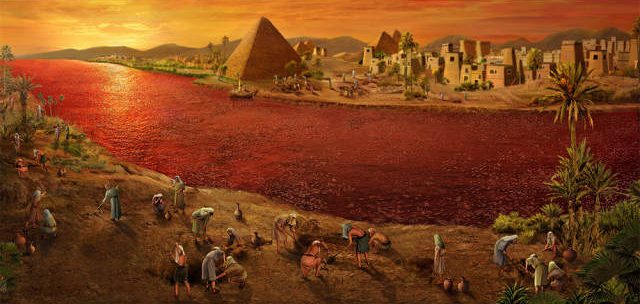
20 Moses and Aaron did as the Lord commanded. In the sight of Pharaoh and in the sight of his servants he lifted up the staff and struck the water in the Nile, and all the water in the Nile turned into blood. 21 And the fish in the Nile died, and the Nile stank, so that the Egyptians could not drink water from the Nile. There was blood throughout all the land of Egypt. 22 But the magicians of Egypt did the same by their secret arts. So Pharaoh’s heart remained hardened, and he would not listen to them, as the Lord had said. 23 Pharaoh turned and went into his house, and he did not take even this to heart. 24 And all the Egyptians dug along the Nile for water to drink, for they could not drink the water of the Nile.

25 Seven full days passed after the Lord had struck the Nile. – Exodus 7:14-25 ESV

Things were about to get busy for God’s two elderly representatives. At an age when most men would be slowing down, Moses and Aaron had been assigned the God-ordained task of delivering His people from their captivity in Egypt. And this formidable responsibility wasn’t made any easier by the recalcitrant Pharaoh. As God had warned, the king of Egypt would do everything in his considerable power to keep the Israelites enslaved.

God was not surprised by Pharaoh’s actions. He had actually predicted it and claimed that He was the motivating factor behind Pharaoh’s stubborn resistance.  The Almighty knew the king’s heart and was using his predispositions and natural tendencies to bring about the preordained plan for Israel’s exodus from Egypt. Pharaoh’s “hard heart” would play a major role in God’s redemptive plan.

Having enacted their first sign in the presence of Pharaoh, Moses and Aaron were given instructions to take things to the next level. Araon’s staff turning into a snake was a mere parlor trick compared to what God was about to do. Pharaoh’s arrogant refusal to accept the terms of God’s demands would be met with severe judgment. God was going to strike at the heart of Egypt’s economic, religious, and cultural life: The Nile.

This vast river was the source of all life for the people of Egypt. Its annual flood cycle ensured the dissemination of nutrient-rich silt on the shorelines, providing fertility and prosperity to the land. The Egyptians believed the Nile to be a gift of the gods and they associated a number of their deities with the river itself.

There were Apis and Isis, the god and goddess of the Nile. Khnum was considered the guardian of the Nile. There were at least two gods who were deemed responsible for the Nile’s flooding. The first was the crocodile-like deity Sobek, whose domain consisted of the Nile’s waters. The second was Hapi, who was sometimes referred to as “Lord of the River Bringing Vegetation.” Because of his role in the annual flood cycle, Hapi was also considered a god of fertility.

It makes perfect sense that God would choose this revered natural resource to be the site of His first judgment. He sent Moses and Aaron to meet Pharaoh on the banks of the river the next morning. The omniscient God of Israel foreknew that Pharaoh would be making a morning visit to the river’s banks and He instructed His two agents to get there early and be ready to confront the king upon his arrival.

Moses was instructed to have Aaron take the same staff that God had transformed into a snake and use it to strike the waters of the Nile. But before doing so, Moses was to deliver to Pharaoh the following short speech from God.

So this is what the Lord says: “I will show you that I am the Lord.” Look! I will strike the water of the Nile with this staff in my hand, and the river will turn to blood. The fish in it will die, and the river will stink. The Egyptians will not be able to drink any water from the Nile.’” – Exodus 7:17-18 NLT

It is likely that Pharaoh was accompanied by a royal retinue of armed guards, servants, and administrative officials. Perhaps his visit had religious overtones and there were priests to assist him in making sacrifices to one or more of the gods of the Nile.

But at the sight of these two elderly Hebrews standing on the bank of the river, Pharaoh must have been more than a bit surprised and irritated. And to hear them pronounce their far-fetched plan to turn the river to blood must have left him bemused. Who did these men think they were? Did they not know they were dealing with one of the most powerful men in the world?

But Moses and Aaron did as God had instructed them.

As Pharaoh and all of his officials watched, Aaron raised his staff and struck the water of the Nile. Suddenly, the whole river turned to blood! The fish in the river died, and the water became so foul that the Egyptians couldn’t drink it. There was blood everywhere throughout the land of Egypt. – Exodus 7:20-21 NLT

In a matter of minutes, the entire river had been transformed into blood. This supernatural display of God’s power was meant to demonstrate His superiority and sovereignty. The God of creation was giving irrefutable evidence of His status as the one true God. Hapi, Khnum, Apis, and Isis were all defenseless before the majesty and might of Jehovah. They could not protect their own domain from the devastating judgment of the God of the Hebrews. And all Pharaoh could do was stand back and watch.

According to the text, the effects of this miracle were not localized but widespread throughout Egypt, impacting “all its rivers, canals, ponds, and all the reservoirs” (Exodus 7:19 NLT). Every source of drinking water was affected. And, not only that, the fish that served as a primary source of food for the Egyptians were wiped out as a result of this nationwide catastrophe. 

In what will become a rather strange and repeated scene, Pharaoh’s magicians responded to this devastating display of God’s judgment by replicating it. In other words, they mimicked the actions of God and actually made matters worse. If they had the power to turn water into blood, why did they not choose to do the opposite? Once again, God seems to be using these so-called magicians as instruments of His sovereign will. It is ironic that they display similar power to that of Moses and Aaron, but they cannot repair or resist what God’s agents have done. They can only replicate it and increase the suffering of their own people.

Seven days would pass. During that time, Pharaoh would go about his business as if nothing had happened. He refused to think about the devastation brought upon his nation by the God of Moses and Aaron. Safely ensconced in his palace, he was unaware that his people were busy digging wells in a vain attempt to find fresh drinking water.  And little did Pharaoh know that this was just the beginning. The book of Psalms records the litany of miraculous judgments that were headed Pharaoh’s way.

They did not remember his power
    or the day when he redeemed them from the foe,
when he performed his signs in Egypt
    and his marvels in the fields of Zoan.
He turned their rivers to blood,
    so that they could not drink of their streams.
He sent among them swarms of flies, which devoured them,
    and frogs, which destroyed them.
He gave their crops to the destroying locust
    and the fruit of their labor to the locust.
He destroyed their vines with hail
    and their sycamores with frost.
He gave over their cattle to the hail
    and their flocks to thunderbolts.
He let loose on them his burning anger,
    wrath, indignation, and distress,
    a company of destroying angels.
He made a path for his anger;
    he did not spare them from death,
    but gave their lives over to the plague.
He struck down every firstborn in Egypt,
    the firstfruits of their strength in the tents of Ham.
Then he led out his people like sheep
    and guided them in the wilderness like a flock. – Psalm 78:42-52 ESV

The blood-filled Nile was only the precursor to so much more that God had planned for the nation of Egypt. And when He was done, they would know that He alone was Lord.

English Standard Version (ESV) The Holy Bible, English Standard Version. ESV® Permanent Text Edition® (2016). Copyright © 2001

New Living Translation (NLT) Holy Bible, New Living Translation, copyright © 1996, 2004, 2015 by Tyndale House Foundation. Used by permission of Tyndale House Publishers Inc., Carol Stream, Illinois 60188. All rights reserved.

God’s Octogenarian Tag Team

1 And the Lord said to Moses, “See, I have made you like God to Pharaoh, and your brother Aaron shall be your prophet. You shall speak all that I command you, and your brother Aaron shall tell Pharaoh to let the people of Israel go out of his land. But I will harden Pharaoh’s heart, and though I multiply my signs and wonders in the land of Egypt, Pharaoh will not listen to you. Then I will lay my hand on Egypt and bring my hosts, my people the children of Israel, out of the land of Egypt by great acts of judgment. The Egyptians shall know that I am the Lord, when I stretch out my hand against Egypt and bring out the people of Israel from among them.” Moses and Aaron did so; they did just as the Lord commanded them. Now Moses was eighty years old, and Aaron eighty-three years old, when they spoke to Pharaoh.

Then the Lord said to Moses and Aaron, “When Pharaoh says to you, ‘Prove yourselves by working a miracle,’ then you shall say to Aaron, ‘Take your staff and cast it down before Pharaoh, that it may become a serpent.’” 10 So Moses and Aaron went to Pharaoh and did just as the Lord commanded. Aaron cast down his staff before Pharaoh and his servants, and it became a serpent. 11 Then Pharaoh summoned the wise men and the sorcerers, and they, the magicians of Egypt, also did the same by their secret arts. 12 For each man cast down his staff, and they became serpents. But Aaron’s staff swallowed up their staffs. 13 Still Pharaoh’s heart was hardened, and he would not listen to them, as the Lord had said. – Exodus 7:1-13 ESV

When God first commissioned Moses for his new role as the deliverer of the people of Israel, Moses tried to use his lack of speaking skills as an excuse for turning down the position. But God responded by adding Aaron, Moses’ older brother, to the team. The two of them would become the perfect pair, with Moses serving as the silent, but highly powerful partner and Aaron performing the role of spokesman. God described their partnership this way:

“You shall speak to him [Aaron] and put the words in his mouth, and I will be with your mouth and with his mouth and will teach you both what to do. He shall speak for you to the people, and he shall be your mouth, and you shall be as God to him. And take in your hand this staff, with which you shall do the signs.” – Exodus 4:15-17 ESV

Moses would be responsible for passing on to Aaron any messages he received from the Lord, then Aaron would vocalize God’s words to the appropriate party. But all signs and wonders would be Moses’ purview. With his staff in hand, he would enact any and all miracles ordered by God to validate the message and the messengers. Even before Moses left Midian, God told him, “When you go back to Egypt, see that you do before Pharaoh all the miracles that I have put in your power. But I will harden his heart, so that he will not let the people go” (Exodus 4:21 ESV).

Upon their arrival in Egypt, Moses and his brother had run into an apparent roadblock in their efforts to deliver the people of Israel. Things had started out well when the Hebrews had received the two men and their message with open arms. But Pharaoh had proved to be a hard nut to crack, rejecting their request to allow the Israelites to go into the wilderness to worship their God. And Pharaoh subsidized his rejection by increasing the workload of the Hebrews, whom he viewed as little more than captive immigrant workers. With their hopes dashed and their daily lives marked by suffering and pain, the Israelites lashed out at Moses and Aaron, blaming them for their circumstances. This led Moses to take out his frustration on God.

“O Lord, why have you done evil to this people? Why did you ever send me? For since I came to Pharaoh to speak in your name, he has done evil to this people, and you have not delivered your people at all.” – Exodus 5:22-23 ESV

But none of this should have come as a shock to Moses. God had warned him that Pharaoh would not be cooperative. What is interesting to note is that words were never going to be the means by which God accomplished His will in Egypt. Pharaoh was never going to be coerced or convinced by words alone. And while Moses had been worrying about his lack of rhetorical skills, he should have listened to what God had said.

“When you go back to Egypt, see that you do before Pharaoh all the miracles that I have put in your power. But I will harden his heart, so that he will not let the people go. Then you shall say to Pharaoh, ‘Thus says the Lord, Israel is my firstborn son, and I say to you, “Let my son go that he may serve me.” If you refuse to let him go, behold, I will kill your firstborn son.’” – Exodus 4:21-23 ESV

The miracles would be the means by which God orchestrated the release of His people. And God told Moses that one particular miracle would prove to be the deciding factor in persuading Pharaoh to let God’s people go.

As chapter seven opens, the roles of Aaron and Moses remain the same. Aaron will continue to act as the mouthpiece for the pair, while Moses performs all the signs. But God informs them that even all the signs and wonders Moses displays before Pharaoh will do nothing to change his mind.

“I will harden Pharaoh’s heart, and though I multiply my signs and wonders in the land of Egypt, Pharaoh will not listen to you.” – Exodus 7:3-4 ESV

In a sense, God is letting Moses know that the initial signs he performs will appear as little more than cheap parlor tricks to Pharaoh. He will be impressed but not enough to change his mind. And as this chapter reveals, the magicians of Egypt will replicate many of the signs that Moses performs, further negating their influence. But God told Moses that another set of signs and wonders was coming.

“Then I will lay my hand on Egypt and bring my hosts, my people the children of Israel, out of the land of Egypt by great acts of judgment. The Egyptians shall know that I am the Lord, when I stretch out my hand against Egypt and bring out the people of Israel from among them.” – Exodus 7:4-5 ESV

These “great acts of judgment” were going to take things to a whole new level. And God wanted His two messengers to know that the simple, yet impressive signs He had instructed Moses to perform were just the beginning. There was far more to come.

But God instructed them to go before Pharaoh and do just as He had commanded them to do. Pharaoh was going to demand that they provide some kind of sign to prove that they were truly representatives of the Hebrews’ deity.

“When Pharaoh says to you, ‘Prove yourselves by working a miracle,’ then you shall say to Aaron, ‘Take your staff and cast it down before Pharaoh, that it may become a serpent.’” – Exodus 7:9 ESV

In this instance, it would be Aaron who did double duty, speaking to Pharaoh but also performing the sign from God. When they appeared before Pharaoh, he demanded a sign just as God had predicted, and Aaron did as God commanded. He threw his staff to the ground and it became a snake. But Aaron and Moses must have been shocked when the Egyptian magicians quickly replicated the sign by turning their own staffs into snakes. The text provides no explanation for how the magicians managed to do what they did. But there are only a few options available. Either these men did what they did by the power of Satan or God did it. The second choice makes the most sense. Since the staff of Aaron possessed no power in and of itself, it had to be God who made this miraculous transformation possible. The sign was His idea. So, when the magicians threw down their staffs, God displayed His power yet again, and the magicians were probably amazed by what they saw. It is likely that they never expected their efforts to be successful. But the real demonstration of God’s power was in what happened next.

But Aaron’s staff swallowed up their staffs. – Exodus 7:12 ESV

This powerful demonstration of God’s power would have validated Aaron as His spokesman. God was the one who turned all the staffs into snakes and He was the one who gave Aaron’s staff primacy over all the others. God was declaring Aaron and Moses to be His official representatives. But Pharaoh remained unimpressed and unwavering in his commitment to deny the Israelites their freedom.

Still Pharaoh’s heart was hardened, and he would not listen to them, as the Lord had said. – Exodus 7:13 ESV

Now the stage was set. Pharaoh knew he was dealing with two men who had true power. Yet, he remained just as fervent in his desire to keep the Israelites in their role as free slave labor. He was not about to give up this valuable asset, even when faced with Aaron’s display of magical power. It was going to take a lot more than that to change his heart and God knew it. Not only that, God had ordained it.

But as this scene in the royal palace comes to a close, it is essential that we not gloss over the small detail that Moses discloses in the narrative.

Now Moses was eighty years old, and Aaron eighty-three years old, when they spoke to Pharaoh. – Exodus 7:7 ESV

As the old adage states, these two men were not spring chickens. They would be considered old in just about any cultural context, but in that day and age, they would have been ancient. Moses spent 40 years of his life in Pharaoh’s court before fleeing to Midian. There, he lived another 40 years in relative obscurity and anonymity. And at the ripe old age of 80, God called Moses to serve as the deliverer of His people. This octogenarian was destined to be the God-ordained savior of the Israelite people. He had been for this role and God had planned for his starting date to begin at age 80.

“D. L. Moody wittily said that Moses spent forty years in Pharaoh’s court thinking he was somebody; forty years in the desert learning he was nobody; and forty years showing what God can do with somebody who found out he was nobody.” – Bernard Ramm, His Way Out

I can’t help but think of the movie, “Grumpy Old Men,” starring Jack Lemmon and Walter Matthau. It is difficult not to see Moses and Aaron as two crusty old senior citizens with bad backs, diminished hearing, and poor eyesight. When they should have been playing canasta in the old folks’ home, they were serving as God’s emissaries in the court of Pharaoh. They would not have been impressive to look at. Their presence would not have struck fear into Pharaoh. But these two unlikely candidates had been chosen by God to carry out His sovereign plan for delivering His people. And, with His help, they would prove more than adequate for the task.

English Standard Version (ESV) The Holy Bible, English Standard Version. ESV® Permanent Text Edition® (2016). Copyright © 2001

New Living Translation (NLT) Holy Bible, New Living Translation, copyright © 1996, 2004, 2015 by Tyndale House Foundation. Used by permission of Tyndale House Publishers Inc., Carol Stream, Illinois 60188. All rights reserved.

God Knows Best

1 But the Lord said to Moses, “Now you shall see what I will do to Pharaoh; for with a strong hand he will send them out, and with a strong hand he will drive them out of his land.”

God spoke to Moses and said to him, “I am the Lord. I appeared to Abraham, to Isaac, and to Jacob, as God Almighty, but by my name the Lord I did not make myself known to them. I also established my covenant with them to give them the land of Canaan, the land in which they lived as sojourners. Moreover, I have heard the groaning of the people of Israel whom the Egyptians hold as slaves, and I have remembered my covenant. Say therefore to the people of Israel, ‘I am the Lord, and I will bring you out from under the burdens of the Egyptians, and I will deliver you from slavery to them, and I will redeem you with an outstretched arm and with great acts of judgment. I will take you to be my people, and I will be your God, and you shall know that I am the Lord your God, who has brought you out from under the burdens of the Egyptians. I will bring you into the land that I swore to give to Abraham, to Isaac, and to Jacob. I will give it to you for a possession. I am the Lord.’” Moses spoke thus to the people of Israel, but they did not listen to Moses, because of their broken spirit and harsh slavery.

10 So the Lord said to Moses, 11 “Go in, tell Pharaoh king of Egypt to let the people of Israel go out of his land.” 12 But Moses said to the Lord, “Behold, the people of Israel have not listened to me. How then shall Pharaoh listen to me, for I am of uncircumcised lips?” 13 But the Lord spoke to Moses and Aaron and gave them a charge about the people of Israel and about Pharaoh king of Egypt: to bring the people of Israel out of the land of Egypt. – Exodus 6:1-13 ESV

Verse one appears to contain God’s immediate response to Moses’ little diatribe recorded in the closing verses of chapter five.

“O Lord, why have you done evil to this people? Why did you ever send me? For since I came to Pharaoh to speak in your name, he has done evil to this people, and you have not delivered your people at all.” – Exodus 5:22-23 ESV

After allowing Moses to vent his frustration, God simply stated, “Now you shall see what I will do to Pharaoh; for with a strong hand he will send them out, and with a strong hand he will drive them out of his land” (Exodus 6:1 NLT).

God feels no obligation to defend Himself to Moses. So, rather than answer His messenger’s accusations, God states His intentions. But this ESV translation seems to give Pharaoh a bit too much credit in the unfolding of God’s plan. At first glance, it appears as if Pharaoh is wielding all the power and authority. It will be Pharaoh’s strong hand that sends them out. It will be Pharaoh’s strong hand that drives them from his land. But the NET Bible translates this verse differently.

“Now you will see what I will do to Pharaoh, for compelled by my strong hand he will release them, and by my strong hand he will drive them out of his land.” – Exodus 6:1 NET

Notice how this translation puts all the focus on God. It better conveys the idea of God’s sovereignty and Pharaoh’s role as an instrument in His all-powerful hands. While either translation could be used, the second makes more sense considering the context.

The expression “with a strong hand” (וּבְיָד חֲזָקָה, uvyad khazaqah) could refer (1) to God’s powerful intervention (“compelled by my strong hand”) or (2) to Pharaoh’s forceful pursuit (“he will forcefully drive them out”). In Exodus 3:20 God has summarized what his hand would do in Egypt, and that is probably what is intended here, as he promises that Moses will see what God will do.– NET Bible Study Notes

It is likely that a time gap exists between verse one and verse two. It records another conversation between Moses and God that took place at a later date. In this encounter, God introduces Himself to Moses by a new name: Yahweh.

“I am Yahweh—‘the Lord.’ I appeared to Abraham, to Isaac, and to Jacob as El-Shaddai—‘God Almighty’—but I did not reveal my name, Yahweh, to them. And I reaffirmed my covenant with them. Under its terms, I promised to give them the land of Canaan, where they were living as foreigners.” – Exodus 6:2-4 NLT

Up to this point in the history of God’s people, God had revealed Himself by the name of El-Shaddai, which can be translated as “God Almighty.” When He spoke to the patriarch Abraham, God used this appellation to identify Himself. 

When Abram was ninety-nine years old, the Lord appeared to him and said, “I am El-Shaddai—‘God Almighty.’” – Genesis 17:1 NET

Now, centuries later, God was letting Moses know that He wanted to be referred to by a different name; a name Abraham, Isaac, and Jacob had never used. When God appeared to Moses at the scene of the burning bush, He revealed His name as,  I AM who I am” (Exodus 3:14 NLT).  Then He added, “Say this to the people of Israel: I AM has sent me to you” (Exodus 3:14 NLT).  But then God provided further clarification.

“Say this to the people of Israel: Yahweh, the God of your ancestors—the God of Abraham, the God of Isaac, and the God of Jacob—has sent me to you.

This is my eternal name,
    my name to remember for all generations.” – Exodus 3:15 NLT

The Hebrew word that is translated as “I am” is hāyâ. It can mean “to be.” In a sense, God was telling Moses, “I am the One who is.” He is the always-existing or eternal one. And from hāyâ, the name Yahweh was derived. This name speaks of God’s self-existence and self-sufficiency. He is dependent upon no one and yet, everyone and everything is completely dependent upon Him.

In future generations, the scribes would hold the name of God in such high esteem that they refused to write it. Instead, they replaced it with the term, “the LORD.”  This would become the most common designation when transcribing the name Yahweh in Scripture.  In this passage, God is letting His disgruntled messenger know that the self-existent Lord over all things was speaking to him. The same Yawheh who had established a covenant with Abraham and all his descendants was the one who was sovereignty ordaining every phase of Moses’ assignment.

The same God who made the covenant with Abraham was getting ready to fulfill the covenant through Moses.

I have heard the groaning of the people of Israel whom the Egyptians hold as slaves, and I have remembered my covenant. – Exodus 6:5 ESV

God heard and God remembered. This doesn’t suggest that God had somehow forgotten about His people. It simply means that He chose this point in time to fulfill the promises tied to His covenant with Abraham. Notice how many times God states, “I will.”

“I will bring you out from under the burdens of the Egyptians…” – vs 6

“I will deliver you from slavery to them…” – vs 6

“I will redeem you with an outstretched arm and with great acts of judgment…” – vs 7

“I will take you to be my people…” – vs 7

“I will be your God…” – vs 7

“I will bring you into the land that I swore to give to Abraham, to Isaac, and to Jacob. I will give it to you for a possession…” – vs 8

God was not declaring his intentions or sharing He hoped to accomplish. He was assuring Moses that each of these things was guaranteed to take place because He had ordained them and would bring them to fruition. He would do what He had promised to do – down to the last detail.

God commanded Moses to deliver these incredible promises to the people, which he did, but they didn’t receive them with open arms.

they did not listen to Moses, because of their broken spirit and harsh slavery. – Exodus 6:9 ESV

Faced with the prospect of making bricks without straw and having to endure increasingly more intense persecution from the Egyptians, the people of Israel viewed all this as little more than empty rhetoric. They had listened to Moses once and were not about to do it again. They were demoralized and devoid of hope. And all these lofty promises from Yahweh were of little use when there were brick quotas to meet and more harsh treatment to expect. What good were the promises of future deliverance and a land of their own if they were all going to die at the hands of the Egyptians?

Fully aware of the people’s rejection of His promises, God ordered Moses to appear before Pharaoh again and reiterate his previous request.

“…let the people of Israel go out of his land.” – Exodus 6:10 ESV

But Moses wasn’t too excited about reliving that experience. After all, he explained, “If my own people won’t listen to what I have to say, what hope do I have of persuading Pharaoh to change his mind?” He broke out his “I’m a lousy speaker” excuse in the hopes of convincing God to change His mind.

But the Lord spoke to Moses and Aaron and gave them orders for the Israelites and for Pharaoh, the king of Egypt. The Lord commanded Moses and Aaron to lead the people of Israel out of Egypt. – Exodus 6:13 NLT

God wasn’t accepting excuses or changing His mind. His plan was set in stone and His promises were guaranteed. While Moses may not have liked the way God’s plan was unfolding, he would eventually learn that everything was happening according to God’s sovereign will and according to God’s perfect timeline.

English Standard Version (ESV) The Holy Bible, English Standard Version. ESV® Permanent Text Edition® (2016). Copyright © 2001

New Living Translation (NLT) Holy Bible, New Living Translation, copyright © 1996, 2004, 2015 by Tyndale House Foundation. Used by permission of Tyndale House Publishers Inc., Carol Stream, Illinois 60188. All rights reserved.
From Bad to Worse

10 So the taskmasters and the foremen of the people went out and said to the people, “Thus says Pharaoh, ‘I will not give you straw. 11 Go and get your straw yourselves wherever you can find it, but your work will not be reduced in the least.’” 12 So the people were scattered throughout all the land of Egypt to gather stubble for straw. 13 The taskmasters were urgent, saying, “Complete your work, your daily task each day, as when there was straw.” 14 And the foremen of the people of Israel, whom Pharaoh’s taskmasters had set over them, were beaten and were asked, “Why have you not done all your task of making bricks today and yesterday, as in the past?”

15 Then the foremen of the people of Israel came and cried to Pharaoh, “Why do you treat your servants like this? 16 No straw is given to your servants, yet they say to us, ‘Make bricks!’ And behold, your servants are beaten; but the fault is in your own people.” 17 But he said, “You are idle, you are idle; that is why you say, ‘Let us go and sacrifice to the Lord.’ 18 Go now and work. No straw will be given you, but you must still deliver the same number of bricks.” 19 The foremen of the people of Israel saw that they were in trouble when they said, “You shall by no means reduce your number of bricks, your daily task each day.” 20 They met Moses and Aaron, who were waiting for them, as they came out from Pharaoh; 21 and they said to them, “The Lord look on you and judge, because you have made us stink in the sight of Pharaoh and his servants, and have put a sword in their hand to kill us.”

22 Then Moses turned to the Lord and said, “O Lord, why have you done evil to this people? Why did you ever send me? 23 For since I came to Pharaoh to speak in your name, he has done evil to this people, and you have not delivered your people at all.” – Exodus 5:10-23 ESV

When God appeared to Moses in the wilderness near Mount Horeb, He had revealed His knowledge of the Israelites’ plight in Egypt.

“I have surely seen the affliction of my people who are in Egypt and have heard their cry because of their taskmasters. I know their sufferings…” – Exodus 3:7 ESV

And God had assured Moses that He was ready to do something about their untenable situation.

“…I have come down to deliver them out of the hand of the Egyptians and to bring them up out of that land to a good and broad land, a land flowing with milk and honey…” – Exodus 3:8 ESV

Much to his surprise and initial dismay, Moses learned that he was to be the one God would use to bring about the deliverance of His people. After much debate and a great deal of delay, Moses finally gave in to God’s call and made the long journey back to Egypt. And he and his brother, Aaron, in obedience to God’s command, delivered His messages to the people of Israel and Pharaoh. But while the Israelites were thrilled with the news of God’s presence among them and His plan to deliver them, Pharaoh had a far less sanguine response to God’s plan. In fact, he was enraged at the audacity of these two nondescript and unimpressive Hebrews. How dare they walk into his palace and demand that he provide their fellow Israelites with a week off so they can worship their so-called God in the wilderness.

Rather than give in to Moses’ request, he decided to teach this upstart Hebrew a painful lesson. To who Moses who was boss, Pharaoh turned up the heat on the already suffering descendants of Abraham. Moses’ arrival had gotten their hopes up and they were expecting an immediate improvement in their circumstances. But, instead, their situation got exponentially worse.

One of their duties as an unpaid workforce for Pharaoh was to manufacture the bricks used in the many construction projects around the kingdom. This labor-intensive process was difficult enough, but now it was going to become even more time-consuming and wearying because Pharaoh denied them access to the straw that helped bind the clay together. As punishment for their request for time off, he ordered them to find their own straw. This would require additional time and effort, but the daily quota of bricks would remain unchanged.

On top of this, Pharaoh ordered the Egyptian slave masters and Hebrew foremen to show no mercy. They were to push the Israelites relentlessly. When the people fell behind and failed to meet their quotas, the Egyptians punished the Hebrew foremen.

And in time, the people began to lose hope. They were in a no-win situation and there seemed to be no other recourse than to appeal to Pharaoh for mercy.

So the Israelite foremen went to Pharaoh and pleaded with him. “Please don’t treat your servants like this,” they begged. “We are given no straw, but the slave drivers still demand, ‘Make bricks!’ We are being beaten, but it isn’t our fault! Your own people are to blame!” – Exodus 5:15-16 NLT

Pharaoh responded, but not with mercy. He accused them of being lazy and trying to use their request to worship their God as an excuse for shirking their duties. And he would have none of it. As far as he was concerned, their whole reason for being was to work, not to worship. Their job was to sacrifice on Pharaoh’s behalf, not on behalf of some impotent deity from a backwater region like Canaan.

So, Pharaoh reiterated his expectation that they meet their daily quota of bricks or suffer the consequences. This left the Hebrew foremen in an even deeper state of despair as they exited the royal palace. Now, they had to go back and break this less-than-encouraging news to their coworkers. But on the way, they ran into Moses and Aaron. And it would not prove to be a well-timed or particularly propitious encounter for the two unsuspecting brothers.

Full of pent-up anger and frustration, the foremen unleashed their vitriol on these two relative strangers, blaming them for the recent spate of troubles.

“May the Lord judge and punish you for making us stink before Pharaoh and his officials. You have put a sword into their hands, an excuse to kill us!” – Exodus 5:21 NLT

As bad as things had been before Moses and Aaron arrived on the scene, the situation in Egypt had taken a decidedly dark turn since their unexpected arrival. These two men had brought down the wrath of Pharaoh and the full weight of the Egyptian government apparatus. The atmosphere had become oppressive and foreboding. And now, the disgruntled and disillusioned Israelites were turning their anger on God’s two messengers.

Moses’ worst nightmare had come true. He had feared this very thing happening. When God had first announced His plan to use Moses as His deliverer, the surprised shepherd had argued, “behold, they will not believe me or listen to my voice, for they will say, ‘The Lord did not appear to you’” (Exodus 4:1 ESV). He was already convinced that this mission was doomed to failure. Now, his suspicions had become a very painful and personal reality. This led him to cry out to God in despair.

“Why have you brought all this trouble on your own people, Lord? Why did you send me? Ever since I came to Pharaoh as your spokesman, he has been even more brutal to your people. And you have done nothing to rescue them!” – Exodus 5:22-23 NLT

From his perspective, nothing had turned out well. He had left Midian and returned to Egypt only to find his own people ready to run him out of town on a rail. And, driven by his frustration and fear, Moses shook his fist in the face of God and dared to accuse Him of a failure to do the right thing. God had claimed that He was going to “deliver them out of the hand of the Egyptians” (Exodus 3:8 ESV) but instead, the whip of Egyptian slave masters had fallen on the backs of the Hebrew foremen. And now the anger of the foremen had come down hard on Moses and Aaron.

But God was not done. He had not promised immediate deliverance. And God had warned Moses that Pharaoh was going to reject their request to release the people of Israel. This was going to prove to be an epic battle of wills – the will of Pharaoh against the sovereign will of God Almighty. And though Moses was doubtful of the outcome, God had everything under full control. Yes, things were going to get worse before they got better. The circumstances under which the Israelites lived were going to become unbearable but that did not mean that God’s plan was fallible. His will would be done. The deliverance He promised would be forthcoming. And Moses was going to learn the invaluable and timeless lesson of waiting on God.

Therefore the Lord waits to be gracious to you,
    and therefore he exalts himself to show mercy to you.
For the Lord is a God of justice;
    blessed are all those who wait for him. – Isaiah 30:18 ESV

English Standard Version (ESV) The Holy Bible, English Standard Version. ESV® Permanent Text Edition® (2016). Copyright © 2001

New Living Translation (NLT) Holy Bible, New Living Translation, copyright © 1996, 2004, 2015 by Tyndale House Foundation. Used by permission of Tyndale House Publishers Inc., Carol Stream, Illinois 60188. All rights reserved.

Just When Things Were Looking Up

1 Afterward Moses and Aaron went and said to Pharaoh, “Thus says the Lord, the God of Israel, ‘Let my people go, that they may hold a feast to me in the wilderness.’” But Pharaoh said, “Who is the Lord, that I should obey his voice and let Israel go? I do not know the Lord, and moreover, I will not let Israel go.” Then they said, “The God of the Hebrews has met with us. Please let us go a three days’ journey into the wilderness that we may sacrifice to the Lord our God, lest he fall upon us with pestilence or with the sword.” But the king of Egypt said to them, “Moses and Aaron, why do you take the people away from their work? Get back to your burdens.” And Pharaoh said, “Behold, the people of the land are now many, and you make them rest from their burdens!” The same day Pharaoh commanded the taskmasters of the people and their foremen, “You shall no longer give the people straw to make bricks, as in the past; let them go and gather straw for themselves. But the number of bricks that they made in the past you shall impose on them, you shall by no means reduce it, for they are idle. Therefore they cry, ‘Let us go and offer sacrifice to our God.’ Let heavier work be laid on the men that they may labor at it and pay no regard to lying words.” – Exodus 5:1-9 ESV

Chapter four ends with the promising statement, “And the people believed; and when they heard that the Lord had visited the people of Israel and that he had seen their affliction” (Exodus 4:31 ESV). Moses and Aaron had presented God’s message word for word.

“Yahweh, the God of your ancestors—the God of Abraham, Isaac, and Jacob—has appeared to me. He told me, ‘I have been watching closely, and I see how the Egyptians are treating you. I have promised to rescue you from your oppression in Egypt. I will lead you to a land flowing with milk and honey…’” – Exodus 3:16-17 NLT

Then, as God had commanded, they backed up their words with actions, performing the signs Moses had received in the wilderness of Horeb. And evidently, their efforts proved successful in convincing the Israelites to believe that Jehovah had heard their cries and had come to deliver them from their miserable conditions in Egypt. Encouraged by what they heard and saw, “they bowed their heads and worshiped” (Exodus 3:31 ESV).

Having faithfully communicated God’s message to the people of Israel, Moses’ next stop was the royal throne room, where he and his brother hand-delivered an ultimate to Pharaoh.

“This is what the Lord, the God of Israel, says: Let my people go so they may hold a festival in my honor in the wilderness.” – Exodus 5:1 NLT

Moses and Aaron were sticking with the plan and, so far, everything was happening just as God had said it would.

“The elders of Israel will accept your message. Then you and the elders must go to the king of Egypt and tell him, ‘The Lord, the God of the Hebrews, has met with us. So please let us take a three-day journey into the wilderness to offer sacrifices to the Lord, our God.’ – Exodus 3:18 NLT

But God had already warned Moses that Pharaoh would prove to be a hard nut to crack. This powerful, self-deified monarch was not going to play along with Moses’ request. In fact, he would find the very thought of it ridiculous and not worthy of consideration. But even that was part of God’s sovereign plan.

“I know that the king of Egypt will not let you go unless a mighty hand forces him. So I will raise my hand and strike the Egyptians, performing all kinds of miracles among them. Then at last he will let you go…” – Exodus 3:19-20 NLT

And as if reading a script written by the hand of God, Pharaoh responded, “Is that so?…and who is the Lord? Why should I listen to him and let Israel go? I don’t know the Lord, and I will not let Israel go” (Exodus 5:2 NLT). Overflowing with hubris, Pharaoh mocked his two visitors and belittled the status of this Jehovah (Yᵊhōvâ) who dared to order him around.

Interestingly enough, back when God called Moses to serve as His deliverer, Moses had expressed concern that the Israelites might know who Jehovah was.

“If I go to the people of Israel and tell them, ‘The God of your ancestors has sent me to you,’ they will ask me, ‘What is his name?’ Then what should I tell them?” – Exodus 3:13 NLT

But according to the opening verses of this chapter, it was not the Hebrews who needed a primer on Jehovah’s identity, it was Pharaoh. And, in response to Pharaoh’s sarcastic inquiry, “who is the Lord?”, Moses simply stated, “The God of the Hebrews” (Exodus 5:3 NLT). He uses the generic term ĕlōhîm, which is a Hebrew word used of Jehovah, but also of all other gods. But Moses makes it clear that he is talking about a very specific “God,” the God of the Hebrews. The one true God who created the heavens and the earth.

Moses reiterates his request for Pharaoh to permit the Israelites a take what would be a six-day break from their work so that they can travel into the wilderness and worship their God. In a sense, he was asking Pharaoh to agree to unpaid time off for all Hebrew workers. But he insisted this was not so they could go on holiday, but so that they might worship their God. And then he added a previously undisclosed bit of information.

“If we don’t, he will kill us with a plague or with the sword.” – Exodus 5:3 NLT

Moses was insisting that they were obligated to obey the commands of their God. If they refused, Pharaoh could end up losing all his laborers, not just for six days, but for good. The ball was in Pharaoh’s court. He could accommodate Moses’ request and suffer a drop in productivity for about a week, or he could refuse and watch his primary labor force get wiped off the face of the earth. It was up to him.

After 400 years, the Egyptians had become familiar with the strange religious rites of the Israelites. They would have known that the offerings they made to their God involved animal sacrifices, and the Egyptians considered many of those animals to be sacred. They believed their gods manifested themselves through these creatures, and the idea of the Israelites sacrificing bulls and goats within the borders of Egypt would have appalled and disgusted them. That is why Moses asked permission to journey three days outside of the borders of Egypt.

But Pharaoh was not buying what Moses was selling. He was not about to release the Israelites into the wilderness for any reason or for any length of time, for fear that they might try to escape. So, Pharaoh doubled down on his previous answer and rebuked his two visitors for wasting his time and filling the heads of the Israelites with false hope.

“Moses and Aaron, why are you distracting the people from their tasks? Get back to work! Look, there are many of your people in the land, and you are stopping them from their work.” – Exodus 5:4 NLT

Having drawn a line in the sand, Pharaoh upped the ante and ordered his Egyptian slave drivers to make the lives of the Israelites worse than before. Even the Hebrew foremen who oversaw the chain gangs of laborers were ordered to drive their fellow Israelites harder than before. To increase their suffering and get their mind off of the messages of Moses and Aaron, Pharaoh ordered that all brick production be done without the benefit of straw. It wasn’t that the Israelites were permitted to make strawless bricks, but that they now had to gather the hay and stubble on their own. It added another layer of back-breaking labor to their already difficult task.

Pharaoh concluded that the Israelites were lazy and easily distracted by Moses’ offer of a week off from work to worship in the wilderness. He was going to teach them a valuable and painful lesson they would not soon forget.

“Load them down with more work. Make them sweat! That will teach them to listen to lies!” – Exodus 5:9 NLT

It doesn’t take a psychologist to deduce that this treatment was going to produce an adverse reaction among the people of God. They had been pumped by Moses’ announcement that Jehovah had heard their cries. They were looking forward to seeing how God was going to improve their lot in life. Now, things had taken a very dark turn for the worse. Rather than experiencing deliverance, their pain and suffering had actually increased. And it wouldn’t take them long to decide that they had been far better off before Moses and his brother showed up on their doorstep.

But little did the Israelites know that this was all part of God’s sovereign plan. Their God was not up in heaven wringing His hands in worry. He had not been caught off guard by Pharaoh’s harsh reaction. God had known all along that this would be Pharaoh’s response. It was built into the whole plan and was part of the sequence of events that would ultimately lead to the release of the Israelites and the judgment of the Egyptians.

English Standard Version (ESV) The Holy Bible, English Standard Version. ESV® Permanent Text Edition® (2016). Copyright © 2001

New Living Translation (NLT) Holy Bible, New Living Translation, copyright © 1996, 2004, 2015 by Tyndale House Foundation. Used by permission of Tyndale House Publishers Inc., Carol Stream, Illinois 60188. All rights reserved.

A Hard Heart is Not Difficult for God

18 Moses went back to Jethro his father-in-law and said to him, “Please let me go back to my brothers in Egypt to see whether they are still alive.” And Jethro said to Moses, “Go in peace.” 19 And the Lord said to Moses in Midian, “Go back to Egypt, for all the men who were seeking your life are dead.” 20 So Moses took his wife and his sons and had them ride on a donkey, and went back to the land of Egypt. And Moses took the staff of God in his hand.

21 And the Lord said to Moses, “When you go back to Egypt, see that you do before Pharaoh all the miracles that I have put in your power. But I will harden his heart, so that he will not let the people go. 22 Then you shall say to Pharaoh, ‘Thus says the Lord, Israel is my firstborn son, 23 and I say to you, “Let my son go that he may serve me.” If you refuse to let him go, behold, I will kill your firstborn son.’” – Exodus 4:18-23 ESV

Moses finally determines to accept the Lord’s commission and return to Egypt, but when he informs his father-in-law of his intentions, his words reflect a tone of pessimism.

“Let me go, so that I may return to my relatives in Egypt and see if they are still alive.” – Exodus 4:18 NLT

It almost sounds as if Moses is expecting the worst when he returns. But it is more likely that he is trying to appeal to the heart of Jethro. After all, his father-in-law is a family man and will understand if Moses simply wants to return to check on the well-being of his relatives. This appeal will also help to convince Jethro to allow his daughter and two grandsons to make the journey back with Moses.

Having gained Jethro’s permission, Moses made plans for the long journey home, but not before God informed him that it was safe to return.

“Go back to Egypt, because all the men who were seeking your life are dead.” – Exodus 4:19 NLT

Evidently, Moses still harbored reservations about going back to the place where he had murdered an Egyptian in cold blood. As far as he knew, the bounty on his head was still in effect and he would be arrested as soon as he set foot in Egypt. But God graciously informed him that the statute of limitations had expired because all those who sought him were dead. Moses could no longer use that as an excuse for delaying his return.

Before Moses loaded his wife and sons on a donkey, he received one final order from God that fully summarized his commission.

“When you go back to Egypt, see that you do before Pharaoh all the wonders I have put under your control. But I will harden his heart and he will not let the people go. You must say to Pharaoh, ‘This is what the Lord has said, “Israel is my son, my firstborn,  and I said to you, ‘Let my son go that he may serve me,’ but since you have refused to let him go, I will surely kill your son, your firstborn!”’” – Exodus 4:21-23 NLT

Moses had his marching orders and they were far from encouraging. God basically told His servant that he would face stiff opposition. Pharaoh was not going to be like what Moses had to say. In fact, he was going to refuse any and all requests to let the people of Israel leave Egypt. And God let Moses know that Pharaoh’s stubborn resistance would be part of His sovereign plan for Israel’s deliverance. God was going to “harden his heart.” This phrase will be used repeatedly throughout the book of Exodus, in order to inform the reader that the entire narrative arc of the story has been authored by God. Though Pharaoh is a powerful figure, he is just another character in God’s divine drama of deliverance.

God is not suggesting that Pharaoh will be a helpless victim of His sovereign will. The king of Egypt will not be subjected to some kind of divine mind control that forces him to function in a robotic, trancelike state. Pharaoh will have full access to all of his mental faculties, and will willingly decide to oppose the will of God. On several occasions, it will become clear that Pharaoh is operating according to his own stubborn will.

But when Pharaoh saw that there was a respite, he hardened his heart and would not listen to them, as the Lord had said. – Exodus 8:15 ESV

But Pharaoh hardened his heart this time also, and did not let the people go. – Exodus 8:32 ESV

In a sense, God is using the prideful and arrogant nature of Pharaoh to accomplish His will. God is not forcing Pharaoh to do anything. He is simply taking advantage of what He knows to be a weakness in the life of this godless, pagan king. By having Moses make the request for Israel’s release, God is hardening Pharaoh’s heart because He already knows the king will reject that request. God could soften Pharaoh’s heart and make him amenable to Moses’ overtures, but that would not provide the proper environment in which to demonstrate His power and authority to the people of Israel.

But it seems clear from the text that God hardened Pharaoh’s heart.

But the Lord hardened the heart of Pharaoh, and he did not listen to them, as the Lord had spoken to Moses. – Exodus 9:12 ESV

But the Lord hardened Pharaoh’s heart, and he did not let the people of Israel go. – Exodus 10:20 ESV

But the Lord hardened Pharaoh’s heart, and he would not let them go. – Exodus 10:27 ESV

Yet, once again, this seems to be an indication that God is allowing Pharaoh to operate according to his own moral compass. Pharaoh was simply doing what he would normally and naturally do, without any interference from God. Without God’s assistance, Pharaoh would be incapable of responding any other way. In that sense, God hardened Pharaoh’s heart by refusing to intervene. God could have provided Pharaoh with the capacity to behave in contrast to his normal, sinful disposition, but that would not have accomplished the plan for Israel’s release.

No man or woman can display heart-motivated behavior in keeping with God’s will without God’s help. In the book of Ezekiel, God informs His own chosen people that their ability to obey His laws and statutes will be impossible until He has given them the ability to do so. But one day, He will do just that.

“I will give you a new heart, and a new spirit I will put within you. And I will remove the heart of stone from your flesh and give you a heart of flesh. And I will put my Spirit within you, and cause you to walk in my statutes and be careful to obey my rules.” – Ezekiel 36:26-27 ESV

The book of 1 Samuel recalls a scene in which the Philistines had stolen to Ark of the Covenant from Israel. This sacred object was integral to Israel’s worship of Yahweh because it contained the mercy seat, where God’s glory dwelt. To convince the Philistines to return the ark, God “terrified and afflicted them with tumors, both Ashdod and its territory.” (1 Samuel 5:6 ESV). In a panic, the people of Ashdod shipped the ark to the nearby city of Gath, “But after they had brought it around, the hand of the Lord was against the city, causing a very great panic, and he afflicted the men of the city, both young and old, so that tumors broke out on them” (1 Samuel 5:9 ESV). 

Like a real-life game of hot potato, the Gathites sent the ark to another neighboring Philistine city. But when it arrived in Ekron, the same thing happened.

…there was a deathly panic throughout the whole city. The hand of God was very heavy there. The men who did not die were struck with tumors, and the cry of the city went up to heaven. – 1 Samuel 5:11-12 ESV

In a heightened state of panic, the Philistines sought the wisdom of their priests and diviners, hoping for a solution to their growing problem. Their advice was to send the ark back to Israel. Then they added this interesting word of warning.

“Why should you harden your hearts as the Egyptians and Pharaoh hardened their hearts? After he had dealt severely with them, did they not send the people away, and they departed?” – 1 Samuel 6:6 ESV

The report of God’s long-past dealings with Pharaoh and the Egyptian people had become legendary. And these pagan priests warned their people not to follow their example. Because the God of the Israelites would eventually get His way.

In his letter to the believers in Rome, Paul uses the story of Exodus as a lesson on God’s sovereign will. His main point is that God never operates unjustly. All that He does is good, righteous, and in order to accomplish His divine will. God can sovereignly choose to show mercy on whom He wills. It is not based on man’s merit or effort. And then Paul uses Pharaoh as an example.

For the Scripture says to Pharaoh, “For this very purpose I have raised you up, that I might show my power in you, and that my name might be proclaimed in all the earth.” So then he has mercy on whomever he wills, and he hardens whomever he wills. – Romans 9:17-18 ESV

He actually borrows from the book of Exodus, quoting the words that Yahweh had Moses deliver to Pharaoh.

“…by now I could have put out my hand and struck you and your people with pestilence, and you would have been cut off from the earth. But for this purpose I have raised you up, to show you my power, so that my name may be proclaimed in all the earth. You are still exalting yourself against my people and will not let them go.” – Exodus 9:15-16 ESV

This helps to explain what God told Moses just before he made the trip back to Egypt. The mission on which Moses was about to embark, was going to be difficult, but its outcome was set in stone. Pharaoh was going to be a tough negotiator, but God was well aware of that. He had planned on it. This particular Pharaoh was just the kind of man God needed on the throne of Egypt because he would prove to be just stubborn enough to reject all of Moses’ requests and God’s judgments. And while God could have destroyed the Egyptians in a heartbeat, He had chosen instead to use Pharaoh’s stubbornness as a means for showcasing His power and sovereignty to the people of Israel. After what appeared to be a 400-year absence, God was going to make Himself known to His chosen people in a powerful and irrefutable way.

English Standard Version (ESV) The Holy Bible, English Standard Version. ESV® Permanent Text Edition® (2016). Copyright © 2001

New Living Translation (NLT) Holy Bible, New Living Translation, copyright © 1996, 2004, 2015 by Tyndale House Foundation. Used by permission of Tyndale House Publishers Inc., Carol Stream, Illinois 60188. All rights reserved.