From Bitter to Better

22 Then Moses made Israel set out from the Red Sea, and they went into the wilderness of Shur. They went three days in the wilderness and found no water. 23 When they came to Marah, they could not drink the water of Marah because it was bitter; therefore it was named Marah. 24 And the people grumbled against Moses, saying, “What shall we drink?” 25 And he cried to the Lord, and the Lord showed him a log, and he threw it into the water, and the water became sweet.

There the Lord made for them a statute and a rule, and there he tested them, 26 saying, “If you will diligently listen to the voice of the Lord your God, and do that which is right in his eyes, and give ear to his commandments and keep all his statutes, I will put none of the diseases on you that I put on the Egyptians, for I am the Lord, your healer.”

27 Then they came to Elim, where there were twelve springs of water and seventy palm trees, and they encamped there by the water. – Exodus 15:22-27 ESV

With their miraculous crossing of the Red Sea, the Israelites were putting a four-century-long season of their life behind them. As the waters of the sea closed behind them, it was as if God closed a lengthy chapter of their existence that had been marked by slavery and persecution. They must have issued a collective sigh of relief as they realized that their days of suffering had finally come to an end. For the first time in centuries, they were a free people and on their way to the land that God had promised as their inheritance. None of them had ever set foot in Canaan before. More than 400 years earlier, their patriarch, Jacob, had entered Egypt of his own free will, bringing along the 70 members of his clan so that they could find refuge from the global famine that had left the land of Canaan a virtual wasteland.

But now, Jacob’s descendants, whose numbers had greatly expanded during their time in Egypt, were returning to the land that he had left. The promise God had made to Abraham was coming true.

“Know for certain that your offspring will be sojourners in a land that is not theirs and will be servants there, and they will be afflicted for four hundred years. But I will bring judgment on the nation that they serve, and afterward they shall come out with great possessions.” – Genesis 15:13-14 ESV

And God had reconfirmed that promise to Jacob as he and his family were making their way to Egypt.

“I am God, the God of your father. Do not be afraid to go down to Egypt, for there I will make you into a great nation. I myself will go down with you to Egypt, and I will also bring you up again, and Joseph’s hand shall close your eyes.” – Genesis 46:3-4 ESV

Jacob and his sons all died while living in Egypt. The only time his 12 sons returned to Canaan was in order to bury his body alongside those of Abraham and Isaac. But the brothers were unable to remain in Canaan because the famine had not yet ended. So, they returned to Egypt where they lived out their lifetimes in the land of Goshen.

But now, their numerous descendants were making the long journey home. But after their four-hundred-year stint in Egypt, the Israelites had grown accustomed to their surroundings. They had acclimated to the land and the ways of its people. Over time, they had forgotten the God of their fathers and adopted the Egyptian gods as their own. Canaan had become a distant memory and the promises of Yahweh had long been forgotten as each successive generation became increasingly more “Egyptianized.”
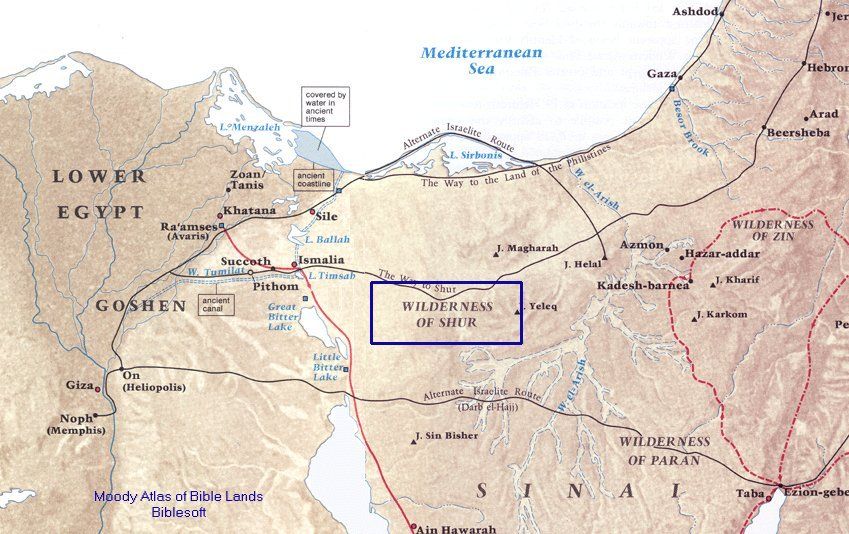
But all that was about to change. Their long-forgotten God had not forgotten them. He had just miraculously delivered them from bondage and was now leading them to their future home in Canaan. And as the scene of their emancipation and the Egyptian army’s annihilation faded into the distance, the people followed the pillar of cloud into the wilderness of Shur. Little did they know that this was going to be the beginning of a new chapter in their collective story. They were entering a new phase of their existence in which they would come to know and understand their “new” God. The ten plagues they had witnessed in Egypt had just been the opening act of His self-revelatory drama.

As they made their way to Canaan, they were going to get a steady dose of divine revelation as God displayed His glory and power. But He would also reveal the expectations He had for His chosen people. He had redeemed them for a reason. They had been set free so that they might live according to His will and display His glory and greatness to the rest of the nations.

The wilderness was to be their classroom, where they learned the painful truth about their own character and discovered the unflinching holiness and unwavering faithfulness of their God. And those lessons began immediately.

Just three days after leaving the Red Sea, they found themselves facing their first test in God’s school of spiritual enlightenment.

They traveled in this desert for three days without finding any water. When they came to the oasis of Marah, the water was too bitter to drink. – Exodus 15:22-23 NLT

Shur was not a desert as much as it was an open expanse of land, and water would have been a constant need for the Israelites. So, during their first three days of travel, the Israelites found no source of potable water. This would have been a serious concern for a group their size. How could they remain alive without water? They knew that their sizeable flocks and herds would quickly diminish if a viable source of water was not found soon.

This unexpected predicament caused the people to turn their anger against Moses. Just as they had done when they found themselves backed up against the sea with the Egyptian army bearing down on them, the people of Israel took out their fear and frustration on God’s appointed leader.

“What are we going to drink?” they demanded. – Exodus 15:24 NLT

And by this time, Moses must have been questioning why he ever agreed to lead this ungrateful and easily disgruntled band of hotheads. As God’s spokesman, he became the target of the people’s wrath. When they became unhappy with their circumstances, they took their complaints to Moses and his brother, Aaron. These two elderly men had shown up in Egypt with lofty promises of emancipation and relocation. They had declared themselves to be the official representatives of Yahweh, the God of Abraham, Isaac, and Jacob, and they had come to lead God’s people out of Egypt and back to the land of promise.

So, when things didn’t go well, the people held Moses and on as responsible. And when Moses felt the heat, he turned to God for help.

So Moses cried out to the Lord for help, and the Lord showed him a piece of wood. Moses threw it into the water, and this made the water good to drink. – Exodus 15:25 NLT

What’s important to note in this story is that there was water, but it was undrinkable. Their problem wasn’t a lack of something, but it was that the solution to their need was “bitter.” It was plentiful but undrinkable. It wasn’t that the water was non-existent but that it was worthless in its current condition. And this non-potable water contained a powerful lesson for the Israelites.

The Hebrew word translated as “bitter” is מַר (mar), which can also be translated as “angry” or “discontented.” Little did the Israelites know that the water was a symbol of their own spiritual condition. Despite all God had done to set them free from their bondage in Egypt, they were a bitter and discontented people. In a sense, they were unusable. Instead of displaying gratitude for all that God had done, they quickly resorted to anger and blame. And their blatant displays of dissatisfaction were evidence that their hearts were bitter and in need of change.

So, God took this opportunity to teach the Israelites a much-needed lesson on how He was going to transform the bitter condition of their hearts. He had Moses take a particular piece of wood and throw it into the bitter water. This act of faith on Moses’ part had an immediate effect, transforming the bitter, worthless water into a refreshing and live-giving source of sustenance for the people of God and all their livestock. The bitterness was removed.

Hundreds of years later, the prophet Ezekiel would record the following promise that God made to His people.

“I will give you a new heart, and I will put a new spirit in you. I will take out your stony, stubborn heart and give you a tender, responsive heart. And I will put my Spirit in you so that you will follow my decrees and be careful to obey my regulations.” – Ezekiel 3626-27 NLT

From the very beginning, God revealed His desire to transform the hearts of His people. Their real problem had never been slavery. They suffered from a heart condition that had left them bitter, angry, and discontented. Their 400-year separation from God had reduced them to a state of spiritual stagnation and impurity. They had become polluted by the culture and robbed of their ability to be a source of life to the nations around them. So, God was going to intervene and, over time, begin His miraculous plan of heart transformation.

One of the things that Moses makes clear is this event at Marah had been a test of their faithfulness. God wanted to know if they were going to trust Him or would they continue to display their distrust through bitter displays of discontentment and dissatisfaction. So, He had Moses give them a warning.

“If you will listen carefully to the voice of the Lord your God and do what is right in his sight, obeying his commands and keeping all his decrees, then I will not make you suffer any of the diseases I sent on the Egyptians; for I am the Lord who heals you.” – Exodus 15:26 NLT

God had used an ordinary piece of wood to transform bitter water into a life-giving source of sustenance. He had just proven, yet again, that He could meet all their needs. And all He was asking in return was that they live in obedience to His commands. If they did, they could expect to see more miraculous evidence of His provision, but they would also experience protection from His judgment. Obedience would bring blessing. Disobedience would result in curses. This would become a recurring theme in their relationship with God. He could both heal and hurt. He could bless and curse. And all He asked of His people was that they could trust and obey so that He could turn them into a life-giving source of sustenance to the nations of the world.

English Standard Version (ESV) The Holy Bible, English Standard Version. ESV® Permanent Text Edition® (2016). Copyright © 2001

New Living Translation (NLT) Holy Bible, New Living Translation, copyright © 1996, 2004, 2015 by Tyndale House Foundation. Used by permission of Tyndale House Publishers Inc., Carol Stream, Illinois 60188. All rights reserved.

Plague Number Eight

1 Then the Lord said to Moses, “Go in to Pharaoh, for I have hardened his heart and the heart of his servants, that I may show these signs of mine among them, 2 and that you may tell in the hearing of your son and of your grandson how I have dealt harshly with the Egyptians and what signs I have done among them, that you may know that I am the Lord.”

3 So Moses and Aaron went in to Pharaoh and said to him, “Thus says the Lord, the God of the Hebrews, ‘How long will you refuse to humble yourself before me? Let my people go, that they may serve me. 4 For if you refuse to let my people go, behold, tomorrow I will bring locusts into your country, 5 and they shall cover the face of the land, so that no one can see the land. And they shall eat what is left to you after the hail, and they shall eat every tree of yours that grows in the field, 6 and they shall fill your houses and the houses of all your servants and of all the Egyptians, as neither your fathers nor your grandfathers have seen, from the day they came on earth to this day.’” Then he turned and went out from Pharaoh.

7 Then Pharaoh’s servants said to him, “How long shall this man be a snare to us? Let the men go, that they may serve the Lord their God. Do you not yet understand that Egypt is ruined?” 8 So Moses and Aaron were brought back to Pharaoh. And he said to them, “Go, serve the Lord your God. But which ones are to go?” 9 Moses said, “We will go with our young and our old. We will go with our sons and daughters and with our flocks and herds, for we must hold a feast to the Lord.” 10 But he said to them, “The Lord be with you, if ever I let you and your little ones go! Look, you have some evil purpose in mind. 11 No! Go, the men among you, and serve the Lord, for that is what you are asking.” And they were driven out from Pharaoh’s presence.

12 Then the Lord said to Moses, “Stretch out your hand over the land of Egypt for the locusts, so that they may come upon the land of Egypt and eat every plant in the land, all that the hail has left.” 13 So Moses stretched out his staff over the land of Egypt, and the Lord brought an east wind upon the land all that day and all that night. When it was morning, the east wind had brought the locusts. 14 The locusts came up over all the land of Egypt and settled on the whole country of Egypt, such a dense swarm of locusts as had never been before, nor ever will be again. 15 They covered the face of the whole land, so that the land was darkened, and they ate all the plants in the land and all the fruit of the trees that the hail had left. Not a green thing remained, neither tree nor plant of the field, through all the land of Egypt. 16 Then Pharaoh hastily called Moses and Aaron and said, “I have sinned against the Lord your God, and against you. 17 Now therefore, forgive my sin, please, only this once, and plead with the Lord your God only to remove this death from me.” 18 So he went out from Pharaoh and pleaded with the Lord. 19 And the Lord turned the wind into a very strong west wind, which lifted the locusts and drove them into the Red Sea. Not a single locust was left in all the country of Egypt. 20 But the Lord hardened Pharaoh’s heart, and he did not let the people of Israel go. – Exodus 10:1-20 ESV

Exodus 12:12 contains a stunning statement from God that comes well after He has delivered nine of the ten plagues on the nation of Egypt. He simply states, “on all the gods of Egypt I will execute judgments: I am the Lord” (Exodus 12:12 ESV). As He prepares to launch the tenth and final judgment, He reminds Moses and Aaron that every one of the devastating signs He has sent upon Egypt has been a direct assault on their false and, therefore, unreliable gods.

And chapter ten contains Moses’ account of the eighth plague which brought a supernatural infestation of locusts upon the land. This too meant to pit the God of the Israelites against one or more of the gods of Egypt. Locusts were nothing new to the Egyptians. These voracious and destructive insects were a normal part of life in that region of the world. Their arrival and the subsequent damage they could do to all vegetation could wreak havoc on the Egyptian agricultural economy. That’s why the Egyptians had gods they relied upon to ward off this destructive menace, including the grain gods Neper, Nepri, Heneb, and Renenutet, as well as Isis and Set, two gods responsible for protecting the nation’s crops. Renenutet, in particular, was revered as a goddess of nourishment and the harvest. She was responsible for the fertility of the fields but was also deemed the protector of the royal office and power.

But with this eighth plague, God would bring another wave of destruction upon the land that would virtually destroy the nation’s economy and cripple Pharaoh’s administration.

God makes it clear to Moses that Pharaoh’s hardness of heart has all been part of the plan. From the very beginning, God had intended to bring a series of judgments against the Egyptians that would prepare the way for His people’s deliverance. Each plague was pre-planned and necessary and, all combined, they would have a cumulative effect that eventually forced Pharaoh to submit to God’s will. Not only that, they would serve as powerful reminders to the people of Israel of God’s power and providence.

“I have made him and his officials stubborn so I can display my miraculous signs among them. I’ve also done it so you can tell your children and grandchildren about how I made a mockery of the Egyptians and about the signs I displayed among them—and so you will know that I am the Lord.” – Exodus 10:1-2 NLT

Moses and Aaron did as they had done so many times before. They came before Pharaoh and delivered their latest message from God.

“Let my people go, so they can worship me. If you refuse, watch out! For tomorrow I will bring a swarm of locusts on your country. They will cover the land so that you won’t be able to see the ground. They will devour what little is left of your crops after the hailstorm, including all the trees growing in the fields. They will overrun your palaces and the homes of your officials and all the houses in Egypt. Never in the history of Egypt have your ancestors seen a plague like this one!” – Exodus 10:3-6 NLT

But, by now, the reader has already come to expect the same outcome as before. Pharaoh will reject their warning. And that is exactly what happens, despite the pleas of Pharaoh’s officials. They warn the king that the nation may not survive another assault from the Israelite’s God. The plague of hail left their crops and orchards in ruin. What was not destroyed would most certainly be devastated by an infestation of locusts. So, they strongly suggested that Pharaoh make a concession to allow the men of Israel to go and worship their God. By demanding that the women and children remain in Goshen, it would ensure that the men would return to their families. In a sense, Pharaoh’s counselors were suggesting that he use the women and children as hostages.

But when Pharaoh announces his intention to let only the men go and worship, Moses argued, “We must all join together in celebrating a festival to the Lord” (Exodus 10:9 NLT). Unused to having his will opposed, Pharaoh erupted against Moses and told him that the deal was off. It was going to be his way or no way at all. At this, Moses and Aaron left the king’s presence and the locusts descended upon the land.

…the locusts swarmed over the whole land of Egypt, settling in dense swarms from one end of the country to the other. It was the worst locust plague in Egyptian history, and there has never been another one like it. – Exodus 10:14 NLT

Once again, the gods of Egypt proved powerless to stand before Jehovah. The Egyptians probably cried out to their gods, but there was no answer. They offered sacrifices and offerings, but there was no relief in sight. Wave after wave of locusts descended upon their fields and orchards, devouring “every plant in the fields and all the fruit on the trees that had survived the hailstorm” (Exodus 10:15 NLT).

And it didn’t take long before Moses and Aaron were summoned back into Pharaoh’s presence. They had gotten his attention and he was ready to negotiate. But first, he begged them to pray to their God so that this latest plight might come to an end.

“Forgive my sin, just this once, and plead with the Lord your God to take away this death from me.” – Exodus 10:17 NLT

He appears to be sincere. His pride appears to be broken. But after Moses prayed and God miraculously removed every last locust from the land of Egypt, Pharaoh resorted back to his old stubborn ways and refused to let the people go.

The land lay in utter disarray, devastated by the effects of the hail and the damage done by the locusts. But Pharaoh remained steadfast in his refusal to give in to God’s demands. He still thought he was in control. Despite all that God had done to his land, Pharaoh believed he remained the king over his domain. His great pride would not allow him to bend the knee to another, even the all-powerful God of the Israelites. He somehow believed he could win this battle of wills. But what he failed to understand was that the sovereign will of Yahweh can be resisted but never thwarted. Pharaoh could stubbornly stand his ground, but he would one day bow his knee to the all-powerful, all-knowing God of the universe.

English Standard Version (ESV) The Holy Bible, English Standard Version. ESV® Permanent Text Edition® (2016). Copyright © 2001

New Living Translation (NLT) Holy Bible, New Living Translation, copyright © 1996, 2004, 2015 by Tyndale House Foundation. Used by permission of Tyndale House Publishers Inc., Carol Stream, Illinois 60188. All rights reserved.

Plague Number Four

20 Then the Lord said to Moses, “Rise up early in the morning and present yourself to Pharaoh, as he goes out to the water, and say to him, ‘Thus says the Lord, “Let my people go, that they may serve me. 21 Or else, if you will not let my people go, behold, I will send swarms of flies on you and your servants and your people, and into your houses. And the houses of the Egyptians shall be filled with swarms of flies, and also the ground on which they stand. 22 But on that day I will set apart the land of Goshen, where my people dwell, so that no swarms of flies shall be there, that you may know that I am the Lord in the midst of the earth. 23 Thus I will put a division between my people and your people. Tomorrow this sign shall happen.”’” 24 And the Lord did so. There came great swarms of flies into the house of Pharaoh and into his servants’ houses. Throughout all the land of Egypt the land was ruined by the swarms of flies.

25 Then Pharaoh called Moses and Aaron and said, “Go, sacrifice to your God within the land.” 26 But Moses said, “It would not be right to do so, for the offerings we shall sacrifice to the Lord our God are an abomination to the Egyptians. If we sacrifice offerings abominable to the Egyptians before their eyes, will they not stone us? 27 We must go three days’ journey into the wilderness and sacrifice to the Lord our God as he tells us.” 28 So Pharaoh said, “I will let you go to sacrifice to the Lord your God in the wilderness; only you must not go very far away. Plead for me.” 29 Then Moses said, “Behold, I am going out from you and I will plead with the Lord that the swarms of flies may depart from Pharaoh, from his servants, and from his people, tomorrow. Only let not Pharaoh cheat again by not letting the people go to sacrifice to the Lord.” 30 So Moses went out from Pharaoh and prayed to the Lord. 31 And the Lord did as Moses asked, and removed the swarms of flies from Pharaoh, from his servants, and from his people; not one remained. 32 But Pharaoh hardened his heart this time also, and did not let the people go. – Exodus 8:20-32 ESV

As a result of Pharaoh’s stubbornness, the Egyptians have already had to endure rivers of blood, the stink of dead and rotting fish, an infestation of frogs, and the frustration of billions of irritating gnats. With each judgment, God increased the intensity of the suffering and pain, but Pharaoh remained unwaveringly committed to resisting the demands of Moses and the will of his God. He was not going to give in. Even when his magicians confessed to him that this latest affliction was “the finger of God” (Exodus 8:19 ESV), Pharaoh continued to dig in his heels like a spoiled toddler.

But Pharaoh’s heart remained hard. He wouldn’t listen to them, just as the Lord had predicted. – Exodus 8:19 NLT

Everything was going according to God’s preordained plan. Each of these devastating displays of God’s power was intended to demonstrate His status as Lord and the one true God. And it should not be overlooked that these signs were all direct attacks on the false gods of the Egyptians.

The Egyptians had a plethora of deities, most of whom were tied directly to the natural world. Many of their gods were displayed with animal features used to illustrate their particular power or area of domain. Egyptian deities, even those that featured human heads, often had animal-like characteristics. It was not uncommon for these hybrid images to appear on statues and in the hieroglyphics that adorned the walls of their palaces and burial places. Virtually every animal indigenous to Egypt was linked to one or more of their gods. And their deification of the animal and insect kingdom is in keeping with the assessment of fallen humanity that Paul gives in his letter to the Romans.

They traded the truth about God for a lie. So they worshiped and served the things God created instead of the Creator himself, who is worthy of eternal praise! – Romans 1:25 NLT

Even the lowly fly was afforded god-like status in Egypt.

Even the humble fly (called aff in Egyptian) was worn as a homopoeic amulet. Fly amulets were distinctly v-shaped, emphasizing the head and wings of the insect. They varied in size but most were 2cm or smaller and could be strung on a single necklace or bracelet, often interspaced by beads. Small fly amulets have been found in Egypt made from gold, silver, bone, lapis lazuli, faience, carnelian, and amethyst. Wearing a fly amulet was probably believed to protect the wearer from insect bites or ward off pesky flying creatures through apotropaic magic. – http://www.nilescribes.org

The Hebrew word translated as “flies” is ʿārōḇ, and it literally means “swarm.” It could refer to any of a number of swarming insects, including flies and mosquitos. But whatever it was, it was larger in size that a gnat and far more vicious in its attacks. The book of Psalms contains a description of these flying insects that reveals that they were far more than just a nuisance.

He sent swarms of biting insects against them,  as well as frogs that overran their land. – Psalm 78:45 NET

From stinging gnats to biting flies, the Egyptians were getting no rest from God’s judgment. And no amulet with the image of an insect was going to immunize the Egyptians against the wrath of God. Their magic was no match for Jehovah. But that didn’t phase the recalcitrant king of Egypt.

So, God ordered Moses to deliver a “stinging” message of His own to Pharaoh.

“Let my people go, so they can worship me. If you refuse, then I will send swarms of flies on you, your officials, your people, and all the houses. The Egyptian homes will be filled with flies, and the ground will be covered with them.” – Exodus 8:21 NLT

But this time, God added a rather novel addendum to His warning of pending judgment. When the flies came, they would somehow avoid the land of Goshen, where the people of Israel lived. In other words, God was going to supernaturally protect His own people. No amulets or good luck charms would be necessary.

“…this time I will spare the region of Goshen, where my people live. No flies will be found there. Then you will know that I am the Lord and that I am present even in the heart of your land.” – Exodus 8:22 NLT

God Almighty was going to put a hedge of protection around His children so that the flies would only affect the people of Egypt. Even the flocks and herds of the Israelites would be supernaturally spared when this judgment came upon the land of Egypt. And God lets Pharaoh know that this seemingly impossible dome of protection around Goshen will prove that He is not some regional deity relegated to the land of Canaan. No, He insists, “you will know that I am the Lord and that I am present even in the heart of your land” (Exodus 8:22 NLT). In a sense, God is stating that He will be the protector of His people. His presence will provide all the immunization they need from the coming judgment. And this miraculous display of divine differentiation between one group and another was meant to be a powerful reminder to the people of Israel that they belonged to God, and He was more than capable of caring for them.

And God delivered on His word.

“A thick swarm of flies filled Pharaoh’s palace and the houses of his officials. The whole land of Egypt was thrown into chaos by the flies.” – Exodus 8:24 NLT

Notice that God did this. There is no indication that either Aaron or Moses did anything to bring about this plague. No staff was raised. No words were spoken. Moses simply states, “And the Lord did so” (Exodus 8:24 ESV). This was all the handiwork of God. No help or assistance was necessary. Moses and Aaron simply stood back and watched as God did His thing.

And God’s actions brought about apparent results. Pharaoh finally gave in and gave his permission for the Israelites to offer sacrifices to their God, but with one caveat. They had to do so within the land of Egypt. He forbade them to cross the border.

But Moses rejected Pharaoh’s last-minute revision to the plan.

“That wouldn’t be right. The Egyptians detest the sacrifices that we offer to the Lord our God. Look, if we offer our sacrifices here where the Egyptians can see us, they will stone us. We must take a three-day trip into the wilderness to offer sacrifices to the Lord our God, just as he has commanded us.” – Exodus 8:26-27 NLT

Under great duress, Pharaoh finally caved into Moses’ demands, allowing them to make the 3-day journey into the wilderness to worship their God. But he insisted that they hurry and that they offer up a prayer for him before they go. Moses agreed to the terms and promised to bring the plight of Pharaoh and his Egyptians to the attention of God. Yet he warned him not to renege on his agreement.

“As soon as I leave you, I will pray to the Lord, and tomorrow the swarms of flies will disappear from you and your officials and all your people. But I am warning you, Pharaoh, don’t lie to us again and refuse to let the people go to sacrifice to the Lord.” – Exodus 8:29 NLT

And Moses kept his end of the bargain. Immediately after leaving the palace, he prayed and, within minutes, God removed every last fly from the land. It was yet another supernatural display of God’s power and authority. Yet while the people of Egypt must have breathed a sigh of relief when the flies finally disappeared, Pharaoh sank back into his dark and defiant black hole of arrogant intransigence.

But Pharaoh again became stubborn and refused to let the people go. – Exodus 8:32 NLT

English Standard Version (ESV) The Holy Bible, English Standard Version. ESV® Permanent Text Edition® (2016). Copyright © 2001

New Living Translation (NLT) Holy Bible, New Living Translation, copyright © 1996, 2004, 2015 by Tyndale House Foundation. Used by permission of Tyndale House Publishers Inc., Carol Stream, Illinois 60188. All rights reserved.

The Second Plague

1 Then the Lord said to Moses, “Go in to Pharaoh and say to him, ‘Thus says the Lord, “Let my people go, that they may serve me. 2 But if you refuse to let them go, behold, I will plague all your country with frogs. 3 The Nile shall swarm with frogs that shall come up into your house and into your bedroom and on your bed and into the houses of your servants and your people, and into your ovens and your kneading bowls. 4 The frogs shall come up on you and on your people and on all your servants.”’” 5 And the Lord said to Moses, “Say to Aaron, ‘Stretch out your hand with your staff over the rivers, over the canals and over the pools, and make frogs come up on the land of Egypt!’” 6 So Aaron stretched out his hand over the waters of Egypt, and the frogs came up and covered the land of Egypt. 7 But the magicians did the same by their secret arts and made frogs come up on the land of Egypt.

8 Then Pharaoh called Moses and Aaron and said, “Plead with the Lord to take away the frogs from me and from my people, and I will let the people go to sacrifice to the Lord.” 9 Moses said to Pharaoh, “Be pleased to command me when I am to plead for you and for your servants and for your people, that the frogs be cut off from you and your houses and be left only in the Nile.” 10 And he said, “Tomorrow.” Moses said, “Be it as you say, so that you may know that there is no one like the Lord our God. 11 The frogs shall go away from you and your houses and your servants and your people. They shall be left only in the Nile.” 12 So Moses and Aaron went out from Pharaoh, and Moses cried to the Lord about the frogs, as he had agreed with Pharaoh. 13 And the Lord did according to the word of Moses. The frogs died out in the houses, the courtyards, and the fields. 14 And they gathered them together in heaps, and the land stank. 15 But when Pharaoh saw that there was a respite, he hardened his heart and would not listen to them, as the Lord had said. – Exodus 8:1-14 ESV

Seven days after having turned all the potable water in Egypt to blood, God summoned Moses and Aaron again. They were to return to the palace and reiterate their request for Pharaoh to release the people of Israel. But this time, their petition was to be accompanied by a warning of a second plague. Having gotten Pharaoh’s attention with the blood-filled Nile and the mass extinction of most of its aquatic life, Moses and Aaron were to issue a threat of further devastation should he refuse their request again.

“This is what the Lord says: Let my people go, so they can worship me. If you refuse to let them go, I will send a plague of frogs across your entire land. The Nile River will swarm with frogs. They will come up out of the river and into your palace, even into your bedroom and onto your bed! They will enter the houses of your officials and your people. They will even jump into your ovens and your kneading bowls. Frogs will jump on you, your people, and all your officials.” – Exodus 8:1-4 NLT

This time, rather than turning water into blood, the plague would feature a supernatural infestation of frogs. As a good Egyptian, Pharaoh would have understood the irony in this warning because his people held these amphibious creatures in high esteem. They even had a goddess, Heqet, whose image reflected that of a frog. This grotesque-looking deity was believed to be the wife of Khnum, the creator god. This husband-wife team of gods was responsible for bringing life to every human being.  Khnum would fashion them on his potter’s wheel, then Heqet would provide them with life before placing them in the mother’s womb.

Many pregnant women wore charms or amulets featuring Heqet’s image, as a kind of talisman to ensure the safe delivery of their child. Frogs were a protected species in Egypt and the intentional killing of them was punishable by death.

So, when Moses announced to Pharaoh that these esteemed creatures were going to suddenly explode in number and fill the land, it was to be a not-so-subtle message concerning the Egyptians’ pantheon of mythical gods and goddesses. It would be as if Heqet, the goddess of fertility, was so good at her job that the creature whose image she bore would proliferate so successfully that they filled the land.

Little Heqets would be everywhere; in their homes and even in the royal palace. These symbols of fertility would show up in their bedrooms and even find their way into the beds of the Egyptians. No place would be free from their pervasive and repugnant presence.

What should not be overlooked is that these creatures came from the very Nile and other water sources that had been turned to blood. While the fish had died, the frogs had survived and thrived. There is no natural explanation for this phenomenon. It was intended to be a supernatural display of God’s power and sovereignty. In a sense, God was bringing life from death. The bloody Nile was producing a superabundance of frogs, the very symbols of fertility and life for the Egyptian people. But this divine infestation would prove to be far less than pleasurable. The sheer numbers of these slimy creatures would soon leave the Egyptians with a sense of revulsion and a collective desire to see them eradicated.

But, as before, Pharaoh’s magicians were unable to do anything about this latest sign. All they could do was replicate it. In other words, they made the problem worse. And their ability to mirror the actions of Moses and Aaron was likely a sovereign act of God. He allowed them to make more frogs but prevented them from doing anything to reduce their number or stop their proliferation.

One of the things that stands out in this scene is the way God utilized His two servants. There was a hierarchy of leadership in their relationship with Yahweh. Moses would receive instructions from God, then he would deliver them to Aaron.

Then the Lord said to Moses, “Go in to Pharaoh and say to him…” – Exodus 8:1 ESV

And the Lord said to Moses, “Say to Aaron, ‘Stretch out your hand with your staff…” – Exodus 8:5 ESV

Aaron was destined to be the primary enactor of God’s will. He was the one who was ordered to throw down his staff in the presence of Pharaoh, and it was his staff that was turned into a serpent. It was also Aaron whom God ordered to turn the water into blood.

And the Lord said to Moses, “Say to Aaron, ‘Take your staff and stretch out your hand over the waters of Egypt, over their rivers, their canals, and their ponds, and all their pools of water, so that they may become blood…” –Exodus 7:19 ESV

This was all in fulfillment of God’s statement: “he shall be your mouth, and you shall be as God to him” (Exodus 4:16 ESV). The working relationship between these two brothers was divinely established. God had ordained that Moses would portray the role of God’s primary emissary. He would then delegate responsibility to Aaron to carry out the will of Yahweh. So that when all was said and done, Pharaoh would know that these supernatural signs and wonders were the actions of the God of Moses and Aaron.

“So I will stretch out my hand and strike Egypt with all the wonders that I will do in it; after that he will let you go.” – Exodus 3:20 ESV

And this hierarchy of leadership did not escape Pharaoh. When he and his people grew weary of the plague of frogs, he appealed to Moses and Aaron but addressed his request to their God.

“Plead with the Lord to take the frogs away from me and my people. I will let your people go, so they can offer sacrifices to the Lord.” – Exodus 8:8 ESV

He recognized that this was the work of a powerful deity and not some kind of parlor trick performed by an elderly Hebrew man. Pharaoh knew he was up against something far greater than he had ever seen before, and he was ready to acquiesce to God’s demands.

Rather than providing Pharaoh with an immediate response to his request, Moses asked him to determine the timing of what would prove to be another miracle.

“You set the time!” Moses replied. “Tell me when you want me to pray for you, your officials, and your people. Then you and your houses will be rid of the frogs. They will remain only in the Nile River.” – Exodus 8:9 NLT

By allowing Pharaoh to choose the exact moment for God to act, Moses was demonstrating his own intimate relationship with Yahweh. Unlike Pharaoh, Moses could approach his God and have his requests heard and answered. And when Pharaoh set the following morning as the deadline for deliverance, Moses agreed with the request but warned Pharaoh “it will be as you have said. Then you will know that there is no one like the Lord our God” (Exodus 8:10 ESV). the God of the Hebrews had brought the frogs into being and He would be the one to make them disappear.

Moses took the request to God and, according to Pharaoh’s timelines, the next morning the frogs began to die off, leaving a massive clean-up effort for the Egyptians. But this miraculous display of God’s power did nothing to change the heart of Pharaoh. As soon as the frogs began to disappear, Pharaoh’s penchant for stubbornness reared its ugly head again.

…when Pharaoh saw that relief had come, he became stubborn. He refused to listen to Moses and Aaron, just as the Lord had predicted. – Exodus 8:15 NLT

God was not done, so Pharaoh was not ready to give in. It was going to take far more than blood and frogs to convince this arrogant despot to bend the knee to the will of God. And God had already preordained an entire series of plagues that would culminate in one final devastating display of His divine sovereignty.

“When you go back to Egypt, see that you do before Pharaoh all the miracles that I have put in your power. But I will harden his heart, so that he will not let the people go. Then you shall say to Pharaoh, ‘Thus says the Lord, Israel is my firstborn son, and I say to you, “Let my son go that he may serve me.” If you refuse to let him go, behold, I will kill your firstborn son.’” – Exodus 4:21-23 ESV

Pharaoh did not yet comprehend the full glory and magnitude of Yahweh. But, in time, he would. In time he would come to understand that there is no other god but the Lord. But for now, he was determined to remain stubbornly opposed to God’s will and destined to subject his people to the full weight of God’s divine wrath.

English Standard Version (ESV) The Holy Bible, English Standard Version. ESV® Permanent Text Edition® (2016). Copyright © 2001

New Living Translation (NLT) Holy Bible, New Living Translation, copyright © 1996, 2004, 2015 by Tyndale House Foundation. Used by permission of Tyndale House Publishers Inc., Carol Stream, Illinois 60188. All rights reserved.

The Latter Days

1 The word of the Lord came to me: 2 “Son of man, set your face toward Gog, of the land of Magog, the chief prince of Meshech and Tubal, and prophesy against him 3 and say, Thus says the Lord God: Behold, I am against you, O Gog, chief prince of Meshech and Tubal. 4 And I will turn you about and put hooks into your jaws, and I will bring you out, and all your army, horses and horsemen, all of them clothed in full armor, a great host, all of them with buckler and shield, wielding swords. 5 Persia, Cush, and Put are with them, all of them with shield and helmet; 6 Gomer and all his hordes; Beth-togarmah from the uttermost parts of the north with all his hordes—many peoples are with you.

7 “Be ready and keep ready, you and all your hosts that are assembled about you, and be a guard for them. 8 After many days you will be mustered. In the latter years you will go against the land that is restored from war, the land whose people were gathered from many peoples upon the mountains of Israel, which had been a continual waste. Its people were brought out from the peoples and now dwell securely, all of them. 9 You will advance, coming on like a storm. You will be like a cloud covering the land, you and all your hordes, and many peoples with you.

10 “Thus says the Lord God: On that day, thoughts will come into your mind, and you will devise an evil scheme 11 and say, ‘I will go up against the land of unwalled villages. I will fall upon the quiet people who dwell securely, all of them dwelling without walls, and having no bars or gates,’ 12 to seize spoil and carry off plunder, to turn your hand against the waste places that are now inhabited, and the people who were gathered from the nations, who have acquired livestock and goods, who dwell at the center of the earth. 13 Sheba and Dedan and the merchants of Tarshish and all its leaders will say to you, ‘Have you come to seize spoil? Have you assembled your hosts to carry off plunder, to carry away silver and gold, to take away livestock and goods, to seize great spoil?’

14 “Therefore, son of man, prophesy, and say to Gog, Thus says the Lord God: On that day when my people Israel are dwelling securely, will you not know it? 15 You will come from your place out of the uttermost parts of the north, you and many peoples with you, all of them riding on horses, a great host, a mighty army. 16 You will come up against my people Israel, like a cloud covering the land. In the latter days I will bring you against my land, that the nations may know me, when through you, O Gog, I vindicate my holiness before their eyes.” – Ezekiel 38:1-16 ESV

God has promised His people that a day is coming when they will return to the land of promise and enjoy a renewed relationship with Him as His chosen people. It will be a time of peace and prosperity, free from the threat of wars, famines, or plagues.

“When I have broken their chains of slavery and rescued them from those who enslaved them, then they will know that I am the Lord. They will no longer be prey for other nations, and wild animals will no longer devour them. They will live in safety, and no one will frighten them.

“And I will make their land famous for its crops, so my people will never again suffer from famines or the insults of foreign nations.” – Ezekiel 34:27-29 NLT

This future period of tranquility and fruitfulness will be accompanied by a remarkable realignment of Israel’s spiritual priorities. The nation’s physical revitalization will be marked by a miraculous transformation of each individual’s religious affections. God will perform much-needed “heart surgery,” providing His once-rebellious people with a new capacity to love and obey Him.

“I will give you a new heart, and I will put a new spirit in you. I will take out your stony, stubborn heart and give you a tender, responsive heart. And I will put my Spirit in you so that you will follow my decrees and be careful to obey my regulations.” – Ezekiel 36:26-27 NLT

As with all prophetic pronouncements, the timing of God’s promise is left unclear. It seems clear that this divine promise of future peace and prosperity has yet to occur. To date, there has been no time at which Israel has enjoyed the kind of idyllic, war-free environment described in these passages. Even today, while Israel experiences the benefits of its status as a revitalized and prosperous nation, it is surrounded by sworn enemies who wage a relentless campaign of hostilities against its sovereignty and very existence. And, for the most part, modern Israel is a secular nation with less than half the population identifying as religious, orthodox, or traditional in terms of their faith.

When asked, “What is your present religion, if any?” virtually all Israeli Jews say they are Jewish – and almost none say they have no religion – even though roughly half describe themselves as secular and one-in-five do not believe in God. For some, Jewish identity also is bound up with Israeli national pride. Most secular Jews in Israel say they see themselves as Israeli first and Jewish second, while most Orthodox Jews (Haredim and Datiim) say they see themselves as Jewish first and then Israeli. – https://www.pewresearch.org/religion/2016/03/08/israels-religiously-divided-society/

So, this prophetic message given to Ezekiel deals with an as-yet-to-be-determined point in history that remains unfulfilled. And, according to chapter 38, Israel’s future restoration to the land will be interrupted by yet another threat of invasion from an outside enemy. Once again, out of the north, will come a powerful alliance of nations that will set its sights on the land of Israel. God personifies this enemy as “Gog of the land of Magog, the prince who rules over the nations of Meshech and Tubal” (Ezekiel 38:2 NLT). And Ezekiel is told to deliver a message to this future enemy of Israel.

“Get ready; be prepared! Keep all the armies around you mobilized, and take command of them. A long time from now you will be called into action. In the distant future you will swoop down on the land of Israel, which will be enjoying peace after recovering from war and after its people have returned from many lands to the mountains of Israel. You and all your allies—a vast and awesome army—will roll down on them like a storm and cover the land like a cloud.” – Ezekiel 38:7-9 NLT

There has been much debate over the centuries as to the exact identity of the individuals and nations named in this prophecy. The names Gog and Magog appear in Ezekiel 38-39 as well as Revelation 20:7-8. This has led many scholars to conclude that both passages are referring to the same end-times event. Whoever Gog is and whatever nations Meshech and Tubal are intended to represent, we know that their arrival lies somewhere in the distant future. God describes the timing of their appearance as “the latter years” (Ezekiel 38:8 ESV) and “the latter days” (Ezekiel 38:16 ESV). On “that day” (Ezekiel 38:14 ESV), God says, “You will come from your place out of the uttermost parts of the north, you and many peoples with you, all of them riding on horses, a great host, a mighty army. You will come up against my people Israel, like a cloud covering the land. In the latter days I will bring you against my land…” (Ezekiel 38:15-16 ESV).

This coalition of northern nations will form an unholy alliance, determined to destroy God’s restored and spiritually revitalized people. The exact timing of this event is difficult to nail down, but it must take place during the end times. There are some who speculate that it will happen prior to the seven years of tribulation that will mark the end of the age. Others place it at the midway point of the tribulation when Israel is enjoying a period of peace made possible by the one-world leader known as the Antichrist. Then there are those who have concluded that this invasion of Israel is tied to the battle described in Revelation 20, which will take place at the end of Christ’s millennial reign.

When the thousand years come to an end, Satan will be let out of his prison. He will go out to deceive the nations—called Gog and Magog—in every corner of the earth. He will gather them together for battle—a mighty army, as numberless as sand along the seashore. – Revelation 20:7-8 NLT

But regardless of the identity of the participants or the exact nature of the timing of the event, God makes it clear that it will be His doing.

“In the latter days I will bring you against my land, that the nations may know me, when through you, O Gog, I vindicate my holiness before their eyes.” – Ezekiel 38:16 ESV

Whoever Gog is, he will think he is acting according to his own prerogatives.

“You will say, ‘Israel is an unprotected land filled with unwalled villages! I will march against her and destroy these people who live in such confidence!” – Ezekiel 38:11 NLT

The land of Israel will look ripe for picking and ideal for plundering. They will appear defenseless and unprotected, living out their lives in blissful ignorance and unwarranted overconfidence. But God reveals that Gog will be wrong in his assessment of the situation. Like so many times before, the Almighty will expose the unmitigated hubris of men and use their arrogant plans to display His own power and holiness. God basically states that by the time He is done with Gog and his allies, “all the nations will know that I am the Lord” (Ezekiel 38:16 NLT).

As the book of Revelation makes clear, up until the very last minute of the end times, the nations of the earth will continue to oppose God by attacking His people. Even the millennial reign of Christ will do nothing to convince the wicked to repent of their sins and turn to God. The rebelliousness of mankind that began in the Garden of Eden will continue throughout human history and only come to an end when God destroys them at the end of the age.

[Satan] will gather them together for battle—a mighty army, as numberless as sand along the seashore. And I saw them as they went up on the broad plain of the earth and surrounded God’s people and the beloved city. But fire from heaven came down on the attacking armies and consumed them. – Revelation 20:8-9 NLT

The psalmist eloquently points out the futility of the nations to oppose God. Their raging against the machine of God’s sovereign plan is useless and pointless, but they will continue to do so until God brings it all to an end.

Why are the nations so angry?
    Why do they waste their time with futile plans?
The kings of the earth prepare for battle;
    the rulers plot together
against the Lord
    and against his anointed one.
“Let us break their chains,” they cry,
    “and free ourselves from slavery to God.”

But the one who rules in heaven laughs.
    The Lord scoffs at them.
Then in anger he rebukes them,
    terrifying them with his fierce fury. – Psalm 2:1-5 NLT

English Standard Version (ESV) The Holy Bible, English Standard Version. ESV® Permanent Text Edition® (2016). Copyright © 2001

New Living Translation (NLT) Holy Bible, New Living Translation, copyright © 1996, 2004, 2015 by Tyndale House Foundation. Used by permission of Tyndale House Publishers Inc., Carol Stream, Illinois 60188. All rights reserved.

You Will Know

17 In the twelfth year, in the twelfth month, on the fifteenth day of the month, the word of the Lord came to me: 18 “Son of man, wail over the multitude of Egypt, and send them down, her and the daughters of majestic nations, to the world below, to those who have gone down to the pit:

19 ‘Whom do you surpass in beauty?
    Go down and be laid to rest with the uncircumcised.’

20 They shall fall amid those who are slain by the sword. Egypt is delivered to the sword; drag her away, and all her multitudes. 21 The mighty chiefs shall speak of them, with their helpers, out of the midst of Sheol: ‘They have come down, they lie still, the uncircumcised, slain by the sword.’

22 “Assyria is there, and all her company, its graves all around it, all of them slain, fallen by the sword, 23 whose graves are set in the uttermost parts of the pit; and her company is all around her grave, all of them slain, fallen by the sword, who spread terror in the land of the living.

24 “Elam is there, and all her multitude around her grave; all of them slain, fallen by the sword, who went down uncircumcised into the world below, who spread their terror in the land of the living; and they bear their shame with those who go down to the pit. 25 They have made her a bed among the slain with all her multitude, her graves all around it, all of them uncircumcised, slain by the sword; for terror of them was spread in the land of the living, and they bear their shame with those who go down to the pit; they are placed among the slain.

26 “Meshech-Tubal is there, and all her multitude, her graves all around it, all of them uncircumcised, slain by the sword; for they spread their terror in the land of the living. 27 And they do not lie with the mighty, the fallen from among the uncircumcised, who went down to Sheol with their weapons of war, whose swords were laid under their heads, and whose iniquities are upon their bones; for the terror of the mighty men was in the land of the living. 28 But as for you, you shall be broken and lie among the uncircumcised, with those who are slain by the sword.

29 “Edom is there, her kings and all her princes, who for all their might are laid with those who are killed by the sword; they lie with the uncircumcised, with those who go down to the pit.

30 “The princes of the north are there, all of them, and all the Sidonians, who have gone down in shame with the slain, for all the terror that they caused by their might; they lie uncircumcised with those who are slain by the sword, and bear their shame with those who go down to the pit.

31 “When Pharaoh sees them, he will be comforted for all his multitude, Pharaoh and all his army, slain by the sword, declares the Lord God. 32 For I spread terror in the land of the living; and he shall be laid to rest among the uncircumcised, with those who are slain by the sword, Pharaoh and all his multitude, declares the Lord God.” – Ezekiel 32:17-32 ESV

Fourteen days later, Ezekiel received the second part of God’s oracle concerning Egypt’s demise. In it, he is told to “weep for the hordes of Egypt and for the other mighty nations” (Ezekiel 32:18 NLT). The scene depicted by God is that of a funeral and Ezekiel is instructed to “bury” Egypt in a grave, sending the deceased nation “to the world below” (Ezekiel 32:18 ESV); to the afterlife. The entire nation of Egypt is portrayed as a corpse ready for burial and Ezekiel is given the responsibility of interring the body and conducting the funeral.

But despite Egypt’s vast wealth and reputation for extravagance as illustrated by its many architectural wonders, the funeral described is that of a pauper. Rather than a royal entombment attended by visiting dignitaries and marked by solemnity and almost worshipful sorrow by the adoring public, this burial is of a relative unknown. God even gives Ezekiel the words of the eulogy he is to speak at the graveside.

“O Egypt, are you lovelier than the other nations?
    No! So go down to the pit and lie there among the outcasts.” – Ezekiel 32:19 NLT

The nation of Egypt would experience the same fate as the “uncircumcised” heathen. When the Babylonians swept through the land, they would be indiscriminate in their destruction. Nebuchadnezzar’s forces would be merciless and show no pity to anyone, leaving the bodies of the wealthy and well-educated lying in the streets alongside the poor and disenfranchised. God even describes their welcome in Sheol with biting sarcasm.

“Down in the grave mighty leaders will mockingly welcome Egypt and its allies, saying, ‘They have come down; they lie among the outcasts, hordes slaughtered by the sword.’” – Ezekiel 32:21 NLT

Egypt will join the other nations that have fallen before them. People from Assyria, Elam, Meshech-Tubal, Edom, the princes of the north, and the Sidonians have all entered the grave and will be ready to greet its newest occupant with open arms. At one time, all these nations “struck terror in the hearts of people everywhere, but now they have been slaughtered by the sword” (Ezekiel 32:23 NLT). They had been major players and had enjoyed their moment in the spotlight, but now there were relegated to an eternal existence of obscurity and irrelevance in the grave. And Egypt would suffer the same fate.

This message, given by God to Ezekiel, was intended to be shared with the Jewish exiles living in Babylon. It was meant to persuade these displaced people from putting any hope in Egypt as a potential source of salvation for Judah. When the Babylonians had first appeared on the scene, threatening the peace of the region, the people of Judah looked for help from their more powerful allies. The Egyptians were a logical choice because they had a track record of success. As one of the oldest nations in the region, they had a long history of military dominance and hegemony. So, it was only natural for Judah to place its hope in their neighbor to the south. Even the exiles were tempted to see the Egyptians as the key to the survival of their homeland and the means of their eventual return from captivity.

But God wanted them to know that Pharaoh would not be their savior. While his people believed him to be a god, he was just another man and his nation would prove to be just another victim of Babylon’s seemingly unstoppable global expansion.

“You too, Egypt, will lie crushed and broken among the outcasts, all slaughtered by the sword.” – Ezekiel 32:28 NLT

From chapter 25 to chapter 32, the phrase “know I am the LORD” occurs 19 times. The oracles contained within these chapters serve as a powerful indictment against the nations of the world but are really a divine dismissal of the gods of this world. The nation of Judah, like its northern neighbor, Israel, was guilty of spiritual adultery. For centuries, they had made a habit of worshiping the false gods of the nations that occupied the land of Canaan. They had become equal-opportunity idolaters who saw nothing wrong with adopting the gods of their pagan neighbors and treating them with the same awe and reverence they had once reserved for Yahweh.

During their 400-year exile in Egypt, the people of Israel worshiped the gods of the Egyptians. In the process of delivering them from their captivity, God exhibited His superiority over these false gods through the ten plagues He sent against the people of Egypt. Each plague was a direct attack on one of their many gods. And when God had finished His divine smackdown of Egypt’s deities, He led them out of bondage and to the land He had promised them. But even after arriving in the land of Canaan, the people of Israel continued their love affair with false gods. In direct violation of God’s commands, they embraced the gods of the Canaanites and the neighboring nations. And despite God’s repeated calls to repent and return to Him, they stubbornly refused.

Prior to the people of Israel entering the land of Canaan, Moses stood before them and issued a covenant commitment.

“I am making this covenant both with you who stand here today in the presence of the Lord our God, and also with the future generations who are not standing here today.

“You remember how we lived in the land of Egypt and how we traveled through the lands of enemy nations as we left. You have seen their detestable practices and their idols made of wood, stone, silver, and gold. I am making this covenant with you so that no one among you—no man, woman, clan, or tribe—will turn away from the Lord our God to worship these gods of other nations, and so that no root among you bears bitter and poisonous fruit.” – Deuteronomy 29:15-18 NLT

But his words had little or no lasting impact. It didn’t take them long to break their covenant with Moses and violate the laws given to them by God. Their entire history is replete with examples of their unfaithfulness and spiritual infidelity. Now, as Ezekiel ministered to the people of God living as exiles in Babylon, they were reaping the consequences of their disobedience. They were experiencing exactly what Joshua had warned their ancestors would happen in they turned to the false gods of Canaan.

“…as surely as the Lord your God has given you the good things he promised, he will also bring disaster on you if you disobey him. He will completely destroy you from this good land he has given you.  If you break the covenant of the Lord your God by worshiping and serving other gods, his anger will burn against you, and you will quickly vanish from the good land he has given you.” – Joshua 23:15-16 NLT

And all those nations from whom they had adopted their false gods would fall before the righteous wrath of Yahweh. Each would eventually pay the price for its idolatry and refusal to acknowledge the one true God. But their destruction would be a sobering warning to the people of Judah, reminding them of the words of God: “Then they will know that I am the Lord.”

English Standard Version (ESV) The Holy Bible, English Standard Version. ESV® Permanent Text Edition® (2016). Copyright © 2001

New Living Translation (NLT) Holy Bible, New Living Translation, copyright © 1996, 2004, 2015 by Tyndale House Foundation. Used by permission of Tyndale House Publishers Inc., Carol Stream, Illinois 60188. All rights reserved.

The Bloody City and the Boiling Pot

1 In the ninth year, in the tenth month, on the tenth day of the month, the word of the Lord came to me: 2 “Son of man, write down the name of this day, this very day. The king of Babylon has laid siege to Jerusalem this very day. 3 And utter a parable to the rebellious house and say to them, Thus says the Lord God:

“Set on the pot, set it on;
    pour in water also;
4 put in it the pieces of meat,
    all the good pieces, the thigh and the shoulder;
    fill it with choice bones.
5 Take the choicest one of the flock;
    pile the logs under it;
boil it well;
    seethe also its bones in it.

6 “Therefore thus says the Lord God: Woe to the bloody city, to the pot whose corrosion is in it, and whose corrosion has not gone out of it! Take out of it piece after piece, without making any choice. 7 For the blood she has shed is in her midst; she put it on the bare rock; she did not pour it out on the ground to cover it with dust. 8 To rouse my wrath, to take vengeance, I have set on the bare rock the blood she has shed, that it may not be covered. 9 Therefore thus says the Lord God: Woe to the bloody city! I also will make the pile great. 10 Heap on the logs, kindle the fire, boil the meat well, mix in the spices, and let the bones be burned up. 11 Then set it empty upon the coals, that it may become hot, and its copper may burn, that its uncleanness may be melted in it, its corrosion consumed. 12 She has wearied herself with toil; its abundant corrosion does not go out of it. Into the fire with its corrosion! 13 On account of your unclean lewdness, because I would have cleansed you and you were not cleansed from your uncleanness, you shall not be cleansed anymore till I have satisfied my fury upon you. 14 I am the Lord. I have spoken; it shall come to pass; I will do it. I will not go back; I will not spare; I will not relent; according to your ways and your deeds you will be judged, declares the Lord God.” – Ezekiel 24:1-14 ESV

The long-awaited and much-talked-about day of Judah’s judgment has finally arrived. In the ninth year, in the tenth month, on the tenth day of the month, God informs Ezekiel that “the king of Babylon has laid siege to Jerusalem this very day” (Ezekiel 24:2 NLT). The prophet was to take special note of this day because it marked the beginning of the end for the capital city of the southern kingdom of Judah. From his distant vantage point in Babylon, Ezekiel could only imagine the scene taking place back home. But his heart must have sunk when he heard the news that the judgment he had talked about for so long had just become a reality. 

The book of 2 Kings describes what happened that day.

So on January 15, during the ninth year of Zedekiah’s reign, King Nebuchadnezzar of Babylon led his entire army against Jerusalem. They surrounded the city and built siege ramps against its walls. Jerusalem was kept under siege until the eleventh year of King Zedekiah’s reign. – 2 Kings 25:1-2 NLT

And the prophet, Jeremiah, reports that the siege would be long and end in Jerusalem’s demise as the Babylonians broke through the walls and poured out their pent-up rage on the city and its inhabitants.

Two and a half years later, on July 18 in the eleventh year of Zedekiah’s reign, a section of the city wall was broken down. – Jeremiah 39:2 NLT

God gave Ezekiel a message for his fellow exiles, whom He addressed as “the rebellious house” (Ezekiel 24:3 ESV). They may have been safely ensconced in Babylon, more than 1600 miles from Jerusalem, but they were not to consider themselves guiltless or free from responsibility. The very fact that they were living as captives in Babylon provided ample proof that they had been complicit in Judah’s rebellion and that God held them personally culpable.

God’s message to the exiles came in the form of a parable. This would not be another one of Ezekiel’s dramatic demonstrations, where he was forced to act out the details in full view of his audience. This time, all the prophet had to do was repeat the highly descriptive words of God’s simple and easy-to-understand story of Jerusalem’s fall. God uses the familiar and non-threatening activity of making stew to portray the slow and steady “cooking” of Jerusalem’s inhabitants. For two-and-a-half years, God would use King Nebuchadnezzar as His personal chef to “stir the pot” of Jerusalem.

God describes water being poured into a large bronze cauldron, into which were added choice pieces of meat and bits of bone. A fire was kindled under the pot, bringing the water and its ingredients to a rolling boil. As the fire raged, the contents of the pot slowly congealed into a stew-like consistency as the meat, bone, blood, and marrow comingled. Like all parables, this simple story portrays what, at first glance, appears to be a rather non-threatening scene. For Ezekiel’s audience, the imagery could almost be appealing, as they imagine the pleasing aroma of the slowly simmering stew. But God was using this commonplace domestic scene to convey a powerful truth and illicit a repellant response from His rebellious people.

God provides no explanation for His parable, leaving His audience to wrestle with the exact meaning of its message. But it seems clear that the bronze cauldron represents Jerusalem. The fire symbolizes God’s judgment, kindled in the form of the Babylonian army. They encamped outside the walls of the city for two-and-a-half years, battering its walls and inflicting constant pressure on the inhabitants within. And God’s choice of imagery is interesting when one considers what was actually happening inside the city during those difficult days.

…the famine in the city had become very severe, and the last of the food was entirely gone. – 2 Kings 25:3 NLT

There were few pots of boiling stew in Jerusalem in those days. The food supplies had run out long ago due to the impenetrable Babylonian blockade.

Yet, in the parable, God describes choice pieces of meat and bones being added to the pot. What do these symbolize? The meat most likely represents the inhabitants of the city. God’s “chosen” people were being thrown into the crucible of His judgment, and even the wealthiest and most powerful citizens were not spared His wrath. No one escaped. They were all thrown into the same pot and forced to suffer the same fate.

But what about the bones? What do they represent? From looking at the rest of God’s message, it would appear that these bones symbolize the lives of those who had died as a result of Judah’s rampant injustice and idolatry. Jerusalem had earned its moniker as “the bloody city.” Back in chapter 22, Ezekiel recorded God’s indictment against the city’s murderous reputation.

“This is what the Sovereign Lord says: O city, who spills blood within herself (which brings on her doom), and who makes herself idols (which results in impurity), you are guilty because of the blood you shed and defiled by the idols you made. You have hastened the day of your doom; the end of your years has come.” – Ezekiel 22:3-4 NLT

They had actually murdered their own children, offering them up as blood sacrifices to their pagan gods. The list of their sins was long and unflattering.

“Slanderous men shed blood within you. Those who live within you eat pagan sacrifices on the mountains; they commit obscene acts among you. They have sexual relations with their father’s wife within you; they violate women during their menstrual period within you. One commits an abominable act with his neighbor’s wife; another obscenely defiles his daughter-in-law; another violates his sister—his father’s daughter—within you. They take bribes within you to shed blood.” – Ezekiel 22:9-12 NLT

The bones of innocent dead were mixed with the “choice meat” of Jerusalem’s citizens, creating a macabre stew where the blood of the victims comingled with that of their attackers. God was illustrating the permanent and irreparable state of Judah’s blood guilt.

The next phase of God’s parable contains a stark image of the contents of the pot being removed. By this time, the items inside would be indistinguishable from one another.  It has all blended together into what God describes as “corrosion.” Not exactly an appealing image.  The Hebrew word is ḥel’â, which can be translated as “scum,” “rust,” or “disease.” The contents are inedible and must be removed from the pot. So, God commands, “Take out of it piece after piece, without making any choice” (Ezekiel 24:6 ESV). Everything in the pot has been stained by blood and is poured out for all to see. Judah’s sins had been open and transparent. They hid nothing and unashamedly flaunted their rebellion in the face of God and for all the world to see. Now, God was going to display His judgment of them in a very visible and humiliating manner.

“I have placed her blood on an exposed rock so that it cannot be covered up.” – Ezekiel 24:8 NLT

With the pot now empty, God orders that it be set back on the coals “until it becomes hot and its copper glows, until its uncleanness melts within it and its rot is consumed” (Ezekiel 24:11 NLT). Jerusalem, once emptied of its corrupted contents, will be purified by God. After the Babylonians destroyed the city and took its citizens captive, it would remain a virtual wasteland for years to come. God would remove the “disease” from within its walls, then allow it to remain unoccupied until He returned a remnant of the people from captivity 70 years later.

But before that time can come, God must purge and purify Jerusalem.

“You mix uncleanness with obscene conduct.
I tried to cleanse you, but you are not clean.
You will not be cleansed from your uncleanness
until I have exhausted my anger on you.” – Ezekiel 24:13 NLT

And God makes it clear that His judgment is just, right, and fully deserved. They have earned their fate. He is judging them according to their conduct. And even the exiles in Babylon will come to realize that they too have been justly judged by God. Those who heard the parable of God from the lips of Ezekiel would not live long enough to return to the land of Judah. They would live out their lives as refugees in a foreign land, worshiping their false gods, and longing for a return to the good old days. But those days would never come because they refused to repent and be cleansed from their uncleanness.

English Standard Version (ESV) The Holy Bible, English Standard Version. ESV® Permanent Text Edition® (2016). Copyright © 2001

New Living Translation (NLT) Holy Bible, New Living Translation, copyright © 1996, 2004, 2015 by Tyndale House Foundation. Used by permission of Tyndale House Publishers Inc., Carol Stream, Illinois 60188. All rights reserved.

Polluted Prophets, Priests, and Princes

17 And the word of the Lord came to me: 18 “Son of man, the house of Israel has become dross to me; all of them are bronze and tin and iron and lead in the furnace; they are dross of silver. 19 Therefore thus says the Lord God: Because you have all become dross, therefore, behold, I will gather you into the midst of Jerusalem. 20 As one gathers silver and bronze and iron and lead and tin into a furnace, to blow the fire on it in order to melt it, so I will gather you in my anger and in my wrath, and I will put you in and melt you. 21 I will gather you and blow on you with the fire of my wrath, and you shall be melted in the midst of it. 22 As silver is melted in a furnace, so you shall be melted in the midst of it, and you shall know that I am the Lord; I have poured out my wrath upon you.”

23 And the word of the Lord came to me: 24 “Son of man, say to her, You are a land that is not cleansed or rained upon in the day of indignation. 25 The conspiracy of her prophets in her midst is like a roaring lion tearing the prey; they have devoured human lives; they have taken treasure and precious things; they have made many widows in her midst. 26 Her priests have done violence to my law and have profaned my holy things. They have made no distinction between the holy and the common, neither have they taught the difference between the unclean and the clean, and they have disregarded my Sabbaths, so that I am profaned among them. 27 Her princes in her midst are like wolves tearing the prey, shedding blood, destroying lives to get dishonest gain. 28 And her prophets have smeared whitewash for them, seeing false visions and divining lies for them, saying, ‘Thus says the Lord God,’ when the Lord has not spoken. 29 The people of the land have practiced extortion and committed robbery. They have oppressed the poor and needy, and have extorted from the sojourner without justice. 30 And I sought for a man among them who should build up the wall and stand in the breach before me for the land, that I should not destroy it, but I found none. 31 Therefore I have poured out my indignation upon them. I have consumed them with the fire of my wrath. I have returned their way upon their heads, declares the Lord God.” – Ezekiel 22:17-31 ESV

God pulled no punches in His indictment of His disobedient people. There were no bright spots for Him to point out and very few reasons for Him to offer compliments or commendations. His assessment of the Israelites was dark and far from flattering, and it left no one unscathed.

“…the people of Israel are the worthless slag that remains after silver is smelted. They are the dross that is left over—a useless mixture of copper, tin, iron, and lead.” – Ezekiel 22:18 NLT

The entire nation had become contaminated by centuries of sinful behavior, produced by their penchant for idolatry and immorality. Israel, once the prized possession of God Almighty, had allowed itself to become defiled and corrupted through its ongoing love affair with the world. They had lived out the stark reality of 1 John 2:15-17.

Do not love this world nor the things it offers you, for when you love the world, you do not have the love of the Father in you. For the world offers only a craving for physical pleasure, a craving for everything we see, and pride in our achievements and possessions. These are not from the Father, but are from this world. And this world is fading away, along with everything that people crave.

And God informs Ezekiel that He would use His coming judgment as a refining fire to purify His contaminated people.

“Just as silver, copper, iron, lead, and tin are melted down in a furnace, I will melt you down in the heat of my fury. I will gather you together and blow the fire of my anger upon you, and you will melt like silver in fierce heat.” – Ezekiel 22:20-22 NLT

God’s judgment was far from just punitive in nature. It had a positive aspect to it. God was going to use it to purify and cleanse His people; an act they had failed to carry out on their own. All throughout the book of Deuteronomy, Moses provides the Israelites with repeated instructions to “purge the evil” in their midst. These admonitions to practice corporate cleansing were written before the Israelites ever set foot in the land of Canaan. Moses was warning them that God expected His chosen people to pursue holiness at all costs.

Moses listed a variety of instances in which corporate cleansing would be necessary, including when any individual violated God’s covenant by practicing idolatry.

“…they might serve other gods or worship the sun, the moon, or any of the stars—the forces of heaven—which I have strictly forbidden…” – Deuteronomy 17:3 NLT

When that happened, an investigation was to be launched, guilt determined, and punishment served.

“…then the man or woman who has committed such an evil act must be taken to the gates of the town and stoned to death…” – Deuteronomy 17:5 NLT

And Moses states the desired outcome of this display of corporal punishment: “In this way, you will purge the evil from among you” (Deuteronomy 17:7 NLT). And he would apply this same exacting standard to false prophets (Deuteronomy 13), false witnesses (Deuteronomy 19), rebellious sons (Deuteronomy 21), and those guilty of adultery (Deuteronomy 22). In each case, Moses affirmed that the goal was to “purge such evil from among you.”

But the Israelites had failed to heed Moses’ warnings. Over the centuries, they had developed a bad habit of excusing sin and turning a blind eye to its damaging effects on their corporate purity. As a result, by the time God was delivering His message of coming judgment to Ezekiel, He had determined that Israel was “a polluted land” (Ezekiel 22:24 NLT). They were damaged goods. And the cancer was widespread and went all the way to the top of the Israelite leadership structure.

In the closing verses of this chapter, Ezekiel includes God’s indictments against the prophets, priests, and princes who had played a role in the nation’s moral collapse. He accused the princes of devouring innocent people, seizing treasures, and extorting wealth (Deuteronomy 17:25). The priests were guilty of violating His instructions and defiling His holy things. They made no distinction between what is holy and what is not (Deuteronomy 17:26). The princes and priests were in it for the money, and the prophets were complicit in their sin by covering up for them by announcing false visions and making lying predictions (Deuteronomy 17:28). This unholy trinity of civic and religious leaders had done irreparable damage to the nation.

These men were in positions of responsibility. They should have been in the vanguard of those seeking to restore the holiness of God’s people. But sadly, God states that when He sought to find someone who would stand in the gap and restore the purity of His people, He came up empty-handed.

“I looked for someone who might rebuild the wall of righteousness that guards the land. I searched for someone to stand in the gap in the wall so I wouldn’t have to destroy the land, but I found no one.” – Ezekiel 22:30 NLT

It’s difficult to read this verse and not be reminded of the famous WWII recruitment poster of Uncle Sam pointing his finger and saying, “I want you!” Here in Ezekiel 22, God is pointing His finger and saying that He looked for a few good men, but found none. There was no one who might help rebuild the spiritual walls of the nation of Judah. Not a single man could be found who was willing or able to stand in the gaping holes of the nation’s proverbial spiritual wall. There was no one willing to protect the people and preserve the integrity of God’s name.

God said, “I searched…but I found no one!” He could find plenty of murderers, unethical leaders, immoral husbands and wives, extortioners, swindlers, unrighteous priests, and false prophets, but He couldn’t a single, solitary man to “stand in the gap.”

From God’s perspective, the land was polluted. The people were like worthless slag, the leftovers of the refining process. The chosen people of God had become valueless because they were no longer holy and set apart. Rather than live their lives as God’s special possession, set apart for His use and His glory, they had chosen to defile themselves and dishonor God by serving other gods. After all that God had done for them, there was not a single individual whom God could point at and say, “I want you!” Yes, He had Ezekiel, Daniel, Jeremiah, Nehemiah, and a handful of other prophets, but there was a glaring absence of faithful men and women who could be trusted to help rebuild the spiritual legacy of the nation of Israel. Things were so bad that even God’s faithful prophets would prove unsuccessful in stemming the tide of sin and rebellion. The moral condition of the nation had reached an all-time low.

But this chapter reminds us that God is always looking for men and women who will rebuild the wall of righteousness that guards the land. Today, we face similar conditions to that of Ezekiel’s day, including immorality, unethical leadership, graft, greed, corruption, and a growing sense of spiritual apathy. And God is looking for a few good men and women who will stand in the gap and help preserve righteousness.

It’s not that they don’t exist, but that they seem to be few in number. The righteous seem to be overwhelmed by the unrighteous and the spiritually indifferent. But God has always worked with a remnant. He is looking for the faithful few through whom He can restore the spiritual walls that have been damaged by constant exposure to sin and unrighteousness.

God is still looking for someone who might rebuild the wall of righteousness that guards the land. He continues to search for someone to stand in the gap in the wall. Has He found you? Are you willing, ready, and able to do your part?

English Standard Version (ESV) The Holy Bible, English Standard Version. ESV® Permanent Text Edition® (2016). Copyright © 2001

New Living Translation (NLT) Holy Bible, New Living Translation, copyright © 1996, 2004, 2015 by Tyndale House Foundation. Used by permission of Tyndale House Publishers Inc., Carol Stream, Illinois 60188. All rights reserved.

When the Godly Become Godless

1 And the word of the Lord came to me, saying, 2 “And you, son of man, will you judge, will you judge the bloody city? Then declare to her all her abominations. 3 You shall say, Thus says the Lord God: A city that sheds blood in her midst, so that her time may come, and that makes idols to defile herself! 4 You have become guilty by the blood that you have shed, and defiled by the idols that you have made, and you have brought your days near, the appointed time of your years has come. Therefore I have made you a reproach to the nations, and a mockery to all the countries. 5 Those who are near and those who are far from you will mock you; your name is defiled; you are full of tumult.

6 “Behold, the princes of Israel in you, every one according to his power, have been bent on shedding blood. 7 Father and mother are treated with contempt in you; the sojourner suffers extortion in your midst; the fatherless and the widow are wronged in you. 8 You have despised my holy things and profaned my Sabbaths. 9 There are men in you who slander to shed blood, and people in you who eat on the mountains; they commit lewdness in your midst. 10 In you men uncover their fathers’ nakedness; in you they violate women who are unclean in their menstrual impurity. 11 One commits abomination with his neighbor’s wife; another lewdly defiles his daughter-in-law; another in you violates his sister, his father’s daughter. 12 In you they take bribes to shed blood; you take interest and profit and make gain of your neighbors by extortion; but me you have forgotten, declares the Lord God.

13 “Behold, I strike my hand at the dishonest gain that you have made, and at the blood that has been in your midst. 14 Can your courage endure, or can your hands be strong, in the days that I shall deal with you? I the Lord have spoken, and I will do it. 15 I will scatter you among the nations and disperse you through the countries, and I will consume your uncleanness out of you. 16 And you shall be profaned by your own doing in the sight of the nations, and you shall know that I am the Lord.” – Ezekiel 22:1-16 ESV

The people of Judah were lawbreakers – plain and simple. They were guilty of violating the commands of God as outlined in the Mosaic Law, and they couldn’t pass the buck and blame their ancestors for their predicament. No, this was a present-day problem that persisted in Judah and all the way to the Kebar River in Babylon. Wherever the people of God could be found, spiritual unfaithfulness and moral laxity were in close proximity. The exiles eeking out a living as refugees in Babylon couldn’t claim exemption from God’s wrath because they were just as guilty of apostasy and idolatry as their friends and family members back home. In the short time they had been in Babylon, they had acclimated to their new surroundings and even adopted the gods of their captors. They no longer bothered to keep the Sabbath day holy. Their observance of God’s commands had become optional rather than mandatory.

But God’s greatest condemnation was reserved for the citizens of “the bloody city” (Ezekiel 22:2 ESV). This was His less-than-flattering description of Jerusalem, the capital city of Judah, and the location of the majestic temple that Solomon had built in His honor.

God’s description of Jerusalem as a bloody city was not just hyperbole. He wasn’t exaggerating or attempting to use over-the-top rhetoric to paint the city in as negative a light as He possibly could. In six verses, God lays out the evidence for His accusation of blood-guilt against Jerusalem’s inhabitants. In verses two and three, He refers to Jerusalem as a “city of murderers,” and each of these “murderers” was guilty of committing an actual crime.

“…you are guilty because of the blood you have shed.” – Ezekiel 22:4 NLT

“Every leader in Israel who lives within your walls is bent on murder.” – Ezekiel 22:6 NLT

“People accuse others falsely and send them to their death.” – Ezekiel 22:9 NLT

“There are hired murderers, loan racketeers, and extortioners everywhere.” – Ezekiel 22:12 NLT

“But now I clap my hands in indignation over your dishonest gain and bloodshed.” – Ezekiel 22:13 NLT

The Mosaic Law had been intended to regulate human behavior, dictating how God’s people were to interact and engage with Him and with one another. The law had a vertical and horizontal aspect to it. It outlined how the Israelites were to conduct their lives and display their set-apart status as His chosen people. There were laws that determined how they were to treat God, and there were laws that determined their relationships with one another. And adherence to the law was to produce a community that was regulated and motivated by love.

There was an occasion when Jesus was approached by some Jewish religious leaders, and they asked Him to name “the most important commandment in the law of Moses,” (Matthew 22:36 NLT), to which Jesus replied, “You must love the Lord your God with all your heart, all your soul, and all your mind” (Matthew 22:37 NLT). Jesus described this as “the first and greatest commandment” (Matthew 22:38 NLT), but then quickly added the following addendum to His answer:

“A second is equally important: ‘Love your neighbor as yourself.’ The entire law and all the demands of the prophets are based on these two commandments.” – Matthew 22:39 NLT

Love God. Love others. The entire corpus of the Mosaic Law rested on those two timeless truths. Obedience to God’s law should reflect a love for Him and demonstrate a love for others. It was never intended to be a list of rules and regulations to adhere to out of some sense of duty or in hopes of a reward for a job well done.

God had graciously given His laws to the descendants of Abraham. They were unique to the people of Israel and were designed to set them apart from the rest of the world‘s population. By living in loving obedience to God’s commands, the Israelites would showcase God’s love, mercy, power, and grace to the nations. But rather than love and listen to God, they had chosen to adopt the ways of the world. They wanted to blend in, not stand out.

“We want to be like the nations all around us, who serve idols of wood and stone.” – Ezekiel 20:32 NLT

They chose idolatry over fidelity and faithfulness. And in choosing to love false gods, they rejected the one true God. They fell out of love with God and abandoned His law and, in doing so, lost the capacity to love one another. The apostle Paul describes the sequence of events that leads to this kind of drastic behavioral change.

…they knew God, but they wouldn’t worship him as God or even give him thanks. And they began to think up foolish ideas of what God was like. As a result, their minds became dark and confused. Claiming to be wise, they instead became utter fools. And instead of worshiping the glorious, ever-living God, they worshiped idols made to look like mere people and birds and animals and reptiles.

So God abandoned them to do whatever shameful things their hearts desired. As a result, they did vile and degrading things with each other’s bodies. They traded the truth about God for a lie. So they worshiped and served the things God created instead of the Creator himself… – Romans 1:21-25 NLT

This pattern is on full display in Ezekiel 22, as God describes the downward trajectory of Judah’s apostasy. Their idolatry or love affair with false gods had resulted in abject hatred for one another. Selfishness ruled the day. The entire community was marked by injustice and abuse. By choosing to reject God and embrace idols, the people of Israel had jettisoned their set-apart status and took on the characteristics of the fallen world around them.

They no longer honored their fathers and mothers as God had commanded them to do. They extorted the foreigners living among them, profiting off of them by demanding payment for protection. Rather than treat orphans and widows with dignity and respect as God had commanded, they wronged and oppressed them. They were guilty of perjury and liable, falsely accusing one another just to line their own pockets. And they were even willing to see the innocent put to death if it meant they could somehow benefit from their demise. Adultery was rampant. Sexual sin was widely practiced and accepted. Rape and incest had become so commonplace that there was no longer any shame associated with these heinous acts. Hired murderers, loan racketeers, and extortioners were everywhere. And God sums up the sorry state of affairs by declaring, “They never even think of me and my commands, says the Sovereign Lord” ( Ezekiel 22:12 NLT).

In a sense, God was out of sight and out of mind. They lived as if He didn’t even exist, or if He did, He was too powerless or indifferent to do anything about their behavior. They truly thought they could continue to live in violation of His law and get away with it. But they were in for a rude awakening. God was about to bring their sinful free-for-all to an abrupt and ignominious end.

“But now I clap my hands in indignation over your dishonest gain and bloodshed. How strong and courageous will you be in my day of reckoning? I, the Lord, have spoken, and I will do what I said. I will scatter you among the nations and purge you of your wickedness.” – Ezekiel 22:13-15 NLT

The people of God had become godless. They had abandoned their set-apart status in order to blend in with the rest of the world. But their idols would not save them. Their substitute gods would prove to be impotent and incapable of delivering them from the wrath of Yahweh. Their sinful behavior had polluted the land of promise, so God was going to purge the land of their presence, sending them into exile just like Ezekiel and his fellow refugees. But when all was said and done, they would know beyond a shadow of a doubt that Yahweh alone is God.

English Standard Version (ESV) The Holy Bible, English Standard Version. ESV® Permanent Text Edition® (2016). Copyright © 2001

New Living Translation (NLT) Holy Bible, New Living Translation, copyright © 1996, 2004, 2015 by Tyndale House Foundation. Used by permission of Tyndale House Publishers Inc., Carol Stream, Illinois 60188. All rights reserved.

The Scepter and the Sword

8 And the word of the Lord came to me: 9 “Son of man, prophesy and say, Thus says the Lord, say:

“A sword, a sword is sharpened
    and also polished,
10 sharpened for slaughter,
    polished to flash like lightning!

(Or shall we rejoice? You have despised the rod, my son, with everything of wood.) 11 So the sword is given to be polished, that it may be grasped in the hand. It is sharpened and polished to be given into the hand of the slayer. 12 Cry out and wail, son of man, for it is against my people. It is against all the princes of Israel. They are delivered over to the sword with my people. Strike therefore upon your thigh. 13 For it will not be a testing—what could it do if you despise the rod?” declares the Lord God.

14 “As for you, son of man, prophesy. Clap your hands and let the sword come down twice, yes, three times, the sword for those to be slain. It is the sword for the great slaughter, which surrounds them, 15 that their hearts may melt, and many stumble. At all their gates I have given the glittering sword. Ah, it is made like lightning; it is taken up for slaughter. 16 Cut sharply to the right; set yourself to the left, wherever your face is directed. 17 I also will clap my hands, and I will satisfy my fury; I the Lord have spoken.” – Ezekiel 21:8-17 NLT

In this rather poetic-sounding passage, God refers to the rod and the sword, two symbols of kingly authority. The rod (šēḇeṭ) refers to the royal scepter of the king. It is the same word used in Jacob’s death-bed blessing of his son, Judah.

The scepter will not depart from Judah,
nor the ruler’s staff from his descendants,
until the coming of the one to whom it belongs,
the one whom all nations will honor.– Genesis 49:10 NLT

Ezekiel’s audience would have been familiar with this passage and would have understood it as a guarantee of the unbroken line of kings to rule over the tribe of Judah. They couldn’t fathom the idea of an end to the royal lineage of King David.

The other imagery used in this passage is that of the sword, another symbol of kingly authority and power. With his sword, the king ruled over the people, providing them with peace and security as he defended them against all those who would bring them harm. The psalmist records the words of a song that celebrates the king and his sword of righteousness and justice.

I will recite a lovely poem about the king,
for my tongue is like the pen of a skillful poet.

You are the most handsome of all.
Gracious words stream from your lips.
God himself has blessed you forever.
Put on your sword, O mighty warrior!
You are so glorious, so majestic!
In your majesty, ride out to victory,
defending truth, humility, and justice.
Go forth to perform awe-inspiring deeds!– Psalm 45:1-4 NLT

The scepter and the sword. These two symbols of royal power and authority would have conjured up images of hope in the minds of the exiled Jews to whom Ezekiel was speaking. They longed for the day when King Zedekiah of Judah would put on his sword and ride out to victory against the Babylonians. They desperately longed for a king who would defend truth, humility, and justice. But from their vantage point in Babylon, they had yet to see anyone step up and wield the sword and the scepter in defense of Judah.

But God wanted them to know that the sword they longed for would not come in the hand of their kingly deliverer, but it would be clutched by their enemy and used to wreak havoc and destruction on His rebellious people.

“Son of man, give the people this message from the Lord:

“A sword, a sword
is being sharpened and polished.
It is sharpened for terrible slaughter
and polished to flash like lightning!” – Ezekiel 21:9-10 NLT

God will leave no doubt as to who will be bringing this sword of destruction against the people of Judah. In verse 19, He refers to it as “the sword of the king of Babylon to come” (Ezekiel 21:19 ESV). This sword will be wielded by a king but not a king from the line of David. No, this king will be a foreigner whom God has chosen to be His royal executioner.

“Now will you laugh?
Those far stronger than you have fallen beneath its power!
Yes, the sword is now being sharpened and polished;
it is being prepared for the executioner.” – Ezekiel 21:10-11 NLT

God wanted His people to understand that this coming destruction was His doing. Nebuchadnezzar and the Babylonians were His chosen instruments to carry out His just and righteous judgment upon His unrepentant people. In Jeremiah 45:10, God refers to Nebuchadnezzar as “my servant.”

Later in the book of Ezekiel, God will refer to Nebuchadnezzar as His employee.

“I have given him the land of Egypt as a reward for his work, says the Sovereign Lord, because he was working for me when he destroyed Tyre.” – Ezekiel 29:20 NLT

God was going to use this pagan king and his seemingly invincible army to carry out divine justice upon the recalcitrant people of Judah. Nebuchadnezzar and his forces would serve as God’s instruments of wrath, and He flatly states, “that sword will slaughter my people and their leaders—everyone will die!” (Ezekiel 21:12 NLT).

God is emphatic that this destruction will be all-encompassing and indiscriminate. All will die, including the king. And the historical record asserts that King Zedekiah was not spared the wrath of God. His royal position did not immunize him from God’s righteous reckoning.

But the Babylonian troops chased King Zedekiah and overtook him on the plains of Jericho, for his men had all deserted him and scattered. They captured the king and took him to the king of Babylon at Riblah in the land of Hamath. There the king of Babylon pronounced judgment upon Zedekiah. The king of Babylon made Zedekiah watch as he slaughtered his sons. He also slaughtered all the officials of Judah at Riblah. Then he gouged out Zedekiah’s eyes and bound him in bronze chains, and the king of Babylon led him away to Babylon. Zedekiah remained there in prison until the day of his death. – Jeremiah 52:8-11 NLT

God wanted His people to know that the royal scepter, while a symbol of kingly authority, would not provide Zedekiah with any protection. The sword of Nebuchadnezzar would show no favorites and extend no courtesies.

“For testing will come, and what will happen when the scepter, which the sword despises, is no more? declares the Sovereign Lord.” – Ezekiel 21:14 NET

God was going to remove Zedekiah from the throne, in keeping with the prophecy He earlier gave to Ezekiel.

“…he will die in Babylon, in the land of the king who enthroned him, whose oath he despised and whose covenant he broke.” – Ezekiel 17:16 NLT

Zedekiah would be the last king to sit on the throne of David. According to the book of 2 Kings, “Nebuchadnezzar appointed Gedaliah son of Ahikam and grandson of Shaphan as governor over the people he had left in Judah” (2 Kings 25:22 NLT). This abrupt end to the Davidic line left the people in a state of despair, prompting many of them to flee to Egypt for protection from the Babylonian occupiers.

It seems that a vital part of Ezekiel’s delivery of this less-than-pleasant message was his acting out of the coming destruction. God instructs his prophet to take an actual sword and swing it before the faces of his stunned audience.

“…take the sword and brandish it twice,
even three times,
to symbolize the great massacre,
the great massacre facing them on every side.” – Ezekiel 21:14 NLT

The sight of this prophet wildly swinging an unsheathed sword while describing the wholesale slaughter of Jerusalem’s inhabitants would have been unsettling. He was to accompany this disturbing display with loud shouts and the clapping of hands, all intended to create an atmosphere of fear and foreboding.

“Let their hearts melt with terror,
for the sword glitters at every gate.
It flashes like lightning
and is polished for slaughter!” – Ezekiel 21:15 NLT

God declares His intentions to guide the hands of His “servant” Nebuchadnezzar as he delivers each deadly blow with the sword of His fury.

“O sword, slash to the right,
then slash to the left,
wherever you will,
wherever you want.
I, too, will clap my hands,
and I will satisfy my fury.
I, the Lord, have spoken!”– Ezekiel 21:16-17 NLT

All of this disturbing imagery would have left Ezekiel’s audience confused and clamoring for answers. How could a good God pour out such devastating judgment upon His chosen people? For centuries, they had relied upon the enduring patience of God. In fact, they had grown accustomed to abusing His patience, assuring themselves that He would always forgive them of any indiscretions they may have committed.

“At least some of the problem that Ezekiel’s audience had in accepting such a gloomy picture of the future can be traced to the natural religious tendency to think of God as kindly and thus not really capable of punishing people decisively. Why would God destroy His own beloved people in whom He had invested such time and effort since He brought them out of Egypt centuries before? Some of the problem lay also in people’s natural, routine optimism. It is hard to imagine the country in which one grew up and enjoyed life in the past actually coming to an end, never again to be an independent nation, never again to have its own government and laws and economy and stable traditions.” – Douglas Stuart, Ezekiel

But they were in for a rude awakening. The patience of God had finally expired and the sword was coming. There would be no escape and no second chances. While they had long relished the idea of an all-loving, all-forgiving God, they had long ago abandoned any concept of His holiness and righteousness. And their actions had proven that they had no intentions of keeping His command:

“You must be holy because I, the Lord your God, am holy.” – Leviticus 19:2 NLT

English Standard Version (ESV) The Holy Bible, English Standard Version. ESV® Permanent Text Edition® (2016). Copyright © 2001

New Living Translation (NLT) Holy Bible, New Living Translation, copyright © 1996, 2004, 2015 by Tyndale House Foundation. Used by permission of Tyndale House Publishers Inc., Carol Stream, Illinois 60188. All rights reserved.