Motivated By the Love of Christ

11 Therefore, knowing the fear of the Lord, we persuade others. But what we are is known to God, and I hope it is known also to your conscience. 12 We are not commending ourselves to you again but giving you cause to boast about us, so that you may be able to answer those who boast about outward appearance and not about what is in the heart. 13 For if we are beside ourselves, it is for God; if we are in our right mind, it is for you. 14 For the love of Christ controls us, because we have concluded this: that one has died for all, therefore all have died; 15 and he died for all, that those who live might no longer live for themselves but for him– 2 Corinthians 5:11-15 ESV

Paul has just told the Corinthians that a day is coming when all believers will stand before the judgment seat of Christ.

For we must all appear before the judgment seat of Christ, so that each one may receive what is due for what he has done in the body, whether good or evil. – 2 Corinthians 5:10 ESV

It is that day Paul has in mind when he mentions “the fear of the Lord.” It is an awareness of the future judgment of our present actions that should create in us a sober-minded evaluation of all that we do in this life. As believers, we should carefully consider all our thoughts and actions, knowing that we will one day answer to God for all that we have done in this life since coming to faith in Christ. Paul told the believers in Rome, “Remember, we will all stand before the judgment seat of God … each of us will give a personal account to God” (Romans 14:10, 12 NLT).

Paul was not saying that he feared the judgment of God in the sense that he might lose his salvation or lose his place in the eternal Kingdom. It was that he was strongly motivated not to do anything that might displease God on the day of judgment. He lived to please God and wanted to do His will — at all costs and at all times. He was unwilling to allow the opinions of men to alter his behavior in this life because he knew he would stand before the judgment seat of Christ in the next life. That is what led him to persuade others and prompted him to risk everything to save some. His reputation took a back seat to the message of redemption. What concerned Paul the most was what God thought of him.

God knows we are sincere, and I hope you know this, too. – 2 Corinthians 5:11b NLT

Over the life of his ministry, Paul had spent a great deal of time defending his apostleship. Unlike the original disciples of Jesus, he had not been there at the beginning of Jesus’ earthly ministry. He was not one of the twelve and had not been personally taught by Jesus. This led his opponents to argue that he lacked apostolic authority. To complicate matters, it appears that Paul had a less-than-impressive aura about him. He was evidently small in stature, unimpressive in appearance, and had gained a reputation for being a second-rate communicator. He even admitted as much in his first letter to the Corinthians.

I came to you in weakness—timid and trembling. And my message and my preaching were very plain. Rather than using clever and persuasive speeches, I relied only on the power of the Holy Spirit. – 1 Corinthians 2:3-4 NLT

The only reason Paul defended his apostleship or said anything about himself that might come across as boastful was to silence those who kept trying to diminish his influence. Paul didn’t mind if people thought he was crazy, as long as he was being faithful to God. If he came across as crazy, it was only because he was obsessed with sharing the gospel with as many people as possible. When it came to the good news, he was “out of his mind.”

Paul said he was controlled by the love of Christ, which meant that everything he did was done out of gratitude and not for gain. He wasn’t in ministry for the money, accolades, power, or popularity. He couldn’t care less whether someone thought he was crazy or sane, as long as they saw Christ in him. He was motivated by his love for the lost and his Christ-like compassion for believers, and his love for others was the direct result of God’s love for him.

The apostle John wrote, “We love each other because he loved us first. If someone says, ‘I love God,’ but hates a Christian brother or sister, that person is a liar; for if we don’t love people we can see, how can we love God, whom we cannot see?” (1 John 4:19-20 NLT). And how did God express His love? “God showed how much he loved us by sending his one and only Son into the world so that we might have eternal life through him” (1 John 4:9 NLT). It was that sacrificial love that motivated Paul. Because of what Jesus Christ had done for him, Paul was willing to risk everything to tell everyone about the good news of salvation through faith in Christ’s sacrificial death on the cross.

He died for everyone so that those who receive his new life will no longer live for themselves. Instead, they will live for Christ, who died and was raised for them. – 2 Corinthians 5:15 NLT

God’s love for us required that Jesus die in our place. His death on our behalf made our new life possible, and that new life has freed us to live for Him, not ourselves. Our newfound capacity to live unselfishly should show up in our desire to selflessly share His love with all those we meet.

For the love of Christ controls us. – 2 Corinthians 5:15 ESV

Father, I hate to admit it, but I am controlled by a lot of things other than the love of Christ. I worry way too much about what people think of me. I spend too much time thinking about me instead of thinking about others. Far too often, I allow my pursuit of personal comfort to prevent me from   carrying out the commission Jesus gave me. But Paul reminds me that I should be motivated by Christ’s selfless love for me, not my selfish love of self. I have so much for which to be grateful and none of it has to do with my reputation, possessions, or personal accomplishments. My only value is found in Your unwavering love for me. You loved me so much that You sent Your Son to die in my place. You sacrificed Your Son so that I might be restored to a right relationship with You. And that undeserved and unfathomable love should motivate me to love others. It is the least I could do to show my gratitude and love for You. I no longer want to live for me. That is a path that leads to nowhere. It is a life that produces no fruit and little satisfaction. So, open my eyes to see the magnitude of Your love for me so that I might pour it out on others. Amen

English Standard Version (ESV) The Holy Bible, English Standard Version. ESV® Permanent Text Edition® (2016). Copyright © 2001 by Crossway Bibles, a publishing ministry of Good News Publishers.

New Living Translation (NLT) Holy Bible, New Living Translation, copyright © 1996, 2004, 2015 by Tyndale House Foundation. Used by permission of Tyndale House Publishers Inc., Carol Stream, Illinois 60188. All rights reserved.

Fame Versus Faithfulness

1 Solomon was building his own house thirteen years, and he finished his entire house.

He built the House of the Forest of Lebanon. Its length was a hundred cubits and its breadth fifty cubits and its height thirty cubits, and it was built on four rows of cedar pillars, with cedar beams on the pillars. And it was covered with cedar above the chambers that were on the forty-five pillars, fifteen in each row. There were window frames in three rows, and window opposite window in three tiers. All the doorways and windows had square frames, and window was opposite window in three tiers.

And he made the Hall of Pillars; its length was fifty cubits, and its breadth thirty cubits. There was a porch in front with pillars, and a canopy in front of them.

And he made the Hall of the Throne where he was to pronounce judgment, even the Hall of Judgment. It was finished with cedar from floor to rafters.

His own house where he was to dwell, in the other court back of the hall, was of like workmanship. Solomon also made a house like this hall for Pharaoh’s daughter whom he had taken in marriage.

All these were made of costly stones, cut according to measure, sawed with saws, back and front, even from the foundation to the coping, and from the outside to the great court. 10 The foundation was of costly stones, huge stones, stones of eight and ten cubits. 11 And above were costly stones, cut according to measurement, and cedar. 12 The great court had three courses of cut stone all around, and a course of cedar beams; so had the inner court of the house of the LORD and the vestibule of the house. 1 Kings 7:1-12 ESV

Once Solomon had completed the construction of the LORD’s House, he turned his attention to building his own royal palace and administrative complex. The author indicates that it took Solomon seven years to complete the Temple, and he spent an additional 13 years constructing the complex that would include separate residences for him and his wife, the daughter of Pharaoh. According to 1 Kings 9:10, Solomon spent two decades of his reign overseeing these various building projects.

It took Solomon twenty years to build the Lord’s Temple and his own royal palace. – 1 Kings 9:10 NLT

From the descriptions provided, it appears that Solomon’s palace complex consisted of a series of distinct structures, including the two royal residences, the House of the Forest of Lebanon, the Hall of Pillars, the Hall of Judgment, and the Hall of the Throne. These were evidently separate, but interconnected buildings arranged around a shared courtyard. Each of them was equally impressive in size and grandeur. The House of the Forest of Lebanon alone was larger in size than the Temple itself and featured the same degree of meticulous detailing and costly craftsmanship.

It would be easy to overlook that these impressive structures were only made possible by the forced conscription of Israelite citizens. In Chapter Five, it was revealed that Solomon instituted a nationwide “draft” to provide the large labor force necessary to accomplish his ambitious and ongoing building projects.

Then King Solomon conscripted a labor force of 30,000 men from all Israel. He sent them to Lebanon in shifts, 10,000 every month, so that each man would be one month in Lebanon and two months at home. Adoniram was in charge of this labor force. Solomon also had 70,000 common laborers, 80,000 quarry workers in the hill country, and 3,600 foremen to supervise the work. – 1 Kings 5:13-16 NLT

Tens of thousands of Israelites were forced into service and required to dedicate 20 years of their lives to these seemingly never-ending construction projects. When one building was done, another one would begin. Stones had to be quarried, transported, and carefully carved. Massive amounts of trees were cut down and moved to the various construction sites, where they were transformed into wood flooring and panels to adorn the walls and ceilings of Solomon’s royal residence and administrative offices. The sheer number of common laborers, skilled craftsmen, and project foremen to complete 20 years’ worth of construction projects is impossible to calculate. This doesn’t include the additional labor force required to manage Solomon’s household, care for his extensive flocks and herds, cultivate his fields and vineyards, tend his gardens, cook his food, and provide ongoing maintenance for his vast and growing kingdom. All of this was in fulfillment of the words spoken by Samuel the prophet, when he warned the people of Israel of the consequences that would come with their demand for a king.

“The king will draft your sons and assign them to his chariots and his charioteers, making them run before his chariots. Some will be generals and captains in his army, some will be forced to plow in his fields and harvest his crops, and some will make his weapons and chariot equipment. The king will take your daughters from you and force them to cook and bake and make perfumes for him. He will take away the best of your fields and vineyards and olive groves and give them to his own officials. He will take a tenth of your grain and your grape harvest and distribute it among his officers and attendants. He will take your male and female slaves and demand the finest of your cattle and donkeys for his own use. He will demand a tenth of your flocks, and you will be his slaves.” – 1 Samuel 8:11-17 NLT

Solomon was a good and wise king. He had been appointed by God Himself. But even his reign brought a certain degree of suffering and servitude upon the people of Israel. Their desire for a king had ultimately proven costly to them. Kings tend to build kingdoms. They go to war. They demand loyalty and allegiance. They wield power. They use their position to pursue their agendas. And sadly, they can end up treating their people as little more than tools in their royal toolbox.

Later in life, Solomon voiced his regrets at spending so much time, money, and energy building his grand and glorious kingdom. In the end, all his hard work and that of his conscripted laborers would be for naught because you can’t take it with you when you go.

I came to hate all my hard work here on earth, for I must leave to others everything I have earned. And who can tell whether my successors will be wise or foolish? Yet they will control everything I have gained by my skill and hard work under the sun. How meaningless! So I gave up in despair, questioning the value of all my hard work in this world.

Some people work wisely with knowledge and skill, then must leave the fruit of their efforts to someone who hasn’t worked for it. This, too, is meaningless, a great tragedy. So what do people get in this life for all their hard work and anxiety? Their days of labor are filled with pain and grief; even at night their minds cannot rest. It is all meaningless. – Ecclesiastes 2:18-23 NLT

There’s little doubt that Solomon was successful in all his building efforts. When the final brick was laid on the last building, the completed project was a sight to behold. Combined with the Temple complex, it must have made a powerful impression on all those who saw it. We know from Chapter 10 that when the Queen of Sheba made a royal visit to Jerusalem, she was awe-struck by the experience.

When the queen of Sheba realized how very wise Solomon was, and when she saw the palace he had built, she was overwhelmed. She was also amazed at the food on his tables, the organization of his officials and their splendid clothing, the cup-bearers, and the burnt offerings Solomon made at the Temple of the LORD. – 1 Kings 10:4-5 NLT

For 20 years, Solomon concentrated his efforts on building the physical representation of his kingdom. He built palaces, administrative buildings, throne rooms, judgment halls, and even a Temple to accommodate the God of Israel. He was transforming Jerusalem into a showplace where his power and prestige were constantly on display. Visitors couldn’t help but be impressed by the opulence of his royal residences, the sheer size and scope of his administrative complex, and the grandeur of the Temple.

But as will soon be made clear, there was something dark and foreboding lying beneath the shiny surface of Solomon’s kingdom. The trappings of success obscured a hidden danger that would prove to be Solomon’s undoing and the key to Israel’s ultimate fall from grace.

Hundreds of years later, Jesus, another descendant of King David, would warn against the danger of building kingdoms on earth and investing all our time and energy in accumulating earthly treasures.

“Don’t store up treasures here on earth, where moths eat them and rust destroys them, and where thieves break in and steal. Store your treasures in heaven, where moths and rust cannot destroy, and thieves do not break in and steal. Wherever your treasure is, there the desires of your heart will also be.” – Matthew 6:19-21 NLT

Solomon was under the misguided impression that materialism mattered. He was out to build a kingdom that would rival that of every other nation on earth. He wanted Israel to be the envy of the world, and his glowing reputation to spread throughout the land. In his later days, he would declare his rather pessimistic belief in the value of a good reputation, because that is all you really leave behind that is of lasting value.

A good reputation is more valuable than costly perfume.
    And the day you die is better than the day you are born.
Better to spend your time at funerals than at parties.
    After all, everyone dies—
    so the living should take this to heart. – Ecclesiastes 7:1-2 NLT

But two decades into his reign, Solomon was still working under the delusion that more was better. He would continue to amass more wealth, increase his land holdings, construct additional buildings, and furnish them all with the finest of furnishings. He was storing up treasures on earth in a desperate search for meaning and significance. Like a child in need of attention, Solomon was using his wealth and wisdom to make a name for himself. Perhaps it was all an attempt to break free from the shadow of his father’s looming legacy. It would have been difficult to follow in the footsteps of the man after God’s own heart. Solomon was neither a warrior nor a kingdom builder. He inherited his domain from his father and received his wisdom and wealth as gifts from Yahweh. However, Solomon used what he had to good effect and made a name for himself.

I also tried to find meaning by building huge homes for myself and by planting beautiful vineyards. I made gardens and parks, filling them with all kinds of fruit trees. I built reservoirs to collect the water to irrigate my many flourishing groves. I bought slaves, both men and women, and others were born into my household. I also owned large herds and flocks, more than any of the kings who had lived in Jerusalem before me. I collected great sums of silver and gold, the treasure of many kings and provinces. I hired wonderful singers, both men and women, and had many beautiful concubines. I had everything a man could desire!

So I became greater than all who had lived in Jerusalem before me, and my wisdom never failed me. Anything I wanted, I would take. I denied myself no pleasure. I even found great pleasure in hard work, a reward for all my labors. – Ecclesiastes 2:4-10 NLT

In time, Solomon’s love of self would replace his love for Yahweh. His obsession with self-promotion and establishing his reputation would supplant his desire to honor the name of God. Fame became more important than faithfulness.

In Solomon’s old age, they [his wives] turned his heart to worship other gods instead of being completely faithful to the Lord his God, as his father, David, had been. Solomon worshiped Ashtoreth, the goddess of the Sidonians, and Molech, the detestable god of the Ammonites. In this way, Solomon did what was evil in the LORD’s sight; he refused to follow the LORD completely, as his father, David, had done. – 1 Kings 11:4-6 NLT

English Standard Version (ESV) The Holy Bible, English Standard Version. ESV® Permanent Text Edition® (2016). Copyright © 2001 by Crossway Bibles, a publishing ministry of Good News Publishers.

New Living Translation (NLT) Holy Bible, New Living Translation, copyright © 1996, 2004, 2015 by Tyndale House Foundation. Used by permission of Tyndale House Publishers Inc., Carol Stream, Illinois 60188. All rights reserved.

If God Is For Us

To the choirmaster: with stringed instruments. A Psalm of David.

1 Answer me when I call, O God of my righteousness!
    You have given me relief when I was in distress.
    Be gracious to me and hear my prayer!

O men, how long shall my honor be turned into shame?
    How long will you love vain words and seek after lies? Selah
But know that the Lord has set apart the godly for himself;
    the Lord hears when I call to him.

Be angry, and do not sin;
    ponder in your own hearts on your beds, and be silent. Selah
Offer right sacrifices,
    and put your trust in the Lord.

There are many who say, “Who will show us some good?
    Lift up the light of your face upon us, O Lord!”
You have put more joy in my heart
    than they have when their grain and wine abound.

In peace I will both lie down and sleep;
    for you alone, O Lord, make me dwell in safety. Psalm 4:1-8 ESV

This Psalm bears striking similarities with Psalm 3, causing some scholars to speculate that it was written by David at about the same time. David found himself in an unexpected dilemma, having fled the capital city of Jerusalem because of a coup led by his son Absalom. Deposed from his throne, David is hiding somewhere in the wilderness outside Jerusalem.

This predicament was preceded by Absalom’s four-year-long character assassination strategy. David’s son had conducted an aggressive PR campaign designed to build up his own reputation by questioning his father’s judgment and leadership skills.

Absalom bought a chariot and horses, and he hired fifty bodyguards to run ahead of him. He got up early every morning and went out to the gate of the city. When people brought a case to the king for judgment, Absalom would ask where in Israel they were from, and they would tell him their tribe. Then Absalom would say, “You’ve really got a strong case here! It’s too bad the king doesn’t have anyone to hear it. I wish I were the judge. Then everyone could bring their cases to me for judgment, and I would give them justice!”

When people tried to bow before him, Absalom wouldn’t let them. Instead, he took them by the hand and kissed them. Absalom did this with everyone who came to the king for judgment, and so he stole the hearts of all the people of Israel. – 1 Samuel 15:1-6 NLT

While living as a fugitive, David had to deal with the fact that his own son had ruined his reputation by defaming his character. These were difficult days for David. He was facing one of the most challenging moments of his life. He had been placed on the throne by God, but now he was a deposed and discredited former king living like a convicted criminal somewhere in the outskirts of his former capital.

But rather than launch a vindictive slander campaign against his conniving son, David took the matter to God. This Psalm opens with a prayer.

Answer me when I call, O God of my righteousness!
    You have given me relief when I was in distress.
    Be gracious to me and hear my prayer! – Psalm 4:1 ESV

He refers to God as “my righteousness” (Psalm 4:1 ESV). With all the false accusations leveled against him, David was willing to leave his guilt or innocence up to God. David didn’t fully understand his circumstances and must have had a thousand questions for God. But rather than demanding answers, he simply asks God to hear his prayer and deliver him from his predicament. This was not the first time David found himself in a difficult situation, and he knew from personal experience that God could be trusted to always do what is right and just.

The Lord is good and does what is right;
    he shows the proper path to those who go astray.
He leads the humble in doing right,
    teaching them his way.
The Lord leads with unfailing love and faithfulness
    all who keep his covenant and obey his demands. – Psalm 25:8-10 NLT

Despire the circumstances, David knew that God was still on his side. While it appeared that everyone else had turned their back on him, David was confident of God’s abiding presence and sovereign control over his life. As if addressing his detractors, David confidently asserts, “You can be sure of this: The Lord set apart the godly for himself. The Lord will answer when I call to him” (Psalm 4:3 NLT).

The Hebrew word translated “set apart” is pālâ, which means “to separate,” “to distinguish,” or “to show special favor.” David knew that he had been set apart by God to serve as the king of Israel. He could recall the moment when Samuel, the prophet of God, appeared at his home in Bethlehem. David had been summoned from caring for his father’s sheep and stood before his family as Samuel anointed him with oil.

So as David stood there among his brothers, Samuel took the flask of olive oil he had brought and anointed David with the oil. And the Spirit of the Lord came powerfully upon David from that day on. – 1 Samuel 16:13 NLT

That fateful day had begun a long and circuitous path to the throne, including another period of isolation in the wilderness as King Saul sought to take David’s life. As a young man, David had been anointed the next king of Israel, but Saul would not relinquish the throne without a fight. During those difficult days, David learned to trust God for the future. It was during that time that David wrote another Psalm expressing his dependence upon the Lord.

Have mercy on me, O God, have mercy!
    I look to you for protection.
I will hide beneath the shadow of your wings
    until the danger passes by.
I cry out to God Most High,
    to God who will fulfill his purpose for me.
He will send help from heaven to rescue me,
    disgracing those who hound me. Interlude
My God will send forth his unfailing love and faithfulness. – Psalm 57:1-3 NLT

David had been here before. He was well acquainted with caves and more than familiar with adversity. Experience had taught him to judge his circumstances through the faithfulness of God and not the other way around. David knew God would deal with him differently because he belonged to God. He even refers to himself as “godly.” That word simply means “faithful one.” David was declaring his faithfulness to God. He wasn’t claiming perfection or sinlessness, but only that he had not abandoned God. He continued to trust in and rely upon God. He belonged to God, so he knew God would hear him when he called.

The people who accompanied David when he fled Jerusalem were asking, “Who will show us better times?” (Psalm 4:6 NLT). They were distraught and wondering what the future held. They wanted to know what plans David had to rectify the situation. He was their leader and they depended on him to solve their problem. But David knew that God was the key to their hope. He knew through experience that God was the source of joy. God had provided David with more joy than any amount of success or affluence could bring.

You have given me greater joy
    than those who have abundant harvests of grain and new wine.Psalm 4:7 NLT

David knew that God alone could hear him when he called, declare him innocent, free him from his troubles, show him mercy, and keep him safe even in his sleep. No matter what was going on around him and to him, David knew that his God could be trusted to do the just and right thing. His fate was in God’s hands, not Absalom’s. That confident assurance had been forged in the fires of his earlier adversities.

My heart is confident in you, O God;
    my heart is confident.
    No wonder I can sing your praises!
Wake up, my heart!
    Wake up, O lyre and harp!
    I will wake the dawn with my song.
 I will thank you, Lord, among all the people.
    I will sing your praises among the nations.
For your unfailing love is as high as the heavens.
    Your faithfulness reaches to the clouds. – Psalm 57:7-10 NLT

God had proven Himself faithful to David time and time again. He had a stellar track record for reliability. In another one of his earlier predicaments, David had written: “This I know: God is on my side! I praise God for what he has promised; yes, I praise the Lord for what he has promised. I trust in God, so why should I be afraid? What can mere mortals do to me?” (Psalm 56:9-11 NLT). David’s words reflect his familiarity with another anonymous Psalm.

In my distress I prayed to the Lord,
    and the Lord answered me and set me free.
The Lord is for me, so I will have no fear.
    What can mere people do to me?
Yes, the Lord is for me; he will help me.
    I will look in triumph at those who hate me.
It is better to take refuge in the Lord
    than to trust in people.
It is better to take refuge in the Lord
    than to trust in princes. – Psalm 118:5-9 NLT

But David’s confidence in God doesn’t mean he had no questions. Psalm 4 reflects his confusion over the circumstances surrounding his son’s actions, but he doesn’t direct his uncertainties to God. He addresses his adversaries with a string of disquieted queries that demand an explanation for their actions.

How long will you people ruin my reputation?
    How long will you make groundless accusations?
    How long will you continue your lies? – Psalm 4:2 NLT

But rather than wait for an answer, David turns his attention to God.

You can be sure of this:
    The Lord set apart the godly for himself.
    The Lord will answer when I call to him. – Psalm 4:3 NLT

Their continued attacks would prove powerless before God, and David was willing to allow the Almighty to defend and avenge him. He didn’t fully comprehend the nature of his fall or the timing of his rescue, but David was willing to trust God with the outcome. So much so, that he encouraged his disgruntled companions, “Don’t sin by letting anger control you.  Think about it overnight and remain silent. Offer sacrifices in the right spirit, and trust the Lord” (Psalm 4:4-5 NLT).

For David, difficult circumstances were not an indication of God’s absence or anger; they were an invitation to see Him work. His son’s opposition was actually a divinelyordained opportunity to display God’s glory and goodness. That is why David was able to say, “In peace I will lie down and sleep, for you alone, O Lord, will keep me safe” (Psalm 4:8 NLT).

Father, I want to trust You more. I want to have the came degree of confidence in You that David expressed. He had found You to be faithful in the past, so he could confidently trust You for the future. He didn’t let the conditions around him determine His faith in You. He trusted in Your character, not his circumstances. He recalled all the wonderful things You had done for him and realized that You had set him apart for Yourself. David belonged to You, so he knew he could trust You. And I want to trust you, too. Amen

English Standard Version (ESV) The Holy Bible, English Standard Version. ESV® Permanent Text Edition® (2016). Copyright © 2001 by Crossway Bibles, a publishing ministry of Good News Publishers.

New Living Translation (NLT) Holy Bible, New Living Translation, copyright © 1996, 2004, 2015 by Tyndale House Foundation. Used by permission of Tyndale House Publishers Inc., Carol Stream, Illinois 60188. All rights reserved.

Peace In the Midst of the Storm

1 Paul, an apostle—not from men nor through man, but through Jesus Christ and God the Father, who raised him from the dead— and all the brothers who are with me,

To the churches of Galatia:

Grace to you and peace from God our Father and the Lord Jesus Christ, who gave himself for our sins to deliver us from the present evil age, according to the will of our God and Father, to whom be the glory forever and ever. Amen. – Galatians 1:1-5 ESV

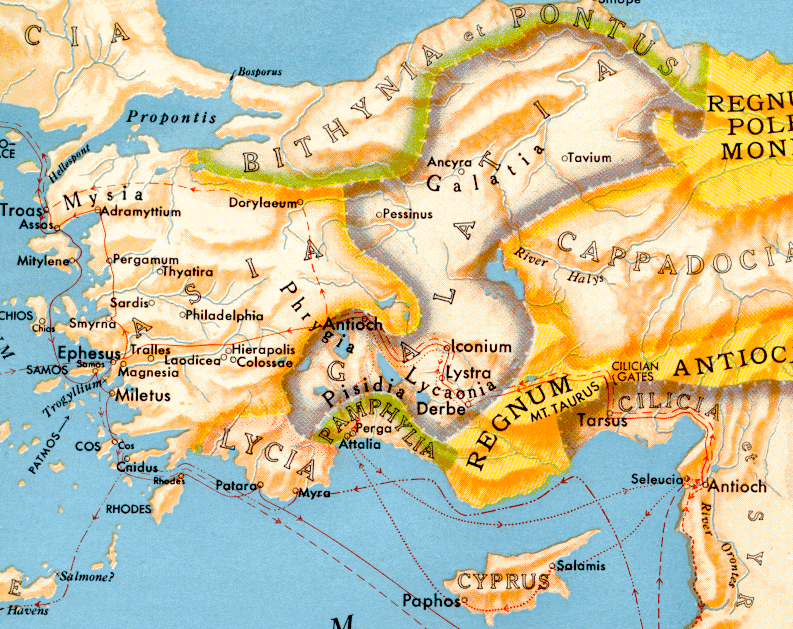
Paul wrote this letter to followers of Christ living in the southern portion of the Roman province of Galatia. The churches there were likely founded by Paul on his first missionary journey, so he had a vested interest in the spiritual well-being of their congregations. Since these relatively new churches were located in a Greek-speaking Roman province, they would have consisted primarily of Gentile converts to Christianity. This is not to say that there were no Jews in their fellowships, but it seems more likely that Paul is writing to those who had little or no understanding of Judaism Jesus’ role as the long-awaited Jewish Messiah.

Based on the content of Paul’s letter, it appears that these Gentile converts to Christianity had come under the influence of Judaizers. These were individuals of Jewish descent who expressed belief in Jesus as the Messiah, but who also demanded strict adherence to all Jewish religious laws and customs. Paul refers to these individuals throughout the letter and not in flattering terms.

But when I saw that their conduct was not in step with the truth of the gospel, I said to Cephas before them all, “If you, though a Jew, live like a Gentile and not like a Jew, how can you force the Gentiles to live like Jews?” – Galatians 2:14 ESV

The word Judaizer comes from the Greek verb Ἰουδαϊκῶς (ioudaikōs) which means “as do the Jews.” The Greek word for Jew is Ἰουδαῖος (ioudaios) and the similarity is obvious. In the verse above, Paul is setting up a contrast between the lifestyles of Gentiles and Jews but his primary point is the not-so-subtle teaching of these Judaizers who were demanding that true faith in Christ required conversion to Judaism and adherence to all its laws and customs.

Since Paul’s last visit to the region, these men had infiltrated the churches in Galatia, claiming to be Christ-followers but teaching a different brand of salvation than the one Paul had proclaimed on his first missionary journey.  These Judaizers seem to have popped up wherever Paul planted churches and their presence caused much confusion and consternation to the new converts that Paul left behind. And because of Paul’s constant travels, he was left with no other recourse than to address this issue through the use of letters.

Because of the vital importance of his letter’s content, Paul opens up with a brief defense of his apostleship. There seemed to be no shortage of individuals who were willing to question or even deny the validity of his claim to being an apostle. After all, every other apostle had been a disciple of Jesus. They had been personally chosen by Him and spent three years of their lives following and learning from Him. But Paul was a latecomer who claimed to have been appointed an apostle by the resurrected Lord. Luke records the testimony of Paul as he shared it before King Agrippa:

“I journeyed to Damascus with the authority and commission of the chief priests. At midday, O king, I saw on the way a light from heaven, brighter than the sun, that shone around me and those who journeyed with me. And when we had all fallen to the ground, I heard a voice saying to me in the Hebrew language, ‘Saul, Saul, why are you persecuting me? It is hard for you to kick against the goads.’ And I said, ‘Who are you, Lord?’ And the Lord said, ‘I am Jesus whom you are persecuting. But rise and stand upon your feet, for I have appeared to you for this purpose, to appoint you as a servant and witness to the things in which you have seen me and to those in which I will appear to you, delivering you from your people and from the Gentiles—to whom I am sending you to open their eyes, so that they may turn from darkness to light and from the power of Satan to God, that they may receive forgiveness of sins and a place among those who are sanctified by faith in me.’” – Acts 26:12-18 ESV

Paul’s fantastic “Damascus road experience” was constantly coming under question by those who opposed him. They denied he had the right to speak on behalf of Christ as one of His apostles. It’s likely they raised doubts about the veracity of Paul’s claims and peppered him with questions. They probably demanded verification and evidence that any of Paul’s “testimony” ever took place.

Their rejection of Paul’s claim of apostolic authority led them to deny his credentials and reject his right to preach a gospel that was based on faith alone in Christ alone. As Jews, they saw Paul as a traitor to his Jewish heritage and the religion of Abraham, Isaac, and Jacob. It seems likely that these men also raised suspicions about Paul’s trustworthiness by reminding the believers in Galatia about his former life as a member of the Pharisees and a persecutor of the church.

But Paul vehemently defended his apostleship in virtually every one of his letters, and this one is no exception. He opens up by describing himself as “Paul, an apostle.” The title “apostle” means “a delegate, messenger, one sent forth with orders” (“G652 – apostolos (KJV) :: Strong’s Greek Lexicon.” Blue Letter Bible. http://www.blueletterbible.org).

It was a common Greek word and was not unique to Christianity. This is why Paul quickly clarified that he was an apostle “not from men nor through men” (Galatians 1:1 ESV). In other words, he had not been sent by men or had not received his message from men. What he shared he received directly from the lips of Jesus Himself. Just a few verses later in this letter, Paul explains, “I did not receive it [the gospel] from any man, nor was I taught it, but I received it through a revelation of Jesus Christ” (Galatians 1:12 ESV).

Luke records that immediately after Paul’s conversion, Jesus appeared to a disciple named Ananias and told him to go to the house where Paul staying and lay hands on him so that he might regain his sight. Jesus told Ananias, “Go, for he is a chosen instrument of mine to carry my name before the Gentiles and kings and the children of Israel” (Acts 9:15 ESV).

There was no doubt in Paul’s mind that he was a messenger sent from Jesus. This is why he boldly claimed that he was an apostle “through Jesus Christ and God the Father, who raised him from the dead” (Galatians 1:1 ESV). The Greek preposition Paul used is dia and it can mean “by reason of” or “on account of” (“G1223 – dia (KJV):: Strong’s Greek Lexicon.” Blue Letter Bible. http://www.blueletterbible.org).

Paul was not a self-proclaimed apostle, but a God-ordained one, by virtue of his commissioning by the resurrected Jesus. His salvation had been made possible by God and the content of his message had come directly from the Son of God. He will spend the rest of this letter defending not only his apostleship but the gospel itself. Paul was less concerned about his reputation or identity than he was with the integrity of the gospel message. He wasn’t out to win friends and influence enemies. Just a few verses later Paul denies any desire to engage in a popularity contest with the Judaizers.

I’m not trying to win the approval of people, but of God. If pleasing people were my goal, I would not be Christ’s servant. – Galatians 1:10 NLT

The gospel was under attack and Paul was ready to go to war to protect it. And this deep desire to preserve the simple message of the good news compelled Paul to go on the offensive.

But there was another desire that motivated Paul. He wanted the recipients of his letter to enjoy the grace and peace of God. He wanted them to comprehend the magnitude of the remarkable gift they had received. Jesus Christ had given Himself for their sins so that they might be delivered from the present evil age. The world in which these new believers lived was hostile, anti-Christian, and intolerant of their beliefs. Many of them had already suffered persecution for having placed their faith in Christ. Some had been rejected by family members and ostracized from society. Others were under constant pressure to give up their faith or simply compromise it.

We face the same threat today. But we must remember that we have been delivered from this age. Yes, we’re still here and surrounded by increasing levels of animosity and pressure to compromise our convictions, but we are not alone. We have been given the indwelling presence of the Holy Spirit and the promise of our future eternal state.  God has promised us an eternal existence in His presence, free from the effects of sin that brought pain, sorrow, and death to the world.

Yet as we wait for that day, we are to live as children of God. The apostle John reminds us, “Dear friends, we are already God’s children, but he has not yet shown us what we will be like when Christ appears. But we do know that we will be like him, for we will see him as he really is. And all who have this eager expectation will keep themselves pure, just as he is pure” (1 John 3:2-3 NLT).

Paul’s call to his readers will be for them to remain steadfast. He wanted them to remain committed to the truth of the gospel and faithful to the call of Christ on their lives. It would not be easy, but it would be well worth the effort in the long run. Regardless of what they might be experiencing, they could rest in the fact that they were right in the middle of God’s will for their lives.

English Standard Version (ESV) The Holy Bible, English Standard Version. ESV® Permanent Text Edition® (2016). Copyright © 2001

New Living Translation (NLT) Holy Bible, New Living Translation, copyright © 1996, 2004, 2015 by Tyndale House Foundation. Used by permission of Tyndale House Publishers Inc., Carol Stream, Illinois 60188. All rights reserved.

Doing Right The Right Way.

But thanks be to God, who put into the heart of Titus the same earnest care I have for you. For he not only accepted our appeal, but being himself very earnest he is going to you of his own accord. With him we are sending the brother who is famous among all the churches for his preaching of the gospel. And not only that, but he has been appointed by the churches to travel with us as we carry out this act of grace that is being ministered by us, for the glory of the Lord himself and to show our good will. We take this course so that no one should blame us about this generous gift that is being administered by us, for we aim at what is honorable not only in the Lord’s sight but also in the sight of man. And with them we are sending our brother whom we have often tested and found earnest in many matters, but who is now more earnest than ever because of his great confidence in you. As for Titus, he is my partner and fellow worker for your benefit. And as for our brothers, they are messengers of the churches, the glory of Christ. So give proof before the churches of your love and of our boasting about you to these men. – 2 Corinthians 8:16-24 ESV

Paul was unashamedly and boldly asking the Corinthians to participate in a fund-raising effort that would be used to alleviate the suffering of the Hebrew Christians living in Judea. Ongoing persecution and the lingering effects of a recent famine had left them in dire circumstances, and Paul was doing all that he could to raise support from all the churches in Macedonia, Achaia, Asia Minor and Galatia. And the church in Corinth was to be no exception. He wants them to know the joy of participating in the gracious support of their fellow believers, even those whom they had never met. Paul was not commanding the Corinthians to give, because he did not want them to do so out of compulsion or with any sense of regret. But he was unapologetically claiming that their giving would be in keeping with the example of Christ Himself.  Paul reminds them, “though he was rich, yet for your sakes he became poor, so that by his poverty he could make you rich” (2 Corinthians 8:9b NLT).

Paul knows that he is doing the right thing. But he has a strong desire to do it in the right way. He is fully aware that everything he does is analyzed and critiqued by his enemies. And while he wasn’t one prone to wasting time worrying about what men thought about him, he did worry about the potential damage his actions might do to the name and cause of Christ. That’s why he was taking special care to handle the collection of the funds in way that was above board and free from accusation by his enemies. He was sending Titus to collect whatever gift the Corinthians were able to provide. They knew Titus and had built a solid relationship with him. But Paul was also sending another individual, “the brother who is famous among all the churches for his preaching of the gospel” (2 Corinthians 8:18 ESV). We do not know who this brother was, but evidently the Corinthians knew exactly who Paul was talking about. He was well-known and well-respected. He had a reputation for trustworthiness, and Paul indicates that he had “been appointed by the churches to travel with us as we carry out this act of grace that is being ministered by us” (2 Corinthians 8:19 ESV).

Paul wasn’t taking any changes. He knew that his efforts to raise funds for the Hebrew Christians provided a perfect opportunity for his enemies to accuse him of everything from extortion and greed to larceny and abuse of power. In the end, what Paul was most concerned about was the name of Christ. He did not want to do anything that might damage the reputation of His Savior or detract from the cause of the gospel. So he took extra precautions to ensure that his efforts were blameless and free from any hint of impropriety.

We are traveling together to guard against any criticism for the way we are handling this generous gift. We are careful to be honorable before the Lord, but we also want everyone else to see that we are honorable. – 2 Corinthians 8:20-21 NLT

It was Jesus who said, “let your light shine before others, so that they may see your good works and give glory to your Father who is in heaven” (Matthew 5:16 ESV). Peter echoed these words when he wrote, “Be careful to live properly among your unbelieving neighbors. Then even if they accuse you of doing wrong, they will see your honorable behavior, and they will give honor to God when he judges the world” (1 Peter 2:12 NLT). As believers, we are to do what is right. But it is just as important that we do right in the right way. We must always consider the outcome of our actions. It is essential that we keep in mind that our conduct is always being analyzed by the lost around us. We are ambassadors for Christ and all that we do in this life is done on His behalf. We speak and act on His part. And even our right actions, if not done in the right way, can produce the wrong results and bring harm to the name of Christ. We cannot live with the attitude, “Who cares what they think?” Our conduct has consequences. Our actions speak volumes. Our every word and deed are potential testimonies that will reflect either positively or negatively on the cause of Christ. What we do matters, but how we do it does as well.

Paul was unashamed to ask the Corinthians for money, but he was unwilling to do it in a way that might damage his reputation, hinder his ministry, or bring shame to the name of Christ. “We don’t want anyone suspecting us of taking one penny of this money for ourselves. We’re being as careful in our reputation with the public as in our reputation with God” (2 Corinthians 8:20-21 MSG). That is how we are to live. That is the attitude we must maintain. Our mission matters. So does our methodology. We must always strive to do the right thing, the godly thing, in the right way – blamelessly and above reproach.


1 Chronicles 3-4, Ephesians 5

How Will You Be Remembered?

1 Chronicles 3-4, Ephesians 5

Look carefully then how you walk, not as unwise but as wise, making the best use of the time, because the days are evil. – Ephesians 5:15-16 ESV

In chapter 3 of 1 Chronicles we are given a complete listing of the Davidic line of succession all the way up until the time when the people of Judah were taken captive to Babylon. It begins with David and ends with Zedekiah, the last king of Judah. In-between we have a list all the kings who ruled over Judah and it is a fascinating compilation of characters. At first glance, it is just a listing of hard-to-pronounce names. But after having worked our way through the books of 1 and 2 Kings, we know that each of these names represents a particular individual who either sought God during his lifetime or turned his back on God and led the nation of Judah into a lifestyle of unfaithfulness. The original Jewish readers of the book of 1 Chronicles would have been very familiar with these names and their reputations. They would have known of Solomon and his wisdom. But they would have also known about his failure to live faithfully and obediently for God, resulting in the split of the kingdom. They would have been familiar with Manasseh and how he had built altars in the house of the Lord and even burned his own son as a sacrifice to one of the many false gods he worshiped. They would have heard about Josiah, who took the throne at the age of eight, but did what was right in the eyes of the Lord. He instituted reforms and attempted to restore the nation of Judah to its covenant relationship with God. Each of the names in this listing represent a life that was marked by a reputation. They would be remembered for the things they had done and the lifestyle they had lived. It’s interesting to note that in the middle of this genealogical listing, one name is given special attention. It is the name of Jabez, an obscure individual who is remembered for having been more honorable than all his brothers. He prayed that God would bless him and increase his borders, keeping him from harm. And the text reads, “And God granted what he asked” (1 Chronicles 4:10 ESV). One man who turned to God and asked Him for blessing, protection and provision. His simple prayer illustrates a faithful, committed life lived in obedience to and dependence upon God.

What does this passage reveal about God?

Every one of the names listed in these two chapters in 1 Chronicles represents an individual who was a member of the chosen people of God. He had been born into the nation of Israel and was set apart as a worshiper of the one true God. But not all of them lived up to their calling. God had set apart the people of Israel as His own possession. He had given them His name, provided them with His law, and graciously made available His sacrificial system to ensure their forgiveness of sin and the possibility of remaining in a right relationship with Him. He had freed them from captivity in Egypt, led them through the wilderness and provided them with a land of their own. He had given them victories in battle, showed them mercy when they had sinned, exhibited patience when they were unfaithful, and offered them the promise of His blessing if they would simply obey Him. All He had asked in return was that they remain faithful to Him. He had forbidden them to worship other gods or to live like the nations all around them. He simply desired that they live distinctively and differently, illustrating to the rest of the world what it looks like to follow the one true God. Their lives were to have been a visual representation of true godliness in a world filled with false gods. God’s expectation of them was exactly what Paul communicated to the believers in Ephesus hundreds of years later. “Walk as children of light (for the fruit of light is found in all that is good and right and true), and try to discern what is pleasing to the Lord. Take no part in the unfruitful works of darkness, but instead expose them” (Ephesians 5:8-10 ESV).

What does this passage reveal about man?

God has always expected His people to live differently. He has always desired that those who are called by His name exhibit characteristics that are in keeping with His name. But the long list of names found in 1 Chronicles 3-4 contains more than a few individuals whose reputations were far from godly and who lived their lives in darkness rather than the light. Paul exhorts his readers that, as believers, their lives were not to be characterized by sexual immorality, impurity, coveting, foolish talk, crude joking, or unfruitful works of darkness. Instead, they were to try to discern what was pleasing to God. As light, they were to expose the deeds of darkness, rather than participate in them. They were to illuminate the darkness of sin all around them, not take part in it. Paul encourages them to “look carefully then how you walk, not as unwise but as wise, making the best use of the time, because the days are evil” (Ephesians 5:15 ESV). Their relationship with God was to have a direct impact on how they lived their lives. It was to influence every facet of their lives, including their relationships with their spouses. They were to walk in love and mutual submission. They were to imitate God just as a child imitates his father. They were to be known and recognized for who they were – the children of God. But the temptation for all of us is to blend into the woodwork and to become just like the world around us. We find it so easy to compromise with the world and allow our light to become absorbed by the darkness. God had called the people of Israel to be set apart from the world, but they failed to live up to that calling. He has issued that same call to those who have placed their faith in Jesus Christ. He has even given us His Holy Spirit to make it possible. But we must submit to His Spirit. We must desire to live according to His will. We must want to live as light in the midst of the darkness. Like Jabez, we must recognize our need for and dependence upon God to live our lives in this world. We must be willing to ask, “Oh, that you would bless me and enlarge my border, and that you hand might be with me, and that you would keep me from harm so that it might not bring me pain!” (1 Chronicles 4:10 ESV).

How would I apply what I’ve read to my own life?

This life is not easy. This world is a difficult place in which to live as salt and light. It is so easy to allow my reputation to become marred by a love for this world and “the unfruitful works of darkness” (Ephesians 5:11 ESV). But at the end of my life, I want my reputation to be that of a man who remained faithful to His God and who lived in dependence upon His Spirit. I want to be remembered as someone who tried to imitate God and who will be recognized as having been a child of God. I have been set apart by God for His use. I have been made His child and an heir to His kingdom. I have been given His Spirit and have access to His power. My greatest desire should be to live in such a way that i reflect my relationship as His child and reveal His light through my life.

Father, I want to be remembered as Your child. I want my reputation to be honoring to You, not me. I ask that you continue Your sanctifying work in my life, transforming me into the likeness of Your Son, so that I might mirror His character and reflect His light into the darkness that fills this world. Amen

Ken Miller
Grow Pastor & Minister to Men
kenm@christchapelbc.org

Proverbs 18b


Where To Run.

“The name of the Lord is a strong fortress; the godly run to him and are safe.” – Proverbs 18:10 NLT

Think about it. Where do you run when things get tough? Who do you turn to when facing difficult circumstances? In what or who do you put your trust or place your hope? Solomon says that the godly run to the Lord and are kept safe. But if we’re honest, most of us have a long list of other options we consider before we go to God. We have our money, friends, family members, the government, and our own resourcefulness to bail us out in time of need. But again, Solomon reminds us that “the name of the Lord is a strong fortress” (Proverbs 18:10 NLT). Isn’t it interesting that he refers to the name of the Lord. That is a common expression in the Old Testament and it speaks of God’s reputation or fame. It refers to those things He has done that have established who He is. It is another way of expressing His character. God has made a name for Himself. He has a solid reputation. He is known by His actions. And in this context, God has proven Himself to be a safe place to turn to for protection. He is faithful, powerful, gracious, consistent, and never fails in providing the protection we need and seek.

God’s reputation is impeccable and totally reliable. So the godly “run to him.” They don’t casually walk or stroll to God, they run. There is a sense of urgency and immediacy to this statement. There is no hesitation. He isn’t a second or third option or a last resort. God is the first choice of the godly person. It reminds me of the response of my children when they were young and found themselves scared or in trouble. They would make a bee-line to dear old dad. No hesitation. No reservations. When in trouble or fearful, dad’s arms were where they wanted to be. And the same thing should be true of us as believers. We should want to run to God, whole-heartedly, unashamedly, unwaveringly – because He has proven Himself trustworthy time and time again.

But as our kids grow older, they grow less willing to turn to dad when scared or in trouble. They have been trained to be self-sufficient. They learn to develop other options and plans for maintaining their safety. They develop other resources to keep them safe and secure. Dad becomes less necessary, and the thought of jumping into his arms for safety becomes slightly embarrassing. And we do the same thing with God. Over time, before we even know it, we have moved God way down the list in terms of where we turn in times of trouble. We even do our best to develop plans to stay out of trouble so we don’t have to turn to God in the first place. It’s interesting that the very next verse in Proverbs 18 says, “The rich think of their wealth as a strong defense; they imagine it to be a high wall of safety” (Proverbs 18:11 NLT). Plenty of people try to create their own safety net for life, and in our society, financial stability is seen as a high priority. Think of all the commercials you see that deal with money, savings, retirement planning and financial security. Money has become the new Messiah. It is the answer to all of life’s problems, in spite of its lousy reputation for actually being able to deliver any real security or safety. There’s nothing wrong with money, saving, planning, or preparing for the future financially. But when all is said and done, there is only one reliable place to turn for protection: The name of the Lord. His reputation is spotless.

Father, Your name or reputation is impeccable. You are completely trustworthy. You aren’t just LIKE a strong fortress, You truly ARE one. You have proven Yourself to be a secure choice in the midst of life’s difficulties time and time again. But I still look elsewhere so often. Forgive me. Help me understand that You are always the safest, most secure place to turn in times of trouble. Amen.

Ken Miller

Grow Pastor & Minister to Men
kenm@christchapelbc.org