They Had Their Work Cut Out For Them

1 The sons of Reuben the firstborn of Israel (for he was the firstborn, but because he defiled his father’s couch, his birthright was given to the sons of Joseph the son of Israel, so that he could not be enrolled as the oldest son; though Judah became strong among his brothers and a chief came from him, yet the birthright belonged to Joseph), the sons of Reuben, the firstborn of Israel: Hanoch, Pallu, Hezron, and Carmi. The sons of Joel: Shemaiah his son, Gog his son, Shimei his son, Micah his son, Reaiah his son, Baal his son, Beerah his son, whom Tiglath-pileser king of Assyria carried away into exile; he was a chief of the Reubenites. And his kinsmen by their clans, when the genealogy of their generations was recorded: the chief, Jeiel, and Zechariah, and Bela the son of Azaz, son of Shema, son of Joel, who lived in Aroer, as far as Nebo and Baal-meon. He also lived to the east as far as the entrance of the desert this side of the Euphrates, because their livestock had multiplied in the land of Gilead. 10 And in the days of Saul they waged war against the Hagrites, who fell into their hand. And they lived in their tents throughout all the region east of Gilead.

11 The sons of Gad lived over against them in the land of Bashan as far as Salecah: 12 Joel the chief, Shapham the second, Janai, and Shaphat in Bashan. 13 And their kinsmen according to their fathers’ houses: Michael, Meshullam, Sheba, Jorai, Jacan, Zia and Eber, seven. 14 These were the sons of Abihail the son of Huri, son of Jaroah, son of Gilead, son of Michael, son of Jeshishai, son of Jahdo, son of Buz. 15 Ahi the son of Abdiel, son of Guni, was chief in their fathers’ houses, 16 and they lived in Gilead, in Bashan and in its towns, and in all the pasturelands of Sharon to their limits. 17 All of these were recorded in genealogies in the days of Jotham king of Judah, and in the days of Jeroboam king of Israel.

18 The Reubenites, the Gadites, and the half-tribe of Manasseh had valiant men who carried shield and sword, and drew the bow, expert in war, 44,760, able to go to war. 19 They waged war against the Hagrites, Jetur, Naphish, and Nodab. 20 And when they prevailed over them, the Hagrites and all who were with them were given into their hands, for they cried out to God in the battle, and he granted their urgent plea because they trusted in him. 21 They carried off their livestock: 50,000 of their camels, 250,000 sheep, 2,000 donkeys, and 100,000 men alive. 22 For many fell, because the war was of God. And they lived in their place until the exile.

23 The members of the half-tribe of Manasseh lived in the land. They were very numerous from Bashan to Baal-hermon, Senir, and Mount Hermon. 24 These were the heads of their fathers’ houses: Epher, Ishi, Eliel, Azriel, Jeremiah, Hodaviah, and Jahdiel, mighty warriors, famous men, heads of their fathers’ houses.’ 25 But they broke faith with the God of their fathers, and whored after the gods of the peoples of the land, whom God had destroyed before them. 26 So the God of Israel stirred up the spirit of Pul king of Assyria, the spirit of Tiglath-pileser king of Assyria, and he took them into exile, namely, the Reubenites, the Gadites, and the half-tribe of Manasseh, and brought them to Halah, Habor, Hara, and the river Gozan, to this day. – 1 Chronicles 5:1-26 ESV
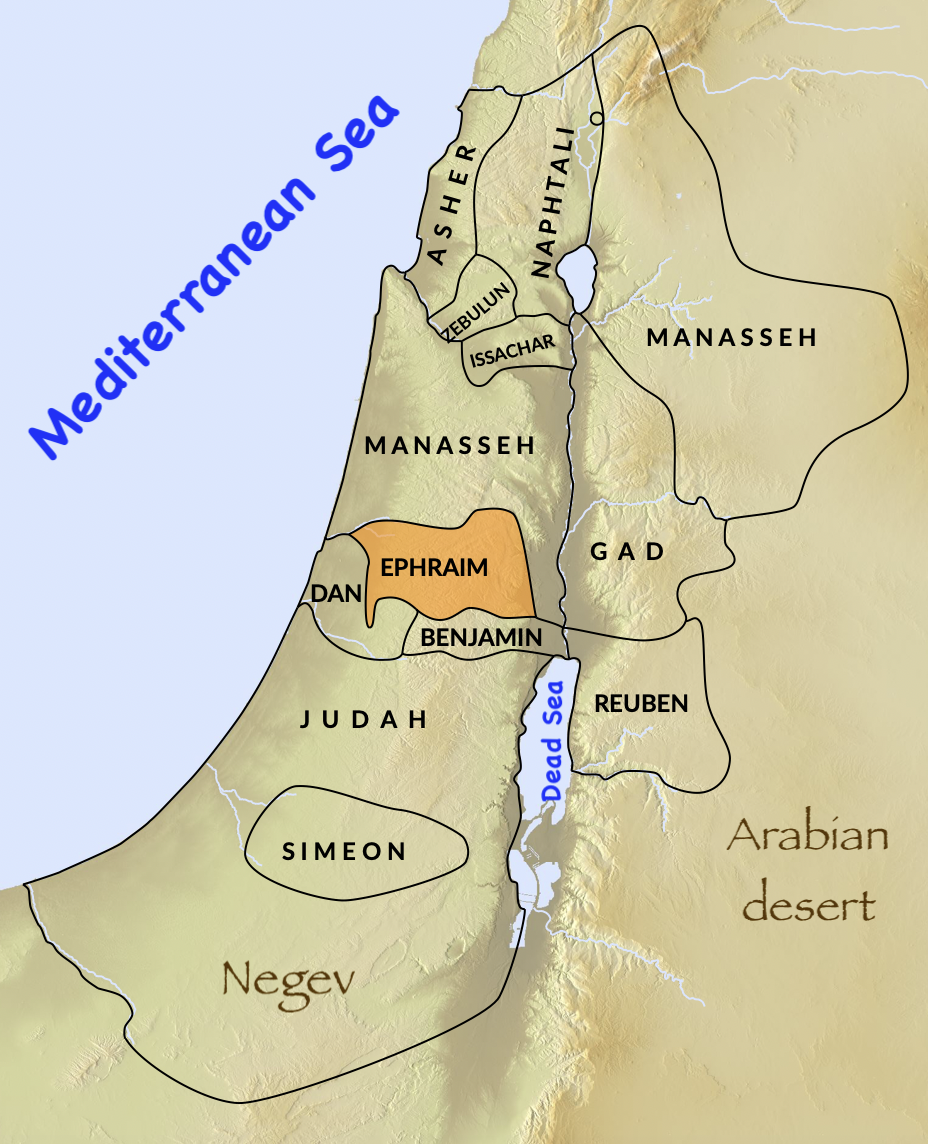
This chapter covers the descendants of the three tribes of Israel that settled on the east side of the Jordan River, outside the designated borders of the promised land. The region in which they settled is often referred to as the Transjordan. Prior to beginning the conquest and occupation of the land of Canaan as God had commanded, the tribes of Reuben, Gad, and Manasseh asked for permission to settle east of the Jordan on fertile land that was perfect for raising their many flock and herds.

The tribes of Reuben and Gad owned vast numbers of livestock. So when they saw that the lands of Jazer and Gilead were ideally suited for their flocks and herds, they came to Moses, Eleazar the priest, and the other leaders of the community. They said, “Notice the towns of Ataroth, Dibon, Jazer, Nimrah, Heshbon, Elealeh, Sibmah, Nebo, and Beon. The Lord has conquered this whole area for the community of Israel, and it is ideally suited for all our livestock. If we have found favor with you, please let us have this land as our property instead of giving us land across the Jordan River.” – Numbers 32:1-5 NLT

Angered by the self-centered nature of their request, Moses gave them an emphatic “No!” as his answer.

“The Lord was angry with Israel and made them wander in the wilderness for forty years until the entire generation that sinned in the Lord’s sight had died. But here you are, a brood of sinners, doing exactly the same thing! You are making the Lord even angrier with Israel. If you turn away from him like this and he abandons them again in the wilderness, you will be responsible for destroying this entire nation!” – Numbers 32:13-15 NLT

Moses feared that if he gave in to their request, they would get comfortable and refuse to assist their brothers in conquering the land of Canaan. This would leave the remainder of the tribes at a distinct disadvantage. However, the elders of the three tribes assured Moses that they would play their part in the conquest of Canaan.

“We simply want to build pens for our livestock and fortified towns for our wives and children. Then we will arm ourselves and lead our fellow Israelites into battle until we have brought them safely to their land. Meanwhile, our families will stay in the fortified towns we build here, so they will be safe from any attacks by the local people. We will not return to our homes until all the people of Israel have received their portions of land. But we do not claim any of the land on the other side of the Jordan. We would rather live here on the east side and accept this as our grant of land.” – Numbers 32:16-19 NLT

While these three tribes refused their inheritance in the land of promise, the chronicler included them in his genealogical listing, along with the rest of the tribes of Israel. Their decision to settle outside the borders of the promised land did not forfeit their right to be called the children of God. It also did not protect them from facing God’s judgment and being conquered by foreign invaders. They too ended up as slaves but not to the Babylonians.

…these tribes were unfaithful to the God of their ancestors. They worshiped the gods of the nations that God had destroyed. So the God of Israel caused King Pul of Assyria (also known as Tiglath-pileser) to invade the land and take away the people of Reuben, Gad, and the half-tribe of Manasseh as captives. The Assyrians exiled them to Halah, Habor, Hara, and the Gozan River, where they remain to this day. – 1 Chronicles 5:25-26 NLT

The inference is that these tribes never returned to the land of promise. Unlike the remaining tribes, the Reubenites, Gadites, and the half-tribe of Manasseh ended up becoming slaves to the Assyrians. Their defeat and deportation took place hundreds of years before the fall of the kingdom of Judah. There is no biblical record of any of the descendants of these tribes returning to the promised land. This closing statement in chapter 5 is meant to remind the returning Israelites of the unique nature of their restoration to the land by God. They were no more deserving than the other three tribes, but God had allowed them to escape their captivity in Babylon and experience the joy of returning to their homeland.

The tribe of Reuben receives special attention because of the actions of their patriarch. He is listed as “the firstborn of Israel” (1 Chronicles 5:1) because he was the oldest son of Jacob. But Reuben had forfeited his rights as the eldest son because “he dishonored his father by sleeping with one of his father’s concubines” and, as a result, “his birthright was given to the sons of his brother Joseph” (1 Chronicles 5:1 NLT). While the chronicler provides little in the way of details, it’s likely his audience was very familiar with the sordid story. The Book of Genesis fills in the gaps.

Then Jacob traveled on and camped beyond Migdal-eder. While he was living there, Reuben had intercourse with Bilhah, his father’s concubine, and Jacob soon heard about it. – Genesis 35:21-22 NLT

Even before the law was given by God, Reuben’s behavior was deemed unacceptable by the prevailing social standards. It seems that his actions were motivated by more than sexual desire. By sleeping with his father’s concubine, Reuben was issuing a direct challenge to his father’s authority and attempting to assert his right to serve as the head of the family. But his act of indiscretion brought down the wrath of his father and the loss of his rights as the firstborn son.

“Reuben, you are my firstborn, my strength,
    the child of my vigorous youth.
    You are first in rank and first in power.
But you are as unruly as a flood,
    and you will be first no longer.
For you went to bed with my wife;
    you defiled my marriage couch.” – Genesis 49:3-4 NLT

The chronicler provides the ramifications of this “curse” issued by Jacob.

For this reason, Reuben is not listed in the genealogical records as the firstborn son. The descendants of Judah became the most powerful tribe and provided a ruler for the nation, but the birthright belonged to Joseph. – 1 Chronicles 5:1-2 NLT

“…because of his sin (v. 1) God passed him over. God blessed Joseph with the double portion of the birthright. He did this by elevating Joseph’s two sons, Ephraim and Manasseh, to equality among Jacob’s other sons, Joseph’s brothers.” – Thomas L. Constable, Notes on 1 Chronicles

Despite his egregious sin, Reuben’s tribe was allowed to settle in the region of Gilead and enjoy the bounty of the land and victories over their enemies.

The tribe of Gad also settled east of the Jordan, sharing the land of Gilead with the Reubenites and expanding their territory into Bashan. They too enjoyed God’s blessings in the form of military success and agricultural abundance.

While these three tribes settled in land outside the borders of the promised land, they were not immune from conflict. They too were seen as foreign invaders by the land’s current occupants and were forced to wage war with their enemies. The chronicler points out that “There were 44,760 capable warriors in the armies of Reuben, Gad, and the half-tribe of Manasseh. They were all skilled in combat and armed with shields, swords, and bows. They waged war against the Hagrites, the Jeturites, the Naphishites, and the Nodabites” (1 Chronicles 5:18-19 NLT). Their occupation of land outside the borders of the designated inheritance did not relieve them of the need to do battle with the enemies of God. The constant conflict they faced led them to trust in the Lord for His assistance. While they could boast of having a large and well-trained army, they knew they were powerless without God’s help. 

The chronicler points out one such occasion when they turned to Yahweh for help.

They cried out to God during the battle, and he answered their prayer because they trusted in him. So the Hagrites and all their allies were defeated. – 1 Chronicles 5:20 NLT

God knew no boundaries. He was not the God of the promised land; He was the God of the people of Israel, and that included the tribes of Reuben, Gad, and Manasseh. Little did these three tribes know that they had settled in land that was always meant to be part of the inheritance God had promised Abraham.

So the Lord made a covenant with Abram that day and said, “I have given this land to your descendants, all the way from the border of Egypt to the great Euphrates River— the land now occupied by the Kenites, Kenizzites, Kadmonites, Hittites, Perizzites, Rephaites, Amorites, Canaanites, Girgashites, and Jebusites.” – Genesis 15:18-21 NLT

God later confirmed this promise with Moses.

“I will fix your boundaries from the Red Sea to the Mediterranean Sea, and from the eastern wilderness to the Euphrates River.” – Exodus 23:31 NLT

God had always planned for the land of Israel to extend all the way to the Euphrates River. But at no point in Israel’s history have their borders included this vast tract of land now occupied by Jordan, Syria, Lebanon, and Iraq. Even during the reigns of David and Solomon, when the borders of Israel expanded greatly, they never included these vast regions. But the day will come when God will complete what He began and fulfill all that He promised to Abraham.

In the meantime, the newly arrived remnant of God’s chosen people needed to be reminded that their ancestors had conquered large portions of Canaan and it was still their rightful possession. But like the tribes of Reuben, Gad, and Manasseh, they would have to trust God if they wanted to enjoy the full scope of their promised inheritance. They were back in the land but the battle was far from over. There was work to be done and they would need to rely upon God if they wanted to see their borders expanded, their homes and towns restored, and their nation renewed.

English Standard Version (ESV)
The Holy Bible, English Standard Version. ESV® Permanent Text Edition® (2016). Copyright © 2001 by Crossway Bibles, a publishing ministry of Good News Publishers.

New Living Translation (NLT)
Holy Bible, New Living Translation, copyright © 1996, 2004, 2015 by Tyndale House Foundation. Used by permission of Tyndale House Publishers Inc., Carol Stream, Illinois 60188. All rights reserved.
Our All-Knowing God Always Knows What Is Best

16 The Lord spoke to Moses, saying, 17 “These are the names of the men who shall divide the land to you for inheritance: Eleazar the priest and Joshua the son of Nun. 18 You shall take one chief from every tribe to divide the land for inheritance. 19 These are the names of the men: Of the tribe of Judah, Caleb the son of Jephunneh. 20 Of the tribe of the people of Simeon, Shemuel the son of Ammihud. 21 Of the tribe of Benjamin, Elidad the son of Chislon. 22 Of the tribe of the people of Dan a chief, Bukki the son of Jogli. 23 Of the people of Joseph: of the tribe of the people of Manasseh a chief, Hanniel the son of Ephod. 24 And of the tribe of the people of Ephraim a chief, Kemuel the son of Shiphtan. 25 Of the tribe of the people of Zebulun a chief, Elizaphan the son of Parnach. 26 Of the tribe of the people of Issachar a chief, Paltiel the son of Azzan. 27 And of the tribe of the people of Asher a chief, Ahihud the son of Shelomi. 28 Of the tribe of the people of Naphtali a chief, Pedahel the son of Ammihud.” 29 These are the men whom the Lord commanded to divide the inheritance for the people of Israel in the land of Canaan. 

1 The Lord spoke to Moses in the plains of Moab by the Jordan at Jericho, saying, “Command the people of Israel to give to the Levites some of the inheritance of their possession as cities for them to dwell in. And you shall give to the Levites pasturelands around the cities. The cities shall be theirs to dwell in, and their pasturelands shall be for their cattle and for their livestock and for all their beasts. The pasturelands of the cities, which you shall give to the Levites, shall reach from the wall of the city outward a thousand cubits all around. And you shall measure, outside the city, on the east side two thousand cubits, and on the south side two thousand cubits, and on the west side two thousand cubits, and on the north side two thousand cubits, the city being in the middle. This shall belong to them as pastureland for their cities.

“The cities that you give to the Levites shall be the six cities of refuge, where you shall permit the manslayer to flee, and in addition to them you shall give forty-two cities. All the cities that you give to the Levites shall be forty-eight, with their pasturelands. And as for the cities that you shall give from the possession of the people of Israel, from the larger tribes you shall take many, and from the smaller tribes you shall take few; each, in proportion to the inheritance that it inherits, shall give of its cities to the Levites.” Numbers 34:16-35:8 ESV

God provided Moses with the name of one man from each of the ten tribes of Israel. These men, hand-picked by God, would assist Eleazar, the high priest, and Joshua in the distribution of the land. The tribes of Gad and Reuben were not included because they had chosen to settle outside the boundaries of Canaan. These men were well-respected leaders among their respective tribes and would help to guarantee that the land was fairly apportioned and that each tribe, regardless of its size, was treated equitably and fairly. There was to be no favoritism or any form of nepotism. The larger tribes, whose numbers would be based on the recent census taken by Moses, would be allotted more extensive land allotments. But was not a guarantee that they would receive the best land. God was giving these ten men the weighty responsibility of dividing up the Israelites’ inheritance in a way that would satisfy all the parties involved, and that would not be an easy task.

The next thing on God’s agenda was to arrange for the needs of the tribe of Levi, his own tribe. He had already informed Moses that the Levites would inherit no land in Canaan. God had set apart the tribe of Levi as His special possession and had dedicated them to the care and maintenance of the Tabernacle. As a result, God promised to be their inheritance.

“Remember that the Levitical priests—that is, the whole of the tribe of Levi—will receive no allotment of land among the other tribes in Israel. Instead, the priests and Levites will eat from the special gifts given to the Lord, for that is their share. They will have no land of their own among the Israelites. The Lord himself is their special possession, just as he promised them.” – Deuteronomy 18:1-2 NLT

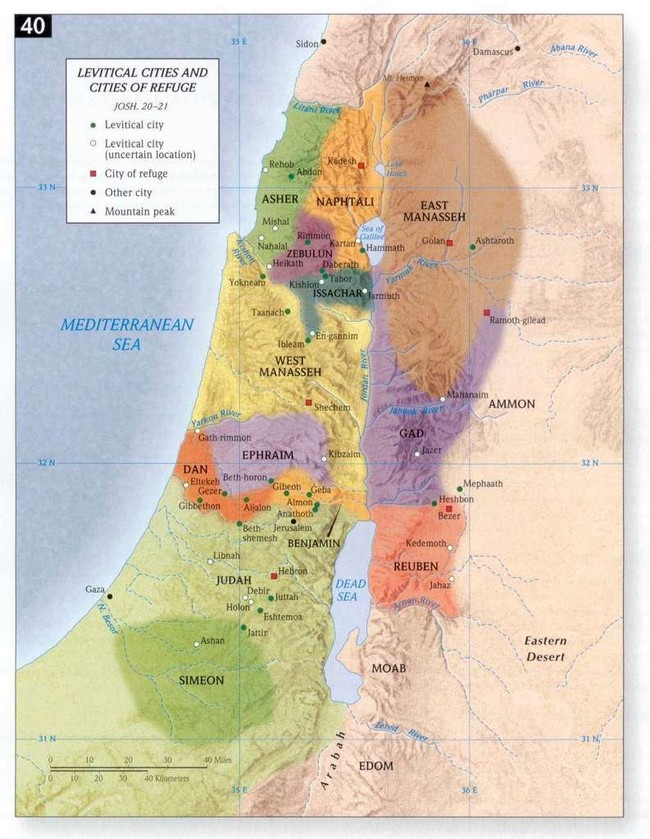
But while the Levites would be allotted no land in Canaan, they would be awarded the deeds to 48 cities located within the territories of each of the other 11 tribes (Joshua 21). Even the tribes of Gad, Reuben, and the half-tribe of Manasseh were required to provide the Levites with towns and pastureland for their flocks on the other side of the Jordan River. God had made ample accommodations for the Levites.

These Levitical cities were to be strategically located throughout the nation of Israel so that every Israelite was no more than ten miles from one of them. This helped to ensure that the people of God were never far away from a member of the Levitical priesthood, whose job was to provide instruction in the ways of God. The Levitical priests served as judges (Deuteronomy 17:8-13) and teachers of God’s law (Deuteronomy 33:10). So, it was essential that every Israelite had ready access to a Levitical town and a priest of God.

Of the 48 towns awarded to the Levites, six were to be designated as cities of refuge. These were specially sanctioned zones within the boundaries of Israel where anyone guilty of committing a non-premediated murder could seek asylum. God had already declared His ruling concerning murder (Exodus 20:13), but He had Moses present a special provision for cases involving accidental homicide.

“If someone kills another person unintentionally, without previous hostility, the slayer may flee to any of these cities to live in safety. – Deuteronomy 19:4 NLT

He even had Moses provide a potential scenario in which a city of refuge would become necessary.

“For example, suppose someone goes into the forest with a neighbor to cut wood. And suppose one of them swings an ax to chop down a tree, and the ax head flies off the handle, killing the other person. In such cases, the slayer may flee to one of the cities of refuge to live in safety.” – Deuteronomy 19:5 NLT

God knew that life would happen and that deadly accidents would be a part of the Israelites’ existence in the land. Men would be killed and justice would need to be pursued. But what He didn’t want was some form of vigilante justice running rampant through the nation. Yet God knew that the relatives of a murder victim would tend to seek revenge against the guilty party and ask questions later. The cities of refuge were intended to protect the innocent while justice was being served.

Since Israel had no professional police force, these kinds of accidents could easily turn into bloodbaths where the relatives of the victim sought to avenge their loved one’s death. So, these cities, occupied by the Levites, would provide a place where the guilty party could find solace and seek a fair judgment concerning his guilt or innocence. In His plans for the land of promise, God was leaving nothing to chance. He was creating a well-designed system for dealing with the inevitable problem of sin among His chosen people. He was going to distribute the Levitical priesthood among them to provide spiritual enlightenment and He was going to create safe havens for those who unwittingly committed even the gravest of sins. God was providing for and protecting His people.

English Standard Version (ESV) The Holy Bible, English Standard Version. ESV® Permanent Text Edition® (2016). Copyright © 2001

New Living Translation (NLT) Holy Bible, New Living Translation, copyright © 1996, 2004, 2015 by Tyndale House Foundation. Used by permission of Tyndale House Publishers Inc., Carol Stream, Illinois 60188. All rights reserved.
Refusing to Do God’s Will God’s Way

28 So Moses gave command concerning them to Eleazar the priest and to Joshua the son of Nun and to the heads of the fathers’ houses of the tribes of the people of Israel. 29 And Moses said to them, “If the people of Gad and the people of Reuben, every man who is armed to battle before the Lord, will pass with you over the Jordan and the land shall be subdued before you, then you shall give them the land of Gilead for a possession. 30 However, if they will not pass over with you armed, they shall have possessions among you in the land of Canaan.” 31 And the people of Gad and the people of Reuben answered, “What the Lord has said to your servants, we will do. 32 We will pass over armed before the Lord into the land of Canaan, and the possession of our inheritance shall remain with us beyond the Jordan.”

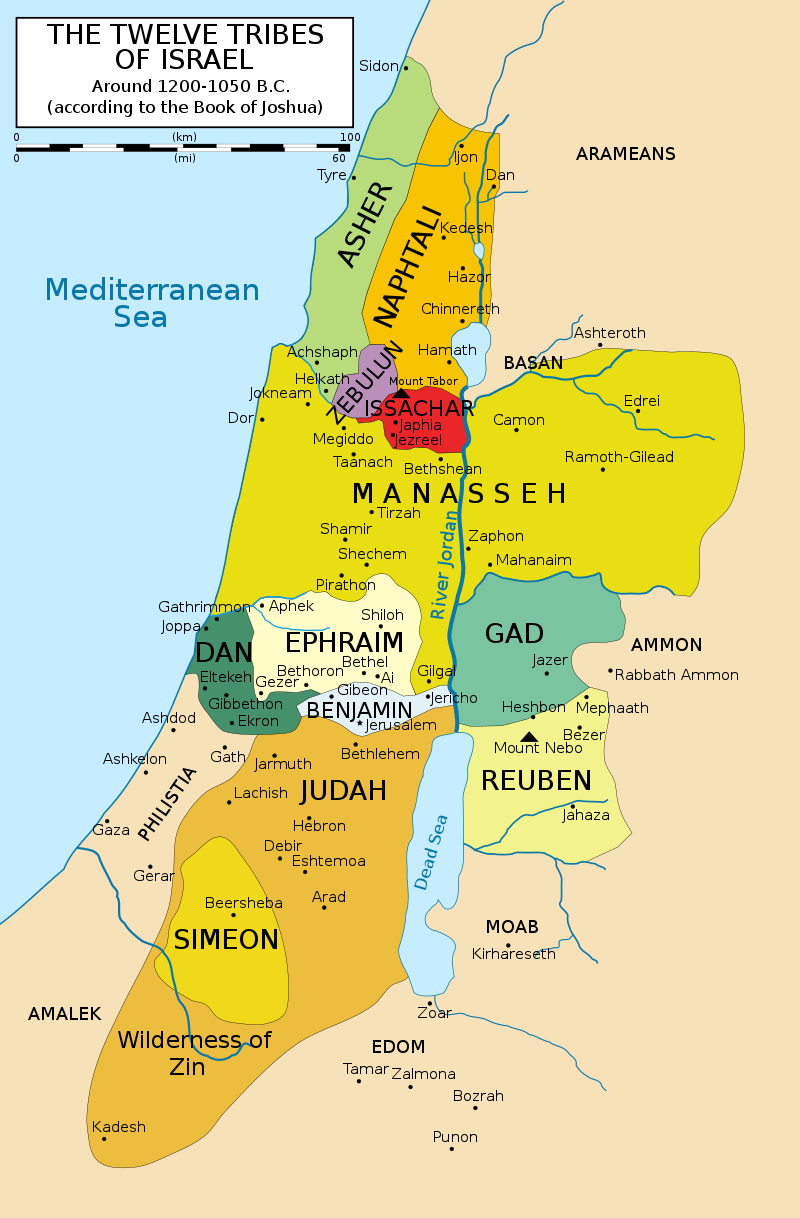
33 And Moses gave to them, to the people of Gad and to the people of Reuben and to the half-tribe of Manasseh the son of Joseph, the kingdom of Sihon king of the Amorites and the kingdom of Og king of Bashan, the land and its cities with their territories, the cities of the land throughout the country. 34 And the people of Gad built Dibon, Ataroth, Aroer, 35 Atroth-shophan, Jazer, Jogbehah, 36 Beth-nimrah and Beth-haran, fortified cities, and folds for sheep. 37 And the people of Reuben built Heshbon, Elealeh, Kiriathaim, 38 Nebo, and Baal-meon (their names were changed), and Sibmah. And they gave other names to the cities that they built. 39 And the sons of Machir the son of Manasseh went to Gilead and captured it, and dispossessed the Amorites who were in it. 40 And Moses gave Gilead to Machir the son of Manasseh, and he settled in it. 41 And Jair the son of Manasseh went and captured their villages, and called them Havvoth-jair. 42 And Nobah went and captured Kenath and its villages, and called it Nobah, after his own name.  Numbers 32:28-42 ESV

After listening to the proposal from the tribes of Gad and Reuben, Moses agreed to allow them to settle in land on the eastern side of the Jordan River, just outside the borders of Canaan. But he required them to swear an oath of fealty to the ten remaining tribes, agreeing to assist them in their conquest of the land of Canaan.

Moses then communicated the terms of the agreement to all the tribes of Israel, ensuring that everyone understood what was expected and what was to be done if those terms were not met. He wanted there to be no confusion or disagreement as to what this concession entailed for both parties.

“The men of Gad and Reuben who are armed for battle must cross the Jordan with you to fight for the Lord. If they do, give them the land of Gilead as their property when the land is conquered. But if they refuse to arm themselves and cross over with you, then they must accept land with the rest of you in the land of Canaan.” – Numbers 32:29-30 NLT

Notice that the terms of the agreement included the full participation of the Gadites and Reubenites until the land of Canaan was fully conquered. This would not be a short-term commitment that entailed a single battle or a few short weeks of military service; the two tribes were obligated to fight alongside their brothers for the foreseeable future. These two tribes were committing a sizeable number of their male population to fight for land that they would never occupy. In fact, the census Moses had taken revealed that between the tribes of Gad and Reuben, they fielded 84,230 soldiers. That comprised 14 percent of the entire Israelite force. So, their involvement in the conquest of Canaan would be vitally necessary to Israel’s success.

The two tribes committed themselves to the terms of the agreement, assuring Moses and the rest of the leaders that they would follow through on their part of the agreement.

“We are your servants, and we will do as the Lord has commanded! We will cross the Jordan into Canaan fully armed to fight for the Lord, but our property will be here on this side of the Jordan.” – Numbers 32:31-32 NLT

For however long it took, the Gadites and Reubenites would fight alongside their brothers and help ensure that every one of the ten tribes had successfully conquered and occupied their portion of the inheritance. That was a huge commitment on their part.

At this point in the narrative, it becomes clear that there was a third tribe that decided to get in on the action. This was the tribe of Manasseh, one of the two sons of Joseph.

So Moses assigned land to the tribes of Gad, Reuben, and half the tribe of Manasseh son of Joseph. He gave them the territory of King Sihon of the Amorites and the land of King Og of Bashan—the whole land with its cities and surrounding lands. – Numbers 32:33 NLT

Half of this tribe also decided to take advantage of the prime real estate on the eastern side of the Jordan River, and Moses gave them his approval.

The rest of the chapter outlines how the three tribes began their conquest of the area known as the Transjordan. Long before the Israelites crossed over the Jordan River and began to do battle with the Canaanites, the tribes of Gad, Reuben, and Manasseh were gaining invaluable fighting experience against the enemies of Israel. The battles they undertook east of the Jordan would provide them with much-needed expertise in warfare strategy. It seems likely that their fellow Israelites assisted in many of these battles, assuring that the three tribes were able to capture and occupy enough land to meet the needs of their people.

God was sovereignly preparing the entire nation to enter the land of promise and carry out His divine plan. By the time came for them to cross the Jordan and conduct their first military campaign, they would have the confidence and experience they needed to succeed.

However, it is important to note that the plan of these three tribes to occupy the Transjordan was not what God had intended. Interestingly enough, Got had promised Abraham that this very region would one day belong to his descendants.

On that day the Lord made a covenant with Abram, saying, “To your offspring I give this land, from the river of Egypt to the great river, the river Euphrates, the land of the Kenites, the Kenizzites, the Kadmonites, the Hittites, the Perizzites, the Rephaim, the Amorites, the Canaanites, the Girgashites and the Jebusites.” – Genesis 15:18-21 ESV

God had given His word that the future territory of His chosen people would be vast and encompass land all the way to the Euphrates River. But God’s instructions to Moses were to conquer the land west of the Jordan River. That was to be the initial portion of the inheritance God would give to His people. By demanding a share of the land east of the Jordan, the three tribes were demanding that God act according to their terms and timeline. While Yahweh had demanded that all 12 tribes conquer and occupy the land of the Canaanites, these three tribes decided that they knew better. It is impossible to say what would have happened had the tribes of Gad, Reuben, and Manasseh never made their request. How would the outcome have differed if they had been willing to accept God’s original terms and trusted His gracious gift of land in Canaan?

This episode in the long history of Israel’s tenure in the land of Canaan is just one more example of God’s patience with His people’s stubbornness and ongoing resistance to His will. Their decision to occupy the land east of the Jordan was not against His revealed will but it was in conflict with His timing. Had they waited and willingly obeyed God’s directive, the entire region promised to Abraham would have eventually come under the possession of Israel. But as the story continues and the roller-coaster history of the Israelites unfolds, it will become increasingly clear that disobedience and unfaithfulness will darken any hopes of God’s people enjoying all that He had planned for them. Even the battle for the land of Canaan would be hard-fought, and their attempts to expel the land’s occupants would be unsuccessful and incomplete.

The land deal east of Jordan would prove to be just one more sign of Israel’s unwillingness to trust God and walk according to His will.

English Standard Version (ESV) The Holy Bible, English Standard Version. ESV® Permanent Text Edition® (2016). Copyright © 2001

New Living Translation (NLT) Holy Bible, New Living Translation, copyright © 1996, 2004, 2015 by Tyndale House Foundation. Used by permission of Tyndale House Publishers Inc., Carol Stream, Illinois 60188. All rights reserved.

The Grass Is Always Greener…

1 Now the people of Reuben and the people of Gad had a very great number of livestock. And they saw the land of Jazer and the land of Gilead, and behold, the place was a place for livestock. So the people of Gad and the people of Reuben came and said to Moses and to Eleazar the priest and to the chiefs of the congregation, “Ataroth, Dibon, Jazer, Nimrah, Heshbon, Elealeh, Sebam, Nebo, and Beon, the land that the Lord struck down before the congregation of Israel, is a land for livestock, and your servants have livestock.” And they said, “If we have found favor in your sight, let this land be given to your servants for a possession. Do not take us across the Jordan.”

But Moses said to the people of Gad and to the people of Reuben, “Shall your brothers go to the war while you sit here? Why will you discourage the heart of the people of Israel from going over into the land that the Lord has given them? Your fathers did this, when I sent them from Kadesh-barnea to see the land. For when they went up to the Valley of Eshcol and saw the land, they discouraged the heart of the people of Israel from going into the land that the Lord had given them. 10 And the Lord‘s anger was kindled on that day, and he swore, saying, 11 ‘Surely none of the men who came up out of Egypt, from twenty years old and upward, shall see the land that I swore to give to Abraham, to Isaac, and to Jacob, because they have not wholly followed me, 12 none except Caleb the son of Jephunneh the Kenizzite and Joshua the son of Nun, for they have wholly followed the Lord.’ 13 And the Lord‘s anger was kindled against Israel, and he made them wander in the wilderness forty years, until all the generation that had done evil in the sight of the Lord was gone. 14 And behold, you have risen in your fathers’ place, a brood of sinful men, to increase still more the fierce anger of the Lord against Israel! 15 For if you turn away from following him, he will again abandon them in the wilderness, and you will destroy all this people.”

16 Then they came near to him and said, “We will build sheepfolds here for our livestock, and cities for our little ones, 17 but we will take up arms, ready to go before the people of Israel, until we have brought them to their place. And our little ones shall live in the fortified cities because of the inhabitants of the land. 18 We will not return to our homes until each of the people of Israel has gained his inheritance. 19 For we will not inherit with them on the other side of the Jordan and beyond, because our inheritance has come to us on this side of the Jordan to the east.” 20 So Moses said to them, “If you will do this, if you will take up arms to go before the Lord for the war, 21 and every armed man of you will pass over the Jordan before the Lord, until he has driven out his enemies from before him 22 and the land is subdued before the Lord; then after that you shall return and be free of obligation to the Lord and to Israel, and this land shall be your possession before the Lord. 23 But if you will not do so, behold, you have sinned against the Lord, and be sure your sin will find you out. 24 Build cities for your little ones and folds for your sheep, and do what you have promised.” 25 And the people of Gad and the people of Reuben said to Moses, “Your servants will do as my lord commands. 26 Our little ones, our wives, our livestock, and all our cattle shall remain there in the cities of Gilead, 27 but your servants will pass over, every man who is armed for war, before the Lord to battle, as my lord orders.” Numbers 32:1-27 ESV

This chapter contains one of those familiar and oft-quoted verses that are often taken out of context and hastily applied to all kinds of situations. Moses’ line, “Be sure your sin will find you out” (verse 23) has become a clichéd catchphrase that has been used as both a threat and a word of encouragement over the centuries, but few who quote it realize its original context or meaning. We’ve all heard before it, but probably never knew where it came from.

“Be sure your sins will find you out!” are words that have flowed from the lips of many a parent and usually in the direction of a disobedient child. But it may surprise you to see these familiar words in their original context. Many of us have forgotten or never known just why Moses spoke them in the first place.

As the people of God prepared to begin their conquest of the land of Canaan, Moses was approached by leaders of the tribes of Reuben and Gad. These two tribes possessed a lot of flocks and had taken note that the land east of the Jordan had abundant pastureland. Having recently defeated the Midianites in battle, this territory was up for grabs, so the tribes of Reuben and Gad asked Moses for permission to settle their tribes on the east side of the river instead of crossing over with everyone else into Canaan.

Moses was dumbstruck by their request and quickly aired his opinion. While four decades had passed since the previous generation of Israelites had refused to enter the land of Canaan, Moses couldn’t help but view this request as another sign of rebellion among the people of God. That earlier event was still a sore spot for Moses because it had resulted in the deaths of an entire generation of Israelites. To dissuade the Reubenites and Gadites from repeating the same mistake, Moses reminded them what had happened 40 years earlier.

“Why do you want to discourage the rest of the people of Israel from going across to the land the Lord has given them? Your ancestors did the same thing when I sent them from Kadesh-barnea to explore the land. After they went up to the valley of Eshcol and explored the land, they discouraged the people of Israel from entering the land the Lord was giving them. Then the Lord was very angry with them…” – Numbers 32:7-10 NLT

On that occasion, Moses had sent spies into the land of Canaan to bring back news of its fruitfulness and the military strength of its occupants. But upon their return, ten of the 12 spies gave a mixed review; the land was rich and plentiful, but its occupants were powerful and unconquerable. This negative news led the people to refuse to enter the land, choosing instead to disobey God and plot a return to Egypt. But that decision resulted in God’s wrath and punishment.

Now, 40 years later, that generation had died off and their descendants stood on the edge of Canaan, preparing to enter the land again. So, when Moses heard the request of the tribes of Reuben and Gad to settle outside the land of promise, he was naturally incensed.

“Are you trying to discourage the rest of the people of Israel from going across to the land the LORD has given them? This is what your ancestors did when I sent them from Kadesh–barnea to explore the land.” – Numbers 32:7-8 NLT

For Moses, this was déjà vu all over again. He saw their request as selfish and short-sighted, and another instance of disobedience. But the Reubenites and Gadites assured Moses that they were not abandoning the people of God or attempting to dissuade them from entering the land; they simply wanted to take advantage of better pastureland on the east side of the river. They expressed their willingness to fight alongside their brothers and assist them in conquering the land of Canaan until every tribe had gained their portion of the inheritance promised to Abraham.

To convince Moses of their intentions, they made a vow not to settle east of the Jordan until the land of Canaan was conquered and the other ten tribes had received their inheritance. This assurance calmed Moses’ fears, but he still issued his familiar, yet stern warning.

“But if you don’t do what you say, you will be sinning against GOD; you can be sure that your sin will track you down.” – Numbers 32:23 MSG

Moses expected them to keep their word and reminded them that if they failed to do so, their sin would be against God, and He would hold them accountable. Jehovah would deal with them severely if they broke their commitment.

The Book of Joshua records that, in the end, these tribes held up their end of the bargain.

The armed warriors from the tribes of Reuben, Gad, and the half-tribe of Manasseh led the Israelites across the Jordan, just as Moses had directed. These armed men—about 40,000 strong—were ready for battle, and the Lord was with them as they crossed over to the plains of Jericho. – Joshua 4:12-13

But despite their willingness to keep their word, their plan was not necessarily what God had in mind. It would appear that they were motivated by greed and self-interest and their decision to settle east of the Jordan overshadowed the promise that God had made to provide them with abundant land on the west side of the Jordan. The vacant Midianite territory was readily available and had everything they were looking for. In other words, it looked good physically and materially. So rather than wait for the land that God had promised them on the other side of the Jordan, they chose what they could see with their eyes. They allowed the temptation of immediate gratification to keep them from waiting on God’s will.

There seems to be an assumption on their part that there might not be any land on the west side of the Jordan useful for raising flocks, so they chose to settle outside the land of “promise.” Their decision, while approved by Moses, would prove to be a problem in the years to come. Physical distance from the other tribes would end up producing a spirit of misunderstanding and disunity (Joshua 22). It would also create a hole in the defensive lines of the Israelites. This region east of the Jordan was often the first to experience invasion, and Israel would lose control of it several times in its later history (2 Kings 15:29).

So what’s the point? First, there is truth to the adage, “Be sure your sins will find you out.” Sin has a way of tracking down the perpetrator and coming back to haunt them. That’s why we need to take our commitments and our sins seriously – because God certainly does. We also need to look closely at the motivation behind our decisions. We must constantly ask ourselves, “Why am I doing what I am about to do?” We must assess whether greed and selfishness lie behind our decisions, and we must determine the long-term ramifications of our decisions if they are wrongly motivated.

Moses was right; our sins will find us out. They will come back to haunt us, but so will those decisions that are motivated by instant gratification and a lack of trust in the will of God. These two tribes had been offered their share of the inheritance promised by God but they had a different plan in mind. They decided that they knew better, and God decided to let them have their way, and both decisions would have long-term ramifications.

English Standard Version (ESV) The Holy Bible, English Standard Version. ESV® Permanent Text Edition® (2016). Copyright © 2001

New Living Translation (NLT) Holy Bible, New Living Translation, copyright © 1996, 2004, 2015 by Tyndale House Foundation. Used by permission of Tyndale House Publishers Inc., Carol Stream, Illinois 60188. All rights reserved.

Part of the Plan

28 So Moses gave command concerning them to Eleazar the priest and to Joshua the son of Nun and to the heads of the fathers’ houses of the tribes of the people of Israel. 29 And Moses said to them, “If the people of Gad and the people of Reuben, every man who is armed to battle before the Lord, will pass with you over the Jordan and the land shall be subdued before you, then you shall give them the land of Gilead for a possession. 30 However, if they will not pass over with you armed, they shall have possessions among you in the land of Canaan.” 31 And the people of Gad and the people of Reuben answered, “What the Lord has said to your servants, we will do. 32 We will pass over armed before the Lord into the land of Canaan, and the possession of our inheritance shall remain with us beyond the Jordan.”

33 And Moses gave to them, to the people of Gad and to the people of Reuben and to the half-tribe of Manasseh the son of Joseph, the kingdom of Sihon king of the Amorites and the kingdom of Og king of Bashan, the land and its cities with their territories, the cities of the land throughout the country. 34 And the people of Gad built Dibon, Ataroth, Aroer, 35 Atroth-shophan, Jazer, Jogbehah, 36 Beth-nimrah and Beth-haran, fortified cities, and folds for sheep. 37 And the people of Reuben built Heshbon, Elealeh, Kiriathaim, 38 Nebo, and Baal-meon (their names were changed), and Sibmah. And they gave other names to the cities that they built. 39 And the sons of Machir the son of Manasseh went to Gilead and captured it, and dispossessed the Amorites who were in it. 40 And Moses gave Gilead to Machir the son of Manasseh, and he settled in it. 41 And Jair the son of Manasseh went and captured their villages, and called them Havvoth-jair. 42 And Nobah went and captured Kenath and its villages, and called it Nobah, after his own name.  Numbers 32:28-42 ESV

After listening to the proposal from the tribes of Gad and Reuben, Moses agreed to allow them to settle in land on the eastern side of the Jordan River, just outside the borders of Canaan. But he required them to swear an oath of fealty to the ten remaining tribes, agreeing to assist them in their conquest of the land of Canaan.

Moses then communicated the terms of the agreement to all the tribes of Israel, ensuring that everyone understood what was expected and what was to be done if those terms were not met. He wanted there to be no confusion or disagreement as to what this concession entailed for both parties.

“The men of Gad and Reuben who are armed for battle must cross the Jordan with you to fight for the Lord. If they do, give them the land of Gilead as their property when the land is conquered. But if they refuse to arm themselves and cross over with you, then they must accept land with the rest of you in the land of Canaan.” – Numbers 32:29-30 NLT

Notice that the terms of the agreement included the full participation of the Gadites and Reubenites until the land was fully conquered. This would not be a short-term commitment that entailed a single battle or a few short weeks of military service. The two tribes were obligated to fight alongside their brothers for the foreseeable future. And these two tribes were committing a sizeable number of their male population to fight for land that they would never occupy. In fact, the census Moses had taken revealed that between the tribes of Gad and Reuben, they fielded 84,230 soldiers. That comprised 14 percent of the entire Israelite force. So, their involvement in the conquest of Canaan would be vitally necessary to Israel’s success.

And the two tribes recommitted themselves to the terms of the agreement, assuring Moses and the rest of the leaders that they would follow through on their commitment.

“We are your servants, and we will do as the Lord has commanded! We will cross the Jordan into Canaan fully armed to fight for the Lord, but our property will be here on this side of the Jordan.” – Numbers 32:31-32 NLT

For however long it took, the Gadites and Reubenites would fight alongside their brothers and help ensure that every one of the ten tribes had successfully conquered and occupied their portion of the inheritance. That was a huge commitment on their part.

At this point in the narrative, it becomes clear that there was a third tribe that decided to get in on the action. This was the tribe of Manassah, one of the two sons of Joseph.

So Moses assigned land to the tribes of Gad, Reuben, and half the tribe of Manasseh son of Joseph. He gave them the territory of King Sihon of the Amorites and the land of King Og of Bashan—the whole land with its cities and surrounding lands. – Numbers 32:33 NLT

Half of this tribe also decided to take advantage of the prime real estate on the eastern side of the Jordan River. And Moses gave them his approval.

The rest of the chapter outlines how the three tribes began their conquest of the area known as the Transjordan. Long before the Israelites crossed over the Jordan and began to do battle with the Canaanites, the tribes of Gad, Reuben, and Manassah were gaining invaluable fighting experience against the enemies of Israel. The battles they undertook east of the Jordan would provide them with much-needed expertise in warfare strategy. It seems likely that their fellow Israelites assisted in many of these battles, assuring that the three tribes were able to capture and occupy enough land to meet the needs of their people.

God was sovereignly preparing the entire nation to enter the land of promise and carry out His divine plan. By the time came for them to cross the Jordan and conduct their first military campaign, they would have the confidence and experience they needed to succeed.

English Standard Version (ESV) The Holy Bible, English Standard Version. ESV® Permanent Text Edition® (2016). Copyright © 2001

New Living Translation (NLT) Holy Bible, New Living Translation, copyright © 1996, 2004, 2015 by Tyndale House Foundation. Used by permission of Tyndale House Publishers Inc., Carol Stream, Illinois 60188. All rights reserved.

Your Sin Will Find You Out

1 Now the people of Reuben and the people of Gad had a very great number of livestock. And they saw the land of Jazer and the land of Gilead, and behold, the place was a place for livestock. So the people of Gad and the people of Reuben came and said to Moses and to Eleazar the priest and to the chiefs of the congregation, “Ataroth, Dibon, Jazer, Nimrah, Heshbon, Elealeh, Sebam, Nebo, and Beon, the land that the Lord struck down before the congregation of Israel, is a land for livestock, and your servants have livestock.” And they said, “If we have found favor in your sight, let this land be given to your servants for a possession. Do not take us across the Jordan.”

But Moses said to the people of Gad and to the people of Reuben, “Shall your brothers go to the war while you sit here? Why will you discourage the heart of the people of Israel from going over into the land that the Lord has given them? Your fathers did this, when I sent them from Kadesh-barnea to see the land. For when they went up to the Valley of Eshcol and saw the land, they discouraged the heart of the people of Israel from going into the land that the Lord had given them. 10 And the Lord‘s anger was kindled on that day, and he swore, saying, 11 ‘Surely none of the men who came up out of Egypt, from twenty years old and upward, shall see the land that I swore to give to Abraham, to Isaac, and to Jacob, because they have not wholly followed me, 12 none except Caleb the son of Jephunneh the Kenizzite and Joshua the son of Nun, for they have wholly followed the Lord.’ 13 And the Lord‘s anger was kindled against Israel, and he made them wander in the wilderness forty years, until all the generation that had done evil in the sight of the Lord was gone. 14 And behold, you have risen in your fathers’ place, a brood of sinful men, to increase still more the fierce anger of the Lord against Israel! 15 For if you turn away from following him, he will again abandon them in the wilderness, and you will destroy all this people.”

16 Then they came near to him and said, “We will build sheepfolds here for our livestock, and cities for our little ones, 17 but we will take up arms, ready to go before the people of Israel, until we have brought them to their place. And our little ones shall live in the fortified cities because of the inhabitants of the land. 18 We will not return to our homes until each of the people of Israel has gained his inheritance. 19 For we will not inherit with them on the other side of the Jordan and beyond, because our inheritance has come to us on this side of the Jordan to the east.” 20 So Moses said to them, “If you will do this, if you will take up arms to go before the Lord for the war, 21 and every armed man of you will pass over the Jordan before the Lord, until he has driven out his enemies from before him 22 and the land is subdued before the Lord; then after that you shall return and be free of obligation to the Lord and to Israel, and this land shall be your possession before the Lord. 23 But if you will not do so, behold, you have sinned against the Lord, and be sure your sin will find you out. 24 Build cities for your little ones and folds for your sheep, and do what you have promised.” 25 And the people of Gad and the people of Reuben said to Moses, “Your servants will do as my lord commands. 26 Our little ones, our wives, our livestock, and all our cattle shall remain there in the cities of Gilead, 27 but your servants will pass over, every man who is armed for war, before the Lord to battle, as my lord orders.” Numbers 32:1-27 ESV

This chapter contains one of those familiar and oft-quoted verses that are often taken out of context and applied to all kinds of situations.

But if you fail to keep your word, then you will have sinned against the Lord, and you may be sure that your sin will find you out. – Numbers 32:23 NLT

That last line has been used as both a threat and a word of encouragement over the centuries, but few who quote it realize its original context or meaning. We’ve all heard before, but probably never knew where it came from.

“Be sure your sins will find you out!” are words that have flowed from the lips of many a parent and usually in the direction of a disobedient child. But it may surprise you to see these familiar words in their original context. Many of us have forgotten or never known just why Moses spoke these words in the first place.

As the people of God prepared to enter the promised land, the land of Canaan, Moses was approached by the tribes of Reuben and Gad. They possessed a lot of flocks and had taken note that the land east of the Jordan had some great pastureland. So they asked Moses for permission to settle their tribes on the east side of the river instead of crossing over with everyone else into Canaan.

Moses was flabbergasted by their request. He viewed it as a form of insurrection and compared it to the time 40 years earlier when the people of Israel had refused to enter the land. That event was a sore spot for Moses because it had resulted in the deaths of an entire generation of Israelites because they had chosen to disobey the command of God. Moses reminded the Reubenites and Gadites what had happened.

“Why do you want to discourage the rest of the people of Israel from going across to the land the Lord has given them? Your ancestors did the same thing when I sent them from Kadesh-barnea to explore the land. After they went up to the valley of Eshcol and explored the land, they discouraged the people of Israel from entering the land the Lord was giving them. Then the Lord was very angry with them…” – Numbers 32:7-10 NLT

Moses had sent spies into the land of Canaan to bring back news of its fruitfulness and the military strength of its occupants. But ten of the 12 spies had convinced the people that while the land was rich and plentiful, its occupants were undefeatable. So, the people decided to disobey God and return to Egypt. But that decision resulted in God’s wrath and punishment. Now 40 years later, that generation had died off and their descendants stood on the edge of Canaan, preparing to enter the land.

When Moses heard the request of the tribes of Reuben and Gad to settle outside the land of promise, he was incensed.

“Are you trying to discourage the rest of the people of Israel from going across to the land the LORD has given them? This is what your ancestors did when I sent them from Kadesh–barnea to explore the land.” – Numbers 32:7-8 NLT

For Moses, this was déjà vu all over again. He saw their request as selfish and short-sighted, and another instance of rebellion against God. But the Reubenites and Gadites assured Moses that they were not abandoning the people of God or attempting to persuade them from entering the land. They simply wanted to take advantage of the better pastureland on the east side of the river. They were willing to fight alongside their brothers and assist them in conquering the land of Canaan until every tribe had gained their portion of the inheritance promised to Abraham.

They made a vow not to settle east of the Jordan until that happened. This assurance calmed Moses’ fears, but he still issued a stern warning.

“But if you don’t do what you say, you will be sinning against GOD; you can be sure that your sin will track you down.” – Numbers 32:23 MSG

Moses expected them to keep their word and reminded them that if they failed to do so, their sin would be against God, not the people, and God would remember their sin. He would deal with them severely if they broke their commitment.

In the end, these tribes held up their end of the bargain.

The armed warriors from the tribes of Reuben, Gad, and the half-tribe of Manasseh led the Israelites across the Jordan, just as Moses had directed. 13 These armed men—about 40,000 strong—were ready for battle, and the Lord was with them as they crossed over to the plains of Jericho. – Joshua 4:12-13

But their plan was not necessarily God’s plan. They were motivated by greed and self-interest and their decision to settle east of the Jordan overshadowed the promise that God had made to provide them with abundant land on the west side of the Jordan.  They were attracted to what looked good physically and materially. Rather than wait for what God had promised, they chose what they could see with their own eyes.

There seems to be an assumption on their part that there might not be any land on the west side of the Jordan useful for raising flocks. So they chose to settle outside the land of “promise.” And their decision, while approved by Moses, would prove to be a problem in the years to come. Distance from the other tribes would end up producing misunderstanding and disunity (Joshua 22). It also created a hole in the defensive lines of the Israelites. This area was often the first to experience invasion, and Israel would lose control of it several times in its later history (2 Kings 15:29).

So what’s the point? First, there is truth to the adage that my sins will find me out. They will track me down and come back to haunt me. So, I need to take my commitments and my sins seriously because God does. Also, I need to look closely at the motivation behind my decisions. Why am I doing what I am about to do? Am I being motivated by selfishness and greed? What will be the long-term ramifications of my decision if it is wrongly motivated? My sins will find me out. So will my selfish decisions. And both can have a tremendous impact on the lives of others.

English Standard Version (ESV) The Holy Bible, English Standard Version. ESV® Permanent Text Edition® (2016). Copyright © 2001

New Living Translation (NLT) Holy Bible, New Living Translation, copyright © 1996, 2004, 2015 by Tyndale House Foundation. Used by permission of Tyndale House Publishers Inc., Carol Stream, Illinois 60188. All rights reserved.

The Test of a Lifetime

1 Then he commanded the steward of his house, “Fill the men’s sacks with food, as much as they can carry, and put each man’s money in the mouth of his sack, and put my cup, the silver cup, in the mouth of the sack of the youngest, with his money for the grain.” And he did as Joseph told him.

As soon as the morning was light, the men were sent away with their donkeys. They had gone only a short distance from the city. Now Joseph said to his steward, “Up, follow after the men, and when you overtake them, say to them, ‘Why have you repaid evil for good? Is it not from this that my lord drinks, and by this that he practices divination? You have done evil in doing this.’”

When he overtook them, he spoke to them these words. They said to him, “Why does my lord speak such words as these? Far be it from your servants to do such a thing! Behold, the money that we found in the mouths of our sacks we brought back to you from the land of Canaan. How then could we steal silver or gold from your lord’s house? Whichever of your servants is found with it shall die, and we also will be my lord’s servants.” 10 He said, “Let it be as you say: he who is found with it shall be my servant, and the rest of you shall be innocent.” 11 Then each man quickly lowered his sack to the ground, and each man opened his sack. 12 And he searched, beginning with the eldest and ending with the youngest. And the cup was found in Benjamin’s sack. 13 Then they tore their clothes, and every man loaded his donkey, and they returned to the city.

14 When Judah and his brothers came to Joseph’s house, he was still there. They fell before him to the ground. 15 Joseph said to them, “What deed is this that you have done? Do you not know that a man like me can indeed practice divination?” 16 And Judah said, “What shall we say to my lord? What shall we speak? Or how can we clear ourselves? God has found out the guilt of your servants; behold, we are my lord’s servants, both we and he also in whose hand the cup has been found.” 17 But he said, “Far be it from me that I should do so! Only the man in whose hand the cup was found shall be my servant. But as for you, go up in peace to your father.” – Genesis 44:1-17 ESV

After a wonderful evening of feasting on fine food in the governor’s palace, the 11 brothers of Joseph prepared to return home to Canaan. Their trip had gone far better than they could have ever imagined. They had rescued Simeon from captivity, settled the matter of the missing grain payment, received a large financial gift from the governor, feasted in his home, and were now returning with full sacks of grain. On top of that, Judah was able to keep his promise to their father that he would bring back Benjamin unharmed.

But as they were busy making preparations to leave, Joseph was devising a scheme that would dramatically alter their plans. He was still testing his brothers’ hearts to see if they had really changed or if they were the same self-serving siblings who had sold him into slavery all those years ago.

Joseph’s strategy was aimed at exposing their loyalty to Benjamin, the youngest son of Jacob. Joseph must have assumed that, in his absence, Benjamin would have become the natural heir to the coveted position of the favored son. And Joseph appears anxious to discover whether his brothers still suffered from the same jealousy and resentment that had driven them to consider taking his life.

As he had done before, Joseph instructed his steward to put money in the bag of each of the brothers. Then he took an expensive silver drinking goblet and told the steward to place it in the bag of the youngest son, Benjamin. The faithful steward did as he was instructed and the brothers loaded their donkeys and set off on their journey home. Their spirits must have been high as they set off, but the upbeat mood would quickly change when they saw a contingent of men rapidly approaching. Panic must have set in when the brothers saw that it was the governor’s steward accompanied by what was likely a group of armed men from Joseph’s private security force. This carefully designed ruse was meant to scare and intimidate the brothers, and the words spoken by the steward must have struck fear into the hearts of Reuben and his siblings. Joseph had given his steward very specific instructions.

“Chase after them and stop them. When you catch up with them, ask them, ‘Why have you repaid my kindness with such evil? Why have you stolen my master’s silver cup, which he uses to predict the future? What a wicked thing you have done!’” – Genesis 44:4-5 NLT

The brothers were indignant that the governor would accuse them of stealing. They professed their innocence and, in a moment of rashness, made an unwise vow to demonstrate their sincerity.

“If you find his cup with any one of us, let that man die. And all the rest of us, my lord, will be your slaves.” – Genesis 44:9 NLT

Moses doesn’t reveal which brother made this costly guarantee, but it was likely either Reuben or Judah. They appear to have been the two who acted as spokesmen for the group. But whoever made the statement would quickly live to regret it because when the steward ordered a search of their belongings, the silver cup was discovered in Benjamin’s grain sack. According to Joseph’s detailed instructions, the steward began the search with the oldest brother. Reuben’s stomach must have dropped when he saw the money sitting in the mouth of his sack. It was all happening again. And as the steward worked his way down the line, the same scene took place. Each brother’s sack was found to contain the money they had paid for the grain.

But it was Benjamin’s sack that held the most shocking revelation: The very silver cup the brothers had vehemently denied having taken. This was when the real test began. The brothers had been so confident of their innocence that they had pledged to put to death the one among them who had stolen the cup. In addition, they vowed to offer themselves as slaves to the governor. But the governor’s steward had wisely countered, stating, “only the one who stole the cup will be my slave. The rest of you may go free” (Genesis 44:10 NLT).

This condition put the brothers in a very awkward position. Now that the cup had been found in Benjamin’s possession, would they abandon him in order to save their own lives? The steward had clearly stated that only the guilty party would be held accountable. They would be free to leave and return to their father in Canaan, with their grain and the money that was found in their bags. That would have been quite a tempting offer.

But rather than abandon Benjamin, the brothers demonstrated their anguish over Benjamin’s fate by tearing their robes and weeping. There was no way they were going to return home without their brother. They dreaded the thought of having to tell their father, yet again, that he had lost another son. So, they packed up their donkeys and returned with the steward to the governor’s house.

When they arrived, they found the indignant governor waiting for them, and he demanded an explanation for their actions.

“What have you done?” Joseph demanded. “Don’t you know that a man like me can predict the future?” – Genesis 44:15 NLT

Joseph and his steward had agreed to bestow on the silver cup a special significance by claiming it was used by the governor to divine the future. It is unlikely that Joseph practiced divination. After all, it was God who had given Joseph the ability to interpret dreams, not a silver goblet. But by deeming the cup to have supernatural qualities, they had increased its value. The brothers were guilty of having stolen something of religious significance, which made the crime all the more scandalous.

But Judah continued to declare their innocence, begging the governor to show them mercy.

“Oh, my lord, what can we say to you? How can we explain this? How can we prove our innocence? God is punishing us for our sins. My lord, we have all returned to be your slaves—all of us, not just our brother who had your cup in his sack.” – Genesis 44:16 NLT

Not only had they returned, but they were willing to offer themselves as slaves. He and his brothers were pledging their lives as payment for Benjamin’s guilt. It had been Judah who had convinced Jacob to let Benjamin return to Egypt with them, even taking full responsibility for his well-being. He had vowed to bring him back safe and sound, and now he was indicating that he and his brothers would rather be slaves in Egypt than abandon their brother.

But the governor refused Judah’s offer, commanding the men to return to their father. Only the brother in whose sack the goblet was found would remain in Egypt as a slave. The rest were free to go. Once again, Joseph was testing the faithfulness and integrity of his brothers. Were they sincere or was their offer to join their brother as slaves a disingenuous ploy to win their brother’s freedom? Joseph was determined to find out. So, he had Benjamin arrested and gave the remaining brothers his final and rather disconcerting instructions: “as for you, go up in peace to your father” (Genesis 44:17 ESV).

Would they do it? Could they do it? Joseph’s reference to “peace” was meant to test his brothers. The Hebrew word is שָׁלוֹם (šālôm), and while it can mean “a state of tranquility and contentment,” it can also refer to “wholeness” or “completeness.” If they left, they would be returning without one of their own. There would be one of them missing. But could they go back to Jacob in “peace” knowing that they were “incomplete?” That was what Joseph aimed to find out.

English Standard Version (ESV) The Holy Bible, English Standard Version. ESV® Permanent Text Edition® (2016). Copyright © 2001 by Crossway Bibles, a publishing ministry of Good News Publishers.

New Living Translation (NLT) Holy Bible, New Living Translation, copyright © 1996, 2004, 2015 by Tyndale House Foundation. Used by permission of Tyndale House Publishers Inc., Carol Stream, Illinois 60188. All rights reserved.

New English Translation (NET)NET Bible® copyright ©1996-2017 by Biblical Studies Press, L.L.C. http://netbible.com All rights reserved.


Son, Servant, Savior

19 So they went up to the steward of Joseph’s house and spoke with him at the door of the house, 20 and said, “Oh, my lord, we came down the first time to buy food. 21 And when we came to the lodging place we opened our sacks, and there was each man’s money in the mouth of his sack, our money in full weight. So we have brought it again with us, 22 and we have brought other money down with us to buy food. We do not know who put our money in our sacks.” 23 He replied, “Peace to you, do not be afraid. Your God and the God of your father has put treasure in your sacks for you. I received your money.” Then he brought Simeon out to them. 24 And when the man had brought the men into Joseph’s house and given them water, and they had washed their feet, and when he had given their donkeys fodder, 25 they prepared the present for Joseph’s coming at noon, for they heard that they should eat bread there.

26 When Joseph came home, they brought into the house to him the present that they had with them and bowed down to him to the ground. 27 And he inquired about their welfare and said, “Is your father well, the old man of whom you spoke? Is he still alive?” 28 They said, “Your servant our father is well; he is still alive.” And they bowed their heads and prostrated themselves. 29 And he lifted up his eyes and saw his brother Benjamin, his mother’s son, and said, “Is this your youngest brother, of whom you spoke to me? God be gracious to you, my son!” 30 Then Joseph hurried out, for his compassion grew warm for his brother, and he sought a place to weep. And he entered his chamber and wept there. 31 Then he washed his face and came out. And controlling himself he said, “Serve the food.” 32 They served him by himself, and them by themselves, and the Egyptians who ate with him by themselves, because the Egyptians could not eat with the Hebrews, for that is an abomination to the Egyptians. 33 And they sat before him, the firstborn according to his birthright and the youngest according to his youth. And the men looked at one another in amazement. 34 Portions were taken to them from Joseph’s table, but Benjamin’s portion was five times as much as any of theirs. And they drank and were merry with him. – Genesis 43:19-34 ESV

The sons of Jacob returned to Egypt, accompanied by their younger brother, Benjamin. Eleven men made the arduous journey from Canaan to the land of the Pharaohs, not knowing what fate awaited them upon their arrival. They were bringing with them gifts to offer Zaphenath-paneah, the governor of Egypt, who was holding their brother, Simeon, as a hostage. They had also brought the money that had somehow made its way into the sacks of grain they had brought back to Canaan on their first trip. For some inexplicable reason, their payment for the first shipment of grain had never made it to the hands of the royal governor, so they feared they would be viewed as thieves and treated accordingly.

Upon their arrival in Egypt, the brothers headed straight to the governor’s palace, and anxiously explained their predicament to his household steward. They declared their innocence and professed ignorance as to how the money had ended up back in their possession. They wanted the steward to know that they were anxious to settle their debt and to purchase additional grain for their families back in Canaan.

Then the brothers received the first of what would be many surprises. The steward attempted to calm their fears by informing them that they owed nothing. He had received full payment for their initial order. And then, this pagan Egyptian informed them that the money found in their grain sacks must have been a gift from ‘ĕlōhîm, the God of their father Jacob. This statement must have left the brothers speechless and staring at one another in astonishment. Was the steward suggesting that the money had been a gift from God? But before they had time to ascertain just what the steward meant, they found themselves reunited with Simeon. At this point, they had to be wondering why things were going so unexpectedly well.

But the brothers had little time to discuss their good fortune because the steward ushered them into the palace and told them to clean up for lunch. Much to their ongoing surprise, they discovered that they would be dining with the governor himself. These 11 sons of Jacob would be treated to a sumptuous feast in the royal palace as the honored guests of Zaphenath-paneah, the second-most powerful man in all of Egypt. As they prepared for this high honor, they must have debated and discussed the surrealistic nature of their unexpected welcome. All of this would have been a shock to theirs systems. It was far beyond anything they could have ever imagined.

And then, just as they were beginning to wrap their minds around these unprecedented events, the governor showed up. Upon seeing this powerful dignitary enter the room, the 11 brothers bowed down before him as sign of honor and deference. And as Joseph stood looking down on his prostrate brothers, the images he had seen in his long-forgotten dreams must have flooded into his mind.

As a young boy, Joseph had been given a vision in his sleep that portrayed he and his 11 brothers as bundles of grain. But what made the dream so offensive to his brothers when he shared it with them was that their sheaves of grain all bowed down to his. And Joseph had a second dream that conveyed the same basic message. In it, he saw the sun, moon, and 11 stars all bowing down before him. And when he shared this dream with his father and brothers, it was met with the same degree of anger and animosity.

Yet, years later, Joseph stood in his royal palace with his brothers lying on their faces before him. The irony of this moment would not have escaped Joseph. His dreams had become vividly and indisputably true. But Joseph didn’t gloat. Instead, he recalled his aging father back in Canaan and inquired as to the status of his health.

“How is your father, the old man you spoke about? Is he still alive?”  Genesis 43:27 NLT

The brothers affirmed that their father was alive and well, and humbly referred to him as a servant of the governor. They followed this statement by bowing before Joseph yet a second time. This action would have been done on behalf of Jacob, illustrating his humble subservience to the Egyptian governor.

News of his father’s good health pleased Joseph greatly. He probably harbored hopes that he might live to see his father once again. But it was the presence of his younger brother, Benjamin, that drew Joseph’s attention. For the first time in years, he stood face to face with his blood brother, and the experience moved him deeply.

Joseph hurried from the room because he was overcome with emotion for his brother. He went into his private room, where he broke down and wept. – Genesis 43:30 NLT

But Joseph regained his composure and returned to the dining room where he ordered the food to be served. Then he treated his brothers to a royal feast fit for a king. To the brothers’ amazement, the governor ushered each of them to their seat, arranging them in the proper chronological order based on their birth. How would this pagan Egyptian have known who was the oldest and who was the youngest? And, once again, the brothers received an additional shock when the governor took it upon himself to serve their plates with food from his own table. Little did they know that the brother whom they had treated with disdain and contempt was showing them honor and reverence. The innocent young man whom they hold sold into slavery was now performing the task of a lowly household servant. In a sense, he was taking the food from his own table and feeding it to the “dogs” who had treated him as less than animal, throwing him into a pit and selling him for a few pieces of silver.

Without realizing it, Joseph was modeling the life of Christ, long before He left His throne in glory and took on human flesh. Jesus said of Himself, “the Son of Man came not to be served but to serve others and to give his life as a ransom for many” (Matthew 20:28 NLT). In a real sense, Joseph had “given his life” when his brothers sold him into slavery. When the Ishmaelite slave traders dragged him away in chains, he had left behind his place of honor in his father’s house. And he soon found himself living as a common slave. He ended up being falsely accused and eventually arrested for a crime he didn’t commit. But, like Jesus, Joseph had been sent to bring rescue to God’s people. But he had ended up humiliated and humbled. But the day came when he was glorified and lifted up, and invested with the power to offer help and hope to those in need. His brothers, undeserving of his grace and mercy, would receive redemption instead of retribution. They would be forgiven and their crime would be forgotten. And, in time, they would discover the true identity of their benefactor. Zaphenath-paneah would end up being their long lost brother and their unlikely savior.

English Standard Version (ESV) The Holy Bible, English Standard Version. ESV® Permanent Text Edition® (2016). Copyright © 2001 by Crossway Bibles, a publishing ministry of Good News Publishers.

New Living Translation (NLT) Holy Bible, New Living Translation, copyright © 1996, 2004, 2015 by Tyndale House Foundation. Used by permission of Tyndale House Publishers Inc., Carol Stream, Illinois 60188. All rights reserved.

New English Translation (NET)NET Bible® copyright ©1996-2017 by Biblical Studies Press, L.L.C. http://netbible.com All rights reserved.


Like Grandfather, Like Son

1 Now the famine was severe in the land. And when they had eaten the grain that they had brought from Egypt, their father said to them, “Go again, buy us a little food.” But Judah said to him, “The man solemnly warned us, saying, ‘You shall not see my face unless your brother is with you.’ If you will send our brother with us, we will go down and buy you food. But if you will not send him, we will not go down, for the man said to us, ‘You shall not see my face, unless your brother is with you.’” Israel said, “Why did you treat me so badly as to tell the man that you had another brother?” They replied, “The man questioned us carefully about ourselves and our kindred, saying, ‘Is your father still alive? Do you have another brother?’ What we told him was in answer to these questions. Could we in any way know that he would say, ‘Bring your brother down’?” And Judah said to Israel his father, “Send the boy with me, and we will arise and go, that we may live and not die, both we and you and also our little ones. I will be a pledge of his safety. From my hand you shall require him. If I do not bring him back to you and set him before you, then let me bear the blame forever. 10 If we had not delayed, we would now have returned twice.”

11 Then their father Israel said to them, “If it must be so, then do this: take some of the choice fruits of the land in your bags, and carry a present down to the man, a little balm and a little honey, gum, myrrh, pistachio nuts, and almonds. 12 Take double the money with you. Carry back with you the money that was returned in the mouth of your sacks. Perhaps it was an oversight. 13 Take also your brother, and arise, go again to the man. 14 May God Almighty grant you mercy before the man, and may he send back your other brother and Benjamin. And as for me, if I am bereaved of my children, I am bereaved.”

15 So the men took this present, and they took double the money with them, and Benjamin. They arose and went down to Egypt and stood before Joseph.

16 When Joseph saw Benjamin with them, he said to the steward of his house, “Bring the men into the house, and slaughter an animal and make ready, for the men are to dine with me at noon.” 17 The man did as Joseph told him and brought the men to Joseph’s house. 18 And the men were afraid because they were brought to Joseph’s house, and they said, “It is because of the money, which was replaced in our sacks the first time, that we are brought in, so that he may assault us and fall upon us to make us servants and seize our donkeys.” – Genesis 43:1-18 ESV

Reuben and his brothers were unable to convince their father to allow them to take Benjamin back to Egypt with them. Fearing that he might lose yet another son, Jacob refused to give in to the Egyptian governor’s demands. But eventually, their supply of grain ran out and he was left with no other option but to send his sons back to Egypt to purchase additional grain. But Judah reminded him that the trip would be a waste of time if they failed to take Benjamin with them. The Egyptian governor had made it very clear that their brother Simeon would not be released unless they returned with their younger sibling. Reuben reminded his father of Zaphenath-paneah’s conditions.

“You won’t see my face again unless your brother is with you.” – Genesis 43:3 NLT

No Benjamin, no grain. It was as simple as that. And Judah informed his father that he and his brothers were unwilling to make the long and arduous trip unless Benjamin accompanied them.

Jacob expressed his frustration that they had ever mentioned Benjamin in the first place. But Judah defended their actions by explaining that they had simply answered the governor’s questions. How were they to have known that Zaphenath-paneah would require physical proof of Benjamin’s existence?  From their viewpoint, they had no other choice but to obey the governor’s demands. If they refused, they would all end up starving to death. So, after a bit of persistent cajoling from Judah, and an assurance that he would guarantee Benjamin’s safety, Jacob finally acquiesced to the plan.

But it’s important to note that two of Jacob’s sons had made solemn pledges to protect and preserve Benjamin’s life. These men had been changed by their disconcerting encounter with Zaphenath-paneah. Reuben vowed to watch over Benjamin, even putting up the lives of his two sons as collateral.

“You may kill my two sons if I don’t bring Benjamin back to you. I’ll be responsible for him, and I promise to bring him back.” – Genesis 42:37 NLT

Even Judah, the one who had suggested that they sell Joseph to the Ephraimite traders, was now willing to put his reputation and his life on the line to guarantee Benjamin’s physical well-being.

“I personally guarantee his safety. You may hold me responsible if I don’t bring him back to you. Then let me bear the blame forever.” – Genesis 43:9 NLT

It should not be overlooked that Jacob, a man who had betrayed and defrauded his own brother, had fathered 10 sons who ended up doing the same thing to one of their own. But now, years later, Jacob watched as two of these same men pledged to protect the life of their younger sibling. While he knew nothing of what they had done to sell Joseph into slavery, he must have been encouraged by the selfless and sacrificial display of love from his two older sons.

Before sending his sons on a potentially dangerous journey into a foreign land where they would face unknown obstacles, Jacob attempted to do what he could to produce a positive outcome.

“Pack your bags with the best products of this land. Take them down to the man as gifts—balm, honey, gum, aromatic resin, pistachio nuts, and almonds. Also take double the money that was put back in your sacks, as it was probably someone’s mistake. Then take your brother, and go back to the man.” – Genesis 43:11-13 NLT

He reached into his old bag of tricks and came up with the same ploy he had used on his brother Esau (Genesis 32:13-16). If the Egyptian governor was angry that Jacob’s sons had left without paying for the grain, he hoped to assuage that anger with gifts. He doubled the amount of money they should have paid and then threw in some additional agricultural products for good measure.

But Jacob also revealed that he was ready and willing to trust God with the outcome. He was willing to purchase favor with the Egyptian governor but if that didn’t work, he would trust in the sovereignty of God.

“May God Almighty give you mercy as you go before the man, so that he will release Simeon and let Benjamin return. But if I must lose my children, so be it.” – Genesis 43:14 NLT

Jacob had come a long way. In his statement, he reflects the same sentiments that Job expressed when he learned that he had lost all his children in a freak accident.

Job arose and tore his robe and shaved his head and fell on the ground and worshiped. And he said, “Naked I came from my mother’s womb, and naked shall I return. The Lord gave, and the Lord has taken away; blessed be the name of the Lord.” – Genesis 43:20-21 ESV

While Jacob feared losing his sons, he also displays a firm belief that God was going to fulfill His covenant promises. By sending his 11 remaining sons to Egypt, he was following in the footsteps of his grandfather, Abraham. No doubt, Jacob’s father Isaac had told him the story of when Abraham had taken him to Mount Moriah with the intention of following God’s command to offer his only son as a sacrifice. And now, here was Jacob willingly sending his son to Egypt, not knowing if they would ever return. But his decision was an act of faith. If God was going to fulfill His covenant promise, Jacob would need to have sons. And so, he let them go, trusting that God would find a way to allow them to return. But little did Jacob know that God had greater plans than he could ever imagine. All of his sons would eventually return, but only so they could bring their father and families back to the land of Egypt. All in keeping with God’s sovereign and unshakeable plan.

English Standard Version (ESV) The Holy Bible, English Standard Version. ESV® Permanent Text Edition® (2016). Copyright © 2001 by Crossway Bibles, a publishing ministry of Good News Publishers.

New Living Translation (NLT) Holy Bible, New Living Translation, copyright © 1996, 2004, 2015 by Tyndale House Foundation. Used by permission of Tyndale House Publishers Inc., Carol Stream, Illinois 60188. All rights reserved.

New English Translation (NET)NET Bible® copyright ©1996-2017 by Biblical Studies Press, L.L.C. http://netbible.com All rights reserved.


I Fear God

18 On the third day Joseph said to them, “Do this and you will live, for I fear God: 19 if you are honest men, let one of your brothers remain confined where you are in custody, and let the rest go and carry grain for the famine of your households, 20 and bring your youngest brother to me. So your words will be verified, and you shall not die.” And they did so. 21 Then they said to one another, “In truth we are guilty concerning our brother, in that we saw the distress of his soul, when he begged us and we did not listen. That is why this distress has come upon us.” 22 And Reuben answered them, “Did I not tell you not to sin against the boy? But you did not listen. So now there comes a reckoning for his blood.” 23 They did not know that Joseph understood them, for there was an interpreter between them. 24 Then he turned away from them and wept. And he returned to them and spoke to them. And he took Simeon from them and bound him before their eyes. 25 And Joseph gave orders to fill their bags with grain, and to replace every man’s money in his sack, and to give them provisions for the journey. This was done for them.

26 Then they loaded their donkeys with their grain and departed. 27 And as one of them opened his sack to give his donkey fodder at the lodging place, he saw his money in the mouth of his sack. 28 He said to his brothers, “My money has been put back; here it is in the mouth of my sack!” At this their hearts failed them, and they turned trembling to one another, saying, “What is this that God has done to us?”

29 When they came to Jacob their father in the land of Canaan, they told him all that had happened to them, saying, 30 “The man, the lord of the land, spoke roughly to us and took us to be spies of the land. 31 But we said to him, ‘We are honest men; we have never been spies. 32 We are twelve brothers, sons of our father. One is no more, and the youngest is this day with our father in the land of Canaan.’ 33 Then the man, the lord of the land, said to us, ‘By this I shall know that you are honest men: leave one of your brothers with me, and take grain for the famine of your households, and go your way. 34 Bring your youngest brother to me. Then I shall know that you are not spies but honest men, and I will deliver your brother to you, and you shall trade in the land.’”

35 As they emptied their sacks, behold, every man’s bundle of money was in his sack. And when they and their father saw their bundles of money, they were afraid. 36 And Jacob their father said to them, “You have bereaved me of my children: Joseph is no more, and Simeon is no more, and now you would take Benjamin. All this has come against me.” 37 Then Reuben said to his father, “Kill my two sons if I do not bring him back to you. Put him in my hands, and I will bring him back to you.” 38 But he said, “My son shall not go down with you, for his brother is dead, and he is the only one left. If harm should happen to him on the journey that you are to make, you would bring down my gray hairs with sorrow to Sheol.” – Genesis 42:18-38 ESV

Zaphenath-paneah (Joseph), the governor of Egypt, ordered the sons of Jacob to return to the land of Canaan, with instructions to bring back their younger brother, Benjamin.  This would provide proof that they truly were innocent foreigners is search of food to survive the famine. But Joseph was seeking to ensure that they had not treated his younger brother with the same hatred and disdain as they had shown to him. He wanted to Benjamin with his own eyes. And to ensure that the men returned, Joseph help Simeon as collateral. This was likely a test of his brothers’ character as well. Would they return as ordered and spare their brother’s life or would they abandon him to his fate in Egypt?

When Reuben and his brothers heard the governor’s instructions, they were filled with guilt and regret. They couldn’t help but conclude that this was all God’s divine judgment for what they had done to their brother years earlier.

“Clearly we are being punished because of what we did to Joseph long ago. We saw his anguish when he pleaded for his life, but we wouldn’t listen. That’s why we’re in this trouble.” – Genesis 42:21 NLT

And Reuben made matters worse by reminding them that he had been the one who had tried to talk them out of their ill-fated plan to get rid of Joseph.

“Didn’t I tell you not to sin against the boy?…But you wouldn’t listen. And now we have to answer for his blood!” – Genesis 42:22 NLT

This only added to their sense of guilt and shame. They freely aired their dirty laundry right in front of the royal governor, thinking him incapable of understanding their language. But as they bickered among themselves, Joseph listened in, taking note of every word they spoke. And upon witnessing the bitter acrimony among his siblings, Joseph was moved to tears. All the memories of his past came rushing in and overwhelmed his emotions. When he regained his composure, Joseph took Simeon as a hostage and ordered the nine other brothers to take their allotment of grain and return home. Their brother would be released as soon as they returned with Benjamin.

Joseph ordered Simeon be bound with ropes as his brothers looked on helplessly. This was meant to be a vivid and painful reminder of their callous treatment of Joseph so many years before. Simeon’s fate was in their hands. And, for the second time, the brothers found themselves returning home with devastating news for their father. But this time, rather than fabricating a lie, they would be telling the truth.

Before they left for Canaan, Joseph had the grain they had purchased loaded onto their pack animals, and then provided them with provisions for their journey. He also played a rather cruel trick on them, ordering that the money they had paid for the grain be returned in full, and secretly dispersed among the bags of grain. When the brothers stopped for the night, they each discovered the money had been returned to the sacks in which the grain was contained. This made them look like thieves. And they immediately concluded that this was a punishment from the hand of God.

“What is this that God has done to us?” – Genesis 42:28 ESV

Could things get any worse? Their brother was a prisoner in Egypt. They were returning to Canaan with grain they had not paid for, making them guilty of theft. And, on top of that, they were going to have to somehow convince their father to send his youngest son back with them to Egypt. It was all a never-ending nightmare.

When they finally returned home and told their father all that had happened, Jacob was beside himself with grief and fear.

“You have bereaved me of my children: Joseph is no more, and Simeon is no more, and now you would take Benjamin. All this has come against me.” – Genesis 42:36 ESV

It was more than he could bear. His sons had returned with much-needed food, but they had left their brother behind. To make matters worse, the Egyptian governor was demanding that Jacob send his youngest son back to Egypt if he ever wanted to see Simeon again. This put Jacob in the unenviable position of risking the life of one son or possibly both. If he refused to send Benjamin, he would never see Simeon again. If he agreed to the governor’s demands and sent Benjamin, he had no guarantee that either would ever return. In fact, he had to face the very real possibility that none of his sons would return if the governor accused them of stealing the grain they brought back from Egypt.

Sensing his father’s dilemma, Reuben promised to bring back Simeon and Benjamin, offering his own two sons as sacrificial substitutes should he fail to do so. He was putting his own family line in jeopardy by doing so, but he was willing to take that risk to guarantee Simeon’s release. Jacob reluctantly agreed to send Benjamin back to Egypt, along with his 10 older brothers. This decision must have been gut-wrenching as he considered the very real possibility that he might never see any of them again.

In reading this emotionally charged story, it’s easy to overlook a statement made by Joseph that establishes the tone for all the takes place. After placing his brothers in confinement for three days, Joseph had them brought before him. Then he said something that must have caught them by surprise. After all, they believed they were standing before a powerful Egyptian dignitary who was speaking to them through an interpreter. But as the translator relayed Joseph’s message, they must have been surprised and encouraged.

Do this and you will live, for I fear God.” – Genesis 42:18 ESV

They must have looked at one another in astonishment as, out of the mouth of this Egyptian lord, came the name of ‘ĕlōhîm, the God of Israel. While hiding his true identity from his brothers, Joseph was not disguising his faith in God. He wanted his brothers to know that their fate was in God’s hands, not his own. If they would only obey his orders and return with their younger brother, all would go well. Their brother Simeon would be cared for while they were gone and be released upon their return. And it must have surprised these men to have someone whom they thought to be a pagan to encourage them to trust their own God. This Egyptian was showing more faith than they were. It seems apparent that Joseph could see God’s sovereign handiwork behind all of the events of the last three days. And, somehow, he knew that good was going to come from it all.

English Standard Version (ESV) The Holy Bible, English Standard Version. ESV® Permanent Text Edition® (2016). Copyright © 2001 by Crossway Bibles, a publishing ministry of Good News Publishers.

New Living Translation (NLT) Holy Bible, New Living Translation, copyright © 1996, 2004, 2015 by Tyndale House Foundation. Used by permission of Tyndale House Publishers Inc., Carol Stream, Illinois 60188. All rights reserved.

New English Translation (NET)NET Bible® copyright ©1996-2017 by Biblical Studies Press, L.L.C. http://netbible.com All rights reserved.